Archive for the ‘Habitat Advocacy’ Category
Wednesday, January 26th, 2011
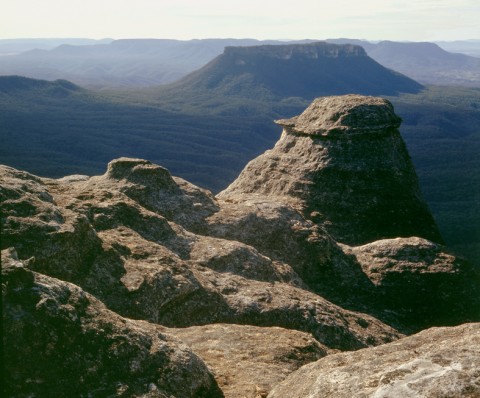 Capetree Valley looking toward Pentoney’s Crown,
Gardens of Stone NP
Blue Mountains region, New South Wales, Australia
© Photo by Henry Gold, wilderness photographer Capetree Valley looking toward Pentoney’s Crown,
Gardens of Stone NP
Blue Mountains region, New South Wales, Australia
© Photo by Henry Gold, wilderness photographer
.
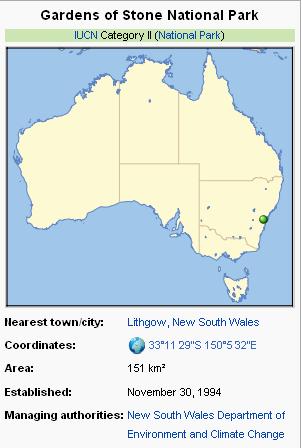
Gardens of Stone is a national park in the Australian state of New South Wales, 125 km northwest of Sydney. At 15,010 ha it is part of the Greater Blue Mountains Area World Heritage Site. [Wikipedia]
.
Yet much larger and similarly high conservation areas featuring pagodas of the Gardens of Stone and other incredibly rare natural landscapes and ecosystems lie adjacent to this national park. Similar rugged natural areas adjoining the Gardens of Stone National Park span some additional 40,000 hectares, featuring rare and magnificent sandstone escarpments, ancient natural pagodas and plateau country of the north western Blue Mountains – a natural part of the declared Greater Blue Mountains World heritage area park system.
Read below to learn more about proposed protection ‘Stage Two’ …
.
.
The Gardens of Stone Park Proposal Stage Two
.
Joint Media Release 28 November, 2005 by Colong Foundation for Wilderness, Blue Mountains Conservation Society and the Colo Committee:
.
‘Today the Colong Foundation for Wilderness, the Blue Mountains Conservation Society and the Colo Committee launched a new proposal to protect 40,000 hectares. The proposal, centred on the township of Lithgow, is called the Gardens of Stone.
“The Gardens of Stone area is scenically, environmentally and historically unparalleled. Its current low level of protection shows a scandalous disregard of this magnificent heritage. The Gardens of Stone proposal is an innovative approach that will ensure better protection of these unparalleled areas and greatly enhance tourism in the western Blue Mountains-Lithgow region”, said Dr Brian Marshal, President of the Blue Mountains Conservation Society.
“’This area for too long has been taken for granted, yet is truly a national gem. Its geology is dramatic and spectacular, its biodiverisity is fascinatingly diverse, and its cultural history is extensive. It is time at last for the overlooked to be valued and acknowledged. This is a fantastic area that truly deserves reserve status!”, said Haydn Washington, Secretary of the Colo Committee.
“The Gardens of Stone is a place worth saving that has great potential for quiet, family-based recreation. The proposed system of new Gardens of Stone parks will greatly enhance tourism opportunities in the central and western Blue Mountains around Lithgow,” said Keith Muir, director of the Colong Foundation for Wilderness.
The Gardens of Stone has iconic heritage of national significance. The park proposal aims to protect and manage:
- the first three rugged mountain passes west to the interior of Australia;
- the outstanding Aboriginal cultural sites on and around Newnes Plateau;
- the wonderful oil shale mining ruins on spectacular Airly Mesa;
- some of the highest plant diversity in the Blue Mountains; and
- some of the most beautiful and intricate sandstone formations in Australia.
.
“The plant, animal and Aboriginal heritage of the proposal reflect the landscape’s diversity. The proposal’s many rare plants, unique snowgrass-snowgum woodlands, shrub swamps and heathlands are not protected elsewhere, said Mr Washington.
“The Gardens of Stone is a geological wonderland of coloured escarpments, narrow canyons, rock arches, cave overhangs, lonely sandstone peninsulas and remnant forested sand dunes from the last ice age”, Dr Marshall said.
Mr Muir believes that “Heritage-based tourism could draw Lithgow toward a more environmentally sustainable future”.
“The proposal provides an integrated plan of action to protect, manage and interpret the area but recognises the realities of existing coalmining operations”, he added.
[Source: http://www.colongwilderness.org.au/media_releases/media_archive05.htm#MR05112800]
.
.
The following article is that by Ian Brown of the Colong Foundation for Wilderness which may be located under the heading ‘Seeing the Gardens by Ian Brown.’ It is based upon a report on the recreational and tourism potential of the Gardens of Stone Stage 2 park proposal, jointly commissioned by the Blue Mountains Conservation Society and the Colong Foundation.)
.
‘The Gardens of Stone Park Proposal Stage Two (GoS2) was launched by the Colong Foundation in 2005. It covers an area of 40 000 hectares of sandstone escarpment and plateau in the western Blue Mountains , on the western side of the existing Greater Blue Mountains World heritage area park system. The proposal takes in parts of the upper Capertee Valley , Coxs River headwaters, Turon River headwaters, Newnes Plateau and Blue Mountains western escarpment.
The objective of the GoS2 proposal is to achieve better management and protection of this area’s many important natural and cultural values. The GoS2 park system is proposed to be a mixture of state conservation area (SCA) and national park tenure. SCA status allows underground coal mining to continue.
The GoS2 area’s outstanding conservation values have been well documented in the Colong Foundation’s The Gardens of Stone Park Proposal Stage Two (October 2005). There is no doubt that the area’s scenery and heritage can also offer a diverse range of low impact recreational activities attracting significant visitor numbers, thus expanding the local tourism industry. One purpose of the current study was to show that GoS2 can deliver significant economic benefits to local communities.
.
An under-valued landscape
.
‘GoS2 offers the part of the Gardens of Stone landscape that is easily accessed and enjoyed by the general public. The nearby parks offer similar features and experiences, but they tend to be accessible to visitors with bush skills due to more rugged topography. GoS2, which is largely of more subdued terrain, brings the unique landscape of the Gardens of Stone to the majority of people.
This article will focus on the northern sectors that make up most of the proposal and which have the greatest potential for improved conservation and recreation management. These include the Airly-Genowlan mesas and Ben Bullen, Wolgan and Newnes State Forests. The other main sector, the western escarpment Crown reserves extending from Hassans Walls at Lithgow to Medlow Bath, is already well developed for recreation with increasingly effective management by local councils.
But the existing management regime over Airly-Genowlan and the state forests can best be characterised as lassez faire in relation to recreation and relatively passive in relation to conservation. The dominant land uses of coal mining and forestry have led to a devaluation of the important natural and cultural heritage values of the area in the public mind. Off-road vehicle activity, particularly trail bike riding, has been allowed by neglect to become the dominant recreation, even though most of it is illegal (unregistered vehicles, unlicensed riders and creating new tracks). This has further alienated less damaging activities such as walking, which mainly takes place on the fringes of the plateaus.
The GoS2 area has not yet been presented or promoted to the public as a great place to enjoy a remarkable landscape. Hence, the strong potential of the GoS2 area for low-impact, nature-based recreation and tourism has been under recognised and under-utilised.”
.
A better future
.
‘This can be changed by implementing the GoS2 reserve proposal and advancing a recreation and tourism plan for the area. With the right presentation and promotion, environmentally benign recreational use of GoS2 can be expanded dramatically.The natural and cultural attractions are many, varied, widespread across the area and highly appealing. Some features (e.g. Lost City , Carne Creek gorge, new Hartley mining heritage, Wolgan Valley Rail Trail) have the potential to become iconic attractions. A number of easy wildlife viewing opportunities exist and several Aboriginal heritage experiences are available.
This alternative vision presents an existing network of touring routes for motor vehicles and bicycles, accessing a range of potential camping areas, bushwalks, lookouts and cultural and wildlife experiences. Most of the proposed places of interest can be linked into a ‘Gardens of Stone Grand Tour’ which could be taken over one to three days by 4WD vehicle or mountain bike.
Although providing for these recreational activities will have some localised impacts, a number of already-disturbed sites can be utilised. Furthermore, the likely impacts are minor when compared to the existing and future impacts of the current recreational regime.
The current controversy over government plans to expand private tourism development within national parks has been taken into account, and the GoS2 plan seeks to demonstrate how low-key, low impact visitor facilities can provide the backbone of local tourism without damaging the parks with accommodation and similar developments.
The proposed network of visitor experiences would provide the basis of a whole new nature-based marketing initiative for the western Blue Mountains, promoting the Gardens of Stone as the very distinctive other side of the Blue Mountains. Just two hours from Sydney and with all the services any visitor could need in adjacent towns, GoS2 could become an iconic venue for campers, bushwalkers, tourers, cyclists and nature and heritage enthusiasts. The suite of opportunities creates a sound basis for commercial tourism enterprises such as guided tours and local off-park accommodation.
Such a future could realise significant economic opportunities through visitor expenditure, and for both specialised services (tours, eco-accommodation) and more general commercial activity in the surrounding area.”
.
Economic benefits
.
Estimating tourism to protected areas and resultant economic benefits can be difficult. Based on comparable statistics and studies from NSW, Queensland and Victoria, a conservative upper estimate for tourism to a GoS2 park with the proposed facilities is 50,000 visitors a year. This level of tourism activity has been estimated to produce substantial net benefits to the community in the order of $28M to $38M, depending on the discount rate used. These net benefits may represent a minimum value since management costs savings to Forests NSW have not been able to be included and the levels of timber production and royalties assumed may be conservatively high.The regional economic benefit produced by 50,000 visitors to GoS2 is estimated as a direct spend of around $3M to $4M. Over and above this would be expenditure on park management, and the expansion of commercial tour activities and the establishment of new visitor accommodation in nearby areas which is likely to follow.
The case for protecting the GoS2 lands for both conservation and direct community benefit is strong. It is now up to the NSW Government to do it.’
.
[Source: http://www.colongwilderness.org.au/features.htm]
.
.
But the Gardens of Stone are being destroyed by Centennial Coal
.
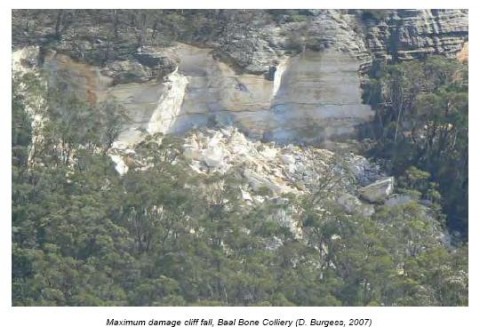
The magnificent rugged and rare geomorphology and high plateau ecosystems of the Bkue Mountains region is under serious irreverible threat of destruction by coal mining. The natural heritage values of the Gardens of Stone are being impacted by coal mining, causing bedrock subsidence, longwall mining is cracking the creekbeds and mine effluent pumping are destroying the natural groundwater acquifers. The rare geodiversity is being destroyed as Centennial Coal’s mining at Angus Place Colliery and Baal Bone Colliery cause cliff falls.
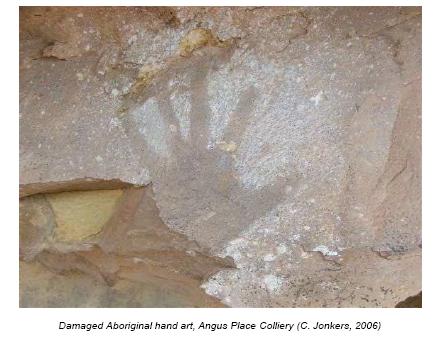
Aboriginal heritage rock art is being fractured. Creeks, rivers and upland swamps such as East Wolgan Swamp are being polluted by heavy metals from Centennial Coal’s mines. The mining is causing surface subsidence, stream flows are disappearing in Kangaroo Creek and the Wolgan River
A media release by the Colong Foundation for Wilderness 27 April 2010, highlighted current threats posed by Coal Mining:
The Gardens of Stone – a story to break the hardest heart
‘Imagine, New South Wales has its very own Bungle Bungle Range just 2½ hours from Sydney on the western edge of the Blue Mountains. It is a place of superlative scenery and tremendous botanical diversity. Today the Colong Foundation reveals that this little known wonderland called the Gardens of Stone may soon be spoiled if high impact coal mining is not curbed..“The Colong Foundation’s recent report (The impact of coal mining on the Gardens of Stone) documents how the coal industry’s environmental record is being etched and caved onto the Gardens of Stone landscape,” said Keith Muir Director of the Colong Foundation for Wilderness.
“Coal mining has:
- Caused several hundred cliff collapses in the most beautiful part of the Blue Mountains;
- Monitored these cliffs falls for 30 years, rather than acted to reduce the damage;
- Turned (nationally endangered) swamps to dust by cracking near-surface aquifers;
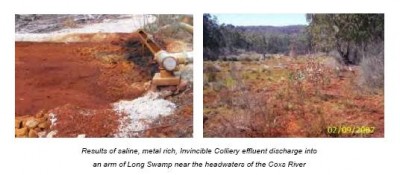
- Poisoned (nationally endangered) swamps with eco-toxic mine effluent;
- Turned the Wolgan River red;
- Claimed an environmental award for providing dirty, saline mine effluent to a power plant that shortly afterwards required a major repairs to its condensers costing tens of millions of dollars;
- Blighted the landscape with a network of roads, pipes, survey lines and power lines;
- Polluted drinking water supplies for Lithgow with nickel.
.The list goes on”, Mr Muir said.“In its monitoring reports to government the coal industry regularly understate the damage caused,” he said. “Mine operations do not work minimise environmental damage and have been largely unresponsive to environmental concerns”, he added.
“Crevasses, cliff falls and rock fractures are spoiling the sandstone beauty of the Gardens of Stone. Yet despite the intense study of mine subsidence for 30 years, the natural geomorphological processes that control cliff falls are not understood”, said Mr Muir.
“The Gardens of Stone in NSW is as spectacular as the Bungle Bungle Ranges, with a far greater floristic diversity. It must not be needlessly degraded by coal mining, as it can be preserved for everyone to enjoy,” Mr Muir said.
The damage can be curbed by reducing mining intensity. Taking such action would actually employ more miners and save this outstanding environment. One colliery has reduced its mining intensity, and a new one is about to start that will be far less damaging than previous operations. The State and Federal Governments should step in to protect from further damage the nationally endangered shrub swamps, the streams, cliffs and the sandstone pinnacles called pagodas that make up this natural wonderland”, Mr Muir said.
.
.
.
New mining prospect for Capertee
[Article from the local newspaper, The Lithgow Mercury, 20080705]
.
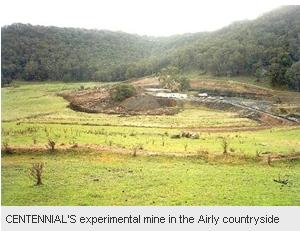
‘The Capertee community could benefit from a significant economic boost in the near future, including the direct creation of 80 jobs, if Centennial Coal’s Airly Project proceeds. Airly is an 80 million tonne coal resource located approximately 3 km north east of the Capertee township and is a project acquired by Centennial Coal in 1997 with an existing planning consent (originally granted in 1993).
There had been previous activity on the site including underground mining to obtain a bulk sample and verify mining conditions. Further work required to establish a trial mine commenced in April 1998. A Trial Mine Phase commenced in December 1998 when about 70,000 tonnes of coal was extracted over a 12 month period. An access road and other surface works were also completed.
“Lately, locals will have noticed an increase in traffic movement around Airly as a variety of visitors to the site complete studies, update data and review planning and engineering options for the site,” Centennial’s General Manager: Projects, Richard Tacon said.
“The proposed mine design would include the construction of a rail loading facility to ensure all coal from the site can be transported by rail.
“We anticipate the internal assessment process will be finalised over the next few months placing Centennial in a position to formalise a decision to proceed with the project,” Mr Tacon said.
“If Centennial does decide to proceed with this project, we will inform the community, place an utmost priority on minimising environmental impacts and strictly comply with the appropriate planning laws.”
[Source: http://www.lithgowmercury.com.au/news/local/news/general/new-mining-prospect-for-capertee/804919.aspx ]
.
.
.
Wolgan Road Project
.
On Centennial Coal’s website, under ‘Operations’ there is mention of a proposed Wolgan Road Project to be located within the Angus Place Colliery Lease. The project area is approximately 14km northwest of Lithgow, approximately 5km to the east of Mount Piper Power Station and 4km north of Wallerawang Power Station.
The area contains a small shallow coal resource between the underground workings of Wallerawang and Angus Place, with an estimated mine reserve of approximately 4.9 million tonnes, recoverable by open cut methods. Further detailed work including geotechnical investigations, environmental management assessment, community consultation and detailed mine planning would need to be completed before the requisite approvals could be sought.
[Source: http://www.centennialcoal.com.au/index.php?option=com_content&view=article&id=46&Itemid=54, accessed 20110126]
Sounds inoccuous enough, except that the Angus Place Colliery Lease is not ‘north west‘, but north of Lithgow. This places it within the Wolgan River catchment in sensitive escarpment country within the proposed Gardens of Stone NP Stage Two.
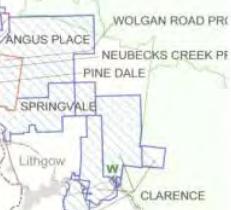 Map from the 2008 NSW Coal Industry Profile.
. Map from the 2008 NSW Coal Industry Profile.
.
.
Centennial Coal’s Environmental Claims
.
Centennial Coal on its website under the heading of ‘Environmental Management‘ claims that Centennial’s Directors and Management are:
“committed to continual improvement in environmental and community management and performance.”
Centennial recognises the importance of effectively managing the environmental impacts associated with each mine and, over the years, has developed an Environmental Policy that commits the Company to continual improvement in its environmental management and performance.
 ‘Impact of Coal Mining on the Gardens of Stone’
©2010 Colong Foundation for Wilderness ‘Impact of Coal Mining on the Gardens of Stone’
©2010 Colong Foundation for Wilderness
.
CENTENNIAL COAL’S VISION
“To conduct our business in an efficient and environmentally responsible manner, that is compatible with the expectations of our Shareholders, government, employees and the community.”
 ‘Impact of Coal Mining on the Gardens of Stone’
©2010 Colong Foundation for Wilderness
.
. ‘Impact of Coal Mining on the Gardens of Stone’
©2010 Colong Foundation for Wilderness
.
.
CENTENNIAL COAL’S GUIDING PRINCIPLES FOR ENVIRONMENTAL MANAGEMENT
.
1. Appropriate decisions are made
2. Risk management strategies are implemented based on clear science and valid data
3. Stakeholders are identified and respected
4. Environmental impacts are recognised and minimised
5. Legal obligations are known and respected
6. Environmental management is integrated into our business
7. Environmental performance is continually improved
8. Natural resources are used efficiently
9. Performance is assessed and reported
 ‘Impact of Coal Mining on the Gardens of Stone’
©2010 Colong Foundation for Wilderness
.
. ‘Impact of Coal Mining on the Gardens of Stone’
©2010 Colong Foundation for Wilderness
.
.
The Centennial Environmental Vision and logo designed to assist in raising the awareness and visibility of the group’s environmental effort, seeks to deliver two messages:
- Firstly, that the environment matters to Centennial, ie it is a fundamental part of Centennial’s business; and
- Secondly, environmental matters, or elements of the biophysical environment (air, plants and animals, ground/soil and water) that sustain society can be affected by Centennial’s activities if not appropriately managed

‘In a “branding” sense, the motto ” environment matters” is designed to be a distinctive reminder of Centennial’s aims and commitments.’
[Source: http://www.centennialcoal.com.au/index.php?option=com_content&view=article&id=4:environmental-management&catid=10:who-we-are&Itemid=12]
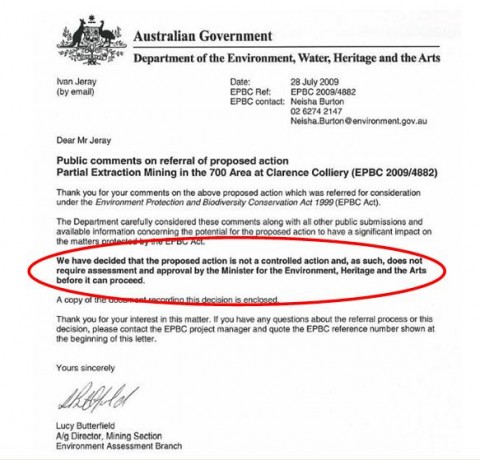
Such is this company’s calculated greenwashing
to the extent of strategic misinformation,
so long as it exploits,
scams impunity from its heavy metal contamination,
inflicts irreversible bedrock subsidence….
Somehow justified by
‘temporary jobs, temporary jobs, temporary jobs’.
.
 …an ethical investment?
.
…an ethical investment?
.
.
Further Reading:
.
[1] Gardens Of Stone Stage 2 Proposal, ^http://bluemountains.org.au/gos2.shtml
.
[2] The Impact of Coal Mining on the Gardens of Stone [ read full publication],
http://www.colongfoundation.org.au
.
[3] Gardens of Stone National Park – Draft Plan of Management [ read full publication]
http://www.environment.nsw.gov.au/resources/parks/PoMDraftGardensOfStoneNP.pdf
.
[end of article]
.
Tags: Airly mine, Airly-Genowlan mesas, Angus Place Colliery, Baal Bone Colliery, Banpu, Ben Bullen State Forest, Blue Mountains Conservation Society, Blue Mountains western escarpment, Blue Mountains World Heritage Area, Capertee Valley, Carne Creek Gorge, Centennial Coal, Centennial Coal’s Airly Project, Clarence Colliery, Coal Mining, Coalex Pty Ltd, Coalpac Pty Ltd, Colong Foundation for Wilderness, Coxs River headwaters, DECCW, Gardens of Stone, Gardens of Stone National Park, Gardens of Stone Park Proposal Stage Two, GoS2, Hassans Walls, Henry Gold, Kores Aust. Pty Ltd, Lost City, Newnes Plateau, SK Corporation Pty Ltd, Springvale Colliery, Sydney Catchment Authority, Turon River headwaters, Wolgan River pollution, Wolgan Valley Rail Trail
Posted in 07 Habitat Conservation!, Blue Mountains (AU), Threats from Mining | 1 Comment »
Add this post to Del.icio.us - Digg
Tuesday, August 31st, 2010
by Editor 20100831.

Australia’s Wattle Day Centenary (1910-2010)
is being celebrated on Wednesday 1 September 2010.
The Wattle flower is uniquely Australian. It is a plant genus ‘Acacia‘ native to Australia. That it is natural to Australia has made it ideal as a recognised and universally accepted Australian symbol. The ‘Golden Wattle‘ (Acacia pycnantha) in particular is Australia’s Floral Emblem and is an integral part of the Australian Coat of Arms.
‘The first known use of wattle as a meaningful emblem in the Australian colonies dates back to the early days of Tasmania (1838), when the wearing of silver wattle sprigs was encouraged on the occasion of an anniversary celebration of the seventeenth century European discovery of the island.’ [Wattle Day Association]
Australian Coat of Arms

‘The first granting of armorial bearings to the Commonwealth of Australia was made in 1908. A new design was granted by Royal Warrant on 19 September 1912. The branches of wattle used as an ornamental accessory to the shield, representing the badges of the six States as they were in 1912, were not mentioned in the blazon, but were depicted in the coloured illustration included in the gazettal of the Australian armorial bearings. The wattle depicted has clusters of spherical flowerheads coloured yellow and blue-grey, and green phyllodes characteristic of many species of Acacia. It is not a botanically accurate representation of Acacia pycnantha ( ‘Golden Wattle’).‘
Order of Australia
 The Order of Australia is part of the Australian system of honours and awards formally recognising achievement or meritorious service to the Australian nation. The designs of the insignia of the Order are based on an individual ball of wattle flowers. The insignia are convex golden discs adorned with beads and radiating lines, and surmounted by an enamelled crown, signifying the traditional role of the Queen as Sovereign Head of the Order. Blue ribbons decorated with golden wattle motifs complete the insignia in which the colours that predominate, blue and gold, represent the sea which surrounds Australia and the colour of the popularly accepted national flower. The blue and gold wreath surmounting the shield in the armorial bearings of Australia is described in the blazon, ‘for the Crest On a Wreath Or and Azure. . .’ The Order of Australia is part of the Australian system of honours and awards formally recognising achievement or meritorious service to the Australian nation. The designs of the insignia of the Order are based on an individual ball of wattle flowers. The insignia are convex golden discs adorned with beads and radiating lines, and surmounted by an enamelled crown, signifying the traditional role of the Queen as Sovereign Head of the Order. Blue ribbons decorated with golden wattle motifs complete the insignia in which the colours that predominate, blue and gold, represent the sea which surrounds Australia and the colour of the popularly accepted national flower. The blue and gold wreath surmounting the shield in the armorial bearings of Australia is described in the blazon, ‘for the Crest On a Wreath Or and Azure. . .’
Australians representing their country in international sporting events usually wear the national colours, green and gold, said to be based on wattle foliage and flowers.
Australian Patriotism
‘In the spirit of national and patriotic fervour generated by the approach of Federation, achieved in 1901, public interest in the Australian environment was awakened and the search for a national identity brought the desire for national symbols.
‘Archibald Campbell founded a Wattle Club in Victoria in 1899 to promote a Wattle Day demonstration every September to encourage recognition of the flower as a symbol of patriotism. In 1908 he delivered a lecture entitled ‘Wattle Time; or Yellow-haired September’ in which he stated that ‘by numbers, the Wattle is almost exclusively Australian, and should undoubtedly be our National Flower’. Interest in a national Wattle Day was revived in Sydney in 1909. Victoria and South Australia participated in 1910, and Queensland in 1912.
‘At the same time R. T. Baker, botanist and museum curator, advocated the choice of the Waratah, Telopea speciosissima as the Australian national flower. He wrote:
“The expression ‘the land of the Waratah’, applies to Australia and no other; it is Australia’s very own. In the Wattle, Australia has not a monopoly like the Waratah, for Africa has over one hundred native wattles, and it also occurs in America, East and West Indies and the Islands. Then again it is not too much to say that throughout the whole botanical world the Waratah is probably unsurpassed as a flower for decorative purposes, and it is impossible to so conventionalise it out of recognition a great feature in a national flower.”
‘In 1911 the Evening News in South Australia reported indignant local reaction to a report ‘that South Africa has commandeered the yellow flower (wattle), and proposes to use it for patriotic purposes’ and supported the choice of the Waratah as the Australian national flower, noting its tangible features of strength, beauty and colour and its symbolic qualities of health, firmness, endurance and independence.
‘The adoption of wattle as the national flower tends to be confirmed by its introduction into the design of the Australian armorial bearings on the recommendation of the Rt Hon. Andrew Fisher, Prime Minister of Australia, when the Commonwealth Armorial Ensigns and Supporters were granted by Royal Warrant on 19 September 1912.’
The conflict which existed about the choice of the Australian national flower is seen in the inclusion of both waratah and wattle flowers as decoration on the three golden trowels used by the Governor General, Lord Denman, the Prime Minister, the Rt Hon. Andrew Fisher and the Minister for Home Affairs, the Hon. King O’Malley, for the laying of foundation stones of the commencement column in Canberra, the national capital, on 12 March 1913.
[Source: Australian National Botanic Gardens, ^http://www.anbg.gov.au/emblems/aust.emblem.html ]
Australians in the Great War [1914-1918]

“During World War I, various gum leaves and golden wattle were often enclosed with letters to me on service, as reminders of things they loved at home. There comes to mind the story that the arrival of one such mail caused an offensive to occur in France, with the same dried gum leaves stirring some men from the bush to burn some, to enjoy the smell of burning gum trees. One became so excited with memories, that he discharged his rifle in glee, unfortunately Fritz was not to know that and some replied with rifle fire which induced machine guns to join in and so it spread until artillery of both sides were engaged.”
Alban Pierce – Extract from a personal letter
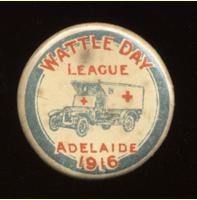
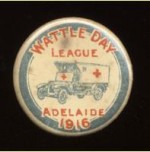 ‘Wattle Day and wattle blossom took on a new emphasis during World War I. Light-hearted celebrations and carefree gatherings were replaced by serious fundraising and a depth of patriotism never before experienced among Australians. ‘Wattle Day and wattle blossom took on a new emphasis during World War I. Light-hearted celebrations and carefree gatherings were replaced by serious fundraising and a depth of patriotism never before experienced among Australians.
The New South Wales Wattle League put all its energies into helping the war effort. Together with the Red Cross and Patriotic Fund, they combined forces to raise as much money as possible by selling sprigs of wattle on the streets of Sydney. Depots were established in various parts of the city to receive wattle sent by country supporters.’
[Source: http://wattleday.com/greatwar.php ]
National Wattle Day – why do we celebrate?
- ‘Wattle is our national floral emblem. It is a symbol that comes directly from our land;
- ‘Wattle is Australian and rerpesents us all. Unlike other national days, National Wattle Day excludes no one;
- ‘Like our people, wattle has great diversity (with nearly 1.000 species) and resilience;
- ‘Wattle welcomes in the spring and is among the first plants to regenarate after fire, reminding us of the importance of renewal as it paints our national colours across our land; and
- ‘Wattle is a unifying symbol for all Australians. There is no other symbol that says so much about us and our land, Australia.
- ‘Wattle is a symbol of Australia and Australians.
So join the celebration of National Wattle Day – 1 September 2010 in this, the centennial year.
Terry Fewtrell
President
Wattle Day Association
2010
[Source: ^http://www.wattleday.asn.au/]
Victorian Bushfires 2009
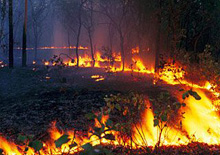 ‘This is the message of National Wattle Day. Wattles are usually the first pioneer plants to rise from the ashes of bushfires, using the extra nutrients to support their growth. They then provide protection for other seedlings growing underneath in a natural succession of the bush.’ ‘This is the message of National Wattle Day. Wattles are usually the first pioneer plants to rise from the ashes of bushfires, using the extra nutrients to support their growth. They then provide protection for other seedlings growing underneath in a natural succession of the bush.’
‘This year we suffered the tragedy of the worst bushfires experienced in our land. Many Victorians lost their lives, their property, everything they owned. Australians all over the continent rallied to their aid, donating money and goods in an unprecedented appeal. The victims are now putting their lives back on track and planning their recovery. This resilience is a characteristic of the Australian way of life. Australians have always shown a determination to succeed and rise above any disasters, showing the spirit that has made us a great nation.’
[Source: http://wattleday.com/ ]
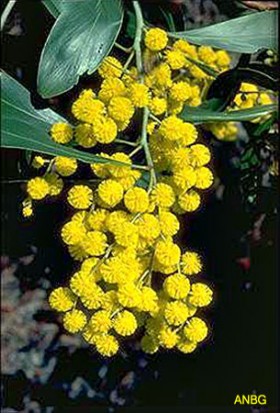 Golden Wattle (Acacia pycnantha Benth.)
©Mornington Peninsula Youth Enterprises
http://www.mpye.org.au/plants.htm
Golden Wattle (Acacia pycnantha Benth.)
©Mornington Peninsula Youth Enterprises
http://www.mpye.org.au/plants.htm
National Wattle Day – ‘It’s an honour’
Further Information:
Australian Government http://www.itsanhonour.gov.au/symbols/flora.cfm
Australians in The Great War 1914-1918 http://wattleday.com/greatwar.php
Wattle Day http://www.worldwidewattle.com/infogallery/symbolic/wattleday.php
Proclamation http://www.anbg.gov.au/emblems/wattle.day.gaz.html
Wattle Day Association http://www.wattleday.asn.au/about-wattle-day-1
Australian National Botanic Gardens http://www.anbg.gov.au/emblems/aust.emblem.html
Australia’s Wattle Day http://www.aph.gov.au/library/pubs/cib/1995-96/96cib1.htm
Nationalising Nature: Wattle Days in Australia http://www.api-network.com/jas/pdf/libby_robin.pdf
Wattle Day Research http://wattleday.com/research.php
Wattle Days from Adam Lindsay Gordon to Ginger Mick http://www.nla.gov.au/pub/nlanews/2007/aug07/story-1.pdf
Wattle Nationalism http://www.nla.gov.au/pub/nlanews/2008/jan08/story-1.pdf
National Symbols – Australia’s national floral emblem and national colours www.australiaday.org.au/toolkit/page173.asp
The Genus Acacia http://www.anbg.gov.au/acacia/index.html
Article: Introduction to Acacia http://plantnet.rbgsyd.nsw.gov.au/WattleWeb/intro.php
Article: The name Acacia retained for Australian species http://www.anbg.gov.au/cpbr/taxonomy/acacia-conserved-2004.html
The Acacia Page Association of Societies for Growing Australian Plants (ASGAP) http://asgap.org.au/acacia.html
World Wide Wattle – conservation, utilization and enjoyment of Australian Acacia species (Wattles) http://www.worldwidewattle.com/
Traditional uses of Australian acacias http://www.worldwidewattle.com/infogallery/utilisation/aboriginal.php
Article: If You Start Sneezing don’t Blame the Acacias http://asgap.org.au/APOL2007/jan07-s3.html
Aussie-Info http://www.aussie-info.com/identity/flora/wattle.php
© The Habitat Advocate Public Domain
Wednesday, August 11th, 2010
by Editor 20100811.
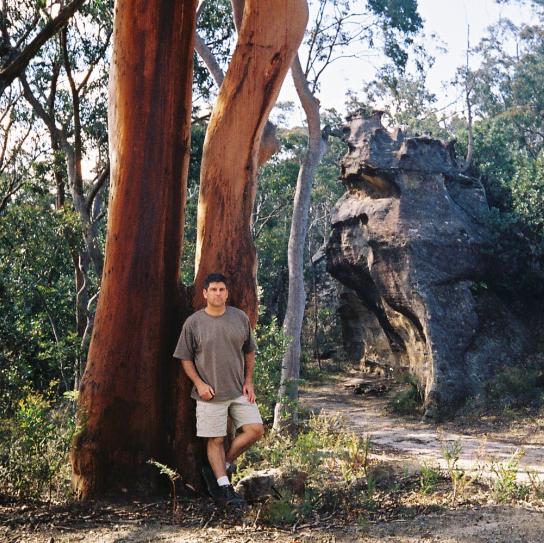
Editor at Blue Drum Waterhole along the Kings Tableland Road south toward McMahon’s Lookout, Blue Mountains, NSW, Australia, 12th November 2004.
© The Habitat Advocate Public Domain
Friday, July 2nd, 2010
by Editor 20100702.
[The information in this article has been sourced from United Nations Environment Programme World Environment Day website]
http://www.unep.org/wed/2010/english/
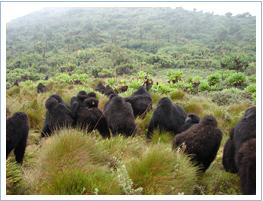
World Environment Day is a environmental event initiated by the United Nations Environment Programme (UNEP) aimed at stimulating worldwide awareness of the environment and encourages political attention and action. It is commemorated on 5th June each year and first started back in 1972.
The approach of World Environment Day is “to give a human face to environmental issues and enable people to realize not only their responsibility, but also their power to become agents for change in support of sustainable and equitable development.”
World Environment Day 2010

The theme of WED 2010 is ‘Many Species. One Planet. One Future.’
It echoes the urgent call to conserve the diversity of life on our planet and encourages all people to carefully consider the actions each person needs to take to help preserve all life on Earth..and prevent increasing extinctions.
‘A total of 17,291 species are known to be threatened with extinction – from little-known plants and insects to charismatic birds and mammals.
The reason? Human activities. With our present approach to development, we have caused the clearing of much of the original forest, drained half of the world’s wetlands, depleted three quarters of all fish stocks, and emitted enough heat-trapping gases to keep our planet warming for centuries to come. We have put our foot on the accelerator, making species extinctions occur at up to 1000 times the natural rate.
For this reason, the United Nations has declared 2010 the International Year of Biodiversity. It is an opportunity to stress the importance of biodiversity for human well-being, reflect on our achievements to safeguard it and encourage a redoubling of our efforts to reduce the rate of biodiversity loss.’
The State of the Planet’s Biodiversity

Key Findings from the Millennium Ecosystem Assessment:
- Scientists have no clear idea of how many species — from algae to blue whales — live on earth. Estimates are up to 100 million of which only about 1.8 million have been named so far. Humans are but one of those species.
- Though the exact number is impossible to determine, an unprecedented mass extinction of life on Earth is occurring. Scientists estimate that between 150 and 200 species of life become extinct every 24 hours.
- There have always been periods of extinction in the planet’s history, but this episode of species extinction is greater than anything the world has experienced for the past 65 million years – the greatest rate of extinction since the vanishing of the dinosaurs.
- This mass extinction is due, in large measure, to humankind’s unsustainable methods of production and consumption, including the destruction of habitats, expanding cities, pollution, deforestation, global warming and the introduction of “invasive species”.
- “Climate change is forecast to become one of the biggest threats to biodiversity,” the UN Convention on Biological Diversity said in a statement marking May 22.
- “Approximately 20-30 per cent of plant and animal species assessed so far are likely to be at greater risk of extinction if increases in global average temperature exceed 1.5 to 2.5 Celsius” (2.7 to 4.5 Fahrenheit), according to a report in April 2007 by the UN climate panel. Beyond that, it said ecosystems would face ever more wrenching changes.
- Biodiversity contributes directly or indirectly to many aspects of our well-being, for instance, by providing raw materials and contributing to health. More than 60 per cent of the world’s people depend directly on plants for their medicines.
- Over the past century, many people have benefited from the conversion of natural ecosystems to agricultural land and from the exploitation of biodiversity. Although many individuals benefit from activities that lead to biodiversity loss and ecosystem change, the full costs borne by society often exceed the benefits.
- World leaders agreed at a 2002 UN Summit in Johannesburg to “achieve by 2010 a significant reduction of the current rate of biodiversity loss at the global, regional and national level as a contribution to poverty alleviation and to the benefit of all life on earth.”
- To achieve greater progress towards biodiversity conservation, it will be necessary – but not sufficient – to urgently strengthen actions on the conservation and sustainable use of biodiversity and ecosystem services.
What is biodiversity?
Biodiversity (biological diversity) reflects the number, variety and variability of living organisms and how these change from one location to another and over time. Biodiversity includes diversity within species (genetic diversity), between species (species diversity), and between ecosystems (ecosystem diversity).
Biodiversity is important in all ecosystems, not only in those that are “natural” such as national parks or natural preserves, but also in those that are managed by humans, such as farms and plantations, and even urban parks. It is the basis of the multiple benefits provided by ecosystems to humans.
Where is biodiversity?
Life, and thus biodiversity, is essentially everywhere on Earth’s surface and in every drop of its bodies of water. The best known dimension of biodiversity is the classification of animals and plants into species, which mainly focuses on animals observable to the naked eye.
What is the link between biodiversity and ecosystem services?
Ecosystem services are the benefits obtained by people from ecosystems.
These include:
- provisioning services such as food, clean water, timber, fiber, and genetic resources;
- regulating services such as the regulation of climate, floods, disease, water quality, and pollination;
- cultural services such as recreational, aesthetic, and spiritual benefits;
- supporting services such as soil formation, and nutrient cycling.
Biodiversity plays an important role in the way ecosystems function and in the services they provide. The local loss of an essential species can disrupt ecosystem services for a long time. Changes in the interactions between species can also lead to negative impacts on ecosystem processes.
The preservation of resident species can enhance resistance of a wide range of natural and semi-natural ecosystems against invasive species.
There have been worldwide declines in the diversity of pollinating insects that are essential for the reproduction of many plants.
Biodiversity, in particular the diversity of plant forms and the distribution of landscape patches, influences climate at local, regional, and global scales. Some components of biodiversity affect carbon sequestration and thus are important in fighting climate change.
The ecosystem’s ability to control pests is strongly dependent on biodiversity and benefits food security, rural households, and national incomes of many countries.
The microbes living in the sea contribute to pollution control by removing toxic substances from the environment, but how species diversity influences this removal is not well understood.
Why is biodiversity loss a concern?
Biodiversity is essential for the benefits the ecosystems can provide to humans and hence for human well-being. Its role goes beyond ensuring the availability of raw materials to include security, resiliency, social relations, health, and freedoms and choices.
Biodiversity loss has direct and indirect negative effects on several factors:
- Food security: The availability of biodiversity is often a “safety net” that increases food security and the adaptability of some local communities to external economic and ecological disturbances.
- Vulnerability: Many communities have experienced more natural disasters over the past several decades. For example, because of the loss of mangroves and coral reefs, which are excellent natural buffers against floods and storms, coastal communities have increasingly suffered from severe floods.
- Health: A balanced diet depends on the availability of a wide variety of foods, which in turn depends on the conservation of biodiversity.
- Energy security: Wood fuel provides more than half the energy used in developing countries. Shortage of wood fuel occurs in areas with high population density without access to alternative and affordable energy sources. In such areas, people are vulnerable to illness and malnutrition because of the lack of resources to heat homes, cook food, and boil water.
- Clean water: The continued loss of forests and the destruction of watersheds reduce the quality and availability of water supplied to household use and agriculture. In the case of New York City, protecting the ecosystem to ensure continued provision of clean drinking water was far more cost-effective than building and operating a water filtration plant.
- Social relations: Many cultures attach spiritual, aesthetic, recreational, and religious values to ecosystems or their components.
- Freedom of choice: Loss of biodiversity, which is sometimes irreversible, often means a loss of choices. The notion of having choices available irrespective of whether any of them will be actually picked is an essential constituent of the freedom aspect of well-being.
- Basic materials: Biodiversity provides various goods – such as plants and animals – that individuals need in order to earn an income and secure sustainable livelihoods. In addition to agriculture, biodiversity contributes to a range of other sectors, including ecotourism, pharmaceuticals, cosmetics, and fisheries.
What competing goals can affect biodiversity?
When humans modify an ecosystem to improve one of the services it provides this generally results in changes to other ecosystem services. For example, actions to increase food production can lead to reduced water availability for other uses, and degraded water quality. In the long term, the value of services lost may greatly exceed the short-term economic benefits that are gained from transforming ecosystems.
What is the value of biodiversity for human well-being?
Unlike goods bought and sold on markets, many ecosystem services do not have markets or readily observable prices. This means that the importance of biodiversity and natural processes in producing ecosystem services that people depend on is not reflected in financial markets.
Degradation of ecosystem services could be significantly slowed or reversed if their full economic value were taken into account in decision-making.
A way of assigning monetary values to them is to rely on non-market valuation methods. These methods have been applied to clean drinking water, recreation, or commercially harvested species.
Non-market values can be either the value to society from the active use of the asset or a “non-use” value, which reflects the value of an asset beyond any use, such as the value of existence of species.
The private use value of biodiversity and ecosystem services by individuals will typically ignore the “external” benefits of conservation to society in general. For example, a farmer may benefit from intensive use of the land but generally does not bear all the consequences caused by leaching of excess nutrients and pesticides into ground or surface water, or the consequences of loss of habitat for native species.
Intensive use of ecosystems often produces the greatest short-term advantage, but excessive and unsustainable use can lead to losses in the long term. A country could cut its forests and deplete its fisheries, and this would show only as a positive gain to GDP, despite the loss of capital assets, because of the income generated by the sale of those products.
Moreover, many ecosystem services, such as groundwater, are available freely to those who use them and so again their degradation is not reflected by standard economic valuation methods.
How are the impacts of biodiversity loss distributed geographically?
The changes in ecosystems are harming many of the world’s poorest people, who are less able to adjust to these changes and who are affected by even greater poverty, as they have limited access to substitutes or alternatives. For example, poor farmers often cannot afford using modern methods for services previously provided by biodiversity.
Poor people have historically disproportionately lost access to biological products and ecosystem services as demand for those services has grown. The transfer in ownership of ecosystem resources often excludes local communities, and the products of their exploitation are not destined for the local market.
What are the current trends in biodiversity?
For all aspects of biodiversity, current pace of change and loss is hundreds of times faster than previously in recorded history and the pace shows no indication of slowing down.
Virtually all of Earth’s ecosystems have been dramatically transformed through human actions, for example, 35% of mangrove and 20% of coral reef areas have been lost. Across the world, ecosystems have continued to be converted for agricultural and other uses at a constant pace over at least the last century.
Species extinction is a natural part of Earth’s history. However, over the past 100 years humans have increased the extinction rate by at least 100 times compared to the natural rate. The current extinction rate is much greater than the rate at which new species arise, resulting in a net loss of biodiversity.
What factors lead to biodiversity loss?
Some of the key drivers include land use change, climate change, invasive species, overexploitation, pollution, and changes in human population, incomes or lifestyle.
Changes in biodiversity are driven by combinations of these drivers that work over time, on different scales, and that tend to amplify each other. For example, population and income growth combined with technological advances can lead to climate change.
Historically, habitat and land use change have had the biggest impact on biodiversity in all ecosystems, but climate change and pollution are projected to increasingly affect all aspects of biodiversity.
Overexploitation and invasive species have been important as well and continue to be major drivers of changes in biodiversity.
How is climate change affecting biodiversity?
Recent changes in climate, such as warmer temperatures in certain regions, have already had significant impacts on biodiversity and ecosystems. They have affected species distributions, population sizes, and the timing of reproduction or migration events, as well as the frequency of pest and disease outbreaks.
Projected changes in climate by 2050 could lead to the extinction of many species living in certain limited geographical regions. By the end of the century, climate change and its impacts may become the main direct driver of overall biodiversity loss.
How might biodiversity change in the future under various plausible scenarios?
The Millennium Ecosystem Assessment developed four plausible scenarios to explore the future of biodiversity and human well-being until 2050 and beyond. The different scenarios are based on either increased globalization or increased regionalization, and an either reactive or proactive way of addressing environmental issues.
Overall, in all four scenarios, agricultural land will expand and forest cover will shrink, particularly in developing countries. This will lead to a continuing decline in local and global biodiversity, mainly as a result of habitat loss. More proactive approaches to the environment will be more successful in slowing these trends.
Human well-being will be affected by biodiversity loss both directly and indirectly. Direct effects include an increased risk of sudden environmental changes such as fisheries collapses, floods, droughts, wildfires, and disease.
Changes will also affect human well-being indirectly, for instance in the form of conflicts due to scarcer food and water resources.
Though the average income per person (GDP) is projected to rise in all scenarios, this can mask increased inequity for instance in terms of food security. Major decisions will have to address trade-offs between competing goals, for instance between agricultural production and water quality, or between water use and aquatic biodiversity.
What actions can be taken to conserve biodiversity?
Protected areas are an essential part of conservation programs, but they are not sufficient by themselves to protect the full range of biodiversity and can be difficult to enforce. To be successful, sites for protected areas need to be carefully chosen, ensuring that all regional ecosystems are well represented, and the areas need to be well designed and effectively managed.
Market tools, such as direct payments for ecosystem services or transfers of ownership rights to private individuals, can provide economic incentives to conserve biodiversity and to use ecosystem services sustainably.
Prevention and early intervention have proven to be the most successful and cost-effective way of tackling invasive species. Once an invasive species has become established, its control and particularly its eradication through the use of chemicals or through the introduction of other species is not necessarily effective and is extremely difficult and costly.
To be conserved, biodiversity must be integrated into the agriculture, fishery, and forestry sectors. These sectors are directly dependent on biodiversity and affect it directly. The private sector can make significant contributions, for example by adopting certain agricultural practices.
International agreements need to include enforcement measures and take into account impacts on biodiversity and possible synergies with other agreements. Most direct actions to halt or reduce biodiversity loss need to be taken at local or national level.
Informing all of society about the benefits of conserving biodiversity, and explicitly considering trade-offs between different options in an integrated way, helps maximize the benefits to society. Ecosystem restoration is generally far more expensive than protecting the original ecosystem, but is becoming increasingly important as more areas become degraded.’
> Further Reading
> Ecosystems and Human Well-Being – Biodiversity Synthesis
Global Host Country 2010: Rwanda
 The World Environment Day 2010 programme was hosted by Rwanda and took place from 29 May – 5 June2010. The World Environment Day 2010 programme was hosted by Rwanda and took place from 29 May – 5 June2010.
Rwanda is hilly and mountainous country located in Central Africa near the equator. It has a humid climate with an average rainfall is about 1,250 mm p.a. It covers an area of 26.338 km2, with an extreme human population density averaging 321 people per km2. Its central plateau includes the volcanic Virunga range in the northwest, home to what is estimated to be a third of the world’s remaining 750 mountain gorillas.
‘Environment is a very important and sensitive factor in the socioeconomic, political and cultural development of the country; Rwanda is naturally endowed with water, biodiversity and landscapes that have shaped the livelihoods, economic and social structure of the country over centuries. These landscapes are, however, fragile and over the years, they have been severely degraded, thereby affecting the quality of livelihoods and economy.
Environmental degradation and climate change impacts have been recognized at the highest political level, as some of the main barriers to realizing Rwanda’s medium and long-term development aspirations enshrined in the Vision 2020 and in the Economic Development and Poverty Reduction Strategy ( EDPRS) respectively. This realization has been translated into a resolve of the Government of Rwanda (GoR) to effectively control pollution, conserve biodiversity, and restore productive ecosystems.
Current state of Biodiversity of Rwanda
Rwanda has a remarkable variety of ecosystems and of flora and fauna. Its location at the heart of the Albertine Rift eco-region in the western arm of the Africa’s Rift Valley is a contributory factor. This region is one of Africa’s most biologically diverse regions. It is home to some 40 per cent of the continent’s mammal species (402 species), a huge diversity of birds (1,061 species), reptiles and amphibians (293 species), and higher plants (5,793 species).
The most biologically diverse habitats in Rwanda lie within three protected areas including Volcanoes National Park, Akagera National Park, and Nyungwe National Park. The last is known to be the largest mountain rainforest in Africa and covers around 1013 Km2of rugged terrain, ranging in elevation from 5,200–9,680 feet, including tall, closed-canopy forests, bamboo thickets, and open, flower-filled marshes. This ecosystem maintains the hydrological system of not only the country but also the region.
Rwanda shelters 151 different types of mammal species, eleven of which are currently threatened and none of which are endemic. Among them are the primates (14 to 16),with half of the remaining world population of mountain gorillas (Gorilla gorilla berengei). The gorillas are found in the Volcanoes National Park.
The Natural Mountainous forests, concentrated in the Western Province which also harbors the Lake Kivu, are home to golden monkeys, the white and black colobus monkey, the owl faced monkey which is on the red list of IUCN to mention but a few. In the East, the relief is characterized by a vast monotonous region cut up in big hardpan strips strewn with a multitude of lakes and marshes which are habitat to various natural resources including hippos, giraffes, zebras, leopards, crocodiles, and nearly 600 species of birds.
Rwanda is one of the top birding countries with 670 different birds having been recorded. Four of species of birds in Rwanda are threatened with extinction: the shoebill (Balaeniceps rex) found in Akagera; Grauer’s rush warbler (Bradyptrus graueri) found in Volcanoes National Park in Nyungwe and in the swamps of Rugezi; the Kungwe apalis(Apalis argentea) found in Nyungwe; and the African or Congo barn owl (Phodilus prigoginei) found along Lake Kivu.
This rich biodiversity is mainly conserved in protected areas (three national parks, natural forests, wetlands). Despite its size and high population density, almost 20 per cent of the national territory is dedicated as protected areas.
With the highest population density in Africa, coupled with its dependence on natural resources, the major threats to the biodiversity and genetic resources in Rwanda are mainly linked to population pressure and the problem of land scarcity. Other threats to the biodiversity are linked to human activities such as loss of habitat by conversion of natural habitats, mining, agriculture and the introduction of alien species.
The rich biodiversity of Rwanda, provide an opportunity for the development of the tourism sector in Rwanda. Rwandan tourism is mainly based on visits in national parks, with the Volcanoes National Park, the most visited.
Rwanda’s Green Initiatives
Under the leadership of President Paul Kagame, who is one of Africa’s strongest voices on environmental sustainability, Rwanda has developed a visionary strategy for sustainable development and environmental protection, with a spate of new policies and laws for environmental management.
Rwanda’s green initiatives include:
- Environment organic law promulgation
- Establishment of Rwanda Environment Management Authority
- Biodiversity and wildlife policies development
- Programmes aimed at halting the effects of climate change, including preserving wetlands and forests as well as a countrywide tree-planting
- Protection of river banks and lake shores for biodiversity conservation
- Tourism revenue sharing scheme for communities surrounding Protected Areas.
- A country-wide ban on non-biodegradable plastic bags
- Nationwide community works known as Umuganda which include activities like litter cleanups tree-planting and greening of cities.
- Trash collection in Kigali, with the litter recycled into cooking bricks as an alternative to firewood.
- Development of renewable energies (Biogas, solar, hydropower) and Rainwater harvesting in schools, household and in public and private institutions
Rwanda’s Endangered Mountain Gorillas
 Dian Fossey & Karisoke Research Centre, Rwanda Dian Fossey & Karisoke Research Centre, Rwanda
‘Dian Fossey founded the Karisoke Research Center on Sept. 24, 1967, in Rwanda’s Volcanoes National Park between Mt. Karisimbi and Mt. Bisoke. She recalled this historic event in her book, Gorillas in the Mist.’
‘…There she began a long-term scientific study of the endangered mountain gorillas. She pioneered ways to approach the gorillas so they would accept human observers, and she learned to identify individual gorillas by the wrinkles on their noses. She also promoted active conservation, protecting the gorillas through measures such as armed anti-poaching patrols. At that time, she feared that the mountain gorilla might become extinct by the end of the 20th century, as her mentor, Dr. Louis Leakey, had warned. A census published in 1981 found that the population had fallen to 242 individuals, from a 1960 estimate of 400-500. Now, 40 years later, Fossey might be surprised to learn that some 380 mountain gorillas are known to inhabit the Virunga mountains (according to a 2003 census), a significant increase since her time.’
‘The Fossey Fund currently employs a staff of 125 at the Karisoke Research Center including gorilla trackers, researchers and anti-poaching patrols.’
Will the mountain gorilla survive?
‘The year 2002 marked the 100th year since the mountain gorilla was first scientifically identified as a distinct subspecies of gorilla. The future of the gorillas is most dependent on the protection and survival of the forests in which they live, since they depend on this land for food, safety and normal activities. But the forests are often in danger from growing human populations, and from civil war in the region.’
Threats to Gorilla Survival
‘All types of gorillas in Africa are endangered, primarily due to human activity such as poaching, disease transmission, and habitat destruction. Ultimately, human poverty is the greatest threat to gorillas. Gorillas live in countries in Africa with some of the highest population densities and lowest adult life spans, literacy rates, and standards of living in the world. The challenges that such intense poverty brings to gorilla conservation vary depending on where in Africa the gorillas live. Western gorillas, which inhabit 11 west African countries from Nigeria to Angola, are primarily threatened by illegal hunting for food, habitat loss from logging, and disease specifically the Ebola virus, which has a roughly 95% mortality rate in gorillas. Eastern gorillas are found only in Rwanda, Uganda and the Democratic Republic of Congo, and are not generally hunted for food like their western counterparts. They are primarily threatened by habitat loss when their forests are converted to farmland and pasture; local civil unrest; poachers’ snares set for other animals such as antelope; respiratory and other diseases probably transmitted by humans; and poaching for the gorilla infant trade.
The only type of gorilla that is known to be increasing is the mountain gorilla. Between 1989 and 2003, the Virunga mountain gorilla population increased by 17% and nearly all that increase occurred within the sector of the park protected by The Fossey Fund. This is astounding, particularly given that civil wars occurred in both Rwanda and Congo during portions of this time period. This increase is attributed to the intense conservation efforts of the national park authorities in Rwanda, Congo and Uganda as well as the Dian Fossey Gorilla Fund International and its partners.’
Gorilla Rehabilitation & Grace
‘Since Dian Fossey’s time, gorilla conservationists have sometimes had to care for infant gorillas confiscated from poachers. But these young gorillas are physically and emotionally fragile, and have usually suffered from extremely traumatic conditions. It is assumed that at least four gorillas have been killed to obtain an infant: certainly the mother, likely the silverback and probably other family members coming to protect their kin.’
The Fossey Fund cares for many young orphaned gorillas rescued from poachers or armed conflict, with the goal of one day returning them to the wild. Raising the gorillas for release will provide genetic diversity critical for a healthy species.’
A new state-of-the-art facility was just opened in Kasugho, Democratic Republic of the Congo called GRACE (Gorilla Rehabilitation and Conservation Education center). This Fossey Fund facility will be a haven for up to 30 rescued Grauer’s gorillas, where they will live in a group similar to those in the wild and ultimately, we hope, will be released into the wild as their own family. The center is on land donated by the local community. The gorillas will have access to 20 hectares (49 acres) of forest when construction is complete.’
The first four gorilla residents arrived at GRACE on April 27th by UN helicopter. The infants had been living in a temporary facility in Goma with their human care staff who must take on the role of both silverback and mother for the youngsters. The gorillas instantaneously seemed at ease, after a stressful travel day, when they were allowed to roam their new forest home. They started eating forest foods that they hadn’t seen since they were taken from the forest and even started building nests. Six more orphaned gorillas will arrive at GRACE in mid-June.’
The GRACE Center will have an impact beyond the rehabilitation of rescued gorillas. Studies have shown that gorilla rehabilitation centers in other areas have helped to discourage the illegal trade in live gorilla infants. Authorities are quicker to confiscate poaching victims if they know there is a place that will receive them. In addition, the center will welcome researchers and students, and house a conservation education and public information program designed by the local university, the Tayna Center for Conservation Biology (TCCB).’
Helping People Help Gorillas
‘Helping people in Africa thrive helps endangered gorillas survive, too.
Poverty reduction, health promotion and conservation education are irrevocably linked to environmental protection. The Dian Fossey Gorilla Fund International has developed programs to help people in Rwanda and the Democratic Republic of Congo where we protect gorillas, to address many of these issues: alleviating extreme poverty; developing public-private partnerships; increasing access to essential medicines; combating disease through intestinal parasite treatment and educational prevention; empowering women; helping children go to school; reducing child mortality; improving maternal health; assisting in environmental stability and reversing loss of environmental resources. The Fossey Fund’s people programs have four major goals:
- To provide a healthy environment for local people living around protected areas.
- To enhance environmental protection and conservation of endangered species living in Volcanoes National Park.
- To improve awareness and understanding of the role of community projects in successful natural resource conservation.
- To ensure sustainability of community projects and community ownership of the projects through capacity building and local involvement.’
Copyright 2010 The Dian Fossey Gorilla Fund International. All rights reserved.
^ Further Information: The Dian Fossey Gorilla Fund International
Environmental Partners
Biomimicry Institute

In support of World Environment Day, the Biomimicry Institute provided scientific information for the WED 2010 poster series. The Biomimicry Institute (TBI) is a 501c3 non-profit organization dedicated to nurturing and growing the global community of people learning from, emulating, and conserving life’s genius to create a healthier and more sustainable human existence on this planet.
^http://www.biomimicryinstitute.org/
CinemAmbiente

In support of WED 2010, CinemAmbiente, Italy’s prime environmental film festival directed by Gaetano Capizzi and co-organized by the National Museum of Cinema, has moved its customary autumn date forward to spring to coincide with WED. CinemAmbiente will run from 1-6 June in Torino, Italy. In addition, CinemAmbiente, in collaboration with agencies and associations, will hold special film screenings in 20 cities throughout Italy on 5 June. CinemAmbiente is the head of the Environmental Film Festival Network (EFFN) and Europe’s first zero-emission festival.
^http://www.cinemambiente.it/splash.php
Clean Up the World

In support of World Environment Day 2010, Clean Up the World will invite its member organisations around the globe to conduct environmental activities with a focus on protecting and promoting biodiversity in their communities. Activities such as planting native trees, cleaning up local parks and waterways, conducting nature walks or organising environmental education exercises will be undertaken. Members will also register their local activities with UNEP.
Now celebrating its 18th year, Clean Up the World, held in conjunction with UNEP, mobilises an estimated 35 million volunteers from 120 countries annually making it one of the largest community based environmental campaigns in the world. While its Member’s activities can be conducted throughout the year, including World Environment Day, Clean Up the World’s flagship event is Clean Up the World Weekend, 17-19 September 2010. Clean Up the World is a not-for-profit, non-government, apolitical organisation that unites communities with a common focus to clean up the world. For more information, please contact e-mail: info@cleanuptheworld.org
^http://www.cleanuptheworld.org/en/
Green TV

In support of WED 2010, Green TV is promoting WED 2010 video materials throughout their online channels, including GreenTV News, iTunes, Blinkx, MySpace, YouTube and Metacafe. Green TV is the world’s leading online TV channel for ‘green’ video. New films are available every day from organisations working around the world. Green TV is proud to be partnered with UNEP and is supporting World Environment Day by promoting WED films and covering relevant stories in its weekly news broadcast.
^http://www.myspace.com/mygreentv
ENERGY Globe Award

In support of World Environment Day 2010, the Energy Globe Awards will be held during the World Environment Day celebrations in Kigali, Rwanda. The ENERGY GLOBE Award TV Gala – a WED partnership project – will take place on 3 June. It will be broadcast worldwide. The ENERGY GLOBE Award was initiated by the Austrian Mr. Wolfgang Neumann and has been awarded annually since 2000. It distinguishes projects from all around the world that conserve natural resources and utilize renewable or emission-free sources. The goal of the ENERGY GLOBE Award is to create the necessary awareness concerning solutions to our environmental problems and to demonstrate that each of us can make a positive contribution. The ENERGY GLOBE Jury is headed by Congresswoman Maneka Gandhi, former Indian Minister for Environment.
^http://www.energyglobe.com/en/energy-globe-award/
National Geographic Society

In support of WED 2010, the National Geographic Society and GlobeScan presented the 2010 results of the annual Greendex consumer behaviour study. This quantitative consumer study of 17,000 consumers in 17 countries (14 in 2008) asked about such behavior as energy use and conservation, transportation choices, food sources, the relative use of green products versus traditional products, attitudes towards the environment and sustainability, and knowledge of environmental issues. The Greendex measures the impact of the average consumer in each country surveyed; it does not measure the environmental impact of a total country.
The National Geographic Society is one of the world’s largest nonprofit scientific and educational organizations. Founded in 1888 to “increase and diffuse geographic knowledge,” the Society works to inspire people to care about the planet. It reaches more than 375 million people worldwide each month through its official journal, National Geographic, and other magazines; National Geographic Channel; television documentaries; music; radio; films; books; DVDs; maps; exhibits; live events; school publishing programs; interactive media; and merchandise. National Geographic has funded more than 9,200 scientific research, conservation and exploration projects and supports an education program combating geographic illiteracy.
^http://www.nationalgeographic.com/
GlobeScan

GlobeScan is an international opinion research consultancy. Companies, multilateral institutions, governments and NGOs trust GlobeScan for its unique expertise in reputation research, sustainability, and issues management. GlobeScan provides global organizations with evidence-based insight and advice to help them build strong brands, manage relations with key stakeholders, and define their strategic positioning.
^http://www.globescan.com/
The Dian Fossey Gorilla Fund International
In support of WED 2010, the Dian Fossey Gorilla Fund International has assisted in organizing events in Rwanda. In addition, the Fossey Fund has kindly contributed photographs for use in WED related materials. The Dian Fossey Gorilla Fund International is dedicated to the conservation and protection of gorillas and their habitats in Africa. Founded by Dr. Dian Fossey as the Digit Fund and renamed after her death, the Fossey Fund operates the Karisoke Research Center in Rwanda, and maintains a staff of scientists, trackers and anti-poaching patrols in Volcanoes National Park. The Fund also works with community-managed reserves and national parks in the Democratic Republic of Congo, and operates extensive education, health and other community outreach programs.
^http://gorillafund.org/
Treehugger

In support of World Environment Day 2010, Treehugger is working with UNEP to raise awareness about WED celebrations. Treehugger partnered with UNEP and Racepoint Group (on behalf of the Government of Rwanda) for the WED Blogging Competition which will see one lucky blogger win a free trip to Rwanda for the WED celebrations from 3-5 June 2010. TreeHugger is the leading media outlet dedicated to driving sustainability mainstream. Partial to a modern aesthetic, we strive to be a one-stop shop for green news, solutions, and product information.
^http://www.treehugger.com/
World Association of Zoos and Aquariums (WAZA)

In support of WED 2010, the World Association of Zoos and Aquariums (WAZA) is promoting WED by encouraging members to take part in WED through an on-line information page.
WAZA is the unifying organisation for the world zoo and aquarium community. Its mission is to provide leadership and support for zoos, aquariums, and partner organizations of the world in animal care and welfare, conservation of biodiversity, environmental education and global sustainability. WAZA supports biodiversity conservation and is partnering with CBD, the Convention on Biological Diversity on the occasion of the International Year of Biodiversity 2010. For WAZA and its members biodiversity is the theme for 2010 and zoos and aquariums worldwide are joining in with numerous events and activities. WAZA therefore fully supports the related activities for WED 2010, information and supporting material is provided on www.waza.org
^http://www.waza.org/en/site/home
Further Information on World Environment Day
UNEP World Environment Day
THE UNITED NATIONS IN GENEVA IN GREEN
Pittsburgh — A United Nations World Environment Day Host City
UNEP World Environment Day in South Korea
Millions of Pieces: Only One Puzzle
Highlights from WED 2010
Wikipedia – history of World Environment Day
Greenfest (Australia)
United Nations Association of Australia (Victorian Division)
© The Habitat Advocate Public Domain
Sunday, April 25th, 2010
by Editor 20100425.
International Wildlife Photography Exhibition 2010
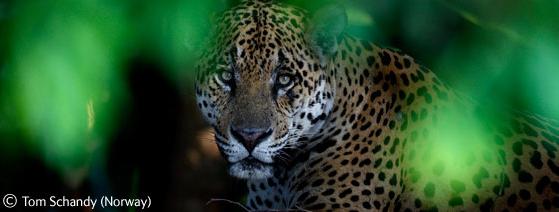 Winning Wildlife Photograph for 2010, by Tom Schandy Winning Wildlife Photograph for 2010, by Tom Schandy
Concurrently on exhibition at both the National History Museum in London and at the Australian Museum in Sydney is a brilliant display of wildlife photography, that recognises the Wildlife Photographer of the Year under a number of international awards.
On exhibition is not only the winning wildlife photographs but also those of the runners-up and the highly commended photographic entries. Entries have also been grouped into age groups so that children and young adults of differing age bracket categories also have their own competition award. This provides an excellent incentive for young people to take a special interest in wildlife and wildlife photography, for it is in our young peopke that the future of wildlife species will be utterly dependent to survive extinction.
The Editor had the opportunity to visit the exhibition held at the Australian Museum in Sydney yesterday and although this current exhibition is all but over, a visit by everyone should be an annual event. The experience is beautiful, inspiring, educational if not a touch sad when realising many of these photos may be of future extinctions. That they are in a museum is a wake up call to humanity and its morality.
Wildlife photography, the wildlife photography awards and the public exhibition of the entrants in each year’s competition contribute vitally in raising mainstream awareness of the plight of threatened wildlife, of poaching, the destruction of their habitats and the increasing risks of wildlife extinctions.
^Australian Museum, Sydney
^Natural History Museum, London
Wildlife Photographer of the Year Award 2010
Exhibited at Australian Museum, Sydney
‘Audience Type: General
Event Type: Special exhibition
Opens: 24 December 2009
Closes: 26 April 2010
Location: Level G, Special Exhibition Space
Experience the power, mystique and beauty of nature. See more than 90 dramatic images, from big cats fighting to silent icy landscapes, all in the Wildlife Photographer of the Year 2009 exhibition.
With over 43,000 competition entries from 94 countries across the globe, this is a selection of the most powerful images capturing wildlife and nature. Photography categories include:
-
- Gerald Durrell Award for Endangered Wildlife
- One Earth
- Animals in Their Environment
- Behaviour: Birds
- Behaviour: Mammals
- Behaviour: All Other animals
- The Underwater World
- Animal Portraits
- Urban and Garden Wildlife
- Creative Visions of Nature
- In Praise of Plants
- Nature in Black and White
- Wild Place
- 10 years and under
- 11-14 years
- 15-17 years.’
Exhibition Owned jointly by:

Exhibition Patron:
Exhibition Sponsor:
Major Sponsor:
Gerald Durrell Award for Endangered Wildlife
‘This award commemorates the late Gerald Durrell’s work with endangered species and his long-standing involvement with the competition. The award is given to the most memorable image and that which captures the unique character or spirit of the subject. The species featured must be officially listed in the 2008 IUCN Red List of Threatened Species as critically endangered or endangered, vulnerable or near threatened at an international or national level.’
Winner
Tom Schandy (Norway)‘The look of a jaguar’
In a small, protected area of swamp-forest in the western area of the Pantanal wetland, in Mato Grosso, Brazil, jaguars still roam free from human harassment. They’re notoriously difficult to see, and pawprints are as lucky as most people get. Along the riverbanks, though, it’s possible to spot them. When Tom took a boat down the Rio Paraguay, he saw four jaguars in three days. This male had picked a slightly concealed spot where he could watch for prey such as capybara. Tom observed him for an hour. ‘He was totally calm, even though he was aware of us.’ At sunset, the jaguar rose, yawned and scent-marked. Then he faded back into the dense forest. [Camera equipment used: Canon EOS-ID Mark III + 500mm f4 lens; 1/250 sec at f4; ISO 400; beanbag]
This photograph is available to buy as an official print by going to the National History Museum website
Runner-Up
Juan Carlos Muñoz, (Spain)
‘Elephant onlooker’

This photograph is available to buy as an official print by going to the National History Museum website
‘Not only are pygmy elephants critically endangered, but they also favour thick forest, which meant that Juan Carlos had his work cut out trying to find any. As he travelled by boat down the Kinabantangan River in Sabah, Borneo, the heavens opened. ‘It was so torrential,’ says Juan Carlos, ‘that I couldn’t decide what I was more worried about, the boat sinking as it filled up with rain or how to protect my camera gear.’ Suddenly the undergrowth parted and a male pygmy elephant looked out. Slowly munching on leaves, he serenely watched the ongoing boat chaos through the sheets of rain, giving Juan Carlos the chance to take his portrait before the elephant melted back into the forest. Pygmy elephants are found only on the island of Borneo and were classified as a subspecies of the Asian elephant in 2003. [Camera equipment used: Canon EOS-1Ds Mark II + Canon 100-400mm lens; 1/60 sec at f5; ISO 400.]
http://www.nhmshop.co.uk/veolia-environnement-wildlife-photographer-of-the-year-2009/elephant-onlooker/product.html
One Earth Award
‘This award highlights conservation issues or actions and the interaction between humans and the natural world. Images must demonstrate the power and resilience of our planet and its impact on us. Whether graphic or symbolic, each picture must be thought provoking, memorable and encourage respect or concern for our natural world.’
Winner
Thomas Haney (United States of America)
‘The lone fir’
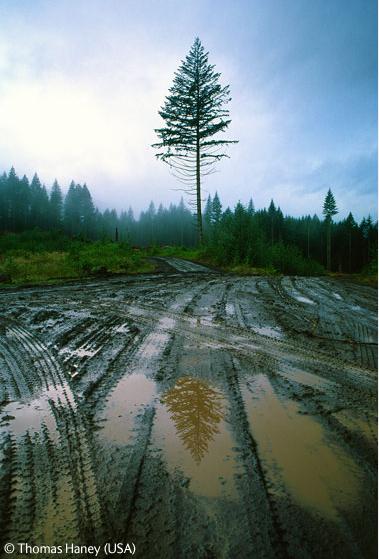 This photograph is available to buy officially as a print from visiting the National History Museum This photograph is available to buy officially as a print from visiting the National History Museum
‘It was late afternoon when Thomas came upon this scene outside Forks, Washington, while documenting old-growth logging in the Pacific Northwest. Loggers had left a single Douglas fir standing in a clearcut area, perhaps to help reseed the area for future logging. ‘As I walked towards it on the muddy road, criss-crossed with the tracks of logging trucks, I saw the reflection in the puddle,’ says Thomas. ‘It was a powerful image, reminding me of the towering forest that once stood here,’ he says. This area has been logged before, so this tree is likely to have been planted as part of a mono-age crop, vastly different from the multilayered forests that once blanketed the region. ‘Clearcutting has long been a focal point of the environmental movement, and while it seems to be falling out of favour in North America, it’s still the preferred method around the world.’
[Camera equipment used: Minolta Maxxum 7 + Minolta 20-35mm f3.5-4.5 lens, + .3 graduated-split neutral-density filter; 2 sec at f16; Fujichrome Velvia 50].
Highly Commended
Andy Rouse (United Kingdom)
Stalking the tiger

‘Andy and his guide Dicky Singh followed the fresh pug marks down the track. When they caught up with the tiger, they discovered it was Machali, a female very familiar to Dicky. Indeed, she’s something of a local celebrity in Ranthambore National Park. It wasn’t long before jeep-loads of tourists drew up to admire her. The drivers kept a respectful distance, but Machali is well used to such attention from the wildlife paparazzi. It has been suggested that Machali has contributed about $10 million to the local economy. Andy believes that ‘if we are to save this wonderful cat, then it has to have an economic value to a local community, and that’s what I wanted to show with this picture.’ [Camera equipment used: Nikon D3 + Nikon 70-200mm lens; 1/250 sec at f5.6; ISO 800.]
For more photos visit:
^Australian Museum, Sydney
^Natural History Museum, London
© The Habitat Advocate Public Domain
Thursday, April 22nd, 2010
by Editor 20100422.
About Earth Day Network
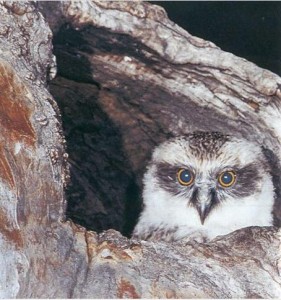 Powerful Owl chick (Brown Mountain, East Gippsland Australia) Powerful Owl chick (Brown Mountain, East Gippsland Australia)
[The following summary information has been extracted from the Earth Day website -editor]
‘Earth Day Network was founded on the premise that all people, regardless of race, gender, income, or geography, have a moral right to a healthy, sustainable environment.
Earth Day Network
1616 P Street NW, Suite 340
Washington, D.C., 20036
Tel: +1 202.518.0044 | Fax: +1 202.518.8794
http://www.earthday.org
Email general inquiries to: info@earthday.net.
Earth Day Mission
‘To broaden and diversify the environmental movement worldwide, and to mobilize it as the most effective vehicle for promoting a healthy, sustainable environment.
Reach
‘We pursue our mission through a combination of education, public policy, and activism campaigns. Earth Day Network has a global reach with more than 20,000 partners and organizations in 190 countries. More than 1 billion people participate in Earth Day activities, making it the largest secular civic event in the world.
Goals
- To Promote Civic Engagement — EDN works with partner organizations to provide opportunities for all citizens to become active at the local, state, national and global levels.
- To Broaden the Meaning of “Environment” — EDN is committed to expanding the definition of “environment” to include all issues that affect our health, our communities and our environment, such as air and water pollution, climate change, green schools and environmental curriculum, access to green jobs, renewable energy, and a new green economy.
- To Mobilise Communities — For the past four years, Earth Day Network has helped create a solid environmental platform for the National Latino Congreso. In 2010, we partnered with the Congreso to pass a strong climate change resolution.
- To Implement Groundbreaking Environmental Education Programs — Earth Day Network’s GREEN Schools Campaign seeks to green all of America’s K-12 schools within a generation. Green schools save money, conserve energy and water, and have better performing and healthier students. The National Civic Education Project is empowering students to solve local environmental problems. .
- To Help Bring Clean Water and Sanitation to the World — Earth Day Network’s Global Water Network allows individuals, organizations, or businesses to help fund water projects in rural areas around the globe.
- To Inspire and engage college students to become environmental leaders — EDN’s campus outreach seeks to grow the size, diversity, and strength of the environmental community in colleges and universities around the world.
- To Support Earth Day Events and Actions around the World — From greening schools in post-Katrina New Orleans to improving water and sanitation services in a refugee community in Ghana, EDN supports and coordinates thousands of Earth Day events worldwide each year. Earth Day, April 22, is the largest secular holiday in the world, now celebrated by more than one billion people.
Core Issues
Advocacy
Earth Day Network seeks to bridge the gap between concerned citizens and their leaders. Action is needed between individuals and organizations with local elected officials to discuss environmental issues. In this way we can push for change in Congress and the White House.
Climate Change
The Earth’s climate is significantly changing at a faster than normal rate. One thing remains clear: mankind’s actions are behind these changes. Fortunately humans are presented with the opportunity to make changes necessary to fight this phenomenon.
Promoting a campaign for reducing consumption of energy at school and at home, and reducing the use of the cars as a way of transport.
Conservation & Biodiversity
Diversity is nature’s greatest gift, but it is threatened around the world by human expansion and activities. Action is needed to help conserve the world’s biodiversity.
5th Ecosystem Services Forum
Education
Earth Day Network is a globally recognized leader in the fields of environmental education and green schools. Our Education programs carry a successful history of providing educators, students and the general public with resources and solutions to create a healthier, more sustainable planet.
Adopt a Meter2 of Land
Anacostia River Environmental Education Fair
Energy
Americans are roughly 5 percent of the world’s population and consume 25 percent of the world’s resources. Almost 50 percent of the energy we produce comes from coal. The time to build a clean energy network is now. Action must be taken to develop renewable energy and we must begin a responsible transition off of coal and oil.
Food & Agriculture
It is important that humans begin supporting organic or small farms, local production and sustainable techniques while harvesting increased yields and protecting the topsoil. The time for action is now, before the world’s rich farmland washes into the sea, and before chemical pesticides and fertilizers cause any more harm to our drinking water and our oceans.
Green Economy
We believe that the choice between the economy and green energy is a necessity to expanding the green sector and opening up a vast trove of jobs. Green industries are the future, and will put Americans back to work, producing real, exportable goods.
Green Schools
Earth Day Network’s successful history of working with teachers, PTAs, students and school administrators has led us to develop a long term, national campaign on green schools. Our National GREEN Schools Campaign, in partnership with the U.S. Green Building Council (USGBC) and The Clinton Foundation, aims to green all of America’s K-12 schools within a generation!
A school becomes “green” through a variety of means. By having more sustainable, energy-efficient, low-resource-using school buildings and school yards, our nation saves energy, reduces carbon emissions, and saves money.
By integrating environmental and sustainability education into our K-12 curriculums, our school’s students are more equipped to be leaders in the emerging green economy. We are achieving our Green Schools Campaign goals through green school policy reform, green makeovers for schools nation-wide, teacher grant programs & resources available on our Educators’ Network…
Recycling & Waste Reduction
The garbage dumps and junkyards of the world are filling quickly, with goods that might have been reused, recycled or composted. The world’s first old computers rot in scrap yards overseas, leeching toxic chemicals into the ground. Action must be taken to reduce the amount of waste we produce.
Sustainable Development
As the world’s human population grows, so does our footprint. We must find ways of living and growing in harmony with nature, and with the earth’s finite resources. Action is needed to promote green building, organic agriculture and responsible environmental practices.
Water
Earth Day Advisory Committee
Her Royal Highness Princess Lalla Hasnaa Alaoui of Morocco: President, Mohammed VI Foundation for the Protection of the Environment
Debbie Allen: American Actress, Choreographer, Television Director, Television Producer; Member of the President’s Committee on the Arts and Humanities
Ford W. Bell, DVM: President, American Association of Museums
Antonio H. Benjamin: Justice, High Court of Brazil (STJ); Co-President of the International Network for Environmental Compliance and Enforcement (INECE) and Deputy-Chair of the IUCN Commission on Environmental Law
Sir Richard Branson: British Entrepreneur; Founder and Chairman, Virgin Group
Lester Brown: Founder, Earth Policy Institute; Founder, Worldwatch Institute
Beverly J. Camhe: Producer, Beverly Camhe Productions
Richard Cizik: Evangelical Leader
Christo and Jeanne-Claude: Environmental Artists
Cerphe Colwell: Radio Legend
Phillipe Cousteau Jr.: Co-Founder, President and CEO, EarthEcho International; Ocean Environmentalist, Educator and Documentarian
Mia Couto: World-renowned Mozambican Writer and Biologist, Great Limpopo Transfrontier Park
Leonardo DiCaprio (Co-Chair): American Actor and Film Producer; Environmentalist; Founder, Leonardo DiCaprio Foundation; Board of Trustees, National Resources Defense Council; Board Member, Global Green USA
S. Richard Fedrizzi: President, CEO and Founding Chairman, United States Green Building Council
Jose Maria Figueres: Former President of Costa Rica; Sustainable Development and Technology Expert
Oliver Fleurot: CEO of Public Relations, Corporate and Financial Communications and Events Management, Publicis
Al Gore: 2007 Nobel Peace Prize Laureate; 45th Vice President of the United States
Paul Hawken: Director, Natural Capital Institute (NCI)
Denis Hayes(Chair): President and CEO, Bullitt Foundation; Coordinator of the first Earth Day in 1970
Joe Holland: United States Olympic Nordic Combined Skier and three-time National Nordic Combined Championship Winner
David L. Hunke: President and Publisher, USA Today
Benjamin T. Jealous: President and CEO, National Association for the Advancement of Colored People (NAACP)
Yolanda Kakabadse: President, Fundación Futuro Latinoamericano (FFLA)
Donna Karan: Fashion Designer and Creator, DKNY; Founder, Urban Zen Foundation
Katie Lee: Cookbook Author
Sheri Liao: President, Global Village of Beijing
Daniel Libeskind: Architect and Artist; Founder, Studio Daniel Libeskind
Maya Lin: Environmentalist, Artist, and Architect
Mindy S. Lubber: President, Ceres; Director and Investor, Network on Climate Risk
Dame Ellen MacArthur DBE: World Record Holder for solo sailing around the Earth and Dame Commander of the Order of the British Empire
Julia Marton-Lefèvre: Director General, International Union for Conservation of Nature (IUCN)
Bill McKibben: American Environmentalist and Writer; Founder, 350.org
Edward Miles: Senior Fellow, Joint Institute for the Study of Atmosphere and Oceans (JISAO); Co-Director,Center for Science in The Earth System, JISAO
Mrs. Gaylord Nelson: Wife of the late Senator Gaylord Nelson, the Founder of Earth Day
Shaquille O’Neal: Professional Basketball Player, National Basketball Association (NBA)
Raymond C. Offenheiser, Jr.: President, Oxfam America
Dr. Rajendra Kumar Pachauri: Nobel Peace Prize Laureate; Chairman, Intergovernmental Panel on Climate Change (IPCC)
John Podesta: President, Center for American Progress
Carl Pope: Executive Director, Sierra Club
David A. Randall: Recipient of the National Aeronautics and Space Administration (NASA) Medal for Exceptional Scientific Achievement and the Meisinger Award of the American Meteorological Society
Ambassador Mohamed Sahnoun: Ambassador, Special Advisor to United Nations Secretary General; Board Member, International Institute for Sustainable Development
U.S. Senator Bernard Sanders: United States Senator, from the State of Vermont
Larry Schweiger: President, National Wildlife Federation
Martin Scorsese: American Film Director, Screenwriter, Producer, and Actor, Sikelia Productions;
Founder and Chairman, World Cinema Foundation; President, Film Foundation
Pete Seeger: Environmental Activist; Performing Artist
Jigar Shah: CEO, Carbon War Room
Ben Silverman: Executive Producer, The Office; Creator, The Biggest Loser; Founder and CEO, Electus
James Gustave Speth: Professor, Vermont Law School; Dean, Yale School of Forestry and Environmental Studies; Co-Founder, Natural Resources Defense Council (NRDC)
Eric A. Spiegel: President and CEO, Siemens Corporation; Member, Business Roundtable
Achim Steiner: Executive Director, United Nations Environment Programme (UNEP)
Rabbi Warren Stone: Environmental Chair, Central Conference of Rabbis
Barbra Streisand (Co-Chair): American Singer, Composer, Film and Theatre Actress, Director, and Producer; Founder and President, The Streisand Foundation; Kennedy Center Honoree
Mark Tercek: President and CEO, The Nature Conservancy
Ted Turner: Founder and Chairman of the Board of Trustees, Turner Foundation; Founder and Chairman, United Nations Foundation; Founder, Turner Endangered Species Fund; Founder, Cable News Network (CNN)
James West: CEO, Alamy Limited
Keith Williams: President & CEO, Underwriters Laboratories Inc.
Edward O. Wilson: Harvard University Research Professor Emeritus; Two-time winner of the Pulitzer Prize; Scientist and Environmentalist
Abdelkbir Zahoud: Secretary of State, Ministry of Energy, Mines, Water and Environment of Morocco.
What are your national and local governments doing to contribute to the goals of Earth Day?
[The following summary information has been extracted from the Convention on Biological Diversity website -editor]
http://www.cbd.int/countries/profile.shtml?country=au
Note: this information is dated to 2005, so Australia is five years out of date.
In Australia:
Status and Trends of Biodiversity
Overview
‘As a large island continent Australia contains a diverse range of biogeographic regions. The arid interior occupies approximately 70% of the continent, with tropical monsoon areas to the north and a Mediterranean and temperate climate to the south. Australia’s marine habitats are just as diverse, ranging from extensive coral reefs to seagrass plains, giant kelp forests and the sand-bottomed habitats that cover much of the continental shelf. Australia is endowed with a unique and diverse biodiversity, with an estimated 80% of endemic wildlife, including flowering plants, fungi, mollusc, insects, fishes, frogs, reptiles and mammals. This high level of endemism has earned Australia its place among the world’s 12 megadiverse countries. A particularity of Australia is its marsupials, having evolved into a great diversity of species filling an extraordinary range of niches, which in other countries are largely occupied by placental mammals. As of February 2001, there were 1,478 species and 27 ecological communities listed as either endangered or vulnerable at the national level. Vegetation clearing remains a significant but diminishing threat to terrestrial biodiversity. Threats affecting Australia’s coral reefs include the effects of sediments, agricultural chemicals and nutrients, fishing and tourism, oil spills, and climate change.
Number and Extent of Protected Areas
‘Terrestrial protected areas covered 10.52% (80.89 million hectares) of the country in 2004 whereas marine protected areas, including ‘no take’ zones’, covered 64,600,000 hectares or 7% of Australia’s marine jurisdiction.
Percentage of Forest Cover
Of the estimated 33% forest cover of Australia at the time of European settlement, there is now 21% remaining.
National Biodiversity Strategy Action Plan
Major features of National Biodiversity Strategy and Action Plan
‘The overall goal of the Strategy for the Conservation of Australia’s Biological Diversity (1996) is to protect biological diversity and maintain ecological processes and systems. There are 6 main objectives, with priorities covering the identification and description of: main ecosystems, existing knowledge about biodiversity, and threats. The strategy also provides the framework to develop a mechanism and management plans for: biodiversity in general, protected areas, information and support of conservation projects, major introduced pests, control of access to genetic resources, bioregional planning and management, private lands to complement the protection provided by the public estate in protected areas, and for local governments to assume a significant role in the conservation of biodiversity.
National Biodiversity Strategy Action Plan National Strategy (English)
National Biodiversity Strategy Action Plan (English)
Implementation of the Convention
Measures Taken to Achieve the 2010 Target
‘Australia has substantially moved towards specific, time bound and measurable outcomes in regional planning under the National Action Plan on Salinity and Water Quality (NAP) and the Natural Heritage Trust (NHT). Regional plans are playing an important role in protecting and enhancing Australia’s unique biodiversity, the viability of rural and regional communities and the future of agricultural industries. Resource Condition Indicators, coordinated by the Australian Government’s Monitoring and Evaluation Working Group (MEWG), are being developed primarily to measure the performance of investments made under funding programs and to contribute to overall assessments of resource condition. The EPBC Act provides for the identification and listing of threatened species and ecological communities, the development of recovery plans for listed species and communities, the recognition of key threatening processes, and where appropriate, reducing the impact of these processes through the development and implementation of threat abatement plans. The international movement of wildlife and wildlife products for commercial purposes is also regulated under the EPBC Act and legislation to meet CITES obligations. The threat of pollution on the conservation of biodiversity is being addressed through the National Pollutant Inventory, whose goals include the maintenance and improvement of ambient air quality as well as marine, estuarine and fresh water quality.
Initiatives in Protected Areas
‘Between 2002 and 2004, terrestrial protected areas increased by 0.44% of the total land area. Designation of marine protected areas has accelerated over the reporting period with one of the most significant increases occurring because of the rezoning of the entire Great Barrier Reef, which became law in July 2004. The proportion of the Marine Park protected under ‘no-take’ zones was increased from less than 5% to more than 33%, and now protects representative examples of each of the 70 broad habitat types identified across the Great Barrier Reef region. By the end of 2002 the National Representative System of Marine Protected Areas (NRSMPA) covered approximately 64,600,000 hectares or 7% of Australia’s marine jurisdiction.
Initiatives for Article 8(j)
‘Several Australian initiatives address this article, such as the Indigenous Protected Areas Program, in which the Department of the Environment and Water Resources and indigenous communities work together to: develop management plans, and hold indigenous knowledge workshops through the Natural Heritage Trust. The Australian Government has also taken measures to engage indigenous people in the key goals of Australia’s Oceans Policy by involving them in the use, conservation and management of Australia’s marine jurisdictions. This led to the development of pilot ‘Sea Country’ Plans as a potential vehicle for indigenous involvement in marine resource use and management processes. There are currently six plans being developed, allowing indigenous people to consider their sea country management priorities, needs and interests. Finally an Indigenous Advisory Committee (IAC) has been established under the Environmental Protection and Biodiversity Conservation Act 1999 (EPBC Act). The Committee advises the Minister for the Environment and Water Resources on the operation of the Act, taking into account the significance of indigenous peoples’ knowledge of the management of land and the conservation and sustainable use of biodiversity.’
The Habitat Advocate supports the principles of the Earth Day Network.
© The Habitat Advocate Public Domain
Thursday, April 8th, 2010
This article provides an extract summary of the IUCN website – Editor.
.
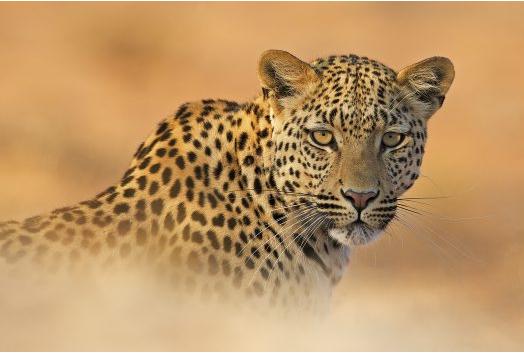 ‘Eyes in the oasis’
© Lee Slabber, (South Africa), 2009 Wildlife Photographer of the Year
.
‘Every morning, Lee would drive 50 kilometres (32 miles) across the Kalahari Desert dunes that separated two dry riverbeds in the Kgalagadi Transfrontier Park, South Africa. The only sign of life – or rather, death – was near a small pan, a mini-oasis in the middle of the dunes, where oryx bones lay scattered all about in various states of decay. One day, Lee stopped to photograph the bones. As he did so, he sensed that he wasn’t alone. ‘I got the feeling I was being watched,’ he said. ‘I slowly turned to face a most beautiful young male leopard, looking intently at me from behind a small bush. I could see how the deep-red dunes would be perfect camouflage for him.’ A moment later, the leopard fled, ‘obviously as shocked to see me as I was to see him.’
[Camera equipment used: Canon EOS-1D Mark III + Canon EF 600mm lens; 1/250 sec at f5.7; ISO 200.]This photograph is available to buy as a print.
http://australianmuseum.net.au/image/Eyes-in-the-Oasis/ ‘Eyes in the oasis’
© Lee Slabber, (South Africa), 2009 Wildlife Photographer of the Year
.
‘Every morning, Lee would drive 50 kilometres (32 miles) across the Kalahari Desert dunes that separated two dry riverbeds in the Kgalagadi Transfrontier Park, South Africa. The only sign of life – or rather, death – was near a small pan, a mini-oasis in the middle of the dunes, where oryx bones lay scattered all about in various states of decay. One day, Lee stopped to photograph the bones. As he did so, he sensed that he wasn’t alone. ‘I got the feeling I was being watched,’ he said. ‘I slowly turned to face a most beautiful young male leopard, looking intently at me from behind a small bush. I could see how the deep-red dunes would be perfect camouflage for him.’ A moment later, the leopard fled, ‘obviously as shocked to see me as I was to see him.’
[Camera equipment used: Canon EOS-1D Mark III + Canon EF 600mm lens; 1/250 sec at f5.7; ISO 200.]This photograph is available to buy as a print.
http://australianmuseum.net.au/image/Eyes-in-the-Oasis/
.
The United Nations (UN) has declared 2010 the International Year of Biodiversity.
Why?
- To seek to significantly reduce the rate of biodiversity loss by the end of 2010
- To celebrate and promote biological diversity – the variety of life on Earth
- To boost awareness of how important biodiversity is for humanity
- To highlight how seriously biodiversity and nonhuman species are threatened with extinction, and the implications for human wellbeing.
The UN’s Approach to Protecting Biodiversity
- Sound management of natural resources to support peaceful communities
- Encouraging well-balanced economic growth
- Reducing poverty
.
IUCN
The IUCN, the International Union for Conservation of Nature, is the world’s oldest and largest global environmental network – a democratic membership union with more than 1,000 government and NGO member organizations, and almost 11,000 volunteer scientists in more than 160 countries.
The IUCN helps the world find pragmatic solutions to our most pressing environment and development challenges. It supports scientific research, manages field projects all over the world and brings governments, non-government organizations, United Nations agencies, companies and local communities together to develop and implement policy, laws and best practice.
The IUCN posits 5 sound reasons why humans need to maintain health biodiversity
- To maintain food sources
- For medicinal benefits associated with diverse plant and animal life
- To mitigate the effects of climate change
- To provide employment
- To enable peoples vulnerable to the effects of climate change improve their livelihoods and increase their resilience to climate change impacts.
.
The Importance of Biodiversity for its own sake [posited by Editor]
- To respect natures processes and ecosystems
- To prevent continuing extinctions
- To prevent extreme climate change
.
To boost global awareness of the importance of biodiversity for humanity
‘The IUCN together with its Members and partners wants to see biodiversity at the top of the global agenda, leading to stronger action from all sectors of society including government and industry to safeguard it.’ ‘Humans are an integral part of biodiversity and have the power to protect or destroy it.’ ‘In the western world, we have become so far removed from biodiversity that we’ve forgotten how much we use it in our daily lives from the food we eat to the clothes we wear to the medicines we use.’
When we Bluefin tuna, we rarely think of the species that the tuna depends on to thrive, or that this species is a serious risk of being fished into extinction. When forestry agencies fell a mature tree to make a table or woodchips, mammalian habitat is lost.
.
To highlight how seriously biodiversity is threatened
Human activities continue to destroy the natural world at an unprecedented rate through habitat destruction, over-harvesting, pollution, poaching, and induced climate change. We’re facing a global species extinction crisis. We need to do better at making the scientific, social, economic and cultural case for keeping diversity, and show just how much it supports nearly every aspect of human life and progress. Through our International Year of Biodiversity focus, we’ll be doing just that, starting with a look at IUCN’s projects relating to forest biodiversity in February.
.
Risks to Biodiversity, Ecosystems and nonhumans species is at crisis point
- ‘The escalating extinction crisis shows that the diversity of nature cannot support the current pressure that humanity is placing on the planet.’
- ‘Every day biodiversity is being lost at up to 1,000 times the natural rate. The extinction of individual species, but also habitat destruction, land conversion for agriculture and development, climate change, pollution and the spread of invasive species are only some of the threats responsible for today’s crisis.’
- ‘Coral reefs provide food, storm protection, jobs, recreation and other income sources for more than 500 million people worldwide yet 70% of coral reefs are threatened or destroyed.’
- ‘17,291 species out of 47,677 assessed so far are threatened with extinction.’
- ‘Of the world’s 5,490 mammals, 79 are Extinct or Extinct in the Wild, with 188 Critically Endangered, 449 Endangered and 505 Vulnerable.’
- ‘1,895 of the planet’s 6,285 amphibians are in danger of extinction, making them the most threatened group of species known to date.’
- ‘With the current biodiversity loss, we are witnessing the greatest extinction crisis since dinosaurs disappeared from our planet 65 million years ago. Not only are these extinctions irreversible, but they also pose a serious threat to our health and wellbeing.’
- ‘From time immemorial, nature has fed us, cured us, and protected us. But today the roles have switched. We need to feed nature, we need to cure it and protect it if we want to secure a healthy and prosperous future for our children.’
- ‘Climate change is set to be one of the major drivers of species extinctions in the 21st century: approximately 20 to 30 per cent of plant and animal species are likely to be at increasingly high risk as global mean temperatures rise.’
.
IUCN Species Most Vulnerable to ‘Climate Change Extinction’
A recent IUCN report identifies the following 10 species are most vulnerable to ‘climate change extinction‘.
- ^Arctic Foxes
- ^Clownfish
- ^Koalas
- ^Emperor Penguins
- ^Leatherback Turtles
- ^Staghorn Corals
- ^Ringed Seals
- ^Quiver Trees
- ^Salmon
- ^Beluga Whales
.
Arctic Foxes
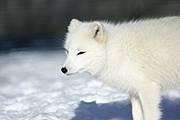
The Arctic Fox [Alopex lagopus or Vulpes lagopus]
Also known as the White Fox, Polar Fox or Snow Fox.
The total population estimate for 1997 is around 60 adults in Sweden, 11 adults in Finland and 50 in Norway.
[Source: Tannerfeldt, M. (1997). Population fluctuations and life history consequences
in the Arctic fox.. Stockholm, Sweden: Dissertation, Stockholm University].
- The Arctic Fox is one of the top land-dwelling predators of the Arctic region. It is thought to be one of the first mammals to have colonised Sweden and Finland following the last ice-age.
- As the Arctic region warms, tundra habitat may slowly be replaced by boreal forest from the South. Forest habitat is unsuitable for Arctic Foxes.
- Red Foxes prey on and are superior hunters to Arctic Foxes. Northward encroachment of Red Foxes into the Arctic Fox’s range has already been documented and is likely to continue as the tundra warms.
- Arctic Foxes prey largely on lemmings and voles. Milder and shorter winters are predicted to cause declines in the regularity of these rodents’ population cycles, as well as decreases in their overall numbers.
- These factors are likely to cause declines in Arctic Fox numbers and range size. Arctic Foxes highlight the impacts of climate change on the ways that species interact with each other, both through competition and via changes in predator-prey relationships.
.
Koalas
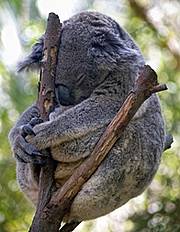
The koala (Phascolarctos cinereus)
is an arboreal herbivorous marsupial native to Australia.
According to the IUCN, as CO2 levels increase, the nutritional quality of eucalyptus leaves
is declining and the koala faces malnutrition and ultimate starvation.
[Editor: What Australian would have thought our precious and assumed plentiful Koalas could be threatened? Well the Tasmanian Tiger was once plentiful across Tasmania. None of us should take our wildlife for granted]
- ‘Koalas are iconic animals native to Australia. They are true habitat and food specialists, only ever inhabiting forests and woodlands where Eucalyptus trees are present.’
- ‘Increasing atmospheric CO2 levels will reduce the nutritional quality of Eucalyptus leaves, causing nutrient shortages in the species that forage on them. As a result, Koalas may no longer be able to meet their nutritional demands, resulting in malnutrition and starvation.’
- ‘Increasing frequency and intensity of droughts can force Koalas to descend from trees in search of water or new habitats. This makes them particularly vulnerable to wild and domestic predators, as well as to road traffic.’
- ‘Koala populations are reported to be declining due to malnutrition, the sexually-transmitted disease chlamydia, and habitat destruction.’
- ‘Koalas have very limited capability to adapt to rapid, human-induced climate change, making them very vulnerable to its negative impacts.’
.
Emperor Penguins
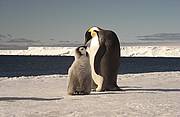
The Emperor Penguin (Aptenodytes forsteri)
The tallest and heaviest of all living penguin species and is endemic to Antarctica.
- For much of the year, Emperor Penguins live on thick sea ice in the Antarctic, which they use for mating, chick rearing and moulting.
- In some regions of the Antarctic, seasonal sea ice extent and thickness have reduced in recent decades following climate change. Continued warming will lead to further reductions in sea ice, impacting Emperor Penguins, with more northerly colonies being most at risk.
- The biomass of Antarctic krill has decreased in recent decades correlating with decreases in sea ice. Changes in krill abundance are likely to negatively affect Emperor Penguins and many other Antarctic species.
- Emperor Penguins highlight the possible impacts of rising sea temperatures and melting sea ice due to climate change. These changes directly or indirectly affect many other species in the Antarctic marine ecosystem.
.
Ringed Seals
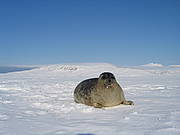
The ringed seal (Pusa hispida), also known as the jar seal
Ringed seals are slaughtered by Artic natives [Inuit] and often killed by the fishing gear of commercial trawlers.
Now climate change is a serious threat to their extence because much of their habitat is dependent upon pack ice.
- ‘Ringed Seals live primarily in the high Arctic and are heavily dependent on Arctic ice, almost never coming onto land.’
- ‘Warming spring temperatures and early ice breakup are causing nursing young to be prematurely separated from their mothers and to be exposed both to the elements and to predators.’
- ‘To cope with global warming, Ringed Seals will need to shift their territories to track suitable ice conditions. Increases in disease and disturbance by humans are also likely challenges.’
- ‘Marked decreases in Ringed Seal abundance are likely to have cascading effects in Arctic food webs. They are the most important species in the diet of Polar Bears.’
- ‘Ringed Seals highlight the direct impacts of climate change on polar habitats, including the effects ice loss has on other ice-adapted species.’
.
.
IUCN participation and Goals for 2010
.
Failure of the 2010 Biodiversity Target
Adopted in May 2002 during the sixth Conference of the Parties to the Convention on Biological Diversity, the 2010 Biodiversity Target aimed to achieve, by 2010:
‘a significant reduction of the current rate of biodiversity loss at the global, regional and national level as a contribution to poverty alleviation and to the benefit of all life on earth’.
Unfortunately, we now know that this aim is far from being met. As we are facing an ever-increasing biodiversity crisis, we need a new, clear and realistic target to respond to it.
Negotiations on the new post-2010 framework will be taking place throughout this year, paving the way for the 10th Meeting of the Parties to the Convention on Biological Diversity in October.
.
1. 2010 Convention on Biological Diversity [Japan]
To follow up on the 1992 Earth Summit in Rio de Janeiro where world leaders adopted the Convention on Biological Diversity (CBD). The Convention has three main objectives:
- To conserve biological diversity
- To use biological diversity in a sustainable way
- To share the benefits of biological diversity fairly and equitably.
The Tenth meeting of the Conference of the Parties to the Convention on Biological Diversity will take place from 18 to 29 October 2010 in Nagoya, Japan.
.
This meeting is set to be a milestone for the Convention. It is during this event that the Parties of the Convention are expected to adopt a new set of post-2010 biodiversity targets. They will also agree upon an international regime to regulate access to genetic resources and the sharing of benefits that we gain from their use.
To keep up to date visit: http://www.cbd.int/cop10/
COP10 [Nagoya] Issues for in-depth consideration
- Inland waters biodiversity
- Marine and coastal biodiversity
- Mountain biodiversity
- Protected areas
- Sustainable use of biodiversity
- Biodiversity and climate change
.
2. COP10 Meeting of the Access and Benefit Sharing Working Group [Colombia]
From 22-28 March 2010, around 600 delegates representing Parties to the Convention on Biological Diversity (CBD), non-governmental and international organizations, and partners, gathered in Cali in Colombia to give the final push to the negotiations on the international regime to regulate access to genetic resources and the distribution of the benefits derived from their use.
This is the ninth and final meeting of the Ad Hoc Open-ended Working Group on Access and Benefit Sharing (ABS) before the tenth Conference of the Parties of the Convention (COP10). The Working Group has been mandated to finalize its work and deliver an ABS international regime to be adopted at COP10 in Nagoya, Japan later this year. The clock is thus ticking but despite the pressure, delegates seem positive about a favourable outcome of the meeting.
http://www.iucn.org/cbd/?4972/Final-Meeting-of-the-ABS-Working-Group-kicks-off-in-Colombia
.
3. Million-dollar boost to people and biodiversity [West Africa]
Part of the IUCN Forest Conservation Programme this IUCN initiative works to improve the livelihoods of people in West Africa receiving a major boost in the form of a CHF 1.9 million grant from Switzerland’s State Secretariat for Economic Affairs (SECO).’
http://www.iucn.org/iyb/iucn_action_22/around_the_world/?4787/Million-dollar-boost-to-the-people-and-biodiversity-of-West-Africa
.
4. The Satoyama Initiative [Japan]
‘Led by IUCN Member the Ministry of the Environment of Japan and the United Nations University Institute of Advanced Studies, the Satoyama Initiative focuses on conserving villages and farmlands, together with the sustainable practices and traditional knowledge that they represent.’
http://www.iucn.org/iyb/iucn_action_22/around_the_world/?4699/People-and-nature
.
5. Protecting life-saving knowledge [Bangladesh]
‘In the remote area of south-east Bangladesh, known as the Chittagong Hill Tracts, IUCN Bangladesh is making sure that traditional health knowledge and practices are revived and secured for future generations.’
http://www.iucn.org/iyb/iucn_action_22/around_the_world/?4703/protecting-knowledge
.
6. Guggul Tree Conservation [India]
IUCN’s biologist Vineet Soni has enlisting the help of tribespeople of the arid regions of Gujarat and Rajasthan, in India to secure the rare ‘Guggul Tree’ [Commiphora wighii], at risk due to overharvesting. Its resin has been a key component in the ancient Indian Ayurvedic system of medicine as an effective treatment for bone fractures, arthritis, inflammation and obesity, and is now widely used in modern medicine for heart problems. Vineet has led a group of friends have founded the Indian Council for Plant Conservation to conserve threatened plant species of Rajasthan through community involvement, running workshops to help make local people aware of the importance and conservation of plants.
http://www.iucn.org/iyb/iucn_action_22/around_the_world/?4702/People-for-plants
.
7. Elephant Foster Parents [Sri Lanka]
‘In Sri Lanka, three elephants are killed every week as a result of human-elephant conflict, leaving behind defenceless orphans. To address this, IUCN State Member The Department of Wildlife Conservation has launched a novel foster parent scheme, where contributions from donors are used to shelter helpless young elephants in a transit home until they have reached an appropriate age to be released into the wild.’
http://www.iucn.org/iyb/iucn_action_22/around_the_world/?4511/Elephant-foster-parents-in-Sri-Lanka
.
8. A future for Wild Cats [Colombia]
Colombia has six native wild cat species including the jaguar, puma, and ocelot. As in many other countries, the species are threatened by habitat loss, loss of prey and killing by livestock farmers. Lack of information on their populations, their prey and ecosystems have until now prevented the design of effective conservation strategies.
But thanks to multi-stakeholder efforts, the National Conservation Programme for Felids in Colombia is now underway. This has established conservation guidelines for all species by region and aims to form an integrated nationwide initiative to establish the abundance and distribution of these species and their prey, and how to tackle conflicts between the wild cats and farmers.
Ocelot (Leopardus pardalis)
http://www.iucn.org/iyb/iucn_action_22/success/?4512/A-future-for-Colombias-wild-cats
.
9. CoP15 to the Convention on International Trade in Endangered Species of Wild Fauna and Flora (CITES)
.
At Doha, Qatar, 25 March 2010 regulatory bodies from around the world met to discuss agreeing on conventions to ensure the continued survival of species threatened by wildlife trade.
Trade regulation for bluefin tuna, African elephants, tigers, sharks, polar bears and coral have all been under discussion in Doha.
During the conference, IUCN called for a more holistic approach to elephant conservation, urging Parties to rise above divisive issues raised at this meeting in favour of more decisive action on the known problems facing African elephants in many parts of their range including decreasing habitat as a result of the needs of growing human populations and managing human-elephant conflict.
Before the next conference in 2013 in Thailand, CITES has a huge challenge to meet in specifically addressing the key challenges and gaps identified at this conference so that discussions at CoP16 can truly support sustainable trade in all wild species.
http://www.iucn.org/iyb/resources/news/?4979/Time-for-closer-collaboration-on-wildlife-trade
.
10. Talks to dismantle trade in tiger poaching [Southern Asia]
Tigers are listed in CITES Appendix I, which includes species threatened with extinction and allows non-commercial trade only in exceptional circumstances, such as for research. Globally, on a species level, tigers are listed as Endangered on the IUCN Red List of Threatened Species™.
At COP15, poaching and illegal trade in tigers was discussed with countries being asked to provide information to the CITES Secretariat and Interpol to help develop anti-poaching strategies.
Estimates from 2007 indicated that there were as few as 3,400 tigers in the wild throughout Asia. Numbers have decreased since then. In the early 1900s there were more than 100,000. Tigers are primarily poached for their skins with other body parts being used for decorative purposes or for traditional medicines.
“If we use tiger numbers as a performance indicator then we must admit that we have failed miserably and that we are continuing to fail. How have we let this happen?” says CITES Secretary-General Willem Wijnstekers. “Although the tiger has been prized throughout history, and is a symbol of incredible importance in many cultures and religions, it is now literally on the verge of extinction.
2010 is the Chinese Year of the Tiger and the International Year of Biodiversity; this must be the year in which we reverse the trend. If we don’t, it will be to our everlasting shame.”
http://www.iucn.org/iyb/resources/news/?4923/Talks-to-dismantle-trade-in-tiger-poaching
.
11. Call for Post-2010 Strategic Plan on Biodiversity
The IUCN is calling for a clear post-2010 Strategic Plan on Biodiversity.
We have failed to meet the target adopted through the Convention on Biological Diversity to reduce the rate of biodiversity loss by 2010.
According to the Millennium Ecosystem Assessment, 60% of ecosystem services worldwide have become degraded in the past 50 years, and the IUCN Red List of Threatened Species™ gives us alarming facts on species extinction rates, which are increasing continuously.
IUCN is calling for a short, focused and action-oriented Strategic Plan to be adopted at the meeting of the Convention on Biological Diversity in Nagoya, Japan, in October.
“Simply aiming at halting biodiversity loss is no longer sufficient; we also need to restore and maintain the populations, habitats and ecological cycles that enable biodiversity and ecosystem services – such as food, water or medicine – to persist “ says Jane Smart, Director of IUCN’s Biodiversity Conservation Group. “To achieve this, we need engagement on all possible levels, with the economic sector, the development community through to the public sector and civil society. It is critical that the role of biodiversity as the foundation of life, livelihoods and development is understood by all.”
To meet these goals, perverse incentives, like subsidies that harm biodiversity, need to be removed and new regulations and financial incentives need to be put in place, clearly reflecting the value of natural resources. Greater interaction between science and policy, and cohesion between multilateral environmental agreements and other organizations are also essential for the implementation of the new biodiversity targets, according to IUCN experts.’
http://www.iucn.org/iyb/resources/news/?4962/Healthy-biodiversity-is-no-luxury—its-the-foundation-of-all-life-on-earth
.
12. Bringing the Bison Back [North America]
The next 10 to 20 years could be extremely significant for restoring wild populations of American bison to their original roaming grounds. But for this to happen, more land must be made available for herds to roam free, government policies must be updated and the public must change its attitude towards bison.
A new publication by IUCN, American Bison: Status Survey and Conservation Guidelines 2010, reports on the current status of American bison, in the wild and in conservation herds, and makes recommendations on how to ensure that the species is conserved for the future.
“Although the effort to restore bison to the plains of North America is considered to be one of the most ambitious and complex undertakings in species conservation efforts in North America, it will only succeed if legislation is introduced at a local and national level, with significant funding and a shift in attitude towards the animal,” says Dr Simon Stuart, Chair of IUCN’s Species Survival Commission.
Five hundred years ago, tens of millions of American bison roamed free on the plains of North America, from Alaska to northern Mexico. Now the American bison – which includes both plains and wood bison – is listed as Near Threatened on IUCN’s Red List of Threatened Species™. As of 2008, there were approximately 400,000 bison in commercial herds in North America, some 93 percent of the continental population. But little progress has been made in recent decades to increase the number of animals in conservation herds, which are managed carefully for their genetic diversity and ecological roles. In 2008, there were 61 plains bison conservation herds in North America containing about 20,500 animals, and 11 conservation herds of wood bison, containing nearly 11,000 animals.
“While substantial progress in saving bison from extinction was made in the 20th century, much work remains to restore conservation herds throughout their vast geographical range,” says University of Calgary Environmental Design Professor and co-editor of the study, Dr Cormack Gates, who is also co-Chair of the IUCN Bison Specialist Group. “The key is recognition that the bison is a wildlife species and to be conserved as wildlife, it needs land and supportive government policies.”
The survival of bison populations is affected by many factors, including limited habitat and severe winters. Yet the greatest challenge is to overcome the common perception that the bison, which has had a profound influence on the human history of North America, socially, culturally and ecologically, no longer belongs on the landscape.
“The decimation of the American bison in the late 1800s inspired the first recovery of bison and an entire conservation movement that protected wildlife and wild places across North America,” says Keith Aune, Senior Conservation Scientist, Wildlife Conservation Society. “The IUCN Status Survey and Conservation Guidelines provide a new framework for inspiring a second recovery of bison and restoring functional grassland ecosystems.”
Bison have the best chance of full recovery as wildlife by being allowed to roam freely across hundreds of thousands or even millions of hectares. Making this possible poses one of the biggest challenges for restoring bison herds as both public and private landowners will need to give their support.
“The bison is the largest land mammal in North America, and yet it is perhaps the most neglected icon,” says Steve Forrest, WWF Northern Great Plains Manager for Conservation Science. “These guidelines provide a roadmap for bringing the bison back to its rightful place as a keystone of the great plains.
http://www.iucn.org/iyb/resources/news/?4750/Bringing-Bison-Back-to-North-America
Bison on the American Prairie Reserve
Photo: Steve Zack, Wildlife Conservation Society
.
Further Reading
.
http://www.iucn.org/iyb/
http://www.iucn.org/iyb/resources/news/
http://www.cbd.int/2010/welcome/
http://www.countdown2010.net/year-biodiversity
http://www.unep.org/iyb/
http://www.environment.gov.au/biodiversity/
http://www.environment.gov.au/biodiversity/strategy/draft-strategy.html
http://www.healthyparkshealthypeoplecongress.org/
.
Thursday, December 17th, 2009
by Editor 20091217.
This website’s focus: ‘a voice for native habitat’
————————————————————————————
Fresh stump of a 500 year old-growth Eucalytus regnans,
killed by John Brumby’s VicForests at Brown Mountain, East Gippsland.
© 2009 Environment East Gippsland
Native Habitat
The term ‘native habitat’ can be described as an ‘ecosystem’ – the biological and physical components of a natural environment.This website focuses on the ecology of flora and fauna and regards an ecosystem as the natural home or ‘habitat’ of flora and fauna. Native habitat is an holistic ‘natural home, natural life’ view of nature.We take fauna-centric and flora-centric views of the natural landscape, not an anthropocentric (human needs) view.
The intended direction of this website is to raise public awareness about the values of native habitat, about the degradation and loss of native habitat and about its scarcity value.Industrial-scale exploitation has reduced much of the world’s native habitat to remnant islands.
We challenge land management policies and practises that are inconsistent with custodial respect for the health, integrity and existence rights of native habitat.We challenge the many human threats that continue to destroy remnant native habitat and which collectively are accelerating local extinctions.
Flora and fauna cannot speak, do not have relocation choices like humans, cannot protest their plight, cannot lobby politicians, and cannot stop the bulldozers.
Once they’ve gone, they’ve gone forever.
The Habitat Advocate is an advocacy for wildlife and habitat conservation, for better applied ecology and for changing harmful destructive human cultures.
The Habitat Advocate is a voice for native habitat. This is our creed and our motto.
Bonnie Doon Reserve, Katoomba, Blue Mountains, Australia,
threatened by State-sanctioned arson, propagandised as ‘hazard reduction’
by the New South Wales Rural Fire Service
[Photo 6-Dec-08]
Habitat Philosophies
These terms shall be elaborated upon and explored during the development of this website endeavour…
· A voice for native habitat
· Embracing Complexity
· Ecocentric Ethics
· Species Justice
· Human Pathogen
· Anti-destructionism
· Habitat Sovereignty
· Deep Ecology
· Socio-Ecology
· Wholeness Principle
· Fresh Learning
· Sustainable Prosperity
· Fostering Knowledge Exchange
· Local Community Partnering
· Independent Citizen Journalism
· Custodial Humility
© The Habitat Advocate Public Domain
|
|
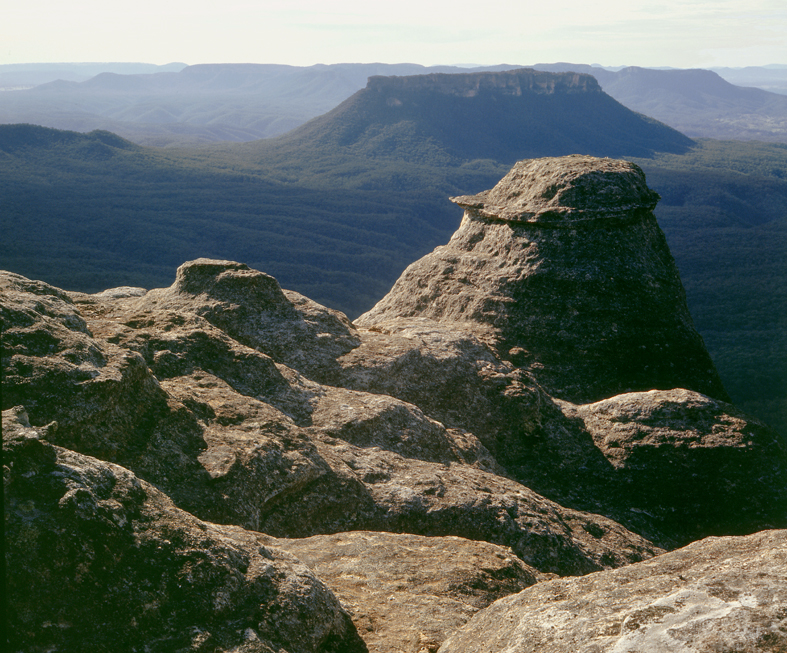 Capetree Valley looking toward Pentoney’s Crown,
Gardens of Stone NP
Blue Mountains region, New South Wales, Australia
© Photo by Henry Gold, wilderness photographer
Capetree Valley looking toward Pentoney’s Crown,
Gardens of Stone NP
Blue Mountains region, New South Wales, Australia
© Photo by Henry Gold, wilderness photographer
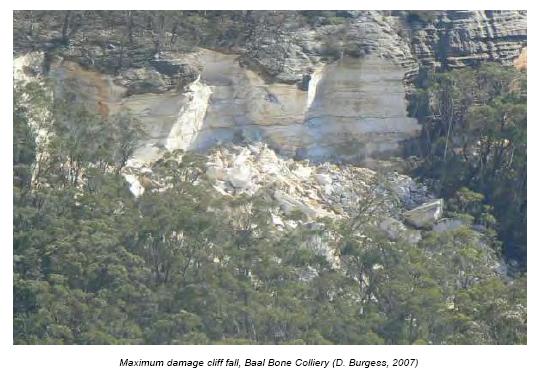 ‘Impact of Coal Mining on the Gardens of Stone’
©2010 Colong Foundation for Wilderness
‘Impact of Coal Mining on the Gardens of Stone’
©2010 Colong Foundation for Wilderness
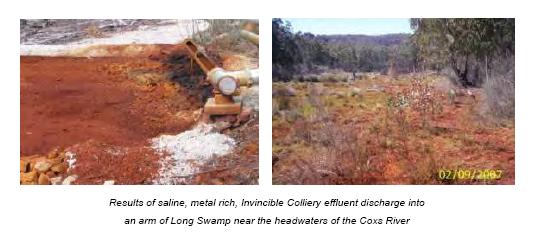 ‘Impact of Coal Mining on the Gardens of Stone’
©2010 Colong Foundation for Wilderness
.
.
‘Impact of Coal Mining on the Gardens of Stone’
©2010 Colong Foundation for Wilderness
.
.