Archive for the ‘Threats from Deforestation’ Category
Wednesday, July 20th, 2011
The following article was initially posted by Tigerquoll on 20090326 on CanDoBetter.net:
.
On Thursday 26th March 2009, four people were charged in their efforts to save East Gippsland old growth forests at Upper Delegate River from being chopped down.
 ‘The Goongerah Blockade’ ‘The Goongerah Blockade’
Protesting against logging of old growth forests in East Gippsland
….prepared to be arrested for habitat.
March 2009.
eco-warriors all!
.
Conservationists trying to conserve protected old growth forests have been charged with illegal conservation. Is Victorian Premier Brumby’s strongman stance seeking to emulate Mugabean democracy?
Is Brumby’s hypocritical law for conservationists that of prima facie guilt of conservation? Surely the need to conserve rare and remnant old growth forests makes conservation self-evident?
Premier Brumby’s DSE and VicForests under their own laws maintain these catchment forests under environmental protection legislation. Yet in breach of their own laws, Brumby’s environmental watchdogs have become lapdogs, watching loggers irreparably destroy these centuries-old Eucalypts and lay witness to Victoria’s disappearing natural heritage. It’s no different to Indonesia condoning destruction of Sumatran and Kalimantan rainforests.
When was the last time Brumby bushwalked through old growth Gippsland? Last year, or never?
A dedicated group of 20 forest conservationists prevented clearfelling in the upper Delegate River catchment up until now. “This particular old growth forest was recently surveyed by trained biologists and the result showed very high density of tree dwelling mammals”, said spokesperson for the group Carmel Roberts.
“The DSE is neglecting their responsibilities to protect endangered wildlife habitat, even though it clearly states in their Forest Management Plan that where high numbers of threatened species are found, habitat must be protected.
“The DSE are saying they are unable to protect these species’ habitat despite the logging being in clear breach of their legal obligations. The government puts more value on a months work by a few people than protecting endangered wildlife from extinction.
“In 2006, Premier Brumby made an election promise to protect the “last significant stands of old growth”. These forests are the very the last refuges for our rare species.”
“Since the devastation caused by the bushfires, East Gippsland’s forests are now even more critical to the survival of Victoria’s native species than before. Rare native wildlife could have been made locally extinct in other areas due to the fire damage.”
“Old growth forest habitats such as hollow-bearing trees, are critically important for the survival of these threatened species in Victoria. The logging industry can survive in plantations and regrowth, endangered wildlife can’t.”
.
.
Comments:
.
Woodchip mafia has Brumby well trained
March 28th, 2009 by ‘Blackdog’:
.
The Brumby government is truly the lapdog to the loggers. The woodchip mafia has him well trained. The rule book says the threatened species have to be saved. He destroys them and their habitat. The promise back in 2006 was to save the old growth – but all he’s done is cover for the increased targeting of prime areas.
Yep – no different to Indonesia or the Amazon. Only Brumby employs better media spin experts. Pity the public don’t wear it.
.
.
Lap dog governments are following Easter Island
On March 28th, 2009 Tigerquoll says:
Blackdog’s comments hit the mark.
I go further than black dog.
Lap dog governments are supporting destructionist loggers while publicly advocating environmental protection in another department.
This is gross hypocracy, a conflict of interest and corrupt.
I worry also that as more clever HSC graduates take on degrees in ‘communications’, which so frequently entices them into well paid jobs in government and corporate spin machines, that pure ethics is neglected at both senior school and at most university courses.
By denying our children skills and wisdom in worldly ethics, our children are being denied their rights to cope with ethical decisions. A degree without a base in ethics is a degree in propaganda, and don’t our lapdog governments lap them up?
Take the following example and ask why in our education system and supposed independent journalism, that Australians are more aware of the extremely rich celebrities than the natural and indigenous exploitation and neglect condoned by governmenst in Australia’s World region?
SOURCE: www.drmartinwilliams.com/conservation-and-environment/indonesian-forest-destruction-corruption-plays-a-role.html
“Since 1982, forest fires on a large scale in Kalimantan, Sumatra and Java have come with the onset of each dry season. A fire in Kalimantan in 1983, reportedly the largest in human history, destroyed 3.7 million hectares of rainforest, an area the size of the Netherlands.
In 1987, 2 million hectares, 1.4 million of primary rainforest, were destroyed in Kalimantan, Sumatra, East Timor, Sulawesi and mountain regions of Java.
In 1991 smoke and ash from fires blanketed Singapore, Malaysia and the Straits of Malacca, forcing Indonesia to call for international help.
Forest fires of this magnitude coincide with a rapid increase in logging and plantation activities which began in the early 1980s. In 1966, 82% of Indonesia’s land mass was covered by primary forest. By 1982 this had shrunk to 68%, and recent satellite photographs indicate that forest cover – including timber plantations – is now down to about 55%.
In late 1996, the Indonesian minister of forests said that 20 million hectares of forest were in a critical state and warned that this was increasing rapidly. The World Bank estimates 800,000 hectares of forest are lost each year.
Around 64 million hectares – one-third of Indonesia’s land mass – is devoted to commercial logging. In 1996 Indonesia became the world’s largest plywood exporter.
…
On September 9, Suharto reissued a 1995 ban on burning forest and called on the military to help enforce it. Companies were given until October 3 to prove they were not the culprits.
Laws allow up to 10 years’ imprisonment and a 100 million rupiah fine for polluters. Not one company, however, has ever been convicted. Even the environment minister, Sarwono Kusumaatmadja, admitted to Reuters on September 22 that environmental laws are not policed properly.
Soon after Suharto’s announcement, the number of fires increased, as companies rushed to clear as much land as possible before the deadline. Even if the deadline was strictly adhered to, it would only let companies finish clearing land at a time the normal rainy season would have forced them to do so.
…
But it is not just the greed of Suharto and the logging and plantation firms which has created this disaster.
Government investment and development policies which have promoted destructive land clearing practices are spurred on by market forces and capitalism’s endless drive for profit. Many of the projects were championed by and funded by institutions such as the World Bank and the IMF, which pressure countries such as Indonesia to increase exports.”
In 2009, we must learn from Easter Island’s ancient community and its unsustainable culture of nature exploitation which ended up condemning its civilization to extinction. Else, despite our iPods, in 2009 we risk the same fate.
.
.
Injustice rules the forests
March 30th, 2009 by Sheila Newman:
.
About time this shameful situation got coverage. I would like to see a story for EVERY charge against conservationists on candobetter.
It is quite true, as you say, that the Victorian Government frequently breaks the law in its forest activities. In fact it has practically torn up its own rule book.
Keep fighting!
.
– end of article –
Tags: Carmel Roberts, clear felling, conservationists charged, East Gippsland, Goongerah Blockade, John Brumby, Logging, old growth forests, Premier Brumby, tigerquoll, Upper Delegate River, VicForests, woodchip
Posted in Gippsland (AU), Threats from Deforestation | No Comments »
Add this post to Del.icio.us - Digg
Tuesday, June 14th, 2011
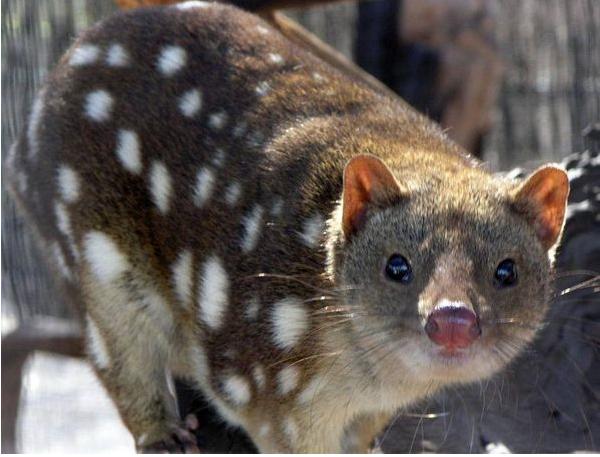
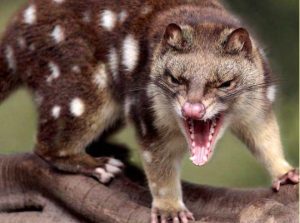
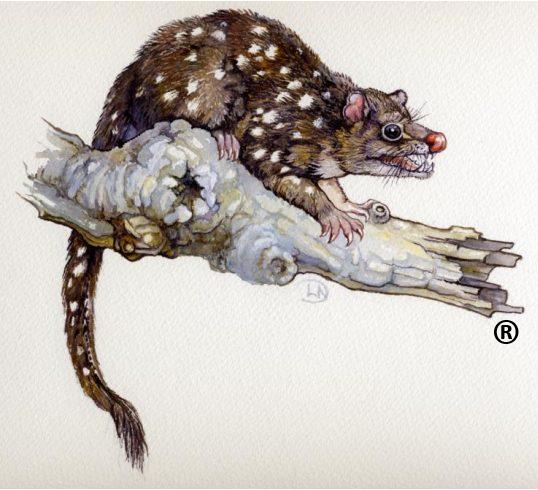
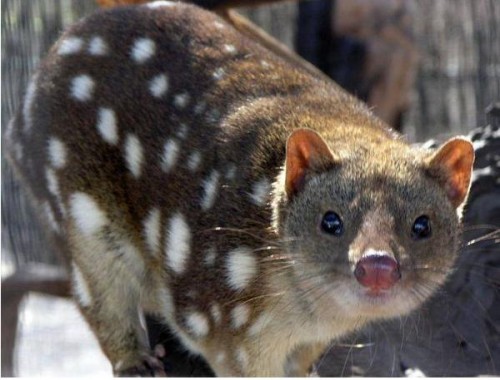 This is a Tiger Quoll (Dasyurus maculatus) This is a Tiger Quoll (Dasyurus maculatus)
Photo courtesy of Sean McClean.
.
It is Australia’s largest carnivorous marsupial on the mainland and it has become endangered because of humans destroying its habitat, shooting it and poisoning it.
It is not a cat. Much information may be obtained online simply by typing ‘tiger quoll’ on Google.
.
.
.
The following extract is from the website ‘Convict Creations‘ (15-Feb-2010):
‘Tiger Quoll…the next to die’
“Without disrespecting the Koala or Kangaroo, the Tiger Quoll is one of Australia’s most interesting animals. It sort of resembles a cat except it has a pouch, bright eyes, a moist pink nose and a powerful bite. It can grow to up to 75 cm in length and weigh up to 7kg. If trained, it will even use a kitty litter tray.
The Tiger Quoll is the type of animal that tourists would love to see on their Australian safari.
Unfortunately, they are quite rare so few have ever caught a glimpse of them.
European colonisation of Australia could have been great for the Tiger Quoll. With Europeans introducing rabbits, rats and mice, the Quoll saw a drastic increase in its food source. Had the colonists warmed to them, then a mutually beneficial relationship could have formed. Farmers could have encouraged Quolls to take up residency in order to keep rodent numbers down with little fear that their livestock would be in danger. As an added bonus, by eating carrion, the Quolls would have reduced the threat of blowfly strike.
Alternatively, they could have just made pets out of the Quoll. Apparently the Quoll has all the positive characteristics of a cat or dog. According to Professor Mike Archer, Former Director of the Australian Museum, who once kept a Quoll as a pet:
“I just can’t praise these animals highly enough as companions for human beings. They have all the good features in dogs and cats, and in my experience not a single downside”.
If colonial owners had taken care of their Quolls, then both Quoll and owner would have been happy. If not, the Quoll would have just escaped and done Australia a service by cleaning up decaying meat, rabbits and other introduced vermin.
Unfortunately, colonists never formed mutually beneficial relationships with the Quoll. Instead, they introduced the cat to serve the role of pest controller. For more than a century, farmers deliberately released cats onto their properties in order to control rabbit and mice populations. Once the cats went feral, they started to compete with the Quoll for food. Although the Quoll was better adapted to Australia’s cycle of droughts, the cat’s symbiotic relationship with humans proved to be an even better environmental adaptation. If feral cats were ever wiped out in a drought, or declined for whatever reason, they still had the family home as an oasis in the desert. From the family home, they were well placed to repopulate the bush once good conditions returned.
Even worse than competition from the cat were the environmentalists’ attempts to “help” them. The use of 1080 poison has been one of the main helping strategies. When it is used to kill rabbits, it indirectly deprives Quolls of food. So much so, by killing rabbits, human deprive Quolls of even more food than is lost due to competition by cats. To compound matters, when 1080 poison is used to kill the cats and foxes competiting with Quolls, it also ends up being eaten by Quolls. In fact, Quolls are more likely to eat the poisons because they have a keen nose for carrion while the feral predators prefer fresh kills.
A very odd example of the misguided environmental policy was recently seen in in Tasmania. 1080 was first used to reduce rabbit numbers. A rumour then developed that foxes had finally established a breeding community in the island state. Even though it was just a rumour, to be on the safe side, environmentalists decided a large scale baiting regime needed to be implemented to eradicate foxes as well. On the State Government’s own data, more than 140,000 poison baits were laid. So far, there has been no evidence that foxes were actually present. There was; however, plenty of evidence of Quoll dying!
The odd wilderness protection policy caught the attention of David Obendorf, a vet with a research focus in marsupial diseases. According to Obendorf:
“Three Tasmanians have each offered $1,000 fox rewards (Tasmanian Times: “$1,000 fox reward”). All remain unclaimed despite farmers, landowners and professional shooters all knowing about them. And yet the government “guessimate” claims there are up to 400 foxes living in Tasmania … somewhere. In my opinion Tasmania’s use of 1080 poison over the last five decades – to kill browsing and grazing native herbivores – has had a significant effect on the over-population followed by the facial tumour disease-crash in devil numbers and in the widespread establishment of feral cats across the island….Ironically the state government has now ceased the use of 1080-laced carrot/apple baits on public lands to kill grazing wildlife but now uses tens of thousands of meat baits in public forests where they claim they are targeting those cryptic foxes.” (1)
The use of 1080 poison could be legitimately referred to as Australia’s dumbest environmental policy since the construction of a 1,833 km fence to “keep” rabbits out of WA. It seems that Western Australians weren’t smart enough to realise that rabbits can dig under fences. All that was required was for a single pregnant female to dig a hole and then 1,833 km of fence line would be obsolete. Perhaps WA politicians did in fact realise the folly of it all, but decided it was more to important to show they were “doing something”.
As an added bonus, “doing something” kept people in regional Australia employed. Perhaps 1080 poison is used for similar reasons. Unfortunately, “doing something” to help Quolls is really not helping them at all. It forces them into wilderness reserves where scientists can erect huge fences to keep out ferals and then make a lucrative income maintaining them. (2)
Even though the Tiger Quoll is mainland Australia’s largest native predator, Australia doesn’t have any professional sporting team named after them. In fact, they don’t really exist in public consciousness in any significant shape or form. Perhaps this is because Quolls spend their time out in the bush where they are only ever seen by rangers.
Alternatively, perhaps the name Quoll just isn’t scary enough.
Zoos – The only real industry is as a research subjects by scientists, or to provide an endangered animal story that can be used by wilderness groups to write emotive appeals asking for funding to save them.
Pest controllers – Potentially, Quolls could make great pest controllers. They could compete with cats and foxes for food, and eliminate rabbits and rats in the process. Landowners could breed them and sell them as a substitute to 1080 poison.
Pets – Sometimes scientists have made great pets out of Quolls. At present, the general public is not allowed to do likewise. The general argument is that Quolls require special care that only a scientist can give. Consequently, Australians have to reserve their abusive ownership methods for dogs and cats that simply go bush if they are unhappy with their owners.”
.
.
The Snowy River is a surviving stronghold of the Tiger Quoll
.
“In East Gippsland, the areas on the Errinundra Plateau, Snowy River and Tingaringy are strongholds of the Spot-tailed Quoll”. (GECO)
“The Upper Snowy River and its tributaries was the Victorian stronghold of the Tiger Quoll before (the 2003) devastating Alpine bush fires. The Tiger Quoll is believed to have lost up to 75% of an estimated population of 1,000 in the area.
Following the devastating effects of recent bush fires The Tiger, or Spotted-tailed Quoll (Dasyurus maculatus) has been reclassified as nationally endangered. it is feared that the fires will have a lasting effect on the Quolls that remain.”
.
.
.
References:
[1] ABC, ^http://www.abc.net.au/rn/science/earth/stories/s145805.htm
[2] David Obendorf – ^http://www.animal-lib.org.au/news/1080–the-real-killer.htm”
[3] ^http://www.fame.org.au/current_projects.html
.
~ article by Tigerquoll, first published on CanDoBetter.net 15-Feb-2011
Wednesday, June 8th, 2011
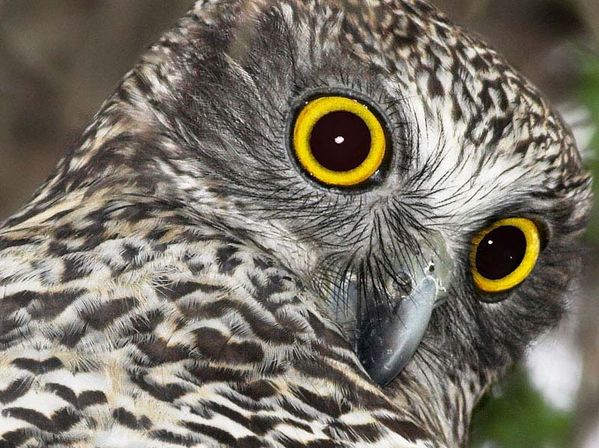
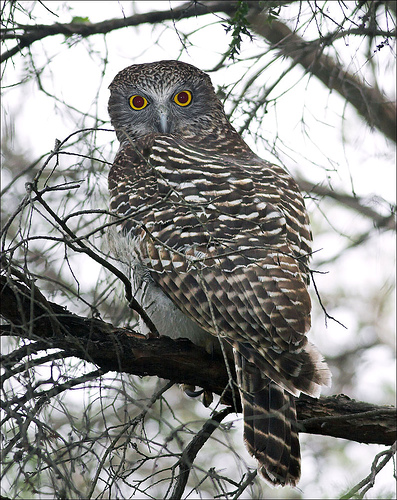 Australia’s Powerful Owl (Ninox strenua) Australia’s Powerful Owl (Ninox strenua)
.
Like many native species in Australia, the Powerful Owl’s conservation status is deemed to be ‘Vulnerable’.
It remains the largest owl in Australasia, endemic to eastern and south-eastern Australia (that is it lives naturally nowhere else on the planet).
Now uncommon throughout its range where it occurs at low densities preferring woodland and open sclerophyll forest to tall open wet forest and rainforest.
The Powerful Owl requires large tracts of forest or woodland habitat but can occur in fragmented landscapes as well. The species breeds and hunts in open or closed sclerophyll forest or woodlands and occasionally hunts in open habitats. It roosts by day in dense vegetation comprising species such as Turpentine Syncarpia glomulifera, Black She-oak Allocasuarina littoralis, Blackwood Acacia melanoxylon, Rough-barked Apple Angorphora floribunda, Cherry Ballart Exocarpus cupressiformis and a number of eucalypt species.
.
The main prey items are medium-sized arboreal marsupials, particularly the Greater Glider, Common Ringtail Possum and Sugar Glider. There may be marked regional differences in the prey taken by Powerful Owls. For example in southern NSW, Ringtail Possum make up the bulk of prey in the lowland or coastal habitat. At higher elevations, such as the tableland forests, the Greater Glider may constitute almost all of the prey for a pair of Powerful Owls. Birds comprise about 10% of the diet, with flying foxes important in some areas. As most prey species require hollows and a shrub layer, these are important habitat components for the owl.
.
Pairs of Powerful Owls are believed to have high fidelity to a small number of hollow-bearing nest trees and will defend a large home range of 400-1450 ha.
Powerful Owls nest in large tree hollows (at least 0.5 m deep), in large eucalypts (diameter at breast height of 80-240 cm) that are at least 150 years old. During the breeding season, the male Powerful Owl roosts in a “grove” of up to 20-30 trees, situated within 100-200 metres of the nest tree where the female shelters.
.
Unlike many humans, Powerful Owls are monogamous and mate for life, making them a superior species.
.
Human Threats to Powerful Owls
...
Powerful Owls have for decades been threatened by the human caused ongoing loss and fragmentation of habitat. Important forest and woodland habitat continues to be cleared and burned for reasons justifying human residential and agricultural development. This loss also affects the populations of arboreal prey species, particularly the Greater Glider which reduces food availability for the Powerful Owl.
Inappropriate forest harvesting practices that have changed forest structure and removed old growth hollow-bearing trees.
Loss of hollow-bearing trees reduces the availability of suitable nest sites and prey habitat. Can be extremely sensitive to disturbance around the nest site, particularly during pre-laying, laying and downy chick stages. Disturbance during the breeding period may affect breeding success.
High frequency hazard reduction burning is also reduce the longevity of individuals by affecting prey availability.
[Source: NSW Department of Environment, http://www.threatenedspecies.environment.nsw.gov.au/tsprofile/profile.aspx?id=10562]
.
In 2007, the New South Wales Labor Government in its State Transit department was found to have poisoned many powerful owls and other wild birds around Ryde in its so-called pest control plan.
.
‘The government-owned agency employed a poison expert to kill pest Indian mynah birds at their bus depot in Ryde but local residents watched in horror as kookaburras, galahs, magpies and rosellas started falling out of the sky.’
‘A spokeswoman said the last poisoning campaign, using baited bird seed, was on November 12.’
[Source: ‘Bird-brained system killing wildlife’, The Daily Telegraph, 14th December 2007, http://www.dailytelegraph.com.au/news/sydney-nsw/bird-brained-system-killing-wildlife/story-e6freuzi-1111115108124 ]
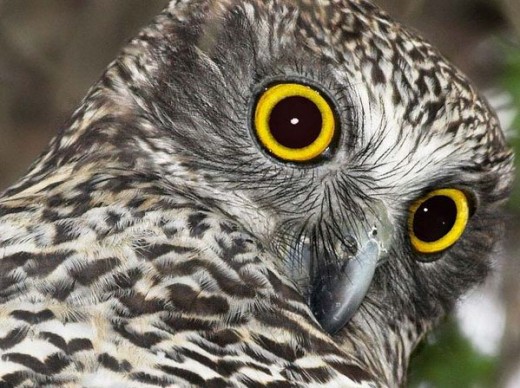
Saturday, June 4th, 2011
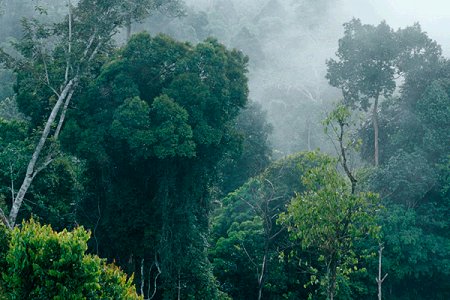
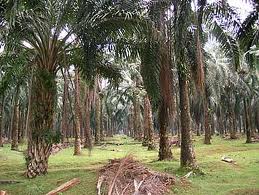
In Indonesia, bulldozing rainforest for profitable palm oil plantations for western diets has become highly profitable due to western corporate demand…


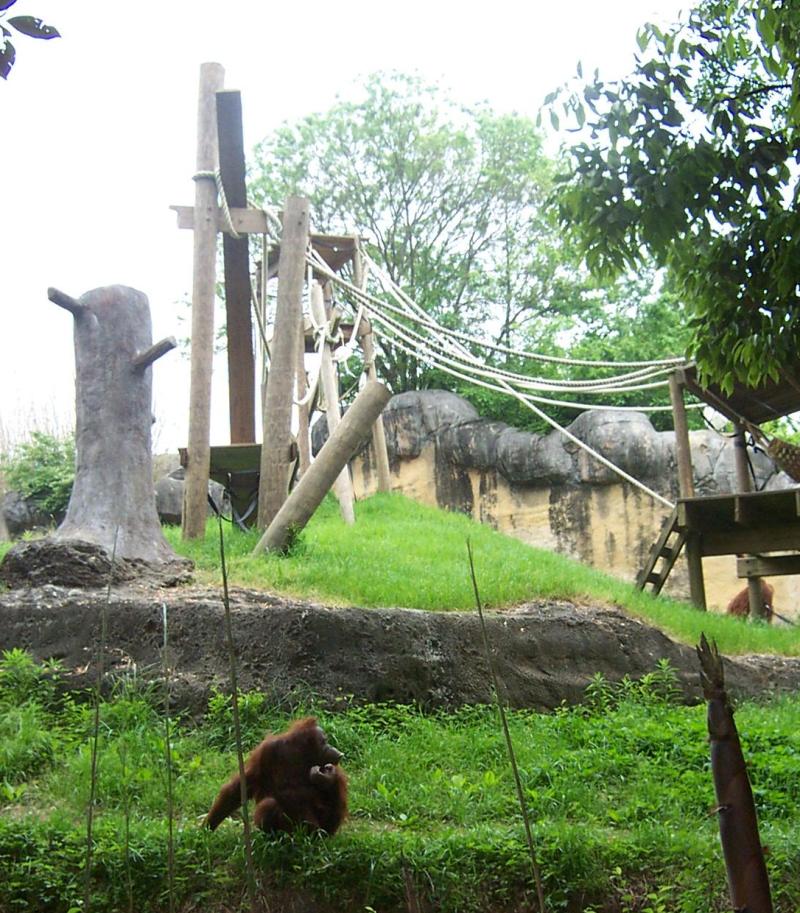
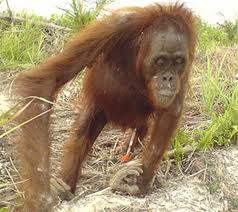
In Indonesia’s Borneo (Kalimantan) the rainforest habitat of orangutans is being destroyed, largely to make way for palm oil plantations due to western diet demand
Arnott’s relies up on palm oil in its popular western ‘Tim Tam’ biscuit product

Just like these other western brands do:

The palm oil driven rainforest deforestation in Borneo (Kalimantan) thanks to unethical palm oil demand from the likes of Arnott’s…
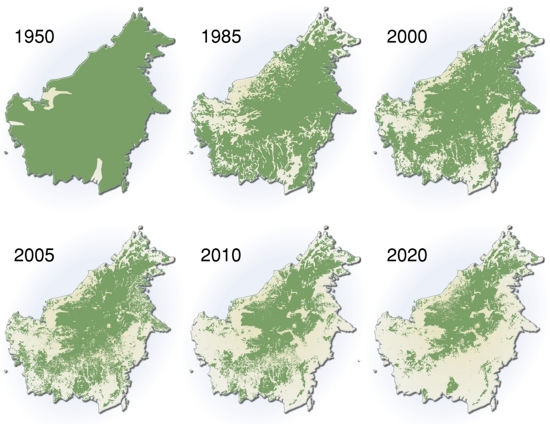
Try finding a shrinking rainforest map on the wrapper of a packet of Tim Tams!
Indonesian unethical destruction of orangutan rainforest habitat continues to provide for palm oil plantations.
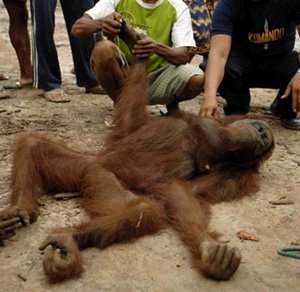
This is costing the lives of about 50 orangutans every week.
Arnott’s knows this, yet continues to buy the palm oil and drive the Indonesian palm oil deforestation.
Arnott’s is expanding its sales of palm oil Tim Tams with new product offerings:

2011 has been declared by the United Nations as the International Year of Forests.
Arnott’s knows this.
 It won’t be long before human demand for Tim Tams and other palm oil consumer products have driven the orangutan into extinction. It won’t be long before human demand for Tim Tams and other palm oil consumer products have driven the orangutan into extinction.
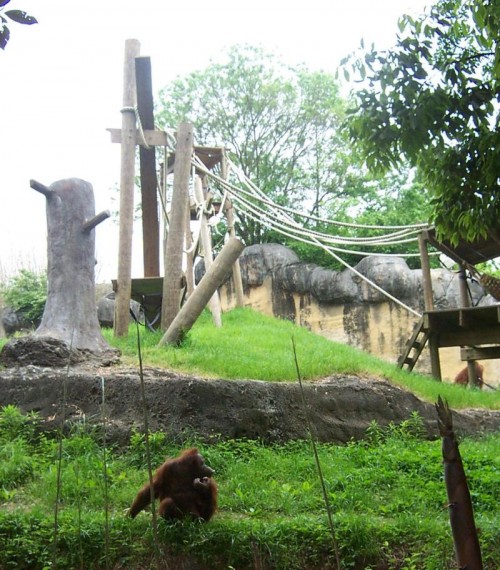
Tim Tams have become the western addiction driving orangutan extinction.
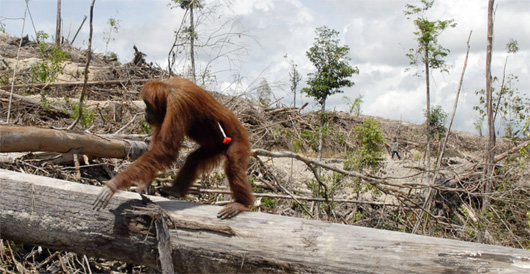
Arnott’s chocolate biscuits are more than a weight gaining guilt.
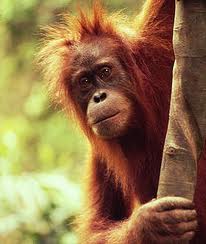
You eat them, you kill a species.
Will someone make clear to the Arnott’s Board that for Orangutans THERE IS NO SUBSTITUTE FOR QUALITY HABITAT.
Tags: arnott's, Borneo, fragile forest ecosystems, Kalimantan, no substitute for quality habitat, orangutan, palm oil plantations, pringle orphans, rainforests, tim tam, tim tam orphans, UN International Year of Forests, World Environment Day 5th June
Posted in Kalimantan (ID), Orang-utans, Threats from Deforestation, Threats from Farming | No Comments »
Add this post to Del.icio.us - Digg
Saturday, May 28th, 2011
Valuable fringe bushland of the Central Blue Mountains (BM) is steadily disappearing as a consequence of Blue Mountains (city) Council-approved housing development integrated with the associated hazard reduction burning that it invites.
Blue Mountains Council has become culturally conditioned to automatically squirm and acquiesce when any threat of a State Environmental Court appeal process that may be instigated to dare challenge Blue Mountains Council, despite a fair and rigorous environmental assessment and ruling. Local political pressure is such that now Blue Mountains Council staff are encouraged to give up and bend over, as if so urbane as to be beholden to developer intimidation. Yet for years such has become Blue Mountains Council’s urbane squeamish mindset, as if the staff and management came from overdeveloped Western Sydney (which most of them they have).
There are morally corrupt politics controlling land use development in the Blue Mountains ~ many are receiving a cut of perceived cheap, yet increasingly scarce, bushland habitat.
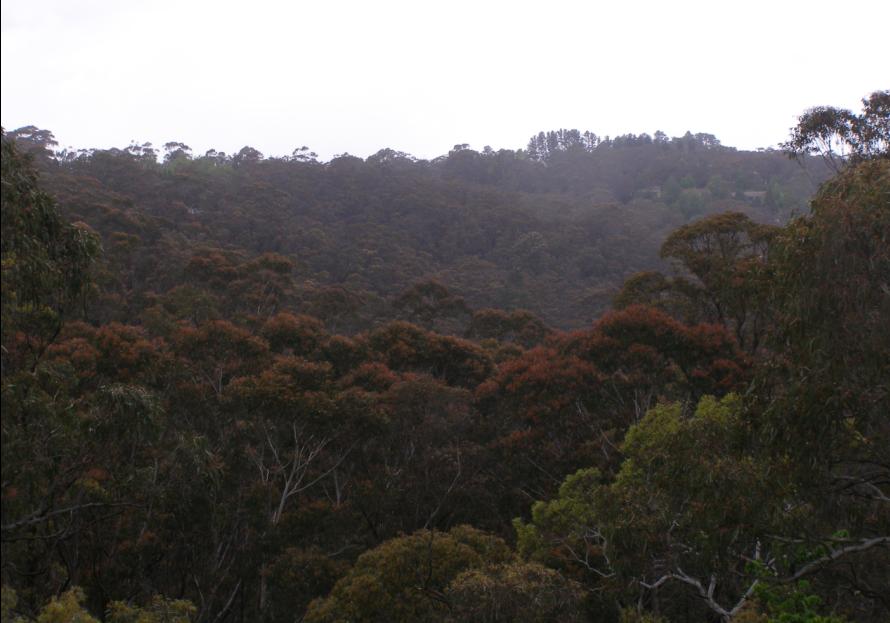
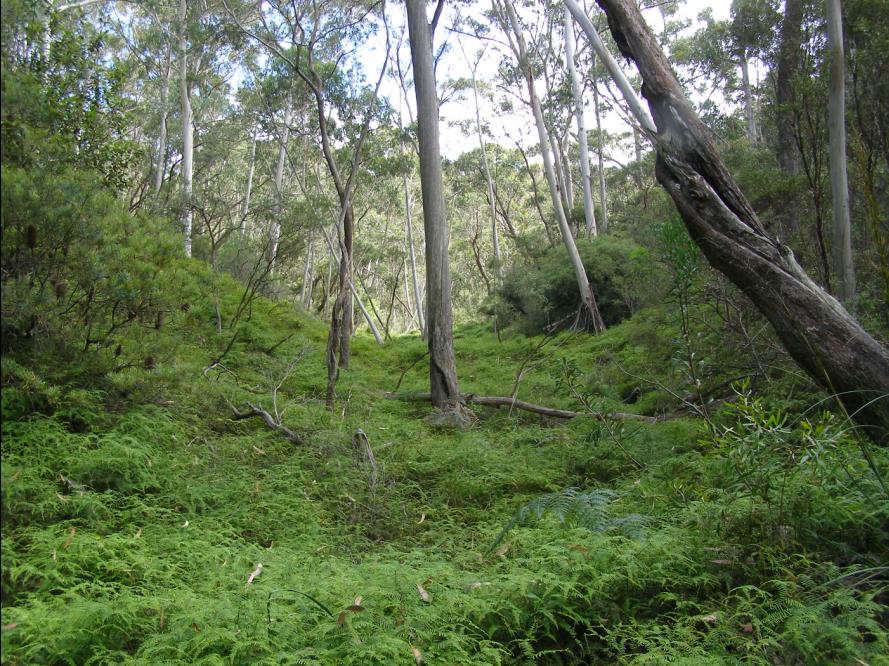
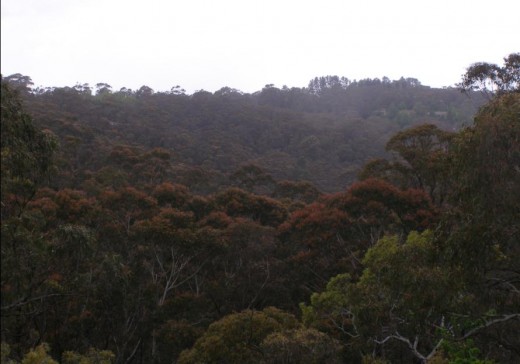 Thick natural bushland habitat just west of Katoomba
Central Blue Mountains Region.
New South Wales, eastern Australia. Thick natural bushland habitat just west of Katoomba
Central Blue Mountains Region.
New South Wales, eastern Australia.
.
.
Case in point:
.
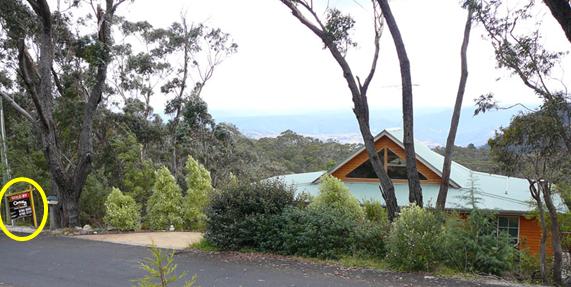
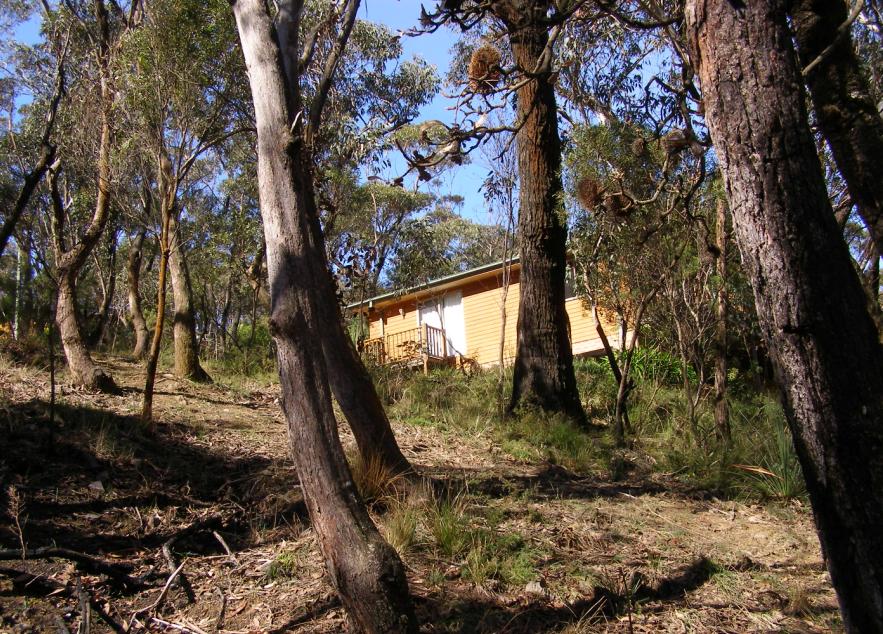
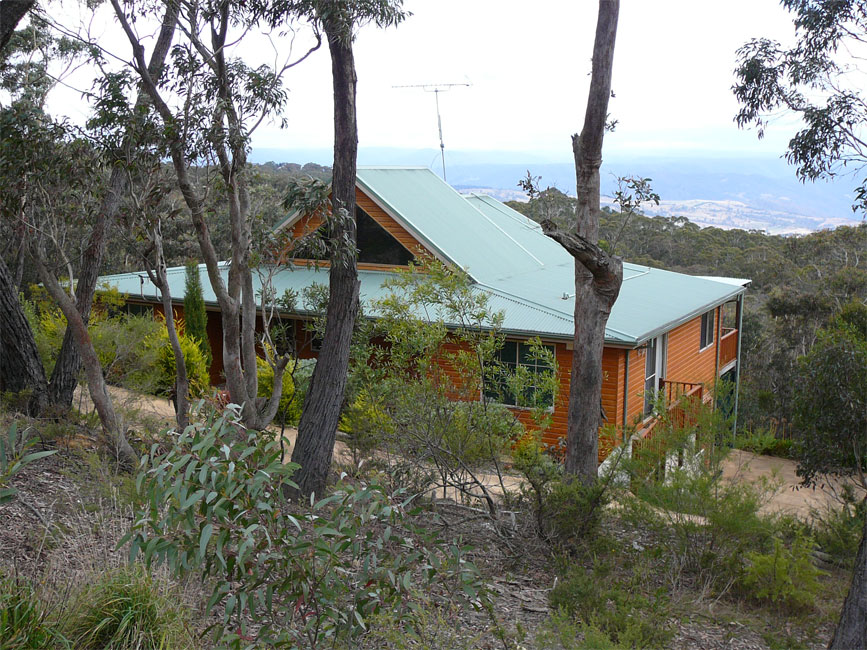
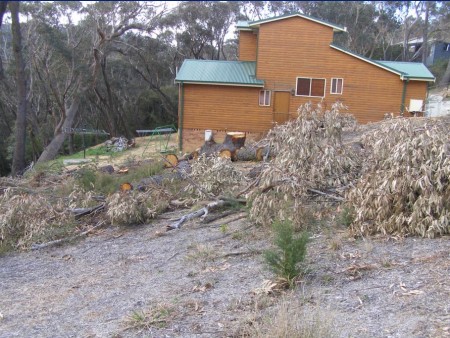
Not so long ago, Blue Mountains Council approved this cypress pine cottage be built in/abutting thick timbered bushland on a west facing slope downwind of the prevaling westerly winds.
Bushfire risk mapping rated the site as ‘extreme’ bushfire risk, yet the cypress pine cottage got built. The builder/developer has long since profited and so moved on, leaving behind a bushfire vulnerable cottage on a site that should never have been built on in the first place.
But try telling a pro-development council that a property owner can’t develop his/her land!
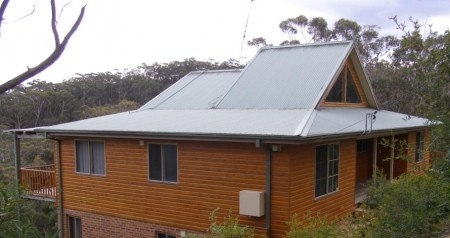 The cypress pine cottage, 2008
. The cypress pine cottage, 2008
.
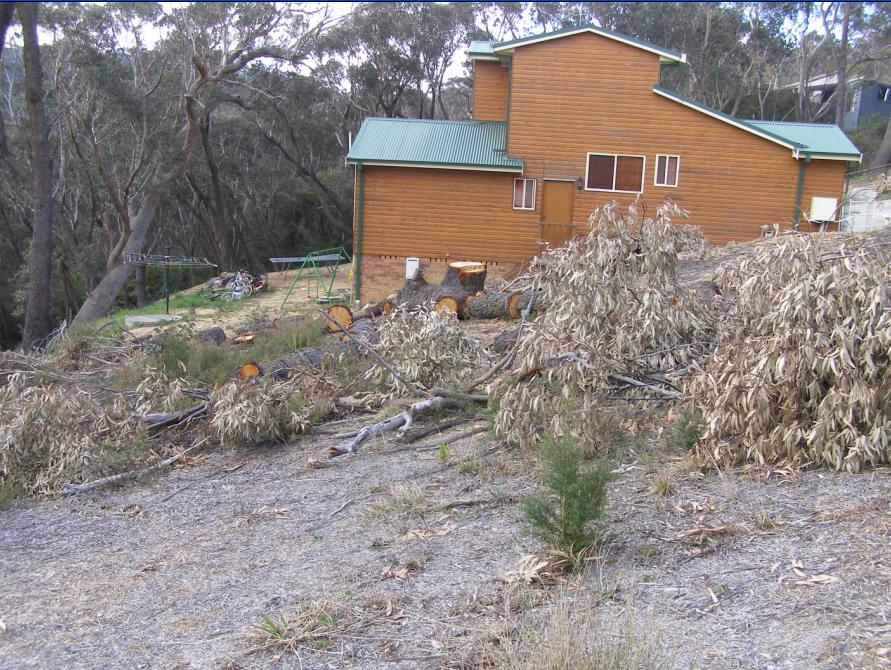
The site was purchased in/abutting dense wooded bushland, which was slashed and bulldozed. Down from the house, around a dozen mature native trees were chainsawed to provide for escarpment views to the west.
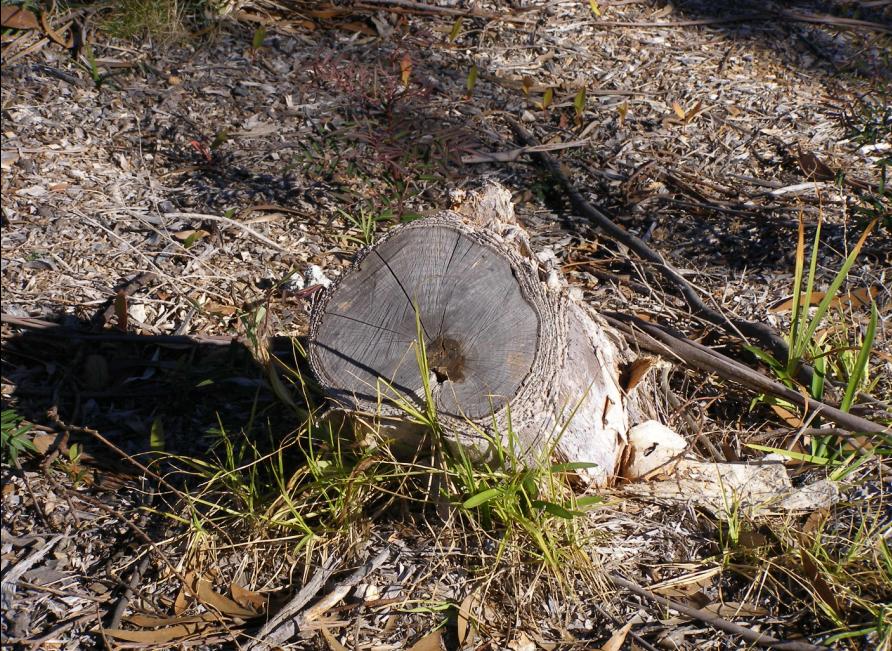
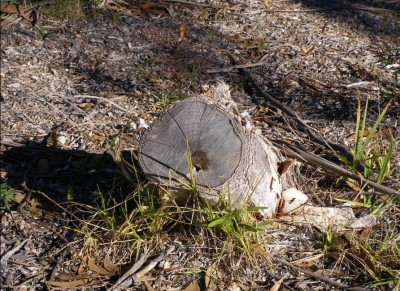 One of the chainsawed native trees
. One of the chainsawed native trees
.
The property has since been sold. Yet, the issue of a cypress clad cottage being approved in extreme fire risk bushland was raised with Blue Mountains Council’s senior development officer, Lee Morgan, on 25-Feb-2009 (Council ref. Customer Service Request #106889). But there was no response.
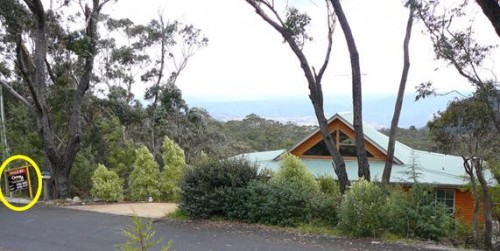 The cottage was sold in 2008…with views
…less the dozen chainsawed Eucalypts to make way for the views. The cottage was sold in 2008…with views
…less the dozen chainsawed Eucalypts to make way for the views.
.
It is typical of Blue Mountains Council’s planning approvals that they encourage development encroachment on the fringe bushland which separates the Blue Mountains National Park from the townships of the Central Blue Mountains.
 A nearby cottage of remarkably similar cypress pine cladding
has surrounding trees chainsawed and the vegetation slashed to bare earth. A nearby cottage of remarkably similar cypress pine cladding
has surrounding trees chainsawed and the vegetation slashed to bare earth.
.
.
Then comes the ‘hazard’ reduction
.
Housing development encroachment is being wedged deeper into fringe bushland, closer to the Blue Mountains National Park, many seeking the profit that escarpment views bring. The sites are indefensible against bushfire. Many are zoned extreme bushfire risk, yet these bush houses received Council building approval.
The Rural Fire Service (RFS) calls for hazard reduction because, with just its truck resources, it would not have access to defend these houses in the event of a serious bushfire. Co-incidentally, the property owners (developers) now cry for RFS hazard reduction to protect their ‘assets’ from the risk of bushfire. Co-incidentally, many property owners (developers) in the vicinity who have these new bush houses do the same.
Of course, to the fire-lighting cult, this is music to their ears and so the Rural Fire Service in cohorts with Blue Mountains Council rustled up a hazard reduction certificate. In September 2008, Blue Mountains Council’s Bushfire Technical Officer, Peter Belshaw, issued a Hazard Reduction Certificate for over 11 hectares of bushland and escarpment heath across Bonnie Doon Reserve to be burnt under a ‘hazard’ reduction programme. Click on image below for details.
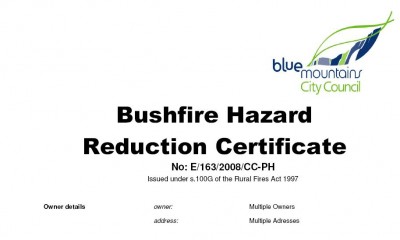 Click image to open PDF document Click image to open PDF document
.
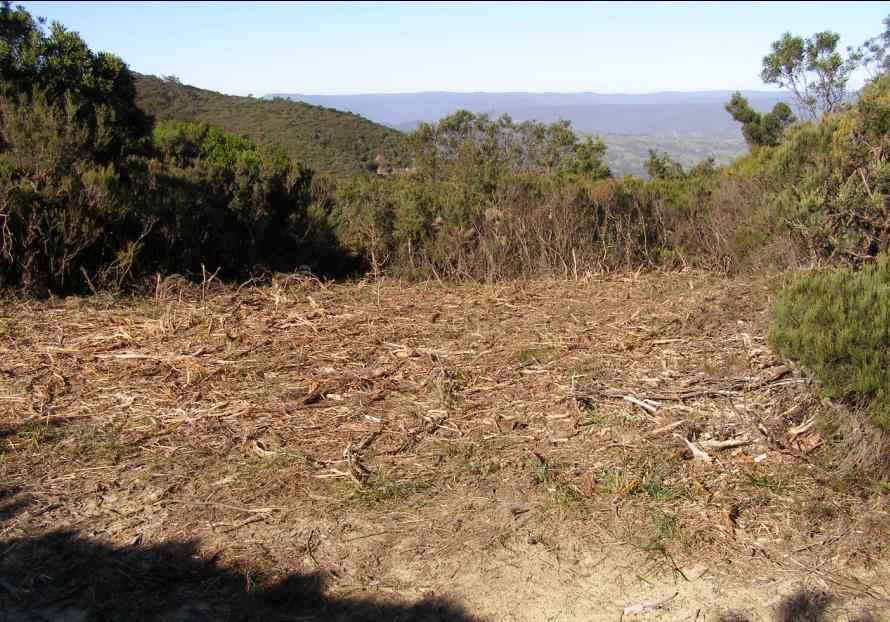
Earlier that year in mid February (2008), some seven months prior, slashing of heathland and a watercourse had been carried out by a Rural Fire Service contractor in preparation for the hazard reduction burning ~ the fire-lighters just couldn’t wait.
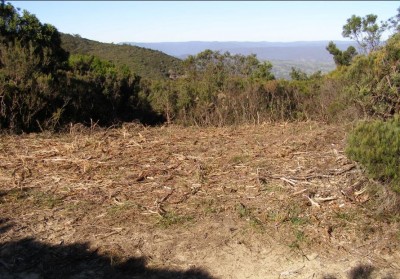 Blue Mountains escarpment is slashed by the RFS, a kilometre west of the cottage site. Blue Mountains escarpment is slashed by the RFS, a kilometre west of the cottage site.
.
.
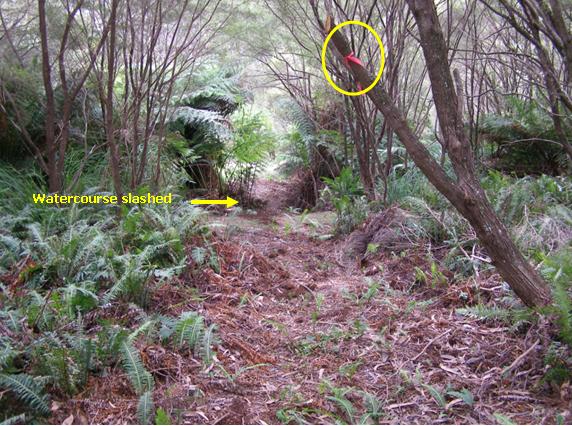
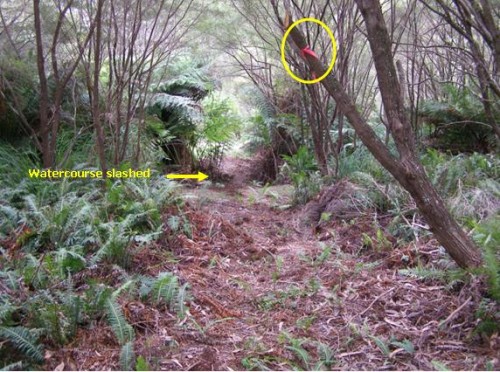 The RFS contractor slashed a trail for over 700m through heathland and through a riparian zone,
even before the Hazard Reduction Certificate was issued.
.
The RFS contractor slashed a trail for over 700m through heathland and through a riparian zone,
even before the Hazard Reduction Certificate was issued.
.
Then comes the intense HR burning:
.
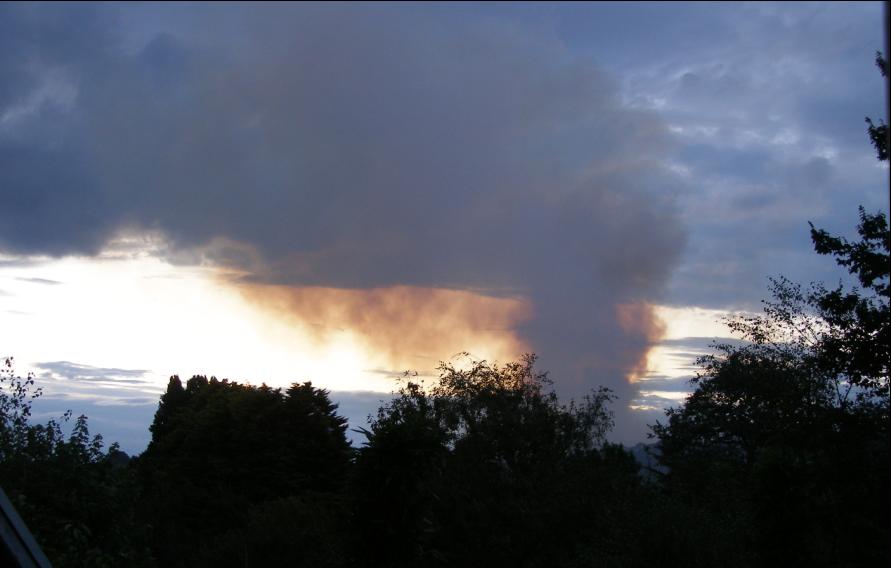
Three years hence, mid afternoon on Friday 11th February 2011, smoke can be smelt and seen rising to the west on the horizon near Bonnie Doon Reserve. A call to emergency ‘000’ confirms that it is not a bushfire, but that official hazard reduction operations are underway. It is still well within the bushfire risk season.
.
Bonnie Doon Reserve is a natural wild area of about 22 hectares that includes a mix of bushland, heathland and upland swamp situated on the Blue Mountains escarpment at the western fringe of the township of Katoomba. It lies above Bonnie Doon Falls. The area is zoned ‘community land’ and ‘environmental protection’ and comes under the control and custodianship of the Blue Mountains Council. Bonnie Doon Reserve has a history of volunteer bushcare to conserve the still wild Blue Mountains escarpment habitat. The reserve is immediately upstream of the endangered Dwarf Mountain Pine (Microstrobos fitzgeraldii) and Leionema lachnaeoides (yellow flowering shrub) found almost nowhere else on the planet. The habitat conservation of both species, particularly the exclusion of fire are considered critical to their survival as a species.
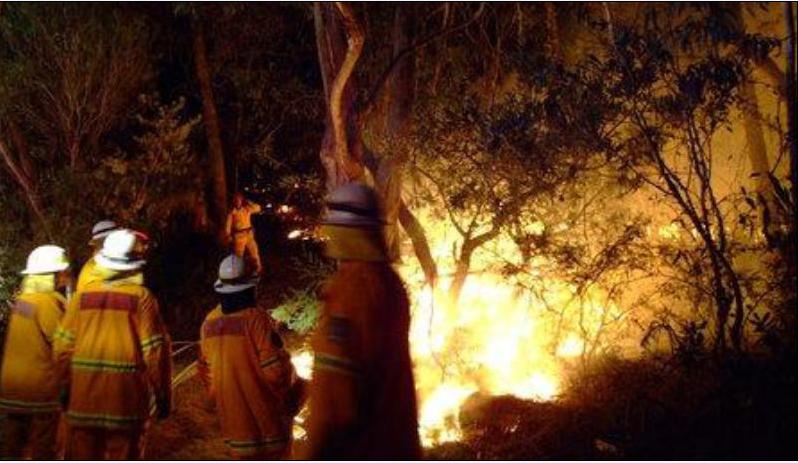
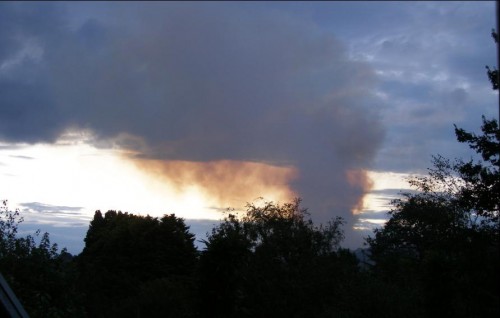 The ‘hazard’ reduction (HR) burning commences The ‘hazard’ reduction (HR) burning commences
.
From a distance of about two kilometres, I can see the smoke billowing strongly and its lasts for over two hours. The direction of the smoke places it around Bonnie Doon Reserve. The strength and density of the smoke indicates that it is more than light burning of ground cover. It is an intense but localised fire.
.
The aftermath of the burning:
.
We have our suspicions, but with other commitments we can’t get around there for some time to investigate the location affected to determine the scale and severity of the burning. In fact it isn’t until nearly three months later on Sunday 1st May 2011, that we inspect the burnt site. The fire was localised.
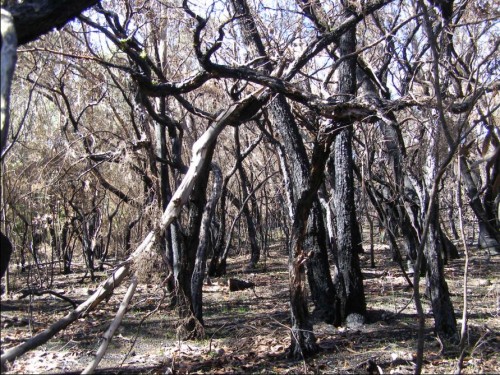 The aftermath
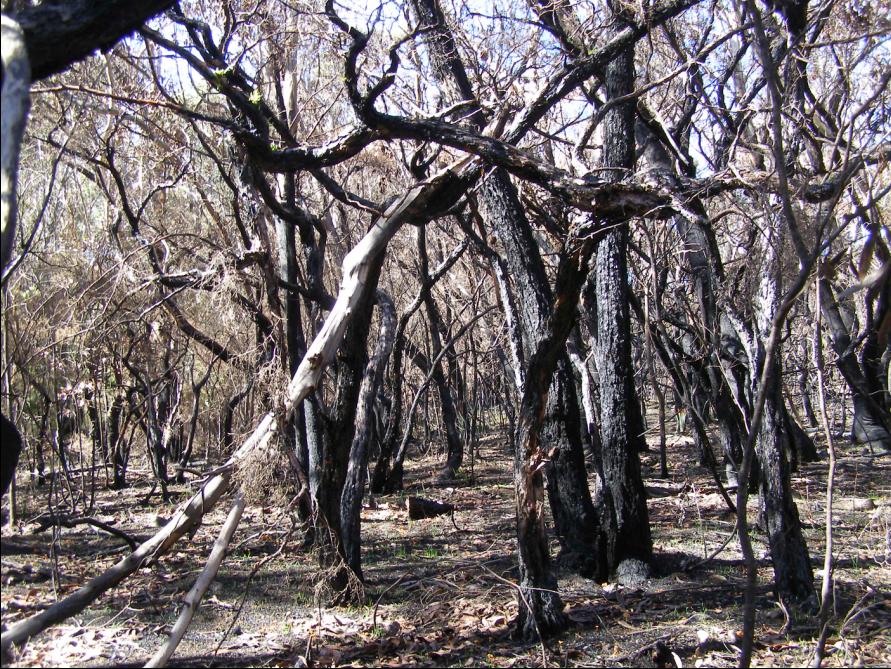
Three months on, evidence of more than just ground-cover has been burnt.
Deliberate intense burning has been allowed to penetrate deep into mature Eucalypts The aftermath
Three months on, evidence of more than just ground-cover has been burnt.
Deliberate intense burning has been allowed to penetrate deep into mature Eucalypts
.
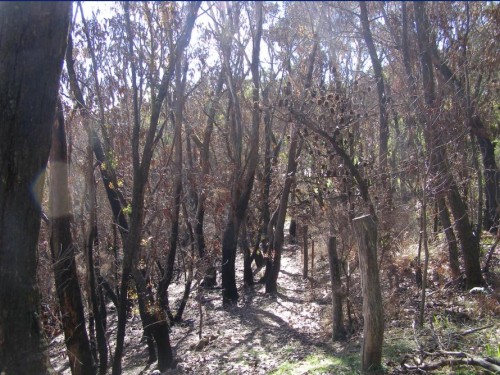
.
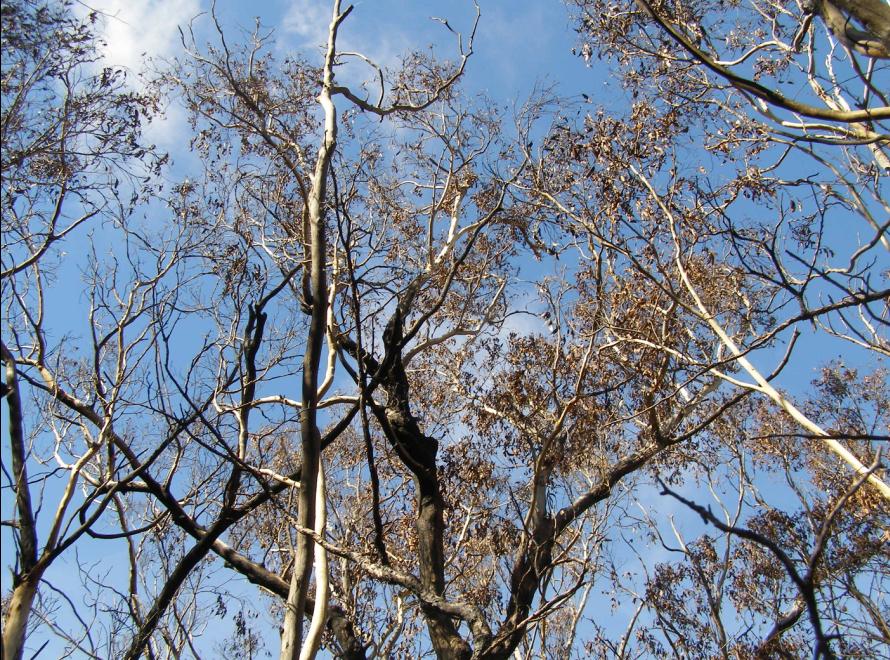
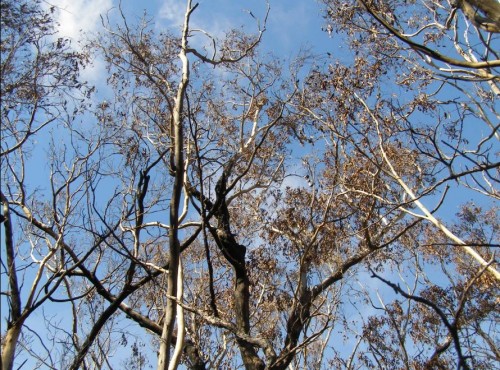 The fire was so intense that the flames reached into the tree canopy.
It must have been a blaze and half for RFS fire-lighters. The fire was so intense that the flames reached into the tree canopy.
It must have been a blaze and half for RFS fire-lighters.
.
.
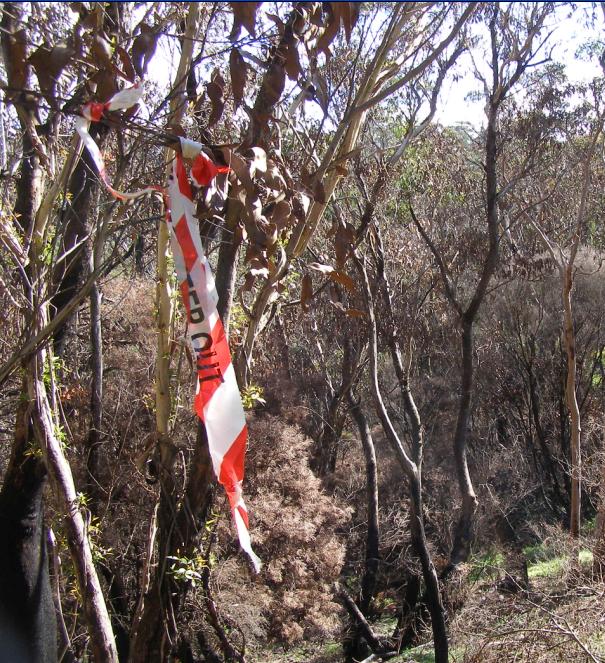
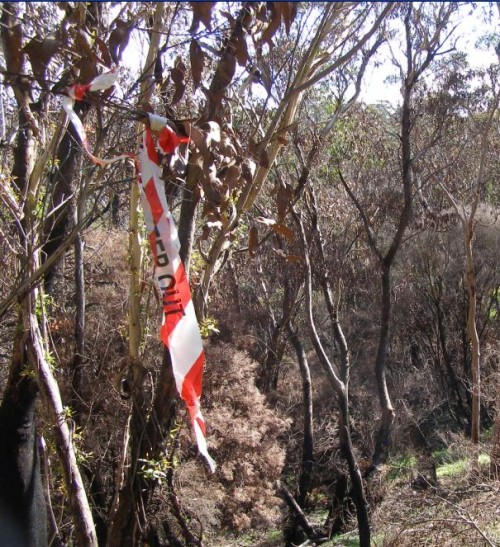 RFS telltale
. RFS telltale
.
The fire was indeed localised. It is very clear, still three months on, that this ‘hazard’ reduction burn had specifically targeted the native bushland surrounding the cypress cottage – an area of perhaps two hectares.
Consequence:
So not only has the developer of the cottage site completely destroyed the bushland on the site, but he has succeeded in having an additional two hectares burnt in the process all associated with the one cottage. Council’s initial approval of the cottage construction has directly led to the destruction of two hectares of what began as intact native bushland. The developer has profited from the bush, but in the process the ecological cost has been ignored ~ it is a perpetuation of a 19th and 20th Century single bottom line exploitation of the natural environment. It is happening across the Blue Mountains and being encouraged by Blue Mountains Council rules, practices and attitudes.
.
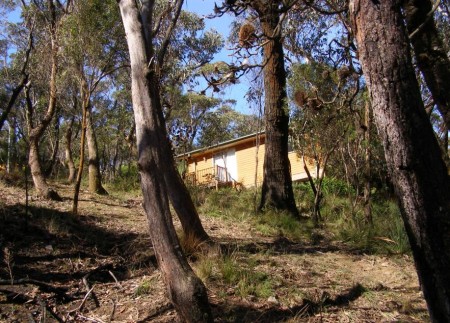 The cottage relative to the HR burn (aftermath) The cottage relative to the HR burn (aftermath)
.
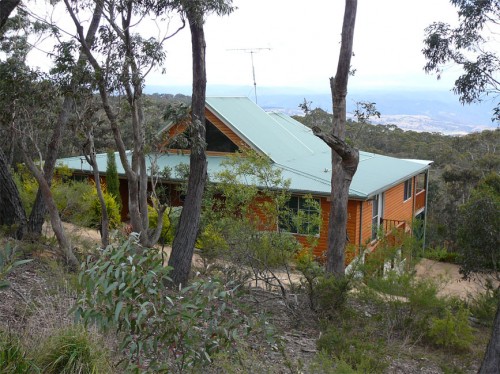
The cottage now with great views, plus an extra 2 hectares of cleared bush done cheap
Blue Mountains (city) Council making bushland-fringe development cheap
.
The ‘hazard’ reduction certificate process has become an insidious part of the development process across the Blue Mountains. The catalyst that is Council’s lax bushland protection zoning, is facilitating fringe deforestation. The combination of Council’s housing approvals on bush blocks with its ‘hazard’ reduction approvals have become a self-perpetuating twin mechanism for incremental encroachment into Blue Mountains fringe bushland, and it shows no sign of stopping.
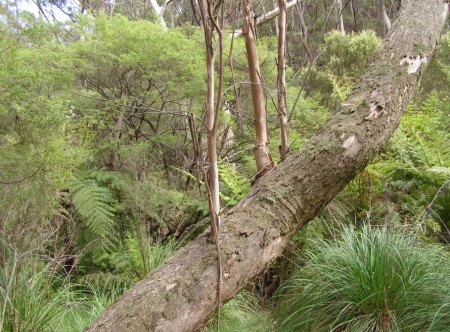 Bushland habitat at Bonnie Doon at risk of further burning Bushland habitat at Bonnie Doon at risk of further burning
.
Hazard reduction has become a cosy win-win-win-win outcome for all collaborators: (1) the builder/developer who profits, (2) the real-estate agent who get the sales commission (first when the bush block is sold, then again when the house is sold with views), (3) Council which earns developer charges in the short term and an expanded rate revenue base over the long-term, and (4) the RFS fire lighters who have become more adept and occupied lighting bushfires than putting them out.
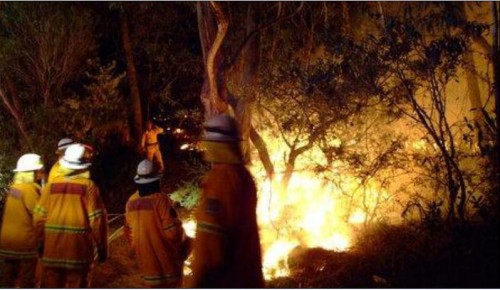 Fire-lighters look on during the Hazard Reduction Burn, Bonnie Doon Reserve Fire-lighters look on during the Hazard Reduction Burn, Bonnie Doon Reserve
.
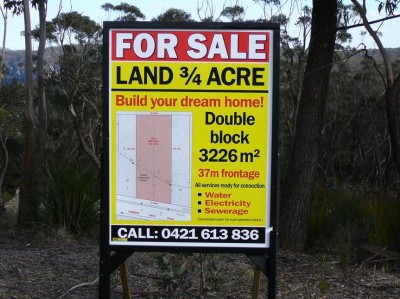
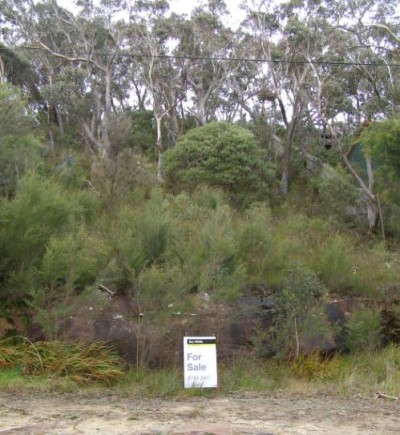 More bushland for sale
~ a ‘lose-lose’ outcome for native habitat and the remnant disappearing wildlife is supports.
More bushland for sale
~ a ‘lose-lose’ outcome for native habitat and the remnant disappearing wildlife is supports.
.
An harbinger of more burning for Bonnie Doon:
.
Of the eleven odd hectares of the 22 ha Bonnie Doon Reserve targeted by the RFS for slashing and burning on the hazard reduction certificate, nine hectares of bushland and escarpment heathland still stands to be burnt, which could happen anytime.
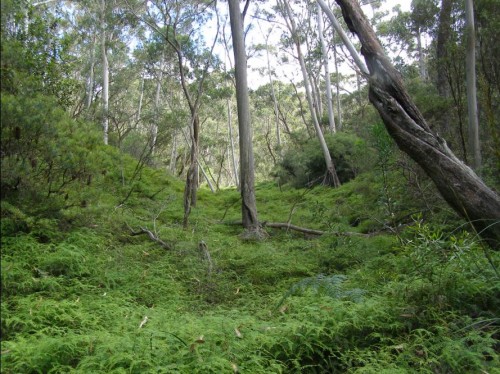 Bonnie Doon Reserve
on the western fringe of Katoomba township Bonnie Doon Reserve
on the western fringe of Katoomba township
(click photo to enlarge)
(Photo by us, so free in public domain)
.
– end of article –
.
 Blue Mountains escarpment is slashed a kilometre west of the house site Blue Mountains escarpment is slashed a kilometre west of the house site
, in preparation for over 11 hectares of buring Bonnie Doon Reserve
Tags: Blue Mountains City Council, Blue Mountains National Park, Blue Mountains World Heritage Area, Bonnie Doon Reserve, bush block for sale, bush fringe development, bush profits, bushland housing, Dwarf Mountain Pine, extreme bushfire risk, hazard reduction, hazard reduction certificate, housing encroachment, Leionema lachnaeoides, Microstrobos fitzgeraldii, property development, real estate land sales, Rural Fire Service, slashing
Posted in Blue Mountains (AU), Threats from Bushfire, Threats from Deforestation, Threats from Development | No Comments »
Add this post to Del.icio.us - Digg
Tuesday, April 26th, 2011
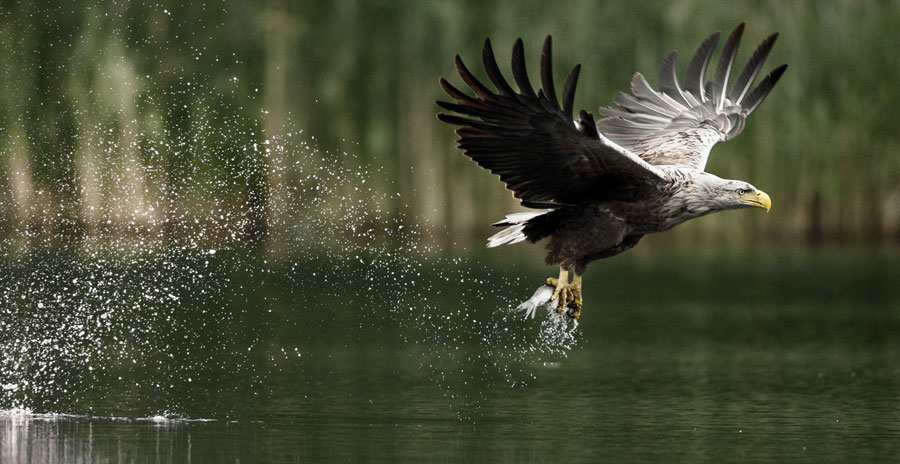
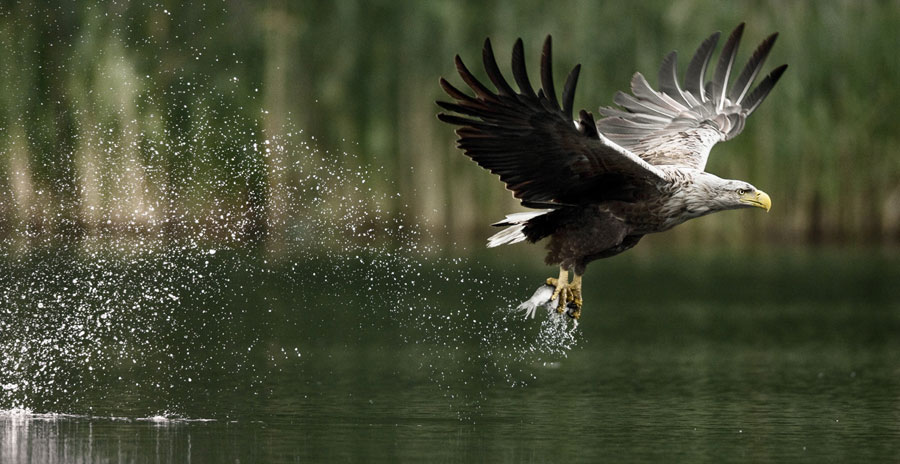
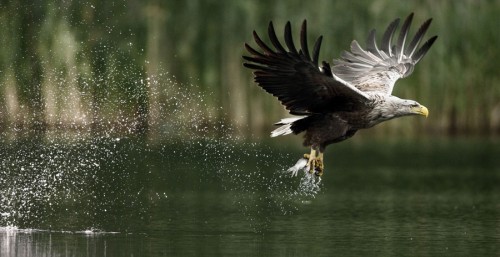 White-tailed Sea Eagle (Haliaeetus albicilla)
© Photo Terry Pickford
^http://raptorpolitics.org.uk/?p=502 (click photo to enlarge)
. White-tailed Sea Eagle (Haliaeetus albicilla)
© Photo Terry Pickford
^http://raptorpolitics.org.uk/?p=502 (click photo to enlarge)
.
.
‘Britain’s largest bird of prey, the white-tailed eagle or sea eagle, is a magnificent, if rare, sight in the wilder reaches of western Scotland.
This massive bird, the world’s fourth largest eagle, with a wingspan stretching 8 feet across, became extinct in Britain in 1918.
Sea eagles were wiped out in Britain due to excessive hunting and egg collection. The last native pair reproduced in 1916, and then there were no more. They were Britain’s largest bird of prey. In 1975 about 82 of the white-tailed eagles were reintroduced from other countries to the island of Rum, a small island off the coast of Scotland. The current human population is about 20, so the eagles should be relatively safe from poaching. Even though Rum is sparsely populated, the new eagles donated by Norway were released in a secret location.
Because of the reintroduction program and various conservation efforts, there are now 52 breeding pairs of the endangered eagles in Scotland. This year these adult eagles have produced about 46 hatchlings, which is a record for reproducing. Depending on the need, about twenty chicks each year are also being brought from Norway.
“I have no doubt that the successful reintroduction of this magnificent bird can continue, and along with the East Coast Sea Eagle Project, ensures that this species can establish territories right across Scotland, restoring a strong Scotland-wide population,” said Environment Minister Roseanna Cunningham. (Source: BBC) Read more: ^http://www.care2.com/greenliving/eagle-population-increasing-in-scotland.html#ixzz1Kbn4PYLe
.
Laws were changed during the 1950’s, which helped pave the way for two early attempts at reintroduction in Scotland. A full-scale reintroduction programme got underway on the island of Rum off the west coast of Scotland in 1975 with 82 birds taken from Norway.
The birds were released over a ten-year period and the first breeding success was recorded in 1985. A further 58 young Norwegian eagles were released onto the Scottish mainland and the first of these began to breed in 1998. In 2004, the population is thought to consist of around 80-90 individuals residing in 26 different territories. With the reintroduction programme now complete, Scottish sea eagles are entirely reliant upon Scottish bred young to continue the population. Sea eagles can now be seen on Mull, Skye and passing over many of the other western isles, although it is still a rarity.
Despite its protected status, sea eagles are still persecuted in Scotland. David Sexton, a The white-tailed eagle – also known as the sea eagle or white-tailed sea eagle – is a huge bird with broad wings up to 245 cm (over 8 feet) wide. White-tailed eagles became extinct in Britain in the early 1900s and despite a lengthy re-introduction scheme, their numbers in Scotland are still very low. The work to reintroduce the species has been hampered by the theft of eggs. This has led to local initiatives, such as Mull Eagle Watch, to help protect eagle nests.
[Source: Wildlife Scotland, ^http://wildlife.visitscotland.com/sitewide/featurerepos/sea_eagle/]
.
.
.
Habitat
The small population of white-tailed eagle in Britain is found only in the highlands and islands of the west of Scotland. Scottish white-tailed eagles prefer sheltered lochs or sea lochs rather than exposed coastal sites. They also prefer to nest in trees rather than on cliffs. On average, their territories range from 30 – 70 km2, but much larger territories are possible depending on the availability of prey. In Britain, white-tailed eagles are non-migratory. Breeding adults stay close to their breeding territory throughout the year. Non-breeding birds may range quite widely to find sufficient food.
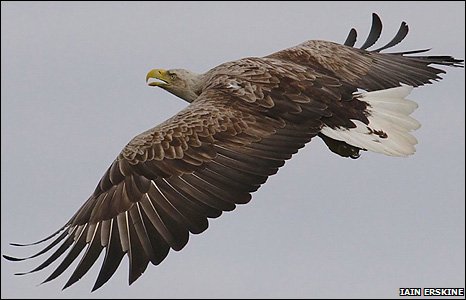 White-tailed Sea Eagle
^http://news.bbc.co.uk/2/hi/uk_news/scotland/glasgow_and_west/8465271.stm
White-tailed Sea Eagle
^http://news.bbc.co.uk/2/hi/uk_news/scotland/glasgow_and_west/8465271.stm
.
.
Threats
White-tailed eagles have no natural predators in Britain. The only threat to the bird’s continued re-colonisation in Scotland is from human activity, by poisoning or stealing eggs, and from degradation of habitat and food resources.
Royal Society for the protection of birds (RSPB) officer based on the Island of Mull explains:
.
“An adult was poisoned in the Highlands in 2003. Its mate died the same way in 2002, so there are still problems for them. Egg collecting is still a threat but local community watches and the police operation against nest robbers – Operation Easter – successfully kept it at bay in 2003.”
.
In total five birds have been killed since the reintroductions began.
.
[Source: ^http://www.forestry.gov.uk/forestry/white-tailedeagle]
‘The last recorded native white-tailed eagle in Britain was a rare albino (all-white) eagle that was shot in Shetland in 1917.’
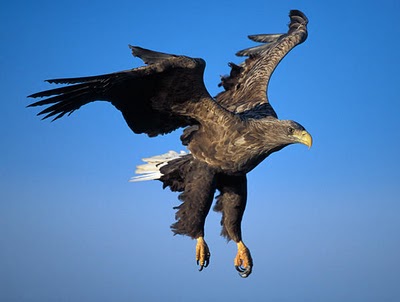 White-tailed Sea Eagle
[Source: ^http://bishopstownhc.blogspot.com/2010/01/bhc-members-spot-white-tailed-sea-eagle.html]
White-tailed Sea Eagle
[Source: ^http://bishopstownhc.blogspot.com/2010/01/bhc-members-spot-white-tailed-sea-eagle.html]
.
.
Sea eagles given more protection
[BBC, 23 March 11, ^http://www.bbc.co.uk/news/mobile/uk-scotland-12828674]
.
‘Sea eagles are to be given further protection in a new three-year scheme.
The £80,000 project involves Scottish Natural Heritage (SNH) working with farmers and crofters to help the birds throughout the areas where they breed.
Scotland’s sea eagle population has reached a record high since the birds were re-introduced on the Isle of Rum 36 years ago. But they are still considered to be rare with just 52 adult breeding pairs across the country.
Sea eagles lay up to three eggs in March with chicks leaving the nest in late July or August.
SNH will help to protect the birds, which usually nest in trees.
Stuart Housden, director of RSPB Scotland, said: “We are really pleased to have been involved in the development of workable measures that help support the conservation and management of these magnificent birds.”
The scheme will focus on agreements with farmers and crofters as well as promoting the birds potential for tourism.
Jonnie Hall, head of rural policy for NFU Scotland, said: “The aims and measures of the new scheme clearly reflect the inter-dependence of conservation and farming interests.”
An advisory panel will be set up to guide SNH on the key priorities. It hopes the scheme will be running by late spring or early summer.‘
.
.

White-tailed Sea Eagle
...
.
.
The Golden Eagle
.

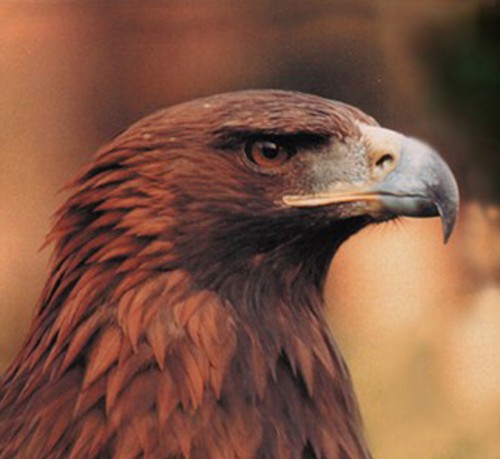 The Golden Eagle (Aquila chrysaetos)
^http://tohatchacrow.blogspot.com/2010/12/irish-farmers-suspected-in-another.html The Golden Eagle (Aquila chrysaetos)
^http://tohatchacrow.blogspot.com/2010/12/irish-farmers-suspected-in-another.html
.
.
.
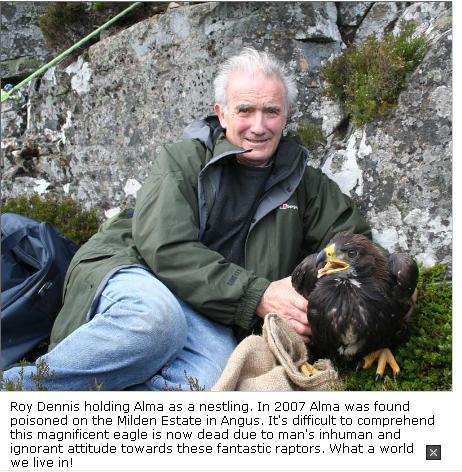
ALMA is dead – POISONED – 30th July 2009
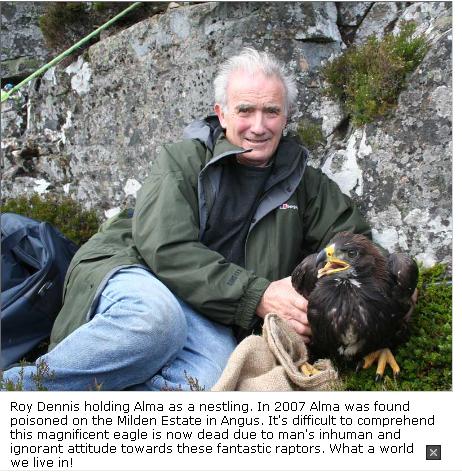
“I am truly appalled that yet another golden eagle has been illegally killed in Scotland – the second this summer.”
~ Scotland’s Environment Minister Roseanna Cunningham.
[^Read More]
“Another depressing example of the arrogant and outmoded attitude of some estate owners and their employees who treat the law with contempt, and break it with impunity. Their belief that land ownership gives them the right to use or abuse it as they see fit, and their dependency on the protection of ‘sport’ as a business, must be challenged.
Of course, the nature and remoteness of these businesses make them impossible to police effectively; but all the more reason to hand out exemplary sentences, including jail, when case are proven – not only to the keeper, but to the landlord.”
~ Alistair, 20090801.
.
.
.
Further Reading:
.
[1] Re-Introducing the White Tailed Eagle To Scotland, ^http://www.holidayscotland.org/re-introducing-the-white-tailed-eagle-to-scotland/
[2] Second Golden eagle found dead Poisoned in Scotland this year (2009), ^ http://raptorpolitics.org.uk/?p=502
[3] White-tailed Eagle Comeback Scheme for Scotland, ^ http://www.birdguides.com/webzine/article.asp?a=1045
[4] Secret release of 19 sea eagles in Scotland, ^ http://www.bbc.co.uk/news/uk-scotland-edinburgh-east-fife-11023724
[5] Young Sea Eagle numbers soaring in Scotland, ^ http://www.bbc.co.uk/news/uk-scotland-highlands-islands-11686816
[6] Sea eagles thriving on Isle of Mull, ^ http://news.bbc.co.uk/2/hi/uk_news/scotland/glasgow_and_west/8465271.stm
[7] Wikipedia ^ http://en.wikipedia.org/wiki/White-tailed_Eagle
[8] New Golden Eagle viewing scheme launched in Scotland, ^ http://www.wildlifeextra.com/go/news/golden-eagles_scotland.html
[9] The Golden Eagle Trust Ltd ^ http://www.goldeneagle.ie/
[10] Wikipedia ^ http://en.wikipedia.org/wiki/Golden_Eagle
(above websites accessed 20110426)
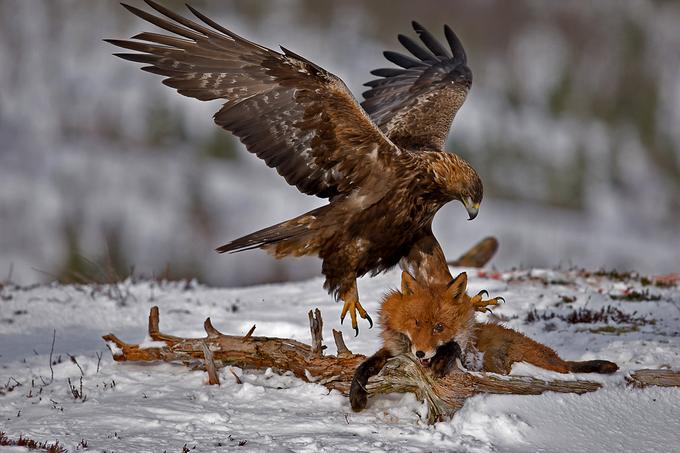
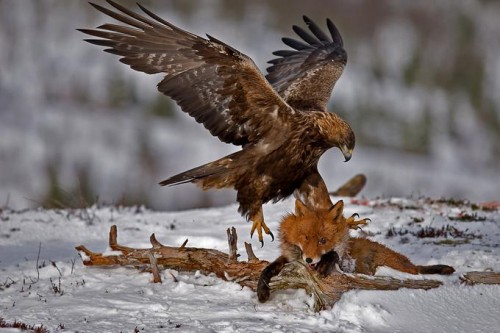 Golden Eagle
© Photo by Tom Elton
^http://naturfototomelton.blogspot.com/ Golden Eagle
© Photo by Tom Elton
^http://naturfototomelton.blogspot.com/
.
[end of article]
White-tailed Eagle
Tags: egg poaching, golden eagle, Isle of Rum, NFU Scotland, raptor persecution, Royal Society for the Protection of Birds, RSPB Scotland, Scottish Natural Heritage, Scottsh farmers poisoning eagles, sea eagle, Threats from Farming, white-tailed eagle, wildlife crime
Posted in 34 Wildlife Conservation!, Threats from Deforestation, Threats from Farming, Threats from Poaching and Poisoning | No Comments »
Add this post to Del.icio.us - Digg
Saturday, March 26th, 2011
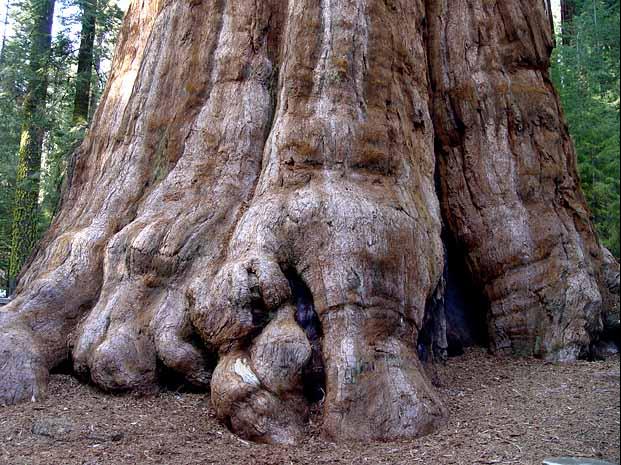
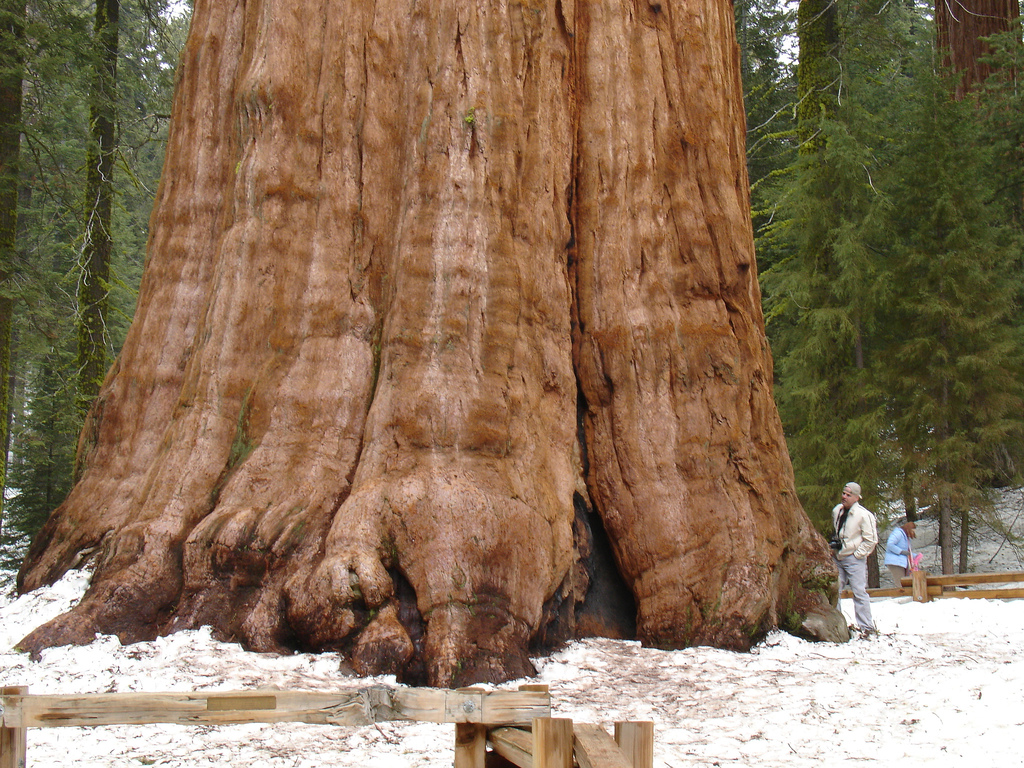
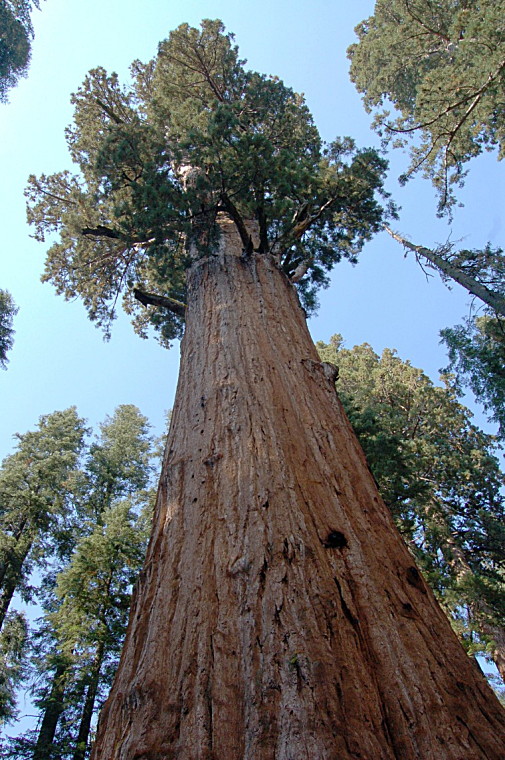
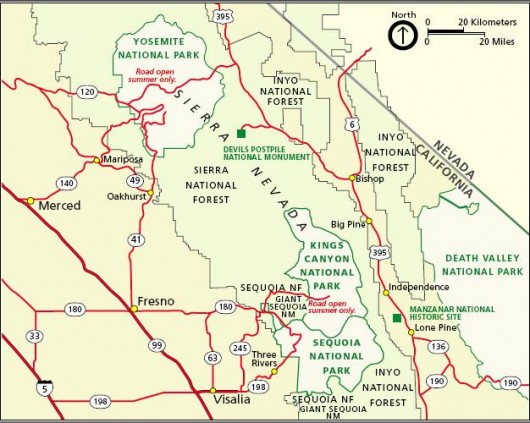
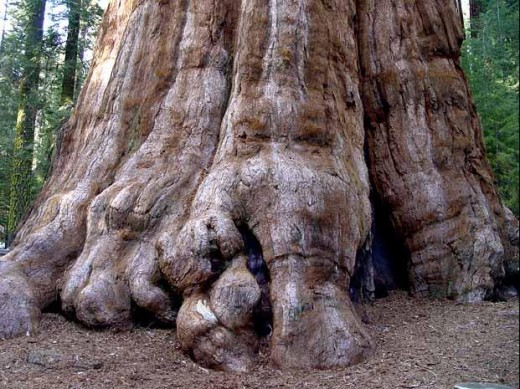 ‘General Sherman’ ~ just another sequoia? (pronounced ‘sequoya’)
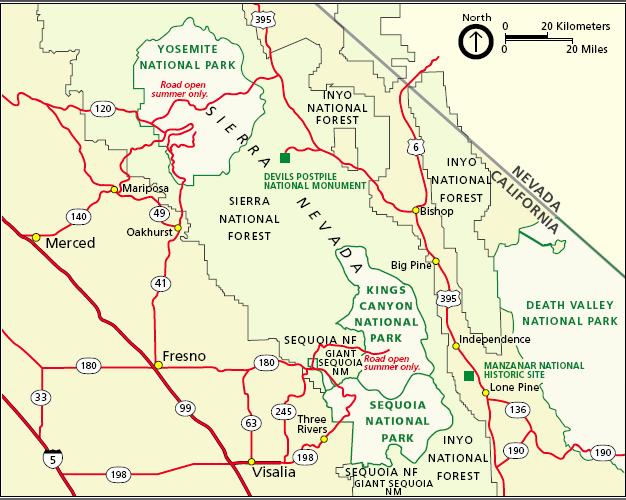
Sequoia & Kings Canyon, Sierra Nevada, California, USA
^http://www.nps.gov/seki/historyculture/gfgst.htm ‘General Sherman’ ~ just another sequoia? (pronounced ‘sequoya’)
Sequoia & Kings Canyon, Sierra Nevada, California, USA
^http://www.nps.gov/seki/historyculture/gfgst.htm
.
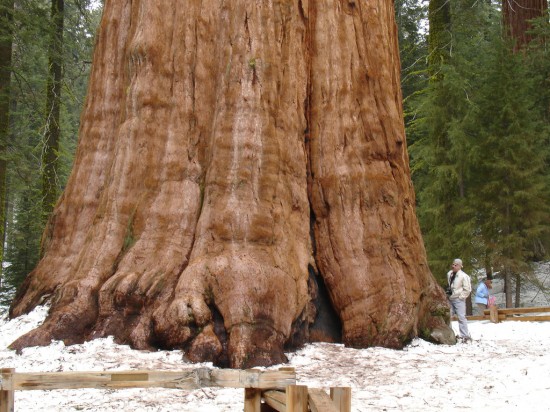 The General Sherman Tree
– the world’s largest tree, is the prime visitor attraction in the Giant Forest.
[Source: ^http://www.nps.gov/seki/historyculture/gfgst.htm]
. The General Sherman Tree
– the world’s largest tree, is the prime visitor attraction in the Giant Forest.
[Source: ^http://www.nps.gov/seki/historyculture/gfgst.htm]
.
“Sequoia sempervirens’ common names include coast redwood, California redwood, and giant redwood. It is an evergreen, long-lived, monoecious tree living 1200–1800 years or more. This species includes the (current) tallest trees on Earth, reaching up to 379 feet (115.52 m) in height and up to 26 feet (7.9 m) diameter at breast height. Before commercial logging and clearing began by the 1850s, this massive tree occurred naturally in an estimated 2.1 million acres along much of coastal California (excluding southern California where rainfall is not abundant enough) and the southwestern corner of coastal Oregon within the United States.” [Source: ^Wikipedia – read more].
.
“The Sierra Nevada is still growing today. The mountains gain height during earthquakes on the east side of the range. But the mountains are being shortened by erosion almost as quickly as they grow. This erosion has deposited sediments thousands of feet thick on the floor of the San Joaquin Valley.”
[Source: ^http://www.nps.gov/seki/historyculture/gfgst.htm]
.
.
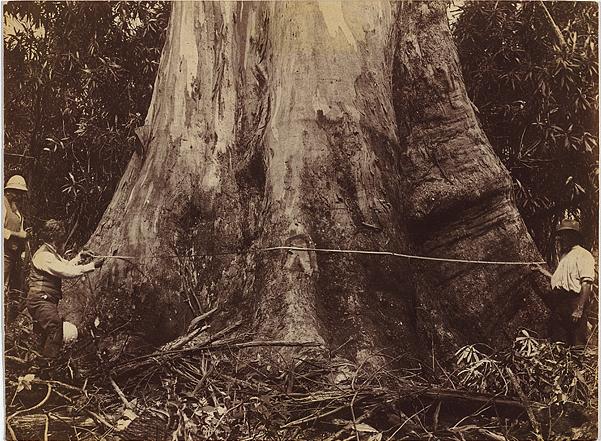
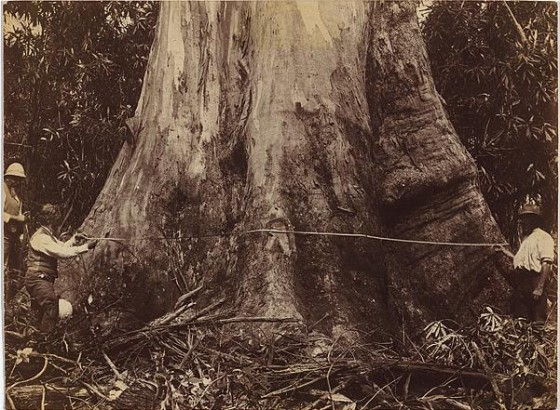 ‘Giant tree’ at Neerim (Gippsland, Victoria, Australia), forty feet girth c.1889
AUSTRALASIAN ART, Photo by Nicholas CAIRE, b.1837 Guernsey, United Kingdom – Australia d.1918[Gelatin silver photograph image 15.0 h x 20.2 w cm, Purchased 1983, Accession No: NGA 83.3083]
.
.
“The men shown here measuring the diameter of a giant eucalypt were not loggers or tree-lovers. They were attempting to determine whether Australian trees were bigger than the famed 400-foot giant redwoods of California. It was mostly national pride surrounding the Australian Centennial of European settlement which motivated scientists and photographers in the 1880s to seek out the remaining giant trees in the more remote areas of Victoria. The Americans claimed that their redwoods were the greatest because of their combined height and girth. In the dense Australian bush, it
was easier to measure the girth than the height and presented a much more dramatic image for a photograph.
.
The general public followed the giant tree debate in the papers and also purchased photographs of them and other idyllic bush scenes. By the late 19th century, the Australian population mostly lived and worked in the cities. They became day-trippers and used the new railway networks to take their recreation in the bush. Nicholas Caire, one of the most active photographers to seek out and record the giant trees, travelled over a number of years on the new rail line to Neerim town reserve.
.
Australia’s giant trees were widely depicted in colonial art as mighty symbols of the pre-settlement and pioneer era. Caire, whilst accepting the desirability of logging and urban development, was also one of those who argued for the preservation of examples for future generations.
.
Most of the awesome giant trees were felled or burnt in his lifetime. Now they are preserved only in photographs.” ‘Giant tree’ at Neerim (Gippsland, Victoria, Australia), forty feet girth c.1889
AUSTRALASIAN ART, Photo by Nicholas CAIRE, b.1837 Guernsey, United Kingdom – Australia d.1918[Gelatin silver photograph image 15.0 h x 20.2 w cm, Purchased 1983, Accession No: NGA 83.3083]
.
.
“The men shown here measuring the diameter of a giant eucalypt were not loggers or tree-lovers. They were attempting to determine whether Australian trees were bigger than the famed 400-foot giant redwoods of California. It was mostly national pride surrounding the Australian Centennial of European settlement which motivated scientists and photographers in the 1880s to seek out the remaining giant trees in the more remote areas of Victoria. The Americans claimed that their redwoods were the greatest because of their combined height and girth. In the dense Australian bush, it
was easier to measure the girth than the height and presented a much more dramatic image for a photograph.
.
The general public followed the giant tree debate in the papers and also purchased photographs of them and other idyllic bush scenes. By the late 19th century, the Australian population mostly lived and worked in the cities. They became day-trippers and used the new railway networks to take their recreation in the bush. Nicholas Caire, one of the most active photographers to seek out and record the giant trees, travelled over a number of years on the new rail line to Neerim town reserve.
.
Australia’s giant trees were widely depicted in colonial art as mighty symbols of the pre-settlement and pioneer era. Caire, whilst accepting the desirability of logging and urban development, was also one of those who argued for the preservation of examples for future generations.
.
Most of the awesome giant trees were felled or burnt in his lifetime. Now they are preserved only in photographs.”
~Anne O’Hehir
.
Indeed…
“The largest tree on Planet Earth is not the California Redwood, but the Mountain Ash (Eucalyptus regnans). The largest trees ever recorded were located in southern Australia near present day Melbourne. The world’s largest tree was the Ferguson Tree at over 500 feet (154m). It was measured by Surveyor Ferguson in 1872 in the Watts River Catchment near Healesville.”
Read More: Click: http://www.baddevelopers.green.net.au/Docs/talltrees.htm
.
Source: Text © National Gallery of Australia, Canberra 2010, Anne Gray (ed), Australian art in the National Gallery of Australia, National Gallery of Australia, Canberra, 2002, http://cs.nga.gov.au/Detail-LRG.cfm?IRN=106546&View=LRG
.
.
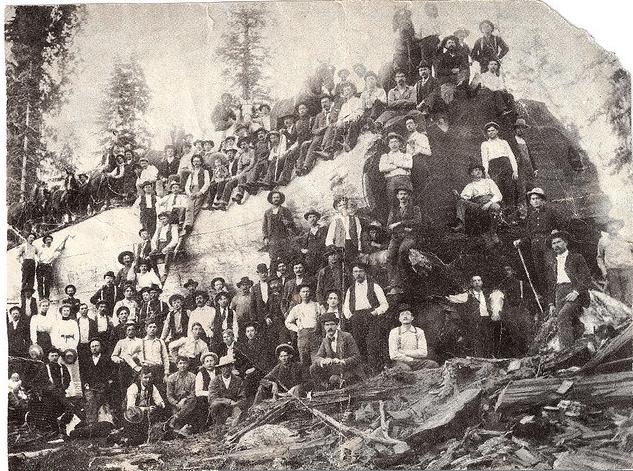
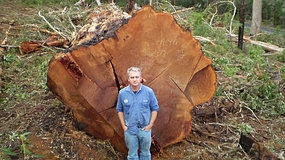
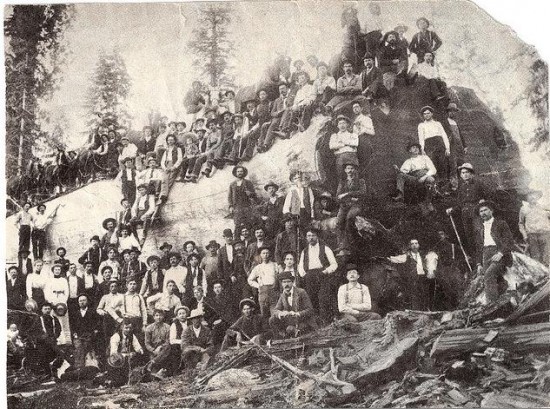 People and Horses on a Gigantic Redwood Log; about 1900.
“This photo is open for down loading for anyone wishing a free copy. Unknown Photo History. I’m fairly certain the tree was a Coast Redwood (Sequoia semperviren) or a Giant Sequoia (Sequoiadendron giganteum) from Central to Northern California or Oregon. I wish this one was still standing. The bark has already been stripped off of it.” [Source: Photo of old photo by David Foster, http://www.flickr.com/photos/21734563@N04/2225069096/] People and Horses on a Gigantic Redwood Log; about 1900.
“This photo is open for down loading for anyone wishing a free copy. Unknown Photo History. I’m fairly certain the tree was a Coast Redwood (Sequoia semperviren) or a Giant Sequoia (Sequoiadendron giganteum) from Central to Northern California or Oregon. I wish this one was still standing. The bark has already been stripped off of it.” [Source: Photo of old photo by David Foster, http://www.flickr.com/photos/21734563@N04/2225069096/]
.
.
Editor’s Comment:
I empathise with David Foster. – ‘I wish this one was still standing‘. Every face in this 1900 photo conveys cultural achievement and exploitative pride.
Now in 2011, has human attitude and on-ground impact toward ‘Old Growth’ really changed any?
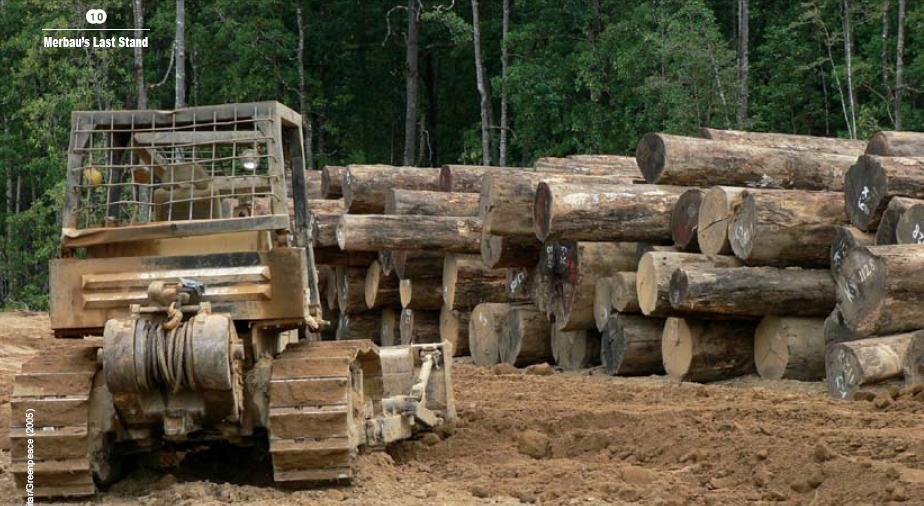
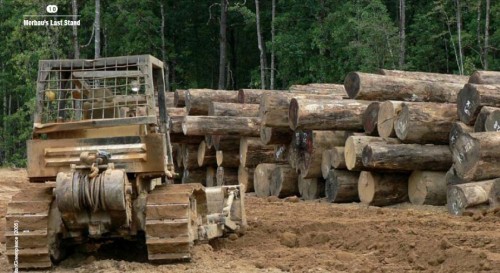
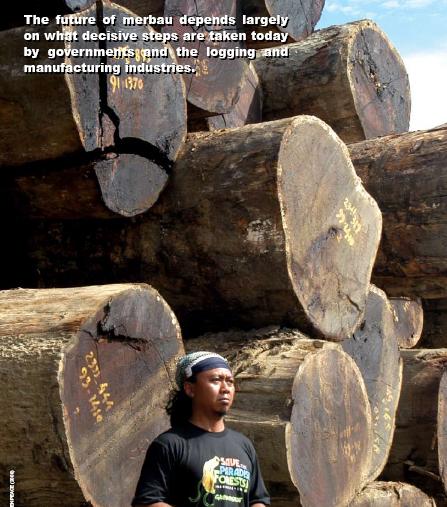
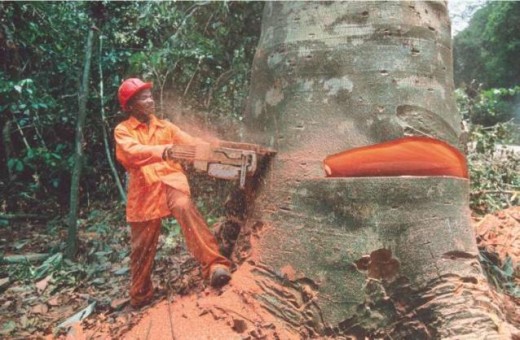
Consider ‘Merbau’ timber, readily available from local timber yards across Australia and in New Zealand as ‘Kwila’ (Botanical names: Intsia bijuga and Intsia palembanica). Comparable old-growth rainforest hardwoods include Narra, Yakal, and Ipil. These old growth giants continually to be currently logged illegally deep in rain forests of the Philippines, Solomon Islands, Fiji and Papua New Guinea. Australian and New Zealand households profit from SE Asian rain forest destruction.
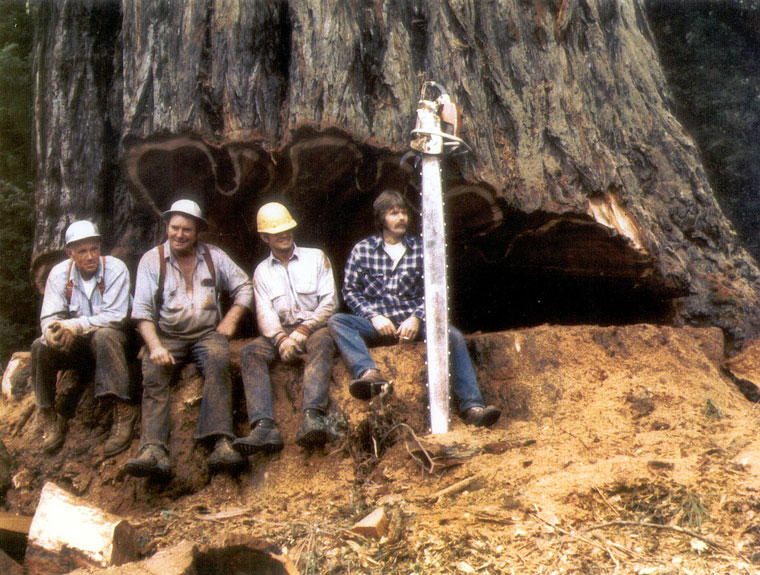
The lost natural assets of giant trees, of old growth have diminished the Earth, and have diminished the value of humanity, and of humanity’s value to the Earth. To forest habitat we are but marauders and rapists.
Humanity has become ‘Earth’s Pathogen’.
.
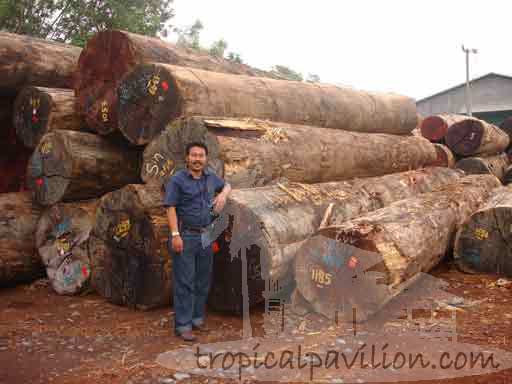 . .
 SE Asia old growth Rainforest Kwila is marketed in Australia and New Zealand as ‘Merbau’
for use mainly in flooring and decking,because of its relative hardness (high Janka rating) and long term stability. SE Asia old growth Rainforest Kwila is marketed in Australia and New Zealand as ‘Merbau’
for use mainly in flooring and decking,because of its relative hardness (high Janka rating) and long term stability.
.
.
.
.
Rimbunan Hijau Group of Companies
.
“Malaysia’s largest timber group is Rimbunan Hijau (“Forever Green”) (Forbes, 1995). It has timber concessions in Sarawak of around 800,000 hectares (FT,1994), dominates Papua New Guinea’s forestry sector and has forestry interests in New Zealand and China, as well as diversifying into other activities such as the ownership of newspapers in Malaysia and Papua New Guinea (AsiaMoney, 1995). Rimbunan Hijau also owns a 40% share in Limgang Trading Sdn., which has a 310,000 hectares concession in Sarawak (55% of Limbang is owned by Sarawak’s Minister for the Environment and Tourism, James Wong Kim Min) It is privately owned and controlled by one family, headed by Tiong Hiew King. The family are estimated to be worth about US$2.5 billion (Forbes, 1995).”
“Whilst it remains largely a private group of companies, whose operations are veiled in secrecy, the Tiong family has sought to obtain a more public face through the reverse take-over of Berjaya Textiles Bhd (now renamed Jaya Tiasa Holdings Bhd), giving it a listing on the Kuala Lumpur Stock Exchange (FT 1994). Its overseas logging operations appear to remain under the control of the private parts of the group and in Papua New Guinea it is the dominant player through control of a number of associate and subsidiary companies. There are recent rumours that Rimbunan Hijau group owns, or is in the process of acquiring, Primegroup Holdings, a British Virgin Islands registered company with logging interests in Guyana and Papua New Guinea. If this is true, then Rimbunan Hijau group’s international logging interests are, or will shortly become, even more extensive, both geographically and in terms of size. Apart from its logging activities, the company has interests in banking, newspapers and oil-palm plantations. One of Hiew King’s younger brothers is a member of the Malaysian Parliament. Despite the company’s political connections, it has been caught for tax evasion, the Asian Wall Street Journal reported.”
.
[Source: Greenpeace, 1997, http://archive.greenpeace.org/comms/97/forest/asian_companies_malaysia.html, accessed 20110325].
.
“Rimbunan Hijau is a Malaysian based global forest logger and controls around 60% of the forest industry in Papua New Guinea. Rimbunan Hijau is Logging vast areas of virgin PNG forest against national opinion and local customs which infringes on the traditional rights of indigenous resource owners.
- (It is) accused in PNG Government reports of gross human rights abuses, labor abuses, sexual abuses and illegal logging.
- Causing destruction of ancient natural forest and associated systems.
- Conducting broad scale industrial logging operations that infringe on the rights of local people to establish and exploit alternative economic opportunies.
- Is influencing political and other processes to gain and maintain a near monopoly on PNGs forest resources and avoid adequate scrutiny and monitoring of its operations.
- Rimbunan Hijau uses the media to promote its operations to the PNG public – Rimbunan Hijau already OWNS The National newspaper and LEGAL THREATS against their only competitor, the Post Courier, have left it wary of criticising Rimbunan Hijau. These have been the only two print media outlets since The Independent was closed down.”
.
[Source: http://www.forestnetwork.net/rhw/]
.
Rimbunan Hijau is ultimately 50% owned by the Boral “Group” of Australia and 50% by Caltex.
[Source: http://www.scribd.com/doc/24211537/2258-Christchurch-New]
.
…so when Australians and New Zealanders buy Merbau timber from local timber yards, hardward stores and furniture retailers – they are driving South East Asian old growth rainforest deforestation.
.
.
.
(The following article from The Guardian in February 2011 is by forests officer for WWF Indonesia, Jimmy Bond, based in West Kalimantan on the island of Borneo)
.
Complacency over deforestation pushes orang-utan closer to extinction
.
“Illegal logging and hunting continues despite legal protection, so the WWF is raising awareness to help save the orang-utan.
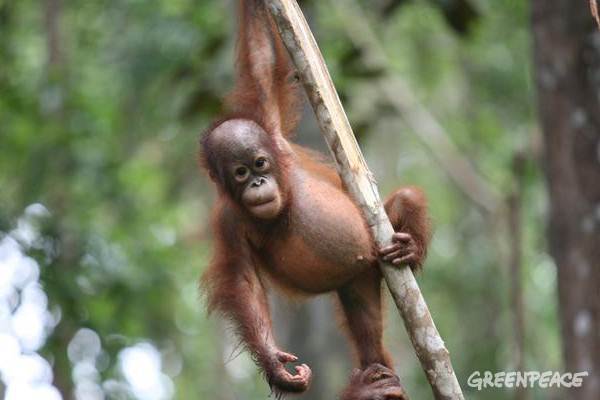
The destruction of the world’s rainforests continues at an alarming rate. Where I’m from in Borneo, illegal logging, coupled with hunting, is driving species such as the orang-utan ever closer towards extinction.
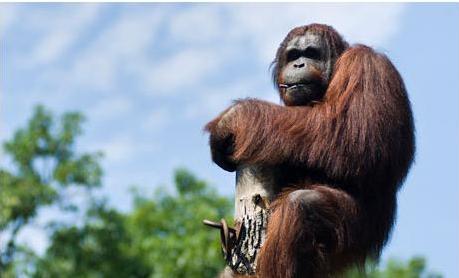 Borneo male orang-utan Wandoo.
There are fewer than 2,000 wild orangutans left in the West Kalimantan province, Indonesia.
©Photograph: Attila Balazs/epa/Corbis Borneo male orang-utan Wandoo.
There are fewer than 2,000 wild orangutans left in the West Kalimantan province, Indonesia.
©Photograph: Attila Balazs/epa/Corbis
.
There are three subspecies of orangutan in Borneo and we only have about 2,000 orangutans left in the wild in West Kalimantan province, and through deforestation and hunting their numbers continue to fall. Just last month I heard from villagers that some people are still killing and eating them even though they’re supposed to be protected by law.
I’ve just been travelling around the region in this part of Indonesia as I’ve been running a series of summer schools as part of a WWF awareness campaign to highlight the problems facing the orang-utan.
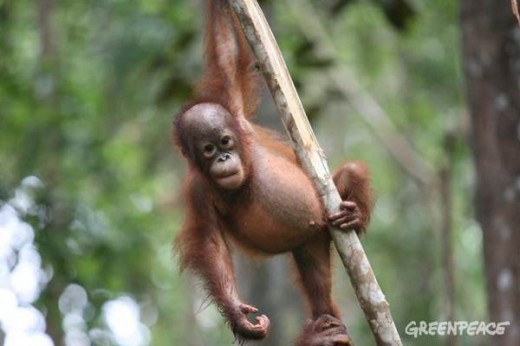
Over the past two years, the main focus for the campaign has been children because we’ve found it very difficult to change the minds and attitudes of older generations. We invite the kids to come along to these camps from nearby villages and at the last one more than 200 kids turned up. We do many different activities from drawing to tug-of-war competitions but the over-arching aim is to touch their hearts with stories about this wonderful creature and the rainforests in which they live. We want to leave them with the understanding that these unique creatures need protecting.
We’re also starting to join forces with local government officials and religious leaders to spread the message to communities that live in traditional longhouses. We tell them about a recent success story that acts as a warning against killing orang-utans. One trader in Pontianak, where I’m based, was recently jailed for two years for trading orang-utans.
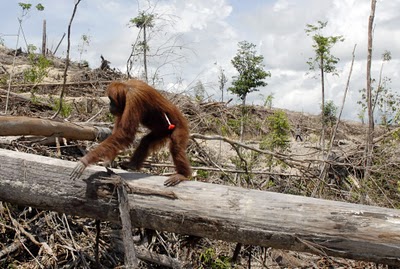
Such discussion also helps us talk about their habitats and the need to protect them too. In West Kalimantan from 1995, large-scale illegal logging cut through a forest corridor that linked two national parks where one of three subspecies of orang-utan (Pongo pygmaeus pygmaeus) lives. This meant they couldn’t migrate between the two areas and their numbers dropped significantly. This was made worse because the illegal loggers who came here to work also hunted meat from the forests and the orang-utans were in the firing line.
Over the past few years we’ve been trying to highlight these problems to the international media because some of the illegally logged timber was transported over the border to Malaysia where it is made into wood products that are shipped all over the world. Globally, we want people to become educated about where the timber that makes their furniture comes from and the harm it is doing to species and communities. When the forest disappears people no longer have access to food and medicines plus we have also seen more flooding as a result of deforestation. The international media focus also helps push our government to react because not so long ago they were doing nothing to help.
Recently, we’ve seen companies get permits from the government to develop palm oil plantations. But what’s worse is that the permits are just a smokescreen for the companies to get at the timber and leave without planting any palm oil.
So we’re working to make indigenous communities aware of this practice and the best way to do this is by bringing in others who have seen this happen on their land to warn them. If they are forewarned then they know not to allow it to happen to their own communities. These people need to have the forest in good condition because it’s not only home to different species, it’s also where they earn their livelihood.
Looking to the future, my big ambition is to set up an orang-utan rehabilitation centre here in West Kalimantan for subspecies Pongo pygmaeus pygmaeus. At the moment, orphaned babies are taken to other parts of the country where they are kept with the two other subspecies. I want them to be able to breed with their own kind otherwise they could die out. And I fear that if the orangutan disappears, the rainforest won’t last much longer either.”
[Source: The Guardian newspaper (UK) , http://www.guardian.co.uk/environment/blog/2011/feb/03/indonesia-deforestation-orangutan-extinction, accessed Feb 2011]
.
.
Further Reading
.
http://www.nps.gov/seki/historyculture/gfgst.htm
http://en.wikipedia.org/wiki/Intsia_bijuga
http://www.indonesianrainforest.org/irf-news/373-campaign-against-kwila-imports-continues-.html
http://rainforest-action.blogspot.com/2010/09/end-sales-of-kwila-timber-products.html
http://www.greenpeace.org/new-zealand/en/press/illegal-kwila-timber-imports-f/
http://www.info-ri.com/indonesia/rainforest-action-end-sales-of-kwila-timber-products/
http://www.robcousens.com.au/files/D512143129.pdf
http://www.dansson.com/kwila.htm
http://www.greenpeace.org/international/Global/international/planet-2/report/2008/7/merbau-report-2.pdf
Greenpeace, 1997, http://archive.greenpeace.org/comms/97/forest/asian_companies_malaysia.html
http://www.coolearth.org/306/whats-new-32/news-155/illegal-logging-threatening-malaysian-wildlife-453.html
http://www.wwf.org.my/media_and_information/wwf_position_statements/?5741
http://www.ewp.asn.au/certification/certificationcoc.html
http://www.forestnetwork.net/rhw/
http://www.atif.asn.au/
http://www.scribd.com/doc/24211537/2258-Christchurch-New
http://www.baddevelopers.green.net.au/Docs/talltrees.htm
The Guardian newspaper (UK) , http://www.guardian.co.uk/environment/blog/2011/feb/03/indonesia-deforestation-orangutan-extinction
.
 . .
Tags: Boral Group, Californian redwood, Caltex, commercial logging, deforestation, Earth's Pathogen, Eucalyptus regnans, Ferguson Tree, General Sherman Sequoia, Giant Forest, giant redwood, Guam, hallowed majesty, human pathogen, illegal logging, Intsia bijuga, Janka rating, Kalimantan, Kwila, Merbau, merbau flooring, Merbau's last stand, Narra, Neerim, old growth conservation, old growth forest, orang-utan, orang-utan extinction, Oregon, Primegroup Holdings, Rainforest Kwila, Rimbunan Hijau, San Joaquin Valley, Sarawak, Sequoia sempervirens, Sequoiadendron giganteum, Sierra Nevada, significant trees, world's largets tree, Yakal
Posted in 31 Old Growth Conservation!, Congo (CD), Kalimantan (ID), Sumatra (ID), Threats from Deforestation | No Comments »
Add this post to Del.icio.us - Digg
Friday, March 4th, 2011
 Gunns’ must really be loaded to commit $2.2 billion on a pulp mill in Tasmania’s Tamar Valley. Gunns’ must really be loaded to commit $2.2 billion on a pulp mill in Tasmania’s Tamar Valley.
Not many companies have that sort of money and certainly not in cash-strapped Tasy. But with access to so much financial capital, why waste it on 20th Century logging? Tasmania has so much economic potential using 21st Century thinking and think what a smart $2.2 billion could otherwise benefit Tasmania’s future, without 19th Century exploitation?

The money to build such a pulp mill has to come from somewhere and it appears Gunns’ may have found a financial joint venture backer in Finnish pulp giant, UPM-Kymmene Oyj.
[Source: ‘Finnish firm UPM eyes stake in Gunns pulp mill‘, by journalist Matthew Denholm, The Australian, 20110209].
Gunns tries to claim that it’s motive is all about forestry jobs for Tasmanians. But once UPM gets a foothold in Tasmania, check UPM’s record with jobs…
.
“In September 2008 UPM announced another cost reduction program that includes layoffs thousands of employees, and its Kajaani paper mill and Tervasaari pulp mill will be closed altogether. These will be the largest layoffs ever in Finland.
In March 2006 UPM announced a cost reduction program that includes layoffs approximately 3,600 employees, nearly 3,000 of those in Finland, and its Voikkaa paper mill in Kuusankoski was closed altogether. This was the largest single layoff ever in Finland. This is attributed[by whom?] to the worldwide overproduction of paper.
UPM announced the permanent closure of a large mill complex in Miramichi, New Brunswick on December 17 2007, citing economic pressures in the North American forest industry.”
[Source: http://en.wikipedia.org/wiki/UPM_%28company%29 ]
.
Greg L’Estrange, Gunns’ replacement CEO for John Gay since July 2009, seems to be tasked with getting the pulp mill up and running no matter what the cost, no matter what spin doctoring efforts are employed to secure government approval. Somehow his deal making has succeeded in government fast-tracking of the assessment process.
.
On 25th November 2010, Gunns released a statement to the Australian Stock Exchange stating that the pulp mill project remained on track. This is Gunn’s ‘do-or-die‘ single corporate strategy. It has no plan B. . L’Estrange’s initial ploy was to remove the motive driving Gunns’ key enemies. Gunns’ declared a moratorium on native forest logging across Tasmania. It was clearly a bid to secure Forestry Standard Certification, to comply with new Japanese buyer benchmarks; rather than any noble recognition of native forest conservation values.
.
Then L’Estrange concocted Gunn’s Forest Statement of Principles and armed with this did a secret forest peace deal late last year with local greenie groups. L’Estrange sold it as a new greener Gunns’ “working with environment groups to create a future without conflict.” Consistent with strategy, the ‘Tassie Talks’ deal it was all about quelling Tasmanian public dissent and he quickly branded the deal pivotal to the Tasmanian forest industry and ‘historic’. Be seen to be green! Whatever it takes! Except environmental groups deny they have given the green light to Gunns Tamar valley pulp mill by signing the deal.  There’s that greenwashing term again – ‘sustainable‘. It’s become an abused and hollow marketing euphemism really about corporate ‘financial viability‘ in the exploitation of natural resources. Such corporations shy from using the term ‘triple bottom line’ any more, because it is harder to promote when one is only focused on the bottom line. And there’s fresh water demand of the mill and the marine effluent it will spew, which L’Estrange has tried to allay concerns claiming new pulp bleaching technology promises to reduced toxic outflow of chlorine dioxide by some 40%. Despite the promise of ‘stricter controls’ an expected 64,000 tonnes of effluent will still be released by the pulp mill into Bass Strait daily. And it won’t harm marine life? There’s that greenwashing term again – ‘sustainable‘. It’s become an abused and hollow marketing euphemism really about corporate ‘financial viability‘ in the exploitation of natural resources. Such corporations shy from using the term ‘triple bottom line’ any more, because it is harder to promote when one is only focused on the bottom line. And there’s fresh water demand of the mill and the marine effluent it will spew, which L’Estrange has tried to allay concerns claiming new pulp bleaching technology promises to reduced toxic outflow of chlorine dioxide by some 40%. Despite the promise of ‘stricter controls’ an expected 64,000 tonnes of effluent will still be released by the pulp mill into Bass Strait daily. And it won’t harm marine life?
‘At its annual general meeting in November, Gunns told shareholders that modelling work showed the mill would have no impact on marine ecosystems, but Environment Tasmania said it was still concerned about the effect of up to 51 gigalitres a year of industrial effluent being discharged into the sea.’
[Source: ‘Promise of greener hue to pulp mill at final hour‘, 20110304]
.
Securing Gunns’ shareholder backing, L’Etrange at Gunns’ recent annual general meeting, drew a line in the sand claiming the moratorium on native forest logging (the greenie forest deal) was now conditional on the Tamar Valley pulp mill going ahead. If the greenies want to keep Tasmania’s native forests, they must agree on the pulp mill proceeding. The ‘Tassie Talks’ deal was always a loaded gunn deal.
“We believe that the development of the Bell Bay Pulp Mill will be the centrepiece of this strategy for the modern industry in Tasmania.”
[Source: ‘Pulp mill key, says Gunns‘, by journalist Sue Neales, 20101125]
.
Of course it’s all rather reminiscent of Gunn’s heavy-handed power playing under John Gay. The Gunns’ Board hasing changed; only its front man. This latest greenwashing approach is one of image rebranding and loaded deals, all the while Gunns’ pulp mill strategy remains on track. L’Estrange plays good cop while the pulp mill unswervingly looms as Tasmania’s big bad cop.
.
Tasmania’s natural heritage is Tasmania’s future… whether dead in a museum like its Thylacene or alive and precious…is ultimately an existence decision for local Tasmanians.
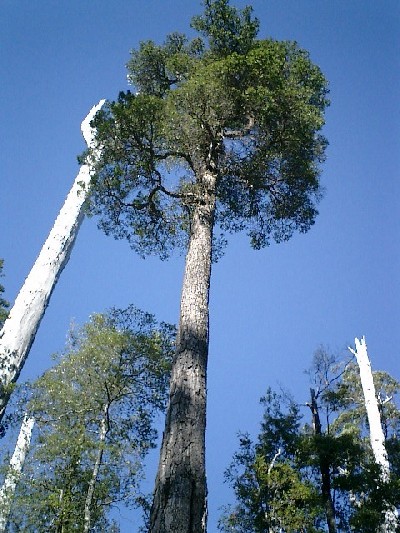 Tasmania’s unique Celery Top Pine
[Source: Veronica Tyquin, WARRA (long-term ecological research)
http://www.warra.com/warra/research_projects/research_project_WRA108.html] Tasmania’s unique Celery Top Pine
[Source: Veronica Tyquin, WARRA (long-term ecological research)
http://www.warra.com/warra/research_projects/research_project_WRA108.html]
.
.
Update News Friday 20110311: ‘Contentious pulp mill wins federal approval’
.
Yesterday L’Estrange must have earned his executive performance bonus following Labor’s federal Environment Minister, Tony Burke, announcing government approval for the pulp mill to proceed. L’Estrange’s comment was that the decision brought certainty for proposed investors in the pulp mill project, now estimated to cost $2.3 billion, pre-cost blowout, pre-government subsidies. (‘Contentious pulp mill wins federal approval’, SMH, 20110311)
.
Upon gaining the final three environmental permits Gunns needs for the mill, Gunns shares rose 5.88% to close at $0.63. (Finnewsnetwork.com.au, 20110311). Certainly a ‘sustainable’ result for L’Estrange.
Gunn’s pulp mill will perpetuate 20th Century logging across Tasmania. It will continue to make Tasmanian rural communities dependent on one industry and vulnerable to the whims of one employer – Gunns.
.
Gunns’ spin is that the mill will only use timber from plantations, capitalising on the fact that those plantations were planted as a result of clear felling destruction of Tasmania’s rare native forests. According to The Wilderness Society, Gunns’ wood supply deal with Forestry Tasmania commits it to supplying a million tonnes a year of native forest for the next twenty years. (‘Gunns’ proposed pulp mill, The Wilderness Society, 20110310)
.
So Gunns’ ‘plantation only’ claim is false and misleading.
.
The mill will spew odorous fumes downwind through the Tamar Valley forcing thousands of residents of this rural region to breathe polluted and toxic air and contaminate local horticultural producers such as vineyards. The mill is forecast to consume fresh water equivalent of the combined use of all water users across Northern Tasmania, according to The Wilderness Society there. (‘Gunns’ pulp mill impacts – Environment, heritage, economy and community threatened, The Wilderness Society, 20100530).
.
Gunns’ mill is still set to spill 64,000 litres of toxic chlorine, dioxins and furans a day from its chemical pulping process into the Tamar River and downstream into Bass Strait. That it will obviously pollute the surrounding waters, kill marine wildlife, poison and permanently contaminate marine habitat, and destroy the local fishing industry; Burke has still managed to find a way to approve the bloody mill!
“I’m only doing what my requirements are under the Act. We’ve got some very specific requirements on environmental approvals. I’m delivering on that.” – Tony Burke. (‘Milne: Pulp mill approval a corrupt process’, ABC TV Lateline, 20110310)
Burke in the same week, managed to push through legislation to allow Sydney’s Barrangaroo development avoid the cost of a heavy metals clean up, while at the same time stuck to the letter of the law with his approval of Gunns’ pulp mill. Can there be no clearer display of pro-development bias? Laws for some!
But then Burke’s bias is predicable, given he came to the portfolio from the other side of the fence, as Minister for Agriculture, Forestry and Fisheries; and his quick rise from the NSW right faction. (‘Gunns deal a shedding of responsibility, by Andrew Darby, The Age, 20110311)
According to federal Greens Senator Christine Milne responding on last night’s Lateline programme:
“There has never been a thorough and rigorous assessment (of the pulp mill) because Paul Lennon, former Premier of Tasmania together with John Gay, managed to pull it out of the proper assessment process (at State level), fast-track it through the Tasmanian Parliament…so what we have got here is a project that has been through a corrupt assessment process.”
Milne is factually correct. There was no rigorous assessment of the Bell Bay site. The Tasmanian assessment process was corrupt, the community was denied a say, the democratic process was abused. The mill has no social license to operate. It is illegitimate and Gunns’ development actions are one of a corporate and political bully imposing its selfish shortsighted greed on Tasmania and Tasmanians.
.
Gunn’s Bell Bay pulp mill will not only degrade the region, but dominate the northern heart of Tasmania. On Google Earth it will show up like a festering sore poisoning a diminishing green forested Tasmania.
L’Estrange borrowed Labor’s classic dirty tactic of divide and conquer to stymie opposition and protests from Tasmanian conservation groups. His deal has seeded a split between conservationists and the Greens over the pulp mill. He has lured local conservationists to compromise with the offer to surrender Gunns’ contract rights to 220,000 cubic metres of native forest saw logs a year and to protect an extra 600,000ha of forests. Even Labor’s appointed negotiator Bill Kelty has been brought in to clench a forest peace deal with select conservationists. The Wilderness Society in Tasmania, together with Environment Tasmania and the Australian Conservation Foundation seem to be coming on board backing down on their opposition to the pulp mill. They are now at odds with the Tasmanian Greens who are a little more savvy about the hollow politics and promises.
“It looks as though somebody wants to save some high conservation value forests, but is sacrificing the Tamar Valley to get them”, says Tamar Valley resident and mill opponent Peter Cundall. (Greens v Greens on Gunns pulp mill, The Australian, 20110304)
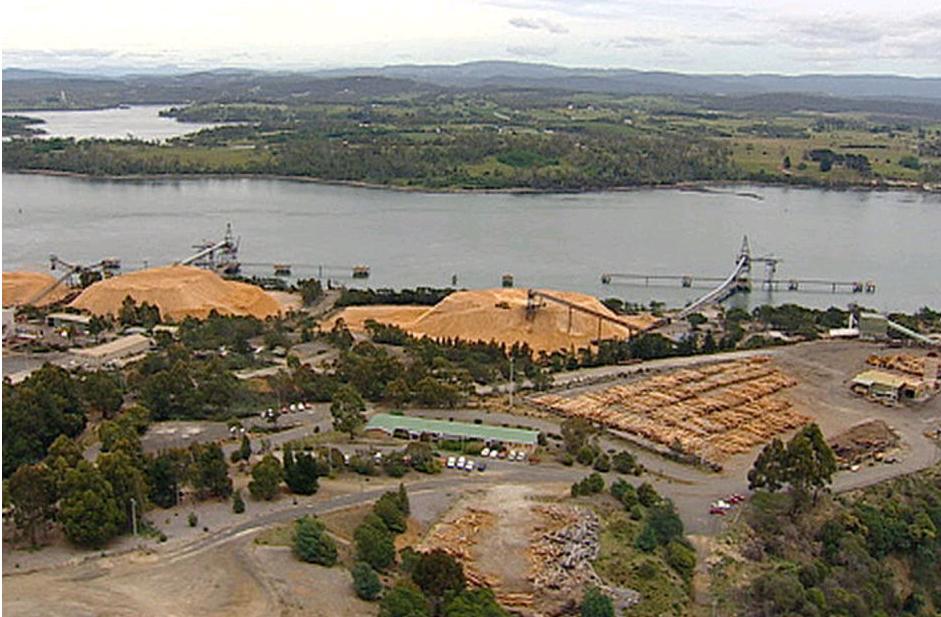
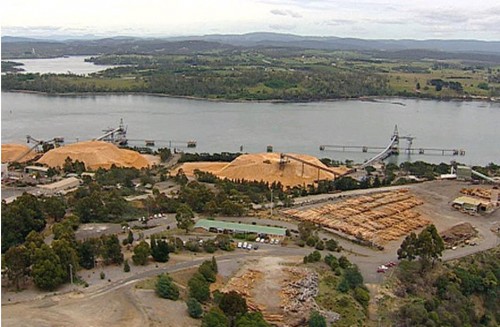 Site of proposed Gunns’ pulp mill, Bell Bay, Tamar Valley
Photo: http://www.abc.net.au/news/stories/2011/03/10/3160890.htm Site of proposed Gunns’ pulp mill, Bell Bay, Tamar Valley
Photo: http://www.abc.net.au/news/stories/2011/03/10/3160890.htm
.
.
.
The editor agrees with the following selected comments posted in The Australian to the article ‘Greens v Greens on Gunns pulp mill, 20110304:
.
By James McMaugh’:
“The mill will never be built. The people are opposed and are right not to trust Gunns. There will be a huge outcry and mass protests blockading construction. I will travel to Tasmania and so will many others to make sure of this. The proposal is dead.
It’s about time politicians listened to the people and business should too. You cannot run roughshod over the will of the people and they don’t want this mill. Overwhelmingly they don’t. It will cost more jobs than it creates and destroy the river. No, no and no to this mill.”
.
By ‘Chris B of Australia’:
“The only acceptable outcome is NO Pulp Mill at all in Tasmania. Gunns has no credibility and has proven time and again how they cannot be trusted by the community. I personally believe there is no place for a company like Gunns in Tasmania and they should make transition plans for their workforce to move to a sustainable industry.
The environmental groups willing to compromise the values and allow Gunns to sacrifice the Tamar Valley should be ashamed of themselves. Make no mistake, the pulp mill will completely and utterly degrade the environment of the Tamar Valley and Bass Strait, no matter which form it takes.”
.
By ‘SW’:
“ Senator Milne speaks for me. Thank you, Christine, for maintaining the rage. It certainly hasn’t died down here in the Tamar Valley.”
.
By ‘Robert of Adelaide’:
“ Same old argument of lack of development, growth, jobs, high crime etc. The same attitude is taken in the case of the Brazilian Rainforest as well. Where does it stop and what will we actually be left with in 100 years? Oh, that’s right, we won’t be here, so who cares… If people want employment, go to where the jobs are in the rest of the country and the world like everyone else is doing! And while you are working in places like Sydney, London, Beijing, Tokyo and Bangkok… reflect on how wonderful development has been for these these concrete infested cities! Then maybe we can appreciate what we have here.”
.
.
.
‘Green movement outguns Gunns’ [20110311]
.
…’Gunns had gone so far as to sue an elected politician, the Greens leader, Bob Brown.
“When I got the writ,” says Brown, “I knew better than to call the lawyers. The first thing I did was to call a press conference. Within 24 hours we had a candlelight vigil for democracy, in Hobart. It was like the Prague Spring.”
Ultimately, Gunns underestimated its opposition and its decision to sue backfired spectacularly.
Far from being cowed by the suit, Marr and his colleagues ramped up an environmental campaign the likes of which had not been seen in this country – targeting the Gunns bankers and shareholders, Japanese customers and European partners – which ultimately brought the company to its knees, decimating its market value and ousting its divisive chairman, Gay.
.
..It was left to the new chief executive, Greg L’Estrange, to concede defeat last September, and promise that Gunns would get out of native forest logging altogether. Despite this week’s federal approval of the mill, and the talks over a Tassie forests peace deal, Gunns is by no means out of the woods. A long, painful process of rebuilding trust with former enemies is only beginning.
.
Gunns was once a corporate powerhouse. A series of acquisitions in 2000-01 turned it into Australia’s largest export woodchipper, and No. 1 target for the environment movement.
..’A bulked-up Gunns put the pedal to the metal. This was logging on an industrial scale. Between 2000 and 2006, working with Forestry Tasmania, Gunns clear-felled 110,966 hectares of native forest, 90 per cent of the timber being used for woodchipping and 58% of the land making way for timber plantations.
“Gunns got unlimited amounts of other people’s money and went on a clearing binge,” says Marr.
The forest was clear-felled and waste burnt off using napalm-like incendiaries. Gunns used 1080 poison bait to protect seedlings, inflicting gruesome death on untold native animals and risking the health of forest workers.
.
Whether from strength or desperation, Gunns launched its ill-fated suit. The company’s shares hit their all-time peak a month later, at $4.38, and began to slide downwards. The story of the Gunns 20 suit, which dragged on until last year and was ultimately settled at a cost to the company of $2.8 million – including $1.3 million paid to the Wilderness Society – has been well told. Perhaps less well understood is the international backlash the case triggered.
The decision in 2008 by the new ANZ chief, Mike Smith, to refuse finance for the pulp mill, quickly followed by the other big banks, was unprecedented in this country and followed a strong online petition campaign by the Wilderness Society and the online activist group GetUp!After a decade’s lobbying, Japanese paper-makers decided in February last year not to accept Gunns wood unless it was Forest Stewardship Council- controlled.
.
Shares in Gunns are off their lows but the company’s future remains uncertain. Bob Brown says if Gunns ”doesn’t survive – and I hope it does – it will be nobody’s fault except the board’s”.
.
[Source: ‘Green movement outguns Gunns, by Paddy Manning, Sydney Morning Herald, News Review, p 6,
http://www.watoday.com.au/national/green-movement-outguns-gunns-20110311-1br8m.html]
.
References
.
[1] ‘Contentious pulp mill wins federal approval’, by Andrew Darby and Dylan Welch, 20110311, Sydney Morning Herald, http://www.smh.com.au/environment/contentious-pulp-mill-wins-federal-approval-20110310-1bpt4.html]
.
[2] ‘Gunns’ proposed pulp mill’, The Wilderness Society, 20110310, http://www.wilderness.org.au/campaigns/gunns-pulp-mill
.
[3] Greens v Greens on Gunns pulp mill, by Matthew Denholm and Matthew Franklin, The Australian, 20110304, http://www.theaustralian.com.au/national-affairs/greens-v-greens-on-gunns-pulp-mill/story-fn59niix-1226015622300
.
[4] http://www.finnewsnetwork.com.au/archives/finance_news_network17216.html
.
[5] Photo: http://www.abc.net.au/news/stories/2011/03/10/3160890.htm
.
[6] http://www.watoday.com.au/national/green-movement-outguns-gunns-20110311-1br8m.html
– end of article –
Tags: Alec Marr, Bell Bay Pulp Mill, chlorine dioxide, Forestry Standard Certification, FSC, greenwashing, Gunns, logging industry, native forests, Tamar Valley Pulp Mill, Tasmania, Tassie Talks, triple bottom line, United Paper Mills Ltd, UPM, UPM-Kymmene Group, wilderness
Posted in Tasmania (AU), Threats from Deforestation, Threats from Greenwashing, Threats to Wild Tasmania | 1 Comment »
Add this post to Del.icio.us - Digg
|
|