September 17th, 2011
 Play music, then click back to this site, zoom in to make the photos larger and scroll through this article and appreciate the magic of what was Lake Pedder. Play music, then click back to this site, zoom in to make the photos larger and scroll through this article and appreciate the magic of what was Lake Pedder.
.
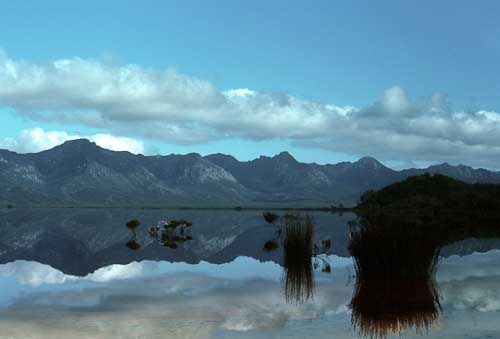
The pristine glacial lake it once was.
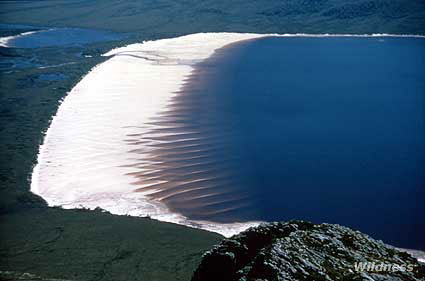
The jewel of Tasmania’s primeval sacred ecology.
.
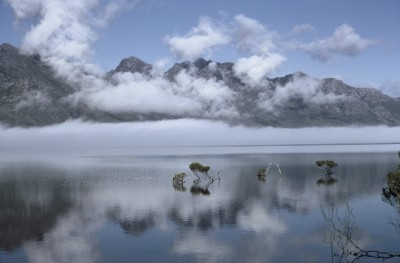 Lake Pedder
(Photo by Olegas Truchanas (1923-1972) Lake Pedder
(Photo by Olegas Truchanas (1923-1972)
.
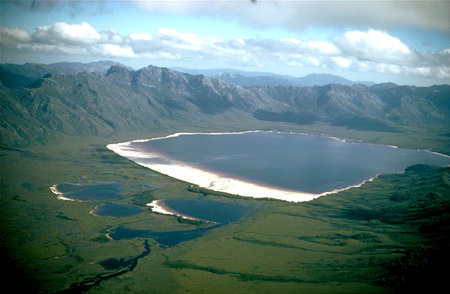 This photo currently appropriated on the website of Tasmanian Resource Planning and Development Commission,
which as the ‘Hydro-Electric Commission’ flooded the lake in 1972 and which oddly uses the word ‘justice’ in its web address.
^http://soer.justice.tas.gov.au/2003/image/544/index.php This photo currently appropriated on the website of Tasmanian Resource Planning and Development Commission,
which as the ‘Hydro-Electric Commission’ flooded the lake in 1972 and which oddly uses the word ‘justice’ in its web address.
^http://soer.justice.tas.gov.au/2003/image/544/index.php
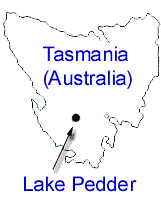
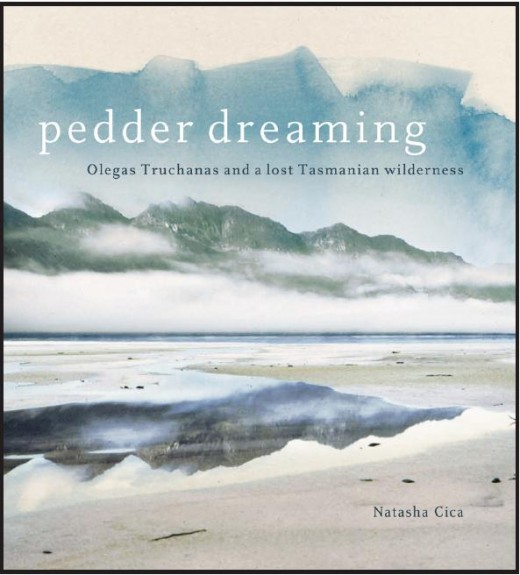
New Book Release:
.
‘Pedder Dreaming: Olegas Truchanas and a lost Tasmanian Wilderness’
by Natasha Cica, September 2011 | ISBN 978 0 7022 3672 3 | RRP:$59.95, | 230mm x 203 mm | Illustrated | 256pp (full colour) | Published by UQP | [Read More]
.
‘In 1972 Lake Pedder in Tasmania’s untamed south-west was flooded to build a dam.
Wilderness photographer Olegas Truchanas, who had spent years campaigning passionately to save the magnificent fresh water lake, had finally lost.
The campaign, the first of its kind in Australia, paved the way for later conservation successes, and turned Truchanas into a Tasmanian legend. Pedder Dreaming quietly evokes the man, the time and the place.
Truchanas, a Lithuanian émigré, is a stalwart adventurer, loving family man, activist, thinker, survivor and artist. Australia on the cusp of environmental awareness is the time, and Lake Pedder and the south-west of Tasmania, the place – wild, pristine, wondrous.
Through those who were closest to him, Truchanas emerges, as does his influence on early conservation in Tasmania, and the small group of landscape artists, the Sunday Group, who admired his passion for the lake and were inspired by it. Stunningly illustrated with original Truchanas photographs from the 1950s, ’60s and ’70s, and artwork from the Sunday Group, Pedder Dreaming captures the brutality, raw beauty and vulnerability of the Tasmanian wilderness and the legacy of one man who had the vision to fight for it.’
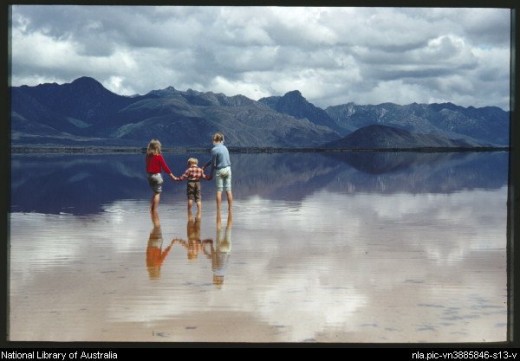 What we destroyed… Olegas Truchanas’ children playing in Lake Pedder in Tasmania’s Southwest in 1971. Less that 12 months later it was flooded. What we destroyed… Olegas Truchanas’ children playing in Lake Pedder in Tasmania’s Southwest in 1971. Less that 12 months later it was flooded.
In 1974 the head of the Lake Pedder Committee of Enquiry, Edward St John QC would famously claim “The day will come when our children will undo what we so foolishly have done.”
.
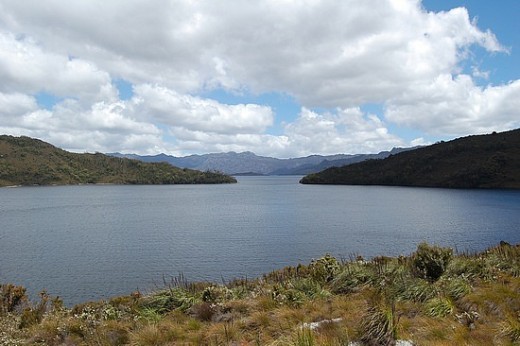 Fake Pedder ~ today’s drowned lake Fake Pedder ~ today’s drowned lake
.
.
About Olegas Truchanas

.
Olegas Truchanas, a Lithuanian born in 1923, emigrated to Tasmania after World War II, during which he fought with the Lithuanian resistance and spent time in displaced persons’ camps in Allied-occupied Germany.
From the 1950s, Olegas photographed Tasmania’s remote south-west wilderness, frequently travelling solo and risking his life in order to do so. He also met and married a Tasmanian, Melva, and together they built a house and had three children.
Through his photography, Olegas established a salon-style connection with a circle of Tasmanian photographers and watercolour painters known as the Sunday Group, and he worked with them to save a remote glacial lake with pale pink sands – Lake Pedder – from inundation by a hydroelectric scheme.
This was Australia’s “first globally noticed environmental battle, and later produced the world’s “first greens party. The campaign failed and the lake was lost. Soon afer, in early 1972, Olegas drowned while on a photographic expedition to one of Tasmania’s wildest rivers.
.
.
Remembering Lake Pedder

.
Play two rare videos of Lake Pedder by ABC Television just before the flooding:
Turn up your computer volume, then click one image at a time.
 . .

.
.
‘What Lake Pedder taught me’
by Brian Holden, 20081023, ^http://www.onlineopinion.com.au/view.asp?article=8057&page=2
.
‘It has gone, and after thousands of years of being, I was one of the last to absorb its magnificence. I still find it hard to believe that I was so fortunate. Lake Pedder February 1972 has become my dreamtime. It was for me a feeling of timelessness and a feeling of being in the type of place we were all meant to be.’
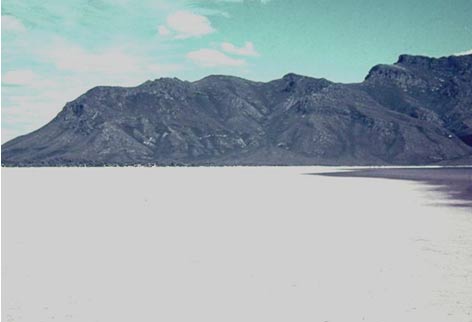 . .
What Lake Pedder taught me
‘Boneheaded politicians will only do what we let them get away with. One of our crown jewels was able to be destroyed for almost no gain because the public at large have become alien to the planet. It is normal to consume and pollute. It is normal to be stressed and in a spiritual void. We are lemmings racing towards the cliff edge – and there can be no turning back.’
.
.
‘Hydro Past Constrains Future’
by Peter Fagan, 20091027, Tasmanian Times newspaper, ^http://tasmaniantimes.com/index.php?/weblog/article/professor-west-reminds-tasmania-that-hydro-past-constrains-future/
.
‘Whatever else Tasmanians agree or disagree with in Professor West’s report, they should be grateful for this timely reminder that hydro-industrialisation continues to impose heavy costs on their state. In dollar terms alone, the sale of electricity to these industrial users below cost and way below potential value is costing the State Government up to $220 million in revenue every year.
If two-thirds of Tasmania’s annual electricity generation was to be freed up for purposes other than powering these old and highly energy-intensive plants, a range of options and opportunities would be available.
For example:
- A great deal more of the hydro electricity generated could be sold at peak times and peak tariffs via Basslink to mainland Australia
- Electricity production could be reduced whenever the hydro storage reservoirs were depleted by drought, restoring some degree of energy security to the system
- The ability of the hydro system to make electricity availabile instantly could enable integration of substantially more eco-friendly wind power into the Tasmanian and national grids – if this one isn’t clear to you the problem space is outlined in these Wikipedia articles:
http://en.wikipedia.org/wiki/Load_following_power_plant
http://en.wikipedia.org/wiki/Intermittent_power_source
.
The most intriguing possibility that gaining control of its electrical energy resource would afford Tasmania is the opportunity to revisit the restoration of Lake Pedder. Draining all or part of the Huon-Serpentine impoundment (the “new” Lake Pedder) need cost less than 20% of the electricity generation capacity of the Middle Gordon Scheme.
.
Restoration of the Lake would bring enormous benefits to Tasmania
.
Remember – less than 60 air miles from Hobart, one of the natural wonders of the world lies under less than 40 feet of water. It is submerged in a massive diversion pond (NOT a storage) whose sole purpose is to transfer water to a hydro power station, two thirds of whose output is gifted, below cost and way below potential value, to old-tech secondary industry.
Professor West’s recommendation serves to remind Tasmanians that what had become the political, social, economic and environmental nightmare of hydro-industrialisation did not end when the High Court ruled out the construction of the Gordon-below Franklin dam in July 1983. More than 25 years later, Tasmania – Australia’s poorest state – a rich island full of relatively poor people – continues to bleed revenue and incur household and business energy costs, social costs, environmental costs and opportunity costs resulting from the excesses of hydro-industrialisation.’
The case for restoration of Lake Pedder and a wealth of other resources are available from the Lake Pedder Restoration Committee web site: www.lakepedder.org
.
.
‘Lake Pedder: the beginning of a movement’
by Natasha Simons, Green Left, 19920930, ^http://www.greenleft.org.au/node/2943
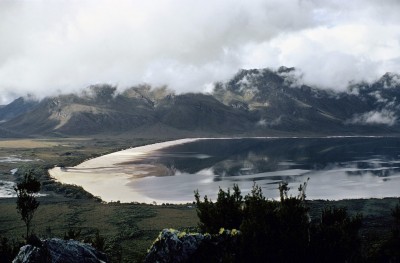
‘On September 8, 1972, Brenda Hean and Max Price, members of the Lake Pedder Action Group, waved goodbye to friends and relatives as their Tiger Moth plane taxied down the airstrip just outside Hobart. Their mission was to fly to Canberra and skywrite the message “Save Lake Pedder” to the federal government in an effort to stop the flooding of the lake. They have been missing ever since.
Twenty years ago the campaign to save Lake Pedder was lost, but its lessons were well learned by the new green movement. The fight to save Lake Pedder laid the foundations for the overwhelming success of the Franklin “no dams!” campaign in the early 1980s, and it inspired many environmental activists — some of whom, such as Bob Brown, hold seats in Parliament today.
Lake Pedder, in Tasmania’s wild south-west, is considered by many to be one of the most beautiful regions in the world. By 1946 Pedder had become a base for expeditions into all parts of the south-west. In 1955, 24 000 hectares were set aside as the Lake Pedder National Park. Bushwalkers, tourists and nature lovers came from afar to experience the beauty of Lake Pedder.
In 1967 the Hydro-Electric Commission proposed to build a power scheme in the Middle Gordon. This meant that Lake Pedder would be drowned by the damming of the Huon and Serpentine Rivers, which lay to the east and west of the lake.
In May 1967, the proposal was tabled in the state parliament. There was an immediate public outcry. Lake Pedder supporters began a petition to stop the proposal and collected 10,000 signatures, the largest number that had ever been collected in Tasmania. As the pressure mounted, the Labor government of “Electric Eric” Reece was forced to establish a select committee to determine the viability of the HEC proposal, and to look at alternatives.
However, the committee merely rubber-stamped the proposal. Two days later, on August 24, 1967, the enabling legislation was passed. Then the campaign to save Lake Pedder really began.
In 1969 the Reece government lost office in the wake of public discontent over the issue and the new government, a coalition of the Liberal and Centre parties headed by Angus Bethune, found itself in a difficult situation.
.
In March 1971 Brenda Hean and Louis Shoobridge, two prominent campaigners for Lake Pedder, organised a public meeting which packed the Hobart Town Hall.
Public opinion on the issue had polarised.
The public meeting proposed to call a referendum on the issue, but the “Shoobridge proposal”, as it became known, was defeated by a government wholeheartedly backing the HEC.
.
The grassroots activists refused to give up. They formed the Lake Pedder Action Group (LPAG), which took the issue to the federal government. As a result, Prime Minister William McMahon directed his unsympathetic environment minister, Peter Howsden, to raise an alternative scheme with Bethune. The Tasmanian premier responded with a resounding “No”.
Just as it seemed things were lost, the Bethune government was forced to the polls, and the environmentalists seized the opportunity. Again a public meeting was called in the Hobart Town Hall. Out of it the first green party, the United Tasmania Group (UTG), was formed. The UTG fielded candidates, among them Brenda Hean, with very diverse backgrounds but who were united in their desire to save Lake Pedder from the HEC.
The UTG polled well and, despite HEC attempts to discredit the campaign, Lake Pedder gained international attention, including support from organisations such as UNESCO. On July 24, 1972, 17,500 signatures reached the new premier, and the LPAG mounted a national campaign.
A few days before Brenda Hean and Max Price set off for Canberra, Hean had received an anonymous phone call from someone pressuring her to give up the campaign or “go for a swim”. The plane hangar was found to have been broken into and the safety beacon, normally stored on the plane, had been removed. There was never a proper inquiry into the case and no wreckage was ever found.
The Pedder campaigners now put their hopes on the newly elected federal Labor government, which mounted a federal-state inquiry. The Tasmanian government refused to participate, but the committee in June 1973 reported the area was too important to destroy. The inquiry recommended a moratorium on flooding so that the feasibility of saving the lake could be addressed. It adopted LPAG’s recommendations to pay the costs of the moratorium and any costs of modifying the scheme to save the lake. The weary LPAG activists could sense victory.
But the premier ignored the inquiry and gave the HEC the go-ahead. In March 1973 the vigil camp to save wildlife threatened by the rising waters was abandoned, and Lake Pedder was drowned. Tasmanian environmentalists had suffered their first great defeat.

In 1979, the HEC released details of another proposal, this time to flood the Franklin River, one of the last great wilderness areas in the world. This time it was met by a much tougher, more unified and stronger opposition.
The Franklin activists, headed by figures like Bob Brown, had learned how to run a campaign. They didn’t only argue that the Franklin should be saved, as the Pedder campaigners had done; they also presented a range of alternative and well thought-out proposals to the HEC. They gained national and international support for their campaign and employed direct action tactics as well. The Franklin was one of the biggest actions of civil disobedience the country had ever witnessed, with 1217 people arrested.
The Franklin blockade polarised the community on the West Coast. The issue tore the Tasmanian ALP apart, and it has never fully recovered from the blow.
The Franklin campaign was won, and in 1986 Bob Brown was elected to state parliament on a wave of green consciousness. Three years later, during which time the campaign for Wesley Vale was fought and won, he was joined by four other Green Independents.
“The failure of Lake Pedder was needed in a way”, says Green Independent Christine Milne, “to allow the fights for the Franklin and Wesley Vale to succeed. When the lake went under, there was a wide sense of guilt that made people feel they would never again allow that to happen without doing something.”
The momentum built up during the Lake Pedder and Franklin campaigns has been lost to the green movement in recent times. The electoral strategy of some sections has changed the focus from mobilising people to making changes through parliament. Lobbying the ALP has also proven largely ineffective for, while the federal Labor government has espoused green rhetoric, it has for the most part ignored environmental issues.
The recession has pushed the issue of living standards and jobs to the forefront. Big business, the government and the media all counterpose jobs to saving the environment, trying to drive a wedge between environmental and social justice issues.
The creation of jobs and defence of living standards need to be at the forefront of the green agenda, with the emphasis on environmentally sustainable jobs. By taking up more of the social justice agenda, the green movement may link up with others fighting for social change and revive the grassroots activity that can challenge the powers that be.’
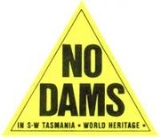
.
.
Further Reading:
.
[1] ‘Pedder Dreaming’ – media release [ Read More]
[2] ‘Pedder Dreaming’ book launches [ Read More]
[3] Lake Pedder Restoration Committee, ^http://www.lakepedder.org/index.html
[4] Lake Pedder – an overview of its history^ http://en.wikipedia.org/wiki/Lake_Pedder
[5] ‘ Remember Lake Pedder?‘, by Robert Rankin^ http://www.rankin.com.au/essay7.htm
[6] ‘ Lake Pedder‘, Timeframe,^ http://www.abc.net.au/science/kelvin/files/s18.htm
[7] Lake Pedder Earthworm, ^ http://www.environment.gov.au/cgi-bin/sprat/public/publicspecies.pl?taxon_id=83060
[8] Lake Pedder Report, presented by ABC Four Corners, 19710424, ^ http://www.abceducation.net.au/videolibrary/view/lake-pedder-report-126 [ View Video as mp4 – ensure volume is turned up first]
[9] Lake Pedder’s Future’ , by Peter Ross, ABC TV, This Day Tonight, 19720704, ^ http://abceducation.net.au/~abceduca/videolibrary/view/lake-pedders-future-74 [ View Video – ensure volume is turned up first]
[10] ‘ Whatever happened to Brenda Hean?‘ ^ http://www.abc.net.au/atthemovies/txt/s2367992.htm
[11] ‘ Whatever happened to Brenda Hean?‘, by Scott Millwood, ^ http://www.allenandunwin.com/default.aspx?page=94&book=9781741756111
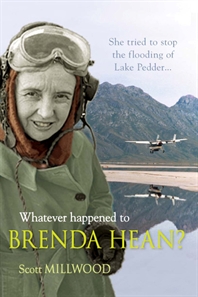
 Remembering Brenda Hean
In ‘Pedder’, Brenda had found her spiritual centre. Remembering Brenda Hean
In ‘Pedder’, Brenda had found her spiritual centre.
.
.
Tags: Brenda Hean, Eric Reece, fake pedder, green movement, HEC, Hydro-Electric Commission, Lake Pedder, Lake Pedder Action Group (LPAG), Lake Pedder Restoration Committee, Louis Shoobridge, Middle Gordon Scheme, Olegas Truchanas, Pedder Dreaming, Tasmania, the jewel of Tasmania's sacred primeval ecology, the victim of an ignorant time
Posted in 04. + Ecological Jurisprudence, 32 Ecosystem Rehabilitation!, Tasmania (AU), Threats from Hydro and Dams, Threats to Wild Tasmania | Comments Off on Lake Pedder – the victim of an ignorant time
Add this post to Del.icio.us - Digg
September 15th, 2011
The following article was published on CanDoBetter.net today (20110915) by wildlife ecologist and biologist, Hans Brunner, under the title: ‘A planned slaughter of endangered wildlife’
.
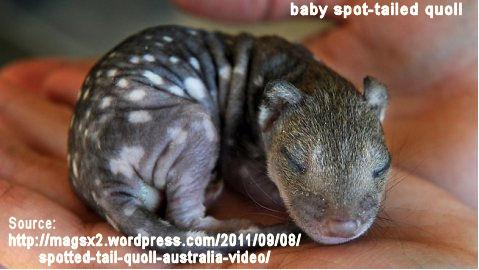
The Victorian Government plans to drop 1080 poison bait from an aircraft into forests could result in the extinction of the already critically endangered Spotted-tailed Quoll.
The purpose of this antiquated and vandalistic method is to poison wild dogs. Why is the Victorian Government using old, dangerous methods? This is like re-introducing the use of DDT. It is now a double disaster; all Ted Baillieu has to do now is to aerial bait to kill wild dogs in order to protect the cattle he allowed to go back into the mountains! Spot-tailed quolls and other dasyurids are meat eaters as well as some species of possums, reptiles, bandicoots and birds. They would be all at a serious risk of being poisoned. Further more, most of this bait would be wasted because of the dogs not being able to find them and this is where non-target animals will rather find and eat them. Baits have therefore to be placed only in places which dogs frequently use, along forest tracks.
.
More effective methods
There is a well researched and efficient method for the poisoning of wild dogs and foxes. It is a target specific bait station system which is successfully used throughout Victoria. Bait stations are placed along forest tracks where activities of dogs are observed.
A bait station consists of a mound of soil about 20 cm high and one meter in diameter. An un poisoned bait (free feed) is buried in the center of the mound about 10cm deep with some SFE lure placed on top. When the bait has been dug up and eaten, a check is made, with some experience, to assess whether a dog or fox took the bait. If satisfied that a target species took the bait it can be replaced with a poison bait. If it appears that a quoll or an other non-target animal may have taken the free feed bait, continue free feeding that station to keep the quoll and others away from a poison station (about 2 km away) or eliminate that station.
.
This is the only responsible way to poison dogs and foxes. Even better, it will be of great benefit to not only the quolls by removing the competition by dogs and foxes of their natural prey species, but also for the survival of Kangaroos, wallabies, bandicoots, possums, echidnas etc.
.
Biologist’s experience of alternatives
I have researched and tested this system in 700 square km of forest between Gembrook and Neerim and found it most effective and efficient. I have also introduced it in NSW National Parks where it was recognized as “The dog baiting stations proposed by Hans are the best practical suggestion to date. With the implementation of the bait stations, properly maintained and serviced at the appropriate times, there would appear to be NO reason to allow the continued use of aerial baiting” and, “Poisoning using the buried bait technique is still proving extremely target specific, with dogs and foxes being the only species killed”.
.
Do it the right way and wildlife return
Barbara Triggs, an eminent naturalist stated after poisoning wild dogs and foxes and using the bait station system on her property in Croajingolong National Park, East Gippsland:
.
“At no time has there been any evidence that a bait has been taken by a non-target animal. In the past year the numbers of native animals seen on the property have increased startlingly. The Red-necked Wallabies, who’s group was here in low numbers, have increased markedly from five individuals to now at least fourteen. The most surprising increase has been in the population of Long-nosed Bandicoots. The Dusky Antechinus, Swamp Rats, Water Rats, Sugar Gliders and several species of ground-nesting birds and also species of owls are much more in evidence than ever before.”
.
With all this evidence, this non specific and irresponsible aerial baiting must be immediately stopped.’
Hans Brunner
Wildlife biologist
Sept 2011
Leave a Reply
You must be logged in to post a comment.
September 13th, 2011
The following letter to the editor appeared in the Blue Mountains Gazette newspaper on page 12 of 10th August 2011, written by Rose and Brett Everingham of Lapstone, Blue Mountains, Australia.

‘Native Wildlife Alert’
.
‘On the evening of Tuesday July 29 a beautiful Echidna was unfortunately hit by a car outside our house.
We would like to publicly thank the three lovely young gentlemen who stopped to assist us as we moved it off the road, and then rang WIRES.
It was a particularly upsetting experience, no one wants to see any creature hit by a car, especially our native wildlife. The young gentleman who hit the Echidna was understandably distressed, as it is not something you would usually expect to see, and we reassured him that it was simply an accident.
It is a timely reminder though to take care when driving at night, particularly on Governors Drive which is often used as a race track for some drivers. Unfortunately the Echidna could not be saved. Once again a thanks to the young gentleman who stayed with my husband and son whilst they buried it.
Whilst a sad experience, it brought relief to know that Lapstone still has such beautiful native wildlife existing amongst us in the bush.’
.

.
.
Editor’s Comments:
.
1. The killing of a native echidna by a driver of a car is an horrific tragedy for the echidna and its likely dependent mate and offspring, which were not mentioned. Each killing of adult native wildlife harms the viability of the local population of that species in the area.
2. Rose and Brett are right to have done what they did and it is valuable to the local community that Rose has taken the trouble to share this tragic event via her letter in the local paper.
3. The cause of the Echidna’s death was that the car driver was driving too fast to prevent killing it on the road. Most drivers drive too fast and are not competently trained to drive for the conditions.
It could have been a child killed while running on to the road. I am sure the local paper would have had more than allowing Rose’s letter, which reflects our culture that human life holds selfishly somehow higher values than wildlife. One may call this ‘speciesism’, a term few are aware.
4. Echidna habitat was there many thousands of years before European colonists destroyed its environment and selfishly carved a road through its habitat, with no care for any native wildlife values.
5. Such roads as Governors Drive, whether constructed by local Blue Mountains Council or larger ones by the Roads and Traffic Authority (RTA), not only destroy native vegetation and wildlife habitat in their construction, as well as allowing sediment pollution of downhill watercourses; no respect is paid to the inevitable road death consequences caused by vehicles using the road. The underlying reason is that human values for wildlife are so low across the community that there is hardly any call for wildlife protection from the threats of road making and its consequential traffic menace. Worse is that perverted attitudes toward wildlife and deviant behaviour prevail to the extent that the killing of wildlife on our roads is disparagingly dismissed as ‘roadkill’. If the same term were applied to pedestrian deaths on our roads, there would be an uproar by extreme humanists.
6. No attempt is made by road builders (local council or the RTA) to facilitate separation of ground dwelling native wildlife from the inevitable risk of death from introduced road traffic. Some roads across Australia have wildlife fencing to prevent native animals such as wallabies, wombat and Echidnas from accessing the road. Others factor wildlife corridors into the design of roads that destroy wildlife habitat. It is an indictment on both the Blue Mountains Council and the RTA that there are no wildlife fences or wildlife corridors throughout the Blue Mountains.
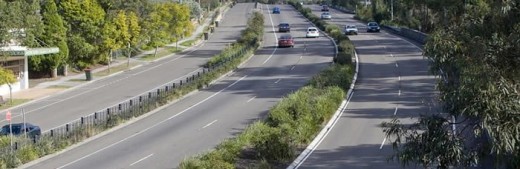
7. That Rose wrote “it is not something you would usually expect to see” is a sad indictment on the demise of wildlife populations across the Blue Mountains since colonial conquest, such that now people living in the Blue Mountains do not expect to see wildlife any longer. Villages like Lapstone have become so urbanised that they are all but outer suburbs of Sydney. The natural bush environment has been lost to a sterile parkland to suit the needs of humans. The values of native wildlife and their habitat continue to be ignored by humans who live and drive through the Blue Mountains and by custodial government authorities – Blue Mountains Council, NSW Department of Environment (etc), Australian Department of Environment (etc).
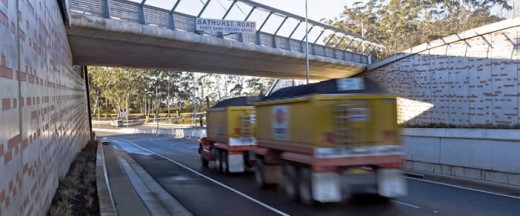 . .
Yet, despite the arrogant disregard for wildlife values across the Blue Mountains, especially at the human interface, other regions take a more proactive view, such as in Sydney’s Northern Beaches region.
.
 Uncontrolled speeding on Australian roads Uncontrolled speeding on Australian roads
.
Related Articles:
.
‘Wallaby becomes roadkill after fence holed’
.
by Brenton Cherry, 20110112, Many Daily, ^http://manly-daily.whereilive.com.au/news/story/wallaby-becomes-roadkill-after-fence-holed/
 Eira Battaglia, Mandy Beaumont, Niamh Kenny,
Cassie Thompson and Elvira Lanham at the damaged fence.
(Photo by Virginia Young) Eira Battaglia, Mandy Beaumont, Niamh Kenny,
Cassie Thompson and Elvira Lanham at the damaged fence.
(Photo by Virginia Young)
.
‘A hole has been cut in the wildlife-proof fence along Wakehurst Parkway at Oxford Falls, leading to at least one wallaby being killed. The death – discovered by Jacqui Marlow from the Northern Beaches Roadkill Prevention Group – was the first along the stretch of road since the fence was installed.
“Why would anyone cut a hole in the fence?” she said. “I found the hole after seeing a dead wallaby in the fence area.
“It’s the first one killed in the fence area since it was installed, which shows that it works.”
Ms Marlow said she had become disenchanted by the actions of some people.
“At the moment my opinion of humans is not very good, especially when it comes to their attitude to nature,” she said. “I’m really tired of dealing with it, the deaths are starting to get me down.”
Fellow group member Eira Battaglia said now more than ever motorists had to be aware of wildlife on our roads.
“Wallabies are around after the recent burn-off,” she said.
“Eight have been killed in the past week so please drive carefully, especially at dusk when the wallabies may be out searching for food.”
A spokesman for the RTA said a maintenance crew would permanently fix the hole as soon as possible. “A temporary repair has already been carried out,” he said.
RTA representatives yesterday met with the roadkill prevention group for a tour of local hot spots and potential sites for additional fauna fencing.’
.
.
‘Peering down the corridor’
.
Source: ^http://www.coolmelbourne.org/articles/2009/07/peering-down-the-corridor/
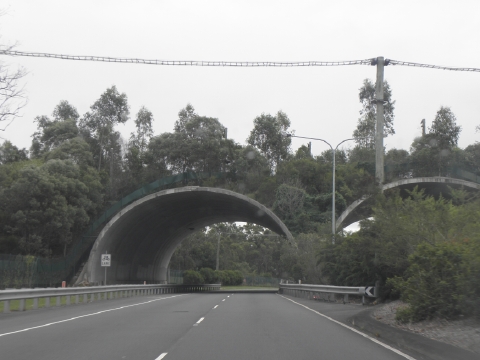 Wildlife Corridors do exist and are effective where human communities
care enough to insist on them.
But don’t expect road designers and engineers in Australia to suggest the concept. Wildlife Corridors do exist and are effective where human communities
care enough to insist on them.
But don’t expect road designers and engineers in Australia to suggest the concept.
.
.
‘Conservationists have long recognised the value of using wildlife corridors to connect wilderness areas, and there is mounting evidence to show that these corridors help many species, from the big to the small to the airborne to the aquatic.
But now ‘megacorridors’ are taking the wildlife corridor concept to a whole new level. Australia’s Great Eastern Ranges Initiative (GERI) is Australia’s answer to the megacorridor.
Aiming to create a 2800km wilderness megacorridor from North Queensland to Victoria, the initiative is about halfway towards completion of the first and most critical stage.saving-wilderness-geri-map-new-scientist.jpg
It is an extremely important move in the conservation of Australia’s biodiversity: after more than 200 years of development, the landscape of eastern Australia has changed significantly.
Fences, roads, dams, industrial and agricultural lands, powerlines, towns and cities cut across the country, isolating natural areas which have become ‘islands’ on which plants and animals have become isolated.
This means that many ecosystems have been fragmented, that the landscape’s capacity to maintain our unique plants, animals and Aboriginal cultural heritage has been reduced. It also means that remaining ecosystems are finding it harder to filter and clean our air, maintain the health of our soils, and produce unpolluted fresh water for the 93% of the Australian population that lives along Australia’s eastern seaboard.
This is no quick fix project however: climate change and the migration of human populations means it could take as long as 100 years before the project’s success can be measured.’
.
.
‘Wildlife corridor from far south to far north’
.
by Mat Churchill, 20100716, ^ http://www.tourismportdouglas.com.au/Wildlife-corridor-from-far-south-to-far.4317.0.html
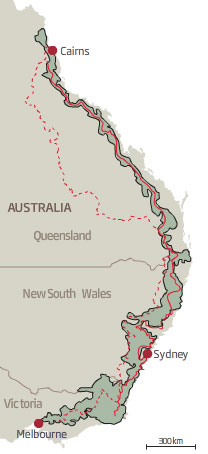
The Great Eastern Ranges Initiative, a proposed 2,800km long conservation corridor
Patches of state and national parks around the country just aren’t sufficient to protect Australia’s native plants and animals.
According to a report commissioned by the NSW Department of Environment, Climate Change and Water, a wildlife corridor 2,800km long stretching from Melbourne to the Atherton Tablelands would allow species to migrate when their habitat changes due to climate change.
”One of the impacts of climate change is that species will have to move around to find suitable habitat resources. We need to make the whole landscape more biodiversity friendly.” said Brendan Mackey, an environmental scientist who wrote the report.
Dubbed the Great Eastern Ranges Initiative, the corridor would be made up of public and privately owned land.
Ian Pulsford, from the Department of Climate Change and Water, said areas earmarked to become part of the corridor would see a person acting as a broker visit the private landholder to discuss the program.
”The corridor is voluntary but there has been a good response from private landholders, and there are incentives to make your land part of the conservation area,” said Mr Pulsford.
The corridor concept is a new way of thinking when it comes to conservation. And a change in the way we do things in Australia is clearly needed when nearly half of the world’s mammal extinctions in the last 200 years have happened here, along with 61 species of flowering plants among others. The world’s current extinction rate is 1,000 higher than nature intended.
”The conventional thinking is wait until things are really bad and then desperately try to save things at the last minute,” said Professor Mackey.
.
.
Further Reading:
.
[1] ^http://www.coolmelbourne.org/our-environment/wildlife/
.
– end of article –
Leave a Reply
You must be logged in to post a comment.
September 10th, 2011
[This article was initially published by Tigerquoll on CanDoBetter.net 20090518 under the title: ‘Repco Rally… driven by Rees’ selfish ‘Red Hot Go!‘. A few modifications have been made].
.
 Ex-NSW Premier, Nathan Rees
Photo: AAP, Sergio Dionisio Ex-NSW Premier, Nathan Rees
Photo: AAP, Sergio Dionisio
.
‘Freshly sworn in NSW Premier Nathan Rees MP back on 5th September 2008, recognising people are annoyed and frustrated with the State Government and proclaiming to have a ‘red hot go’ at fixing NSW. Rees says he recognises people are annoyed and frustrated with the State Government. [SOURCE: ABC 5-Sep-08]
Why do we tolerate it?
Why do politicians, as soon as they taste power, think they have rights akin to the kings of old, to splurge on personal fettishes and pet hobbies using taxpayers’ money and abuse the rights of local citizens?
In less than four weeks safter Rees took office, on Monday 29th September 2008, Rees’ personal passion for V8 racing saw him personally approve the unprecedented introduction of V8 Supercar racing at Sydney Olympic Park (Homebush) for five years despite strong local community opposition. Hardly a decision to address the people’s annoyance and frustration with the NSW Government.

Accompanied by a howl of boos from a small group of protesters, Rees overruled Homebush locals concerns about the required removal of 700 trees, significant noise and air pollution impacts, contamination of parklands waterways & habitat (including Green & Golden Bell Frog habitat) from fuel & oil spills, disturbance to native fauna from noise impacts & crowd movements and the unfair impost on local urban amenity & public open space. Our naive Nathan has been sold on hollow promises of “attracting 15,000 visitors and attracting $100 million to a desperate NSW economy. So desperate and naiive Nathan has grabbed the hype to get quick political wins. It is these ‘quick political wins’ that have shaped his tenure and that will shape his legacy. Long term State investment, that is investment beyond the next election cycle is not a mandate the NSW Labor Party has granted him.
[SOURCE: ^http://www.tec.org.au/index.php?Itemid=291&id=693&option=com_content&task=view]
.

The motor racing event is being promoted by Events NSW (an arm of the Rees NSW Government) and is set to be an annual event every December. The main sponsor is Telstra, which at the same time hypocritically declares on its corporate website that its “concern for the community and resolve to address environmental issues will only serve to improve Telstra’s future.”
.
.
.
.
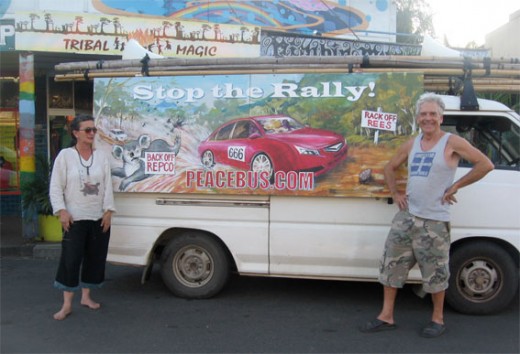
In 2009 Repco imposed is car rally on the rural shires of Tweed and Kyogle
.
Then we see another motor racing event for NSW, the Repco Rally, relocated from where is has been staged for two decades outside Perth to the NSW in the Tweed and Kyogle shires in September. It is set to be staged every two years at least until 2017. Of course Rees has given it his red hot support and again his Events NSW is plugging it hard.
Again, NSW taxpayers are paying up to $8 million to the rally organizers and the Tweed Shire Council has promised to fund the rally organisers an extra $120,000 every two years out of local rates revenue. This funding comes at a time when the Rees government says it can’t afford to provide adequate local policing or health services to the people of the Tweed Shire.
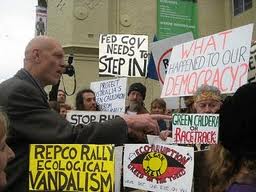
Layla Gain-Hill with residents of Barkers Vale and Wadevale who are concerned the Repco Rally with endanger Hanging Rock Creek. Photo courtesy of Mel McMillan and Northern Star newspaper 21st January 2009.
Many locals at both events have strongly and unanimously voiced their objections to these events respectively, but ‘king’ Rees likes his car racing and has proclaimed it’s all going ahead. It’s not too dissimilar to the English aristocracy of old pursuing fox hunts through farmers properties, thumbing their noses at the locals. Auburn, Parramatta and Ryde Councils all unanimously passed resolutions opposing the proposed V8 Supercar race at Homebush.
Both races will mean senseless environmental vandalism and are a blatant denial of local communities of their Common Law rights to quiet enjoyment and amenity. If the history of both races is any guide, Rees’ red hot go at promoting his car racing fetish is set to cost NSW more than the exaggerated hype of making money for NSW.

At a time when peak oil has been and gone and the motor car industry is in decline, Rees’ petrol head fetish can only be a selfish desire and an abuse of privilege and power to doggedly pursue an unsustainable 20th century motor racing culture. This is set to be Rees’ legacy of his red hot term in power.
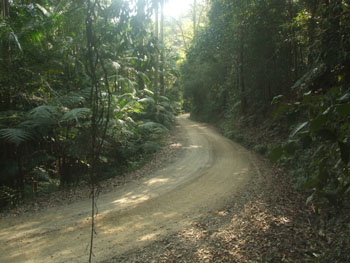 Repco Rally a high speed reckless route through tropical rainforest tracks Repco Rally a high speed reckless route through tropical rainforest tracks
.
Rees fetish for V8s should be tempered. The V8 race could more suitably staged at the existing dedicated motor racing circuit just down the road at Eastern Creek. Rees’ fetish for rally driving could be fed by him flying over to Perth where it used to be staged.’

.
.
‘Rees supporting Mad Max 4 – says it all!’
October 24th, 2009 Tigerquoll says:
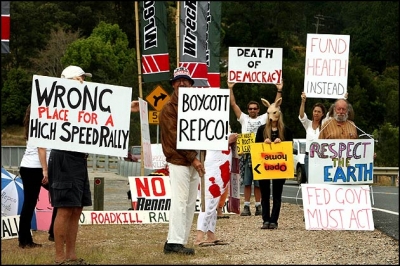
‘Petrol head Nathan Rees was behind the Repco Rally and sorted political legislation to make it happen, same with V8 Supercars ripping through Homebush. So somehow I expected to see him supporting the forth Mad Max film being announced today for New South Wales. The original Mad Max was screened back in 1979.
As Rees sees it – simple – more jobs for mechanics, spray painters nd tourism – jobs, jobs, jobs. But film making is a one off. So like mining companies than come and go sacking workers as hey move on so will this film. Boom and bust mentality perpetuates like the 19th Century gold rush.
Now there digging up the 1970s for a remake. It’s like Bowie’s Life on Mars remastered. But I wish “Fury Road” every success for Australia’s struggling film industry, although can’t we find a new subject? How about a file called ‘Franklin’ with Australia’s best actors and emerging actors retelling the iconic environmental and social battle of Australia’s recent history? It would be new, fresh and topical.
Anyway, may be Mel s Max 4 may wish to do a Silvester Stalone come back. The NSW Film & Television Office is now part of Rees mega department Industry & Investment NSW. It all sounds energetic, but can someone name just one project out of it that is fully funded, approved and underway with a 5 year life or longer let alone beyond the NSW election cycle.
Nathan relishes any business announcement especially one that involves cars. Pity Bridgestone has suddenly announced closing up shop in South Australia with no thought to redeploying its 600 Australian employees.
Executive director of the Australian Institute for Social Research, Associate Professor John Spoehr, says “”We know from the past that around about one-third of manufacturing workers that lose their jobs during downturns go on to be long-term unemployed.”
[SOURCE: ^http://www.abc.net.au/news/stories/2009/10/24/2723176.htm]
.
The writing is on the wall for the automotive industry in Australia, but some petrol heads just can’t give up the addiction and keep tuning into Top Gear ‘to keep the dream alive’.
Rees says ‘keep it simple stupid’! Well simple ideas for simple minds as other say. NSW has become the meat head state! May be I should change my number plate.’
 Petrol Head Inculcation
~ like irresponsible father, like pre-P-plating son. Petrol Head Inculcation
~ like irresponsible father, like pre-P-plating son.
.
 Another irresponsible P-plater after high speed in the rain
Albion (northern Brisbane, 2010)
[Read More] Another irresponsible P-plater after high speed in the rain
Albion (northern Brisbane, 2010)
[Read More]
.

.
.
Further Reading:
[1] Peacebus.com, ^ http://www.peacebus.com/NoRepcoRally/blog2009.html
[2] Fight against the Rally, CanDoBetter.net, ^ http://candobetter.net/blog/130
[3] Homebush V8 Event Slammed As Cost Blowout, ^ http://richardsf1.com/2010/06/23/homebush-v8-event-slammed-as-cost-blowout/
.
– end of article –
Leave a Reply
You must be logged in to post a comment.
September 9th, 2011

At a time when the Tasmanian Government has a protracted budget crisis, when Gunns and its logging venture is on the brink of financial collapse, and the Australian Federal Government is offering a $276 million package to the Tasmanian logging industry to transition out of subsidy-dependent logging; this is a time for strategic decision making. This is a time for considering the next generation of Tasmanians.
The days of governments providing subsidies to forestry are numbered. The writing is on the wall for multi-national/industrial hardwood forestry in Tasmania.
Despite the less than perfect negotiations, the undemocratic secrecy of the deal making, State and Federal governments’ poor grasp of change management, Tasmanians are presented with an olive branch. The last time a middle-ground opportunity was available to the two warring sides was the 1989 Salamanca Agreement which was quickly scuttled by government. A generation later, a considerable financial incentive and the facilitation of transition out of logging are on the table.
Irreplaceable old growth forest ecosystems are at stake, but equally at stake are rural livelihoods. There are structural social repercussions that will last decades. But then Tasmania’s poverty is already structural. It has become inter-generational and Tasmanians need a transitional direction out of poverty. While mindful of the recurring history of conflict and community polarisation, this current opportunity for change is rare and perhaps a once in a generation one at that.
In order to begin to appreciate the cultural depth of Tasmania’s ‘age-old conflict‘, at least four particular books should be read on this history:
- ‘The South West Book: A Tasmanian Wilderness‘, compiled by Helen Gee,Janet Fenton and Greg Hodge in 1978, published by William Collins Pty Lts and The Australian Conservation Foundation [Read More]
- Helen Gee’s 2001 book ‘For the Forests: A History of the Tasmanian Forest Campaigns‘, published by The Wilderness Society, Inc. [Read More]
- Greg Buckman’s 2008 book ‘Tasmania’s Wilderness Battles: a history‘, published by Allen & Unwin [Read More]
- Anna Krien’s 2010 book ‘Into the Woods: the battle for Tasmania’s Forests‘, published by Black Ink [Read More]
.
Perhaps as an interested outsider, a mainlander, I can consider this Tasmanian-wide conflict from a detached unencumbered perspective. The younger generations have opportunities that their parents and ancestors never did. Had my grandfather not died on the farm when my father was just eight years old, I may well have followed generations into sheep farming. My grandmother with her only child left the farm to give my father the best opportunity she could. I reflect on that opportunity and the greatly increased opportunity that my parents have provided me and my siblings. It takes one opportunity, for others to become available and sometimes it takes generations.
While not setting out to be critical of sheep farming per se, in hindsight sheep farming in Australia over my lifetime has become low margin and commoditised (like woodchips) and many a wool grower have not experienced the anticipated opportunities flowing on from the halcyon days when Australia was built off the sheep’s back. ‘Once a great nation-building icon, the wool business today is but a third of its size when Australia ‘rode on the sheep’s back’. Compared to the more recent Australian Wheat Board scandal, 40 times more funds were lost in the downfall, and vastly more collateral social and economic damage was done in this country and across the globe.’ Indeed, Charles Massey’s 2011 book ‘Breaking the Sheep’s Back‘ tells the untold story of the events that led to Australia’s biggest industry disaster. [Read More].
Just as Australia’s traditional wool business has declined, so too has Australia’s traditional timber business.
‘Most of the change we think we see in life is due to truths being in and out of favor.’
~ Robert Frost’s 1915 poem, ‘The Black Cottage’.
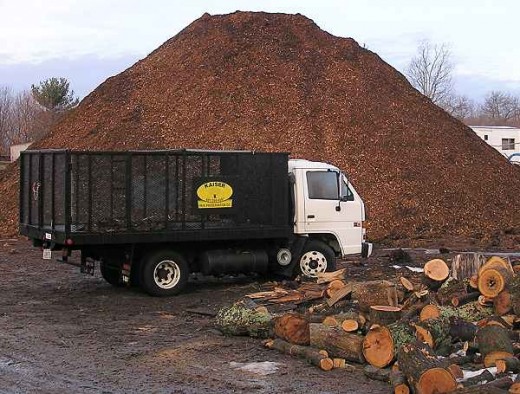 Woodchipping Tasmania only benefits foreign buyers, who must be laughing Woodchipping Tasmania only benefits foreign buyers, who must be laughing
.
Once island problems are recognised for what they are (internal island problems), the quicker more Tasmanian’s will recognise that the future challenges and opportunities of the island lie with industry diversification, value adding produce and services and with the world outside it. Trading internationally directly is where Tasmania’s future prosperity lies. Tasmania can learn much from the pure brand of ‘New Zealand’. Much of Tasmania’s output competes in comparable industries with the output of New Zealand.
Past and current generations of Tasmanians have become familar with old growth forests and many have become complacent of their presence. Future generations have a right to that familiarity.
Tasmanian complacency was the root cultural cause behind the eventual extinction of the Thylacene.
 Extinction is forever ~ the dark past should not curse our future Extinction is forever ~ the dark past should not curse our future
.
“Tasmania is slowly evolving towards goals we cannot now see. If we can revise our attitudes towards the land under our feet; if we can accept a role of steward and depart from the role of conqueror; if we accept the view that man and nature are inseparable parts of a unified whole – then Tasmania can be a shining beacon in a dull, uniform and largely artificial world”.
~ Olegas Truchanas, 1969
[Source: ^http://florentine.org.au/]
.
.
Intergovernmental Forests Agreement, 2011
.
In October 2010, the major breakthrough in the almost century long dispute over Tasmania’s forests was reported secured in principle between the key parties, Tasmanian timber communities, forest unions, and industry, Gunns, Environment Tasmania, the Conservation Council, The Wilderness Society, Australian Conservation Foundation. Credit is due to the two instrumental negotiators, Gunns chief executive Greg L’Estrange and forest facilitator Bill Kelty.
 Tasmanian History in the making Tasmanian History in the making
.
The aim was to find an agreement develop a more sustainable timber industry and to end logging Tasmania’s remaining valuable native forests. It will mean an end to logging of native forests will also protect critical habitats for Tasmanian devils and other threatened species. A moratorium on the logging of high native forests will be phased in over three months, while maintaining essential supplies for necessary timber mill operations.
The “Tasmanian Forests Statement of Principles” were agreed to set Tasmania’s timber industry on a new path to economic opportunities through plantation-based forestry, protecting timber worker’s jobs and native forests.
.
.
“The forestry industry, unions and environment groups have found common ground in the interests of all Tasmanians. This will pave the way for a sustainable timber industry that protects jobs and also protects the state’s remaining unique native forests,” said Environment Tasmania’s Phill Pullinger..
.
[Source: ‘Forests: Peace in our time?’, by Andrew Darby, The Age, newspaper, 20101019, ^http://tasmaniantimes.com/index.php/article/peace-in-our-time]
.
.
.
Tasmanian Transition from High Volume/Low to Low Volume/ High Value Add Timber – public debate recommended
.
While not advocating industrial logging of Tasmania’s native myrtle, a refocus from high volume/low margin woodchips toward low volume / high value specialised timbercraft is a Tasmanian industry that has potential to be both commercially viable while being ecologically sustainable, if excluding old growth and so long as it is appropriately tightly controlled and monitored.
A public debate on this potential is recommended.
 High value-add Electric Guitar in Tasmanian Myrtle
[Source: ^http://tasmaniantonewoods.com/guitars] High value-add Electric Guitar in Tasmanian Myrtle
[Source: ^http://tasmaniantonewoods.com/guitars]
.
.
Further Reading:
.
‘Gunns rejects crucial financial offer’
.
[by Andrew Darby, The Age newspaper, 20110906, ^http://www.theage.com.au/national/gunns-rejects-crucial-financial-offer-20110905-1ju9j.html]
.
‘Troubled forestry company Gunns has rejected a financial offer from the Tasmanian government seen as key to the future of the state’s timber industry. The settlement for exiting native forest logging was critical both to Gunns’s future operations and to a landmark forests peace settlement.
”The state government has been formally advised by Gunns Limited of their decision to reject our offer of commercial settlement,” a spokesman for Premier Lara Giddings said yesterday.
The settlement was needed to unlock funding for contractors squeezed by the exit from native forests in a $276 million federal-state package. Rejection comes with Gunns into the fifth week of a stock exchange trading halt, called for the settlement negotiations, with its share price at an all-time low of 20.5¢. The settlement, covering tens of millions of dollars, was meant to extinguish Gunns’s legal rights over native forest contracts with Forestry Tasmania.
.
.
.
‘Tasmanian Forests Agreement (official announcement)’
.
[Source: The Australian Government, 2011, ^http://australia.gov.au/content/tasmanian-forests-agreement]
.
‘The Prime Minister and the Tasmanian Premier have announced a $276 million funding package to support the adjustment of the Tasmanian forestry industry, and to create a significant conservation benefit by reserving and protecting High Conservation Value native forest areas. The Tasmanian Forests Intergovernmental Agreement is designed to support the forest industry to progressively transition to a more sustainable and diversified footing and to build regional economic diversity and community resilience.
The agreement includes:
.
Support for workers, contractors and communities
- Up to $25 million to provide immediate employment and training support for redundant forest workers
- Intensive support through Job Services Australia and other providers relocation support for redundant forestry workers
- $15 million for transition support payments (through ForestWorks)
- $1 million over two years for mental health counselling and community well-being services (through Rural Alive and Well)
- $45 million for voluntary exits from public native forest operations for haulage, harvest and silvicultural contractors.
Tasmanian forest industry workers can call the Tasmanian Forest Support Information Line on 1800 648 075 for more information about the services and payments that may be available to them.
Protecting high conservation value forests and ensuring sustainable wood supply
- Guaranteed annual sustainable timber supply of at least 155,000 cubic metres of high quality sawlog per year and 265,000 cubic metres of peeler billets each year
- Provision for speciality timber, noting that the industry claim is 12,500 cubic metres per year, subject to verification funding to support an independent verification process
- Funding for a voluntary sawlog contract buy-back program for sawmillers wishing to exit the industry
- 430,000 hectares of native forest immediately placed into Informal Reserves
- Legislation no later than 30 June 2012 to formally protect the areas of reserve determined by the independent verification
- $43 million to implement this Agreement (including at least $5 million to support provision of information and consultation with affected communities)
- $7 million per year to support management of additional reserves.
Economic diversification
- $120 million over 15 years to fund regional development projects
- Development of a process to identify by mid 2012:
- the impacts of forestry adjustment on affected regions, including the scope for
- alternative sectors and jobs to support regional adjustment
- progress in implementing Commonwealth and Tasmanian adjustment measures
- the need for further regional development assistance
- A major research and analytical project to underpin this process.
.
.
‘Giddings acts to avert budget crisis’
[Source: Brand Tasmania Newsletter, March, 2011, Issue 114, ^http://www.brandtasmania.com/newsletter.php?ACT=story&issue=114&story=1]
 Tasmanian Premier and Treasurer, Lara Giddings
Photo courtesy of The Hobart Mercury
Tasmanian Premier and Treasurer, Lara Giddings
Photo courtesy of The Hobart Mercury
.
As unemployment figures for January showed a monthly rise from 5.0 to 5.6 %, the Premier and Treasurer, Lara Giddings, foreshadowed a 3 % cut in public sector spending and warned Tasmanians to expect three tough Budgets as the State’s balance sheet is shifted back into the black.
Releasing the Mid Year Financial Report on 10 February, Ms Giddings said several 2010 elections promises would have to be scrapped in the drive to off-set an $800 million loss of revenue. She outlined the following immediate savings:
- $97.5m cancellation of equity transfers to GBEs;
- $30.9m scrapping of planned Helicopter Emergency Medical Service;
- $18.0m shelving of proposed Cosgrove Specialist Sports School;
- $ 3.8m dropping of the Events Attraction Program;
- $ 2.0m closing down the Renewable Energy Loan Fund
- $ 3.9m deferring IT projects over two years; and
- $ 2.5m cutting ministerial and parliamentary office expenditure.
“These savings will improve the Government’s financial position in the short term while longer-term structural changes are being developed and implemented,” Ms Giddings said.
She told a media conference the savings needed were the equivalent of 2,300 jobs and she could not rule out forced redundancies in the public service, nor cuts to frontline services. Unions immediately branded her as the first Labor Premier in history to announce public service sackings.
.
“I want to be open and frank with people about the problems we are facing,” Ms Giddings said.
“We are in a place where we need to see significant action to avert a crisis. This is not a crisis; this is an unsustainable situation that will lead to a crisis if action isn’t taken now.”
.
[Editor’s note:
To the contrary, a ‘crisis‘ in a governmental context is defined by the Merriam-Webster dictionary as:
“an unstable or crucial time or state of affairs in which a decisive change is impending; especially : one with the distinct possibility of a highly undesirable outcome <a financial crisis>“]
.
The number of people on the State Government payroll has increased 24 per cent this decade to 25,000 – almost one in every nine employed Tasmanians. Economic commentator Saul Eslake has pointed out that it costs public employees 14 per cent more a year to deliver services to each citizen, compared with their counterparts in Victoria.
So the Government expects job cuts, spending cutbacks and increased efficiency in the public service to contribute $270 million of the $420 million it hopes to save over the next four years.
Ms Giddings said it was regrettable that some worthwhile Government programs could not be continued, but strong action was needed in response to falls in GST revenue and other income in the wake of the global financial crisis. “I am determined to take the steps necessary to protect the Government’s financial position,” Ms Giddings said. “While I would prefer not to have to take some of these measures, I believe they are essential if we are to avoid sliding back into net debt.”
A Sensis Business Index released in late February reinforced the need for decisive action, Ms Giddings said. “The national downturn in retail trade is a concern the State Government shares with local retailers, as it continues to directly impact upon the State budget through reduced GST receipts.”
.
[ Read More]
.

– end of article –
.
Tags: Bill Kelty, Forest Reserve Map, high conservation value forests, Intergovernmental Forest Agreement, Tasmanian Budget Crisis, Tasmanian complacency, Tasmanian Forests Statement of Principles, Tasmanian logging, Woodchipping Tasmania
Posted in Tasmania (AU), Threats from Deforestation, Threats to Wild Tasmania | No Comments »
Add this post to Del.icio.us - Digg
Leave a Reply
You must be logged in to post a comment.
September 5th, 2011
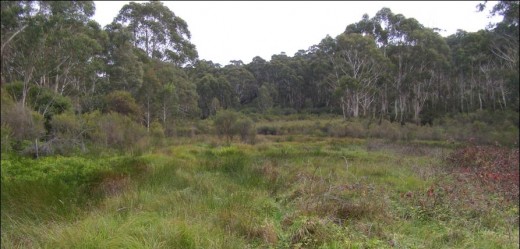 The Gully Water Catchment (Photo by editor 20110502, copyright free in the public domain) .
The Habitat Advocate’s raison d’être
Habitat Campaigning best starts close to home. If everyone took this approach then the natural environment would be far more intact, the wildlife habitat more viable to sustain local wildlife, and the risk of species extinction far lower than where current trends are heading.
The Habitat Advocate established as a volunteer conservation group back in 2001 on the edge of a small steep creek valley within what we term The Gully Water Catchment based at The Habitat Advocate founder’s residential home on the bushland fringe of the regional township of Katoomba, situated in the central Upper Blue Mountains of New South Wales in Australia.
The reference to this creek valley as ‘The Gully‘ is the historical affection name for the valley by former resident tenants.
Our raison d’être (purpose in forming) initiated on one Saturday morning within a few weeks of the founder, Steven, moving into his recently acquired house and suddenly being impacted by the roar of racing Mini Cooper cars down in the creek valley less than 100 metres away. Having had all due diligence in conveyancing previously undertaken ahead of purchasing the property and the previous tenant advising how quite the area was, no mention had been made of the deafening motor racing circuit! Local Blue Mountains [city} Council (local council) maps had labelled the small surrounding valley as ‘Katoomba Falls Creek Valley‘, with the northern portion near our house named by Council as ‘Frank Walford Park‘, but NOT as ‘Catalina Park‘ motor racing circuit.
So that was it, the battle to end the motor racing commenced.
Steven soon learned about a local grassroots activist group of residents living around the edge of this creek valley, which had formed back in 1989 initially and primarily to end the car racing use of the valley and also to respect and rehabilitate the creek valley’s natural ecology. Steven joined them in 2002 – ‘The Friends of Katoomba Falls Creek Valley Inc.‘ (‘The Friends’), led by the now late Neil Stuart [1937-2016].
Between 2002 and 2007, Steven volunteered in The Friends working group’s activities – lobbying local council to end the racing, participating in community meetings about the valley, meeting with former residents of ‘The Gully’ (mostly Aboriginal), writing letters in the local Blue Mountains Gazette newspaper, undertaking bushcare weeding and rubbish clean ups in the valley, and generally monitoring and reporting unsavoury goings such as illegal squatting by transient outsiders.
During those early years, The Friends learned about the tragic history of the creek valley’s 1957 forced eviction of former tenants by Council and its bulldozing of their homes so that the racetrack could be constructed. The former tenants had referred to the creek valley as The Gully – mainly the northern portion of what Council had named Frank Walford Park after one of its mayors of the 1950s who had approved the racetrack usurpation* of the land previously known by former residents as The Gully. A number of members of The Friends were indeed former residents of the valley – Aboriginal, non-Aboriginal, as well as intermixed local families.
[Ed: *Usurpation is the act of taking somebody’s position and/or power without having the right to do this. Land Usurpation is the appropriation of land from the previous or lawful owner].
In 1995, local council had renamed ‘Katoomba Falls Creek Valley‘ to being ‘Upper Kedumba River Valley‘. In around 2007, The Gully Traditional Owners decided to rename The Gully as ‘Gungaree’ in Gundungurra aboriginal language acccording to historical doctoral research undertaken by Wentworth Falls historian Jim Smith, Ph.D.
Around the time from 2000 to 2002, as chance would have it, there occurred an environmentalist momentum in the area, followed by a local social momentum that firstly had the Blue Mountains region internationally recognised as a natural World Heritage area on Thursday 30th November 2000. Secondly, portions of the valley became recognised and declared by the New South Wales Government as an Aboriginal Place under its National Parks and Wildlife Act 1974 on 18th May 2002. That declaration resulted in local council terminating the car racing in the valley.
So job done! It was certainly a changeable time, and Steven just happened to have arrived from Sydney, originally Melbourne.
By 2007, despite tirelsss efforts of The Friends since forming back in 1989 to persuade local council (as the legal owner of the valley) to end the racing and to consult with interested local residents around the valley and about managing a natural rehabilitation process for the valley, that was not to be.
Instead, council bureaucracy over the years systematically thwarted all attempts by The Friends, and The Friends’ allied collaborated group The Gully Guardians (2004-2006) from having any say in joint community consultation and rehabilitation management of the valley. In fact, due to the years of The Friends demands upon local council to consult in rehabilitate the valley and The Friends’ relentless and strident criticism of local council (whilst valid in this author’s view), local council went further.
By 2007, local council had completely ostracised The Friends from all community consultation concerning the valley and had bureaucratically driven a by-law wedge between The Friends and the local Aboriginal people who had been former residents of the valley before 1957.
By 2007, local council had chosen to side solely with the newly formed Gundungurra Aboriginal group, The Gully Traditional Owners, in an exclusive management partnership for the valley. From local council’s bureacuratic standpoint The Friends had effectively become personae non gratae.
It wass in this year, that Steven sadly decided to resign from The Friends and focus his environmentaliost attention upon building the website of the Habitat Advocate.
All the while and since then, Steven has continued to maintain close good friendship and communication with members of The Friends.
The Gully Water Catchment?
In the upper Blue Mountains, a creek and series of wetlands following the upper reaches of the Upper Kedumba River above Katoomba Falls form an elongated upland valley covering an area of more than 100 hectares. This creek valley has been known for many decades by its former residents and their descendants affectionately as ‘The Gully’. Over more than a century since the 1870s, this natural valley was steadily deforested and around the fringes subdivided for housing so that the remnant natural area has been reduced to under 70 hectares..
Situated next to the township of Katoomba, The Gully has long been surrounded by housing development above it atop its steep valley embankments. Yet, The Gully held important ancestral cultural values to traditional Aboriginal peoples of the Gundungurra, Darug, Wanaruah, Wiradjuri, Darkinjung and Tharawal of the greater Blue Mountains region and adjoining lands. These values contimue to be held by formre residents of the Gully and current generations.
The Gully has been a ceremonial meeting place for traditional peoples of the Blue Mountains for perhaps thousands of years. Since colonial settlement at Katoomba in the 1870s, The Gully has provided a secure haven for poor people both black and white, who although living in basic squat conditions in the extremes of Mountains weather, lived together as a close knit community; the Congregational ‘Mission’ Church for many years having played a key uniting role for Gully folk and as an informal umbrella protecting authority to stave off designs on the place by selfish others.
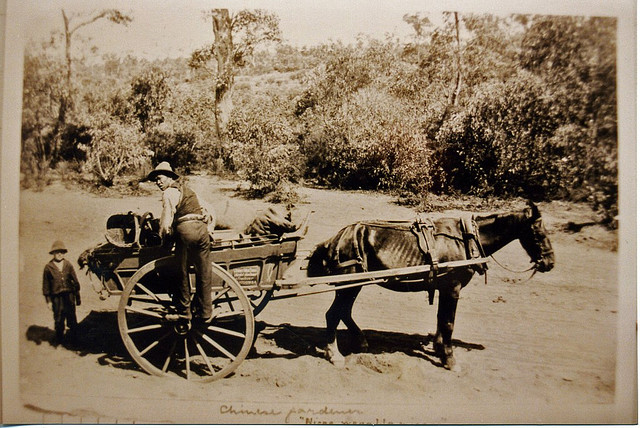
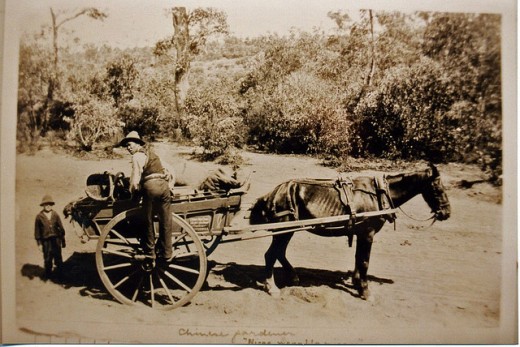 Jimmy War Sing, Chinese market gardener and fruiterer on his sulky in The Gully; the poor horse not well fed.
His ‘Chinese Garden’ was situated in a natural gully with a small watercourse running through it behind Loftus and Neale Streets (McRae’s Paddock).
(Photo circa 1903), supplied by Colin Slade in Pict. Memories Blue Mountains, John Low 2002)^http://www.flickr.com/photos/blue_mountains_library_-_local_studies/2669879647/ . Jimmy War Sing, Chinese market gardener and fruiterer on his sulky in The Gully; the poor horse not well fed.
His ‘Chinese Garden’ was situated in a natural gully with a small watercourse running through it behind Loftus and Neale Streets (McRae’s Paddock).
(Photo circa 1903), supplied by Colin Slade in Pict. Memories Blue Mountains, John Low 2002)^http://www.flickr.com/photos/blue_mountains_library_-_local_studies/2669879647/ .
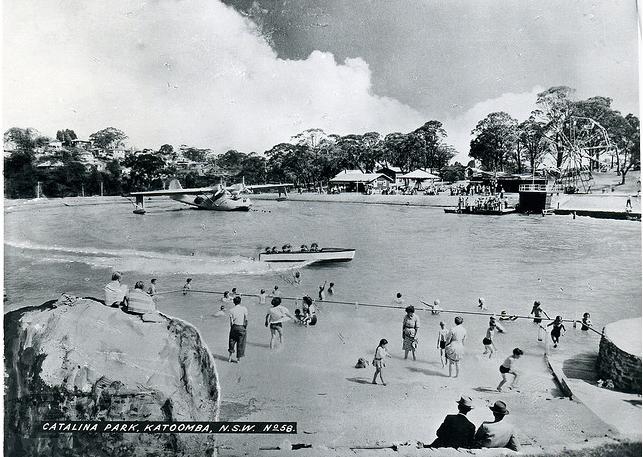
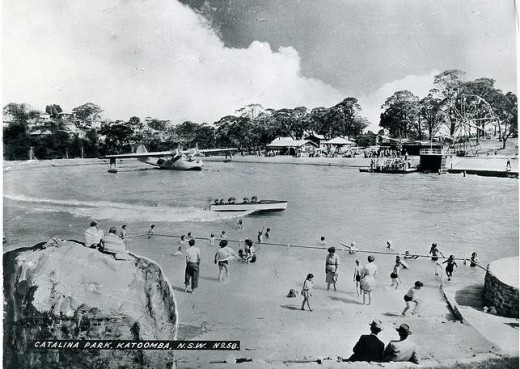
Two particular historic events have adversely impacted upon The Gully’s ecological integrity and its human community. The first event was the bulldozing of the natural swamp of frogs hollow in the 1940s by developer Horace Gates to construct a dam as an artificial lake as part of his theme park scheme for the Gully. A few years later a Catalina flying boat was floated in the dam (lake) as a tourism draw card. At some time in the late 19th Century a local by the name of McRae, decided to bulldoze and infill the wetland in the mid part of the valley so that he could graze his horse stock.
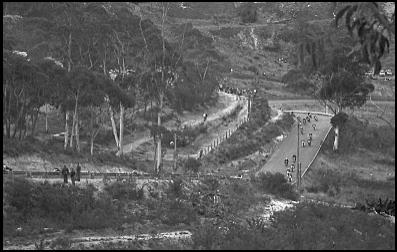
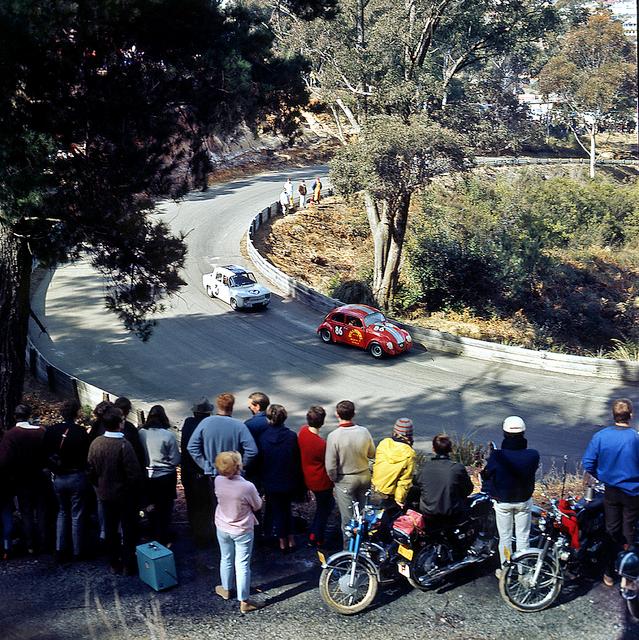
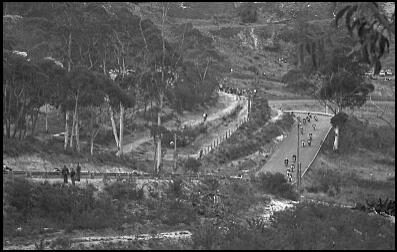
The second event was the bulldozing of the entire top valley including the homes of several families in 1957 by the Blue Mountains Council in collaboration with a local fraternity car racing drivers and local businessmen to make way for a motor racing circuit – ‘Catalina Raceway’. Those families were forcibly evicted from their homes, extricated from The Gully and one woman died of a heart attack during the raid.
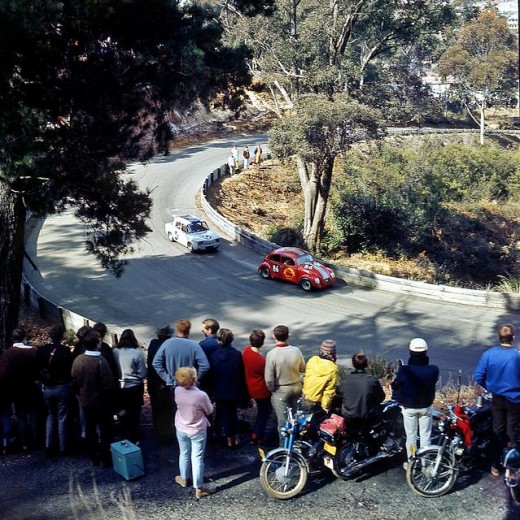
Catalina Raceway was used for motor racing through the 1960s, by the 1970s the racing circuit had steadily fallen into disrepair. This was due to a number of factors – repeated foggy weather at many racing events, the inability of the racing association to repay its construction debt to the Blue Mountains Council, new competition from circuits nearer to Sydney (Oran Park and Amaroo Park), and due to the prohibitive cost of increasing motor racing safety standards, prompted by the death of two racing drivers on separate occasions at ‘Craven A Corner’.
The track became overgrown and weeds spread throughout the valley. Blue Mountains Council named the valley ‘Catalina Park‘, and later named the top northern part of the valley as ‘Frank Walford Park’ after the namesake of a previous councillor who had been a key decision maker in approving the racetrack be built. Car racing at Catalina, culminating in the formation of the Blue Mountains Tourist Association.
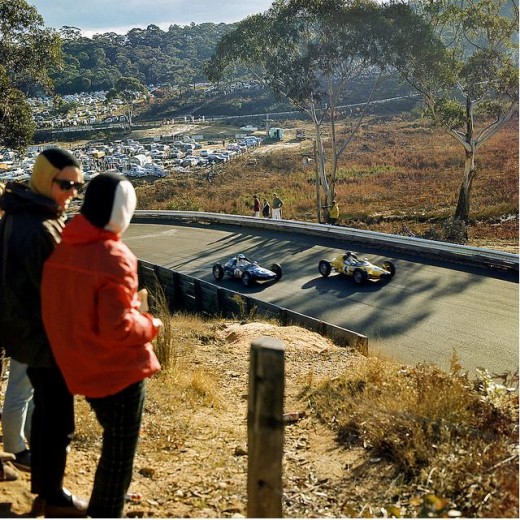
Catalina Raceway was a form of early Blue Mountains tourism and became very popular with car racing enthusiasts during the 1960s and 1970s.
In 1989, local nearby residents concerned about the poor state of the valley and with a desire to stop the car racing and protect the natural values of the valley, formed The Friends of Katoomba Falls Creek Valley, Inc. (‘The Friends’).
This grassroots local community group of local Katoomba residents established as one of the first bushcare groups in the Blue Mountains and since then their volunteers have regularly engaged in bush regeneration throughout the valley.
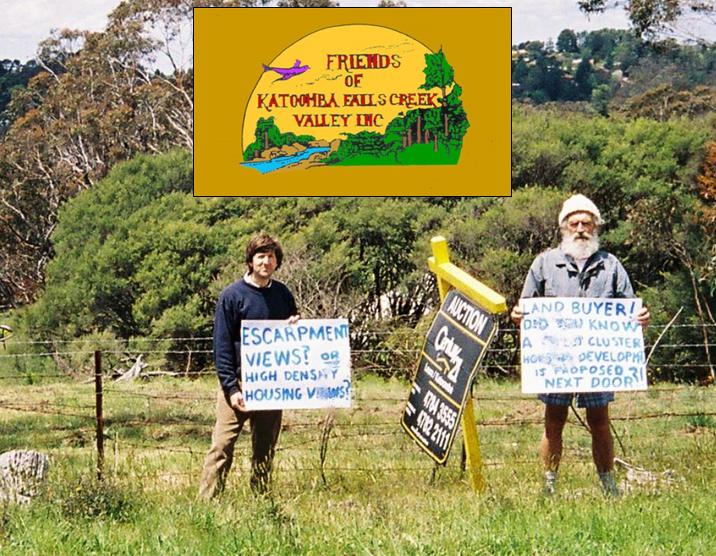
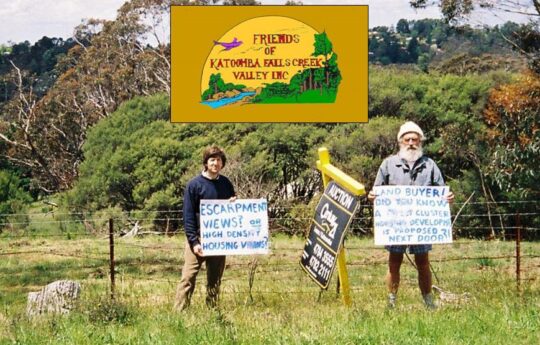 One of many protests by members of ‘The Friends’ (1989-2016) to save The Gully (‘the Valley’) from harm mainly from housing developers and tourism operators seeking to profiteer. In this photo locals Ivan Jeray and the late Neil Stuart (joint founder of The Friends) in 2005 protesting about the proposed massive deforestation and subdivision of this remnant side gully into a 69 lots of new houses dubbed 21 Stuarts Road Katoomba.
The Friends also galvanised local community support to stop the racing and to rehabilitate the valley back to its natural condition, holding street stalls to raise funds and to raise community awareness over the plight of the long neglected valley. The Friends lobbied Blue Mountains Council over nearly three decades to have the car racing banned, to have the weeds removed and to restore the valley to its pre-1957 natural state.
The Friends’ became instrumental in having plans prepared for the rehabilitation for the valley, most notably the 1993 Bell Report prepared by environmental consultant Fred Bell, the only one done so in consultation with the local community. To date, none of the several plans drafted has been put into effect by local council, so the Gully remains neglected and the race track long abandoned, yet the natural bush vegetation is steadily recovering.
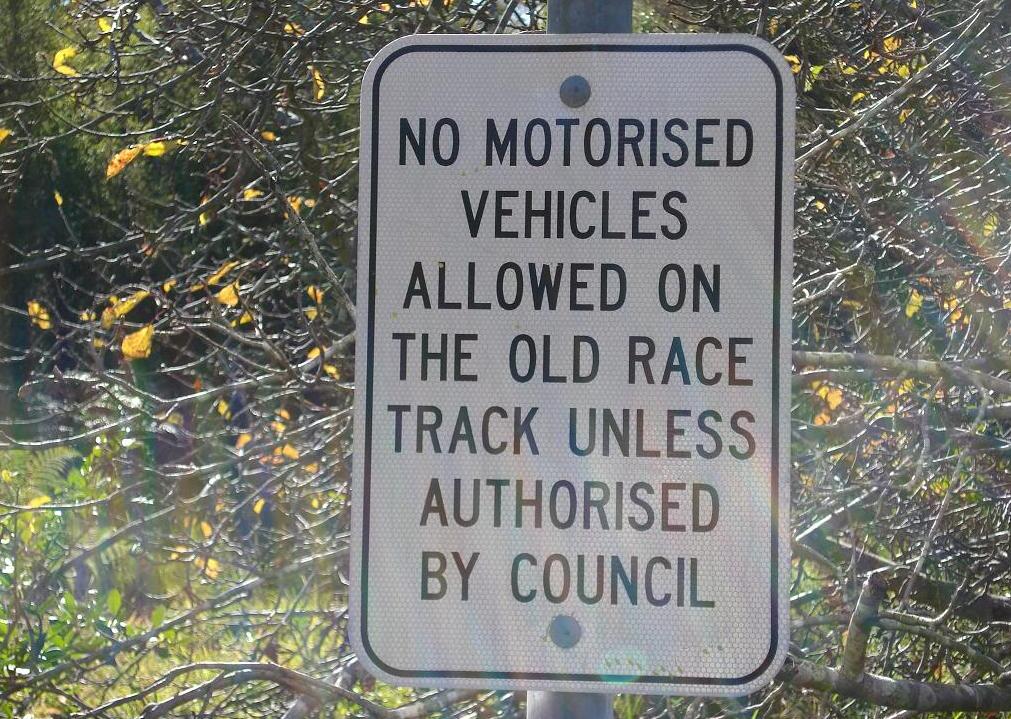
In 2000, local Darug elder, Aunty Dawn Colless, was instrumental in achieving proper recognition for The Gully as an official Aboriginal Place under the New South Wales National Parks and Wildlife Act. On 18th May 2002, regrettably after Dawn’s passing, The Gully became protected under Sections 84, 85 and 90 from development and all racing formally banned.
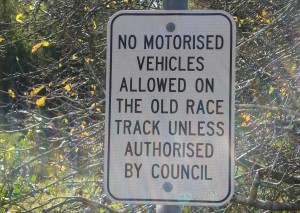
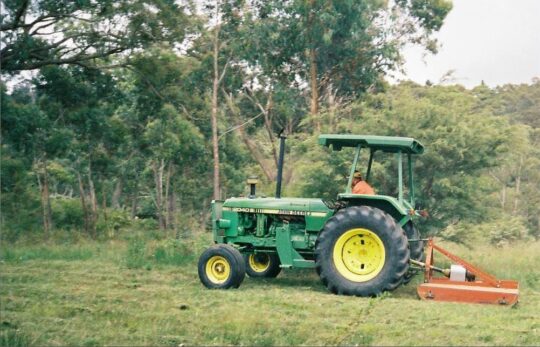 We dubbed this tractor towing a mower/slasher as ‘Hector’. It has been a notorious tool of destruction of the ecology of The Gully, also known for decades as Katoomba Falls Creek Valley.
Concerned local residents around The Gully back in 1988 began to realise that this natural creek valley immediately upstream and feeding Katoomba Falls and Kedumba River with fresh drinking water, was becoming increasingly under threat of destruction from various external vested interests. So in 1989 a mob of them formed a local community environmental conservation bushcare and activist group , The Friends of Katoomba Falls Creek Valley Inc.
This committed volunteer community group ran for some 27 years under the leadership and inspiration of local social worker and teacher, Neil Stuart. Most members of ‘The Friends’ initially lived within the water catchment of Katoomba Falls Creek Valley – a natural amphitheatre of multiple watercourses on the western side of the Blue Mountains township of Katoomba, which covered about 600 hectares.
So yes they were NIMBYS proudly, defending their beautiful natural place from selfish invaders threatening to ruin and exploit the Nature and its natural amenity.
Without the concerted efforts and activism of this committed community group, it is most likely that The Gully would now no longer exist, but be a valley of housing and recreational development.
The purpose of this webpage is to offer a perpetual factual account of the truth about The Gully, its recent history, its stories, its plethora of threats to undermine its integrity, values and spirit over many decades, and the stories of the ongoing abuse, neglect, battles, egos, bias – warts and all.
In 2004, the Blue Mountains {city} Council finally released it 2002 draft Plan of Management for The Gully, however, after seven years is yet to be funded and implemented; council preferring to fund multi-million urban developments such as nearby Katoomba Cultural (Shopping) Centre. In that same year, past Aboriginal residents and descendants of The Gully collaborated with local council management to have an archaeological survey conducted at key traditional cultural sites throughout The Gully.
In early 2006, a collaborative coalition of various community members including traditional Gundungurra and Darug and The Friends and formed ‘The Gully Guardians’, although this was short-lived due to undermining tactics by political interests within Blue Mountains Council causing hostilities. This was superseded by the establishment of the ‘Gully Traditional Owners’ in June 2006 by representatives of the Aboriginal people that had inhabited the Gully over many generations. The Gully Traditional Owners has since that time collaborated with Blue Mountains {city} Council to achieve New South Wales grant funding for restoration works, including a planned interpretative walking track through the Gully.
‘The Gully Cause’
The Gully Cause (i.e. saving it from ongoing abuse and neglect) is an humanitarian one as it is an ecological one.
This creek valley is the site of some of the Blue Mountains most divisive conservation battles that persist – citing the forced evictions by Council, the notorious 1957 bulldozing for a car racetrack, the bulldozing for Katoomba golf course, massive subdivision for housing, council profiteering from land sales for incremental housing development, deforestation for mass tourism, arson, a sports centre development by council, the creek diverted into a dam as part of one of two wacky theme park developments, etc, etc.
The values, history, stories, threats, abuse and neglect remain ongoing. The Habitat Advocate was established in 2006 as a conservation activist organisation based in The Gully water catchment situated in inner west Katoomba.
Since the events of 1957, when council acquired the majority of what was then known as Katoomba Falls Creek Valley upstream of Katoomba Falls to the highway, most of the land has been deemed Council Community Land, so it is largely public open space, except for the many sections sold off for development – both housing subdivision and mass tourism.
The editor of The Habitat Advocate has lived within The Gully water catchment since 2001 and has contributed an active community voluntary role to protect the natural values of The Gully and assist local residents and former residents of The Gully and their descendants in a constructive way. This includes years of Bushcare weeding, SCA Streamwatch drinking water quality monitoring winning five awards from the Sydney Catchment Authority, as well as community activism as a member of the former local Katoomba community group Friends of Katoomba Falls Creek Valley Inc. (affectionately termed ‘The Friends’ by its members), which spanned some 26 years (1989 – 2016) protecting and the defending this natural valley from all sort of development threats.
In addition, our editor was a member of the former Gully Guardians (a joint informal coalition of both local Aboriginal and non-Aboriginal locals and former residents of The Gully and their descendants). I have enjoyed ongoing co-operation with The Gully Traditional Owners.
The Habitat Advocate grew out of its editor’s five year membership of local Katoomba protest action group The Friends from 2002 to 2006. The Habitat Advocate is intimately aware of The Gully’s values, cultural sensitivities, histories, issues and threats that continue to affect this special place.
The Gully Collection
This Habitat Advocate webpage is dedicated to the conservation values of The Gully and remains a work-in-progress, collating various records, documents, images and accounts on The Gully so that locals, past, present and emerging of all persuasions may learn more about the important conservation values of this special place, thus continuing in the conservation spirit of The Friends.
We have amassed a considerable library of knowledge on The Gully spanning a century.
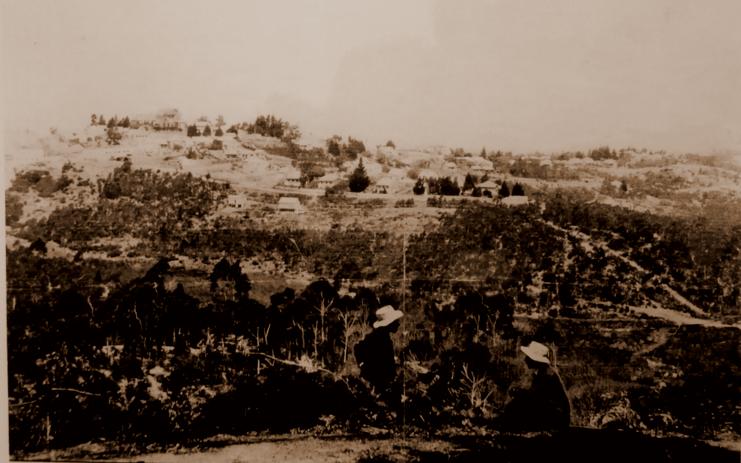
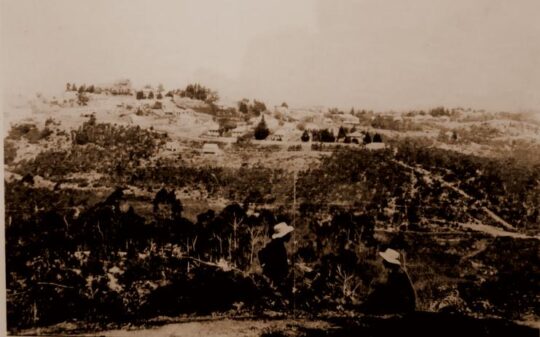 An early photo of The Gully’s landscape (circa. 1920), taken looking from from the rear of the Balmoral Guesthouse (then 196 Main Street, since renamed Bathurst Road) in Katoomba perhaps by the renowned Blue Mountains photographer Harry Phillips (1873-1944) An early photo of The Gully’s landscape (circa. 1920), taken looking from from the rear of the Balmoral Guesthouse (then 196 Main Street, since renamed Bathurst Road) in Katoomba perhaps by the renowned Blue Mountains photographer Harry Phillips (1873-1944)
The following hyperlinks below are to pages and posts internally on this website that over time will form a reference library of material on The Gully restricted to what is in the public interest – ‘The Gully Collection‘ (created by The Habitat Advocate from 2016):
Leave a Reply
You must be logged in to post a comment.
September 4th, 2011
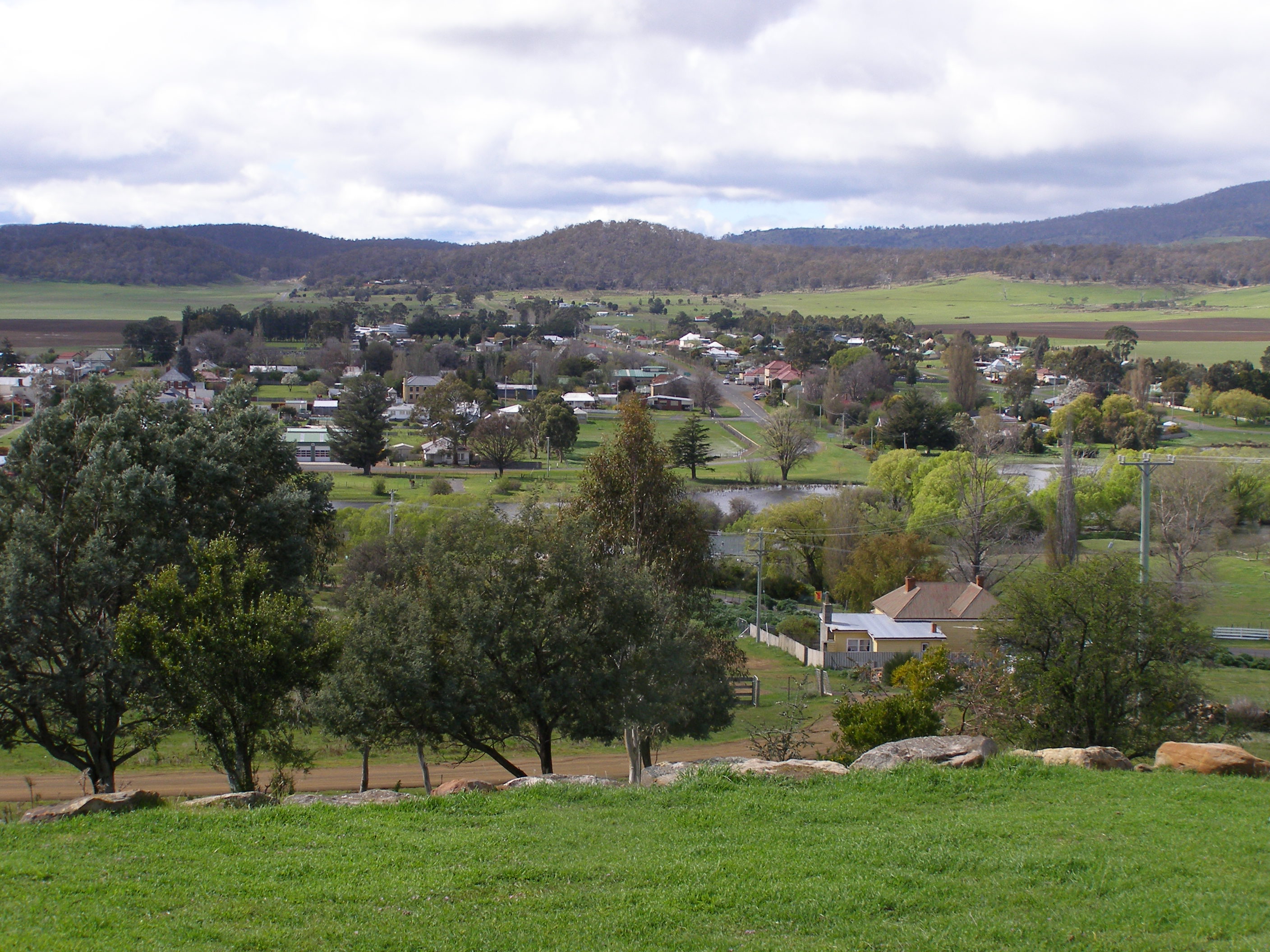
Whilst touring Tasmania’s highland country in 2009, we stopped over in the old rural town of Bothwell.
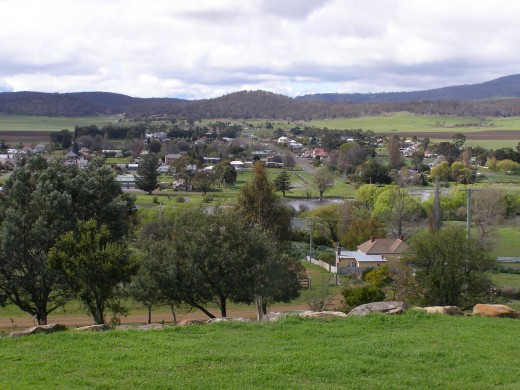 A pastoral Bothwell ~ an ode to the British countryside A pastoral Bothwell ~ an ode to the British countryside
looking from Barrack Hill over the River Clyde
(Photo by Editor 2009, free in Public Domain)
(click photo to enlarge, then again to enlarge again)
.
Bothwell is historically known for its colonial exploration dating back to 1806, its convict past dating back to the 1820’s, and for its soldiers’ barracks, and for its pastoral colonial heritage.
Its namesake was derived from a town in Lanarkshire, Scotland; likewise the naming of the River Clyde.
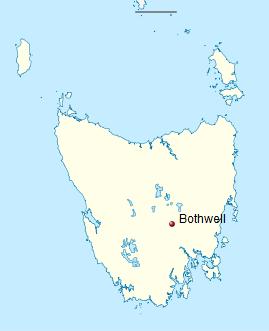 Bothwell
Situated in the Tasmanian South East Bioregion Bothwell
Situated in the Tasmanian South East Bioregion
.
Few will know of the prior Tasmanian Aboriginal heritage of the 5 bands of the traditional Tasmanian tribe (kinship group) the ‘Teen Toomle Mennenyer‘ of this highland and river region. Many were either massacred, rounded up and put into missions, or succumbed to European diseases. Most were dispersed from their traditional lands by 1832. This otherwise labelled ‘Big River Tribe‘ likely due to the big river country characterising this fertile inland region; rivers of which subsequently named the Derwent, Ouse, Clyde, Shannon, Weld, Styx, Plenty, Jordan, Lake, Isis and Pine, amongst others.
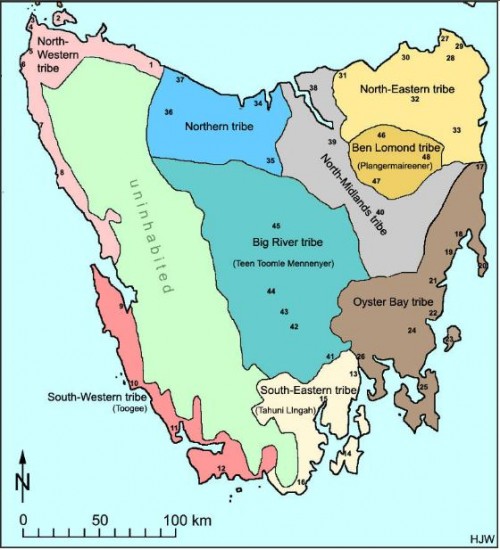 Traditional Aboriginal Territories of Tasmania Traditional Aboriginal Territories of Tasmania
.
Even fewer will know of the extensive tall Tasmanian Swamp Gum forest that for thousands for years blanketed this lush river valley, prior to it being clear-felled for timber and to make way for colonial pasture.
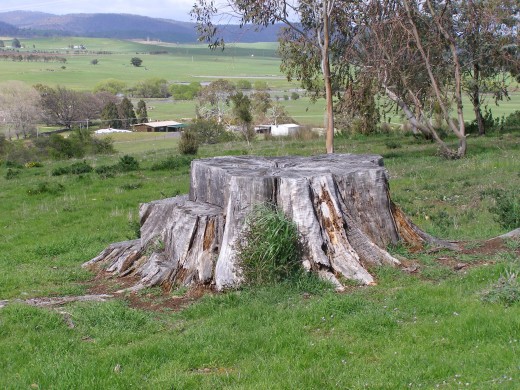 ‘Dead Heritage’
Stump of a Tasmanian Swamp Gum (Eucalyptus regnans)
on Barrack Hill, overlooking Bothwell
(Photo by Editor 2009, free in Public Domain
(click photo to enlarge, then again to enlarge again) ‘Dead Heritage’
Stump of a Tasmanian Swamp Gum (Eucalyptus regnans)
on Barrack Hill, overlooking Bothwell
(Photo by Editor 2009, free in Public Domain
(click photo to enlarge, then again to enlarge again)
.
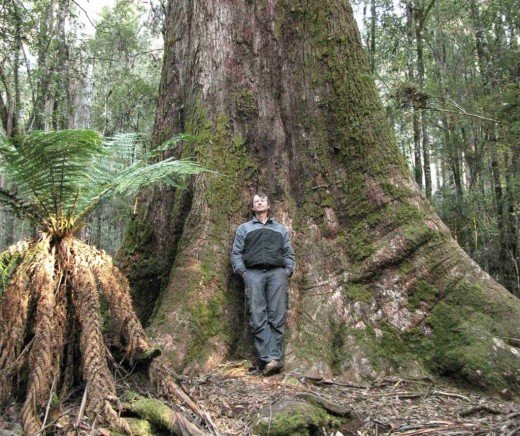 ‘Tasmanian Natural Heritage’
Tasmanian Swamp Gum
The type of Swamp Gum forest around Bothwell
that would have greeted the colonists back in the 1820s
(© Photo Magi Nams)
Source: http://www.nams.ca/MagiBlog/tag/tasmanian-snow-gum/page/2/
.
.
Fifty kilometres down the road from Bothwell on the tourist drive, lies the old colonial town of Oatlands. The old Callington Flour Mill in the town has become a tourist attraction and has recently been restored aided by a $1.2 million grant by Australia’s Minister for Trade, Simon Crean, in 2007.
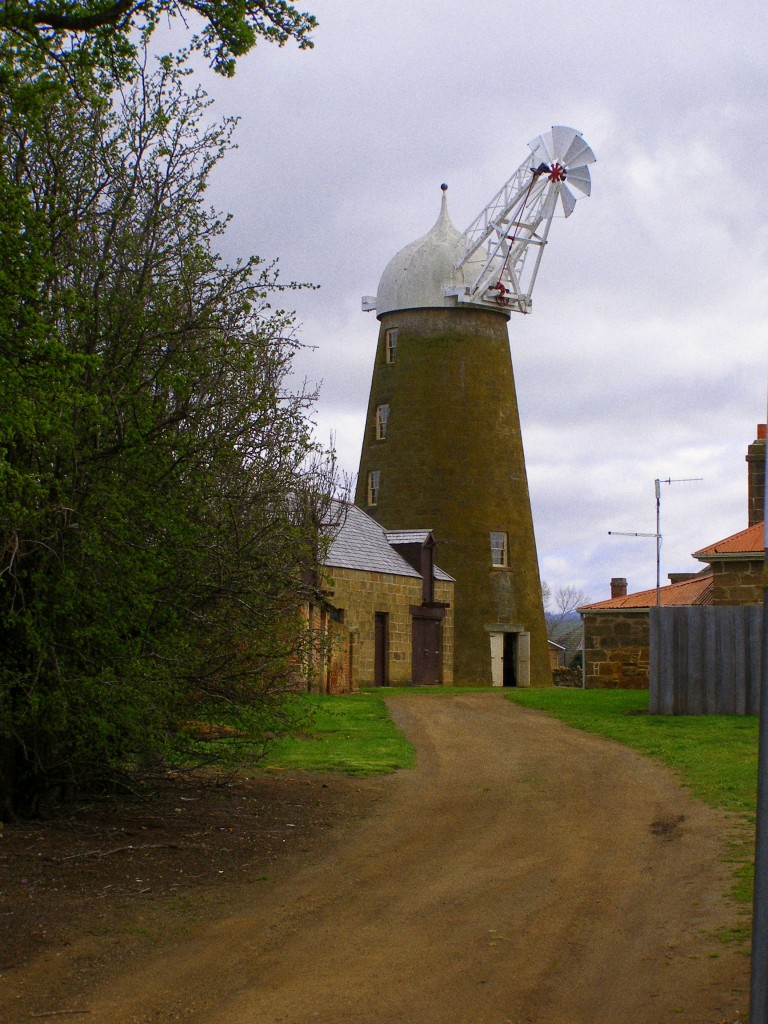 ‘Tasmanian Colonial Heritage’
Oatlands’ Wind Mill
The 1837 landmark Callington Flour Mill, recently restored
(Photo by editor, September 2009, free in Public Domain)
‘Tasmanian Colonial Heritage’
Oatlands’ Wind Mill
The 1837 landmark Callington Flour Mill, recently restored
(Photo by editor, September 2009, free in Public Domain)
.
Part of that restoration involved adding new structural posts in its interior. The following photo is of a rather new looking hardwood post inside the mill. It looks like local Messmate/Stringybark (Eucalyptus obliqua), generically marketed as ‘Tasmanian Oak‘.
.
Other local timbers sold as ‘Tasmanian Oak’ are Alpine Ash (Eucalyptus delegatensis) and Swamp Gum (Eucalyptus regnans).
On Mainland Australia, Eucalytus regnans is referred to as Mountain Ash ~ once the world’s tallest tree species, once taller than the Californian Redwood.
 The environmental cost of Tasmanian Tourism
A new ten inch (wide) post inside Oatlands’ restored mill,
probably from local Messmate/Stringybark (Eucalyptus obliqua)
(Photo by editor, September 2009, free in Public Domain)
. The environmental cost of Tasmanian Tourism
A new ten inch (wide) post inside Oatlands’ restored mill,
probably from local Messmate/Stringybark (Eucalyptus obliqua)
(Photo by editor, September 2009, free in Public Domain)
.
.
.
.
.
Further Reading:
.
[1] ‘The Traditional Tasmanians‘, ^http://www.andaman.org/BOOK/chapter52/5-Tasmania-traditional/traditional.htm [Read More]
.
– end of article –
.
Tags: Big River Tribe, Bothwell, Dead Heritage, Eucalyptus globulus, forgotten forest, Oatlands' Callington flour mill, stump heritage, Tasmania, Tasmanian Aborigines, Tasmanian Blue Gum, Tasmanian Natural Heritage, Tasmanian South East Bioregion
Posted in Tasmania (AU), Threats from Deforestation, Threats from Tourism and Recreation, Threats to Wild Tasmania | No Comments »
Add this post to Del.icio.us - Digg
Leave a Reply
You must be logged in to post a comment.
September 3rd, 2011
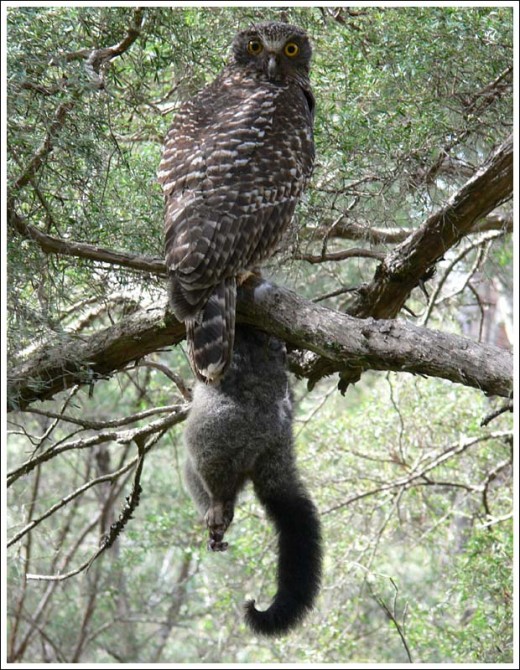 Australia’s native Powerful Owl with native prey – a juvenile Brushtail Possum (2kg?) Australia’s native Powerful Owl with native prey – a juvenile Brushtail Possum (2kg?)
© Photo by Duncan Fraser
^http://www.natureofgippsland.org/
.
Powerful Owl Call
(turn on your computer volume)

.
.
Drought, bushfires…it’ll take years to find out what’s happened to Victoria’s Forest Owls
.
[Source: ‘Something is knocking the states owls off their perches‘, by John Elder, The Age newspaper (Victoria, Australia), 20100613, ^http://www.theage.com.au/victoria/something-is-knocking-the-states-owls-off-their-perches-20100612-y4s0.html]
.
‘What’s happened to Victoria’s carnivorous owls? A significant number have vanished, and the (Victorian) Department of Sustainability and Environment (DSE) isn’t sure what’s going on.
It’s assumed the top end of the woodland food chain is either starving to death because its food source has been killed off by the drought and fires, or it is relocating to parts unknown, but it will take years to find an answer.
The DSE has been monitoring the owl populations – including that of the Powerful Owl, Australia’s largest owl – since 2000. Since then, detection rates in South Gippsland and the Bunyip State Park have dropped by half.
In some areas of the Bunyip State Park – half of which was lost to the Black Saturday fires – detections of the Sooty Owl have dropped to a third.
DSE owl specialist Ed McNabb says: ”We don’t know what’s happened to them. We can only assume that drought has played a major role. We noticed the downward trend before the fires. They’re very mobile birds, but the fires would have had an impact on their prey.”
Powerful and sooty owls, both officially listed as vulnerable, mainly eat sugar gliders and ringtail possums. The possums in particular are known to have little resistance to chronic hot weather, and their failure to thrive in the drought is the main reason why owl numbers have dropped.
While owls may have escaped (Victoria’s) Black Saturday fires, many possums would have been incinerated.
.
McNabb says the smaller carnivorous birds, such as the barking owl, are able to sustain themselves on insects. Powerful and sooty owls can also eat rabbits and birds such as magpies and kookaburras, but they need to make the change in their diet before energy loss reduces their ability to effectively hunt.
”They’ll either starve or take something else,” said McNabb.
Equally disastrous for the owls was the loss of old trees with large hollows that they require for nesting. They might have shifted elsewhere to recolonise, but this would mean taking over an already occupied territory. ”And there tends to be a home-ground advantage in these battles,” said Mr McNabb. The occupying bird has inside knowledge of the territory and a greater capacity to defend its patch, because it’s energy store will be higher. Flying great distances in search of food saps the strength from large birds and even causes them to starve.
The DSE’s biodiversity team leader for West Gippsland, Dr Rolf Willig, said:
The top order carnivores were ”an indicator species as to the well-being of the ecosystem.
Theoretically, if they’re happy, the rest are happy.”
.
For five years Dr Willig has been running a playback monitoring program in South Gippsland, where recordings of owl calls are played into the dark and answering calls are recorded. The number of birds answering calls have dropped significantly this year.
”The results indicate we may be having a delayed reaction from the fires,” he said. ”The possums not actually killed in the fires might have been exposed afterward, and the owls picked them off, eating all the food that was left.”
It will take years to find out what’s happened. ”And not just three or five years. We’ll be out here for a long time,” said Dr Willig.’
.
.
‘Conservation through Knowledge’ – a motto of leadership

The Royal Australasian Ornithologists Union is Australia’s largest non-government, non-profit, bird conservation organisation. It has sensibly branded itself as ‘Birds Australia‘, which in just two words says all that it is about, and the Emu family graphic is uniquely representative of Australia ~ the Emu being Australia’s largest bird.
Similarly sensible is its motto ‘Conservation through knowledge‘ which provides inspiration for conservation leadership, beyond Ornithology. The organisation was founded way back in 1901 to promote the study and conservation of the native bird species of Australia and adjacent regions, making it Australia’s oldest national birding association.
The Powerful Owl call above is sourced courtesy of Birds Australia.
.
.
Powerful Owl (Ninox strenua)
http://www.birdsaustralia.com.au/our-projects/powerful-owl-wbc.html
 Powerful Owl (weighs under 1.5 kg) Powerful Owl (weighs under 1.5 kg)
© Photo by Duncan Fraser
^http://www.natureofgippsland.org/
.
A noctural top-order predator of tall old forests, the Powerful Owl is territorial, sedentary and monogamous ~ it calls one place home and mates for life (a lifestyle model for many humans).
.
HABITAT
Throughout most of its range this species typically inhabits open and tall wet sclerophyll forest, mainly in sheltered, densely vegetated gullies containing old-growth forest (where they breed in hollows in large trees) with a dense understorey, often near permanent streams. Such habitats are often dominated by Mountain Grey Gum, Mountain Ash, Manna Gum or Narrow-leafed Peppermint. They occasionally also occur in rainforest in gullies surrounded by sclerophyll forest or woodland. Powerful Owls also occur in adjacent open dry sclerophyll forests and woodlands, such as those dominated by box–ironbark eucalypts, Candlebark, Messmate or riparian River Red Gums; they sometimes also occur in open casuarina and cypress-pine forests.
The main food source for these owl species is hollow-dependant mammals (e.g. greater gliders, sugar gliders). Natural processes that create tree hollows typically take hundreds of years to form.
Human disturbed forests, through logging/burning/fragmentation/euphemistic ‘clearing’, destroy these vital yet rare hollow-bearing trees, and this considerably disadvantages owls.
DISTRIBUTION
- Endemic (found nowhere else on the planet, except for…) to eastern and south-eastern mainland Australia, mainly on the seaward side of the Great Divide.
.
CONSERVATION STATUS
- Vulnerable in Queensland
- Vulnerable in New South Wales
- Vulnerable in Victoria
- Endangered in South Australia
.
SURVIVAL THREATS
- Powerful Owls are adversely affected by the clearfelling of forests and the consequent conversion of those forests into open landscapes. [Deforestation]
.
When in flight, the silhouette of the Powerful Owl is distinctive, combining long, broad, rounded and deeply fingered wings with a large, sturdy body and a longish tail, gently rounded at the tip when spread. The flight is rather slow, with deep laboured wing-beats interspersed with glides.
.
.
References and Further Reading:
.
[1] The Nature of Gippsland (photographic website), ‘A photo gallery featuring the natural world of Gippsland, Victoria, Australia’, Photographs by Duncan Fraser, ^ http://www.natureofgippsland.org/
[2] Birds Australia, (Special survey on Powerful Owl distribution around Sydney, 2011), ^ http://birdsinbackyards.net/surveys/powerful-owl.cfm
[3] ‘ Powerful Owl (Conservation) Action Statement, Victorian Government, Department of Sustainability and Environment, (1999), ^ http://www.dse.vic.gov.au/__data/assets/pdf_file/0019/103177/092_powerful_owl_1999.pdf [ Read More]
[4] ‘ Protecting Victoria’s Powerful Owls‘, Victorian Government, Department of Sustainability and Environment, (2001), ^ http://www.dse.vic.gov.au/__data/assets/pdf_file/0012/102144/PowerfulOwls.pdf [ Read More]
.
– end of article –
Tags: Birds Australia, Conservation through Knowledge, Forest Owls, hollow-bearing trees, old growth, Otway Ranges, Powerful Owl, Sooty Owl, South Gippsland
Posted in 07 Habitat Conservation!, Gippsland (AU), Otway Ranges (AU), Owls, Threats from Bushfire, Threats from Deforestation | No Comments »
Add this post to Del.icio.us - Digg
Leave a Reply
You must be logged in to post a comment.
|
|
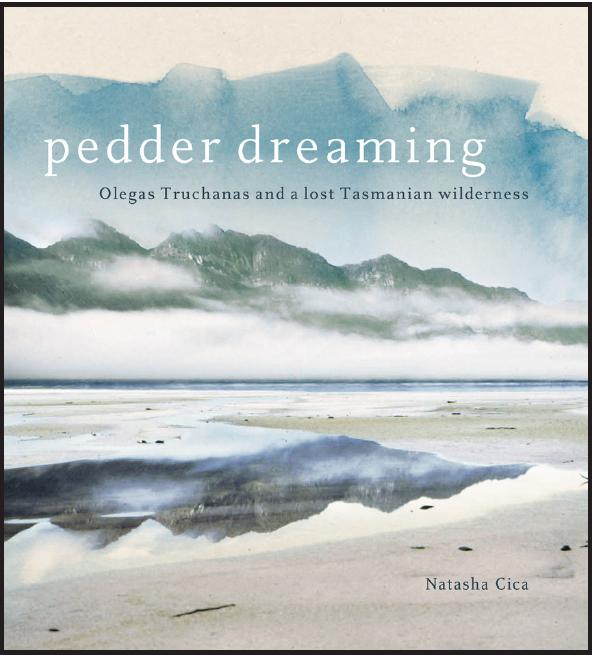
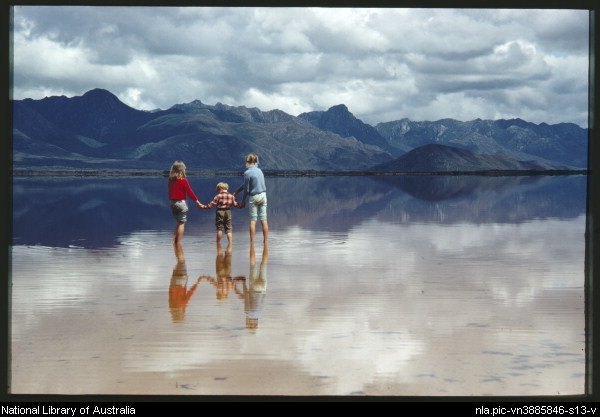 What we destroyed… Olegas Truchanas’ children playing in Lake Pedder in Tasmania’s Southwest in 1971. Less that 12 months later it was flooded.
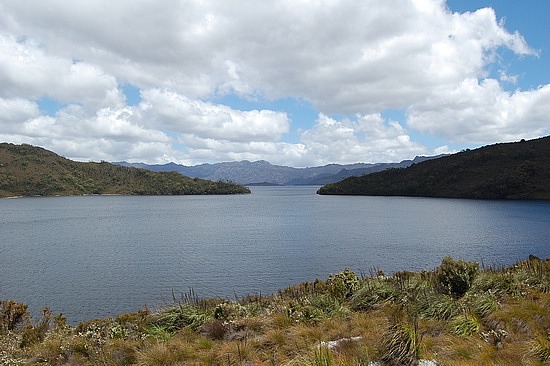 Fake Pedder ~ today’s drowned lake