Within just a minute’s walk from The Habitat Advocate base we happened upon some wonderful local wildlife.
It was a native Blotched Blue Tongue Lizard in this case (scientific species name Tiliquanigrolutea). It was 10th February 2025 (summer) in the late hot afternoon around 6:30pm AEDT, so the sun was still up in the western sky; this given sunsets in late summer at this time of year are as late as 8 pm, some two hours hence. So, this happenstance timing made sense, but a rare sighting these days.
This particular lizard was not easy to then photograph due to it subsequently retreating from the footpath (after we went back for our camera) and retreating into the camouflage cover of the grassy verge behind for safety.
Upon our initial sighting, this lizard had been laying in the middle of the footpath sunning itself – being a cold-blooded lizard (‘ectothermically’ that is; not the human malice variety).
This one we think is female – telling from the comparatively small head size and its thicker tail root. It was not a native Shingleback Lizard (scientific species name Tiliqua rugosa) since such species has a stubbed tail land prefers the habitat plains inland from the Great Dividing Range, and are not found in the Blue Mountains region, whereas Blue Tongues are.
The location was on The Gully’s urban periphery, yet wholly environmentally within the broader Gully Water Subcatchment, where The Habitat Advocate is based. So nice to see wildlife in one’s neighbourhood – we share local wildlife’s neighbourhood.
We provide hyperlinks below to further information and clearer images about this lizard species.
Anyway, it was a pleasurably welcomed and encouraging sighting.
Such sightings however are increasingly rare around these parts these days due to Council’s habitat destruction – pretty much since Council has existed since its origins in Katoomba in 1890, then in 1947 re-branding itself Blue Mountains City Council from being a two adjacent regional municipality/shire councils. Then from November 2000 after the Blue Mountains region was declared an international World Heritage Area, this local Blue Mountains Council has bizarrely extolled its contradictory perceived virtues of being a city within a World Heritage Area – what espousing urban sprawl development and high-rises amongst Eucalyptus habitat?
We bought our house in 2000, which had there since the 1920’s. So, we did not build into bush, but rather it was long existing ‘in-town’, and so technically we just recycled and renovated it. It had had only lawn back and front, but since 2001 we have created an onsite forest and restored much local habitat on site, So, no more grass and we then gave away our lawn mower!
One also recalls that on 13th February back in 2017 around 5:30 pm during a 47o Celsius unseasonal heatwave weather event across New South Wales, observing a large native Eastern Brown Snake (scientific species Pseudonaja textilis) of almost 2 metres in length scurrying across the scorching road surface of our street into the cooler shade of our forested front garden. Well, we chose not to garden or water there for a week afterwards and warned our neighbours. However, we immediately reported this snake sighting to the volunteer-based Wildlife Rescue Service (WIRES) for safety guidance and we spoke to one of their trained snake catchers who gave us helpful and reassuring advice over the phone.
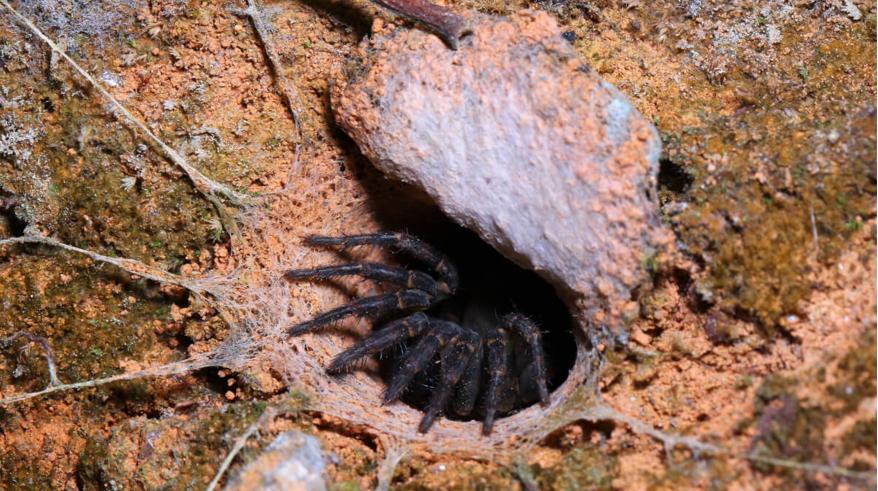
Also, when we first moved in where we are, one had to contend with a native Blue Mountains Funnel Web Spider (scientific name Hadronyche versuta) ground nest in our then unkempt backyard, also unfortunately the native Brown Broadfooted Marsupial Mouse (scientific name is Antechinus stuartii) family over the back fence that we observed, eventually sadly perished.
But it beats living in increasing sprawling concreted, treeless sterile Sydney human megalopolis.
[7] ‘Fauna Watch –Winter is not the time for hunkering down for Antechinus!, 2019-08-19, by Anne Carey, Bushcare Blue Mountains (Fauna, Natives), ^https://bushcarebluemountains.org.au/fauna-watch/
When we bought our 1920’s cottage bungalow in The Gully Catchment (Katoomba Falls Creek Valley) back in 2000, it was run down and surrounded by lawns front and back.
Since then over the past nearly 25 years, we removed all the lawn, renewed the dilapidated fences, annexed the verge with a fern rockery, terraced the front and planted many trees (including a Mountains Blue Gum), hedging and what has now become a micro temperate rainforest with now 17 tree ferns under an established canopy. The image above is one of a number we planted in Spring.
The birds have come back – crimson roselas, king parrots, magpies, currawongs, a few sulphur crested white cockatoos, bower birds, wattle birds, seasonal koels, New Holland honey eaters, thornbills.
Whilst we have not sought to re-establish the local forest ecology, our small plot is contributing to the ecology fringe buffer between The Gully and the surrounding township of Katoomba.
Welcome to Australia.
We are not about inculcating divisiveness of this local, national and global conservation cause. That’s for nasty politics with ulterior motives – we stand well clear of such lot.
We have just been notified by IP Australia, the Australian Government’s official registry of intellectual property (that is, governing Australian trademarks, patents and designs, etc. by home grown Australians) that The Habitat Advocate branded logo (image above) has just been legally registered in Australia.
So, we’re pretty happy with this, just quietly. That’s why we’re happily informing the whole Planet! 🙂
A moment of indulgent reflection, if one may…
Well, it’s been a while for us.
Steven John Ridd is the founder of The Habitat Advocate, an environmental conservation advocacy website, championing the cause of the rights of native habitat.
Born in Melbourne, then having travelled on sabbatical, and then having relocated from renting in expensive eastern Sydney’s Randwick out to regional Katoomba in the natural Blue Mountains in 2001, I first registered the business name ‘The Habitat Advocate‘ with the then NSW Department of Fair Trading at Parramatta and the domain habitatadvocate.com.au together back on 10th May 2006. A date close to my heart – my 42nth birthday.
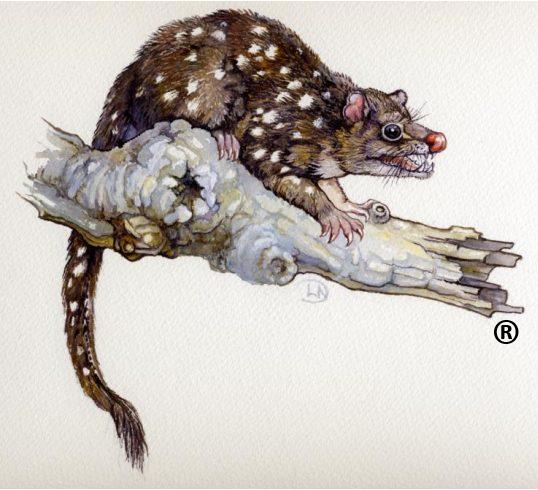
I have used the motto for The Habitat Advocate (A voice for native habitat) publicly since 2001, and the logo (image above) since 2006.
I felt I needed to protect both; this is especially since recently on Google, the use of the word ‘habitat’ and the term ‘habitat advocate’ have become popularised terms used by unrelated others for other purposes. May be they just liked the concept. I did back in 2001 before the trend, because of its genuine natural meaning that was understandable to many, rather than use more highfalutin scientific terms like ‘ecology‘.
So, I commissioned this particular image to be painted by professional wildlife artist, Lyn Naismith, back in 2006 and I invaluably hold her original artwork.
I conceived and designed the logo to be of Australia’s most threatened endemic top order predator in the ecological food chain, the Tigerquoll. I wanted to convey the message of the ongoing threats to native habitat. So, I felt it necessary that the logo image convey reality of being threatened, rearing up on a dead tree branch with nowhere to retreat in its native habitat.
Ecologically, if top order predator communities subsist healthily, then that is a positive signal that the broader localised ecology is healthy as well. That is why we chose the Tigerquoll symbolically.
And we prefer the name Tigerquoll rather than the more lame academic descriptive term of ‘Spotted Tailed Quoll’. That is, we wouldn’t suggest anyone try to pick up and cuddle a Tigerquoll without being ripped to shreds. It’s just like we wouldn’t suggest anyone try to pick up and cuddle an Australian native Brush-tailed Possum with is strong sharp claws and territorialness. Tigerquolls eat Brush-tailed Possums for breakfast, if you know what I mean.
A captured Tigerquoll from Radiata Plateau in 2008. Photo: Courtesy of local identity Glenn Humphreys, who caught it after losing some of his chickens from his rural backyard coop. Glenn handed this caged quoll over to the local National Parks and Wildlife Service of NSW to relocate it into the Blue Mountains National Park nearby.
So, I sincerely thank Lyn for reading my sentiments in this respect exactly, to her credit.
Bureaucratic wheels turn slowly, but now I own the image as a registered logo. This logo is emblematic to promote the habitat threat and our conservation advocacy for native habitat, and this top order predator the Tigerquoll is ecologically apt.
There is one held in captivity in Healesville Sanctuary, but since it is nocturnal, no visitors get to see it in its enclosure by day, and the sanctuary is closed by night. Crazy idea that, and its tiny prison cell-sized enclosure is cruel. They should instead release it into its native habitat and provide visitors with a video presentation to visitors, akin to the Sanctuary’s enclosed darkened platypus auditorium…
It’s about responsible governmental legislative respect for the value of wildlife and proactively decent funding and ecological preservation, restoration and perpetual heritage management of their precious disappearing habitat to sustain their very survival.
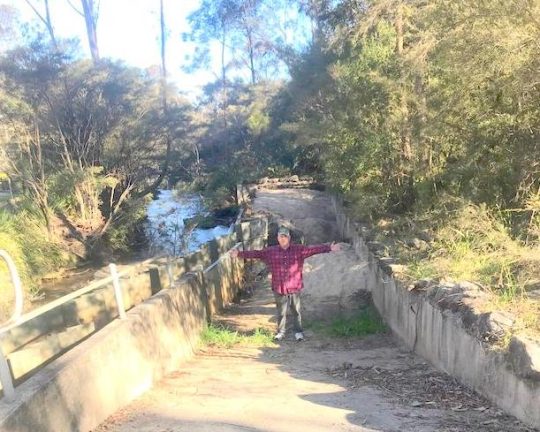
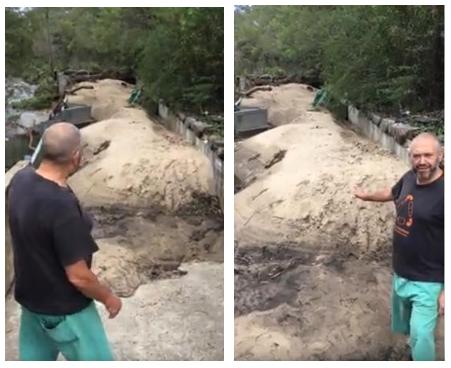
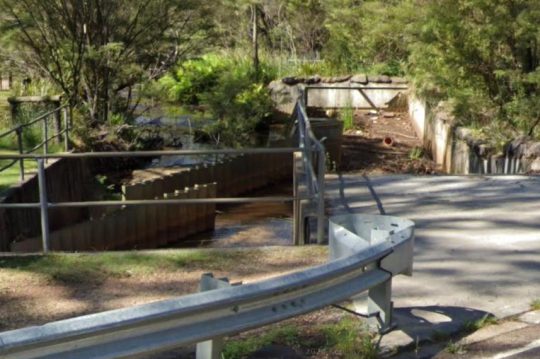
This is yet another example of neglected stormwater runoff maintenance by Blue Mountains {city} Council. Its in-creek water pollution trap (vane style) device is situated just above Katoomba Falls (left of photo).
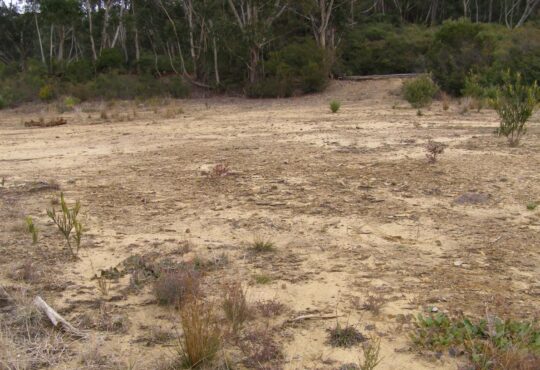
Our editor standing in front of large piles of sand pollution re-directed out of Katoomba Falls Creek by an in-creek pollution control device (left). [Photo by The Habitat Advocate, taken Thursday 30th May-2024.]
This pollution detritus trap has, from our very local experience over two decades, been typically full of destroyed native vegetation debris caused by (a) torrential rain events, and (b) bushland clearing (deforestation). It has also been observed typically full of siltation from (a) upstream creek bank erosion through Maple Grove, (b) from housing construction sand and graded topsoil, and (c) from unfiltered urban stormwater waste ignored by Council since it was established first as the Municipality of Katoomba in 1889.
We have lived in The Gully Water Catchment since 2001. The Gully Water Catchment includes all land with watercourses and natural drainage flowing to Katoomba Falls, and we have taken a keen interest in this natural place.
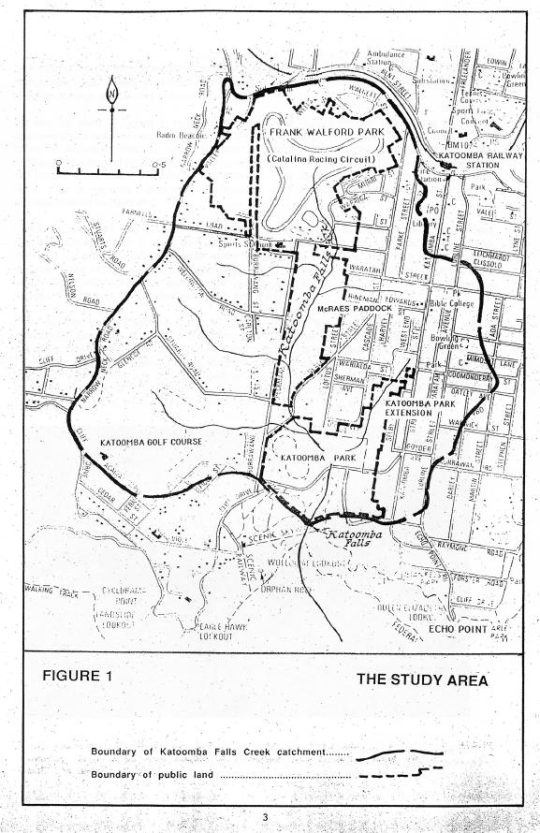
Katoomba Falls Creek Catchment as it was then called in 1993. [SOURCE: The Bell Report]
From our observed experience as local environmental activists, Council’s ongoing management culture is such that it focuses on the capital works projects, obtains external grant funding (usually from the NSW Government) but then fails to budget and resource the ongoing maintenance of such capital works projects. This Baramy Trap is another case in point.
We repeatedly observe this pollution trap full and overflowing for months at a time, so the trap overflows and the continuing detritus flows downstream into the downstream Kedumba River to supply Greater Sydney’s drinking water to Sydney’s artificial Lake Burragorang for Sydney and a Greater Sydney so scarily morphing beyond. Currently this pollution trap has been full of sand sediment for many months.
The above photo shows the concrete ramp down to the pollution trap for access by a small front-end mechanical loader designed to remove the sand and debris pollution into a waiting tip-truck.
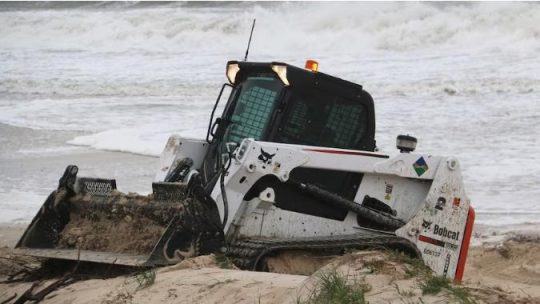
A Bobcat more suited to a construction site or at a beach as in this example photo. But at Blue Mountains {city} Council it’s Missing-In-Action.
Council is supposed to maintain it and clean it out on an ‘as-needed‘ basis periodically, but it doesn’t. The following is an extract of Baramy’s terms and conditions for this pollution device once installed.
We obtained a copy of these terms and conditions back in 2004 when The Friends of Katoomba Falls Creek Valley Inc. (the Friends) sought a quote for a similar but smaller pollution device (4 m long x 2.1 m wide) previously to be constructed in the same creek further upstream. Baramy’s quote came in at $26,000 and we referred this initiative for action/grant funding to Council – it being the custodian of this community land and the creek water catchment. But Council ignored it.
In this case Council is the “customer” having paid to have this much larger device constructed by Baramy Engineering in this different location much further downstream. It would have cost Council double, constructed probably around 2005 from one’s memory.
Council’s culture
Council has form of having its other non-environmental priorities, such as its latest newfangled ‘Planetary Health Initiative’ to showcase its environmental stewardship, when it is just more greenwashing.
Previously, all such debris, sediment and stormwater pollution into the creek used to just flow over Katoomba Cascades and further downstream over Katoomba Falls into the Kedumba River below and southward through the Jamison Valley.
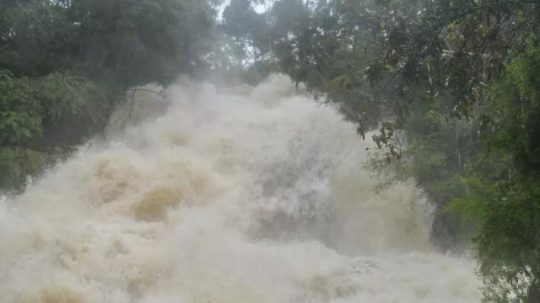
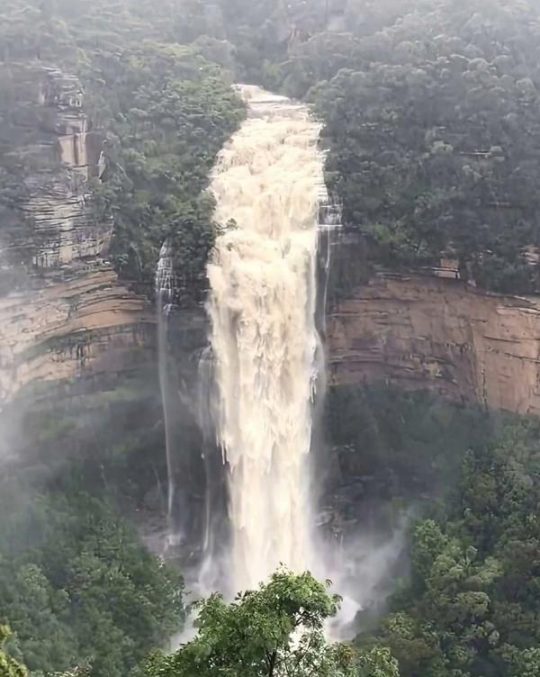
Katoomba Cascades during full flood, situated about 100 metres downstream of the pollution trap. [SOURCE: Photo by Brigitte Grant, in article ‘Flood photos: Three-day drenching’ 22nd March 2021, Blue Mountains Gazette newspaper]
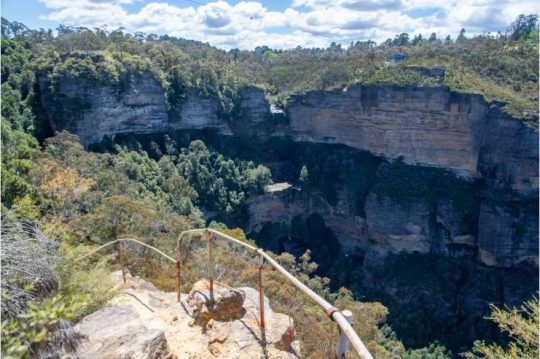
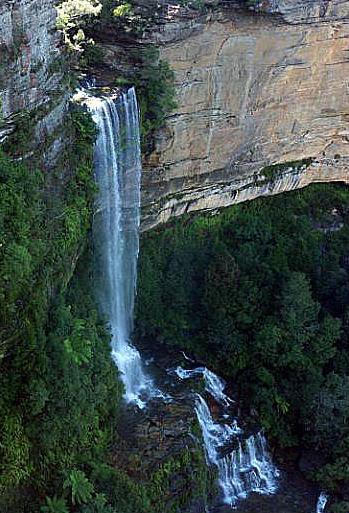
Katoomba Falls in full flood after days of heavy rain. The falls are situated about 300 metres downstream of the pollution trap. [SOURCE: Photographer unknown, in article ‘Police to co-ordinate evacuation of visitors trapped in Megalong Valley following landslip’ 4th April 2024, by Damien Madigan in Blue Mountains Gazette newspaper]
By the way, Upper Mountains sewage design (Katoomba, Leura, Wentworth Falls) back between 1907 and the 1990’s also flowed by iron piping down into the Jamison Valley to the former Leura Sewage Treatment Plant (historic image below) situated just by Leura Falls Creek between Echo Point and Sublime Point. The iron piping still can be seen along hiking tracks down the escarpment – the reason for the hiking tracks actually being first constructed.
We estimate that the current sand quantity filling this particular Creek Pollution Trap would be twenty cubic metres at least. We reported the problem to Council the day we took the first photo above – receiving Council’s Customer Service Request reference #533082.
We’re not the only locals having noticed this particular in-creek pollution trap full. Here’s another documented event of the very same pollution trap in February 2020. It was during the start of Australia’s East Coast Low events associated with the La Niña oscillating weather pattern:
Local Blue Mountains Aboriginal Gundungurra Elder, Mr David King, posting his video on Google YouTube protesting this exact same problem back in 2020. He even likened it Bondi Beach! [SOURCE]
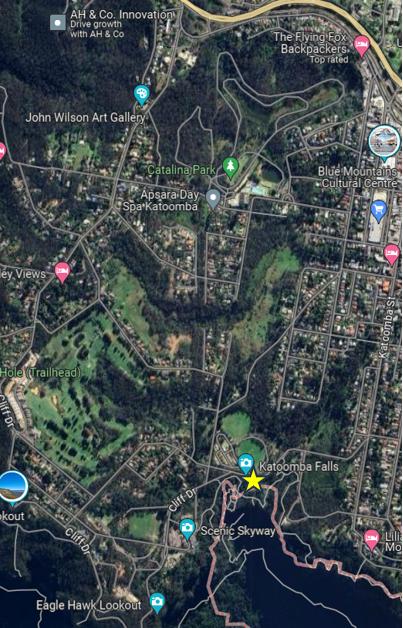
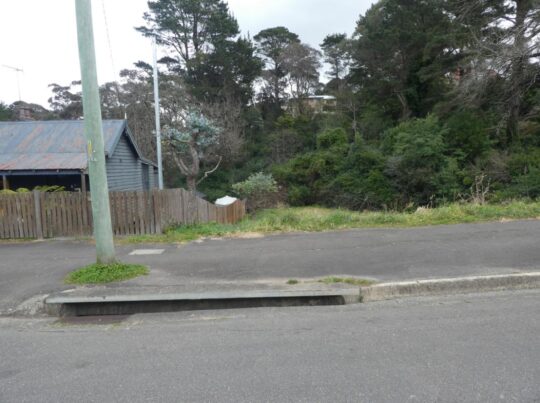
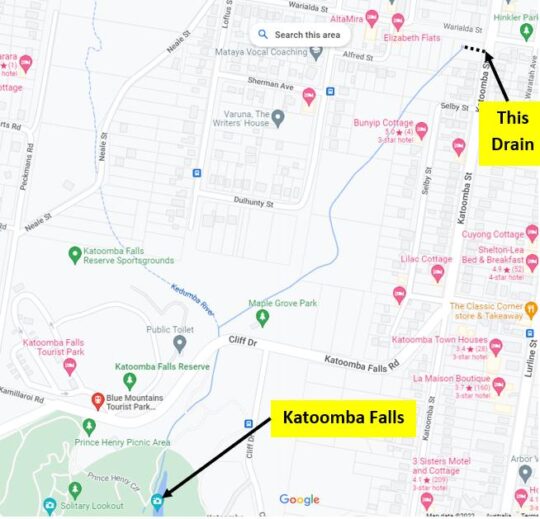
This pollution trap’s exact location is situated beside Cliff Drive in Katoomba on the southern (downstream) side of the road at the road culvert over Katoomba Falls Creek. See the aerial photographic map below showing the yellow star.
An aerial photo of the 100 ha extent of The Gully Water Catchment juxtaposed upstream of this pollution trap. (NB. The “Katoomba Falls” photo label is incorrectly shown on this image, being rather just a Google nominal reference on the roadside. [SOURCE: Google Maps aerial photo, 2024]
This in-creek pollution trap was constructed by Baramy Engineering Pty Ltd of Katoomba for Council.
The Baramy Vane Trap showing the two rows of vertical galvanised steel vanes in the creek line that divert debris to the concrete trap device on the right.
The construction timing was a few years or so following The Greater Blue Mountains Area (1 million km2) being inscribed on the UNESCO World Heritage list on 29th November 2000. Katoomba Falls flows into the Jamison Valley within this World Heritage area. The Jamison Valley, below these falls (and others) is also part of the drinking water catchment leading to Warragamba Dam supplying an ever-expanding Greater Sydney (current population approaching 5.5 million) adjoining the Blue Mountains region.
It is the researched opinion of The Habitat Advocate that this World Heritage listing was more about the human utility of protecting the value of Sydney’s drinking water in perpetuity, than it was about protecting the Eucalyptus forests of the Blue Mountains.
Katoomba Falls in the centre of this photo. The Gully Water Catchment upstream feeds natural and stormwater to these falls. The area covers an estimated 100 hectares a passes through a small valley up on the Blue Mountains plateau. This valley includes bushland and increasingly more and more housing development.
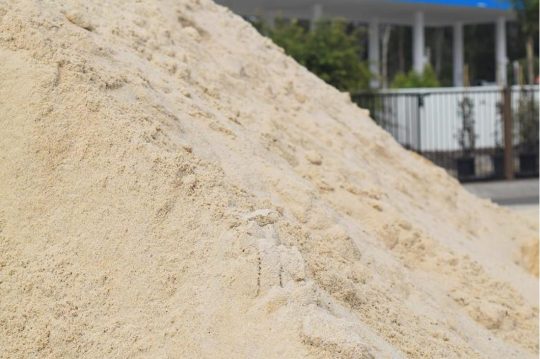
Notably, the sand type in this pollution trap appears to be not the naturally river sand, but consistently all the same light colour of Concrete Sand type used commercially in construction.
Concrete Sand
Concrete Sand is a coarser sand variety, pivotal in construction use to create strong and durable concrete structures. It’s typically made from crushed quartz, which gives it a rougher texture, enhancing the binding properties in concrete mixtures. This sand type is indispensable for laying robust foundations, constructing driveways, and forming sidewalks. This is exactly what is going on in The Gully Catchment upstream of this creek pollution trap.
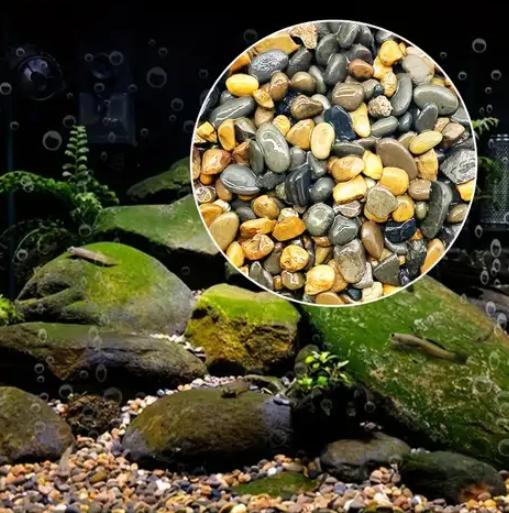
Whereas the natural creek-bed of Katoomba Falls Creek is comprised of small pebbles. This editor knows this from being local to Katoomba Falls Creek Valley and having voluntarily performed Streamwatch quality monitoring of Katoomba Falls Creek for five years (2004-2008) on behalf of the Friends of Katoomba Falls Creek Valley, Inc. reporting to the Sydney Catchment Authority (SCA) within the New South Wales Governments Sydney Water department.
An example of the characteristics of creek-bed pebbles typically found naturally on the creek bed of Katoomba Falls Creek and other nearby watercourses – yet sadly beneath the years of construction sand sedimentation pollution from various identified housing construction sites throughout this plateaued catchment.
Council doesn’t analyse the sand to determine its source. Council doesn’t fine the polluters and issue a stop work court order. Council doesn’t employ a hydrologist or geotechnical engineer on its books. Yet where is all the housing constrution taking place in the Blue Mountains? Upstream of the World Heritage area.
In our view, Council is unfit in delegated stewardship as custodian of the geographic plateau of the Blue Mountains Local Government Area (LGA) atop the Blue Mountains World Heritage Area from its atrocious record of failings. So long as this pollution control device is full and overflowing, sand and debris is flowing downstream over Katoomba Cascades and Katoomba Falls into the Kedumba River. Parks Service (‘NPWS’) doesn’t monitor pollution levels or water quality in Kedumba River down in the Jamison Valley.
Council doesn’t enforce sediment controls are housing development sites upstream in The Gully Water Catchment (Katoomba Falls Creek Valley).
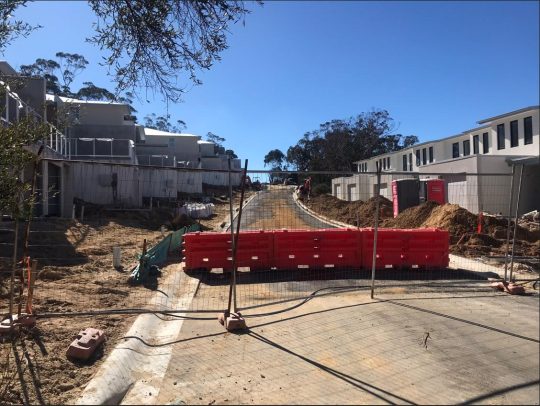
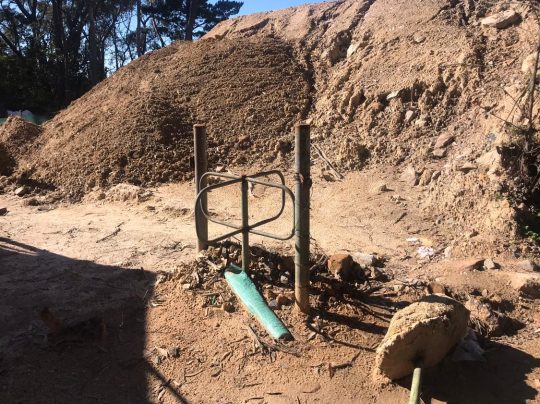
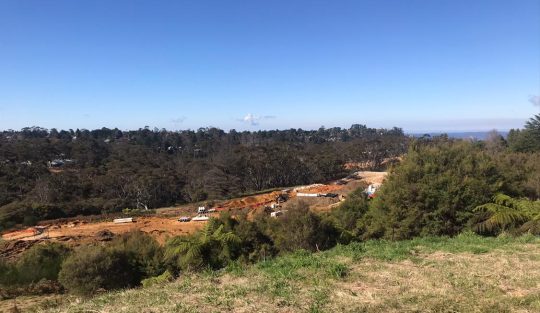
There are current two large housing subdivision sites contribution to sedimentation of the creek.
Some 13 odd hectares of fragile native bush surrounding an upland brook between Stuarts & Wellington Roads is to be bulldozed into a 53 cluster housing subdivision.
Bulldozing all the top soil throughout this side creek valley to Katoomba Falls Creek (Kedumba River). [Photo by Editor, Sunday 26th May 2024]
[5] ‘Pollution Control Device‘ quote prepared for ‘Frank Walford Park Bushcare’ (Friends of Katoomba Falls Creek Valley Inc), 2004-09-27, by Baramy Engineering Pty Ltd, 7 pages.
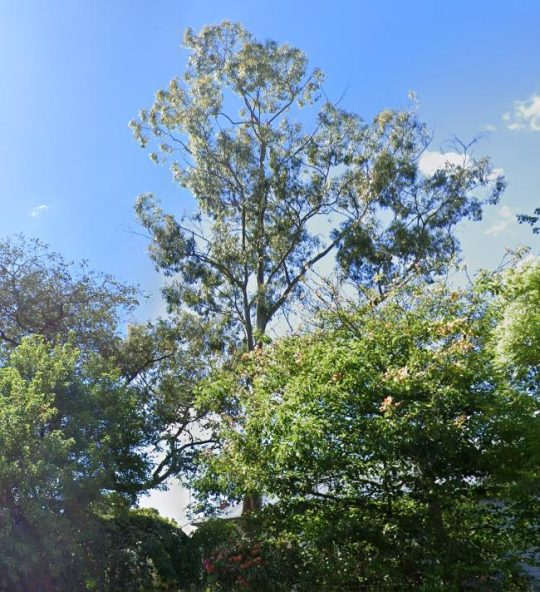
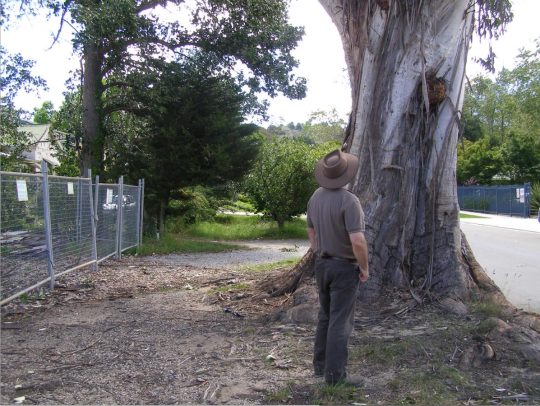
This large healthy mature native Eucalypt has just been chainsawed to death today. We could hear the noise of multiple chainsaws ripping reverberated around the neighbourhood from early this morning.
This tree grew on private residential land within The Gully Catchment on a large double block on the top of a prominent natural spur overlooking the northern part of The Gully not far from Horrie Gates’ old Catalina Dam.
The Gully is a valued small natural valley situated on the western edge of the township of Katoomba in the Blue Mountains of New South Wales.
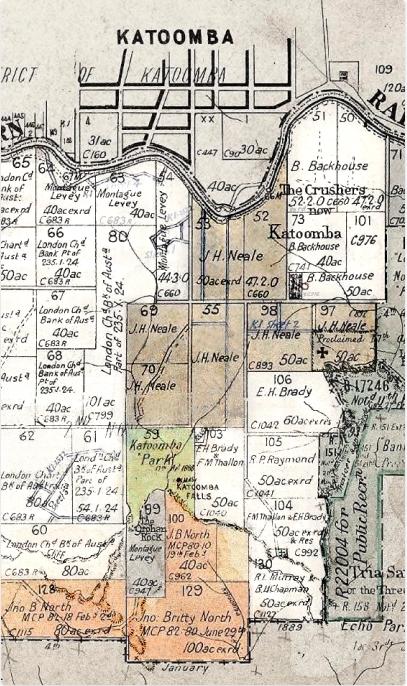
The particular site is zoned by local Blue Mountains Council as ‘Heritage’ and ‘Environmental Land’ under current Local Environmental Plan 2015. It is also a very old settlement area of the Blue Mountains dating back to 1876. In fact, it forms part of the oldest housing area of the Blue Mountains Local Government Area (LGA) and traditionally known as ‘North’s Estate’.
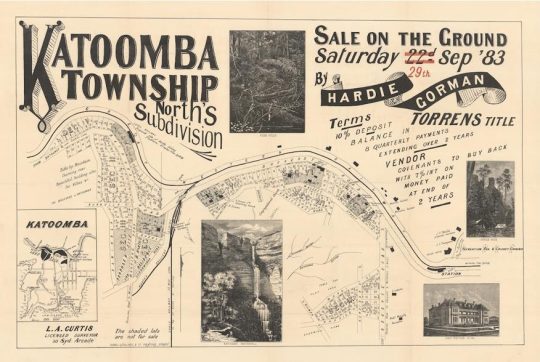
Land sale auctions advertisement from 1883
It was named after the first land Torrens Title owner John Britty North (1831-1917), an English immigrant during British colonial times who owned most of the immediate area and became a coal shale miner and then property developer there.
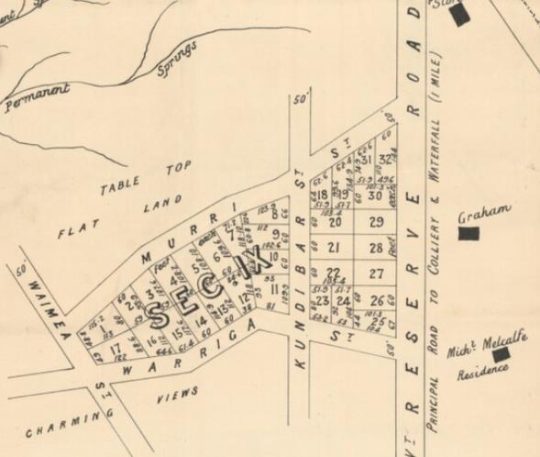
Close Up of the above map, the particular site is situated within ‘Sect IX’.
Recognition of this colonial heritage is such that this North Estate precinct has been especially zoned by council as ‘K171 – Norths Estate Conservation Area‘ under council’s LEP 2015.
Was Council permission sought? It appears from a call to Council, that it knew nothing about the owner’s plan to kill this significant native tree in this heritage and conservation precinct, as confirmed by CSR525105. Council used to have a Significant Tree Register to protect identified significant trees within its LGA. It no longer does.
So why kill it? It was a slight 5 degree lean but in the direction of the prevailing wind. Was it some perceived fear that in many years to come it might fall on the house? Was it a prejudiced fear of gum trees? For fire wood?
This native tree was probably over 100 years old, perhaps dating back to the 19th Century and was the most prominent specimen in the immediate area.
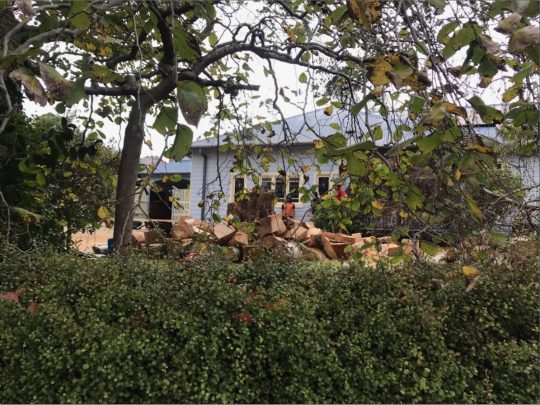
What was left of the tree this afternoon before the rain came again.
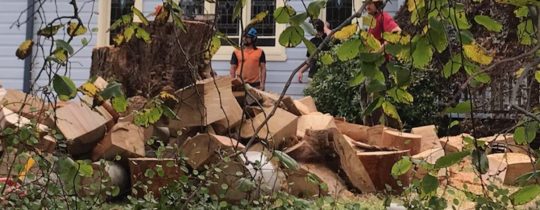
Yet this majestic native tree was in good health and vigour, and showed no signs of decay.
Close up: This tree was structurally sound. No dead wood from the tree can be seen in these chainsawed sections (‘body parts’)
Was any prior assessment by professionally qualified arborist conducted on the tree?
We recall back in 2014 with regards to saving the 300+ year old Eucalyptus oreades tree that local conservationists had dubbed ‘ATLAS’, that The Habitat Advocate contracted renown expert arborist (the late) Mr Fred Janes, to conduct a professional arborist appraisal and report on the relative health of ATLAS. This was sought because a property developer of the adjoining land wanted the tree killed by chainsaw so that he could selfishly have an overflow car park for the benefit clients of his proposed industrial estate complex. So he had secured a dodgy arborist, only licensed to use a chainsaw. Where as Mr Jane’s report found the tree to be in good health and vigour, and Council agreed.
We have observed over time since our own arrival in this special place in 2001, that whilst in The Gully’s ‘Aboriginal Place’ dissociated land parcels of native bush, the native trees within are culturally sacrosanct, as they should be; yet around the immediately periphery of adjoining private lands, housing development and deforestation continues incrementally. It is death by a thousand cuts transforming the natural valley into an artificial urban landscape.
This is why council insists on being called Blue Mountains City Council in its urbane dreams within a world heritage area.
‘ATLAS’? This is the worthy name our campaign branded this magnificent and extremely rare 250+ year-old Eucalyptus oreades that came under greedy developer threat. It is an endemic native tree estimated to predate Katoomba and indeed pre-date Captain Cook (that is pre-1770!)
About ‘Friends of ATLAS’
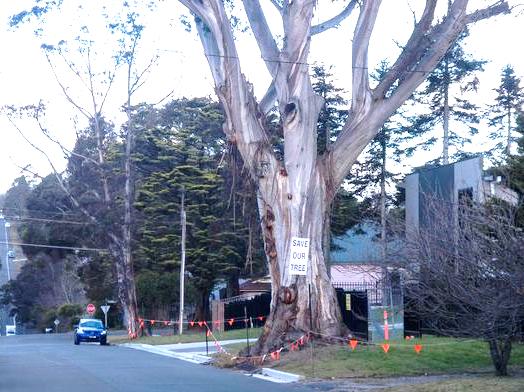
Back in 2014 at the start of spring in the Blue Mountains (Australia), Katoomba residents Maureen and Peter Toy from their home at 57 Megalong Street observed a man inspecting this magnificent tree on the verge out front. They approached the man, who then told them that he reckoned the tree was “diseased” and so had to be “removed” (aka killed).
The Toy’s campaign to save this magnificent tree was on in earnest!
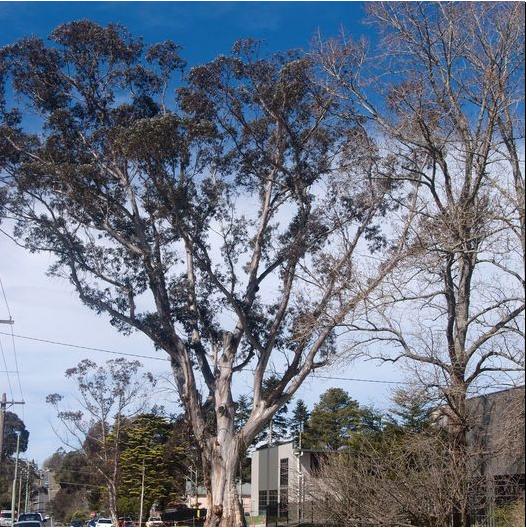
ATLAS survives in good health, not diseased, as a 250 year old (in 2014) native Blue Mountains Ash (Eucalyptus oreades), with a still-growing canopy of 40+ metres high.
ATLAS pre-dates the settlement of Katoomba. Indeed, ATLAS predates colonial settlement of Australian in 1788. According to a learned Grade 5 arborist with long experience in these species, ATLAS probably started growing as a sapling from the 1760s – before the French Revolution, before the American War of Independence, before James Cook first set sail from Britain to explore the Pacific and find the rumoured great southern continent in 1768.
This tree is an icon like the Three Sisters, yet hidden in Blue Mountains {city} Council’s assigned industrial area of Katoomba near the headwaters of Leura Creek and upstream of the popular tourist attraction of Leura Cascades and Leura Falls which tumbles into the Jamison Valley within the Greater Blue Mountains World Heritage Area.
According to advice the Toys received from local conservation consultancy The Habitat Advocate, this large Blue Mountains Ash (Eucalyptus oreades) is a native tree only found in the Upper Blue Mountains. Thousands of oreades were incinerated by the 2003 Centennial Glen bushfire, making the species now threatened in the upper Blue Mountains.
Maureen says:
“It is a beautiful and rare specimen and Blue Mountains folk are fortunate that we have such a significant tree still growing right by Megalong Street in industrial Katoomba. Over the many decades, this tree has withstood fierce windstorms, bushfires, (dodgy) road-widening and even industrial development all around it.”
A new industrial development in 2014 was constructed behind ATLAS, replacing a old motor garage.
With a canopy about 40 metres high and a trunk girth of over 5 metres (measured at 1.4m above the ground ^SOURCE), the tree has become a recognised icon and reference point in the area. It is home to a large flock of Sulphur-Crested Cockatoos that roosts in the tree daily.
Campaign Background
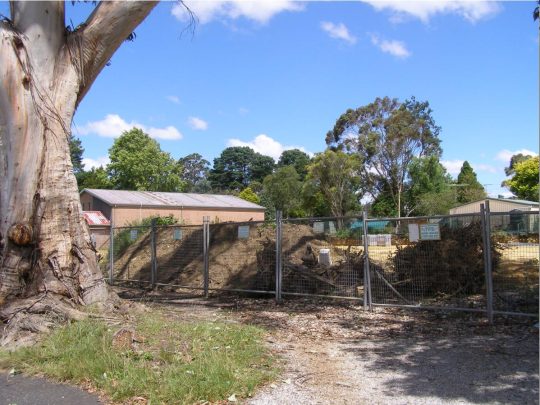
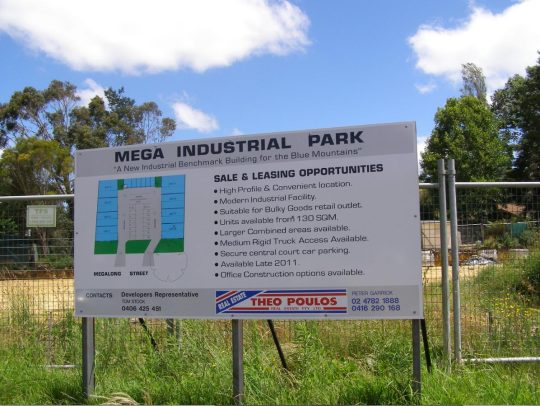
Some years prior in 2012, The Habitat Advocate’s Conservation Consultant Steven, had had his own concerns about the new development taking place behind the tree at 59 Megalong Street Katoomba, and decided to take some before-shot photos; the following three taken on 11th January 2012.
Our editor by ATLAS in 2012
So two years hence, with the new ‘mega industrial park’ constructed adjacent to the tree, the consulting arborist David Ford, whom Maureen and Peter had talked to, became the arch enemy to the preservation of the tree.
Peter couldn’t understand why the tree was NOT already listed on Council’s Blue Mountains Significant Tree Register or why anyone would want to harm it. The tree is situated on a community verge (Council-community land) and for the prior few years there had been an industrial development constructed behind it.
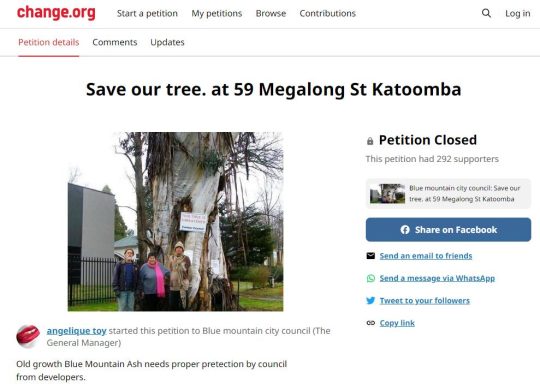
Peter and Maureen were vehemently opposed to any further harm being inflicted upon the tree and they have lodged a protest with council. Several others in the local community sided with the Toys and together formed an informal local community activist group ‘Friends of ATLAS’ – determined to save and protect this magnificent native tree. Their daughter Angelique started up an online petition to garner local community recognition and support to protect the tree.
Peter reckoned at the time:
“It’s early days but he is ready for a sustained fight.”
A fellow local supported commented:
“Dear Friends,
There is an emergency right now, to save one of the oldest Blue Mountain Ash trees that we have left.. The tree is now known as ‘Atlas’. You may well know this magnificent tree located at 59 Megalong Street, Katoomba. It has a girth of 5 metres and a growing canopy of 40 metres high. The tree has been estimated to be between 200 and 300 years old, I love this tree and hope you will help us save it 🙂
THANKS FOR YOUR SUPPORT
Peter H. Marshall”
A spokesperson from Blue Mountains {city} Council confirmed that the tree is situated on council verge land and not on the industrial development site behind. Research into the planning approval for the industrial development behind revealed that Council had stipulated in its development consent conditions that the tree must not be harmed by the development activity.
Though Peter disagrees. He says “guttering has been dug right into the tree roots system, then just a month ago the developer (behind) had a bobcat grade the topsoil and roots around the tree for an entire day!.”
Council’s spokesperson at the time clarified that council had not received any request for the tree to be destroyed. The community battle to save this tree from Council neglect and indifference was set to ensue.
Save ATLAS Campaign
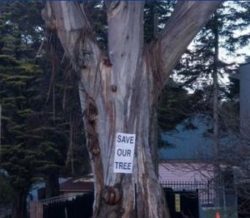
The Habitat Advocate took a particular interest in saving this tree shortly after noticing the sign on it ‘SAVE OUR TREE‘, placed there by Peter and Maureen in September 2014.
Our Conservation Consultant, Steven, had first observed the sign on the tree whilst a driver for Blue Mountains Bus Company as he sat in a bus in the depot one morning doing his bus pre-checks.
After his shift, Steven took a chance that the sign’s maker lived nearby and so knocked on the door of the house adjacent at 57. Peter and Maureen opened the door and the contact was established. [Editor’s Note: Peter and Maureen have long since relocated back to their home town in Western Australia].
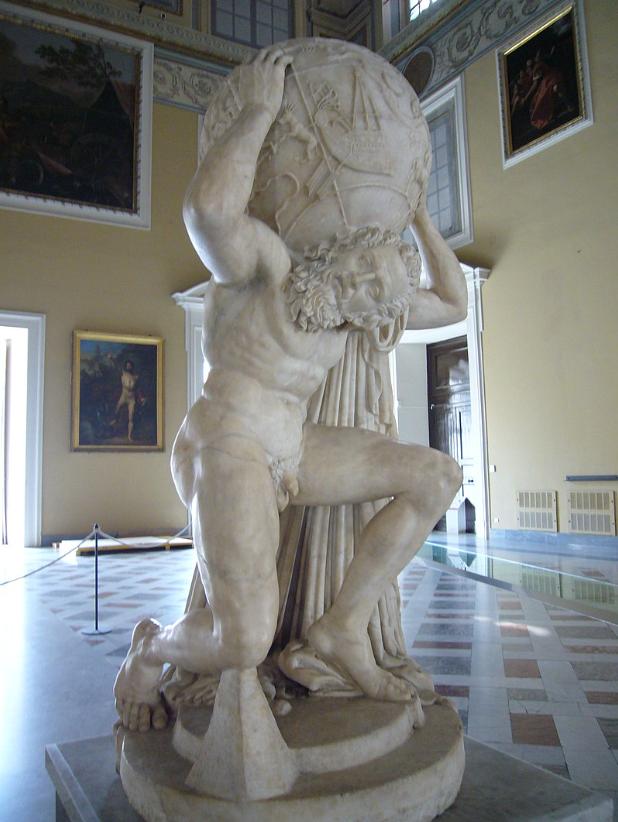
Steven suggested the tree deserved a name, as a brand for a public campaign to save it from being killed. Maureen affectionately called it the ‘Atlas’, after the Greek God, appropriately for its towering size and for be so enduring. In Greek mythology, Atlas was one of the most famous Titans, the son of Iapetus and the Oceanid Asia (or, possibly, Clymene). He was the leader of the Titan rebellion against Zeus, and he got a fitting punishment after the end of the Titanomachy: he was condemned to eternally hold up the sky. The etymology of the name ‘Atlas’ is from the ancient Greek word τλῆναι “to endure”.
This is a Roman statue of Atlas at the National Archaeological Museum of Naples in Italy. It is believed to be the oldest, dating from 2nd century AD.
Steven suggested a change of sign to generate more passerby interest, given that adjoining Megalong Street is a busy thoroughfare between the industrial precinct of Katoomba and Leura.
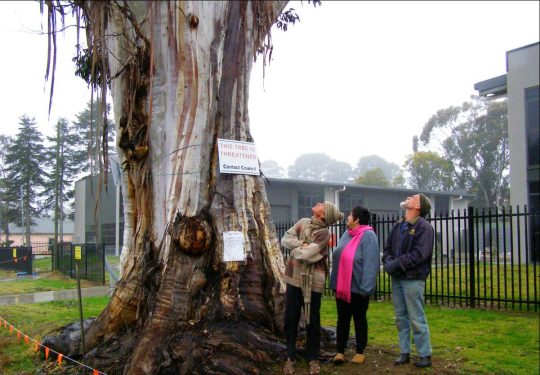
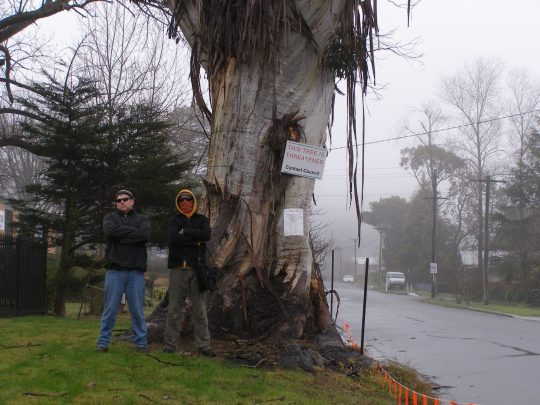
This new sign proved very effective. It reads: “THIS TREE IS THREATENED, Contact Council“. Many concerned locals indeed did contact Blue Mountains {city} Council to protest and demand what was going on. [Photo by Editor: Katoomba locals Maureen and Peter Toy, with Glenn Humphreys on the right, spring 2014]
“Threatened” was a play on words, since it had three meanings, intentionally.
Firstly, this flora species, a ‘Eucalyptus oreades’, is locally endemic to this small area of the Central Upper Blue Mountains, that is it is wildly found nowhere else on the planet and the species natural habitat and number of trees have been decimated by human deforestation since British colonisation of the area from the 1870s such that the remnant number of trees can almost be counted. This species and its ecological community is likely botanically deemed “threatened”, that is, it is likely to become extinct in the foreseeable future.
Secondly, this extremely large and mature, yet healthy specimen, could be more than 250 years old and so an even rarer example of the species. The number of such specimens growing in what once was their wild habitat may well be currently counted on one’s hands.
Thirdly, more imminent a threat is that the industrial developer who owns the site immediately behind this tree has intention of having it killed the tree in order to make way for some greedy notion of providing an overflow of customer parking on the verge outside his site.
Peter Toy quickly set up a dedicated Facebook Page (now defunct) in September 2014, calling it ‘Friends of ATLAS’. Maureen and Peter’s daughter Angelique established an online petition on the Change.org website.
Garnering a community support base of nearly 300 individuals on a petition to save one important tree was one campaign success outcome
Fact Finding
As the publicity campaign to save the tree got under way, The Habitat Advocate considered some fact finding needed be done about the compliance of this development with Council’s conditions of consent, and in order to clarify the justification posed by the consulting arborist for killing this magnificent and otherwise healthy native tree.
Suspicions were that the arborist had assessed the tree on behalf of his client the property developer and had concluded what the developer wanted – the tree’s removal to make way for concrete paving of the Council verge to facilitate increased vehicle parking for the new industrial site.
Enquiries to Blue Mountains {city} Council confirmed that the development at 59 Megalong Street Katoomba was recorded by Council as ‘Industrial Development DA X/435/2010‘. A number of publicly available documents were obtained by The Habitat Advocate in relation to this development threat.
[Editor’s Note:
This habitat story is to be continued sometime in spring 2023, due to other pressing commitments that we currently have. The story shall be told in a number of parts discussing the SAVE ATLAS Campaign, its goals, strategy, opponents, supporters, relevant framework (planning and legal), research, publicity and ongoing updates. Unlike other attempts by Blue Mountains conservationists to save valued trees, especially endemic natives like this one, this conservation campaign succeeded and the campaign story shall provide not just a wonderful Blue Mountains story about a community coming together to protect natural heritage but also shall be instructive to others facing similar challenges of how to win against often overwhelming odds. Future parts to this story shall be posted in turn as a lead article on the front page of this website, The Habitat Advocate, which continues to be based in The Gully Catchment in the town of Katoomba since 2001. We thank our readers for their interest, support and patience].
We at The Habitat Advocate have lived in Katoomba in the Blue Mountains of Australia since 2001.
Situated on the western fringe of Katoomba, we continue to be closely connected with a small creek valley just below us observed outside our windows, referred to as Katoomba Falls Creek Valley, or by former residents simply as ‘The Gully’.
Katoomba Falls Creek Valley is situated within what we term ‘The Gully Water Catchment’. It is geographically less that 50 metres away from us, uphill on a spur from the Carrington. We observe the amphitheatre-shaped natural valley below and hear it within earshot and we greatly respect where we live and appreciate this area’s complex heritage.
In our mind, the historical and ancestral story of The Gully is a microcosm of the greater story of Australia’s colonial settlement saga. Whilst Australia’s colonial impost saga started from 1788 at Botany Bay then shifted to a fresh water source at Sydney Cove, The Gully’s saga started from 1815 when the Cox’s Road was driven through and then came land acquisition, deforestation, housing subdivision followed by coal mining by robber baron John Britty North who set the wrath from 1883.
The stories of the past of those before us and those current are vital and so to prevent a repeat of history, deserved to be told warts and all out there and everywhere; not greenwashed by mealy-mouthed government bureaucracy after closed door deals, eating canapes at PC publicity events. Raw on-ground truth must hold jurisdiction over political papered propaganda for any decent society.
‘The Gully Water Catchment‘ comprises the upland creek valley catchment of some (290 hectares/2.9 km2) above Katoomba Falls in the Blue Mountains. Over time since the 1870s it has been divided up for various human uses and abuses.
We are connected to this creek valley environmentally and have cared for its ecology and monitored various threats to it for now two decades. As a former member of local resident group activist group the Friends of Katoomba Falls Creek Valley Inc. between 2002-2007 we participated in voluntary Bushcare weeding and rehabilitation and in Streamwatch water quality monitoring.
We are connected politically. We have lobbied the land manager/custodian, Blue Mountains {city} Council since 2001 to secure this creek valley’s ecological protection and rehabilitation).
We are connected socially (we hold a close friendship with many local residents who live around the hilltop fringes surrounding this small creek valley.
We are connected personally (we hear and see the going on down there daily and we walk around it weekly).
We are connected historically having researched those who came before us, some who once lived down in this creek valley. We have researched local history of the area back to 1813).
Essentially, we think we know this small creek valley over the past 21 years quite intimately.
We respect where we live here, regarding this natural creek valley as the environs of our neighourhood; and as an extension of our home environment. To us and to many local residents, this is a beautiful natural creek valley; quiet, peaceful and with a sense of a peaceful welcoming sacred spirit. Our friendship with local elders (some of whom have since passed away) as well as our readings of historical research, confirm this. Since arriving here to call this place home in 2001, our family feels strongly connected to The Gully, like many of our neighbours.
But although we consider The Gully to now be our home after two decades, we are not so family or spiritually connected to The Gully as those who have come before us, who were here long before us but forcibly evicted by authorities. It was simply because they were too poor to protest and fight against powerful and wealthy outsiders who usurped The Gully for their own selfish ends.
The family and spiritual connection to The Gully by those who have come before us, extend back generations. Indeed, their stories and archaeological evidence shows back 14,000 years to this special place. We respect that.
Since various others refer to this creek valley and its many portions by other titles, and given various re-namings by local council over the years, for clarity we herein begin by explaining the various namings and their meanings as follows:
In summary, the portions of land of The Gully Water Catchment, including historically, and their relative sizes are:
The Gully Water Catchment (290 hectares/2.9 km2)
The Gully (northern section pre-1957) (50 hectares/0.5 km2)
Katoomba Falls Creek Valley (50 hectares/0.5 km2)
Upper Kedumba River Valley (50 hectares/0.5 km2)
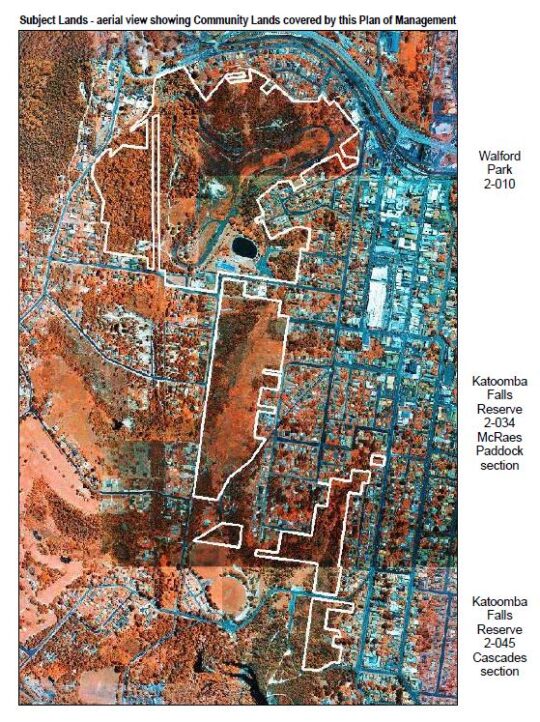
McRaes Paddock (17 hectares/0.17 km2)
Catalina (amusement) Park (2 hectares/0.2 km2)
Catalina Park (motor) Raceway (50 hectares/0.5 km2)
Frank Walford Park (50 hectares/0.5 km2)
Katoomba Park and Katoomba Park Extension (8 hectares/0.8 km2)
Built Up Residential Katoomba (within The Gully Water Catchment) (158 hectares/1.58km2)
21 Stuarts Road (single private land holding – a mixture of pasture and intact sedge swamp (12 hectares/0.12 km2)
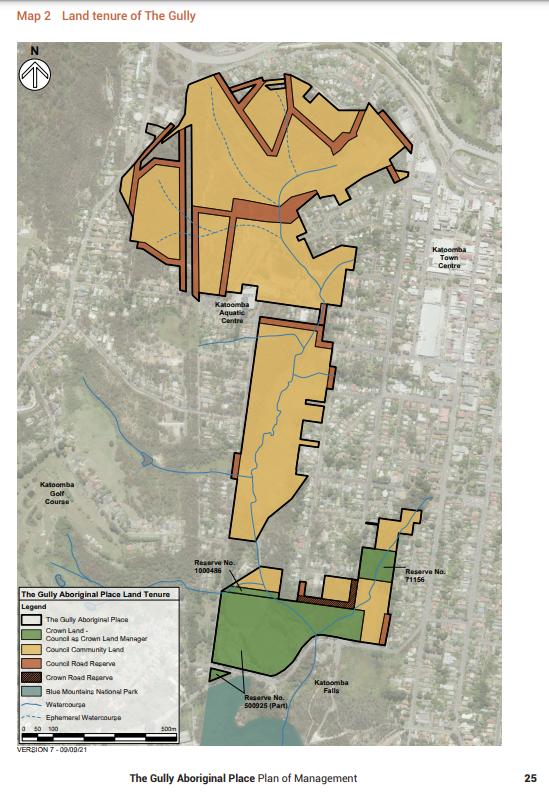
The Gully – Aboriginal Place version 2004 Plan (66 hectares/0.66 km2)
The Gully – Aboriginal Place‘ version 2021 Plan (73 hectares/0.73 km2)
Gargaree‘ (a Gundungurra word for gully) (73 hectares/0.73 km2)
Why so many place-descriptive names for one little sub-catchment? Well, ask Blue Mountains {city} Council, since these place names and their renaming are of Council’s doing.
We notably observe that Council’s land area for ‘The Gully – Aboriginal Place’ in 2021 has expanded from 65.52 hectares since its 2004 Plan to 73 hectares in 2021. Why so? Has a miscalculation/estimate error occurred using different metric methods or software? “65.52 hectares” in its 2004 Plan is pretty darn accurate since down to 0.02 hectares covers an area of just 200m2, or 14m x 14m.
Seriously, is the public who have poor analytical/mathematical interests simply being conned by Council’s guesswork data?
These multiple place names for this creek valley have locally ‘evolved’ over decades to various portions by vested interests. This is confusing to outsiders to comprehend what is what. So from our local knowledge gained from living here for the past 20-odd years and from our passionate interest in researching to better understanding this place, we elaborate.
The Gully Water Catchment
One of the headwaters of Katoomba Falls Creek. One of three StreamWatch water quality testing sites selected by The Friends of Katoomba Falls Creek Valley Bushcare Group [2003-2007]. (Photo by Editor 2011-04-01)
Given the field focus of The Habitat Advocate is ecology, for ecological clarity we shall herein refer to the entire valley catchment area with a hybrid title of ‘The Gully Water Catchment‘. We include the term ‘gully’ as a conciliatory recognition and respect to the former residents who used this term affectionately when they lived here before the racetrack land usurpation* of The Gully.
[Ed: *Usurpation is the act of taking somebody’s position and/or power without having the right to do this. Land Usurpation is the appropriation of land from the previous or lawful owner].
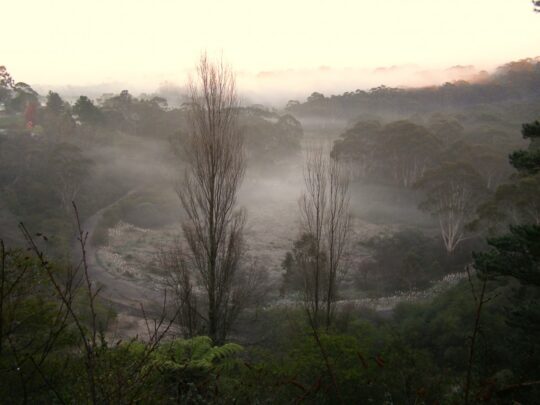
Ecologically, this creek valley is most importantly fundamentally a hydrological environmental system. The natural geography of this creek valley is characterised as an upper course riverscape, which takes the form of a south-facing naturally steep bushland amphitheatre shape in the northern portion of this valley. The valley lies about a thousands metres above sea level.
This area is defined as the entire water catchment area of 290 hectares/2.9 km2. The water catchment’s geographical boundaries comprise the Cox’s Watershed (Bathurst Road) to the north, Valley Road to the Jamison clifftop escarpment to the west, a meandering watershed though central Katoomba to the east and Katoomba Falls to the south.
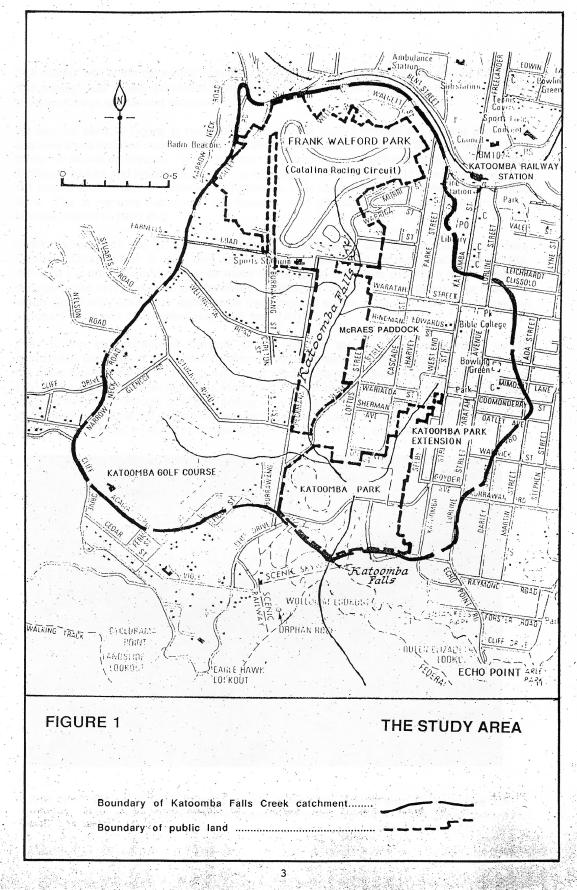
‘The Gully Water Catchment‘ [SOURCE: Dr Val Attenbrow’s Map of 1993 as ‘The Study Area’, in Katoomba Falls Creek Valley Environmental Study | Draft Report and Management Plan prepared for Blue Mountains [city] Council | by F.&J. Bell & Associates | June 1993 | page 3 of 87]
Rainwater that becomes surface water and ground water, flows from a small perennial waterfall and a number of springs which flow into several watercourses that confluence into the central creek with a native sedge swampland riparian zone leading to and surrounding the creek. The creek flows downstream southward over Katoomba Cascades and plunges over Katoomba Falls into the Kedumba River about 300 metres below in the magnificent Jamison Valley of the Blue Mountains World Heritage Area. Kedumba River then flows and meanders southward confluencing into the flooded Cox’s River and the artificial Lake Burragorang (constructed 1948-1960) which has since been Sydney’s primary drinking water supply.
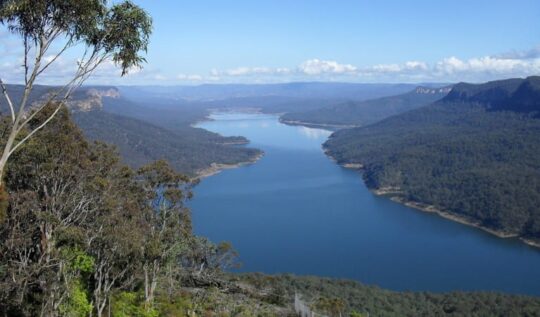
Lake Burragorang (reservoir) is situated about 40km downstream south of The Gully Water Catchment [Photo on Wikipedia by Goran Has taken in January 2014, https://www.flickr.com/photos/goranhas/11897893604/ ]
This all means that indeed the relatively small creek valley on the western fringe of Katoomba forms part of an official drinking water catchment. But it is not just for the benefit of a distant growing urban Greater Sydney metropolis.
The Gully Water Catchment in its own right serves as a vital small natural ecosystem to sustain remnant locally native flora and fauna including aquatic macroinvertebrates throughout its creek riparian zone. This was despite the catchment’s history of land management abuse and neglect by local council and self-interested outsiders.
This author for five years between 2003 and 2007, as a former volunteer member of local community group the Friends of Katoomba Falls Creek Valley Bushcare Group (‘The Friends’ for short) undertook regular water quality monitoring and testing of three test sites of this creek under the instruction and resourcing the then Sydney Catchment Authority’s Streamwatch Programme.
‘Citizen science’ indeed!
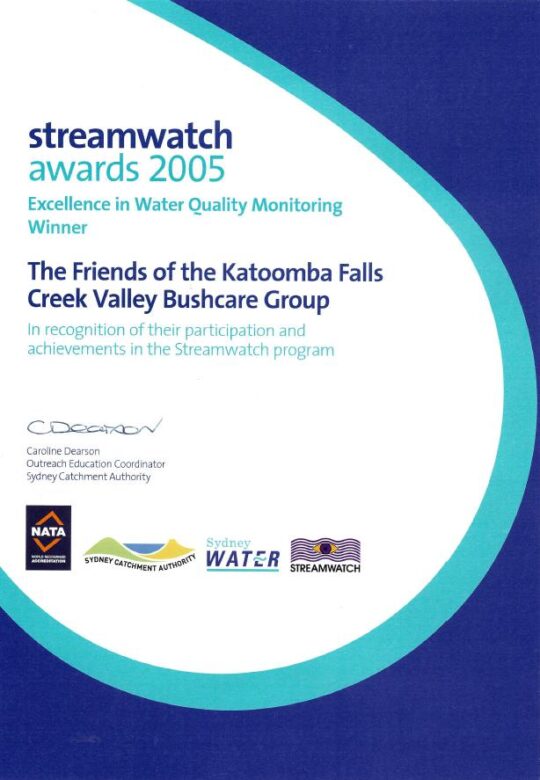
Our group proudly won five awards over this time for our efforts including this one below in 2005. Our winning award was a recognition by the Sydney Catchment Authority for our specific work in monitoring, testing, investigating and reporting incidents of sewer overflow pollution of the creek from Sydney Water’s sewer network in the valley.
As part of our win, Sydney Catchment Authority rewarded our StreamWatch group with a $2000 cheque thank you.
Fresh flowing water has always been an integral value of this small creek valley. It is not just that it is part of the Kedumba River Water Catchment that supplies drinking water to Sydney, but vital to restoring the local riparian ecology.
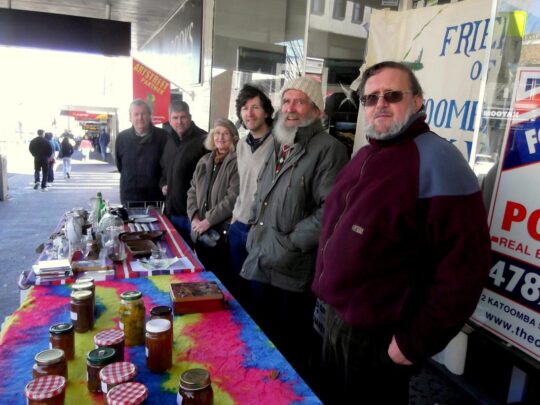
At the time our volunteer charity group The Friends subsequently invested this $2000 into a fixed interest account, since its operational expenses continued to be funded by our street stalls in Katoomba Street. Ultimately, upon the sad passing of the founder and chairperson of The Friends on 26th May 2016, The Friends elected to formally wind up the incorporated organisation. These funds along with the balance of the operational bank account were then gifted to the Blue Mountains Historical Society as part of a successful handover of The Friends archival records spanning 27 years.
Over two centuries, government in NSW (both state and local) continually re-zoned and divided up The Gully Water Catchment from being a pristine natural water catchment into various ‘sold out’ portions, thus.
The New South Wales colonial government’s land usurpation of Aboriginal country west of Sydney for colonial settlement since the British colonial explorers’ crossing of the Blue Mountains in 1813
Government sales of the Blue Mountains plateau lands around what is now Katoomba and Leura (including this creek valley) to various colonial settlers who subsequently deforested the land for timber, cattle and horse grazing and for town building and associated housing subdivision
The acquisition of this creek valley and surrounding land by one John Britty North [1831-1917] in the 1870s for subsequent deforestation, housing subdivision and then for coal mining exploitation to the south
John Britty North’s Katoomba Coal Mine’s coal shale tramway corridor (3 metres wide along the western ridge of the valley since the 1870s from the Jamison Valley escarpment (where Scenic World is located) to a rail loading platform called North’s Siding near the corner of Valley Road and Bathurst Road (next to what locals call ‘Shell Corner’ – where the Shell servicestation used to be situated, currently Bohman Automotive repairs.)
Incremental sales of bushland by Council for housing subdivisions along with urban streets over many years since the 1880s
Catalina Park amusement park and lake [1946-1951]
Council’s subsequent purchase of the land of Catalina Park in 1952
Catalina Park motor racing circuit leased by Council to the Blue Mountains Sporting Drivers Club Ltd [1957-1971]
Council’s aquatic centre constructed in Katoomba Falls Creek valley in the 1980s
Two Council cricket ovals at Katoomba Reserve
Katoomba Golf Course [1911-2013]
Council’s rezoning and subdivision approval of ‘The Escarpments’ townhouses on a portion of the Katoomba Golf Course site (2000 – current)
Council’s caravan park (currently called ‘Katoomba Falls Tourist Park’)
The NSW Government’s Rural Fire Service’s South Katoomba RFB Station with subsequent access roads
The NSW Government’s Rural Fire Service’s Bushfire Control Centre built near the aquatic centre below Mission Street
As a secret waste dump for hundreds of tonnes of sand and rock on top of the swamp extracted from the RTA’s Great Western Highway cutting between Blackheath and Mount Victoria
The areas previously gazetted by Council as Frank Walford Park, Mc Rae’s Paddock, Selby Street Reserve and Katoomba Falls Reserve have in piecemeal been handed over to Gundungurra (Aboriginal)-only custodianship as ‘The Gully – Aboriginal Place’ in 2002
Council’s proposed ‘Centre for Planetary Health’ to occupy the defunct golf course clubhouse from 2022
This list is not complete.
The remnant natural bushland portions of The Gully Water Catchment continue to be steadily sold off periodically by Council (along with many other bushland blocks owned by Council in order it seems to bankroll Council’s annual operations and councillors’ capital works indulgences – external consultants, legal fees, media public relations, over-paid executive management, and unnecessary capital works projects.
The Gully
‘The Gully’ is the old affectionate name given to this creek valley above Katoomba Falls and in particular to the northern portion by its former residents (numbering two or three dozen or so) who lived there for decades from the early 19th Century first contact with British colonial settlers. This was until the last residents were forcibly removed from the gully 1957-1959 by Council and their homes demolished by contracted bulldozer.
“By May 1959, the shacks of the last Gully residents had been all demolished to make way for the Catalina Racing Circuit which officially opened in 1961. “
– John Merriman, Blue Mountains historian.
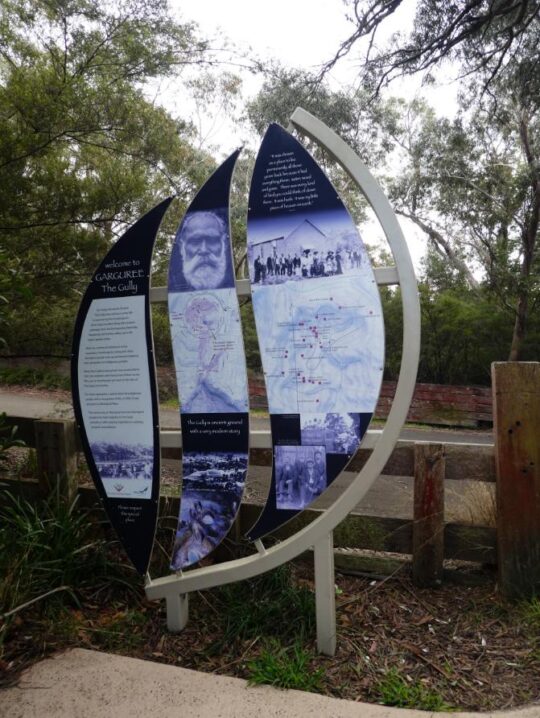
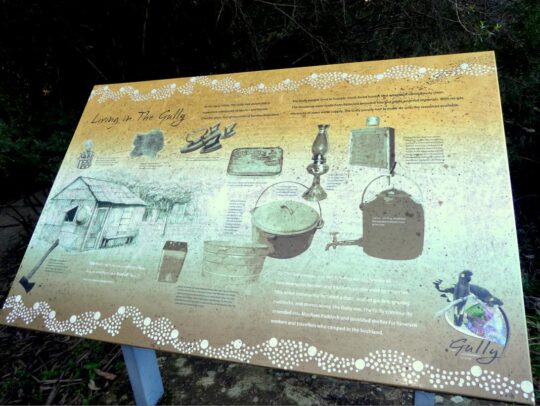
Aboriginal interpretative sign of 2008 positioned at the entrance to The Gully. It briefly outlines the record of former residents who lived there before the racetrack land usurpation of The Gully.
Those residents comprised both locally Aboriginal clan families, comprising predominantly people of Gundungurra and Darug ancestry as well as non-Aboriginal, many of whom had inter-married. It had been a tight-knit self-sufficient yet quite poor community refuge of displaced persons, subsisting in bushland typically in meagre dirt-floor shacks with no utilities (i.e. no connected running water, electricity, gas, plumbing, phonelines or streets).
It had been simple bush living refuge of poor folk subsisting on the fringe of Katoomba of both regional Aboriginal, non-Aboriginal and a intermarried mix of both. Many had been previously displaced in 1948 from their Burragorang Valley bush homes when the NSW government evicted them to flood the valley to create a Sydney’s Warragamba Dam reservoir. The Gully was a close-knit community.
It holds archaeological evidence thanks to field research separately by Dianne Johnson, Ph.D (2001) and Alan Lance (2005) which confirm ancient Aboriginal archaeological sites within the gully extending to ancient origins, extending back as far as 12000 years.
The Gully in the old days (early 1800s to the 1957-59 forced eviction by Blue Mountains {city} Council.
But The Gully people must have had sewage since around 1907 when then Katoomba Municipal Council had trenched up the valley for sewage to flow to the ‘Leura Filter Beds’ via the escarpment around Katoomba Falls and situated down in the Jamison Valley. Remnants of the long disused iron sewer pipe infrastructure may still be seen along on the hiking track between Katoomba Kiosk and the Furber Steps access down into the Jamison Valley.
Before colonial settlement, The Gully had been a traditional ‘summer camp’ location used by regional Aboriginal peoples for meeting and ceremonial place of traditional Aboriginal peoples of the Gundungurra, Darug, Wonnarua, Wiradjuri, Darkinjung and Tharawal of the greater Blue Mountains region and adjoining lands. This was usually is the warmer times of year and this connection to country. Particularly appealing to these traditional people was the constant and reliable supply of fresh flowing spring water and the abundance of bush tacker and wildlife to sustain a small community.
‘The Gully Bringing Back the Sweetwater’, by former residents of The Gully and descendants.
[Source: Blue Mountains {city} Council]
Katoomba Falls Creek Valley
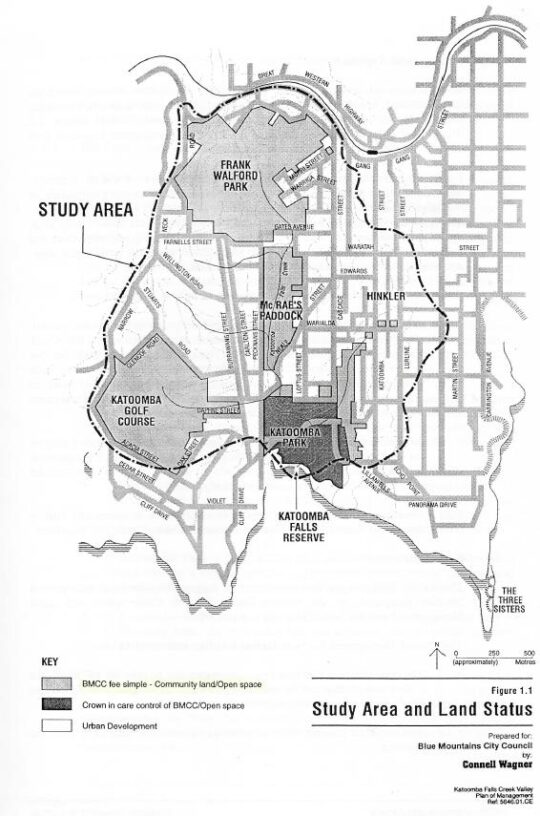
Katoomba Falls Creek Valley was long the gazetted name of this creek valley by local council for decades throughout the 20th Century. The following map shows some identified sub-portions of the creek valley juxtaposed within the black dotted line of the overall water catchment, flowing to Katoomba Falls to the south.
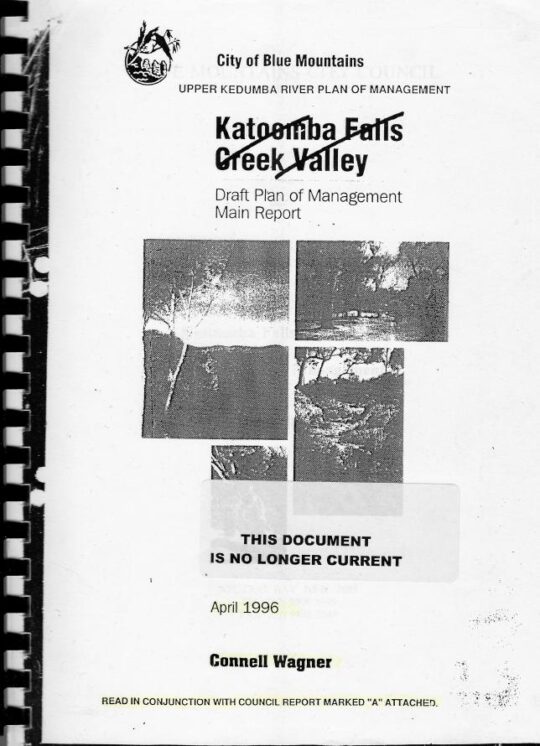
Katoomba Falls Creek Valley – Study Area and Land Status, Draft Plan of Management, (renamed by Council as Upper Kedumba River Plan of Management), by Connell Wagner April 1996.
It was affectionately referred to simply as ‘The Valley’ by surrounding residents’ grassroots environmental group The Friends of Katoomba Falls Creek Valley Inc. (The Friends) which functioned to respect and rehabilitate its natural values and ecology as informal ecological custodians and to challenge the many damaging threats to it by various vested outside interests between the years 1989 and 2016; some 27 years.
Katoomba Falls Creek Valley was the historical name of the full length of this creek valley water catchment up until 1995.
The following recent YouTube video shows the downstream water emanating from this creek valley flowing over Katoomba Cascades and then down Katoomba Falls.
Upper Kedumba River Valley
In 1995 Blue Mountains {city} Council unilaterally decided to rename Katoomba Falls Creek Valley as ‘Upper Kedumba River Valley‘ without local community consultation. One presumes that Council’s renaming logic was because this the central creek flows of this upland valley flows to Katoomba Cascades and over to Katoomba Falls into the Kedumba River more than 300 metres down in the Jamison Valley below, so it seems that some bureaucrat in Council wanted to continue the name to the small creek above the falls.
The renaming suggests Council’s recognition of this upland creek valley as being part of the water catchment area of the Kedumba River below Katoomba Falls and through the lower Jamison Valley. One suspects that given Council’s decades of fighting against the wises of local community environmental activist group The Friends of Katoomba Falls Inc. and that the renaming of the creek valley was a snide attempt by Council to undermine the validity of this group.
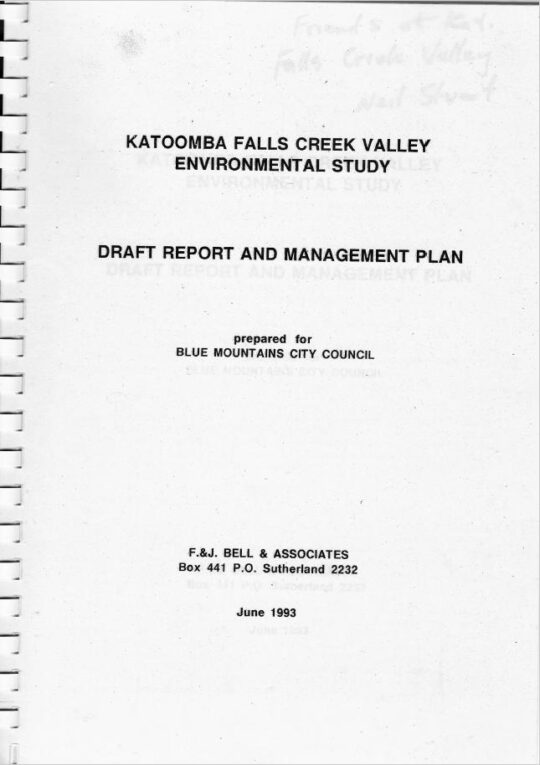
Compare the following two documents below. The second shows the original name crossed out by Council.
This study and report by Fred Bell and his environmental consulting team was commissioned by The Friends at a cost of $10,000. It was formerly submitted by The Friends to Council, but was wholly ignored by Council bureaucracy and the councillors at the time. A full transcript copy is made availabe on this website at: https://www.habitatadvocate.com.au/gully-report-1-the-bell-report-of-1993/
This subsequent report was commissioned by Council at ratepayer expense and prepared by Sydney based consulting firm (in Neutral Bay) Connell Wagner and probably at considerably higher cost – not their money.
Council’s 1996 plan of management was pretty much a copy of Fred Bell’s 1993 plan of management for The Friends. Both plans considered the entire water catchment and recommended similar environmental restorative actions be undertaken. It didn’t happen.
As a former member of The Friends, this author recalls that when the group learned of the renaming on Council’s 1996 plan of management title, the group chose not to change their name. Affectionately the members just referred to the entire water catchment simply as ‘The Valley’ for short anyway.
What is so hypocritical of Council’s recognition of this upland creek valley as forming the upper reaches of the water catchment area of the Kedumba River, is that over the decades both state and local government have repeatedly divided up the contiguous water flowing nature of this creek valley in various ways. This includes rezoning various portions of the land from being gazetted as ‘community land’ to being ‘operational land’ so it could be re-purposed and exploited. This dates from the colonial 1870s and continues with Council’s most recent culturally exclusive plan of management of 2021.
Land use development examples include:
James Henry Neale’s subdivision and lobbying from the 1870s to build what has become Katoomba township
John Britty North’s adjoining subdivision and joint lobbying for housing and coal shale mining access from 1883
Various housing subdivision approvals by Council since
Horace Gates Catalina (amusement) Park and dam construction 1946-1951
Council’s sewer network trenching throughout The Gully to facilitate further housing subdivision
Blue Mountains Sporting Drivers’ Motor Racing Club Limited’s motor racing circuit [1957-1971]
Two Council cricket ovals
Council’s aquatic centre – which keeps getting bigger
A bushfire brigade building, hardstand and two access roads
Hundreds of tonnes of sand and rock dumped from a highway development (at Soldiers Pinch) on The Gully’s swampland by the RTA in 2001 (with Council approval)
Sydney Water’s dumping of hundreds of tonnes of sewer fill in The Gully in 2005
Scenic World’s Skyway development in a secret land swap deal between the Parks Service and Council [2006]
Sydney Water’s sewer amplification trenching [2007-2008] to facilitate further housing subdivision
About a hectare of sand and rock fill (1 metre thick) was dumped on top of The Gully swampland by the Roads and Traffic Authority (RTA) in 2001. The RTA has since been rebranded RMS and current TfNSW, probably to avoid its bad reputation.
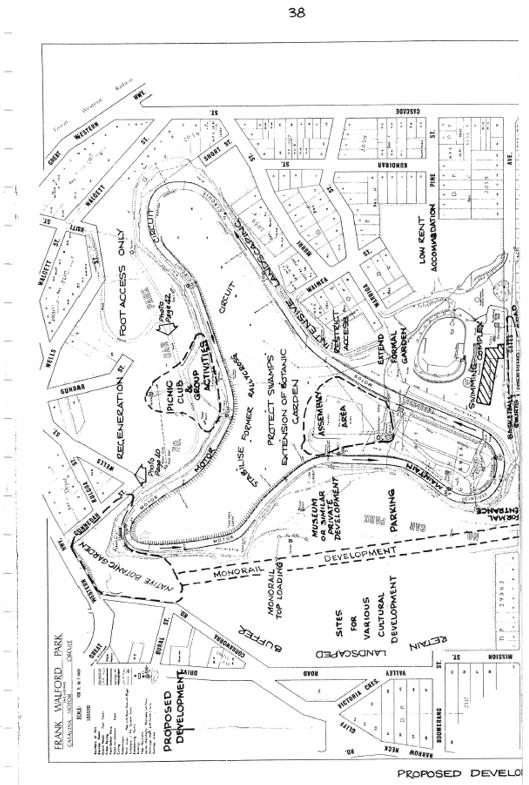
This is just to name a few, and this doesn’t include the many hair-brained proposals for The Gully over the years, like an ice-rink, basketball courts, Scenic World’s cable hang-gliding and flying fox, a complete housing subdivision to be called ‘Highmark’, low-rent accommodation, a museum, and even Katoomba’s own mono-rail! Study Council’s 1981 Plan of Management map below.
The Gully’s legacy of exploitation exemplified in Blue Mountains {city} Council’s 1981 proposed development Plan of (mis)Management, page 38.
The word ‘Kedumba’ is has Aboriginal origins and is just a variation of the word ‘Katoomba’ depending on how it is pronounced. The original meaning was supposedly “tumbling waters” in reference to Katoomba Cascades and Katoomba Falls below.
Katoomba Falls
Another theory espoused by local Blue Mountains historian Jim Smith Ph.D. is that ‘Katoom-ba‘ could have been a local aboriginal Gundungurra phrase relating to the pointing to a certain edible ‘fern: ‘Katoom’ (the fern plant) and ‘ba’ (over there) down in the Jamison Valley. We like the tumbling waters version.
Blue Mountains {city} Council has since renamed Upper Kedumba River as Kedumba River on Google Maps:
Council renamed Katoomba Falls Creek as Kedumba River. Seriously, has Blue Mountains {city} Council bureaucracy got nothing better to do than indulge in ‘cancel culture’ renaming of local geography?
McRae’s Horse Paddock
This middle portion of the creek valley used to be colloquially called by locals as McRae’s Horse Paddock possibly in the post-WWII days of nearby Catalina Park.
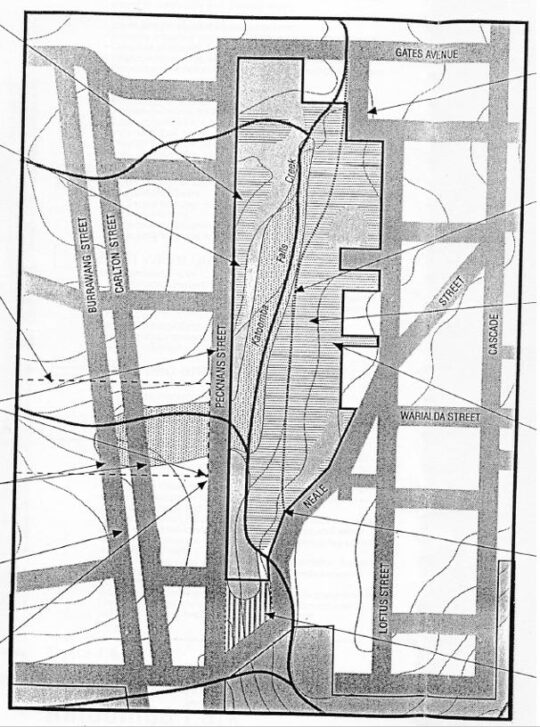
This portion comprises the riparian zone and bushland either side of Katoomba Falls Creek extending southward downstream situated south of Gates Avenue in the north, to Neale Street in the south and east of Peckmans Road in the west as the following map shows. It excluse the lands already sold off by Councik for residential housing in the east along Loftus Street.
McRae’s Paddock map, in McRae’s Paddock Action Plan (1996-1999) in Katoomba Falls Creek Valley Draft Plan of Managamnt Main Report, prepared for Blue Mountains {city} Council by Connell Wagner, April 1996. (no page number)
McRaes Paddock (as it has become abbreviated by Council) is characterised as a narrrow riparian swampland corridor midway along the valley creek that extends from being channeled as a drain culvert underneath Gates Avenue and then south for about 800 metres to being similarly channeled as a drain culvert underneath Neale Street.
The creek corridor at this creek valley portion narrows from about 200 metres wide to 100 metres at Neale Street, and the approximate remnant swamp/bushland area not yet been encroached upon by housing, covers about 70 hectares (or 0.7 km2).
Anecdotal local oral history records that the land owner was a grazier by the name of McRae (Scottish heritage spelt ‘Macrae’) who grazed his horses in this ploughed up swampland and the surrounding natural grassland either side of the comparatively narrower section of this creek valley.
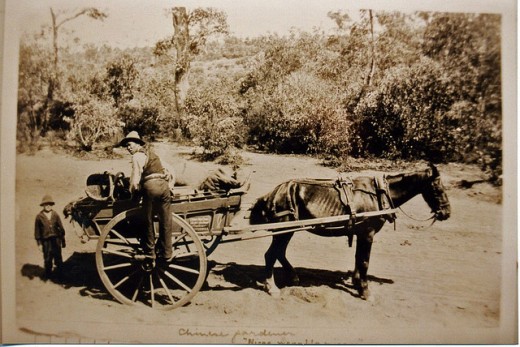
Prior to the use of this area as a horse paddock, it had been utilised for market gardening as old photos reveal.
Jimmy War Sing, a Chinese market gardener (circa 1903) of this creek valley area from which the swamp has been ploughed up and soil brought in.
Over the decades post-WWI, Gully locals shortened the name to just ‘McRae’s Paddock’ and the name stuck. The surname has Scottish ancestral origins, the ‘Clan Macrae’ being a traditional Scottish highland clan, however the origins of McRae’s Horse Paddock are not know to us, yet, but give us time with our ongoing research for this website.
Catalina (amusement) Park
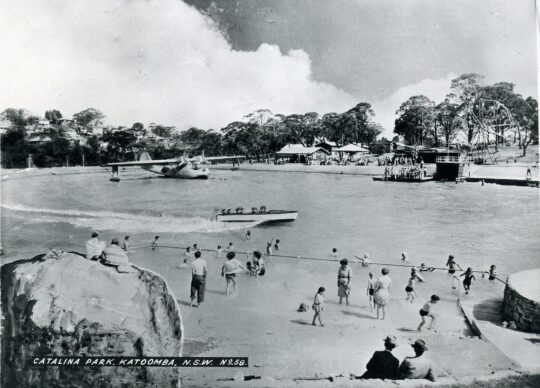
Post World War II, between 1946 and 1951 local Katoomba tourism entrepreneurial businessman, Horace Gates, established an amusement park in the valley (The Gully) that, with support from local council aldermen, he named Catalina Park.
However not long after, by 1951 Horace Gates had lost patronage for his amusement attraction and the venue fell into disrepair. In 1952 local council acquired his land in the valley.
Catalina Park Raceway
At this time, Council had hiked up the land rates of properties across the Blue Mountains including those in this creek valley. It was in order to fund Council’s then utility obligations in a growing need for sewage, electricity and road making. Over more than a decade post-war, Council had forcibly acquired many bushland properties that had been investment block of private land holders due to the repeated non-payment of Council’s increasing rate hikes, outsourcing the legalities to the Katoomba legal firm Soper Brothers. By 1957, Council owned most of The Gully.
During the 1950s motorcar racing had become very popular in Australia and particularly with local businessmen in the Upper Blue Mountains who had bought racing cars and wanted to test them out and to compete with one another. Numerous small motorcar garages established and there became a growing motorcar racing fraternity. They registered as as company as the Blue Mountains Sporting Drivers’ Club Limited.
Their short uphill car races became popular, usurping various steep local streets of Katoomba and their power and influence evolved into them lobbying Council for a dedicated local car racing circuit to be established in the Upper Blue Mountains.
The Blue Mountains Councillors obliged on Tuesday 2nd April 1957 by passing the following motions thus:
SOURCE: Council of The [city} of Blue Mountains councillor special meeting minute 447 (c), page 216, dated Tuesday 2nd April 1957.
And then on the same day:
SOURCE: Council of The [city} of Blue Mountains councillor special meeting minute 450, page 216, dated Tuesday 2nd April 1957.
So between 1957 and 1959, Blue Mountains [city] Council proceeded to forcible evict the residents of The Gully and demolish their homes in order to appease these influential businessmen and to construct a motor-racing racetrack circuit in the northern amphitheatre portion of this creek valley. Council funded the racetrack construction by way of a loan to the Blue Mountains Sporting Drivers’ Club Limited, using ratepayer moneys. That loan was never repaid.
The usurping motor racing fraternity then called the place ‘Catalina Park‘, named after the float plane that had decades earlier been positioned in an artificial dam alongside the creek as an amusement attraction.
This is the name that Blue Mountains {city} Council gave to the northern portion of the creek valley which forms a natural amphitheatre shape and covers about 80 hectares. In the 1990’s, following the demise of Catalina Park racetrack, the government landowner of The Gully, councillors on the Blue Mountains {city} Council unilaterally named this northern portion of the creek valley after one of their own, former alderman Frank Walford [1882-1969] who was also the local mayor on three occasions.
Frank Walford was from Sydney and settled in Katoomba from 1919 just after The Great War where he worked as a journalist with the local newspaper The Blue Mountains Echo and became its editor. He was a keen and experienced bushwalker, bushman, mountaineer a variable adventurer. He became an accomplished author of novels and poetry.
As alderman and mayor he was largely credited (accused by former residents of ‘The Gully’) as being largely responsible for approving the motor racing circuit in 1957 in this portion of the creek valley. However, while he supported the race track construction, Council records show that he was not mayor at the time in 1957, but an alderman.
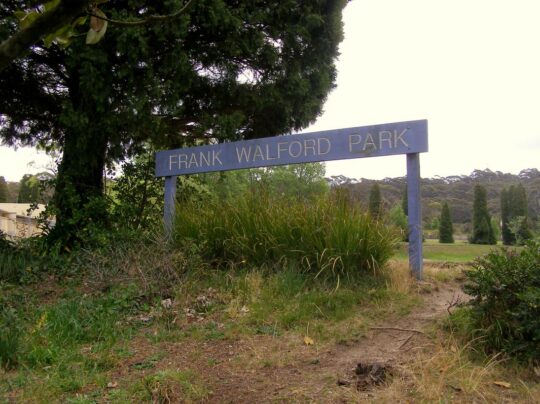
The park sign off Madge Walford Fountain car park just by Lake Catalina. It was moved likely by Council sometime around 2014. Madge was Frank’s wife. [Photo by Editor 2007-10-27]
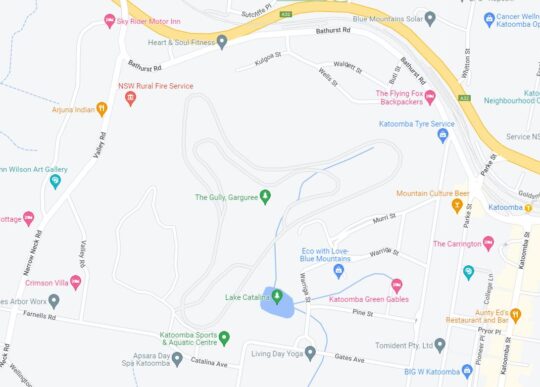
Frank Walford Park is bounded by a steep bushland amphitheatre up to the surrounding ridgeline along where Lower Wells Street borders to the north, where Valley Road and Mission Street borders to the west, where Cascade Street borders to the east; and to the south where Gates Avenue, Catalina Avenue and Farnells Road. There is also a spur-line that juts into the valley from the east which includes the residential streets of Murri Street, Waimea Street and Warriga Street.
The surrounding street map around Frank Walford Park. [Google Maps, 2022]
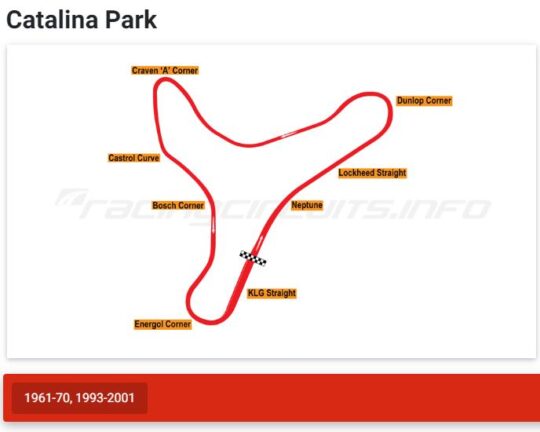
It was the broader gazetted land area of the creek valley around which the 1940s amusement park ‘Catalina Park’ centred around the artificial lake was constructed by Horace Gates and later from 1957 where the 2.1 km ‘Catalina Park’ motor racing circuit was constructed by the former Blue Mountains Sporting Drivers’ Club Limited.
Probably a key justification for Council’s naming of Frank Walford Park after Frank’s passing in 1969 was because his home with his wife Madge was situated close by in an 1880s stone house up on the eastern spur-line overlooking Dunlop Corner at 6 Kundibar Street in Katoomba. Frank and his wife became a fan of the motor racing so much so that during the circuit’s peak operation in the 1960’s Frank had a second storey added to their the stone house as well as a small balcony so they could better watch the car racing especially from the starting grid up Lockheed Straight and left around the sharp Dunlop Corner.
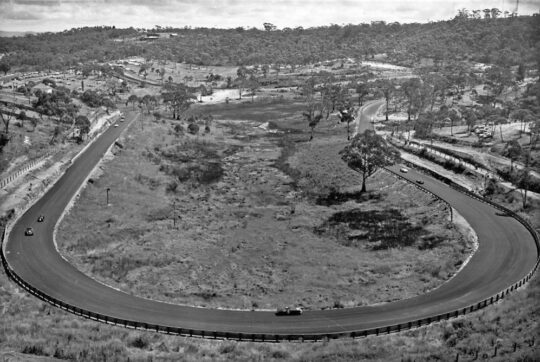
Dunlop Corner of Catalina Park (anti-clockwise) motor racing circuit circa 1965 looking west from up near Katoomba Tyres on Cascade Street. Frank Walford’s family home was located left of the photo, uphill on the spurline above the racetrack. With all the trees cleared by Council, Mayor Walford created an uninterrupted view from his new upstairs balcony. [SOURCE: Blue Mountains Local Studies, ^https://www.flickr.com/photos/blue_mountains_library_-_local_studies/33414945591/]
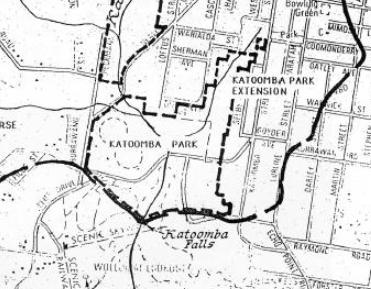
Katoomba Park (and Katoomba Park Extension)
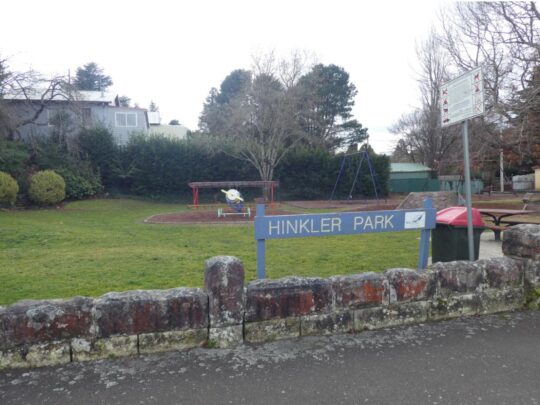
This comprises the southern portion of The Gully Water Catchment between Neale Street and to the Jamison clifftop escarpment around Katoomba Falls. It includes the two sports ovals primarily used for local cricket during the summer months, as well as the caravan park called Katoomba Falls Tourist Park. It also includes the riparian zone along the eastern tributary that has its headwaters at where Hinkler Memorial Park is situated and flows through Selby Street Reserve and alongside Council Maple Grove tourist picnic area. This water course confluences into the main creek just near the road bridge at Cliff Drive.
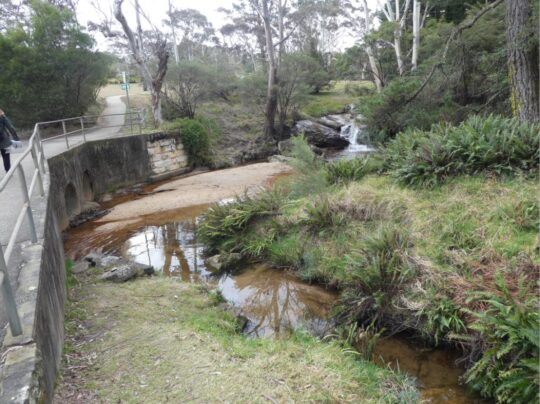
The confluence of Katoomba Falls Creek (Upper Kedumba River) and the eastern side watercourse (unnamed) which flows through Selby Street Reserve from Hinkler Park. [Photo by editor August 2022].
The names ‘Katoomba Park’ and ‘Katoomba Park Extension’ date from the 1990s and are documented in the Bell Report to Council of 1993 and in the Connell Wagner Plan of Management Report to Council of 1996.
Extract of ‘The Gully Water Catchment’ [SOURCE: Dr Val Attenbrow’s Map of 1993 as ‘The Study Area’, in Katoomba Falls Creek Valley Environmental Study | Draft Report and Management Plan prepared for Blue Mountains [city] Council | by F.&J. Bell & Associates | June 1993 | page 3 of 87]
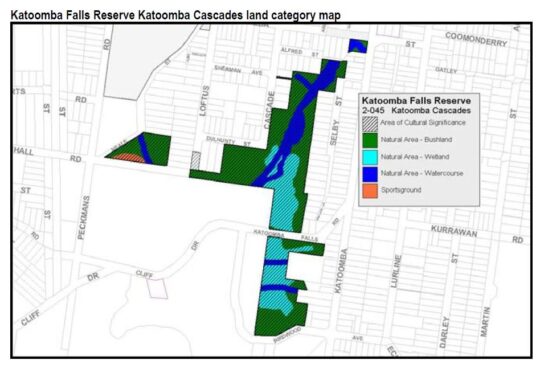
Eight years hence, by the time of Council’s Plans of Management of 2004, prepared by consultancy Environmental Partnership, this area was re-labelled ‘Katoomba Falls Reserve – Cascades section (Selby Street)‘. It had become a disjointed collection of land parcels as the following map shows.
Katoomba Falls Reserve Katoomba Cascades land categorisation map in Upper Kedumba River Valley Plans of Management, revised edition 2004, p. 65
Notably, the following land parcels have been excluded from Katoomba Falls Reserve in Council’s 2004 plan:
The two sports ovals
Most of the bushland south of Cliff Drive
The escarpment top bushland that includes Prince Henry Picnic Area
The area bushland around Katoomba Falls Kiosk, including the kiosk
The area of bushland around what is now Scenic World’s Skyway East Station (sold by the Parks Service to Scenic World in 2006)
The riparian area around Katoomba Cacades and atop Katoomba Falls, including Katoomba Cascades
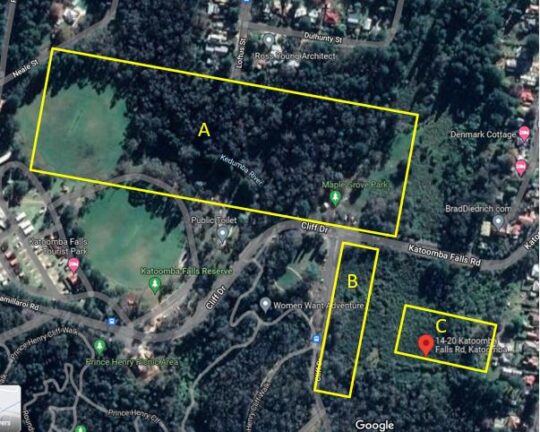
About 4 hectares of intact swamp/bushland including Maple Grove picnic area (Area ‘A’ below)
About a hectare of intact swamp/bushland south along Cliff Drive (Area ‘B’ below)
About a hectare of intact swamp and bushland at the address 14-20 Katoomba Falls Road (Area ‘C’ below)
Edited Google Maps aerial photo, 2022.
Katoomba Falls Reserve
This comprises the southern portion of The Gully Water Catchment and is a mix of Crown Land owned by the NSW Government around the creek to Katoomba Cascades and the top of the Jamison Valley clifftop escarpment at Katoomba Falls.
It includes council owned riparian zone of the creek and surrounding bushland from Neale Street flowing southward, as well as the two sports (cricket) ovals, Katoomba Falls Tourist Park, Maple Grove Park, as well as the side creek riparian zone from Warialda Street and Selby Street, which for years was referred to as Selby Street Reserve.
Selby Street Reserve
This is the above mentioned side creek riparian zone and bushland to the north east direction to Warialda Street and Selby Street. The headwaters of this watercourse begin from a spring originally situated where Hinkler Park lies in a hollow.
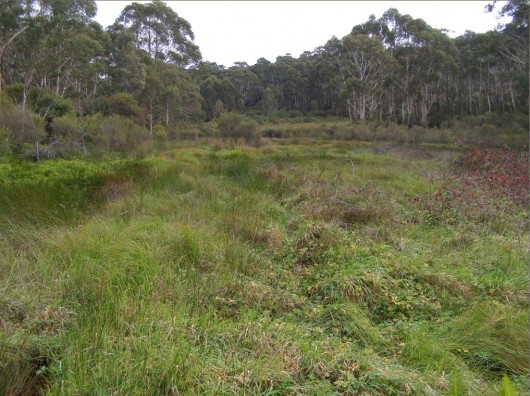
The original swamp headwater location of the watercourse in Selby Street Reserve.[Photo by editor August 2022].
Katoomba Golf Course
The Katoomba Golf Course site lies wholly within The Gully Water Catchment situated on the south western portion near the Jamison Escarpment. It covers 30 hectares and the land is owned by Blue Mountains {city} Council, formerly Katoomba Council, and as such it is community land. The Katoomba Golf Club formed in 1911 after the Council approved the native woodland and swamps to be destroyed to make way for fertilised lawn fairways and putting greens.
An historic pursuit by Scottish gentry from 1297AD, Katoomba Golf Course was bulldozed into this creek valley from 1911 as a 9-hole golf course and later bulldozed out to a 18 hole golf course. It went broke in 2013 due to lack of interest in golf, but the ecological damage had been done.
In the 1990s the 9-hole course was expanded to 18 holes by deforesting more adjoining woodland. By 2013 the owner of the club went into liquidation.
At the time of writing, Council has leased the upstairs level of the clubhouse to the Parks Service and is proposing to lease the lower level to a new organisation it terms The Centre for Planetary Health in a joint partnership with two universities. It remains unclear what that organisation will achieve and what the future use of the land will be.
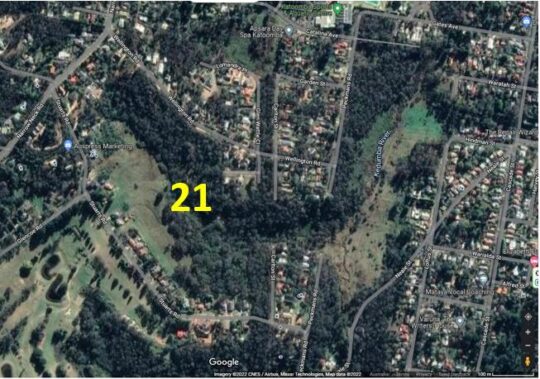
21 Stuarts Road: bushland subdivision for housing
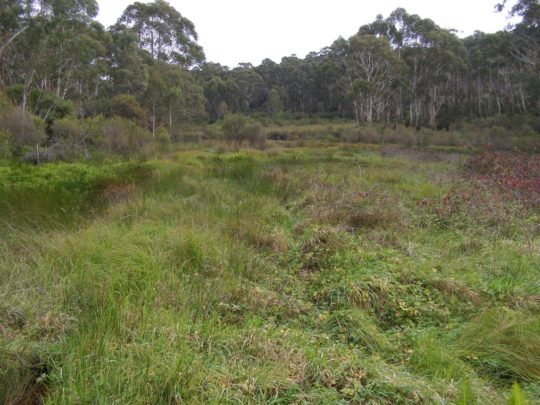
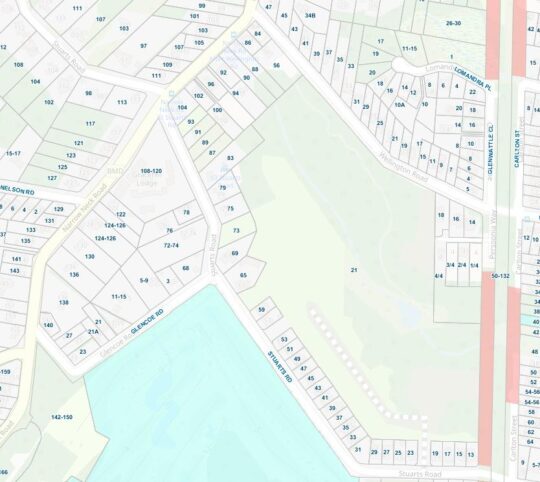
21 Stuarts Road Katoomba is located in the south-west portion of The Gully Water Catchment. It is a single bushland site of covering 12 hectares that is situated between Stuarts and Wellington Roads, west of Burrawang Street in the west of Katoomba. The site comprises remnant bushland, swampland and riparian zone around a watercourse in a easterly-sloped side gully flowing westward confluencing with Kedumba Creek (previously Katoomba Falls Creek) about 200m to the east and downstream.
SOURCE: Google Maps 2022
The following street map identifies ’21’ Stuarts Road in more detail.
Blue Mountains {city} Council records reveal that between 2002 and 2006, the property owner of a rural bushland site, one Ronald Heasman applied for a land use subdivision of the entire site so he could sell off the land for housing development. Heasman’s initial development application to Council proposed a one into 69 lot subdivision [DP 593545, No. 21 STUARTS ROAD, KATOOMBA, FILE NO: (DA) S03/0029]
Essentially, the DA was to bulldoze all the 12 hectares of entire remnant woodland and swampland ecology of the site in order to create and profit from a village-scale dense urbanisation of 69 residential dwellings.
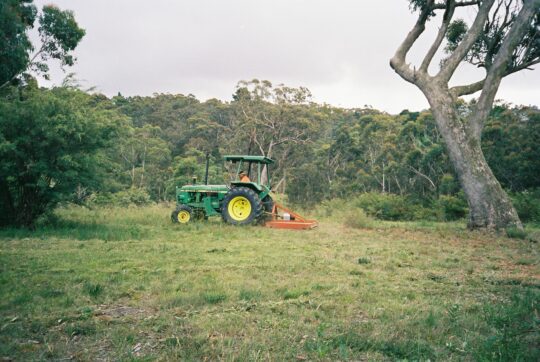
In order to revalue the ecological integrity of this western side gully of The Gully, over time Heasman despatched various bulldozers, excavators, forestry cutters and mulchers and his tractor with a mowing slasher attached to destroy the bushland.
Heasman’s tractor in action on 21 Stuarts Road that The Friends dubbed ‘Hector’. It has been used to steadily deforest this side valley to undermine the ecological integrity. [Photo courtesy of the (former) Friends of Katoomba Falls Creek Valley Inc. taken 2005-01-08].
Relevant planning controls at the time included
Local Environmental Plan 4 (LEP 4) zones the site Residential 2(a1), a zone that permits subdivision and detached dwellings. The minimum allotment size is 700m2 for ordinary allotments and 1,100m2 for hatchet shaped allotments. The minimum frontage is 18.5m.
Local Environmental Plan 1991 (LEP 91) zones the site Environmental Protection. LEP 91 identifies land with a slope in excess of 33% as Protected Area – Environmental Constraints Area.
Local Environmental Plan 2005 (LEP 2005) zones the site Living Bushland conservation and Environmental Protection – General Zone. The LEP designates part of the site Protected Area – Slope Constraint Area, Protected Area – Ecological Buffer Area, and Protected Area – Water Supply Catchment.
The Blue Mountains Better Living Development Control Plan (the Better Living DCP).
At the time, local resident conservation group the Friends of Katoomba Falls Creek Valley Inc. actively campaigned to prevent the ecological destruction of this side valley and against the subdivision for mass housing development application, lobbying Council and arguing as follows:
An over development of the site
The building parameters are unclear.
Significant Alteration of Bushland Character
Fails to comply with ‘Lot Layout’
Fails to comply with ‘Cluster Housing’
Proposal Fails to Provide Adequate Environmental Protection Buffer
Proposal is Contrary to Objectives of LEP 1991
Proposal Is Contrary to the Objectives of ‘Residential A1’ Zoning Under LEP4
Proposal is Contrary to The Objectives of ‘Environmental Protection’ Zoning Under LEP4
Proposal is Contrary to Objectives of ‘Environmental Protection’ Zoning under Draft LEP 2002
Proposal is Contrary to Objectives of ‘Living Bushland Conservation’ Zoning under Draft LEP 2002
Proposal is Contrary to Objectives of ‘Protected Areas’ Zoning under Draft LEP 2002
Likely adverse environmental impact on the ‘Slope Constraint’ Areas
Likely adverse environmental impact on the watercourse
Likely adverse environmental impact upon the water supply catchment.
Likely adverse environmental impact upon the indigenous vegetation and native fauna
Likely Adverse Impact on Biodiversity
Failure to undertake adequate surveys for likely Aboriginal heritage
Failure to assess likely impacts upon Aboriginal Place downstream
Consequential Excessive Demand Upon Katoomba’s Existing Infrastructure, Services and Utilities
Lack of Environmental Impact Statement (EIS)
Failure to provide an assessment of the likely impact on traffic pressures on nearby streetsnersurvey Increased Traffic Congestion to Adjoining and Nearby Streets
The Proposed Creation of Burrawang Street Will Destroy The Existing Bushland Amenity
The Proposal Fails to Identify Likely Impacts to Carlton Street
The Site Location is Too Distant From Town to Justify the provision of ‘Accessible Housing’
The Proposal Fails to Provide Sufficient Details of Dwelling Locations, Design and Landscaping
The Site is Zoned for Environmental Protection
The Subdivision Boundary Will Encroach Upon The Ecological Buffer Area
Destruction of Indigenous Vegetation Communities & Habitat
Downstream Contamination of Kedumba Falls Creek Valley and the Blue Mountains National Park
Absence of a Conservation Management Plan or EIS
Loss of topsoil & contamination by sediment into the watercourse
Steep Slopes Outside Limits for Building Construction
Kedumba Falls Creek Valley holds historical and cultural significance as an aboriginal place.
On 23rd November 2004 [ITEM NO: 7] Blue Mountains {city} Council rightly refused consent for Heasman’s DA outright at its councillors’ ordinary meeting, and pursuant to Section 80 of the Environmental Planning and Assessment Act 1979.
Council formal refusal of Heasman’s massive subdivision was made on the following grounds:
The proposal is contrary to Clause 33 of Local Environmental Plan No. 4 as the proposed battleaxe allotments are below minimum size requirements and there are numerous allotments that do not have minimum frontages required, resulting in an over development of the site.
The proposal is contrary to Clause 42 of Local Environmental Plan No. 4 as the proposal if carried out would not achieve satisfactory arrangements to reduce the risk of bush fire without significantly impacting on the environmental qualities of the site; and due to the impact on the visual amenity of the locality.
The proposal is contrary to the objectives of the Environmental Protection zone within Local Environmental Plan 1991.
The proposal is contrary to Clause 10.5 of Local Environmental Plan 1991 as the proposal if carried out would have an unsatisfactory impact on the native vegetation contained within the site and would have an adverse impact on the water supply catchment and on development excluded land within the site.
The proposal is contrary to the objectives of the Environmental Protection zone, the Living Bushland Conservation zone and the Protected Areas on the site as proposed and mapped under Draft Local Environmental Plan 2002.
The proposal will, if carried out, constitute an over development of the site due to Draft Local Environmental Plan 2002 as the applicant has failed to demonstrate that the proposal will have no adverse environmental impact:
The proposal includes development on the slope constraint areas within Precinct C and Precinct B; and
The proposal will impact on the watercourse that traverses the site and on the buffers that contribute to the protection of that watercourse; and
The proposal will impact on the water supply catchment (Kedumba Creek Catchment) mapped for this locality; and
The proposal will impact on the indigenous vegetation and native fauna present on the site and on significant vegetation communities on the site and downstream of the site; and
The requirements for Asset Protection will have significant impacts on the biodiversity of the site; and
The proposal does not comply with the considerations for lot layout, nor does it comply with the definition of cluster housing.
The development proposal will if carried out, result in significant alteration of the character of the area from a residential bushland character to an urban character.
The applicant has failed to undertake adequate surveys or assessments of the potential of the development to impact on the potential for Aboriginal heritage significance on the site; nor has there been adequate assessment of the potential for the development to impact on the Aboriginal Place located downstream of the subject site.
Insufficient details have been provided in relation to the management of asset protection zones on the site; and landscaping details for individual allotments and across the public areas of the site; and Aboriginal archaeology and cultural significance.
Persistent to get his way, Heasman took Council to the Land and Environment Court of New South Wales (in Sydney) multiple times between 2004 and 2006. He amended his DA proposal thus:
“The applicant proposes to subdivide the land under community title into 46 lots (43 residential lots and 3 community lots) and to erect a dwelling on 42 of the residential lots. The development is divided into three sections: Precincts A, B and C. Lot A8 is a residential lot of 5,032m2, which is proposed for a six-lot subdivision but presented as a single lot because of the uncertainty of access from Burrawang Road. The applicant indicated that when that access becomes available, it intends to lodge a development application reinstating the original six-lot subdivision.” [SOURCE: Heasman v Blue Mountains City Council, 11039 of 2004].
Heasman’s appeal to the Land and Environment Court (LEC) in Sydney used a team of solicitors and barristers who seconded five so-called expert witnesses to support his appeal on technical grounds, being:
Mr M Ball, a town planner retained by the applicant;
Ms N Cavanagh, a town planner employed by the council;
Mr P Mehl, a consulting civil engineer retained by the applicant;
Dr P Bacon, a natural resource scientist retained by the council; and
Mr R Morse, an environmental scientist appointed by the Court,
With support from Council’s appointed experts Ms N Cavanagh and Dr P Bacon, The Land and Environment Court subsequently overruled Councillors’ decision to refuse the application. LEC Senior Commissioner, Dr John Roseth, residing, upheld Heasman’s appeal thus:
“As I indicated above, discussions between the experts led to complete agreement between them. The agreement is reflected in the amended drawings as well as in the conditions of consent. The parties appeared before me on 10 March 2006 stating that there were no outstanding issues and that I should make orders in chambers approving the application.
Orders 1. The appeal is upheld.
2. Development application subdivide the land under community title into 46 lots (43 residential lots and 3 community lots) and to erect a dwelling on 42 of the residential lots on lots 1, 2 and 4 DP 593545, known as 21 Stuarts Road, Katoomba is determined by the granting of consent subject to the conditions in Annexure A.
3. The exhibits are returned except Exhibits 28, A, J, K, L and M.”
The ecological destruction of this side valley incrementally persists to this day, as remnant bushland gets bulldozed and the site is converted to a housing estate and Heasman profits.
Built-Up Subdivided Residential Katoomba
Almost a half of The Gully Water Catchment comprises housing and commercial subdivision across the eastern portion. It includes the commercial high street of Katoomba being Katoomba Street. This water catchment extends from Cascade Street in the north to Ada Street in the east to Lurline Street in the south. North’s Estate housing subdivision extends into the creek valley down a spur westward from the Carrington Hotel on top of the hill. The eastern boundary of the housing subdivision runs north-south along Loftus Street.
The exact date of Katoomba’s settlement is unclear, but since 1815 it has been on the south side of the Cox’s Road first colonial crossing of the Blue Mountains high plateau bush country. The railway passed by the site of what would become Katoomba from 1967, but the railway platform was not built until 1874. Katoomba was then just a remote rural locality, referred to as The ‘Crushers’ a sandstone quarry for ballast for train descent down plateau eastward. It was situated adjacent to the rail line opposite the site of what is currently The Edge Cinema) as shown in the late 19th Century land title map below.
In 1967, English emigrant pastoralist and later Australian politician, James Henry Neale [1828 – 1890], acquired perhaps the first private permanent houses within The Gully Water Catchment including his ‘Froma House’ situated on the site of the current TAFE college on what is now Parke Street.
As the map reveals, Neale purchased the then swampland of what is referred to as McRae’s Paddock south of what is now Gates Avenue to Katoomba Park. Neale Street on this land is named after Neale. Contrary to standard compass point street planning of the time, Neale Street formed a convenient direct bee-line diagonal access road from his Froma House home to the coal mine that was owned by English emigrant, John Britty North [1831-1917] from 1880. North was a merchant, stockbroker, mining agent and later mining operator of Katoomba Coal and Shale Co. Ltd.
In the 1870s, North had acquired the rest of the plateau bushland and swampland of The Gully Water Catchment and southward into the Jamison Valley, by taking out a mortgage loan with England-based London Chartered Bank of Australia. See his holdings are shown in the map above. The land labelled on the map as Katoomba Park in green was probably retained as Crown land, as it remains so today. North steadily subdivided his land holdings during the 1880s in order to profit from the residential land sales as a means of financing his shale mining business.
The Gully Water Catchment is show by the dotted black outline on the map below. The eastern portion is dominated by the Katoomba township.
‘The Gully Water Catchment’ [SOURCE: Dr Val Attenbrow’s Map of 1993 as ‘The Study Area’, in Katoomba Falls Creek Valley Environmental Study | Draft Report and Management Plan prepared for Blue Mountains [city] Council | by F.&J. Bell & Associates | June 1993 | page 3 of 87].
All rainfall runoff and stormwater from these streets, inside the dotted black line, flows to Katoomba Falls and to the Kedumba River below in the Jamison Valley. This has formed part of the water reservoir behind Warragamba Dam for Sydney’s drinking water supply since it was completed and opened on 14 October 1960.
So what goes down these Katoomba drains ends up in Sydney’s drinking water. As a result, WaterNSW, an agency of the Government of New South Wales, which controls Warragamba Dam water drinking supply adds disinfectants (typically chloramine (chlorine), ammonia and fluoride) to disinfect and purify the water to help make it safe to drink.
A large 3 metre wide stormwater drain at the riparian block at 233A Katoomba Street opposite Hinkler Park at the base of the hill of Katoomba Street. Stormwater runoff from the street and via a large culvert under the street pipe raw stormwater directly into the side creek behind through Selby Street Reserve. [Photo by editor 2022-08-12].
And this is where the stormwater from this drain flows to via a large pipe into the side creek…
‘The Gully – Aboriginal Place’ [Council’s Plan of 2004]
The community lands within this creek valley that had long been gazetted by Council as ‘Frank Walford Park’, ‘Mc Rae’s Paddock’, ‘Selby Street Reserve’ and ‘Katoomba Falls Reserve’ were in 2004 collectively incorporated into Council’s Upper Kedumba River Valley Plans of Management of some 105 pages. This 2004 plan followed a series of previously separate plans for this creek valley that extend back to the 1950s and even back to the days of colonial settler ownership and subdivision of from the 1860s. This 2004 plan was the first to recognise regional Aboriginal historical and pre-historical attachment to this creek valley and was the first plan after this creek valley had been formally declared an ‘Aboriginal Place’, named ‘The Gully – Aboriginal Place’ under the National Parks and Wildlife Act 1974 (NSW).
The rationale and the emergence of legal Aboriginal custodianship of this creek valley came at a brief period in Australia’s socio-political history (pretty much concentrated from Whitlam’s Labor government coming to power in 1972 through to 2002 in respect to this creek valley. The becoming of ‘The Gully- Aboriginal Place‘ is best described in detail particularly 2001-2002 in the documentary book ‘Sacred Waters – The Story of the Blue Mountains Gully Traditional Owners‘ by anthropologist Dianne Johnson [1947-2012] published in 2007. In her superbly researched book, Johnson explains that the critical mover and shaker was local Gundungurra Elder Dawn Colless who in August 2001 had formally nominated the Upper Katoomba Falls Creek Valley (The Gully) for consideration as an Aboriginal Place. Johnson worked closely with Aunty Dawn and members of the Aboriginal community to prepare the submission for state government. This included two related books ‘Aunty Joan Cooper Through the Front Door – a Darug and Gundungurra Story‘ (February 2003) and ‘Report to the Gundungurra Tribal Council concerning Gundungurra Native Title Claim‘ (2004).
On 18th May 2002, the Hon. Bob Debus as NSW member for Blue Mountains and Minister for the Environment, officially declared The Gully “An Aboriginal Place” – a place of special significance to Aboriginal culture.
A concern at the time, was that the declaration had been closed supported by Council and the Parks Service, which had chosen to emphasise the Gundungurra cultural custodianship of this creek valley over and above other cultural claims by Darug, Wonnarua, Wiradjuri, Darkinjung and Tharawal Aboriginal peoples. Council with the Parks Service also behind closed doors and with selective invitees to the declaration process, had deliberately excluded interested local residents, particularly ostracising the Friends of Katoomba Falls Creek Valley (bushcare group), who had since forming in 1989 had continually lobbied Council to end the car racing and to start ecologically rehabilitating this creek valley. The Friends wholly supported respecting Aboriginal cultural claims to The Gully, having over the years learning about their legacy of Aboriginal dispossession. Founder and leader of The Friends, Neil Stuart [1937-2016] initiated a joint community informal partnership between The Friends and former residents of The Gully (aboriginal and non-Aboriginal) and with other caring local residents in 2002, called the informal partnership The Gully Guardians.
But on matters concerning any decisions and management of The Gully – Aboriginal Place, Council has cultural form and policy of refusing to consult with anyone outside their selected few of the Gundungurra. It is an effective socio-political tactic of ‘divide and conquer’ by an organisation hell-bent on process control through ostracising those in the community it does not wish to be accountable to.
As a former member of the Friends, let the truth be told.
Katoomba Falls downstream, politics upstream
The truth about ‘The Gully – Aboriginal Place’ as set aside by Council is that it is only a part of The Gully Water Catchment. Of the remnant bushland within this catchment, ‘The Gully – Aboriginal Place’ comprises selective land portions that are not contiguous, that is, they don’t link up. Yet The Gully historically, before the racetrack land usurpation, which the former residents considered The Gully. It was/is one unified little valley from the northern ridgetop down to Katoomba Falls – two kilometres north to south and one kilometre east to west.
This is what Council bureaucracy has done ‘The Gully – Aboriginal Place‘ portions – divided them up piecemeal. Careful observation of this mapping reveals that many boundaries have changed since Council’s 2004 plan of management.
Upper Kedumba River Valley Plans of Management map, revised edition 2004, page 6.
Gargaree
In around 2005, a small group of former residents of The Gully (from the pre-1957 Council evictions) and their descendants who hold Gundungurra aboriginal ancestral heritage, decided to form an organisation they named The Gully Traditional Owners (GTO). Their purpose has been to become the sole managing custodians of ”The Gully – Aboriginal Place’ in a memorandum of understanding partnership agreement with the legal landholder Blue Mountains {city} Council.
Regrettably, this has proven to be a controlling initiative over what management decisions are made concerning the Gully, about the priority works and their funding and funding streams. Local residents around The Gully and The Gully Valley Catchment, the broader interested local community and former members of The Friends of Katoomba Falls Creek Valley have been deliberately excluded in the consultation process and so effectively ostracised by Council and this group.
If the 1957 forced eviction of The Gully residents for an elitist motor tracing group’s exclusive usage as a racetrack was land usurpation with racist overtones, then how is the current exclusion by The Gully Traditional Owners comprising a select Gundungurra-only membership that excludes interested local residents around The Gully, not the comparable reverse land usurpation…with this time reciprocal racist overtones?
When locals of one race is favoured for planning and decision making about a land area (place) to the deliberate exclusion of a different race of locals, this suggests a racist agenda and so is illegitimate in a national society. This implies a reciprocal repeat of a sad history. As a society here are we learning? Age and experience does not automatically translate to wisdom. It is not a bad thing to grow past your elders in some things.
A few years later GTO decided to rename The Gully (yet again) as ‘Garguree‘. This word apparently means ‘gully’ or ‘valley’ in the Gundungurra language and was sourced from Blue Mountains historian, researcher and author into the Gundungurra history, Jim Smith Ph.D. This follows a contemporary trend of renaming geographic places in Aboriginal language. Is it sending a socially dividing message of some sort of cultural payback to the descendants of non-Aboriginal Australians, who had no say nor played no role in tragic past events in our social history before they were born, just as do the descendants of Aboriginal people and of mixed marriages thereof?
The Gully used to look all like this, pristine riverine ecology uninterrupted by human harm – all the way to Katoomba Falls, Kedumba River, Cox’s River, Nepean River, Hawkesbury River out to Broken Bay on the coast into the Pacific Ocean.
Remnant upland swamp/wetland of The Gully, lately called ‘Gargaree’ [Photo by Editor]
‘The Gully – Aboriginal Place’ [Council’s Plan of 2021]
Blue Mountains {city} Council persists with ongoing re-categorisation of land tenor within The Gully Catchment Area with its ulterior motives that are locally divisive.
Council’s latest 2021 Plan is one of many over the years. But this one is perhaps worse than the others in that as a plan of management it not about rehabilitating this creek valley , but a biased Aboriginal cultural document that has excluded locals to the benefit of a select few. It prescribes a racist agenda of Reverse Land Usurpation.
‘The Gully – Aboriginal Place‘ divided up in Blue Mountains {city} Council’s Plan of Management of 4th October 2021.
“We’re coming to you from the custodial lands of the Hairygowogulator and Tarantulawollygong, and pay respects to uncle and grandaddy elders past, present and emerging from their burrows. So wise to keep a distance out bush.”
"We're coming to you from the custodial lands of the Hairygowogulator, Tarantulawollygong, and Longdrop country, within the Australia nation since 1901. From our home in Inner West Katoomba we pay respects to uncles and grandaddy elders past, present and emerging from their burrows. So wise to keep a distance out bush."
Recent
Supporting Us
A VOICE FOR NATIVE HABITAT
One’s solo mindful walk…
The Friends of Katoomba Falls Creek Valley Inc. in The Gully
The Gully Collection
Save Atlas Campaign
The Friends Archive: War and Peace with the Blue Mountains ‘hysterical’ Society
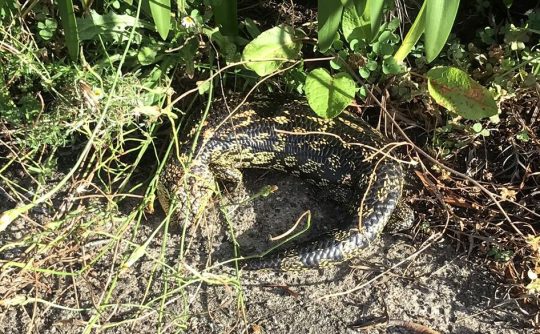
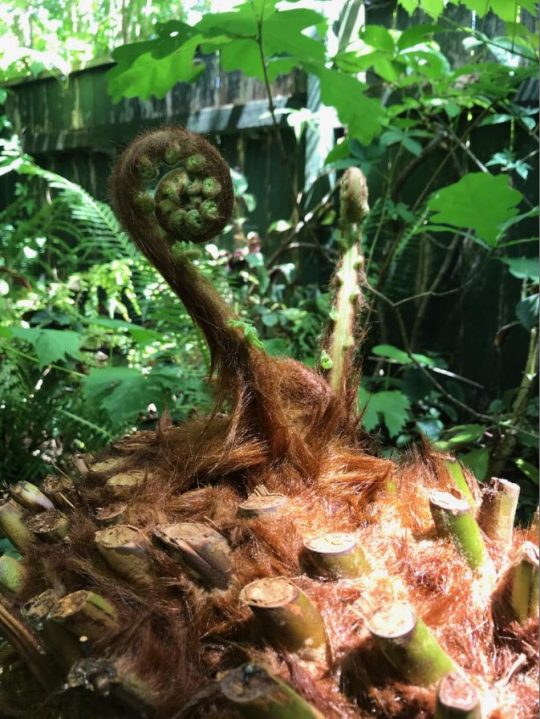
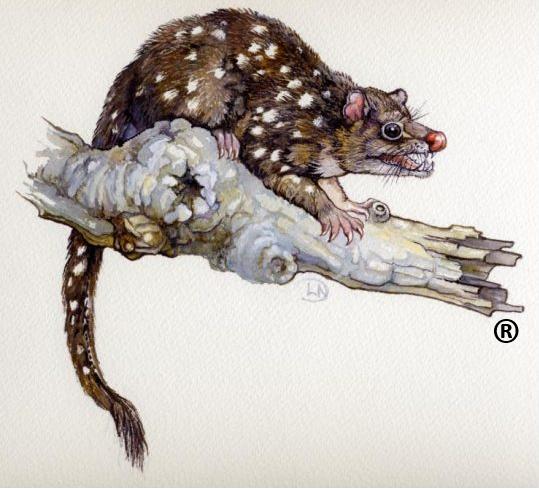


 Reload document
  Open in new tab