Archive for the ‘Threats from Bushfire’ Category
Monday, July 18th, 2011
The duty of fire fighting is to detect, control and suppress fires..
If bushfire fighting cannot do this reliably outside the urban environment, then the bushfire fighting promise has become a community lie and a deadly one at that..
This is a duty, irrespective of who is charged with the responsibility – government professionals, local volunteers, outsourced contractors, whomever?
But people in the bush are dying in their homes and in their cars, irreplaceable property has gone forever, and vast valleys and ridges of Australia’s rare ecosystems are being incinerated into extinction.
Australia’s post-war Dad’s Army model has long become ineffective. It has become a reckless and incompetent menace luring vulnerable bush communities into a false sense of security and trust, to their death..
It is long time that Australia’s post-1939 Black Friday bushfire fighting mentality, resourcing and infrastructure were challenged by communities!
.
The following is article was initially posted by Tigerquoll 20090326 on CanDoBetter.net:
.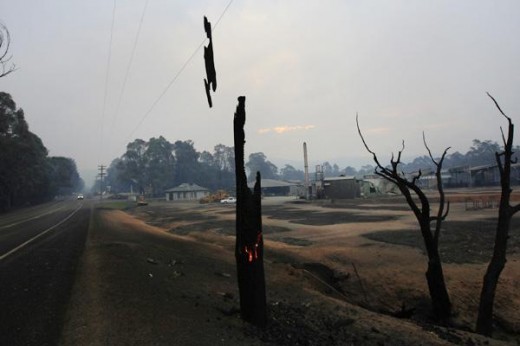
Out of the media frenzy to get ratings out of the Victorian bushfires, a ‘so-called’ bushfire expert on an ABC 730 Report panel (David Packham) advocated a 6 to 7 fold increase in prescribed burning for Victoria.
Another neo-Dreamtime wizard?
The effectiveness of this strategy is undermined by the live evidence shown (on ABC 730 Report Thursday 12-Feb-09) of local resident Jim Baruta in his home video. Over 200m of clear paddock stood between the bush and his house. This represents hazard reduction to an extreme degree (no trees or undergrowth for 200 m). Yet it was ineffective defence. Only his bunker saved his life.
As the ‘heat’ of the tragedy cools down, one of the overlooked impacts that needs to be considered in a balanced way is the impacts of broad scale fire (prescribed, wild, arson or otherwise) is having on the habitat of ground dwelling mammals. In the search for answers to avoid a repetition of the firestorm it is important that natural areas of high conservation value including old growth forests receive due recognition as natural assets worth protecting. Its integrity is not being measured and is probably disappearing through fire at a rate comparable to what logging is causing in SE Asia. That the bush grows back is not an indicator of its biodiversity health.
One must recognise that the bush (habitat) is also the innocent victim of these horrific fires. Dense ground cover is a fuel for fire but also home for wildlife. Keep removing the fuel and one removes the wildlife- eventually to its mass extinction. The underlying causes of the fires are the ignition, the lack of non-burnable material to create a buffer between good bush and human settlement, the slow detection of ignitions, the slow response to these while still manageable (remote country or otherwise) and the inadequate resources to suppress many spot fires. As to the ignition cause being arson – Australia needs a serious permanent criminology unit dedicated to this crime. The media and our leaders need to be careful not to incite dormant serial arsonists – just like one read and watched in the days preceding the first arson attack at Delburn on 29 Jan. The media frenzy just fuelled the copy cats’ excitement.
Bushfire management is a complex issue, so poorly under resourced, so poorly disconnected from bushfire research, yet so integrated into the lives of so many Australians. The public deserve a say into the Royal Commission. Those who tragically died and lost everything deserve billions not just in recovery but in the whole task of bushfire management.
.
.
Comments:
.
Re: Prescribed burning
April 17th, 2009 by ‘Matthew’:
.
I don’t doubt your commitment to the environment, but you’ve got it exactly backwards. Increased burning is exactly what we need. Not just for human safety, but because the Australian ecology depends on fire at the very least as a means of recycling dead matter (The Australian ecology is different from many others in that our lack of water tends to inhibit microbial decomposition – as a result fire takes on that role).
There are many other reasons, as well. The natural adaptation of Australian plants to fire means that fire suppression actually helps drive native species to extinction, as they are out-competed by faster growing, more prolific seed spreading imported weeds. This is often accompanied by native animals being pushed out in the same fashion.
But the weeds, by putting their effort into spreading widely, have few resources left to recover from periodic annihilation events (like bushfires), meaning that where the bush burns periodically, native plants and wildlife have a natural advantage. Strange as it may sound, continual fire protects native species.
So long as the fires are not the huge events that just happened, of course. Continual small fires (such as aboriginals lit – look up “firestick farming”) has proven to be best. This is not to say that exactly the same areas should be burned each time, of course.
An early paper of Tim Flannery’s on the subject would be a good introduction to the historical importance of fire, and how it relates to the rest of the Australian environment – please don’t be put off by the windy title: “The Timing, Nature, and Aftershock of Pleistocene Extinctions in Australia” (^http://www.amnh.org/science/biodiversity/extinction/Day2/bytes/FlanneryPres.html)
.
.
Lies, damn lies, and bushphobic myths
April 19th, 2009 by Tigerquoll:
.
Burning native habitat is State-sanctioned arson. If not, then perhaps Matthew in his claims above can offer verifiable ecological authority behind the myths he relies upon to justify why deliberatly setting fire to native habitat is ‘good’ for it?
.
Myth 1: “Increased burning is exactly what we need.”
Arsonist profess this, so how do you differentiate yourself? Arsonists feel good about lighting fires.
.
Myth 2: Bushfire is “good for human safety.”
Ambit claims deserve no more than single words rebuffs like: ‘crap’. But politely, I offer a more reasoned response.
Many prescribed burns actually get out of control and become the threat to human safety they are trying to avoid. Human safety is about not building in bushfire prone areas and not using materials that burn. Why is this logical solution avoided? If you choose to build in the bush and then burn the bush so that there is no bush around to burn, have you ust defeated your purpose of building in the bush? Bushfires burn down houses mainly fronm ember attack which can travel by winds many kilometres, so to remove the threat of ember attack, how many kilometres circumference of bush do you need to destroy to feel safe – 3km, 10km? You may as well build you house on farm land with no trees, undergrowth or grass in sight. Then you may be safe from ember attack. Think of the St Andrews example during the February Victorian Bushfires.
Bushfire fighting is all about rapid detecton, response and suppression of ignitions. Currently most bushfires are detected by thoughtful members of the public calling 000, then volunteers are called in and drive out in fire trucks. What are the performance statistics for say 2008 for all ignitions in Victoria in terms of elapsed time between estimated ignition time and response on site? Hours? Days? Such delays are not good for human safety or habitat.
.
Myth 3: “Australian ecology depends on fire”
Another ambit claim and so I say, crap. Name your ecological authority? Name species of flora that are threatened with extinction due the lack of fire? Name species of fauna that are fire dependent and relish being burns victims and displaced for years due to habitat destruction by fire?
.
Myth 4: “The natural adaptation of Australian plants to fire means that fire suppression actually helps drive native species to extinction, as they are outcompeted by faster growing, more prolific seed spreading imported weeds. This is often accompanied by native animals being pushed out in the same fashion.”
.
So you are now claiming bushfires are good because weeds grow faster than native plants. How is putting out bushfires logically connected to weeds? I am being really patient now.
Some Australian flora have become more fire tolerant that others, but others remain sensitive to fire and vulnerable to fire. This generalist claim disregards the complexity of biodoversity. It’s like claiming the bush growns back and so must be ok. Again, what ecological authority do you base you claim?
How does putting out bushfires (fire suppression) “drive native species to extinction”?
Weeds do not invade undisturbed bush easily – there is too much bush in the way. Heavy rain after burning will leave exposed subsoils and attracted weeds, but bushfire authorities who engage in prescribed burning abrogate themselves of responsibility for follow up weeding – ‘not our problem’ they say.
.
Myth 5: “Strange as it may sound, continual fire protects native species.”
Really strange this one. What ecological source, evidence, location do you have for this claim?
..
Myth 6: Aboriginal firestick farming has proven to be best.
Small mosaic occasional fires have prevailed across Australia, but the frequency and scale of that applied since 1788 has been a thousand fold – hardly comparable. Now we have a fraction of the good bush left, so hardly a comparable practice when we only have islands of the original natural landscape left.
Referring to Tim Flannery’s book is a start as a source, but what argument are you drawing upon? Name dropping is not supporting evidence.
Matthew, here’s some an ecological authority to counter your myth that ‘fire stick farming’ is an age old environmental condition “best” for the Australian bush.
“Professor Gell has uncovered evidence that the incidence of fires increased dramatically with the arrival of Europeans after the 1830s. Contrary to conventional beliefs, he says, the first squatters burnt the land far more regularly than Aborigines ever did.” [Source: “Researcher questions fire strategy” by Geoff Maslen in the SMH of 23 Mar 09, ^http://www.theage.com.au/national/researcher-questions-fire-strategy-20090323-96e2.html]
One must recognise that the bush (habitat) is also the innocent victim of bushfires, so how can you argue fire is good when the bush burns and by burning is killed, habitat lost and native animals burned alive, displaced because home ranges of native mammals are not transportable?
Think of a ‘home range’ like a farm dog chained to a tree – it can’t just walk to the next hill to escape fire. Home ranges are geographically fixed. Fire destroys them and the animals do know to move elsewhere. They may roam to feed but return to their burnt out home after feeding – exposed and so many die. I can cite evidence if you want.
Simplistic myths trying to generalise bushfires being good for Australia’s native flora and fauna are overdue their time of reckoning. Bushfire authorities simply are flying blind with no ecological idea of what they do.
The CFA in Victoria and RFS in NSW have become more adept at letting remote fire burn millions of hectares of native habitat and to lighting prescribed burns systematically every year, to the extent that bushfirefghting has forgotten its core task of bushfire suppression and supplanted it with prescribed burning.
This is defeatist. Perhaps the CFA now stands for Country Fire Arsonists and the RFS stands for Rural Fire Starters?
Notably not a Australian native zoologist among them.
.
.
Researcher questions fire strategy‘
by Geoff Maslen [March 23, 2009, The Age, http://www.theage.com.au/national/researcher-questions-fire-strategy-20090323-96e2.html]
.
A leading bushfire researcher has questioned calls for more frequent controlled burn-offs, saying they may make our forests more prone to large blazes.
The director of the centre for environmental management at the University of Ballarat, Professor Peter Gell, says frequent burning of Victoria’s forests may have resulted in bushfires becoming more frequent and more intense. Professor Gell has uncovered evidence that the incidence of fires increased dramatically with the arrival of Europeans after the 1830s.
Contrary to conventional beliefs, he says, the first squatters burnt the land far more regularly than Aborigines ever did.
“This may have created a situation where the frequent burning of forests early on changed the plants on the forest floor to create fire-provoking vegetation rather than reducing it.”
Professor Peter Gell is convener of a national network of scientists examining the affects of humans on Australia’s ecosystems. He also heads an international network of researchers on the effects of people on the world’s lakes
“At Ballarat, we are looking at fire history and we believe the incidence of fires markedly increased after Europeans arrived. The first squatters burnt more regularly than the indigenous people and might actually have increased the interaction between fire and vegetation rather than reduced it.”
Victoria’s early settlers turned most of the original forests into woodland and most of the woodland into grassland, Professor Gell says. So although the total “fuel load” has decreased, conditions for bushfires within the remaining forests are different now than they were 300 years ago.
“If we are facing a new climate and increasingly extreme and catastrophic fire hazards, fuel reduction burning may be doing little to restrict the passage of fires,” he says.
“It’s also possible that fuel reduction burning will become so frequent or excessive that biodiversity is completely sacrificed because the shrub layer that is critical for most of our rare and endangered birds and animals will be destroyed.”
Professor Gell says that governments are investing enormous sums of money in trying to maintain biodiversity, soil stabilisation and water quality. But these are all negatively affected by regular burning.
“If you burn every year or two, you could be throwing the baby out with the bathwater.” .
.
– end of article –
Tags: 1939 Black Friday Bushfires, bushfire fighting promise, bushphobic, duty of bushfire fighting, fire dependent, fire suppression, fire-provoking vegetation, firestick farming, fuel reduction burning, prescribed burning, save our forests, Threats from Bushfire, Victorian Bushfires 2009
Posted in Threats from Bushfire | No Comments »
Add this post to Del.icio.us - Digg
Saturday, July 16th, 2011
This article initially posted March 26th, 2009 on CanDoBetter.net by Tigerquoll
.
The Australian Institute of Criminology reported last month that half of Australian bushfires are deliberately lit. Bushfire research needs to go further to evaluate whether in fact of the most damaging most are deliberately lit.
Test: If one excluded arson ignitions and their related spotover fires (between 29 Jan at Delburn to 8 Feb) would the firestorms have occurred?
Assuming the answer is no, then clearly arson must be Australia’s key focus in combating the impacts of bushfire.
Unlike the other two causes of bushfire, (lightning and accident) which are random, bush arson targets the worst conditions, upwind of a specific target and often involving multiple ignitions.
The term ‘fire bug’ is too docile and to start seriously dealing with it, we must change the perception and the language. Bush arson has become so deadly and catastrophic a crime that it warrants the term ‘pyroterrorism‘. See the application of this term in the recent California fires.
^http://www.lilith-ezine.com/articles/thepyroterroristsarecoming.html
The forthcoming Royal Commission into the Victorian Bushfires of 2009 risks concluding similar theme recommendations as the 2004 COAG Enquiry into the 2003 Canberra Firestorm, which itself repeated those of many previous bushfire enquiries. The implementation of any recommendations requires budget, timeframe and an independent federal watchdog accountable to the public. I will be analysing its terms of reference.
Aside from serious resourcing of bush fire fighting (nationalising it, building approvals, building codes, etc), the key systemic problem is the cultural disconnect between bushfire research and fire fighting practice. Criminal arson investigation needs to be a permanent and dedicated arm of bushfire management, properly resourced with primary data collected from all Australia and overseas using the best criminal psychologists and with a proactive mandate.
In NSW, the government set up Strike Force Tronto to investigate serial bush arsonist after the Christmas 2001 bushfires. Then the government got complacent, other priorities emerged and it was disbanded in 2005. But following a series of arson bushfires in 2006 (with houses lost in (Picton and Cattai) the force was reinstated on 26 Sep 06 (Daily Telegraph p1). Reactive sporadic resourcing of bush arson investigation clearly isn’t effective.
To seriously address the main cause of deadly bushfires, a national organisation needs to be permanently established and perpetually funded to focus on criminal investigation into bush arson/pyroterrorism with a mandate to recommend deterrent policies and practices across Australian bushfire fighting as well as the media.
Media reporting leading up to the 7-Feb-09 firestorms, simply incited dormant serial arsonists. Go back and read The Age and television media in the days before and after 29 Jan when the first bush arsonist struck at Delburn (south wast of Churchill). The front page of The Age on Saturday 7-Feb-09 read: ’44 degree heat “as bad a day as you can imagine”
– which was a quote from of all people the Victorian Premier made to the general public the day prior.
Just like the media policy of not reporting suicides due it being known to encourage copy cats, so too media reporting of heatwaves and of extreme bushfire conditions needs to be tempered to avoid inciting dormant serial arsonists.
________________________________________
This was a submission to the ABC TV Four Corners programme on the Victorian Bushfires ‘Two Days in Hell’ by reporter Quentin McDermott, ahead of it being aired Monday 16-Feb-09.
Friday, July 15th, 2011
The following article by Tigerquoll was initially published on CandoBetter.net on 20090312
.
During Victoria’s devastating 2009 bushfires, few will be aware that the Victorian Government’s so-called Department of Sustainability and Environment (DSE) allowed nearly all of the natural ecology of the northern half of Wilsons Promontory National Park (‘The Prom’) to burn at will.
Indeed ‘DSE’ has long been colloquially denigrated by rural Victorians as an acronym for ‘Department of Sparks and Embers‘ for such very reason.
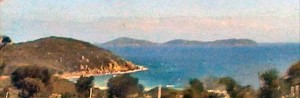
Out of control, lack of resources?, or has The Prom Fire (now having destroyed 24,800 hectares of native habitat) in fact been deliberately left to burn?
DSE in collaboration with the Victorian Government’s CFA (Country Fire Authority) have protected private property at Tidal River and Yanakie.
Perhaps ‘CFA’ has similarly become an acronym for…’Culpable Fire Arsonists‘.
- What really has been going on at The Prom behind the fire barricade out of public view?
- Why was the small fire north of Sealers Cove not extinguished on Friday 13th February 2009, when it was nearly out?
- Why after three weeks with mild weather conditions has this wildfire not been put out?
- Why, ahead of more forecast hot winds, has DSE risked this fire continuing?
…government silence is deafening!
.
Is this really an opportunistic prescribed burn…thanks to lightning? Is it in fact because the DSE doesn’t want the fire out..not until its prescribed burn area is burnt?
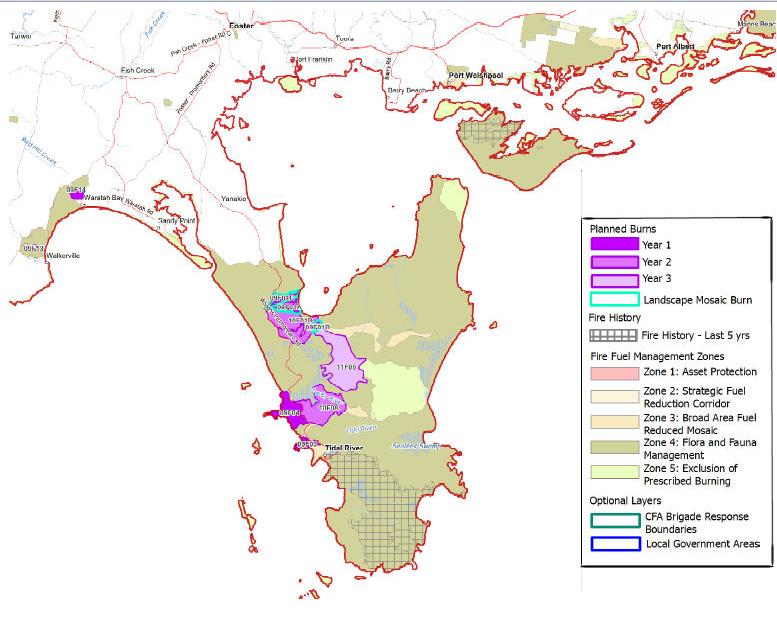
A DSE operational fire planning document sourced from the Yarram Fire Distict (which includes The Prom) shows that most of The Prom that has now been burnt is in fact part of DSE’s ‘Planned Burns’ for 2009, 2010 and 2011 anyway. The DSE map (click link below) shows no fires history for the northern half of The Prom.
…’so quick let’s burn it, lest it burns!’
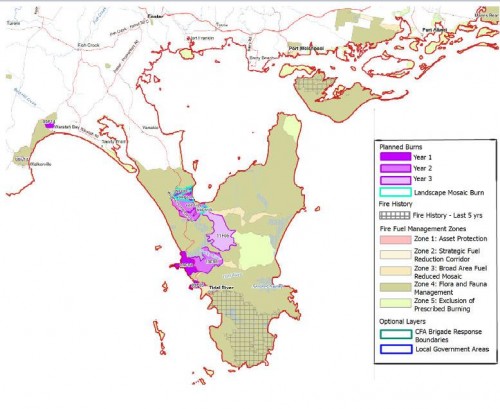 [CLICK MAP TO ENLARGE] [CLICK MAP TO ENLARGE]
Yarram Fire Operations Plan 2008/09 – 2010/11 – showing most of Wilsons Promontory colour coded for planned burning.
© Firemap Tue 14th Oct 2008
.
On this DSE planned burn map of The Prom, no areas are off limits from burning save the few villages and small pockets of private property and what the DSE has mapped as Zone 5 ‘Exclusion of Prescribed Burning’.
All other natural bushland areas of The Prom have been targeted by DSE for burning anyway.
This prescribed burning culture labels all bush hazardous ‘fuel’ and a demonic threat. Instead of putting out the fires in bushland they let the bush burn and all the native animals burn alive in the process.
They brag… ‘we save houses, the bush will grow back so what’s the problem?’
The ‘Department for Sparks and Embers’ is living up to its name.
But who’s responsible for the fauna?

.
.
Comments:
.
Is DSE helping developers get at the Prom??
March 4th, 2009 by ‘Prudence C’:
.
I would go further.
Are the developers that are driving this country to ruin actually after the Prom???
Does DSE, which is removing all rights from citizens to object to development, purposefully causing extinctions through burning so that soon it will be able to say, “Oh, all that land is degraded, it may as well be developed”?
I would put NOTHING past this government.
It should not be allowed to get away with what it has already done to Wilson’s PRom.
DSE is really just an old wood-feller’s hang-out. It should be closed down and something that cares about animals put in its place.
.
.
Vic DSE’s handling of Wilson’s Promontory fire defended
March 22nd, 2009 by ‘callum’:
.
You people have no idea what DSE try to do to get that fire out as so as they could! Where it was burn is very thick bushland and very high country you couldn’t get fire trucks in there. they tried droppin strike teams in but with the water bomber not make making a difference there was no point keep it going to without the water bomber the strike teams weren’t allow to stay on the fire front. so they had to wait until the fire got to where they could attack it. so before you start having a go at dse get the facts right. because the DSE did a great of protecting as much of the prom as they could. if they wanted the whole thing to burn they would have sat at the enterance to the prom and watched it burn! (Abuse removed – JS (Can DoBetter.net editor))
.
.
DSE’s prom effort was opportunistic prescribed burning
March 25th, 2009 by Tigerquoll:
.
Callum (above comment) claims the remote fire on Wilsons Promontory could not be put out.
The evidence is that on 13th March 2009 it was almost out due to rain, according to a timely online NASA satellite photograph. A fire truck approach for remote ignitions is obviously not going to work. It’s a bit like trying to connect up to the nearest fire hydrant in the bush. Such an urban fire fighting approach to remote ignitions is clearly flawed. The fact is that the Victorian government grossly under-resources remote fire fighting. This results in stuff all effective ignition detection (delegated volunteers rely on a goodwilled member of the public to ring 000 before fire trucks roll) and stuff all in effective response and suppression – if the truck hoses can’t reach the remote ignition, let’s sit and wait -it’s only bush. The resourcing of serious standby airborne Canadairs and Aircranes is beyond Brumby’s mindset, the let the bush burn culture is stuffed.
Questions to Callum, assuming he is duly informed about the actual fire response operation:
- Why did the “water bomber” not make making a difference to controlling the fire – especially on or before the 13th, before the wind speed picked up?
- Why were not extra water bombers including dedicated aircranes deployed immediately?
- Why weren’t the strike teams allowed to stay on the fire front and extra strike teams deployed, if necessary from interstate?
- Why did DSE have to wait until the fire got to where they could attack it?
- Why doesn’t DSE have an effective response strategy to remote fires?
(This was one ignition in favourable weaher conditions leading up to the 13th March).
- Was not most of the northern Prom burnt consistent with the 2009-11 fire plan of the Yarram Fire District?
- A lot of Victoria has thick bushland and very high country, moreso than the comparatively accessible (by air) coastal landscape of The Prom.
- How is DSE measured on its performance – by the minimal amount of area burnt due to fast and effective suppression? If so it has failed Victorians and their forests big time.
.
If DSE can be demonstrated to not have used every resource possible to quell this fire, the the presumption of opportunistic prscribed burning remains and the organisation deserves to be disbanded.
What’s the bet that Brumby’s Royal Commission ignores the Prom and the plight of ground dwelling fauna?
.
.
A large number of native
April 14th, 2009 by ‘Anonymous’:
.
A large number of native plant species in the Prom (and indeed, across Victoria) require fire to persist. There are however many species that will not survive fire (including animals obviously). The problem is that the species that require fire to disperse their seeds, sprout from epicormic shoots, flower like the native grass tree and for dormant seeds in the soil to be stimulated by fire do not survive the type of fire that spread through the Prom on the 13th March. Controlled fires are only lit when they can be managed and are either hot quick burns or slow not so hot burns. There are many ecologists that would give you this same view point. If you are correct and the DSE allowed this fire to burn then they should be held accountable but I seriously doubt that this was their conscious decision. They would be fully aware that many species would be lost.
While I understand your arguements, I think that you are being unreasonably harsh. The Prom fires were not immediately endangering property or person, of course the government would deploy all efforts in areas such as Healesville and Marysville where this was the danger before protecting native bushland. I think that this fire season was a unique situation and had there not been immediate danger to human life then I’m sure the management of the Prom fires would have been handled differently.
.
.
Let the DSE publicly justify its actions
April 14th, 2009 by Tigerquoll:
.
The desperately dependent myth that a few native plants require fire to survive is perpetuated to the extent that encourages DSE and CFA to incinerate all Victoria within cooee of a Eucalypt. Latching on to epicorimic growth seems to justfy incinerating ground dwelling mammalian habitat. Since when did a Potoroo sprout epicotic paws? DSE, to have any legitimacy beyond myth must provide independent ecological authority of the mandatory requirement for fire for species survival. I challenge the conspicuously ignored fact that any species of Australian fauna require fire to survive. Try lighting fire to you hand or house and see the reaction!
The bushphobic myth is defeatist! Burn the bush in case it burns!
Isn’t the real problem the fact that rural fire authorities are denied the right resources to instantly detect, respond to and suppress remote ignitions. Relying on calls to 000 and sitting in fire trucks is useless in quelling ignitions in rugged and remote country. It must be immensely frustrating to watch a fire grow into an uncontrollable monster because one is denied by government the right resources to deal with it while it is controllable. The considerable investment needed and asked for from government to fight fires while they are controllable, pale compared to the massive tragedy of letting a wildfire rip lives, property, wildlife and heritage to cinders because of government cost savings.
Then what a cheek to hear government thank the charities for picking up the tab and then to target mass burning of the natural environment just because government does not want to fund State of the Art fire fighting – which would instantly detect, respond to and suppress remote ignitions with military precision – saving lives, property, the rural way of life and our wildlife like genuine heroes.
The wildfire problem is likely to get worse with drought and arsonists more prevalent. Waiting for a remote ignition to reach a control line is what they in the 1940s. The risk and cost is too great to rely on a dad’s army response in the 21st Century, unless you have a mantra to destroy the Aussie landscape and create a neo-colonial parkland.
.
.
Your comments appear only half-educated
July 20th, 2009 by ‘artemis’:
.
No offence, but your comments appear only half-educated. A prescribed burn is done in pockets, so that an entire area is not burned off all at one time. This allows animals to continue to flourish in the wider area. This is what is called a “mosaic” effect. Which is why you see the DSE have burnt a little each year over the last few years. This is not “bush phobic” but takes into account the fact that the Australian bush has a complex and necessary relationship with fire for propagation and the DSE tries to work with the bush to encourage it at its natural state as best as possible without injuring or harming the humans that now inhabit it so profusely. In fact you will find that when prescribed burns as the Aboriginals carried them out stopped, certain species of animals that thrived and lived in the edges of them became extinct.
As fire is the natural state of the Australian bush, you will never stop it, the best we can do in our situation, is learn to harmoniously work with the land and manage it. If you understand it from this angle you will understand that prescribed burns cause no where near the damage to flora, fauna, the environment and humans as the huge deadly wildfires that occur if we don’t prescribe burn.
The DSE and the CFA are both committed to working to save the environment as much as possible, unfortunately too many people see them as the enemy – humans love to have a tangible enemy to attack, even if that means turning on one another when convenient. It will be nice when people finally realize that prescribed burns are much more green than they first understood.
.
.
Prescribed burning is based on unsupported myths
July 21st, 2009 by Tigerquoll:
.
Mosaic prescribed burns immediately around built assets (aka Asset Protection Zones) would seem sustainable. Building approvals only in low bushfire risk areas would seem sustainable. Permitting building construction out of non-combustible and fire retardant material would seem sustainable.
But the ‘bushphobic’ culture has pushed the boundaries and scale well beyond immediate protection of buildings. The scale of bush burning into remote wild parts of Victoria by DSE and the CFA is broadscale and massive and causing local faunal extinctions. Take a look at the DSE site
Take also one small example of a CFA fire district in Victoria. The Yarram Fire District in South Gippsland in its DSE Approved Fire Operations Plan [2008/09 to 2010/11] for 2500 hectares of bush to be deliberately burned.
The issue of burning the bush is indeed complex, yet the ecological complexity and impact is not understood or appreciated by DSE or CFA. How do you know that “DSE activities “allows animals to continue to flourish in the wider area”
Where are your statistics Artemis? Why are not independent zoologists with experts in Australia’s native fauna providing independent public reports supporting each Proposed Plan Burn by the DSE and CFA across Victoria? Too embarrassing, especially when these get out of control 1 in every 2? It is because the DSE and CFA have cumulatively destroyed more native habitat that any other threatened process? Look at Wilsons Promontory in 2009 and 2005! Default prescribed burning from the convenience of lightning. No building threatened so let the bastard – saves us the work anyway on the Fire Plan and we can always argue the old “it was burning in inaccessible country” excuse – works every time, guaranteed!
Controlled limited ‘mosaic’ burning that excludes flora species and ecological systems vulnerable or intolerant to fire is the PR spin. But on the ground prescribed burning is not an exact science. It is not undertaken scientifically nor supervised scientifically or able to be independently verified as compliant. The DSE or CFA have no independent public watchdog. They are a law under themselves and they know it. Weekend warriors end up torching most of the prescribed burns – “this’ll do!” If it gets out of control, we’ll deal with it but actually it will save us bother next time and minimise the fire risk next summer.
The Aboriginal firestick burning is another excuse used to justify deliberate arson of wild landscapes remote from buildings is another old school fire management myth, lacking scientific merit. Since when did ancient Aborigines drop aerial incendiaries over vast inaccessible areas every year?
The Armageddon myth is another bushphobic alarmist excuse to try to justify slashing and burning as much bush as possible ‘before it burns’ every seven years or so. This way no bush is ever allowed to live beyond seven years. The main reason huge deadly wildfires occur is because the fire authorities take too long to detect the ignitions take too long to respond, don’t have the right tools to suppress remote ignitions fast and effectively.
The DSE and the CFA are both committed to perpetuating the status quo, let alone give a toss about the natural environment.
.
.
Logging is drying our forests!
July 20th, 2009 by ‘Anonymous’:…
.
By “managing” our forests and clearing native vegetation, along with the conditions of drought and climate change, we are actually making them drier and less dense, and thus adding to the risk of mega-fires.
While our State government continues to permit the logging and thinning of our native forests and water catchment areas, the public can do little to prevent further mega fires.
The dry conditions means that trees suffer and compete for water. They lose their leaves, or die, thus exacerbating the dry undergrowth problem. Instead of moisture, forests continue to become more vulnerable. It is then a cycle downwards to damaged ecosystems, and thus more fire dangers.
.
.
Broadscale frequent prescribed burning is a threatening process
July 21st, 2009 by Tigerquoll:
.
Indeed, logging, thinning and frequent burning (forest practices) over Australia’s 220 year colonial history have and continue to destroy the integrity of our native forests and force our native fauna closer to extinction. Colonial ‘clearing’ for agriculture and building materials destroyed most of south eastern Australia’s natural landscape. Neo-colonial practices including unchecked urban invasion and prescribed burning continue to do destroy what’s left.
Australia’s original natural landscape is characterised by varied topography and varied mosaics of different vegetation types. Broad scale destruction of native vegetation across south eastern Australia has reduced the remnant forest and heath habitat into fragmented and isolated islands. Many specific habitat types are now threatened and endangered as a consequence. Wet schelophyll has being transformed into dry schlerophyll. Note the fire resistent species that return after a fire – Acacias (wattles), tea tree and Eucalypts. These then dominate the new growth and when the next fire occurs they burn more intensely and exacerbate the wildfire. Frequent prescribed burning makes our remnant forests more susceptible to wildfire. Frequent prescribed burning and uncontrolled broadscale bushfire are by area and impact are responsible for the loss of our remaining biodiversity and ecological values across south eastern Australia.
This is even though prescribed burning has been found not to prevent ember attack – the main cause of wildfire spread in extreme bushfire weather conditions! Frequent broadacre burning policies have limited effectiveness at mitigating wildfire risk (its intended aim). The previous “NSW Rural Fire Service Commissioner, Phil Koperberg, echoed similar sentiments when faced with criticism after the 2002 fires: ‘Unless you’re going to keep all of New South Wales hazard reduced to a point where there is no fuel on the ground…we’re going to have fires’ (McKey 2002).” SOURCE: http://www.australianreview.net/digest/2003/02/brandes.html
ACB Submission to the Teague Commission on Victoria’s 2009 Bushfires
The Australian Centre for Biodiversity (ACB) at Monash University has made a submission to Teague Commission on Victoria’s 2009 Bushfires, and addresses the fundamental question: ‘Can fire and land management practices and policies be modified to minimise the future risk of similarly catastrophic bushfires without compromising Victoria’s native ecosystems and the biodiversity that they support?’
ACB in its submission, has offered the following warnings of how broadscale frequent burning threatens our native forests:
“Natural fire is a complex physical process that affects organisms, communities, and landscapes in various ways. The spatial and temporal variability of these impacts depends on the intensity and frequency of fires in an area, that is, the fire regime.”
“Inevitably, after a major bushfire, there are calls to increase the amount and frequency of fuel reduction burns. However, increasing the rate of fuel-reduction burns is, in effect, changing the fire regime in an ecosystem and may have substantial ecological implications.
“The application of fuel-reduction burning to mitigate fire risk, therefore, needs to be critically questioned on two fronts.
First, will increasing the frequency and amount of prescribed burning reduce fire risks at the landscape scale?
Second, how will changing the fire regime through increased fuel-reduction burning impact on native ecosystems? Will increasing fuel-reduction burning lower fire risks?
“Theoretical studies have also shown that fuel-reduction burning at the landscape scale can reduce the risk of large, catastrophic fires. However, these studies make important assumptions about the other point of the fire triangle: climate. Under most reasonable climatic conditions, fuel reduction burns done sufficiently frequently may reduce the risk of large fires. However, under extreme climatic conditions, such as those that preceded Black Saturday, this may not hold. As of Friday, 6 February 2009, approximately one-third of Victoria’s public lands had been subjected to fuel-reduction burns since 2003; that is, ~5% of public lands were subjected to fuel-reduction burns each year. This was the target set in an earlier Parliamentary Enquiry and clearly did not prevent the Black Saturday fires. Modeling studies suggest that the amount of fuel reduction burns would need to be doubled, at least, to have any potential for avoiding similarly catastrophic fires if conditions of such extreme fire danger re-occur in the future.”
“Increasing fuel-reduction burning to proposed levels (10-15% of public lands per year) would reduce habitat diversity by homogenizing the regional fire regime. The diversity of habitats and their mosaic distribution across the Victorian landscape is a critical component in maintaining local and regional biodiversity. The interdigitation of sites differing in their susceptibility to fire provides temporary refuges for animals that can move away from fires and later recolonise their original sites. More frequent fuel-reduction burning will change the structure and composition of the understorey vegetation. While many animals may be better able to survive the low-intensity fuelreduction, the resultant vegetation may be poor-quality habitat.”
“Applying a single prescribed burning policy to Victoria’s public lands will disadvantage a large proportion of the native biodiversity and reduce local and regional habitat diversity. Shifting
toward more homogeneous landscapes through increased prescribed burning will be detrimental to the long-term conservation of biodiversity in Victoria.”
“Increased prescribed burning may reduce fire risks in some years, but is unlikely to have any effect in those years with extreme climatic conditions similar to those of 2009.”
“A uniform and widespread increase in fuel-reduction burning across Victoria’s public lands will likely have negative long-term impacts on the native flora and fauna.”
ACB’s recommendation:
“We recommend that the State government consider a more nuanced policy that acknowledges the spatial complexity of Victoria’s landscapes and the values associated with them. We recommend that increased prescribed burning be focused in high-risk areas directly surrounding towns to minimize threats to people and property. However, for more remote, unpopulated areas, where the primary values are biodiversity and timber, we believe that fire management plans should be based on the best available science, that they should be consistent with the appropriate historical fire regimes, and that they provide an integrated, long-term vision for Victoria’s natural heritage.”
SOURCE: www.biolsci.monash.edu.au/research/acb/docs/teague-commission.pdf
.
.
Conservation biologist disputes that burn-offs harm ecology
May 1st, 2010 by ‘Anonymous’:
[Subject was: Myth? are you serious? – JS]
Myth? Are you serious? Perhaps you should learn the basics of Australian ecology and the critical role of fire for the majority of Australian flora before you go and bad mouth the authorities who do their best to save your homes. I know there is a lot of debate but you can’t base your arguments from what you hear in the media. I am a studying ecologist and conservation biologist, you need to hear the real truth from the experts – not the damn reporter who gets paid to write what ever will sell papers. without fire the prom will disintegrate. sure you feel sorry for the cute and fluffy animals that may be caught in these fires but if you had any decent knowledge you would know that our native wildlife have evolved with fire and they wont all perish, They have adapted the most interesting adaptations and behaviours that allow them to escape or rebuild their populations at amazing rates after fire. For most, if not all, of the Australian biota, fire is beneficial!
.
.
Feeling “sorry” for the “cute and fluffy animals” is sickening
May 1st, 2010 by Milly:
.
Feeling “sorry” for the “cute and fluffy animals” is sickeningly patronising and degrades our wonderful and diverse wildlife. How could you be studying ecology and not have some appreciation of our stunning and awesome range of unique species in Australia, and their tragic decline? It is ecologist like you who, without peer support and without having a shred of compassion or empathy with living creatures, become paid to “manage’ wildlife with fire-arms! (Such as Canberra’s kangaroo managers[1]).
There was no capacity for fires to be as large or as intense as what we are seeing today. Land clearing and logging have made soils and undergrowth drier and more open for oxygen, increasing fire risks.
Since European settlement, the landscape has changed dramatically. Trying to replicate Aboriginal fire practices in southern Australia would unfortunately now be a risky experiment. European land management has seemingly done everything necessary to turn the Australian landscape into a moonscape. The argument that we should engage in widespread and regular burning of the forest because that’s what Aboriginal people did for years is, as the 2003 bushfire inquiry put it, “a highly attractive philosophy”. However, we simply do not know enough about traditional burning in southern Australia to be able to re-create an Aboriginal burning regime.
Firstly, in most parts of Australia, we don’t know how Aboriginal people used fire. Secondly, since European occupation, ecosystems have been changed so much that Aboriginal burning would no longer be possible. The native animals that ate and buried plant material have largely disappeared, so there is a lot more flammable vegetation in the bush now than there was before Europeans arrived.
Many wildlife have traits that enable them to survive fire. Often they are adapted to specific fire regimes, determined by intensity, frequency, season and scale. However, inappropriate fire regimes may have undesirable consequences including declines or local extinctions of biodiversity.
Footnotes
See:
^Roo culls lead to tourism boycott calls of 6 Jul 09
^RSPCA rubber-stamp in Majura Kangaroo kills unworthy of this organisation’s aims of 17 Jun 09
^Fitzgibbon’s Massacre – 9th May 2009 of 14 May 09
^It is clear that the government is interested in “managing” wildlife such as kangaroos out of existence of 13 May 09
^ACT Environment Commissioner unqualified to condemn kangaroos of 16 Apr 09
^Majura kangaroo killings: Another Belconnen Cover-Up? of 15 Apr 09.
.
.
Bushfire authorities: underfunded dad’s armies playing with fire
May 2nd, 2010 by Tigerquoll:
.
In response to comment above: “Authorities who do their best to save your homes.”
What is the latest excuse for these ‘bushfire authorities’ failing to save homes in Victorian in February 2009?
The simplistic strategy applied to rural fire fighting across Australia is to burn the bush before it burns. Get rid of the bush (fuel), with no thought to the impact to wildlife of burning and to the sterile ground cover landscape such practice leaves.
Bushfore authorities do this to hide the blatant fact that they are incompetent at suppression fires before they cause serious damage. By the time the detect the fire and get to it, it is too late.
As for bush being a natural asset would even occur to them. Only houses matter because they are the only thing they know how to defend, and they can’t even get that right. It is not the volunteers at fault, it is the Government dependent on volunteers and token funding that is at fault. Try taking that approach with the police?
Brumby and Rudd were ultimately responsible for the 17 Victorian deaths. They simply avoid funding a serious emergency force to prepare for and to mitigate such natural disasters and bush arson. A pre-1939 Black Saturday approach to bushfire fighting is gross public negligence. I hope those affected take up a class action and sue the pants of the government authorities. Only then will the billions needed to to do a proper fire fighting job be invested by Australian governments rather than paid out after the tragedy and rely on volunteer charities.
Fire is beneficial is only beneficial for those with a penchant for lighting fires. If it isn’t doing too little too late to put wild fires out, the rest of the year is spent lighting new ones. If there is no fire there is nothing to do, so we better light a fire and look busy. Drip torches and airborn incendiary – burn the lot seem to be the Neanderthal thinking!
Didn’t learn much from Ash Wednesday 1983 or the hundreds of fires since. Bloodly uselfess lot these dad’s army. No I don’t expect a fire truck to turn up outside my house if there is a fire. I know here I stand and it’s every man for himself.
‘Fire ecology’ what a farcical term for State-sanctioned arson. Well name one species of flora or fauna made extinct due to lack of fire? – there’s a good one for your so called ‘ecology’ course.
.
– end of article –
Tuesday, July 12th, 2011
Article by Tigerquoll initially posted on CanDoBetter.net on 20090226:
.
.
The Fire was nearly out..so why was it abandoned by bushfire management?
The 2009 Wilsons Promontory bushfire was reportedly sparked by lightning striking the remote Cathedral Range on the east coast just north of Sealers Cove on Sunday 8th February 2009.
Witnesses say that by the following Friday 13th, the fire was still localised on the Range and all but out. This is confirmed by the following satellite photo taken by NASA’s MODIS Rapid Response Team on the 13th. The satellite takes high-resolution images of visible, shortwave and near-infrared light of Victoria twice daily.
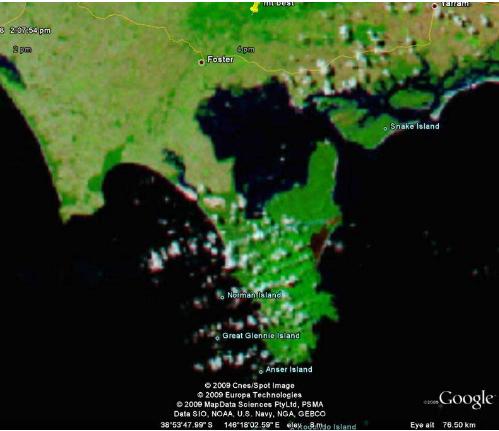 Wilsons Promontory on 13th Feb 2009
showing scattered cloud over the Prom and on the east coast (right side) a small red (burnt) patch with only a single column of smoke noticeable.
© NASA 13-Feb-09
. Wilsons Promontory on 13th Feb 2009
showing scattered cloud over the Prom and on the east coast (right side) a small red (burnt) patch with only a single column of smoke noticeable.
© NASA 13-Feb-09
.
Daily updates of this fire can be found at the following URL:
http://www.nasa.gov/mission_pages/fires/main/world/australiafire_20090223.html
.
The Prom was left to burn
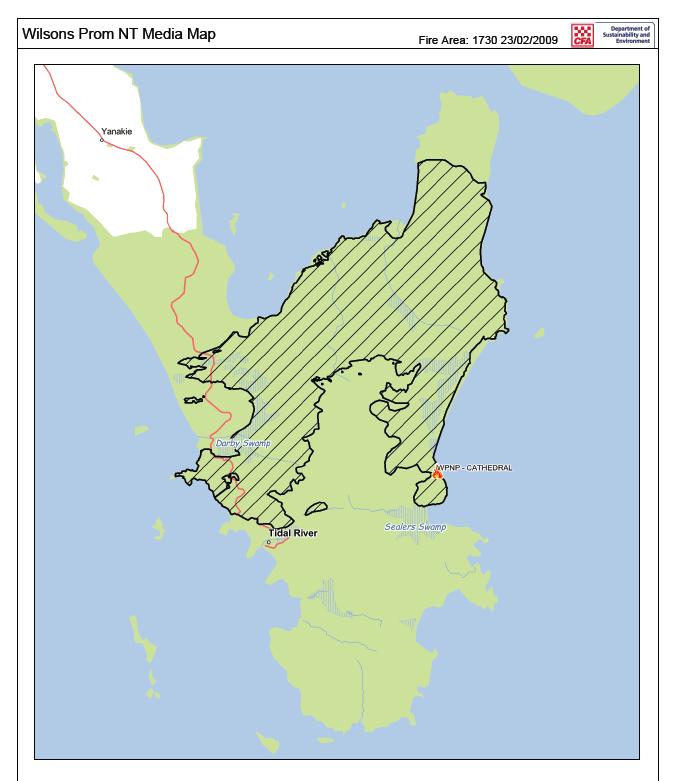
Over the subsequent days the fire continued to burn then the winds increased. Now, more than two weeks later most of the northern half of ‘the Prom’ has been burnt. The vegetation has gone. The Victorian Country Fire Authority (CFA) website today reports 23,800 hectares burnt out. The Department of Sustainability and Environment (DSE) website shows the following map of the burn (shaded area below).
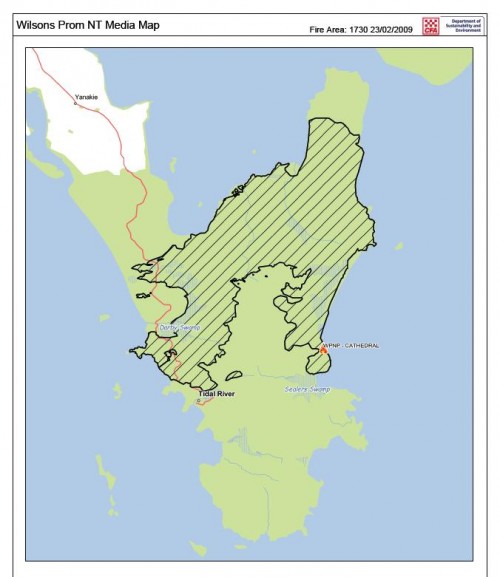
© DSE Wilsons Promontory Media Map 24 Feb 09 12:30pm
.
The fire has burnt the Cathedral Range, along the east coastline right across and along the Corner Inlet shoreline to Millers Landing. Affected sites are Vereker Creek, Whiskey Bay, Tongue Point, Monkey Point, Three Mile Point, Mt Roundback, Three Mile Beach, Mt Margaret, Lighthouse Point Lighthouse, Mt Hunter and parts of Darby Swamp. Wilsons Promontory National Park is just one of the many important natural and wilderness areas of Victoria devastated by these current bushfires.
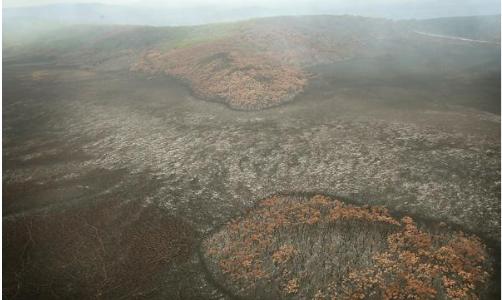 Wilsons Promontory where thousands of hectares have been burnt
© Photo. John Woudstra 18-Feb-09 Wilsons Promontory where thousands of hectares have been burnt
© Photo. John Woudstra 18-Feb-09
.
Frequent Fire History
In the case of the Prom, this is the second time in four years that fire has burnt through this northern region. On 21 March 2005, a twenty hectare prescribed burn was lit east of Tidal River. It escaped three times over a period of twelve days and burnt out 6,000 hectares of native bushland in the National Park.
A key investigative report was undertaken by Commissioner, Emergency Services, Bruce Esplin, (the Esplin 2005 Report) into a number of fires over previous years. In the case of this DSE prescribed burn in the Prom, the investigations found that the prescribed burn was poorly planned and after ignition, was not patrolled properly.
A notable finding of the report was that: “There remains considerable community uncertainty about the effectiveness of the prescribed burning program, and what changes, if any have occurred in the amount of prescribed burning undertaken since 2003”.( para 33)
Yet prescribed burning continues each year across Australia, not in the small mosaics, but on a grand scale and with a record of frequently getting out of control. On top of the 6,000 hectares four years ago, just a few days ago we hear of over 23,000 hectares of the Prom has now been burnt. Fires in the Prom also occurred in 2001.
.
Impacts on Flora and Fauna
The Prom has diverse vegetation communities including warm temperate and cool temperate rainforest, tall open forests, woodlands, heathlands, and swamp and coastal communities. There are rare stands of White Mangrove, being the most southerly stands of mangroves in the world.
The Prom is rich its diversity of native mammals with over thirty species having been recorded, many of which are either rare or threatened. These include the Long-nosed Potoroo, Swamp Antechinus, White-footed Dunnart, Broad-toothed Rat, Feather-tailed Glider and Eastern Pygmy-possum. “One of the most significant habitats of the New Holland Mouse also occurs within the park, and a number of species of whale have been sighted in the waters off its coastline.” The Prom also provides habitat to populations of Eastern Grey Kangaroos, koalas, wombats and emus.
The heathlands, influenced by the frequency and intensity of fire, are rich in species and provide habitats for a variety of fauna, including many threatened species. [Source: Parks Victoria website]
However, bushfire research across Australia has shown that while some native flora are fire tolerant and/or can recover and in some case thrive in the immediate years following a fire, other species have not adapted and so they become displaced and can die out. (DSE website).
While the Victorian Royal Commission is focusing on the fire management measures to protect life and private and public property associated with the 2009 Victorian Bushfires, the impacts on flora and fauna seem to have been overlooked. Some species may not survive if fires are too frequent, as the plants are unable to reach maturity and produce sufficient seed before the next fire episode. (DSE website).
.
Threatening Process
Little is known about the recovery of fauna diversity as a consequence of such widespread bushfires, be they caused by lightning, intentionally or otherwise. But given the scale of these current fires across the Prom crossing from shore to shore, it is probable than many native animals, as in many other parts of Victoria, will have been burnt alive in the fires and that their already rare populations will now have declined substantially and be at risk of local extinction.
In respect to Australia’s fauna, given that there we now have a fraction of the intact native habitat compared with pre-1788, how can anyone argue that allowing bushfires to get out of control is not a threatening process?
.
Saturday, July 9th, 2011
Originally posted February 23rd, 2009 by Tigerquoll on Candobetter.net
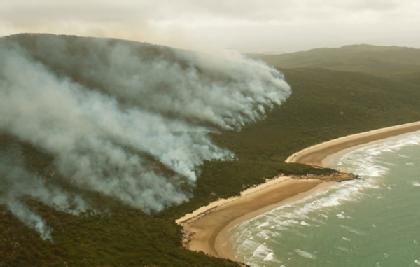
Eastern side of Wilson’s Promontory (coastal Victoria) near where
the fire started. Photo: John Woudstra
.
I have been monitoring the Jan-Feb 2009 Victorian bushfires from NSW and have turned my attention to the bushfire management in a natural area – Wilsons Promontory.
I note satellite observations of the fire with concern showing the lighting ignition on the east coast started 9th February, but had almost extinguished itself by the 13th. Then a wind change drove it out of control. A week later it has burnt out 22,000 hectares (almost 50% of our precious 50,000ha Prom)!
While the Country Fire Authority (CFA) has paid special attention to non-imminent bushfire risks to rather distant private property. The CFA says “the fire does not currently pose a threat to the Yanakie community.” Backburning the Prom is given as the only bushfire response strategy. So do we interpret this as a noncommittal response by the CFA for the Prom – that is since no human lives or private property are at threat, the CFA’s bushfire response is to just ‘monitor’ the fire and put out the spot fires threatening private property to the north?
“I interpret this bushfire management by Victoria’s CFA as one that respects only human life and property, but does not rate the natural asset values of fauna and flora habitat of the Prom with any respect.”
.
The CFA reports read as though CFA policy for active and damaging bushfires in important conservation areas is to wait for rain, but otherwise ‘let it burn’.
And yet the Bureau of Meteorology forecasts hot and windy conditions for tomorrow Monday, 23 Feb 2009.
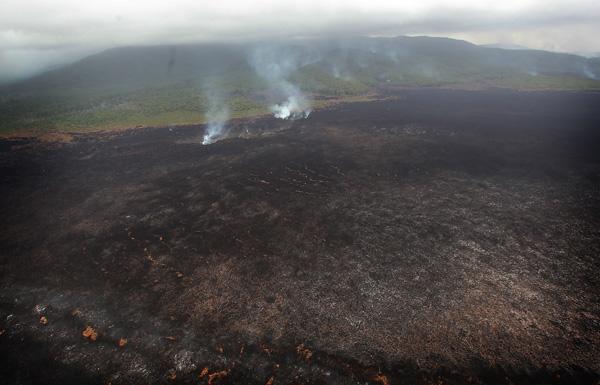
Wilsons Promontory where thousands of hecteres have been burnt.
Photo: John Woudstra
.
I interpret this bushfire management by Victoria’s CFA as one that respects only human life and property, but does not rate the natural asset values of fauna and flora habitat of the Prom with any respect. It seems at best an opportunity for de-facto hazard reduction that it would normally not get permission to do, and at worst an inconvenient distraction for CFA crews.
If this is the prevailing attitude of rural firefighting then clearly the CFA has no interest in natural assets, and no mandate to protect them from fire in the same passionate way it does private property? There seems no difference in approach or skill set by the CFA to that that would be exercised by urban fire brigades.
So why do we have a Country Fire Authority? Because professional fire brigades are expensive.
Whereas luring local volunteers is cheap for government, so long as the propaganda is correctly instilled – ‘locals protecting local assets…’
Government has a bet each way. If the local volunteers put out the fire and save lives and property, they are heros and the organisation is justified. If the local volunteers fail and people die, governments defend the local volunteers for doing their best and reject criticism of fire fighting as criticism of local volunteers, and pleads the unAustralian line.
With this premeditated social strategy, successive governments have got off scott free when people die in bushfires. Government bushfire fighting strategy is this to have a bet each way and when catastrophe eventuates to hide behind the ‘Volunteer Firefighter Facade…
Such has become the politics of negligent government. For decades hiding behind the ‘Volunteer Firefighter Facade has proven effective in persuading a gullible media, so the policy and practice perpetuates in absence of an independent public watchdog.
Public class action for damages is long overdue.
On this basis, it is overdue for the CFA to be incorporated within the urban fire brigade structure. While this initial structural change won’t save Victoria’s vast tracts of wildlife habitat in the short term, it will sure will remove the false premise to the community that the CFA respects and defends natural wildlife habitats.
What does Victorian Government’s Department of Sustainability and Environment have to say for itself? It is charged with the Promontory’s protection.
See also: “Crews unable to slow Wilsons Promontory blaze” on ABC online on 17 Feb 09, “Huge blaze threatens the very heart of the Prom” in the Age of 19 Feb 09.
Monday, July 4th, 2011
Article by Tigerquoll:[Article first published on CanDoBetter.net20090220].
Containing the largest coastal wilderness area in Victoria, but massively scarred by a 700 hectare fire in 2005 due to a prescribed burn that escaped (again).
Now again, just four years hence, the Prom is suffering a massive blaze out to 11,000 hectares, having burned from coast to coast across the more remote northern section of the Promontory.
No lives, no homes so no priority!
.
Tuesday, June 14th, 2011
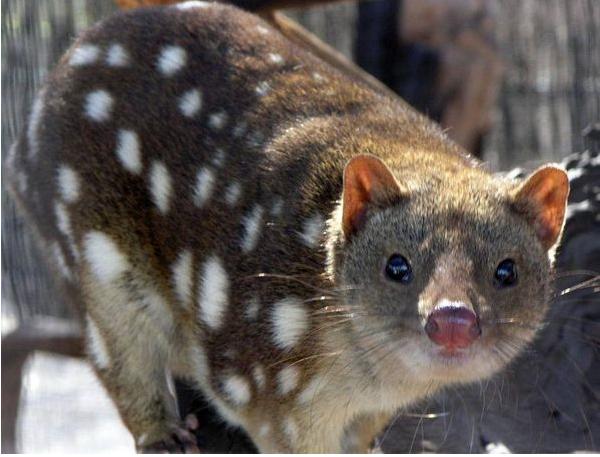
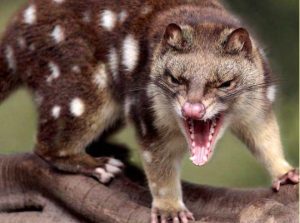
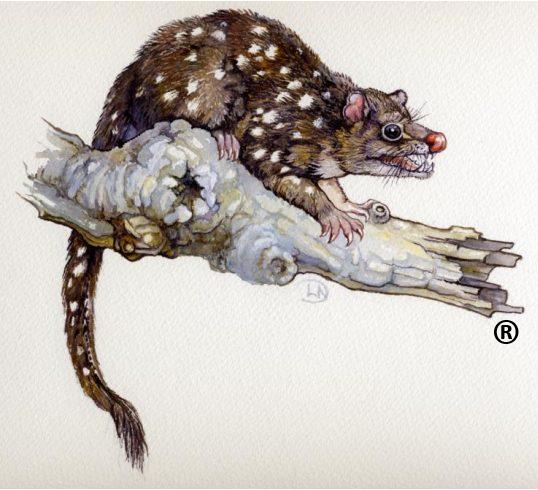
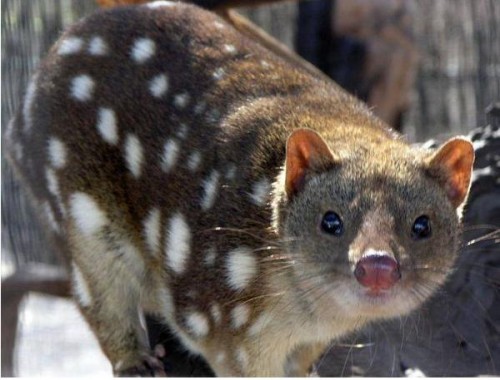 This is a Tiger Quoll (Dasyurus maculatus) This is a Tiger Quoll (Dasyurus maculatus)
Photo courtesy of Sean McClean.
.
It is Australia’s largest carnivorous marsupial on the mainland and it has become endangered because of humans destroying its habitat, shooting it and poisoning it.
It is not a cat. Much information may be obtained online simply by typing ‘tiger quoll’ on Google.
.
.
.
The following extract is from the website ‘Convict Creations‘ (15-Feb-2010):
‘Tiger Quoll…the next to die’
“Without disrespecting the Koala or Kangaroo, the Tiger Quoll is one of Australia’s most interesting animals. It sort of resembles a cat except it has a pouch, bright eyes, a moist pink nose and a powerful bite. It can grow to up to 75 cm in length and weigh up to 7kg. If trained, it will even use a kitty litter tray.
The Tiger Quoll is the type of animal that tourists would love to see on their Australian safari.
Unfortunately, they are quite rare so few have ever caught a glimpse of them.
European colonisation of Australia could have been great for the Tiger Quoll. With Europeans introducing rabbits, rats and mice, the Quoll saw a drastic increase in its food source. Had the colonists warmed to them, then a mutually beneficial relationship could have formed. Farmers could have encouraged Quolls to take up residency in order to keep rodent numbers down with little fear that their livestock would be in danger. As an added bonus, by eating carrion, the Quolls would have reduced the threat of blowfly strike.
Alternatively, they could have just made pets out of the Quoll. Apparently the Quoll has all the positive characteristics of a cat or dog. According to Professor Mike Archer, Former Director of the Australian Museum, who once kept a Quoll as a pet:
“I just can’t praise these animals highly enough as companions for human beings. They have all the good features in dogs and cats, and in my experience not a single downside”.
If colonial owners had taken care of their Quolls, then both Quoll and owner would have been happy. If not, the Quoll would have just escaped and done Australia a service by cleaning up decaying meat, rabbits and other introduced vermin.
Unfortunately, colonists never formed mutually beneficial relationships with the Quoll. Instead, they introduced the cat to serve the role of pest controller. For more than a century, farmers deliberately released cats onto their properties in order to control rabbit and mice populations. Once the cats went feral, they started to compete with the Quoll for food. Although the Quoll was better adapted to Australia’s cycle of droughts, the cat’s symbiotic relationship with humans proved to be an even better environmental adaptation. If feral cats were ever wiped out in a drought, or declined for whatever reason, they still had the family home as an oasis in the desert. From the family home, they were well placed to repopulate the bush once good conditions returned.
Even worse than competition from the cat were the environmentalists’ attempts to “help” them. The use of 1080 poison has been one of the main helping strategies. When it is used to kill rabbits, it indirectly deprives Quolls of food. So much so, by killing rabbits, human deprive Quolls of even more food than is lost due to competition by cats. To compound matters, when 1080 poison is used to kill the cats and foxes competiting with Quolls, it also ends up being eaten by Quolls. In fact, Quolls are more likely to eat the poisons because they have a keen nose for carrion while the feral predators prefer fresh kills.
A very odd example of the misguided environmental policy was recently seen in in Tasmania. 1080 was first used to reduce rabbit numbers. A rumour then developed that foxes had finally established a breeding community in the island state. Even though it was just a rumour, to be on the safe side, environmentalists decided a large scale baiting regime needed to be implemented to eradicate foxes as well. On the State Government’s own data, more than 140,000 poison baits were laid. So far, there has been no evidence that foxes were actually present. There was; however, plenty of evidence of Quoll dying!
The odd wilderness protection policy caught the attention of David Obendorf, a vet with a research focus in marsupial diseases. According to Obendorf:
“Three Tasmanians have each offered $1,000 fox rewards (Tasmanian Times: “$1,000 fox reward”). All remain unclaimed despite farmers, landowners and professional shooters all knowing about them. And yet the government “guessimate” claims there are up to 400 foxes living in Tasmania … somewhere. In my opinion Tasmania’s use of 1080 poison over the last five decades – to kill browsing and grazing native herbivores – has had a significant effect on the over-population followed by the facial tumour disease-crash in devil numbers and in the widespread establishment of feral cats across the island….Ironically the state government has now ceased the use of 1080-laced carrot/apple baits on public lands to kill grazing wildlife but now uses tens of thousands of meat baits in public forests where they claim they are targeting those cryptic foxes.” (1)
The use of 1080 poison could be legitimately referred to as Australia’s dumbest environmental policy since the construction of a 1,833 km fence to “keep” rabbits out of WA. It seems that Western Australians weren’t smart enough to realise that rabbits can dig under fences. All that was required was for a single pregnant female to dig a hole and then 1,833 km of fence line would be obsolete. Perhaps WA politicians did in fact realise the folly of it all, but decided it was more to important to show they were “doing something”.
As an added bonus, “doing something” kept people in regional Australia employed. Perhaps 1080 poison is used for similar reasons. Unfortunately, “doing something” to help Quolls is really not helping them at all. It forces them into wilderness reserves where scientists can erect huge fences to keep out ferals and then make a lucrative income maintaining them. (2)
Even though the Tiger Quoll is mainland Australia’s largest native predator, Australia doesn’t have any professional sporting team named after them. In fact, they don’t really exist in public consciousness in any significant shape or form. Perhaps this is because Quolls spend their time out in the bush where they are only ever seen by rangers.
Alternatively, perhaps the name Quoll just isn’t scary enough.
Zoos – The only real industry is as a research subjects by scientists, or to provide an endangered animal story that can be used by wilderness groups to write emotive appeals asking for funding to save them.
Pest controllers – Potentially, Quolls could make great pest controllers. They could compete with cats and foxes for food, and eliminate rabbits and rats in the process. Landowners could breed them and sell them as a substitute to 1080 poison.
Pets – Sometimes scientists have made great pets out of Quolls. At present, the general public is not allowed to do likewise. The general argument is that Quolls require special care that only a scientist can give. Consequently, Australians have to reserve their abusive ownership methods for dogs and cats that simply go bush if they are unhappy with their owners.”
.
.
The Snowy River is a surviving stronghold of the Tiger Quoll
.
“In East Gippsland, the areas on the Errinundra Plateau, Snowy River and Tingaringy are strongholds of the Spot-tailed Quoll”. (GECO)
“The Upper Snowy River and its tributaries was the Victorian stronghold of the Tiger Quoll before (the 2003) devastating Alpine bush fires. The Tiger Quoll is believed to have lost up to 75% of an estimated population of 1,000 in the area.
Following the devastating effects of recent bush fires The Tiger, or Spotted-tailed Quoll (Dasyurus maculatus) has been reclassified as nationally endangered. it is feared that the fires will have a lasting effect on the Quolls that remain.”
.
.
.
References:
[1] ABC, ^http://www.abc.net.au/rn/science/earth/stories/s145805.htm
[2] David Obendorf – ^http://www.animal-lib.org.au/news/1080–the-real-killer.htm”
[3] ^http://www.fame.org.au/current_projects.html
.
~ article by Tigerquoll, first published on CanDoBetter.net 15-Feb-2011
Thursday, June 2nd, 2011
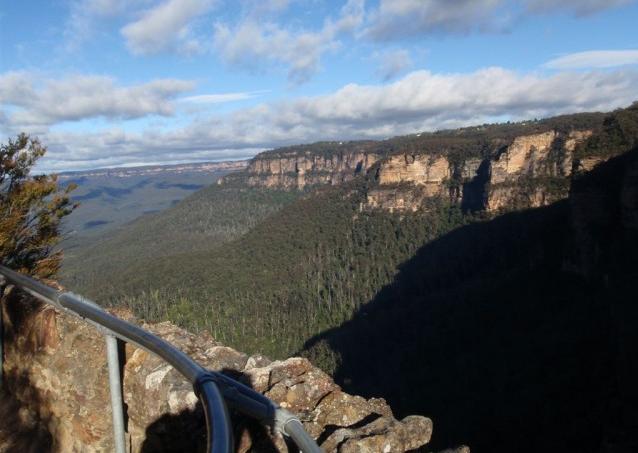
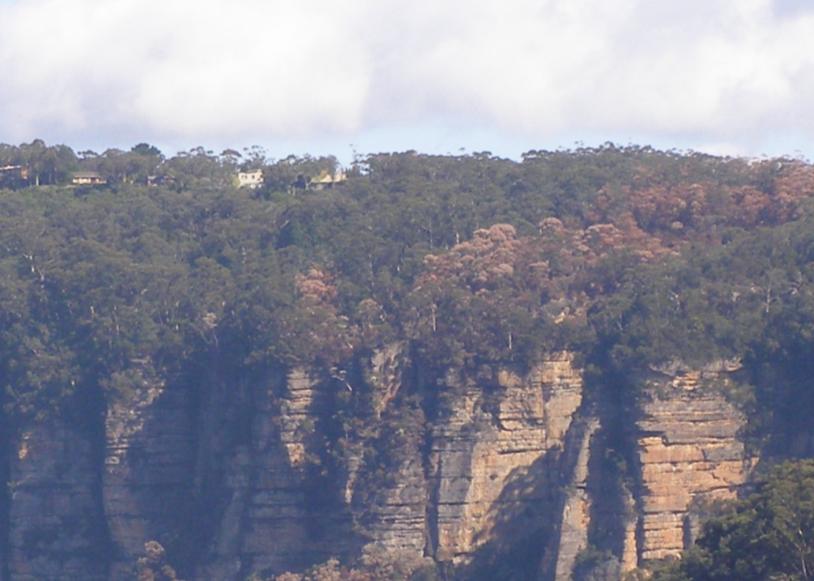
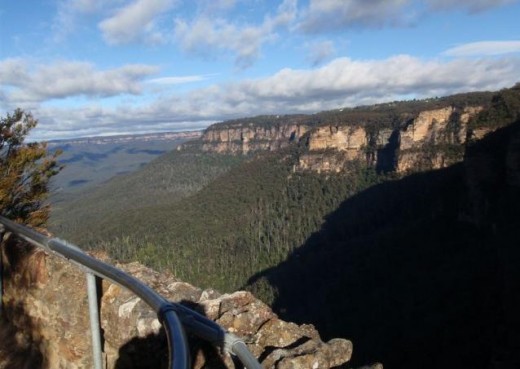 Jamison Valley from Sublime Point, Leura
(Blue Mountains, New South Wales, Australia) Jamison Valley from Sublime Point, Leura
(Blue Mountains, New South Wales, Australia)
.
For those who have purchased an escarpment-edge bush block in Blue Mountains villages of Leura, Wentworth Falls or Katoomba, who have ‘arranged‘ for native escarpment habitat to be killed in order to gain property views to the magnificent Jamison Valley, such actions are selfish and contribute to the ecological vandalism and disappearance of important and scarce escarpment habitat.
For others enjoying the Jamison Valley naturally on foot, to look back up at the Leura escarpment has become an ugly one dominated by increasing housing development.
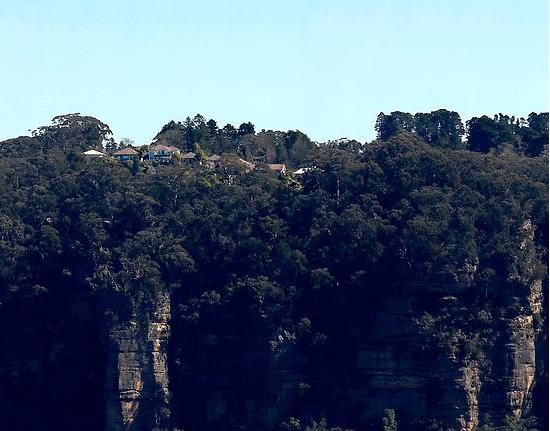
Views are bidirectional, but try explaining that to a property developer or to those real estate agents who only appreciate the sales commission.
On the spectacular escarpment fringe of the much valued village of Leura in the much valued Blue Mountains, not only have the fire-lighters taken a fancy at setting fire to nearby prized escarpment bushland, but the property developers have been in with the bulldozers.
The Blue Mountains (city) Council has for decades signed off on developer applications for clifftop development and consequential deforestation. More recently, Blue Mountains (city) Council continues to happily signed off on approval of applications from subsequent clifftop property owners to ‘hazard reduce’ the surrounding escarpment bushland ~ either to improve the views or to save money having to bushfire protect their properties.
Either way, valuable limited habitat along the Blue Mountains escarpment overlooking the Jamison Valley continues to disappear for new selfish housing views.
All along the Jamison Valley escarpment, the following photos tell a tragic story of the selfish developer destruction of the Jamison Valley Escarpment …
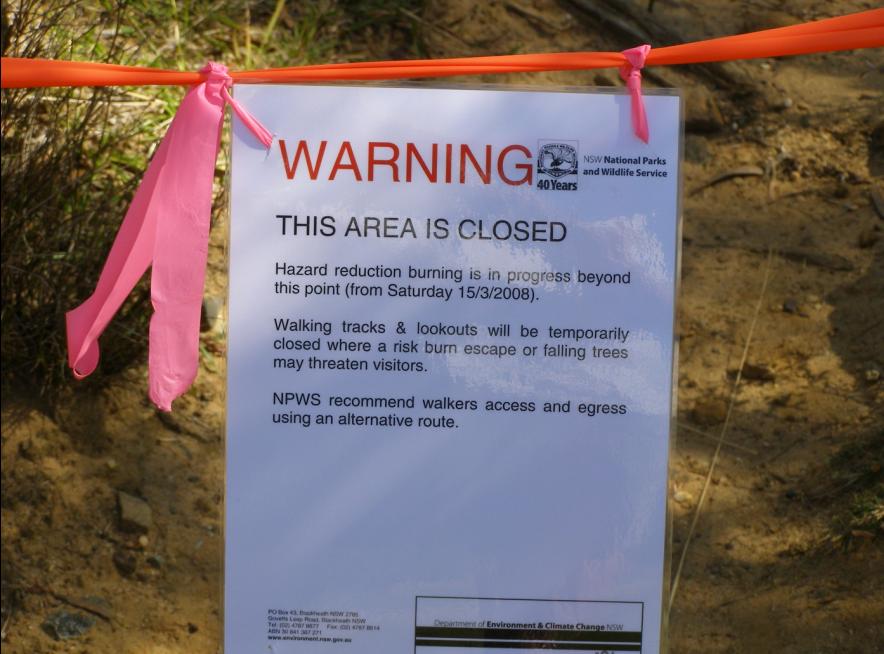
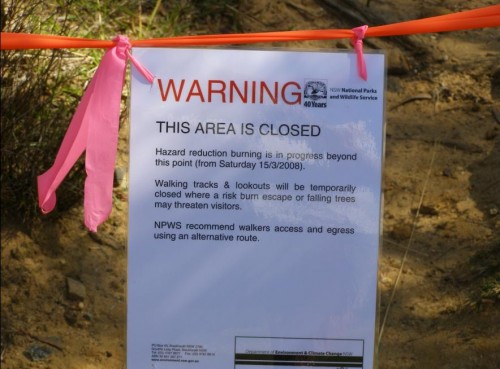 Wildlife Service ‘hazard reduction’ burn notice for Sublime Point escarpment at the end of Willoughby Road, Leura back on 15th March 2008.
(click photo to enlarge) Wildlife Service ‘hazard reduction’ burn notice for Sublime Point escarpment at the end of Willoughby Road, Leura back on 15th March 2008.
(click photo to enlarge)
.
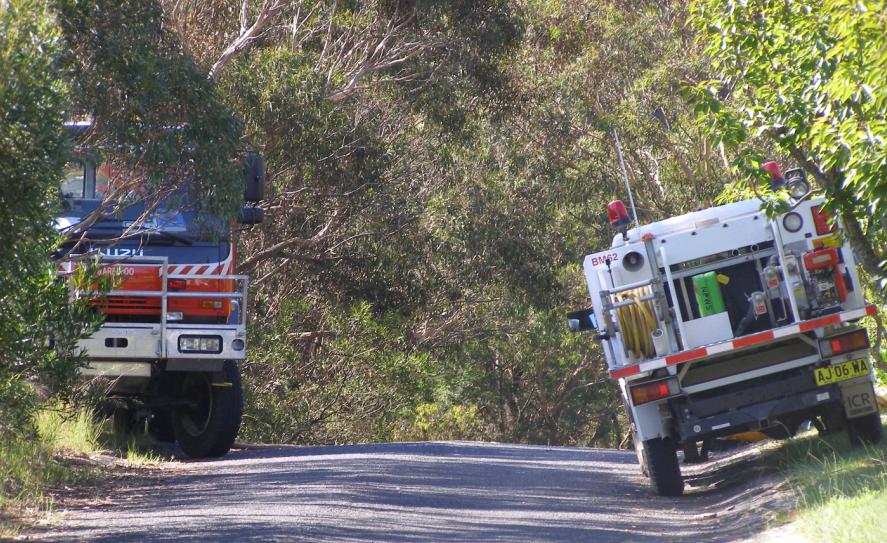
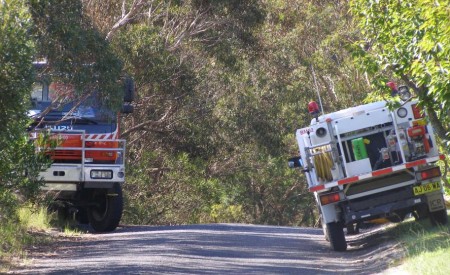 Warrimoo Rural Fire Service set up to conduct hazard reduction at Sublime Point, Leura (Carleton Road, Leura, 15th March 2008). Warrimoo Rural Fire Service set up to conduct hazard reduction at Sublime Point, Leura (Carleton Road, Leura, 15th March 2008).
.
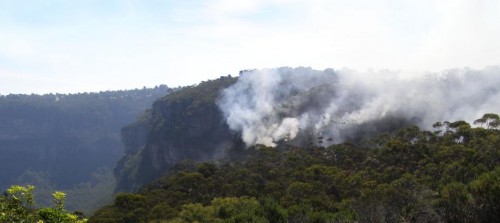
Rural Fire Service setting fire to escarpment vegetation at Sublime Point on the Jamison Escarpment, Leura. (Photo from Willoughby Road,Leura, 15th March 2008).
.
A year later again at Sublime Point…
.
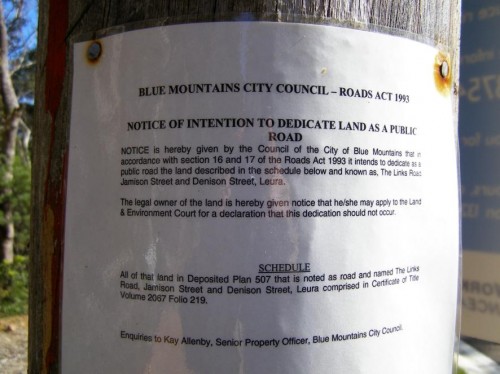 DECC Wildlife Service ‘hazard reduction’ burn notice for Sublime Point escarpment again on 24th March 2009, almost exactly a year to the date. DECC Wildlife Service ‘hazard reduction’ burn notice for Sublime Point escarpment again on 24th March 2009, almost exactly a year to the date.
.
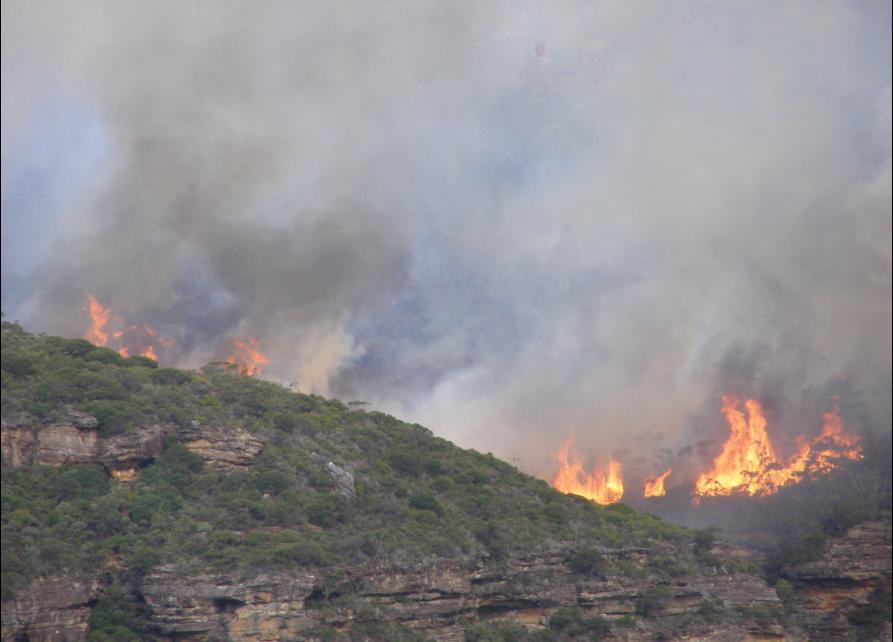
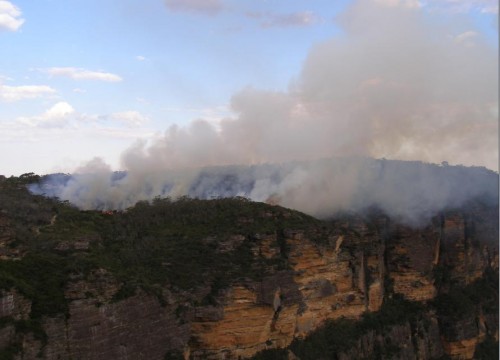 Blue Mountains Wildlife Service ‘hazard reduction’ burn of the Jamison Escarpment at Sublime Point 24th March 2009 Blue Mountains Wildlife Service ‘hazard reduction’ burn of the Jamison Escarpment at Sublime Point 24th March 2009
.
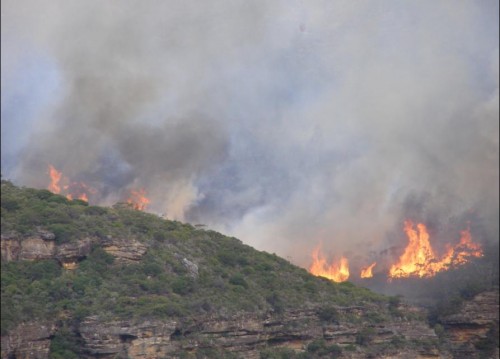 Blue Mountains Wildlife Service ‘hazard reduction’ burn of the Jamison Escarpment at Sublime Point 24th March 2009. Blue Mountains Wildlife Service ‘hazard reduction’ burn of the Jamison Escarpment at Sublime Point 24th March 2009.
.
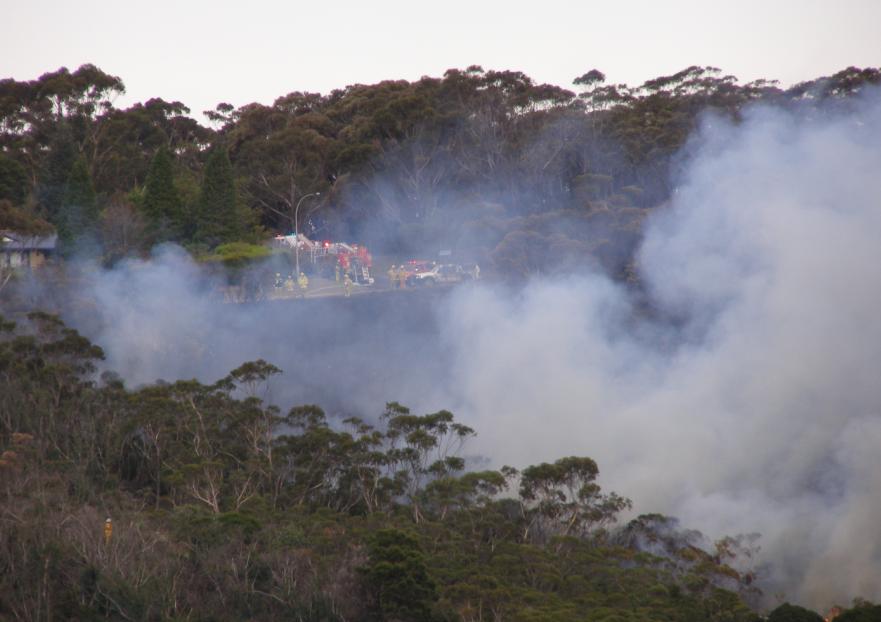
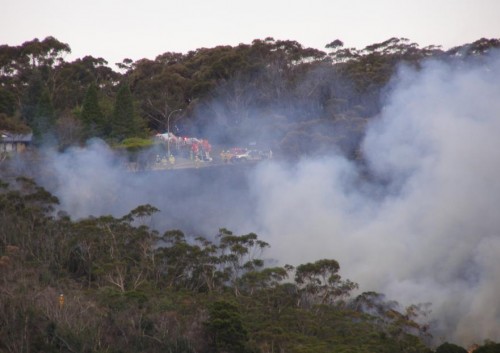 Fire-lighters watching on as their blaze gets out of control at Sublime Point 24th March 2009.
(Click photo for enlargement) Fire-lighters watching on as their blaze gets out of control at Sublime Point 24th March 2009.
(Click photo for enlargement)
.
.
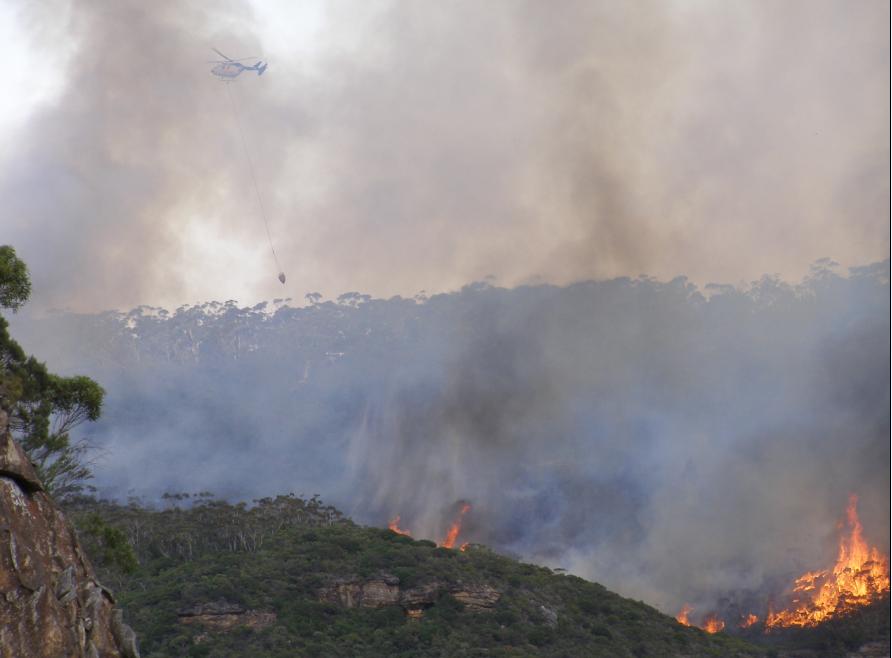
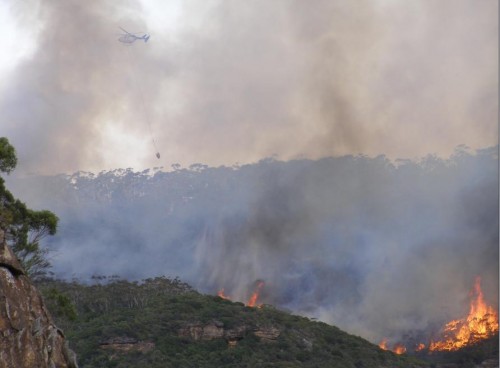 Same ‘hazard reduction’ burn out of control, requiring expensive and embarrassing helicopter water-bombing to stop the fire spread down into the protected Jamison Valley Same ‘hazard reduction’ burn out of control, requiring expensive and embarrassing helicopter water-bombing to stop the fire spread down into the protected Jamison Valley
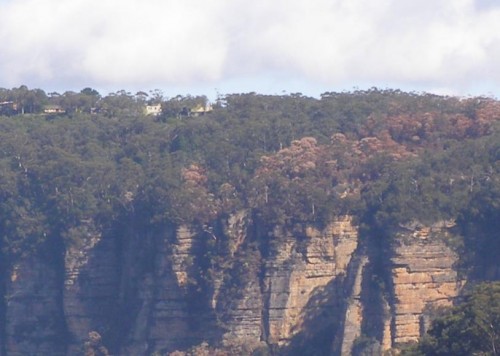 East side of Sublime Point (5th April 2009) showing burnt vegetation, where the HR burning had escaped and nearly entered down into the Jamison Valley.
(The media spin by bushfire management was that this section was arson, but not surprisingly the culprit was never found). East side of Sublime Point (5th April 2009) showing burnt vegetation, where the HR burning had escaped and nearly entered down into the Jamison Valley.
(The media spin by bushfire management was that this section was arson, but not surprisingly the culprit was never found).
.
nec.
Meanwhile, property developers at Sublime Point, a block away…
.

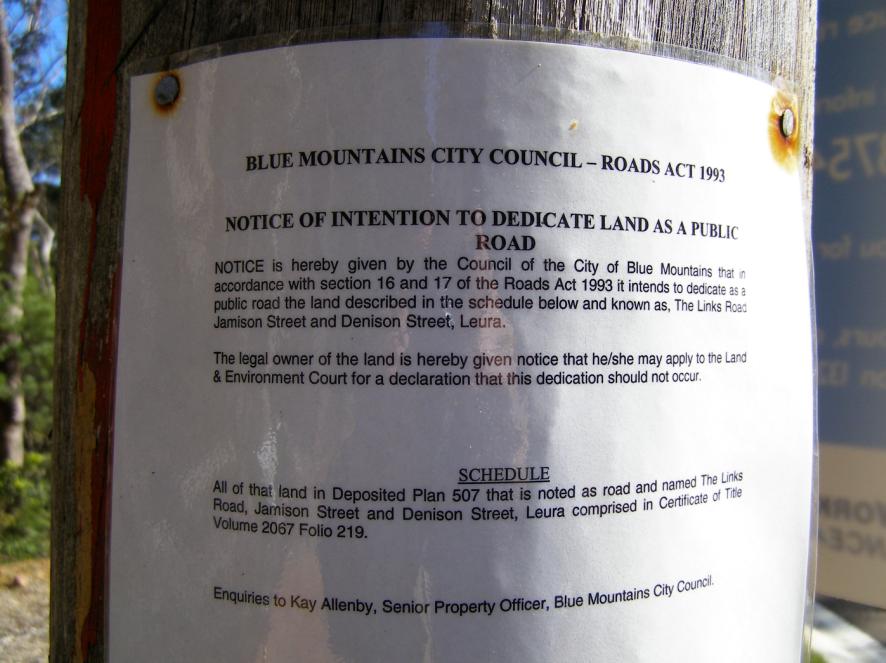
Leura’s recently approved and created ‘ The Links Road‘ (31st May 2008) following Council approved destruction of escarpment vegetation and subsequent subdivision ready for escarpment housing..with views.
.
Meanwhile, further along Cliff Drive at Katoomba…
.
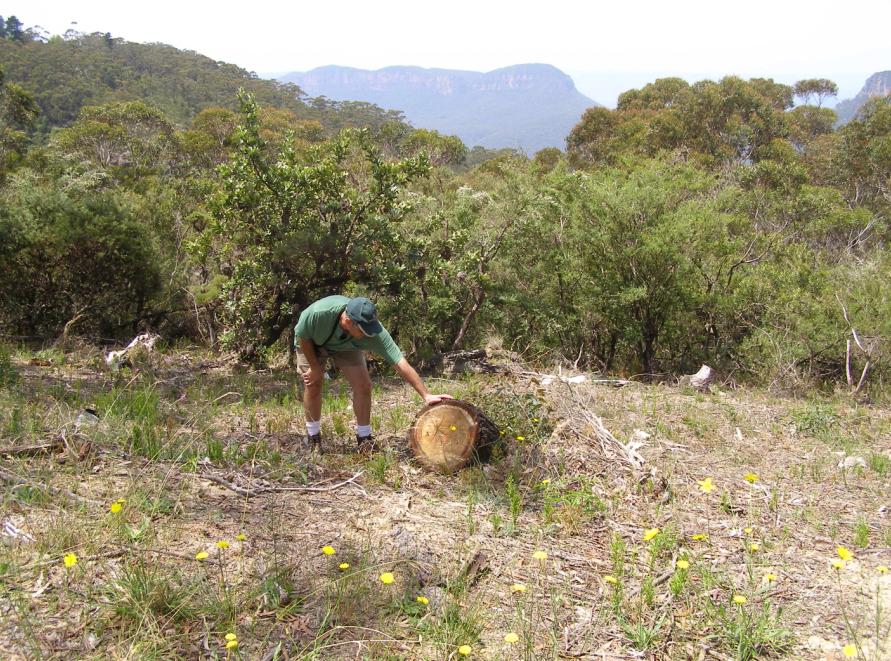
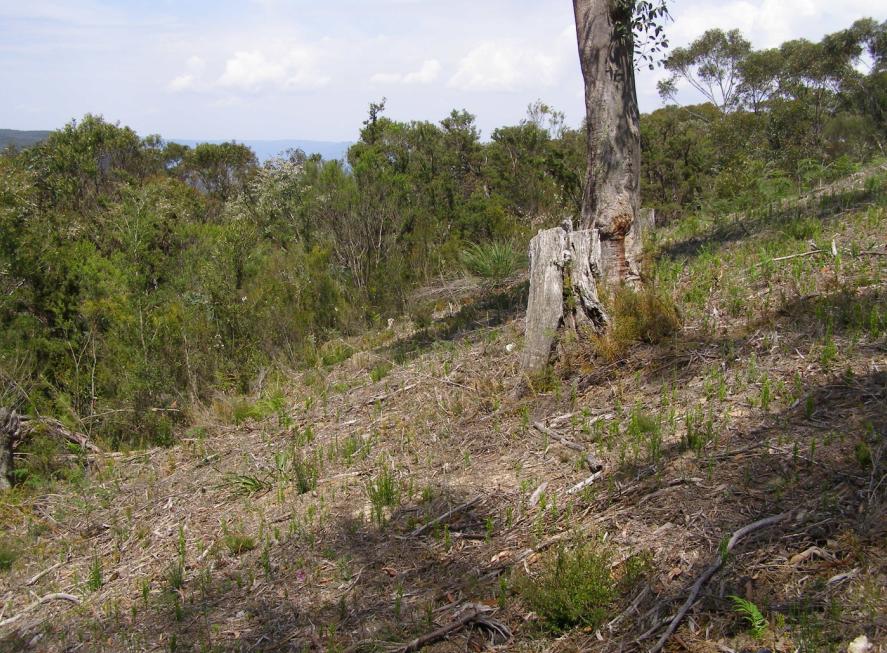
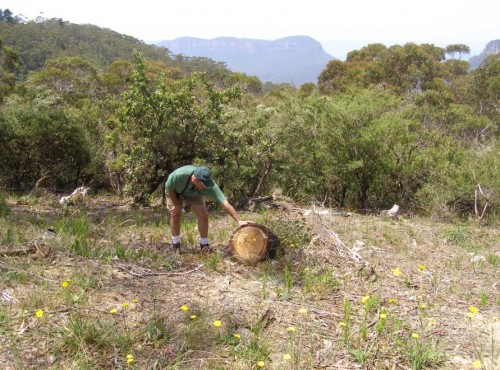 Editor inspecting native escarpment site on Cliff Drive, Katoomba back on 12th January 2008 that had been recently slashed by the Wildlife Service.
It just so happened that a house opposite on Cliff Drive was up for sale and would benefit from the fresh views of the Jamison Valley. Editor inspecting native escarpment site on Cliff Drive, Katoomba back on 12th January 2008 that had been recently slashed by the Wildlife Service.
It just so happened that a house opposite on Cliff Drive was up for sale and would benefit from the fresh views of the Jamison Valley.
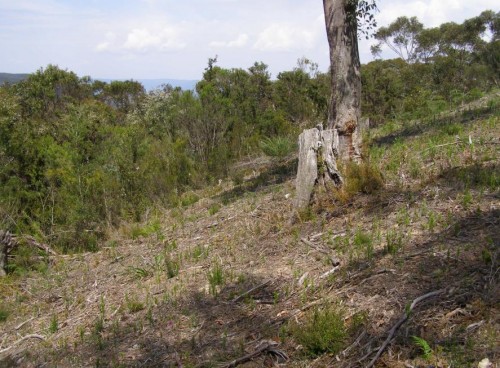 Same site, same date. Same site, same date.
.
 Seven months later, a few hundred metres west along Cliff Drive Katoomba,
some developer gets escarpment views towards Nellies Glen approved,
or is it more a case of ‘overlooked‘ by Blue Mountains (city)Council? Seven months later, a few hundred metres west along Cliff Drive Katoomba,
some developer gets escarpment views towards Nellies Glen approved,
or is it more a case of ‘overlooked‘ by Blue Mountains (city)Council?
.
.
.
-end of article –
Tags: Blue Mountains City Council, Blue Mountains western escarpment, Blue Mountains World Heritage Area, bushland housing, hazard reduction, housing encroachment, Jamison Valley, Katoomba, Leura, Links Road, NPWS, prescribed burning, Sublime Point, Wentworth Falls, Wildlife Service
Posted in Blue Mountains (AU), Threats from Bushfire, Threats from Development | No Comments »
Add this post to Del.icio.us - Digg
|
|