A heavily polluted river in the town of Zhugao in China’s southwest Sichuan province in 2010.
Source: Peter Parks/Agence France-Presse — Getty Images
.
As economists drive growth, which is the only god they know, and lure China to becoming more westerised, China’s economy is under pressure to economically perform and keep up with the economic Jones’s. China now proudly has gained status as the world’s second-biggest economy.
.
But China’s economically global adage ‘Made in China‘ has come at a terrible cost to China’s environment, ecology and its people.
<<One of China’s most critical environmental problems is water pollution.
.
Nearly 1/4 of Chinese lack access to clean drinking water, over 70 percent of lakes and rivers are polluted, and pollution accidents happen on a near daily basis.
.
Water pollution not only strains freshwater ecological health, but also severely impacts human health. Today, China has a growing cancer rate, with hundreds of “cancer villages” along the banks of polluted water sources. The World Health Organization recently estimated that nearly 100,000 people die annually from water pollution-related illnesses in China, and 75 percent of disease is linked to poor water quality.
China’s water pollution crisis made international headlines following a 2005 petro-chemical plant explosion which released 100 tons of benzene into the Songhua River. Such spills are not rare in China, yet the accident and ensuing cover-up opened new space for pressuring the Chinese government to change its approach to water pollution problems. Local, regional and national environmental groups now have more opportunity to establish themselves as watchdogs of government regulators and private industry.
Working with partners across China, Pacific Environment is reaching out to local communities concerned about water pollution and helping these communities conduct legal, public relations and advocacy campaigns to reduce the impacts of water pollution on public health and the local environment. Through these actions, our partners are playing a pivotal role to ensure clean water for China’s future.>>
Liujiaxia Hydro Dam on the toxic Yellow River China’s Gansu Province
.
<<In recent weeks (Feb 2013), Chinese and western media have been all atwitter over the shocking levels of air pollution in Beijing and a number of other Chinese cities. But it really shouldn’t be all that shocking. After all, in 2007, the World Bank and China’s own State Environmental Protection Administration (now the Ministry of Environmental Protection) found that that as many as 750,000 people die prematurely in China annually from respiratory disease related to air pollution.
And more recently, Greenpeace Beijing reported that in 2011 in four major cities, more than 8,000 people died prematurely as a result of just one pollutant, PM 2.5 [Particulate matter 2.5 – refers to tiny particles or droplets in the air that are two and one half microns or less in width]. Anyone who spends any time in Beijing knows that the city has not yet found a way to tackle the myriad sources of air pollution from construction to cars to coal.
.
According to one report, “up to 40 percent of China’s rivers were seriously polluted” and “20 percent were so polluted their water quality was rated too toxic even to come into contact with.”
.
As frightening as the country’s smog-filled skies might be, the country’s water pollution is easily as alarming. According to one 2012 report, “up to 40 percent of China’s rivers were seriously polluted” and “20 percent were so polluted their water quality was rated too toxic even to come into contact with.” Part of the explanation may rest in the “estimated 10,000 petrochemical plants along the Yangtze River and 4000 along the Yellow River.” (And the Yellow and Yangtze are not even the most polluted of China’s seven major rivers.) On top of whatever polluted wastewater might be leaching or simply dumped into China’s rivers from these factories, the Ministry of Supervision reports that there are almost 1,700 water pollution accidents annually. The total cost in terms of human life: 60,000 premature deaths annually.
While the macro picture is concerning, even more worrying is that individual Chinese don’t know whether their water is safe to drink or not. A Chinese newspaper, the Southern Weekly, recently featured an interview with a married couple, both of whom are water experts in Beijing (available in English here). They stated that they hadn’t drunk from the tap in twenty years, and have watched the water quality deteriorate significantly over just the past few years, even while state officials claim that more than 80 percent of water leaving treatment facilities met government standards in 2011.
It is difficult to get the straight story. According to one report by Century Weekly, there are a number of reasons for differing assessments of the country’s water quality:
.
The frequency of testing at treatment plants is too low, and only 40 percent of the treatment plants in China’s thirty-five major cities have the capacity to test for all 106 indicators in any case
There are only a few independent water-quality monitoring bureaus, and most water testing is done in-house by the same water-treatment plant being evaluated
There is weak transparency from local governments as to the results of the tests,and,
No water testing accounts for the contamination that occurs from the aging and degraded pipes through which the water is transmitted to Chinese households.
.
China’s environmental challenges are long in the making, not simply a function of the past thirty years of reform. As one reporter has noted, Beijing in the 1950s transformed from a city that “did not produce even pencils” to one that boasted “700 factories and 2000 blast furnaces belching soot in the air.”
In his 1991 book ‘Environmental Management in China‘, QuGeping, China’s first director of the country’s National Environmental Protection Agency, further commented about that time: “The environmental situation quickly deteriorated. A lot of places were polluted by either smog, sewage waters or rubbish. Biological resources, forests in particular, were seriously damaged, causing several losses to the ecosystem. There was extensive destruction of the natural environment of our country.”
In the 1950s, China, like other countries, neither understood well nor had the capacity to deal effectively with the environmental and health challenges its rapid development was creating. Today, however, China has both the knowledge and the capability. In the midst of the recent air pollution crisis, Premier-elect Li Keqiang said it would take time to address the air pollution problem: “There has been a long-term buildup to this problem, and the resolution will require a long-term process. But we must act.” In the meantime, the Chinese people can only wear their masks, buy their bottled water, and hope they are not in this year’s batch of pollution-related casualties.>>
.
[Source: ‘China’s Water Pollution Crisis’, 20130122, by Elizabeth C. Economy, The Diplomat, ^http://thediplomat.com/2013/01/22/forget-air-pollution-chinas-has-a-water-problem/ . Elizabeth C. Economy is C.V. Starr Senior Fellow and Director for Asia Studies at the Council on Foreign Relations. She is an expert on Chinese domestic and foreign policy and U.S.-China relations and author of the award-winning book, ‘The River Runs Black: The Environmental Challenge to China’s Future‘ She blogs at Asia Unbound, where this piece originally appeared.]
.
Trash clogs up a polluted canal at the edge of Beijing on March 16, 2012.
[Source: ‘Chinese Environmental Official Offered Reward To Swim In Polluted Ruian River’, 20120220,
by Sara Gates, The Huffington Post, Photo by Mark Ralston, AFP/Getty Images]
.
<<China’s government on Tuesday (20100209) unveiled its most detailed survey ever of the pollution plaguing the country, revealing that water pollution in 2007 was more than twice as severe as was shown in official figures that had long omitted agricultural waste.
The first national pollution census, environmentalists said, represented a small step forward for China in terms of transparency. But the results also raised serious questions about the shortcomings of China’s previous pollution data and suggested that even with limited progress in some areas, the country still had a long way to go to clean its waterways and air.
The pollution census, scheduled to be repeated in 2020, took more than two years to complete. It involved 570,000 people, and included 1.1 billion pieces of data from nearly 6 million sources of pollution, including factories, farms, homes and pollution-treatment facilities, the government announced at a news conference.
But the comprehensiveness of the survey also resulted in stark discrepancies between some of the calculations and annual figures that the government has published in the past.
By far the biggest of these involved China’s total discharge as measured by chemical oxygen demand — the main gauge of water pollution, which measures chemical compounds in the water by checking how much oxygen they use. These discharges totalled 30.3 million tons in 2007, the census showed.
In recent years the Ministry of Environmental Protection has done a much narrower calculation of these discharges, excluding agricultural effluents like fertilizers and pesticides as well as fluids leaking from landfills. By that narrower measure, discharges came to only 13.8 million tons in 2007, which officials described at the time as a decline of more than 3 percent from 2006 and a “turning point.”
Zhang Lijun, the vice minister of environmental protection, sought to play down the differences with previous data. He noted that the census had counted 13.2 million tons of agricultural effluents for the first time, and 324,600 tons of discharges from landfills.
The census keepers had also used updated methodologies and reached many more parts of the countryside and industrial sites than had official statistics, which helped account for the much larger figure in the census, Mr. Zhang said. Were it not for the vastly expanded scope of the survey, the chemical oxygen demand level in 2007 would stand at only 5.3 percent higher than previously calculated, he said.
Ma Jun, director of the Institute of Public and Environmental Affairs, a nonprofit research group in Beijing, said that government planners had estimated that the country’s rivers and lakes could handle only 7.4 million tons a year of chemical oxygen demand. The scale and significance of agricultural effluent was seldom recognized in previous government planning, which focused on bringing down mainly industrial emissions to around 7 million tons a year from 13.8 million tons, said Mr. Ma, a leading expert on water pollution in China.
The new total of more than 30 million tons suggests a much bigger problem. “We believed we needed to cut our emissions in half, but today’s data means a lot more work needs to be done,” Mr. Ma said.
The extent of agricultural waste could prove a more intractable problem than that of the many factories dumping effluent into China’s rivers and lakes.
“When it’s millions of farmers, it’s more difficult to bring it under control,” Mr. Ma said.
Steven Ma, of the Beijing office of Greenpeace, said that the government’s decision to calculate and release figures for agriculture would have an effect on the policy debate over water pollution in China. “Everybody knew there was a problem with agricultural pollution in China, but now there are numbers,” he said.>>
.
[Source: ‘China Report Shows More Pollution in Waterways’, 20100209, by Jonathan Ansfield and Keith Bradsher (New York Times), Zhang Jing contributed research, Photo by Peter Parks (Agence France-Presse), ^http://www.nytimes.com/2010/02/10/world/asia/10pollute.html?_r=0]
.
.
Poisoned River – Gold Mining Along the Biliu River’
.
Biliu River Sludge (Liaoning Province, south-eastern China)
.
<<The Biliu River in Liaoning Province, whose source is near Yingkou City, empties into Bohai Sea at Dalian City. The upper stretch of the Biliu River is abundant in gold.
Villagers in this region for several years have been voicing their concerns regarding the impacts of gold mining on communities and the environment.
In response, in the summer of 2011, Blue Dalian conducted investigative trips to the upper Biliu River. Blue Dalian’s investigations revealed the region is impacted by six gold mines and seven gold separation plants. A total of three local companies are actively producing gold, while four companies that previously mined in the area have closed their operations. The report also includes data from publications produced by the Dalian Water Quality Supervision authority.
.
Gold: A Dirty Business
.
Gold mines in the upper Biliu River are subsurface hard rock mines, meaning rock which contains gold is dug from beneath the surface using tunnels. Once rocks are removed, two methods are used to extract gold: cyanide heap-leach and froth flotation. The cyanide heap-leach method involves leaching finely crushed rocks in cyanide liquid; cyanide binds to the gold which can then be separated out from the other materials in the rock. Froth flotation is also another chemical process used to separate gold from rock, and is generally used when gold is found in rocks that contain sulfides. Cyanide and other chemicals used in these processes are extremely toxic and can seriously threaten environmental and human health.
The primary negative environmental risks associated with these forms of gold processing include:
.
1. Human impacts: poisonous gases, dusts, and waste accumulation at and near the mining sites are harmful to the physical health of the local people and mine workers; water quality is impacted by the mines and there is risk of serious poisoning in the event of a mining waste pond failure.
2. Vegetation loss: development of mines and processing plants damages the ecology of the local landscape, including through removal of vegetation.
3. Geological and soil impacts: mines poison the soil, and soil loss is accelerated through erosion; landslides can be caused by digging or by accumulation of mining wastes, particularly if protective measures are not put in place.
4. Water impacts: water is diverted for use in the mines and is then no longer available to support ecological functions. Surface water pollution and underground water pollution is common, particularly through waste water leaks, which are likely in the event of heavy rains.
5. Wildlife impacts: waste water contains cyanide and other chemicals which are extremely poisonous and which may kill fish or other aquatic life.
.
.
Biliu River Gold Mining Companies: a History of Negligence
.
There are three mining companies actively mining in the upper Biliu River watershed at present: Xinlong Mining Corporation, Futian Mining Corporation, and Futian Mining Corporation Flotation Factory.
Xinlong Mining Corporation, a local state-owned corporation, was visited by Blue Dalian during summer, 2011. According to the local Environmental Protection Bureau, the Xinlong Mining Corporation has accumulated more than 1,000 tons of waste residues at the site, far beyond the waste residue carrying capacity permitted. The investigation team observed piles of waste ore and accumulated waste residues held back by a low dam which were susceptible to being washed into the Biliu River in the event of a heavy rain.
The investigation team also learned that several years ago, waste residues directly leaked into Biliu River by the Xinlong Mining Corporation killed local livestock. Villagers living beside Xinlong Mining Corporation operations also told Blue Dalian that they have had difficulty selling their grain crops, due to concerns that the grain may be contaminated with heavy metals through contact with mine waste. Local people have tended to keep silent about these pollution issues because many of them work at the mine.
People living near Futian Mining Corporation operations told investigators about a suspected cyanide toxin accident. A massive fish kill occurred, and many residents developed thyroid problems, had difficulty breathing, and developed impaired eyesight. Local villagers insisted the government release data on water quality of the local river and information on the contents of the company’s waste water ponds, but the government never responded. The factory initially agreed to give monetary compensation to villagers whose health was impacted by the accident, but later broke that promise. Investigators learned from villagers who had connections inside the mine that no protective measures to prevent sewage containing cyanide from polluting the Biliu River were in place, though the company covers toxic residues with dirt so that they are out of sight of inspectors. The villagers now drink water from neighboring villages instead of the local groundwater they have relied upon for generations.
Primary Environmental and Human Health Concerns of Mining on the Biliu River
Threats to the health of local villagers: the Xinlong Mining Corporation uses cyanide heap leach method to extract gold, which produces waste water and residues that contain cyanide. Cyanide is extremely toxic and it is suspected villagers have already been poisoned.
Water environmental safety: gold mines along the upper Biliu River are located near tributaries to the river, and mine tailings ponds were found be located close to these tributaries. Tailings ponds were observed to be poorly located and managed, and their size and number was beyond the carrying capacity for the area. Further, dams used to contain the tailings are made from compressed earth and consequently are not water tight. According to Chinese safety standards for tailing pond construction, all the ponds observed along the Biliu River do not meet normal safety standards.
Government data shows that the water quality of the Biliu River is much lower than other sections of the river, especially for sulfate radicals, cyanide, and some heavy metals. Waste water samples collected from the Xinlong mine area were tested and found to contain more mercury and cyanide than is permitted for surface water. This is not surprising given mining waste water in this area flows directly into the Biliu River.
Heavy metal pollution in the soil: gold mining has led to the accumulation and compounding of many heavy metals – including arsenic, lead, cadmium, and zinc – in the soil environment in this area. Soil becomes polluted with heavy metals through leaks in the mine tailings ponds.
Drinking water safety in Dalian City: the Biliu River reservoir supplies Dalian City with a million tons of drinking water per day, which accounts for the overwhelming majority of the water supply in Dalian. During rain events, mine tailing in the upper watershed may directly leak into the Biliu River. The cyanide and heavy metals accumulated in these tailings may pollute the river, leading not only to local water quality impacts but a potential water crisis for Dalian City. There are already some cases in China where hundreds of people have been poisoned by water containing high amounts of cyanide which entered drinking water supplies after heavy rain storms.
.
Suggestions for Protection of the Upper Biliu River
.
1. Regular supervision of cyanide pollution and other heavy metal pollution along the upper Biliu River. The local environmental supervision department should regularly test cyanide content and other heavy metal content in the soil, surface water, and groundwater at and near the mining sites. At same time, the department should evaluate the risk of accidents and take protective measures.
2. Heavy metal cleanup and ecological recovery. Clean up and ecological recovery is needed to remove heavy metals and decrease the toxicity of the soil in and near the mines. This is important to the recovery of normal functions of soil ecosystem and reducing heavy metals being transmitted to the food chain and groundwater.
3. Establish an emergency water pollution accident mechanism in Dalian City. First, Dalian should store water in case of a water pollution emergency. A water reserve could reduce the dependence on the Biliu River and assure water supplies if an emergency happens. Second, an early warning system should be established. Related departments should punctually notify citizens to suspend water use and mobilize other water sources.
4. Strengthen integrated watershed management of the Biliu River. Dalian City should coordinate Biliu River management and development with upstream Yinkou City, which is heavily invested in mining in the upper watershed. Working together can help ensure that the river can be sustainably used and managed into the future, and that less resource intensive industries can be developed in the region.
5. Strengthening environmental supervision of mining companies. Regulators need to ensure companies improve production techniques in order to increase efficiency and reduce pollution, and that companies safely handle wastes and where possible, recycle some of the resources contained in the mining waste products.
The Sad Story of an Environmentalist in northeast China
.
<<Forty-five-year-old Lv Qingrong lives in a village 10 kilometers away from the Biliu River in southeast China. The family has lived in the village for 14 generations. In his childhood, Lv Qingrong and his friends played by the riverside catching fish and shrimp. By the river, there was a thick forest, visuals of which are deeply engraved in Lv Qingrong’s mind.
“There were lots of trees in the mountain and there lived all kinds of animals. In the river, you could find fish, turtles, shrimp and crabs. These memories are still so vivid and dear to me now.”
In 1984, when Lv Qingrong was 21, he retired from the army and returned to his hometown in the countryside of Yingkou city in Liaoning Province.
“At the time, there were very few trees left in the mountain and water levels in Biliu River dropped dramatically. There were garbage and sometimes dead animals along the river banks. I was so sad seeing all this.”
Lv Qingrong started his garbage collection efforts in 1984. One day in spring when Lv Qingrong and a relative passed the river bank on the way to work, he came across a pile of firecrackers abandoned near the river. “Let’s deal with this first,” he said to his relative.
He started collecting clearing out the pile of firecrackers. Later, it developed into a massive project to clean the river banks.
Since then, Lv Qingrong took several bags and went to pick garbage by the river. Even in the following years when everyone had a chance to make money thanks to the government’s reform and opening up policy, Lv Qingrong didn’t stop picking garbage. Many people, especially his family members, did not understand him and sometimes got irritated with him concentrating on something they thought was useless.
In July 28th, 1981, the village was hit by a mudslide in which 300 people were killed.
“Why did the mudslide happen? When forests are destroyed by practices such as burning vegetation for land reclamation, over grazing and cutting trees for firewood, soil is easily washed away without the cover of vegetation, and mudslides occur. It is human beings who destroy their own environment and life.”
When he realized that picking garbage was not a permanent solution, Lv Qingrong decided to plant trees on the mountain. In 2000, even though his family was against it, he contracted 23 hectare of deserted land in the mountain after taking a debt of 110,000 yuan. His wife started to quarrel with him after the family became dirt poor and the couple ended up getting a divorce in 2003. His youngest son had to leave home and work in a big city to fund his own education.
After the divorce, Lv Qingrong continued to work towards preserving the environment around the mountain area.
.
A man collects water samples from the polluted Longjiang River in Liuzhou, Guangxi Zhuang autonomous region. The authorities dumped hundreds of tons of aluminium chloride into the Longjiang River in an effort to dissolve tonnes of dumped cadmium.
[Source: ’20 tons of cadmium poisoning vital Chinese river’, 20120201, by David Eimer UK Telegraph (in Beijing),
^http://www.telegraph.co.uk/earth/environment/9053671/20-tons-of-cadmium-poisoning-vital-Chinese-river.html]
.
“What made me sad were misunderstandings from other people, especially my family members. I sometimes doubted myself and wondered if I could keep going. But every time I came to the river, I became clear and focused again. I was sure that what I was doing was right, so I became determined to continue.”
In addition to bearing the brunt of people’s misunderstandings, Lv Qingrong was struggling in other ways at that time. Without any home appliances or decent furniture, Lv Qingrong couldn’t even afford a proper New Year’s dinner to celebrate China’s most important holiday; the Spring Festival.
“I was poor and alone on New Year’s eve. I couldn’t even afford a meal of dumplings because I had given all my money to the bank to pay the debt. I wrote a couplet to celebrate the festival. It said ‘I don’t eat dumplings because I don’t have money. There’s nothing I can do, but setting off a string of firecrackers to celebrate the New Year.'”
Lv Qingrong is a big fan of traditional Chinese poems and when he feels lonely or sad he also writes them. He has had more than 100 poems published in popular Chinese magazines and newspapers. His favorite writer is the ancient Chinese poet Po Chu-yi (白居易) who lived some 160 years ago and was best known for his ballads and satirical works. Lv Qingrong recites his favorite Po Chu-yi poem.
“Don’t say all the living beings are petty and low. They have the same flesh and blood. Please don’t kill the bird on the tree, Her fledglings are expecting their mother in the nest.”
Eight years have past since Lv Qingrong started to reforest the mountains and his efforts haven’t been in vain. The once deserted area is now covered with young trees and animals have returned. In the river people can see salamanders again, after they had almost become extinct.Contented with the results, Lv Qingrong still lives a poor life alone. Some people suggest he could make money by selling wood or breeding sheep.
However Lv Qingrong is reluctant to use anything from the mountain. So he is known as a poor millionaire who owns a goldmine but has not a penny to spend.Despite other people’s doubts, the environmentalist’ efforts continue. In 2006, he initiated the “Biliu River Water Resources Protection Association”. There are already 200 members, ranging from municipal officials to primary school students. They come from his hometown and from the neighboring cities of Yingkou and Dalian.
“The officials are more persuasive then I am when we go to spread environmental protection messages to students. Environment education should start with children. We teach them about garbage disposal and proper ways to deal with used batteries. The children have also learned to protect animals. The overall awareness of environmental protection will improve if we start to educate them.”
In order to increase awareness about river protection, Lv Qingrong has erected a monument at the source of the Biliu River and engraved water protection slogans along with an introduction to the history of the river. With more government attention nationwide on environmental protectionand with increasing interest from people in his hometown, everything seems have taken a turn for the better. Lv Qingrong’s eldest son, who’s in his early 20s, has been emulating his father when it comes to river protection.
“The protection of the environment has become a hot topic in our village. People often come to me and inquire about environmental issues. I’m happy more and more people have become involved.”
Forty-five-year-old Lv Qingrong is resolute in his dedication and focus.
“I will stay and keep watching the river for the rest of my life.”>>
.
[Source: ‘The Sad Story of An Environmentalist in Northeast China’, 20080921, by Wu Jia, CRIENGLISH.com, ^http://english.cri.cn/4026/2008/09/21/1241s407576.htm]
Blue Gum Forest in 1931An innocent time in fading history – when Platypus were plentiful, bred and swum freely in the Grose River
Party of Sydney Bush Walkers in Blue Gum Forest, circa October 1931
[Source: Photo by Alan Rigby, Blue Gum Forest Committee,
from ‘Back from the Brink: Blue Gum Forest and the Grose Wilderness’ (1997), book by Andy Macqueen, p.256, click image to enlarge]
.
In 2006, the New South Wales (Government’s) Parks and Wildlife Service (NPWS) or ‘Parks‘, being delegated by the Australian Government for absolute responsibility for ecologically protecting the Blue Mountains World Heritage Area (BMWHA), so under-resourced its firefighting effort as to deliberately let the Grose Valley burn out of control.
Senior management well knew, like their firefighting partners the Rural Fires Service, that legal and political accountabilty extended ONLY to protecting private properties and human lives. So this they did and so let 14,070 hectares of the Grose Valley and adjoining land burn. It saved them the cost and effort of future ‘hazard’ reduction.
Parks adopted a cost-saving abandonment strategy (making management look efficient) which it labels deliberate bushfire as ‘fire ecology‘ and so by deliberate under-resourcing of fire fighting against two documented ignitions to then let burn into the Grose Valley and the Blue Gum Forest. These two ignitions (1) a purported lightning strike on Burra Korain Ridge and (2) a deliberate RFS ‘hazard’ reduction burn along the south side of Hartley Vale Road – both outside the BMWHA, were the instigators of the 2006 Grose Fire.
It was all hushed up, despite public calls for an independent public enquiry. Both the RFS Commissioner and Blue Mountains Local Member at the time said no to the public calls for an independent public enquiry. Why?
.
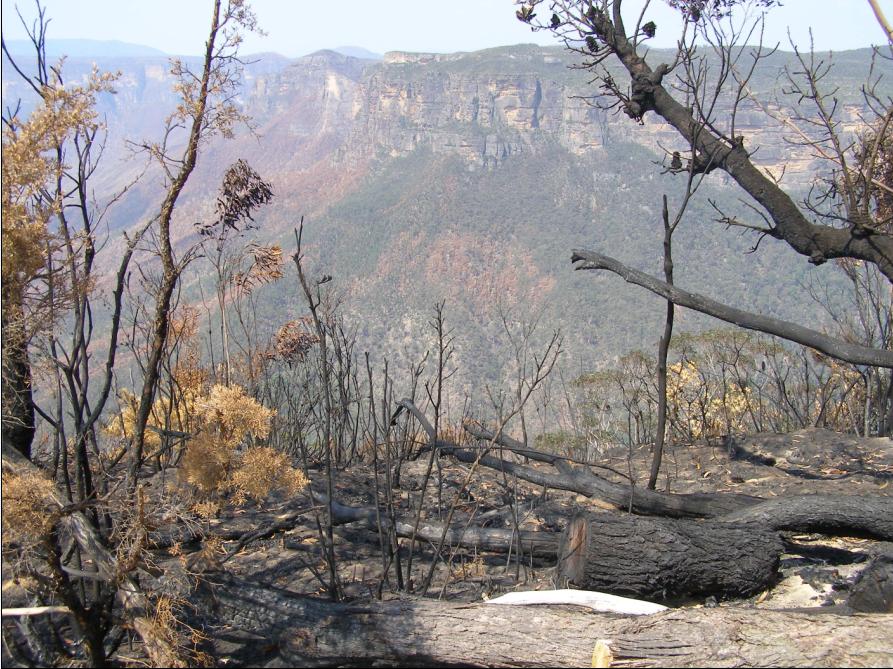
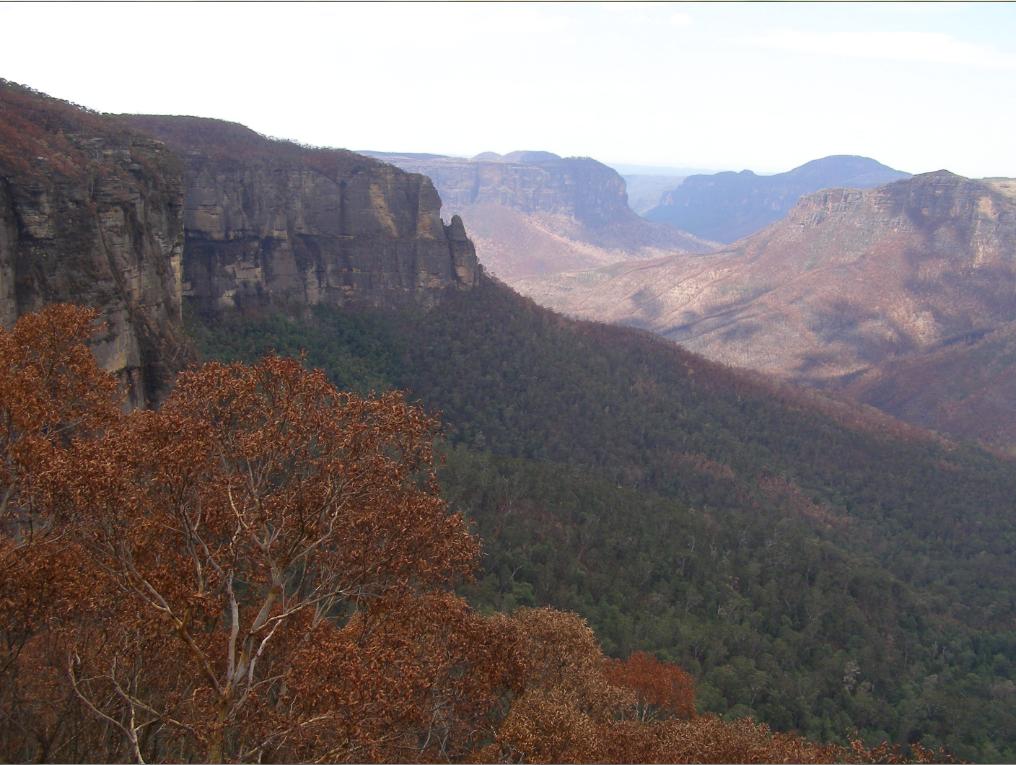
Grose Valley Fire aftermath at Govetts Leap, Blackheath
[Photo by Editor 20061209, click image to enlarge, free in public domain]
.
New South Wales colonists, once they stumbled across the spectacular Grose Valley deep in the Blue Mountains, were in awe in sublime wonder. So it was that initially that the Grose Valley as far back as in 1875 became reserved as a ‘national spectacle’.
But many wanted to dam it – ^Robber Barons and prevailing industrialist politicians of the times had the same view of ‘progress‘ being a colonial right and unquestioningly superior to Nature. They tried to put the railway through the Grose, to mine it, to log it or else to farm it; all so long as the vast ‘resource’ was not neglected for ‘progress‘.
.
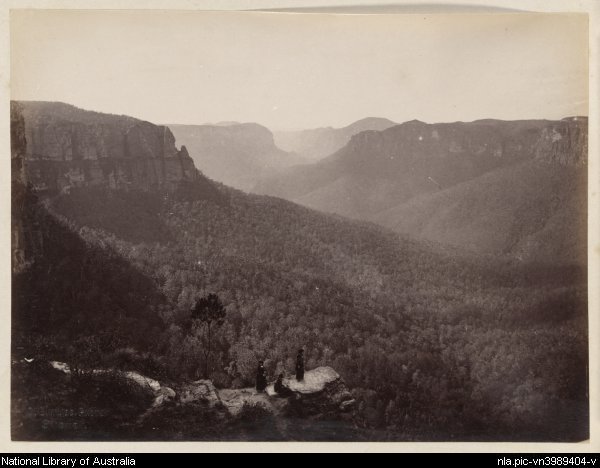
Grose Valley, view from Govett’s Leap in 1886 by Charles Bayliss
Note the women in the foreground in the Victorian dress of the day
[Source: Part of Lindt, J. W. (John William), 1845-1926,
National Library of Australia, 1 digital photograph : b&w,
^http://nla.gov.au/nla.pic-vn3989404]
.
Thankfully, this majestic Grose Valley and its ancient icon Blue Gum Forest were saved the axe in 1931. But is was only marginally due to the persistent campaigning efforts of a small dedicated group of bushwalkers passionate about saving this forest back even in the midst of The Great Depression.
If ever a case were not truer:
“Never doubt that a small group of thoughtful, committed people can change the world. Indeed, it is the only thing that ever has.”
~ American cultural anthropologist, Margaret Mead
.Margaret Mead, 1901–1978
.
‘The Blue Gum‘ was ultimately saved by the generous personal donation by allied bushwalker W.J. Cleary of £80 [perhaps $20,000 in today’s value *] to purchase the rights to the land from the pastoralist Clarrie Hungerford in February 1932.
.
Significantly, their dedicated act of environmental conservation is arguably the first environmental campaign in Australia’ history. ‘The Blue Gum‘ since then and for eighty years since has been affectionately known amongst environmentalists as ‘The Cradle of Conservation‘.
[Ed: * CALCULATION: In 1930, the average yearly wage for ordinary Australian workers was roughly £220, source: ^http://guides.slv.vic.gov.au/content.php?pid=14258&sid=95522. So given that today’s average yearly salary in Australia is about $56,000 (Source: ^http://www.abs.gov.au), the calculation is 80/220 * 56,000 = $20,000]
.
<<Everyone has been to the lookouts. Many have been to the Blue Gum Forest, deep in the valley– but few know the remote & hidden recesses of the labyrinth beyond. Here, an hour or two from Sydney, is a very wild place.
The Grose has escaped development. There have been schemes for roads, railways, dams, mines & forestry, but the bulldozers have been kept out. Instead, the valley became the Cradle of Conservation in New South Wales when it was reserved from sale in 1875 – an event magnificently reinforced in 1931 when a group of bushwalkers were moved to save the Blue Gum Forest from the axe.
Local author, Andy Macqueen, has been an enthusiastic bushwalker and conservationist since the 1960’s. In 1997, he published his book, ‘Back from the Brink: Blue Gum Forest and the Grose Wilderness‘, aptly titled in telling the true story of how the Blue Gum Forest was saved from destruction.
Macqueen’s well researched book tells in detail the story of the whole Grose Wilderness experience and of the Blue Gum Forest rescue story in particular. It tells about the many different people who have visited this wilderness: Aborigines, explorers, engineers, miners, track builders, bushwalkers, canyoners, climbers…those who have loved it, and those who have threatened it.>>
A decade later, in 1940 the Grose Valley was subjected to a bushfire; however its cause, circumstances and extent of damage are unknown by The Habitat Advocate.
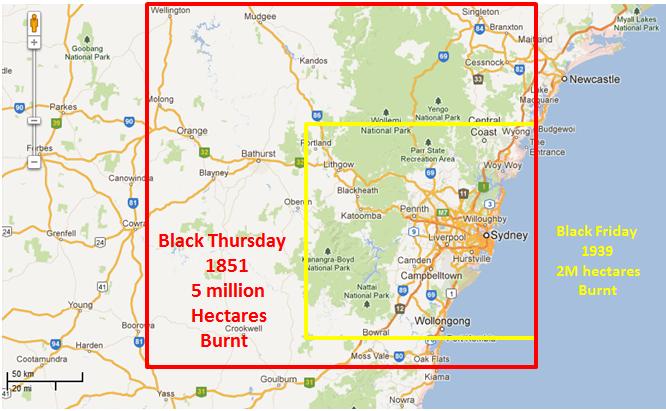
This bushfire occurred only a year after the devastating 1939 Bushfires of ‘Black Friday‘ across Victoria, which is collectively considered one of the worst natural bushfires (wildfires) in the world. Almost 20,000 km² (2 million hectares) was burnt, 71 people perished and several significant native forests were destroyed (Victorian Alps, Yarra Ranges, Otway Ranges, Grampians and Strzelecki Ranges) and the townships of Dromana, Healesville, Kinglake, Marysville, Narbethong, Warburton, Warrandyte, Yarra Glen, Hill End, Nayook West, Matlock, Noojee, Omeo, Woods Point, Pomonal and Portland.
The subsequent Royal Commission, under Judge L.E.B Stretton (known as the Stretton Inquiry), attributed blame for the fires to careless burning, such as for campfires and land clearing.
It was the second major bushfire tragedy since the 1851 Black Thursday Bushfires which wiped out 5 million hectares of Victoria.
.Bushfire Tragedy in aggregated geographical context.So why are Australian wildlife hard to find in their natural bush habitat?
.
More recently a disturbing ‘bushphobic culture‘ has produced a need to burn it for its burning sake. One must wonder whether our society has indeed advanced, matured or just ‘progressed‘ its colonialism?
.
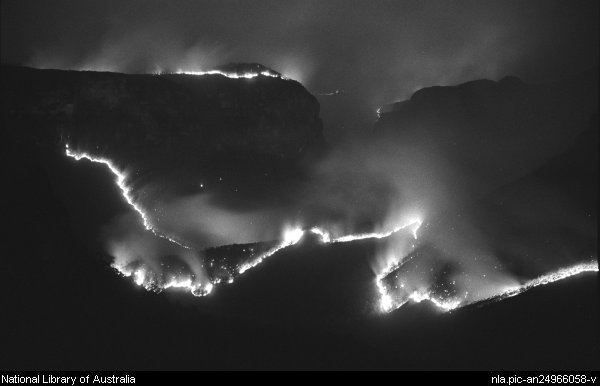
Grose Valley Bushfire of 25th October 2002
[Source: Image by Paul Cosgrave, National Library of Australia, 2003,
1 digital photograph : b&w.http://nla.gov.au/nla.pic-an24966058]
.
In 2006, the Grose Valley was incinerated in a massive firestorm and this time the fire ripped through the Blue Gum Forest..
.
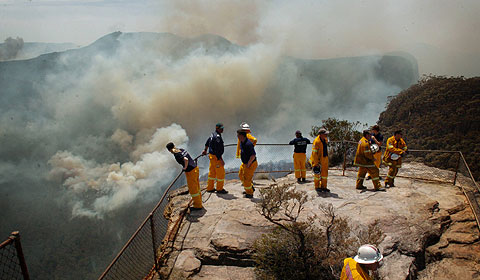
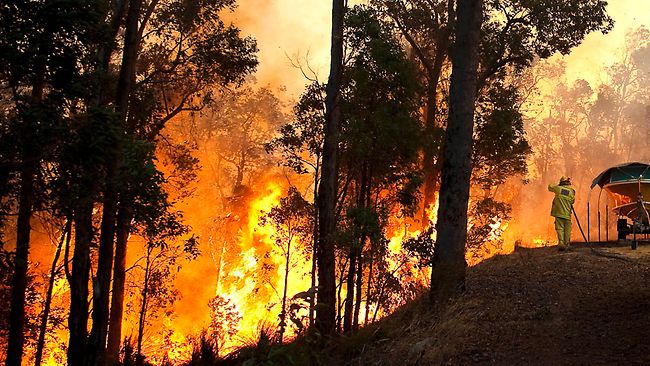
.Firefighters watching the escalating bushfire incinerating the Grose Valley below22 November 2006 – the day before the Grose Firestorm
Picture: Brad Newman, in The Australian.
.
<<Residents in towns across NSW waited for the worst last night as bushfires burned thousands of hectares across the state and dry conditions were forecast for almost the entire continent for another week.
Spot fires from a 10-day-old bushfire burning in the Blue Mountains came within a few hundred metres of houses in Blackheath. Katoomba, Mount Tomah and Lawson and other towns in the region were also under threat from the worst bushfire in the nation.
“There was virtually no cloud over the entire continent,” said Julie Evans from the NSW Bureau of Meteorology of the dry conditions expected to continue across most of Australia in the coming week.
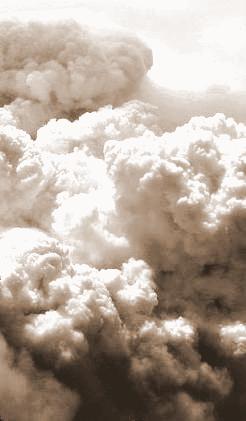
As mild weather and a cool change provided relief to firefighters in South Australia and Victoria, smoke from the Blue Mountains blaze, which was last night largely contained in the Grose Valley, rose more than 12km into the air, causing ash to fall on central Sydney and effectively creating its own weather system.
Watching from a helicopter above the flames, National Parks and Wildlife Service acting regional manager Kim De Govrik said the explosion as the fire crowned in the tree-tops around the Banks Wall cliff-face was “like a nuclear bomb going off”.
Sparks ignited fires up to 15km away, near Faulconbridge, home of Rural Fire Service Commissioner Phil Koperberg, who is directing the operation to contain the state’s fires.
“By tomorrow morning, it wouldn’t be unreasonable to expect that there will be additional fires around the countryside,” Mr Koperberg said yesterday.
About 2000 firefighters spent the day battling about 44 fires across NSW, five of which the RFS said it was unable to contain. Molong enjoyed a reprieve after a late wind shift caused a fire to change direction just 4km from the central-western town. Residents were relocated to a community centre last night, while an unoccupied house and vehicle were destroyed by the fire.
The RFS met residents in the Hawkesbury and Goulburn regions early last night to update them on the fires and what they can do to prepare their homes.
The bushfires also led to blackouts across Sydney. Just a week after the city endured its coldest November night in a century, the city sweltered through its third-hottest November day in 25 years — the official maximum temperature was 38.4C. Dozens of suburbs in the city’s west and southwest were affected by the outages, as were large sections of the CBD.
The NSW parliament was twice plunged into darkness as the power surges hit in the late afternoon, with the second one lasting several minutes.
Mild weather led the bushfire threat across South Australia to fall. CFS spokeswoman Krista St John said the state’s southeast had been hardest hit, with fires burning about 8500ha.
In Victoria, a cool change helped firefighters bring the state’s larger fires under control, although lightning strikes ignited several smaller fires in the west of the state.>>
23 November 200614,070 hectares of precious Blue Mountains habitat incineratedSo why are Australian wildlife hard to find in their natural bush habitat?
.
The home that Parks had it in for … the Blue Gum Forest’s fire-scarred trees,some of which have graced the Grose Valley for hundreds of years.
A defacto hazard reduction burn.
[Photo: Nick Moir, ^http://www.nickmoirphoto.com/]
.
<<More than 70 years ago this forest inspired the birth of the modern Australian conservation movement. Today Blue Gum Forest stands forlorn in a bed of ash.
But was it unnecessarily sacrificed because of aggressive control burning by firefighters focused on protecting people and property? That is the tough question being asked by scientists, fire experts and heritage managers as a result of the blaze in the Grose Valley of the upper Blue Mountains last month.
As the fate of the forest hangs in the balance, the State Government is facing demands for an independent review of the blaze amid claims it was made worse by control burning and inappropriate resources.
This comes against a backdrop of renewed warnings that Australia may be on the brink of a wave of species loss caused by climate change and more frequent and hotter fires. There are also claims that alternative “ecological” approaches to remote-area firefighting are underfunded and not taken seriously.
In an investigation of the Blue Mountains fires the Herald has spoken to experienced fire managers, fire experts and six senior sources in four agencies and uncovered numerous concerns and complaints.
* It was claimed that critical opportunities were lost in the first days to contain or extinguish the two original, separate fires.
* Evidence emerged that escaped backburns and spot fires meant the fires linked up and were made more dangerous to property and heritage assets – including the Blue Gum Forest. One manager said the townships of Hazelbrook, Woodford and Linden were a “bee’s dick” away from being burnt. Another described it as “our scariest moment”. Recognising the risk of the backburn strategy, one fire officer – before the lighting of a large backburn along the Bells Line of Road – publicly described that operation as “a big call”.
It later escaped twice, advancing the fire down the Grose Valley.
.
Concerns were voiced about the role of the NSW Rural Fire Service Commissioner, Phil Koperberg.
Members of the upper Blue Mountains Rural Fire Service brigades were unhappy about the backburning strategy.
There were doubts about the mix and sustainability of resources – several senior managers felt there were “too many trucks” and not enough skilled remote-area firefighters.
Scientists, heritage managers and the public were angry that the region’s national and international heritage values were being compromised or ignored.
There was anecdotal evidence that rare and even common species were being affected by the increased frequency and intensity of fires in the region.
Annoyance was voiced over the environmental damage for hastily, poorly constructed fire trails and containment lines, and there were concerns about the bill for reconstruction of infrastructure, including walking tracks.
.
The fire manager and ecologist Nic Gellie, who was the fire management officer in the Blue Mountains for the NSW National Parks and Wildlife Service during the 1980s and ’90s, says the two original fires could have been put out with more rapid direct attack.
“Instead, backburning linked up the two fires and hugely enlarged the fire area … what we saw would be more accurately described as headfire burning, creating hot new fire fronts. While it protected the town of Blackheath, the plateau tops burnt intensely – and that created new problems both for management of the fire and the protection of biodiversity.
“When extreme fire weather, hot days and high winds arrived as predicted, the expanded fire zone was still not fully contained – and that was the cause of most of the high drama and danger that followed.”
In that dramatic week, Mr Gellie confronted Mr Koperberg with his concerns that the commissioner was interfering with the management of the fire by pushing hard for large backburns along the northern side of towns in the Blue Mountains from Mount Victoria to Faulconbridge, along what is known in firefighting circles as the “black line”.
The Herald has since confirmed from numerous senior sources that “overt and covert pressure” from head office was applied to the local incident management team responsible for fighting the fire.
There were also tensions relating to Mr Koperberg’s enthusiasm for continuation of the backburning strategy along the black line – even when milder weather, lower fuel levels and close-in containment were holding the fire.
Several sources say the most frightening threat to life and property came as the fire leapt onto the Lawson Ridge on “blow-up Wednesday” (November 22) – and that those spot fires almost certainly came from the collapse of the convection column associated with the intensification of the fire by the extensive backburns.
.
The Herald has also confirmed that:
The original fire lit by a lightning strike near Burra Korain Head inside the national park on Monday, November 13, could not be found on the first day. The following day, a remote area fire team had partly contained the fire – but was removed to fight the second fire. The original fire was left to burn unattended for the next couple of days;
.
An escaped backburn was responsible for the most direct threat to houses during the two-week emergency, at Connaught Road in Blackheath. However, at a public meeting in Blackheath on Saturday night, the Rural Fire Service assistant commissioner Shane Fitzsimmons played down residents’ concerns about their lucky escape. “I don’t want to know about it. It’s incidental in the scheme of things.”
.
Mr Koperberg, who is retiring to stand as a Labor candidate in next year’s state elections, rejected the criticisms of how the fire was fought. He told the Herald: “The whole of the Grose Valley would have been burnt if we had not intervened in the way we did and property would have been threatened or lost. We are looking at a successful rather than an unsuccessful outcome.
“It’s controversial, but this is world’s best backburning practice – often it’s the only tool available to save some of the country.”
The commissioner rejected any criticism that he had exerted too much influence. “As commissioner, the buck stops with me. I don’t influence outcomes unless there is a strategy that is so ill-considered that I have to intervene.”
Mr Koperberg said it was “indisputable and irrefutable” that the Blue Mountains fire – similar to fires burning now in Victoria – was “unlike any that has been seen since European settlement”, because drought and the weather produced erratic and unpredictable fire behaviour.
The district manager of the Blue Mountains for the Rural Fire Service, Superintendent Mal Cronstedt, was the incident controller for the fire.>>
Grose Valley’s bushphobic habitat incinerated because in the minds of Parks and the Rural Fire Service it was a fuel hazard
Click image to enlarge,
Photo by Editor 20070106, free in public domain
.
<<A bushfire scars a precious forest – and sparks debate on how we fight fire in the era of climate change, writes Gregg Borschmann.
The ghosts of an enchanted forest demand answers
“Snow and sleet are falling on two bushfires burning in the Blue Mountains west of Sydney.”
ABC Radio, November 15: The news report was almost flippant, something that could happen only in Dorothea Mackellar’s land of drought and flooding rains. Later that evening, two weeks from summer, Sydney had its coldest night in more than a century.
Over the past month – as an early summer collided with a late winter and a decade-long drought – NSW and Victoria have battled more than 100 bushfires.
But of them all, last month’s Blue Mountains blaze reveals tensions and systemic problems that point to a looming crisis as bushfire fighters struggle to protect people, property, biodiversity and heritage values in a world beset by climate change.
The tensions have always been there – different cultures, different ways of imagining and managing the landscape. Perhaps they are illustrated by a joke told by two Rural Fire Service crew in the Blue Mountains. “How does the RFS put out a fire in your kitchen? By backburning your sitting room and library.” The joke barely disguises the clash between the imperative of saving lives and homes, and the desire to look after the land, and the biodiversity that underpins our social and economic lives.
For fire managers, whose first priority will always be saving people and property, the equation has become even more tortured with a series of class actions over fires in NSW and the ACT. As one observer put it: “These guys are in a position where they’re not going to take any chances. No one will ever sue over environmental damage.”
For bushfire management the debate tentatively started a couple of decades ago. The challenge was to do what poets, writers and painters have long grappled with – coming to terms with a country whose distinctiveness and recent evolutionary history have been forged in fire.
Drought and climate change now promise to catapult that debate to centre stage.
It is perhaps no accident that such a defining fire has occurred in one of the great amphitheatres of the Australian story, the Grose Valley in the upper Blue Mountains. Charles Darwin passed by on horseback in 1836, and described the valley as “stupendous … magnificent”.
The Grose has long been a microcosm of how Australians see their country. In 1859 some of the first photos in Australia were taken in the valley. Proposals for rail lines and dams were forgotten or shelved. The first great forest conservation battle was fought and won there in 1931-32.
But now the valley is under threat from an old friend and foe – fire.
Ian Brown has worked on dozens of fires in the Blue Mountains. He is a former operations manager for the National Parks and Wildlife Service.
“All fires are complex and difficult, and this sure was a nasty fire … But we need lots of tools in the shed. Those hairy, big backburns on exposed ridges so close to a blow-up day with bad weather surprised me. Frightened me even.”
For Brown, even more worrying is the trend.
“Parts of the Grose have now burnt three times in 13 years and four times in 24 years. Most of those fires started from arson or accident. Many of the species and plant communities can’t survive that sort of hammering.”
Ross Bradstock, a fire ecologist, agrees. Professor Bradstock is the director of the new Centre for the Environmental Risk Management of Bushfires at the University of Wollongong, which is funded by the Department of Environment and Conservation and the Rural Fire Service. He says Australia stands out as one of the countries whose vegetation may be most affected by climate change.
Bradstock says that in south-eastern Australia the potential for shifts in fire frequency and intensity are “very high … If we’re going to have more drought we will have more big fires.”
But the story is complicated and compounded by the interaction between drought and fire. The plants most resistant to fire, most able to bounce back after burning, will be most affected by climate change. And the plants that are going to be advantaged by aridity will be knocked over by increased fire frequency. “In general, the flora is going to get whacked from both ends – it’s going to be hit by increased fire and climate change. It’s not looking good.”
Wyn Jones, an ecologist who worked for the wildlife service, says the extremely rare drumstick plant, Isopogon fletcheri, is a good example. There are thought to be no more than 200 specimens, restricted to the upper Grose. Last week, on a walk down into the Blue Gum Forest, Jones found three – all killed by the fire.
The NSW Rural Fire Service Commissioner, Phil Koperberg, has been a keen supporter of Bradstock’s centre. Asked if he agreed with the argument that the Grose had seen too much fire, Mr Koperberg replied: “It’s not a comment I disagree with, but had we not intervened in the way we did, the entire Grose Valley would have been burnt again, not half of it.”
The great irony of the fire is that it was better weather, low fuels and close-in containment firefighting that eventually stopped the fire – not big backburns.
Remote area firefighting techniques have been pioneered and perfected over recent decades by the wildlife service. In 2003 a federal select committee on bushfires supported the approach. It recommended fire authorities and public land managers implement principles of fire prevention and “rapid and effective initial attack”.
Nic Gellie, a fire ecologist and former fire manager, has helped the wildlife service pioneer ecological fire management. The models are there – but he says they have not been used often enough or properly.
Doubts have been expressed about the sustainability of the current remote area firefighting model. It is underfunded, and relies on a mix of paid parks service staff and fire service volunteers. Most agree the model is a good one, but not viable during a longer bushfire relying on volunteers.
The Sydney Catchment Authority pays $1 million for Catchment Remote Area Firefighting Teams in the Warragamba water supply area. It has always seemed like a lot of money. But it looks like a bargain stacked against the estimated cost of $10 million for the direct costs and rehabilitation of the Grose fire.
Curiously, one unexpected outcome of the great Grose fire may be that the valley sees more regular, planned fire – something the former wildlife service manager Ian Brown is considering.
“If climate change means that the Grose is going to get blasted every 12 years or less, then we need more than just the backburning strategy. We need to get better at initial attack and maybe also look at more planned burns before these crises. But actually getting those burns done – and done right – that’s the real challenge.”
It may be the only hope for Isopogon fletcheri.
Asked if he would do anything differently, Mr Cronstedt answered: “Probably.” But other strategies might have also had unknown or unpredictable consequences, he said.
Jack Tolhurst, the deputy fire control officer (operations) for the Blue Mountains, said: “I am adamant that this fire was managed very well. We didn’t lose any lives or property and only half the Grose Valley was burnt.”
Mr Tolhurst, who has 50 years’ experience in the Blue Mountains, said: “This fire is the most contrary fire we have ever dealt with up here.”
John Merson, the executive director of the Blue Mountains World Heritage Institute, said fire management was being complicated by conditions possibly associated with climate change.
“With increased fire frequency and intensity, we are looking at a fundamental change in Australian ecosystems,” he said. “We will lose species. But we don’t know what will prosper and what will replace those disappearing species. It’s not a happy state. It’s a very tough call for firefighters trying to do what they think is the right thing when the game is no longer the same.
“What we are seeing is a reflex response that may no longer be appropriate and doesn’t take account of all the values we are trying to protect.”>>
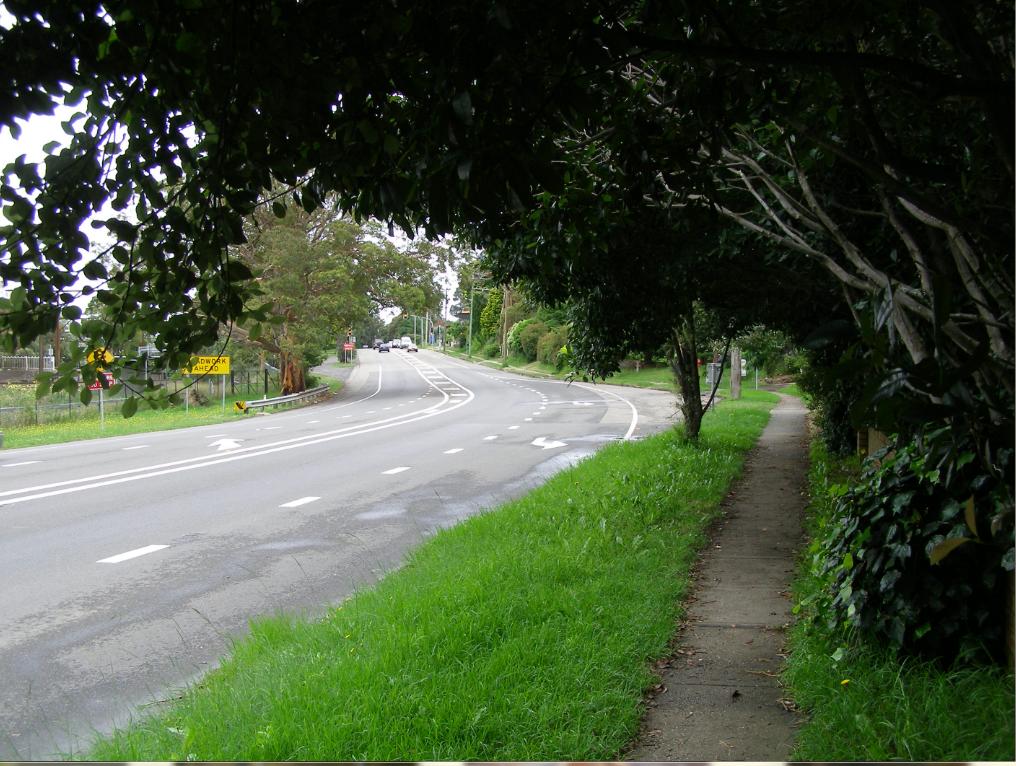
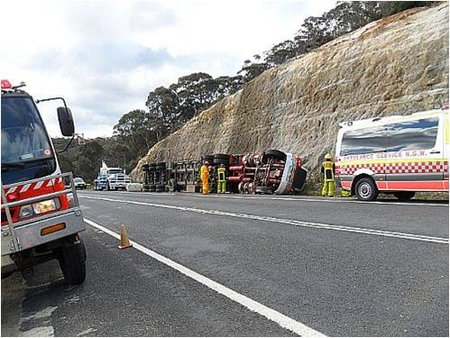
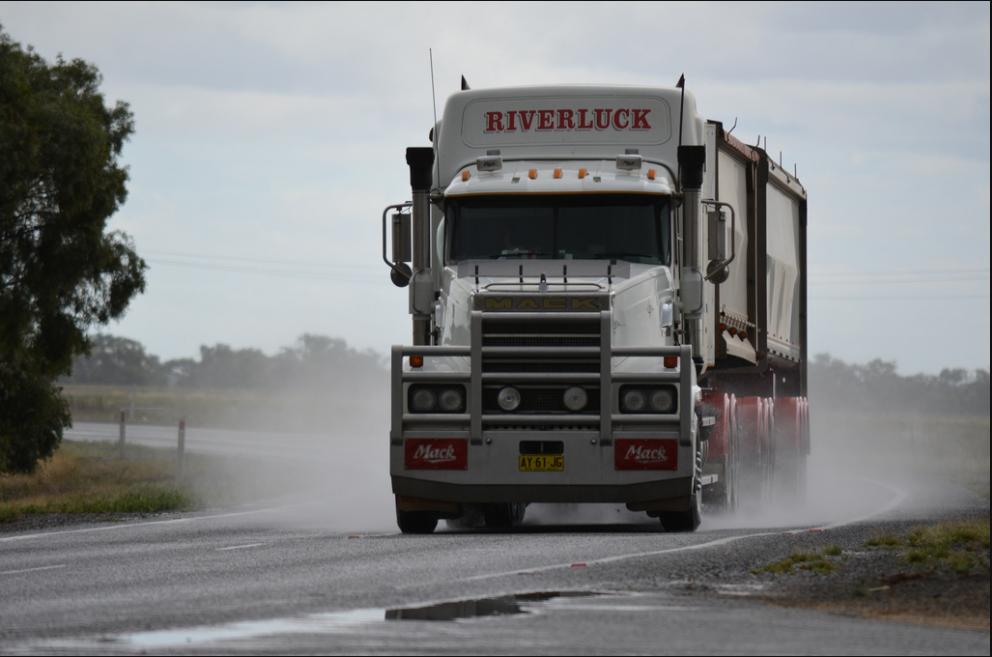
The Dangerous Trucking Menace is becoming increasingly prevalent across the Blue Mountains on both the Great Western Highway and the Bells Line of Road.
This is because the ‘Roads and Traffic Authority‘ – rebranded but culturally unchanged to the ‘Transport Roads and Maritime Services‘ is tasked to re-engineer the Great Western Highway, a regional and local road, to facilitate more trucks.
The trucking mandate is to transform the highway into an expressway designed for bigger and faster trucks, just like the F3 Motorway between outer Sydney and the regional city of Newcastle, as infamously deadly that the F3 is.
The trucking mandate is national and driven by an Australia-wide freight transport policy which prioritises 95% road and 5% rail. The truck-centric policy is steered by self-interested influential trucking magnates and their industry, whose driving catch-phrase is ‘time is money‘ and so any community along the highway that slows their trucks down must be dealt with. They fund political economic rationalism which prefers to outsource and privatise instead of responsibly investing in national rail freight infrastructure.
Highway communities are treated as second class citizens. Residents like the many thousands across the Blue Mountains are increasing exposed to the Dangerous Trucking Menace, when sharing the highway and from their homes:
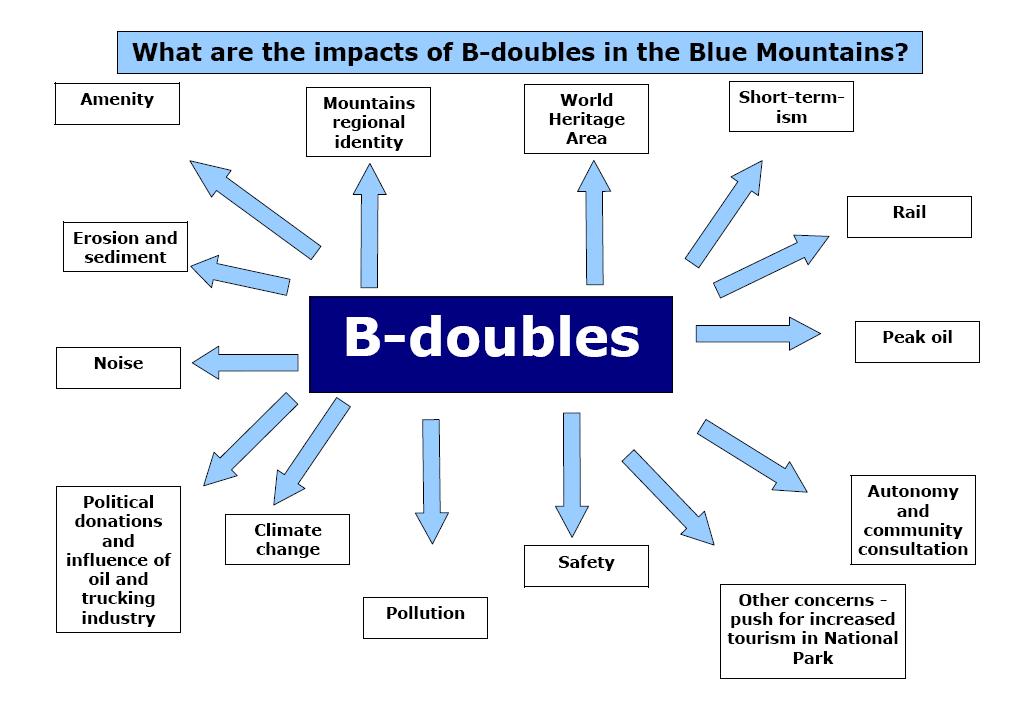
Bigger trucks and more B-Doubles
Speeding trucks
Tailgating trucks
Trucks over the centre double lines
Truck drivers frequently seen talking on a mobile phone while driving
Exhaust brakes used at all hours through towns and villages
Collisions and deaths
Overturned trucks
Broken down trucks
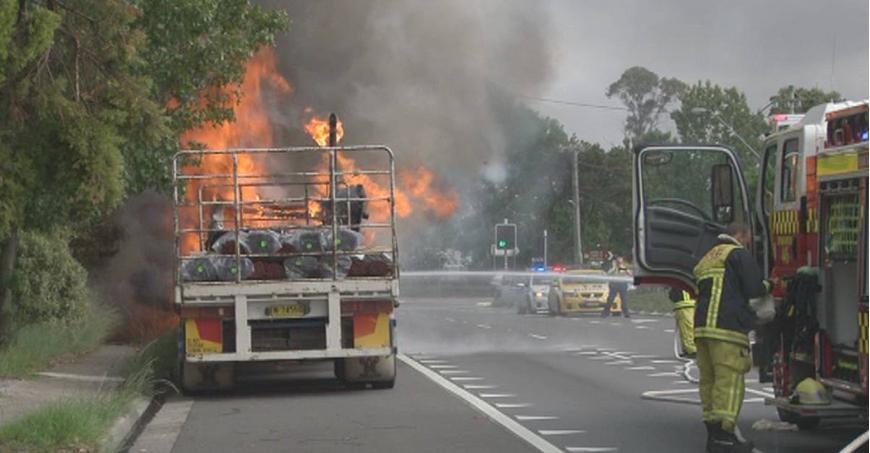
Trucks on fire
Truck tankers with gas, fuel or hazardous chemical leaks
Selfish truckies sleeping outside residents at all hours with refrigerator motors running at Mt Victoria
Same selfish truckies found urinating and defecating in residents’ front verges at Mt Victoria.
.
[Ed: And truckies and their supporting wives wonder why truckies have a bad reputation and often cop blame? Trucking is not a profession. It is a uncontrolled cowboy skill-easy job earning pittance, attracting imbeciles and causing reckless maiming and death. This Editor has continued to hold an ‘HC’ licence from 1989, but income-wise has long since moved on.]
.
Source: Blackheath Highway Action Group
‘The Blackheath Highway Action group was formed in 2008 to fight a proposal to turn the Great Western Highway
into a 4 lane high productivity freight vehicle (25/26/30m B-doubles) route across the Blue Mountains.
Website: ^http://www.bag.asn.au
.
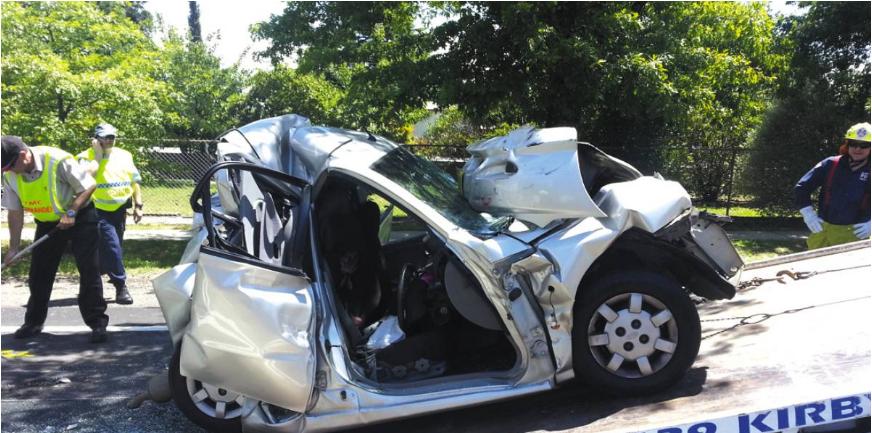
Hardly a week passes without some report of a truck-related incident along the Great Western Highway and especially along the Hume Freeway, F3 Motorway and Pacific Highway, and that is just in New South Wales. One local resident of the Blue Mountains, a Marcus Padley, terms these ‘Mack Truck Moments‘. If only it were funny. Last month Sarina Heta in her Kia Rio sedan wasn’t laughing when she was violently crushed between two B-doubles on the Great Western highway at Blackheath.
Australia has no central register of truck incidents, but if it did one wagers that the occurrence would be a daily one. This is unacceptable yet the trucking menace is encouraged and poorly controlled or policed.
Currently, the Great Western Highway is being widened to four lanes at Hazelbrook at great expense and considerable delay due to poor due diligence and mismanagement. In the re-engineered design, all interests of trucks are priorities by the road engineers, while local residents have little or no say. As each stage of widening transformation takes place, successive affected communities become disheartened and confronted by the bulldozing of the regional highway and its replacement with a much wider trucking expressway.
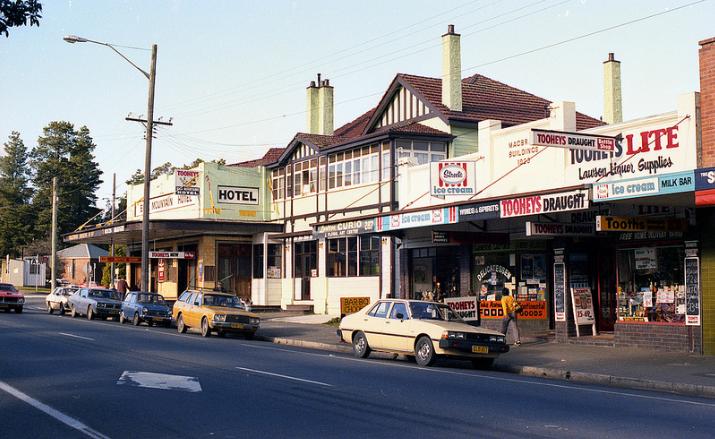
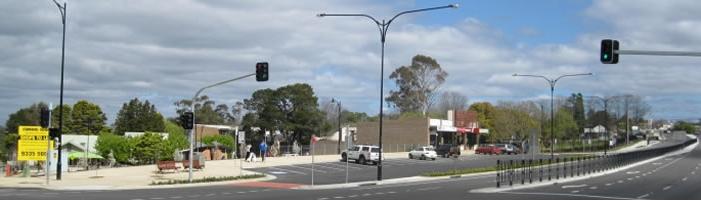
Lawson has been completely obliterated and its character ‘lobotomised‘ as a town.
.
Lawson before the Trucking Expressway bulldozers
.
Neo-LawsonShops bulldozedVillage Character urban lobotomised
.
Soon it will be neighbouring Bullaburra’s turn and highway properties are already up for sale.
Bullaburra: On Trucking Death Row
.
The Bells Line of Road across the Blue Mountains is also having its side shoulders widened to accommodate B-double trucks 24/7 and is involving the destruction of native vegetation for kilometres. Stage 1 is around the agricultural village of Bilpin.
Many sand and gravel B-Double style trucks use the Bells Line of Road between quarries and Sydney. They are paid a trip rate and so travel at excessive speed to maximise trips per day. The road has no speed cameras and is rarely patrolled by police. It has become an infamous trucking cowboy route. In June 2012, a sand loaded semi-trailer collided with two cars near Mt Tomah. The truck was probably over the centre double lines like they usually are.
In May 2011, a gravel truck overturned on the Bells Line of Road while exceeding the speed limit. The road is a renowned trucking menace and car drivers and motorbike riders use it at their own risk. In July 2009, a motorcyclist has been killed on the Bells Line of Road 10 kilometres west of the Mount Tomah. It must have surely been a ‘Mack Truck Moment‘.
The government’s Trucking Expressway Mandate is to keep widening the Great Western Highway out to mainly four lanes between outer Sydney where the 6-lane M4 Motorway currently links to, and all the way out to Orange and beyond. The long-term trucking strategy to eventually encourage 24/7 trucking of B-doubles between Sydney and Perth and Darwin. In western Victoria even B-triples have been introduced, which are basically Road Trains – give the trucking lobby time.
B-doubles have to date been prohibited from the Great Western Highway due to its narrow unsuitable design and to respect the fact that it passes through nearly two dozen regional town and villages. But that is constantly being challenged and undermined by hard-nosed government policy.
The dangerous misguided premise by the policy and by road engineers is that a wider a faster trucking expressway will be safer than the existing highway, yet the evidence refutes that. All one needs to do is consider the repeated statistical record of trucks incidents along the already widened sections of the Great Western highway, and indeed along the RTA/RMS’s favourite creation, its F3 Motorway.
The following recent reports of trucking incidents are testament to the trucking menace that trucking expressways attract.
.
2nd March 2013: ‘Overturned Truck Closes F3 at Mount White’
.
<<Mount White: The F3 remains closed northbound approaching the Old Pacific Highway Overpass in Mount White due to a truck accident. Motorists are being diverted off the F3 onto the Old Pacific Highway at the Hawkesbury Interchange in Mooney Mooney. Emergency services and RMS crews are on site, working to clear the accident as quickly as possible…>
<<All southbound and northbound lanes have reopened on the F3 near Motorway Link Road in Warnervale now that gas bottles are no longer leaking on the back of a truck. Gas cylinders began leaking on the back of a truck near Motorway Link Road about 6.45pm, forcing the closure of southbound lanes and one northbound lane.>>
<<There was a lucky escape for a truck driver on the Central Coast yesterday. Just after 11am, a Rutherford-bound semi trailer full of clay caught fire, forcing the closure of northbound lanes of the F3 Freeway at Mount White. The driver, from Victoria, had pulled the rig over after seeing smoke billowing from the engine. He escaped unharmed but the same couldn’t be said for the prime mover.>>
7 Feb 2013: ‘Hume Highway traffic affected after truck roll over’
.
<<Both northbound lanes of the Hume Highway were closed south of Tarcutta following the accident but one northbound lane was since been re-opened. The accident about 15km south of Tarcutta occurred shortly after 9am this morning. Emergency services are in attendance and a HAZMAT team has been sent following reports of diesel over the road. Motorists are advised to drive with caution if in the area and to allow for extra time on their journey.>>
Nov 2012: ‘Traffic slow at Ourimbah following truck rollover’
.
<<Traffic is slowing on the F3 Freeway near Ourimbah on the Central Coast where a semi-trailer rolled onto its side about 9.30am. It is understood the driver was trapped for a short time but has since been freed and police are on-site managing the clean up and traffic control.>>
Mar 2012: ‘Police target second trucking firm over safety’
.
<<New South Wales police are targeting another truck company over suspected serious safety breaches. Trucks from the South Australian-based Scott’s transport are being stopped at several heavy vehicle checking stations, including the F3 freeway at Mount White and the Hume Highway at Marulan. Officials from Roads and Maritime Services are also involved in the operation.
Police say one of the company’s B-double trucks was caught driving on the Hume Highway at Mittagong at 142 kilometres per hour early on Monday morning. Officers are searching for 32 Scott’s trucks out of the company’s fleet of more than 300, and say that number may rise. They say the trucks will then undergo a comprehensive mechanical inspection. The investigation follows an operation against Sydney-based Lennons Transport Services, where police say speed limiting devices in numerous trucks had been tampered with.
A Lennons driver is before the courts charged over a crash that killed three people on the Hume Highway at Menangle in January.>>
Jul 2011: ‘Delays on freeway after truck rollover’
.
<<NSW motorists on the F3 freeway are being warned to expect significant delays after a B-double truck rolled over at Cooranbong southwest of Newcastle. The truck, which was carrying milk, rolled onto its side and skidded for several metres at the Freemans Drive overpass before being hit by a ute.
The truck driver was taken to hospital but the woman driving the ute escaped injury. A salvage operation is underway but it is expected the freeway will be blocked for several hours. Southbound traffic is being diverted at Palmers Drive to re-enter at Freemans Drive southbound on-ramp.>>
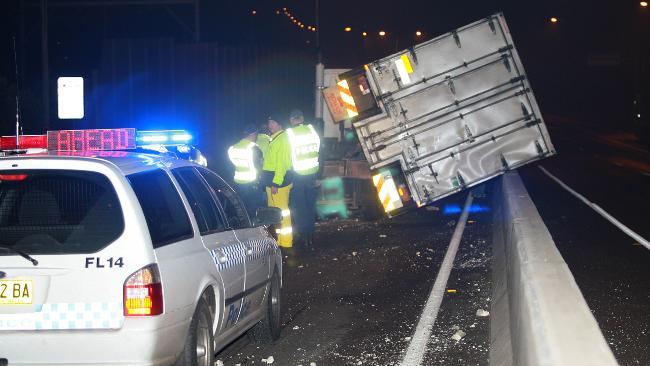
Lost load … the scene at Chullora where a refrigerated pantech fell from a truck
[Source: Picture: Bill Hearne, The Daily Telegraph]
.
<<It was a year of carnage for the state’s truck drivers, with the number of fatal accidents increasing by more than 90 per cent, government statistics reveal.
There were 23 fatal crashes involving heavy rigid trucks – non-articulated vehicles greater than eight tonnes – in 2009. This was up from 12 a year earlier, the Bureau of Infrastructure, Transport and Regional Economics (BITRE) said. The BITRE data also showed the number of people killed in accidents involving heavy rigid trucks in NSW was up 100 per cent to 24, when deaths in Australia decreased by 14.7 per cent.
The RTA dismissed claims that the increase in the road death statistics were a cause for concern. The RTA’s NSW Centre for Road Safety director Soames Job said the increase was the result of a reduction in deaths the year before. “The main number that produces the outcome is the low number of deaths the previous year. It was extraordinary that we had so few in 2008,” Dr Job said.
Fatal accidents involving articulated trucks fell from 47 in 2008 to 34 in 2009, BITRE said. The figures came as a truck driver had a lucky escape in Sydney’s west on Tuesday night.
The refrigerated section of a meat carrier sheared from the truck and rolled on to the Hume Highway flyover at Chullora. A crane was brought in to right the truck to clear the road.
Dr Job said in many crashes, the smaller vehicle might be at fault. “Lots of these accidents will involve speed and fatigue and that is what we are trying to address,” he said. “We have this large program of speed enforcement in areas where there is known heavy truck traffic and that is why we have said we’ll roll out 20 locations of point-to-point speed cameras across our highway network”..>>
Aug 2010: ‘B-double crashes on F3, shutting southbound lanes’
.
<<Motorists using the F3 Freeway are being told to divert their travel or face significant traffic delays after a B-double carrying gas cylinders crashed today. The truck was carrying 1600 nine kilogram cylinders when it hit the eastern brick wall just before the Hawkesbury River Bridge about 9:15am.
No one was injured but the crash forced police to close two of the three southbound lanes. Northbound lanes remain open and all lanes are expected to be opened by 4pm. Southbound motorists are being urged to avoid the area by taking the Pacific Highway exit at Brooklyn,” a police statement says. “The gas cylinders are being removed by hand for safety reasons prior to the B-double being removed. Inquiries into the crash are continuing.>>
Jun 2010: ‘Driver dies after flipping truck on F3’
.
<<A man has died in a truck accident on the F3 at Mount White on the New South Wales central coast yesterday. Police say the driver was turning into a heavy vehicle checking station when his trailer jackknifed at about 3:30pm. The truck then flipped onto the driver’s side before sliding into a power pole. The male driver, who has not been formally identified, was killed. A report will be prepared for the Coroner.>>
Apr 2010: ‘Highway smash raises response time questions’
.
<<The New South Wales Roads Minister says the RTA did not act quickly enough to re-open the F3 Freeway after an accident south of Newcastle yesterday, which left motorists stranded for hours.
A flat-bed truck ran into the back of a fully loaded fuel tanker on the freeway around midday near Mount White, with the accident closing all northbound lanes.
The RTA set up a contraflow around the accident site, using southbound lanes for motorists heading north, and diverting southbound traffic along the old Pacific Highway.
Questions are being asked why it took so long to set up the contraflow, which was not in place until at least eight hours after the crash.
Hazmat crews worked to remove fuel from the tanker, with the Fire Brigade declaring the area safe sometime around midnight.
The Roads and Transport Minister David Campbell says he will be meeting with the RTA today to discuss the delay in re-opening the road.>>
<<A truck driver has been left with serious head injuries after an accident on the New South Wales central coast. Police say the accident happened on the F3 Freeway at Mount White at about 11:40am (AEST). It is believed a flat-bed vegetable truck ran into the back of a fully laden petrol tanker…>>
Sep 2009: ‘Delays on Sydney’s F3 after another fatality’
.
<<Traffic is being delayed on the F3 freeway as police investigate a death near the Mooney Mooney Bridge, south of Gosford. Police say a man fell onto the road and died just after 1pm AEST. All northbound lanes have been closed while investigations are carried out…>>
Aug 2009: ‘Young parents and baby die in F3 inferno’
.
The wreckage on the F3 after the fatal crashA couple and baby killed
[Photo: Matt Black Productions]
.
<<A young Gosford couple and their baby were killed when their car burst into flames in a crash involving a B-double truck and another car on the F3 freeway on the NSW Central Coast yesterday night.
Police said two cars stopped on the freeway before a truck struck both vehicles from behind, killing a 27-year-old woman, a 32-year-old man and a five-month-old baby at 10.50pm. The impact caused one of the cars and the truck to catch fire. There was also another triple fatality in central-northern NSW about 10.30am today on Newell Highway near Narrabri.
Police said the bodies of the young family were found in the charred car on the 110 km/h marked stretch of road near the Mount White weigh-bridge. Two other people were taken to Gosford Hospital with various injuries.
Metropolitan crash investigator Sergeant Peter Jenkins said the family’s car was completely “incinerated”. “For some reason the two vehicles have become stationary in lane one, northbound, they’re not in the breakdown lane, they’re actually still in the traffic lane,” he told Macquarie Radio today.
“The young family’s car is the southern vehicle, another northbound car has braked and stopped and swerved to miss it and entered into the breakdown lane.
“Since that’s happened the truck driver’s been exposed to these two vehicles and he’s done what he can, but he hasn’t been able to avoid these two vehicles.” He said the truck driver was suffering from shock and had been discharged from hospital after speaking to police.
Towers Transport general manager John Perkins said the truck driver was very upset. “He has no apparent physical injuries … he’s extremely distraught,” Mr Perkins said.
He would not comment on the circumstances surrounding the accident but said the company had never been involved in a fatal crash. “We’ve been in business for 20 years, we’ve got about 50 trucks, and this is the first time we’ve been faced with something like this,” Mr Perkins said.
The driver of the second car was taken to Gosford Hospital for treatment, but police have been unable to to speak to him. His condition is unknown. The family has been identified and some relatives have been notified of their deaths, he said.
Sergeant Jenkins played down claims the stretch of road was dangerous, saying he hadn’t been able to attribute a serious crash in the area to the design or condition of the road in the past 20 years.
“I think the F3 is actually quite a good stretch of road in most parts,” he said.
“Inquiries into the circumstances leading up to the crash are continuing,” a police spokesman said.
‘Expect long delays’
Northbound lanes on the F3 freeway out of Sydney have reopened to traffic but motorists are warned to expect long delays.
All northbound lanes were closed while police removed the bodies and wreckage and carried out an investigation until about 11.20am today.
Despite reopening the lanes, traffic is still banked up for almost 10 kilometres between Mount White and the Hawkesbury River, the Road and Traffic Authority says.
“All lanes are open on the F3, but traffic will take a while to clear, an RTA spokesman told AAP.
“Traffic is still heavy with significant delays and people who have been diverted on to the Pacific Highway will also experience significant delays.”
It is the second major crash in two days on the F3 in that area. Four people escaped serious injury in a six-vehicle crash caused when a piece of scaffolding fell off a semitrailer at Mooney Mooney yesterday.
Police are appealing for anyone who might have seen the crash and are yet to speak to crash investigators to contact them via Crime Stoppers on 1800 333 000.>>
<<Car drivers have had lots of restrictions placed on them over the years in an attempt to reduce the road toll including school zones due to a slight increase in accidents. A 100% increase in heavy truck deaths is not acceptable. Reduce their speeds to 60kph and reduce fatigue by reducing driving time to 6 hours per day and accidents due to speed or fatigue will drop. Imagine what would happen if car deaths increased 100%. Would we see changes, you can bet on it.>>
.
Rod Pickin:
<<Until the maximum road speed for heavy vehicles is limited to 80kph, you can expect a continued increase in accidents/deaths involving these vehicles. Currently heavy vehicles are being driven dangerously and at high speed as a result of work/deadline pressures imposed upon drivers by owners/operators and major supermarket customers all sanctioned by govt. bodies.
Truly how rediculous is it that a fully loaded B-Double even road train fuel/gas tanker is legally allowed on our highways in the wet to travel at 100kph? that is just inviting major drama so one is entitled to ask, who is putting presure on who in order that this be allowed.>
.
Rob:
<<I’ve noticed the lack of ‘100 speed limited’ signs on most trucks these days as they go flying past me on the highways while I’m obeying the limit.>>
.
Julian:
<<This is sad. The carnage on the F3 goes on, mostly involving semi-trailers. When I take my family on holidays, trucks tail-gate us at 120Kph, and scare the hell out of me.>>
.
Young parents and toddler die in fiery crash:
<<The solution is simple. make speed limit for trucks 70kmh max and must not move out of left lane for whatever reason. the F3 is the most dangerous freeway I have ever driven on, doing 100-110 on blind hills and bends a truck has no way of stopping fast if it has to.>>
.
David:
<<I drive the F3 every day and it is a miracle that more accidents such as these do no occur. In peak hour the average speed of vehicles is in excess of speed limit and cars do this with the knowledge that they are highly unlikely to be caught. When police do drive along the freeway they also average around 10 kph above the speed limit and cars just happily follow them at that speed.
In the road works area you have speed variances of between 80 kph (speed limit) and 120 kph with average of around 100 kph. To sit on the speed limit along that road is nearly more dangerous than speeding. This is a tragedy as are all road deaths and one can only hope that this does force the authorities into action so that something positive comes from it to get some sanity back into the way drivers behave on this road.>>
.
mirage:
<<I’m sure its another example of a truck driver that was speeding – I travel every few weeks up and down the F3 in a normal sedan at 100-110km per hour and most trucks fly past me except when going up the hills…the Police are not doing enough and some truck drivers just think they can do what they want…same attitude problem as the ferry drivers on the harbour and bus drivers…they think the road is theirs and they are smarter than the rest, professional drivers…they should know that in the end the extra speed doesnt make much difference…>>
.
More Trains, Less Trucks:
<<One partial solution would be to build a freight line so that we could send more goods by rail. Think about howmany trucks would be off the road for each extra train. I am sure that the truckies would complain about potential loss of jobs, but that wasn’t the case when the Ghan was extended from Alice Springs to Darwin.
Instead of losing jobs, the truckies found that they had more short haul jobs supplying the freight trains and less long haul jobs with all of the associated safety issues.>>
.
Kate:
<<I used to drive the F3 regularly but now catch the train as it is too dangerous. If you look at the accident record over the past few years, you will see most involve trucks. The F3 is one of the few decent roads in the state, yet now ruined by huge speeding semis and other trucks that are a terrible hazard to cars. On top of that everyone speeds like the devil, with impunity it seems. All those massive tonnes of heavy goods in transit should be shipped by rail. The whole transport thing is getting completely out of hand.>>
.
frederick:
<<I am often horrified at the increase in trucks on our roads and the frequent aggressive driving adopted by these drivers. Driving generally on our roads has become so bad that this sort of horror is going to keep happening. Anyone who drives at or near the speed limit would know. Unless of course our pollies have the guts to do something about it and the Police start to enforce some of the existing road rules. With three warning signs before every fixed speed camera we might as well adopt a new slogan for NSW – THE DUMB STATE!
How many more lives is it going to take before we come to our senses?>>
.
Ian C. Purdie:
<<Yes, so trucks are speed limited to 100 kph, the sign on the back says so. That would be the reason they either tail gate you at 110 kph or overtake.>>
.
waqi13:
<<I travel on F3 several times each week for work. At least once a week I have a close call with truck drivers not paying attention to what is going on around them. It seems that 90% of trucks have blinkers and side mirrors that don’t work – they change lanes at the drop of a hat with no indication, and in the worst case scenario to overtake another truck that they cannot go fasther than anyway – creating a long line of traffic, chugging up a hill at much less then the speed limit.
I have learnt to give trucks a wide berth, because they will do what they want to do without checking for any cars around them.>>
.
Daniel:
<<It’s a dangerous road at night and drivers need to have full concentration on the freeway. they need to stick to the speed limit. Ive driven on it so many times and I do 110 and others are flying past me all the time. Trucks are going faster than the 100 they are supposed to be doing. Most of the time now I use the old Pacific Highway through to Gosford. its just too dangerous with all the rats on the road.>>
.
JSKS:
<<It’s very sad indeed. In fact 110km/hr is a very fast speed for a fully loaded truck. It’s not easy for the truck to stop that easily when their loads are full. At 10.30pm, the truck light shining distance is at best 30 meters. I believed by the time the driver realised that there is a car in front, it’s too late to stop effectively. In other countries, while the Freeway limit is 110km/hr, the maximum speed limit for truck is only 90km/hr. Yes, this will delay delivery time but I think HUMAN LIFE is more important than delivery time.>
.
SP233K:
<<I drive on the F3 every day, and seriously no one obeys speed limits,they tailgate,they speed like crazy,the have no regard for anyone else,trucks speed and change lanes cutting people off and don’t care at all. Every day i worry i will end up in an accident and as soon as it gets dark trucks drive about a thousand times worse,they would have no way of stopping quickly.
Police constantly pull over cars (in the event there are actually police patrolling which is not very often). I really think they should be pulling over trucks as well. I hope this is a warning to everyone to be more careful on the F3, surely there have been enough horrific accidents for everyone to see how dangerous it is.
My heart goes out to the families of the people involved in last night’s accident. I drove past this morning and it really was a horrible scene.>>
May 2009: ‘B-double involved in F3 collision with car’
.
<<There has been yet another traffic accident on the F3 involving a B-double truck, overnight. About 10.40pm last night (Tuesday), the driver of the B-double truck, a 38-year-old man from Cundletown, allegedly changed lanes and ran straight into a car being driven by a 63-year-old man from Umina. Both vehicles were travelling north along the freeway at Wahroonga, near Alexandria Pde.
When the car was hit, it spun out of control, police said, and collided with the median guardrail. The driver of the car was trapped until emergency crews cut him from the wreckage.
He was taken to the Royal North Shore Hospital with suspected back injuries and remains in a serious but stable condition. Hornsby Police have told the Advocate they will wait on the results of blood test before taking any action. No charges have yet been laid.>>
Apr 2009: ‘F3 truck ‘cut off’ before cliff plunge’
.
<<Police are searching for the driver of a white Kenworth truck seen close to a semitrailer that plunged 80 metres off the F3, north of Sydney yesterday. Emergency services workers have recovered the body of the 40-year-old driver. The driver is reported to have been married with a young child.
The semitrailer will be salvaged by crane from 8pm today, with northbound traffic to be diverted from the F3 at Wahroonga. The B-Double Linfox semitrailer was carrying toilet paper when it crashed through a safety barrier at the side of the freeway and fell into the valley near Hornsby about 11.35am yesterday.
Two northbound lanes of the F3 were closed and traffic was diverted after the crash. Police are investigating reports the Sydney man had swerved to miss another truck which had changed lanes in front of him, before his vehicle speared off the road. Police today appealed for the driver of the Kenworth truck to come forward.
“We are appealing for the driver of a white Kenworth that was close to the [semitrailer] at the time of the crash to contact police through the Crime Stoppers hotline and tell us what they know or what they might have seen at the time the truck went over the railing,” a NSW Police spokeswoman said.
Senior Sergeant Peter Jenkins of the Metropolitan Crash Investigation Unit said witnesses told police there were some trucks near the semitrailer before the crash happened.
“It would apply at this stage that they might not have contributed to the crash. They might be totally innocent people driving along. But we would like to interview them because they may know something about the reason why this gentleman has left the roadway,” he said. “So we are appealing to them as witnesses at this stage.”
Senior Sergeant Jenkins said it was raining quite heavily when the accident occurred and police would be investigating all the possible accident factors, including weather, road surface, traffic, mechancial issues and the driver’s schedule.
But Phil Easterbrook, who lives near where the accident happened and heard a bang, said the accident was not unexpected. “We always hear the sound of horns going off and of braking. They are [hooting] to avert an accident because people are cutting them off,” he said. “We hear banging quite regularly from vehicles from accidents happening.”
Mr Easterbrook, who used to drive a truck, said trucks would try to build up speed as they went up the hill, and so would not like other vehicles cutting them off.
.
ROAD SURFACE HAZARD
Paul Gerrard, who uses the F3 daily to travel from Kellyville to his work in Tuggerah and back, said the road surface where the accident occurred had been a serious hazard for a few months.
“Approximately four to five months ago the original freeway road surface [bitumen] was removed by mechanical pavement machines in an overnight operation that went for several weeks,” he said. “In the absence of signs it appears the pavement was removed to enable the whole freeway to be resurfaced with bitumen after the widening project [of the freeway] is completed.
Mr Gerrard said the northbound lanes, which were resurfaced, now had a rough texture and were dangerous to drive on especially during heavy rain. “The road gets far too much water and there’s no control. My experience is that, during heavy rain, drivers must slow to approximately 70kmh or the car aquaplanes left. It is an expectation and not random.”
He said the rails along these lanes were dented from large impacts of vehicles hitting them.
An RTA spokesman said that, while it could not comment on the accident as it was the subject of a police investigation, concrete roads such as the ones on the F3 were not uncommon in NSW.
“The RTA regularly carries out tests on road surface across the state and this section of road was last tested in August and September of last year. These tests showed that the road surface provided adequate wet-weather grip,” the spokesman said. The RTA spokesman said it understood the accident took place “on a downhill section where surface water would not accumulate”, and advised motorists to slow down and adjust their driving when there was wet weather.
From 2003 to 2007, there were six crashes reported on the 1km northbound section of of the F3 just north of the Edgeworth David Avenue overpass at Wahroonga, the spokesman said.
None of the crashes involved heavy vehicles and there were no deaths, he said.
.
CRANE FAILED TO MOVE SEMI-TRAILER
A crane was brought in to lift the semitrailer, but a 7?-hour operation from 4.30pm to midnight by emergency services failed to move it.
“The boom on it to go down to the truck was not long enough,” an RTA spokeswoman said. A larger 400-tonne crane would be brought in to lift the truck tonight, the spokeswoman said.
It was not yet decided which company would be supplying the crane, although it was likely Linfox would foot the bill, she said.
The RTA said the crane would take three to four hours to assemble, and the same time to disassemble. It said it would take four hours to move the truck. The RTA will close access to the F3 northbound from the Pacific Highway and Pennant Hills Road at Wahroonga during the salvage operation.
Traffic would rejoin the F3 at Berowa. Diversions were expected to be in place until 8am tomorrow, the RTA said. Southbound lanes would not be affected. Yesterday’s fears that the fuel spilt from the truck would cause environmental damage have also dissipated, NSW Fire Brigades spokesman Craig Brierley said.
The diesel from the truck spread over a large area and sank into the soil beneath the truck, but did not reach the water catchment area nearby, Mr Brierley said. The low amount of fuel in the tank and its cargo meant there were fewer fears about its impact on the environment, he said. “There was only 500 litres of diesel on the truck, which is not a lot, so that made the job a lot easier,” Mr Brierley said. Hazmat crews were at the site of the crash for most of yesterday night and would check the area again when the truck was removed, he said.
.
[Ed: Was the RTA recklessly culpable for the driver’s death?]
.
FUND ESTABLISHED TO HELP FAMILYT OF DEAD TRUCKIE
The young family of the driver will be the recipients of a fund established by transport union officials.
“The man who died yesterday had a young family and what happened can only be described as a tragedy,” Transport Workers’ Union NSW secretary Wayne Forno said today. “The TWU is calling on all members to donate to a fund we are setting up for the man’s family, and Linfox has indicated they will match those donations. “But we are also calling for a full investigation into the incident, and for the coroner to examine how hyper-competitive road freight industry and the inadequate pay and conditions of truck drivers are contributing to more deaths on the road.”
A Linfox spokesman said the company did not comment on donations, but “conditionally we would match what colleagues contribute”.>>
<<There has heavy traffic on the F3 freeway north of Sydney after a truck caught on fire just before 11:00am AEDT today. The accident blocked all northbound lanes at Mount White, but traffic is now moving slowly after a lane was reopened. It is not yet known what caused the blaze.
Kate Martin was driving on the freeway when the accident happened. “It was on fire, really badly on fire, black smoke just streaming out of the truck,” she said. “It took a while for the police to arrive. It was burning for about 10 minutes before any services arrived.”>>
<<Commuters on the New South Wales Central Coast are being urged to delay their drive to Sydney after a crash involving a semi-trailer and several cars on the F3 freeway, near Mount White.
The Ambulance Service says two women and a teenage girl are in a stable condition in hospital after the accident. Roads and Traffic Authority spokesman Alec Brown says all three southbound lanes are blocked and traffic is backed up for three kilometres.
Mr Brown says it is not known how long it will take to clear the accident. “It’s impossible to predict. It really does depend on how smoothly it goes,” he said. “We’ve removed one truck already. We’re working on the rest of the vehicles and that’s something we’re doing as a priority.”
Traffic is being diverted onto the Old Pacific Highway.>>
Motorway Widening CancerRoad Widening is a Chicken and Egg causality dilemma – widen it and they shall come and then congest it, so widen it again…
.
<<It doesn’t matter who’s right in this situation. The bigger problem has been the failure of the Australian government for setting unrealistic freight rail goals for Port Botany.
After setting a goal of shipping 40 percent of all Port Botany cargo by rail, the Australian government has dropped its target to 28 percent
“’Forty per cent was unrealistic and unachievable and typified Labor’s propensity to pluck figures out of the air,” the Transport Minister, Gladys Berejiklian, told the Sydney Morning Herald.
The increased number of trucks on the road is already causing considerable delays for motorists. Last Friday, one semi-trailer jack-knifed across one highway, according to the Herald, causing a traffic jam roughly 5 miles long.>>
Perth Hills Bushfires at Roleystone, Feb 2011
(Photo credit: AP)
.
In our technologically advanced society, many people now wrongly presume that Humanity has elevated itself above Nature and so no longer needs to respect it. This misguided attitude extends to government.
In Australia, people continue to build homes in flood prone river plains, and governments continue to approve them. People continue to build homes in bushfire prone areas that are indefensible from bushfire, yet governments continue to approve their construction.
Almost every year now, a natural disaster hits a community somewhere in Australia.
.
The Once in a Hundred Year Event is a Vernacular Myth
.
So is it community ignorance, memory loss, denial or primeval fatalism? Perhaps it is just plain old foolhardiness – she’ll be right, it won’t happen to me, our technologically advanced society has insulated us from the forces of Nature.
Lives, property and what’s left of native Australia (its flora and fauna) suffer or are devastatingly lost to natural disasters, and also disturbingly to Man-made ones. Unprepared communities suffer, go into shock, and experience trauma. They question and with the self-serving interests of commercial media seek answers, get angry, seek blame, and call on government to explain and learn from its failure to protect them from Nature’s fury. In the case of bushfire disasters, as Australia’s encouraged expanding human population encroaches further into the Australian bush, people have become inherently more susceptible to bushfire risk. So when bushfire tragedy occurs, these people blame government and call for the inevitable ‘enquiry’. Governments react by delivering enquiries.
Since the 1939 Black Friday bushfire catastrophe, Australia has a library full of these post-disaster government enquiries. But are we learning from all these enquiries? Are we better prepared and able to cope with Nature’s fury?
Governments may be getting better at emergency management but the pace appears incremental. At each disaster, government’s emergency management comes under criticism in the ensuing enquiry, which sends a message that government emergency management is always falling well short of community expectations. Then after each enquiry and its report into what, why, how and why not in readiness and response to the natural disasters, what lessons are put into action? History shows repeatedly that short-term memory prevails, government finds a scapegoat, increases the emergency management budget, then getrs distracted on other political priorities of the day; but otherwise reverts to business-as-usual laissez faire. The same policy, systems, people and infrastructrure are left in place, which is most convenient to government, but which most sets the scene for future failure all over again.
Government across Australia, at all its duplicated levels, has a fundamental civic duty to do their utmost to protect citizens from disasters – invasion, storms, floods, bushfires. Given the increasing trend in the scale, severity and frequency of natural disasters and the increased exposure of more people in harms way, governments’ business-as-usual convenience is not good enough..
‘A Geneva based research centre has described 2010 as the deadliest year from natural disasters in two decades – and Australia ranks in the top ten countries affected. The 12th January 2010 earthquake in Haiti devastated the island nation and killed over 222,000 people. Some 373 natural disasters killed over 296,800 people in 2010, affecting nearly 208 million others and costing nearly US$110 billion, according to the Centre for Research on the Epidemiology of Disasters (CRED).’
Now that these risks are well know and more probable, it is not only not good enough, it is clear that governments have become grossly negligent in its civic duty to properly invest in emergency management. Yet risk is not matched with resourcing. Or is it that Australians are content with taking a fatalistic approach to Nature’s fury? Are Australians content for our governments to continue with their ‘business-as-usual’ political priorities and conveniences, ignoring emergency management?
But Australian values have evolved. Australian society expects emergency management to more than to protect ‘life and property’. Many in our society now place a high value also on livestock, arable land, native forests and native animals. As Australia’s population has increased considerably, these once taken for granted assets of Australia have become scarcer and so more valuable. Whilst human life and property remains of course the highest priority, to ignore these and to lose these in bushfire has become increasingly unacceptable to many Australians. But if these evolved values have not been adopted by government emergency management then there has become a serious disconnect between government priorities and the communities it represents. Public debate on this disconnect is long overdue.
In Australia and in our region it’s now become ‘another season, another natural disaster’. Tragically, in just the past four years, Australians have witnessed Nature’s fury and government failure in emergency management to protect and mitigate the loss of what we value:
.
2009 SE Australia 3-week heatwave
2009 Victoria’s Black Saturday bushfires
2009 Perth bushfires at Badgingarra and Toodyay
2009 Boorabin NP bushfire (WA)
2009 Samoa earthquake and tsunami
2009 Severe hails storms across NSW & ACT
2010 Severe storm hits Perth
2010 Severe storm hits Melbourne
2010 Cyclone Yasi in Far North Queensland
2010 Queensland Floods
2011 Christchurch Earthquakes
2011 Perth Hills bushfires
2011 Japanese earthquake and tsunami
2011 Ash cloud grounds many Australian flights
2011 Floods in northern NSW and Wollongong
2011 Severe storm hits Perth
2011 Floods in central Victoria
2011 Queensland Floods -Lockyer Valley, Brisbane River, Rockhampton, etc
2012 Queensland Floods
2012 Cyclone Lua in WA Pilbara
2012 Cyclone Iggy along WA coast
2012 Cyclone Heidi in WA Pilbara
2012 Port Lincoln Bushfire in South Australia
2012 Bushfire in the Gascoyne, WA
2012 Storms across SE Queensland
2013 Tasmanian Bushfires
2013 NSW Bushfires
2013 Victorian Bushfires
2013 Western Australia Bushfires
2013 Eastern Australia Floods
.
This list is not exhaustive and we are not yet through 2013.
Crushed between two large trucks on the Great Western Highway
Blue Mountains, New South Wales, Australia
[Photo by Top Notch Video, Blue Mountains Gazette, 20130213, p.9]
.
The Great Western Highway over the Blue Mountains west of Sydney is becoming an increasingly dangerous thoroughfare as the New South Wales Government steadily transforms it into a faster expressway designed for larger trucks and increasing the B-Double menace.
This highway is a regional route to towns like Bathurst and Orange and passes through many small towns and villages. Yet the trucking lobby and State Government don’t care about local safety or amenity. The wider and faster expressway is just carved through each town and village in turn, preventing safe crossing, dividing communities and prioritising the commercial imperatives of express road freight over human lives.
Hardly a week goes by without the local newspaper, the Blue Mountains Gazette, reporting a serious collision along our Great Western Highway.
All too frequently such collisions occur on the already widened expressway sections that are sold to the community as ‘safety upgrades’. All too frequently across the State and the country, we read about collisions on these expressways that have involved trucks – trucks speeding, trucks tailgating, trucks exceeding weight limits, drunk or drugged up truck drivers under the pressure of unrealistic delivery deadlines all hours of the day and night.
Local people who use these regional roads are now forced to confront larger and faster trucks, and B-doubles with trailers, hurtling along nudging above increased speed limits brought in by government planners. Ordinary road users are now risking the lives of themselves and their passengers as they are forced to increasingly share regional roads with the B-Double Menace.
.
Get out of my way! I’m on an unrealistic deadline!
(The B-Double Menace)
.
Just over a week ago, on the Great Western Highway at Blackheath, a Sydney woman driving in her car mid Wednesday morning toward the town of Orange braked behind a large truck that suddenly stopped on the highway in front of her. She glanced in the rear vision mirror only in horror to see a second large truck bearing down on her at speed. It slammed in to the back of her car, pushing her car compressed up against the large truck in front of her.
The woman, 34 year-old Sarina Heta was sandwiched in contorted metal that was her car, unable to escape and lucky to be alive. Her wrecked car, a Kia Rio sedan, is shown in the top photo.
Ms Heta was trapped in her car in a state of shock for 45 minutes until rescued by and the Fire Brigade and paramedics.
<<Blue Mountains emergency services were called to the scene about 10.50am where they found the woman trapped in her car. She was treated by ambulance officers while other emergency services workers spent an anxious 45 minutes working to safely remove her from the vehicle. Ms Heta was flown by helicopter to Westmead Hospital where she was in a stable condition and already reflecting on her miraculous survival.>>
.
“I remember just taking a big breath and taking the steering wheel and actually thinking it was over for me. I was a lucky girl that day with a group of angels looking over me. I just keep thinking, I must have done something good, or I have to do something amazing now I have another chance.” said Ms Heta.
.
Ed: This poor woman. It is plainly unjust that ordinary road users should have to experience life-threatening encounters with dangerous trucks.
.
So why did the first truck stop on the highway?
More importantly, why didn’t the second truck stop safely?
Was the truck driver distracted talking on his mobile phone as many of these drivers frequently are observed, without being caught?
Is the bastard still driving?
.
There are few if any police patrolling the highway. There is only one speed camera on the Great Western Highway and that is at Warrimoo over 30km away. These truck drivers are cowboys racing through the Blue Mountains as if they’re on a raceway and they couldn’t care less about any other road users. Other road users just get in their way.
Ordinary Blue Mountains road users have constantly complained about truck driver behaviour along the Great Western Highway; yet the State Government, local politicians and the police do nothing.
One resident wrote on social media: “The trucks very rarely travel at 60km through the town. . . There is no point trying to out run them as they are more powerful and you end up exceeding the speed limit,” wrote Alex Michie. “The road is fine . . . it’s the halfwits driving on it that is the problem,” wrote Josh Steel.
Many of these large B-Double trucks cart sand, soil or rock into Sydney from quarry sites located in the Central West region of New South Wales. But when they are empty travelling out of Sydney, they rip along speeding over 90kph and tail-gating at all hours, menacing other road users.
A root cause of the truck speeding problem is that the truck drivers themselves are not paid by the hour. The transport industry remuneration structure has long surrendered Award-based pay for individual pay contracts. Truck drivers get paid not an hourly rate, but by the trip rate. The more trips a driver does, the more the driver gets paid, so speed has become a motivator for more pay.
This may make the job costing easier for the company accountants of the trucking companies or the corporate clients of the trucking companies, but it encourages unreasonably fast driving incentives which has dangerous implications for all road users, and the government allowing this must be held largely responsible and culpable.
Past local politician for the Blue Mountains, Bob Debus, approved hundreds of millions be spent transforming the regional highway into a trucking expressway a decade ago. This remains the State Government’s agenda.
Yet the Great Western Highway passes through twenty-one local communities over the Blue Mountains between the end of the M4 Motorway in outer Sydney and Lithgow, a road distance of 87km.
Lapstone
Glenbrook
Blaxland
Warrimoo
Valley Heights
Springwood
Faulconbridge
Linden
Woodford
Hazelbrook
Lawson
Bullaburra
Wentworth Falls
Leura
Katoomba
Medlow Bath
Blackheath
Mount Victoria
Hartley
Little Hartley
Old Bowenfels
.
Many of these communities also have families and in many cases local schools. Many of these communities have their own 60kph maximum speed zones to allow for local street access, local traffic and indeed pedestrians of all ages. Many school crossings and school 40kph speed zones exist along the Great Western Highway. The encouragement of a 80kph trucking expressway transformation of the Great Western Highway is incongruent with its local use.
In some cases the government’s trucking expressway transformation of the highway has completely divided communities to the extent that there is no sign that a community even exists. When it was their turn, the communities of Lapstone and Linden succumbed entirely to the expressway imperative. Other communities are denied local vehicle access or access that is so contorted as to have made the local communities second rate citizens, like Warrimoo and now parts of Wentworth Falls.
When the expressway juggernaut came through town in Leura, Medlow Bath and Katoomba eight years or so ago, local properties were inundated by flash flooding caused directly by redirected highway stormwater design.
Recently Lawson and Hazelbrook have been witness to the bulldozing of heritage and amenity as the four lanes lobotomised their villages into a 80kph Blaxland byway.
As the expressway juggernaut arrives it carves through more native vegetation and habitat.
.
Destruction in progress at Boddington Hill in early 2012, east of Wentworth FallsGreat Western Highway, Blue Mountains, NSW
(Photo by Editor 20120201, free in public domain, click photo to enlarge)
.
Bullaburra residents sensibly got involved in the expressway process early, drafted their own re-design for their community and thought that had a special deal with the RTA-come-RMS. But although the clever Government consultants have listened, the RTA has got its way. The trucks will be able to set their cruise control to nudge 85kph through this bucolic Bullaburra..
The trucking companies would like to minimise their transit times across the Blue Mountains, simply because in transport, time is money.
A recent trucking strategy has been to introduce bigger trucks so that more can be carted by each driver. This is why the Blue Mountains has seen a steady increase in B-Doubles – rigid trucks with a bogie trailer. On designated motorways in New South Wales, these B-Doubles are 26 metres long. In western Victoria and South Australia, B-Triples have been allowed, basically equating to the Road Trains of Outback Australia.
Also, most of these newer trucks have more powerful turbo diesel engines so that they can travel faster with the increased gross weights.
The 87km Blue Mountains section of the Great Western Highway lies between the end of the M4 Motorway at Emu Plains where trucks can sit on 110kph and Lithgow, where the highway opens up to 100kph passing by very few communities.
It is this populated variable speed 87km section that is the bane of the trucking companies and so their lobbying target to government to transform it into a trucking expressway to serve them. If the designated average travel time over the 87km Blue Mountains section is say 1 hour and 20 minutes, the cumulative billions being spent to transform the Great Western Highway into a trucking expressway could at the absolute best expect to save just 20 minutes truck transit time. This is even if all traffic lights and pedestrian crossings were removed so that the trucks could cruise on 90kph, through this Blue Mountains section.
Cost benefit analysis? Has it been done by anybody?
The proposed Mount Victoria bypass is set to cost over a billion dollars alone, to save perhaps just 2 minutes truck transit time.
.
The crazy planning Elephant in the Room that has been ignored in the wake of all these billions, is that once the trucks arrive in metropolitan Sydney, their transit times blow out in the congestion.
.
Our Editor wrote the following article which was published in the local Blue Mountains Gazette 7th January 2009. It is pertinent, because within a 100 metres or so of the truck collision that impacted Sarina Heta this month, another woman, Blackheath resident Betty Dowdell, was not so lucky.
.
Faster trucks Bob?
.
<<Blackheath resident Betty Dowdell was hit and run by a semi last month less than a truck length from Blackheath’s main intersection [SMH 16/12/08]. On 18th November a B-double caused a pile up on Richmond Road. Drug utensils were allegedly found in the driver’s compartment [SMH 19/11/08].
On 24 July around 3pm between Lawson and Bullaburra a Volvo B-double driver “lost control of the vehicle and collided head-on with a white light goods van heading west.” The 56-year-old Leura man driving the van was killed. [BMG 30/7/08].
On 3 October at 9.15am, a motorcyclist collided head-on with a semi-trailer on the wrong side of the Bells Line of Road at Mt Tomah [AAP 4/10/08]. On 29 March last year, a semi driver over-turned at Mt Vic. In 2004, on 25 February at 11pm a semi laden with mixed chemicals failed to negotiate a sharp bend at the bottom of Mt Vic pass. The truck rolled, killing the driver and spilling a load of hydrochloric acid and herbicide.
I recall driving back from Mt Tomah a few years ago with my family. An oncoming truck was well over the double lines and I was forced onto the gravel shoulder to avoid a head-on.
Speeding traffic is making our two highways more dangerous. Highway patrols and speed cameras are almost non-existent in the Mountains. Many collisions occur on sections of the highway that are already four lanes. Government policies are encouraging more, and bigger trucks to drive faster while rail options remain ignored.
Why is our federal member Bob Debus MP encouraging faster trucks through the Mountains?>>
.
Just because highways are transformed into expressways, doesn’t make them safer.
This is the six-laned M4 motorway at Emu Plains.
A truck driver not concentrating, wiped out and killed cyclists out for a ride in the cycle lane.
10th April 2010.
May they rest in peace.
.
Footnote
.
On the other side of the M4 motorway from the above cyclist collision at Emu Plains, but this time heading east, a cyclist in the cycle lane was hit and killed by a car.
Blue Mountains resident, Marc Simone, 43, was cycling in the cycle lane at 7:30am Saturday 16th February 2013, when an incompetent P-plater veered and hit and killed Marc.
Marc had been training to cycle over 3,900 km to Darwin to raise money for Mission Australia.
[Source: ‘Marathon Mission Ends in Tragedy’, 20130220, journalist B.C. Lewis, Blue Mountains Gazette newspaper, p.1]
.
[Ed: Any highway, motorway or road that has ‘cycle lanes’ are death traps unless there is a concrete barrier keeping reckless and incompetent vehicle drivers killing cyclists.]
The Tasmanian Greens (yesterday) condemned Forestry Tasmania’s appalling waste of valuable specialty timber species, which rots and splits on the Burnie wharf as sawmillers cry out for access to such a valuable resource.
Greens Forestry spokesperson Kim Booth MP today took a group of Tasmanian country sawmillers and timber merchants to inspect the growing mountain of logs on the Burnie wharf, which was delivered to the mill as valuable timber and now awaits export to China as virtually worthless split and cracking logs.
.
“There’s enough high value logs stacked up on the Burnie wharf right now to keep a generation of small family owned sawmills in business, but instead they are being sold into China as downgraded and virtually worthless whole logs,” said Mr Booth.
.
“We saw thousands of tonnes of Eucalypt, Blackwood, Myrtle, and black heart Sassafras all splitting up in the sun and going to waste.”
“Many of the logs were of the highest quality, with a dense grain and a rich colour and could have been turned into superb furniture, musical instruments, wooden boats and other high value sawn boards and building timber.”
Swift Parrot (Lathamus discolor)
Listed as endangered under the Tasmanian Threatened Species Protection Act 1995 and the Federal Act.
Its favoured feed trees include winter flowering species such as Swamp Mahogany (Eucalyptus robusta), Spotted Gum (Corymbia maculata), Red Bloodwood (Corymbia gummifera), Mugga Ironbark (Eucalyptus sideroxylon), and White Box (Eucalyptus albens); species targeted in Tasmania for logging.
[Source: Photo by 0ystercatcher on Flickr,
^http://www.birdlife.org/community/2010/11/hope-for-tasmania%E2%80%99s-forests/]
.
“The sawmillers were rightly upset and dismayed that they have been unable to get hold of these logs because Forestry Tasmania simply will not sell them to them.”
“This puts the lie to the claim that there is a shortage of specialty timber logs in Tasmania.”
“The only specialty timber trees that are locked up at the moment in Tasmania are the ones lying horizontal and splitting in the sun behind a cyclone fence on the Burnie wharf and locked up for export by Forestry Tasmania.”
It’s nothing but a fully publicly subsidised, completely incompetently run, spitefully driven, mendicant not-for-profit club operated for the benefit of a select few overfed underworked bludgers of little or no intellect.
Forestry Tasmania and the Tasmanian Government are deliberately creating unemployment in the private forestry sector.“
.
State Forest on Forestier Peninsula, south eastern Tasmania Incinerated last month in the Forcett Fire
[Photo by Editor, 20110926, free in public domain]
Minke Whale mother and her calfJapanese ICR Whale Blood Sport Japanese Men Only
[Source: Sea Shepherd]
.
Feb 2008:
.
<<(Then Australian) Prime Minister Kevin Rudd has vowed to do whatever it takes to end Japan’s whale hunt as the bloody slaughter continued yesterday.
Mr Rudd’s declaration came as Japanese companies scurried to try to minimise a consumer backlash over whaling.
A people-power campaign has begun against the Japanese whalers, spearheaded by The Daily Telegraph, with 100,000 people signing a petition of outrage.
Yesterday Mr Rudd joined the Australian people in demanding Japan cease its so-called “scientific whaling program”.
.
Mr Rudd:
“I want to see an end to whaling. I don’t have a magic wand, but the Australian Government will do everything within our power to put pressure on the Japanese whalers to bring this slaughter to an end. Australia and Japan have a strong relationship, but that strength demands that we leave the Japanese in no doubt that Australia will continue to campaign to bring an end to whaling once and for all.”
.
Mr Rudd said he had instructed Foreign Minister Stephen Smith to “exert real pressure” on the Japanese to end the program. However, talks this week between Mr Smith and his Japanese counterpart Masahiko Koumoura have been deadlocked. As the Japanese continued to harpoon and slice up minke whales throughout the day, Mr Smith emerged from talks saying the two men had “agreed to disagree“.
[Ed: What is Japanese for ‘up yours‘ ?]
.
Consumers have now called for boycotts of all Japanese products, sending some of Japan’s biggest companies into a panic. Hayley Wilson, 21, of Surry Hills said she thought boycotts were the only solution: “Nothing else seems to be working.”
Big name Japanese companies immediately went into overdrive. Electronics giant Sanyo has written to the Japanese Consulate in Sydney voicing its concern about a consumer backlash. Sony Australia called on Australians to reconsider the approach and Mazda also begged Australians not to target its products.>>
Australian PM Kevin Rudd : ‘Whatever. You win’ to a stronger willed Japanese PM Yasuo Fukuda.
(Photo: Glen McCurtayne)
.
<<Kevin Rudd has “agreed to disagree” with Tokyo on the issue. Prime Minister Kevin Rudd has effectively conceded defeat on his plan to stop Japanese whaling, declaring after talks in Tokyo that Australia and Japan have agreed to disagree on the issue..
Ed: ‘Whatever happened to the days way back, when the world was safe
And it seemed worth saving,
We search for leaders on our hands and knees..’
.
[Source: Richard Clapton, Song: ‘Best Years of Our Lives’, 1989, Australian singer-songwriter and guitarist from Sydney; off his album: ‘The Best Years of Our Lives’, on WEA Label 256582, ^http://www.richardclapton.com/?page_id=629 ]
.
<<The long-awaited talks between Mr Rudd and his Japanese counterpart, Yasuo Fukuda, concluded yesterday with both leaders saying the Japan-Australia relationship was too important to be disrupted by their disagreement over whaling.
Mr Rudd later insisted that Labor’s policy had not changed from last year, when he demanded that the Howard government take Japan to the International Court and pledged that Labor would do so.
But he made it clear yesterday that Labor now had no plans to take Japan to court and would instead pursue its complaints through normal diplomatic channels and through its campaign to reform the International Whaling Commission.
.
Mr Rudd:
“Prime Minister Fukuda and I have agreed that you can have disagreements between friends” (with Mr Fukuda at Rudd’s side, who understands English). “This disagreement should not undermine in any way the strong relations between our two countries … we will be working diplomatically for the period ahead.”
.
This means, in effect, that after Labor’s election campaign pledge to haul Japan before the International Court, and after the Government spent $1 million sending a Customs vessel to follow the Japanese whaling fleet last summer to collect video evidence, Australia’s policy on whaling is now back where it started.
Mr Rudd immediately came under attack from anti-whaling groups and the Opposition, which said it was not good enough to “agree to disagree” and called on the Government to announce its long-delayed special envoy on whaling.
.
Last summer the Japanese killed 551 minke whales, the most abundant whale species. This was well short of its target of 850 minkes and 100 larger whales.
.
Japanese Sport Whale Meat
… blood sport as usual.
.
Ecologist and former Australian of the Year Tim Flannery has argued that Australia should not oppose the Minke kill, saying it frees up food in the oceans for the larger, endangered whales.
Darkside Ecology: when ecological knowledge is applied to kill wildlife
..selling skills, selective statistics, academic theories and even convincing hand movements..and all.
…meanwhile, Japanese whale blood sport as usual…
.
Mr Fukuda was keen to talk about the whaling issue, raising it in private discussions over lunch as well as in formal talks. But the Australian side saw no shift in his stance, and in his public statement he emphasised that diplomacy had triumphed.
“We agreed to engage in further discussion, so that differences on this issue will not underline good bilateral relations,” he said.
The talks took place amid political turmoil in Japan, after Mr Fukuda was censured by the Opposition-controlled Upper House for making people over 75 meet more of their medical costs. But Mr Fukuda took two hours off his domestic troubles for an hour of official talks followed by lunch with Mr Rudd.
Importantly, he gave support to Mr Rudd’s initiative to try to tighten the nuclear non-proliferation treaty by setting up an international commission co-chaired by former foreign minister Gareth Evans and holding an international conference to discuss how the treaty can be made more effective.
In a communique, the two leaders did not mention whaling. But they emphasised the strengths of the bilateral relationship, which has been questioned after the sharp dispute over whaling and after the Rudd Government’s decision to pull out of talks between the US, Japan, India and Australia – which China saw as aimed against it. Instead, the leaders agreed to strengthen bilateral and trilateral defence co-operation.
Responding to Mr Rudd’s retreat on whaling, Greenpeace Australia Pacific chief executive Steve Shallhorn said it was time to move on the appointment of a whaling envoy “because regular diplomatic channels are clearly not working”.
Opposition environment spokesman Greg Hunt said the failure to announce the appointment sent a message to Japan that Labor was only interested in the whaling issue for domestic purposes. He also said the Government’s election promise to take Japan to the International Court “was always a fraud“.>>
<<The Rudd Government has reneged on a promise to send an Australian ship to monitor Japan’s annual slaughter of 1000 minke, humpback and fin whales.
The Opposition said an Australian ship must be sent to gather evidence for use in a promised international courts case to stop the whaling.
The annual Japanese whale kill is in full swing despite a promise by the Rudd Government in May 2007 to take Japan to the international courts to stop the slaughter.
Opposition environment spokesman Greg Hunt wrote to Environment Minister Peter Garrett and demanded he honour the Government’s promises to monitor – and ultimately bring an end – to the whale slaughter.
.
Mr Hunt:
“We are now facing the third whaling season since this promise was made and I ask that you agree now to dispatch a non-military observation vessel to the Southern Ocean by January 5, (2010).”
.
The Humane Society International (HSI) said Japan’s own figures, revealed in secret documents discovered at the International Whaling Commission meeting being held this week, showed the “true, disgusting nature” of the country’s whale hunting.
“The purpose of this would be both to chronicle the tragic slaughter of these majestic creatures and to act as an intermediary in the case of conflict between the Japanese whaling fleet and non-government organisations.”
A spokesman for Mr Garrett said the Rudd Government had honoured its promise to monitor the cull in 2008 when it spent $1 million sending the customs ship the Oceanic Viking to observe the cull. That mission captured damning pictures of Japanese whalers killing a mother whale and its calf but the evidence was never used to take Japan to court, although it did reduce the Japanese whale cull that year. [Ed: See image at the start of this article.]
Japan’s whalers blamed “relentless interference” from environmentalists and the Australian surveillance ship for the fact they only took 551 minke whales out of a maximum quota of 935 in early 2008.>>
Research has become an internationally interpreted Japanese word for ‘Whale Blood Sport’
.
Jan 2010:
.
A criminally violent blood sportNo-one wants the whale meat.It is all about Japanese Men Only cultural barbarism
.
<<Japan has risked an open breach with the Rudd government by hitting back hard at Acting Prime Minister Julia Gillard’s handling of last week’s whaling confrontation in the Southern Ocean.
Ministry of Foreign Affairs officials have accused Ms Gillard of aggravating the whaling controversy between Tokyo and Canberra, and called for Australian action to prevent further illegal activities by the Sea Shepherd Conservation Society.
The officials warned a senior Australian diplomat on Friday that Ms Gillard’s statements immediately before and after the collision between Sea Shepherd’s speedboat and a Japanese whaling ship were inflaming public opinion in Japan and making diplomatic resolution of the underlying dispute harder to realise.
This is the toughest public stance a Japanese government has taken towards Australia on Antarctic whaling — or any other issue — in recent times and is also highly unusual in singling out for criticism a senior member of a friendly government.
The move betrays Japanese frustration with the Australians’ political management of the issue, including Kevin Rudd’s repeated threats of international legal action against so-called scientific whaling, while not obviously helping to curb hazardous protest activities, including Sea Shepherd’s efforts to disable whaling ships.
Ministry of Foreign Affairs senior officials told acting japanambassador Allan McKinnon it was “not appropriate” for Ms Gillard to urge Japanese whalers and the activists in equal terms to show restraint, “notwithstanding the Sea Shepherd itself was conducting the unlawful rampage”.
Sea Shepherd accuses the Shonan Maru 2 crew of deliberately running over Ady Gil during a day of confrontation in which the activists’ speedboat ran across the Japanese factory ship’s bow and allegedly tried to entangle its propellers.
Ms Gillard yesterday stood by her call for calm on both sides and for Japanese and Sea Shepherd skippers to ensure crews’ safety as their first duty.
“These are extremely dangerous conditions and it is likely Australia would be called upon to deploy a search and rescue mission if things were to go horribly wrong,” Ms Gillard said. “It is not therefore inappropriate for Australia to call for calm from both sides in these circumstances.”
Japanese officials questioned the jurisdiction of Australia’s Maritime Safety Authority to investigate last week’s collision. Without access to the crew of Shonan Maru 2, any finding by an Australian inquiry into the collision is likely to be meaningless.
The Japanese have agreed to co-operate with a New Zealand investigation (Ady Gil was New Zealand-registered) and they are expected to vigorously contest a piracy complaint lodged in a Dutch court by Sea Shepherd on Friday.
Sea Shepherd leader Paul Watson said yesterday the group was aiming to secure a charge of attempted murder against the Japanese crew.
“That’s what the crew of the Shonan Maru tried to do, the video makes that clear,” Mr Watson said from the Steve Irwin, which continues to pursue the whaling fleet.
“If I rammed and sank a Japanese vessel in Australian territory, the Australian navy would be on its way down here right now to arrest me.”
Ministry of Foreign Affairs officials, in answer to questions from The Australian, have called for the Australian Federal Police to investigate Sea Shepherd’s actions the next time its vessels put into an Australian port.
Japanese officials were already annoyed that the Steve Irwin, which uses Australian ports for its annual Southern Ocean campaigns, was allowed to put into Hobart without question late last month after initiating the first clashes of the season.
They told Mr McKinnon that Ms Gillard’s call for the Institute of Cetacean Research to suspend charter flights monitoring the Sea Shepherd vessels that have been harrying the whaling fleet since mid-December “has already unnecessarily provoked the Japanese public opinion”.
“This has invited the Japanese public (to) call for a strong protest and it might impair both governments’ will to lead the whaling issue to a resolution through diplomatic efforts,” said a Foreign Ministry spokesman.
Japan aims to slaughter nearly 1000 minke whales this summer for “scientific research”, as well as 20 rare fin whales and 50 humpbacks. It has urged Canberra to distinguish between official Australian opposition to Antarctic whaling and illegal acts in international waters that put at risk Japanese crewmen and ships.
A culture that has long celebrated brutal killing
.
On Wednesday, before news of the collision and in response to a newspaper report about the charter flights, Ms Gillard said: “We do not condone this action by the Japanese government at all and we are certainly urgently seeking legal advice about this conduct.” On Friday, she said: “Ending whaling will happen through diplomacy or legal action; it’s not going to happen on the high seas. And because we are pursuing diplomacy, I am in a position to advise that our embassy in Tokyo has made high-level representations to the Japanese government.”
Ms Gillard said Australia’s diplomats in Tokyo had made clear to the Japanese the government’s strong view that Japanese whaling had to cease: “We are pursuing diplomacy with all of our force. We have made it absolutely clear we are not ruling out taking international legal action.”
At that stage, Ministry of Foreign Affairs officials would not confirm Thursday’s discussion with Mr McKinnon but The Australian understands that later on Friday they asked him for another meeting, at which they delivered the toughened message.
Ms Gillard yesterday maintained that the Australian government was “pursuing its anti-whaling position through the appropriate diplomatic and legal channels very strongly”.
“The government also respects the right of those who also oppose whaling to protest, and to do so peacefully,” she said.
Opposition foreign affairs spokeswoman Julie Bishop said yesterday the government’s handling of whaling was damaging Australia’s relationship with Japan.
She said Mr Rudd should either fulfil his pre-election promise to pursue international legal sanctions against Japan or withdraw the threat.>>
<<Prime Minister Kevin Rudd says Japan must stop Southern Ocean whaling by November 2010 or face an international legal challenge.
The diplomatic heat between Australia and Japan appears not to have deterred whalers in the Antarctic cold.
As Japanese Foreign Minister Katsuya Okada met Prime Minister Kevin Rudd in Sydney yesterday, the whaling factory ship Nisshin Maru was steaming through the heart of an Australian Antarctic whale sanctuary, anti-whaling activists aboard the Sea Shepherd vessel the Steve Irwin claim.
The pursuers took this image of the Nisshin Maru behind a GPS locator that showed its position as 65 degrees 11 minutes south, and 78 degrees 8 minutes east. That is only about 100 nautical miles from Australia’s Davis Station in eastern Antarctica, well inside the 200-nautical-mile Exclusive Economic Zone (EEZ).
Sea Shepherd pursuers.
In protected waters … a GPS locator aboard the Steve Irwin shows the Japanese whaler is just 100 nautical miles from Davis Station and well inside the Australian Exclusive Economic Zone.
GPS confirms Japanese whaler illegally trespassing inside the Australia Exclusive Economic ZonePM Kevin Rudd at the time did nothing about it.
.
”It’s almost like a slap in the face,” Sea Shepherd leader Paul Watson said from the Steve Irwin. ”They were skirting the EEZ by about a mile until Friday and then they dove down into it.”
Advertisement
Mr Rudd has strongly objected to the ”slaughter of whales” in the sanctuary declared throughout the EEZ. Whaling is banned in all Australian waters and the hunt’s illegality in this polar sanctuary was upheld in a 2008 Federal Court case brought by Humane Society International. In response to Mr Rudd’s warning on Friday that whaling must be brought to an end or Australia will go to an international court by November, Mr Okada reiterated Japan’s view that it was legal.
Mr Okada met Mr Rudd at Admiralty House in Kirribilli yesterday. His spokesman, Hidenobu Sobashima, said:
”In light of the importance of Australia-Japan relations … we hope that the two countries will confirm it is imperative to reach a diplomatic solution.”
Mr Okada will meet Foreign Minister Stephen Smith in Perth today before returning to Tokyo.>>
.
[Ed: Came to nothing: …how’s your father, tasty food…Whatever. You win!]
<<The former prime minister Kevin Rudd launched legal action against Japan’s whaling program despite opposition from senior ministers and officials who warned it was likely to fail and strengthen the hand of the Japanese.
Leaked United States diplomatic cables also indicate that the decision to take Japan to the International Court of Justice was designed to divert public pressure on Labor over whaling.
The Department of Foreign Affairs warned that the case against Japan’s ”scientific” whaling would ”either fail completely or, at best, set up the Japanese to simply make changes to their program to improve the science”.
And a senior Australian diplomat told the Americans that both the then foreign minister Stephen Smith and the trade minister Simon Crean had made clear their opposition to an international legal challenge.
According to the cables, obtained by WikiLeaks and provided exclusively to the Herald, officials told US diplomats that even if successful, legal action against Japan would be ”unlikely to stop the whale hunt entirely”.
They added that ”equally importantly, such action would probably take a long time, removing some of the pressure on the government for the next few years”.
The government yesterday attempted to play down earlier revelations that Australia had been prepared to secretly negotiate a compromise to allow continued Japanese whaling.
The acting Attorney-General, Brendan O’Connor, said that the ICJ case demonstrated that the government was not soft on whaling. ”I think that underlines the seriousness of the matter and the fact that this government … opposes whaling and will continue to fight through the courts,” he said.
But the new embassy cables show that the government’s advisers were deeply pessimistic about the prospects of success in any legal action.
In October 2008, as officials were working to develop their case, the US embassy reported to Washington that domestic political considerations were high in Mr Rudd’s thinking. It said he was likely to eventually see legal action ”as the least damaging politically of his limited choices in dealing with public anger over whaling”.
However, the embassy also reported the Foreign Affairs Department’s environmental strategies director, David Dutton, had admitted that his department and the Attorney-General’s Department ”had long shared the view that international legal action against Japan’s whaling program has a limited chance of success”.
Mr Dutton told US diplomats that the Attorney-General’s Department had ”recently done an about face” to argue that the prospects for success at the ICJ were ”high enough to justify taking action”.
Mr Dutton said the Foreign Affairs analysis was that the only basis for effective action was that Japan’s whaling violated the International Whaling Convention because it did not achieve substantive scientific outcomes.
”[Foreign Affairs] continues to believe that such a challenge will either fail completely or, at best, set up the Japanese to simply make changes to their program to improve the science,” the US embassy reported to Washington.
The cables also reveal that the Rudd cabinet was ”very divided” over how to deal with whaling, with the prime minister reported to have been ”increasingly worried that the Japanese will forge ahead despite Australian concerns”.
The embassy reported that Mr Dutton had said that Mr Smith and Mr Crean ”had made clear their opposition to an international legal challenge, but opined that … DFAT and by extension [Mr] Smith had ceased to have much relevance in influencing the PM’s office on this issue”.
When they announced the legal challenge in May last year, Mr Smith and the then environment minister Peter Garrett said the government had ”not taken this decision lightly”.
However, the cables also reveal that domestic politics featured prominently from the start of the government’s consideration of possible legal action against Japan.
Soon after the election of the Labor government, the embassy reported Australian government contacts were saying that referring Japan’s whaling program to the ICJ ”would be unlikely to stop the whale hunt entirely, but could well force modifications that would make it more difficult for the Japanese”.
The embassy’s contacts also suggested that ”equally importantly, such action would probably take a long time, removing some of the pressure on the government for the next few years”. Australia is not required to file its detailed arguments with the court until May and Japan is not obliged to respond until March next year. A hearing may not take place until 2013.
The leaked cables also reveal Japanese confidence that Australia’s legal challenge would fail and vindicate Japan’s position.
In February last year the US embassy reported that the Japanese deputy head of mission in Canberra had observed that the then foreign minister Katsuya Okada had ”made clear his growing annoyance with Australian complaints about whaling”.
”Okada is very confident that Tokyo will win a legal challenge and has suggested internally that it would be good for Japan to show that its whaling program is on firm legal ground,” the embassy reported.
The Greens and the opposition yesterday attacked the proposed Australian government compromise with Japan.
The opposition environment spokesman, Greg Hunt, said Labor had damaged Australia’s case against Japanese whaling.
”It’s absolutely clear that the Australian government was saying one thing publicly and then another thing privately about whaling so as to allow the continued hunting and slaughter of whales, all of the while this was being denied by the government.”
The Greens leader, Bob Brown, also said the proposed compromise was ”very troubling”.
”Hopefully this may help the current government take a stronger line,” he said.
He urged the government to use all available legal and diplomatic means, as well as naval surveillance, to increase the pressure on Japan to end the slaughter of whales.>>
<<The Australian Government condemns Japan’s decision to continue whaling in the Southern Ocean this year under the guise of science. Australia remains resolute in its opposition to all commercial whaling, including Japan’s so-called ‘scientific whaling’.
Foreign Minister Kevin Rudd said the Government was particularly disappointed that this whaling will take place in the Southern Ocean Whale Sanctuary established by the International Whaling Commission.
.
Mr Rudd:
“There is widespread concern in the international community at Japan’s whaling program and widespread calls for it to cease. The Government has always been firm in our resolve that if we could not find a diplomatic resolution to our differences over this issue, we would pursue legal action. This is the proper way to settle legal differences between friends.”
.
Attorney-General Robert McClelland said the decision to commence proceedings in May 2010 was not taken lightly.
“Australia believes Japan’s whaling is contrary to international law and should stop,” said Mr McClelland. “That is why Australia is taking our case in the International Court of Justice to bring to an end Southern Ocean whaling permanently.”
Environment Minister Tony Burke said the decision to take legal action demonstrated the strength of Australia’s commitment.
“The Australian Government remains opposed to all commercial whaling, including so-called ‘scientific whaling,” Mr Burke said. “We will keep working to achieve a permanent end to all commercial whaling.”>>
<<Japan’s whaling authorities are suing militant environmentalists Sea Shepherd for ‘harassing’ whale hunters.
It is the first time that Japan has attempted legal action abroad against anti-whaling campaigners, who have sometimes used extreme methods against ships involved in the hunt, carried out under rules that allow research whaling.
“Today, Kyodo Senpaku Kaisha and the Institute of Cetacean Research along with research vessels’ masters filed a lawsuit against the Sea Shepherd Conservation Society (SSCS) and Paul Watson,” they said in a statement. “The Institute of Cetacean Research and Kyodo Senpaku are seeking a court order in the US District Court in Seattle, Washington that prevents SSCS and its founder Paul Watson from engaging in activities at sea that could cause injuries to the crews and damage to the vessels.”
Kyodo Senpaku owns ships, while the cetacean institute operates the whaling programme under the authority of the Japanese government.
Sea Shepherd, based in Washington state in the US, regularly sends vessels to harass the whalers. In previous years it has thrown stink bombs onto the decks of the Japanese fleet, while vessels from both sides have repeatedly clashed.
The Japanese statement said the whaling programme was “greatly contributing to the advancement of scientific knowledge of whale resources in the Antarctic”.
Commercial whaling was banned under a 1986 International Whaling Commission agreement. “Lethal research” is allowed, but other nations and environmental groups like Sea Shepherd condemn it as disguised commercial whaling.
Tokyo says the whale hunts are needed to substantiate its view that there is a robust whale population in the world. However, it makes no secret of the fact that whale meat from this research ends up on dinner tables and in restaurants.
The statement condemned Sea Shepherd’s actions as “life-threatening”.
“Sabotage activities against the research fleet by SSCS and Paul Watson have been escalating over several years,” it said. “The activities perpetrated by SSCS and Paul Watson not only put at risk the safety of the research vessels at sea but are also affecting the scientific achievement” of the program, it said.
In February, Japan cut short its hunt for the 2010-2011 season by one month after bagging only one fifth of its planned catch, blaming interference from Sea Shepherd.
.
Mr Watson (Sea Shepherd founder):
“We are not down there protesting whaling, we are down there intervening against criminal activities. We defend ourselves from being rammed, hit with water cannons, shot at, have concussion grenades and bamboo spears thrown at us, so yes, we defend ourselves. The United States government and courts have no authority over these ships so I don’t know what they are hoping to achieve.”
.
Mr Watson – who travels to Australia each year to lead activists in their efforts against the whale hunt – said that the ships his organisation used were not owned by Sea Shepherd USA, nor were they US-flagged vessels.
The Japanese legal action came after the whaling fleet left port on Tuesday for this season’s annual hunt.
The coast guard has deployed an unspecified number of guards to protect the ships from anti-whaling activists, and the Japanese government has confirmed it will use some of the public funds earmarked for reconstruction after the massive March earthquake and tsunami to boost security for the hunt.
Three ships from the Sea Shepherd fleet are due to set sail over the coming days to once again confront the Japanese whalers, the organisation said. The Steve Irwin and the MV Brigitte Bardot will leave from Albany in Western Australia and the MV Bob Barker will depart from Hobart.>>
.
MV Brigitte Bardot – whale defender Named after the famous French actress, who remains most supportive of Sea Shepherd’s cause to stop whaling
.
“Being outraged by the fact that he’s been put in prison, I offer to take his place because I am his accomplice,” Bardot, 77, said in a statement. “I have always supported Paul Watson, my brother in arms,” said the retired French actress who had a Sea Shepherd trimaran named after her in 2011.
<<Japan’s whaling fleet has left its home port for another turbulent season in the Southern Ocean, this year courtesy of extra money from the nation’s earthquake recovery fund.
Three vessels have set sail from the port of Ishinomaki, in western Japan, with a mission to catch 900 whales over the next three months.
The Japanese fleet will have beefed-up security this year after its last season was cut short by the Sea Shepherd anti-whaling group.
The fleet did not get anywhere near its target last season and Sea Shepherd is hoping for a repeat performance.
But there is anger in Japan and elsewhere this year about the source of new funds for the trip.
.
The Japan Fisheries Agency says the trip’s use of $28 million from the earthquake recovery fund is legitimate, because it is taken from the government’s own quake recovery fund.
.
Once again, the male dominated Japanese Government turns its back on its own
.
Greenpeace Japan executive director Junichi Sato says it is a massive stretch to link whaling to the earthquake.
“It’s not related to the recovery at all,” he said. “It is used to cover the debts of the Whaling Programme because the Whaling Programme itself has been suffering from big financial problems.”>>
.
.
[Source: Japanese whalers get $28m in earthquake cash’, 20120131, by Adam Harvey, AM Programme, ABC News, ^http://www.abc.net.au/news/2011-12-07/japan-whaling-fleet-embarks/3716546]
.
Jan 2013:
.
Former Greens leader Bob Brown says fear of a diplomatic fallout is preventing Australia from standing up to Japan on whaling.
Dr Brown, who is now a member of the Sea Shepherd board, also stood behind Sea Shepherd skipper Paul Watson, who jumped bail in July in Germany while being detained over an incident off the coast of Costa Rica in 2002.
The former senator says he wants the Australian Government to seek an international court injunction to stop Japan’s annual whale hunt in the Southern Ocean.
“They’re worried. They want a free-trade agreement, they’re worried that this is going to, in some way or other, annoy politicians in Tokyo,” he said.
“There’s a lot of Australians who are annoyed that the Australian Government, and indeed the Opposition when it was in government, haven’t stood up to the Japanese. And it’s time they did.”
Dr Brown said he has nothing but praise for Watson.
Interpol has issued an arrest alert for Watson, who is wanted in Costa Rica over charges relating to a confrontation over shark finning.
Watson has since said he is back on board an activist vessel and ready to confront whalers.
“I’ve admired Paul Watson and Sea Shepherd for 30 years,” Dr Brown said.
“They have done a fantastic job. It’s been non-violent, they have never harmed anybody in that process.”
The former senator also wants the Government to ensure the safety of the Sea Shepherd’s four ships and crew.
“This time they (the Japanese) have armed coastguard people – this is men with guns on their ships coming into the demilitarised zone in Antarctica – while our Government and governments elsewhere sit on their hands and allow this international law-breaking,” he said.
“It’s Sea Shepherd that’s upholding the law here.”
.
Paul Watson and his Sea Shepherd Crewin search of Japanese Whale Killing ShipsVoluntarily undertaking the job of the Australian Government.
<<Anti-whaling activists Sea Shepherd say they have made their first contact with Japanese whalers in the Southern Ocean this season.
The group says its vessel the MV Brigitte Bardot intercepted harpoon ship the Yushin Maru 3 yesterday.
In a statement, Brigitte Bardot captain Jean Yves Terlain said the position of the whaling boat indicates it has not yet killed any of the mammals.
“The Yushin Maru 3 was on a westerly course, indicating that the fleet has been in bad weather for the past several days,” he said.
“The latitude at which they were found was rather far north and given that the large concentrations of whales are found further south, closer to the Antarctic Continent where there are high concentrations of krill, this would indicate that they have not yet begun whaling.”
Sea Shepherd says this year’s mission is its largest to date, involving four ships and more than 120 crew.
Mission chief and former Greens leader Bob Brown say it is also shaping up to be the most successful.
“We’re one day short of the end of January, the prime killing month for these whaling fleets, and they haven’t yet been able to kill a whale,” he said. “Sea Shepherd is very, very happy.”>>
<<Japan has begun injecting new tax-payer-funded subsidies into its whaling program in a bid to keep the fleet afloat, the ABC has learned.
It is believed the “profitable fisheries program” is helping to keep the so-called scientific research program’s ongoing debts at bay and to help refit the whaling fleet’s flagship.
With the Japanese fleet now entering Antarctic waters, the annual whale wars are again expected to flare any day.
Militant Sea Shepherd activists have been able to all but scupper the fleet’s catch over the past few years.
This, plus lower demand for whale meat, means the government has been forced to prop up the whaling program.
Some of the money has come from funds set aside for the rebuilding of communities shattered by the 2011 tsunami.
And now it appears more cash has come from the new taxpayer-funded subsidy.
“This subsidy is supposed to help fishermen in financial trouble,” investigative journalist Junko Sakuma said.
“Now it’s propping up the unprofitable whaling fleet, and if they keep running a loss, they won’t even have to pay it back.”
Documents seen by the ABC suggest the subsidy has already been used to partly refit the whaling fleet’s mother ship, the Nisshin Maru, with a smoking room and internet connections.
Patrick Ramage is the whale program director at the International Fund for Animal Welfare.
Tomorrow he will release a report into just how the Japanese whaling industry is propped up financially.
“The most important finding of this new report is really three things: first, that whaling is an economic loser in the 21st century, second, that the Japanese people have lost their appetite for whale meat, and third that whale watching rather than whale killing is the economically beneficial whale industry for the 21st century,” he said.
Even the strongest supporters of whaling in Japan are pessimistic about the future of the hunt, especially with the government forced to pump in more subsidies into the fleet to keep it afloat.
Masayuki Komatsu is a former Japanese delegate to the International Whaling Commission and one of the architects of the country’s scientific research program.
He warns that the injection of this new subsidy is a sign that program is in big trouble.
“It’s not sustainable, right. How long can you get such money from the government? Everybody likes money, particularly other people’s money,” he said.>>
<<The Federal Government has ordered a Japanese whaling vessel to get out of Australia’s exclusive economic zone.
The Shonan Maru Number 2 – a Customs vessel which travels with the whaling fleet – entered the zone off Macquarie Island in the Southern Ocean yesterday afternoon.
Environment Minister Tony Burke said he had made it clear to Japan that vessels associated with the whaling program “are not welcome in in Australia’s exclusive economic zone or territorial sea”.
“Our embassy in Tokyo has conveyed these sentiments directly to the Japanese government,” Mr Burke said in a statement.
Former Greens leader Bob Brown, now the mission leader of the Sea Shepherd anti-whaling group, says he believes the vessel has armed Japanese personnel aboard.
.
Mr Brown:
“It is accompanying the whaling ships into the killing fields off Antarctica. When the Sea Shepherd ship Bob Barker made contact with the factory ship, this ship tailed Bob Barker and has been doing so for a couple of days. The Bob Barker has lost the [factory ship] Nisshin Maru but that was after it was hunted out of the whaling area and this Customs vessel, this government vessel, has kept with the Bob Barker through to Macquarie Island and into Australia’s economic zone waters.”
.
Mr Brown says the Shonan Maru stopped this morning just outside Australia’s territorial waters. He says there may be legal arguments about who has control over exclusive economic zones.
.
Mr Brown:
.
“Tokyo has ignored the call from the Federal Government for this part of the whaling fleet not to enter our exclusive economic zone. It’s stayed outside the direct territorial waters but it has not obliged that request and protest from Australia that it should not enter our exclusive economic zone. That is a matter of some affront to Australia and one that I’ve no doubt the Federal Government will be looking to deal with during today.” >>
.
.
[Source: Japanese whalers ordered out of Australian waters’, 20130201, by Samantha Donovan and staff, ^http://www.abc.net.au/news/2013-02-01/government-orders-japanese-whalers-out/4495166]
[The following article was initially written by Tigerquoll and published on CanDoBetter.net, 20100116, ^http://candobetter.net/node/1778, entitled ‘Ban whaling vessels from using our ports’].Japanese Whale Blood Sport…at it again, trespassing and poaching in Australian waters!
.
One would assume that an organisation entitled the ‘Australia Strategic Policy Institute‘ would be a government body or a body at least having Australia’s strategic interests at heart.
But its director, Dr Anthony Bergin, with a title one would assume would be capable of research, has written an article for Fairfax media supporting Japan’s strategic interests.
Bergin’s article: ‘Ban Protest Vessels from using our Ports‘ dated 16th January 2010 in The Age newspaper sides with the Japanese whalers and calls on the Australian Government to support Japan in denying protesters access to Australian ports.
Perhaps Dr Bergin should take up residency in Taiji and become an employee of their Institute of Cetacean Research.
If Dr Bergin were respectful of the democratic rights to protest we have in Australia and recognised the Japanese incursion in Australia’s whale sanctuary in the Southern Ocean, and respected the existence rights of whales, then perhaps his article for Fairfax would have instead read like this…
The Australian Government has been far too even-handed in its statements about the reckless actions of the Japanese whalers trespassing in the Southern Ocean in breach of commercial whaling prohibitions.
By not condemning this annual intrusion by Japanese ships undertaking commercial whaling, Australia is in effect acquiescing in illegal poaching of whales, while Sea Shepherd does Australia’s naval monitoring of illegitimate Japanese whale poachers. Harassment will not change Japan’s position on whaling. And not condemning these Japans actions is counterproductive for Australia trying to secure its protection of endangered whales with the International Whaling Commission.
Whale Watching: A Minke Whale is harpooned by the Japanese whaling vessel Yushin Maru 2 in Australia’s Southern Ocean
.
Australia could legitimately take Japan to court and hold Japan in breach of the Antarctic Treaty at the next meeting of the commission in Morocco in June 2010. Australia could legitimately and formally demand Japan to cease its whaling actions immediately.
Given the public interest in these matters, the Australian Government has sensibly asked the Australian Maritime Safety Authority to examine the recent events in the Southern Ocean. Yet it is hard to see how, on any reading of the Convention on the International Regulations for Preventing Collisions at Sea, that the ramming of the Sea Shepherd vessel, the ‘Ady Gil‘, by the Japanese whaling vessel, could argue his actions were in compliance with it.
On January 6, 2010, the New Zealand flagged tri hull wave piercer, Ady Gill, was stationary in the water at the time of the ramming and no action was taken by the Japanese whaling vessel to avoid a collision. In fact the ship’s master the Japanese whaling ship, the ‘Shōnan Maru 2‘deliberately turned away from its course toward starboard to deliberately ram and sink the Ady Gil.
.
Japanese Attack Formation – caught on video by Sea Shepherd’s MV Bob Barker On 6th January 2010, in Australia’s Southern Ocean, the traspassing ‘Shōnan Maru 2′ deliberately rams the stationary Ady Gil Australia lets the ship’s master and company Kyodo Senpaku Kaishaoff ‘Scott’ free!
(click image to enlarge)
.
“The crew of the Ady Gil claimed that, at the last moment, the ‘Shōnan Maru 2′ turned to starboard, changing its heading to 30 degT6 and colliding with the port sponson and then smashing off a 3 metre section of the bow of the Ady Gil.”
At the time the Shōnan Maru 2 was believed to be under command of Master Toshiyuki Miura, an employee of Japanese company Kyodo Senpaku Kaisha.
Piracy and criminality at sea deserve more than a token ‘fact finding report‘ that concludes nothing:
<<On the basis of the available evidence, AMSA has been unable to determine whether either vessel took any action intended to cause a collision. In the absence of face-to-face interviews with all the parties involved, the value of the publicly posted video footage was limited. The lack of confirmation of the validity of the source of this footage and therefore its limited evidentiary value prevented definitive conclusions being drawn.”>>
It’s called a diplomatic whitewash. Australia and New Zealand didn’t even receive an apology from the Japanese Government.
.
To demonstrate that Australia does not support the activities of the Japanese whalers, the Australian Government should ban the entry of its vessels into Australian ports.
In deciding whether to grant consent to vessels to enter its ports, a state is free to impose conditions as it wishes – access to a port of a state is a privilege, not a right.
Australia banned port access to Japanese fishing vessels in 1998 when Japan would not agree on a total allowable catch for Southern Bluefin Tuna in the Commission for the Conservation of Southern Bluefin Tuna. The port access ban was lifted in mid-2001. Why? It is an offence under the Environment Protection and Biodiversity Conservation Act for a whaling vessel to call at an Australian port unless the master has written permission from the environment minister to bring it into the port.
If the Federal Government is serious about ending whaling and shifting the Japanese Government’s position – one that has hardened in response – it should directly monitor all whaling activities in the Southern Ocean, follow through on its promise to take legal action against Japan, ban all whaling vessels from Australian ports and ban all use of aircraft from Australian airports for use by Japanese whalers.
Dr Anthony Bergin needs to continue his research and then get back to us with what he has learnt.
.
To Japanese Whale Sportsmen, it’s just big game fishingIt’s the thrill of the harpooning!The whale meat doesn’t matter The ‘research’ label is to keep Greenies distracted in courts
.
.
Comment by Anonymous 20100117:
.
<<We urgently need leadership.
How is it that whaling authorities, or ‘spies’, were allowed to hire Australian planes to spy on anti-whaling protest ships!
Where are our border controls, our security forces? Australia is a sovereign nation, one to be proud of and patriotic towards. However, we have leaders cowering to Japan’s superior powers, and all their rhetoric about “legal options” and “diplomatic pressure” are just forms of procrastination, a smoke-screen for the public.
It is becoming clear that some agreement has been made between Japan and Australia to prevent any “interference” to their whale slaughter.
Head of the Australian whaling envoy, Sandy Holloway, is set to receive up to $200,000 for 100 days work. Costs could escalate to one million dollars as bureaucrats travel the globe in a futile effort to stop Japan killing whales.
Mr Holloway’s ‘formal representations’ to Japan, on a $1,800 a day retainer, were designed to fail and are really an expensive smokescreen to fool the Australian public.
Such was the ambiguity of diplomatic pressure that Japan even asked Australia for help against the “eco-terrorists” upholding the laws in the Antarctic!
Public money is being wasted. Australia’s Antarctic Territory, a $300 million whale-watching industry, domestic and international laws and Treaties are being abandoned in an effort to secure economic agreements with Japan.
Our government’s “anti-whaling” stance, despite pre-election pledges, is a charade. It is time we see some leadership from our Federal government and have Japan’s illegal whaling fleet permanently removed from the Antarctic. We urgently need leadership at this time, but clearly we won’t be getting it from our present government!>>
.
Comment by Peter Bright (20100117):
.
The Prime Minister has to overview the whole picture in the national interest, long term as well as short term. Although a Green, I believe that he and his government are being unfairly criticised and insultingly abused with insufficient cause.
A better understanding of any problem may sometimes be gleaned by putting oneself in the position of one’s despised target and considering matters from his point of view.
To protect the welfare of this nation Mr Rudd has to very carefully consider the reciprocal benefits of trade between Australia and Japan, as well as a whole lot of other factors and subterranean international innuendos the likes of which we could only guess at. Mr Rudd surely realises this, and so do his advisors.
In Mr Rudd’s position, with his huge and numerous responsibilities, I would not expect to last even a minute. Personally, I’m grateful he’s there.
Because of trade matters, and in the interests of keeping the peace, I suspect that the Japanese whalers down south could ram half the Australian navy without provoking Mr Rudd into showing retaliatory muscle.
Of course if I was the commander of an Australian naval ship that had just been rammed down there, I would, um, deal with the problem there and then.
It’s likely that my response would be something less than one fully loaded with diplomatic tact and courtesy.
[Ed: Like seizing and impounding the Japanese vessels, arresting the crews, and summoning the Japanese ambassador to the Australian Prime Minister’s office.]
.
If Australia’s Prime Minister sides with Japan against Australia, what right does Rudd have to represent Australia as Prime Minister.
Rudd already sides with China and speaks fluent Chinese. Does he have similar allegiances to Japan?
Australia must escort Japanese vessels (which have a home territory 5000 or more kilometres north) out of Australian waters. Rudd has become a treacherous Prime Minister, favouring the rights of foreign powers over Australian sovereign rights. In doing so, Rudd has breached the Australian Constitution and must be sacked immediately.
1. Australian Antarctic Territory breached
2. Whale Protection Act, 1980 breached ‘Part I – Preliminary 6. Application of Act
(1) This Act extends to every external Territory and, except so far as the contrary intention appears, to acts, omissions, matters and things outside Australia, whether or not in a foreign country.
(2) Subject to subsection (3):
(a) to the extent that a provision of this Act has effect in and in relation to any waters or place beyond the outer limits of the exclusive economic zone, that provision applies only in relation to Australian citizens domiciled in Australia, Australian aircraft and Australian vessels and the members of the crew (including persons in charge) of Australian aircraft and Australian vessels; and
(b) to the extent that a provision of this Act has effect in and in relation to Australia or any waters other than waters referred to in paragraph (a), that provision applies in relation to all persons, aircraft and vessels, including foreign persons, foreign aircraft and foreign vessels.
(3) This Act has effect subject to the obligations of Australia under international law, including obligations under any agreement between Australia and another country or countries.
Part II – Preservation, conservation and protection of whales
9. Killing, taking etc. of whales prohibited
(1) A person shall not:
(a) in waters to which this Act applies, kill, injure, take or interfere with any whale; or
(b) treat any whale that has been killed or taken in contravention of this Act or has been unlawfully imported. ‘
.
Japanese whalers keep poaching whales in Australian territorial waters contravention of Australia’s Whales Protection Act. Kevin Rudd, as Australia’s Prime Minister is dutifully bound to protect Australia’s sovereignty and enforce Australian legislation. But he is not.
3. Prime Minister’s failure to enforce Australian territorial legislation constitutes a breach of the Australian Constitution The COMMONWEALTH OF AUSTRALIA CONSTITUTION ACT – SECT 122 ‘ Government of territories’ states:
“The Parliament may make laws for the government of any territory surrendered by any State to and accepted by the Commonwealth, or of any territory placed by the Queen under the authority of and accepted by the Commonwealth, or otherwise acquired by the Commonwealth, and may allow the representation of such territory in either House of the Parliament to the extent and on the terms which it thinks fit.”
.
Under the COMMONWEALTH OF AUSTRALIA CONSTITUTION ACT – SECT 120 ‘Custody of offenders against laws of the Commonwealth’
‘Every State shall make provision for the detention in its prisons of persons accused or convicted of offences against the laws of the Commonwealth, and for the punishment of persons convicted of such offences, and the Parliament of the Commonwealth may make laws to give effect to this provision.’
.
Australia’s federal parliament has enacted the above legislation. The Japanese whalers have breached those laws, yet our Prime Minister fails to enforce these laws. But Rudd lets them go unpunished.
Indeed, Rudd is so appeasing of the Japanese as to be in allegiance with Japanese interests to the detriment of Australia’s interests. Under Section 44 of the Constitution sets out restrictions on who can be a candidate for Federal parliament.
It reads:“
‘Section 44 (i). Any person who..is under any acknowledgement of allegiance, obedience, or adherence to a foreign power, or is a subject or a citizen or entitled to the rights or privileges of a subject or citizen of a foreign power…shall be incapable of being chosen or of sitting as a senator or a member of the House of Representatives.’
.
So Australia’s Prime Minister Rudd needs to work out whether he is siding with Japan or Australia.
If Rudd recognises Australian Antarctic Territorial Waters, then he needs to uphold and enforce Australia law.
If he sides with the Japanese, he is in breach of Section 44 and must be sacked from the House of Representatives forthwith. Q.E.D.
I also refer to a pertinent well researched letter by Mr Graham J. Clarke (President of Whales in Danger) dated 6th January 2003 to Minister for the Environment and Heritage, David Kemp. I also point out that since the Prime Minister has confirmed he will challenge Japan legally on this issue, indicates that the Australian Government considers Japanese whalers have breached the law and have a case to answer.
.
Comment from Vivienne (20100306):
.
<<What a disgrace our Federal leaders are! Instead of arresting the criminal whale killers, they actually act on their behalf and use our AFP to “investigate” Sea Shepherd.
What about Peter Buthane held captive? The cowards we have in government are grovelling to Japan to ensure safe trading relationships and “friendship”, and protected whales are just ignored.
Japan’s bogus “research” is a cover to return to commercial whaling, and due to our government’s incompetence and ignorance, Japan is winning the wars against whales.
This is a totally contemptible action by our Federal government, using the taxpayer-funded AFP contrary to our Australian interests. They have surrendered Antarctic security, and the blood of magnificent and gentle whales are heading towards becoming just another red meat!.”
..Trade with Japan is a different topic. Our economic relationship with Japan should not depend on their being allowed to audaciously break International and domestic laws and treaties. According the the Federal Court, 2008, we would be quite within our rights to stop Japan’s illegal whaling. Whether they are arrested and impounded should not depend on the economic power of the law-breaking nation. Setting a precedent that allows powerful nations to break the laws in our economic zones is dangerous and unfair.
Kevin Rudd is morally obliged to complete his pre-election promises and force Japan to respect our sovereignty. Anything else maligns us to being nothing but cowardly.
“Protected” whales are not political or economic pawns to be traded or betrayed so cruelly.>>
"We're coming to you from the custodial lands of the Hairygowogulator, Tarantulawollygong, and Longdrop country, within the Australia nation since 1901. From our home in Inner West Katoomba we pay respects to uncles and grandaddy elders past, present and emerging from their burrows. So wise to keep a distance out bush."
Recent
Supporting Us
A VOICE FOR NATIVE HABITAT
One’s solo mindful walk…
The Friends of Katoomba Falls Creek Valley Inc. in The Gully
The Gully Collection
Save Atlas Campaign
The Friends Archive: War and Peace with the Blue Mountains ‘hysterical’ Society
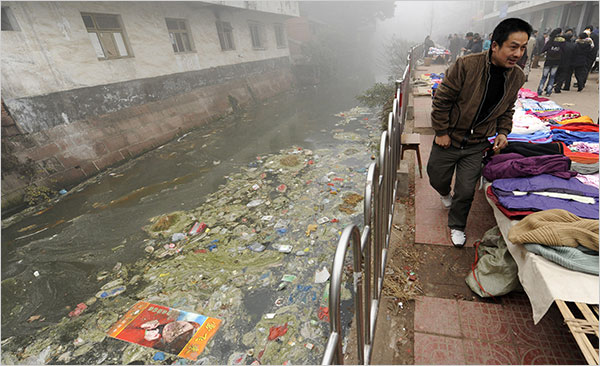 A heavily polluted river in the town of Zhugao in China’s southwest Sichuan province in 2010.
 .
.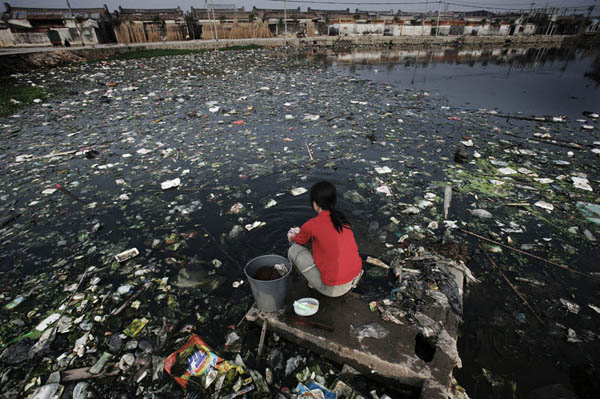 [Source: ^http://www.ecolatin.org/en/water-and-river-pollution-in-china-%E2%80%93-a-cotton-problem]
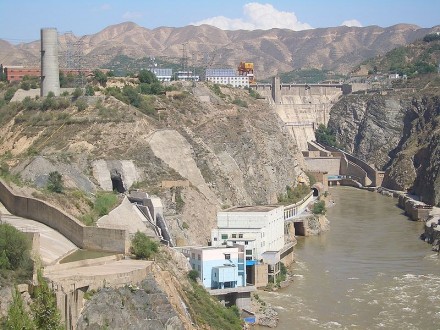 Liujiaxia Hydro Dam on the toxic Yellow River
China’s Gansu Province
Liujiaxia Hydro Dam on the toxic Yellow River
China’s Gansu Province
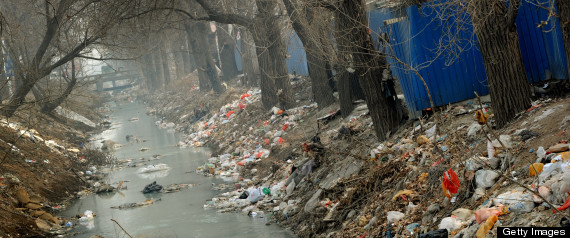 Trash clogs up a polluted canal at the edge of Beijing on March 16, 2012.
[Source: ‘Chinese Environmental Official Offered Reward To Swim In Polluted Ruian River’, 20120220,
by Sara Gates, The Huffington Post, Photo by Mark Ralston, AFP/Getty Images]
Trash clogs up a polluted canal at the edge of Beijing on March 16, 2012.
[Source: ‘Chinese Environmental Official Offered Reward To Swim In Polluted Ruian River’, 20120220,
by Sara Gates, The Huffington Post, Photo by Mark Ralston, AFP/Getty Images]
 Biliu River Sludge
(Liaoning Province, south-eastern China)
Biliu River Sludge
(Liaoning Province, south-eastern China)
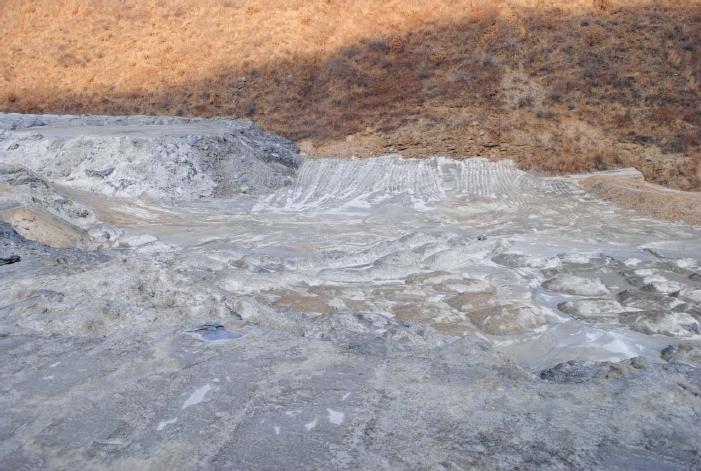
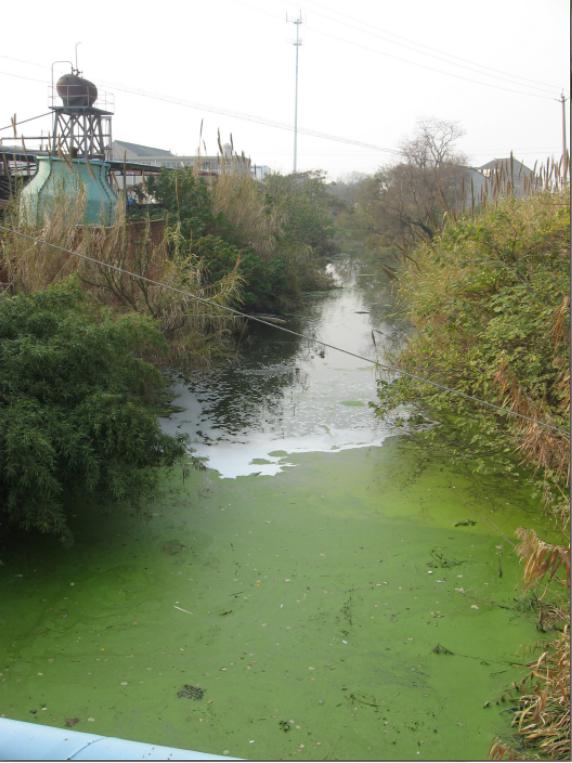 One of the many thousands of dead streams across China
[Source: ^http://www.dispatchesfromchina.com/2010/06/]
One of the many thousands of dead streams across China
[Source: ^http://www.dispatchesfromchina.com/2010/06/]
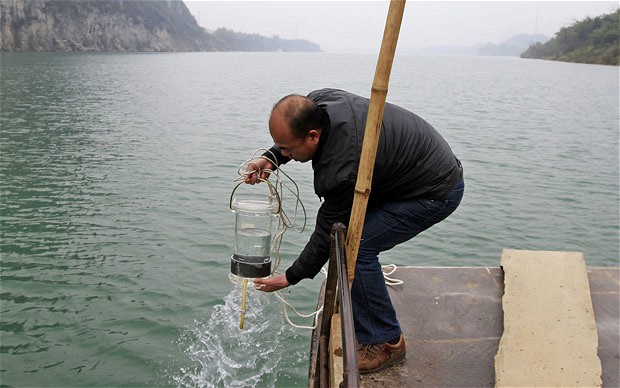 A man collects water samples from the polluted Longjiang River in Liuzhou, Guangxi Zhuang autonomous region. The authorities dumped hundreds of tons of aluminium chloride into the Longjiang River in an effort to dissolve tonnes of dumped cadmium.
[Source: ’20 tons of cadmium poisoning vital Chinese river’, 20120201, by David Eimer UK Telegraph (in Beijing),
^http://www.telegraph.co.uk/earth/environment/9053671/20-tons-of-cadmium-poisoning-vital-Chinese-river.html]
A man collects water samples from the polluted Longjiang River in Liuzhou, Guangxi Zhuang autonomous region. The authorities dumped hundreds of tons of aluminium chloride into the Longjiang River in an effort to dissolve tonnes of dumped cadmium.
[Source: ’20 tons of cadmium poisoning vital Chinese river’, 20120201, by David Eimer UK Telegraph (in Beijing),
^http://www.telegraph.co.uk/earth/environment/9053671/20-tons-of-cadmium-poisoning-vital-Chinese-river.html]
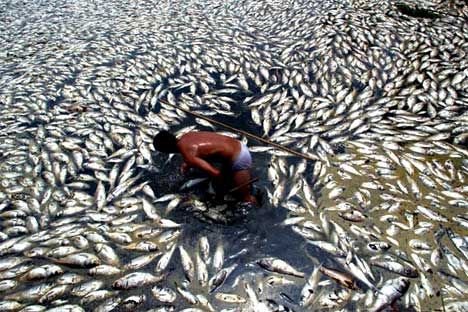 [Source: ^http://www.treehugger.com/corporate-responsibility/the-price-of-chinas-pollution-and-its-environmental-catch-22.html]