Archive for the ‘Habitat Threats’ Category
Sunday, April 21st, 2013
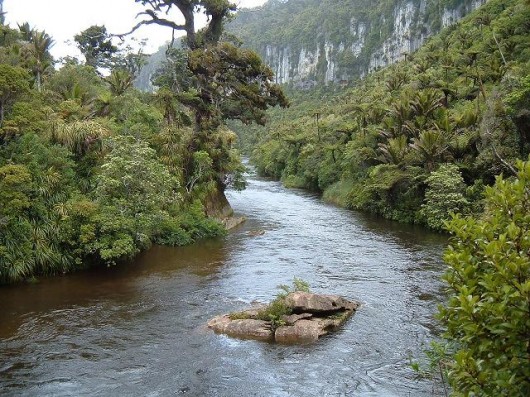 Wild Poporari River protected inside Paparoa National Park
Similar to nearby but unprotected cousin Pike River
Both inside Te Wai Pounamu (New Zealand’s South Island)
Note the Nikau Palms (Rhopalostylis sapida) endemic to New Zealand. Wild Poporari River protected inside Paparoa National Park
Similar to nearby but unprotected cousin Pike River
Both inside Te Wai Pounamu (New Zealand’s South Island)
Note the Nikau Palms (Rhopalostylis sapida) endemic to New Zealand.
.
Poporari River is a wild river of New Zealand’s South Island that flows from headwaters and chasms below the rugged mountainous Paparoa Range, westward into the Tasman Sea. Since 1987 the river and some of the range have been rightly protected within the Paparoa National Park.
But the Pike River flows from the other (eastern) side of the Paparoa Range, just outside the national park. It is a tributary to Big River which in turn flows south of the Paparoa Range into the Mawheranui (Grey River) and eventually westward through the town of Greymouth and out to the Tasman Sea. Yet of the Poporari River and the Pike River, their forest and riverine ecosystems are the same.
‘Paparoa‘ is Māori for ‘long place‘. The Paparoa Range extends parallel to the west coast for about 50 km south-south-west from the lower Buller Gorge, between the Grey and Inanga-hua Valleys and Tasman Sea and the coastal plains. The range aproximates heights of over 4,000 ft with the heighest peak being Mount Uriah at 4,925 ft.
The Paparoa Range bedrock is of granite formed during Earth’s pre-Cambrian Era (over 600 million years ago), and the range subsequently uplifted during the early Pleistocene Epoch (2.6 million years ago), was then carved by glacial action during the Ice Age 20,000 years ago, and since eroded by water and wind leaving sharp ridges, steep cliffs, cirques, and deeply incised rivers and streams.
[Source: Frederick Ernest Bowen, B.Sc.(Durham), New Zealand Geological Survey, Otahuhu, New Zealand, in Te Aara – The Encylopaedia of New Zealand, 1966, ^http://www.teara.govt.nz/en/1966/paparoa-range]
.
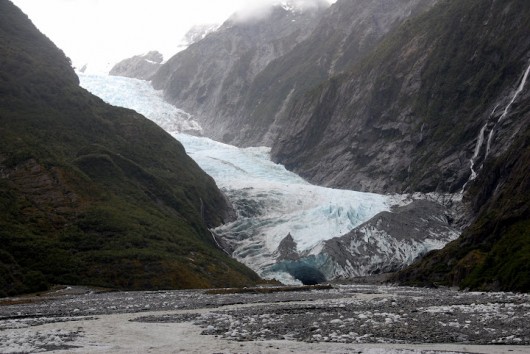 Glacial action still evident further south in Tai Poutini National Park
[Source: ^http://www.duwal.com/en/travelguide/australia/new-zealand/westland-tai-poutini-national-park] Glacial action still evident further south in Tai Poutini National Park
[Source: ^http://www.duwal.com/en/travelguide/australia/new-zealand/westland-tai-poutini-national-park]
.
Limestone underlies most of the Paparoa National Park and it is responsible for the area’s amazing landforms – high coastal cliffs, impressive river canyons, delicate cave formations and the bizarre ‘pancake-stack’ coastal formations that the area is so well known for. The national park is perhaps most famous for the ‘pancake rocks’ and blowholes of Dolomite Point, near the little settlement of Punakaiki.
The Park is also famous for Cave Creek which flows through a 30-metre chasm emerging from a limestone karts system deep beneath the Paparoa Range.
.
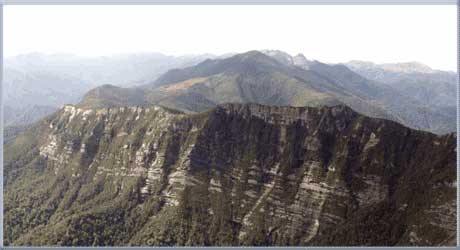 The Paparoa Range
above the Pike River The Paparoa Range
above the Pike River
.
Paparoa National Park is characterised by luxuriant coastal forest, limestone cliffs and canyons, karst systems and underground streams, and an absolutely spectacular coastline.
Vegetation within the park is wide and varied, due to the mild climate and high fertility. With an annual rainfall of 350–500 mm, the Paparoa Range below 3,500 ft is dominated in thick Podocarp Hardwood Forest (broadleafed) canopy. Above 3,500 ft, a thin narrow belt of subalpine scrub giving way to mountain grasses on the tops.
Podocarp trees belong to a coniferous family known as Podocarpaceae of which there are seventeen. The best known are rimu, kahikatea, miro, mataī and tōtara. In its natural state, a podocarp forest can be luxuriant with a dense undergrowth of shrubs, ferns and tree-ferns. The few precious remnants of forest which survive often contain the highest diversity of plants and animals in the region. They are a left-over from an ancient forested time that dates back to Gondwanaland of the Late Cretaceous Period (144 to 65 million years ago).
One of the significant understory elements is the Crown Fern (Blechnum discolor), which is endemic to New Zealand.
.
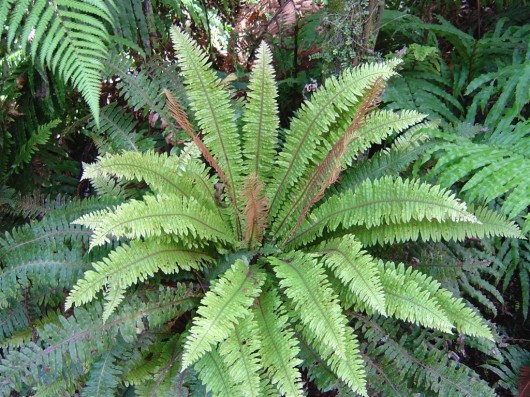 Crown Fern (Blechnum discolor)
Māori name is ‘Piupiu’ Crown Fern (Blechnum discolor)
Māori name is ‘Piupiu’
.
The koru (Māori for “loop”) is a spiral shape of a growing fern based on the shape of a new fern frond and symbolizing new life, growth, strength and peace.
.
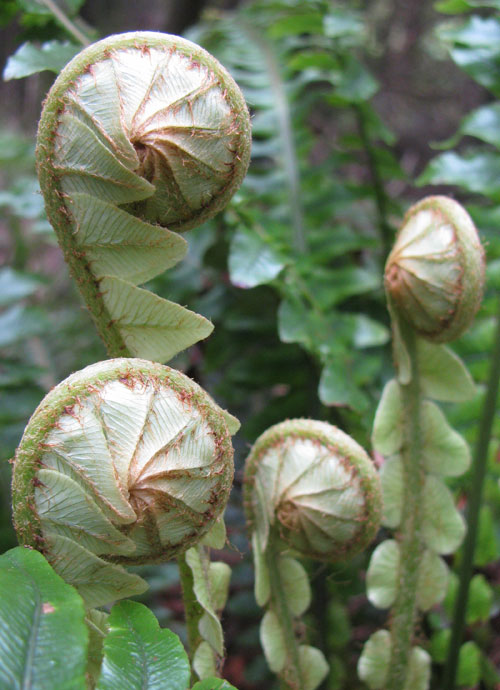 The ‘koru’ of New Zealand’s endemic Crown Fern
[Source: ^http://blogs.arcadia.edu/impactmagazine/files/2010/10/Plant-Blechnum-discolor-koru_500px.jpg] The ‘koru’ of New Zealand’s endemic Crown Fern
[Source: ^http://blogs.arcadia.edu/impactmagazine/files/2010/10/Plant-Blechnum-discolor-koru_500px.jpg]
.
Forest birds such as Tui, Korimako (Bellbird) and Kereru (New Zealand pigeon) migrate seasonally between coastal and upland forests. The Titi (Westland Petrel) colony south of the Punakaiki River is the only known place in the world where these burrowing seabirds breed. The birds live mostly out at sea, but during the breeding season you can see them flying to and from the colony at dusk and dawn. The nocturnal and secretive Great Spotted Kiwi (Roroa) is not often seen.
[Source: New Zealand Government, ^http://www.doc.govt.nz/parks-and-recreation/national-parks/paparoa/]
.
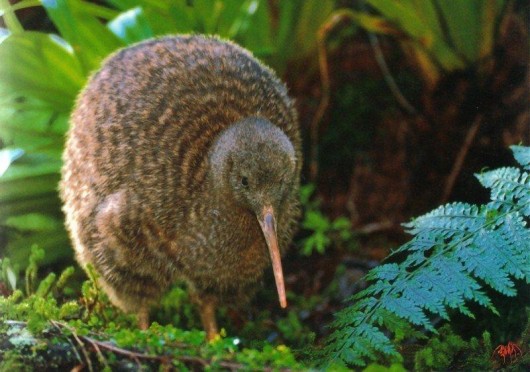 Great Spotted Kiwi, or Roroa (Apteryx haastii)
A rare species of kiwi endemic to the South Island of New Zealand – sadly classified as ‘nationally vulnerable’.
[Source: ^http://true-wildlife.blogspot.com.au/2011/05/great-spotted-kiwi.html] Great Spotted Kiwi, or Roroa (Apteryx haastii)
A rare species of kiwi endemic to the South Island of New Zealand – sadly classified as ‘nationally vulnerable’.
[Source: ^http://true-wildlife.blogspot.com.au/2011/05/great-spotted-kiwi.html]
.
Finders Keepers or Might is Right?
.
Native Māori tribe, the Ngāti Wairangi, had traditionally lived along the Te Tai Poutini (west coast) including in the area around Greymouth (the mouth of the Grey River).
Ancestrally, the tribe apparently originated from Hawaii in the 15th Century. But irrespective of ancestral authenticity, the native Māori Ngāti Wairangi lived around and called the river valley area Māwhera. Thankfully, due to the natural mountainous terrain dividing the east and west coasts, Ngāti Wairangi territory was protected for generations from invasive tribes.
It is generally recognised by New Zealand historians that the arrival of Māori to New Zealand included the introduction of the Polynesian Rat (Rattus exulans) known to the Māori as ‘kiore‘, which being prolific breeders would have had a devastating impact on native ground dwelling birds and small animals and reptiles. Similarly, it is generally recognised by New Zealand historians that the original eleven distinct species of Moa (endemic flightless birds) were hunted into extinction by the Māori by about 1400 AD.
A joint Māori and New Zealand Government sanctioned reported statement about the validity of such history would secure the truth, should such can be proven true. Myths can be dangerous.
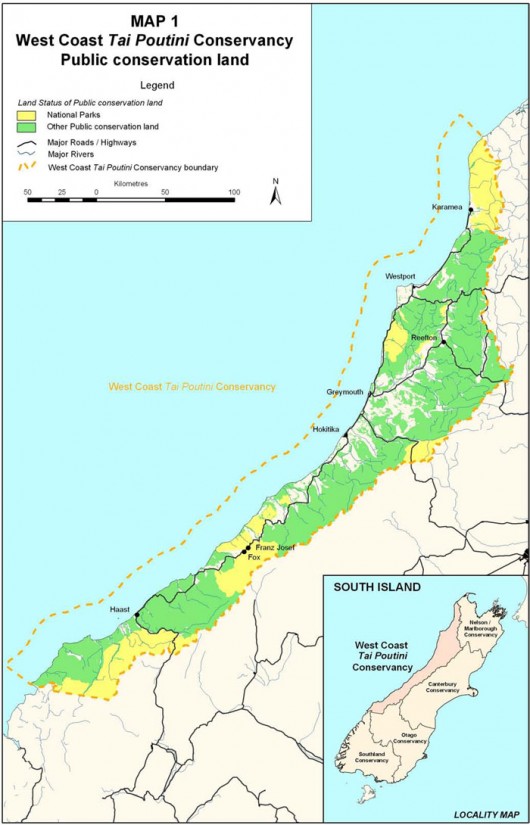 [Source: New Zealand Government,
^http://www.doc.govt.nz/publications/about-doc/role/policies-and-plans/conservation-management-strategies/west-coast/foreword/map-1/] [Source: New Zealand Government,
^http://www.doc.govt.nz/publications/about-doc/role/policies-and-plans/conservation-management-strategies/west-coast/foreword/map-1/]
.
‘Māwhera‘ (Greymouth area) became known for its Pounamu (precious and rare ‘greenstone‘, like jade). The unique nature of pounamu had a deep spiritual significance in Māori life and culture and was and remains highly prized. It naturally is found along the river bed of the Upper Arahura River around Greymouth, particularly at Kaikanohi, Pahutani, and at Kotorepi.
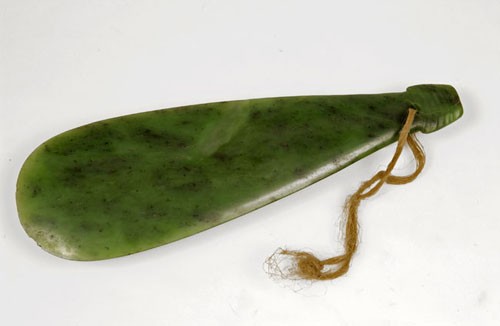 A Māori Mere Pounamu
a Greenstone traditional Māori club or ‘patu’ (‘mere’ meaning ‘weapon’)
The greenstone patu (‘mere pounamu’) is the most revered of all traditional Māori weapons and chieftainship.
[Source: National Army Museum Waiouru collection,
^http://www.nzhistory.net.nz/media/photo/greenstone-patu] A Māori Mere Pounamu
a Greenstone traditional Māori club or ‘patu’ (‘mere’ meaning ‘weapon’)
The greenstone patu (‘mere pounamu’) is the most revered of all traditional Māori weapons and chieftainship.
[Source: National Army Museum Waiouru collection,
^http://www.nzhistory.net.nz/media/photo/greenstone-patu]
.
Over time, the Ngāi Tahu tribe from the north learned about the pounamu and fought the Ngāti Wairangi for control of the stone. A number of battles ensued, and ultimately Ngāi Tahu wrested control of the resource from Ngāti Wairangi. This West Coast section of Ngāi Tahu became known as Poutini Ngāi Tahu, and it incorporated both Ngāi Tahu and the remnants of Ngāti Wairangi. Poutini Ngāi Tahu were then able to supply their eastern relations, and Kaiapoi became a focus of pounamu trading.
What happened to the Ngāti Wairangi and their land rights?
.
“There must be somebody there, because somebody must have said “Nobody.”
~ A.A. Milne, Winnie-the-Pooh
.
In 1846, English colonial explorer Thomas Brunner sailed to the area in 1846 and discovered coal along the Grey river valley. The area was soon settled and exploited by the English colonists, usurping themselves as ‘The Crown‘, and with coal mining industry taking off in the 1880s as well as gold mining and logging of the ancient native forests. Greymouth and the Grey River were duly named after a colonial governor of the British Empire.
By the 1860s, the English colonists, aserting themselves as ‘The Crown’, began intruding upon Ngāi Tahu’s access to pounamu. In 1874, a Dunedin based lapidary (gemstone) firm was purchasing the greenstone from Greenstone Gully near Greymouth, at £8 per cwt. In 1904, a Wellington Jeweller had paid to 5/- per lb for two tons of Westland greenstone to ship to lapidaries in Amsterdam, Holland, for shaping into Māori curios (tikis and the like) . In 1912, the amount of greenstone calculated as being able to be quarried at Tara Tame, Westland, amounted to 270,000 tons. Greenstone suitable for working was valued at from 1/-to 6/- per lb., or in bulk £56 to £672 per ton.
It wasn’t until 1997 under the Ngāi Tahu (Pounamu Vesting) Act that the New Zealand Government, asserting its absolute sovereignty, recognised the legal ownership of pounamu to Ngāi Tahu in its natural state and in Ngāi Tahu’s tribal area, including unsettled bits of the coastline.
[Source: Victoria University of Wellington Library, ^http://nzetc.victoria.ac.nz/tm/scholarly/tei-TayLore-t1-body1-d22.html; Te Ara – The Encyclopaedia of New Zealand, ^http://www.teara.govt.nz/en/pounamu-jade-or-greenstone/]
.
Meanwhile, colonists had introduced rats, stoats, possums, goats and deer to New Zealand and they flourished and wiped out many native fauna.
.
The Paparoa Range – mining the pristine
.

.
The coal deposits in the West Coast area are referred to as the Paparoa and Brunner Coal Measures, concentrated at Greymouth, Buller, Inangahua, Pike River and Stockton ‘coalfields‘. Two decades after Brunner discovered coal 7 km upstream from the mouth of the Grey River in 1864, coal mining begun at Coal Gorge (later called Brunnerton, then later just Brunner).
Once rail and ports were completed to Greymouth in 1882, large scale mining commenced and facilitated industrialised coal mining in the area. Coal mining has since been the dominant industry ever since, containing virtually all New Zealand’s bituminous (coking) coals.
On 26th March 1896, a tragic explosion deep in the Brunner Mine killed all 65 miners inside.
It seemed most likely that the explosion was caused by firedamp, a common hazard in bituminous (black) coal mines, where fammable methane gas accumulates under pressure in pockets in the coal and adjacent strata, and when penetrated accidentally ignites and explodes.
Extraction of bituminous coal demands the highest safety procedures involving attentive gas monitoring, good ventilation and vigilant site management.
The Brunner Mine Disaster was labelled the worst mining disaster in New Zealand’s history.
.
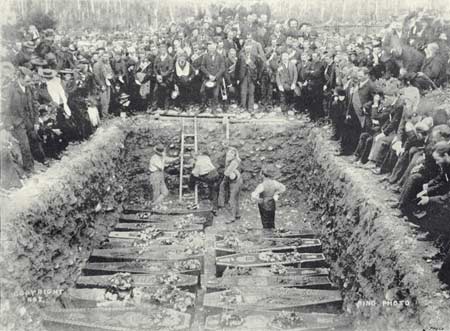 The 1896 mass grave for 33 of the 65 miners (men and boys) at Stillwater
[Source: Christchurch City Libraries, Ref. PhotoCD 2, IMG0073, ^http://christchurchcitylibraries.com/ The 1896 mass grave for 33 of the 65 miners (men and boys) at Stillwater
[Source: Christchurch City Libraries, Ref. PhotoCD 2, IMG0073, ^http://christchurchcitylibraries.com/
.
Coal production peaked in 1914, when 1.3 million tonnes were produced with 2550 employees. Following World War II there was a significant production decline as hydro-electricity and diesel fuel became more available. Loss of markets resulted in the closure of a number of mines.
Up to 1973, most coal was extracted by underground methods. In the Buller and Stockton coalfields, coal continues to be extracted by opencast mining, while underground methods are necessary for the deeper coal seams of the Greymouth Coalfield and more recently at Pike River.
.
Government Corporate Mining
.

.
Up until the 1980s, black coal from the Coast was used within New Zealand mainly for home and industrial heating (steam raising at dairy factories, as fuel at the Cape Foulwind cement works and in gas works).
Since 1987, the Stockton Mine, 80km north of Greymouth, has been operated by New Zealand Government-owned coal-mining company, Solid Energy, in a partnership agreement with Downer Australia.
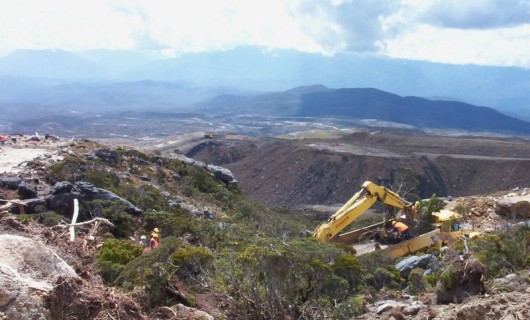 Stockton Opencast Coal Mine
Run by the New Zealand Government’s Solid Energy
80km north of Greymouth, New Zealand Stockton Opencast Coal Mine
Run by the New Zealand Government’s Solid Energy
80km north of Greymouth, New Zealand
.
Solid Energy remains New Zealand’s leading coal producer and the Stockton Coal Mine New Zealand’s largest opencast mining operation, with self-granted licence to operate for at least forty years to 2017 and beyond. Since 1990 around 90% of West Coast coal production has been exported for use as metallurgical coke in the steel making industry mainly in Japan, with the remaining 10% sold to industrial users and for electricity generation within New Zealand.
[Sources: New Zealand Government, ^http://www.mineralswestcoast.co.nz/westcoast_coal.aspx ; ^http://www.coalnz.com/]
.
Coal deposits have also been found in the Paparoa Range, including extensive seams in both the Greymouth Coalfield and the smaller, isolated Pike River Coalfield. Rail connections were built to provide access to the mines.
In 2009, New Zealand’s Government proposed opening up 7,000 hectares of high conservation land to prospecting for valuable minerals in the Paparoa National Park and in other parts of New Zealand, including on the Coromandel Peninsula and on Great Barrier Island.
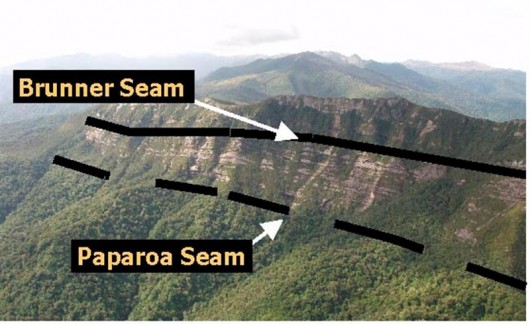 Coal Seams along the eastern side of the Paparoa Range
targeted by the New Zealand Government Coal Seams along the eastern side of the Paparoa Range
targeted by the New Zealand Government
.
Pike River Coal – Carter’s flawed compromise
.
 The marketing pike symbol
~ a symbol of socio-ecological arrogance above and beyond the River The marketing pike symbol
~ a symbol of socio-ecological arrogance above and beyond the River
.
In around 1996, Pike River Coal was set up by its mining founder, Gordon Ward, which became a subsidiary of New Zealand Oil and Gas (NZOG) subsidiary at the time.
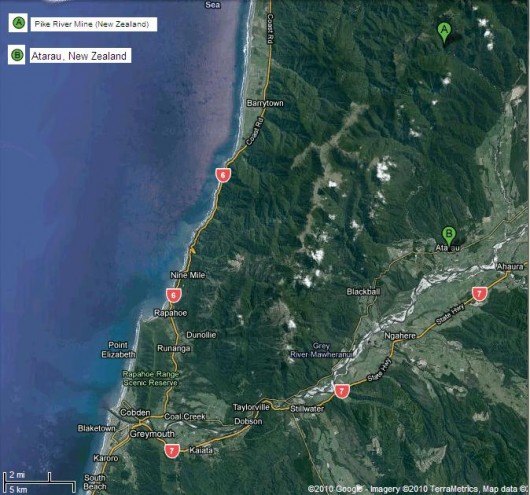
The company was formed chiefly to exploit the Brunner Coal Seam comprising lucrative hard coking black coal under the Paparoa Ranges situated 80 km north-east of Greymouth. Hard coking coal is an essential ingredient in the steel making process and at the time the commodity price was high in international markets, particularly due to demand in booming industrial India and Japan.
Ward formed Pike River Coal for the business of mining and exporting at least 18 million tonnes of the 58 million tonne potential resource of the premium hard coking coal over a mine life of at least 18 years. The reserves lying in the Brunner coal seam are estimated to be the largest of their kind in New Zealand.
.
Politically, Pike River Coal was expected to earn around NZ$170 million in export income annually.
.
In 1996, after successful exploration and testing confirmed the potential resource under the Paparoa Ranges, Pike River Coal applied to the New Zealand Minister of Conservation to mine up to one million tonnes of coal annually inside the conservation area under the Crown Minerals Act.
The application recognised the anticipated environmental pollution of acid mine drainage into the Pike River Catchment. Such sub-surface mining progresses below the water table, so water must be constantly pumped out of the mine in order to prevent flooding. After being exposed to air and water, oxidation of metal sulfides (often pyrite, which is iron-sulfide) within the surrounding rock and overburden generates acidity. Due to the sulphur-rich chemistry of the coking coal, the acidity draining out of subsurface coal mines is sulfuric acid which is highly toxic to river ecosystems.
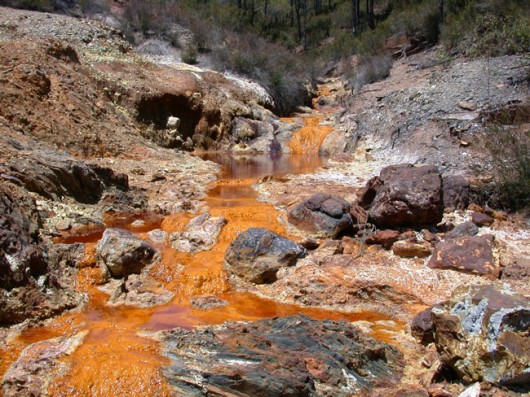 Example of Sulphuric Acid Mine Drainage in the Rio Tinto River (Spain)
What the New Zealand Government was keen to avoid by approving Pike River Mine Example of Sulphuric Acid Mine Drainage in the Rio Tinto River (Spain)
What the New Zealand Government was keen to avoid by approving Pike River Mine
.
So Pike River Coal offered the New Zealand Government $1.5 million in ‘compensation‘ to fund local environment and conservation programmes as well as associated ecological and biodiversity studies. This included setting up a pest control programme in the Pike River Catchment to help deal with the heavily infestation by the introduced pests – the Polynesian rats, stoats, possums, goats and deer.
[Source: ^http://www.proactiveinvestors.com.au/companies/news/9928/pike-river-coal-managing-director-gordon-ward-to-leave-9928.html]
.
Eight years later in 2004 the Minister of Conservation, Chris Carter, finally approved Pike River Coal access agreement to underground mine up to one million tonnes of coal annually from under the Paparoa Ranges.
Approval was granted despite the Department of Conservation Report to the Minister on the application indicating that the mining would be:
- inconsistent with objectives of conservation legislation
- inconsistent with purposes for which the land is held
- inconsistent with conservation management plans.
.
Further, there were concerns about adverse effects of acid mine drainage and the New Zealand Conservation Authority and the West Coast Tai Poutini Conservation Board objected to the mine.
To Carter, and the Labour Party Prime Minister of New Zealand at the time, Helen Clark, who had also held the portfolio of Conservation, clearly the money made it right – “…politics without principle, commerce without morality..” ~ Mahatma Gandhi.
.
Pike River Coal was expected to earn around NZ$170 million in export income annually.
.
According to the Department of Conservation Report to the Minister, the upper Pike River Catchment on the eastern side of the Paparoa Range is very high in conservation values.
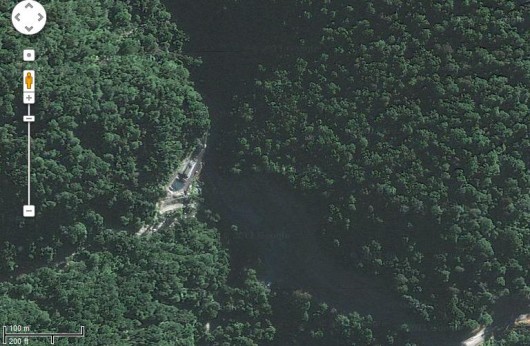 Pike River Mine – located deep in high conservation value native forest Pike River Mine – located deep in high conservation value native forest
A pristine site for a coal mine
.
- Pike River Catchment “is a relatively intact catchment” with high natural character and high “landscape and scenic values”
- It has “high quality aquatic habitat for threatened species such as:
- Blue Duck Māori name is ‘whio’ (Hymenolaimus malacorhynchos)
- Dwarf Galaxias (Galaxias divergens)
- Long Finned Eel (Anguilla dieffenbachii)
- “The catchment is the “habitat for ten known threatened species, including the Great Spotted Kiwi, Kaka and Kakariki”
(page 2)
.
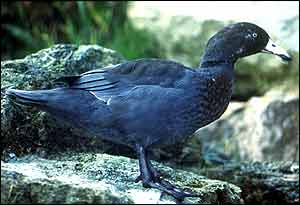 New Zealand’s blue duck: Predators and habitat loss mean rapid decline
[Source: Photo by Jonathan Leach, World Wildlife Trust,
^http://news.bbc.co.uk/2/hi/science/nature/2299547.stm] New Zealand’s blue duck: Predators and habitat loss mean rapid decline
[Source: Photo by Jonathan Leach, World Wildlife Trust,
^http://news.bbc.co.uk/2/hi/science/nature/2299547.stm]
.
 New Zealand’s endemic Blue Duck recognised on the NZ 10 dollar bill New Zealand’s endemic Blue Duck recognised on the NZ 10 dollar bill
.
The vegetation cover consists of a mosaic of five distinct types:
- Tall red tussock grassland
- Pink pine
- Leatherwood and dracophyllum mixed shrubland
- 300 year-old mountain and silver beech forest
- Mixed beech-hardwood forest with Kamahi, Rata, Tawherowhero
- Lowland beech-podocarp forest of Kamahi, Red Beech, Rimu
(page 5)
.
Approval of the Pike River Coal Mine inside a highly sensitive conservation value area, placed environmental constraints on the design of the mining infrastructure which should have flagged a risk assesssment by the mining management.
The ecological environment issues required restrictive mine access arrangements outside Paparoa National Park and limited drilling of ventilation holes. This apparently required the main drift tunnel to be drilled horizontally more than 2kms under the National Park in order to gain access to the coal resource. Normally mines are built atop the mineral to be extracted, if normal mining operations are being undertaking, thus boring down onto the resource, but also allowing lighter than air gases such as methane to escape vertically.
So desperate was Pike River Coal to proceed that this horizontal access design became the only mine in the world to have its entrance below the coal resource and so to mine upwards to the coal resources. Methane, a lighter than air gas had nowhere to go. There was clearly a degree of Titannic ego stubbornness in the venture, dismissive of the abnormal environmental conditions.
Approving Pike River Coal proceeed in high conservation, demanding high risk design was inherently flawed by compromise.
Was Pike River Coal’s decision to proceed an abject failure in operational risk management by informed qualified experts or by management overriding the operational risks in favour of the financial commitment and rewards. Another case of classic mining arrogance?
.
2004: Simon Johnson protests to NZ Minister of Conservation, Chris Carter
.
<<The Minister of Conservation
Chris Carter
c/- Parliament Buildings
Molesworth Street
Wellington
Fax: 04 472 8034
14 March 2004
Dear Mr Carter
Approval of access for Pike River Coal Company to conservation land
I understand that you have approved the application of Pike River Coal Company for access for mining within Paparoa National Park and other conservation areas.
I have to admit to being completely dumbfounded as to how approving mining in national parks and conservation areas can possibly further the purpose of conservation, preservation and protection. How could you possibly have approved mining in a national park? Why did you not simply decline the application?
Can I please register my utmost disapproval of this decision. If a Minister of Conservation from a Labour-led government cannot keep mining out of national parks then who will?
I request under the Official Information Act 1982 a copy of the record of your decision under the Crown Minerals Act that gives the reasons for this disappointing approval.
Yours sincerely
Simon Johnson
.
.
Chris Carter’s ‘ministerial’ reply:
.
Office of Hon Chris Carter
Minister of Conservation
29 March 2004
Dear Mr Johnson
Thank you for your correspondence, regarding the Pike River Coal Company’s application for access to operate a coalmine in the Pike Stream catchment in the eastern Paparoa Ranges.
I have approved in principle Pike River Coal Company’s application for an access arrangement to mine the coal deposits in the headwaters of Pike Stream on the West Coast.
My approval, however, is subject to the company and my department reaching a satisfactory agreement on the terms and conditions of the company’s access arrangements to the area, including financial assurances such as bonds and insurances.
This approval is conditional on my being satisfied that the terms of the access agreement achieve the higest possible environmental safeguards so that the conservation values of the area are protected as fully as possible.
I am aware that this mine does represent a significant intrusion into an area of high conservation values and a decision on whether to allow it to go ahead has been a very difficult one to make. I have considered the fact that the mine is mostly underground and its visual footprint and its visual footprint above ground is small (10 hectares) compared with the large area of protected landscape surrounding it (88,000 hectares). The lesser environmental impacts of underground mining have been recognised by environmental groups. The Royal Forest and Bird Protection Society, while critical of the Pike decision, has noted that, compared to opencast mining, underground mining reduces the impacts on the landscape, wildlife habitat, vegetation and public access. I agree.
I appreciate and can understand your concerns for the protection of public conservation lands. I agree that the Paparoa Range is an important area for nature conservation, recreation, tourism and for landscape protection. The significance of the Paparoa Range has been recognised over the years by successive Labour governments. This has included the formation of the Paparoa National Park, gazettal of a number of ecological areas and the Paparoa Wilderness Area, and ending all logging of publicly owned indigenous forests along the range and protecting these areas as public conservation land. These decisions were often made in the face of strong local opposition.
Direct human impacts on the heritage values of the public lands of the Paparoa Range, and of the West Coast generally, are at the lowest they have been in more than a century. I believe my conditional approval of this underground mine needs to be seen in this wider context.
Yours sincerely
Hon Chris Carter MP
Minister of Conservation
.
.
Chris Carter sends the decision making report:
.
Office of Hon Chris Carter
MP for Te Atatu
Minister of Conservation
8 April 2004
Dear Mr Johnson
Thank you for your letter of 14 March 2004, requesting a copy of the record of my decision under the Crown Minerals Act 1991, to conditionally approve Pike River Coal Company’s access arrangement application at Pike Stream on the West Coast.
Please find attached a copy of the relevant paper, excluding the financial amounts related to the proposed financial assurances, and excluding the compensation amounts that were not referred to in my media release of 12 March 2004. These financial amounts have been deleted under section 9(2)(k) of the Official Information Act 1982, to prevent the disclosure or use of official information for improper advantage.
With regard to the information I have withheld, I do not see that my reason for withholding the information is outweighed by other considerations which render it desirable, in the public interest, to make that information available.
You are entitled to seek an investigation and review of my decision by writing to an Ombudsman as provided by section 28(3) of the Official Information Act.
I have also enclosed a copy of the media release statement that went with my decision.
In your letter you refer to mining within a national park. Please note that this conditional mine approval does not provide for mining in the national park apart from the provision of four emergency exits.
Yours sincerely
Hon Chris Carter MP
Minister of Conservation
.
.
My letter requesting Chris Carter’s reasons:
.
The Minister of Conservation Chris Carter
c/- Parliament Buildings
Molesworth Street
Wellington
Fax: 04 472 8034
12 May 2004
Dear Mr Carter
Access for Pike River Coal Company to conservation land
Thank you for your letter of 29 March 2004 and for your letter of 8 April 2004 which enclosed the document “Pike River Access Arrangement” being the record of your decision under the Crown Minerals Act 1991 to conditionally approve Pike River Coal Company’s access arrangement application at Pike Stream on the West Coast.
I note that page 15 of this report states “The key issue for you to decide is whether the proposed partial safeguards and the compensation package offered, are sufficient to outweigh our concerns about the matters covered by section 61(2)(a), (b) and (c),”
Obviously you decided that the s 61(2)(d) matters outweighed the s 61(2)(a), (b) and (c) matters as you chose the option on page 16 to approve access.
I request under the Official Information Act 1982 your reasons for your weighting of the s 61(2) matters and for deciding on the option of approving conditional access.
Yours sincerely
Simon Johnson
.
.
Chris Carter’s reply:
.
Office of Hon Chris Carter
Minister of Conservation
19 May 2004
Dear Mr Johnson
In reply to your letter of 12 May 2004, I can advise that I decided that the section 61(2)(d) and (e) matters of the Crown Minerals Act 1991 outweighed the section 61(2)(a), (b) and (c) matters.
My decision was based on the information set out in the departmental submission and froma site visit. No arithmetical weighting was given to the matters to be considered under section 61(2); rather my decision was based on the totality of the evidence before me. The details of the proposed partial safeguards and the compensation package are set out in the departmental submission.
Yours sincerely
Hon Chris Carter MP
Minister of Conservation>>
.
[Source: ‘Letters to and from Carter about his softdoc decision to allow coal mines in the conservation areas in Pike Stream’, 20040313, by Simon Johnson, “Greenlight for new Coast coalmine”, in The Press, ^http://www.kapiti.co.nz/simonjohnson/mine5.htm]
.
.
2007: Pike River Coal cashed up and mining
Miner Gordon Ward, ahead of public listing on the New Zealand Exchange, became managing director and chief executive officer from May 2007 until significantly 1st October 2010, afterwhich Peter W. Whittall became Director and Chief Executive Officer of Pike River Coal Ltd. Two months later came the Pike River Mining Disaster.
The timing of Ward’s departure is interesting. Until his departure, Ward had led Pike River Mine from its initial conceptual design for some fourteen years since 1996, so why leave?
Other company directors included John Dow, Stuart Nattrass, Arun Jagatramka, Raymond F Meyer, Roy Antony Radford, and Dipak Agarwalla.
In July 2007, Pike River Coal Co Ltd launched on to the New Zealand Exchange to raise revenue through an Initial Public Offering (IPO), afterwich Pike River’s largest shareholder NZ Oil and Gas maintained its 29% stake, with Gujarat NRE Coke (7.14%), Saurashtra Fuels (5.5%) and the remaining equity spread across public stakeholders. Over $100 million was invested into the West Coast mine development and coal production commenced in October 2008 making Pike River Mine the second largest hard coking coal export mine in New Zealand.
It is located about 50km north-east of Greymouth in the west coast region of South Island. The mine is owned by Pike River Coal, the only listed coal mining and export company in New Zealand. The company is owned by New Zealand Oil & Gas (29%), Gujarat NRE Coke (7.14%) and Saurashtra Fuels (5.5%) and the remaining by public stakeholders.
The mining on Pike River Coal reserves was started in October 2008 by digging a 2.3km access tunnel under the Ranges for two years. The Brunner coal deposit seam runs 6.5km north-south (length), 1.5km east-west (width) and has a thickness of about 7m. The Brunner seam has estimated in-ground reserves of 58.5mt. The estimated recovery from the seam is 18mt over its 18-year mine life.
Paparoa seams lie about 200m beneath the Brunner seam. Initial drilling estimated an additional potential recovery of 8mt from this seam.
 Pike River Mine in operation Pike River Mine in operation
.
The Pike River used two mining methods which include creating roadways in the Brunner seam through large cutting machines and using hydraulic monitors to break the coal face. The mining was initially done using a NZ$5m road-header machine with tungsten tipped blades. The water cannons use high pressure blasting with water to break coal at a rate of 2,000 tonne/day. The crushed coal is then washed downhill through a 10km-long, low pressure, slurry pipeline to a processing plant.
A 10 km access road to the mine site was constructed in August 2006. In June 2008 TNL Group was contracted for trucking the hard coking coal processed at the Pike River coal preparation plant to the rail loadout facility at Ikamatua.
In late 2008, the mine’s ventilation shaft partially collapsed, delaying production and further production issues occured afterwards. An underground trench or ‘graben‘ was encountered immediately to the west and north of the pit bottom and Pike had to drill and blast through non-productive rock to get to the coal seam. Work began on a ventilation shaft that was 100 m deep, 4m diameter wide in 2008, but ran into ‘difficult rock conditions’. Before reinforcement of the shaft could be completed, the walls of the shaft collapsed.
At coal mine working faces, simultaneous application of three basic elements reduces the methane explosion hazard: (1) adequate ventilation, (2) regular monitoring of gas concentrations, and (3) the elimination of ignition sources. [Source: ^http://www.cdc.gov/niosh/mining/works/coversheet1682.html]
Still, within a month in January 2009, a NZ$20 million coal preparation plant was constructed and by mid-2009 production of hard coking coal from Pike River Mine had started. By February 2010 the first export shipment of 20,000 tonnes was made to coking plants in India for steel production. Mining financial management had overruled mining operational management absolutely and irresepectively.
[Sources: ‘Pike River Mine, New Zealand’, ^http://www.mining-technology.com/projects/pikeriverminenewzeal/; [Source: ^http://www.proactiveinvestors.com.au/companies/news/9928/pike-river-coal-managing-director-gordon-ward-to-leave-9928.html; ‘The making of Pike River’, by Alistair McKenzie, Q&M Vol.7 No.1 February-March 2010, Contrafed Publishing, ^http://www.contrafedpublishing.co.nz/QM/February-March+2010/The+making+of+Pike+River.html]
.
May 2010: New Zealanders stand against mining Paparoa Range
.
 The people of New Zealand protest along Queen Street, Auckland on 1st May 2010
Some 40,000 New Zealanders very publicly were prepared to challenge government
for its flawed compromise between conservation and mining. The people of New Zealand protest along Queen Street, Auckland on 1st May 2010
Some 40,000 New Zealanders very publicly were prepared to challenge government
for its flawed compromise between conservation and mining.
“No Mining Pure New Zealand”!
[Source: ^http://lucylawless.net/events/2010/marchagainstmining010510/]
.
In May 2010, 40,000 New Zealanders protested a “No Mining” message to ask their government to simply respect New Zealand. This was the largest grassroots protest by New Zealanders in a generation.
.
.
Nov 2010: Tragedy
.
Later that year on 19th November a methane explosion inside the mine trapped 31 miners and contractors. Two managed to escape. The remaining 16 miners and 13 contractors ‘the twenty-nine‘ didn’t.
Following a second explosion five days later, the 29 remaining men were believed by police to be dead. They remain there.
.
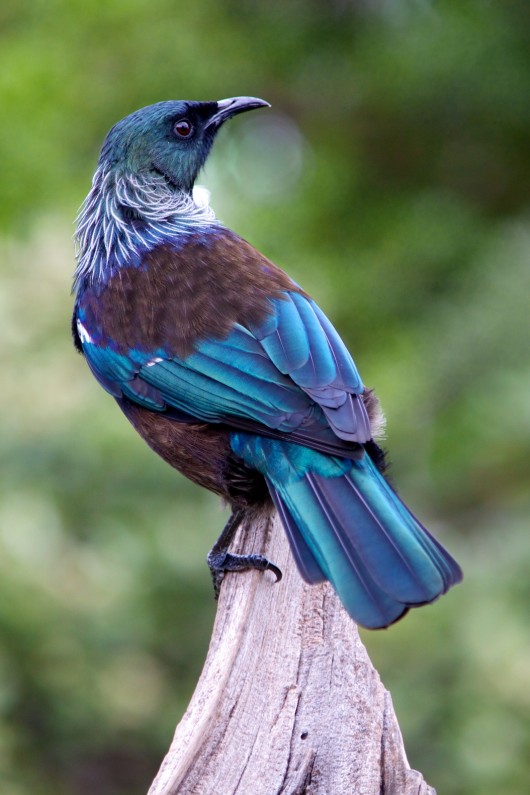 Tui
(Prosthemadera novaeseelandiae)
An endemic honeyeater of New Zealand
[Source: ^http://msf2011.blogspot.com.au/2012_03_01_archive.html] Tui
(Prosthemadera novaeseelandiae)
An endemic honeyeater of New Zealand
[Source: ^http://msf2011.blogspot.com.au/2012_03_01_archive.html]
.
Tags: Cave Creek, Crown Fern, Downer Australia, Great Spotted Kiwi, Greymouth, Kereru, kiore, Korimako, koru, Māori, New Zealand, Ngāti Wairangi, Paparoa National Park, Paparoa Range, Pike River Coal, Pike River Mine, Podocarp Hardwood Forest, Poporari River, Solid Energy, Tai Poutini, Tui
Posted in Threats from Mining | No Comments »
Add this post to Del.icio.us - Digg
Thursday, April 18th, 2013
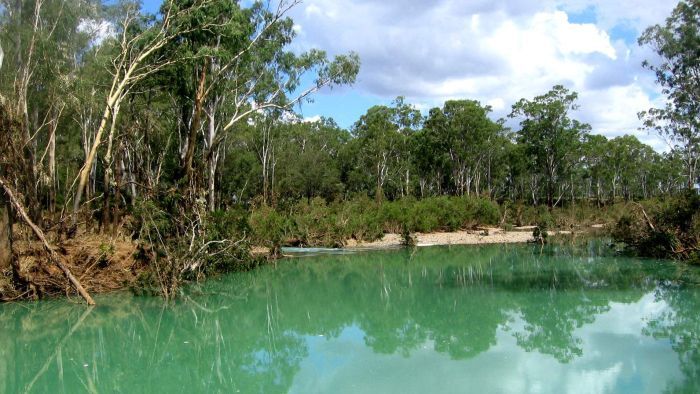
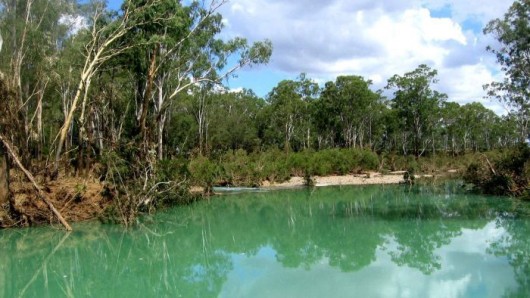 The Dee River at Dululu, 55km downstream from the Mount Morgan mine, North Queensland.
The aqua colour is due to heavy metal compounds polluting the river.
[Source: (Photo by Ian Townsend), ‘Toxic mine water’, ABC Radio National programme, 20130217,
^http://www.abc.net.au/radionational/programs/backgroundbriefing/2013-02-17/4513916] The Dee River at Dululu, 55km downstream from the Mount Morgan mine, North Queensland.
The aqua colour is due to heavy metal compounds polluting the river.
[Source: (Photo by Ian Townsend), ‘Toxic mine water’, ABC Radio National programme, 20130217,
^http://www.abc.net.au/radionational/programs/backgroundbriefing/2013-02-17/4513916]
.
Mining companies are perhaps the worst form of entity that perpetuates in modern industrial society to inflict ongoing narcisistic destruction upon the Natural landscape.
Mining companies employ consultants to window dress their activities with the effect of putting lipstick on a pig. They rape pillage and plunder the landscape with impunity because of corrupt governments sharing financial vested interests in the booty. Mining companies before, during and after their nefarious operations have no concern for the irreversible damage to ecology and landscape, but only for the profit promise. They are a relic of the 19th Century with the same immorality as the corporate slave traders.
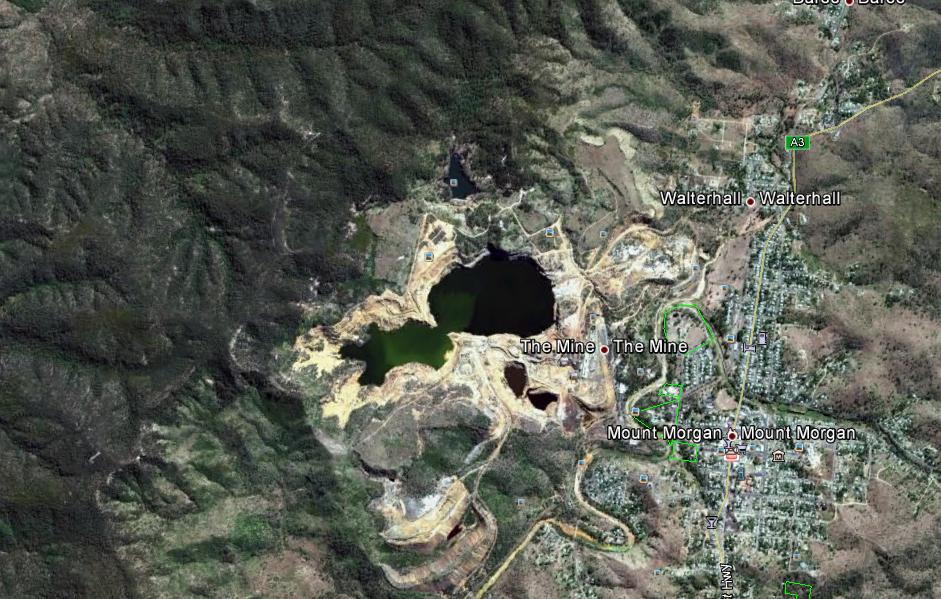
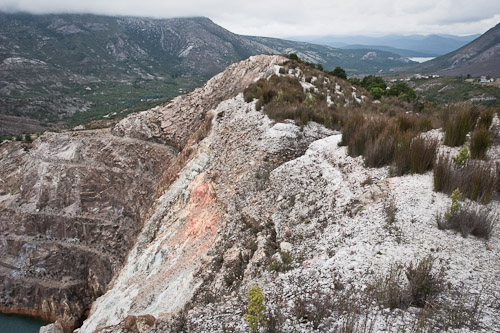
As Mount Lyell in Tasmania remains the moonscape legacy of 19th Century mining, then in Mount Morgan is its sister mining moonscape.
 ‘Iron Blow Mine’
Mount Lyell’s copper mining legacy of West Coast Tasmania
(Photo by Gary Sauer-Thompson) ‘Iron Blow Mine’
Mount Lyell’s copper mining legacy of West Coast Tasmania
(Photo by Gary Sauer-Thompson)
.
Both have irrevocably destroyed all ecology for miles and contaminated river systems with heavy metals and lethal toxins. Both made their mining companies, mining magnates and complicit investors millions. Both were abandonned when the ore ran out and the taxpayer has been left to pay for the clean up if ever that could be possible.
And mining companies complain when there is suggestion of a mining tax. Beyond a mining tax, mining companies in the 21st Century need to be held accountable for their impacts before they dig the first sod. There needs to be a compulsory bond required from mining companies up front to sufficiently cover the complete remediation of the site according to scale and risk. Instead of the artificial obscene profit skimming by management and investors that currently ignores the real cost of mining on the landscape, it would bring the profits from mining more in line with corporate social responsibility.
The Dee River is a river in Central Queensland, Australia. The Dee is a tributary of the Dawson River, itself a tributary of the Fitzroy River. The mining town of Mount Morgan is located on the river. It is crossed by the Burnett Highway a number of times. The Dee River rises in the Razorback Range south of Bouldercombe Gorge Resources Reserve near Bouldercombe. Tributaries include Limestone Creek, Horse Creek, Hamilton Creek and Nine Mile Creek on the left while Boulder Creek, Oaky Creek and Pruce Creek enter from the right. The Dee River joins the Don River near Rannes.
But Queensland’s Dee River is being killed by toxic water from the old gold mine of Mount Morgan – and is one of thousands of abandoned and unregulated mine sites, many of which are leaking contaminated ‘legacy water’ into river catchments.
 In this picture you can see the acid mine water gushing out the side of the mine pit.
(Photo by Ian Townsend, February 2013) In this picture you can see the acid mine water gushing out the side of the mine pit.
(Photo by Ian Townsend, February 2013)
.
The largest dam on the Dee River is in mining accounting lingo, ‘Number 7 Dam‘, built for the Mount Morgan Mine.
 Number 7 Dam Number 7 Dam
Mount Morgan Mine in 2011
Lies right next to the Mount Morgan township
.
Mount Morgan Mine has been a copper, gold and silver mine in northern Queensland, Australia since 1882 up until 1981. Over its lifespan, the mine yielded approximately 262 tonnes of gold, 37 tonnes of silver and 387,000 tonnes of copper and was once the largest gold mine in the world.
Mount Morgan Limited progressively scaled back its workforce and operations until it reached the end of its ore body in 1981. Since 2007, the mine and mining leases have been owned by Norton Gold Fields and an estimated 327,000 ounces of gold still apparently exists at the site.
Concerns regarding the discolouration of the river’s water and fears of contamination causing irreversible damage to the river were raised back in mid 2011.

In January 2013, the mine pit overflowed… and 700 mm of rain fell after ex-tropical Cyclone Oswald resulted in the 2013 Eastern Australia floods.
Towards the end of February the dam was still spilling acid and heavy metals into the river, and probably continues at the time of writing.
.
 The Dee River at Mount Morgan is highly acidic.
Here the river is badly contaminated with heavy metals, staining the rocks and producing a sludge in the river.
(Photo by Ian Townsend, February 2013) The Dee River at Mount Morgan is highly acidic.
Here the river is badly contaminated with heavy metals, staining the rocks and producing a sludge in the river.
(Photo by Ian Townsend, February 2013)
.
Contamination fears for Dee River
.
<<Calls have been made for a full investigation into pollution in the Dee River, with fears of contamination from nearby closed mines.
The Queensland member for Mirani, Ted Malone, said he is worried that the Dee River’s very blue-green colour is unnatural and that something is very wrong with the waterway, according to The Morning Bulletin.
Malone called for a comprehensive inquiry into contaminated water leaking into the river from the Mount Morgan mine, and to identify it as an environmental hazard.
“With controlled releases of highly contaminated mine water this year, as well as seepage offsite, the Dee is in a contemptible state. It is void of life and lined with a precipitate containing heavy metals and it will soon be past the rehabilitation stage if the government does not step in and fully rehabilitate the mine site,” chairman of the Wowan/Dululu Landcare Group, Neal Johnson, said.
These calls come after the QLD Government announced a boost in funding for the rehabilitation of the Mount Morgan and Mount Oxide mines. It announced $24.2 million in funding to ensure the safe management and rehabilitation of historic mine sites.
Mining minister Stirling Hinchliffe stated that historic mines such as Mt Morgan and Mt Oxide are a legacy of old mining practices and need safe management.
“This is Government is committed to managing problems caused by past mining practices,” Hinchliffe said. “Problems with old and outdated mining practices were created over many years and will take many years to address but we won’t shy away from that. That’s why we’re investing a further $24.2 million over four years for mine management and rehabilitation, $6 million of this operational and capital funding will be invested during 2011-12.”
However, Queensland senator Barnaby Joyce stated that the government has failed to address the issue of contaminated water in Mt Morgan’s pit lake. He said the pit lake is almost full and could leak into the Dee River, exacerbating residents concerns of contamination.
Joyce did state, following the funding, “thankfully now they are doing something”.
QLD mines minister Stirling Hichliffe stated that the government had also just completed a $1.8 million upgrade of the Mt Morgan mine water treatment plant to increase capacity to one billion litres each year, to allay fears of uncontrolled releases.>>
.
[Source: ‘Contamination fears for Dee River’, 20110725, by Cole Latimer, ^http://www.miningaustralia.com.au/news/contamination-fears-for-dee-river]
.
“I never wonder to see men wicked, but I often wonder to see them not ashamed.”
~ Jonathan Swift (1667-1745)
.
Tuesday, April 16th, 2013
 . .
<Federal environment minister Tony Burke has rejected National Heritage listing for Tasmania’s precious Tarkine Wilderness.
.
Burke’s Ten New Mines!
.
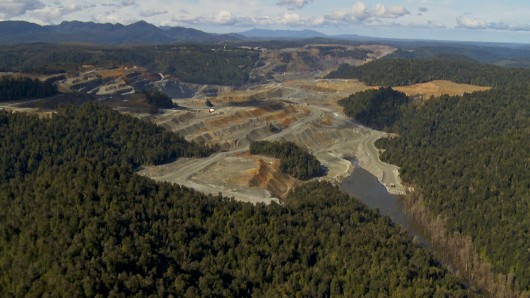
On 8th February 2013, Burke announced 10 new mines proposed over the next five years for the Tarkine Wilderness. Nine of these 10 mines will be open cut leaving scars of devastation in an area of north-western Tasmania.
 Savage River Mine already scarring The Tarkine Wilderness Savage River Mine already scarring The Tarkine Wilderness
.
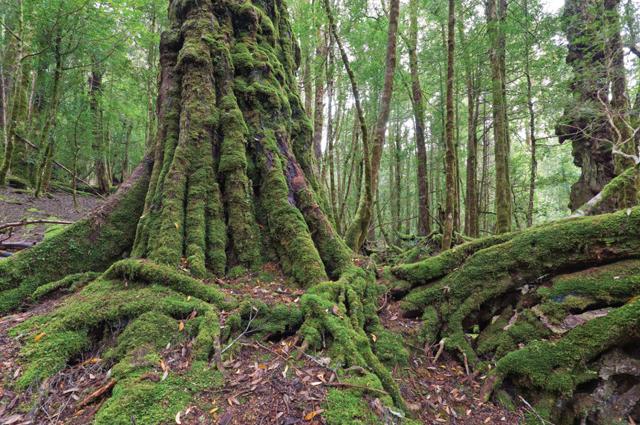
“The Tarkine is one of the world’s great wild places.
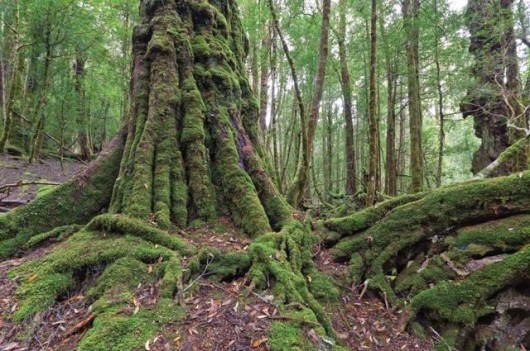
It is an expansive 447,000 hectare wilderness area of recognised World Heritage significance in the North-West corner of Tasmania, Australia’s island state. The Tarkine contains remarkable natural and cultural values, including one of the world’s most significant remaining tracts of temperate rainforest,” said the Tarkine National Coalition.
The Tarkine is a place of unique natural and cultural significance and was nominated for World Heritage listing by the Australian Senate in 2007.
The Tarkine has been recognised by prominent bodies including the International Union for the Conservation of Nature, the Tasmanian Department of Parks, Wildlife and Heritage and environment groups such as The Wilderness Society and the Australian Conservation Foundation.
The Australian government has recognised the Tarkine’s outstanding national significance through listing the Tarkine on the register of the National estate.
As the Tarkine National Coalition says:
.
Burke only “listed a paltry 4% of the 433,000 hectares recommended to him by the inquiry”
.
Since February 8, Burke has granted the first two of 10 mining permits to Venture Minerals for three iron mines at Mount Lindsay and granted Shree Minerals an iron ore mine proposed for Nelson Bay River.
Successive environment ministers have failed to put forward an assessment by the Australian Heritage council for Heritage listing with UNESCO leaving these areas of “outstanding natural and cultural value” vulnerable to the policies of Burke.
A national day of action on 14th February 2013 and a campaign in local media helped to expose the plight of the now endangered Tarkine and reverse this environmentally catastrophic decision.
Venture Minerals and Shree Minerals are driven by the profits to be made from these proposed mining ventures in the Tarkine. But the Tarkine has far more long-term value as a wilderness area and should continue to benefit all.>>
.
[Source: ‘Mining approved in the Tarkine’, 20130219, by Rachel Christensen, ^http://www.greenleft.org.au/node/53374]
.
 Tarkine Wilderness
(Peter Walton, Tasmania Expeditions) Tarkine Wilderness
(Peter Walton, Tasmania Expeditions)
.
So in the absence of government responsibility, Dr Bob Brown has just been announced as new patron of rebranded Save the Tarkine campaign.
The Tarkine National Coalition is pleased to make two exciting announcements that we believe will help increase the national profile of this important campaign.
“Today we are unveiling the new Save the Tarkine branding that we will campaign under”, announced Campaign Coordinator, Scott Jordan. “We believe that brand, Save the Tarkine will help the public more easily identify this important campaign, and let them know in clear terms what our mission is.”
To support this rebranding, a new Tasmanian devil inspired logo has been adopted (see above).
Tarkine National Coalition Incorporated remains as the registered legal entity, with campaigns to be conducted under the registered trading name Save the Tarkine.
Save the Tarkine are also thrilled to announce that Dr Bob Brown has accepted our invitation to become patron of the campaign.
“Bob is no stranger to the Tarkine, having fought for it’s protection both in and out of the parliament. We are thrilled that Bob has agreed to accept the role of patron, and we look forward to sharing Bob’s passion for the Tarkine with all of Australia”.
“I’m honoured to be first patron of Save the Tarkine”, said Dr Brown in Launceston. “I first walked the Tarkine forty years ago looking for Tasmanian Tigers, and if protected the Tarkine will create hundreds, if not thousands of jobs in the future. If mined it will end up another post-industrial waste dump”.
. . .
 . .
<<The Tarkine is a vast, continuous and largely untouched wilderness of exceptional and rare diversity. Covering an area of around 450,000 hectares in Tasmania’s north-west, it is a place worthy of World Heritage protection yet, unbelievably, remains inadequately protected and vulnerable to being carved up by the mining and forestry industries.
This book is the authors’ tribute to this last of the last frontier experiences on earth.>>
.
‘Tarkine – Wild and Sacred’
by S & E Bartley
40 Degrees South Publishing
RRP:$29.95 Paperback 144 pp
ISBN 9780987243195
.
[Source/Purchase: ^http://www.fortysouth.com.au/writers-market/book/161]
.
Tags: Bob Brown, Mount Lindsay, Nelson Bay River, save the Tarkine, Shree Minerals, Tarkine wilderness, Tasmania, Tasmanian Tarkine, Tin Mining, Tony Burke, Venture Minerals
Posted in Tasmania (AU), Threats from Mining | 2 Comments »
Add this post to Del.icio.us - Digg
Saturday, April 13th, 2013
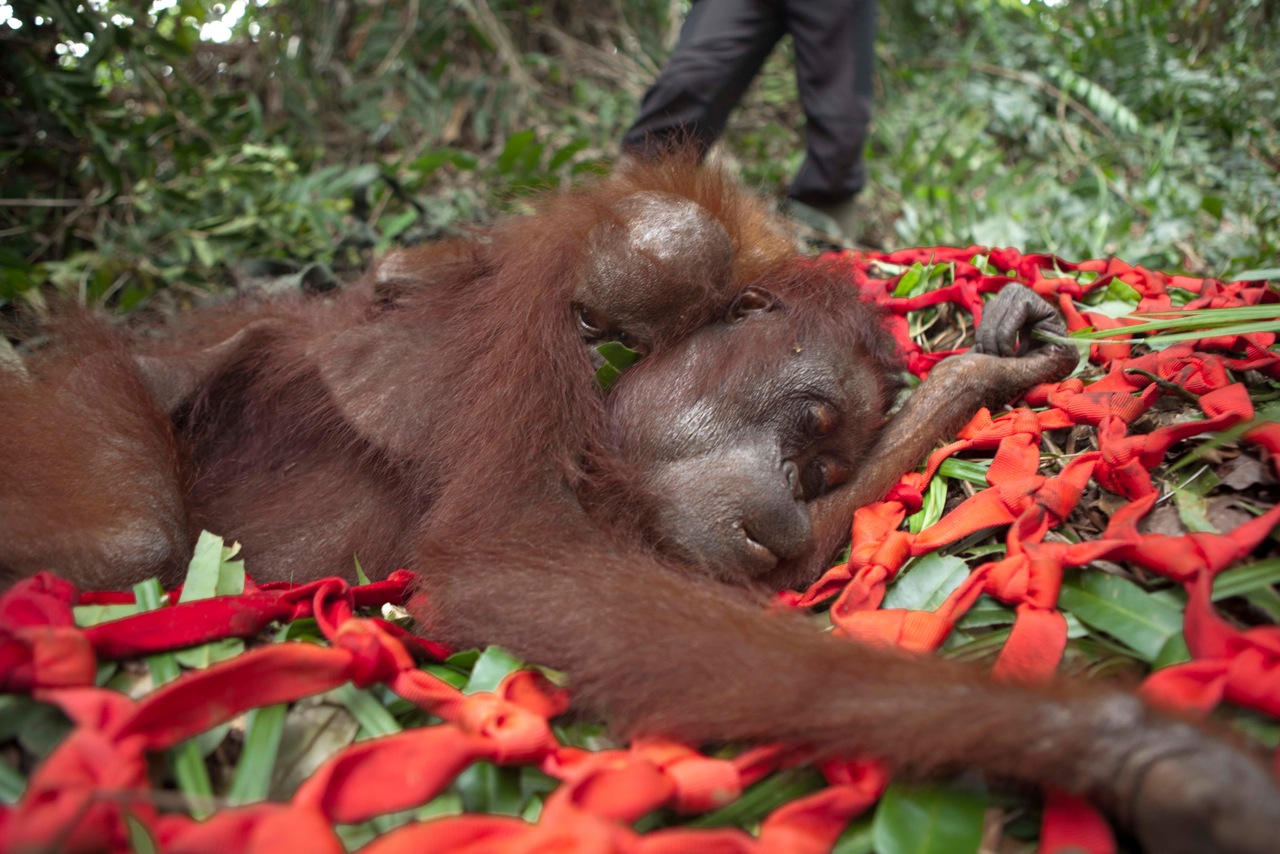
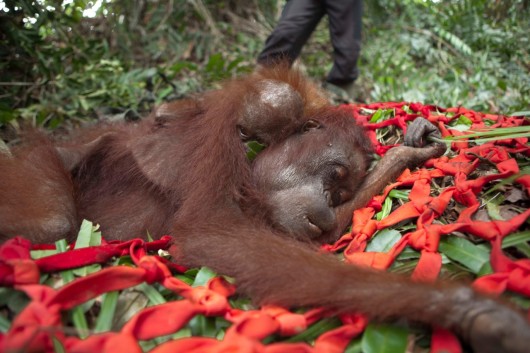 March 2013: she’s almost dead, like her entire species cornered in the wild March 2013: she’s almost dead, like her entire species cornered in the wild
.
<<Footage released 4th April 2013 shows starving orangutans being rescued from an oil palm concession in Borneo after their forest homes were bulldozed by a member of the Roundtable on Sustainable Palm Oil (RSPO), in flagrant violation of the body’s rules.
Conservationists have urged oil palm firm Bumitama Gunajaya Agro (BGA) to cease further clearing immediately amid credible concerns that more of the endangered species are trapped inside the concession and will die if not relocated.
.
[Bumitama is an Indonesian Oil Palm plantation company that cultivates Oil Palm trees and produces crude palm oil (CPO). It was established in 1996 by the Harita Group through its first acquisition of land bank in Central Kalimantan. In 2007, IOI Corporation bought a 33% stake in PT Bumitama Gunajaya Agro.
As of March 2012, Bumitama controls over 190,000 hectares of land bank and has planted 133,000 hectares of Oil Palm trees, mostly in Central and West Kalimantan. Bumitama owns 6 CPO mills (5 in Kalimantan and 1 in Riao), which produces more than 450,000 tons of CPO a year. The main buyers of their CPO include Wilmar, Sinar Mas, and Musim Mas. ]
 Dato’ Lee Yeow Chor
Group Executive Director, Dato’ Lee Yeow Chor
Group Executive Director,
IOI Group of Companies
.
According to RSPO statutes BGA should have carried out High Conservation Value assessments prior to clearing in the concession, setting aside areas that are home to the endangered species.
However, International Animal Rescue Indonesia (IAR Indonesia) and government conservation staff have already rescued four orangutans, including a pregnant adult and a baby, from the concession in Ketapang Regency, West Kalimantan. Other individuals remain at risk if BGA continues to ignore RSPO rules.
Adi Irawan, Program Director of IAR Indonesia Foundation in Ketapang, said:
“We know that there are more orangutans isolated in small patches of forest in this plantation along with other protected wildlife such as proboscis monkeys. All the animals in this plantation are under threat and therefore this company should stop all land clearing immediately, carry out habitat assessments and develop strategies to protect all the endangered wildlife in their estate”.
The concession is operated by BGA subsidiary PT Ladang Sawit Mas (LSM) in a forest buffer next to Gunung Palung National Park, an area that hosts one of the largest populations of Central Bornean orangutan (Pongo pygmaeus wurmbii) in West Kalimantan.
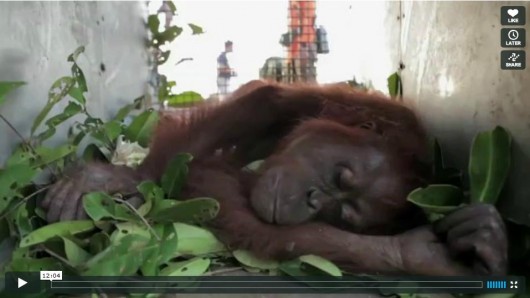
The footage released today shows IAR Indonesia’s Orangutan Rescue Team and the Regency Agency for Natural Resources Conservation (BKSDA) rescuing the orangutans from areas cleared by LSM, to move them to areas with sufficient food for their survival.
Karmele Llano Sanchez, Executive Director of IAR Indonesia Foundation, said:
“We were appalled to see the condition of these rescued orangutans. All of them had gone through long periods of starvation before we rescued them, as the area where they were found, since the company had cleared most of the forest, was too small to provide them with enough food. One of the rescued orangutans had lost her baby, probably killed before the rescue team arrived. More orangutans could die if this company does not take immediate action”.
According to Indonesian Law Act Number 5 year 1990 concerning the Conservation of Living Resources and their Ecosystems the killing of orangutans or other protected wildlife is prohibited and can be severely punished.>>
.
View Footage (click image):.
 . .
Notes:
.
1. The Environmental Investigation Agency (EIA) is a UK-based Non Governmental Organisation and charitable trust (registered charity number 1145359) that investigates and campaigns against a wide range of environmental crimes, including:
- illegal wildlife trade
- illegal logging
- hazardous waste
- trade in climate and ozone-altering chemicals.
.
2. RSPO Criterion 7.3 dictates that new plantings since November 2005 cannot replace any areas required to maintain or enhance one or more High Conservation Value. This includes “Forest areas containing globally, regionally or nationally significant concentrations of biodiversity values (e.g. endemism, endangered species).”
• To view the footage of the rescue go to ^https://vimeo.com/63254306
• For further photos of the rescued orangutans please contact Tom Johnson at tomaszjohnson@eia-international.org
• Interviews are available on request: please contact Karmele Llano Sanchez (IARI) at karmele@internationalanimalrescue.org or Tom Johnson (EIA) at tomaszjohnson@eia-international.org
• Caption for attached picture: An adult female orangutan who was rescued with her baby by IAR Indonesia in Ketapang, March 2013.
.
[Source: ‘Conservationists urge RSPO member to cease rainforest destruction after starving orangutans rescued from concession’, 20130404, Environmental Investigation Agency on behalf of International Animal Rescue, West Kalimantan (Borneo) Indonesia]
.
HSBC loans $135 million to Bumitama Gunajaya Agro (BGA) Group
.
 . .
<<DBS Indonesia and HSBC (Hongkong and Shanghai Banking Corporation) together with its syndication banks have completed the final process of Syndicated Term Loan Facility for Bumitama Gunajaya Agro (BGA) Group. Due to the oversubscribed participation, the final loan amount provided for the facility has been upsized to USD 135 million from the original amount of USD 110 million.>>
[Source: ^http://www.hsbc.co.id/1/2/misc/media-release/21-oct-10]
 Arnott’s Tim Tam, proudly killing Orangutans
(it is one of Australia’s largest selling products that includes Palm Oil in its manufacture) Arnott’s Tim Tam, proudly killing Orangutans
(it is one of Australia’s largest selling products that includes Palm Oil in its manufacture)
.
<<Palm oil plantations are now the leading cause of rainforest destruction in Malaysia and Indonesia. In Southeast Asia alone the equivalent of 300 football fields are deforested every hour. At the current rate, experts believe Orang-utans will be extinct in the wild by 2013 (this year).
Palm oil and its derivatives are present in 50% of all packaged foods on our shelves. While 50% of products in Australian supermarkets contain Palm Oil, it is nearly impossible for consumers to be able to make an informed choice about which products to purchase. This is because under current food labelling laws, Palm Oil can be legally labelled as ‘Vegetable Oil’.
Australia’s current food regulations don’t require this truth in labelling.>>
.
[Source: ‘Food Labelling, ^http://www.nickxenophon.com.au/food-labelling]
.
.
Products blatantly continuing to include crude Palm Oil
.
Aldi Supermarkets
-Damora snack foods
-Belmont Biscuit co.
-GoldenVale cereals
-Dominion products
-Choceur chocolates
-Bramwells
-Sprinters chips
-Brookdale
-Milfina ice-cream
.
Arnott’s Biscuits
-Shapes (AP)
-Shapes Sensations (AP)
-Tim-Tams (AP)
-Wagon Wheels
-Mint Slice biscuit
-Royals
-Classic assorted
-Venetian
-Lemon Crisp
-Raspberry shortcake
-Arnott’s cookies
-Tiny Teddies
-Jatz Clix biscuits (savoury)
.
Coles Supermarkets (Coles brand range)
-“You’ll Love Coles” range (ice-cream, garlic bread, milk chocolate etc.)
-$mart Buy
-Coles Pastries: Donuts, Biscuits, Cakes, Muffins & Scrolls (AP)
.
Colgate-Palmolive
-Shampoos (AP)
-Conditioners (AP)
-Body wash (AP)
-Soaps (AP)
-Liquid hand-soap (AP)
-Shower gel (AP)
.
Colgate
-Toothpastes (AP)
-Mouthwash
-Shaving cream
.
Fonterra dairy products
-Dairy Milk
Anchor (Fonterra brand)
-Blue top milk
-Cheese singles
-Butter
Mainland cheeses (Fonterra brand)
-Edam cheese
-Colby cheese
-Tasty cheese
-Mild cheese
-Special reserve cheese range (AP)
.
Tip Top ice-creams (Fonterra brand)
-Joy Bar
-Soft serve
-Ice-creams in tub (AP)
-Ice-creams on cone (AP)
-Ice-creams on stick (AP)
.
General Mills
-Old El Paso tacos, dips, salsas & tortillas (AP)
-Betty Crocker products (AP)
-Cheerios breakfast cereal
-Nature Valley granola bars
-Fruit roll-ups
-Latina Pasta (AP)
.
Olay (owned by General Mills)
-Most cosmetics
.
Kraft
-Easy Mac
-Deluxe macaroni and cheese
-Peanut Butter
-Velveeta
-Cool Whip cream
.

.
Nabisco (owned by Kraft)
-Oreos (AP)
-Ritz Crackers
-Chips Ahoy! (biscuits)
-Wheat Thins
.
Heinz
.
-Beans
-Spaghetti
-Sauces & dressings
-Soups (AP)
-Frozen meals
-Desserts (AP)
-Wattie’s canned snack foods (AP)
-Weight watchers products
.
 . .
Mars Incorporated
.

.
-M&Ms
-Snickers
-Mars Bars
-Milky Way
-Twix
-Bounty
-Maltesers
-Doublemint
-Dove
.
Wrigley’s (owned by Mars)
-5 gum (AP)
-Extra gum (AP)
-Juicy Fruit gum (AP)
-Starburst lollies
-Skittles lollies
-Hubba Bubba bubble gum (AP)
-P.K. chewing gum (AP)
.
Mars Petcare
-Pedigree
-My Dog
-Dine
-Kitekat
-Optimum
-Schmakos
-Advance
-Whiskas
-Royal Canin
.
Sara-Lee
-Bavarians
-Cakes & cheesecakes (AP)
-Chocolate Pies & Fruit Pies
-Croissants & Danishes (AP)
-Crumbles & Puddings
-Ice Creams (AP)
-Lasagna
-Quiches (AP)
.
Snack Brands Australia
-Cheezels
-Samboy chips (AP)
-CC’s corn chips
-Thins chips (AP)
-French Fries
-Chickadees
-Colvan chips
.
Uncle Tobys
.
 . .
-Fruit Breaks bars (AP)
-Chewy bars (AP)
-Bodywise bars
-Le Snak
-Roll Ups
.
‘AP’ = All products. Palm oil is found in all products or flavours of this specific brand. Example – palm oil is found in all flavours of Arnott’s Shapes: Plain, Chicken, Pizza, BBQ etc.
[Source: ^http://www.saynotopalmoil.com/]
.
“In 2008 Food Standards Australia and New Zealand (FSANZ) rejected an application for the compulsory labelling of Palm Oil, arguing that they have no legal capacity to hear the case.”
[Source: ^http://www.palmoilaction.org.au/shopping-guide.html]
.
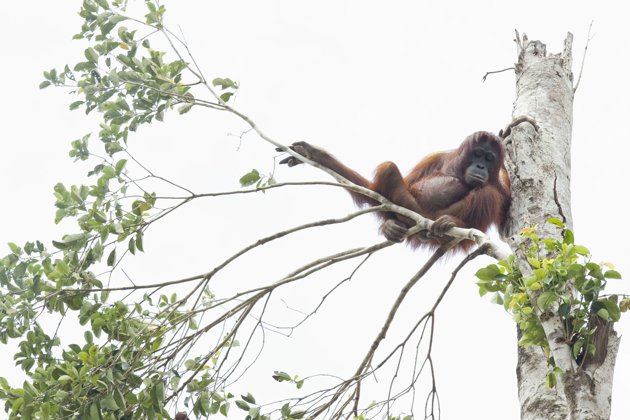
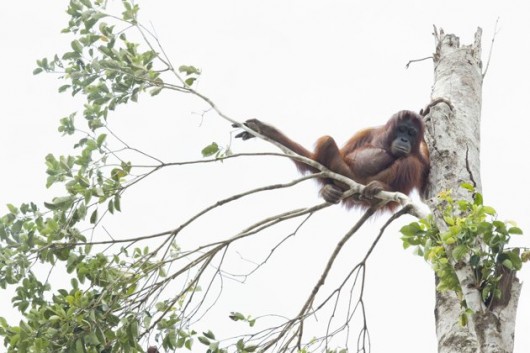 An adult orangutan looks down from its treetop home as the forest in Ketapang, Borneo, is bulldozed (Caters)
Source: ^http://uk.news.yahoo.com/orangutan-rescue-borneo–primates-deforestation-palm-oil-ketapang-mother-and-baby-104041487.html#tZX7oWc] An adult orangutan looks down from its treetop home as the forest in Ketapang, Borneo, is bulldozed (Caters)
Source: ^http://uk.news.yahoo.com/orangutan-rescue-borneo–primates-deforestation-palm-oil-ketapang-mother-and-baby-104041487.html#tZX7oWc]
.
Food Standards Australia New Zealand Board
.
Under the FSANZ Act, the FSANZ Board is selected by the Australian Minister for Health and Ageing in consultation with the Legislative and Governance Forum on Food Regulation and must include qualified people from all walks of life.
.
[Source: ^http://www.foodstandards.gov.au/scienceandeducation/aboutfsanz/theboard/, April 2013]
.
 |
|
Ms Philippa Smith AM [s.116(1)(a)]
Ms Philippa Smith, AM was appointed Chair of the FSANZ Board in July 2008. Ms Smith is a former Commonwealth Ombudsman, CEO of the Association of Superannuation Funds of Australia and the inaugural Chair of the Consumer’s Health Forum. She has developed strong strategic skills and extensive experience in ensuring effective accountability and governance structures across a number of portfolios. |
 |
|
Mr Steve McCutcheon (Chief Executive Officer) [s.116(1)(b)]
Mr McCutcheon, who holds a Bachelor of Economics degree and has undertaken further studies in public law and public policy, was appointed CEO of FSANZ in October 2007. Before his appointment, Mr McCutcheon held a number of senior executive positions in the Commonwealth Department of Agriculture, Fisheries and Forestry. During that time, he led the team that developed the new food regulatory framework for Australia and New Zealand under the auspices of the Council of Australian Governments. Mr McCutcheon also led the Australian delegation to annual sessions of the Codex Alimentarius Commission. |
 |
|
Dr Michele Allan [s.116(1)(f)]
Dr Michele Allan has strong leadership experience across many facets of the food industry. Her areas of expertise include manufacturing strategy, organisational strategy, risk and insurance leadership, food safety systems implementation, food packaging innovation and commercialisation. Dr Allan has held senior executive positions with Amcor Limited, Bonlac Foods, Bioinformatics Centre of Excellence Tasmania, Kraft Foods and ICI; and has also held board positions within both the private and public sectors. |
 |
|
Mr Peter Boyden [s.116(1)(g)]
Mr Peter Boyden is an internationally experienced CEO with extensive general management and marketing experience gained in consumer foods businesses in Australia, the United Kingdom, the Netherlands and Greece. Mr Boyden has been the Managing Director and regional Board member of the Unilever Australasian foods business and a Board member of the Australian Food and Grocery Council. His areas of responsibility have included the management of consumer marketing, product and packaging development, food production and general management, where he has focused on strategy development and portfolio management. |
 |
|
Professor Stephen Corbett [s.116(1)(f)]
Professor Stephen Corbett has had more than 20 years of experience as a public and environmental health physician, with qualifications in public health and medicine. His interests include environmental health risk assessment and management, regulatory policy and practice, and chronic disease prevention. Professor Corbett’s experience includes holding senior executive positions in NSW Health-Public Health; being Conjoint Associate Professor at the School of Public Health, University of Sydney and Western Clinical School, Westmead Hospital; and being Associate Editor on the journal Evolution, Medicine and Public Health. |
 |
|
Ms Jenni Mack [s.116(1)(d)]
Ms Jenni Mack has worked in consumer affairs since 1993 when she was Executive Director of the Australian Federation of Consumer Organisations. Her work has spanned food, chemicals, telecommunications, energy and financial services policy incorporating areas such as industry self-regulatory and co-regulatory practices, professional standards and codes of practice. Ms Mack has worked closely with regulators and government agencies on good regulatory science, community education, licensing, best practice enforcement and compliance schemes, and community and social research projects. |
 |
|
Dr Andrew McKenzie QSO [s.116(1)(c)]
Dr Andrew McKenzie is qualified as a veterinarian with post graduate qualifications in veterinary public health and has a background working for the New Zealand Ministry of Agriculture and Fisheries with a focus on the meat, seafood and other food industries. In 2002, Dr McKenzie set up the New Zealand Food Safety Authority and led it until his retirement in June 2010. He has extensive experience in domestic food safety policy and standards, as well as international food safety and trade standards at the bilateral and multilateral level. Dr McKenzie has a continuing interest in management and governance, as well as contemporary regulatory approaches to food safety/quality and trade, particularly around standard-setting. |
 |
|
Dr James (Gardner) Murray AO PSM [s.116(1)(f)]
Gardner Murray has veterinary medicine, surgery and management qualifications. Through his work in high level government positions and via his company—Gardner Murray Pty Ltd., Dr Murray has contributed to national and international developments in food safety, animal health, ‘One Health’ (collaboration between animal, human and environmental scientists and related disciplines to achieve optimal health), biosecurity, market access, emergency management, animal welfare, policy development and strategic planning. He has held and holds numerous high level Board, Commission and Committee positions at the national and international levels. |

|
|
Mr Tony Nowell CNZM [s.116(1A)]
Mr Tony Nowell has had extensive senior executive experience across various industries (including food) both internationally and within New Zealand. This has included holding positions such as CEO of Zespri International; Managing Director of Griffin’s Foods; Regional Vice President of Sara Lee Asia; Zone Manager for Sara Lee Indonesia, Philippines and Thailand; Managing Director of Sara Lee Indonesia; Managing Director of L’Oreal Indonesia; and Operations Manager of L’Oreal New Zealand. Mr Nowell’s other roles and responsibilities have included being the former Chair of the New Zealand Packaging Accord Governing Board and the New Zealand Government Food and Beverage Taskforce; and include Chairmanship of the New Zealand Forest Research Institute and Wellington Drive Technologies, as well as directorships at New Zealand Food Innovation Auckland and the Export Advisory Board of Business New Zealand. Mr Nowell has represented New Zealand as a member of the APEC Business Advisory Council since 2007. |
 |
|
Dr David Roberts [s.116(1)(g)]
Dr David Roberts is a food and nutrition Consultant with extensive experience in health and science. He has expertise in public health, food science, food allergy, human nutrition, food safety, food industry, food processing/retail, government and regulation. Dr Roberts was the Deputy CEO and scientific and technical Director of the Australian Food and Grocery Council for 5 years until October 2007. Prior to that, he had held the Foundation Chair in Nutrition and Dietetics (established 1991) at the University of Newcastle for 10 years. Dr Roberts was at Sydney University for 12 years teaching and researching in nutritional biochemistry. He is a former Chair of the Federation of Australasian Nutrition Organisations, former President of the Nutrition Society of Australia (3 years), former Chair of the NSW Branch of AIFST (1 year), former Chair of the inaugural Complementary Medicines Evaluation Committee of the Therapeutic Goods Administration (4 years) and former member of the editorial board of the British nutrition foundation (10 years+). |
 |
|
Mr Neil Walker JP [s.116(1)(ca)]
Mr Neil Walker is a food scientist with 35 years of experience in the dairy industry in New Zealand. He is a fellow of both the Institute of Chemistry and the New Zealand Institute of Food Science and Technology (NZIFST); and was the Dairy Chair of the NZIFST. He has had experience as Chair, director, trustee and committee member in relation to public councils and authorities; private trusts; companies and organisations; and national, community, charitable and family entities. |
Tags: Bumitama Gunajaya Agro, Environmental Investigation Agency, Food Standards Australia and New Zealand, FSANZ, Gunung Palung National Park, International Animal Rescue Indonesia, orang-utan, orang-utan extinction, palm oil, palm oil plantations, Roundtable on Sustainable Palm Oil
Posted in Orang-utans, Threats from Deforestation, Threats from Farming | No Comments »
Add this post to Del.icio.us - Digg
Saturday, April 6th, 2013
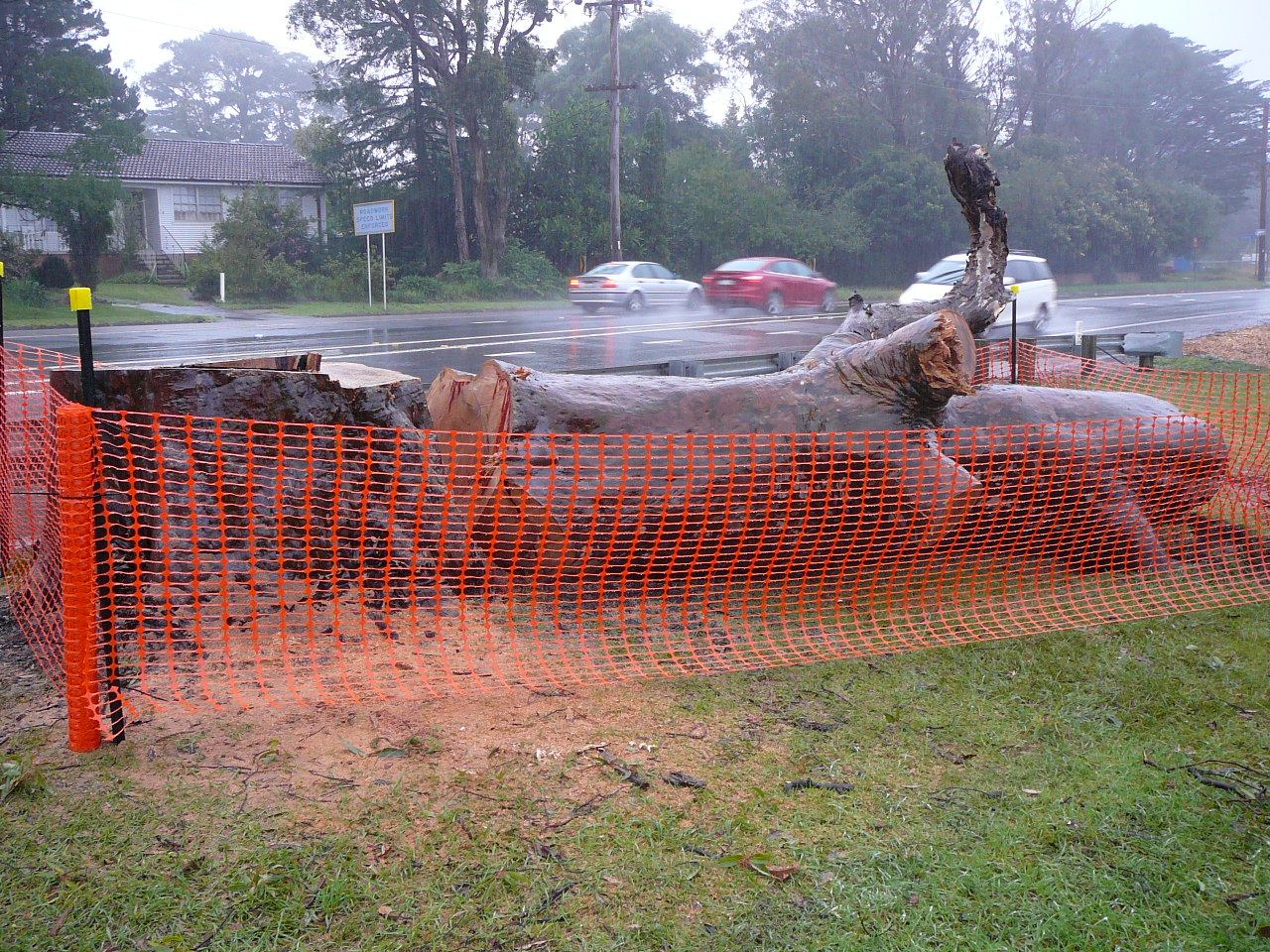
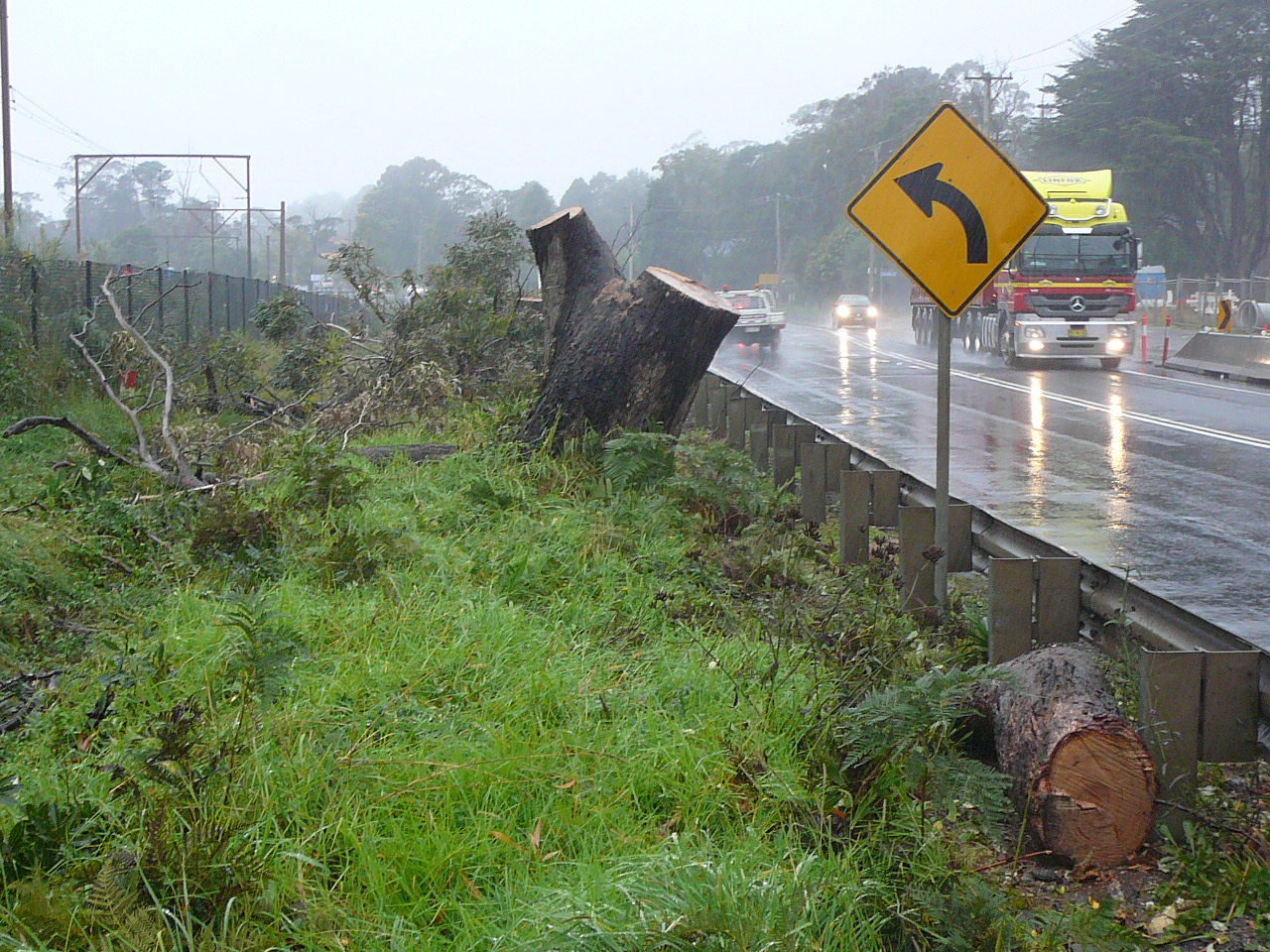
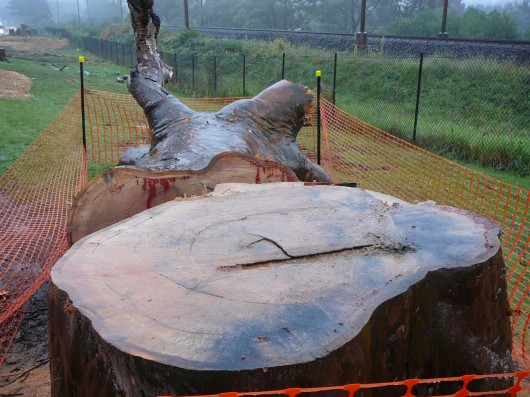
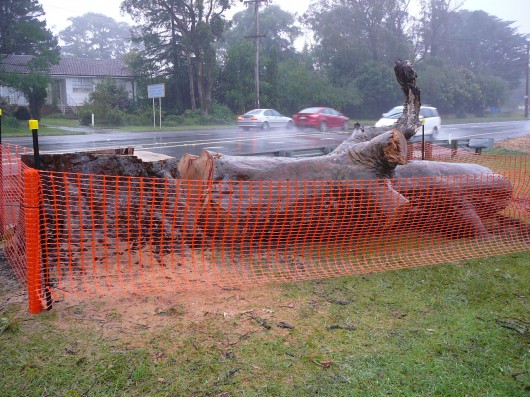 The trunk of a healthy 300+ year old Angophora lies beside the highway in Bullaburra
Blue Mountains, New South Wales, Australia
[Photo by our investigator, 20130403, Photo © ^Creative Commons] The trunk of a healthy 300+ year old Angophora lies beside the highway in Bullaburra
Blue Mountains, New South Wales, Australia
[Photo by our investigator, 20130403, Photo © ^Creative Commons]
.
Government destruction of Bullaburra has begun. Last Monday, April Fools Day 2013, they came and killed Bullaburra’s magificent Angophora to make way for a trucking expressway through the village. But who are the fools who destroy our native heritage?
To many perhaps this is just another tree. Some people value trees and ecology. Others have deep value for wildlife and other animals, especially their pets. Many people value where they live and grow very attached to where they live for reasons that can seem difficult for others to appreciate. But it is the existence rights of species that humans ignore besides their own self-serving interests. Male Baby Boomers remain the most extreme in their self-righteousness, and those in government prescribe utilitarian dictates over the rights of the few.
Elie Wiesel, novelist, political activist, and Humanities Professor at Boston University, has said that the opposite of love is not hate, it’s indifference. The opposite of beauty is not ugliness, it’s indifference. The opposite of faith is not heresy, it’s indifference. And the opposite of life is not death, but indifference between life and death.
.
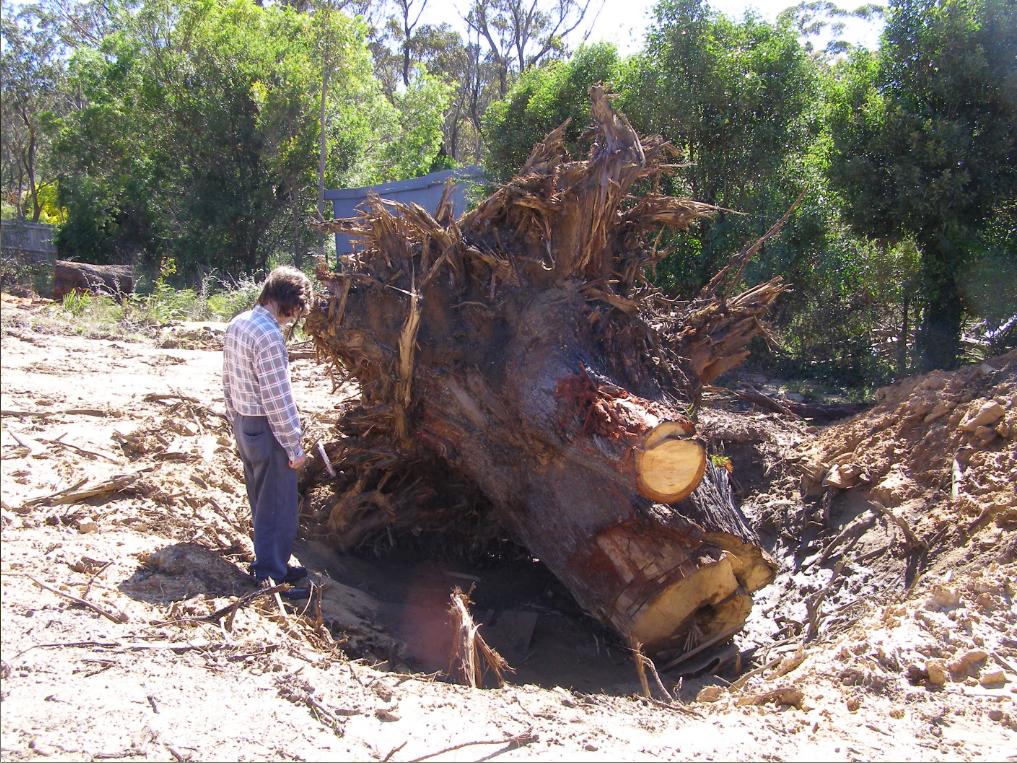
 Witnessing an old friend being slaughtered
[Photo by our investigator, 20130403, Photo © ^Creative Commons] Witnessing an old friend being slaughtered
[Photo by our investigator, 20130403, Photo © ^Creative Commons]
.
A native tree that once was part of an Angophora (Sydney Redgum) forest, existed way back when the three explorers Lawson, Wenthworth and Blaxland crossed the Blue Mountains in 1813. They would have passed right past this tree. Two years later road builder William Cox similarly would have laid his rough track, and in 1836 Major Mitchell upgrading the road too would have passed by this tree. For nearly two centuries travellers have passed by this tree, most probably not even giving it a glance. Now it is gone and the opportunity to respect and appreciate this remnant of natural heritage has gone with it.
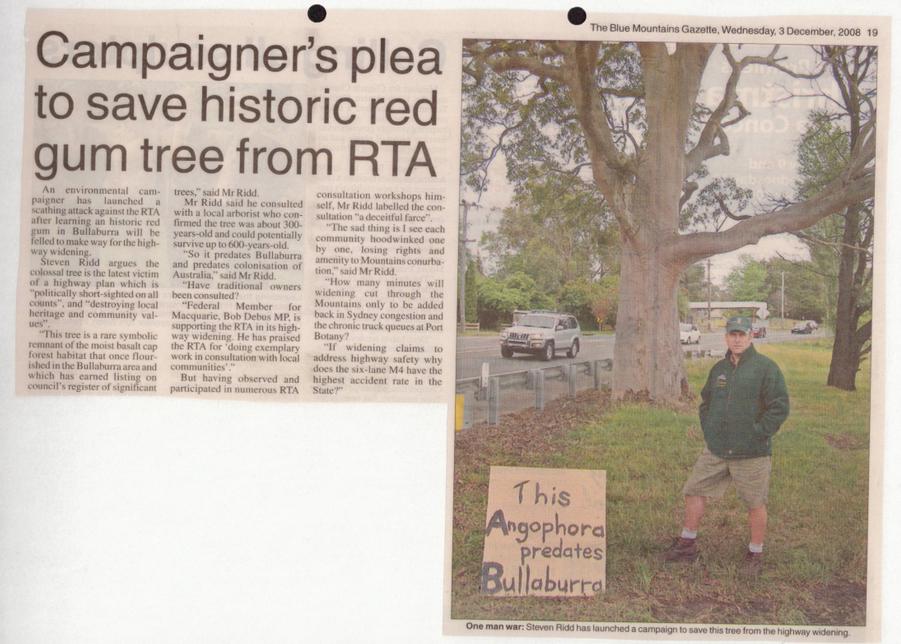
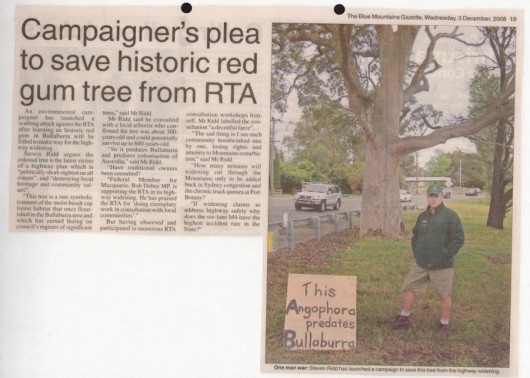 We tried to save you
Campaign to Save Bullaburra’s 300 year old Angophora back in 2008
(Blue Mountains Gazette, 20081203) We tried to save you
Campaign to Save Bullaburra’s 300 year old Angophora back in 2008
(Blue Mountains Gazette, 20081203)
.
Last January, spiteful people set fire to two Hermmansburg ghost gums made famous in Albert Namatjira’s landscape paintings. In 2006, Barcaldine’s famous ghost gum, ‘the tree of knowledge’ was poisoned. Just last week an old gum tree in the Rylstone public school was poisoned. Human hate for native trees has pervaded Australian colonising society since Cook landed at Camp Cove and chopped down trees for firewood.
.
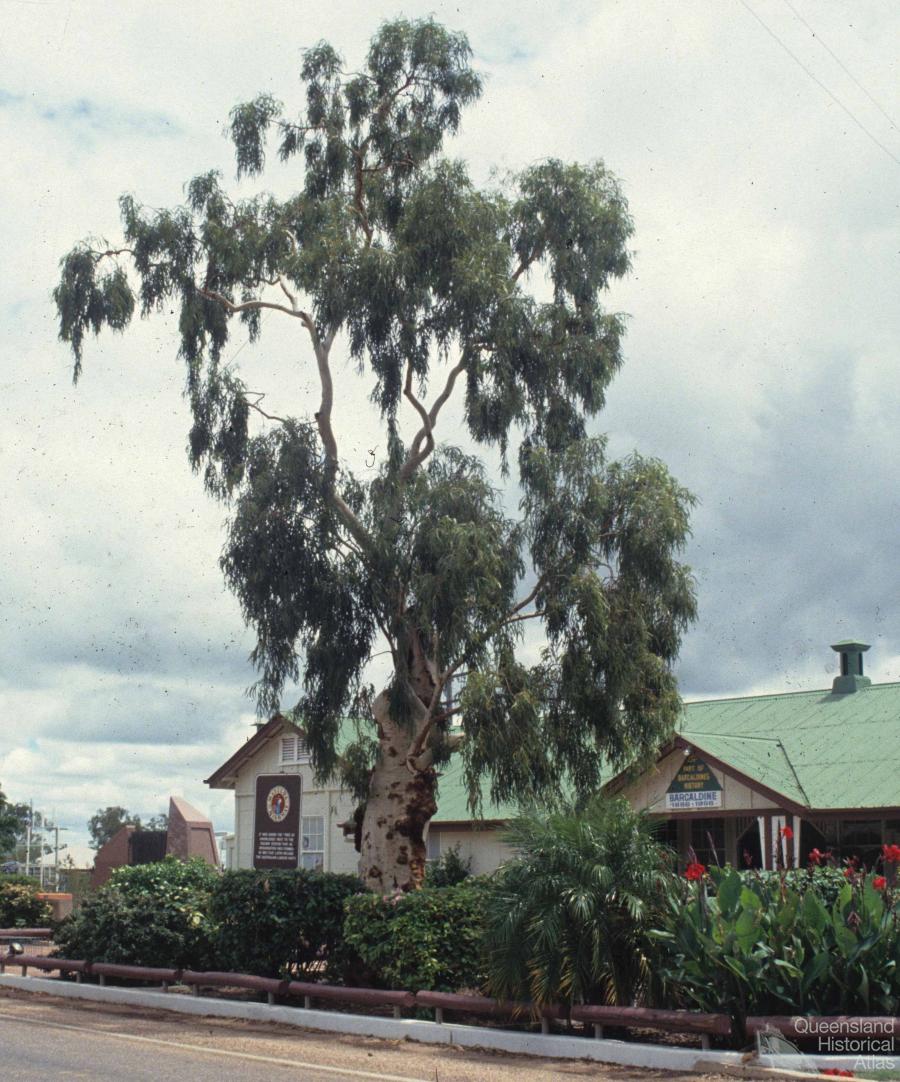
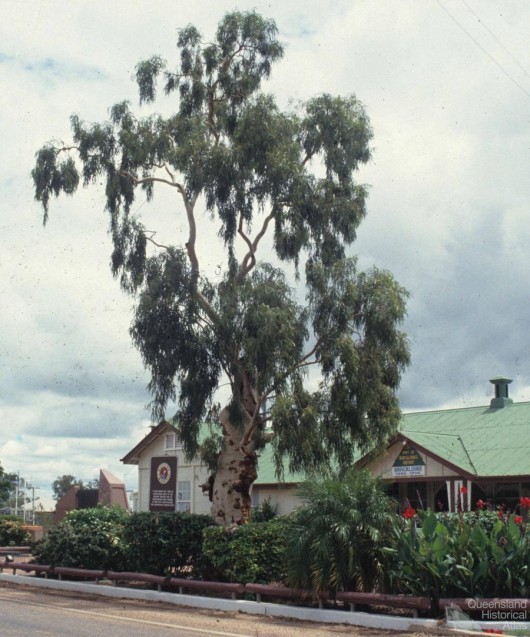 Tree of Knowledge, Barcaldine, Queensland
As it used to be, before it was poisioned.
[Source: Queensland Historical Atlas, 1991,
^http://www.qhatlas.com.au/photograph/tree-knowledge-barcaldine-1991] Tree of Knowledge, Barcaldine, Queensland
As it used to be, before it was poisioned.
[Source: Queensland Historical Atlas, 1991,
^http://www.qhatlas.com.au/photograph/tree-knowledge-barcaldine-1991]
.
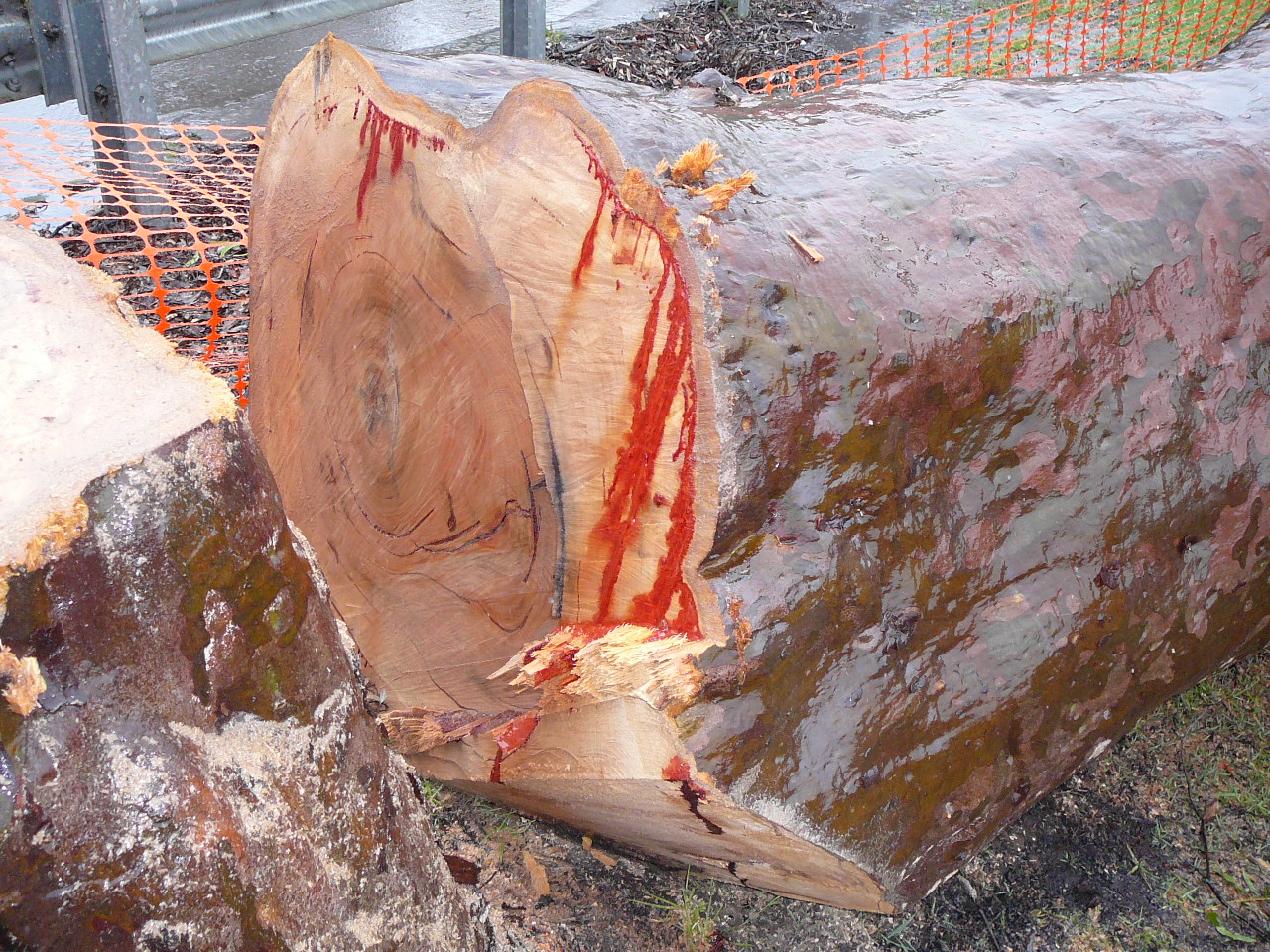
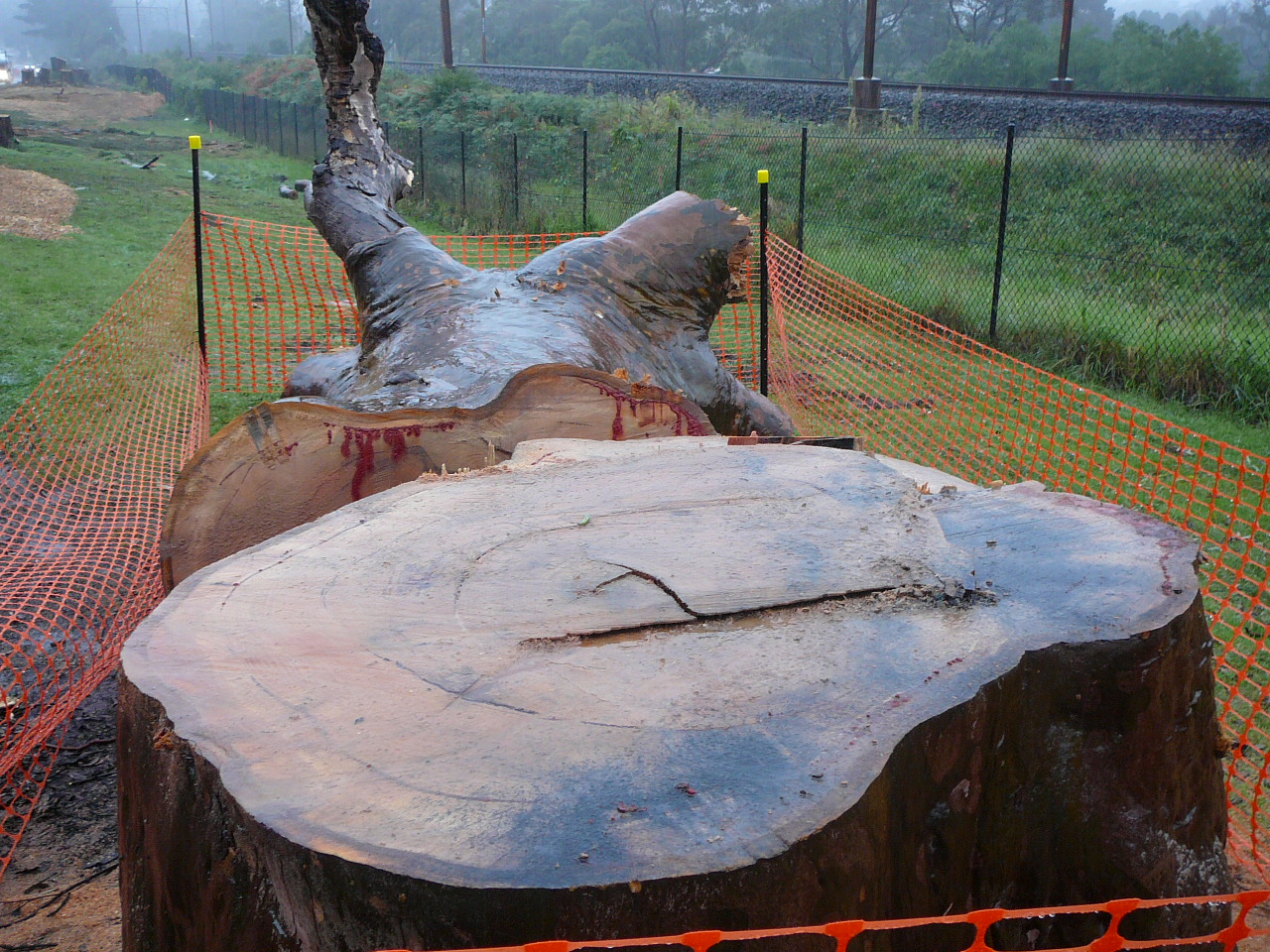
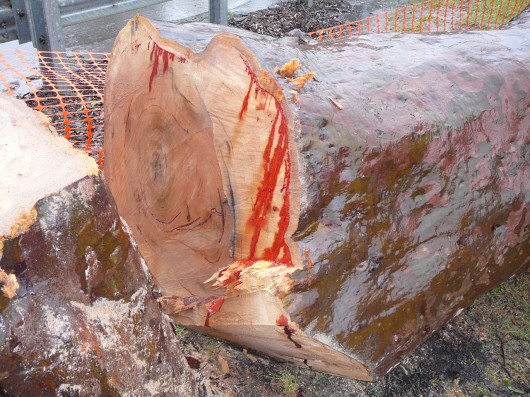
A local arborist with expertise in native trees of the Blue Mountains including Angophoras, estimated in 2007 that the Bullaburra Angophora to have been over 300 years old. It was still healthy and still growing as confirmed by the solid core of the severed trunk.
Now it lies like a dead harpooned whale like roadkill beside the highway, where it has stood all those decades.
.
 A dendrochronology of more than 300 annual growth rings.
The tree was healthy to the core. It was not rotting. It was not diseased.
It was just in the way of someone’s trucking interpretation of ‘progress’.
[Photo by our investigator, 20130403, Photo © ^Creative Commons] A dendrochronology of more than 300 annual growth rings.
The tree was healthy to the core. It was not rotting. It was not diseased.
It was just in the way of someone’s trucking interpretation of ‘progress’.
[Photo by our investigator, 20130403, Photo © ^Creative Commons]
.
Significant Tree #29
.
This Angophora was recognised as a ‘Significant Tree‘ on the local Blue Mountains Council’s Significant Tree Register back on 17th July 1985 and formally adopted on 21st June 1988, at the time of Australia’s Bicentennary.
No opposition against killing the tree was communicated by the Blue Mountains Council to the RTA-come-RMS. Indeed, this is one of many such ‘significant trees’ that have been killed for development convenience in recent years. Clearly, the Blue Mountains Council’s Significant Tree Register has become disingenuous and lying greenwash.
.
.
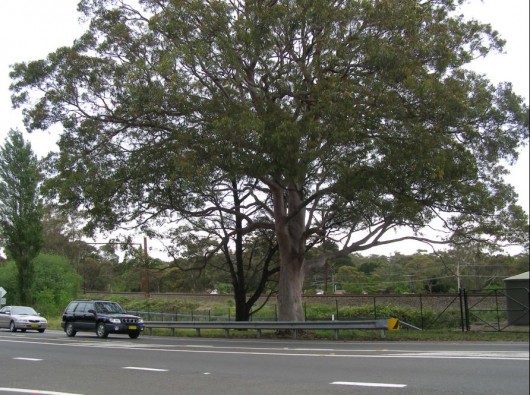 Bullaburra’s Angophora, in memoriam Bullaburra’s Angophora, in memoriam
Registered Significant Tree #: 29
Botanical Name: Angophora costata (Smooth Barked Apple, Red Gum)
Location: Great Western Highway Bullaburra, Opp. Lot 173, DP13407
[Photo by Editor, 20071028, Photo © ^Creative Commons]
.
Trucking Expressway
.
The death of the Angophora is the begining of the end of Bullaburra. The highway village is set to become a siding for four-laned trucking expressway so that B-double trucks can rumble 24/7 through Blue Mountains towns and villages, nudging 90kph on cruise control.
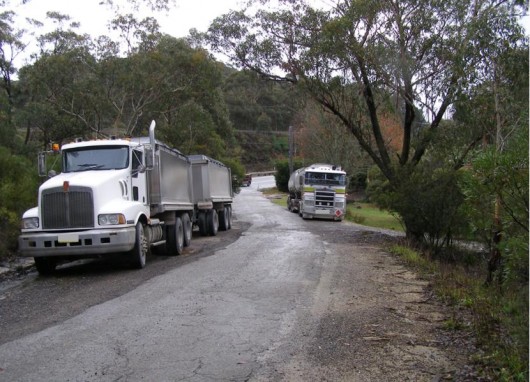 Bigger Trucks demanding bigger roads
[Photo by Editor, 20090531, Photo © ^Creative Commons] Bigger Trucks demanding bigger roads
[Photo by Editor, 20090531, Photo © ^Creative Commons]
.
The rural amenity of this highway village is to be lobotomised into a mono-design urban landscape taking on the same monotonous blandness as any other expressway in the country. The government euphemises this as:
.
“to achieve greater consistency in the design of the Blue Mountains area to achieve a simple and unified design of the highway and its elements.”
.
The fundamental basis for the government’s conversion of this regional highway into a national trucking expressway route is simply “to improve travel times” for trucks, so that more and larger trucks are encouraged to use the route.
The Bullaburrra section is to cost taxpayers $80 million and will see 3.6 hectares of native bushland destroyed on the basis that the vegetation “is already dissected and fragmented“. So it seems that moral relativism allows for wedge development just like a little bit of corruption doesn’t hurt anyone.
But as if the twisted morality isn’t bad enough. It is the greenwashing that really twists the knife in. The RTA-come-RMS in its Review of Environmental Effects maintains that the expressway development aims:
“to protect the natural systems and ecology of the corridor”
..
[Source: ‘The Great Western Highway Upgrade – Bullaburra East, Review of Environmental Effects’, Vol.2, July 2009, Roads and Traffic Authority, New South Wales Government, p.2.]
.
However, the expressway development will simply result in the heart of rural Bullaburra being ripped out and the amenity reduced to a trucking siding adopting a benale concrete landscape akin to the bland urban character of an upper Blaxland, and mirroring what has happened to nearby lobotomised Lawson.
.
“It’s just really tragic after all the horrors of the last 1,000 years we can’t leave behind something as primitive as government sponsored execution.”
~ Wisconsin Senator Russ Feingold, when introducing a bill that would end the death penalty on the Federal level.
.
Progress of Hate
.
Under Australia’s Federal Auslink Policy the national freight thinking is road-centric and all about replacing real trains with road trains. Behind this trucking expressway scheme is a powerful and influential trucking lobby group who donate generously to the political parties that control the New South Wales Government, and various politicians including retired Blue Mountains MP Bob Debus, who has long been a driver of this trucking expressway.
The New South Wales Government department behind this scheme is the RTA-come-RMS (Roads and Maritime Services). In 2007, the then General Manager – Environmental Branch, Ms Erica Adamson, claimed that to retain the Angophora consequential loss of tree roots and pruning would instigate the decline of the tree. “For road construction and safety reasons the tree will have to be removed…to maintain sight lines (for speeding trucks).”
“It’s called progress” they say. For the Blue Mountains it is being inflicted at any cost – economic, social, environmental.
The idea of ‘progress‘ is an economic one that was borne out of Western 18th Century hard-nosed Industrial Revolution and perhaps extending back to the 16th Century Enlightenment of Europe and perhaps even back to when the Iron Age triumphed so aggressively and effectively over the Bronze Age.
Perhaps progress remains subjective only with the progressor who doggedly in his pursuit rough shods over others in the process. Perhaps the idea of progress is a myth. Is the human condition better off as a result? Are we advancing as a society by rough shodding over others and over what is left of Ecology and Nature? The philosophy of ‘^Deep Ecology‘ posits otherwise.
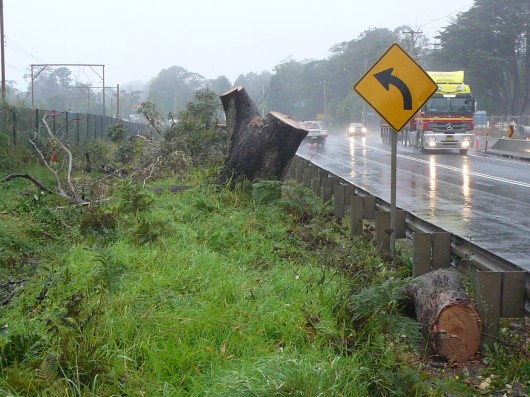 Progress of Hate
[Photo by our investigator, 20130403, Photo © ^Creative Commons] Progress of Hate
[Photo by our investigator, 20130403, Photo © ^Creative Commons]
.
“Progress means getting nearer to the place you want to be. And if you have taken a wrong turning, then to go forward does not get you any nearer. If you are on the wrong road, progress means doing an about-turn and walking back to the right road; and in that case the man who turns back soonest is the most progressive man.”
~ C.S. Lewis, Mere Christianity
.
Related reading on this website:
.
[1] >Threats from Road Making – articles
.
[2] >Bushphobia – a case of deluded convenience
.
Tags: Blue Mountains, Blue Mountains Council, BMCC, Bullaburra, Bullaburra Angophora, Bullaburra's Angophora, ghost gums, Great Western Highway, greenwash, RMS, Roads and Maritime Services, RTA, RTA-come-RMS, Significant Tree, Significant Tree Register, Tree of Knowledge, trucking expressway
Posted in Blue Mountains (AU), Threats from Greenwashing, Threats from Road Making | 1 Comment »
Add this post to Del.icio.us - Digg
Sunday, March 31st, 2013
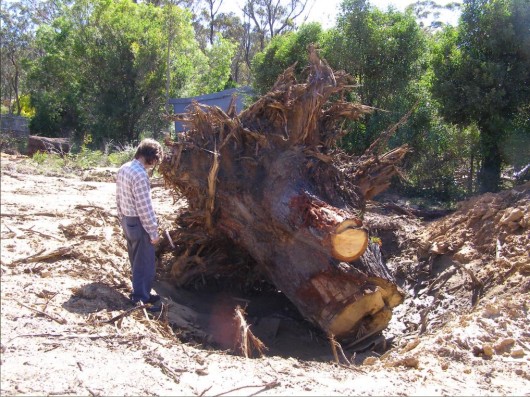 A hundred year old native Eucalypt killed for housing development
Wellington Road Katoomba, Blue Mountains
[Photo by Editor, 20130307, click image to enlarge, Photo © ^Creative Commons] A hundred year old native Eucalypt killed for housing development
Wellington Road Katoomba, Blue Mountains
[Photo by Editor, 20130307, click image to enlarge, Photo © ^Creative Commons]
.
Month by month, year on year, the native vegetation of the Blue Mountains is steadily disappearing lot by lot, hectare by hectare, for private housing development profit.
A native bushland site along Wellington Road on the bush fringe of Katoomba has been recently sold off for private profit, then bulldozed and trees uprooted ready for housing construction. Like so many such sites, once the house is built, it soon goes on the market for sale and profit.
Typically, it is not owner-occupiers buying up the bush, but property developers for quick sale and profit. Cummulatively, much of fringe Blue Mountains bushland is being flogged for profit. Cheap bush blocks are bought, bushland habitat is destroyed and private profit is made at the expense of cheapened ecology.
And real estate agents are in on the private profit making bandwagon.
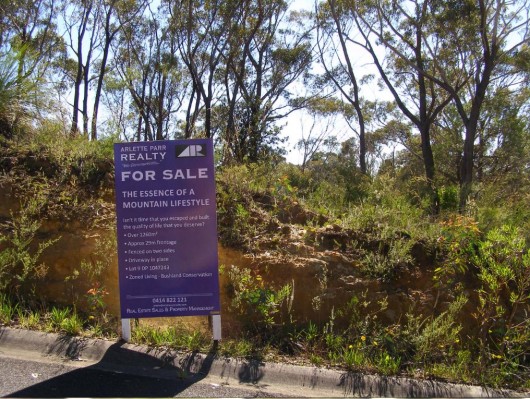 Katoomba fringe bushland flogged by real estate agents
Oxymoronic zoning: ‘Living – Bushland Conservation’
[Photo by Editor, 20130307, click image to enlarge, Photo © ^Creative Commons] Katoomba fringe bushland flogged by real estate agents
Oxymoronic zoning: ‘Living – Bushland Conservation’
[Photo by Editor, 20130307, click image to enlarge, Photo © ^Creative Commons]
.
On this particular site, grows a threatened species of native flora, Needle Geebung (Persoonia acerosa), which is endemic to this region of the Blue Mountains – that is, outside this region, the species grows naturally nowhere else on the planet. It is a protected species under the Threatened Species Conservation Act 1995 (New South Wales).
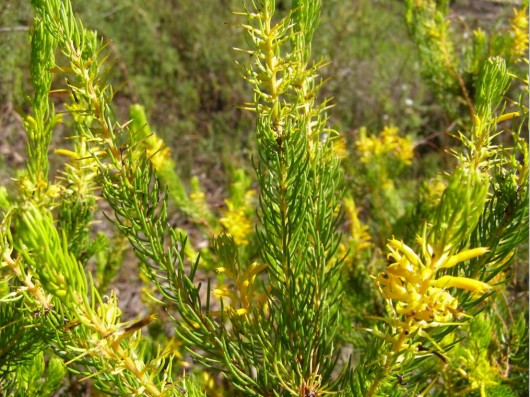 Blue Mountains Needle Geebung (Persoonia acerosa)
[Photo by Editor, 20130307, click image to enlarge, Photo © ^Creative Commons]
Listed as vulnerable to extinction in Schedule 2 ‘Vulnerable species and ecological communities‘
within the Threatened Species Conservation Act 1995 (New South Wales).
[Source: NSW Government, ^http://www.environment.nsw.gov.au/threatenedspecies/whatists.htm] Blue Mountains Needle Geebung (Persoonia acerosa)
[Photo by Editor, 20130307, click image to enlarge, Photo © ^Creative Commons]
Listed as vulnerable to extinction in Schedule 2 ‘Vulnerable species and ecological communities‘
within the Threatened Species Conservation Act 1995 (New South Wales).
[Source: NSW Government, ^http://www.environment.nsw.gov.au/threatenedspecies/whatists.htm]
.
The Needle Geebung is a plant species within the Proteaceae family of flowering plants. The Needle Geebung is a small, erect to spreading shrub 1 – 2 m tall. Its bright green, pine-like foliage is very distinctive. The small, needle-like leaves are channelled on the upper surface. Flower clusters are produced along leafy shoots, not at the branch tips, as in related species. The yellow tubular flowers are up to 1 cm long and most frequently appear in summer. Fruits are pear-shaped, yellowish-green with brownish-red markings, to 14 mm long and 10 mm in diameter.
.
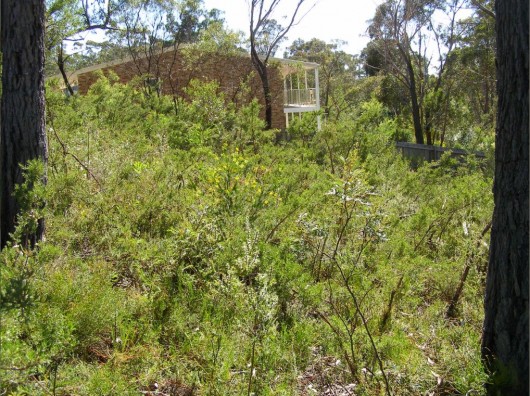 Needle Geebung in its natural setting (yellow flowers in centre of image)
[Photo by Editor, 20130307, click image to enlarge, Photo © ^Creative Commons] Needle Geebung in its natural setting (yellow flowers in centre of image)
[Photo by Editor, 20130307, click image to enlarge, Photo © ^Creative Commons]
.
The Needle Geebung occurs in dry sclerophyll forest, scrubby low-woodland and heath on low fertility soils. Plants are likely to be killed by fire and recruitment is solely from seed. This species seems to benefit from the reduced competition and increased light available on disturbance margins including roadsides.
The threatened status of this species was last assessed in September 2012, but as each month passes and more fringe bushland is flogged off for housing development, the existence of the species is further reduced.
In New South Wales, ‘threatened‘ species, populations and ecological communities are those respectivelyconsidered by the New South Wales Scientific Committee to be at risk of extinction in the immediate to medium-term future in New South Wales, and are listed under Threatened Species Conservation Act 1995, Schedules 1, 1A and 2.
[Source: New South Wales Government, ^http://www.environment.nsw.gov.au/threatenedspecies/whatists.htm]
.
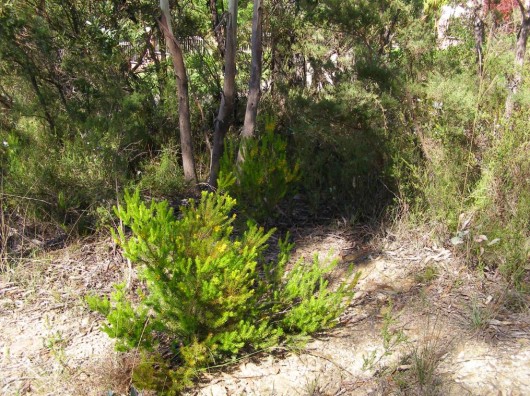 Needle Geebung isolated by the property developer
[Photo by Editor, 20130307, click image to enlarge, Photo © ^Creative Commons] Needle Geebung isolated by the property developer
[Photo by Editor, 20130307, click image to enlarge, Photo © ^Creative Commons]
.
The Needle Geebung has been recorded only on the central coast and in the Blue Mountains, from Mt Tomah in the north to as far south as Hill Top where it is now believed to be extinct. It is mainly concentrated in the Katoomba, Wentworth Falls and Springwood area of the mid to upper central Blue Mountains. The following map is only indicative of where the species grows naturally, but due to government withdrawal of environmental funding, species surveys are not conducted, let alone implementation of Species Recovery Plans or Threat Abatement Plans.
 Needle Geebung – indicative distribution map
[Source: New South Wales Government,
^http://www.environment.nsw.gov.au/threatenedspeciesapp/profile.aspx?id=10591] Needle Geebung – indicative distribution map
[Source: New South Wales Government,
^http://www.environment.nsw.gov.au/threatenedspeciesapp/profile.aspx?id=10591]
.
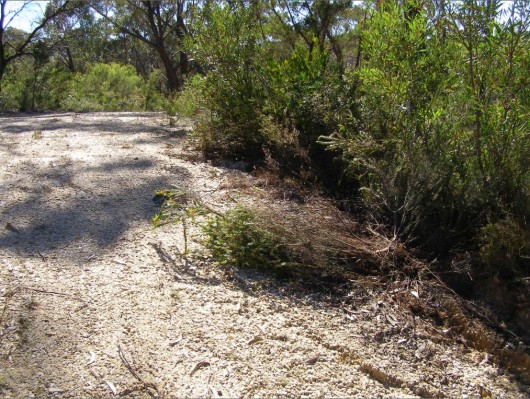 Property developer has killed a Needle Geebung on the site
[Photo by Editor, 20130307, click image to enlarge, Photo © ^Creative Commons] Property developer has killed a Needle Geebung on the site
[Photo by Editor, 20130307, click image to enlarge, Photo © ^Creative Commons]
.
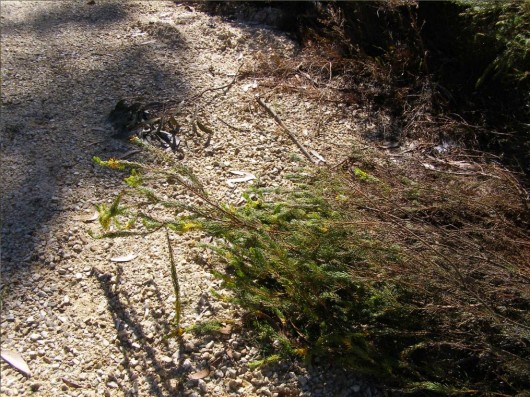 Close up of the same killed plant
[Photo by Editor, 20130307, click image to enlarge, Photo © ^Creative Commons] Close up of the same killed plant
[Photo by Editor, 20130307, click image to enlarge, Photo © ^Creative Commons]
.
The damage and killing of this particular plant and others on the site along Wellington Road was reported to the local statutory authority, the Blue Mountains Council on Friday 1st March 2013, following the discovery by local residents of the damage to this protected species. Council’s Customer Service Request reference is #174709.
Despite the previously undisturbed natural bushland on the site and the prolific concentration of Needle Geebung plants, the Council approved housing construction on the site about two weeks prior on 19 February 2013.
Such approval and the subsequent vegetation removal on the site and damage and killing of this species to the would seem to be a direct breach of the Threatened Species Conservatioin Act as it relates to protecting the Needle Geebung from harm. Under Section 91, Clause 1, the Director-General may grant a licence authorising a person to take action likely to result in one or more of the following:
.
(a) harm to any animal that is of, or is part of, a threatened species, population or ecological community,
(b) the picking of any plant that is of, or is part of, a threatened species, population or ecological community,
(c) damage to critical habitat,
(d) damage to habitat of a threatened species, population or ecological community.
.
Such harm is deemed and offence under the Act and can attract up to 200 penalty units or about $22,000 fine under Section 141E of the Act.
However, since reporting the incident, no action has been taken by Council and no fine imposed. The expression ‘paying lip service‘ comes to mine.
.
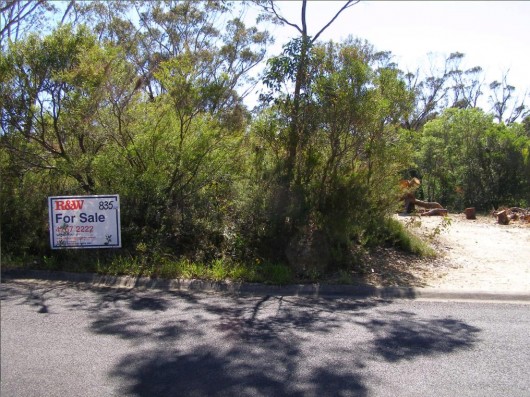 Real estate agents flogging Blue Mountains bush
[Photo by Editor, 20130307, click image to enlarge, Photo © ^Creative Commons] Real estate agents flogging Blue Mountains bush
[Photo by Editor, 20130307, click image to enlarge, Photo © ^Creative Commons]
.
Australia is estimated to be home to more than 500,000 animal and plant species. Many of which are found nowhere else in the world. Australia is faced with unprecedented loss of biodiversity. Over the last two hundred years, more than 100 species of animals and plants have become extinct. More mammals have died out in Australia, than in any other continent.
<<According to the International Union for Conservation of Nature and Natural Resources Red List of Threatened Species, Australia now has the highest rate of species extinction of any developed nation. Almost one in five mammal species are facing extinction and there are over 800 plants and animals which are listed as threatened.>>
[Source: 6.1 Threatened species and ecological communities, ^http://www.edo.org.au/edonsw/site/factsh/fs06_1.php]
.
The main causes of species’ decline include habitat destruction and degradation, impacts of introduced invasive species, pollution and disease. In New South Wales, there are more than 850 animal and plant species at risk of extinction – including the Koala, Humpback Whale and Wollemi Pine. Our ecosystems are also at risk. Only a small proportion of forests, woodlands and grasslands remain. The status of many thousands of species is unknown.
.
Under New South Wales Threatened Species Conservation Act 1995, Part 1, Section 3, the objects of the Act are:
.
(a) to conserve biological diversity and promote ecologically sustainable development, and
(b) to prevent the extinction and promote the recovery of threatened species, populations and ecological communities, and
(c) to protect the critical habitat of those threatened species, populations and ecological communities that are endangered, and
(d) to eliminate or manage certain processes that threaten the survival or evolutionary development of threatened species, populations and ecological communities, and
(e) to ensure that the impact of any action affecting threatened species, populations and ecological communities is properly assessed, and
(f) to encourage the conservation of threatened species, populations and ecological communities by the adoption of measures involving co-operative management.
.
[Source: New South Wales Government, ^http://www.legislation.nsw.gov.au/viewtop/inforce/act+101+1995+fn+0+N]
But unless diligent monitoring and enforcement supports the legistlation, such protection is effectively ‘paying lip service‘.
Here is the official lip service of the Blue Mountains Council as it relates to protecting Threatened Species in the Blue Mountains.
<<The Blue Mountains Local Government Area contains approximately 10% of the listed threatened species in New South Wales.
The high percentage is a function of the high biodiversity of the area, the large number of endemic species and the ongoing impacts of urban development such as land clearing, urban runoff, sedimentation, habitat disturbance, and weed invasion. Blue Mountains Council is committed to reversing this situation through sensitive urban planning, a strong environmental program, and targeted Environment Levy funded projects and by fostering community involvement in biodiversity conservation through the Bushcare, Landcare, Swampcare and Bush backyards programs.
Blue Mountains City Council employs a Biodiversity Conservation Officer who co-ordinates an integrated threatened species recovery team which focuses on threatened species which are endemic (ie only occurring in the Blue Mountains) or species that have a stronghold in the Blue Mountains including the Blue Mountains Water Skink, the Giant Dragonfly, the Dwarf Mountain Pine, Epacris hamiltonii, Leionema lachnaeoides and Eucalyptus copulans. The Biodiversity Conservation Officer is also responsible for raising awareness of threatened species and endangered ecological communities (EECs) such as Blue Mountains Swamp and Shale Based EECs in the Blue Mountains and fostering community involvement in their recovery.
How many threatened species occur in the Blue Mountains (as at June 2009)?
Vulnerable:
12 birds
14 mammals
3 amphibians
28 Plants (including the Needle Geebung)
1 Reptile
Endangered:
20 Plants
2 birds
1 amphibian
1 insect
2 mammals
2 reptiles
8 ecological communities
.
‘Vulnerable‘: a native species is considered ‘vulnerable’ if a species is likely to become endangered unless the threats to its survival cease to operate.
.
‘Endangered‘: a species is considered ‘endangered’ if it is in danger of extinction unless the threats to its survival cease to operate.
.
‘Presumed extinct‘: a species that has not been seen for more than 50 years despite thorough searching, is presumed extinct. Native species, populations and communities, which are presumed extinct, endangered or vulnerable in NSW, are all considered ‘threatened’.>>
.
[Source: Blue Mountains Council website, ^http://www.bmcc.nsw.gov.au/sustainableliving/environmentalinformation/threatenedspecies/]
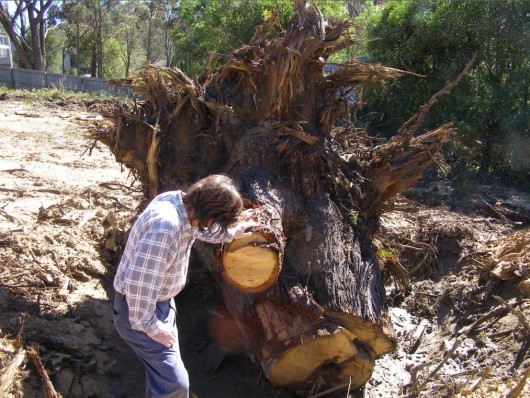 Mature Eucalypt 100+ years old killed for housing
[Photo by Editor, 20130307, click image to enlarge, Photo © ^Creative Commons] Mature Eucalypt 100+ years old killed for housing
[Photo by Editor, 20130307, click image to enlarge, Photo © ^Creative Commons]
.
.
A Lesson for Blue Mountains Greenwashing
.
2009: ‘Manager Fined for Environmental Offence’
.
<<In a recent case in NSW, the Land and Environment Court found the Director of Infrastructure at Port Macquarie Hastings Council guilty of an offence under the National Parks and Wildlife Act 1974 (Garrett v Freeman (No 5) [2009]). This is the first time that a senior council employee has been found guilty of an offence conducted while carrying out their normal work. The prosecution also shows that the Authorities are becoming more willing to target individual employees, rather than only their company or organisation.
The prosecution found that the Director had committed an offence under s 118D(1) of the National Parks and Wildlife Act 1974 (NPW Act). This section of the Act states that it is an offence to cause damage to the habitat of threatened species or endangered populations or endangered ecological communities. The maximum penalty for an offence against Section 118D(1) of the NPW Act is $110,000 or imprisonment for one year, or both. The recent court sitting, in which the penalty was determined, concluded with the Director being fined $57,000, as well as being directed to pay the prosecutor’s costs of $167,500.
As well as prosecuting the Director of Infrastructure, the Council was ordered to pay $45,500 plus $114,00 in prosecutor’s costs for an offence under the NPW Act and $35,000 and prosecutor’s costs of $80,000 for an offence under the Fisheries Management Act 1994 (NSW).
.
What lead to the decision?
.
The prosecution was made after the Director instructed access roads to be constructed within a wetlands, which was an area identified as having acid sulphate soils. The construction of the roads resulted in the disturbance of the habitats of two threatened species; the Grass Owl (Tyto capensis) and the Eastern Chestnut Mouse (Pseudomys gracilicaudatus).
The construction of the roads was found to be an activity within the meaning of Part 5 of the Environmental Planning and Assessment Act 1979 (EP&A Act), which requires that the environmental impact of an activity be considered prior to the activity being undertaken. The impact of the activity must be considered by the determining authority in approving the activity.
The Director did not obtain any approval for the construction of the access roads, and hence no determining authority was notified to assess the environmental impact of the activity. There was conflicting evidence surrounding whether the Director was aware that threatened species were present at the site, however it was concluded that he ought to have reasonably been aware, as a number of comprehensive studies to which he had access had identified the threatened species. The Director believed that he had conducted a Review of Environmental Factors for the site, which determined that there was no impact to threatened species. However the form of the Review did not constitute an assessment of the project’s impacts as required by the EP&A Act 1979, including the impact on the threatened species of the disturbance and destruction of their habitat.
The construction of the roads was found likely to significantly affect the environment or threatened species within the meaning the EP&A Act 1979. By undertaking the construction without obtaining an Environmental Impact Statement (EIS) or Species Impact Statement (SIS), council failed to comply with the requirements of the Act.
.
Key Factors
.
Evidence that lead to prosecution of the defendant included:
.
- The Director had actual knowledge that the roads were constructed
- The Director knew that the wetlands were habitat for the Grass Owl and the Eastern Chestnut Mouse, listed as threatened species
- The Director had actual knowledge, imputed knowledge, and/or constructive knowledge that the construction of the roads would damage threatened species habitat, specifically the Grass Owl and the Eastern Chestnut Mouse
- The Director failed to prove that he did not have knowledge that the council failed to comply with the EPA Act 1979
- The NPW Act requires the defendant to satisfy the Court that the principal offence was committed without his knowledge. The Director was unable to prove this to the satisfaction of the court. The case also found that there was ample evidence that the Council knew that the land was habitat of the two threatened species.
.
Lesson
.
… the precautionary principle always applies. If you suspect potential environmental impacts, you have a duty to ensure they are considered, whether there is sufficient information available about the impact or not. Ignoring the precautionary principle has been used as evidence for prosecutors in numerous past environmental litigation cases.>>
.
[Source: Noel Howard and Associates (risk management consultants), ^ http://www.noel-arnold.com.au/content/index.php?mact=News,cntnt01,detail,0&cntnt01articleid=197&cntnt01origid=69&cntnt01returnid=69]
.
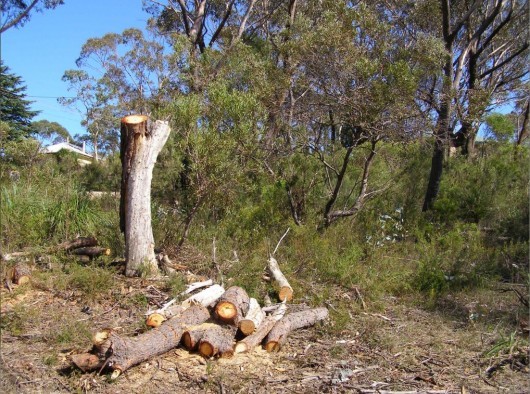 Blue Mountains Council – caring for country?
[Photo by Editor, 20130307, click image to enlarge, Photo © ^Creative Commons] Blue Mountains Council – caring for country?
[Photo by Editor, 20130307, click image to enlarge, Photo © ^Creative Commons]
.
.
Footnote
.
Response from Council..
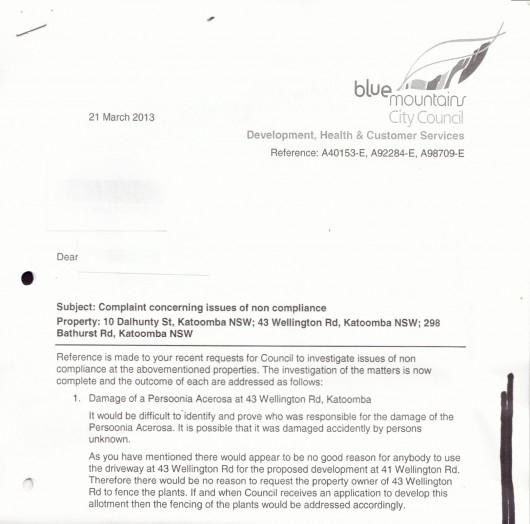 This is typical bureaucratic greenwashing to which Blue Mountains Council has developed into an artform to avoid its environmental responsibilty and to fob off any resident who dares to take an active interest in environmental protection. Some residents who complain about environmental pollution and damage too often are black listed, and are even cast with a punitive ‘Plan of Management’. This is typical bureaucratic greenwashing to which Blue Mountains Council has developed into an artform to avoid its environmental responsibilty and to fob off any resident who dares to take an active interest in environmental protection. Some residents who complain about environmental pollution and damage too often are black listed, and are even cast with a punitive ‘Plan of Management’.
The response has the same nonchalant disinterest and excuse that could well have instead read as follows:
‘Look resident 123456,
Frankly, this is again in our too hard basket and you should really stop contacting us and crawl back under your bush and leave us to do other things like write environmental reports, which we do well.
Yes, we sort of care about threatened species – our glossy brochures, reports, website and symposiums say so, and we believe them, but we don’t have time to get out there and actually check. We don’t have the resources.
Yeah, we have environmental protection by-laws, but we’re busy and anyway people need homes built. If we put too much environmental pressure on them their developers challenge us in the Land and Environment Court and usually win because we have weak laws and shit lawyers who love creaming ratepayers money. And so we don’t have the resources.
Since we can’t prove who killed the Persoonia plants, we put this matter in the category of ‘known unknowns’. We see that no-one else but the developer and his contractors had reason to use the driveway, so we see no reason for fencing out others since only the developer and his contractors would be damaging the Persoonia.
When they have finally cleared the block of all vegetation, and when the developer then thinks it is safe to lodge a development application to build with all plants removed, only then the fencing of the plants would be addressed accordingly.. if we get resource funding.
Signed Yours,
Pompous Arse (acting)
Development Monitoring Team (every second Tuesday of the third month*)
Development, Health & Custoner Services (on a completely separate floor to Council’s City & Community Outcomes Directorate which funnily enough includes environmental protection)
Please consider the Environment before photocopying this printed letter.
..the city within a world heritage national park
Blue Mountains Council (thinking it is a big city)
.
* Subject to staff availability and yes, resources.
.
Tags: Blue Mountains, caring for country, housing development, Living - Bushland Conservation, Mature Eucalypt killed, Needle Geebung, paying lip service, Persoonia acerosa, real estate land sales, Threatened Species Conservation Act, Vulnerable species and ecological communities, Wellington Road Katoomba
Posted in Blue Mountains (AU), Threats from Development, Threats from Greenwashing, Threats from Weak Environmental Laws | No Comments »
Add this post to Del.icio.us - Digg
Sunday, March 17th, 2013
[The following article was initially posted by Tigerquoll under the title “Basically a Fur Trade…”SKIN THE BEST and PLUCK THE REST” and published on 20091209 on ^candobetter.net]
.
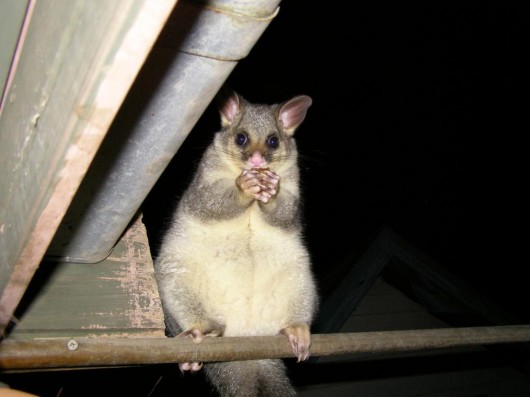 Brushtail Possum (Trichosurus vulpecula) a native to the Blue Mountains, Australia
(Photo by editor in winter, 20100606, click image to enlarge, © ^Creative Commons ) Brushtail Possum (Trichosurus vulpecula) a native to the Blue Mountains, Australia
(Photo by editor in winter, 20100606, click image to enlarge, © ^Creative Commons )
.
<<When the Australian Brushtail Possum was first released into New Zealand in 1837 (becoming successfully established around 1858) with the express purpose of establishing a fur trade, our colonial New Zealand forefathers had no idea of the terrible impact that possums would have on the delicate natural balance of the native New Zealand ecosystem.>>
 [Source: ‘The history of possums in New Zealand’,
^http://www.gorgeouscreatures.co.nz/NZ+Possum+Fur/Possum+History.html] [Source: ‘The history of possums in New Zealand’,
^http://www.gorgeouscreatures.co.nz/NZ+Possum+Fur/Possum+History.html]
.
On New Zealand’s North Island at the Bay of Plenty, a backyard possum fur trader, BASICALLY BUSH, runs a thriving business slaughtering Brushtail Possum for profit. It’s just like the good ol’ days of the 19th Century.
It seems the preferred kill method is by shooting…“Be careful not to get rubbish into the bag, and that you don’t end up dropping bullets or spent shells in.” But then they sell traps to possum poachers as well, so take your pick. Check out the possum trap called ‘Bushmaster No 1’:
 Steel Jaw Cruelty – NZ style Steel Jaw Cruelty – NZ style
.
A good sound trap, leg hold. Freight Costs incl GST: 1 – 12 traps: $6.50 12 – 24 traps: $17.00 24 – 48 traps: $25.00 48 – 96 traps: $65.00 Please add the cost of freight to your payment.
Basically Bush’s motto is “SKIN THE BEST and PLUCK THE REST”
It claims “this exciting raw material that has revolutionised the knitwear industry in New Zealand. Possum fibre is referred to as ‘possum merino’ and is promoted as ‘lighter than cashmere’.”
And profits are healthy. Back in 2007, “there has been a marked increase in fibre availability since we raised the price to $105/kg. “This increase was necessary to make sure that there was enough raw material to meet the needs of domestic production.”
 Not eradicating a feral animal population
But instead profiting and perpetuating an 1837 NZ Fur Trade Not eradicating a feral animal population
But instead profiting and perpetuating an 1837 NZ Fur Trade
.
These pest controllers have now gone international, making trips to India to promote fur sales, with brands like ‘Snowy Peak’ and ‘Woolyarns’.
Click here to meet the poaching team.
Colonial New Zealanders relocated Australian Brushtail Possums to New Zealand from the early 19th Century. Kiwi possum poaching currently just perpetuates the slaughter for the same reason as then – possum fur, not to eradicate them at all.
Anyone who takes exception to killing possums in large numbers (i.e the definition of ‘slaughter’) should be contributing alternatives. But profiteers like Basically Bush seem to be condoning the poaching practice. The numbers are not reducing, but the profiteers are making a killing. How backward!
What is the right way to remove introduced animals? It remains an avoided Kiwi ecological problem.
.
Illegal traps discovered in Makara bush
.
[Source: ‘Illegal traps discovered in Makara bush’, 20120731, Dominion Post, Wellington, New Zealand, ^http://www.stuff.co.nz/dominion-post/news/northern-suburbs/7384752/Illegal-traps-discovered-in-Makara-bush]
.
 SPCA Inspector Ritchie Dawson with a banned inhumane possum trap
found in Makara Forest
(Photo by Maarten Holl) SPCA Inspector Ritchie Dawson with a banned inhumane possum trap
found in Makara Forest
(Photo by Maarten Holl)
.
Inhumane possum traps were discovered dotted throughout a Makara forest. A dead possum in an illegal trap dragged home by a family dog leading to the discovery of inhumane trapping on the block.
Brent Lyell Still, of Upper Hutt, was yesterday convicted of using the illegal traps.
Guy Holmes’ called the SPCA after his dog came home dragging a leg trap in August last year. Mr Holmes told the animal welfare inspectors he found 10 possums in traps and had to kill them. The SPCA found traps had been set on Mr Holmes’ land and his neighbour’s to catch possums.
Carcasses taken to a vet showed crush injuries that would cause distress and significant pain before death.
Mr Holmes had planted pine trees on his Makara Rd property intending to mill them and had never given permission for the traps to be set on the property.
Still, 45, yesterday pleaded guilty and was fined $300 and ordered to pay costs of $353.22 for illegally using size 1.5 leg traps, which were banned at the beginning of last year.
It was the first time someone has been prosecuted for using the illegal traps. The traps grab a possum, most often by the leg, which can be crushed.
A further charge of setting traps that could entrap companions animals like dogs and cats was withdrawn. Still had been asked by the neighbour to do the trapping but had laid several traps on Mr Holmes’ property as well. In three days he killed over 600 possums.
Still’s lawyer Tim Blake said Still had been trapping for 20 years and had not known the law had changed. Wellington District Court judge Bill Hastings agreed with Mr Blake that there had been little publicity about the recent law change but said ignorance of the law was no excuse.
Judge Hastings said despite possums being pests, there was still an obligation to treat them humanely. To set the traps in place, a nail is driven into the tree.
SPCA prosecutor Liz Hall said any nail found in a tree at a mill would result in all logs being rejected by a mill because of the dangers of metal going through machinery. Blake disputed there would have been any problem, saying the nail was set only a couple of inches from the ground and the trees would be cut down higher than that.>>
.
Tuesday, March 12th, 2013
 Chinese Shark Fin Soup is the barbaric dish of backward Chinese following a primitive custom from the ancient Ming Dynasty.
Many Chinese eat Shark Fin Soup at weddings and banquets out of superstition.
Sharks are caught by Chinese fishermen their fins hacked off while alive and the sharks thrown back into sea to die of a torturous death. Chinese Shark Fin Soup is the barbaric dish of backward Chinese following a primitive custom from the ancient Ming Dynasty.
Many Chinese eat Shark Fin Soup at weddings and banquets out of superstition.
Sharks are caught by Chinese fishermen their fins hacked off while alive and the sharks thrown back into sea to die of a torturous death.
.
Mar 2013: CITES Conference in Bangkok to decide on global Shark Finning Bans
.
<<World governments have agreed to restrict international trade in four shark species in a bid to save them from being wiped out due to rampant Chinese and Japanese demand for their fins.
The 178-member Convention on International Trade in Endangered Species (CITES) voted at a meeting in Bangkok to control exports of the oceanic whitetip and three types of hammerhead shark, but stopped short of a full trade ban. The move would require countries to regulate trade by issuing export permits to ensure their sustainability in the wild, otherwise they could face sanctions from CITES.
Asian nations led by Japan and China – where shark fin soup is considered a delicacy – tried in vain to block the proposals, which were pushed by countries including Brazil, Colombia and the United States.
The decision to add the species to CITES Appendix 2, which restricts cross-border trade, must still be formally approved by the conference’s plenary session later this week. Members would then have 18 months to introduce the trade controls.
The four species would join the great white shark, the whale shark and the basking shark, which already enjoy international trade controls. The Bangkok meeting was also set to vote on a similar proposal for the porbeagle shark and the manta ray.
Humans kill about 100 million sharks each year, mostly for their fins, according to the UN Food and Agriculture Organisation (FAO), and conservationists are warning that dozens of species are under threat. About 90 per cent of the world’s sharks have disappeared over the past 100 years, mostly because of overfishing in countries such as Indonesia, the FAO says.>>
.
[Source: ‘Protections aim to moderate trade in shark fins’, 20130311, AFP, ^http://www.abc.net.au/news/2013-03-11/protections-aim-to-moderate-trade-in-shark-fin/4566208]
.
 [Source: ^http://www.zmescience.com/ecology/americans-shark-finning-09082012/] [Source: ^http://www.zmescience.com/ecology/americans-shark-finning-09082012/]
.
<<Government representatives to CITES, have agreed to put the porbeagle, oceanic whitetip, three kinds of hammerhead shark and two kinds of manta ray on its Appendix II list, which places restrictions on fishing but still allows limited trade.
Joyce says “conservation groups have been trying for years to curtail the widespread killing of sharks for their meat and for shark fin soup.”
According to The Independent newspaper, scientists estimate that almost 100 million sharks are caught each year, and because they are slow-growing and slow to reproduce, they are especially vulnerable to overfishing.
“Although some regions, including the European Union, have banned shark finning, commercial fishing for fins, meat, liver oil, cartilage and other body parts is largely unregulated in much of the world, conservationists warn. Some countries have been reluctant to include marine species, which can generate large revenues, in the treaty that regulates or bans international trade in wildlife.
The shark fin business is worth an estimated $475 million a year.”>>
.
[Source: ‘International Convention Moves To Limit Shark ‘Finning’ Trade’, 20130311, by Scott Neuman, NPR, ^http://www.npr.org/blogs/thetwo-way/2013/03/11/174018120/international-convention-moves-to-limit-shark-finning-trade]
.
 Shark Fin hacked off a live shark
so that backward Chinese can drink superstitious soup Shark Fin hacked off a live shark
so that backward Chinese can drink superstitious soup
.
Further Reading:
.
[1] Stop Shark Finning, ^http://www.stopsharkfinning.net/boycott-australia.htm
.
|
|
 Wild Poporari River protected inside Paparoa National Park
Similar to nearby but unprotected cousin Pike River
Both inside Te Wai Pounamu (New Zealand’s South Island)
Note the Nikau Palms (Rhopalostylis sapida) endemic to New Zealand.
Wild Poporari River protected inside Paparoa National Park
Similar to nearby but unprotected cousin Pike River
Both inside Te Wai Pounamu (New Zealand’s South Island)
Note the Nikau Palms (Rhopalostylis sapida) endemic to New Zealand.
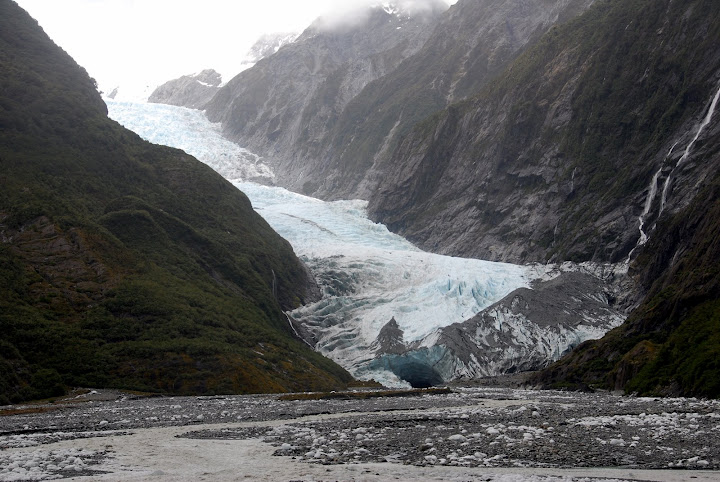 Glacial action still evident further south in Tai Poutini National Park
[Source: ^http://www.duwal.com/en/travelguide/australia/new-zealand/westland-tai-poutini-national-park]
Glacial action still evident further south in Tai Poutini National Park
[Source: ^http://www.duwal.com/en/travelguide/australia/new-zealand/westland-tai-poutini-national-park]
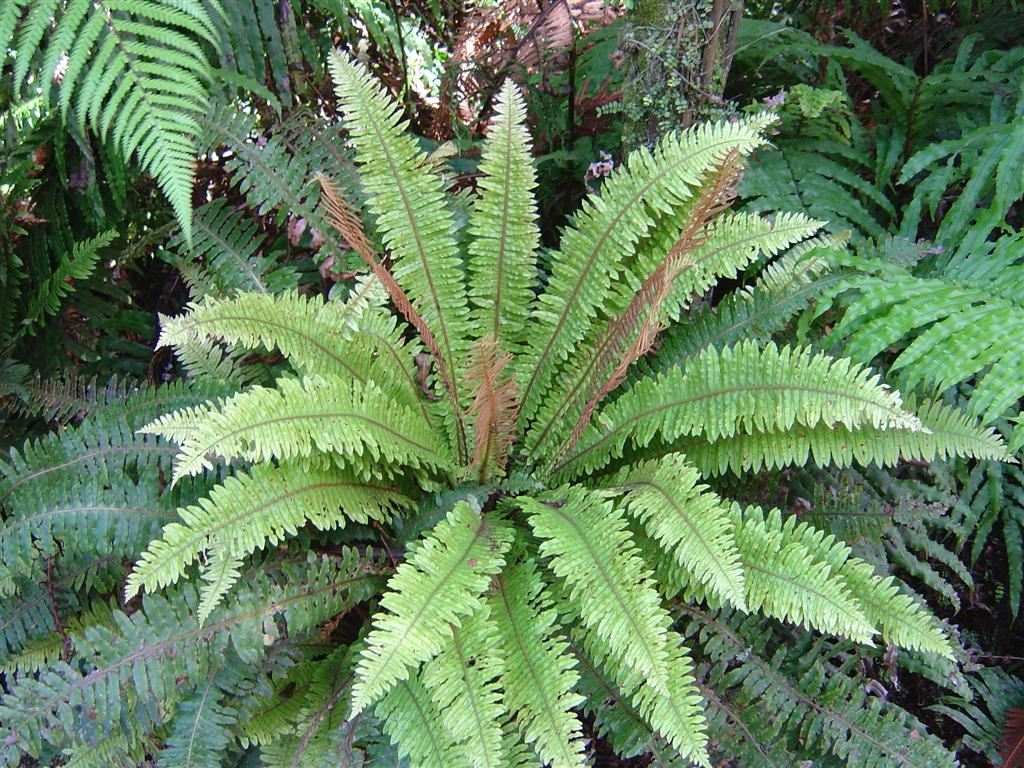 Crown Fern (Blechnum discolor)
Māori name is ‘Piupiu’
Crown Fern (Blechnum discolor)
Māori name is ‘Piupiu’
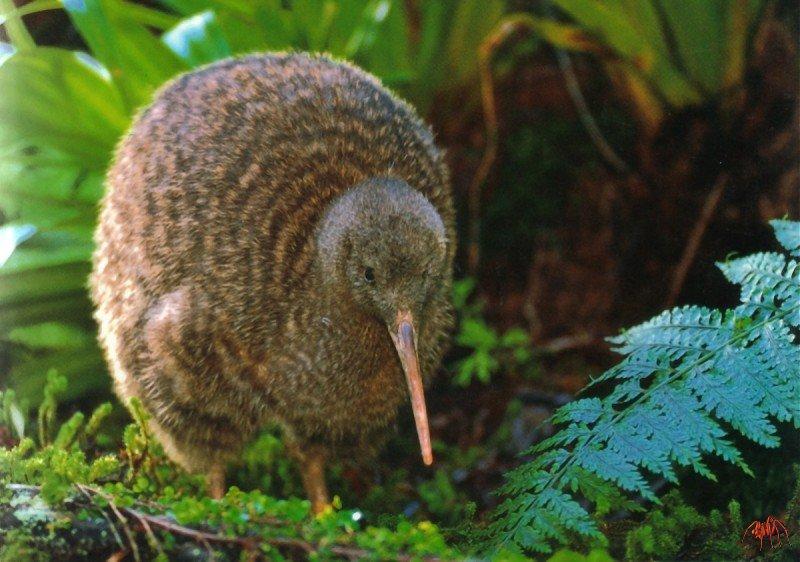 Great Spotted Kiwi, or Roroa (Apteryx haastii)
A rare species of kiwi endemic to the South Island of New Zealand – sadly classified as ‘nationally vulnerable’.
[Source: ^http://true-wildlife.blogspot.com.au/2011/05/great-spotted-kiwi.html]
Great Spotted Kiwi, or Roroa (Apteryx haastii)
A rare species of kiwi endemic to the South Island of New Zealand – sadly classified as ‘nationally vulnerable’.
[Source: ^http://true-wildlife.blogspot.com.au/2011/05/great-spotted-kiwi.html]
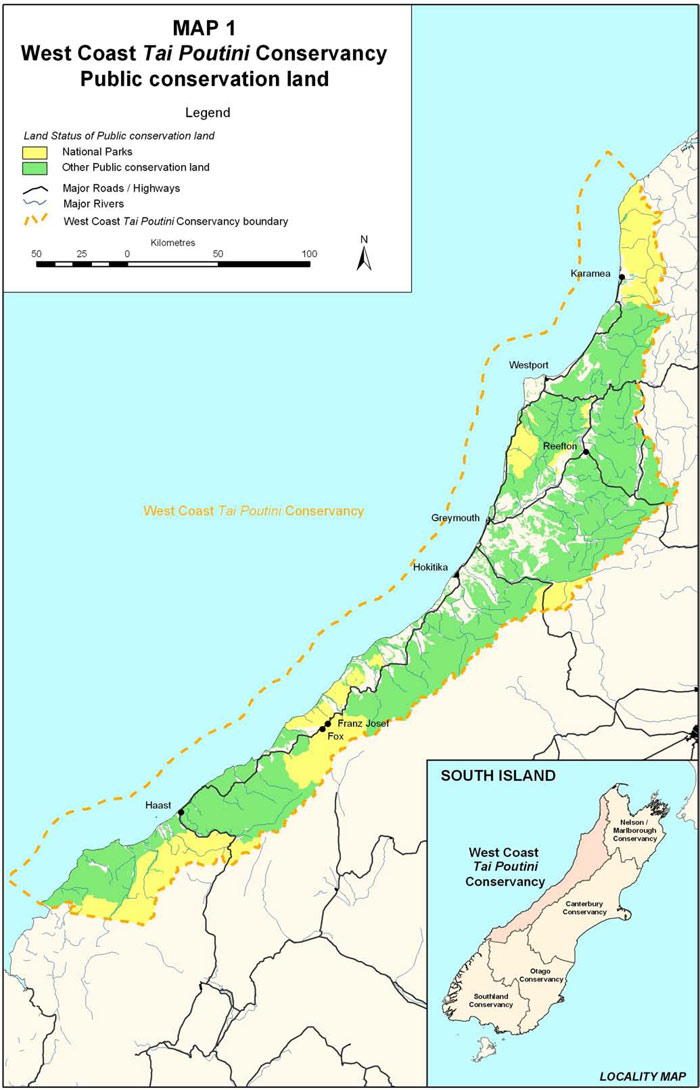 [Source: New Zealand Government,
^http://www.doc.govt.nz/publications/about-doc/role/policies-and-plans/conservation-management-strategies/west-coast/foreword/map-1/]
[Source: New Zealand Government,
^http://www.doc.govt.nz/publications/about-doc/role/policies-and-plans/conservation-management-strategies/west-coast/foreword/map-1/]
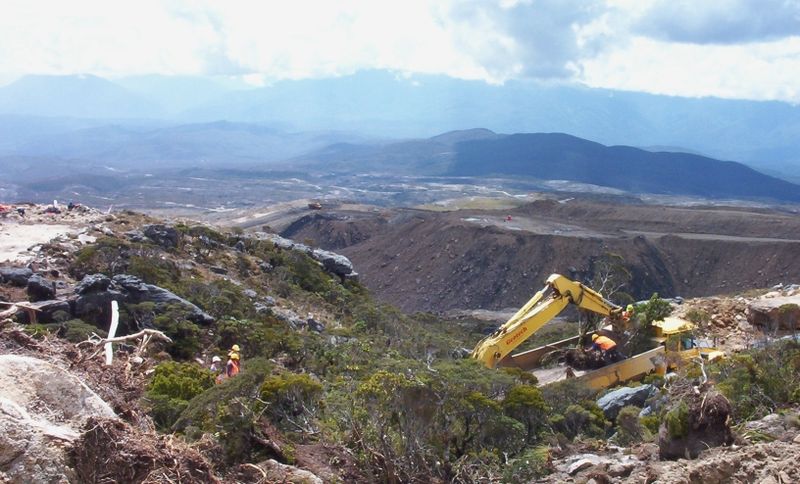 Stockton Opencast Coal Mine
Run by the New Zealand Government’s Solid Energy
80km north of Greymouth, New Zealand
Stockton Opencast Coal Mine
Run by the New Zealand Government’s Solid Energy
80km north of Greymouth, New Zealand
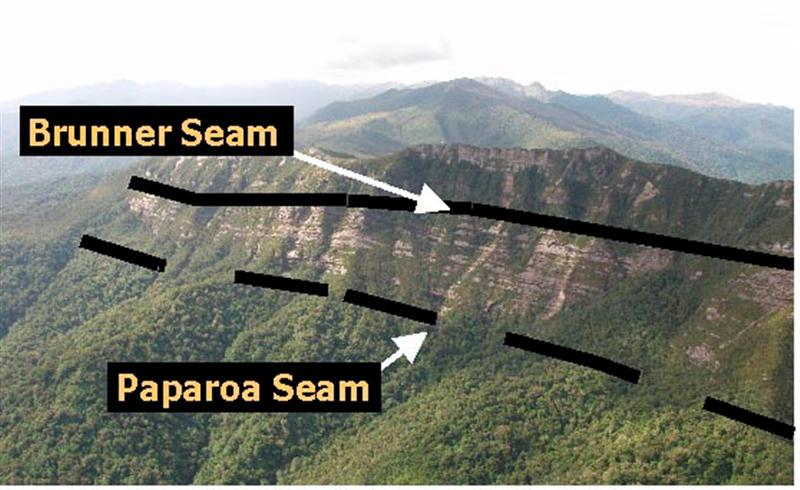 Coal Seams along the eastern side of the Paparoa Range
targeted by the New Zealand Government
Coal Seams along the eastern side of the Paparoa Range
targeted by the New Zealand Government
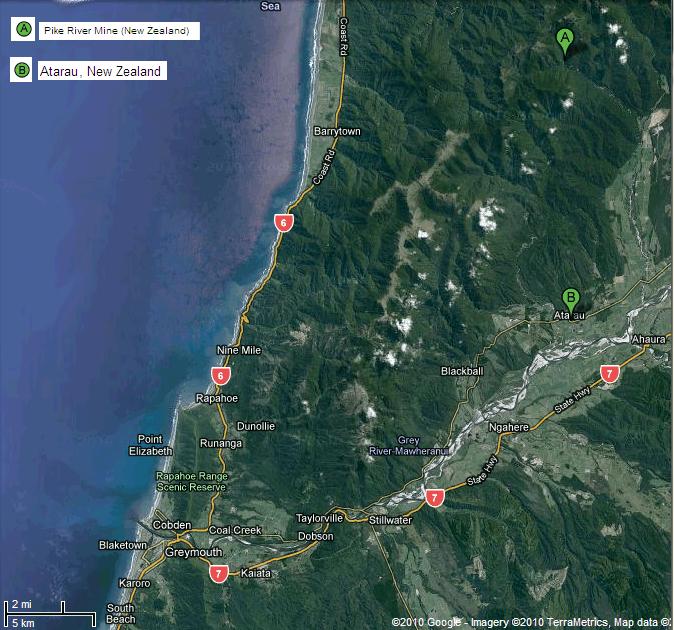
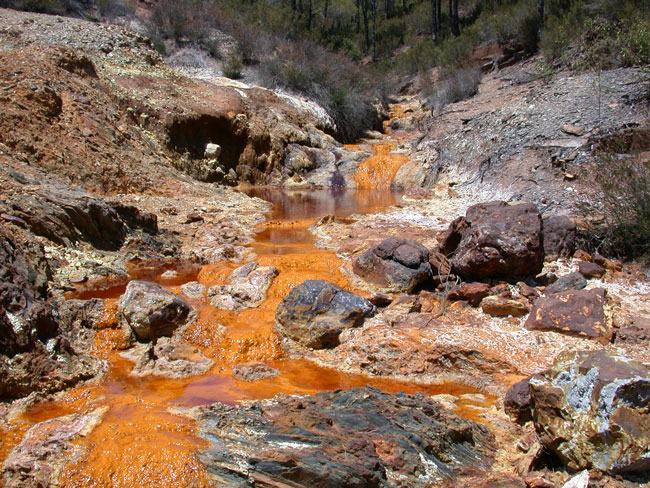 Example of Sulphuric Acid Mine Drainage in the Rio Tinto River (Spain)
What the New Zealand Government was keen to avoid by approving Pike River Mine
Example of Sulphuric Acid Mine Drainage in the Rio Tinto River (Spain)
What the New Zealand Government was keen to avoid by approving Pike River Mine
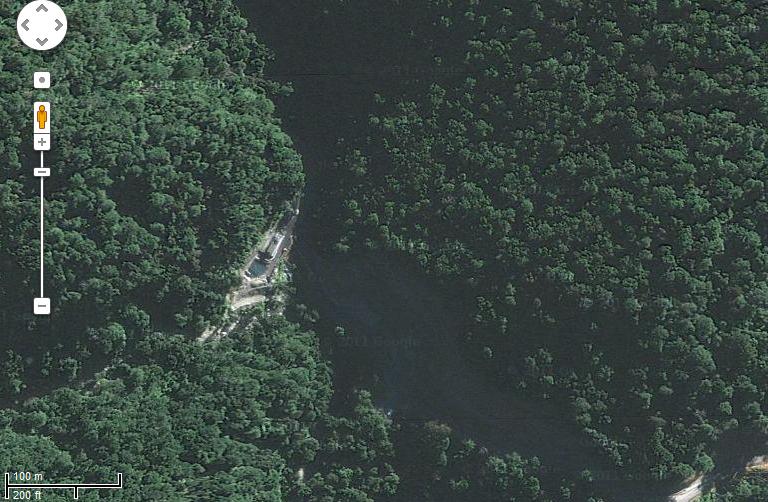 Pike River Mine – located deep in high conservation value native forest
 The people of New Zealand protest along Queen Street, Auckland on 1st May 2010
Some 40,000 New Zealanders very publicly were prepared to challenge government
for its flawed compromise between conservation and mining.
The people of New Zealand protest along Queen Street, Auckland on 1st May 2010
Some 40,000 New Zealanders very publicly were prepared to challenge government
for its flawed compromise between conservation and mining.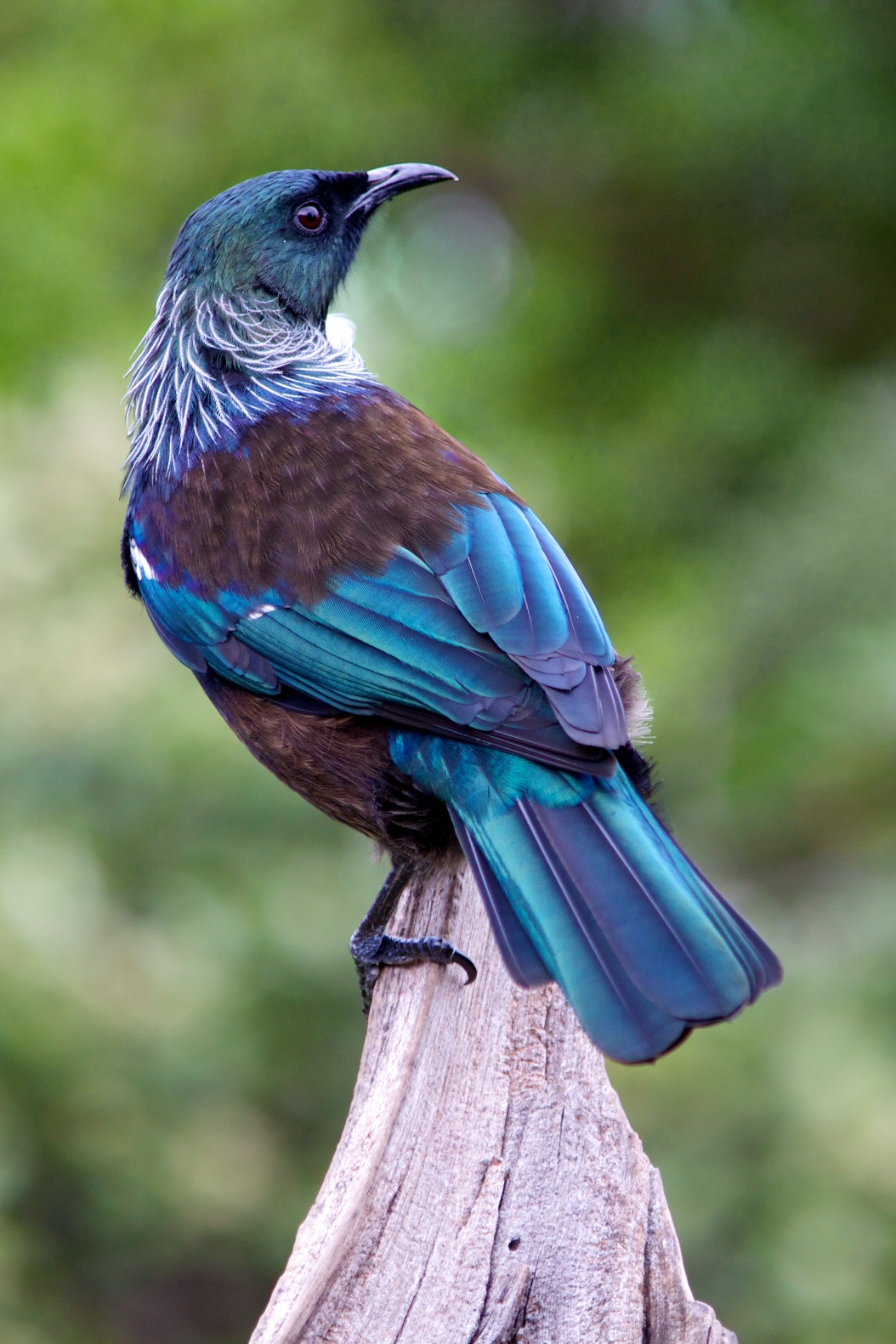 Tui
(Prosthemadera novaeseelandiae)
An endemic honeyeater of New Zealand
[Source: ^http://msf2011.blogspot.com.au/2012_03_01_archive.html]
Tui
(Prosthemadera novaeseelandiae)
An endemic honeyeater of New Zealand
[Source: ^http://msf2011.blogspot.com.au/2012_03_01_archive.html]