Archive for the ‘Habitat Threats’ Category
Wednesday, November 23rd, 2011
‘The axe had never sounded’…
.
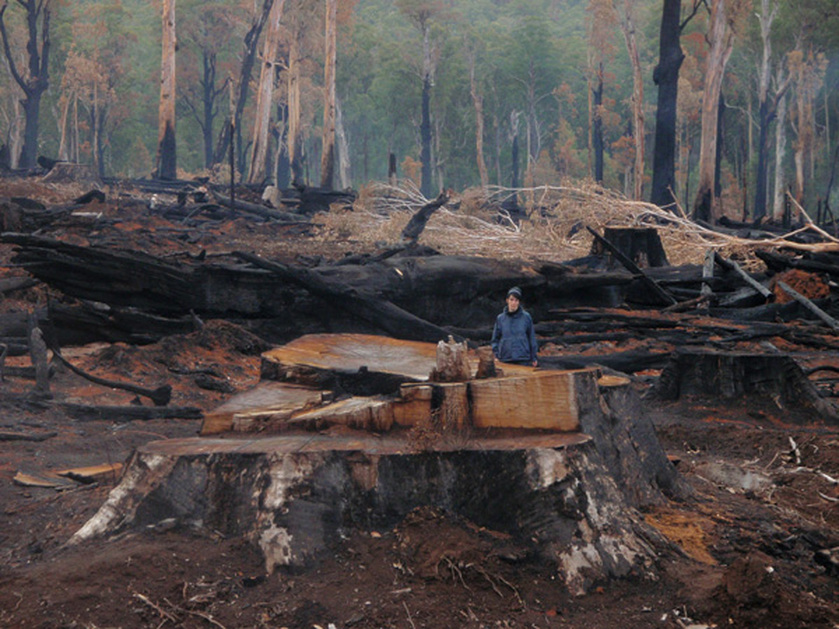
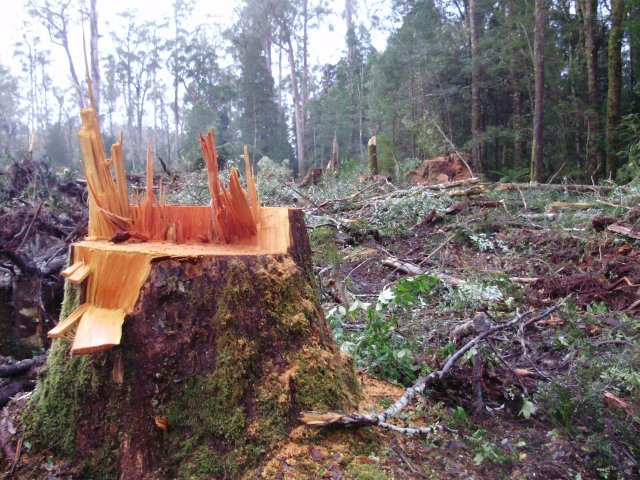
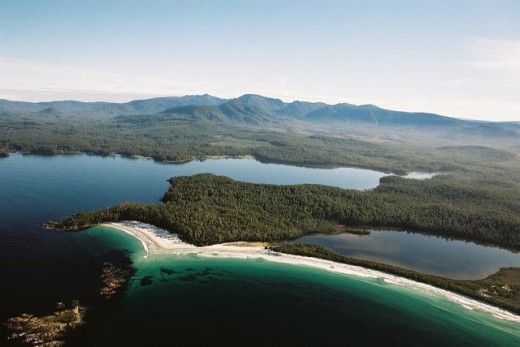 Unprotected ancient native forests around Tasmania’s Recherche Bay Unprotected ancient native forests around Tasmania’s Recherche Bay
(Photo by Bob Brown)
.
Despite Tasmania’s Inter-governmental Agreement (IGA) on 7th August 2011 assuring immediate logging moratorium of native forests in agreed reserves, Forestry Tasmania continues to eco-rape and pillage protected native forests in defiance of this agreement.
IGA Clause 25 states:
‘The State will immediately place the 430,000 hectares of native forest identified in Attachment A (other than any areas that are not State forest), from the 572,000 hectares nominated by ENGOs through the Statement of Principles process, into Informal Reserves. The boundaries of this 430,000 hectares were verified through an independent verification process.’
The southern forests around Recherche Bay were agreed to be included into the Informal Reserves through the Independent Verification Process.
So by embarking on new logging in these Informal Reserves, clearly Forestry Tasmania is in breach of the IGA and operating out of the control of the Tasmanian Government. Forestry Tasmania is logging Tasmania like there’s no tomorrow, because it knows there it has no tomorrow. The business is seriously loss-making. It’s continuing unfettered destruction of Tasmanian native forests is akin to the calculated genocide of Sri Lankan Tamils in May 2009 by the Sinhalese Sri Lankan dictator Mahinda Rajapaksa. Forestry Tasmania’s manic mindset has it logging and woodchipping native forests until they’re all decimated. And Lala’s Labor Government doesn’t have the gumption to enforce the moratorium on its own renegade department.
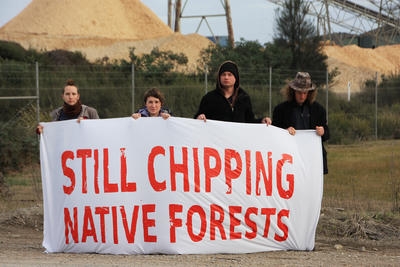
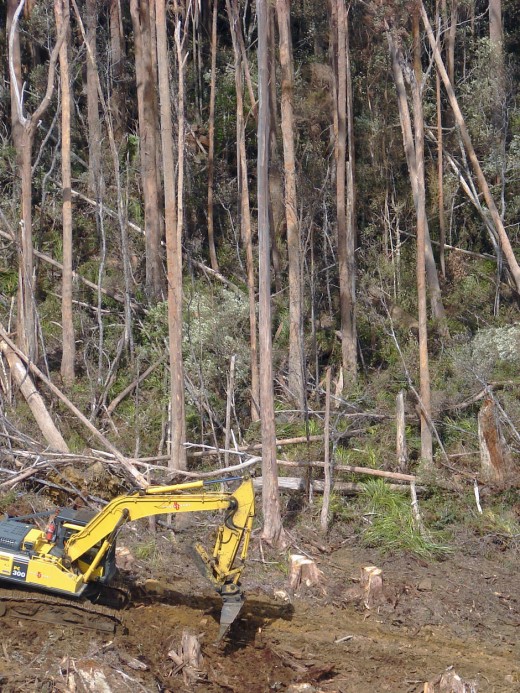 Forestry Tasmania getting stuck into native forests near Tasmania’s Recherche Bay, May 2011
[Source: ABC, ‘Bid for forest peace funding’, 20110519, ^http://www.abc.net.au/news/stories/2011/05/18/3220585.htm?site=hobart] Forestry Tasmania getting stuck into native forests near Tasmania’s Recherche Bay, May 2011
[Source: ABC, ‘Bid for forest peace funding’, 20110519, ^http://www.abc.net.au/news/stories/2011/05/18/3220585.htm?site=hobart]
.
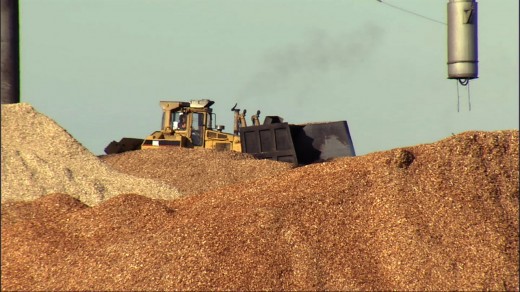
Not only is this organisation out of control, it has no market for its woodchip product. The logs are trucked to woodchipping mills only to be stockpiled with nowhere to go. With no income, it is a business heading for collapse. Unpaid wages will likely remain that way, when the doors are finally closed up. Meanwhile Tasmania’s remaining old growth forests are being logged and the ancient vital ecology decimated.
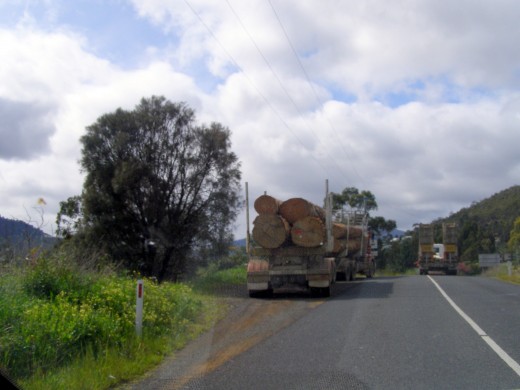 Loaded logging truck (New Norfolk, 20110929)
(Photo by editor, free in public domain) Loaded logging truck (New Norfolk, 20110929)
(Photo by editor, free in public domain)
.
Conservationists are this morning conducting a protest in a logging area in the far south of Tasmania, where world heritage value forests are being clearfelled.
.
Huon Valley Environment Centre’s Jenny Weber says:
‘Tasmania’s world heritage value forests continue to be logged despite yesterday’s controversial announcement that woodchips shipments have been postponed by Tasmania’s only export woodchipping company, Artec (Artec Pty Ltd, Lilydale).’
‘Ta Ann is driving logging in contentious forests, and woodchip logs are leaving these same forests regardless of a viable market for the timber. The Tasmanian taxpayers are subsidising a logging industry that is economically unviable and environmentally unsustainable.’
‘This morning at Catamaran, in threatened forest behind Recherche Bay, a conservationist is in a tree sit, and thirteen people are halting logging. Huon Valley Environment Centre is repeating it’s calls for the immediate end to logging in this forest that borders the Tasmanian Wilderness World Heritage Area, (TWWHA).’
.
Logging in this area, identified by Forestry Tasmania as CM004C, commenced after the Prime Minister Julia Gillard and Premier Lara Giddings announced the Inter-governmental Agreement on 7th August 2011 would provide ‘immediate protection in informal reserves’ for forests such as these.
 Tasmanian Premier Lara Giddings and Australian Prime Minister Julia Gillard
signing the Tasmanian Forests Agreement, 7th August 2011 Tasmanian Premier Lara Giddings and Australian Prime Minister Julia Gillard
signing the Tasmanian Forests Agreement, 7th August 2011
.
Forestry Tasmania Coupe ‘CM004C’ is located within the 572 000ha of identified forests for legislated protection. Last week conservationists participated in a protest in the coupe, and it was revealed that the area is being clearfelled for Ta Ann, export peeler logs and woodchip logs.
 Forestry Tasmania’s cable logging of The Weld Forest, 2009
Tasmanian Southern Forests
(Huon Valley Environment Centre)
(click image to link to slide show) Forestry Tasmania’s cable logging of The Weld Forest, 2009
Tasmanian Southern Forests
(Huon Valley Environment Centre)
(click image to link to slide show)
IGA Clause 26 states:
.
‘The State will ensure that, until the further independent verification process required under Clause 20 is completed, wood supply required under Clause 17 will be sourced from outside the 572,000 hectares of ENGO-nominated High Conservation
Value forest area unless the remaining State Forest area is insufficient to meet the contractually specified quality and quantity of wood supply. Where this is the case, the Tasmanian Government will ensure that wood supplies are sourced outside the 430,000 hectares placed in Informal Reserves. The Tasmanian Government will ensure that the 430,000 hectares of State Forest identified in Attachment A is not accessed’
.
Analysis:
-
There are copious hundreds of hectares of Tasmanian forest area available outside the 572, 000 hectares of ENGO-nominated High Conservation Value forest area.
-
The Lala Labor Government by not ensuring wood supply is sourced outside the 430,000 ha in Informal Reserves is not accessed, and thus in prima facie breach of the IGA. Lala Labor is deliberately and mischievously exercising selective deafness by not listening to ENGO accusations of the breach of the IGA terms. Labor as head wolf of the chicken pen, turning a blind eye to its fellow wolves while they help themselves to the plunder.
-
The Gillard Labor Government is in breach of IGA Clause 27, by failing to act on this trigger ‘to appoint independent expert specifically to review scheduling and other relevant data and attempt to reschedule harvesting activities so as to meet the requirements of contracts and maintain the interim protection of the 430,000 hectares’. The option of log anyway is not an option. The prescribed option under IGA Clause 27, is that the Commonwealth will instead compensate the contract holder for the value of lost profits and unavoidable costs.
-
Both Governments, by sitting on their hands as forests in the Informal Reserves are logged, are in breach of the spirit of the Agreement.
.
.
2009: ‘Woodchip stockpile in Tasmania a ‘health risk’
[Source: Matthew Denholm, Tasmania correspondent, The Australian, 20091014, ^http://www.theaustralian.com.au/news/woodchip-stockpile-in-tasmania-a-health-risk/story-e6frg6ox-1225786465432]
.
The woodchip stockpile in Burnie could pose a “significant health risk”, according to an expert opinion being assessed by health authorities. Tasmanian Director of Public Health Roscoe Taylor said the advice that the stockpile would at times contain Legionella bacteria is being examined.
“I have actually asked someone to have a look at it — we’ll be taking a look at it,” Dr Taylor said.The advice from Legionella expert Trevor Steele concludes the bottom layer of the stockpile on Burnie’s wharf would “undoubtedly” contain Legionella at times. Dr Steele warned the bacteria’s dispersal via dust could pose a significant health risk to townsfolk near the wharf and to workers at the port.
“It (the bottom layer) will at times undoubtedly contain Legionella and these could multiply there given the right conditions,” he said.
“This layer would also act as a source to contaminate newly arrived woodchips, setting the stage for a new cycle of Legionella growth.
“Dispersal of dust … containing these organisms could pose a significant health risk to susceptible persons working in, or residing in, adjacent residential or business districts, as well as to susceptible workers on the Gunns site and in the port area.”
Dr Steele was commissioned to provide the advice by Royal Hobart Hospital physician Frank Nicklason. Last week, Dr Nicklason apologised to timber company Gunns for his 2004 statement that the woodchip pile “almost certainly” had Legionella present that could blow across Burnie. However, he said his concerns about the potential for public health risks from the pile — initially sparked by several Legionella cases in Burnie — remained.
Dr Nicklason said he accepted that Gunns’ sampling in 2002 had not found Legionella in the pile. However, he said Dr Steele’s findings, from July this year, contributed to his concern and warranted further investigation.
Gunns’ own advice, conducted independently in 2002 and released under Freedom of Information, found that the available evidence “suggests strongly” that the bottom layer is “not a reservoir for Legionella”.
However, Dr Steele, formerly director of clinical microbiology at the Institute of Medical and Veterinary Science in Adelaide, disagreed.
“To claim that the sacrificial layer did not contain Legionella on the basis of two tests of small samples is misleading,” he says.
He agreed the bottom layer, because it was relatively undisturbed, was unlikely to pose much risk to the community, but that this did not mean there was no risk, since Legionella there could contaminate new woodchips.
When asked whether Gunns stood by its own findings, a spokesman said: “We don’t have to: Dr Nicklason has stood by it.
“At the time Dr Nicklason gave this apology he was in possession of the Steele report. His attempt to retract his apology by reference to this report is hypocritical, disingenuous and beggars belief.”
Dr Nicklason said his “carefully worded” apology — made as part of settlement of defamation proceedings — merely acknowledged that Legionella had not been found in samples taken by Gunns, and that its report had concluded there was “no available data” to implicate woodchips as a microbial health risk.
There are few detailed studies of Legionella in woodchip piles, although Dr Steele has found the bacteria present in all forms of composting and degrading wood products, including woodchips.
On the basis of his work, Dr Steele believes that conditions in woodchip stockpiles are ideal for Legionella and other micro-organisms that require moisture and warmth.
Legionella is thought to spread by people inhaling the bacteria contained in tiny water droplets, known as aerosols, or in dust.
Over the years, there have been complaints about dust and debris blowing from the stockpile to the Burnie CBD, adjacent to the port.
These have been focused on days of easterly winds, which occur about 20per cent of the time, and when woodchips were being loaded on to ships.
The 2002 Gunns report, conducted by Adelaide environmental health expert Richard Bentham, pointed out that survival of Legionella in aerosols was “highly dependent upon ambient weather conditions”.
For this reason, Dr Bentham concluded the health risks from the Burnie pile were “most probably confined to employees or contractors working on the site” and that transmission beyond the port area was “unlikely”.
However, Dr Steele says Legionella “could survive well in dust travelling long distances, even in adverse climatic conditions”. He cites instances of up to 20km.
.
.
.
Recherche Bay – a brief background
.French explorer D’Entrecasteaux led his ships to grateful shelter in Recherche Bay, southwest of Hobart, in 1792 and 1793, recording “ancient forests, in which the sound of an axe had never been heard”. Barely 200 years later, the forest of Recherche Bay is being threatened by the sound, not merely of axes, but of bulldozers and chainsaws.In spite of public protest and National Heritage listing, the green light to log the area has been given.
- 24/1/06 Entrepreneur/adventurer Dick Smith offers $100,000 towards the purchase of Recherche Bay plus a $1.9 million no-interest loan to be paid back within 12 months.
- 5/11/05 Over 5000 people rally in Hobart for the protection of Recherche Bay. Bob Brown launches a bid to purchase the peninsula, asking people to pledge units of $1,000 to raise the money. Bob pledges $5,000.
- 6/10/05 Senator Ian Campbell announces Recherche Bay will be placed on the National Heritage list but says logging will still go ahead.
- 19/8/05 Launch of Bob Brown’s photographic exhibition and book, Tasmania’s Recherche Bay
- 27/4/05 Actor David Wenham and director Robert Connolly fly over Recherche Bay and visit the tall trees in the Styx Valley, stating their support for conservation.
- 20/4/05 Tasmanian Greens leader Peg Putt calls on French scientists to help save Recherche Bay
- 17/4/05 1000 people rally on site to protect Recherche Bay
- Nov, 03 Tasmanian Heritage Council recommends the protection of the north east peninsula for its cultural significance.
[Source: ^http://www.leatherwoodonline.com/wild/2006/recherche_bay/index.htm]
.
.
1993: ‘Campaign over Recherche Bay scores win’
[Source: Bob Elliston, Hobart, Green Left Weekly, 19931117, ^http://www.greenleft.org.au/node/34677]A five-year campaign to save part of historic Recherche Bay, in south-east Tasmania, has been won, with all parties involved having achieved a satisfactory resolution. The agreement was announced on February 8 by Labor Premier Paul Lennon.Thanks mostly to the support of well-known philanthropist Dick Smith, the tireless negotiations of Greens Senator Bob Brown and the decency of owners David and Robert Vernon, 142 hectares of forest will now be purchased by the Tasmanian Land Conservancy for $2.21 million.Recherche Bay had been under the threat of logging by Gunns Ltd since a contract with the owners was signed in 1998. The bay became home to a French expedition to observe the Earth’s magnetic field in 1792 and 1793. Had logging gone ahead, today’s very destructive logging techniques would have destroyed any chance for useful archaeology of the site to be conducted.Under the deal, Dick Smith will lend the Conservancy group $2 million, $100,000 of which is a personal donation. The state government, which initially supported the Vernon brothers’ decision to have the area logged, has now agreed to assist with $210,000 towards the cost of the land. In addition, the government will waive the $80,000 it would have collected in stamp duty. donations exceeding $238,000 have already been pledged.Although the small forest will not be harvested, no jobs will be lost. More jobs are likely to be generated in services supporting the local community and scientific interest.
However, the deal is not without its critics. Terry Edwards, CEO of the Forestry Industries Association, is distressed that the forest will continue to grow, rather than be turned into cash for Gunns. Newly appointed federal forests minister and Tasmanian senator Eric Abetz has also criticised the agreement, describing it as “a grubby deal”. According to Abetz, the area “has no heritage value”.
.
.
Further Reading:
.
[1] The Last Stand, ^http://www.thelaststand.org.au/, Media Release 20111116:
‘The HVEC and Code Green have taken direct action on Tassie’s forest floor this morning to highlight ongoing logging in high conservation value forests that were supposed to be protected under the Inter-governmental Agreement. Campaigners are currently taking simultaneous action in two logging coupes in the north and south of the island – RS117C on Roses Tier, north of Ben Lomond, and in the Catamaran area, where forests are being logged behind Recherche Bay.
“This is an area that should have been given immediate protection on March 15 this year. Instead we are still seeing machines clearing what has been identified by both the State and Federal Governments as being of high conservation value.” Said Jared Irwin, spokesperson for Code Green.
“The lost values of these forests that are bordering the Tasmanian Wilderness World Heritage Area is such a tragedy, when the logging commenced after the State and Federal Governments announced they would be protected in August 2011,” Said Jenny Weber, Huon Valley Environment Centre’s spokesperson.’
.
[2] ^http://www.nativeforest.net/
.
[3] Tasmanian Intergovernmental Forest Agreement 2011, ^http://australia.gov.au/content/tasmanian-forests-agreement
.
[4] ‘The Axe Had Never Sounded: place, people and heritage of Recherche Bay, Tasmania’, by John Mulvaney, published by ANU E Press and Aboriginal History Incorporated, ANU E Press,
^http://epress.anu.edu.au/aborig_history/axe/html/ch13.html
.
‘A thriving sawmilling industry existed at two centres around the bay by 1900. The steam-driven mill continued at Waterhole Cove until 1868. Then the industry faltered until 1884, when large sawmills were established by the Catamaran River and at Leprena on the western side of the northern bay. By 1900 the population living there exceeded 100 at each centre. It was around the turn of the century that coal mining also offered employment, and an active industrial period followed for a few years. The seams of coal proved limited or uneconomic. As trees were felled, their distance from the sawmill increased. This required timber rail tramways establishing a network radiating out from an area and moved on when that area was harvested. The same applied to transporting coal.
By 1939 a complex network radiated from harbour-based centres at Catamaran, Leprena and Cockle Creek. Traces of these lines survive today in regrowth forests.[1] One moss-covered segment runs by the shore on the north-eastern peninsula in the area of the French activities in 1792.
The timber industry is necessarily situated in forests, so bushfires prove a recurring hazard. The Catamaran mill was destroyed in a 1914 bushfire, coinciding with the abandonment of the coal mine there. The spasmodic and transitory nature of frontier employment was again demonstrated at Recherche Bay when the community of around 100 people, supporting a school and a store, faced sudden unemployment. Today the media feature factory closures and speculate about the future employment of the urban employees. The history of much of rural Australia also has been a boom and bust story of employment, as rural industries prosper then fold. Recherche Bay is a classic example. On a smaller scale than urban plant closures, the impact upon the families dependant upon a timber mill or colliery was no less drastic.’
[Chapter 13. Good and Bad Times]
|
The State will ensure that, until the further independent verification process required under Clause 20 is completed, wood supply required under Clause 17 will be sourced from outside the 572,000 hectares of ENGO-nominated High Conservation Value forest area unless the remaining State Forest area is insufficient to meet the contractually specified quality and quantity of wood supply. Where this is the case, the Tasmanian Government will ensure that wood supplies are sourced outside the 430,000 hectares placed in Informal Reserves. The Tasmanian Government will ensure that the 430,000 hectares of State Forest identified in Attachment A is not accessed. Where harvesting work has already begun in coupes within the nominated 430,000 hectares, rescheduling will occur as soon as practical and a list of coupes that will be harvested will be agreed by the Governments and the signatories, advised by the Independent Verification Group, within two weeks of the signing of this agreement. If sourcing of wood supply from within the 572,000 hectares is considered to be necessary under any circumstances, the Governments will immediately consult with the Reference Group of Signatories and the Independent Verification Group in order to inform them of the basis for sourcing wood supply in those areas, and with the intention of providing this supply in a way that minimises impacts on conservation values.
|
|
During the independent verification process, in the event that Forestry Tasmania reports that it cannot meet contractual requirements from production resources outside the nominated 430,000 hectares, the Governments will undertake the following steps. First, an independent expert will be jointly appointed by the Governments to review scheduling and other relevant data and attempt to reschedule harvesting activities so as to meet the requirements of contracts and maintain the interim protection of the 430,000 hectares. In the event that the independent expert concludes that it is impossible to achieve this through rescheduling on a reasonable commercial basis or through sourcing alternative supplies, the Commonwealth will compensate the contract holder for the value of lost profits and unavoidable costs. Any such costs will be met, in the first instance, from within the $7 million payment in financial year 2011-12 referred to in Clause 35.
|
Tags: Catamaran, Clause 25, Forestry Tasmania, IGA, illegal logging, logging moratorium, Recherche Bay, Roses Tier, Ta Ann Group, Tasmanian Forests Intergovernmental Agreement, Tasmanian Wilderness World Heritage Area, the axe had never sounded, Weld Forest, woodchip horders, woodchip stockpile health risk
Posted in Tasmania (AU), Threats from Deforestation, Threats to Wild Tasmania | No Comments »
Add this post to Del.icio.us - Digg
Friday, November 18th, 2011
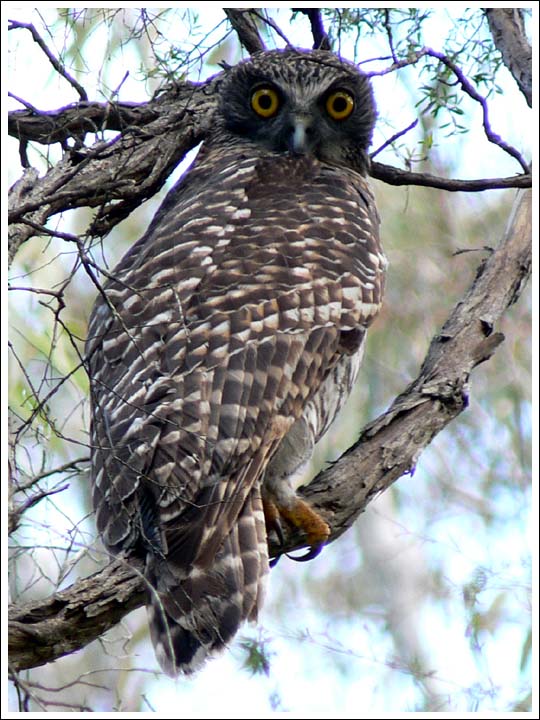
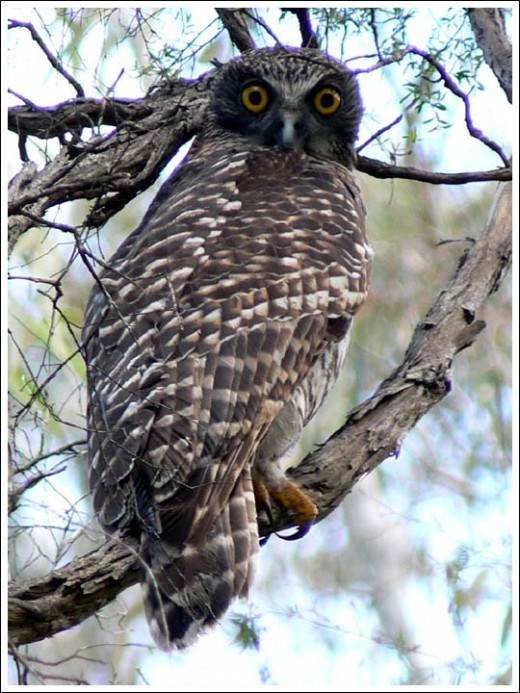 Powerful Owl (Ninox strenua)
(© Photo by Duncan Fraser, ^http://bencruachan.org/blog/?p=170) Powerful Owl (Ninox strenua)
(© Photo by Duncan Fraser, ^http://bencruachan.org/blog/?p=170)
.
The Powerful Owl (Ninox strenua) is Australia’s largest owl, yet in Victoria it has become a threatened species due to human destruction of old growth forest habitat; particularly the destruction of hollow-bearing trees used by this owl for nesting, roosting and home for its natural prey – possums. ‘Powerful Owls are adversely affected by the clearfelling of forests and the consequent conversion of those forests into open landscapes, but the species may persist in forests that have been lightly or selectively logged.’
[Source: ^http://www.birdsaustralia.com.au/our-projects/powerful-owl-wbc.html]
.
Since European settlement, 65% of Victoria’s forest cover has been cleared (Woodgate & Black 1988). Only 5% of freehold land remains forested. This past permanent loss of habitat has likely led to an overall reduction in owl numbers and fragmentation of the original continuous population into a series of small residual populations, each of which is at risk of becoming locally extinct.

‘It is estimated that hollows suitable for owls do not form, even in the fastest-growing eucalypts, until they are at least 150-200 years of age (Parnaby 1995). Of 21 nest trees observed by McNabb (1996) in southern Victoria, about 50% were senescent and all ranged between 350-500 years of age, based on data collected by Ambrose (1982).
Over much of its range, the lack of suitably large hollows is considered to be a limiting factor to successful breeding and population recruitment. The Powerful Owl is, therefore, vulnerable to land management practices that reduce the availability of these tree hollows now or in the future. The loss of hollow-bearing trees has been listed as a potentially threatening process under the Flora and Fauna Guarantee Act (SAC 1991).
In addition, prey density may be an important determinant in territory size and breeding success, particularly considering that only the male hunts during the breeding season. Seebeck (1976) estimated that about 250 possums (or their equivalent) would be required per year by a family group and recent studies have estimated around 300 prey items for a breeding pair rearing two young (Webster unpubl. data.). Key prey are also dependent on hollow trees.’

In its final recommendation the Scientific Advisory Committee (SAC 1994) has determined that:
‘the Powerful Owl is significantly prone to future threats which are likely to result in extinction, and very rare in terms of abundance or distribution.’
.
The short-term conservation objective is to prevent further decline by ensuring that good quality habitat for at least a population target of 500 breeding pairs of Powerful Owl is maintained on public land in Victoria.
[Source: ‘Powerful Owl Action Statement‘, Victorian Government’ s Department of Natural Resources and Environment (or whatever its latest incarnation is), ^http://www.oren.org.au/issues/endspp/powerfulowlAS.htm]
.
.
‘Impact of Bushfire on Sooty Owls and Powerful Owls’
[Source: Rohan Bilney, Report on Sooty Owls and Powerful Owls for the Supreme Court proceeding number 8547 of 2009 – Environment East Gippsland v VicForests, pp.12-13]

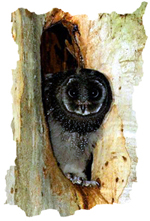
Greater Sooty Owl (Tyto tenebricosa)
.
‘Fire is likely to kill individual owls and small mammals, and remove potential habitat in the short-term, potentially resulting in long-term impacts.
‘How owl populations adapt or respond to fire is largely unknown’
.
‘Fire can consume hollow-bearing trees, while also stimulating hollow formation, but as hollow formation can take decades, frequent fires are likely to result in a net loss of hollow-bearing trees from the landscape (Gibbons and Lindenmayer 2002). This is likely to cause detrimental effects to all hollow-dependant fauna (Catling 1991; Gibbons and Lindenmayer 2002; Garnett et al. 2003).
‘Sooty Owls typically occupy habitats subject to infrequent fire regimes such as wetter forest types, possibly due to higher densities of hollow-bearing trees in such landscapes. Frequent fire regimes also simplify habitat structure, which can cause deleterious impacts on terrestrial mammals (Catling 1991; SAC 2001), which includes increased predation rates by feral predators due to the loss of habitat refuge (Wilson and Friend 1999). Overall, it therefore seems likely that owls and small mammals will be negatively impacted by frequent fire regimes. It is likely, however, that it will be the impacts of fire on prey densities that dictate how the owls respond to fire.
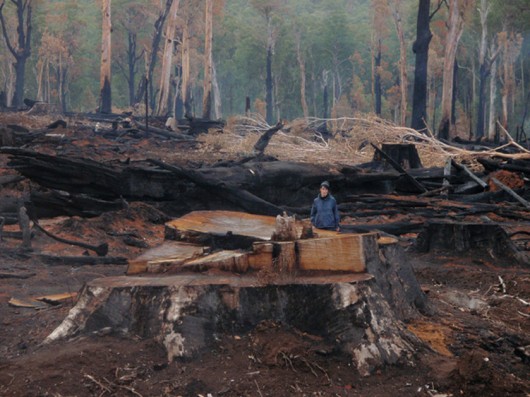 Brown Mountain ancient old growth logged, incinerated, razed by VicForests
(Photo by Environment East Gippsland) Brown Mountain ancient old growth logged, incinerated, razed by VicForests
(Photo by Environment East Gippsland)
.
‘Most species are not adapted to fire per se, but adapted to a particular fire regime, which include fire aspects such as intensity, frequency, seasonality and scale (Bradstock et al. 2002). Due to variations in the life history requirements of species and their ability to survive fire, particular fire regimes can advantage some species, while being deleterious to others (Bradstock et al. 2002; Gill and Catling 2002; Keith et al. 2002). Due to the varying ecological responses to fire, it is important for biodiversity conservation that we not only understand species responses to particular fire regimes, but to ensure that appropriate fire regimes are maintained across the landscape. As prescribed fire is used as a management tool for reducing fuel load to minimise fire risk, it is important that its effects on biodiversity are well understood.
‘Unfortunately, knowledge on how native species respond to particular fire regimes is poorly understood, especially for fauna (SAC 2001, 2003; Clarke 2008). So, in the absence of this crucial ecological information it is virtually impossible to implement appropriate fire regimes which will result in minimal negative ecological impacts, let alone enhance biodiversity. Fire, both prescribed burning and wildfire, can present a threat to owls if conducted at inappropriate seasons, frequency, intensity or scales. It is therefore difficult to quantify the threat. The threat of inappropriate burning at high fire frequencies is likely to be mainly concentrated around human assets and populations, while fires in more remote forested areas will be subject to less frequent fires (DSE 2004). Fire also affects the entire owl population because all habitats occupied by owls is flammable.
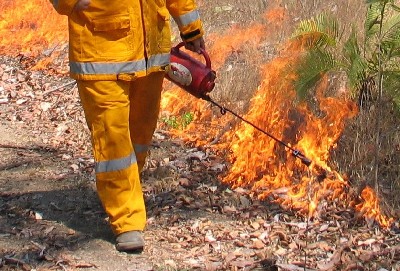
‘Victoria has experienced three catastrophic fire events in the past 7 years, and combined with prescribed burning, approximately three million hectares have been burnt in this time.‘
‘This equates to approximately 2/3 of potential Sooty Owl habitat in Victoria. How populations of Sooty Owls and many other forest dependant fauna have been affected by these fires remains poorly understood or unknown. The ability for forest fauna to recover is therefore being hampered by further prescribed burning, and recovery is also hampered by reduced fecundity caused by a decade of drought, and for the owls, low prey population densities.’
.
.
The ‘Bushfire Fighting Principle’ corrupted by blinkered economic rationalism
.
The traditional principle of bushfire management is to put out bushfires…one would think. Yet this simple concept has been hijacked, bastardised and corrupted by successive governments as a consequence of systemic under-resourcing. Government under-resourcing has contributed to the deadly human toll in recent years.
The corrupting of this core bushfire management principle has morphed into a blanket one-size-fits-all defeatist policy of broadscale prescribed burning – burning the bush before it burns. The bushfire management tradition of ‘suppression‘ has been economically rationalised and politically supplanted by the proactively sounding notion of ‘prevention‘.
In Victoria, the fundamental job of putting out bushfires has bureaucratically morphed into a ‘Code of Practice for Fire Management on Public Land’, with its two general principles…
.Fire management planning on public land must address the threat of wildfire, guide the use of prescribed burning, and provide for the achievement of integrated land management objectives such as human safety and environmental management.’ (Clause 50)
‘Fire management activities must be undertaken in a participative manner where the responsibility for reducing the likelihood and consequence of wildfire is appropriately shared between public and private land holders and managers.’ (Clause 51)
.
What happened to the fundamental principle of bush fire fighting?
To put out bushfires!
Instead, vast areas of remaining native bushland and forests across Australia are being deliberately burnt to the point where critical faunal habitat is sterilised – only the trees remain, while the rich underlying vegetation, demonised as ‘hazardous fuel‘ is incinerated and repeatedly prevented from regrowth. Wildlife habitat has become a fuel hazard targeted for burning by the very custodians charged with wildlife conservation. And out of the Victorian Royal Commission into the Black Saturday bushfires, the anticipated kneejerk response by bushfire agencies to commence Prescribed Burning Armageddon against the bush has started as many genuine conservationists have feared.
And what has been the full realised cost of the 2009 Victorian Bushfires – valuing human lives, human injuries, ongoing trauma, livelihoods, wildlives, livestock, private property, natural assets, on top of the direct operational response cost, the indirect costs of contribiting agencies, the donations raised, capital costs, the opportunity costs, the investigation costs, the Royal Commission costs? No one has come up with a figure. These values were outside the Victorian Royal Commission’s terms of reference – so what real value was it? Economic rationalising of emergency management is costing lives and contributing to species extinctions.
.
.
Victorian Government Policy of Bushfire Lighting
.
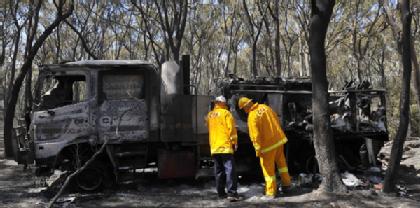
The Victorian Government’s delegated custodian on natural areas across the State is the infamous Department of Sustainability and Environment (DSE), with a reputation for lighting most of the bushfires it euphemistically labels as ‘prescribed burning’ wherein it finds unburnt bushland and prescribes its own burning regimes. When such custodial agencies restore the word ‘conservation‘ back into their title, some respect may return.
DSE’s ‘Code of Practice for Fire Management on Public Land‘ was revised in 2006. It relies upon background premises that since “much of the Australian continent is fire-prone”, that “fire occurs naturally”, that “many species of vegetation and wildlife have adapted to living within the natural fire regime” and that “Victoria’s Indigenous people used fire as a land management tool for thousands of years”. The Code justifies that “Victoria’s flora, fauna and the ecosystems they form are adapted to fire of varying frequencies, intensities and seasonality.” Victoria’s Flora and Fauna Guarantee Act 1988 has objectives to ensure “Victoria’s native flora and fauna can survive, flourish, and retain their potential for evolutionary development”. Now the integrity of this Act is under threat. Perversely DSE’s Code of Practice argues that deliberate burning of bushland and forest habitat will help Victoria’s native flora and fauna to survive, flourish, and retain their potential for evolutionary development.
Crap!
DSE stretches its rationalising propaganda further, claiming that excluding bushfire can have “negative consequences for Victoria’s flora and fauna“. And this is where the hijacking, bastardisation and corrupting turns from mythology into unsubstantiated falsehood and misinformation. No document exists to zoologically prove that native fauna will suffer such negative consequences if it does not have a bushfire range through its habitat. As a result, the Code of Practice implies that bushfire is ok for all Victorian bushland and forests – DSE conveniently convinces itself that the urgent moral imperative for DSE to suppress bushfires is extinguished. So now it lights more fires than it puts out.
The Code also premises that “often these wildfires can be difficult to suppress”. Well no wonder with an grossly under-resourced, firetruck-centric volunteer force.
 . .
.
‘DSE holds fire management workshop in Bendigo’
.
On 22nd June 2011, DSE staged a workshop of stakeholders to discuss some recommendations of the Royal Commission into Victoria’s February 20o9 bushfire tragedy. According to the website ‘Friends of Box-Ironbark Forests’, in attendance were representatives from the CFA, local government, The Wilderness Society, Bendigo Field Naturalists Club, Friends of Kalimna Park, North Central Victoria Combined Environment Groups [NCVCEG], Apiarists Association and DSE attended a workshop on June 10 to learn about the process for implementing the findings of the Victorian Bushfires Royal Commission. Though Friends of Box-Ironbark Forests (FOBIF) was not invited to this workshop, we were represented by members of some of the other groups.
Once again DSE’s Code of Practice for Fire Management on Public Land (COP) is to again be reviewed and updated, except its premises have not changed, so what’s the point? The following notes taken on the issue of Fire management Zones/Prescriptions is telling of how disconnected DSE is from wildlife habitat conservation:
.
‘Fire Management Zones (FMZ) have been reviewed recently. An interim zoning is to be released soon. With little time left the group briefly discussed the merits of fire management zones, and how they might relate to the risk model. It was highlighted that the residual fuel load is an important aspect, but further detail as to how was not provided.
NCVCEG made the point that the current diagram used by DSE to represent the relationship between ecological outcomes and fire management outcomes across the four FMZ is misleading, encourages poor planning, discourages biodiversity management in zones 1 and 2, and neglects to recognise that fire management outcomes may be achieved in all zones, especially where integrated planning and alternative practices (to prescribed burning) are established.
In relation to FMZ the Apiarists pointed out that Box Ironbark forests generally have very low fuel levels in comparison to heavily forested regions where many lives were lost during the fires in 2009. The merit of burning areas used for honey production was questioned and the long term impacts of severe burning on Box Ironbark forest ecology was raised.’
.
[Source: Friends of Box-Ironbark Forests, 20110622, ^http://www.fobif.org.au/2011/06/dse-holds-fire-management-workshop-in-bendigo/]
.
.
Yet at the same time DSE points out that… ‘biodiversity is in decline‘
.
In its ‘Victoria’s Biodiversity Strategy 2010–2015: Consultation Draft‘ DSE reminds us that two hundred years of (immigrant deforestation), severe droughts, major bushfires and the impact of climate change, has severely affected Victoria’s species and ecosystems. DSE professes:
- Victoria is the most cleared and densely populated state in Australia. Victoria has the highest proportion (48%) of sub-bioregions in Australia in poor condition, with four out of Australia’s five most cleared bioregions found in western Victoria (CES 2008).
- Approximately half of Victoria’s native vegetation has been cleared for agricultural and urban development, including 80% of the original cover on private land. Victoria is losing native vegetation at a rate of some 4,000 hectares per year, mostly from endangered grasslands (DSE 2008).
- Victorian landscapes are the most stressed in the country (NLWRA 2001). One third of Victoria’s major streams are in poor or very poor condition. Two thirds of wetlands have been either lost or degraded and nearly half of our major estuaries are significantly modified. Flows at the Murray mouth are estimated to be a quarter of what would naturally occur (VCMC 2007).
- 44% of our native plants and more than 30% of our animals are either extinct or threatened (CSIRO 2004). The highest number of threatened species in any one region in Australia occurs in north western Victoria.
- Exotic species represent about 30% of the Victorian flora with 1,282 species considered naturalised and a further 214 species considered incipiently naturalised in Victoria. This has increased from 878 naturalised species in 1984. It is estimated that an average of 7.3 new plant species establish in Victoria per year, and this number is increasing by a rate of 0.25 plants per year. Approximately 90% of the native vegetation in Melbourne is impacted by weeds, with more than 50% considered severely degraded. There are 584 serious or potentially serious environmental weeds in Victoria with 129 very serious (CES 2008).
- Over 100 marine species have been introduced to Port Phillip Bay.’
.
[Source: Victorian Government’s Department of Sustainability and Environment, ^http://www.dse.vic.gov.au/conservation-and-environment/biodiversity/victorias-biodiversity-strategy/biodiversity-strategy-renewal/draft-victorian-biodiversity-strategy-2010-2015/current-state, Clause 2.2 ‘Biodiversity is in decline‘]
.
.
State aware but doesn’t care
.
The Victorian landscape has undergone massive changes in the past 150 years. As a consequence of environmental degredation and destruction of indigenous flora and fauna:
- Over 60% of the state has been cleared, and much of what is left is seriously degraded by weed invasion;
- Of the two thirds of the state which is privately owned, only 5% retains its natural cover;
- Soil erosion and salination have become serious problems;
- Over 35% of our wetlands have been drained;
- Close to 80% of rivers and wetlands have been substantially modified;
- Almost all native grasslands have been eliminated or modified;
- Many other vegetation communities are almost extinct, or critically endangered;
- Over 900 exotic plant species have been established in Victoria, many of which are weeds, and scores of noxious exotic animal species are now widespread;
- 23 native mammal species have become extinct in Victoria.
.
[Source: The Southern Peninsula Indigenous Flora & Fauna Association Inc., ^ http://www.spiffa.org/victorias-biodiversity-crisis.html]
.
And the Victorian Government is well aware.
DSE acknowledges that the ‘clearing of native vegetation (across Victoria) and habitat has also led to the loss or decline in wildlife species. Habitat fragmentation has meant that wildlife are more at risk from predators, harsh environmental conditions, and human influences (e.g. roads) as they move between remnant patches. Isolated patches support fewer and lower densities of wildlife, increasing the chances of population extinction in individual patches as a result of the impacts of chance events upon genetically simplified populations. Habitat loss and degradation also increases the susceptibility of wildlife to severe environmental conditions, such as fire and drought, and broader processes, such as climate change and changing rainfall patterns.’
DSE acknowledges that ‘while maintaining or restoring ecosystem function will help to reduce the rate at which species decline, we already have a legacy of species that are at risk due to past ecological disruption, and a latent ‘extinction debt’. Victoria’s past land management actions have resulted in the loss of species and created and ongoing risk of future losses. Many existing threatened species occur in remnant or fragmented landscapes where the work required to recover them is intensive, expensive and long-term. In extreme cases it is necessary to remove part of the remnant population to captivity until critical threats have been mitigated.
DSE acknowledges that ‘effective threatened species recovery requires:
- Effectively dealing with threats to reduce the rate at which species become threatened;
- Conducting recovery efforts in situ by managing the processes that degrade their habitat or directly threaten them, including, where required, support from ex situ conservation programs;
- The best available knowledge and an adaptive management approach, including adoption of the precautionary principle when required;
- Co-operative approaches to recovery, with an effective and efficient mix of incentives and regulations; and
- Planning and regulatory frameworks to provide clear and consistent policy, process and outcomes.’
.
Yet in the same breath DSE goes on to reinforce its ‘fire is good for wildlife‘ propaganda – ‘a substantial proportion of Australia’s unique biota is dependent, to varying degrees, on fire and the variety of fire regimes for its continued existence and development.‘
[Source: DSE’s ‘Code of Practice for Fire Management on Public Land‘, Clause 2.3.8 ‘Challenges relating to fire management’]
.
.
‘Fuel reduction burns threaten species’ – or Black Saturday incompetence an excuse for broadscale State Arson
[Source: Peter Vaughan, Monash University, Melbourne, 20100531,^http://www.reportage-enviro.com/2010/05/fuel-reduction-burns-threaten-endangered-species/]
.
‘Conservationists are concerned that fuel reduction burns in East Gippsland will threaten endangered species and reduce biodiversity.
On March 16, fire managers from the Department of Sustainability and Environment (DSE) ignited a fuel reduction burn in the Dinner Creek catchment of Waygara state forest, approximately 14 km West of Orbost. The fire quickly gained intensity, aided by a temperature of 30 degrees Celsius. It burnt most of the environmentally sensitive vegetation within the fire zone along four kilometres of the Dinner Creek.
DSE Fire Manager for the Orbost Region, Steve de Voogd, said that the Dinner Creek fuel reduction burn grew hotter than intended. The fire was meant to burn 2206 hectare of coastal forest and leave a mosaic of burnt and un-burnt areas within the fire’s containment lines.
.
According to Mr de Voogd, the DSE is now under community pressure to reduce the risk of wildfire through fuel reduction burning, and that must take precedent over ecological considerations.
.
“Although there is probably room for more fire ecology planning, it is incumbent on the DSE to take action because the consequences of doing nothing may be worse,” Mr de Voogd said.
Most of the hollow bearing trees in the burn zone, which were home to a number of endangered species protected under state and federal law, were destroyed.
Dr Rohan Bilney, an expert on Australian forest owls and spokesperson for the Gippsland Environment Group, said that the program intended to burn large areas of coastal forest without adequate ecological planning, monitoring or research, which threatened crucial habitat and food sources for the forest’s owls species.
.
“The coastal forests of East Gippsland are the strong hold of the Masked Owl, a species listed as threatened under two laws: the Victorian Flora and Fauna Guarantee Act and the Federal Environmental Protection and Biodiversity Conservation Act. Most of East Gippsland’s Masked Owls live in the coastal forests now being subjected to intense broad area fuel reduction burns by the DSE,” said Dr Bilney.
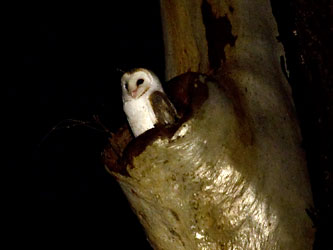
Masked Owl (Tyto novaehollandiae)
.
The Masked Owl Action Statement, prepared under the Victorian Flora and Fauna Guarantee Act, estimates only 150 pairs of Masked Owl exist in Victoria. Of that total, 100 pairs are found in East Gippsland and most are concentrated in the coastal forest.
DSE Manager of Biodiversity in East Gippsland, Dr Steve Henry, said that the current DSE fuel reduction fire strategy allows for large fires but burning on such a scale leaves few options for the protection of important ecological values.
“If there are some areas that contain specific environmental attributes that we want to protect, we could exclude them from fire with a bulldozer line. However that is expensive and often very destructive on most of these large burns. The main management technique used is the way in which the lighting pattern of the fire is done, sometimes that is not as effective as we would hope,” he said.
Mr Henry said that funding constraints have not permitted the DSE to conduct detailed ecological studies of the coastal forests, including the effect of fire on the environment.
A post-fire ecological survey is currently being conducted by the DSE in selected fuel reduction areas.
The Dinner Creek fire was just one of 48 fuel reduction burns planned by the DSE for the region during 2009-2010. Like other fuel reduction burns, the DSE must comply with the Victorian Code of Practice for Fire Management on Public Land.
The primary objective of the Code is to protect of life and property, while minimising negative impacts on natural and cultural values, and abiding by threatened species legislation, are also included.
The Code of Practice also states that the DSE must prepare a Fire Ecology Strategy that includes input from ecological experts and full consideration of all available scientific research.
If little ecological research exists, fuel reduction burning can be conducted under the rational that it may reduce the future risk of wildfire.
.
In the absence of scientific data, the DSE will continue to plan fuel reduction burns from computer desktops, utilising the ad hoc data collected as part of the Environmental Vegetation Class mapping projects of the late 1990s.
While political pressure continues to increase, the DSE fire policy will remain focused on protecting the community against the spectre of Black Saturday.’
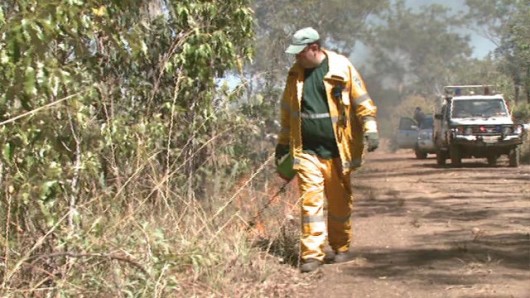 Burn it in case it burns, because we don’t have the resources for wildfire suppression Burn it in case it burns, because we don’t have the resources for wildfire suppression
.
.
‘Climate change, fires and logging -the deadly combination for Victoria’s species’
[Source: Environment East Gippsland, ^http://www.eastgippsland.net.au/?q=node/446]
.
‘Two hundred years ago the Sooty owl was abundant and fed on about 18 species of ground prey in Gippsland. Today they have only two or three to chose from. Other species are under similar pressure.
Many of our native animals have become sparser in numbers and their range has shrunk. Some, like the Southern Brown Bandicoot (Federally listed but not State listed), are now isolated in small “island” populations which are dangerously close to extinction mainly due to threats of fire and predation. Fires destroy understorey cover, making it easy for foxes and dogs to wipe out small populations of ground dwelling animals.
The 2003 fires and the recent December ’06 fires have destroyed the habitat and ground cover over about 2 million hectares of Victoria’s forested country. This has had a horrifying impact on ground mammals, birds and hollow dependent species.
.
Scientist and Quoll expert, Dr Chris Belcher, has calculated that this species’ Victorian numbers were reduced by 33 – 45% as a result of the ’03 fires. The December ’06 fires would have reduced this again to even more precarious numbers.
The isolated colony of Long Footed Potoroos discovered around Wonangatta (or Wongongara?) will most likely have been killed as a result of the recent fires.
The Helmeted Honeyeaters had five small and isolated populations left but the 1983 fires wiped out four of them. Yellingbo is still likely to burn and our faunal emblem will be extinct on this planet.
Bandicoots are very fire sensitive. There are small and vulnerable populations scattered in Gippsland. In 1994, fires burnt 97% of the Royal National Park and Bandicoots no longer survive in this area. The safety of thick ground cover does not return for years, meaning foxes and dogs heavily predate any survivors.
.
East Gippsland is the last stronghold for many of our rare and endangered fauna. It is a wetter environment and has much higher floristic diversity and therefore animals.
Climate change will now make fires more frequent and intense in SE Australia (CSIRO). Governments must adapt management of natural areas to account for this reality as it is for agriculture, water and energy.
The greatest pressure on Eastern Victorian species has been in the Critical Weight Range from 35 gms to 5 kg. Many ground dwelling animals are extremely susceptible to fire. Potoroos, Quolls, Bandicoots, native rodents (the rare New Holland Mouse, Smokey Mouse etc).
The predation rate after a fire is huge and patches of unburnt forest within the fire zones are absolutely essential to help populations survive predation, recover and disperse in time. These areas are critical to protect from further disturbance.
The recovery of species after a fire is now very different from 200 yrs ago. Populations are more isolated, salvage logging further destroys their chances, there is less diversity of prey species for the higher order predators like owls and quolls to turn to if gliders and possums are impacted by fires (or logging the hollow-rich forests).
Logging ecologically diverse forests favours the return of biologically poor tree communities such as silvertop and stringybark. The forests with mixed gum and box throughout can have 20-50 times higher animal densities. Significant vegetation changes due to massive landscape disturbance such as clearfelling, makes endangered species recovery from fire even more unlikely.
In the 1990s, East Gippsland supported seven times more threatened species than other areas in Victoria. This made the region seven times more important for our endangered species’ survival. Since the fires of 03 and 06, it is not unreasonable to suggest that East Gippsland is the last refuge and last chance for these species to survive extinction. Extinction can happen very quickly.
Species which are fairly general in their roosting, nesting and feeding needs can often survive (as they have in other areas of the state) but the many specialist species which rely on large areas of diverse and thick forest are highly likely to vanish forever.
This is why the hasty and unscientifically mapped areas of newly reserved forest require careful refinements. The needs of the state’s threatened species must be made the priority. Independent biologists and on-ground local knowledge (not VicForests) must be used to finalise the new reserve boundaries, with the long-term impact of the recent fires as a major guiding factor.
The Bracks Government suggested there be no net loss of resource as an adjunct to the mapped reserve areas. This is an impossible and irrational qualification as fires can take out large percent of the forest and therefore wood resources in one season. Commercial use of forest should be allocated only after biologically essential considerations have been adequately addressed.
Another point made in pre-election promises was to make sure the new areas are mapped and industry changes are resourced so as to adhere to the terms and spirit of the RFA. This then should see the government honour its long overdue commitment to carry out research into the impact of clearfelling on threatened species, to identify sustainability indicators, carry out five yearly reviews and ensure threatened species are protected. None have been honoured in the last 10 years!
The recent court ruling regarding the EPBC Act should also give the state government substantial opportunity to begin to alter protection measures for Federally listed species in East Gippsland.
The conscience of this government cannot put the very limited future of several sawmills ahead of a large number of entire species. Continued logging of intact original forests must not be the overriding priority. The ability for species to cope with the escalating impacts of climate change and fires from 2007 onwards has to now be put ahead of politics and union threats. These species survived well in Australia for over 40,000 years. The clearfell logging industry has been around for less than 40 years. Political priorities have an even shorter lifespan.’

.
.
Further Reading:
.
[1] ^ http://eastgippsland.net.au/files/Sooty_Owl_%20Powerful_Owl_Bilney_December_2009.pdf , [ Read Report]
[2] Environment East Gippsland website, ^ http://www.eastgippsland.net.au/
[3] ‘ Sooty Owl Action Statement‘, Victorian Department of Sustainability and Environment (DSE), [ Read Statement]
[4] ‘ Powerful Owl Action Statement‘, (DSE) ^ http://www.dse.vic.gov.au/__data/assets/pdf_file/0019/103177/092_powerful_owl_1999.pdf , [ Read Statement]
[5] ‘ Masked Owl Action Statement‘, (DSE), ^ http://www.dse.vic.gov.au/__data/assets/pdf_file/0015/103173/124_Masked_Owl_2001.pdf , [Read Statement]
[6] Victorian Rainforest Network website, ^ http://www.vicrainforest.org/
[7] The Southern Peninsula Indigenous Flora & Fauna Association Inc., ^ http://www.spiffa.org/victorias-biodiversity-crisis.html
[8] ‘Protecting Victoria’s Powerful Owls’, ^ http://www.dse.vic.gov.au/__data/assets/pdf_file/0012/102144/PowerfulOwls.pdf , [ Read Report]
[9] ‘ Fire Protection Plan Gippsland Region‘, 2011, ^ http://www.dse.vic.gov.au/fire-and-other-emergencies/fire-management/fire-protection-plans/fire-protection-plan-gippsland-region , [ Read Plan]
[10] ‘ North East Victoria: Biodiversity‘, Australian Department of Agriculture, Fisheries and Forestry, ^http://www.daff.gov.au/__data/assets/pdf_file/0007/63583/Environmental_Values.pdf , [ Read Report]
[11] ‘ Submission to East Gippsland Forest Management Zone Amendments September 2010‘, ^ http://vnpa.org.au/admin/library/attachments/Submissions/EG%20Zoning%20Review%20Joint%20Submission%20ENGO%20Groups.pdf , [ Read Report]
[12] ‘ Ecology and conservation of owls‘ by Ian Newton, ^ http://www.publish.csiro.au/pid/3152.htm
.
Tags: DSE, Flora and Fauna Guarantee Act, fuel reduction program, habitat trees, hazard reduction, hollow trees, hollow-dependant fauna, Masked Owl, Powerful Owl, prescribed burning, Sooty Owl, State Arson, State Logging, VicForests, Victoria's old growth forests, Victorian Bushfires Royal Commission, Victorian Department of Sustainability and Environment
Posted in Gippsland (AU), Owls, Threats from Bushfire, Threats from Deforestation | No Comments »
Add this post to Del.icio.us - Digg
Friday, November 11th, 2011
This article was initially published by Tigerquoll 20090623 on CanDoBetter.net in the aftermath of the devastating Victorian bushfires that climaxed on 7th February 2009:
.
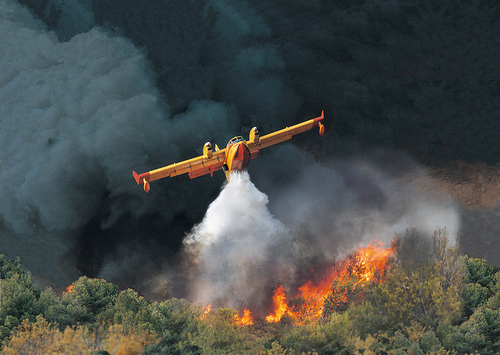
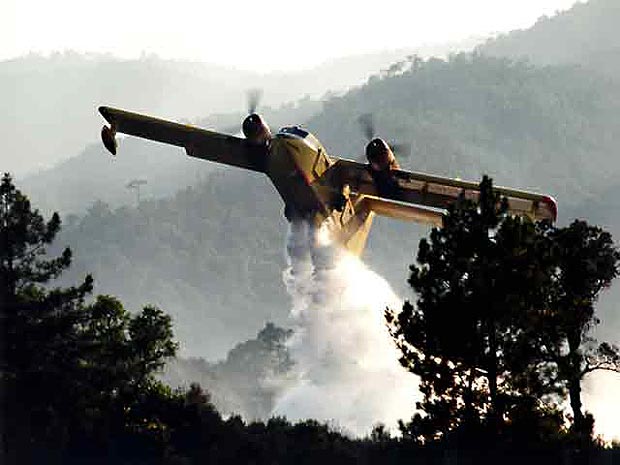
Standby Bombardier 415’s strategically placed during Australian summers – a clear advantage over road-limited fire trucks
– but try telling Australia state governments at budget time and they only cry poor.
But then state government bushfire response record is littered with recurring tragedy and failure – Victoria, Canberra, Perth Hills, Blue Mountains, Eyre Peninsula…
.
We need to dig deeper if we are serious about the bushfire threat, and this doesn’t mean just more charity to prop up the existing but failing system, as Prime Minister Rudd seems to perpetuate. This goes beyond the Victorian Bushfires. Under-resourcing is a fundamental problem with Australian bushfire management nationally.
The bushfire problem is only going to get worse given the trend toward hotter summers, prolonged droughts, climate change, arsonists and millions of houses now situated in bushfire prone areas. The answer is not to destroy vast swathes of bushland, which embers jump anyway sometimes spotting beyond 10km ahead of a fire front.
Detection, response and suppression are the measures of firefighting success criteria. Yet to adequately perform these, current bushfire management remains chronically under-resourced by all levels of government across Australia.
A fleet of Bombardier 415s (formerly Canadair CL-415) is a cost effective proactive investment in bushfire response and without doubt preferable to the $2 billion economic cost of Victoria’s 2009 bushfire catastrophe, ‘after the fact’.
.
Check this out: ^http://www.aerospace-technology.com/projects/bombardier_415/bombardier_4152.html
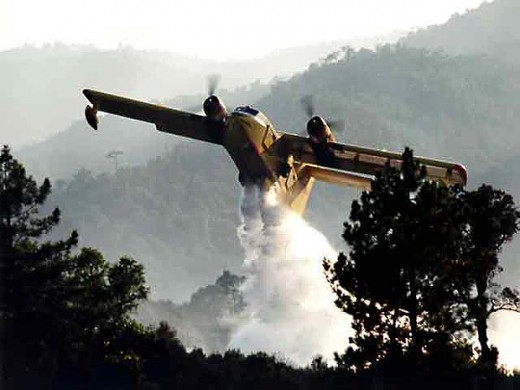
Airborne Bushfire Fighting is proven effective
But do Australian bushfire fighters reject such effective airborne options because (1) they seem overkill?,(2) because of prejudice against American/Canadian tech solutions?,
(3) State Government budget is so limited as to make them fanciful? (4) volunteer fire truck drivers can’t fly them so see their roles threatened?
In the most dangerous bushfire scenarios – remote ignitions – which is more effective fire trucks or these magnificent machines?
Airborne and ground force attack are not mutually exclusive; as in the military, they are critically interdependent.
.
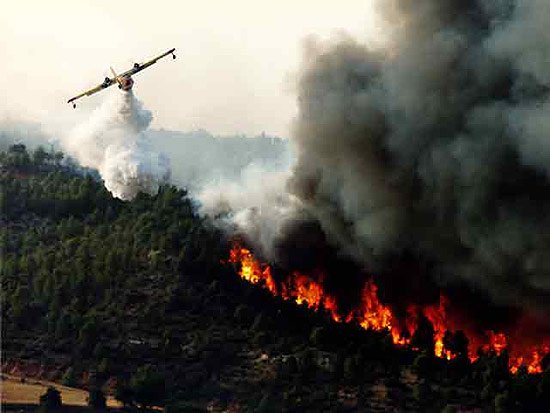
But also more manoeuvrable water-bombing rotary-wing aircraft like the Erikson Aircrane plus the dropping in of RAFT crews also deserve consideration particularly in rugged terrain, where Bombardiers would not be able to achieve water-bombing runs low enough to be effective.
 Remote Ignitions: Prompt airborne suppression simply works! Remote Ignitions: Prompt airborne suppression simply works!
.
The cultural problem is that bushfire management is typically fire-truck centric in its thinking, planning and response. And beware of pollies and their devoted fans lobbying red herrings and porkies to try to stimie investigation into these options, when really the debate is simply one of cost.But research needs to precede any investment.
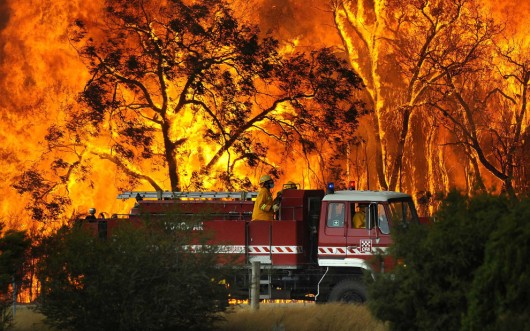 A fire truck moves away from out of control flames from a bushfire in the Bunyip Sate Forest near the township of Tonimbuk, 125 kilometers (78 miles) west of Melbourne, Saturday, Feb. 7, 2009. Walls of flame roared across southeastern Australia, razing scores of homes, forests and farmland in the sunburned country’s worst wildfire disaster in a quarter century. (Source: AP Photo, ^http://archive.boston.com/bigpicture/2009/02/bushfires_in_victoria_australi.html)
Fire trucks exposed to remote wildfire? What OH&S standard would permit this operation outside volunteer rural fire fighting? A fire truck moves away from out of control flames from a bushfire in the Bunyip Sate Forest near the township of Tonimbuk, 125 kilometers (78 miles) west of Melbourne, Saturday, Feb. 7, 2009. Walls of flame roared across southeastern Australia, razing scores of homes, forests and farmland in the sunburned country’s worst wildfire disaster in a quarter century. (Source: AP Photo, ^http://archive.boston.com/bigpicture/2009/02/bushfires_in_victoria_australi.html)
Fire trucks exposed to remote wildfire? What OH&S standard would permit this operation outside volunteer rural fire fighting?
.
Australia’s peak bushfire research organisation, Bushfire CRC, in its August 2006 report on the merits of aerial suppression made the following key findings:
.
- Aerial suppression can be effective in providing support to ground crews and improving the probability of first attack success by 50 percent or more. (so relies on fast detection of ignitions)
- For an aircraft to provide effective assistance it must be available at call, rapidly dispatched with minimal travel time and with logistical systems in place.
- Air operations effectively integrated into the incident management structure and competent personnel are needed to be available to direct the operations for good outcomes.
- The use of ground resources with initial aerial support is the most economically efficient approach to suppression.
- The use of aircraft for first attack until ground resources reach the fire produces the best suppression outcome.
- Large fixed wing air tankers such as a DC 10 are at a cost disadvantage. This is particularly the case for first attack when fires are small and where water drop accuracy is required. (…But no-one could argue that Victoria is now at a cost disadvantage without them..the economic bill alone is $2 Billion, which excludes the psychological, social and ecological costs).
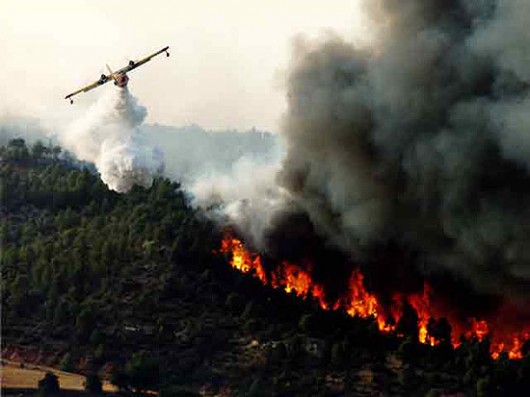
Standby Bombardier must be a first strike capability for bushfire fighting
…they are part of the performance solution, not the solution.
.
The airborne response to ignition suppression is just one strategy. The bushfire management solution is complex. To be effective in preventing a repeat of Victoria’s tragic and disgraceful 7-Feb-09, demands massive public investment and organisation at a level only national resources can muster. Don’t deny the legacy of Victoria’s 173 bushfire victims to be remembered as a recurring Armistice Day. It is unacceptable for governments to dismiss bushfire deaths as a fate of nature.
.
~ Tigerquoll, licensed commercial helicopter pilot, Suggan Buggan, Victoria.
.
Thursday, November 10th, 2011
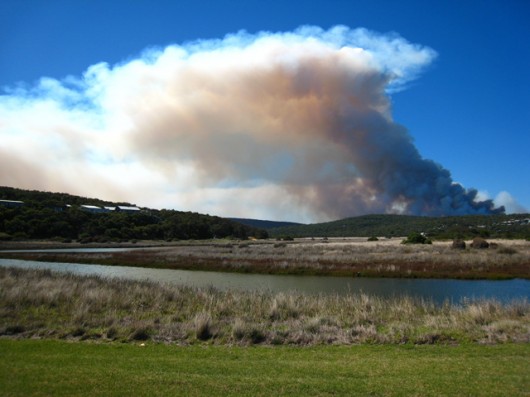 Ash Wednesday Bushfires in 1983 – approaching Anglesea on Victoria’s Great Ocean Road, Australia Ash Wednesday Bushfires in 1983 – approaching Anglesea on Victoria’s Great Ocean Road, Australia
.
This article was initially published by Tigerquoll 20090622 on CanDoBetter.net in the aftermath of the devastating Victorian bushfires that climaxed on 7th February 2009, quickly branded by the media as ‘Black Saturday‘:
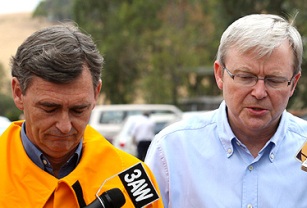
Ultimate responsibility at the time – Victorian Premier Brumby and Australian Prime Minister Rudd
(and tomorrow is Armistice Day when nearly a hundred years ago people questioned…
‘Ultimate Responsibility‘)
.
The Victorian Premier Brumby’s Royal Commission into the January-February 2009 bushfires is a mere incident review. If Victoria is to be protected from firestorms in future, it should undertake a root cause analysis, including the numerous past investigations into bushfires, with a view to achieving a cultural shift in rural fire fighting methods, resourcing and emergency management and into ecology management, housing approvals in bushfire prone areas, building design in bushfire prone areas, bush arson criminology and into serious resourcing of rural fire management.
Indeed, given the repeated history of bushfires across Australia and the repeated uncontrolled nature of many of these leading to extensive property damage, the loss of thousands of livestock, widespread ecological destruction, the human lives lost and injuries, and the massive costs incurred every year, the scope of the enquiry should be escalated to a national level.
But the Victorian Commission’s terms of reference focuses on the immediate causes and circumstances of the 2009 Victorian Bushfires. It focuses on the immediate management, response and recovery. This is a start, but the real start occurred in 1939 with the shock of Black Friday. It lead to the Stretton Enquiry, but many large and damaging firestorms have occurred since – so the Stretton Enquiry showed that lessons were either ignored or the application of those lessons were ineffective. The Esplin Inquiry of 2003 identified striking parallels between 1939 and 2002-3 bushfires. Now we have the 2009 Bushfires, but each investigation is disconnected from the previous one, almost as if to intentionally ignore history and any prior lessons learnt. Interstate and overseas, many major bushfires and their subsequent investigations have amassed research, insight and lessons. Why limit the investigation to one event?
Incident investigation will uncover causes and flaws and will likely make specific recommendations in the hope of preventing similar incidents. But root cause analysis goes beyond identifying the symptoms of a problem. But the Commission has not started with identifying the problem.
- Let’s premise that at the core is the problem of preventing ignitions becoming firestorms.
- What are the causes of uncontrolled ignitions in the bush.
- Where are they typically lit?
- How are ignitions detected by fire authorities?
- What is the time lapse between ignition and detection?
- What is the time lapse between detection and response and eventual suppression?
- Which causes and interventions would mitigate the risk of these ignitions developing into uncontrollable firestorms?
- Are the ignition detection tools adequate?
- Are the communications tools adequate?
- Do we have the right tools and trained personnel in the right places to effectively respond?
- Is the entire detection, response and suppression system sufficiently integrated to deal with multiple ignitions in extreme conditions across the State at the same time? How would this be achieved?
- What budget would be required to have such resources and technology in place to achieve this standard?
- Is the problem indeed too big for Victoria by itself to adequately deal with and so is the problem in fact a national one?
- How would a satisfactory solution be achieved without causing other problems like ecological damage and local wildlife extinctions?
.
Then implement the recommendations and scientifically monitor their effectiveness.
However, the Commission is looking at what caused the specific ignitions, what damage the specific bushfires caused and specific responses. It will conclude what specifically should have been done in these specific incidents. It will lead to a blame game that will solve nothing. Subsequent ignitions if not predicted, detected, responded to and suppressed to prevent firestorms, will likely have different circumstances in different locations. So how will the problem have been solved by this royal commission?
.
.
What about the affected people up in the Bush?
.
Horror, shock, helplessness, anger, loss – loved ones, family, next door neighbours, familiar faces gone. Then there’s financial loss, bank issues – sympathy first but then demands, threats and ambivalence. This is whole livelihoods. It is devastation. The initial trauma (community and personal), plus the ongoing trauma (community and personal).
Governments do the obligatory media spin, but as months pass they move on to other priorities. But the people don’t – whether they end up staying or going, the trauma stays.
This was absolutely catastrophic! Catastrophic! No-one can prepare or recover as easy as Government claims. What is ‘moving on’?
This is War Reparations league! A war hit here and ordinary people were simply living their ordinary lives in the bush. Another token bushfire enquiry without bushfire reform is repugnant, ignorant and callous. How will the Victorian Royal Commission prevent bushfire history repeating itself?
If our society could cope before, we may accept fate. But knowing the extreme risk in February 2009 and now, fate is no excuse. It is wrong for government to pursue bushfire management nonchalant business-as-usual in Victoria… in Australia.
.
.
Footnote
.
My uncle and aunt lost their family home down at Angelsea during the 1983 Ash Wednesday bushfires. They weren’t insured. Though they escaped with their lives, they lost everything else. Thereon they were never really quite the same. They became refugees in their home community.
 Anglesea Dreaming – a recollection of one’s youth and holidays Anglesea Dreaming – a recollection of one’s youth and holidays
.
.
Tuesday, November 8th, 2011
This article was initially published by Tigerquoll 20090620 on CanDoBetter.net in the aftermath of the devastating Victorian bushfires that climaxed on 7th February 2009, quickly branded by the media as ‘Black Saturday‘:
.
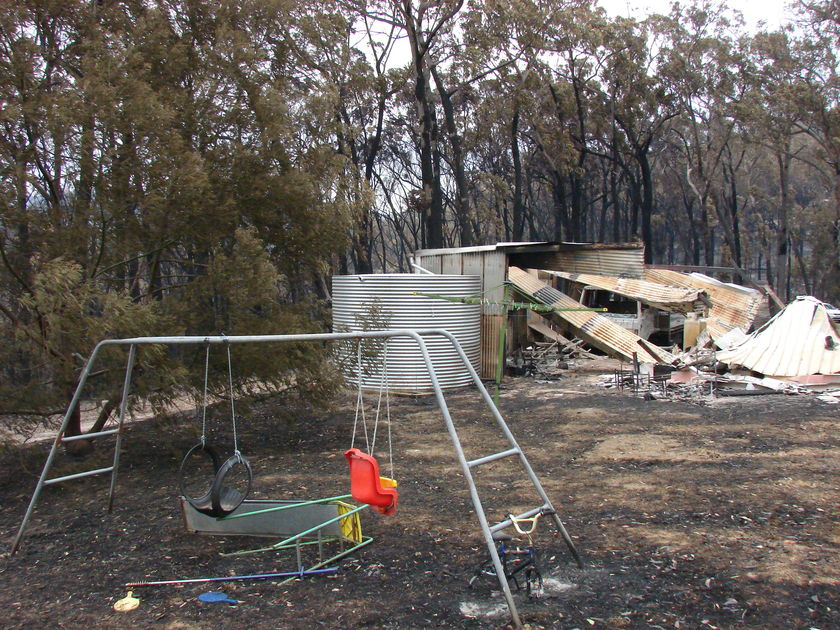
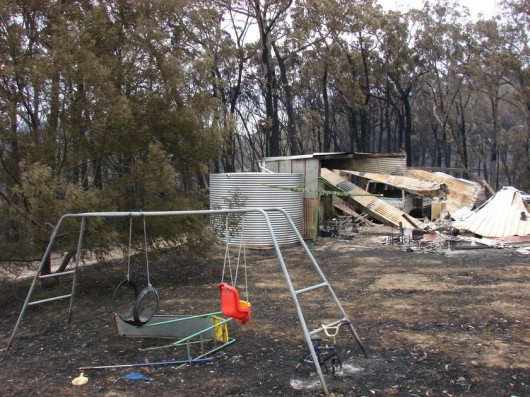 Children’s play equipment sits in front of a house destroyed by bushfire in Chum Creek
North Healesville, Victoria, Australia
[Photo: ABC] Children’s play equipment sits in front of a house destroyed by bushfire in Chum Creek
North Healesville, Victoria, Australia
[Photo: ABC]
.
Pursuing the ‘bunker solution‘ is a dead end that no government will underwrite – think of the risk of failure!
What has been avoided in this Victorian bushfire debate are the fire fighting statistics. Where are the fire fighting operational metrics showing the time between ignition and detection and response and suppression?
Is anyone considering the fundamental task of effective bush fire fighting as a key cause of this disaster? The operational metrics, if indeed collated, would be alarming to the general public. The unprecedented extreme risk of uncontrollable wildfires was known to fire fighting operations management, yet no extraordinary resources were deployed in advance. Hours, not minutes, lapsed between ignitions, detection and responses. As a consequence, suppressions via a tired old truck-centric response methodology was demonstrably grossly inadequate. CFA responses were absolute failures in the tactical response to the February 2009 Victorian Bushfires. The whole show descended into an incompetent stuff up which resorted to the worst case scenario – ‘every man for himself’.
Only vigilante fire response had a chance of working. Acceptable may be in 1909, but not in a sophisticated 2009 supported by millions in annual funding and research. The response at strategic management level was ‘Keystone Kops‘. The field response was like a tragic Gallipoli – a strategic blunder with good men sent in with too little, too late.
The Marysville community like others didn’t deserve official response approach of ‘too hard basket’ and abandonment. The result was incineration entrapment.
This is the lesson of the incompetence of the CFA, DSE and Emergency Management Australia. An ignition started in the bush is not an uncontrollable tsunami. But in conditions like that in January 2009 in Victoria, an ignition and more so multiple ignitions become equivalent to a tsunami if conditions, delay and inadequate resources are a combined factors.
The systemic failure to deal with ‘before-the-fact’ (ignition) causes is just as vital in being effective at bush fire fighting. I am not talking about slashing and burning the Aussie bush like an ‘Agent Orange’ sortie over Vietnam to eliminate all threat and wildlife habitat. I am talking about grossly negligent housing approvals in extreme bushfire areas, about grossly negligent property owners building houses out of flammable materials and doing squat about bushfire preparedness, about governments at all levels that fail to prepare bushfire prone populations and that fail to effectively communicate emergency drills to protect their lives, and that fail to provide sufficient resources to stop bushfires killing people.
Police are only this week interviewing residents around Bendigo to try to identify the suspected arsonist of that fire – five months later as a one-off investigation. Why did Brumby wait 5 months to investigate? I wager the arsonist involved could have been detected well in advance had a co-ordinated permanent bush arson squad been established long ago complete with specialist criminologists, psychologists, experienced bush fire investigators, criminal investigators, etc and enough resources to allow them to do their job.
I have no time for political band-aids or government responses that invariably involve millions that do not address the root causes of the problem. The bush itself, as habitat to millions of Australian animals must first be respected as the mutual innocent victim. Bushphobic responses by fanatics calling for scorched earth blanket responses will only fuel greater ecological catastrophe.
.
.
Further Reading:
.
[1] ‘Bushfire bunkers may be death traps’
.
[Source: ABC Radio ‘AM’ Programme adapted by Zoie Jones, 20090511, ^http://www.abc.net.au/news/2009-03-02/bushfire-bunkers-may-be-death-traps/1605846]
.
‘With firefighters on high alert in Victoria, some people in bushfire risk zones have decided to install fire bunkers on their properties. But there are no regulations controlling the structures and there are concerns some of the fire shelters could be death traps.
Garrie Ferguson, who lives in the bushfire-prone Adelaide Hills, has started selling reinforced concrete water tanks as bushfire bunkers.
“If at the end of your street you only have one way in, one way out, you either run the fire in your car and risk getting killed, you either go back to your house and risk burning in there,” he said. “Or risk the chance of hopping in underground to something that’s very well protected and try and outride it in there.”
For under $3,000 Mr Ferguson can install a concrete tank that fits six people and comes with metres of underground piping that holds reserve air. He has sold 14 bunkers in the past two weeks.
“I do actually have a member of the metropolitan fire service that has bought one as well,” he said.
But Mr Ferguson cannot guarantee that people will be safe. “I can’t guarantee anything at all. Somebody might put 12 people in it, use the oxygen supply and die,” he said.
Another option that some people are turning to, is to install a shipping container into the side of a hill.
Robert Caulfield from the Australian Institute of Architects warns against the temperatures that can be generated inside the containers and the possibility of running out of oxygen.
“It’s quite possible we could end up with fireproof shelters with people absolutely cooked inside it or get suffocated,” he said. Mr Caulfield says during the bushfires three weeks ago shelters with steel roofs and similar features became glowing hot.
“It really needs a rigorous test on these sorts of things because once you get something generating that sort of heat it will also actually set up convection currents inside it, it can start fires inside the unit and so forth,” he said.
The institute is now calling for an urgent review and testing of the products being sold as fire bunkers.’
.
.
[2] ‘Bushfire Bunkers Report’
.
by the Victorian Bushfire Royal Commission in its Final Report – Section 6.10 ‘Bushfire Bunkers’, p. 190^http://www.royalcommission.vic.gov.au/finaldocuments/volume-2/PF/VBRC_Vol2_Chapter06_PF.pdf]
.
‘In its second interim report the Commission expressed its concern about the lack of regulation for bunkers, the risks of misplaced reliance on bunkers, the demand for bunkers, and the widespread availability of bunker products. It tackled the clear and pressing need for a minimum standard to regulate the design, siting and construction of bunkers by recommending that the Australian Building Codes Board (ABCB) develop a standard as a matter of priority.
The Commission also made recommendations designed to ensure that, in Victoria and nationally, bunkers are regulated under building legislation and the standard developed by the ABCB is referenced as the minimum standard for construction of bunkers.
On 30 April 2010 the ABCB released a performance standard for private bushfire shelters; the standard is available free on the ABCB website. The ABCB advised the Commission that the 2011 edition of the Building Code of Australia will include bunkers and will reference the standard. In the meantime, the Commonwealth and the ABCB will continue to encourage all jurisdictions to adopt the bunker standard by means of interim regulations. On 28 May 2010 the Victorian Government adopted the standard through an amendment to the Building Regulations. The Commission commends this swift action to finalise and adopt the standard.’
.
.
[3] ‘Fire Bunkers: Interim Regulations Released’
by Fire Protection Association of Australia, ^http://a.cdn.fpaa.com.au/docs/Fire%20Bunkers.pdf [Read Document]
.
.
[4] ‘Bushfires Royal Commission makes early recommendations for fire bunker standards’
.
by Geraldine Mitchell, 20090921, ^http://www.heraldsun.com.au/news/special-reports/early-guidelines-for-bushfire-bunkers/comments-fn4chuwg-1225777637531]
.
‘The bushfires Royal Commission will make early recommendations for building standards as Victorians rush to install bunkers and rebuild their homes in high- risk areas. Commission chairman Bernard Teague has just announced the commission will not wait until the release of its final report next year to make the recommendations.
Commissioner Teague said evidence in relation to building standards indicated changes needed to be made before the next bushfire season. He said recommendations would focus on the regulation of bushfire bunkers, changes to the new building standard and a revision of the Standards Australia handbook. Further hearings will be held on Friday, October 30 and recommendations are expected to be released before the end of the year. Last month the commission heard bushfire survivors rebuilding homes in ravaged areas were making risky decisions as officials wrangled over the best building standards.’
.
Comment by ‘Les’ 20090926:
‘As a base standard the existing bunkers or dug outs at Surrey Rd, Powelltown, or the intersection of Warburton to Woodspoint Rd and Rd 7 Upper Yarra, or on top of Mount Ritchie off Rd 10 in the O’Shannasy, should be looked at (being) maintained! As to the base level add 10% to February 7th, and budget to maintain them, problems occur when Government Agencies start cutting maintenance costs because nothing has eventuated for 5 years.’
.
.
[5] ^Fire bunkers could have helped in the Victorian fires
.
[6] ^How misconceptions about bushfire bunkers may cost lives
.
[7] Wildfire Safety Bunkers, ^ http://www.wildfiresafetybunkers.com.au/
.
[8] ‘Death Trap or LifeSaver? ‘, ^http://www.firesheltersaustralia.com.au/media/Bushfire%20Shelters.pdf [Read Document]
.
[9] ‘ Bushfire Bunkers – A Summary of Products and Concepts‘, by the Royal Commission into the 2009 Victorian Bushfires, [ Read Report]
.
[10] ‘ Bushfire survivor shares tale of escape‘, transcript of interview by ABC 7:30 Report, 20090212, ^ http://www.abc.net.au/7.30/content/2008/s2490128.htm [ See video]
..
.
https://www.habitatadvocate.com.au/wp-content/uploads/2011/11/Fire-Bunkers-Interim-Regulations-Released-FPAA-20091204.pdf
Sunday, October 30th, 2011
The following article is a selected summary of relevant information sourced from the Tasmania Times (TT) online newspaper from articles and reader comments (October 2011) concerning the revelation that Tasmanian Premier Lara Giddings unnecessarily paid $34.5 million of taxpayers money to industrial logger Gunns as compensation for it exiting native forestry.
 Tasmanian Premier Lara Giddings (2011- )
What will be her legacy ~ accountable and faithful to the people of Tasmania? Tasmanian Premier Lara Giddings (2011- )
What will be her legacy ~ accountable and faithful to the people of Tasmania?
.
The Charge:
.
Previously secret communications between Gunns and Forestry Tasmania, obtained by the Liberals under Right to Information laws, blows a massive hole in (Tasmanian Labor Premier) Lara Giddings’ claim that she had no option but to pay Gunns’ $34.5 million in compensation for exiting native forestry. (NOTE: The $34.5 million = 23m for Gunns residual rights and $11.5m to settle the dispute with FT.)
A letter, dated 18 April 2011, from Gunns Chairman Chris Newman, to Forestry Tasmania Chairman Adrian Kloeden, reveals that Gunns not only wrote to Forestry Tasmania to formally terminate their native wood supply contracts (917 and 918) in April this year, they also offered to terminate the contracts on a “full release and indemnity basis.”
In part, the letter reads: “Gunns therefore wishes to terminate CoS 917 and 918…To the extent that FT requires formal notice, please treat this letter as notice of termination under clauses 3.3(b)(i) of Cos917 and 3.3(b)(ii) of CoS918.
.
“While Gunns remains ready, willing and able to perform its contractual obligations under CoS 917 and 918 during the notice period, we consider than an immediate separation would be in the interests of Gunns, FT and the Tasmanian forestry industry generally…“I therefore propose CoS 917 and 918 be terminated on a full release and indemnity basis in respect of any and all outstanding issues.”
.
Mr Newman also offered to help Forestry Tasmania gain access into the (immoral and greedy) Chinese Woodchip Market, including introducing FT to Gunns’ customers and also offered to hand over roading infrastructure to the value of $200 million over to Forestry Tasmania.
 Asian appetite for woodchips cares squat about the forest source,
cares squat about the means.
Tasmanians understand: Asian corporate culture is single bottom line:
Personal ends justifying any eco-social means to maximise personal economic wealth! Asian appetite for woodchips cares squat about the forest source,
cares squat about the means.
Tasmanians understand: Asian corporate culture is single bottom line:
Personal ends justifying any eco-social means to maximise personal economic wealth!
.
.
A Tasmanian Case to Answer:
 Tasmania’s traditional Coat of Arms
‘Ubertas et Fidelitas’? …”fertility and faithfulness” Tasmania’s traditional Coat of Arms
‘Ubertas et Fidelitas’? …”fertility and faithfulness”
.
The significance of this letter cannot be under-estimated. Under the hand of Gunns’ chairman, Gunns voluntarily wrote to Forestry Tasmania to terminate its contracts ‘immediately’ on the 18th of April 2011 requesting an ‘immediate separation’ which clearly would have extinguished the Premier’s so-called “residual rights”.
This is supported by the advice of Forestry Tasmania Managing Director Bob Gordon In a subsequent Ministerial Brief dated 10 May 2011 from to Bryan Green, where Mr Gordon informs the Minister that this offer to terminate on a “full release and indemnity basis” from Gunns would “extinguish” the need to negotiate in good faith new terms of agreement for supply, the so-called “residual rights” that Ms Giddings has claimed as the reason for the $34.5 million in compensation.
.
Given this correspondence, it appears inconceivable that Lara Giddings could have been advised by the Solicitor-General that the Government was obliged to pay Gunns to extinguish the contracts. Ms Giddings now has no option but to release the Solicitor-General’s advice on the matter.
Tasmania’s Resources Minister has played down correspondence between Gunns and Forestry Tasmania, which the Opposition says raises questions about Gunns’ right to government compensation for pulling out of state forests. The Opposition obtained a letter between Gunns and FT under Freedom of Information Laws, which shows Gunns offered to terminate its contracts. Liberal spokesman Peter Gutwein says it contradicts the Premier’s argument, that she had no choice but to pay Gunns.
“The Premier now has no leg to stand on,” he said.
.
.
Community insights and informed analysis:
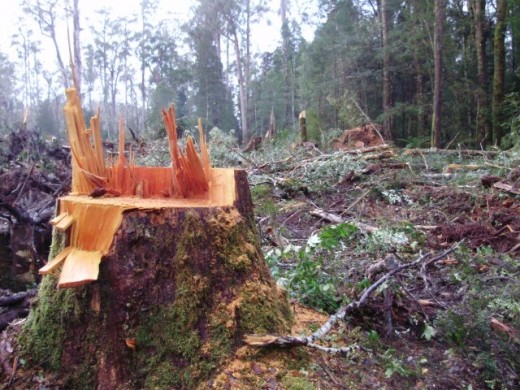
‘If all the above is genuine, and I can see no reason why it should not be, then the matter needs to be taken further. Much further. Lara and her “advisers” need to peruse all correspondence, memoranda and diary notes etc from Gunns in relation to their claim as to why there should be a payment to them by the taxpayers. Should there be a deliberate deception, or a deception by deliberate ommission that resulted in a serious financial advantage to Gunns then all avenues of recourse should be explored. If criminal charges are appropriate then so be it. It all would depend on the nature of the claims/submissions put forward by Gunns. There should also be cross referencing with any correspondence on the matter by Forest Tasmania. A formal investigation is surely warranted and the reason for the indecent haste in coughing up the taxpayer’s hard earned to Gunns and FT needs now to be justified.
Oh Lara. What a patsy you are. Your only contributions to the negotiations in this “complex” matter were to first publicly announce that “…we need Gunns..”, and secondly to publicly announce that you had $45 million in the “envelope” to resolve the “complex” matter. Brilliant. Just brilliant Lara.’
~ Len Fulton (a Tasmanian commenting to TT) 20111003
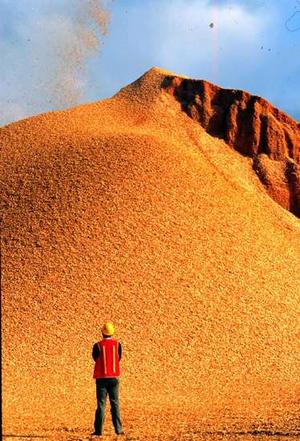
Woodchip stockpile – same colour as the chainsawed ancient Myrtle above
.
‘Very interesting documents. Regardless of whether you support the pulp mill or not there is something extremely fishy about this payment to gunns and all australian taxpayers should be screaming for the tabling for scrutiny of all documentation regarding the justification of this payment. Just on these produced documents and the fact that gunns had already closed down x no. of mills dismissed employees and placed triabunna on an approx. 8 week closure at the time the payment of compensation was dubious let alone some $34mil for the remaining life of the contract/s. This has a bad smell about it – now this previously “keep quiet” info is out Mr Gutwein what are you going to do about it?’
~ Ian (a Tasmanian commenting to TT) 20111003
.
‘Liberal complacence has helped foster the culture that has allowed our government to use excuses like “commercial in confidence” to not keep the public informed. So while Peter Gutwein is bouncing up and down on this issue, will he actually do anything, or remain as noticeable as a fly on the backside of an elephant?
~ Salamander (a Tasmanian commenting to TT) 20111003
.
‘Very revealing letter. I’ve previously argued that, if required, the Government should be prepared to buy back Gunns timber rights. Now, it seems, there was no need to buy them back at all because they had already formally relinquished them. This sheds a very nasty light on the way the Government rushed to pay Gunns double the initial offer. It also brings up questions about the $25 million that FT were apparently owned and why the Government felt it necessary to settle this matter to “avoid expensive legal arguments”.
The expense argument always seemed spurious. When there’s $25 million in dispute, surely it’s worth thrashing the matter out in court? On the other hand, the trouble with courts is that all the facts are likely to come out. I bet the Greens are having some interesting discussions at the moment! On the one hand there’s nothing to be gained by pulling the pin on Lala, but on the other hand, how far can they afford to let their reputation be trashed before they’ll never be able to recover the ground lost?’
~ Steve (a Tasmanian commenting to TT) 20111003

‘So Mr Gutwein, what are you going to do about it?
Are you quite rightly going to demand the return of all the ill-gotten monies from Gunns Ltd and Forestry Tasmania? Are you also going to demand FT collects monies owed by Gunns Ltd to them? Are you going to demand all the IGA (Julia Gillard’s Intergoverment Agreement) monies be shared amongst everyone except these two companies as was intended?’
~ Russell Langfield (a Tasmanian commenting to TT) 20111003
.
‘This isn’t the first or the biggest apparent fraud Tasmania has seen – the land swap was far bigger and the pulp mill approval business was more blatant – but it’s still very unusual to see the LibLabs falling out on something like this. The Tas justice system was magnificent in snatching Bryan Green from disaster, but do they have they the moxie to save the government’s bacon here? I suspect that Tas Inc’s closets are too dank to support an explosion, but I hope I’m wrong.’
~ John Hayward (a Tasmanian commenting to TT) 20111003
.
‘These damning documents show that the potential financial scam perpetrated upon the Australian and Tasmanian taxpayer is even worse than that stated by Peter Gutwein. Firstly, a further 10% GST has been added to the payments made to Gunns and FT increasing the amount paid in so-called settlement to $37.95M. On top of that, FT has effectively written off the $13.5M balance of the $25 million reputedly owed to it by Gunns under the ‘take or pay‘ provisions of its wood supply contracts bringing the total amount gifted by the taxpayer to at least $51.45 million.
Tasmanians must be told why, and on whose advice, was Gunns’ termination offer made on 18 April 2011 not accepted by FT and what part did the Premier and her Deputy play in this? What was the role of the Solicitor General and what were the circumstances that led to the Premier claiming the need for payment to extinguish Gunns’ “residual rights”?
What is the legal precedence and basis for the taxpayer settling a financial dispute between a private company and GBE over which the Minister has limited jurisdiction and no apparent financial control? The scale of this matter is beyond the scope of the feeble Integrity Commission and is so serious that it demands a full criminal investigation.
Finally, given that the release of this documentation has the potential to bring down the Government, the motives of the usually recalcitrant FT for being so forthcoming to the Shadow Minister for Forestry’s request are extremely suspect and demand that FT is put into administration pending the outcome of investigations.’
~ PB (a Tasmanian commenting to TT) 20111003
.
‘As per Chris Newman, Gunns ….“I will not recount Gunns’ various complaints of defective performance and non-performance by FT ….” Why? Not consistent with Gunns previously pretending the woodchip driven industry was sustainable let alone ‘worlds best practice’! Can the public see a copy of those complaints? Surely they are not all ‘commercial in confidence’.
“The reputation and marketability of Tasmanian native forest woodchip product is, and has always been directly affected by FT’s forestry management practices …” You forgot to add … and Gunns greedy easy street deal to woodchip bio diverse forests into oblivion. “FT was aware of the damage that its forestry practices were causing to the reputation of Tasmanian woodchip products …” Oh so FT’s forestry practices haven’t been a beautiful shining example afterall … I’m shocked at having been so deceived!! “Gunns therefore wishes to terminate CoS 917 and 918, noting our agreement that construction of the pulp mill did not commence by 30 November 2010.” You mean Gunns deliberately didn’t make a commencement of the mill to get out of the contract or used the companys own incompetence and failure to grab a government payout?
“Ünless a commercial resolution can be reached, I fear that these disputes will ultimately result in court proceedings.” Is that called holding the state to ransom … or bribery perhaps?
“I therefore propose that CoS 917 and 918 be terminated immediately on a full release and indemnity basis in respect of any and all outstanding issues.” So that’s what Gunns meant as per their ASX market update.
“3. Mutual release between the company and Forestry Tasmania from certain current and future claims arising out of those agreements.” “At the same time, FT will receive the benefit of a substantial infrastructure, worth in excess of $200 million, established by Gunns in anticipation of harvesting pulpwood from State Forests pursuant to CoS 917 and 918.” Is that where the touted $200 million figure for the so-called locking up of native forests originally came from? And you mean to say those native state forests being established, (albeit in reality little more than plantations) after wiping out the original diverse forests, weren’t actually being grown for future sawlogs, but indeed for nothing but pulpwood … thought so!
Bobby Gordon to embattled Bryan Green …. “It is unlikely the exchange of letters between Gunns and FT will become public.” … Why, something to hide perhaps? Obviously Labors Braddon office shredder mustn’t have been available.
“In the event that stakeholders become aware of the termination notice, Forestry Tasmania intends to release the following statement….” Is that called conspiring?
Let’s call it as it is, the $23 million for ‘residual rights’ and the Labor Gov gifting Gunns $11.5m to virtually pay itself via FT wasn’t to buy back HCV state native forests, it was hush money! Gunns are undoubtedly as successful as a trap door in a canoe. Gunns would be better off to start manufacturing butchers chopping blocks on wheels which they could pass around to their shareholders, directors, contractors, workers and political allies. Afterall, apparently they are attributing any future succusses on continuing to mobilize a self-serving carvery …
 Citizens’ justice – doing away with privilege, the French way
[Source: http://www.toonpool.com/user/589/files/it_chops_383035.jpg] Citizens’ justice – doing away with privilege, the French way
[Source: http://www.toonpool.com/user/589/files/it_chops_383035.jpg]
.
Caught in an avalanche of their own making, Gunns have at least successfully pulped themselves …Gunns and Forestry Tasmania and indeed blokes like Bryan Green and the Tasmanian Labor Government have been treating the public like fools for far too long … just desserts is the same ridicule and contempt they have shown the state of Tasmania.’
~ Claire Gilmour (a Tasmanian commenting to TT) 20111003
.
‘Other than the pyrotechnic display contained in this letter there are other incendiary devices. Such as the Gunns Chairman admitting that “construction of the pulp mill did not commence by 30 November 2010” That’s very different from the findings of EPA director Schaap. There is also a clear accusation that FT abused its monopoly position in the Tasmanian pulp wood market.’
~ Karl Stevens (a Tasmanian commenting to TT) 20111003
.
‘Has Gutwein called the Federal Police? If not, why not?
His inference is that The Commonwealth, and the State of Tasmania has been defrauded and if so it is very difficult to see how the Premier and Prime Minister are not parties to the act. In the absense of that call to the police being made, Mr Gutwein is nothing but another useless mouth we are feeding for no discernable benefit. Time to piss, Peter, or get off the bloody pot.If you don’t, many of us will return to our default position which is that we are governed by a coalition of liblab with the greens used as a smoke screen.’
‘Your party’s voting record backs that view to the hilt.. On reflection I would go further: Either it is fraud and therefore conspiracy to commit fraud, or it is extortion. Either way, it has all the hallmarks of something the federal police should be investigating. Why the Feds? Aside from the obvious reason it is federal money involved. My bet is that Gutwein will do nothing substantial because the bottom line is the Libs are run by TasInc who want the mill built right or wrong by anyone because they can make a dollar out of it. They fund both wings of the liblab machine. Such is the nature of party representatives. They know what the voters want, but serve the party interests first because that is where their loyalty lies. You get what you vote for. That gaping hole in the mills risk profile has not and will not go away regardless of any of this. It just keeps getting larger.’
~ Simon Warriner (a Tasmanian commenting to TT) 20111004
.
‘Having also read all the FOI it is interesting to see that Gunns had already terminated the wood supply agreements and that after the 15th of October the agreements were finalised. Also the $200 million of roading and bridge assets that they told FT they would be giving them would have reverted to FT ownership after 45 days under the agreement anyway. It appears that the rush to give Gunns money was important because after the 25 th October there would have been no reason to pay them anything. The briefing docs to Bryan Green show that he was fully cognisant of the deal ending.’
~ Pete Godfrey (a Tasmanian commenting to TT) 20111004
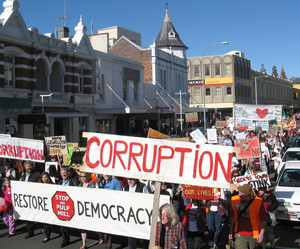
.
.
.
Subsequent revelations…
.
‘No advice on $34.5m Gunns deal: Tony Burke’
.
[Source: Matthew Denholm, Tasmania correspondent, The Australian, 20111022, ^http://www.theaustralian.com.au/news/nation/no-advice-on-345m-gunns-deal-tony-burke/story-e6frg6nf-1226173569723]
.
Federal taxpayers paid $34.5 million to Gunns to extinguish its rights to log Tasmania’s native forests without Canberra first seeking advice on whether the payment was legally required. Federal Environment Minister Tony Burke told The Weekend Australian he had not sought legal advice on whether the payments were necessary to extinguish Gunns’ contractual rights.
“I didn’t seek any advice on that,” Mr Burke said. “Legal advice on that was sought by the Tasmanian government.”
The state Liberals claim the payment was not legally required because Gunns had already voluntarily handed back the contracts to harvest 210,000 cubic metres of sawlogs each year. Tasmania’s Labor-Green government, which brokered the payment to Gunns, is refusing to release its own legal advice on the issue. However, Premier Lara Giddings insists the advice backs its stance that the payment was needed to remove Gunns’ “residual rights” over the vital contracts.
Their surrender was key to the protection of 430,000 hectares of forests under the $276 million federal-state forest peace deal signed by (Prime Minister) Julia Gillard in August (2011). However, Gunns had said it was leaving native forest logging regardless and documents obtained by the Liberals under state right-to-information laws show that on April 18 the company gave “formal . . . notice of termination” of the contracts.
Despite this, on September 15 deeds signed by the Tasmanian government granted $23 million in funds provided by Canberra to Gunns and a further $11.5 million—also federally sourced—to Forestry Tasmania. Mr Burke said yesterday the money had been provided to the Tasmanian government to “facilitate” the peace deal, also known as the Intergovernmental Agreement on Forests. Late yesterday, federal Agriculture Minister Joe Ludwig and Tasmanian Deputy Premier Bryan Green announced an additional$45 million voluntary exit package for Tasmanian forestry contractors. “This package will assist eligible contractor businesses to exit the native forest harvest, haulage and silvicultural contracting sectors,” he said.
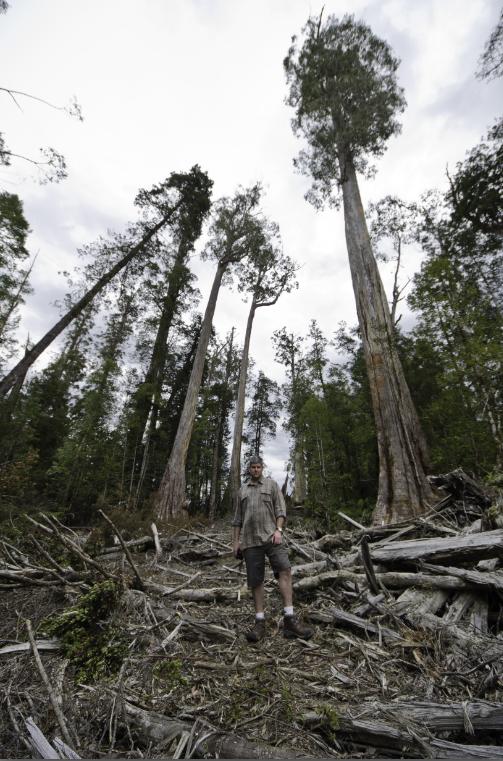 Meanwhile, Forestry Tasmania continues in earnest its wholesale massacre and incineration
of Tasmanian Old Growth for woodchipping pittance
(Upper Florentine Forest old growth, photo taken 28th September 2011) Meanwhile, Forestry Tasmania continues in earnest its wholesale massacre and incineration
of Tasmanian Old Growth for woodchipping pittance
(Upper Florentine Forest old growth, photo taken 28th September 2011)
.
.
‘Minister dodging questions on Forestry handout. Mill buyers. Gunns quizzed’
.
[by Kim Booth MP Greens Forestry spokesperson MR, 20111019, ^http://tasmaniantimes.com/index.php?/weblog/article/minister-dodging-questions-on-latest-forestry-handout/]
.
The Tasmanian Greens today said the Forestry Minister Bryan Green has failed to explain to the Tasmanian people why he approved another $1.1 million in public funding to prop up the failing forestry industry. Greens Forestry spokesman Kim Booth said there’s no credibility to the Minister’s claim that the industry could afford the transportation costs to Triabunna, but somehow could not afford to go the remaining 146 kilometres to Bell Bay without receiving public subsidisation.
.
“If the woodchipping industry is so unviable that it cannot even afford to pay the cost of transporting logs 146 kilometres, it is about time that the Minister realised that the industry is just not viable,” Mr Booth said.
“The Minister must first justify then explain why he thinks woodchippers of native forests should be paid with public funds and should take priority at a time when other areas are having to do it tough by cutting services.”
“As for the question of the supposed ‘log jam,’ the question must be asked why Forestry Tasmania is causing these trees to be cut down if the operators cannot even afford to transport them to the point of sale?”
“Every other transport business in the state must survive on its own resources, and there’s no doubt that all the other struggling transport operators in Tasmania would love a handout. So why is the woodchipping industry treated so differently?”
“How many million dollars of public money will this Minister rob from the public purse and give to his industry darlings before he wakes up to the fact that public money if for public benefits like healthcare, not to prop up unviable private businesses.”
 ..The Tasmanian Government’s logo…’explore the possibilities’…at what cost?
A return to Tasmania’s traditional coat of arms would be very appropriate. ..The Tasmanian Government’s logo…’explore the possibilities’…at what cost?
A return to Tasmania’s traditional coat of arms would be very appropriate.
.
.
Further Reading:
.
[1] ‘ Explosive letter confirms Gunns voluntarily gave up contracts‘, Tasmanian Times, 20111005, ^ http://tasmaniantimes.com/index.php?/weblog/article/explosive-letter-confirms-gunns-voluntarily-gave-up-contracts/
[2] ‘ More questions over Gunns’ rights buyout‘, 20111003, ^ http://www.abc.net.au/news/2011-10-04/2011041011-gunns-rights-buyout-questioned/3207848?section=tas
[3] Letter from Mr Newman and subsequent Ministerial Brief: Gunns_letter_and_Ministerial_briefing.pdf [ Read Letter]
[4] The full Right to Information documents requested by Peter Gutwein MP, Forestry Tasmania, ( Part 1), ( Part 2)
[5} ‘ Hush Lara Hush‘, by Peter Henning, Tasmanian Times, 20110520, ^ http://tasmaniantimes.com/index.php?/weblog/article/hush-lara-hush/
•
.
Tags: asian corporate culture, commercial in confidence, corruption in confidence, Forestry Tasmania, Gunns, Gunns' residual rights, Julia Gillard, Lalaland, Mr Greedy, Peter Gutwein MP, Right to Information, Tasmanian Forests Intergovernmental Agreement, Tasmanian Solicitor General, The Lala Swindle, Ubertas et Fidelitas
Posted in Tasmania (AU), Threats from Deforestation, Threats from Greenwashing, Threats to Wild Tasmania | No Comments »
Add this post to Del.icio.us - Digg
Friday, October 28th, 2011

From its satellite image, Tasmania is a green ‘apple’ isle
(except the bright ‘apple’ colour dominating Tasmania’s east is grass, long clear-felled forest for farming.
Any wonder why Eastern Tasmania lives in a rain-shadow getting just 600 mm of rainfall a year.)
.
 . .
.
Any State that uses 1080 is backward and internationally sends a message of being so.
It’s tourism marketing should have its brand tarnished so. Tasmania’s ecological image deserves to be as bad as New Zealand’s. NZ’s Department of Conservation drops 1080 indiscriminately out of helicopters in spades.
‘Pure’ New Zealand has a reputation for aerial poison of its native forests using ‘1080 poison’
.
The natural forest vista harbours a sterile faunal ecosystem. Tourism doesn’t care. It’s promotional photos still convey its target ‘pristine’ image, irrespective of the faunal carnage below the tree canopy.
‘Satellite Pristine’ – a ecologically contestable concept, eh?
I am sure that Guantanamo adopted a military ‘spit -and-polish’ image from the front gates too.’
.
 The entrance to Camp Justice, the site of the U.S. war crimes tribunal compound,
at Guantanamo Bay U.S. Naval Base in Cuba (Reuters)
The entrance to Camp Justice, the site of the U.S. war crimes tribunal compound,
at Guantanamo Bay U.S. Naval Base in Cuba (Reuters)
.
by Tigerquoll
Suggan Buggan
Victoria 3885
Australia
.
Tags: 1080 poison, aerial poisoning, Camp Justice, Eastern Tasmania, Guantanamo, New Zealand aerial baiting, New Zealand Apples, rain-shadow, satellite pristine, Tasmanian apples
Posted in Tasmania (AU), Threats from Poaching and Poisoning, Threats to Wild Tasmania | No Comments »
Add this post to Del.icio.us - Digg
Wednesday, October 26th, 2011
It’s past time that the barbaric and backward chinese culture of Traditional Chinese Medicine (TCM) was recognised by the world’s civilized countries for what it is, an evil cult against wildlife, and so criminalised along with Female Genital Mutilation forthwith. Neither serve any purpose except barbaric harm.
TCM superstition claims that rhino horns cure typhoid fever, convulsions, cancer, rheumatism, gout, snakebites, hallucinations, headaches, carbuncles, vomiting, food poisoning, and ‘devil possession’. What backward quackery! Even the the rhino’s skin and faeces is used by TCM witchdoctors. Being superstitious and backward is one thing, but such ludicrously is driving and perpetuating the chinese illegal wildlife poaching of rhinos and elephants for their horns. Is this why the chinese regime is spreading its influential tentacles across Africa?
 Dried Tiger bone, Moon Bear bile, ground Elephant horn
All packaged and sold in an innocuous TCM grocer,
belying the world’s most barbaric cult against wildlife Dried Tiger bone, Moon Bear bile, ground Elephant horn
All packaged and sold in an innocuous TCM grocer,
belying the world’s most barbaric cult against wildlife
.
Today we learn that the last Javan rhino subspecies in Vietnam was found poached for its horn. It is now extinct.
The Javan rhino is Critically Endangered on the IUCN Red List of Threatened Species. In 2009 only ten individuals of the subspecies Rhinoceros sondaicus annamiticus remained in South Vietnam’s rainforest region.
 Javan one-horned Rhinoceros extinct as from yesterday due to poachers paid by the TCM witchdoctor cult Javan one-horned Rhinoceros extinct as from yesterday due to poachers paid by the TCM witchdoctor cult
.
‘Vietnam has lost its fight to save its rare Javan rhinoceros population after poachers apparently killed the country’s last animal for its horn, pushing one of the world’s most endangered species closer to extinction, a conservation group (World Wildlife Fund) said Tuesday (25th October 2011).
Vietnam’s Cat Tien National Park has had no sightings, footprints or dung from live rhinos since the last known animal living there was found dead last April, shot through the leg with its horn chopped off, the WWF said. Genetic analysis of rhino feces had confirmed in 2004 that at least two rhinos were living in the park, raising hopes that Vietnam’s population might survive.
Only 40 to 60 Javan rhinos now remain in Ujung Kulon National Park in Indonesia. They are the last known living members of the species, with none in captivity.
Vietnam’s Javan rhino population had been shrinking for decades as land conversion and a rising local population threatened the animal’s habitat, but poaching and a lack of effective park management and patrols hastened the decline, said Christy Williams, coordinator of WWF’s Asian Elephant and Rhino Program.
“It appears that protection is not being given a high priority by the Vietnamese government,” he said. Park director Tran Van Thanh said that while some of his rangers failed to fulfill their duties, it is impossible for them to stop all of the estimated 100,000 people living near the park from hunting exotic animals when the average farmer there earns around 150,000 dong ($7.50) per day.’
[Source: ‘Javan rhino goes extinct in Vietnam after last rhino poached‘, by Mike Ives, Associated Press, 20111026, ^http://www.csmonitor.com/World/Latest-News-Wires/2011/1026/Javan-rhino-goes-extinct-in-Vietnam-after-last-rhino-poached]
.
The subspecies Rhinoceros. sondicus inermis once found in Bengal, Assam, and Myanmar is now extinct. The subspecies Rhinoceros sondaicus sondaicus lives only in Ujung Kulon National Park, Java, and has less than 60 individuals remaining.

All these TCM potions and remedies contain a small amount of Rhinoceros horn
© Esmond Bradley Martin
.
The Yin and Yang philosophy may suggest a wholesome healthy balanced approach to alternative medicine, but according to the Australia Herbal Medicine Centre (a Chinese run practice in Sydney’s Chinese-centric Ryde)..”Chinese Herbal Medicines are mainly plant based, but some preparations include minerals or animal products.”
“Some of the conditions which may be treated by Chinese Herbal Medicine include:
- Chronic headaches
- Skin disorders
- Irritable bowel syndrome
- Constipation and diarrhoea
- Insomnia and fatigue
- Common cold and influenza
- Anxiety, depression and stress
- Allergies
- Rheumatoid and osteoarthritis
- Premenstrual syndrome and painful menstruation
- Excessive menstruation
- Infertility
- Impotence and prostate disorders
- Disorders associated with menopause
- Loss of appetite and common digestive disorders
- Fluid retention”
.
This all sounds impressive, but question is: Which remedies contain wildlife parts and so require illegal poaching? …sorry not on the label?
.
TCM is an evil backward cult inciting wildlife poaching and the key driver of wildlife extinctions around the globe. TCM ethically needs to be immediately banned, its barbaric practices made illegal and its products containing animal parts declared illegal wildlife trafficking and so an illegal import. Poaching endangered animals is far worse than mass slaughter of non-endangered animals or even the mass slaughter of humans. Species Extinction is the worst crime on the planet, because a whole species is threatened with extinction, not just a few million humans or so out of 7 billion.
.
The Sydney Institute of Traditional Chinese Medicine [http://www.sitcm.edu.au/] needs to immediately and publicly renounce any use of wild animal parts in its practice, else be immediately criminalised as an ecologically destructive cult.
Rhino Horn is not medicine – chew your nails instead. Go and see a real doctor!
.
.
.
Further Reading:
.
[1] ^ http://www.csmonitor.com/World/Latest-News-Wires/2011/1026/Javan-rhino-goes-extinct-in-Vietnam-after-last-rhino-poached
[2] ^ http://newswatch.nationalgeographic.com/2009/11/23/dogs_sniff_out_rhinos_of_vietanm/
[3] ^ http://www.asianscientist.com/topnews/wwf-traditional-chinese-medicine-rhino-horn-cancer-cure-cites-meeting/
[4] ^ http://www.guardian.co.uk/environment/video/2011/oct/25/javan-rhino-extinct-vietnam-wwf-video?newsfeed=true
[5] ^ http://www.rhinoconservation.org/2010/01/15/is-surge-in-illegal-rhino-horn-trade-linked-to-chinas-designation-of-tcm-as-strategic-industry/
[6] ^ http://www.treehugger.com/files/2011/01/does-protecting-endangered-rhinos-conflict-with-traditional-chinese-medicine.php
[7] ^ http://www.greenfudge.org/2011/08/22/tcm-quackery-fuels-brutal-rhino-poaching/
[8] ^ http://www.sciencebasedmedicine.org/index.php/asian-bear-bile-remedies-barbarism-or-medicine/
[9] ^ http://www.abc.net.au/news/2010-02-06/female-circumcision-happening-in-australia/2594496
.
Tags: Australia Herbal Medicine Centre, backward chinese, evil cult, Female Genital Mutilation, illegal wildlife trade, Javan Rhino subspecies extinct, rhino poaching, Rhinoceros sondaicus annamiticus, Sydney Institute of Traditional Chinese Medicine, TCM, TCM witchdoctor cult, Traditional Chinese Medicine, Tran Van Thanh, Ujung Kulon National Park, Vietnam Rhino extinct, wildlife extinction, world's most barbaric cult, WWF's Asian Elephant and Rhino Program
Posted in Africa, Rhinoceroses, Threats from Poaching and Poisoning | No Comments »
Add this post to Del.icio.us - Digg
|
|
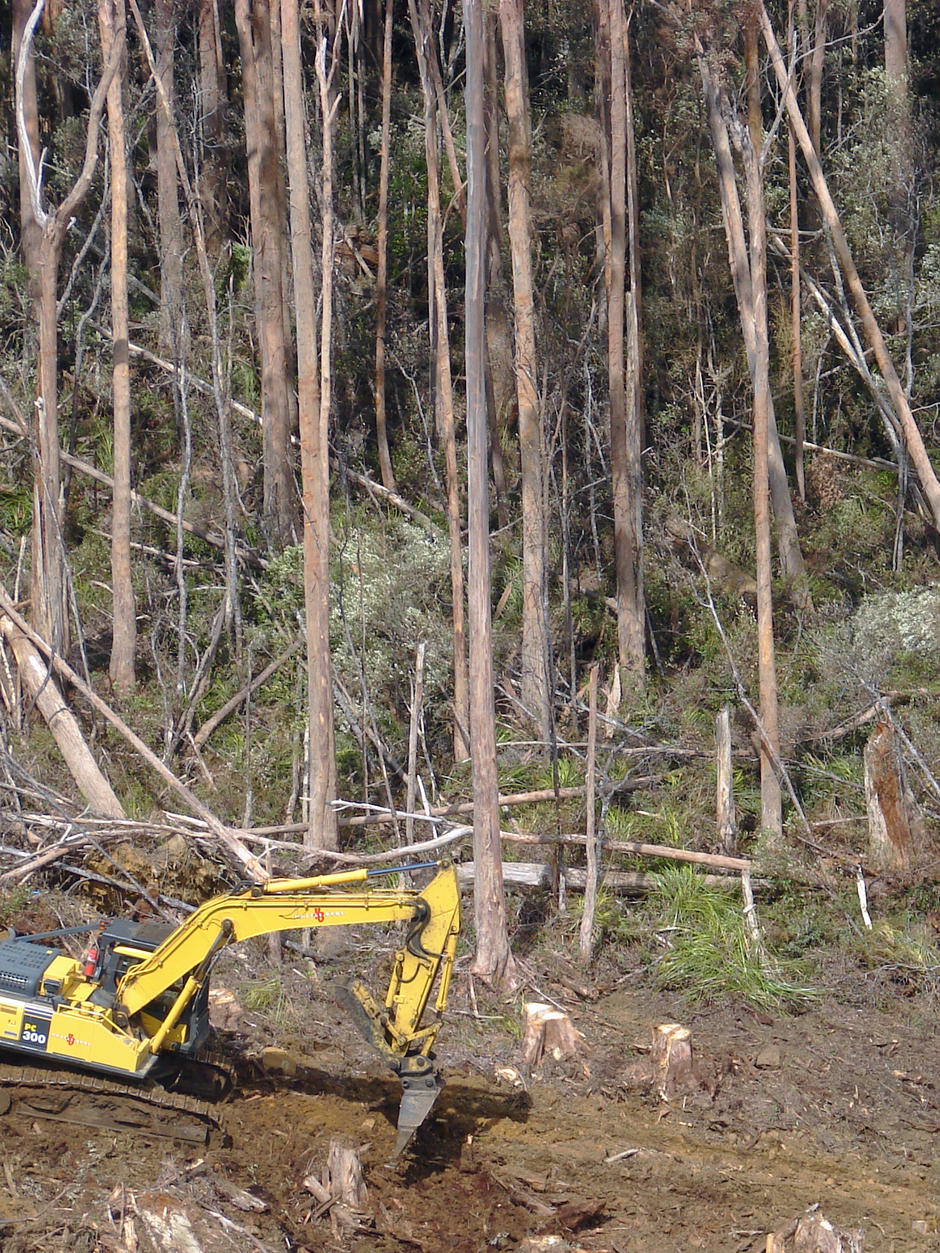 Forestry Tasmania getting stuck into native forests near Tasmania’s Recherche Bay, May 2011
[Source: ABC, ‘Bid for forest peace funding’, 20110519, ^http://www.abc.net.au/news/stories/2011/05/18/3220585.htm?site=hobart]
Forestry Tasmania getting stuck into native forests near Tasmania’s Recherche Bay, May 2011
[Source: ABC, ‘Bid for forest peace funding’, 20110519, ^http://www.abc.net.au/news/stories/2011/05/18/3220585.htm?site=hobart]
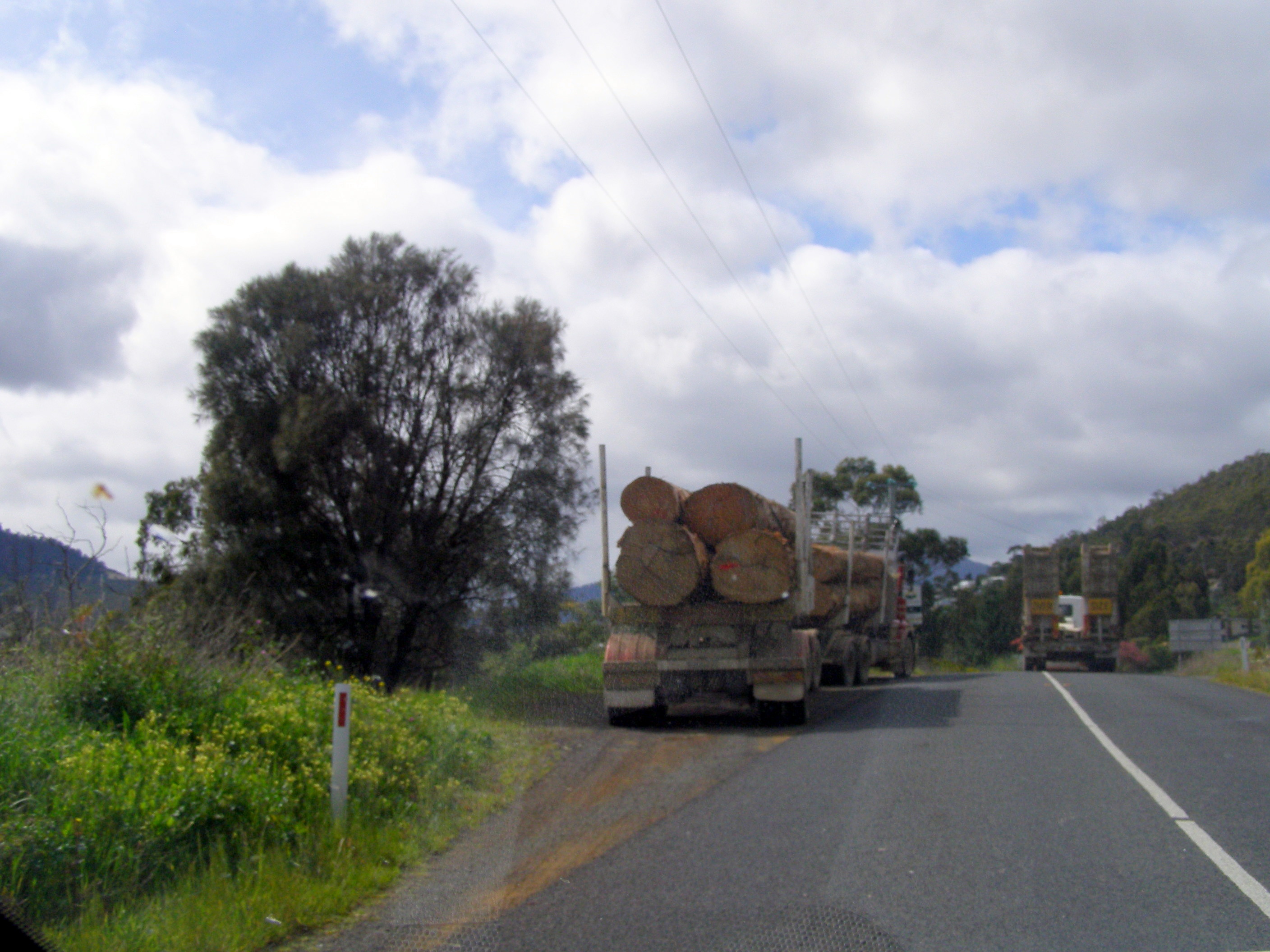 Loaded logging truck (New Norfolk, 20110929)
(Photo by editor, free in public domain)
Loaded logging truck (New Norfolk, 20110929)
(Photo by editor, free in public domain)
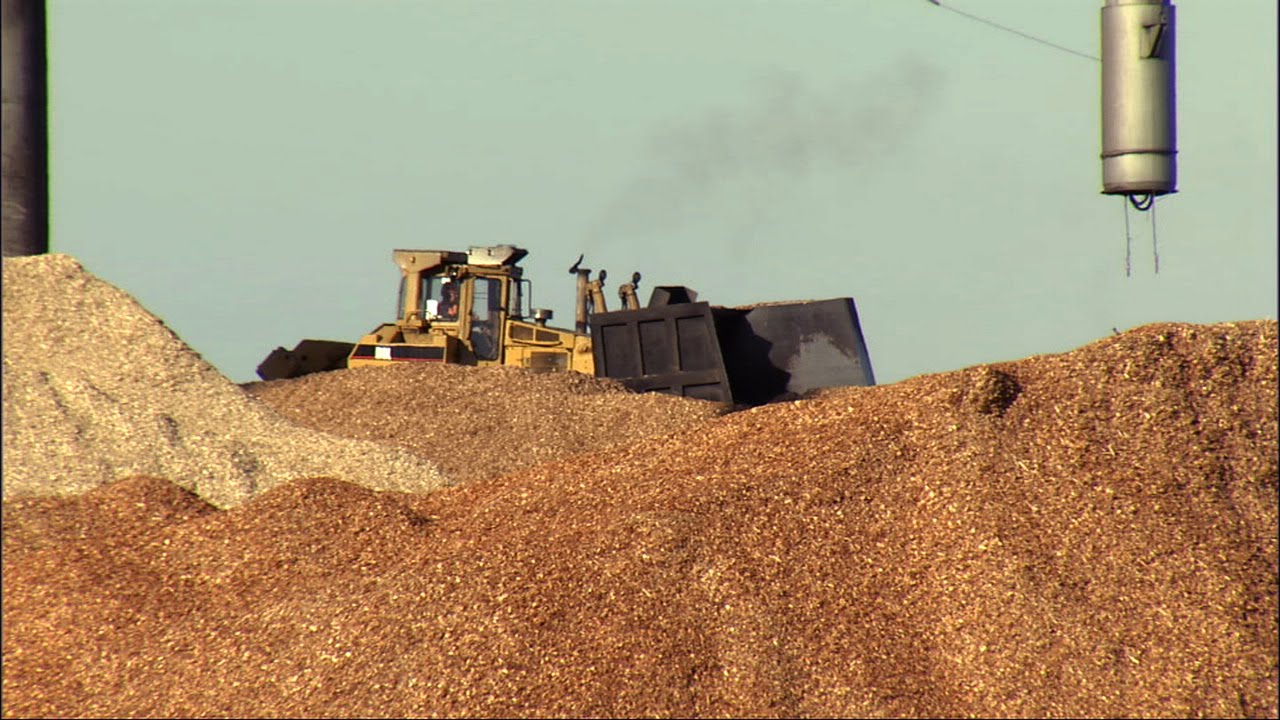
 Tasmanian Premier Lara Giddings and Australian Prime Minister Julia Gillard
signing the Tasmanian Forests Agreement, 7th August 2011
Tasmanian Premier Lara Giddings and Australian Prime Minister Julia Gillard
signing the Tasmanian Forests Agreement, 7th August 2011