When we bought our 1920’s cottage bungalow in The Gully Catchment (Katoomba Falls Creek Valley) back in 2000, it was run down and surrounded by lawns front and back.
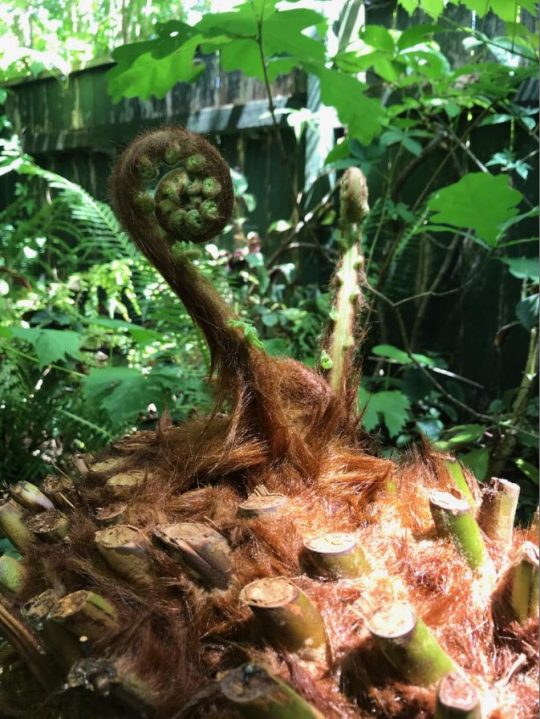
Since then over the past nearly 25 years, we removed all the lawn, renewed the dilapidated fences, annexed the verge with a fern rockery, terraced the front and planted many trees (including a Mountains Blue Gum), hedging and what has now become a micro temperate rainforest with now 17 tree ferns under an established canopy. The image above is one of a number we planted in Spring.
The birds have come back – crimson roselas, king parrots, magpies, currawongs, a few sulphur crested white cockatoos, bower birds, wattle birds, seasonal koels, New Holland honey eaters, thornbills.
Whilst we have not sought to re-establish the local forest ecology, our small plot is contributing to the ecology fringe buffer between The Gully and the surrounding township of Katoomba.
Welcome to Australia.
We are not about inculcating divisiveness of this local, national and global conservation cause. That’s for nasty politics with ulterior motives – we stand well clear of such lot.
So, following the loud noise disturbance from the Katoomba Carrington Hotel on Saturday 26th October 2024, and from our failed attempt to chat with the hotel’s festival organiser, who immediately ordered us off his premises, we notify local Blue Mountains Council on the following Monday 28th October when Council is back at work.
We lodged a Customer Service Request (CSR 514828) to Council and request a dialogue about this matter.
This Carrington’s owner had setup some brass band with additional amplified music situated in the guest car park that played over towards adjoining residences, rather than having previously utilised their approved festival space (of equivalent size) on the other side of The Carrington’s grounds in the more suitable bustling retail heart of uptown Katoomba just off high street Katoomba Street.
We received no response from back from Council by Wednesday 30th October. So we emailed out complaint to Council in writing as follows, and this isn’t the first time we’ve raised this intrusively loud amplified noise issue with this Carrington owner.
Attention: Council’s Programme Leader for Health and Compliance
RE: Noise Complaints – Carrington Hotel amplified music | CSR 514828/13 Feb 2024 | CSR 558418/28-Oct-2024
I hereby again complain a second time to you about the amplified noise coming from The Carrington Hotel premises…
Last time, on 13th February this year I had previously raised this noise problem with both The Carrington management via its Reception and then local Council. A day later I happend to then receive a phone call from one of the joint owners of the Carrington Hotel identifying himself to me as Michael Brischetto. I explained to him about my genuine concerns about the very loud amplified music audible from my place and our conversation then was amicable.
Now we have another noise disturbance incident.
All I seek in this matter is a right to quiet enjoyment of where I live in an historical and typically quiet residential neighbourhood. I am concerned about this new noise becoming a precedent and a more frequent occurrence if not nipped in the bud.
My records and expressed concerns support my real worries about what this ‘new noise’ pollution could lead to, to risk destroying our peaceful home environment:
1. I refer to my email to you 7th March 2024 about the loud amplified music noise at The Carrington Hotel car park off Parke Street in Katoomba, and also from last Saturday 26th October 2024.
2. This loud noise was clearly audible to me at my home, being situated three streets away to the west in Kundibar Street. The noise started in the morning, and on and off, continued into the night. The first I heard it, it was a loud small brass band playing with a heavy bass guitar reverberating deep sound that was audible from inside my home. I happened to have been ill that day and I was asleep in bed, and this noise woke me up.
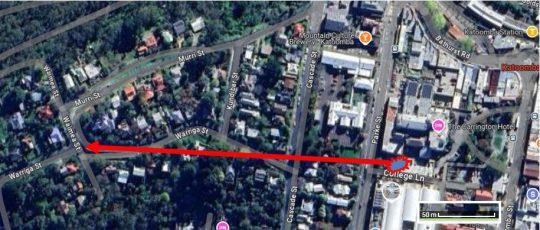
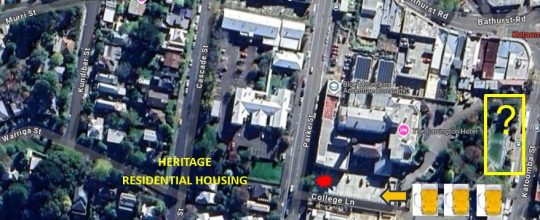
3. This amplified noise could be heard as far away as Waimea Street in The Gully, more than 250 metres away westward through this residential precinct. I had a walk around the block that day and I confirm this. [See attached ‘Residential Proximity to Noise Map’]
Residential Proximity to Noise
4. I then went to inspect where the noise from coming from and found it emanating from The Carrington Hotel’s car park off Parke Street, used again for a music festival – this time The Carrington’s own ‘Oktoberfest’ festival involving live bands (amplified music) and selling beer in The Carrington’s car park.
5. Again, as a local resident, I consider it highly inappropriate and disrespectful that amplified noise be allowed to occur adjacent to residential homes and audible into the back streets beyond.
6. Generally, The Carrington Hotel’s owners permit public access on site to the Grounds, Front Verandah, Reception, the Cocktail Bar, its adjoining toilets, Lounge and Dining spaces. On this particular Saturday, public access was granted to the car park’s upper level where the festival was taking place under a large marquee. So as a member of the public I was free to walk around the grounds and the upper level of the car park and to freely take ‘tourist’ photos.
This I did.
7. I noticed the event’s signage on the day read that it was open to general public. I also read the event promotional banner above the car park lower-level eastern entrance read ‘Free admission’.
8. As supporting evidence, I attach photos I took last Saturday on foot as well as my audio recording (software of which does not reflect the true loudness of the actual volume).
9. For your reference, also as supporting evidence I attach copies of excerpts of The Carrington’s public website specific to this event ’Oktoberfest’. SOURCE: ^https://thecarrington.com.au/whats-on/oktoberfest/ [Accessed: 30-Oct-2024]
10. My understanding is that The Carrington a few years back (perhaps 2015) gained Council approval to double the size of its car park by converting it into a two-storey car park. But this car park second-story development was surely not approved as a venue for holding festivals, concerts, serving alcohol and encouraging large crowd gathering, nor for playing loud amplified music. Is this the case?
11. The Carrington’s website advertised this event to occur between 11am and 9pm on the Saturday. Did Council give approval to The Carrington Hotels owners for this event and amplified music?
12. The juxtaposition of this car park is directly across the street from residential homes. Indeed, these homes at situated in a heritage housing conservation precinct dating back to the 1870s. It includes heritage listed ‘North’s Estate’ which pre-dates The Carrington Hotel opening of 1883. This Norths Estate’ is where I live and have done so in residential quiet enjoyment continually since 2001.
13. The current owners of The Carrington Hotel date their ownership to 2004.
14. I request a copy of council’s consent conditions for this car park development, since I am an adversely affected neighbour to this development use.
15. Did Council approve the use of the car park for festivals including loud amplified noise that could be audible into the adjoining residential area many streets away?
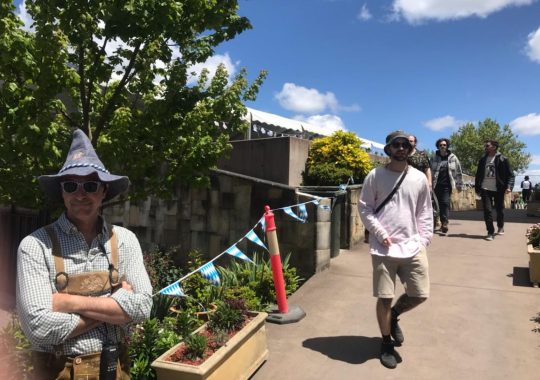
16. On this occasion, I walked up to the pedestrian entrance to this festival in the car park and met a man in a silly pixie hat and costume wearing sunglasses (my photo attached) there gatekeeping the festival’s entrance, who then identified himself as one of the joint owners of The Carrington. It was Michael Brischetto again.
I expressed my concerns to Mr Brischetto politely about the loud amplified noise, pointing out that I live just a few streets away.
But he was quite rude to me, refusing to listen to me, and recalled my previous complaint from the February festival and realised I was the same person who had complained then.
Mr Brischetto then immediately ordered me to “Get off my property!” So I immediately did so.
17. So, having tried to reason with Michael Brischetto unsuccessfully, I now complain to Council about this noise.
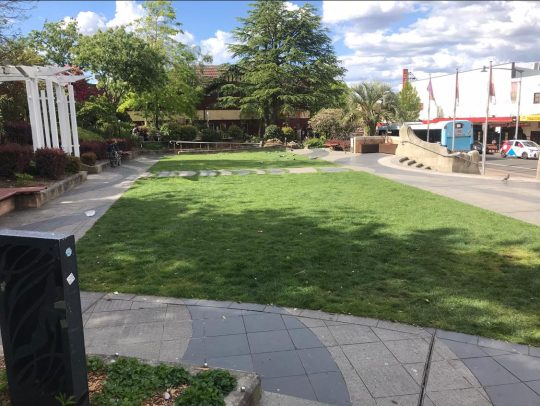
18. As before, I request such loud festival events not be staged in The Carrington’s purpose-built car park off Katoomba’s Parke Street, but rather at the dedicated grassed lawn area (below), which has been successfully used previously for such festivals as the Lady Luck Festival (of the past 14 years) , which is more appropriately located off Katoomba Street in the heart of retail Katoomba, some 200 metres east of the car park.
I am sure that both The Carrington Hotel owners and Council could readily work together toward a mutually suitable arrangement for such ongoing festivals, so as not to upset local residents like me and my family by it using its unintended car park near homes.
19. This time, I request Council actually contacts the owners of The Carrington about this matter, notifies them of my complaint and that Council does something to address it, ideally prohibit such loud amplified music from being played from its car park off Parke Street please.
20. I am prepared to go public on this matter, and indeed pursue this matter legally.
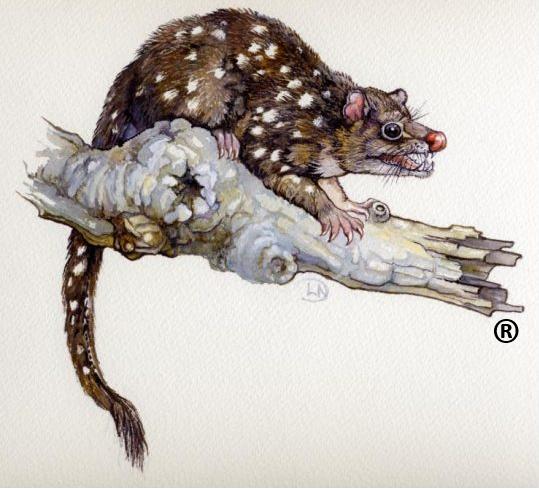
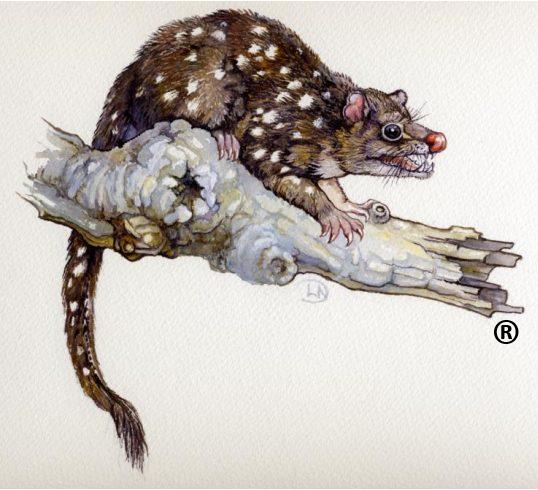
We have just been notified by IP Australia, the Australian Government’s official registry of intellectual property (that is, governing Australian trademarks, patents and designs, etc. by home grown Australians) that The Habitat Advocate branded logo (image above) has just been legally registered in Australia.
So, we’re pretty happy with this, just quietly. That’s why we’re happily informing the whole Planet! 🙂
A moment of indulgent reflection, if one may…
Well, it’s been a while for us.
Steven John Ridd is the founder of The Habitat Advocate, an environmental conservation advocacy website, championing the cause of the rights of native habitat.
Born in Melbourne, then having travelled on sabbatical, and then having relocated from renting in expensive eastern Sydney’s Randwick out to regional Katoomba in the natural Blue Mountains in 2001, I first registered the business name ‘The Habitat Advocate‘ with the then NSW Department of Fair Trading at Parramatta and the domain habitatadvocate.com.au together back on 10th May 2006. A date close to my heart – my 42nth birthday.
I have used the motto for The Habitat Advocate (A voice for native habitat) publicly since 2001, and the logo (image above) since 2006.
I felt I needed to protect both; this is especially since recently on Google, the use of the word ‘habitat’ and the term ‘habitat advocate’ have become popularised terms used by unrelated others for other purposes. May be they just liked the concept. I did back in 2001 before the trend, because of its genuine natural meaning that was understandable to many, rather than use more highfalutin scientific terms like ‘ecology‘.
So, I commissioned this particular image to be painted by professional wildlife artist, Lyn Naismith, back in 2006 and I invaluably hold her original artwork.
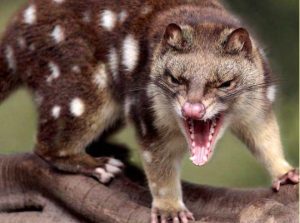
I conceived and designed the logo to be of Australia’s most threatened endemic top order predator in the ecological food chain, the Tigerquoll. I wanted to convey the message of the ongoing threats to native habitat. So, I felt it necessary that the logo image convey reality of being threatened, rearing up on a dead tree branch with nowhere to retreat in its native habitat.
Ecologically, if top order predator communities subsist healthily, then that is a positive signal that the broader localised ecology is healthy as well. That is why we chose the Tigerquoll symbolically.
And we prefer the name Tigerquoll rather than the more lame academic descriptive term of ‘Spotted Tailed Quoll’. That is, we wouldn’t suggest anyone try to pick up and cuddle a Tigerquoll without being ripped to shreds. It’s just like we wouldn’t suggest anyone try to pick up and cuddle an Australian native Brush-tailed Possum with is strong sharp claws and territorialness. Tigerquolls eat Brush-tailed Possums for breakfast, if you know what I mean.
A captured Tigerquoll from Radiata Plateau in 2008. Photo: Courtesy of local identity Glenn Humphreys, who caught it after losing some of his chickens from his rural backyard coop. Glenn handed this caged quoll over to the local National Parks and Wildlife Service of NSW to relocate it into the Blue Mountains National Park nearby.
So, I sincerely thank Lyn for reading my sentiments in this respect exactly, to her credit.
Bureaucratic wheels turn slowly, but now I own the image as a registered logo. This logo is emblematic to promote the habitat threat and our conservation advocacy for native habitat, and this top order predator the Tigerquoll is ecologically apt.
There is one held in captivity in Healesville Sanctuary, but since it is nocturnal, no visitors get to see it in its enclosure by day, and the sanctuary is closed by night. Crazy idea that, and its tiny prison cell-sized enclosure is cruel. They should instead release it into its native habitat and provide visitors with a video presentation to visitors, akin to the Sanctuary’s enclosed darkened platypus auditorium…
It’s about responsible governmental legislative respect for the value of wildlife and proactively decent funding and ecological preservation, restoration and perpetual heritage management of their precious disappearing habitat to sustain their very survival.
Love the Tigerquoll. Beautiful little animal with lots of courage. Seen particularly in the Flinders Ranges in S.A.
Congratulations on ‘capturing ‘it as your logo… good choice!
From our personal experience, we would NOT describe The Carrington Hotel as being a good neighbour in Katoomba where we live.
On Saturday late morning 26th October 2024, from where we live in The Gully Catchment of Katoomba, we were dozing at home as not feeling particularly well.
Suddenly, we then get this pounding deep bass sound reverberating from somewhere not far away. It was so loud that it became impossible to sleep through. Where was it coming from?
Ours is a quiet residential neighbourhood set in the oldest heritage precinct of the Blue Mountains. Our street dates to the 1870s, even before The Carrington Hotel of 1883 up on the hill.
So we get up and dress to investigate the noisy racket. We shortly find the source just three short streets away. We reproduce two samples below, but the volume is ten times louder that what the AMR software on our iPhone has captured. Most of the band playing sounds out of tune.
It’s that bloody Carrington Hotel again, thumping its amplified festival music from what is supposed to be its large car park rooftop on nearby Parke Street on the top of the hill in our township of Katoomba.
We had previously raised our concerns about a similar car park festival episode directly with one of The Carrington’s joint owners on a previous occasion back in February 2024, when some other concert started up on top of the same car park playing loud amplified music (multiple large stage speakers pointing in direction of our home) so audible as to be heard down into The Gully, half a kilometre away.
On this occasion, 26th October, it was some blood brass band amplified up at full volume, again! WTF!
Yet there are residential homes just across Parke Street, just metres away from the stage where the band is playing, like ours about 300 metres away from the now fabricated temporary stage.
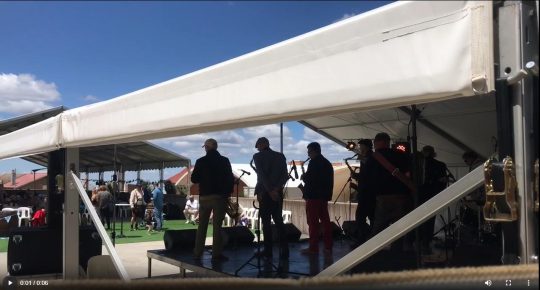
This is what we heard and saw on the car park second storey upon our investigation after having just woken up…
This is just not fair! A festival with loud amplified music set up juxtaposed to residential homes? It’s so selfish and arrogant and it’s not right. It’s hardly respecting the rights of immediate locals like us to our quiet enjoyment. It’s a noise impost.
And it’s also so unnecessary that this particularly large accommodation hotel with options of utilising its multiple internal entertainment spaces and on such an extensive site, should resort to re-purposing its purpose built guest car park into a festival venue and so cause annoyance to locals immediately across the street (Parke Street) and on to adjoining quiet back streets like ours within earshot.
We say this because The Carrington Hotel has ready onsite access also to a similarly sized level grassed area at the front of the hotel site just off retail Katoomba Street. The Carrington has long used this level open lawned space for various festivals and events. It’s a perfect location in the retail heart of Katoomba!
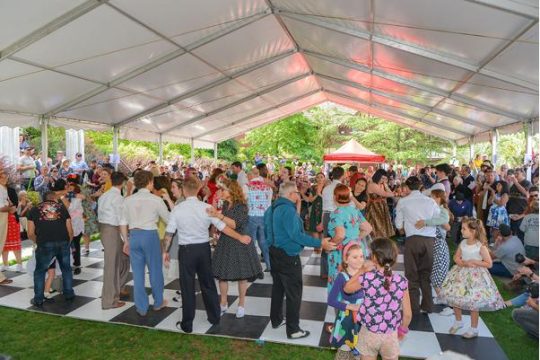
The Lady Luck Festival has been run for the past 14 years using both this marquee for dancing plus the inside of the Carrington’s sizeable ballroom.
So, then why move the Carrington’s marquee from here in town to the rear car park opposite residences?
Today, unable to sleep and feeling a bit crook, we approached the entrance to the car park festival and briefly expressed our concerns to some bloke in a pixie hat and joker costume about the loud amplified noise and that we lived just a few streets away. The bloke happened to be one of The Carrington’s joint owners in disguise. He promptly got agitated with one’s comments and then immediately ordered me to leave his property, as in “bugger off”!
The Carrington’s nasty pixie (left). Note the body language.
As a Katoomba resident where we live since 2001, we provide some instructional background.
A few years back, Blue Mountains Council granted The Carrington Hotel development approval to double the size of its car park off Parke Street on its very large site. The approval was to build a second storey car park above the existing car park so as to double off-street parking capacity for its in-house guests. This followed substantial renovations of many rooms which so increased the hotel’s accommodation capacity.
We have no problem about The Carrington Hotel’s enlarged car park being used as a car park for its staying guests. The investment into restoring, upgrading and diversifying the Carrington continues to wonderfully appreciated for Katoomba. As long locals we know of no other tourism establishment that has done so this this extent. This is a credit to its joint owners.
The car park concrete structure is about the size of a narrow-elongated basketball court and further dominates the hotel’s 4 storey high-rise landscape on top of the hill in uptown Katoomba.
This festival is the Carrington’s own Oktoberfest on 26th October since 2023. We were away at the time that year.
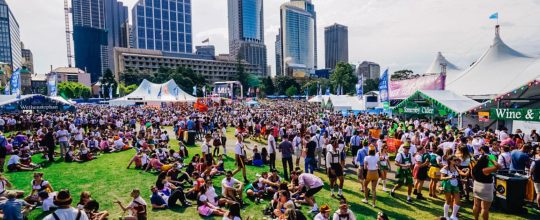
But why a decision for a remote miniature Oktoberfest festival in Katoomba outside Sydney, when there has long been a huge one in Sydney’s Botanic Gardens annually every October attracting thousands? It’s held on the very same day on the 26th!
So why the hell would tourists in Sydney not conveniently head close by to the real big deal in Sydney, to instead choose a 4-hour return train ride to The Carrington car park in Katoomba for a half-pint to bad music? No chance!
Sydney’s ‘Oktoberfest in the Gardens’ 26th October
A big double storey concrete car park is one thing, but then we discover they’re starting to use it for ticketed music festivals and even lease it out to independent festival organisers. So they’re profiting from festivals despite never having had such Council approval to do so. We would have objected had the development application plans included converting the car park into a venue for external festival hire.
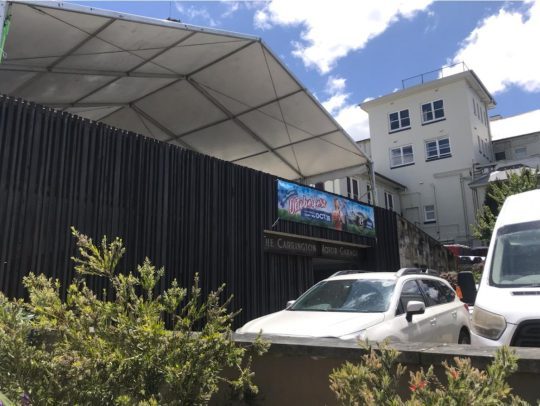
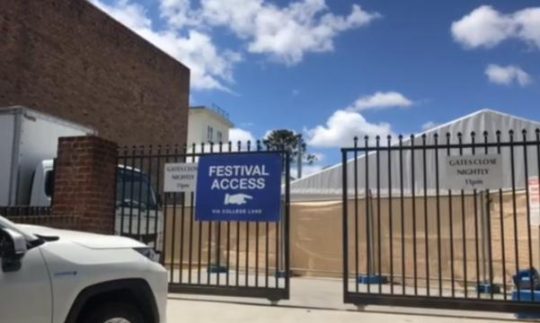
This is the car park in question showing its driveway entrance off Parke Street. The brass band is playing behind the car park gates on a stage behind the calico screen inside the temporary marquee.
The following aerial view of this precinct in Katoomba (Google Maps) shows the relevant juxtaposition of The Carrington hotel with its car park used as a band stage (shown in red), plus the remaining section of the car park for audience seating and outdoors drinking of German beers in large jugs.
It also shows the proximity of the residential housing and also the similar sized garden lawn (yellow rectangle) situated within the Carrington grounds off Katoomba Street.
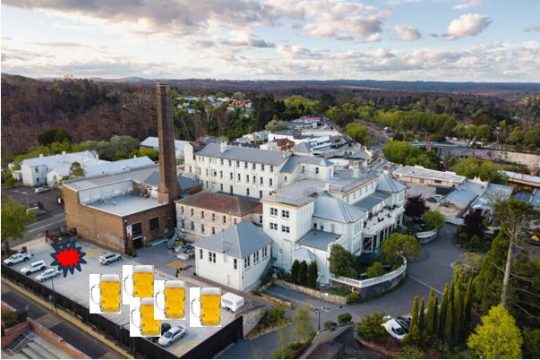
The Carrington Hotel and its juxtaposition
Same problem, different camera angle. Who approved a car park for festival hire?
So why doesn’t the Carrington simply return to using the Council-approved outdoor entertainment space it had purposely re-developed on its flat lawned area right in the retail heart of Katoomba, rather than pissing off local residents to the west of the hotel.
Some big business people presume they can do what they want and bugger everyone else? Perhaps the owners would benefit more by investing quality time researching negotiation pathways with local Council to mitigate the costs of returning to utilising the grassed area for events as before and the Carrington’s similarly sized large ballroom. But diversifying into illegally using the hotel’s guest car park to hock for event leasing to external festival organisers for a pittance return?
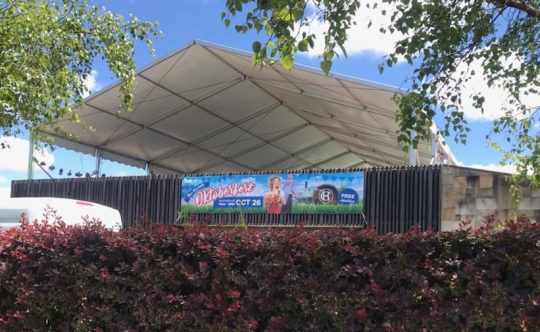
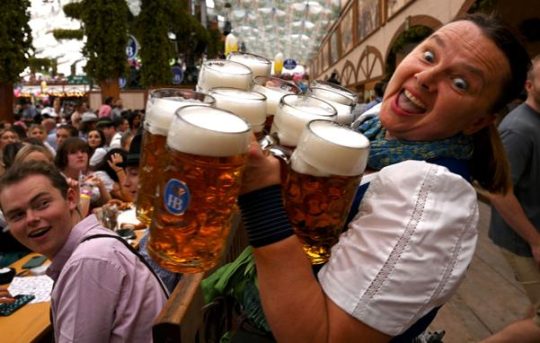
Indeed the event is promoted as “free admission” as per the banner outside (see below). So what its the point of this event? The musicians would not be performing for free. Only the beer it seems, is for sale. So the whole thing appears to be a loss making exercise. Is this for the indulgence of the pixie who just likes getting dress down and drinking beer? Or is he just wanting to piss off the neighbours?
The event banner reads “Free Admission”
Of course, while the car park has been leased out, many of The Carrington’s in-house guests will be denied the brochured off-street parking, so be relegated to use Council’s on street paid parking, costing over $100 per day. We suggest this pet project to annoy locals is a false economy. So as Katoomba long-time locals, we wont be frequenting The Carrington any time soon. The actions of The Carrington are so unneighbourly.
The big concern we have is that this illegal use of the car park repurposed for festivals, risks setting a precedent for drunken crowds and on a more frequent basis. The toilets are not convenient to the car park. The only toilets are well inside the hotel itself, passed reception, passed the bar if you now where to find them. So what is preventing drunken party goers after downing a full German beer jug or three, desperate for a leak, taking advance of the adjacent brick walls of the adjoining Blue Mountains Cultural Centre and the front fences of local homes to urinate into the wee hours. There are no toilets in the car park. Is the car park a licensed venue to serve alcohol? We’ve not heard.
What is to come if this is allowed to snowball into a more regular Carrington Hotel Booze Fest, fuelled by incoming bus loads of yobbos on bucks nights.
Surely, no Katoomba local here wants this problem. The festival lease brain-snap for a re-purposing of the car park needs to stopped in it tracks before it morphs out of control!
As if Katoomba doesn’t already have enough booze outlets!
Where is local Blue Mountains Council in all this?
Comment:
Judy Harding:
“I text the Carrington saying I was considering staying there but have been told it’s too noisy because of the bands playing in the car park so I have decided to stay in Leura.”
[2] ‘Oktoberfest in the Gardens‘, Botanic Gardens of Sydney, ^https://www.botanicgardens.org.au/whats-on/oktoberfest-gardens, Australia’s biggest and best Oktoberfest celebration returns to Sydney in 2024, Abstract: “Inspired by a love of the traditional Bavarian festival and great beer. Oktoberfest in the Gardens Sydney features two massive beer halls, authentic German food stalls, roving performers, sideshow alley, silent disco and an eclectic mix of entertainment and competitions across multiple stages throughout the afternoon and evening. Taste your way across Europe with a large selection of imported German beer, cider, wine and a range of other beverages.”
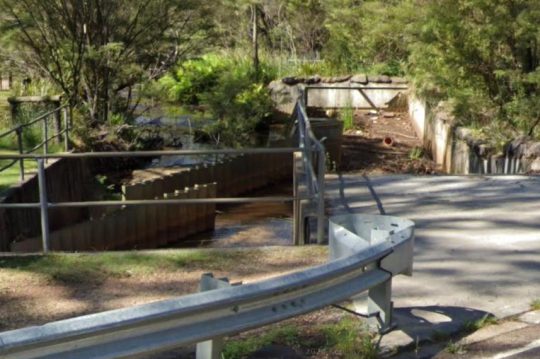
This is yet another example of neglected stormwater runoff maintenance by Blue Mountains {city} Council. Its in-creek water pollution trap (vane style) device is situated just above Katoomba Falls (left of photo).
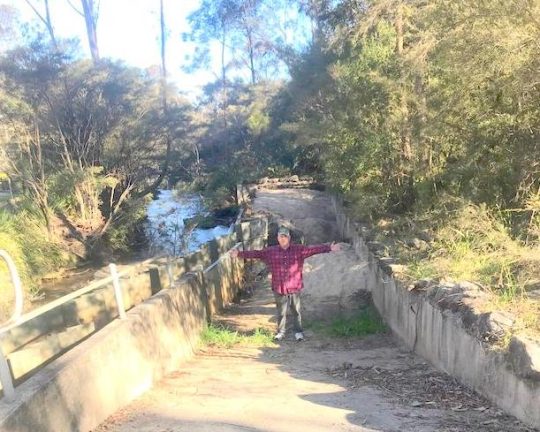
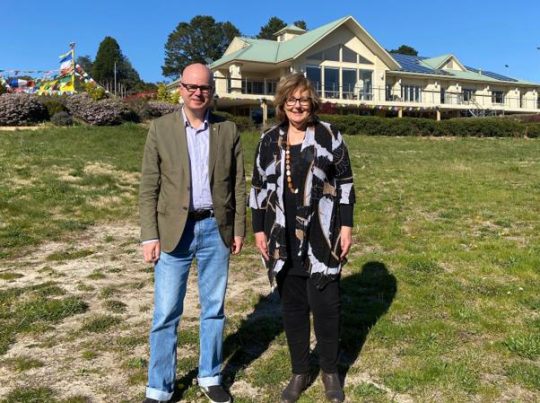
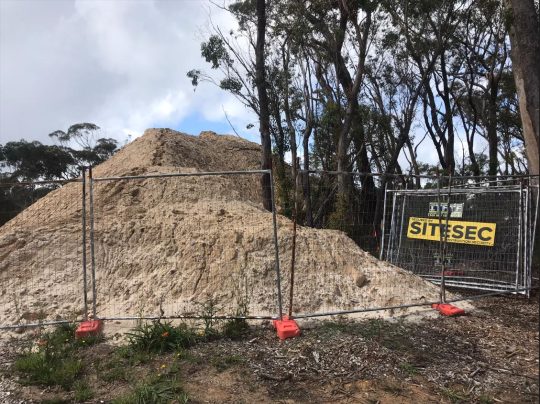
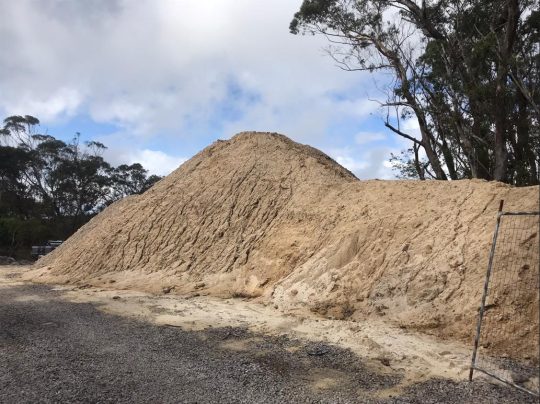
Our editor standing in front of large piles of sand pollution re-directed out of Katoomba Falls Creek by an in-creek pollution control device (left). [Photo by The Habitat Advocate, taken Thursday 30th May-2024.]
This pollution detritus trap has, from our very local experience over two decades, been typically full of destroyed native vegetation debris caused by (a) torrential rain events, and (b) bushland clearing (deforestation). It has also been observed typically full of siltation from (a) upstream creek bank erosion through Maple Grove, (b) from housing construction sand and graded topsoil, and (c) from unfiltered urban stormwater waste ignored by Council since it was established first as the Municipality of Katoomba in 1889.
We have lived in The Gully Water Catchment since 2001. The Gully Water Catchment includes all land with watercourses and natural drainage flowing to Katoomba Falls, and we have taken a keen interest in this natural place.
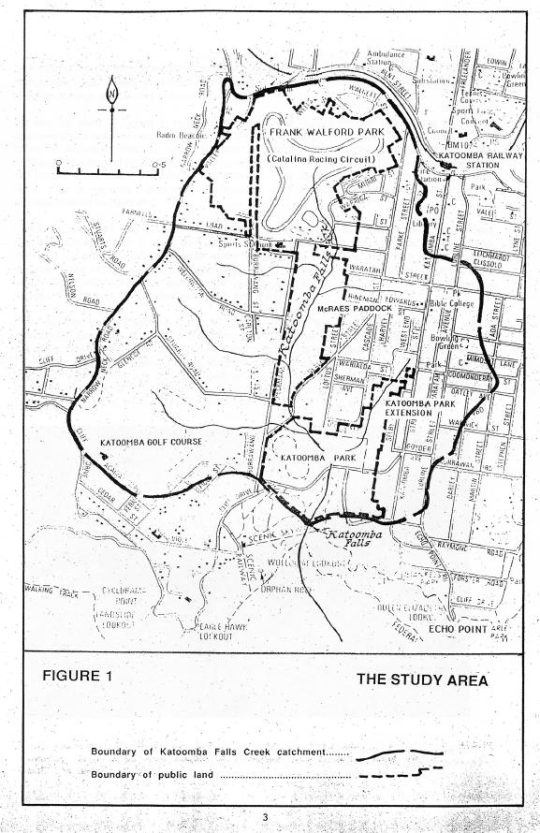
Katoomba Falls Creek Catchment as it was then called in 1993. [SOURCE: The Bell Report]
From our observed experience as local environmental activists, Council’s ongoing management culture is such that it focuses on the capital works projects, obtains external grant funding (usually from the NSW Government) but then fails to budget and resource the ongoing maintenance of such capital works projects. This Baramy Trap is another case in point.
We repeatedly observe this pollution trap full and overflowing for months at a time, so the trap overflows and the continuing detritus flows downstream into the downstream Kedumba River to supply Greater Sydney’s drinking water to Sydney’s artificial Lake Burragorang for Sydney and a Greater Sydney so scarily morphing beyond. Currently this pollution trap has been full of sand sediment for many months.
The above photo shows the concrete ramp down to the pollution trap for access by a small front-end mechanical loader designed to remove the sand and debris pollution into a waiting tip-truck.
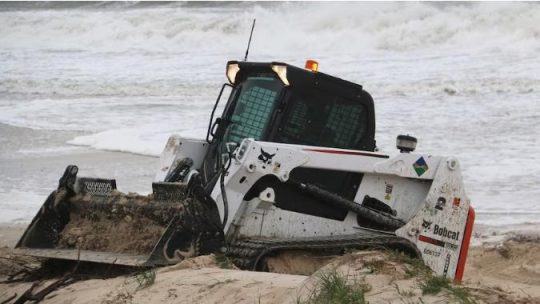
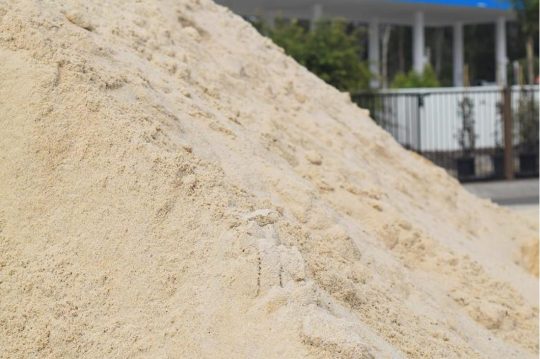
A Bobcat more suited to a construction site or at a beach as in this example photo. But at Blue Mountains {city} Council it’s Missing-In-Action.
Council is supposed to maintain it and clean it out on an ‘as-needed‘ basis periodically, but it doesn’t. The following is an extract of Baramy’s terms and conditions for this pollution device once installed.
We obtained a copy of these terms and conditions back in 2004 when The Friends of Katoomba Falls Creek Valley Inc. (the Friends) sought a quote for a similar but smaller pollution device (4 m long x 2.1 m wide) previously to be constructed in the same creek further upstream. Baramy’s quote came in at $26,000 and we referred this initiative for action/grant funding to Council – it being the custodian of this community land and the creek water catchment. But Council ignored it.
In this case Council is the “customer” having paid to have this much larger device constructed by Baramy Engineering in this different location much further downstream. It would have cost Council double, constructed probably around 2005 from one’s memory.
Council’s culture
Council has form of having its other non-environmental priorities, such as its latest newfangled ‘Planetary Health Initiative’ to showcase its environmental stewardship, when it is just more greenwashing.
Previously, all such debris, sediment and stormwater pollution into the creek used to just flow over Katoomba Cascades and further downstream over Katoomba Falls into the Kedumba River below and southward through the Jamison Valley.
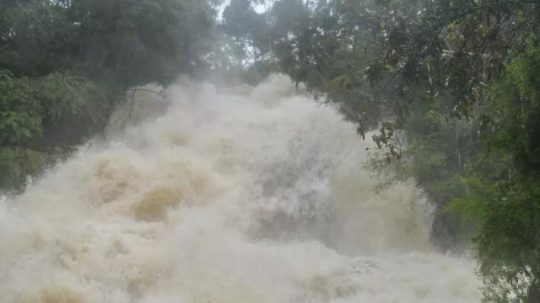
Katoomba Cascades during full flood, situated about 100 metres downstream of the pollution trap. [SOURCE: Photo by Brigitte Grant, in article ‘Flood photos: Three-day drenching’ 22nd March 2021, Blue Mountains Gazette newspaper]
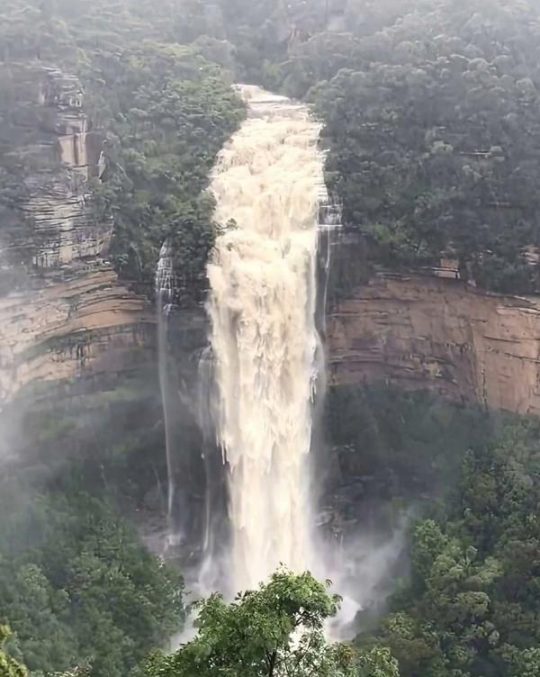
Katoomba Falls in full flood after days of heavy rain. The falls are situated about 300 metres downstream of the pollution trap. [SOURCE: Photographer unknown, in article ‘Police to co-ordinate evacuation of visitors trapped in Megalong Valley following landslip’ 4th April 2024, by Damien Madigan in Blue Mountains Gazette newspaper]
By the way, Upper Mountains sewage design (Katoomba, Leura, Wentworth Falls) back between 1907 and the 1990’s also flowed by iron piping down into the Jamison Valley to the former Leura Sewage Treatment Plant (historic image below) situated just by Leura Falls Creek between Echo Point and Sublime Point. The iron piping still can be seen along hiking tracks down the escarpment – the reason for the hiking tracks actually being first constructed.
We estimate that the current sand quantity filling this particular Creek Pollution Trap would be twenty cubic metres at least. We reported the problem to Council the day we took the first photo above – receiving Council’s Customer Service Request reference #533082.
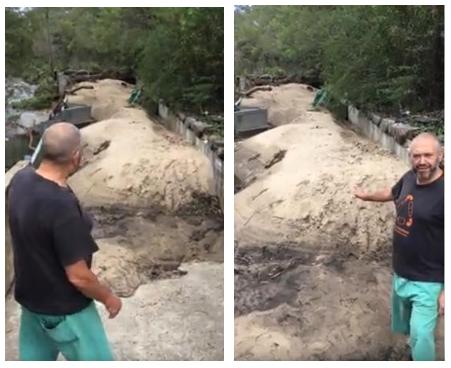
We’re not the only locals having noticed this particular in-creek pollution trap full. Here’s another documented event of the very same pollution trap in February 2020. It was during the start of Australia’s East Coast Low events associated with the La Niña oscillating weather pattern:
Local Blue Mountains Aboriginal Gundungurra Elder, Mr David King, posting his video on Google YouTube protesting this exact same problem back in 2020. He even likened it Bondi Beach! [SOURCE]
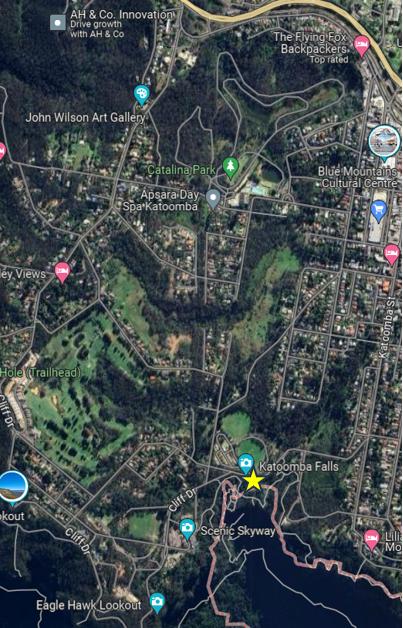
This pollution trap’s exact location is situated beside Cliff Drive in Katoomba on the southern (downstream) side of the road at the road culvert over Katoomba Falls Creek. See the aerial photographic map below showing the yellow star.
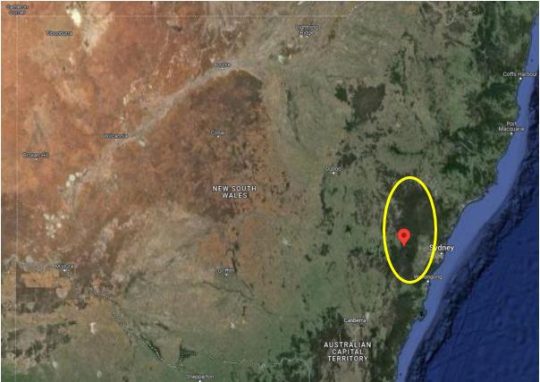
An aerial photo of the 100 ha extent of The Gully Water Catchment juxtaposed upstream of this pollution trap. (NB. The “Katoomba Falls” photo label is incorrectly shown on this image, being rather just a Google nominal reference on the roadside. [SOURCE: Google Maps aerial photo, 2024]
This in-creek pollution trap was constructed by Baramy Engineering Pty Ltd of Katoomba for Council.
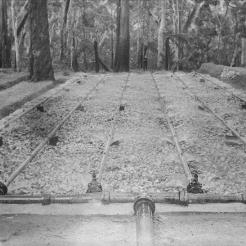
The Baramy Vane Trap showing the two rows of vertical galvanised steel vanes in the creek line that divert debris to the concrete trap device on the right.
The construction timing was a few years or so following The Greater Blue Mountains Area (1 million km2) being inscribed on the UNESCO World Heritage list on 29th November 2000. Katoomba Falls flows into the Jamison Valley within this World Heritage area. The Jamison Valley, below these falls (and others) is also part of the drinking water catchment leading to Warragamba Dam supplying an ever-expanding Greater Sydney (current population approaching 5.5 million) adjoining the Blue Mountains region.
It is the researched opinion of The Habitat Advocate that this World Heritage listing was more about the human utility of protecting the value of Sydney’s drinking water in perpetuity, than it was about protecting the Eucalyptus forests of the Blue Mountains.
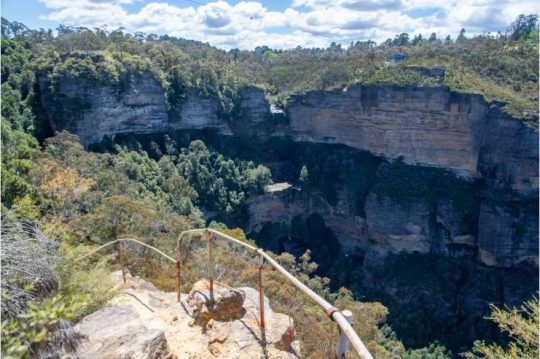
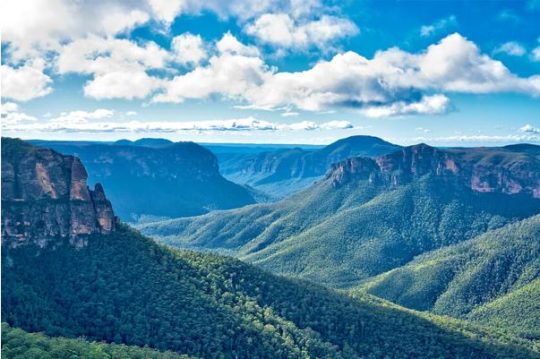
Katoomba Falls in the centre of this photo. The Gully Water Catchment upstream feeds natural and stormwater to these falls. The area covers an estimated 100 hectares a passes through a small valley up on the Blue Mountains plateau. This valley includes bushland and increasingly more and more housing development.
Notably, the sand type in this pollution trap appears to be not the naturally river sand, but consistently all the same light colour of Concrete Sand type used commercially in construction.
Concrete Sand
Concrete Sand is a coarser sand variety, pivotal in construction use to create strong and durable concrete structures. It’s typically made from crushed quartz, which gives it a rougher texture, enhancing the binding properties in concrete mixtures. This sand type is indispensable for laying robust foundations, constructing driveways, and forming sidewalks. This is exactly what is going on in The Gully Catchment upstream of this creek pollution trap.
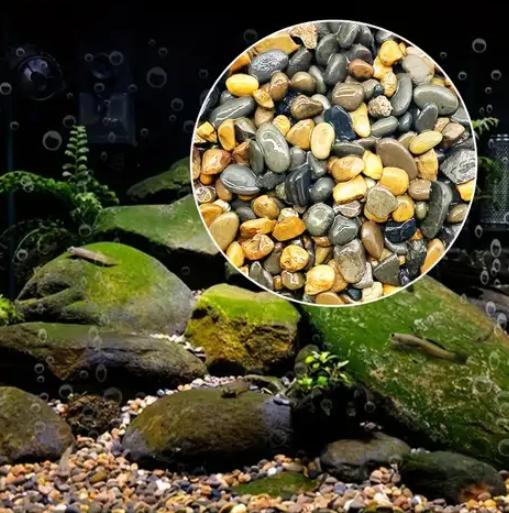
Whereas the natural creek-bed of Katoomba Falls Creek is comprised of small pebbles. This editor knows this from being local to Katoomba Falls Creek Valley and having voluntarily performed Streamwatch quality monitoring of Katoomba Falls Creek for five years (2004-2008) on behalf of the Friends of Katoomba Falls Creek Valley, Inc. reporting to the Sydney Catchment Authority (SCA) within the New South Wales Governments Sydney Water department.
An example of the characteristics of creek-bed pebbles typically found naturally on the creek bed of Katoomba Falls Creek and other nearby watercourses – yet sadly beneath the years of construction sand sedimentation pollution from various identified housing construction sites throughout this plateaued catchment.
Council doesn’t analyse the sand to determine its source. Council doesn’t fine the polluters and issue a stop work court order. Council doesn’t employ a hydrologist or geotechnical engineer on its books. Yet where is all the housing constrution taking place in the Blue Mountains? Upstream of the World Heritage area.
In our view, Council is unfit in delegated stewardship as custodian of the geographic plateau of the Blue Mountains Local Government Area (LGA) atop the Blue Mountains World Heritage Area from its atrocious record of failings. So long as this pollution control device is full and overflowing, sand and debris is flowing downstream over Katoomba Cascades and Katoomba Falls into the Kedumba River. Parks Service (‘NPWS’) doesn’t monitor pollution levels or water quality in Kedumba River down in the Jamison Valley.
Council doesn’t enforce sediment controls are housing development sites upstream in The Gully Water Catchment (Katoomba Falls Creek Valley).
There are current two large housing subdivision sites contribution to sedimentation of the creek.
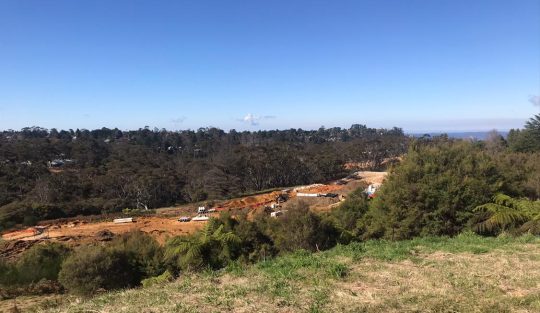
Some 13 odd hectares of fragile native bush surrounding an upland brook between Stuarts & Wellington Roads is to be bulldozed into a 53 cluster housing subdivision.
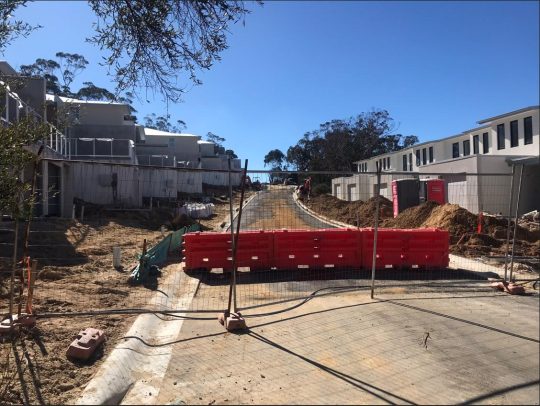
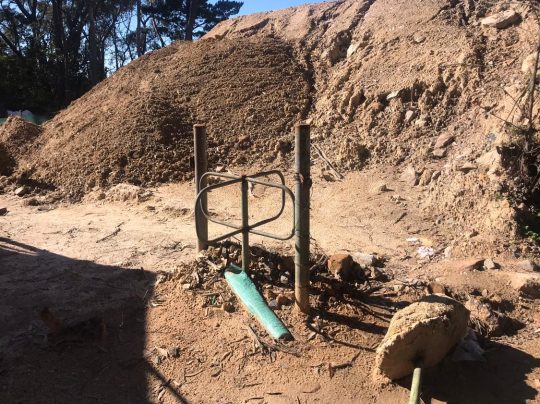
Bulldozing all the top soil throughout this side creek valley to Katoomba Falls Creek (Kedumba River). [Photo by Editor, Sunday 26th May 2024]
[5] ‘Pollution Control Device‘ quote prepared for ‘Frank Walford Park Bushcare’ (Friends of Katoomba Falls Creek Valley Inc), 2004-09-27, by Baramy Engineering Pty Ltd, 7 pages.
I am a Katoomba local and have been chatting to Jon Dee (Katoomba local, ex Planet Ark founder, Sky News reporter, environmentalist/activist) and have joined his group on Facebook relating to PFAS contamination in the Blue Mountains dams and water supply.
I was doing some online research about truck and tanker crashes that have happened around the Medlow Bath catchment dams (annd the use of PFAS-containing firefighting foams that could have runoff into the Medlow dam) and I came across your website. I mentioned this to Jon and he asked if I could contact you.
You seem to have a lot of knowledge on crashes and contaminations etc in that area.
Do you have a Facebook profile that myself or Jon can add you on?
Or would you mind joining the “Blue Mountains – PFAS Action Group” on Facebook?
As my follow up to your email, I have made contact with Jon.
We are meeting in person today in Katoomba to discuss his environmental campaign.
Thanks for reaching out to me on this pollution issue.
BTW, I suppose I have an interest in monitoring the state of the Blue Mountains environment. The way it gets abused in many ways, one wouldn’t think it has World Heritage status. I don’t particularly have a penchant for crashes and contaminations in the Blue Mountains. It’s more a case of highlighting the systemic risk and poor safety record of long-distance trucking, especially the risk to the environment (and drinking water).
This is likely one of the articles you found on this website: https://habitatadvocate.com.au/toxic-chemicals-trucked-through-world-heritage/
The following are links respectively to our ‘blog categories’ (A) Threats from Road Making and (B) Threats from Pollution
I am happy to assist Jon. I can help Jon independently, but not Facebook.
I just don’t trust Facebook. I know of instances of entire Facebook pages suddenly disappearing because of Facebook’s founder Mark Zuckerberg disagrees with what some people say. Zuckerberg is a control freak.
Blue Mountains {city} Council’s latest greenwashing promotion of itself, it terms its ‘Planetary Health Initiative‘.
But what on Earth is this construct syntax ‘planetary health‘?
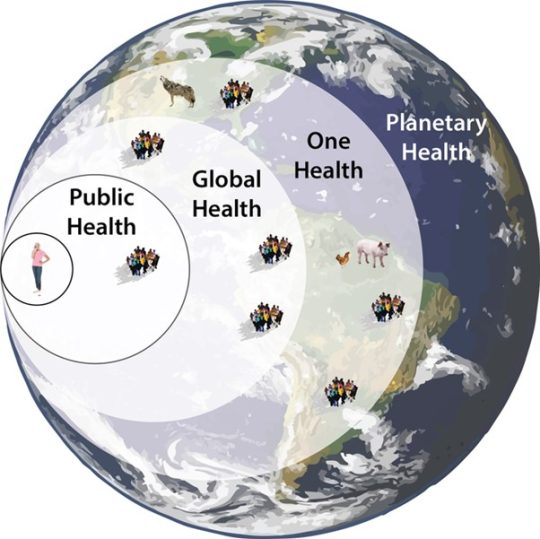
Some quick online research reveals it’s all about human health, not that of planet Earth. It is another anthropocentric ideology, so those guilty of damaging native habitat can feel warm and fuzzy by token eco-gesturing.
We found on a quick Internet search, this cone-shaped model image of how individual human health is the pinnacle and ‘Planetary Health’ being the fifth tier below? It’s globalist and anthropocentric, that is centred on humans above all else. So humans first and other species and Ecology may then benefit?
The Habitat Advocate disagrees strongly with any anthropocentric philosophies. In stark contrast and transparently, we advocate the ‘Deep Ecology‘ philosophy – meaning:
“Deep ecology, environmental philosophy and social movement based in the belief that humans must radically change their relationship to Nature from one that values nature solely for its usefulness to human beings to one that recognizes that Nature has an inherent value.”
In our view, ‘Planetary Health’ comes under the realm of ‘Greenwashing‘ – typically a public relations ploy used by both governments and corporations that are way short of best practice to protect the natural environment under their custodial stewardship, so they resort to token public relations campaigns using expert consultants and publicly trusted ‘celebrities’ to message ‘ecological care’ when it isn’t. Blue Mountains {city} Council is a serial offender of greenwashing – we think the worst in Australia given the council’s location (surrounded by and upstream of natural World Heritage), its record of environmental neglect and harm, and its hubris about is continual self back-patting claims of its ecological stewardship.
Greenwashing?
“‘Greenwashing’ is a term used to describe false or misleading environmental claims. Greenwashing makes business appear more environmentally beneficial than they really are. Omitting information can amount to a false or misleading representation or misleading or deceptive conduct, depending upon the circumstances and the overall impression created. We consider a business to be engaging in greenwashing where they use any claim that makes a product or service seem better or less harmful for the environment than it really is. Sometimes businesses accidentally mislead consumers. By following the ACCC’s guidance, businesses that make environment or sustainability claims are less likely to mislead consumers and break the law.”
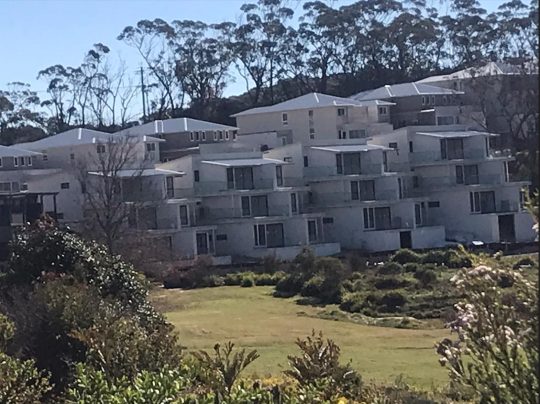
Planetary health? Not for the planet, yet this is what Blue Mountains {city} Council approved – ugly mass over-development for many more humans on old Katoomba Golf Course into what was bushland within The Gully Catchment.
Where is this current high density townhouse development taking place?
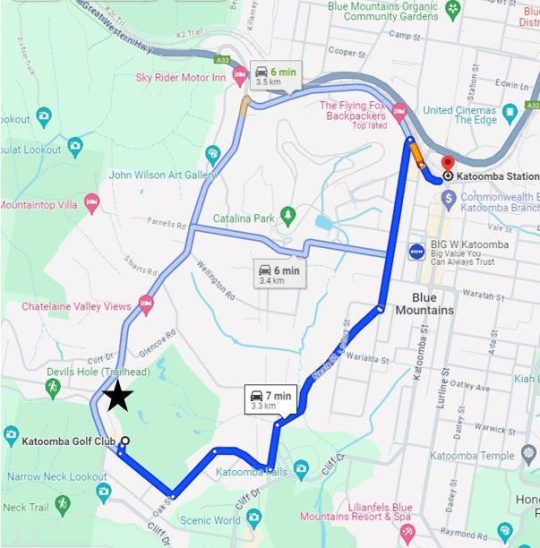
It’s more than 3 km from Katoomba’s retail precinct, isolated on the defunct golf course site (was fairway #3) within just 100 meters of the World Heritage Jamison Valley escarpment across Narrowneck Road. Here’s the location map with the black star showing the site location of the above photo image.
The black star is the location of this current massive over-development’ of 24 additional townhouses. Transport access is only by private car. It’s isolated just like the ‘The Escarpments’ totalling 21 townhouses adjoining. [SOURCE: Google Maps plan view, 2024 with the black star superimposed]
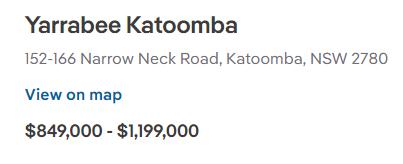
In our view, hardly close to amenities, and these properties aren’t cheap…
At Council’s public meeting of 29th September 2020, councillors endorsed purchase of the defunct Katoomba Golf Course Clubhouse site (1 Acacia Street, Katoomba) for $3.3 million using ratepayers’ money of course, not theirs. So, an easy low-risk decision by said councillors who voted ‘YES’.
That old defunct clubhouse sits alongside the similarly defunct Katoomba 18-hole golf course – long owned by council. This combined site has become council’s largest operational land holding, at 29.66 hectares (so pretty much 30 hectares). It’s bigger than Ben Hur. It exceeds Council budget and Council doesn’t know what to do with it.
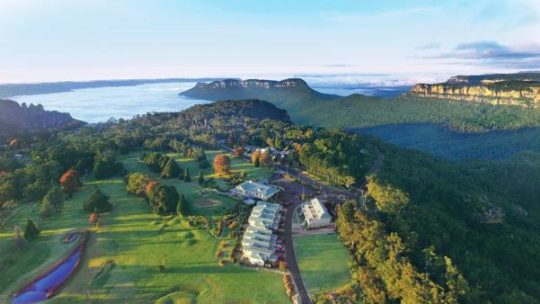
An old PR aerial photo of the defunct Katoomba Golf Course and Clubhouse pre-2013. Plus note the separate portion of designated golf course land that Council subdivided, re-zoned ‘Operation’ and flogged off for profit to a townhouse developer [the housing row deliberately centre focus of the photo].
A key Blue Mountains community question here is that given the Katoomba Golf Club and its predominant owner at the time, golfer Geoff Reed of Reed Constructions had in 2012 gone into liquidation, and the Club then followed suit being liquidated in 2013; so to whom did Council pay the $3.3 million out of Blue Mountains ratepayers’ funds?
Presumably, the money was paid to the Katoomba Golf Club’s liquidator so as to pay off the Club’s owed creditors and owed staff salary entitlements. This means that local ratepayers ultimately bailed out this failed golf club, not Council. This sham had all the while for well over a decade, seen Council senior management and ratepayer-elected councillors stage numerous closed-door secret meetings at Council chambers with the Club and developers (denying access to ratepayers) – yet those developers ultimately all went bloody broke, and ratepayers took the can.
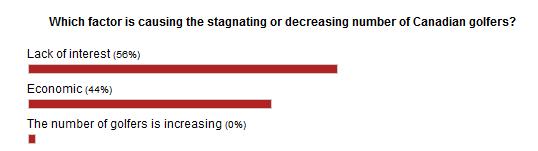
All the while for decades, fewer were interested in playing golf. The writing had been on the wall for decades.
Quite separately, a third adjoining site to the direct east of the Clubhouse used to also be part of the community land that Council undertook in 1920 to be for explicit sole use for the old Katoomba Golf Club. But multiple dodgy closed door meetings by Council re-zoned numerous fairways into ‘operational land’ (so deeming the land saleable) so that Council could flog them off for profiteering of community land to a developer for dense housing development, which it did during in the 1990’s for its own coffers.
That’s just a brief background to this multi-decade saga.
So why did Council buy it?
What was the hard sell to councillors who voted to approve the purchase?
Who benefits?
What is the return on investment for Blue Mountains ratepayers?
How is this part of Council’s remit?
Surely there were opportunity costs for a lazy $3.3 million – like potholes fixed, rates reduced, landslips properly repaired and vital access roads re-opened?
Did this $3.3 million purchase of a tired building (hardly an “asset”) ever appear on Council’s strategy plans, like on its 2017 ‘Blue Mountains Community Strategic Plan 2035’?
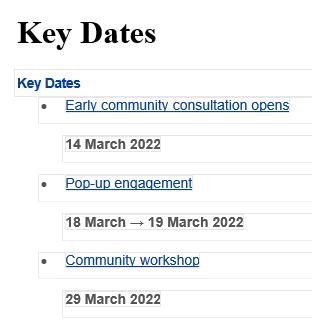
Council since its 2020 purchase of the Clubhouse, has for the past four years been trumpeting its planned re-purposing of this 30 hectare defunct recreational site, including options for re-use of the old clubhouse. Before, that purchase and before any local community consultation. Council’s consultation with the local community didn’t start until 14th March 2022.
Council at least two years prior had already (secretly again) seconded external consultants for ideas about the site’s possible uses (another Greenwashing public relations campaign to justify Council’s $3.3 million expense of ratepayer’s funds and its proposed ‘noble’ initiative).
Yet, The Habitat Advocate previously accessed Council’s webpage. We also made a written submission which we shall soon share publicly in a subsequent article on this website.
We discovered the following fine print, which reveals Council had already pre-decided that any community ideas would have to conform within its notion of restoring planetary health – whatever Council decided to have that mean…
Quote:
“Former Katoomba Golf Course Precinct Plan
You’re invited to imagine the future of the former Katoomba Golf Course Precinct
At this extraordinary time, at an extraordinary site in our City within a World Heritage Area, we have an amazing opportunity to do something special.
We urgently need to take better care of nature to protect our own health. Our City is perfectly positioned to explore ways to care for our planet’s natural systems and share these solutions globally.
With Traditional Custodians, our community, educators and researchers from a number of universities, Blue Mountains City Council is exploring opportunities related to planetary health initiatives at the former Katoomba Golf Course precinct (clubhouse and adjoining 30 hectares of public land). We are doing this for the long-term benefit of our City and our community and to create new job opportunities.
We want to know – what opportunities you see for the former Katoomba Golf Course site? How do you think this site could be transformed to help restore planetary health?”
That is why in Council’s media release about the purchase, Council was already on the front foot flagging its pre-arranged re-purposing plans for the large site under its newly conceived ‘Blue Mountains Planetary Health Initiative‘. Read the two media releases we reproduce below – one by Council dated 5th October 2020, the other by Western Sydney University dated 10th December 2020. Recall councillors approved the purchase of the clubhouse on Tuesday 29th September 2020, just a week before Council’s media release, as stated in this article.
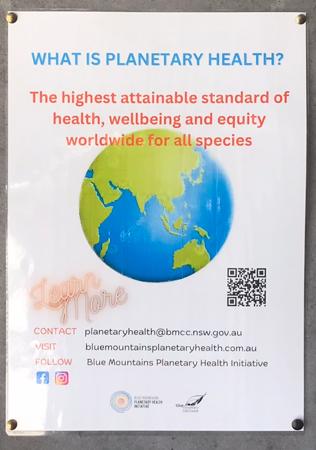
Council’s promotional poster inside its Planetary Health Centre. “The highest attainable standard of health , wellbeing and equity worldwide for all species”. [Photo by Editor 2024-05-26]
A few fact checks here…
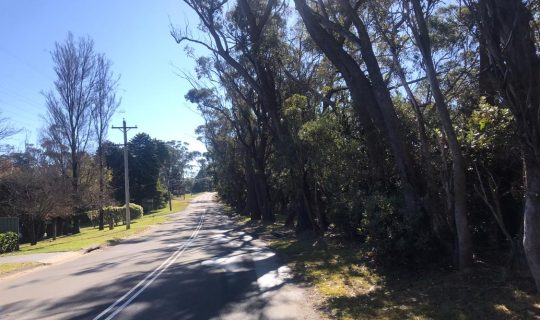
Katoomba Golf Course bushland verge along Narrowneck Road [Photo by Editor 2024-05-26]
The same verge 50 metres south along Narrowneck Road…
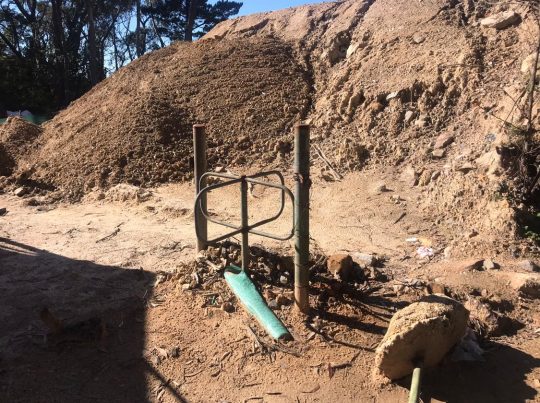
Ye olde turnstiles that provided public access to the Katoomba Golf Course through what had been a fence behind the bushland verge. [Photo by Editor 2024-05-26]
And the forthcoming beneficiaries of Council’s so-called planetary health initiative? …
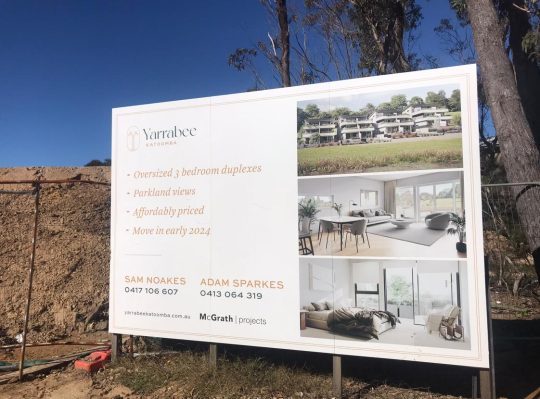
BENEFICIARIES: Council’s coffers for selling off what was Community bushland, soon the Developer’s coffers with commission to McGrath real estate agent’s coffers. Oh, and ‘Yarrabee’ means ‘place of many gums‘ in Aboriginal. We’ll, there used to be. [Photo by Editor 2024-05-26]
Council has set up a webpage that defines its understanding of this rather academic globalist concept of ‘Planetary Health‘, stating: “Its aim is to provide a framework for us to reassess and adapt human practices to better support a healthy planet for current and future generations.”
Council: …”adapting human practices to better support a healthy planet “…on Council’s defunct Katoomba Golf Course site (this was the 3rd hole). This location is just 300 metres from Lis Bastian’s Planetary Health Centre on the lower ground floor of the old clubhouse. [Photo by Editor 2021-04-11]
Council’s initiative programme is being delegated to Blue Mountains local Lis Bastian, now Council’s Senior Programme Lead for the Planetary Health Local Action Programme. Now there’s a bureaucratic mouthful. Ms Bastian is an experienced art teacher, grassroots environmentalists of sorts with a passion for The Arts and Permaculture amongst other interests and public leadership roles. An eco-celebrity being used by Council to garner trust with the local community. A brave person to take on this role.
But Council didn’t initiate this “Planetary Health” nonsense.
Prior to Council effectively buying back a building asset on the community land of Katoomba Falls Creek Valley it had long already owned, Council had consulted with Western Sydney University to try to attract university interest and ongoing funding for this otherwise very large defunct recreational site on the edge of Katoomba.
This is the Western Sydney University’s media release timed around the same time of Council’s purchase of the Golf Clubhouse (actually, less than two weeks later from 29th September 2020, thus:
‘Western Sydney University to explore Planetary Health excellence in local area’
2020-12-10, by Emma Sandham, Senior Media Office, Western Sydney University, ^SOURCE
“Western Sydney University has signed a Memorandum of Understanding (MOU) with Blue Mountains City Council (BMCC) and the Monash Sustainable Development Institute to explore the establishment of a Planetary Health Leadership Centre in Katoomba.
The Centre – to focus on the emerging science of Planetary Health, which links our activities with the health of people and the planet – is set to be based at the former Katoomba Golf Clubhouse recently purchased by BMCC.
Western Sydney University’s Deputy Vice-Chancellor and Vice President (Research, Enterprise and International) Professor Deborah Sweeney commended the signing, which will place Western at the forefront of this emerging interdisciplinary research field.
“This MOU underpins the University’s mission of striving for innovation and excellence in its pursuit of impactful research that solves some of our most pressing local, regional, national and international challenges,” said Professor Sweeney.
The Planetary Health Leadership Centre’s (PHLC) proposed aims include:
The research and promotion of sustainable living, environmental science and other initiatives relating to how human practices can better support a healthy planet for current and future generations;
Research into climate change and bushfire management, and their impact on the Blue Mountains World Heritage Area and its unique biodiversity;
A reinvigorated sustainability model for the region based on the principles of planetary health;
A substantive forum for BMCC, academics, local stakeholders, and global theorists and practitioners to be in meaningful dialogue about:
the practicalities of enacting transitions to cultures of planetary health;
the undertaking of research and promoting the development of strategies to improve the environmental health of the planet and to respond to the challenges of climate change, natural disaster, bushfire, and other processes which threaten sustainable living;
emulating the persona of the Blue Mountains as a unique place that fosters a culture of diverse and high quality creative endeavour as a City of the Arts.
Blue Mountains Mayor Mark Greenhill said: “The signing of this MOU to coincide with the 20th anniversary of the Blue Mountain’s World Heritage status announcement, is fitting.
Planetary Health is a global imperative. It resonates with the people of the Blue Mountains, but it is a matter for all people globally.”
For further information about plans for the PHLC, please contact Professor Nicky Morrison nicky.morrison@westernsydney.edu.au.
Yet, before 2020, we find this online academic article on Planetary Health dated September 2018…
‘Planetary Health: From the Wellspring of Holistic Medicine to Personal and Public Health Imperative’
by Susan L Prescott 1, and Alan C Logan 2, PMID: 30316687 DOI: 10.1016/j.explore.2018.09.002, National Library of Medicine (an official website of the United States government), ^SOURCE.
Abstract
“The term planetary health – denoting the interconnections between the health of person and place at all scales – emerged from the environmental and holistic health movements of the 1970-80s; in 1980, Friends of the Earth expanded the World Health Organization definition of health, stating: “health is a state of complete physical, mental, social and ecological well-being and not merely the absence of disease – personal health involves planetary health”.
By the 1990s, the concept of planetary health was part of the fabric of integrative medicine; more recently, after the 2015 Lancet Commission on Planetary Health report, the concept has penetrated mainstream academic and medical discourse.
Here, we explore this history and describe its relevance to contemporary healthcare; integrative medicine is uniquely positioned to educate and advocate on behalf of patients and communities (current and future generations), helping to safeguard health of person, place and planet.
We use the emerging microbiome science as a way to illustrate the interconnectivity and health implications of ecosystems (including social/political/economic systems) at all scales. As highlighted in the Canmore Declaration, mainstream planetary health discourse will be strengthened by inter-professional healthcare perspectives, and a more sophisticated understanding of the ways in which social dominance orientation and medical authoritarianism compromise the World Health Organization’s broad vision of global health.
Planetary health isn’t a “new discipline”; it is merely an extension of a concept that was understood by our ancestors, and remains the vocation of all healthcare providers. Discourse on the topic requires cultural competency, critical consciousness and a greater appreciation of marginalized voices.”
Ok, so this term ‘Planetary Health’ pre-existed as a human holistic health concept back in the 1960’s. So, it was definitely NOT Blue Mountains {city} Council’s original initiative. Yet, admittedly borrowed from some external consultant – a university or one more local?
Notably, the term ‘planetary health‘ from this definition from 2018 is clearly NOT about the health of the planet, but rather the health of person and place. The notion is purely anthropocentric – meaning “regarding humankind as the central or most important element of existence, especially as opposed to God or animals“. [Oxford Dictionary]
It states that by the 1990s, the concept of planetary health was part of the fabric of integrative medicine. So NOT ecology.
Council has made up it’s own different definition, akin to somehow saving the planet. But clearly not by what it does itself, but by what it expects others to do.
Out of the blue then in 2020, Blue Mountains {city} Council issued a press release to the local Blue Mountains Gazette newspaper
‘University push for Katoomba as council buys old golf clubhouse site’
“Two universities are planning to establish a centre in Katoomba under a major proposal unveiled by Blue Mountains City Council. Monash University and Western Sydney University are currently finalising a Memorandum of Understanding (MoU) with council after it purchased the old Katoomba Golf Clubhouse site for about $3.3 million. The MoU sets out a commitment to establish a leadership centre of international significance in the field of planetary health at the clubhouse site.
Monash University’s Sustainable Development Institute director, Professor Tony Capon, described the plan as “a visionary way to mark the 20th anniversary of the UNESCO world heritage listing of the Greater Blue Mountains Area next month. We are very much looking forward to pressing forward with our shared vision for planetary health in the Blue Mountains,” he said.
Councillors endorsed the purchase of the clubhouse site that sits alongside the former Katoomba golf course – already owned by council – at their September 29 meeting. The purchase makes the site council’s largest operational land holding, at 29.66 hectares.
Blue Mountains Mayor Mark Greenhill: “The site is a strategic investment opportunity with significant potential benefits for the city in the short, medium and long term,” “Council will explore, with the community, the best strategic options for future uses of the precinct through the upcoming master plan process for Katoomba. What’s exciting is that this opportunity gives us our first real chance to work with universities to establish a leadership centre in the Blue Mountains that would provide jobs, as well as income that comes from sources other than rates.”
Establishing a planetary health leadership centre with universities was part of a local strategic planning statement endorsed by council this March.
Discussions with the universities have canvassed linking the centre with a hub in Katoomba’s town centre.
A UNESCO Chair in Planetary Health, funded by an external donor, could also be attached to the learning centre.
Professor Capon said the emerging field of planetary health “acknowledges that human health entirely depends on the health of natural systems. The COVID-19 pandemic, and last year’s unprecedented bushfire season, are signs that our current lifestyles are out of balance with nature”.
“In the interest of the well-being of all people, we should re-think the way we feed, move, house, clothe and power the world,” he said. “The Planetary Health Leadership Centre will advance practical solutions to everyday challenges, and strive for planetary conscious in the way we live.”
Blue Mountains mayor Mark Greenhill and Blue Mountains City Council CEO Dr Rosemary Dillon at the former Katoomba Golf Clubhouse (below).
Blue Mountains City Council CEO Dr Rosemary Dillon said the former clubhouse site has “significant potential to support appropriate development of this precinct that enables sustainable economic and social development, as well as job creation. By purchasing the clubhouse site, it remains in council’s ownership and leverages opportunities for the future.” She said “it is a fitting gift to the city – and the world – that we look to establish such a significant centre” as the Blue Mountains prepares to celebrate the 20th anniversary of its world heritage listing.
The purchase has been funded by council’s property investment fund and internal sources to avoid the long-term cost of borrowing.
While the establishment of any university-linked centre is likely years away, council believes income generated from the site in the short term will help cover the costs associated with the facility and maintenance of the former golf course site.”
Council’s corporate culture still blindly considers it’s a “city”. It’s management and staff need to get outside that ivory tower more.
No city here – not yet anyway.
Our Blue Mountains region is the antithesis of being a city. It remains one of the last natural tracts of contiguous forested land in New South Wales and indeed Australia. That is why many local folk campaigned from the 1920s to protect it to achieve its World Heritage status. So why celebrate an ugly ‘city’ status for this beautiful and rare natural place in which we live?
According to Council’s ‘Blue Mountains Planetary Health Initiative’ webpage, it wants us to recognise as humans #WeAreNature. Yet, the reality is that with the planet’s human population plague at 8.1 billion and forecast to reach a “milestone” of 10 Billion by 2058 according to the United Nations, humans are not Nature but a virulent destructive, self-serving plague; hardly a Natural phenomenon.
… “you don’t know what you got ’til it’s gone?” – Joni Mitchell, 1970 . [Google Maps satellite view 2024 showing a dark green island within a mostly otherwise deforested landscape].
Council: #WeAreNature
Council’s ‘city’ mindset emanated from councillors proclaiming the string of villages along the Cox’s Watershed to be a ‘City’ back in post-war 1946. That’s where the bureaucrats mindset is stuck, still boasting in its media releases of “celebrating the unique privilege of managing a City within a World Heritage Area“. A city is not a privilege. It is an oxymoron. The mindset poses a threat to World Heritage – mostly juxtaposed downstream of Council’s encouraged urban development.
If council management, staff and councillors want to live in a city they should go back to the Sydney megalopolis which permeates on our Nepean River boundary – and crossing it recently by gerrymandering the NSW Penrith electoral boundary into Glenbrook. The Blue Mountains is not ‘Greater’ Sydney. When a NSW Government declaration, like a lockdown, is imposed for Greater Sydney, it does NOT affect the Blue Mountains.
[9] ‘Wollumboola threatened by selfish 20thC ‘golf’‘, 2011-09-02, by The Habitat Advocate, ^https://habitatadvocate.com.au/wollumboola-threatened-by-selfish-20thc-golf/
There is a legacy of hoaxes, scams, cons, white elephants, crazy schemes and plans, wacky ideologies and bandwagon movements globally (since before the notorious Dutch Tulip Mania of 1634), and including sadly throughout Australia; also indeed right here in the Blue Mountains of New South Wales.
Possibly the worst on the cards currently is Blue Mountains {city} Council’s conjured up ‘Centre for Planetary Health Initiative‘, which is set to re-purpose its disused and ultimately failed Katoomba Golf Course situated on the western edge of Katoomba.
Actually, it seems that this initiative was not Council’s idea, but introduced from Western Sydney University via an intermediary we shall say. Those in Council’s ivory tower chambers, situated aloof from town, appear to have been hoodwinked by some cult-type global noble phenomenon, termed ‘Planetary Health‘.
‘Planetary Health‘ is an interesting construct. Where did this crop up from? Well, our research shall soon reveal the background to this latest fad in subsequent articles.
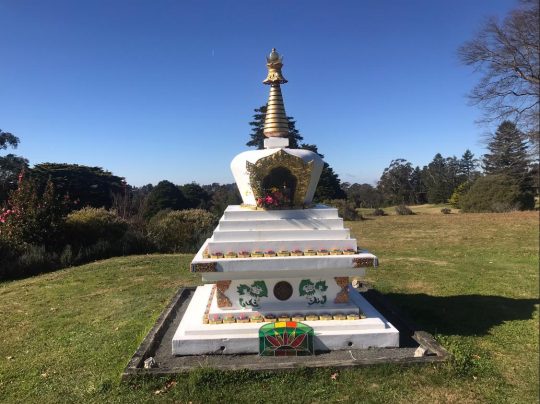
A decade after Katoomba Golf Course inevitably went broke in 2013, this exotic religious ornament propped up unannounced on Council’s old Katoomba Golf Course site just outside the old club house. Perhaps the timing was just after Blue Mountains [city} Council forking out $3.3 million of ratepayers’ funds to buy back the golf course club house building on the combined site that it had originally owned.
We presume this obelisk is not Aboriginal, but may have arrived from a falling comet from the Cosmos, else some Council notional ‘Kumbaya’ committee thought bubble. Who knows?
A PLANETARY HEALTH CULT OBELISK? But why here? How much did this ugly monstrosity cost? Who ultimately paid for it – local ratepayers?
So who on Council arranged this ugly cult thing at Council’s defunct Katoomba Golf Course?
Back on 8th October 2019, nearby Radiata Plateau outside Katoomba was sold by the Indian religious cult, the Transcendental Meditation Organization (TMO), to the NSW Government Minister for the Environment (NPWS), Matt Kean for $2.8 million. So is this where the TMO ended up, quid pro quo?
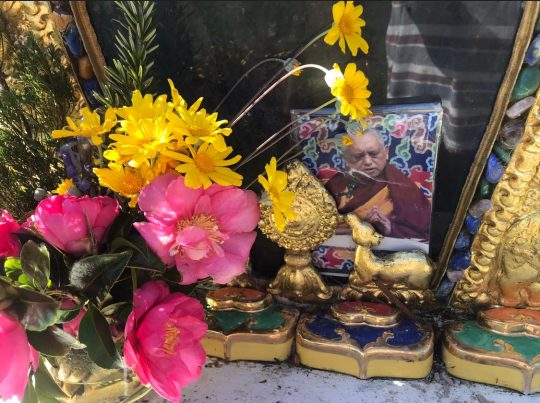
A zoom-in of this ‘cult-thing’ to some maharishi yogi…
IMPOST ON LOCALS: Katoomba Golf Course now some cult site? By Blue Mountains Council?, NPWS Parks Service?, TMO? What is going on here?
Clearly something odd is going down in Council’s ivory tower over in North Katoomba. Katoomba residents around the old golf course are not impressed, especially local dog walkers being denied by Council off-leash access on the 30-hectare golf course.
‘Planetary Health‘ seems to be some motherhood construct. It conveys a sense of ‘warm and fuzzy’ do-gooding. The choice combined wording is a syntax slogan morally is difficult to criticise. This ‘initiative’ sounds wonderful in concept and hard to morally criticise, so IT MUST BE GOOD? Good for the planet and good for health? Such is what propaganda is about. We suspect this is a deliberate propaganda ploy by another organised social movement. We shall explore this background.
The Habitat Advocate has been in The Mountains since 2001. We didn’t come down in the last shower. We have experienced dealing with Blue Mountains {city} Council especially on matters negatively impacting Katoomba Falls Creek Valley as a member (2002-2008) of the Friends of Katoomba Falls Creek Valley Incorporated. This includes protesting against the now defunct 30 hectare Katoomba Golf Course and its expansionism and residential developments.
Local residents, again, are concerned with Blue Mountains Council’s motives and undisclosed plans and ends for this public land site that has a record of dodgy ‘Confidential Business Papers, secret closed-door council meetings and deals dubbed ‘commercial-in-confidence’, all the while council has repeatedly wasted ratepayers’ funds for decades in order to bail out its hair-brained golfing mates’ developments and expansions.
A bit of relevant history:
Back in 1920, a group of local Katoomba businessmen (golfers) initially set up ‘The South Katoomba Land Company Limited‘ having the idea of leasing bushland on the edge of Katoomba near the Jamison Valley escarpment from then custodial owners ‘The Council of the Municipality of Katoomba‘ (now Blue Mountains {city} Council) – to deforest the bushland and watercourse in order to convert the land use into a convenient local golf links for their golfing leisure. This was the heyday of golf, popular up to the 1960s.
Council was very obliging, probably because many of the then male councillors enjoyed playing few rounds. ‘The South Katoomba Land Company Limited‘ morphed into becoming Katoomba Golf Club Ltd and so had the golf links constructed – we suspect with generous financial support from Council’s ratepayers’ funds. This will become evident by reading further.
By 1923, it was a 9-hole golf course replete with a moderate club house. It was popular and became crowded, so by 1927, double the bushland was deforested eastward and northward to expand it into an 18-hole golf course.
Over the decades, Council then acquired adjoining bushland sites to expand the size of the golf course out to about 74 acres (30 hectares). That’s 300,000 m2, or the equivalent area of 550m x 550m – a big chunk of bushland, which included a watercourse and series of natural swamps – all graded and swallowed up – bugger the ecology! Golf being more important, like Council’s bulldozed Catalina car racing track nearby in The Gully in 1957! This was all in the same Katoomba Falls Creek Valley natural water catchment above Katoomba Falls.
Later in May 1991, it was Council itself that proposed funding the tenants of the golf course, Katoomba Golf Club Ltd, a massive residential expansion development proposal.
Council labelled its own initiated development ‘Katoomba Golf Resort and Spa‘. It was an A3-sized spiral-bound booklet of 30 pages including promotional ‘artist impression’ watercolour drawings that included a proposed large 2-storey club house including a licensed hotel, multiple function facilities and 48-room ‘lodge’ accommodation in two adjoining side wings either side of the club house/hotel.
So, a conflict of interest by Council as custodial landlord of this public land to fund a commercial tenant’s recreational interests, or what?
Here are a few extracts of that proposal commission by Blue Mountains {city} Council via its outsourced developer Leisure Lea Corporation to St Leonard’s based architects John Bruce and Partners:
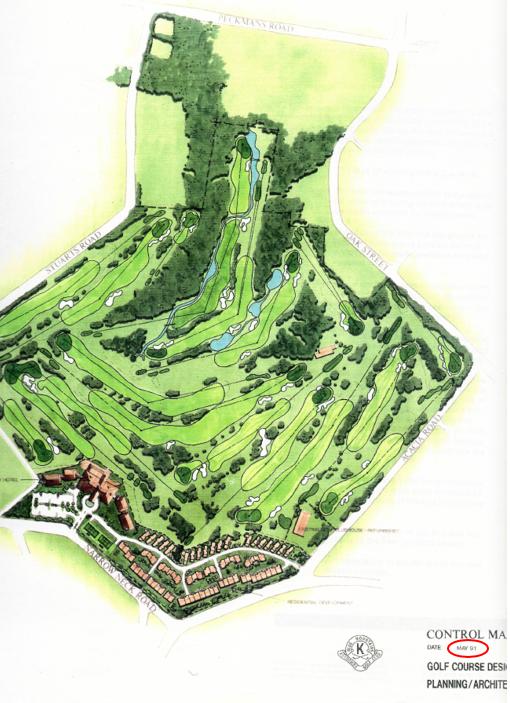
Council’s May 1991 Development Application residential expansion for its tenant on community land, Katoomba Golf Club. Note the lower map portion off Narrowneck Road to be replete with a residential golfing village.
Note that multiple golf fairways/holes were to be re-purposed so driving the need to maintain the golf club’s 18-hole golf course offering by Council’s acquisition and re-zoning of surrounding community bushland. This was an ongoing programme of destructive environmental expansionism for the pursuit of a dying pastime – Golf. The architectural costs of this plan would have been considerable – all paid by local ratepayers.
Just one of many examples of Blue Mountains [city} Council’s secret deals concerning its dodgy secrecy with their golfing mates, whilst exploiting ratepayers’ funds behind closed doors:
Council had sold off a number of fairways to housing developer, Mr Tracey Lake of Noroton Holdings Pty Limited, to use the land to build a hotel and ab0ut 20-odd townhouses.
For over a decade the various developments schemes for the mixed use site were negotiated with Council in secret behind closed doors for more than a decade – suspiciously, the proceeds of Council’s partial land sell-off of what was ordiginall community land (rezoned operational by Council to enable it to be sold for housing, was used to prop the failing Katoomba Golf Club multiple times.
Mr Lake’s business went broke and re-emerged as Numarra Pty Limited in 2004 and as Katoomba Escarpment Estates Pty Ltd (KEE). In 2010, Council approved a 99-year lease of the Golf Course to Reed Constructions, which had controlling ownership in the club. Then the golf course expanded into surround bush to recreate its 18-hole course status. In 2012, Reed Constructions went into liquidation. Then Katoomba Golf Club went into liquidation on Monday 1 July 2013.
In 2020 Council bough the club house using $3.3 million of ratepayers’ funds. The adjoining townhouse development persists to this day.
Photo of the Escarpments site in taken 2007-11-10 [Photo ‘PB102385’ by Editor on behalf of local resident activist group the Friends of Katoomba Falls Creek Valley Inc.]
This is Blue Mountains {city} Council hypocrisy in spades. Since when has Blue Mountains {city} Council been trusted?
Katoomba Golf Course ultimately went broke, first during Council’s re-zoned residential development and sale to Noroton Holdings Pty Limited, then by Reed Constructions in 2013. Council all the while schemed with the lessee and successive developers behind closed-door backroom deals, misappropriating Blue Mountains ratepayers’ funds to prop up this dated golfing failed venture.
Outcome? A dog’s breakfast.
Local dog walkers: What’s all this planetary bandwagon thing? We just wanna go for a walk across the defunct golf course.
The Katoomba Golf Course had gone broke in 2013 basically due to the lack of local general interest in playing golf. The similar demise has afflicted the antiquated courses at Lawson, Wentworth Falls, and Leura, and decades ago the one at Mount Victoria once attached to the Victoria and Albert Hotel harking from before The Great War.
So over time, disused golf clubs incrementally have sold off their land for housing development. Notably, this includes the golf clubs at Leura, Wentworth Falls and Katoomba. The defunct Lawson golf course remained in Council ownership, and being so remote, Council proposed no housing development to be viable.
Back to Katoomba Golf Course…
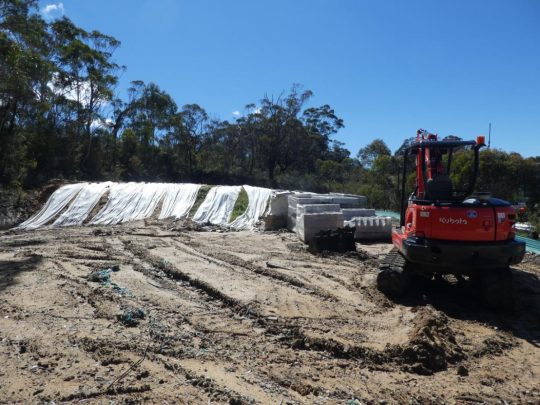
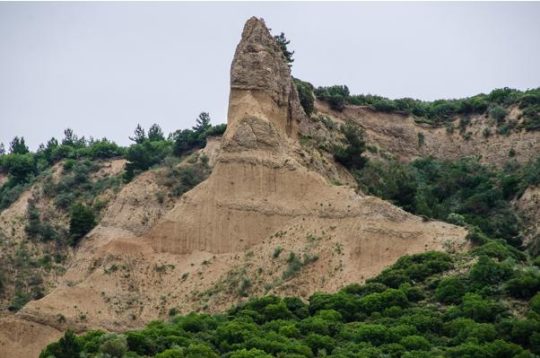
PLANETARY DESTRUCTION: Blue Mountains Council’s flogging off acreage from Katoomba Golf Course to residential property developers for high-density urban housing resembling inner Sydney. This was the third fairway from the original 9-hole course opened in May 1923. Now this 6-metre-high cut-and-fill slag heap (March 2023) resembles the Sphinx at Gallipoli.
‘The Sphinx’ was really a remnant outcrop of the Sari Bair range above ANZAC Cove 25th April 1915 following British and French naval bombardment of the sandstone escarpment.
Our Blue Mountains (‘The Mountains’) have a destructive bombardment record of deforestation of this valley to suit its own ends backing selfish indulgences of wealthy business people wishing to indulge in their sporting pastimes – like playing golf, and watching car racing, and profiting from amusements parks (like Catalina and Scenic World). Cultural spots don’t change.
Council’s old business paper records reveal that near Blackheath some enterprising nutter once proposed Australian prime ministers’ equivalent gouging like Mount Rushmore be carved into the west facing escarpment of Fortress Ridge, so viewable to tourists from Govetts Leap Lookout on the western side of the Gross Gorge, plus a glass elevator shaft up and down Bridal Veil Falls nearby. There used to be cattle grazing in the Blue Gum Forest and Kanangra and previously in the mid 19th Century, the colonial government of NSW proposed building a railway line up the Grose River Gorge from Windsor to Lithgow.
Exploitative damage to The Mountains natural landscape, along with the permanent destruction of native habitat, has been encouraged by successive governments since 19th Century English immigrant ‘robber baron’ John Britty North’s deforestation and mining exploits of Katoomba in the 1870s.
Now a decade after Katoomba Golf Course went into liquidation in 2013 and lay abandoned for a decade, Council since 2020 indulged $3.3 million of Blue Mountains ratepayers’ funds to buy back the golf course and club house.
Government’s latest hair-brained scheme like this failed Katoomba Golf Course site smells surely of more Blue Mountains {city} Council’s PR greenwashing again. ‘Blue Mountains Centre for Planetary Health’. Seriously?
Research the history of this 30-hectare site to begin to understand our cynicism. Where to start? Start with our thirty-year knowledge and environmental protest legacy perhaps.
The site was Community land. The original Katoomba Golf Club leased the lands from the land holder Blue Mountain Council in 1920.
Check this document. A Declaration of Trust with Council that the land only be used for recreation…
Embarrassingly so, Blue Mountains {city} Council re-imagined a re-purposing of its failed golf club from a century since 1920. Bureaucrats are slow learners. Actually, they most never learn from their mistakes because they are granted impunity from any accountability. The head honcho fat cat bureaucrats in BMCC senior management are still there, raking it in for themselves and wrecking the joint.
This is our previous article on this matter from 2013:
[1] ‘Declaration of Trust‘, between The South Katoomba Land Company Limited to The Council of the Municipality of Katoomba, 28th January 1920, declaring said specified council land in Katoomba for the sole purpose of lessee use for golf links, as witnessed by Hughes & Hughes solicitors of 26 Hunter Street Sydney, (3 pages), resourced from The Neil Lewis Stuart Archive – Topic Group ‘F2: Valley Threats Katoomba Golf Course’;
[2] ‘Katoomba Golf and Resort Spa Resort‘ land-use development proposal, Development Agreement Documents, May 1991, by John Bruce + Partners (architects) for Ted Stirling PGA of Golf Development Resources, resourced from The Neil Lewis Stuart Archive – Topic Group ‘F2: Valley Threats Katoomba Golf Course’, A3-size, 30 pages;
[3] ‘Katoomba Golf Club membership brochure‘, circa 1999, 2 pages, resourced from The Neil Lewis Stuart Archive – Topic Group ‘F2: Valley Threats Katoomba Golf Course’;
[4] ‘Item C3 in Confidential Business Paper – Katoomba Golf Course Development‘, 12 Nov 2002, ‘Quality Local Government’, Ordinary Meeting business paper Page 17, Blue Mountains {city} Council , File No: H00003, 1 page, resourced from The Neil Lewis Stuart Archive – Topic Group ‘F2: Valley Threats Katoomba Golf Course’;
On Friday 26th April 2024, at 1:10 am I saw a fox again on Murri Street Katoomba that scurried out of The Gully across the road into a nearby property.
I reported this to Blue Mountains Council as the land owner of The Gully, but only to be given a run around by Council’s call centre staff, claiming that protocol is that such pests are not Council’s responsibility. I was told to instead phone some Local Land Service on 1300 795 299, so I did. The person there said I then had to phone Biosecurity Officer ‘Jacob’ on 0438 073 749. So I did, but I had to leave a message.
What a cop out by Blue Mountains Council!
So then I phoned back Council again and spoke to a different person in customer service and reported the same problem of the fox sighting in Murri Street.
This time I was given a CSR 529097, whatever that may come to.
Council is all care, greenwashing and no responsibility.
"We're coming to you from the custodial lands of the Hairygowogulator, Tarantulawollygong, and Longdrop country, within the Australia nation since 1901. From our home in Inner West Katoomba we pay respects to uncles and grandaddy elders past, present and emerging from their burrows. So wise to keep a distance out bush."
Recent
Supporting Us
A VOICE FOR NATIVE HABITAT
One’s solo mindful walk…
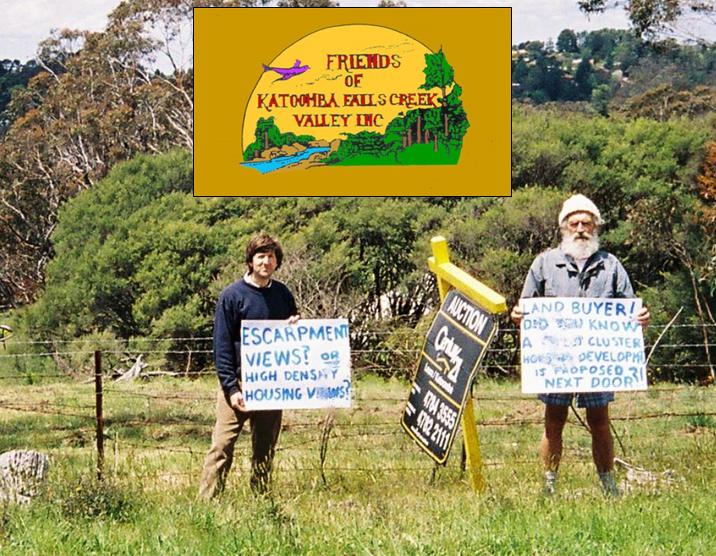
The Friends of Katoomba Falls Creek Valley Inc. in The Gully
The Gully Collection
Save Atlas Campaign
The Friends Archive: War and Peace with the Blue Mountains ‘hysterical’ Society


 Reload document
  Open in new tab






Love the Tigerquoll. Beautiful little animal with lots of courage. Seen particularly in the Flinders Ranges in S.A.
Congratulations on ‘capturing ‘it as your logo… good choice!