Australian Colonial Heritage equally valuable as Aboriginal Heritage
Tuesday, March 24th, 2026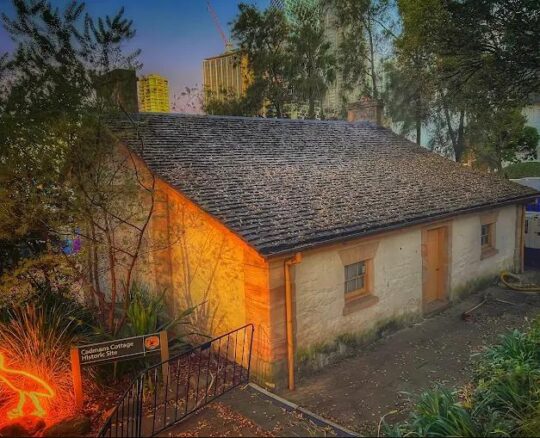
A brilliantly warm photo artwork of Cadman’s Cottage in The Rocks (possibly the best photo to date) [Photo by Makesh Sundaram, 2023 on Google] – now there’s a name most welcomed in Australia!
In one’s view, Australian history is equally as valuable to our nation and our Australian people as is this continent’s pre-history of a suggested 500+ distinct aboriginal clan-groups from millennia.
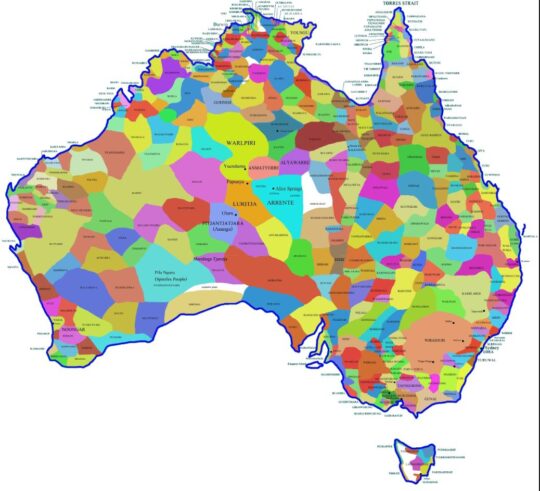
A map of ancient Aboriginal clan-groups pre-1788 of the continent that then was yes invaded and fought, then united to become the nation of Australia from 1901. It was imperfect, warts and all, but’s now history. Yet never forget the English only just beat the French to Downunder. [Source: https://connectionandwellbeing.com.au/start-the-conversation/australia-aboriginal-tribes-map/]
What we mean by this statement is that Aboriginal pre-history, pre-1788 for millennia, and Aboriginal history post-1788 to date is almost equally important to how Australians are today (our joint cultures) and into the future; as equally significant to Australia’s colonial past (troubles and struggles) and to our shared post-colonial past (troubles and struggles) up to just bloody yesterday! No-one is superior.
“Ghosts appear and fade away”.
Australians one and all, never forget that the French arrived at Botany Bay on January 26, 1788, just days after the British First Fleet, in an expedition led by La Pérouse, creating an immediate, peaceful “close call” for colonial possession. Though the British stayed, French explorers, missionaries, and settlers contributed to Sydney’s early development, with a peak in French-born residents during the 1890s. But they don’t impart such truthful Australian History to children in our schools – warped ideology reigns.
This author has become a friend of a number of Aboriginal people (from Kununurra to Katoomba). One is a 6th generation Australian from a mix of impoverished purely British settlers and including one English convict since the pre-Gold Rush 1840s. (The said convict starving with his brother, had stolen a sheep for food in Hampstead, west London).
No-one chooses their birth origin, birth mother, birth right, or birth financials. Yet one does then choose what they do in life. In lucky Australia, this place presents a globally privilege of rare choice – we in Australia should never forget that. We recommend to travel abroad just to realise that, then you realise the best decision reasurringly is to returning home ‘downunder’ to familiarity to know how bloody lucky we Australians really are.
One has travelled most of Australia intentionally since turning the adult age of 19 years as a type of ‘grand tour’ downunder. One recalls that it was at the time to deliberately experience and learn the true realities of the real Australia; especially its north and outback. Over time we’re talking the likes of Ceduna, Quindilup, Kalbari, Broome, Kununurra, Kalumburu, Halls Creek, Kurumba, Croydon, Cairns, Wilcannia, Bourke, around Tassie, and other places. This followed a very sheltered and privilieged childhood in an exclusive part of urban Melbourne and regional Sale in Victoria, and then attending elite Camberwell Grammar School for seven years and graduating with HSC. Yes, 7 years – one repeated Year 11, but that’s another story perhaps worth telling. This was subsequently recognised upon one’s early adulthood.
So what this article here is about is one’s critique of how government in Australia mistreats such Australian History. Still 238 years on its trying to make up for excusing Australia’s pre-history, yet stumbles like its naïvely misconceived Voice Referendum debacle of 2023.
Australia, its heritage girth and depth, and Australian History and Australian pre-History are a complex, frontier, imperfect, horrible, yet special ‘opals’ (gems) of value. All who call themselves ‘Australian’ by birth or immigration, should during their lifetime quest to travel Australia and to learn for themselves of its personality personally – best younger the better while one is still receptive to learning about truths.
Equally, one does not consider one’s ancentors to warrant the politically bandied slur of being ‘invaders’. They mostly had no bloody choice! Rather most came from a desperate poverty who sought and found a new life hope to escape a desparate situation of widespread famine and destitution back in the old world; this author’s ancestors included. [Read More]
Of course, this story is not unique. It is perennial thoughout human history and continues so, sadly. Yet this story version deserves telling so truths be known, to challenge the oft bandied ‘invasion’ innuendo. In historicaly hindsight, ‘Australians’ could have all else have ended up a French or even a Japanese colony, if one reflects upon our relatively recent past. Let’s not perpetuate the divisiveness – us Australians are better than all that, which perpetuates overseas.
Ok, so to this article’s topic of … ‘Cadmans Cottage‘????
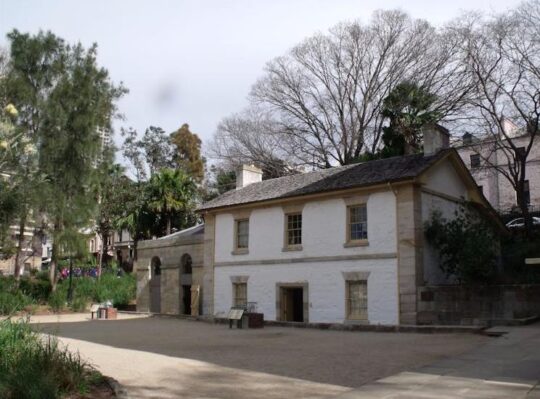
Cadmans Cottage built by the British in 1816, just 28 years after 1788 disembarkation of the British First Fleet downunder. It was the first built to replace their ‘temporary’ calico tents at Sydney Cove from those who had been forcibly despatched as convicts to the antipodes and landed at what must have seemed like Mars. Naturally, all then yearned for a semblance of old world familiarity. The convicts built this for an emancipated convict of their own – one John Cadman, Government Coxswain and as a base for his crew of tender skippers to and from the sailing ships moored in the harbour and also venturing upstream to explore the Parramatta River further inland. [Photo by somewhere on the Internet]
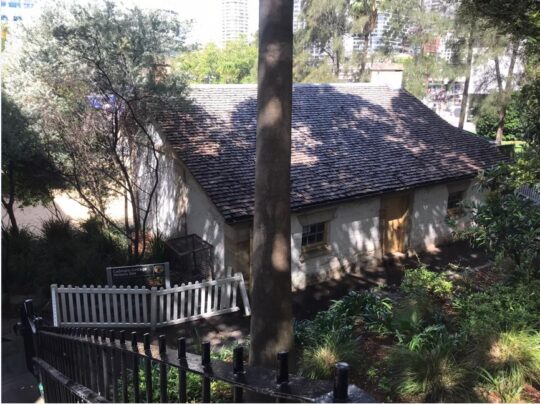
Cadmans Cottage of the rear [Photo by author]
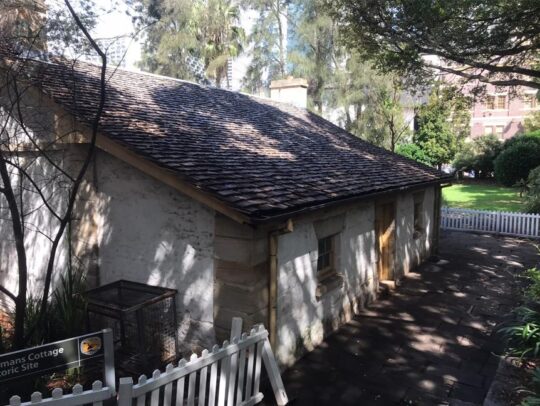
Cadmans Cottage of the rear [Photo by author]
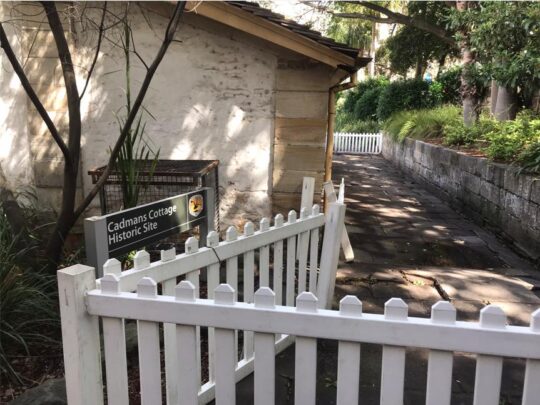
Cadmans Cottage of the rear [Photo by author]
This colonial building is the oldest know surviving building structure in Sydney and dates back to 1816. In Australia, only Elizabeth Farm out west by the Parramatta River from 1793 is the oldest still-surviving structure in Australia; no disrespect to aboriginal Australians, whom had previously never known about bricks nor stonemasonry.
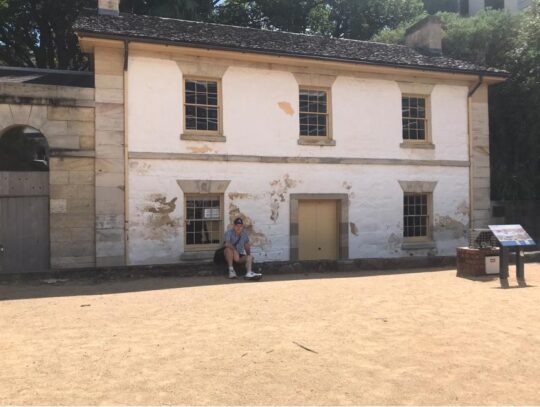
Our Tour Director of Nature Trail shown sitting outside Cadmans Cottage in 2026. It has been a destination for Steven of late. But he found the building just locked up, no museum, no tours; just a static colonial relic it seems. Only a few informational signs and plaques. This, after all that work done rediscovering it, excavating, restoring and authentically replicating the long derelict materials with professional consultation. Why is such heritage here under-valued by those in government – Aboriginal and non-Aboriginal – we’re all Australians, like Kiwis are all Kiwis – been there too, three times, both islands of the three – and on that last note I’m not talking about the big ‘west’ island, but of Rakiura. [Photo by wifies of author].
“Ghosts appear and fade away”.
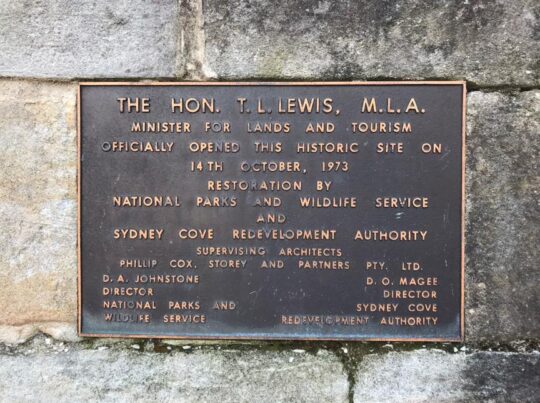
Cadmans Cottage plaque…NSW Government in 1970 had just been about to demolish The Rocks for highrise: ‘Oh shit, some archaeologist has uncovered original early colonial heritage – how bureaucratically embarrassing!’ The New South Wales Goverment’s official (backdated apologetic plague) on the unseen side of Cadmans Cottage. Yeah but…yeah but… [Photo by author]
Cadmans Cottage convict bricks:
And one has in 2026 by happenchance come into physical possession of three uniquely rare convict bricks with provenance to Cadman’s Cottage.
Here’s one:
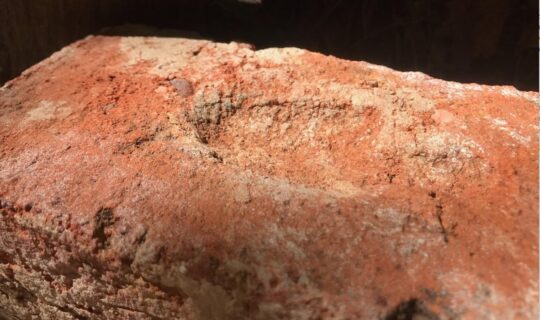
One of our received convict bricks, purportedly stolen from the Cadman’s Cottage archaelogical excavation site at The Rocks during an archealogical exacation in the late 1980s. The brick ‘frog’ top shows the inset moulded shape representing a playing-card spade identifier by the convict who had hand-made this in 1816. [Photo by author]
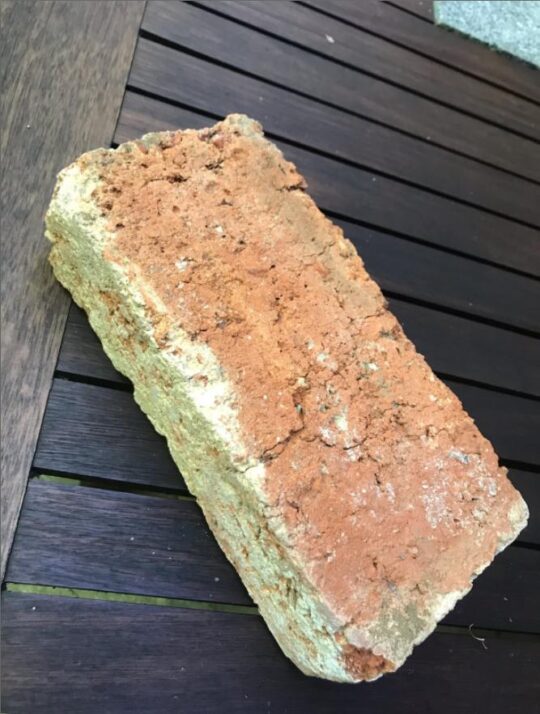
The underside of one of this brick. Note that the pale limewash on the left, which happens to match that of Cadmans Cottage’s exterior walls. [Photo by author]
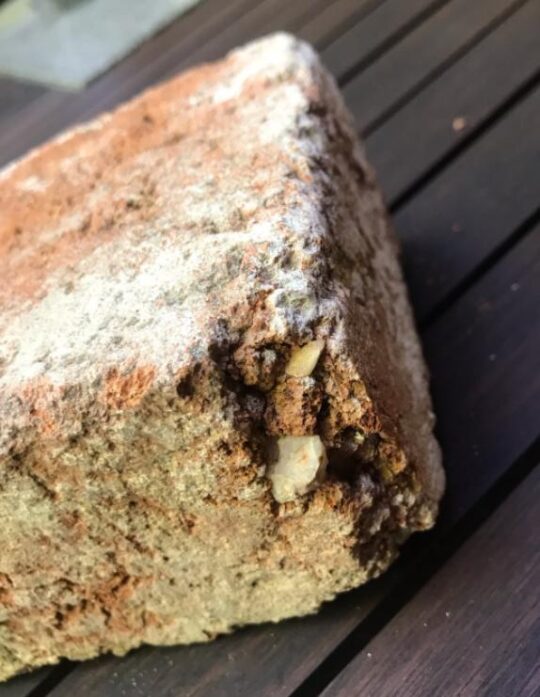
A close up of this same attained brick – showing its burnt orange colouring of clay material and embedded stones. These characteristics indicate at least its probable handmade colonial provenance, if not of Cadmans Cottage site. Devil’s advocacy – prove us wrong! [Photo by author]
Cadmans Cottage – its location?
Ye ol’ Sydney Cove in 2026, rather long since British colonisation from 1788..
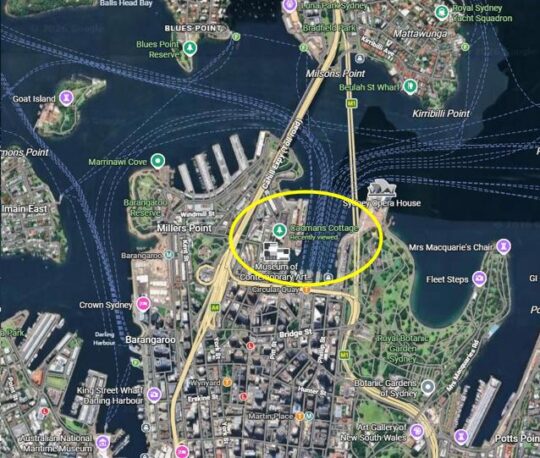
[Google Maps edited by author]
British Lieutenant James Cook back in 1770 had ‘come across’ what he documented as ‘Botany Bay’. An English Yorkshire man, he later was promoted to British Naval ‘Captain’ for his adventurous global endeavours to the other side of the world.
But then 18 years later, when British naval Captain Authur Phillip arrived with the First Fleet (of mostly British convicts) he realised that Botany Bay didn’t have any fresh water source, so that settlement wasn’t going to work. So, Captain Phillip rightly decided to pack up kit and sail off to explore better options up the east coastline. Too right! He discovered a rather hidden entrance off the Pacific Ocean, which Cook had somehow overlooked from the Pacific, that which became known as Port Jackson (since renamed Sydney Harbour).
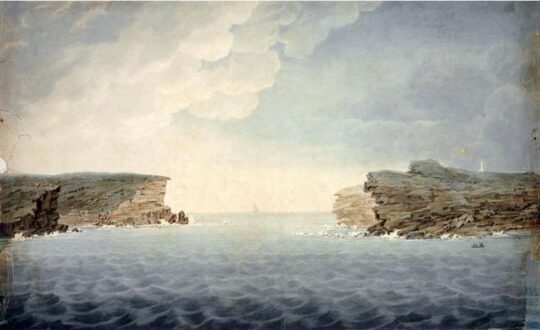
‘The Heads‘ of Port Jackson (subsequently ‘Sydney Harbour’) looking outwards to the Pacific Ocean. British Navy Lieutenant James Cook on his commissioned sailing voyage of 1770 had passed by not noticing the entrance to this majestic harbour due to the heads being rather narrow and geographically ‘offset’. Though later in 1788, out of desparate necessity to find fresh drinking water that initially Botany Bay lacked, Captain Arthur Phillip (British commander the First Fleet, did notice and entered through and proverbally the rest is history of what eventually became Australia. [SOURCE: By Richard Read Senior, from the collections of the State Library of New South Wales [a128859 / V1/Har/S Hd/3] (Mitchell Library, Sydney, ^https://dictionaryofsydney.org/media/3076].
What became the Sydney Cove settlement was due entirely to the discoverty of the flowing fresh drinking water of a creek Tank Stream at Sydney Cove to rescue dire situation of the first fleet. The rest of course is history.
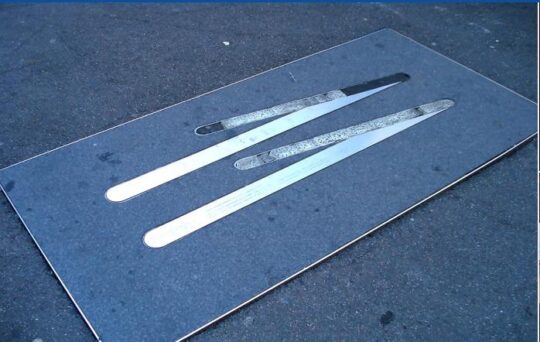
In Sydney today at ground level is revealed the location of the vitally sustaining fresh water creek of what they terms the ‘Tank Stream’. It is down near Circular Quay, Sydney. But visitors should marvel at what Sydney has become since by visiting the place that is Sydney, Australia today.
History is history. It’s warts and all and can’t be changed. “Ghosts appear and fade away”….
Three Convict Bricks recently attained:
Earlier this year (2026), as mentioned, one by happenchance came into physical possession of three uniquely rare convict bricks with supposedly the provenance of Cadmans Cottage.
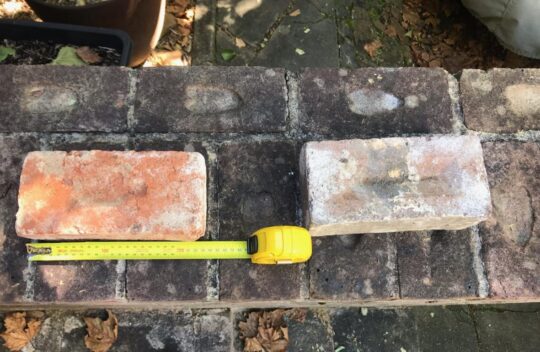
Convict brick on left: Dimensions of this brick are 230mm (L) x 110mm (W) x 65mm (H). Now how does that satisfy convict brick enthusiasts to its authenticity? Well, modern brick on right: Dimensions are different and larger being 233mm (L) x 108mm (W) x 78mm (H), plus it is far more dense and weighs nearly twice as much. [Photo by author]
Well, one is not a convict brick archaeological expert, but we trust the donor to us as a gift from a trusted mate, told us how he happened upon three of such convict bricks. A close member of his family, being an ex-convict himself happened to be working the dig site of Cadman’s Cottage in the late 1980’s and stole three bricks from that site. Now that’s a tale in itself – a convict brick stolen by a latter day convict.
So, legally one guesses, one in is possesion of stolen property – Australian heritage property, the oldest heritage property of Sydney!
So, what do do about it? Fess up and contact the government I guess, no names mentioned of course.
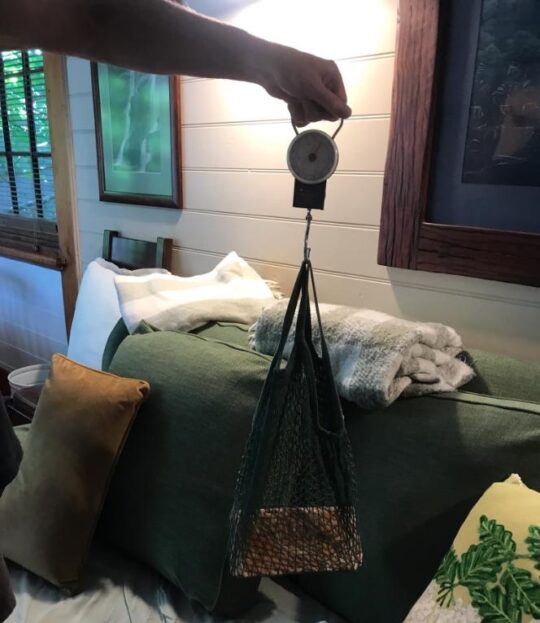
Weighing the said convict brick. [Photo by author]
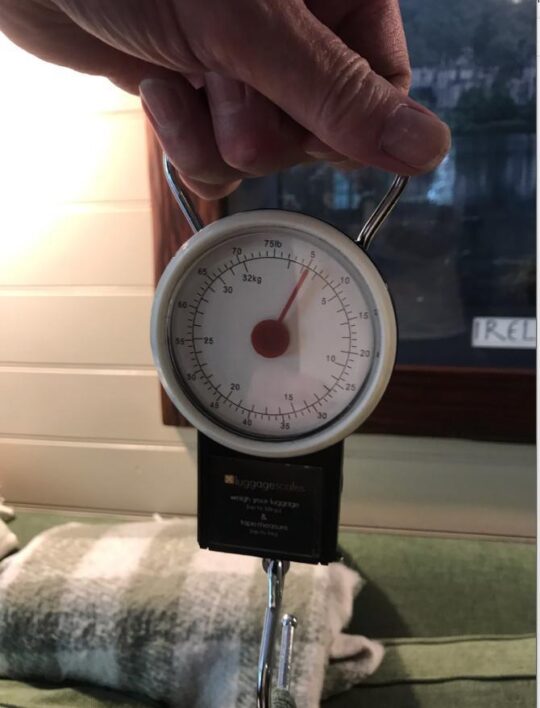
The said brick weighs 5 pounds. [Photo by author]
Compare the contemporary Aussie brick:
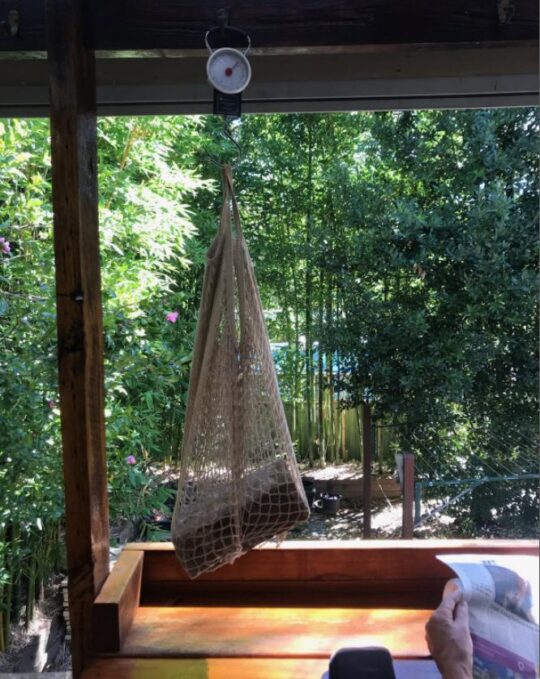
Comparative weighing a modern brick on the back deck. [Photo by author]
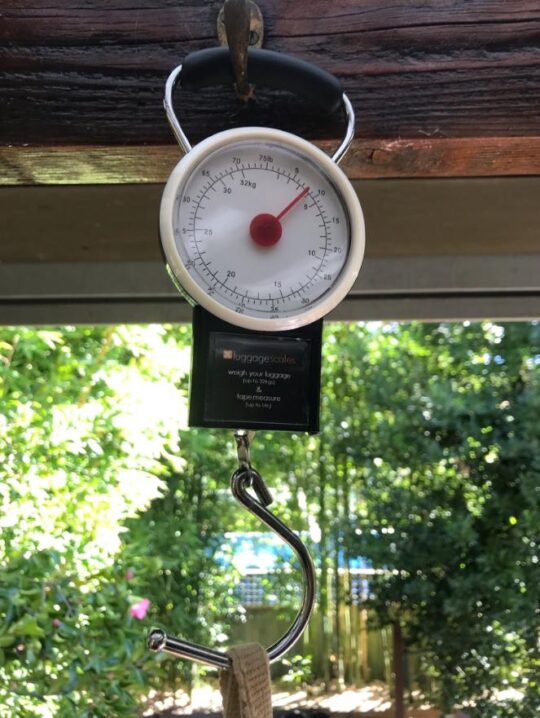
The weight of this modern day brick. Now there you go! It’s 8 pounds, so weighing in much bigger and heavier than the convict equivalent! Yeah but, the modern industrial mass-produced brick frog is boringly and symetrically, with no character. [Photo by author]
Provenance defined:
- the beginning of something’s existence; something’s origin.
One has long held an interest in the value of Australian convict bricks…
Some years ago, one managed to come into possession of about 100 or so (definite) clay convict bricks obtained for from a prior immediate neighbour. A South African woman, she charged us $100, but well that was ok, because they were well worth the ‘neighbourly’ fee. So we’ve since integrated them into our home landscaping design…
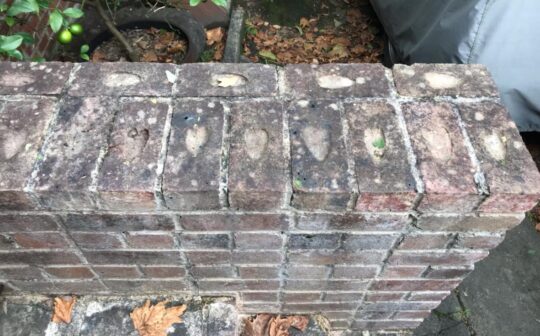
[Photo by author]
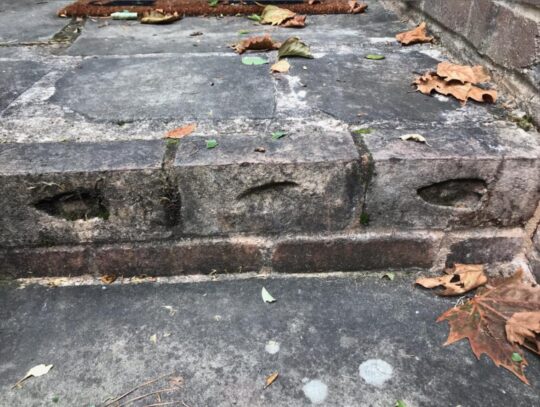
[Photo by guess who]
Our Problem though with the Museum of Sydney:
So, one contacted our gifting friend regarding these three convict bricks, having recognised their significance to Australia’s heritage to request his permission for one to donate them to the Museum of Sydney, rather than us just like incorporating them into our home’s landscaping. He responded ‘yep, no worries’.
Ok. So one then subsequently contacted the Museum of Sydney accordingly with our brick donation offer. We herein provide a transcript of that offer and the museum’s response for public exposé…

Hello Wesley,
Thank you for your phone message reply to my enquiry with the Museum of Sydney, and for your follow up email contact information.
As discussed, I am in possession of a convict brick that I recent received from a local long-time trusted friend of mine, who has told me that he obtained it onsite from the excavation project of Cadman’s Cottage, Sydney Cove (The Rocks).
Though best I don’t divulge his name, yet I trust his account of his coming into possession of it.
As suggested, I attach a number of photos for your reference to share with other curators whom you trust.
Also, I offer brick and information as a donation to the Museum of Sydney, since I consider it more valuable to the people of Sydney and the Museum of Sydney in particular than sitting in my garage, or worse me inappropriately using this timeless artefact in my home landscaping.
My wife and I happened to be in Sydney CBD (from Katoomba) last Tuesday 10th March 2026 and visited the Museum of Sydney. We were both impressed with the premises and its displays, and then I saw the convict brick on display. Sue and I have one of them!
I attach my original photos taken with my iPhone so the quality is maximised. This to assist curators assess its authenticity and similarities to those of Cadman’s Cottage, for I may be wrong.
The brick is currently in my possession/ownership with no lien.
So, please let me know if the Museum of Sydney is interested in receiving this brick from me (free of charge of course).
But specially for the purposes of public display in the Museum of Sydney (Phillip and Bridge Sts, Sydney). If so, I will be happy to provide providence notes that I have to add better insight value and then deliver it n person to an appropriate official on site at the Museum and at a time mutually suitable.
Please, after your consultation with other curators, get back to me at your earliest convenience.
I look forward to hearing back from you.
Yours faithfully,
Steven Ridd
From: Wesley Stowe <wesley.stowe@mhnsw.au>
Sent: Thursday, 12 March 2026 3:18 PM
To: steve@naturetrail.com.au
Cc: Ask a Curator <AskACurator@mhnsw.au>
Subject: BrickOFFICIAL
Hi Steve
Good to speak to you just now, look forward to receiving pictures of the brick you were mentioned.
Cheers
Wes
Wes Stowe (he/him)
Assistant Curator
Curatorial & Research Team
Museums of History NSW
Working days Mon-Fri
The Mint, 10 Macquarie St, Sydney NSW 2000
On Gadigal Country
Western Sydney Records Centre, 161 O’Connell St, Kingswood NSW 2747
On Darug CountryI acknowledge the traditional custodians of the land and pay respects to Elders past and present.
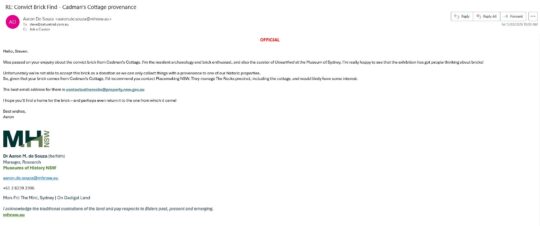
Well, sadly here’s the NSW Goverment’s bureaucracy dismissive email reply:

Hello, Steven.
Wes passed on your enquiry about the convict brick from Cadman’s Cottage. I’m the resident archaeology and brick enthusiast, and also the curator of Unearthed at the Museum of Sydney. I’m really happy to see that the exhibition has got people thinking about bricks!
Unfortunately we’re not able to accept this brick as a donation as we can only collect things with a provenance to one of our historic properties.
So, given that your brick comes from Cadman’s Cottage, I’d recommend you contact Placemaking NSW. They manage The Rocks precinct, including the cottage, and would likely have some interest.
The best email address for them is contactustherocks@property.nsw.gov.au
I hope you’ll find a home for the brick – and perhaps even return it to the one from which it came!
Best wishes,
Aaron
Dr Aaron M. de Souza (he/him)
Manager, Research
Museums of History NSW
+61 2 8239 2396
Mon-Fri: The Mint, Sydney | On Gadigal Land
I acknowledge the traditional custodians of the land and pay respects to Elders past, present and emerging.
COMMENT: One immediately phoned Placemaking NSW about Cadmans Cottage at The Rocks in Sydney, but I was told they had no idea what I was talking about. We replay one’s phone call with Placemaking NSW of 30th March 2026…, being a publicly funded government department of New South Wales supposedly responsible for Australian heritage in the state of New South Wales Cadmans Cottage.
We then also tried the following on Tuesday 31st March 2026 at 9:30am during business hours:
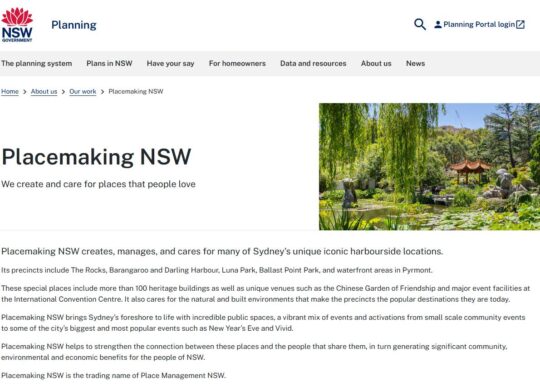
Placemaking NSW’s website regarding The Rocks…
^https://www.therocks.com/contact-us
T (02) 9240 8500
E contactustherocks@property.nsw.gov.au
Office Hours
8.30am – 4.30pm Mon – Fri
Street Address
Placemaking NSW
Level 3, 66 Harrington Street
The Rocks
Postal Address
PO Box N408
Grosvenor Place NSW 1220
THE ROCKS MARKETS ENQUIRIES
T 0412 271 725
E pag.therocksmarket@property.nsw.gov.au
MEDIA ENQUIRIES
The Media Unit is the primary point of contact for news organisations. Contact us for interviews, speakers and special requests.
E media@dpie.nsw.gov.au
We phoned the above phone number thus:
So, WTF! No wonder a Portuguese de Souza that Timor Leste has systemic problems. “Ghosts appear and fade away”.
Cadmans Cottage? – some historical background
Cadman’s Cottage is a heritage-listed former water police station and coxwains’ home located at 110 George Street in the inner city Sydney suburb of The Rocks in the City of Sydney local government area of New South Wales, Australia. This convict built sandstone cottage dates back to 1816 and is the oldest surviving colonial building in Sydney.
Cadmans Cottage was a former water police station and coxwain’s base for the use of the then governmental coxswains and their crews to row out to moored sailing ships in the harbour. Cadmans Cottage was indeed the first building to have been built on the shoreline of The Rocks area. It is claimed that during high tide, the water would come within 2.4 metres (8 ft) of Cadmans Cottage. However, due to the reclamation of land during the building of Circular Quay, the waterline has moved about 100 metres (330 ft) away since 1816. The building has had several different uses in its lifetime; first and foremost as the abode of the four governmental coxswains (from 1816 until 1845), the headquarters of the Sydney Water Police (from 1845 to 1864) and as the Sailor’s Home (from 1865 to 1970).
Before 1797, government shipbuilding was carried out only on the eastern side of Sydney Cove. In July 1797, a site for shipbuilding was designated on the western side of the Cove. The yard became operational at the end of that year, with fences, gates and the construction of two timber sheds and a house in the north of the yard for the principle shipwright. In 1798, additions and improvements were made including the roofing of a workshop and storehouse, construction of a watch house, an apartment for the clerk, a joiners shop and a smithy. By 1804, a long open fronted building, probably a boat shed, had been constructed along the George Street frontage, and is illustrated in various views of Sydney Harbour.
There are no official records of the date of construction of the Coxswains’ Barracks, now knows as Cadmans Cottage, after the longest serving government Coxswains, John Cadman. Based on the evidence of a series of sketches by James Wallis it was built between late 1815 and early 1816, on land adjoining the Government Dockyard. Wallis’ drawing of the West Side of Sydney Cove, prepared between January and May 1816 shows the completed two-storey stone building located on the waters edge.
There are no known plans or specification for the building, nor records of payment for its construction. The absence of a record of payment from the Police Fund, the construction of the dockyard wall in 1818, has led Francis Greenway directed the construction of Cadman’s.[7]: 4 Tropman and Associates also consider it possible that Greenway designed the building in his capacity as Acting Colonial Architect, but there is as yet no solid evidence for Greenway’s involvement and this must still be considered speculative.
The harbour was the focus of the city and Cadmans as the headquarters of the Government Boats, played a key role in the early development of Sydney. The Cottage was built up against a protruding rock shelf, below the level of George Street to take advantage of its shoreline location for supervision of the Government Boats. These were either moored close by or pulled up on the shore in front, but it is highly unlikely that they would have been brought into the building given the scale of the lower room and the original doorway.
The Coxswains’ Barracks (Cadmans Cottage), was occupied by the government coxswains and it probably originally served both as an office and as quarters for some of the boat crews, though the later coxswains appear to have lived there with their families.[7]: 17 The coxswain supervised shipping on the harbour and was responsible for rostering the boat crews who were employed in the procurement and transportation of timber, grass, shells (for lime) and stores. The coxswains also provided crews for the Governor’s Barge and the naval Officer’s boats.
There were complaints about the lack of facilities and the standard of construction of the buildings, most of which were in poor condition by 1806. A building used by the boat crews and Coxswains was reported as needing repairs and was probably demolished in 1816 on the completion of the Coxswain’s Barracks, later known as Cadmans. In 1810, Lachlan Macquarie became Governor and initiated a major programme of public works, including the upgrading of the government dockyard, though little if any of this work was carried out before 1816.
Restoration of Cadmans Cottage began in 1972 after it was proclaimed a heritage site under the National Parks and Wildlife Act and control of the site was handed over to the Sydney Cove Redevelopment Authority. A major archaeological investigation occurred in 1988 (in preparation for the bicentennial redevelopment) and since then, only minor maintenance works have been completed on the building.
The post of government coxswain was held by four people:
- Bernard Williams, from 1807–1822
- David Smith, from 1822–1823
- John von Mangerhouse Weiss, from 1823–1826; and
- John Cadman, from 1827–1845.
Cadman was the longest serving of the coxswains. In 1798, he was transported to NSW for horse stealing and in the records of the Muster for Sydney for 1814 is shown as having received an unconditional pardon. He probably started work at the dockyard as Assistant Government Coxswain around the time that Williams was appointed as Coxswain. [So he was a proper ‘Convict’].
In 1823, Cadman was appointed as master of the government cutter Mars which was wrecked in 1926. Cadman was removed from his post following the sinking of the Mars and applied for another position in the dockyard. In 1827, when Weiss resigned Cadman was appointed as coxswain. Cadman married Elizabeth Mortimer, who had two daughters, on 26 October 1830 at St Phillip’s Church. They all lived at the Cottage until his step-daughters married in 1842 and 1845.
Cadman held the position of Coxswain and occupied the Cottage until he retired in 1845. Francis Low’s Directory for 1847 advertises the John Cadman Steam Packet Hotel at Parramatta confirming that he had departed from Sydney by this time. Following his retirement the post of Government Coxswain was abolished and the functions were taken over by various other bodies, including the Water Police, Customs and private traders. Cadman died in 1848 and was buried in the Sandhills Cemetery until 1901 when work commenced on Central Station and he and his headstone were relocated to Bunnerong Cemetery at Botany. (So one surmises that he was rather sick upon his retirement, and no pension but).
Da Downunder Convict Bricks:
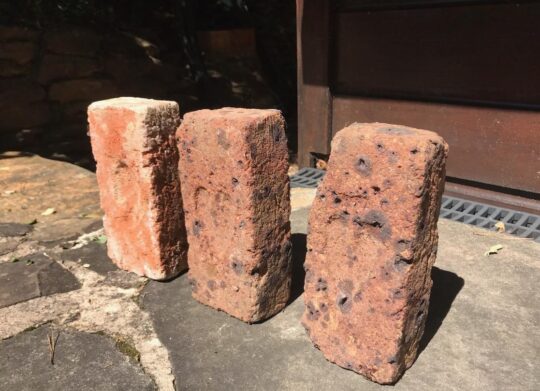
One’s three convict bricks from Cadmans Cottage 1970’s excavation obtained illegally by a former convict. So bloody Australian! [Photo by author]
This video was surely outside The Stokehouse at St Kilda. Being where my aunty held her birthday with Trish and Irvin. Now there’s Melbourne heritage, no names identified.
References:
[1] ‘Aboriginal clan-groups pre-1788 ‘ ^https://connectionandwellbeing.com.au/start-the-conversation/australia-aboriginal-tribes-map/]
[2] ‘Cadmans Cottage‘, Wikipedia, ^https://en.wikipedia.org/wiki/Cadmans_Cottage
[3] ‘Cadmans Cottage‘, New South Wales Government, ^https://www.sydney.com/destinations/sydney/sydney-city/the-rocks/attractions/cadmans-cottage
[4] ‘Archaeology in The Rocks, Sydney, 1979-1993: from Old Sydney Gaol to Mrs Lewis’ Boarding-house‘, by Jane Lydon, Australasian Historical Archaeology, Vol. 11 (1993), pp. 33-42 (10 pages), published by Australasian Society for Historical Archaeology, ^https://www.jstor.org/stable/29544329
[5] ‘Cadmans Cottage Historic Site Plan of Management‘, ^
 Loading...

 Reload document
  Open in new tab