Archive for the ‘Threats from Bushfire’ Category
Monday, September 6th, 2010
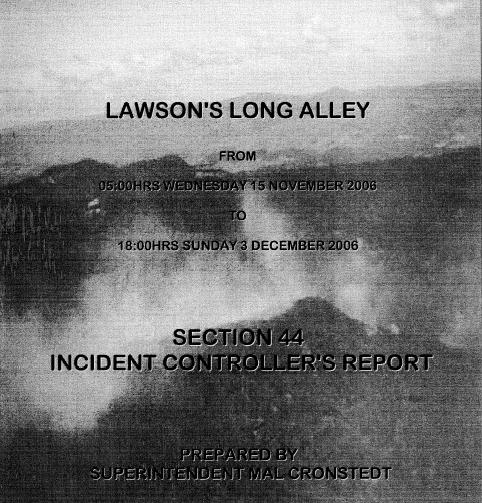 . .
The official RFS Section 44 Report into the 2006 Grose Valley Fires found that “there (were) not sufficient RAFT crews” despite multiple spot fires in difficult terrain and “the likelihood of fire escape during severe fire weather (being) certain.”
“Suspected” dry lightning sparked two ignitions last November on Monday 13, one oddly mapped to a grass paddock within easy fire truck access off Walton’s Road, Hartley Vale. But these fires were “not detected until the following day.” On Tuesday 14, with a gusting westerly and a fire index of 25, numerous spot fires had progressed into steep bushland inaccessible to fire truck crews. Despite it becoming apparent to fire authorities that these fires “would present problems beyond the resources available locally”, the decision to declare a Section 44 escalated response wasn’t taken until Wednesday 15.
Multiple broad-acre backburning became the “fall-back strategies” despite “spot-over” fires occurring “some 12 kilometres distant from the main fire” north of Linden, showing up backburning as ineffectual. A new burn was lit along Hungerford Track inside the Grose and “aerial incendiary” was dropped “north of Blackheath on Sunday 19. An RFS burn south of Bells Line of Road became “a concern” on Wednesday 22 (“blow-up day”) before it coalesced with the wildfires into “a major run” through the Grose Valley. A massive 6km pyro-cumulous cloud developed “visible from much of the Sydney basin”. Some 14,070 hectares of bush habitat had been burnt.
The report documents insufficient aerial support, “deployment was less than satisfactory”, “radio communications (were) poor”, bulldozer contractors were unsupervised and RFS RAFT crew standards “were questioned”.
Lack of early detection resources, of rapid initial suppression and ineffective resource management were inferred as key operational concerns behind the Grose Fire. Surely, fire fighters protecting both community and public assets deserve first class management, resources and funding.
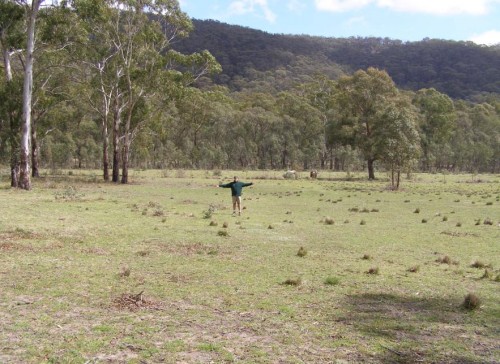 ‘Silverdale‘ property south of Hartley Vale. Editor standing at the exact Grid Reference GR 442842 documented by the New South Wales Rural Fire Service Section 44 Report’s ‘official’ location of the ignition of the Lawsons Long Alley bushfire which ‘officially’ was struck by lightning and caused the devastating 14,070 hectare Grose Valley Fires in the Greater Blue Mountains World Heritage Area of November 2006. (Bollocks!) ‘Silverdale‘ property south of Hartley Vale. Editor standing at the exact Grid Reference GR 442842 documented by the New South Wales Rural Fire Service Section 44 Report’s ‘official’ location of the ignition of the Lawsons Long Alley bushfire which ‘officially’ was struck by lightning and caused the devastating 14,070 hectare Grose Valley Fires in the Greater Blue Mountains World Heritage Area of November 2006. (Bollocks!)
[Photo taken 22 Sep 2007, just ten months after the firestorm].
Doubtful? Check the Lawsons Long Alley Section 44 Report 20070208.pdf
Friday, August 20th, 2010
by Editor 20100820.
Following the devastating Grose Valley bushfires of November 2006 in New South Wales (Australia), which burnt out 14,070 hectares of high conservation bushland in and around the Greater Blue Mountains World Heritage Area, the editor (a nearby resident and witness) wrote to the head of the NSW Rural Fire Service.
The letter raised serious concerns about bushfire management and offerred constructive recommendations and a detailed operational reform initiative. The letter was not responded to by the Rural Fire Service.
[Read below]
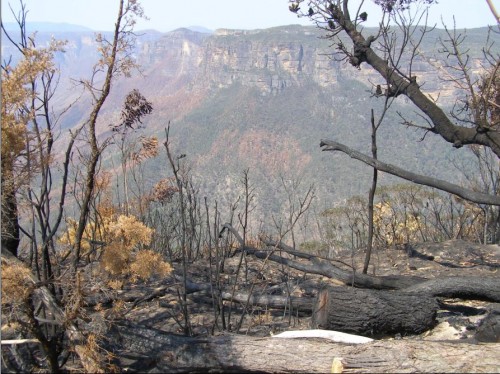
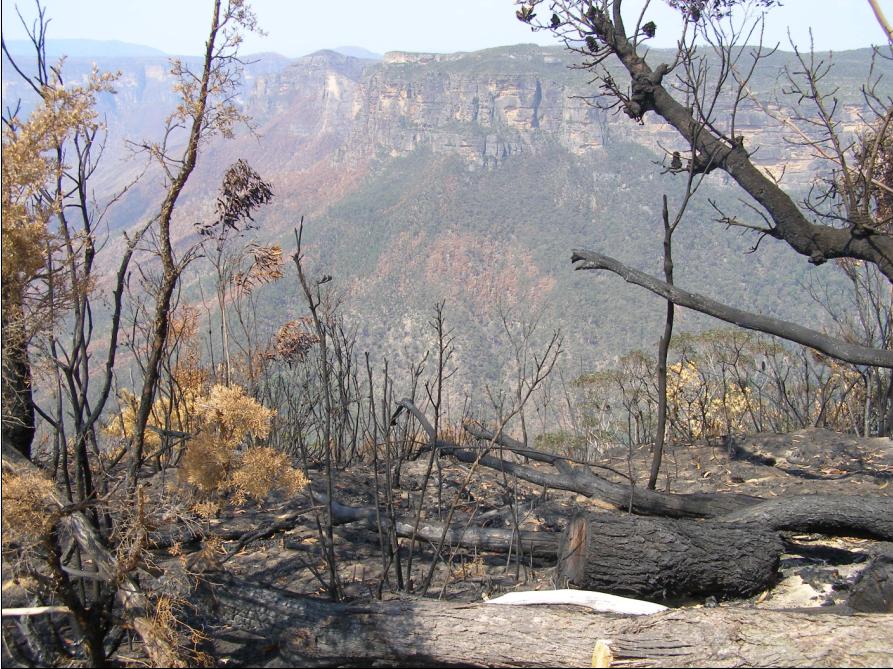
Aftermath of the Grose Valley Bushfires, Blue Mountains, NSW (Australia)
looking from Govett’s Leap, Blackheath.
[Photo taken 9-Dec-2006]
The Habitat Advocate
PO Box 21
KATOOMBA NSW 2780
Wednesday, 9th January 2007
Mr Keith Harrap
Assistant Commissioner
NSW Rural Fire Service
15 Carter Street
HOMEBUSH NSW 2127
Dear Mr Harrap,
Your Ref: M07/0515
RE: FOI Request for Operational Reports & Costs of the Grose Fire
Thank you for your reply letter of 24-Dec-07. I appreciate the efforts of your staff to search and to try to provide this information that I have requested about the operational reports and costs directly associated with the Grose Fire of November 2006. I am particularly grateful for the co-operative communication provided by Justin Walsh at NSW Rural Fire Service (RFS) headquarters.
I have some questions about the information provided in respect to the RFS recording of events and costs associated with this major fire. I wish to also offer some observations and make recommendations that I will appreciate you taking on board by way of ongoing quality improvements to fire management policy and practices. In this regard, I have had some brief communication with the local Superintendent District Manager of the RFS in the district where I live (the Blue Mountains), Mal Cronstedt.
Mal Cronstedt as you will be aware, was the Incident Controller of the Grose Fire. As courtesy I shall send him a copy of this letter as well as the information you have provided me. I will also appreciate you passing on a copy of this letter to the NSW RFS Commissioner, Mr Shane Fitzsimmons and advise that I will also welcome his feedback.
Fire Incident Recording
I am surprised by your reply that the RFS does not have any record or minutes of the operational meeting immediately following the Grose Fire. The reported inter-agency review that took place at Katoomba on 19th December 2006 some three weeks after the fire would have included critical operational information about the Grose Fire. The accurate hands-on operational feedback from fire fighters would have proved invaluable in preparing the formal Section 44 Incident Controller’s Report into this fire. Such operational information, feedback and assessment would be invaluable in providing increased understanding of the fire incident and fire behaviour, of resource utilisation and of management handling and decision making during the fire.
This would support fire investigation efforts and facilitate analysis of the fire and of fire fighting performance and effectiveness. It would be a valuable addition to the wealth of strategic and operational fire knowledge to the local fire command to help them take remedial actions to improve fire management standards and resourcing.
However, without any operation records of this major fire incident such benefits have been lost.
I have asked Justin Walsh at RFS headquarters to also find out if any reports or meeting minutes exist by either Fire Captains at Katoomba or Lithgow from where the fire fighting of the Grose Fire was jointly controlled. If such information exists then I shall be applying for an additional Freedom of Information request for this.
Given the considerable monetary cost of this fire, the extensive resources required to combat it and bring it under control, the wide media attention it attracted and the public outcry as a result of the damage to the Blue Gum Forest, it would seem inconceivable that no records, field notes or daily records exist about the fire’s progress and of decisions and actions taken by fire management.
If so, this suggests a serious disconnect between executing fire suppression operations and monitoring those operations. This surely would undermine performance management planning and review systems within the RFS. It sends a message to the community that the RFS is not accountable.
As you will be aware, under the RFS Corporate Plan 2007-2009, a key value includes ‘continuous improvement’ which it applies on page 14 to being “we pro-actively seek, develop and implement benchmarks, to measure, monitor and improve our performance.”
RFS Key Strategy Programme 1.1.5 under this plan reads:
“Maintain an accurate system for the recording of all fire and emergency incidents using the Fire Incident Reporting System (FIRS) by reporting all incidents to the Operations Customer Support Centre.”
RFS Key Strategy Programme 1.1.33 under this plan reads:
“Continuously improve the effectiveness and efficiency of the Service’s business and tactical planning by reviewing, maintaining and improving the Service Delivery Model (SDM).”
I have concerns that this plan is not transferring into practice.
Recommendation:
Last month I outlined to Mal Cronstedt a recommended reform initiative ‘Compulsory Fire Event Logging’. This reform initiative proposes to standardise and make compulsory a Bushfire Event Log for every registered fire in New South Wales. This would seek to capture all quantitative and qualitative information about a fire. The purpose of a Fire Event Log would be to capture and consolidate all information associated with combating a fire into one document for operational analysis and future reference use.
I look forward to Mal’s feedback on this recommended reform.
Total Fire Cost
The expenditure summary that you have provided seems to be an internal RFS accounting report limited to the direct recorded outlays of the RFS associated with the Grose Fire.
However, my Freedom of Information request is for the total cost of the Grose Fire – the ‘Total Fire Cost’. By this I am referring to all expenditures and costs incurred by the RFS and all associated organisations involved directly and indirectly in fighting this fire, including asset loss valuations. The direct and indirect costs that I expect can be attributed to the fire, would include:
- Direct and indirect operating costs incurred by the RFS from the time of first responding to the fire through to completing mopping up operations after the fire was extinguished
- Direct and indirect operating costs incurred by all fire fighting authorities fighting the fire including NSW Rural Fire Service (RFS) – both local and Inter-District, NSW Fire Brigades (NSWFB), Department of Environment & Conservation (NSW) – (NSW National Parks and Wildlife Service (NPWS)).
- Direct costs incurred by organisations associated with fighting the fire such as the many interstate support agencies seconded to fight the fire, including their associated transport and accommodation costs, plus the costs of other support organisations which can directly attribute costs specifically to this fire. Support Agencies listed in the Section 44 Report section 4.2 include the following:
- Any direct operating costs of the fire not paid for by the RFS due to funding, subsidies or rebates provided by government agencies outside the RFS.
- Direct expenses of related injury and accident claims of personnel directly involved in fighting the fire, including the cost of WorkCover claims, related payouts and lost time at work.
- Economic loss valuations of property, plant and equipment damaged as a direct result of the fire. This includes those of owners of land and infrastructure such as DECC, Blue Mountains City Council, RailCorp, Sydney Catchment Authority, Integral Energy, Telstra, the NSW Roads and Traffic Authority and private land owners, including insurance claims.
-
- Ambulance Service of New South Wales
- Blue Mountains City Council (BMCC)
- Department of Defence, Royal Australian Air Force (RAAF)
- Integral Energy
- NSW Department of Community Services
- NSW Department of Land and Water Conservation
- NSW Department of Primary Industries
- NSW Health
- NSW Police Force
- NSW State Emergency Service (SES)
- Roads and Traffic Authority, NSW (RTA)
- Rail Corporation New South Wales (RaiICorp)
- Salvation Army
- St Johns Ambulance of Australia
- Sydney Catchment Authority (SCA)
- Sydney Water
- Telstra Corporation Limited
This list is not exhaustive.
Importantly, here I am not seeking to obtain the broader social and environmental costs, which though relevant, would understandably be more difficult to estimate and obtain. Instead, I am merely seeking those accounting costs that can be reasonably and justifiably attributed to this fire. Such costs must be recorded respectively by each organisation as part of Australian financial accounting practices.
Does the RFS have access to these costs? Does the RFS maintain a database that captures all direct and indirect costs of each major bushfire in NSW? If not, does the RFS have any plans to start capturing Total Fire Costs of major fire or indeed to capture the Total Fire Costs of each registered fire incident during each financial year?
Recommendation:
I propose that the RFS should capture the Total Fire Costs for each major fire and, to be comprehensive, for all registered fire incidents to which the RFS responds. The expertise for this task may well require the assistance of an outside audit firm.
However, the benefit of this to the RFS and to the community will be considerable in highlighting the Total Fire Costs of fighting fires in New South Wales, which I argue we still don’t know with any reliably accuracy. I expect that for the Grose Fire for instance, the Total Fire Cost will be a considerably larger figure than the internally recorded accounting records of the RFS of $6.1 million.
Such record keeping will serve to greatly assist the effort of the RFS to attract increased funding to enable it to better:
- mitigate the risk of bushfires
- resource itself to better detect ignitions
- resource itself to better suppress bushfires.
I understand that between 2003 and 2007 the Bushfire Co-operative Research Centre (Bushfire- CRC) with RMIT University completed a research project, which involved researching the ‘true costs of bushfires’. It would be useful to seek the reports from this project.
RFS Reporting of Fire Incidents
Please advise RFS policy and practice guidelines for recording major fire incidents? [Read recommended policy initiative below]
Recommendation:
As an RFS policy, that for each major fire incident declared under Section 44 of the Rural Fire Act 1997, I recommend that both an Incident Controllers Report together with the Total Fire Costs of Fire be provided by the RFS to the Minister for Emergency Services.
I will welcome your feedback and the opportunity to participate in reforms to fire management across NSW.
Yours sincerely,
[the Editor]
CC: Mal Cronstedt, Superintendent, District Manager, Blue Mountains
Rural Fire Management Reform
Recommended Reform Initiative #01
Compulsory Fire Event Logging
Table of Contents
1. Purpose of Reform Initiative
2. Recommended Policy
3. Recommended Procedures
4. Justifications for Reform Initiative
5. Benefits of Reform Initiative
1. Purpose of Reform Initiative
This reform initiative proposes to standardise and make compulsory a Bushfire Event Log for every registered fire in New South Wales.
The purpose of a Fire Event Log is to capture and consolidate all information associated with combating a fire into one document for operational and reference use.
Typical information about a fire is to be sourced from fire management decision-making, deployment instructions, radio communications from fire-fighting crews, observations by airborne crews, current weather statistics from the Bureau of Meteorology and relevant information received from other emergency services (NSWFB, Police, Ambulance, SES, etc) associated with a subject fire.
2. Recommended Policy
The Fire Control Centre of each Rural Fire District in New South Wales must establish and maintain a separate Fire Event Log of each registered fire occurring, either wholly or partially, within its Rural Fire District.
A minimum Australian standard of vital fire information necessary for a Fire Event Log must be established and approved by the NSW Rural Fire Service Commissioner. This standard must be reviewed annually ahead of each peak fire risk season.
A suitable training programme in Fire Event Log Procedures must be established to enable suitable fire personnel to be trained in order to competently maintain a Fire Event Log to the minimum Australian standard.
This policy should be integrated into the RURAL FIRE SERVICE Standard Operating Procedures once a process of consultation with all relevant personnel has been extensively undertaken across the entire breadth of the organisation.
Once approved, a Fire Event Log Policy and Procedures should be gazetted into the Rural Fires Act (NSW), 1997 and considered similarly for each fire authority in each Australian State.
3. Recommended Procedures
- The Fire Control Centre of each Rural Fire District across New South Wales must establish a new and separate Fire Event Log upon becoming first aware of any fire within its fire district.
- A Fire Event Log must be maintained continuously throughout the duration of a fire within a Fire District until such time as the responsible Fire Control Officer (or higher RURAL FIRE SERVICE command) declares the fire extinguished within that district.
- A Fire Event Log must be recorded using the RURAL FIRE SERVICE central computer system, with appropriate daily data back ups generated at the end of each day.
- The Fire Control Officer for a given Rural Fire District is ultimate responsibile and accountabile for establishing and maintaining an accurate and thorough Fire Event Log for each fire in its district. A Fire Control Officer may only delegate the task of maintaining a Fire Event Log to a qualified fire fighter holding a current endorsement in Fire Event Log Procedures.
- The Fire Control Officer of each Rural Fire District must endeavour to capture all information about a fire in a separate Bushfire Event Log for each fire (where possible) including, but not limited to
- The designated name of the subject fire
- Date & time of the ignition
- Location of the ignition
- Cause of the ignition
- GIS digital map updating of the fire spread, likely path and key data
- Details of the initial reporting of the fire outbreak/detection details
- Lapse time to initial response & details of initial response action
- Location of fire(s) & fire behaviour updates at 15 minute intervals
- Local and forecast weather statistics relevant to the fire
- Interstate agencies seconded
- Daily updates on Total Area Burnt
- Daily updates on any lives Lost
- Daily updates on property lost, including number of dwellings
- Daily updates on area of private property & farmland burnt
- Daily updates on areas of mapped high conservation areas burnt
- Daily updates on the number of fire-fighters involved
- Daily updates on the number of aircraft involved
- Daily synopsis on the fire(s) status
- Executive decisions and actions taken, including incident declaration
- Critical issues
- Key operational threats & risks
- Fire resource needs and shortfalls
- Contact details and correspondence with assigned fire investigation
- Total duration of fire activity once extinguished
- Injury Summary Report
- Resource Usage Summary Report by contribution agency
- Register of Support Agency Involvement
- When a fire takes the form of combined fires or multiple fire fronts within reasonable proximity in a geographic area, the responsible Fire Control Officer may order that a single Fire Event Log be maintained for the combined fires/multiple fire front.
- Regular communication must be maintained between the Fire Control Centre and field brigades fighting a fire to facilitate logging fire activity to a minimum standard that allows communications at a minimum interval of 15 minutes.
- Any communications failures or difficulties between firefighting crews (ground and airborne) and Fire Control, or any problems experienced in maintaining a minimum 15 minute communications frequency, must be immediately reported by the Fire Control Officer, or in the case of a major fire incident, to the Incident Controller.
- A Fire Event Log is to be deemed the official single register of a fire event, a core operational document and a legal document admissible in a court of law.
- As an internal document, a Fire Event Log is not automatically available for public access. The RURAL FIRE SERVICE Commissioner may at his/her discretion allow public access to such a document via a Freedom of Information Request from a member of the public.
- The integrity and security of a Fire Event Log is paramount and is the ultimate responsibility of the Fire Control Officer assigned to a given fire. A digital copy of Fire Event Log must be provided by a Rural Fire District branch to RURAL FIRE SERVICE Headquarters within 7 days of the fire being declared extinguished. A secure and accessible database of Fire Event Logs is to be maintained by both the respective Rural Fire District branch and for all fires across NSW by RURAL FIRE SERVICE Headquarters.
4. Justifications for Reform Initiative
- While it is acknowledged that the author is not a member of the Rural Fire Service and so not privy to Rural Fire Service policy and procedures for recording bushfire operations, the lack of operational detail provided the Section 44 Incident Controllers Report for the Nov-06 Grose bushfire and the absence of minutes from the subsequent Inter-Agency review on 19-Dec-06, highlight shortcomings in record keeping of fire operations.
- Perhaps much of the information reported of bushfire events is obtained from personal recollection of events from individual line personnel a considerable time after the event. For instance, the Section 44 Report into the Grose bushfire (14-Nov-06 to 3-Dec-06) is dated 8-Feb-07, two months later. There are obvious problems relying upon recollecting detailed events, the precise time and order of those events, the changing fire behaviour, the decisions made and actions taken and the changing conditions at the time. The absence of a factual minute by minute event log makes it difficult to be accurate and comprehensive in reporting major bushfire incidents. In the event of a major fire, maintaining a Fire Event Log will provide a record the performance of the four ICS functions – control, operations, planning and logistics.
- It may well be that bushfire agencies in each Australian state have their own methods and protocols for recording fire events. It may also be that different agencies and indeed different regional branches have their own different ways of recording bushfire event data. There is likely no universal consistent standard across Australia of recording bushfire events as they occur. Some records may be better than others. There is a need to have a consistently high standard of record keeping for bushfire events across Australia.
- Recent coronial inquests in Australia into bushfire deaths (Canberra Bushfire Jan 2003, Eyre Peninsula Fire Jan 2005), highlight the need for fire authorities need to have accurate records of bushfire events so that they are better able to defend their actions in court.
5. Benefits of Reform Initiative
- The benefits of establishing and maintaining a Bushfire Event Log is to better enable bushfire management to achieve an accurate and comprehensive record of a fire – the events, decisions and actions and outcomes associated with each fire event. All relevant operational data associated with a fire will be recorded in one convenient document.
- A Bushfire Event Log will provide a reliable source document for preparing a fire incident report. This will avoid the often difficult task of having to recall events, the order of those events, decisions made along with the fire behaviour at the time, long after a fire sometimes days or weeks later when memories have faded.
- Recent reports and inquests have highlighted failures in fire-fighting communications, which arguably had a role in contributing to operational problems in controlling the spread, severity and impacts of fires. Compulsorily requiring a Bushfire Event Log will require regular communication between fire-fighters and Fire Control. This requirement will help drive the need to improve the reliability of operational communications during a bushfire event.
- A Bushfire Event Log will provide a actual live record of the performance of the co-ordination, command and control functions of the ICS, including the operational sequence: Reaction, Reconnaissance, Appreciation, Plan, Issue of Orders and Deployment. This log will be highly useful at a debriefing session following a fire, allowing operational problems to be better identified. This will aid the RURAL FIRE SERVICE to increases its knowledge and understanding of rural fire fighting.
- A Bushfire Event Log will enable bushfire management to be more transparent in reporting its operations, assisting any possible coronial investigations, for operational evaluation and improvement, analysis and to contribute firefighting practice into bushfire research. By making fire event logging compulsory, regular information must be fed back to central command in order to achieve the minimum reporting standard. This will drive a higher standard in strategic communications.
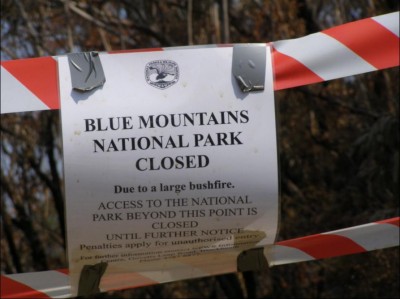
© The Habitat Advocate Public Domain
Friday, July 30th, 2010
by Editor 20100730.
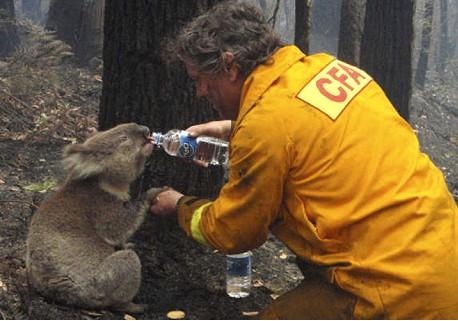 [© 2009 CFA. The koala dubbed ‘Sam’ who only temporarily survived
the worst bushfire tragedy in Australia’s history in February 2009. [© 2009 CFA. The koala dubbed ‘Sam’ who only temporarily survived
the worst bushfire tragedy in Australia’s history in February 2009.
The final findings of the Victorian Bushfires Royal Commission into the bushfire management of the February 2009 firestorm are due to be publicly released tomorrow.
What will government do to prevent a repetition? This must be the ultimate question, else what has it all been about? The recurring history of bushfires followed by enquiries shows that little is done to prevent a repetition. The risk of over reacting and incinerating vast swathes of habitat is a likely immature kneejerk response. The bunker suggestion is a last ditch tactic, but it is not a strategy. It is not the needed transformation of bushfire management.
Emergency management funding is not priority government funding for the head of the Victorian Government in Australia, Premier John Brumby.
The despicable reality of government bushfire management policy across Victoria and indeed Australia is:
‘You’re On Your Own’ – before, during and after!
It is government policy Australia-wide, played out in repeated wildfires, investigations, coroner enquiries, royal commissions in Victoria, New South Wales, Australian Capital Territory, South Australia, Western Australia, Tasmania, Queensland, Northern Territory as it has been, is and remains.
The only way to change callous government attitude is to change government – and to keep changing the government until the government attitude to our life, assets, public responsibility and environmental responsibility changes.
Across Australia, the official bushfire management ‘Stay or Go‘ policy has become a government euphemism for government neglect.
Bushfire and natural disaster is not just the lot of Victorians. Disaster and mass trauma is an Australian national issue, that statistically re-occurs every year and is trending climatically to get worse.
Australia needs a national force for handling national emergencies. It has to become professional to cope. It has to be given resource capability to cope, to plan, mitigate and to crisis manage the after effects of disasters. Not just bushfires, but damaging storms, floods, and any disaster situation across Australia and responsibly throughout our immediate Oceanic Region. All emergency services across Australia need to be rolled up into a single co-ordinated national and professionally paid force.
Australia needs a professional, national Emergency Management Australia.
Emergency Management Australia needs to be set up now as a fully multi-skilled, world-class professional paid force as a new forth arm of Australia’s Defence Force integrated with the Army, Navy and Airforce. It is time Australian governments cease shirking responsibility and despicably hand balling crisis management to noble charities like the Salvation Army, Red Cross and Country Womens Association.
Emergency Management is the task of government. This is what our taxes are for!
To be serious the annual budget needs to be what Australia is wasting on America’s selfish military crusade in Afghanistan.
To do less is to continue to sacrifice local family volunteers financed by chook raffles, resourced by drip feed, only so they can helplessly piss into the flames.
To do less is to continue to see government dispense crisis management to local charities and when it is all over to present a public servant scapegoat for public stoning to pacify those who have lost everything.
Else it’s same old, same old government neglect of its public and environmental responsibilities.
© The Habitat Advocate Public Domain
Wednesday, May 12th, 2010
by Editor 20100512.
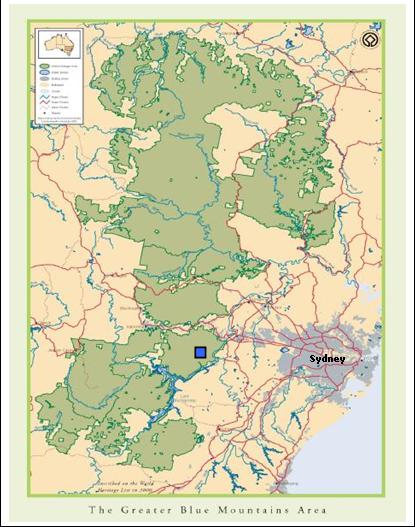
Yesterday, The NSW Department of Environment, Climate Change and Water (DECCW) within its Parks and Wildlife Group set fire to over 2500 hectares of remote wilderness in the Greater Blue Mountains World Heritage Area.
This deliberate burning was carried out in the name of ‘hazard reduction’ – in order to reduce the available ‘fuel’ (native vegetation) for potential future wildfires or bush arson.
Under the orders of the Blue Mountains regional manager, Geoff Luscombe, this deliberate burning was started around Massif Ridge some 12 kilometres south of the town of Woodford in wild inaccessible forested area of the World Heritage Area.
Aerial incendiary from a helicopter was used to ignite the forest vegetation floor and incinerate all ground cover and vegetation habitat across a large contiguous area, crossing over creeks and gullies. Fanned by a light southwesterly, the fire incinerated all native ground cover up to the tree canopy for a distance of 5 km into the Blue Labyrinth up to The Oaks Fire Trail.
Luscombe told the media that:
“this late warm weather has created a window of opportunity for us to get this important burn done and we’re taking full advantage. “The 2507-hectare burn will be conducted south of the Woodford-Oaks fire trail, and as a result the trail will be closed to mountain bikers and bushwalkers for the duration of the burn – approximately four to five days….“This burn is aimed at reducing fuel loads to help protect properties and assets in the region.” [1]
Luscombe ignores the massive natural asset in the region is indeed the Greater Blue Mountains World Heritage Area he is setting fire to. The scale of the forested area affected equates to a 5km x 5km area, or 25km2 – an area about 1/3 the size of Lake Burragorang. Yet, the official Rural Fire Service website typically and misleadingly shows the burn area size as ‘zero’ hectares.[2]
| Incident Name |
Alert Level |
Location |
Council Area |
Status |
Type |
Size (Ha) |
Agency |
Last Updated |
| Massif Ridge Hazard Reduction |
Advice |
Massif Ridge Hazard Reduction |
Blue Mountains |
Under Control |
Other |
0 |
Dept Environment & Conservation |
|
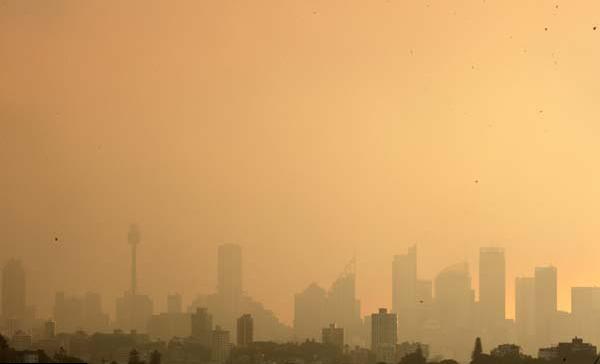
The scale of the combined burns was also evident from the blanket of smoke smothering the entire Sydney basin and Cumberland Plain yesterday. This is shown in the following photo from the Sydney Morning Herald.
 Smoke Haze over Sydney Smoke Haze over Sydney
© Photo by Sydney Morning Herald
Broadscale Burning Policy
The purpose of bush fire-fighting is to put out bushfires and in the case of wildfires to limit their spread and impact.
However, DECCW’s bush burning policy is advocating exactly the opposite. This year up until 19th April 2010, DECCW boasts that it has performed 193 prescribed burns across NSW ‘treating’ more than 56,000 hectares. Last year it manage 168 prescribed burns ‘treating’ a similar 59,202 hectares. It claims this represents one of the biggest ever deliberate burning programs in National Parks’ history.[3] This equates to an area of national parks being burned every year approximating ¼ the area of the Australian Capital Territory; and this is on top of wildfire and bush arson.
Every year DECCW contracts helicopters and indiscriminately tosses out incendiary devices over wilderness forests. Thousands of hectares are burnt in a free-for-all and thousands of native animals are roasted. Thank crikey these State-sanctioned arsonists aren’t given access to napalm.
DECCW labels its deliberate burning of native vegetation with euphemisms like ‘hazard reduction’, ‘controlled burning’, ‘prescribed burning’, ‘cool burning’ and even ‘ecological burning’. It claims burning vast areas of vegetation somehow ‘assists’ biodiversity, justified on the simplistic premise some species of flora are fire tolerant and grow back. DECCW claims that its burning is essential to manage biodiversity to maintain the reproductive viability of a species or a community of species. DECCW’s ‘eco-logic’ is that since the bush grows back after fire it must be a good impact and therefore good for biodiversity.
DECCW terms areas of national parks targeted for such broadscale burns as ‘Strategic Fire Advantage Zones’ or SFAZs. DECCW justifies charcoaling a massive contiguous landscape as ‘assisting’ biodiversity.
Bollocks!
Luscombe himself has admitted that given the few reliable days a year it is considered safe to burn, DECCW engages in broadscale burning simply a matter of operational convenience.
Mosaic burning is too labour intensive and the typically inaccessible gullied terrain and thick forested vegetation of many national parks makes mosaic burning impracticable and too costly. Be clear; it is all about operational efficiency, not ecological biodiversity.
Last March, DECCW set fire to 2,200 hectares of native habitat in the Blue Mountains in remote wilderness in Kanangra-Boyd National Park near Jenolan Caves.[4] In April 2008, DECCW dropped aerial incendiaries in remote wilderness just to the north along the Krungle Bungle Range.
Like the Rural Fire Service, DECCW is denied serious public resources to detect and suppress wildfires, so it demonises and burns the bush, so destroying the natural asset it is charged to protect and conserve.
DECCW has descended into ecological bastardry, imposing a regime of arson fundamentalism upon nature. This is an unprincipled ‘bush-phobic’ culture.
Broadscale burning is sterilised ecosystems and driving species extinction
The Sydney Morning Herald reported ‘a rogue breeze drove smoke from hazard reduction burning in the Blue Mountains down to street level.’[5] It is more the rogue management of the National Parks Service that misguidedly thinks burning vast swathes of bush at once is good for biodiversity. This demonstrates the wanton disregard for native fauna and flora habitat and disrespect for Aboriginal cultural heritage.
Large contiguous areas of tens of thousands of hectares severely compromising flora and fauna conservation, potentially causing permanent ecological change and loss of species. In the process, DECCW is destroying natural and cultural heritage values of National Parks, causing long-term ecological damage and driving native species extinction.
Collectively, the forested area of the Blue Labyrinth now will lay sterilised of the naturally rich biodiversity of flora and fauna. When the rains come the exposed tops soil will wash away. Watercourses will choke with sediment. The thin fragile soils will change and so change the ability of the soil to replace the complex floristic structure. Only plants that are fire tolerant will recover. Only plants that are hardy to poor soils will recover. There will be less floristic diversity, not more.
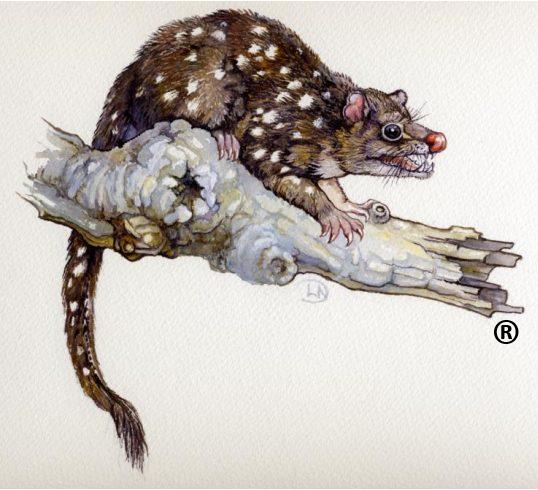
Ground-dwelling mammals will have had their burrows, dens, nests, shelters burned and destroyed by the fires. Food sources for spotted-tailed quolls, rufous betongs and wombats will have gone. The undergrowth will have gone leaving a bare open charred landscape. Such a disturbed open landscape benefits feral pedators like cats and foxes and wild dogs. Complex and dense ground vegetation reduces the impacts of predators. But the post-fire regrowth takes many months and creates a simple shrub and herb layer. This allows maximum freedom of movement for cats and foxes, and provides minimum concealment for their prey.[6]
Territorial mammals and raptors do not simply relocate. They remain in their territory and have to compete with these feral predators. Many die. As top order predators like quolls and owls die, this alters the food chain and contributes to local extinctions.
Such broadscale deliberate burning of forest habitat is a threatening process driving Australia’s mammalian extinctions.
Australia has the worst record of mammalian extinctions of any country on Earth, with nearly 50% of its native mammals becoming extinct in the past 200 years.[7]
Australian native fire tolerant fauna (‘pyrophytes’) like most Eucalyptus, Acacia, Proteaceae, Xanthorrhoeaceae and many native ferns and grasses recover quickly after bush fire. However not all species of Eucalypt are fire tolerant (or ‘pyrophobes’) as commonly assumed. Eucalyptus parvula, Eucalyptus saxatilis and Eucalyptus tetrapleura are not fire tolerant. Also, some species of Acacia are not fire tolerant such as Acacia georgensis and Acacia chrysoticha.
Flora diversity varies with soils, aspect, topography and other factors. The Blue Labyrinth is characterised by a labyrinth of ridges and gullies, hence its name. Flora along riparian zones is generally wetter and not as well adapted to fire as ridgeline flora. Yet DECCW’s one-size-fits-all blanket broadscale burning of 2500 hectares up hill and own dale completely disregards the complex biodiversity variations between the gullies and ridgelines. What its blanket burning yesterday has done to the Blue Labyrinth, however, is indeed to have encouraged a consistent simpler form of regrowth vegetation – that is, less biodiversity.
Obviously no animal species is fire tolerant. The Blue Mountains provides habitat to many native mammals including Yellow-bellied Gliders, Koalas, Feathertail Gliders, Eastern Pygmy-possums, Brush-tailed Rock-wallabies, Spotted-tailed Quolls and Antechinus. What happens to these mammals when caught in burn-offs? Where are the native zoological surveys before and after reports for each of these burns?
Native mammals and raptor birds are territorial and do not relocate and typically perish. Broadscale unnatural fire regimes produce unnaturally high biomass, but not true biodiversity.
DECCW’s policy has bad biased biodiversity and fire ecology science to support its simplistic economic approach to bushfire management. DECCW has lost its way as a custodian of protected areas. It is now charged with priorities for exploitative tourism.
Land clearing and frequent broadscale bushfire continue to put many unique species of Australian wildlife at risk. Over the last two hundred years many species of plants and animals have become extinct. DECCW as trusted custodian of NSW’s natural wild areas and in increasing its frequent broadscale burning is possible the greatest contributor to species extinctions across NSW.
Broadscale Burning Justifications Lack Scientific Merit
The DECCW is charged with custodial responsibility for environmental conservation and protection of the national parks and reserves under its control. DECCW is the lead agency responsible for environmental management of the Greater Blue Mountains World Heritage Area (GBMWHA). The GBMWHA Strategic Plan provides management principles and a framework for the integrated management, protection, interpretation and monitoring of the heritage values.
Two key strategic objectives for DECCW management of the GBMWHA is to ‘identify, protect, conserve… the World Heritage values of the GBMWHA’ and to reduce the potential for major impacts to adversely affect the integrity of the GBMWHA. Where there is doubt about the potential impacts of an action on World Heritage values
the ‘precautionary principle’ shall be applied. Under the ‘precautionary principle’:
“where there are threats of serious or irreversible damage, lack of full scientific certainty shall not be used as a reason for postponing cost-effective measures to prevent environmental degradation”.[8]
Aerial incendiary to indiscriminately burn 2500 hectares of remote wilderness is clearly an impact causing serious and likely irreversible damage to important faunal habitat. Such bush fore management practice on a large congruous scale clearly lacks scientific certainty.
In a CSIRO Journal of Wildlife Research, Michael Clarke, associate professor in the Department of Zoology at La Trobe University says it is reasonable for land management agencies to try to limit the negative effects of large fires and to be sure they do not lead to irreversible damage to native wildlife and habitat.
Much hazard reduction is performed to create a false sense of security rather than to reduce fire risks, and the effect on wildlife is virtually unknown. The sooner we acknowledge this the sooner we can get on with the job of working out whether there is anything we can do to manage fires better. We need to know whether hazard reduction can be done without sending our wildlife down a path of firestick extinctions.[9]
Clarke has called for the massive burn-offs to be scrutinised much more closely.
“In this age of global warming, governments and the public need to be engaged in a more sophisticated discussion about the complexities of coping with fire in Australian landscapes.”
He wants ecological data about burns collected as routinely as rainfall data is gathered by the agricultural industry. Without it, hazard reduction burning is flying scientifically blind and poses a dangerous threat to wildlife.
“To attempt to operate without proper data on the effect of bushfires should be as unthinkable as a farmer planting a crop without reference to the rain gauge.”
In the coming decades, native plants and animals will face enough problems – most significantly from human-induced climate chaos – without having to dodge armies of public servants armed with lighters. Guesswork and winter smoke are not enough to protect our towns and assets now, and the risk of bushfires increases with the rise in carbon dioxide.[10]
The incinerating of 2500 hectares of remote bushland in the Blue Labyrinth yesterday was not to protect the houses and properties of Woodford some kilometres away.
Such broadscale deliberate lighting of thousands of congruous hectares of native forest habitat is not protecting houses. This is not clearing dead vegetation around properties. It was fuelled by an unquestioned vandalistic compulsion to burn any bushland that has not been burnt, simply for that reason and that reason alone. The bushfire management call it strategic. But it is a cultural bush-phobia – a fear and lack of respect for the natural landscape. It harks to early Australian colonial mindset that feared the bush to the extent that one had to tame it else invite wildfire Armageddon.
Contempt for Aboriginal Archaeology in the Blue Labyrinth
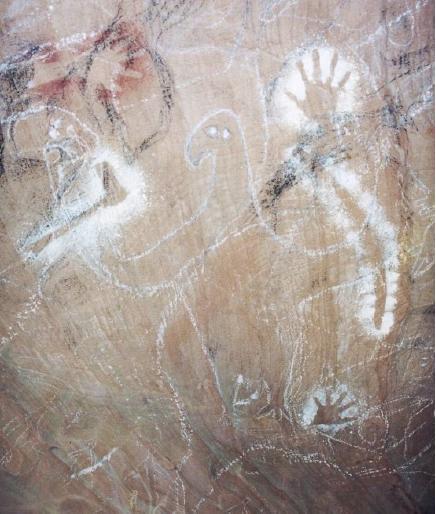
The Blue Labyrinth is a rugged natural region of forested hills and gullies a few kilometres south of the central Blue Mountains village of Woodford. It is an area of ancient Aboriginal culture. There are caves in the area displaying Aboriginal rock art dating back tens of thousands of years.
In February 2006, DECCW’s Aboriginal Heritage Information Management System (AHIMS) collated an official record of indigenous archaeological sites across the Greater Blue Mountains World Heritage Area. It listed some 850 discrete archaeological sites and 973 features in the GBMWHA, representative of past indigenous activities that remain in the landscape and are essentially the “Aboriginal archaeological record”.
An Assessment of the Aboriginal Cultural Heritage Values of the Greater Blue Mountains World Heritage Area by the Blue Mountains World Heritage Institute (BMWHI) in 2007 highlights the important Aboriginal cultural heritage values of the area. Recent discovery and documentation of numerous Aboriginal archaeological sites and features in the Blue Labyrinth include shelters, shelter walls, rock platforms marked with imagery and grooves. These have largely been preserved because of the rugged and inaccessible terrain. The GBMWA remains highly significant for the many Aboriginal communities associated with it and there is a renewed and re-invigorated interest in the Area’s cultural heritage.”[11]
In December 2006, leading world rock art expert Dr. Jean Clottes to dozens of sites across the GBMWHA and the central coast. Clottes was recently appointed to UNESCO to advise the institution on the creation of a World Heritage Rock Art List.
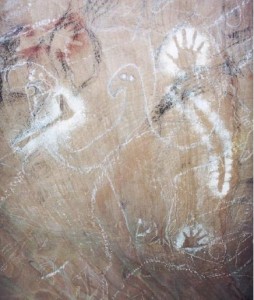
The main eagle depiction at Eagle’s Reach,
acknowledged as extremely rare by the Aboriginal community
© Photo by Paul S.C. Taçon
He was so impressed with the GBMWHA rock art sites, and associated contemporary Gundungurra, Darug, Wiradjuri and Darkinjing stories that he considers the Area to have world Heritage significance. Indeed, it was the living connections to the sites and larger landscapes that most impressed him.[12] Rock Art at Bora Cave in the Blue Labyrinth is an example of important cultural connections of the local Gundungurra and Darug to the area.
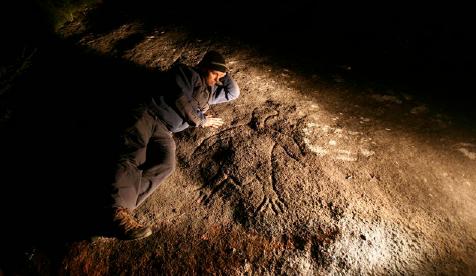
Life-size eagle engraving, Gallery Rock
© Photo by Tristram Miller
Through the Mapping Country research in the Blue Labyrinth area of the Blue Mountains National Park, hundreds of Aboriginal cultural places were recorded. The BMHWI highlighted in its 2007 report the risk of damage by natural environmental processes and exposure to modern human activities. Particularly highlighted was the risk posed by an increase in the frequency and intensity of wildfires and… and efforts to control fires can damage or destroy rock art sites. By locating and mapping sites they can be catered to as part of fire management strategies.[13]
Yet, it would appear from anecdotal evidence that DECCW failed to contact the traditional Aboriginal owners of this land to inform them of the planned burning. It is likely with such indiscriminate broadscale burning that some of the cultural sites may have been irreparable damaged.
What happened to Attic Cave, Dadder Cave and the Aboriginal archaeology between the Massif and The Blue Labyrinth? Was it burnt out and destroyed by DECCW’s needless incineration?
What happened to the wildlife and wildlife habitat? DECCW these days is more a patsy of NSW Labor right wing economic rationalism focusing on tourism revenues, than it is on its core ecological wildlife conservation raison d’etre .
References:
[1] ‘Smokin’: Sydney cloaked by burn-off’, by Paul Tatnell, Sydney Morning Herald, 11th May 2010, http://www.smh.com.au/environment/smokin-sydney-cloaked-by-burnoff-20100511-usg7.html
[2] NSW Rural Fire Service, http://www.rfs.nsw.gov.au/dsp_content.cfm?cat_id=683
[3] DECCW, Nature Conservation > Fire > Managing fire in NSW national parks > Preparation and hazard reduction, http://www.environment.nsw.gov.au/fire/prepandhazreduction.htm
[4] ‘Hazard Reduction – DECC playing with matches in Kanangra-Boyd NP’, 13th March 2009, http://candobetter.org/node/1142
[5] ‘The big smoke finally enjoys a little light relief’, by Ben Cubby, Environment Editor, Sydney Morning Herald, 12th May 2010, page 1, http://www.smh.com.au/environment/the-big-smoke-finally-enjoys-a-little-light-relief-20100511-uuum.html
[6] Chris Johnson, ‘Australia’s Mammal Extinctions: A 50,000 year history’, Cambridge University Press, Melbourne, p.226
[7] Tasmanian Department of Primary Industries, Parks, Water and Environment, http://www.dpiw.tas.gov.au/inter.nsf/WebPages/BHAN-53777B
[8] United Nations, General Assembly, ‘Report of the United Nations Conference on Environment and Development, Rio de Janeiro, 3-14 June 1992, Annex I: ‘Rio Declaration’, http://www.un.org/documents/ga/conf151/aconf15126-1annex1.htm
[9] ‘The dangers of fighting fire with fire’, by James Woodford, 8th September 2008,in Sydney Morning Herald, http://www.smh.com.au/news/opinion/the-dangers-of-fighting-fire-with-fire/2008/09/07/1220725850216.html
[10] ‘The dangers of fighting fire with fire’, by James Woodford, 8th September 2008,in Sydney Morning Herald, http://www.smh.com.au/news/opinion/the-dangers-of-fighting-fire-with-fire/2008/09/07/1220725850216.html
[11] Blue Mountains World Heritage Institute, 2007, ‘Assessment of the Aboriginal Cultural Heritage Values of the Greater Blue Mountains World Heritage Area’, p.10, http://www.bmwhi.org.au/docs/Assessment%20of%20Aboriginal%20Cultural%20Heritage%20Values.pdf
[12] Blue Mountains World Heritage Institute, 2007, ‘Assessment of the Aboriginal Cultural Heritage Values of the Greater Blue Mountains World Heritage Area’, p.10, http://www.bmwhi.org.au/docs/Assessment%20of%20Aboriginal%20Cultural%20Heritage%20Values.pdf p.26
[13] Blue Mountains World Heritage Institute, 2007, ‘Assessment of the Aboriginal Cultural Heritage Values of the Greater Blue Mountains World Heritage Area’, p.10, http://www.bmwhi.org.au/docs/Assessment%20of%20Aboriginal%20Cultural%20Heritage%20Values.pdf p.36
© The Habitat Advocate Public Domain
Tags: aboriginal archaeology, biodiversity, blue labyrinth, Blue Mountains, bush fire, Geoff Luscombe, hazard reduction, mammalian extinctions, massif ridge, prescribed burning, threatening process, Woodford-Oaks fire trail
Posted in Blue Mountains (AU), Threats from Bushfire | No Comments »
Add this post to Del.icio.us - Digg
Tuesday, March 30th, 2010
by Editor 2010330.
The New South Wales government logging agency, euphemistically named ‘Forests NSW’, has ongoing plans to log old growth native forests through the South East Corner bioregion of NSW. These forests provide rare and important habitat for Australian fauna, some of which in this region are now critically threatened with extinction due to the logging, burning and deforesting activities of Forests NSW, the National Parks Service under its parent which changes its name every frew years, and the NSW Rural Fire Service.
Australia’s SE Corner (SEC) Bioregion encompasses the shires of Eurobodalla, Bega Valley, Bombala and parts of Cooma-Monaro and Snowy River. The South East Corner forests include the Tilba, Bermagui, Murrah, Mumbulla, Tanja and Wapengo State Forests . It also includes a number of national parks including the Biamanga National Park.
Not surprisingly, many Australians, and particularly locals in this bioregion, value these forests being protected and are opposed to the habitat destruction being wrought to the old growth forests. Key active environmental organisations seeking to protect these forests include the Friends for Five Forests and the South East Region Conservation Alliance Inc. (SERCA). SERCA is an umbrella organisation for conservation, environment and for citizens’ groups who want to conserve and protect the natural environment of South East NSW, Australia. SERCA’s member organisations include Bega Environment Network | Chipstop | The Coastwatchers Association Inc | Colong Foundation for Wilderness | Friends of Durras | National Parks Association – Far South Coast | Natural Native Forests | SE Forest Rescue | Yurangalo Inc.
SERCA formed in September 2005 to ’maximise efforts and resources’ of these organisations to combat the continued NSW Government-sanctioned woodchipping of native forests, to participate in formal environmental planning by the NSW Government in the regionprocesses and importantly to protect these forest habitats from damaging development and land and forest management practices.
Below is a series of reports on the events affecting these forests from these various organisations and from media reports up until March 2010.
Forests NSW have moved into log the Mumbulla State Forest
SOURCE: Friends for Five Forests, 20100329, http://www.fiveforests.net/
29 March 2010:
‘Forests NSW have moved into Compartments 2133 and 2135 in Mumbulla State Forest.
‘After a local resident photographed koala prints on Lizard road, near Cpt 2163 next on the logging list, the DECCW have apparently decided to undertake surveys before their burning operation on the other side of the road.
‘Much of the forest in Mumbulla creek catchment of Biamanga NP is growing on the Murrah soil landscape – still the only place koalas have been located. On this basis and in combination with the State Government’s management, the species remains endangered and likely to become extinct.’
Tanja State Forest – local residents meeting with State Forest reps.
Richard Blakers, 20100322 http://www.serca-online.org/our_media_releases/2010/Blakers22.rtf
22 March 2010:
‘Residents shocked by scale of proposed logging in Tanja State Forest Local residents met with State Forest representatives last week to discuss proposed logging operations in Tanja State Forests.’
‘The residents thanked the State Forests representatives for meeting with them and listened carefully to the information they provided. However, residents are very unhappy with the outcome of the meeting. They were shocked to discover the scale and intensity of the proposed logging and are not satisfied with State Forest responses to any of the concerns raised.’
‘The areas to be logged lie between Bega and Tathra along the north side of the Bega River. Near Mogareeka, the logging comes to within 50 metres of the river. It is also along the eastern side of ReedySwamp Road and extending along all the ridges and down to within 15 -20 metres of the drainage lines and creeks draining into the Bega River.’
‘The State Forests representatives explained steps taken to protect water quality, wildlife and scenic values in the logging operations. However it was clear that the measures are the barest minimum and worked out to allow for maximum tree removal, not maximum protection of other forest values.’
‘State Forests representatives conceded that after the proposed logging operation all available larger trees will have been removed from the forest and it will be well over 100 years before similar trees will again be available for commercial logging.’
‘They also stated that the logging was being driven by their need to meet wood supply agreements, and that within 3-5 years this kind of logging would stop in the Southern Region Forests because the supply of older trees will be exhausted. Once this happened, the industry would restructure to be able to use smaller trees.’
‘State Forests acknowledged that this logging will have significant short and long term impacts on local residents, and suggested the solution might be for residents to question their decision to buy property adjoining state forest.’
‘Residents think this is not a helpful attitude that does not address any of their issues.’
‘The residents have legitimate concerns about what happening to the public forests around our towns and homes. State Forests representatives do not seem to be in any position to cater to the residents needs because they are under pressure to meet wood supply agreements.’
‘Residents are therefore demanding that the State Government bring forward plans to restructure the timber industry and place a moratorium on logging in these coastal forests. It is not reasonable that these areas of older forest that have significant values other than just timber production should be sacrificed in order to meet such short term
goals.’
Koala colony under threat
Source: ABC 7pm TV News NSW, 18 March 2010, http://www.abc.net.au/news/video/2010/03/18/2849958.htm
‘Environmental groups say State Government plans to commence logging in the Bega Valley, on the NSW far south coast, will decimate the local koala population.The last known population of koalas on NSW’s far south coast could be under threat by State Government plans to log their habitat.’
Forests NSW & RFS burn 700 ha of Biamanga NP
SOURCE: Friends for Five Forests, 20100329, http://www.fiveforests.net/
Early March 2010:
‘Working collaboratively the NPWS, Forests NSW and the Rural Fire Service [RFS] have decided to burn close to seven hundred hectares of Biamanga National Park.
‘It appears the timing of this operation is consistent with plans to begin unsustainable logging on Monday 29 March. Consequently the NPWS is proposing to close the Lizard road to reduce access to the logging area from the east.’
NSW Government report on koalas in Mumbulla State Forest is flawed
SOURCE: Friends for Five Forests, 201002, http://www.fiveforests.net/
February 2010:
‘The month ends with NSW government releasing a belated ‘interim’ report on the highly inefficient and non-adaptive/heuristic koala surveys. Amongst other disturbing elements the survey took 5 times as long to complete as the pilot survey. The cost to date, leaving aside the eight arrests and other time runs at over $1million, being twice the estimated value of all the sawlogs remaining in Mumbulla State Forest.’
‘The survey outcome, based on employing a 2% (?!) activity contour, is that less than 5% (1089 ha) of the area surveyed (22,000 ha) is said to be occupied by koalas. Regrettably there is some uncertainty about how this area has been derived as the RGB-SAT methodology measure for a single tree in a plot is 3.3%. There are no details as to how the 2% contour has been calculated although theoretically it should encompass a greater area than a 3.3% contour but this is apparently not the case.’
‘Seems to be another example of how the NSW and other governments put unsustainable logging above all else. On a positive note the genetic analysis demonstrates the NSW Scientific Committee was quite wrong.’
Loggers are set to destroy one of Australia’s last remaining koala habitats.
Source: John Hibberd, SERCA: http://www.serca-online.org/our_media_releases/sercamembers/Koala.pdf
February 2010:
‘The NSW Government has started sending contractors into the forests in South Eastern NSW. Negotiations between the NSW Department of Environment and the state government agency responsible for logging, Forests NSW, appear to have failed to reach a compromise.
‘The irony is that the NSW Government last year ordered a survey to try and find koalas in the coastal forests that are now about to be logged. The survey, which was conducted across all land tenures, found a small, active population of about 30 koalas and is continuing.
‘It seems the NSW Government has now decided its contractual obligations to supply saw logs locally and woodchips to Asia are more important then protecting this much loved native animal, which is immortalized in Australian culture.
‘The disease, Chlamydia, plus loss of habitat have contributed to a dramatic decline in koala numbers over recent decades, with the species now close to being declared endangered.
“Soon it will be too late to save the species.” Says Debora Numbers of koalas in Australia may be as low as 45,000 recent surveys by the Australian Koala Foundation show.
‘The koala population in South Eastern NSW was once healthy but in the last 100 years has been decimated by hunters interested in koala pelts and by logging.
‘Forests NSW have not publically given a date for the start of logging in the Mumbulla State Forest, no doubt expecting direct action from conservationists who forced loggers out of an area close by three years ago.
‘The issue will put heat on the new premier of the state of NSW, American-born Kristina Keneally, who was installed by the right-wing faction of the party recently.
‘And Commonwealth Minister for the Environment Peter Garrett – a former rock star with internationally successful band Midnight Oil and environmentalist – has been asked to intervene.
‘Steve Phillips – arguably NSW most experienced and expert Koala scientist, said on ABC radio recently,” We have got the management prescriptions (for koalas) wrong, especially in the SE …. The small area of koala habitat remaining is such a precious resource …. They have just got to be protected so they can continue to expand ….. there is no longer any argument about what is important habitat”.
‘NSW Minister for forestry Ian MacDonald stated in Parliament in 2008 that despite recurrent financial losses, logging in native forests will continue, in order to support jobs.
‘Yet billions of dollars of taxpayer funds have been pumped into plantations as replacement timber and fiber for industry and export. NSW Forests rely heavily on the outdated Regional Forest Agreements that were signed off in the late 90s giving new areas in National Parks to the state but retaining forests for logging. Conservationists say the industry is outdated and only propped up by political will and union backing.
‘These agreements are excluded from the Environment Protection Act (EPBC) as well as climate change and water supplies.
‘Will zoos soon be the only places to see koala? Will NSW Premier Kristine Keneally do her part and stop logging these coastal forests of Mumbulla, sealing the fate of these last few koala?’
‘It seems not despite 2010 being The Year of Biodiversity.’
Logging Plan Poses Threat to Precious Koala Colony
SOURCE: Friends for Five Forests, 20100124, http://www.fiveforests.net/ from Sydney Morning Herald.
January 2010:
‘The year begins with the NSW government deciding to support the (Japanese) native forest logging industry and their proposals to eliminate the last koalas. According to the Sydney Morning Herald: Forests NSW and the Department of Environment and Climate Change are “ . . . in search of a compromise between felling trees and maintaining enough forest to allow the koalas to survive.” (http://www.smh.com.au/environment/conservation/logging-plan-poses-threat-to-precious-koala-colony-20100124-msm7.html)
‘Referring to the Regional Forest Agreements the recently released independent review of the EPBC Act states “ . . . if the terms of the approval are not complied with, or if there is insufficient reporting information to verify that compliance, Dr Hawke recommends that the approval should be terminated.” And “ . . . the full protections of the Act should apply to forest activities.” In his press release Environment Minister Peter Garret stated:
“ . . . the Government notes the concerns raised by Dr Hawke in recommendation 38 in the review regarding the current mechanisms in the Act for forest management under Regional Forest Agreements (RFAs), and is committed to working with state governments to improve the review, audit and monitoring arrangements for RFAs, including their timely completion, clearer assessment of performance against environmental and sustainable forestry outcomes, and a greater focus on compliance of RFAs in the intervening years.”
‘The Government intends to use upcoming RFA renewal processes to improve the achievement of these outcomes in future RFAs. In light of this, the Government rejects the mechanisms proposed in recommendation 38 and does not propose to review section 38 of the EPBC Act as it currently applies to RFAs.” [Source: http://www.environment.gov.au/minister/garrett/2009/mr20091221.html]
The fact that the DECC are working with Forests NSW to ensure logging in the catchments suggests that they either remain unconvinced that logging spreads Bell-miners or they believe that koalas like sick trees. If the Commonwealth are committed to these ideas they should have no problems working with the state government.’
Forests NSW ignores koalas to permit logging of Mumbulla State Forest
SOURCE: Friends for Five Forests, 20100329, http://www.fiveforests.net/
December 2009:
‘With no apparent reason, other than to progress koala extinction the NSW Government is reportedly planning business as usual when work resumes in the New Year. This work has begun and the Department of the Environment for Climate Change (DECC) has deleted from their website all information about the koala surveys over the past 2 years.’
‘The NPWS Regional manager Tim Shepard is reported as saying “. . . now we have a good idea of where Koalas live . .” We are using this information to help us plan our hazard reduction programs”(Coastal Custodians, Nov/Dec 2009). Also, a rumour has spread from the Wapengo Watershed Association claiming Forests NSW will begin the year logging koala habitat in Mumbulla State Forest. While the source of this proposal remains unconfirmed, it does confirm some suspicions. Notably that logging is to be suspended at Bermagui so the negative impacts of uncontrollable wildfire in logging slash adjacent to the town, can be reduced over summer. Killing koalas is, apparently, OK.’
Logging begins in Compartment 2001 in Bermagui State Forest
SOURCE: Friends for Five Forests, 20100329, http://www.fiveforests.net/
‘Forests NSW have approved logging in 89% of the compartment as opposed to the maximum of 60% allowed for in their legal approvals. Desperate to maintain timber supplies this logging confirms the statement from Forests NSW manager Mr Martin Linehan that “We can do what we want when we want“.
‘Fifteen months after the NSW Government released a map that is inconsistent with the outcomes of the pilot koala surveys. Koala expert Dr Steve Phillips has been interviewed ABC local radio about the uncertain fate for koalas at a national level and the last few Five Forests koalas.’
Forests NSW Illegally Logging in Bermagui
SOURCE: Friends for Five Forests, 20100329, http://www.fiveforests.net/
September 2009:
‘Four arrests have been made as a result of Forests NSW claims, but examination of the operational map, the prohibited area notice and the logging plan(s) for Cpt 2002 demonstrate the logging is outside the IFOA. Critical koala habitat is being destroyed while the NSW police support Forests NSW illegal logging.’
‘Logging began in Compartment 2002 of Bermagui State Forest on Thursday September 10. The logging plans (download from resources page) for the compartment are not an accurate or honest representation of soil, flora, water or roads in the compartment. Details of concerns about the operations, also available on the resources page, have been passed onto the NSW police and NCS International.
‘Forests NSW can log this critical koala habitat on the only soil landscape known to have koalas because they have been able to abuse the process based on unproven claims about koalas in the south east.’
‘A community conducted review of the Eden Regional Forest Agreement (RFA) between the Commonwealth and NSW State Governments has found that forests in the southeast are being exploited at rate that far exceeds the limits of ecological sustainability and those of the relevant legislation.’
‘Community representative on the Forest Resources and Management Systems Committee for the Eden assessment process and review author Mr Robert Bertram believes that the RFA has failed to achieve the legislated ecological milestones and this failure has negative implications at local, regional and global levels.’
“ The review analyses Annual reports from the NSW Forestry Commission that indicate dramatically reduced timber yields of 60% for sawlogs and 40% for pulp logs and a massive escalation in areas being logged, such that over the past five years nearly 50% of all State forests in the Eden region have been scheduled for logging.’
“These outcomes confirm that extensive canopy dieback and the associated death of millions of trees in the southeast is having a significant impact on the native forest logging industry. It is apparent that some 50,000 hectares of additional forests have been covertly handed over to ensure wood supplies.’
“These additional forests include areas that the Forestry Commission failed to declare during the Eden assessment and vast tracts of forests on the tablelands, that have similarly not been assessed. It is apparent that these Crown forests are being logged with the assistance of significant public subsidies and at a rate that greatly exceeds the requirements of the RFA.
However, of greatest concern is that the RFAs are designed to ignore the science that explains the decline of eucalyptus forests and it’s relationship to timber supplies, species extinction, catchment degradation and climate change. It seems that Government departments and other publicly funded organizations are either threatened or ‘paid off’ to ignore or suppress relevant information. The success of the RFA has been to demonstrate that ignorance and greed has overcome credible science, accountability and intergenerational equity.”
‘The review entitled: ‘The effects of deforestation on timber volumes, areas logged and associated climate change issues: A community review of the EdenRegionalForest Agreement” can be downloaded at the Friends of the Five Forests website: http://www.fiveforests.net/resources
Forests NSW has compartment 2002 in the Bermagui State Forest on its worklist
SOURCE: Friends for Five Forests, 2005, http://www.fiveforests.net/
‘Friends of Five Forests and their supporters will have to mount yet another campaign to have the logging stopped if Black Lagoon and Meads Bay are to be protected in accordance with the sanctuary zone classification they have been given as part of the Batemans Marine Park, and if the very few remaining koalas are to have any chance of survival. This large compartment of predominantly spotted gums is a significant part of the catchment for Narira Creek and Black Lagoon, which link into Meads Bay.’
‘The Batemans Marine Park provides for the highest level of protection of Black Lagoon and Meads Bay as sanctuary Zones. Logging can be expected to lead to further serious siltation of the Creek, and to damage plant and fish life in both the Lagoon and Meads Bay. The Park Zone Plan does not come into operation until June 2007.’
‘Pre-emptive action by Forests NSW to log compartment 2002 in the interim would make a mockery of the Marine Park zoning.’
‘The compartment contains areas of significant koala habitat. It is also next to part of the Kooraban National Park that contains the only koalas in this immediate region. Both this area and compartment 2002 are occupied by the Five Forests koala population, which was nominated as endangered some years ago.’
‘NSW Government release of a report by consultants on a Koala Management Plan for the region is now well overdue.’
‘Friends of Five Forests and their supporters will have to mount yet another campaign to have the logging stopped if Black Lagoon and Meads Bay are to be protected in accordance with the sanctuary zone classification they have been given as part of the Batemans Marine Park, and if the very few remaining koalas are to have any chance of survival.’
150 residents call for immediate halt to all logging operations in the Five Forests
SOURCE: Friends for Five Forests, 20050320, http://www.fiveforests.net/
20 March 2005:
‘More than 150 people from many areas of the Bega Valley Shire and beyond attended a meeting at the Murrah Hall to hear about logging operations being implemented by non-adaptive land managers in the coastal forests around Bermagui.’
‘The meeting was unanimous in calling for an immediate halt to all logging operations in the Five Forests.’
‘In late May 2005 the NSW Forestry Commission breached the conditions of the Regional Forest Agreements and their Threatened Species licence when they started to log critical Koala habitat in Cuttagee catchment part of Murrah State Forest.
‘As a result of community actions the logging crew pulled the operation four days after it started and after FNSW arrested two people.’
‘Several actions are being planned and implemented that are aimed at stopping the further destruction of our flora, fauna and degradation coastal catchments and implementing sustainable forest management.’
The second stage has been the production of management and research proposals that take a holistic approach to natural resource management. The management and research proposals blend appropriate restoration forestry with world’s best practise and public accountability.’
As a result of the communities efforts and after failing to find anyone in DEC prepared to accept the mission, the NSW State Government has recently employed consultants to gather community opinions for possible input into a Koala Management Framework.’
[Background Ecology] ‘Koalas in the Bega Valley’
SOURCE: John Hiberd, SERCA, 201002, http://www.serca-online.org/latest_news/koala.pdf
‘There were once, 100 years ago, hundreds of thousands of koalas in the Bega Valley. They were so numerous that you could even see them in the trees along Bega’s main street! Hunting for the fur trade, habitat loss through extensive clearing, and fire have all decimated that once vast population.
Now all we know for sure is that a tiny remnant clings on in Mumbulla State Forest, with a few scattered individuals possibly elsewhere. And this is what they
are going to log and burn. Recent DECCW surveys have shown that this population is slowly recovering, and may now number up to 50 individuals. Studies of tree species preferred by Mumbulla koalas have shown that species diversity appears to be important for them.’
‘Surprisingly, given this population’s small size, DNA analysis by Sydney University has shown that Mumbulla koalas are genetically strong, and thus potentially able to increase their numbers without some of the inbreeding problems that have affected other disjunct koala populations.
Koalas need space. They need space to find the most nutrient rich leaves for their highly specialised diet; they need space so that young males, forced from their homes, can find new territories; they need space to handle our changing climate with more frequent and longer droughts; and they need space if their population is going to grow to a more viable size, capable of withstanding major events such as fire or disease.’
‘It is this space that they are being denied. And for what? For the sake of a few months supply of sawlogs and woodchips. Once they have logged and burnt, we may have prolonged the inevitable decline of the local sawlog industry, but we will have lost our koalas for ever!’
‘It is also no good just thinking that we can log carefully. The requirements of koalas are so poorly understood as to make it impossible to be certain which trees they are going to need, or in which direction they are going to need to move. Perhaps forestry believe that they can get away with just “not logging the trees with koalas in them”! And once the forest has been logged it will be burnt, which will nicely finish off any remaining koalas!’
‘The koalas of the Far South Coast are an integral component of our natural heritage – a natural heritage which has endured for millenia – respected by the traditional Aboriginal custodians of the land – a heritage which has led to the designation of this area as Australia’s Coastal Wilderness, with a campaign aimed at increasing tourism in the area and thus improving the local economy. Yet again we face the dilemma of short-term economic gain versus long-term
environmental degradation and the loss of opportunity to establish a truly sustainable local economy.’
‘A Koala recovery programme in these coastal forests has the potential to become an internationally recognised species recovery project, since:
-
They are an iconic species facing regional extinction, but for which there appears to be a reasonable chance of recovery with appropriate management actions;
-
There is a significant role for indigenous people, both because they are custodians of the area (especially the adjacent Biamanga National Park), and because of potential training and employment opportunities that could arise through the recovery program;
-
We now have a sound scientifically-based foundation giving us the capacity to monitor the conservation status of the population;
-
There are a range of educational and research outreach opportunities involving tertiary institutions, schools and field studies centres;
-
We can build a significant role for the local community; and,
-
We can develop substantial opportunities for research-based tourism and thus grow the local economy in a sustainable manner.
© The Habitat Advocate Public Domain
Tags: Bermagui State Forest, Biamanga National Park, Forests NSW, Koala, Logging, Mumbulla, Murrah, SE Corner Forests, SERCA, South East Region Conservation Alliance, Tanja, Tilba, Wapengo
Posted in Koalas, South East Corner (AU), Threats from Bushfire, Threats from Deforestation | No Comments »
Add this post to Del.icio.us - Digg
Wednesday, January 13th, 2010
by Editor 20091216.
Cann River Fire started by VicForests
———————————————————————————
The Reported Fire Facts
On Wednesday 16th December 2009, during peak summer on a day of high fire danger, a VicForest logging operation started a fire near Cann River in East Gippsland, which got out of control (again) and this time burnt over 7000 hectares [3/4 the size of Phillip Island].
The story goes that logging machinery was responsible while carrying out ‘thinning’ operations. The burn got out of control and threatened the town of Cann River (pop.230).
The temperatures at the time stretched into the 30s. The fire has since destroyed over 7000 hectares of East Gippsland forest habitat (which firies demonise as ‘fuel’). The firefighting response involved over 150 firefighters and over 40km of bulldozed control lines. It took over a week to control.
But the fire was not extinguished and blew up into a bushfire again on a day of TOTAL FIRE BAN on 12th January 2010.
Out of Control Again
The same fire “jumped containment lines” grew in size and threatened the town of Cann River and the hamlet of Tonghi Creek (5km east along the Princes Highway) plus numerous holidaying campers in the area. The new blaze was an outbreak from the larger fire that started at Cann River about a month prior.
Fire Fighting Performance
The DSE standard excuse is that the fire was “burning in dense, inaccessible forest” and standard firie practice is “to let it burn itself out.” Of course this assumes the wind won’t pick up and rain will do the firies job for them. At the same time the DSE will contradict itself saying “it’s the sort of country that burns very, very quickly and with the (wind) change heading towards it, that can be unpredictable fire behaviour that we have to deal with.’’ So clearly, the DSE policy of letting a remote fire burn itself out is recklessly irresponsible. Time and again such negligence leads to flare ups.
Low and behold the wind did pick up, the fire jumped containment lines and spot-fires stared forming 200 metres ahead of the fire front. The bushfire grew “rapidly from 5 hectares to about 60 hectares” and with wind changes stoking it got “out of control.” Multiple roads including the Princes and Monaro Highways were closed.
So the firie reaction ramped up again – “two dozen fire trucks had joined three water bombers, three helicopters and a heavy-duty helicopter from Melbourne in fighting the fire. Eight CFA strike teams and six aircraft had been dispatched to the fire and DSE fire crews were in there too.” Over 170 DSE tankers fought the blaze.
Total Cost of Fire Accountability
As to the Total Fire Cost, including forest loss, economic losses including the consequential transport costs of closing Highway 1, and businesses in Cann River being forced to close. As usual will not be measured. VicForests won’t accept responsibility, let alone compensate. Even if it was it would remain a state secret since it would show up the failings of Victorian fragmented firefighting.
Then they have the cheek to demand residents have a bushfire survival plan. Residents need to be vigilant against forest arsonists operating in the area and then mindful that the emergency response will be half-hearted, so they better be super ready to evacuate if there is fire anywhere within 50km.
Fire Investigation
What investigation? The DSE with the Victorian Police conducted an investigation but no information has been published.
So, unsupervised, VicForests is causing 2nd degree bush arson and getting away with it. VicForests is not only a reckless environmental vandal; it is a State-sanction arsonist.
Questions:
Will the logging contractor or VicForests have to pay for the firefighting efforts and costs?
Will VicForests pay compensation for the loss of tourism to the area during these weeks?
Take Home Message:
It is time the Victorians community demanded Brumby hold his three stooges VicForests, DSE and CFA criminally and financially accountable for all prescribed burns and abandoned bushfires.
Fuel reduction is a firie myth. It encourages dense regeneration of highly flammable vegetation which only exacerbates future fuel loads. It’s like mowing grass. Once you start, you have to mow for life. Bushphobia is a defeatist response to under-resourced firies throwing their hands in the air and saying we can’t cope, so burn it before it burns.
Prescribed burning and uncontrolled bushfires have become the greatest cause of native flora and faunal extinctions and possibly the greatest contributor to greenhouse gas emissions across the state.
Recommendations:
The buck stops with Victorian Premier John Brumby.
- Brumby needs to hold VicForests accountable for the consequences of prescribed burning getting out of control.
- Brumby needs to recognise the grossly inadequate capacity of DSE and CFA to detect, respond to and suppress bushfires especially remote ones in difficult terrain and that at times the CFA now deems of ‘catastrophic’ risk the CFA considers itself almost a useless force.
- Brumby needs to recognise that bushfire management requires respecting Victoria’s forests as rare and vital natural assets, not as fuel to be burnt before it burns.
- Brumby needs to legislate to prevent further housing approvals in bushfire flame zones and to introduce building standards that enable dwellings to be defendable in bushfire emergencies.
Reckless Fire History of Gippsland:
In early and mid-November 2009, prescribed burns by VicForests in East Gippsland escaped including one 2km west of Mallacoota and another left to burn months before (from still-burning underground peat from an autumn burn) around the Conran area.
When contained, the fires had burnt out several thousand hectares.
“On 1 December 2006, over 70 fires were caused by lightning strikes in the Victorian Alps, many of which eventually merged to become the Great Divide Fire Complex, which burned from December 2006 to February 2007 (69 days) across approximately 1 million hectares. Fifty-one houses were ultimately lost in the fires. One man died in a vehicle accident while assisting a property owner to prepare for fire impact.
By the 7th February, lasting 69 days and having merged to burn a total of 1,154,828 hectares [6 Port Phillip Bays]. The bushfires were the longest in Victoria’s history. More than 1,400 firefighters had been injured (including bruises, cuts, blisters, burns, dehydration, broken limbs and spider bites). More than 400 St John Ambulance volunteers, including doctors, nurses and first aid officers provided first aid. On 16 December, eleven New Zealand firefighters were injured while fighting the fire in the Howqua Valley in north-east Victoria.” http://en.wikipedia.org/wiki/2006-07_Australian_bushfire_season
Reported lightning strikes across north and east Gippsland and over the Great Dividing Range into NSW in early January 2003 were allowed to burn to 7th March (two months) and wiped out over 1.12 million hectares of parks and forests (this figure includes the large number of lightning-caused fires that were contained in the first weeks of January) and destroying around 75,000 hectares of farmland, 41 houses, 200 other buildings.
On 31 January 1983 (Ash Wednesday), a fire starting at Cann River eventually burnt out 120,000ha to the north and west of the river. It wasn’t brought under control until 12th February. Then on 4th March, a second fire started, escaping from the first fire, and burnt a further 140,000 ha, and threatened the town of Mallacoota. It wasn’t controlled until 12th March. So a quarter of a million hectares [or 2600km2] of forest burnt. Port Phillip Bay is 1930 km2, to give a sense of scale.
Fires that burnt around Gippsland’s Mitchell River in 1965 wiped out the local population of Yellow Bellied Gliders;
References:
1. AAP (via The Age) , 19-Dec-09, ‘Fire crews battle Cann River blaze’,
2. Herald-Sun, Anthony Dowsley, Stephen McMahon,18-Dec-09, ‘Rain & gallant firefighters save Cann River’
3. EMA Disasters Database – Country Fire Authority Victoria, Publication/Report – Fires of the Past by Andrea Carson.
4. Fairfax Media (vie the Age), 12 Jan 10, Darren Gray, ‘New Cann River fire ‘out of control’
5. DSE website – ‘Fire season 2002 – 2003’
6. http://en.wikipedia.org/wiki/2006-07_Australian_bushfire_season
© The Habitat Advocate Public Domain
|
|
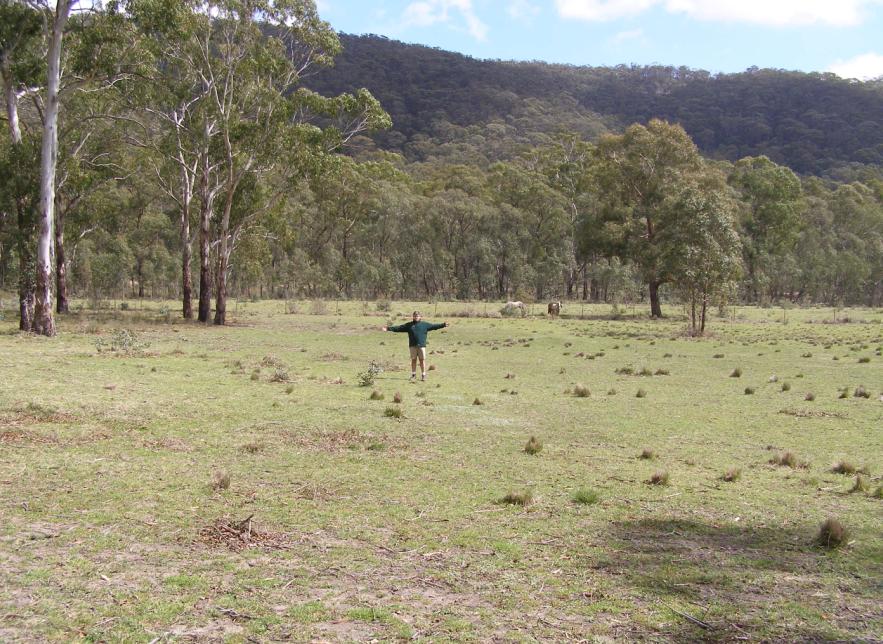 ‘Silverdale‘ property south of Hartley Vale. Editor standing at the exact Grid Reference GR 442842 documented by the New South Wales Rural Fire Service Section 44 Report’s ‘official’ location of the ignition of the Lawsons Long Alley bushfire which ‘officially’ was struck by lightning and caused the devastating 14,070 hectare Grose Valley Fires in the Greater Blue Mountains World Heritage Area of November 2006. (Bollocks!)