Archive for the ‘Threats from Bushfire’ Category
Monday, January 9th, 2012
This article was initially published on CanDoBetter.net 20090717 by Tigerquoll under the title ‘Victorian Bushfires – cost effectiveness of aerial fire-fighting [Bushfire CRC Ltd]’
. . .
In April 2009, Australia’s leading bushfire research organisation, Bushfire CRC Ltd, published another important report ‘THE COST-EFFECTIVENESS OF AERIAL FIRE-FIGHTING IN AUSTRALIA‘ by Gaminda Ganewatta & John Handmer, via the Centre for Risk and Community Safety, RMIT University in Melbourne.
The report has examined the cost effectiveness of aerial fire suppression in Australia and has made the following important and most relevant findings, which cannot be ignored by fire authorities and their politically disposed masters:
- The use of ground resources with initial aerial support is the most economically efficient approach to fire suppression!
- Aircraft are economically efficient where they are able to reach and knock down a fire well before the ground crew arrives!
- Rapid deployment of aerial suppression resources is important, especially in remote or otherwise inaccessible terrain!
- The sole use of aircraft is economically justified in the event of other suppression methods being unable to reach the fire event quickly!
- Critical factors are speed of deployment and turnaround time!
- Aircraft save more damage than they cost to operate, noting that high volume helicopters and fixed wing aircraft are economically more efficient in fire suppression, compared to small helicopters and large air tankers. Air tankers are less maneuverable compared to helicopters, thus their use in initial attack is not practical, unless used solely for large events!
.
So while Brumby’s Royal Commission ( Victorian Bushfires 2009) is working towards finalising its investigation into the Victorian Bushfires, this presents an opportunity for Fire Management to harness such relevant bushfire research.
Before next bushfire risk season key relevant bushfire research like this can be evaluated and the costs, budgets and business cases formulated to propose application to fire management operations.
But frankly can one lead a politicised brumby to water?
The following references provide useful illustrations and real life accounts of practical aerial fire fighting resource options out there (print them off and have a darn good read):
‘Helicopters: Stopping the Blazes‘ by Amanda N. Gustafson (2008) [Read publication]
[Source: ^http://www.rotormagazine.org/portals/24/pdf/winter2007_8/p64.pdf]
.
Tigerquoll
[Licensed Commercial Helicopter Pilot]
.
Saturday, January 7th, 2012
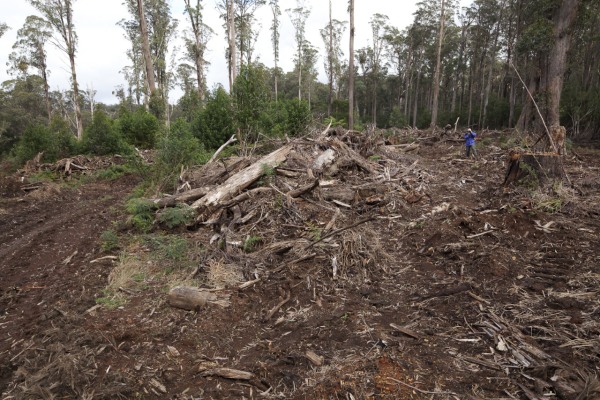
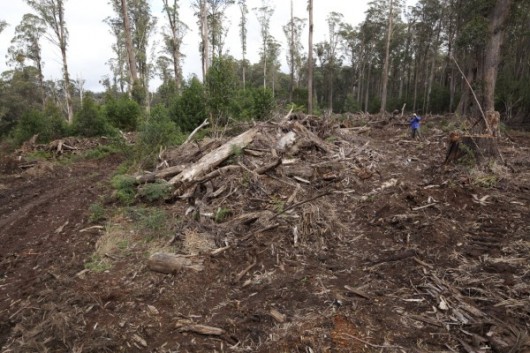 Cathcart State Forest (NSW) being logged in 2011
[Source: Australian Forests and Climate Alliance ^http://forestsandclimate.net/newsouthwales] Cathcart State Forest (NSW) being logged in 2011
[Source: Australian Forests and Climate Alliance ^http://forestsandclimate.net/newsouthwales]
.
Most of Australia’s native vegetation cover, over 75% of that predating the 1788 Colonial Invasion, has been ‘cleared’ – a euphemism for deforested, logged, destroyed, killed.
Today, as one travels around Australia and sees vasts areas of unproductive, degraded, denuded and abandoned farmlands – one questions why destroy more fragile environment? Yet the exploitative bastards are still hell bent on killing more native forest and bushland, even though they can’t properly manage the ‘already ‘cleared’ lands they’ve got. It is a short sighted insatiability, harking to a 19th Century ‘old blighty’ mindset of taming the land. It is deluded thinking that just because the native vegetation is green and looks fertile that it can be replaced for pasture and cropping and that new cleared land will be any different to that already cleared.
The Liberal-Labor governments and their rural National mates haven’t given a toss throughout the entire 20th Century and still couldn’t give a toss.
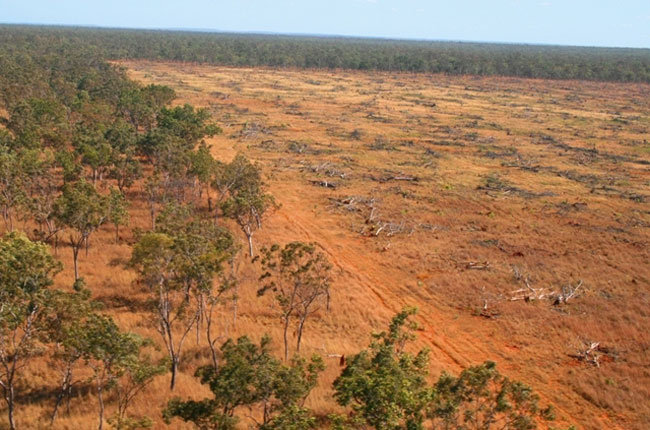
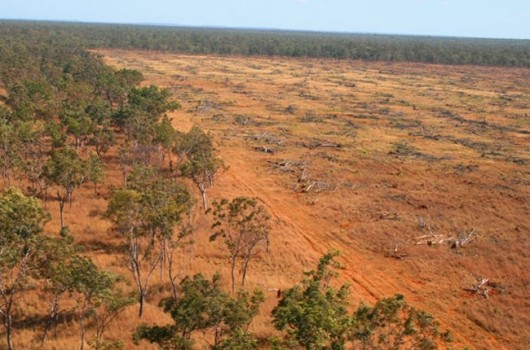 Recent land clearing in the Daly River catchment area
Northern Territory, Australia.
Photo: Environment Centre NT Recent land clearing in the Daly River catchment area
Northern Territory, Australia.
Photo: Environment Centre NT
.
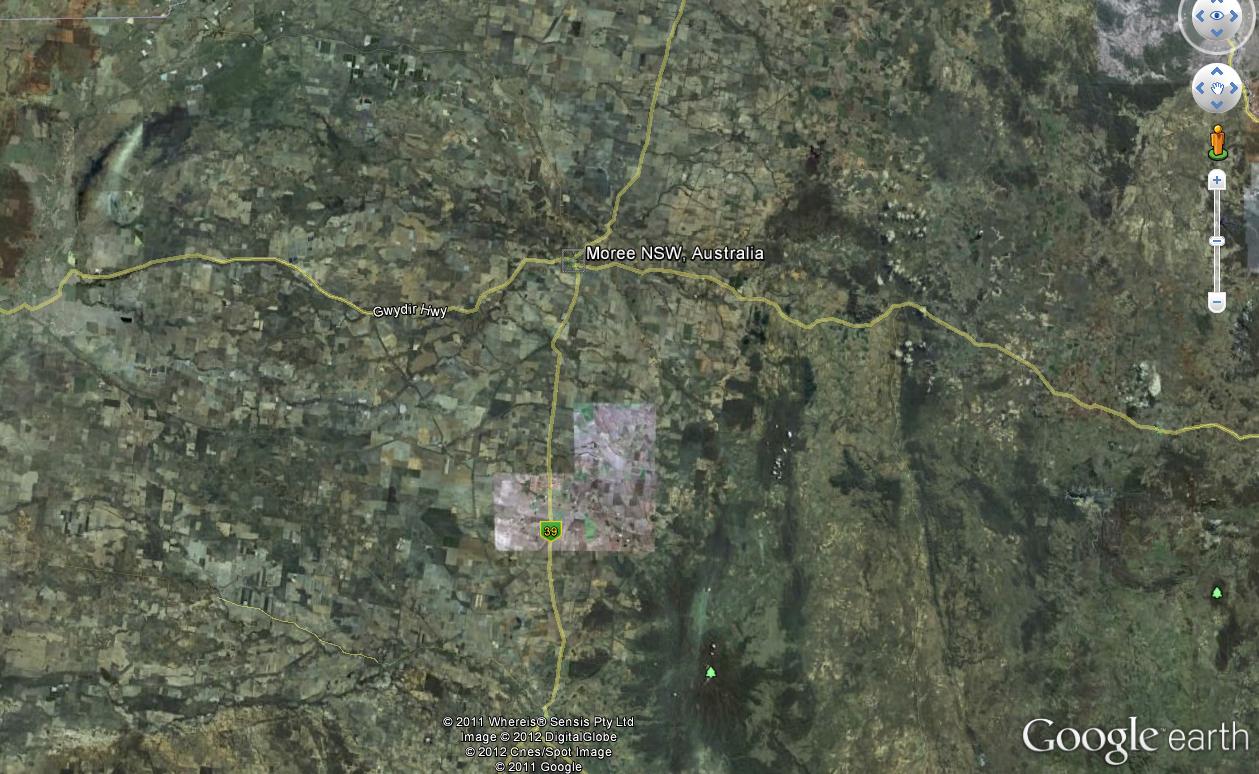
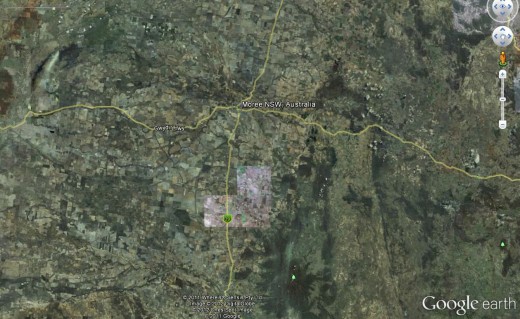 Moree region New South Wales – mainly deforested
Visit Google Earth and zoom into any area of NSW and see that most of it has been deforested
(click image to enlarge) Moree region New South Wales – mainly deforested
Visit Google Earth and zoom into any area of NSW and see that most of it has been deforested
(click image to enlarge)
.
Still across Australia in 2011, thousands of hectares of native forests continue to be deforested – albeit for farming, logging and development, or just bizarre bushfire abandonment. Not only is this occurring on private land, but in State Forests, which most people think are protected. Native forests on land are being cleared branded by State governments as ‘State Forests’ are simply not protected.
The native trees, flora and fauna are not protected from logging, bushfire, State-sanctioned arson (aka ‘hazard reduction‘), State napalming (aka indiscriminate ‘hazard reduction‘), indiscriminate State aerial poisoning with 1080, wildlife poaching, 4WD hooning, trail bike hooning, or even backpacker murdering. The watercourses (and the interconnected groundwater aquifers), that flow through State Forests are not protected from fishing, stormwater run-off, mine tailing contamination, farm pesticide and herbicide, industrial pollution.
.
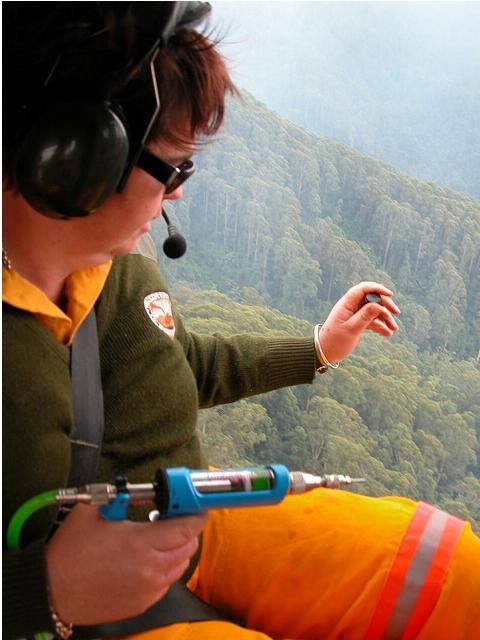 Helicopter Aerial Incendiary
Over Bindarri National Park, 20km south-west of Coffs Harbour, New South Wales
Yes, even our National Parks and Wildlife Service sets indiscriminate fires to National Parks! Helicopter Aerial Incendiary
Over Bindarri National Park, 20km south-west of Coffs Harbour, New South Wales
Yes, even our National Parks and Wildlife Service sets indiscriminate fires to National Parks!
.
For the likes of taxpayer funded government industrial loggers ‘State Forest’ is a euphemism ‘for not logged yet‘. This applies to the likes of Forestry Tasmania, VicForests, Forests NSW, Forestry SA (spot the naming trend), as well as the more aptly Queensland Department of Primary Industries and Fisheries, and likewise the Forest Products Commission of Western Australia.
It seems that doesn’t matter whether there is proof that there is an endangered and protected species such as the Long-Footed Potoroo in the Cann Valley State Forest or Drummer State Forest in Victoria, or protected Koalas in the Murrah/Mumbulla State Forests of New South Wales, or three identified endangered species, the wedge-tailed eagle, the swift parrot and the wielangta stag beetle in Tasmania’s Wielangta State Forests, the Liberal-Labor governments of those States turn a blind eye to deforestation.
It is only when self-funded local communities take the respective government logger to the Supreme Court and win that logging stops momentarily, such as in the recent Victorian Supreme Court case Environment East Gippsland Inc v VicForests [2010] VSC 335. In 2006, the Victorian State Government committed to increasing the conservation parks and reserves within the broader Brown Mountain area. Disregarding its elected master and ignoring any concerns for the ecological Precautionary Principle, State industrial logger VicForests, got stuck in with its mechanical clearfelling of old growth forests in the Brown Mountain area.
Not-for profit group Environment East Gippsland (EEG) self-funded and obtained numerous studies of the area indicated the presence of important threatened and rare species. EEG requested the Minister for Environment and Climate Change, Gavin Jennings, to make an interim conservation order to conserve critical habitat of the endangered Long-footed Potoroo, Spotted-tailed Quoll, Sooty Owl, Powerful Owl and Orbost Spiny Crayfish at Brown Mountain. Even then, the Minister for Environment and Climate Chang did not grant a conservation order, but instead increased the conservation area surrounding Brown Mountain. It took the overriding legal authority of the Supreme Court to stop the Victorian Government and its delinquent logger trashing protected old growth habitat.
 Victorian Labor Minister for Environment (etc), 2007-2010 Victorian Labor Minister for Environment (etc), 2007-2010
.
In March 2010, Forests NSW began controversial logging operations in the Mumbulla State Forest, south of Bermagui on the state’s far south coast. Despite being criticised, after a recent survey identified the forest as a key colony for the region’s remaining koala population, Forests NSW Regional Manager Ian Barnes says the logging must go ahead across 240 hectares of the forest, in order to satisfy a supply agreement with the timber industry.
 Deforestation is all about lining ones pockets out of ecological wanton exploitation
It’s a ‘wam bam thank you mam’ approach no different to what the Vikings did to the British in the eight Century.
Colonial Australians and their descendants are doing the same to Australian ecology in the 19th, 20th and 21st Centuries. Deforestation is all about lining ones pockets out of ecological wanton exploitation
It’s a ‘wam bam thank you mam’ approach no different to what the Vikings did to the British in the eight Century.
Colonial Australians and their descendants are doing the same to Australian ecology in the 19th, 20th and 21st Centuries.
Mr Barnes says the logging will not affect the koala habitat. “We’ve taken quite some effort to avoid any possible conflict there,” he says. “As anybody who reads the recent report will know, the koalas have been found in the eastern side of the forest, and our logging is planned for the western part, as far away as we can get from the koalas.”

Despite assurances, anti-logging campaigners have organised a vigil in the forest in an attempt to stop the logging. Conservationist Prue Acton says the activity will devastate the koala population.
“Why risk the only healthy koala colony left in the far south coast. For what? “ she said. “95% of what is going to be logged is going to end up at the Eden woodchip mill, be shipped to Japan for cheap copy-paper. What a disgrace.”
The Greens MP Lee Rhiannon says the Premier should put the protection of koalas ahead of the interests of logging companies. “The New South Wales Government has refused to end logging in the south east native forest but they should step in and stop the destruction of the koala habitat,” she said.
[Source: ‘Logging begins near key koala habitat‘, ABC, 20100330, ^http://www.abc.net.au/news/stories/2010/03/30/2859615.htm?site=southeastnsw]
.
‘Loggers are clearing bushland at rising rate‘
[Source: ‘Loggers are clearing bushland at rising rate’, by Ben Cubby, Sydney Morning Herald, 20111221, ^http://www.theherald.com.au/news/national/national/general/loggers-are-clearing-bushland-at-rising-rate/2399764.aspx?storypage=0]

The amount of bushland being cleared by logging in NSW soared last year to the highest level since state-wide records began in 1988. An area equivalent to 138,400 football fields was cleared for crops, forestry or infrastructure, says a government report.
The Office of Environment and Heritage said the rise in logging was probably cancelled out by regrowth, leading to no net loss of trees, though its most recent survey took place in 2008, before the land clearing spike. It said the reasons for the logging increase were unclear.
”[The] most likely factors relate to market demand and favourable climatic conditions and [they] can be expected to fluctuate over time,” a department spokesman said. ”It is also possible that recent changes in forestry methods are more readily detectable by satellite monitoring.”
Environment groups said the annual vegetation report was evidence that logging companies were operating in an unrestrained manner.
Bushfires remain the biggest destroyer of forests in the state, leading to a net loss of 48,300 hectares in 2010, the report said.
.
But logging activities now come a close second, accounting for the removal of 42,700 hectares of trees in 2010. This is up from 31,000 hectares the previous year, and an average of about 21,000 hectares a year since 1988.
About 21,200 hectares of bushland was cleared in 2010 to make new areas for crops and grazing, while 5300 hectares were cut down to make way for roads, factories and housing.
”The NSW government is currently conducting a review of native vegetation controls,” said the chief executive of the Nature Conservation Council of NSW, Pepe Clarke. ”They should take this report as a warning – what is required are stronger land- clearing laws that do more to protect the environment, not weaker ones.”
The Wilderness Society said the government had ”failed in its promises to restrain land clearing, resulting in rapid and accelerating degradation of wildlife habitat and water catchments.”
The most recent State of the Environment report found that there had been no net loss of ”woody cover” across NSW between 2003 and 2008.
”This is because, although clearing has occurred over that period, there has also been an equivalent amount of regrowth including government sponsored environmental and forestry planting programs conducted by private landholders and state forests, within crown forests areas,” the department said.
”Notwithstanding no net loss over the whole state, some regions have experienced net declines in woody cover.”
The report uses the international definition of ”woody cover”, which includes land at least 20% covered by the crowns of trees higher than 2 metres, a description which would include relatively open country.
The introduction of a satellite monitoring system for land clearing last year appears to have increased the level of prosecution for illegal land clearing on private property. On crown lands, the number of prosecutions has increased threefold, from a low base, since 2007.
In 2010, the government received 471 reports of suspected illegal land clearing.
.
‘Landowners sent satellite images identifying land clearing‘
[Source: ‘Landowners sent satellite images identifying land-clearing’, NSW Department of Environment (etc), Media release: 14 May 2010, ^http://www.environment.nsw.gov.au/media/DecMedia10051404.htm]
.
NSW Department of Environment Climate Change and Water (DECCW) today began a high tech education campaign to encourage compliance with native vegetation laws by sending letters to landholders including before and after satellite pictures identifying land clearing.
DECCW Director-General Lisa Corbyn said the letters were part of an ongoing education program to encourage compliance with the laws and inform landowners of the proper channels available to them if they want to clear native vegetation.
“We’ve been using satellite technology for some time to identify changes in vegetation cover that may warrant further investigation,” Ms Corbyn said.
“Now we are also using the technology as an education tool. From today, advisory letters will be sent to landowners including before and after satellite pictures showing that vegetation has been cleared on their land.”
Ms Corbyn said the letters aim to inform to the landowner that the satellite imagery has picked up that vegetation had been cleared and highlight the proper channels available to them under the legislation to allow clearing of native vegetation, such as property vegetation plans.
The letters support other tools used by DECCW to encourage compliance with the legislation, including strategic investigations, prosecutions, penalty notices, stop work orders, remedial directions, warning and advisory letters.
The letter also alerts landowners to incentive funding available to restore and protect native vegetation on their properties.
The Native Vegetation Act was introduced in 2003 to bring an end to broadscale land-clearing in NSW. Since then, more than 400,000 hectares of native vegetation has been conserved or rehabilitated on private land through property vegetation plans (PVPs) and 1.6 million hectares has been managed for thinning and invasive native scrub management.
.
Over 60 % of the native vegetation in NSW has been cleared, thinned or substantially disturbed.
.
The impacts of native vegetation clearing have included the extinction of 77 plant and animal species, soil erosion, increased dryland salinity and a decline in water quality.’
.
2003: ‘Clearing rate in NSW 116,000 to 216,000 hectares per year: NSW Govt report’
[Source: ‘Clearing rate in NSW 116,000 to 216,000 hectares per year: NSW Govt report’, by Stephanie Peatling, Environment Reporter, Sydney Morning Herald, 20031117, ^http://www.sydneyalternativemedia.com/id64.html]
.
The equivalent of up to 200,000 football fields may be illegally stripped of native trees and grass each year in NSW, figures suggest.
The first estimates on the extent of the clearings, which the Department of Natural Resources field staff prepared for the Government’s vegetation taskforce, suggest the figure could be as high as 100,000 hectares a year. The figures show between 150,000 hectares and 560,000 hectares were illegally cleared between 1997 and 2002.
The advice is the first official guess at NSW’s illegal clearance levels. The highest rates are in the Barwon, Central West and Far West regions where much of NSW’s remaining native vegetation is located.
The figures have shocked environmentalists, who stress the urgency of making changes to the state’s natural resource management system, which Parliament is debating this week.
A Wilderness Society campaigner, Francesca Andreoni, said: “The new system needs to be fair to everyone, particularly farmers doing the right thing.
“The shocking extent of illegal clearing confirms the urgent need for the Government to implement its decision to end broadscale clearing.”
Figures recording the rate of illegal land clearing each year are almost impossible to compile because it so hard to charge people who breach native vegetation laws. There is also a complicated system of exemptions which allow people to clear land for purposes such as maintaining fire access trails.
Monitoring illegal clearing is potentially dangerous for departmental compliance officers. After reports of illegal clearing earlier this year on a property near Nyngan, in the state’s west, department officers were prevented from entering the property by an angry crowd of up to 150 people.
.
When the amount of land illegally cleared is added to land that is legally approved for clearance, the department estimates between 700,000 hectares and 1.3 million hectares of land were cleared between 1997 and 2002.
.
The figures suggest clearing was faster than the Department of Natural Resources’ previously admitted figure of about 60,000 hectares a year. That figure would give NSW the second-highest clearing rate in the country behind Queensland.
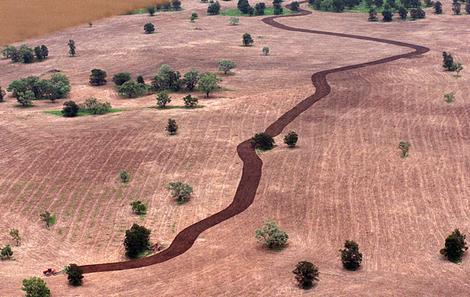
Debate on the Government’s package to overhaul native vegetation laws, based on an election promise to end broad-scale clearing, will take place this week. Last month the Premier, Bob Carr, announced a $406 million deal between farmers and environmentalists to end broad-scale clearing.
Most of the money is expected to go towards such things as tree planting and fencing waterways to help counter salinity and erosion. But local authorities may also compensate farmers for not clearing land. Clearing will still be allowed where it is deemed environmentally necessary.
Under the new system, natural resource management is being overhauled. Thirteen catchment management authorities will replace 19 catchment management boards, 20 regional vegetation committees and 33 water management committees.
Scientists often name land clearing as one of Australia’s most urgent environmental concerns. It contributes to soil salinity, loss of biodiversity and greenhouse gas emissions because carbon dioxide is released into the atmosphere when the cleared timber is disposed of, usually through burning.
.
‘Green groups attack logging growth’
[Source: ‘Green groups attack logging growth’, by David Bancroft, My Daily News, 20111229, ^http://www.mydailynews.com.au/story/2011/12/29/green-groups-attack-logging-growth/]
.
Environment groups have banded together to criticise the level of logging occurring in New South Wales. The Nature Conservation Council, The Wilderness Society, National Parks Association, the Northern Inland Council for the Environment and the North Coast Environment Council have issued a joint warning that iconic and endangered species are being threatened by land clearing.
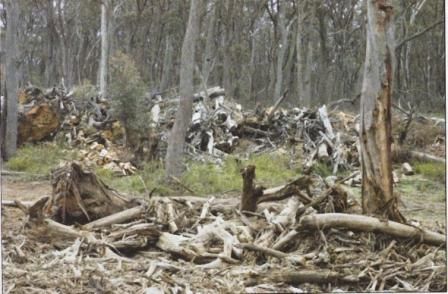 Illegal deforestation for fire wood, near Taralga, on the western edge of the Blue Mountains
Source: ^http://www.orchidsaustralia.com/article_%20conservation_no3.htm Illegal deforestation for fire wood, near Taralga, on the western edge of the Blue Mountains
Source: ^http://www.orchidsaustralia.com/article_%20conservation_no3.htm
.
In a joint press release, the groups said the NSW annual report on native vegetation released by the Office of Environment and Heritage (Ed. yet another money wasting name change) this month showed 2009/10 was the “worst year on record for clearing of native bushland”.
.
The Wilderness Society campaigns manager Belinda Fairbrother said the report showed that in 2009/10 an area equating to 138,400 football fields was cleared for crops, forestry or infrastructure.
.
“This is higher than any other year since records commenced in 1988 and shows the NSW Government has failed in its promises to restrain land clearing, resulting in rapid and accelerating degradation of wildlife habitat and water catchments,” she said.
North Coast Environment Council president Susie Russell said the report made a sad end to the International Year of Forests.
“The area cleared for forestry in 2009/10 was almost five times greater than it was in 1988/89,” she said.
“It reveals a massive increase in the rate and intensity of logging in NSW, which will be causing untold damage to the extraordinary high diversity forests of north-east NSW.”
Nature Conservation Council chief executive officer Pepe Clarke said land clearing was recognised as the single greatest threat to wildlife in Australia.
“It causes the death of birds and animals, the extinction of species, leads to the poisoning of soils from salinity and makes a major contribution to global warming,” he said.
.
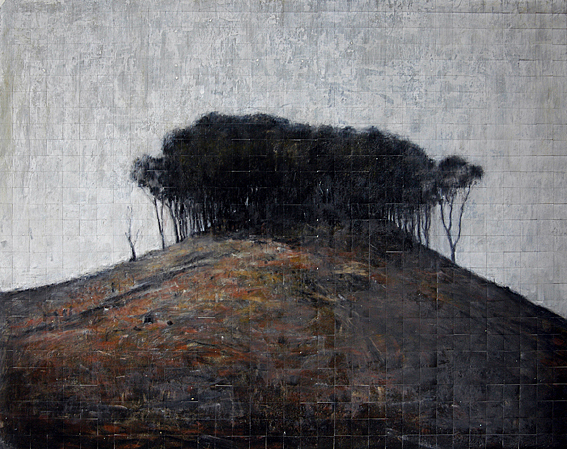
 The Liberal-Labor Party ‘Island Vision’ for Australia’s State Forests
‘The Hill’ (Penrose State Forest, NSW) 2007, drawing by James King The Liberal-Labor Party ‘Island Vision’ for Australia’s State Forests
‘The Hill’ (Penrose State Forest, NSW) 2007, drawing by James King
^http://www.jamesking.com.au/drawings.html
.
Tags: 1788 Colonial Invasion, Cathcart State Forest, deforestation, Eden woodchip mill, fire wood, Forests NSW, Google Earth, hazard reduction, Helicopter Aerial Incendiary, Island Vision for Australian State Forests, koala habitat, land clearing, Logging, Long-footed Potoroo, Murrah/Mumbulla State Forests, not logged yet, Orbost Spiny Crayfish, Powerful Owl, precautionary principle, Sooty Owl, spotted-tailed quoll, State-sanctioned Arson, VicForests, Wielangta State Forests
Posted in Koalas, Owls, Quolls, Threats from Bushfire, Threats from Deforestation, Threats from Farming | No Comments »
Add this post to Del.icio.us - Digg
Friday, January 6th, 2012
[This article was initially published by Tigerquoll on CanDoBetter.net 20090626, in the aftermath of the Victorian Bushfires which conflagrated on 20090207]
.
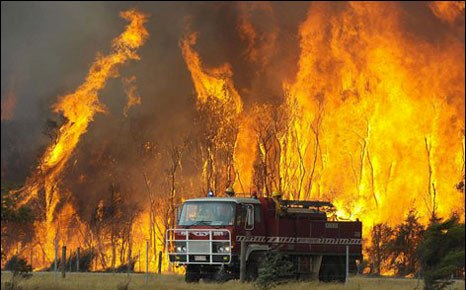
The Australian Press Council has just dismissed a complaint against Sydney Morning Herald columnist Miranda Devine about her ‘opinion’ article back on 12-Feb-09 ‘Green ideas must take blame for deaths.’
But although provocative, Devine’s ‘opinion‘ article pales in comparison to the social implications of headline media reporting of extreme bushfire risk immediately BEFORE the bushfires! [‘Complaint against Devine dismissed’, SMH, 26-Jun-09, p.5]
Note that the date of the article was made while fires still raged. Also, note that the article was published on the front page of the Herald, indicating that the editor was unusually highly supportive of it. Normally, the Herald’s ‘Opinion and Letter’s‘ articles are printed way back around page 12.
The main inflammatory bits drawing criticism in Devine’s article were:
.
“It wasn’t climate change which killed as many as 300 people in Victoria last weekend…it was the power of green ideology over government to oppose attempts to reduce fuel hazards before a megafire erupts.” [and] “If politicians are intent on whipping up a lynch mob to divert attention from their own culpability, it is not arsonists who should be hanging from lamp-posts but greenies.”
 . .
Clearly, the article’s emotive tone expresses anger, frustration, retaliation and spiteful provocation. Perhaps this is understandable given the scale of the disaster and public shock, disbelief and for many, the personal loss. People react in their own way to tragedy. Devine’s article upset many and presumably it was intended to in order to unseat entrenched community complacency about Australia’s bushfire management generally.
If so I agree with her motive, but not her method.
The Australian Press Council considered the article’s lead paragraphs as ‘dogmatic’ and ‘confrontational’. But the complainants asserted that the article breached a number of Press Council principles. Yet the Press Council’s principles or journalism are vague and advocate the rights of journalists rather than prescribing responsibilities. The principles include noble motherhood ideals such as being accurate, fair and balanced, not being misleading, acting in the public interest and not being biased against minority groups. So then perhaps the complainants were misguided and it is not surprising that the Press Council found that publicising the article didn’t breach any of these principles.
Devine was accused of incitement in her article, which is a fair interpretation.
On Crikey, Greg Barns questions whether Devine’s article incited violence. He suggests that in “these fraught times, where there is a smell of blood in the air as well as smoke, as communities, individuals and the media look to find someone to blame for the Victorian bushfires, are just the environment where incitement flourishes.” Barns goes on: “To date no one appears to have acted on the inflammatory statements of Ms Devine and her fellow sabre rattlers, but that does not matter, says the law. It is enough that the incitement to commit a offence occurs, it is irrelevant that no one acted on the statement made.”
[Source: ^http://www.crikey.com.au/2009/02/17/did-miranda-devine-incite-violence/]
.
In the press at the time, local anger in Gippsland was palpable and vigilante feeling clearly was at breaking point. But it was targeted at the arsonists.
No-one rationally can blame the conservation movement and its ecological principles for the Victorian Bushfires. The bush and its creatures were innocent victims of the fires, just like people, livestock and houses. Many tend to forget this in the wake of such enormous tragedy. But one must blame the arsonists.
Yet it wasn’t apparently just arsonists that caused the ignitions and it is the task of Brumby’s Royal Commission to investigate and find out the causes of all the ignitions. However, thereafter, the real problem solving should start, but I doubt Brumby will have the will and instead will want to close the political door on the bushfire tragedy – just like the bushfire investigations of the past and interstate.
.
But let’s turn more importantly to the media incitement before the bushfires!
The Age newspaper in Melbourne during the Victorian heatwave through January and early February 2009 immediately preceding the bushfires, ran headlines repeating the extreme bushfire risk. On 6 February 2009, the day before the fires started, indeed the Premier of Victoria John Brumby issued a warning about the extreme weather conditions expected on 7 February:
“It’s just as bad a day as you can imagine and on top of that the state is just tinder-dry.
People need to exercise real common sense tomorrow”.
.
Was this wise?
To serial dormant bush arsonists and to would be arsonists, this frenzied media excitement about such pending doom surely would have been been read by arsonists and I suggest directly incited the bush arson. Yet at the time there was no complaining or realisation of this.
If bush arsonists are found to have been the key causes of the ignitons and indeed of the most catestrophic firestorms that burt alive people for instance Marysville and Kinglake, then the investigation must focus on the root cause of the arsonist motivations. I argue that media arousal through its sensationalising of the bushfire risk and its portrayal of the bushfire threat is directly responsible and accountable for actual bush arson. Let’s see what the Royal Commission concludes.
.
Compare the Media Restrictions on Reporting of Suicide
.
Getting back to the subject of press responsibility, let’s look at where the Press Council actually prescribes reporting restrictions on journalists.
Take the subject of media reporting of suicide.
In the Council’s General Press Release No. 246 (i) (July 2001) on Reporting of Suicide, The Press Council:
“calls upon the press to continue to exercise care and responsibility in reporting matters of suicide consistent with government attempts to curb the suicide rate. Research shows that an association exists between media portrayal of suicide and actual suicide, and that in some cases the link is causal. So the Press Council recommends journalists avoid reporting which might encourage copy-cat suicides and which unnecessary references details of or the place of a suicide, or which uses language which trivialises, romanticises, or glorifies suicide.”
[Source: ^http://www.presscouncil.org.au/pcsite/activities/guides/gpr246_1.html]
.
So on the sensitive topic of suicide, the Press Council is quite prescriptive, moreso than in its broader principles for journalists rights.
Serious thought needs to be given by all levels of government and by the Press Council as the media industry’s representative body to the reporting of bushfire risks. Just as links can be drawn between the media portrayal of suicide and actual suicide, causal links can be drawn between the media portrayal of bushfire risk and bush arson arousal.
This is a matter for criminal psychology. Media sensationalising of bushfire risk and of bush arson is known to incite bush arson and copy-cat bush arson. This is a little known and neglected form of social deviant behaviour, yet it has become increasingly prevalent and deadly.
There is an urgent need for national level investment into bush arson criminology research and investigations. Media rights and responsibility for reporting bushfires play a critical role, perhaps more than many of us realise.
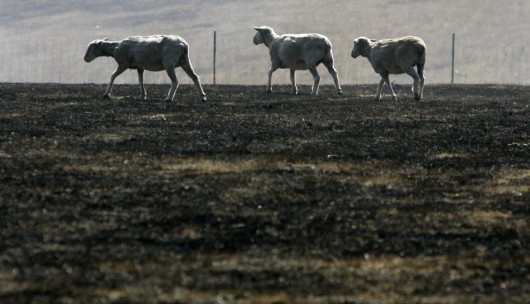 . .
Editor’s submission to ABC Four Corners ahead of its programme ‘Two Days in Hell’ aired 20090216
[Source: ‘Two Days in Hell’, by Reporter Quentin McDermott, ABC TV Four Corners programme, ^http://www.abc.net.au/4corners/content/2008/s2489831.htm]
Dear Quentin,
Thank you for highlighting this perennial problem.
The Australian Institute of Criminology reported last month that half of Australian bushfires are deliberately lit. Bushfire research needs to go further to evaluate whether in fact of the most damaging most are deliberately lit.
Test: If one excluded arson ignitions and their related spotover fires (between 29 Jan at Delburn to 8 Feb) would the firestorms have occurred? Assuming the answer is no, then clearly arson must be Australia’s key focus in combating the impacts of bushfire. Unlike the other two causes of bushfire, (lightning and accident) which are random, bush arson targets the worst conditions, upwind of a specific target and often involving multiple ignitions.
The term ‘fire bug’ is too docile and to start seriously dealing with it, we must change the perception and the language. Bush arson has become so deadly and catastrophic a crime that it warrants the term ‘pyroterrorism’. See the application of this term in the recent California fires. [^http://www.lilith-ezine.com/articles/thepyroterroristsarecoming.html]
The forthcoming Royal Commission into the Victorian Bushfires of 2009 risks concluding similar theme recommendations as the 2004 COAG Enquiry into the 2003 Canberra Firestorm, which itself repeated those of many previous bushfire enquiries. The implementation of any recommendations requires budget, timeframe and an independent federal watchdog accountable to the public. I will be analysing its terms of reference.
Aside from serious resourcing of bush fire fighting (nationalising it, building approvals, building codes, etc), the key systemic problem is the cultural disconnect between bushfire research and fire fighting practice. Criminal arson investigation needs to be a permanent and dedicated arm of bushfire management, properly resourced with primary data collected from all Australia and overseas using the best criminal psychologists and with a proactive mandate.
In NSW, the government set up Strike Force Tronto to investigate serial bush arsonist after the Christmas 2001 bushfires. Then the government got complacent, other priorities emerged and it was disbanded in 2005.
But following a series of arson bushfires in 2006 (with houses lost in (Picton and Cattai) the force was reinstated on 26 Sep 06 (Daily Telegraph p1). Reactive sporadic resourcing of bush arson investigation clearly isn’t effective.
To seriously address the main cause of deadly bushfires, a national organisation needs to be permanently established and perpetually funded to focus on criminal investigation into bush arson/pyroterrorism with a mandate to recommend deterrent policies and practices across Australian bushfire fighting as well as the media.
Media reporting leading up to the 7-Feb-09 firestorms, simply incited dormant serial arsonists. Go back and read The Age and television media in the days before and after 29 Jan when the first bush arsonist struck at Delburn (south wast of Churchill). The front page of The Age on Saturday 7-Feb-09 read: ’44 degree heat “as bad a day as you can imagine”
– which was a quote from of all people the Victorian Premier made to the general public the day prior.
Just like the media policy of not reporting suicides due it being known to encourage copy cats, so too media reporting of heatwaves and of extreme bushfire conditions needs to be tempered to avoid inciting dormant serial arsonists.
.
‘The Fire Starters’ – ABC TV Four Corners programme of 2003 about bush arson in NSW, following a spate of bush arson
[Source: “The Fire Starters”, ABC TV Four Corners programme, 20030224, ^http://www.abc.net.au/4corners/content/2003/20030224_fire_starters/default.htm]
.
‘It’s a summer ritual: fire fighters across Australia battling hundreds of bushfires, putting themselves at risk to save other people’s lives and property. But these men and women are confronting dangers they should never have to face. While most fires, like the recent Canberra inferno, are ignited by lightning strikes or by stray sparks, investigators say a growing proportion of fires are being deliberately lit – by serial arsonists playing havoc in the bush.
As Australia tallies the cost of one of its worst bushfire seasons, Four Corners looks at the devastation that firebugs wreak on the landscape and the fear they generate in vulnerable communities. Reporter Stephen McDonell focuses on two communities where a firebug has been at work. In one case the arsonist has been caught and jailed; in the other the offender remains at large, apparently still living among anxious neighbours who suspect his every move.
McDonell builds a profile of offenders who typically crave power and status. For all their fundamental inadequacies, arsonists often presents normally enough to other people – even to their fellow volunteers in the local fire service. Authorities are fighting a difficult battle against these elusive, superficially unremarkable people, whose crimes rely on secrecy, solitude and destruction of evidence.’
.
Interview by ABC journalis Stephen McDonell with NSW Police Assistant Commissioner John Laycock (edited transcript):
.
STEPHEN MCDONELL: It’s been suggested by some people there should be a full time arson squad in NSW, do you think that we’re getting to the stage where that’s what we need?
ASSISTANT COMMISSIONER JOHN LAYCOCK: Well there is at the moment. With the establishment of Strike Force Tronto last year, that will be ongoing on a needs basis and we saw very quickly in October this year how quickly that Task Force got up and running.
STEPHEN MCDONELL: You don’t think though there’s a need for developing some expertise in the area, have a team specifically designed just to look at arson?
JOHN LAYCOCK: Well, we have that now with Strike Force Tronto and in addition to the permanent team, we’re also training up investigators right across the state to look at the fire investigations across the board so we’re fairly well on top of that now.
STEPHEN MCDONELL: Can you just tell us the thinking that’s led to you having a team that is assembled as the need arises rather than having a full time squad?
JOHN LAYCOCK: Look Strike Force Tronto is virtually full time on a needs basis. We started off in 2001 with the large volume of fires in the state. It took a little time to get that up and running but that expertise and the database and the skill they’ve learnt from that has now flowed to, very quickly, starting up (Strike Force) Tronto II. So, whilst ever the actual need is there, the strike force will be there to assist. In addition to that, you’d normally find that between bushfires or wild fires there’s a three or four year gap. We have 94, 97, then 2001, on this occasion we’ve had two years in a row so the need this year is unusual to say the least.
STEPHEN MCDONELL: If you were asked if bushfire arson is getting worse, what would you say to that?
JOHN LAYCOCK: No I don’t think so. I think the reporting of it has improved. All our local area commands now are on the scene as soon as it occurs, they’re investigating the fires straight away. In the past that might not have always been the case. With Strike Force Tronto up and running, all fires are investigated and eliminated: whether it’s accidental or lightning or what have you and others are put aside for further investigation.
STEPHEN MCDONELL: So you don’t think we’re getting more bushfire arson?
JOHN LAYCOCK: I think the community’s become more up to date and aware of arsonists being involved. The majority of our people apprehended are done by information from the public and, in a lot of cases, actually apprehended by people from the community and people are just sick and tired of people being involved lighting fires so they’re doing something about it which is great.
STEPHEN MCDONELL: So, in other words, are you saying that while the statistics might bear out something of an increase, it’s really just that more people are being caught?
JOHN LAYCOCK: That’s one interpretation. In addition to that: our scientific skills, our forensic skills – with both the Rural Fire Service and the NSW Fire Brigade, with our own forensic people – have enhanced tremendously. Technology has increased. There’s a lot more out there that we can use, we can tap into, and plus the skill level of our people on all fronts has also increased.
STEPHEN MCDONELL: Just on the question of your ability to investigate bushfires, what would you say is the area that has come on the most, that is changing the fastest and is enabling you to catch people?
JOHN LAYCOCK: Look without doubt the technology, our forensics, the scientific people, our research people. We tap into overseas data; we tap into overseas experts. Our own local people here are well down the road to being able to fully investigate a fire, to track it from A to Z, with help from the community. Our crime scene investigation has enhanced tremendously and it’s improving all the time. There’s satellite inventory; there’s aerial photography; there’s video links; there’s a whole raft of things we can tap into now.
STEPHEN MCDONELL: I’ve seen some statistics that show that while the offending appears to be going up, the clear up rate remains static, what would you attribute that to?
JOHN LAYCOCK: Probably wouldn’t agree with that entirely and I think I can play with figures with the best of them. For example, in our 2001 fires, there were 22 people charged straight out with arson. There was another 130, 140 odd processed for various breaches, minor breaches of the Rural Fires Act and other Acts of parliament. None of those persons have re-offended again this year to our knowledge. Now most arsonists I think you’d have to agree are not sort of rocket scientists and one would expect that, if they were continuing to offend, they would be apprehended. That hasn’t occurred. So I don’t think the clear up rate has decreased per se. I think the instance of reporting and investigation activity has increased.
STEPHEN MCDONELL: What do you think that those statistics tell us about the impact that catching people has on their likelihood of them re-offending when it comes to bushfire arson?
JOHN LAYCOCK: Look, again, with the number of people we’ve processed – from those that went to gaol, to those who were fined, cautioned or were conferenced – none of those people have re-offended to our knowledge, which indicates whatever process did take place, whether it be gaol or a caution or bond or what have you, has worked in that case. In addition to that, all persons processed have been, their details have been given to our our local area command so at the first sign of an investigation being required, those people would have their names up as a possible suspect to get looked at so the heat is on if I can use that phrase for those people locally in the first instance.
STEPHEN MCDONELL: We’ve spoken to one person who suggested that part of the problem with catching people when it comes to bushfire arson is that crime scene can be totally destroyed, especially if the fire moves over it a couple of times, would you agree with that?
JOHN LAYCOCK: Probably to the contrary and our forensic capacity with the Rural Fire Service, the Fire Brigade, our own forensic people now has increased to the extent that we can get a lot of information from the crime scene long after the fire has gone.
STEPHEN MCDONELL: So, even if a big fire has moved through an area, there’s still a lot there at the crime scene?
JOHN LAYCOCK: There’s a lot of signs, there’s a lot of expertise, and we tap into a lot of stuff still left behind and, as I keep saying, cold fires leave hot trails.
STEPHEN MCDONELL: How sophisticated would you describe the bushfire arsonists as compared to other criminals?
JOHN LAYCOCK: Not very sophisticated: they’re certainly not rocket scientists. Arson is an unusual crime because there’s no financial profit or gain. There’s normally no great planning goes into it: it’s unusual, to say the least. I think that the people involved are possibly not of brilliant intelligence.
STEPHEN MCDONELL: Do you think that, across Australia, we’re doing enough to catch bushfire arsonists?
JOHN LAYCOCK: Look we can always do more but here in NSW the community is up and running. The number of reports we get through crime stoppers, continually, for the police to act upon is encouraging to say the least. The number of a people apprehended at fire scenes, lighting fires where people got out of their cars and physically grabbed hold of them where they’re capable of doing it and just hand them over to the police just shows a no nonsense approach. The three organisations working together -with the Rural Fire Service and the Fire Brigade – it’s ongoing, I think we’re doing a lot, we can always do more but, as each year goes on, our expertise increases.
STEPHEN MCDONELL: Do you ever worry about discussion in the media relating to bushfire arson: that it might encourage copycat behaviour?
JOHN LAYCOCK: And certainly I think that does occur (but) to what extent…? but we have to weigh up the public interest – the need for the public to know what is happening around them. We’ve found, with the community support, with the open campaigns we’ve been running, they’ve been nothing short of outstanding.
STEPHEN MCDONELL: If we could just look at why one of the cases that your team has dealt with, the Burgess case, can you just tell us, from the outset, what the idea was in terms of when you heard that he was hanging around this brigade in the Blue Mountains, what did you intend to do, especially in relation to that brigade?
JOHN LAYCOCK: We first got some information not long after the fire season started in relation to that offender and I can only speak in general terms. Information is fine but we needed sufficient evidence to place him before a court, it was obvious to us that he was a very firm suspect. We then tapped into the support from the Rural Fire Service. We spoke to the executive and we virtually placed him under surveillance. They did report issues to us. We had our surveillance teams actually follow him from site to site. In the meantime, in the background, our forensic people were linking the crime scenes together and, of course, you’re aware he’s virtually working from one part of the state to the other – from the Central Coast down to Albury and then up to the Blue Mountains, so a fairly wide area – but we were able to link him into all those scenes. Our surveillance people tracked him into places where fire had been lit, just a painstaking good thorough investigation by Strike Force Tronto Police.
STEPHEN MCDONELL: Now, for people who don’t know much about crime and the detection of crime, can you explain what this linking of the crime scenes was and how significant that was?
JOHN LAYCOCK: It was quite significant because each offender has their own way of doing things or committing a crime – quite, sort of, peculiar to anybody else – so no arsonists would work alike, as a general statement. So the way in which the fires are lit at all locations were almost identical and that gives us a guide only to the fact that he was the person responsible. But it’s not just the crime scene, it’s sightings, information from other people in the community, people from the Rural Fire Service that felt things weren’t quite right, that was all fed into our system to give us enough to get out and charge him.
STEPHEN MCDONELL: So, is this right, it was something like that there was a pattern to his behaviour, is that right, that he was doing similar sorts of things?
JOHN LAYCOCK: There was a pattern to the way he was committing the offences, which showed very promising signs to us.
STEPHEN MCDONELL: What could you say about Burgess’s behaviour that led you to actually apprehend him?
JOHN LAYCOCK: It wasn’t so much his behaviour, I think it was the investigation results from behind the scenes. Evidence from witnesses, admissible evidence we could place before a court, the linkages between the forensics at the crime scenes and the fact that we were able to place him at those particular sites either before, after or during a particular fire breakout. That’s the cold hard evidence that we need.
STEPHEN MCDONELL: I think you were saying something before about his behaviour being consistent and that, because he didn’t vary it so much, you were able to say right, bang, bang that he did all those, lit all those fires. Can you just tell us a bit about that?
JOHN LAYCOCK: Yeah, look we have to prove each individual fire by itself. We just can’t say that we think it’s him because all the fires appear to have lit the same way. We need admissible evidence to place before a court to put him at the scene and, what happens at the crime scene, there’s only a small part of the jigsaw. So each investigation needs to be complete and be able to stand in its own right but the common factor was the linkage between the crime scenes.
STEPHEN MCDONELL: Can you tell us a bit about how Cameron Burgess’s behaviour assisted police in catching him?
JOHN LAYCOCK: I think: in the way that he exposed himself to other members of the fire fighting fraternity; that he was always there at the crime scene, he was in the locations at the time when the fires went up; on occasions he actually went to help fight the fire, it didn’t do him any favours when we started putting the brief together.
STEPHEN MCDONELL: So you could see the same sorts of things coming up again and again?
JOHN LAYCOCK: There was a pattern there but there was also admissible evidence that we could use and place before a court.
STEPHEN MCDONELL: What was found out about Cameron Burgess’s mental state?
JOHN LAYCOCK: According to the psychologist’s report that was tended to the court at the time, he had no mental illness or condition, probably can’t comment too much further than that.
STEPHEN MCDONELL: Was there anything significant about this Burgess case?
JOHN LAYCOCK: Look all police investigations are virtually quite different but the one thing that struck out with him was that he was operating in such vast distances away from each other: the Central Coast, Albury, Wagga and the Blue Mountains, entrenching himself in with the local fire fighting sort of type community and committing offences of that nature. It was quite unusual. Most arsonists tend to work fairly close in one area.
STEPHEN MCDONELL: Why do you think he was moving from area to area?
JOHN LAYCOCK: I don’t really know, I never could find that out. I think he had contacts in all those locations and he entrenched himself in with the local community.
STEPHEN MCDONELL: Have you ever had a problem with other members of the volunteer brigades being arsonists?
JOHN LAYCOCK: Look occasionally with all large organisations you might have one or two, even a handful of people who fall through the cracks and obviously Burgess is one of those but probably no more than any other group from the community. We’ve found offenders from all walks of life so I don’t see that as particularly unusual or significant.
STEPHEN MCDONELL: How important do you think it is for the bushfire brigades to be vigilant in keeping an eye out for arsonists in their midst?
JOHN LAYCOCK: Very important. We work so closely together, we find that most captains of all the outfits, all brigades, do report anything unusual to us through their own chain of command. Obviously, if they’ve got one of their own out lighting fires, it’s a big risk. It does them damage so they are very supportive of the police and, on quite a few occasions, they have been entrusted and vice versa with sensitive details and they don’t breach security so the probability of that sort of continuing can’t be excluded but it’s small on the scale.
STEPHEN MCDONELL: Do you think that the checks are sufficient at the moment: the background checks of people wanting to join volunteer brigades?
JOHN LAYCOCK: Look that’s a question I think for the Rural Fire Commissioner, Mr Koperberg. Whether that would solve all the problems I don’t know. I don’t profess to be an expert. It’s a question of how far you go and what expense and what are the risks involved if you don’t…? There’s the odd one that falls through the crack but whether what you’re going to do is enough to weed them out I don’t know.
STEPHEN MCDONELL: If you could look into your crystal ball – 5, 10 years down the track – paint us a bit of a picture of the likelihood that you’ll be catching more bushfire arsonists.
JOHN LAYCOCK: I think, from what we’ve developed now, is that if you’re going to go out and start lighting fires, the probability of being caught is fairly high. Our forensics, our working with the other agencies, our scientific, our expertise, our skill base, our investigators, the probability of being caught is very high. As the years progress that capacity’s only going to increase and will get better and better. The end result will be that, if you’re going to be an arsonist, you better pack a toothbrush because you’ll be going to gaol.
.
October 2011: Arsonist hits Blue Mountains again
.
Katoomba blaze the “perfect storm”
[Source: ‘Katoomba blaze the “perfect storm’ by reporters Krystyna Pollard and Michael Cleggett, Blue Mountains Gazette, 20111026, ^http://www.bluemountainsgazette.com.au/news/local/news/general/katoomba-blaze-the-perfect-storm/2336384.aspx]

[Ed: Monday 24th October 2011 was the first hot day for some months in the Blue Mountains and it was a day where winds were forecast to pick up in the afternoon from the west. The bush arsonist must have known this. What were the media reports ahead of this? What language did the media use on Sunday 23rd October to describe the weather forecast?]
.
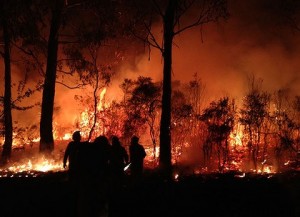
‘Arson may be behind the Mountains’ second major bushfire outbreak in a month that saw hundreds of schoolchildren and residents evacuated, and damaged seven homes.
The blaze broke out shortly before 2pm on Monday, October 24 at Cliff Drive near Echo Point and forced the evacuation of 450 children from Katoomba High School and 25 residents from 12 nearby homes.
Tourists were also warned to stay away from the area and fears were held at the height of the blaze for landmarks including Katoomba’s Scenic Skyway, Lilianfels and Echoes Hotel, with the Skyway’s terminal scorched by the flames.
“During the blaze, seven homes sustained minor damage, and a garden shed was destroyed,” a police statement said.
Local detectives and Strike Force Tronto officers together with Rural Fire Service investigators are looking into the cause of the fire, with initial inquiries suggesting the fire “may have been deliberately lit”, according to a police statement.
Blue Mountains Crime Manager Inspector Mick Bostock told reporters yesterday (Tuesday) while the fire had “two points of origin”, investigators believed it was lit by the one arsonist. He could not say exactly how. Police were interviewing one witness, an overseas tourist living in Bondi, who reported a fire in the area, he said.
Firefighters worked on Monday night to secure the fire edges and by Tuesday morning it had burned out 20 hectares of bushland and was no longer a threat to property. Fire and Rescue NSW sector commander for the incident, Inspector Kernin Lambert, said he was amazed no homes had been lost, with conditions creating “the perfect storm”.
“On this occasion the timely response and some brilliant firefighting from Fire and Rescue NSW and the Rural Fire Service saved the day,” he told the Gazette. “We are told that fire has not burned through that area for 35 years and the high accumulation of bush . . . the angle of the slope, wind direction, the aspect, it was like the perfect storm in terms of potential for fire disaster.
.
‘Blue Mountains bushfire: police investigate arson’
[‘Blue Mountains bushfire: police investigate arson’, Sydney Morning Herald, 20111025, ^http://www.smh.com.au/environment/weather/blue-mountains-bushfire-police-investigate-arson-20111025-1mgvj.html]
.
‘A bushfire in NSW’s Blue Mountains, which was believed to be deliberately lit, is now under control after firefighters back-burned overnight. Police are investigating if arson is to blame for a bushfire that is burning in the Blue Mountains for a second day. The blaze, which started about 2pm yesterday, has scorched 19 hectares at Katoomba, west of Sydney, and forced the evacuation of a high school.Detectives from the Blue Mountains Local Area Command and Strike Force Tronto and the Rural Fire Service will investigate the circumstances of the fire burning between Cliff Drive and Katoomba Street.’
.
‘Arson investigators probe Katoomba blaze’
[Source: ‘Arson investigators probe Katoomba blaze’, ABC, 20111025, ^http://www.abc.net.au/news/2011-10-25/arson-investigators-probe-katoomba-blaze/3598740]
.
Detectives specialising in arson cases are heading to the Blue Mountains to investigate a bushfire that damaged seven homes at Katoomba yesterday. Police believe the blaze was deliberately lit near Cliff Drive or Katoomba Street about 2:00pm (AEDT). Officers would like to speak with anyone who saw any suspicious behaviour in the vicinity.
.
Tags: ABC TV Four Corners, Australian Press Council, bush arson, bushfire arsonist, bushfire management, Delburn Fire 2009, hazard reduction, Katoomba bushfire, media responsibility, Rural Fire Service, serial bush arson, stir dormant bushfire arsonists, Strike Force Tronto, Victorian Bushfires 2009
Posted in Blue Mountains (AU), Threats from Bushfire | No Comments »
Add this post to Del.icio.us - Digg
Wednesday, December 28th, 2011
 [Source: Xπr, Dublin, c.2007] [Source: Xπr, Dublin, c.2007]
.
In February 2010, at the advent of the Chinese Year of the Tiger, the World Wildlife Fund (WWF) reported that tigers were in crisis around the world. With as few as 3,200 left of this endangered species compared to 100,000 a century ago, it was clear that this would be the vital tipping point for tigers.
Two key causes of the tiger’s plight are (1) poaching to feed consumer demand for tiger body parts, mostly for use in traditional Asian medicines (TCM) and folk remedies, and (2) deforestation as more and more forests are cleared for paper and palm oil, tiger habitat disappears daily.
.
‘New Study shows Bengal Tiger’s Habitat in Danger’
.
[Source: ‘New Study shows Bengal Tiger’s Habitat in Danger’, World Wildlife Fund, 20100119, ^http://www.worldwildlife.org/who/media/press/2010/WWFPresitem14914.html]
..
A new study by WWF scientists and partner organizations has found global climate change could shrink Bangladesh’s Sundarbans tiger habitat by 96 %, potentially reducing the tiger population to fewer than 20 breeding individuals!
An estimated sea level rise of 11.2 inches above 2000 levels by 2070 means this unique mangrove ecosystem could disappear within half a century.
 Bengal Tiger (Panthera tigris tigris)
© naturepl.com/Francois Sevigny / WWF Bengal Tiger (Panthera tigris tigris)
© naturepl.com/Francois Sevigny / WWF
.
Sundarbans Delta
.
The Sundarbans delta is the largest mangrove forest in the world.
This UNESCO World Heritage Site is shared by India and Bangladesh and sits at the mouth of the Ganges River. It is home to an estimated 254-432 Bengal tigers, the only tiger population adapted to live in mangroves. The tigers here regularly swim between islands and are the only tigers to have crabs and other seafood as an important part of their diet.
The area is an amazing ecosystem that houses a plethora of species including the spotted deer (the tiger’s prey), water birds, many kinds of fish, marine mammals, crocodiles, and snakes. The landscape naturally protects the area from natural disasters such as cyclones, storm surges, and wind damage. The mangroves are home not only to endangered fauna like tigers, but also to several million people who depend on the Sundarbans for their livelihoods.
The Bengal tiger population has already been under threat from poaching and habitat destruction and loss, and research suggests that the seas may be rising faster than originally thought.
Worldwide, tigers occupy only 7 percent of their historic range with as few as 3,200 left in the wild. The study encourages local governments to take immediate action to conserve and expand mangroves while cracking down on poaching. It suggests that globally, countries should work strongly on reducing greenhouse gas emissions in order to save the Sundarbans.
.
The Siberian (Amur) Tiger – Conservation Threats
.
[Source: ^ http://www.wcsrussia.org/Wildlife/AmurTigers/ConservationThreats/tabid/1468/language/en-US/Default.aspx]
.
The Siberian tiger is a tiger subspecies inhabiting mainly the Sikhote Alin mountain region with a small subpopulation in southwest Primorye province in the Russian Far East. In 2005, there were 331–393 adult-subadult Amur tigers in this region, with a breeding adult population of about 250 individuals.
The main threats to the survival of the Siberian Tiger are (1) poaching, (2) habitat loss, and (3) illegal hunting of ungulates, which are tigers’ main prey (Ed: looks similar to a lama). Because they increase access for poachers, roads are another important threat to the Siberian tiger. Intrinsic factors such as inbreeding depression and disease are also potential threats to this big cat, but are less understood.
 The Siberian tiger (Panthera tigris altaica), also known as the Amur tiger The Siberian tiger (Panthera tigris altaica), also known as the Amur tiger
.
Poaching
.
Roads in Amur tiger habitat, Russian Far East Wildlife Conservation Society (WCS) research has demonstrated that human-caused mortality accounts for 75-85% of all Amur tiger deaths. Current estimates indicate that 20-30 tigers are poached in the Russian Far East each year, although actual numbers may be higher.
Population modeling based on Siberian Tiger Project field data suggests that poaching rates exceeding 15% of the adult female population could have dangerous repercussions, especially as tigers have fairly low population growth rates compared to other big cats. Analysis of mortality data in Sikhote-Alin Biosphere Reserve indicates that poaching rates may be at least this high in a significant area of Russian tiger range.
Tigers are most commonly poached for their fur and for their body parts, such as bones, that are used in Traditional Chinese Medicine. The opening of the border between China and Russia after the fall of the Soviet Union has now made it possible to easily transport goods to Chinese markets and beyond. Although tigers are a protected species in Russia, enforcement agencies have very limited ability to catch convict poachers, and, even when this happens, fines are relatively small and disincentives insufficient. Poaching problems are further exacerbated by low incomes in many rural areas of the Russian Far East – sale of a tiger skin and bones represents a substantial source of income for poor people in remote villages.
It is also common for hunters to poach tigers to eliminate competition for ungulates and for locals to kill tigers in retaliation for depredations on domestic animals such as dogs and cows.
.
Habitat Loss
.
In Russia, human population growth does not threaten habitat as it does in many other tiger-range countries. However, activities such as logging, grazing, various development projects and uncontrolled fires are all resulting in direct habitat loss in the Russian Far East. Habitat is increasingly being divided into isolated patches, particularly at the southern edge of Amur tiger range.
Logging takes place in most of Amur tiger habitat. Although existing guidelines for timber harvest are actually quite sufficient, significant illegal logging and overharvest still occur. Selective logging, rather than clear cutting, is most common in tiger habitat, and does not seriously impact the quality of the habitat, if access to the extensive road system is controlled (thereby limiting poaching).
Fires are another important form of habitat loss. Many local residents consider fires to be the main cause of loss of forest habitat in parts of Primorsky Krai, and Amur tigers avoid areas that have burned, as they provide neither adequate cover for hunting, nor the habitat needed for prey.
.
Illegal Hunting of Ungulates
.
Illegal hunting of ungulates such as deer and wild boar significantly reduce prey availability for tigers. While official estimates continue to report stable numbers of ungulates, many hunters and wildlife biologists believe that abundance of ungulates in the Russian Far East has decreased considerably over past 15 years. Analyses from WCS’s Amur Tiger Monitoring Program clearly demonstrate that ungulate numbers are often 2-3 times higher inside protected areas, which are nonetheless impacted by poaching, though to a lesser extent.
Low ungulate numbers also foster a sense of competition between hunters and tigers. When ungulates numbers are low, it is easy to blame tigers, even when the root cause of population declines is over-harvest by humans. When there is little prey available in the forest, tigers sometimes enter villages and prey on domestic animals, including dogs and livestock, which creates tiger-human conflict situations.
.
Roads
.
The number of roads in Amur tiger habitat is increasing steadily as logging activities and development push into even the most remote regions. Besides allowing greater access for poachers, roads increase tiger mortality from vehicle collision, and increase the probability of accidental encounters between tigers and people, leading to tigers being shot out of fear or opportunity.
Roads also provide poachers greater access to ungulate habitat, which reduces tiger prey abundance. Roads can be divided into two categories: primary roads, which are maintained year-round and provide access between villages and towns; and secondary roads, which are not regularly maintained but nonetheless allow access.
From 1992 to 2000 the Wildlife Conservation Society studied the fates of radio-collared Siberian tigers living in areas with no roads, secondary roads and primary roads. Our findings:
- 100% survival rate for adult tigers living in areas with no roads
- 89% survival rate for adult tigers living in areas with secondary roads
- 55% survival rate for adult tigers living in areas with primary roads
.
These results clearly demonstrate that the presence of both secondary and primary roads both greatly increase the odds of tigers being poached, and indicate the need for road closures and access control. (Ed. Main roads contribute to tiger road kill reducing tiger populations by about a half).
.
‘World tiger population shrinking fast’
.
..
[Source: ‘World tiger population shrinking fast‘, IOL, 20080312, ^http://www.iol.co.za/scitech/technology/world-tiger-population-shrinking-fast-1.392813]
.
The number of tigers in the world has diminished at an alarming speed in recent years, global conservation group WWF cautioned on Wednesday, blaming poaching for much of the decline. “We are left with roughly 3,500 tigers (2008) all around the world now,” Bivash Pandav, a tiger specialist at the World Wildlife Fund, said, pointing out that “five years back, the estimate was around 5,500 to 6,000.” [Ed: In 2010 total world population was 3,200, and in 2011?, 2012?]
.
In India, which is home to nearly half of the world’s tigers, or 1,400 animals,
the number of the big cats has shrunk by 60% over the past three to four years!
…Pandav said during a visit to Sweden.
A century ago, some 40,000 tigers roamed the Indian subcontinent, according to the WWF, which singles out poaching, widespread destruction of the tigers’ natural habitat and human hunting of their prey as the main causes of today’s dire situation.
“Poaching is primarily to meet the demand for tiger bones in Traditional Chinese Medicine (TCM)… That’s the immediate reason behind the decline of tigers,” Pandav explained.
“The situation is pretty bad in the sense that they (the tigers) are rapidly being wiped out from many parts of their range,” he added.
.
According to the WWF:
- On the Chinese market, a dead tiger can be worth “tens of thousands of dollars”
- The United States is the world’s second largest market for tiger products.
.
Despite the daunting challenge of preserving tiger populations, Pandav insisted that “there is definitely hope,” pointing out that big cats “are prolific breeders (and) produce large numbers of offspring.”
“Despite all the problems, there are a couple of places in India (where tigers) are doing pretty well,” he said.
To rectify the overall situation however, the animals need access to forests, food and undisturbed habitats, Pandav said, insisting that the main priority was to protect the tigers from poachers and put “pressure on China to stop the farming of tigers.”
“The Chinese government is actively planning to legalise the trade (of tiger products) and if they legalise this trade then the demand for wild tigers is going to increase many fold,” he said, pointing out that people preferred products from wild tigers over farmed animals. That is going to be the death blow for the tigers in the wild,” he said.
.
‘Plight Tiger’
.
[Source: ‘Plight Tiger‘, by Neha Sinha, India Express, 20090101, ^http://www.indianexpress.com/news/plight-tiger/405197/]
..
‘At the beginning of this year, a ground-breaking, new, and scientific tiger census, which took two years to complete, announced that there were 1,411 wild tigers left in India. By November, the Government had admitted that of that number, 14 tigers had been poached this year. The figure actually may be nearly double.
The poaching cases registered and seizures of body parts of tigers this year show that around 27 of the big cats have been killed in 2008, making the number of wild tigers in India less than even 1,400, and showing that government efforts have failed so far to deter poachers.
“On an average, 25 tigers are poached every year”
.
…says an official from the NTCA. Data compiled by the WPSI shows an equal number, 27 tigers, were killed in 2007.
In January, a tiger survey commissioned by the Government indicated that there were only five-seven tigers left in Panna. Now, tiger experts fear the number may actually be just two. Kanha, also in Madhya Pradesh, lost a tiger to poaching by electrocution, using an 11,000-volt current, this November.
According to data compiled by the Wildlife Protection Society of India (WPSI), there have been 27 instances of tiger skins and parts being found in different parts of the country in 2008. The Wildlife Crime Control Bureau (WCCB), which came into existence this year, recovered a tiger skeleton from Gurgaon and two tiger skins from Himachal Pradesh, a case that involved a Tibetan national.
“Tiger killing may be higher than what recorded numbers tell us,” admits National Tiger Conservation Authority Member Secretary Rajesh Gopal. “Poachers are very clandestine and at times even a tiger carcass may not be found.”
A WCCB official said their main problem was that the trade in tiger parts was trans-country and inter-state, necessitating strong intervention from the Centre.
“Day before, we managed to get a case registered in Bihar for Dariya, a tiger poacher, who was arrested in December in Katni, Madhya Pradesh. A case had to be registered in Bihar where he is suspected to have poached tigers from the Valmiki tiger reserve. We have to expedite history-sheeting quickly to facilitate arrest of poachers who travel and escape extensively,” he added.
“The fact that tiger numbers are going down but poaching remains constant is a huge cause for concern. The number of tigers as per the Census is very low. If we don’t improve protection, India may well lose its tigers,” says Belinda Wright, Executive Director, WPSI.
The tiger census also shows another trend: that India’s tigers are now found only in areas with a high degree of protection, which is sanctuaries or existing tiger reserves. Recognising this, the NTCA has given approval to as many as 12 new tiger reserves this year, of which four — Pilibhit (Uttar Pradesh), Sunabeda (Orissa), Rapa Pani (MP) and Sahyadri (Madhya Pradesh) — have got in-principle approval.’
.
Videos on the plight of the Bengal Tiger
.
Videos in 2010 on the Bengal Tiger by big cat expert Dr. Alan Rabinowitz i, hosted by the BBC on its Lost Land of the Tiger series.
Click the following link then scroll down to watch the four episode extracts:
- Episode 1: ‘Fragmented Isolation‘
- Episode 1: ‘Tantalizing Tigers‘
- Episode 2: ‘Nowhere To Go‘
- Episode 2: ‘Population Patterns‘
.
.
.
What if tigers did become extinct?
.
[Source: ‘What if tigers did become extinct?’, World Wildlife Fund, ^http://wwf.panda.org/what_we_do/endangered_species/tigers/last_of_the_tigers/what_if_tigers_did_become_extinct_/]
.
.
Coextinction of other species
.
The tiger is at the top of the food chain in all the ecosystems it lives in. If one species in a food chain becomes extinct there is a knock-on effect on other species. The loss of a main predator can actually cause the extinction of a prey species as greater competition presents a threat to a species.
When the Bali and Javan tigers became extinct in the 20th century, poachers turned their attention to the Sumatran tiger. Which animal will be exploited into extinction once all the tigers are gone?
If tigers were to go, the forests which are currently protected as key habitat would be more likely to fall victim to illegal logging, conversion to agriculture and development. This leads to greater CO2 emissions and climate change. Deforestation currently accounts for 15% of global greenhouse gas emissions.
Which species live alongside the tiger?
Many of the species which could be affected by the disappearance of tigers are also endangered and already fighting for their own survival. The 5 sub-species of tigers live in some of the most spectacular parts of the world which provide a home for some other amazing species, including:
- Brown bear
- Sloth bear
- Sun bear
- Dhole
- Elephant
- Clouded leopard
- Amur leopard
- Lion tailed macaque
- Musk deer
- Orangutan
- Rhino
- Saola
.
Tiger Reserves
.
Huangnihe River Nature Reserve
^http://www.ancientsites.com/aw/Places/District/1138640
.
India’s Panna Tiger Reserve
^http://www.pannatigerreserve.in/
.
Sundarbans Tiger Project
^http://www.sunderbansnationalpark.com/
.
Palamau Tiger Reserve
^http://projecttiger.nic.in/palamau.htm
.
Kanha Tiger Reserve
^http://projecttiger.nic.in/kanha.htm
.
Tadoba-Andhari Tiger Reserve
^http://www.tadobatiger.com/
.
Hukawng Valley Wildlife Sanctuary
^http://www.wcs.org/news-and-features-main/a-valley-of-tigers.aspx
.
.
Read More About the Campaigns to Save Tigers from Extinction
.
^http://www.panthera.org/species/tiger/subspecies
.
^http://www.savetigersnow.org/
.
^http://www.internatyearofthetiger.org/plight.htm
.
^http://www.forevertigers.com/plight.htm
.
^http://www.bbc.co.uk/nature/life/Tiger
.
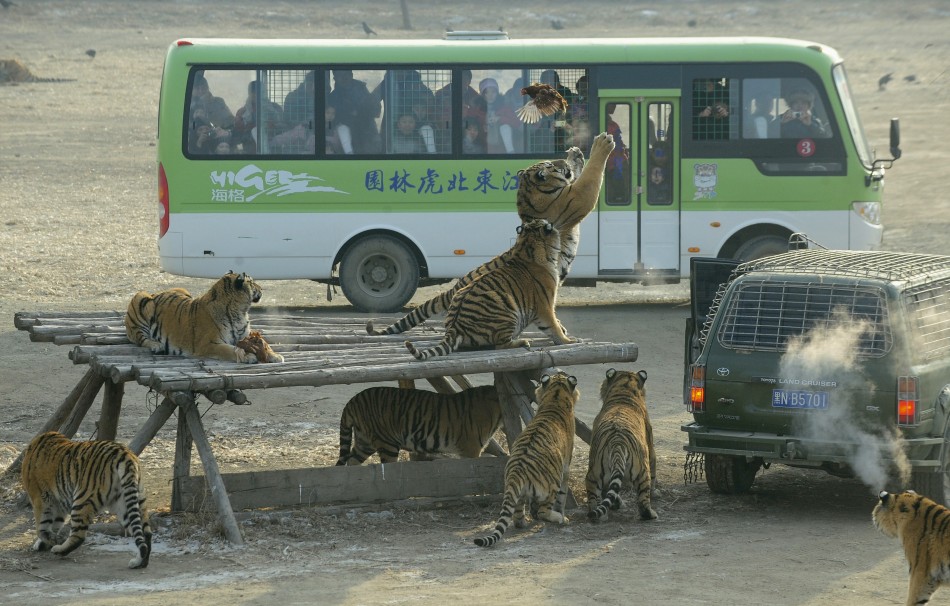
Chinese unethical handing of Tigers…
.
A herd of Siberian tigers chased and devoured live chicken flung at them from a tourist safari bus at the Siberian Tiger Forest Park in Harbin, north-west China, on Tuesday.
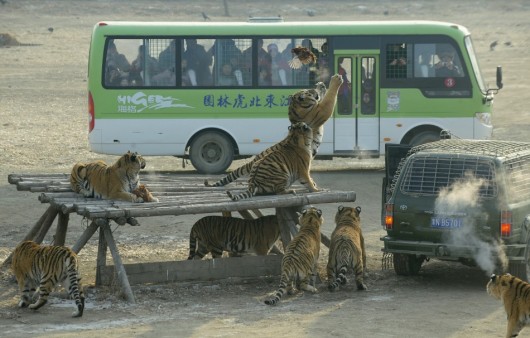
Siberian Tigers Grab at Live Chickens Tossed at Them to Tourists’ Delight in China
20111227 (two days ago)
Photo by Sheng Li
.
[Source: ‘Siberian Tigers Grab at Live Chickens Tossed at Them to Tourists’ Delight in China‘, by By Sanskrity Sinha, IBTimes, 20111228, ^http://www.ibtimes.com/articles/273353/20111228/siberian-tigers-grab-live-chickens-tossed-tourists.htm]
.
 Tiger Parts used in backward TCM Wine Tiger Parts used in backward TCM Wine
.
In China, only about 20 tigers are thought to be left in the wild!
.
“The existence of tiger ‘farms’ and increasing illegal trade in tiger products is seriously threatening this precious species.”
~ Ge Rui, Asian Regional Director of the International Fund for Animal Welfare.
.
[Source: ‘Thirst is building for tiger bone wine’, by Yang Wanli (China Daily), 20100301, ^http://www.chinadaily.com.cn/metro/2010-03/01/content_9516414.htm]
.
Tags: Amur Tiger, Amur Tiger Monitoring Program, Bangladesh, Bengal Tiger, China, fires, habitat loss, India, National Tiger Conservation Authority, Russian Far East, Siberian Tiger, Siberian Tiger Project, Sundarbans Delta, TCM, tiger, tiger census, Tiger Plight, tiger poaching, Traditional Chinese Medicine, Wildlife Conservation Society, Wildlife Crime Control Bureau, Wildlife Protection Society of India, World Wildlife Fund
Posted in Threats from Bushfire, Threats from Deforestation, Threats from Poaching and Poisoning, Threats from Road Making, Tigers | No Comments »
Add this post to Del.icio.us - Digg
Tuesday, December 20th, 2011
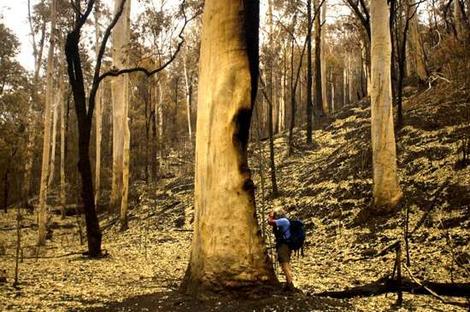 The Blue Gum Forest’s fire-scarred trees of December 2006
some of which have graced the Grose Valley in the Blue Mountains for hundreds of years.
Photo: Nick Moir (Source: Sydney Morning Herald, 20111211, Front Page) The Blue Gum Forest’s fire-scarred trees of December 2006
some of which have graced the Grose Valley in the Blue Mountains for hundreds of years.
Photo: Nick Moir (Source: Sydney Morning Herald, 20111211, Front Page)
.
The following articles are drawn from those by Gregg Borschmann, the first of which hit the front page of the Sydney Morning Herald on Monday 11th December 2006, following the massive bushfire conflagration that coalesced in the Grose Valley on 23rd November 2006.
From the community’s perspective, no noticeable lessons have been since learned by the Rural Fire Service (RFS) responsible. The prevailing bushfire management culture is that unless private property is directly, bushland is not valued and so not defended from bushfire. Indeed the approach is to let a bushfire burn as a defacto hazard reduction, so long as it doesn’t threaten human life or property. The RFS does not consider bushland an asset worth protecting from bushfire no matter what its conservation value, so with such a mindset such an ecological tragedy could well happen again.
.
‘The ghosts of an enchanted forest demand answers’
.
[Source: ^http://www.smh.com.au/news/national/the-ghosts-of-an-enchanted-forest-demand-answers/2006/12/10/1165685553891.html]
.
‘More than seventy years ago this forest inspired the birth of the modern Australian conservation movement. Today Blue Gum Forest stands forlorn in a bed of ash. But was it unnecessarily sacrificed because of aggressive control burning by firefighters focused on protecting people and property? That is the tough question being asked by scientists, fire experts and heritage managers as a result of the blaze in the Grose Valley of the upper Blue Mountains last month.
As the fate of the forest hangs in the balance, the State Government is facing demands for an independent review of the blaze amid claims it was made worse by control burning and inappropriate resources.
This comes against a backdrop of renewed warnings that Australia may be on the brink of a wave of species loss caused by climate change and more frequent and hotter fires. There are also claims that alternative “ecological” approaches to remote-area firefighting are underfunded and not taken seriously.
In an investigation of the Blue Mountains fires the Herald has spoken to experienced fire managers, fire experts and six senior sources in four agencies and uncovered numerous concerns and complaints.
- It was claimed that critical opportunities were lost in the first days to contain or extinguish the two original, separate fires.
- Evidence emerged that escaped backburns and spot fires meant the fires linked up and were made more dangerous to property and heritage assets – including the Blue Gum Forest. One manager said the townships of Hazelbrook, Woodford and Linden were a “bee’s dick” away from being burnt. Another described it as “our scariest moment”. Recognising the risk of the backburn strategy, one fire officer – before the lighting of a large backburn along the Bells Line of Road – publicly described that operation as “a big call”. It later escaped twice, advancing the fire down the Grose Valley.
- Concerns were voiced about the role of the NSW Rural Fire Service Commissioner, Phil Koperberg.
- Members of the upper Blue Mountains Rural Fire Service brigades were unhappy about the backburning strategy.
- There were doubts about the mix and sustainability of resources – several senior managers felt there were “too many trucks” and not enough skilled remote-area firefighters.
- Scientists, heritage managers and the public were angry that the region’s national and international heritage values were being compromised or ignored.
- There was anecdotal evidence that rare and even common species were being affected by the increased frequency and intensity of fires in the region.
- Annoyance was voiced over the environmental damage for hastily, poorly constructed fire trails and containment lines, and there were concerns about the bill for reconstruction of infrastructure, including walking tracks.
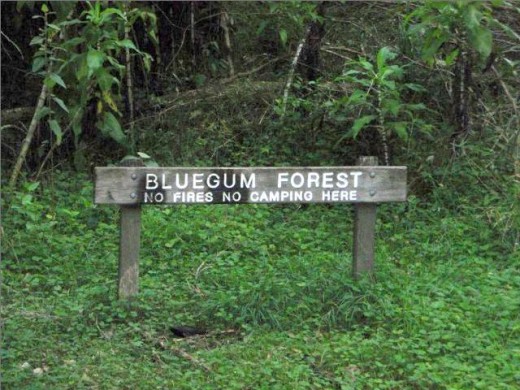
The fire manager and ecologist Nic Gellie, who was the fire management officer in the Blue Mountains for the NSW National Parks and Wildlife Service during the 1980s and ’90s, says the two original fires could have been put out with more rapid direct attack.
“Instead, backburning linked up the two fires and hugely enlarged the fire area … what we saw would be more accurately described as headfire burning, creating hot new fire fronts. While it protected the town of Blackheath, the plateau tops burnt intensely – and that created new problems both for management of the fire and the protection of biodiversity.
“When extreme fire weather, hot days and high winds arrived as predicted, the expanded fire zone was still not fully contained – and that was the cause of most of the high drama and danger that followed.”
In that dramatic week, Mr Gellie confronted Mr Koperberg with his concerns that the commissioner was interfering with the management of the fire by pushing hard for large backburns along the northern side of towns in the Blue Mountains from Mount Victoria to Faulconbridge, along what is known in firefighting circles as the “black line”.
The Herald has since confirmed from numerous senior sources that “overt and covert pressure” from head office was applied to the local incident management team responsible for fighting the fire.
There were also tensions relating to Mr Koperberg’s enthusiasm for continuation of the backburning strategy along the black line – even when milder weather, lower fuel levels and close-in containment were holding the fire.
Several sources say the most frightening threat to life and property came as the fire leapt onto the Lawson Ridge on “blow-up Wednesday” (November 22) – and that those spot fires almost certainly came from the collapse of the convection column associated with the intensification of the fire by the extensive backburns.
The Herald has also confirmed that
- The original fire lit by a lightning strike near Burra Korain Head inside the national park on Monday, November 13, could not be found on the first day. The following day, a remote area fire team had partly contained the fire – but was removed to fight the second fire. The original fire was left to burn unattended for the next couple of days;
- An escaped backburn was responsible for the most direct threat to houses during the two-week emergency, at Connaught Road in Blackheath. However, at a public meeting in Blackheath on Saturday night, the Rural Fire Service assistant commissioner Shane Fitzsimmons played down residents’ concerns about their lucky escape. “I don’t want to know about it. It’s incidental in the scheme of things.”
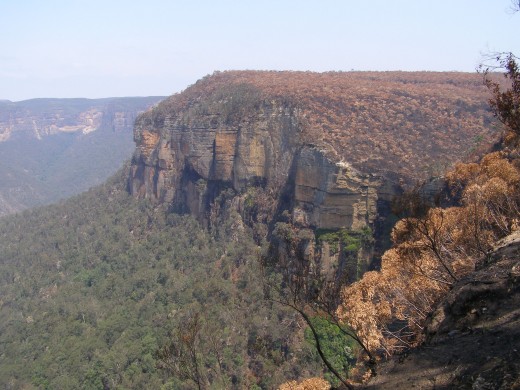 Blackheath escarpment broadscale backburn – “incidental in the scheme of things“?
(Photo by Editor 20061209, free in public domain, click photo to enlarge) Blackheath escarpment broadscale backburn – “incidental in the scheme of things“?
(Photo by Editor 20061209, free in public domain, click photo to enlarge)
.
Mr Koperberg, who is retiring to stand as a Labor candidate in next year’s state elections, rejected the criticisms of how the fire was fought.
He told the Herald: “The whole of the Grose Valley would have been burnt if we had not intervened in the way we did and property would have been threatened or lost. We are looking at a successful rather than an unsuccessful outcome.
“It’s controversial, but this is world’s best backburning practice – often it’s the only tool available to save some of the country.”
The commissioner rejected any criticism that he had exerted too much influence. “As commissioner, the buck stops with me. I don’t influence outcomes unless there is a strategy that is so ill-considered that I have to intervene.”
Mr Koperberg said it was “indisputable and irrefutable” that the Blue Mountains fire – similar to fires burning now in Victoria – was “unlike any that has been seen since European settlement”, because drought and the weather produced erratic and unpredictable fire behaviour.
.
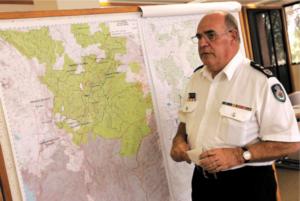 Phil Koperberg
NSW Rural Fire Service Commissioner at the time of the Grose Fire Phil Koperberg
NSW Rural Fire Service Commissioner at the time of the Grose Fire
.
The district manager of the Blue Mountains for the Rural Fire Service, Superintendent Mal Cronstedt, was the incident controller for the fire.
Asked if he would do anything differently, Mr Cronstedt answered: “Probably.” But other strategies might have also had unknown or unpredictable consequences, he said.
Jack Tolhurst, the deputy fire control officer (operations) for the Blue Mountains, said: “I am adamant that this fire was managed very well. We didn’t lose any lives or property and only half the Grose Valley was burnt.”
Mr Tolhurst, who has 50 years’ experience in the Blue Mountains, said: “This fire is the most contrary fire we have ever dealt with up here.”
John Merson, the executive director of the Blue Mountains World Heritage Institute, said fire management was being complicated by conditions possibly associated with climate change.
“With increased fire frequency and intensity, we are looking at a fundamental change in Australian ecosystems,” he said. “We will lose species. But we don’t know what will prosper and what will replace those disappearing species. It’s not a happy state. It’s a very tough call for firefighters trying to do what they think is the right thing when the game is no longer the same.
“What we are seeing is a reflex response that may no longer be appropriate and doesn’t take account of all the values we are trying to protect.”
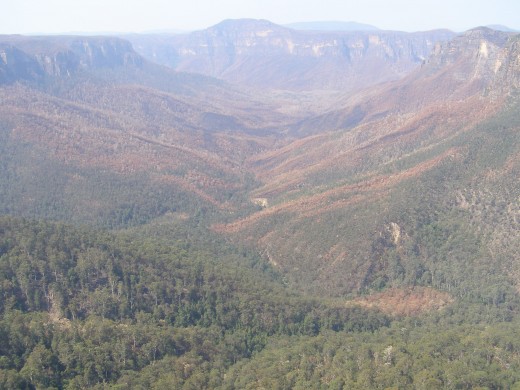 Grose Valley incinerated 23rd November 2006
(Photo by Editor 20061209, free in public domain, click photo to enlarge) Grose Valley incinerated 23rd November 2006
(Photo by Editor 20061209, free in public domain, click photo to enlarge)
..
‘The burning question’
.
[Source: ^http://www.smh.com.au/news/national/the-burning-question/2006/12/10/1165685553945.html]
.
‘A bushfire scars a precious forest – and sparks debate on how we fight fire in the era of climate change.
.
“Snow and sleet are falling on two bushfires burning in the Blue Mountains west of Sydney.” ~ ABC Radio, November 15 (2006).
The news report was almost flippant, something that could happen only in Dorothea Mackellar’s land of drought and flooding rains. Later that evening, two weeks from summer, Sydney had its coldest night in more than a century.
Over the past month – as an early summer collided with a late winter and a decade-long drought – NSW and Victoria have battled more than 100 bushfires. But of them all, last month’s Blue Mountains blaze reveals tensions and systemic problems that point to a looming crisis as bushfire fighters struggle to protect people, property, biodiversity and heritage values in a world beset by climate change.
The tensions have always been there – different cultures, different ways of imagining and managing the landscape. Perhaps they are illustrated by a joke told by two Rural Fire Service crew in the Blue Mountains. “How does the RFS put out a fire in your kitchen? By backburning your sitting room and library.” The joke barely disguises the clash between the imperative of saving lives and homes, and the desire to look after the land, and the biodiversity that underpins our social and economic lives.
For fire managers, whose first priority will always be saving people and property, the equation has become even more tortured with a series of class actions over fires in NSW and the ACT. As one observer put it: “These guys are in a position where they’re not going to take any chances. No one will ever sue over environmental damage.”
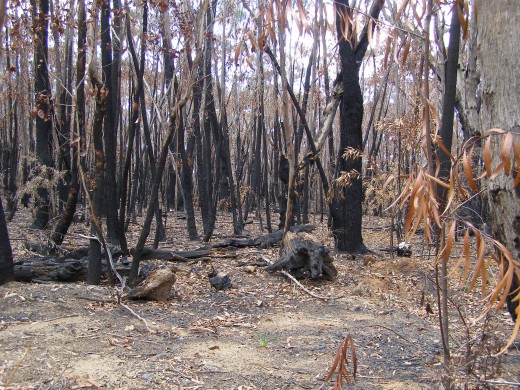
For bushfire management the debate tentatively started a couple of decades ago. The challenge was to do what poets, writers and painters have long grappled with – coming to terms with a country whose distinctiveness and recent evolutionary history have been forged in fire. Drought and climate change now promise to catapult that debate to centre stage.
It is perhaps no accident that such a defining fire has occurred in one of the great amphitheatres of the Australian story, the Grose Valley in the upper Blue Mountains. Charles Darwin passed by on horseback in 1836, and described the valley as “stupendous … magnificent”.
The Grose has long been a microcosm of how Australians see their country. In 1859 some of the first photos in Australia were taken in the valley. Proposals for rail lines and dams were forgotten or shelved. The first great forest conservation battle was fought and won there in 1931-32.
But now the valley is under threat from an old friend and foe – fire.
Ian Brown has worked on dozens of fires in the Blue Mountains. He is a former operations manager for the National Parks and Wildlife Service.
“All fires are complex and difficult, and this sure was a nasty fire … But we need lots of tools in the shed. Those hairy, big backburns on exposed ridges so close to a blow-up day with bad weather surprised me. Frightened me even.”
For Brown, even more worrying is the trend.
“Parts of the Grose have now burnt three times in 13 years and four times in 24 years. Most of those fires started from arson or accident. Many of the species and plant communities can’t survive that sort of hammering.”
Ross Bradstock, a fire ecologist, agrees. Professor Bradstock is the director of the new Centre for the Environmental Risk Management of Bushfires at the University of Wollongong, which is funded by the Department of Environment and Conservation and the Rural Fire Service. He says Australia stands out as one of the countries whose vegetation may be most affected by climate change.
Bradstock says that in south-eastern Australia the potential for shifts in fire frequency and intensity are “very high … If we’re going to have more drought we will have more big fires.”
But the story is complicated and compounded by the interaction between drought and fire. The plants most resistant to fire, most able to bounce back after burning, will be most affected by climate change. And the plants that are going to be advantaged by aridity will be knocked over by increased fire frequency. “In general, the flora is going to get whacked from both ends – it’s going to be hit by increased fire and climate change. It’s not looking good.”
.
Wyn Jones, an ecologist who worked for the wildlife service, says the extremely rare drumstick plant, Isopogon fletcheri, is a good example. There are thought to be no more than 200 specimens, restricted to the upper Grose. Last week, on a walk down into the Blue Gum Forest, Jones found three – all killed by the fire.
.
The NSW Rural Fire Service Commissioner, Phil Koperberg, has been a keen supporter of Bradstock’s centre. Asked if he agreed with the argument that the Grose had seen too much fire, Mr Koperberg replied: “It’s not a comment I disagree with, but had we not intervened in the way we did, the entire Grose Valley would have been burnt again, not half of it.”
The great irony of the fire is that it was better weather, low fuels and close-in containment firefighting that eventually stopped the fire – not big backburns.
Remote area firefighting techniques have been pioneered and perfected over recent decades by the wildlife service. In 2003 a federal select committee on bushfires supported the approach. It recommended fire authorities and public land managers implement principles of fire prevention and “rapid and effective initial attack”.
Nic Gellie, a fire ecologist and former fire manager, has helped the wildlife service pioneer ecological fire management. The models are there – but he says they have not been used often enough or properly.
Doubts have been expressed about the sustainability of the current remote area firefighting model. It is underfunded, and relies on a mix of paid parks service staff and fire service volunteers. Most agree the model is a good one, but not viable during a longer bushfire relying on volunteers.
The Sydney Catchment Authority pays $1 million for Catchment Remote Area Firefighting Teams in the Warragamba water supply area. It has always seemed like a lot of money. But it looks like a bargain stacked against the estimated cost of $10 million for the direct costs and rehabilitation of the Grose fire.
Curiously, one unexpected outcome of the great Grose fire may be that the valley sees more regular, planned fire – something the former wildlife service manager Ian Brown is considering.
“If climate change means that the Grose is going to get blasted every 12 years or less, then we need more than just the backburning strategy. We need to get better at initial attack and maybe also look at more planned burns before these crises. But actually getting those burns done – and done right – that’s the real challenge.”
It may be the only hope for Isopogon fletcheri.
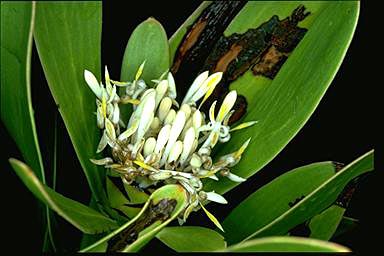 Fletcher’s Drumstricks (Isopogon fletcheri)
http://www.anbg.gov.au Fletcher’s Drumstricks (Isopogon fletcheri)
http://www.anbg.gov.au
.
.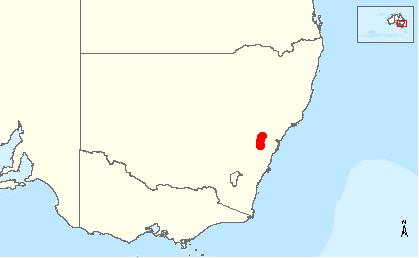 Distribution of Isopogon fletcheri is restricted to a very small area in the Blackheath district of the Blue Mountains.
Given restricted distribution, it is susceptible to local extinction due to environmental and demographic uncertainty and in particular pathogens such as Phytophthora cinnamomi. Distribution of Isopogon fletcheri is restricted to a very small area in the Blackheath district of the Blue Mountains.
Given restricted distribution, it is susceptible to local extinction due to environmental and demographic uncertainty and in particular pathogens such as Phytophthora cinnamomi.
What needs to be done to recover this species? Continued habitat protection.
http://www.threatenedspecies.environment.nsw.gov.au/tsprofile/profile.aspx?id=10440
.
.
What price now?
.
[Source: ^ http://www.smh.com.au/news/national/what-price-now/2006/12/10/1165685553948.html?page=2]
.
The Blue Gum Forest stands tall, straight and surreal in a fire-ground of still smouldering ash. Three weeks ago it was intensely burnt during bushfires in the Grose Valley. The future of the iconic forest – some trees are thought to be 200 to 300 years old – now hangs in the balance.
Last week the massive white-trunked blue gums were dropping their scorched leaves to reveal a stark and unrecognisable forest of tall trunks, bare limbs and fallen logs.
The director of the Colong Foundation for Wilderness, Keith Muir, did not speak out during the fires, but now he wants answers.
.
-
“Could the Blue Gum have been saved using other firefighting strategies that also protected life and property?
-
Was the fire that burnt this very special forest made more intense, unpredictable and extensive by massive backburning operations?
-
Was the Blue Gum sacrificed for the sake of a de facto fuel reduction exercise that didn’t consider heritage values?
-
We need answers. We need an independent inquiry. This is too important to happen again.”
.
In the early 1930s the Herald supported a campaign by bushwalkers to save the Blue Gum from grazing and agricultural development. It was the first successful Australian conservation campaign to protect an almost pure stand of tall mountain blue gum ( Eucalyptus deanei) on about 40 hectares of river flats in the rugged Grose Valley of the upper Blue Mountains. The bushwalkers raised £130 to buy the lease covering the forest and create the Blue Gum Forest Reserve.
The Herald visited the Blue Gum Forest again last week with a forest ecologist, Wyn Jones, and Ian Brown, former National Parks and Wildlife Service operations manager with overall responsibility for fire management. In 1994 Jones, then an ecologist with the service, helped to describe scientifically the rare and newly discovered Wollemi pine. He first saw the Blue Gum Forest more than 40 years ago. He has been involved with it professionally and as a bushwalker ever since.
He said the forest would re-shoot and regrow, but it remains to be seen when and how. He predicted its immediate future would be decided over the next six months. That would depend largely on the vagaries of climate. Severe wind storms, a hot dry summer or even persistent rain, fungal growth and insect attack could all compromise the forest’s ability to bounce back quickly.
More uncertain and potentially bleak is the long-term prognosis. Jones said changing fire regimes caused by humans could be further complicated by climate change, a recipe for more frequent and hotter fires.
The Blue Gum Forest has been burnt four or five times in less than 50 years: by wildfire in 1957, possibly 1968, and in 1982, 1994 and 2006.
“Without human interference , this forest may have been burnt once or perhaps twice in 50 years, not five times,” Jones said.
Jones is convinced cracks in majestic gums were caused by the fire. If they are deep enough to effectively ringbark the surviving trees, then the demise of the forest promises to be a slow and painful affair.
“The old Blue Gum Forest is gone,” he said. “We don’t know what the Blue Gum of the future will look like. We could be heading for strange and very different days.”
===========
‘Friends of the giants’
.
In 1931 the Herald’s conservation reporter, J.G. Lockley, writing under the name Redgum, led a campaign to save the Blue Gum Forest.
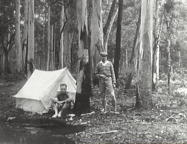
“To destroy the trees would be unforgivable vandalism .. if they are permitted to stay, they will stand straight and true for many generations … Every acre on which those grey gums are growing should be reserved for the distant days, when the nation will know the true worth of the giant trees, which are not understood.”
.
‘Blue Gum Lessons’
.
(Editor’s letter in the Blue Mountains Gazette, 20061220)
.
‘One of our most precious natural heritage assets, the Blue Gum Forest, has been allowed to be scorched by bushfire. This demands an independent enquiry into current fire fighting practices to ensure such a tragedy is not repeated.
Not a witch hunt, but what is needed is a constructive revision into improving bushfire fighting methods incorporating current research into the issue. The intensity and frequency of bushfires have become more prevalent due to disturbances by man, including climate change.
An enquiry should consider the assets worth saving; not just lives, homes and property but natural assets of the World Heritage Area. Fire fighting methods should seek to protect all these values. It seems back-burning, however well-intentioned, burnt out the Blue Gum. This is unacceptable. What went wrong? The future survival of our forests depends on how we manage fire.’
.
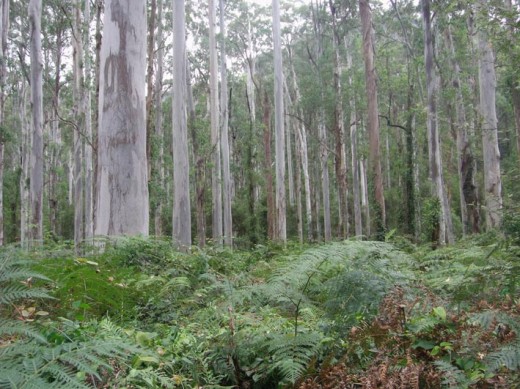
A Grose Valley Fire Forum was held at Mount Tomah on Saturday 17th February 2007, but the public were denied entry.
An independent enquiry was never conducted. A public enquiry was never conducted.
.
Tags: backburns, Blackheath, Blue Gum Forest, Blue Mountains, Blue Mountains World Heritage Area, broadscale backburning, ecological values, forest values, Grose Valley, Grose Valley Fires 2006, Isopogon fletcheri, Mal Cronstedt, old growth, Phil Koperberg, RFS, Rural Fire Service
Posted in Blue Mountains (AU), Threats from Bushfire | No Comments »
Add this post to Del.icio.us - Digg
Wednesday, November 30th, 2011
This article was initially published by Tigerquoll 20090622 on CanDoBetter.net in the aftermath of the devastating Victorian bushfires that climaxed on 7th February 2009:
.
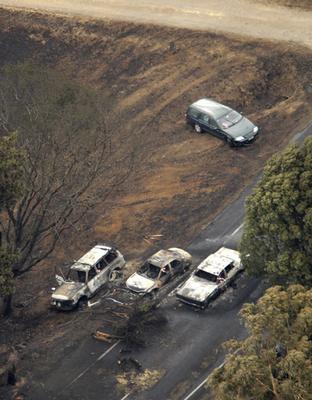 Last ditch huddling together in cars didn’t work
(Chum Creek)
Last ditch huddling together in cars didn’t work
(Chum Creek)
.
The Victorian Premier Brumby’s Royal Commission into the January-February 2009 bushfires is a mere incident review. If Victoria is to be protected from firestorms in future, it should undertake a root cause analysis, including the numerous past investigations into bushfires, with a view to achieving a cultural shift in rural fire fighting methods, resourcing and emergency management and into ecology management, housing approvals in bushfire prone areas, building design in bushfire prone areas, bush arson criminology and into serious resourcing of rural fire management.
 A familiar media icon of Victorian television news for over a decade – he and his family, like those around him, had a right to a safe lifestyle in beautiful rural Victoria
(This editor grew up watching Nine News, as part of our family routine for many years, and I remain still personally affected by his awful tragedy). A familiar media icon of Victorian television news for over a decade – he and his family, like those around him, had a right to a safe lifestyle in beautiful rural Victoria
(This editor grew up watching Nine News, as part of our family routine for many years, and I remain still personally affected by his awful tragedy).
.
Indeed, given the repeated history of bushfires across Australia and the repeated uncontrolled nature of many of these leading to extensive property damage, the loss of thousands of livestock, widespread ecological destruction, the human lives lost and injuries, and the massive costs incurred every year, the scope of the enquiry should be escalated to a national level.
But the Victorian Commission’s terms of reference focuses on the immediate causes and circumstances of the 2009 Victorian Bushfires. It focuses on the immediate management, response and recovery. This is a start, but the real start occurred in 1939 with the shock of Black Friday. It lead to the Stretton Enquiry, but many large and damaging firestorms have occurred since – so the Stretton Enquiry showed that lessons were either ignored or the application of those lessons were ineffective. The Esplin Inquiry of 2003 identified striking parallels between 1939 and 2002-3 bushfires. Now we have the 2009 Bushfires, but each investigation is disconnected from the previous one, almost as if to intentionally ignore history and any prior lessons learnt. Interstate and overseas, many major bushfires and their subsequent investigations have amassed research, insight and lessons. Why limit the investigation to one event?
 Victorian Premier’s complicity in under-preparation, and precious nothing’s been done since Victorian Premier’s complicity in under-preparation, and precious nothing’s been done since
.
Incident investigation will uncover causes and flaws and will likely make specific recommendations in the hope of preventing similar incidents. But root cause analysis goes beyond identifying the symptoms of a problem. But the Commission has not started with identifying the problem.
Let’s say that that at the core is the problem of preventing ignitions becoming firestorms.
- What are the causes of uncontrolled ignitions in the bush?
- Where are they typically lit?
- How are ignitions detected by fire authorities?
- What is the time lapse between ignition and detection?
- What is the time lapse between detection and response and eventual suppression?
- Which causes and interventions would mitigate the risk of these ignitions developing into uncontrollable firestorms?
- Are the ignition detection tools adequate?
- Are the communications tools adequate?
- Do we have the right tools and trained personnel in the right places to effectively respond?
- Is the entire detection, response and suppression system sufficiently integrated to deal with multiple ignitions in extreme conditions across the State at the same time?
- How would this be achieved?
- What budget would be required to have such resources and technology in place to achieve this standard?
- Is the problem indeed too big for Victoria by itself to adequately deal with and so is the problem in fact a national one?
- How would a satisfactory solution be achieved without causing other problems like ecological damage and local wildlife extinctions?
.
Then implement the recommendations and scientifically monitor their effectiveness. But the Commission is looking at what caused the specific ignitions, what damage the specific bushfires caused and specific responses. It will conclude what specifically should have been done in these specific incidents. It will lead to a blame game that will solve nothing. Subsequent ignitions if not predicted, detected, responded to and suppressed to prevent firestorms, will likely have different circumstances in different locations.
- So how will the problem have been solved by this Royal Commission?
- How will the Victorian Royal Commission prevent bushfire history repeating itself?
.
What a useless fabricated enquiry, another one in the litany of government rural community betrayal!
.
.
Tuesday, November 29th, 2011
This article was initially published by Tigerquoll 20090621 on CanDoBetter.net in the aftermath of the devastating Victorian bushfires that climaxed on 7th February 2009:
.
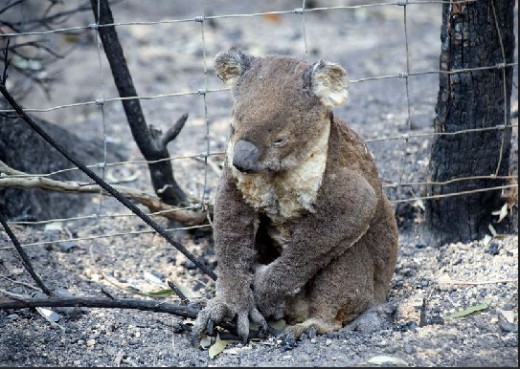 A forgotten victim of bushfire
.
The analogy of the Titanic ocean liner disaster of 15th April 1912 is apt in relation to rural communities entrusting those in charge to be able to deal with public/national emergencies. The public trusted the Titanic met government standards. But 2,223 people boarded and 1514 died from the iceberg collision. Government standards were later revealed as substandard.

Public trust in government is appropriate (it’s why we pay our bloody taxes), but government systemically neglects its responsibility and abuses that public trust. Government has the nerve to entice volunteer members of the community to do its dirty work – aka the CFA. So individuals have given up on their government to be able to respond adequately to emergencies (bushfires, floods, droughts, etc) feel compelled to take measures themselves. Building a bunker is a vigilante response. I’m not saying its not a constructive response, but it is a consequential reaction of government failing to protect bushfire-prone communities. It’s like residents losing faith in the police and feeling compelled to being vigilantes. It’s akin to Titanic passengers bringing along their own liferafts.
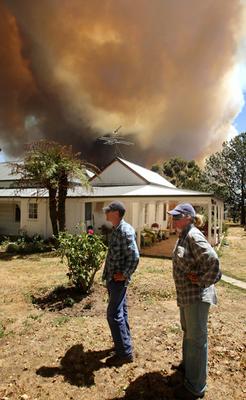 ‘Stay or Go‘? ‘Stay or Go‘?
.
To attribute blame on climate change ignores the role of government and in the case of the 2009 Victorian Bushfires lets government get away with manslaughter – literally.
Look into the history of the causes of the Titanic sinking and one can draw many comparisons with the failures of Emergency Management Australia in how it failed to protect life, property and ecological values from the bushfires across Victoria last January and February. The root causes of the (a) 1914 Titanic’s sinking and (b) the loss of 1514 lives were: management culture, poor contingency planning, design flaws, poor governance (e.g. inadequate safety regulations), poor operational response, amongst others.
 Victorian CFA Chief during Victoria’s tragic 2009 bushfires Victorian CFA Chief during Victoria’s tragic 2009 bushfires
The root causes of (a) the 2009 Victorian Bushfires being allowed to grow into unstoppable infernos and (b) the tragic loss of 127 lives were: management culture, poor contingency planning, design flaws, poor governance (e.g. inadequate safety regulations), poor operational response, amongst others.
The basic question is what emergency strategy was adopted to deal with the Victorian bushfires and why didn’t it work adequately to achieve a best practice outcome – no lives lost, no houses lost, no wildlife killed?
 Words from Strathewen
. Words from Strathewen
.
A root cause of the firestorms being allowed to become firestorms from multiple ignitions is that insufficient dedicated resourcing was provided to deal with the hundreds of ignitions in extreme tinder dry conditions with high winds. The government agencies (CFA, et al) knew the fire index was 300, that this was the worst on record, yet did stuff all to prepare or warn the public. There was a wind change forecast, yet this was not communicated to residents. Relying upon volunteers to drive fire tankers to remote ignitions is proven as ineffective as pissing into a wall of flame.
The 1940’s fire fighting thinking needs to be overhauled – by the time the 000 call is received, the volunteers are called in, drive their fire trucks out to an ignition, two hours later, that ignition has spotted into a fire front and its too late! Happens all the time!
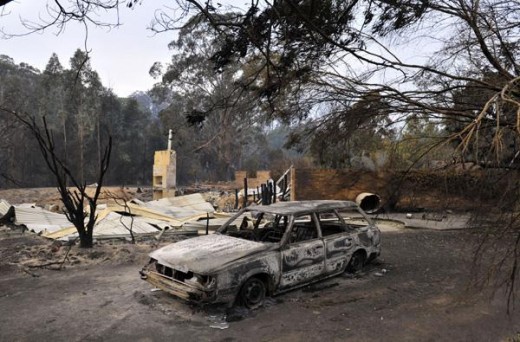
Trapped and no hope
.
Another root cause is government allowing people to build in the bush in extreme fire risk locations and in houses that are not bushfire resistant. The tragedy is that after the Royal Commission, the likely response is to incinerate the bush like no tomorrow – destroy the natural environment that people yearn to be near. It will fail to recognise the complexity of the causes and the solutions and will advocate a knee-jerk – troglodyte (‘ugg ugg’) burn the lot approach. The Commission’s verdict will fuel Brumby’s Final Solution to prescribe Victoria back to the Stone Age.

A key question is what is government leadership in fire fighting to do – i.e Emergency Management Australia? How about four fundamental approaches:
- Introduce world-leading scientific research and monitoring of bushfire threats – climate and weather conditions, bush conditions, arson investigation, lightning, and integrate these with bushfire fighting.
- Obtain state-of-the-art monitoring of bushfire-prone areas across South Eastern Australia to the point where ignitions and plumes in the remotest of locations can be detected within minutes of them starting, feeding this data to a central database and to a standby emergency professional and national response unit.
- Employ military-esque emergency services professionals to respond to ignitions within an hour of starting – airborne professionals, not a volunteer ‘dads army’ sitting in trucks.
- Resource Australian Firefighting with serious air resources to combat bushfires with military efficiency and scale. A chunk of Rudd’s $26 billion budget on Defence should have gone to setting up a national airborne fire fighting response division and an integrated satellite detection, alert and response system/unit. Isn’t this defence at home?
.
Unless the above is done, nothing will change, but now that Titanic has sunk (Victorian Bushfires killed 173 human lives, cost billions in property losses and contributed to many local wildlife extinctions) we no longer should be shocked when it happens all over again.
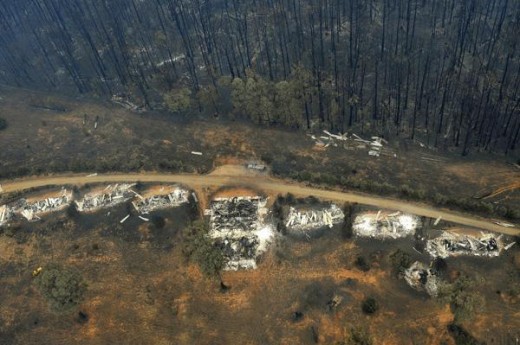 Kinglake aftermath – homes and lives incinerated Kinglake aftermath – homes and lives incinerated
.
As for bunkers, no government will guarantee a bunker to protect life ever.
One must attribute responsibility to the top of government, down. I hold Kevin Rudd accountable for the next bushfire tragedy and we are six months before next January.
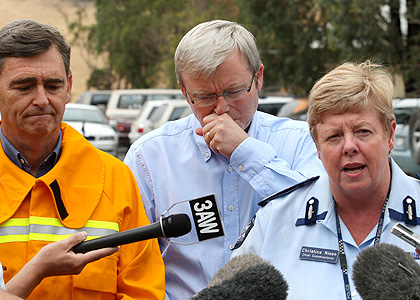 Brumby, Rudd, Nixon- the ultimate emergency leadership responsible for the Victorian Bushfires outcome of 2009 Brumby, Rudd, Nixon- the ultimate emergency leadership responsible for the Victorian Bushfires outcome of 2009
Ultimate government leadership has ultimate responsibility for public emergency
– the resourcing, the planning, the risk recognition, the mitigation, the response, the compensation.
.
In bushfire management, political will continues to be negligent.
.
.
Tags: bush fires, CFA, Emergency Management Australia, emergency services, Kevin Rudd, Kinglake, Premier Brumby, Stay or Go, Strathewen, tigerquoll, Titanic, Victorian Bushfires 2009, wildlife victims of bushfire
Posted in Threats from Bushfire | No Comments »
Add this post to Del.icio.us - Digg
Friday, November 25th, 2011
‘It’s only bush, she’ll be right’ – famous last words by bushfire management, and not a wildlife zoologist among them.
 …was …was

Part of the human cost of State-sanctioned Arson
Margaret River Fire 2011.
.
“All my bits and pieces that make me are gone,” says Marjorie Stewart, who lost her home in the raging bushfire in Margaret River.
.
Here we go again. Every year, prescribed burns get out of control somewhere across Australia, yet the State culture of lighting fires to mitigate wildfires continues unquestioningly. No thought is given to the consequential killing of Australian wildlife and the destruction of ever-shrinking islands of habitat. To wildlife it is arson. Is it any wonder why Australia has the world’s worst record in local fauna extinctions.
But it is when human lives and human property are damaged that bushfires make the human headlines. The current Margaret River Bushfire’ is a consequence of yet another ‘escaped burn’ in the litany of bushfire management’s perverted ‘strategic bushfire protection‘. Some protection! Lighting bushfires is arson. Letting a bushfire burn remotely overnight for 80 nights is grossly reckless neglect. The consequential human cost and community cost is the responsibility of the State.
Local farmer near the WA town of Denmark Tony Pedro is angry at what he says are government-sanctioned burns which get out of control and threaten private property. Mr Pedro says it is time authorities in WA changed their fire management policy from one of ignition to suppression.
“In summer the community doesn’t light fires. You know the farmers don’t light fires and if someone does light a fire they’re called an arsonist.”
[Source: ‘Fires in Denmark contained and downgraded’, ABC, 20111125, ^http://www.abc.net.au/news/2011-11-25/denmark-fires-downgraded/3694428?section=wa]
.
.
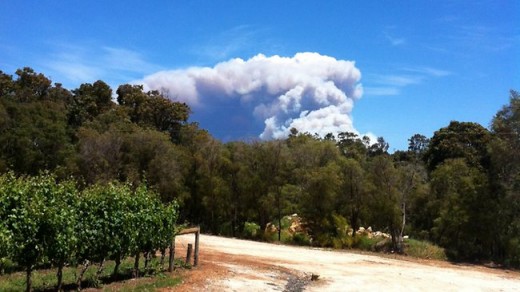
Margaret River Bushfire, 2011
.
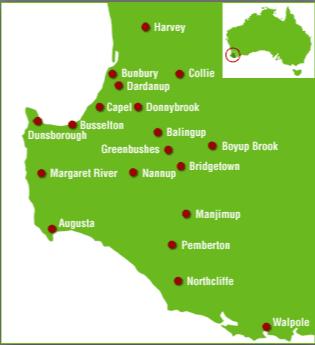 Margaret River, Western Australia
situated about 230km south of Perth
[Source: http://www.mysouthwest.com.au/Tourism]
. Margaret River, Western Australia
situated about 230km south of Perth
[Source: http://www.mysouthwest.com.au/Tourism]
.
The West Australian Government’s Department of Environment and Conservation (DEC) is the State authority delegated the custodial responsibility for protection and conservation of the environment of Western Australia. This includes managing the State’s national parks, marine parks, conservation parks, State forests and timber reserves, nature reserves, marine nature reserves and marine management areas. Leading its key objectives is the requirement to conserve biodiversity – ‘Protect, conserve and, where necessary and possible, restore Western Australia’s biodiversity’. [Source: ^http://www.dec.wa.gov.au/content/section/29/2035/ (About Us)]
Yet, every three years DEC lights bushfires across the State, euphemistically termed ‘prescribed burns‘ under its Master Burn Planning process, that it has convinced itself..is designed for:
- ‘Biodiversity conservation through application of scientifically based fire regimes to maintain and protect native flora and fauna communities and/or habitats’
- ‘Community protection-protection of human life, property, public assets, parks, water catchments, timber values and plantations’
- ‘Silvicultural burns for regeneration of native forests following timber harvesting’.
[Source: DEC website, ‘Planning for prescribed burning’, ‘Proposed Burn Program’, ^http://www.dec.wa.gov.au/content/view/128/1870/1/3, accessed 20111125]
.
You see, Australian native vegetation burns, so burning it must be good for it. As for the wildlife, well we think they come back, but we don’t really check. DEC’s Master Burn Planning for the three year period 2011-2014 began in Spring.
.
.
Tue 6th Sep 2011: The ignition?
.
The Margaret River ‘prescribed burning’ was reportedly lit on Tuesday 6th September, two and a half months ago by DEC as a prescribed burn! Exactly when or where has not been made officially public by DEC. Another report claims that a spokesperson for Environment Minister Bill Marmion said:
“The Department of Environment and Conservation were not undertaking any prescribed burns in the Augusta-Margaret River area. However, a prescribed burn was commenced in the Leeuwin-Naturaliste National Park on the 10th of November and completed yesterday. We understand that this fire is a result of winds picking up an ember from a hot spot and carrying it over the burn boundary today.”
.
The ‘extent of the indicative burn programs for the south-west regions for the six seasons for spring 2011 to autumn 2014’ specific to the Margaret River area is shown on the following map extract . [Read full PDF map]
.
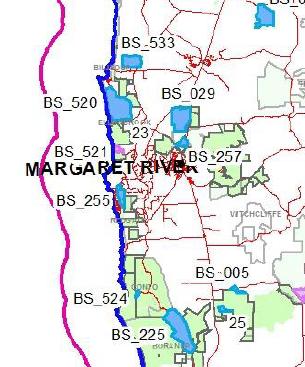
DEC’s ‘Indicative Burn Plans for South West (Spring 2011)
– Blackwood and Wellington districts‘
(Blue areas are targeted for ‘strategic bushfire protection’)
.
Anecdotal evidence from various online media reports suggests that DEC’s prescribed burning was occurring within the nearby coastal Leeuwin-Naturaliste National Park.
So DEC, the custodian of National Parks in Western Australia, set fire to the National Park. So it is likely the magnificent tall stands of Karri and Jarrah forest, that characterise areas of the Park, have been burned? The coastal scrub-heath and large peppermints and banksias which provide habitat to a variety of native mammals including the Southern Brown Bandicoot, Western Grey Kangaroos, Common Ringtail Possum and Brush-tailed Wallabies – have they been burned too? What of the native birds of the Park including the Red-eared Firetail, White-breasted Robin, Rock Parrot and Emu? How much of this important dedicated wildlife sanctuary has been incinerated and disclocated by the custodian charged to protect it? And why?
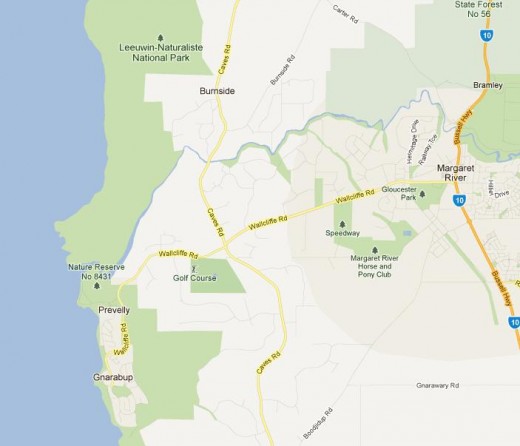 Map of Margaret River and surrounds
The Leeuwin-Naturaliste National Park is where the bushfire was apparently started,
then the fire seems to have been fanned across the Margaret River into the villages of Prevelly and Gnarabup Map of Margaret River and surrounds
The Leeuwin-Naturaliste National Park is where the bushfire was apparently started,
then the fire seems to have been fanned across the Margaret River into the villages of Prevelly and Gnarabup
(Google Maps)
.
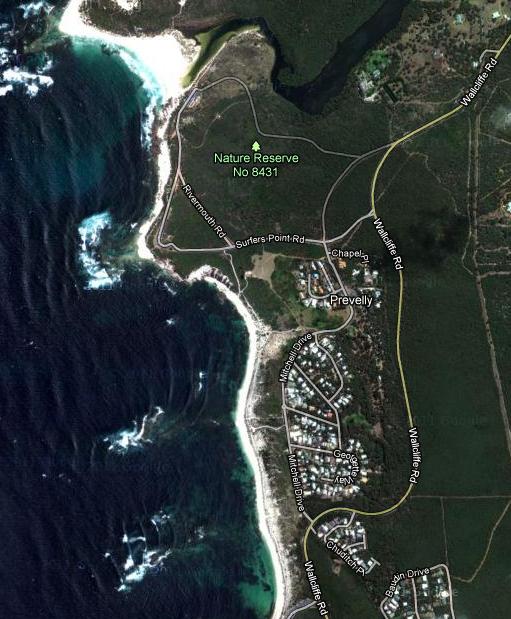 Close up satellite map of the Nature Reserve and coastal village of Prevelly
[Source: http://www.maplandia.com/australia/western-australia/augusta-margaret-river/margaret-river/] Close up satellite map of the Nature Reserve and coastal village of Prevelly
[Source: http://www.maplandia.com/australia/western-australia/augusta-margaret-river/margaret-river/]
.
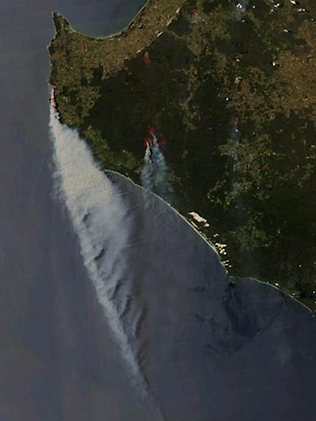 High level satellite photo shows a clear plume of smoke along the coast indicating a strong NNW wind.
[Source: Jeff Schmaltz and LANCE/EOSDID Rapid Response Team, NASA] High level satellite photo shows a clear plume of smoke along the coast indicating a strong NNW wind.
[Source: Jeff Schmaltz and LANCE/EOSDID Rapid Response Team, NASA]
At the time of compiling this article (20111125), no clear and definitive map of the progress of the bushfire zone was available online. The following map is indicative, but it is known that the coastal village of Prevelly to the south was affected, so not too much reliance can be placed upon this aerial map.
 . .
Weather Forecasts?
.
A key factor in bushfires is weather – minimum and maximum temperatures, wind direction, wind speed, maximum wind gust strength, relative humidity, anticipated wind changes, precipitation, etc. What as the weather forecast at the Time? Over 80 days the weather must have varied – the winds, the temperature, yet the prescribed burn was allowed to perpetuate. Weather archival information is available from the Australian Bureau of Meteorology (BOM) for a small fee. An example of yesterday’s weather forecast for the south western area where Margaret River is situated is limited but reads as follows:
.
District Forecasts for Western Australia:
IDW13000
Australian Government Bureau of Meteorology
Western Australia
DISTRICT FORECASTS FOR WESTERN AUSTRALIA
Issued at 4:20pm WST on Thursday the 24th of November 2011
for tonight and Friday with outlooks for Saturday
—————————————————–
IDW1300003
SOUTHWEST:
Remainder of Thursday: Partly cloudy. Becoming humid. Moderate to fresh NW’ly
winds, easing during the evening.
Friday: Areas of morning drizzle in the southwest. Moderate W/SW winds.
Fire Danger:
COASTAL LOW-MODERATE
INLAND LOW-MODERATE
Outlook for Saturday : Isolated areas of drizzle in the southwest in the
morning.
Temperatures for Friday (Minimum Maximum)
Bunbury 17 26
Busselton 15 26
Margaret River 15 24
Bridgetown 16 26
Collie 15 28
Manjimup 16 26
——————————————————-
IDW1300004
SOUTH COASTAL:
Fire Weather Warning issued for Stirling-Inland subdistrict.
Remainder of Thursday: Partly cloudy. Moderate N/NE winds.
Friday: Areas of morning drizzle in the far west. Isolated showers and
thunderstorms developing during the afternoon. Moderate W/SW winds.
Fire Danger:
Stirling Coastal VERY HIGH
Stirling Inland SEVERE
Outlook for Saturday : Isolated areas of drizzle in the far west in the morning. Isolated showers and thunderstorms over the central and eastern parts in the afternoon.
Temperatures for Friday (Minimum Maximum)
Albany 17 27
[Source: ^http://www.bom.gov.au/wa/forecasts/swarea.shtml]
.
 Presuming the fire danger was rated low-moderate,
on 6th September off DEC went and lit bushfires around Margaret River Presuming the fire danger was rated low-moderate,
on 6th September off DEC went and lit bushfires around Margaret River
.
.Clearly DEC’s prescribed burn by yesterday (24th Nov) the bushfire(s) around Margaret River had been burning for some 80 days.
- Why?
- When had they got out of control?
- What measures were put in place to handle increase in wind speed?
- Clearly it was imprudent to allow a bushfire continue for 80 days. When had the decision to suppress been taken?
- DEC had decided to continue the prescribed burn in the National Park as recently as Sunday 20th November, despite high temperatures and strong winds being forecast for later in the week. *
*[Source: ‘WA Premier admits failures on Margaret River fire‘, by Nicolas Perpitch and Paige Taylor, The Australian, 20111125, ^http://www.theaustralian.com.au/national-affairs/politics-news/wa-premier-admits-failures-on-margaret-river-fire/story-fn59nqld-1226205457331]
.
When prescribed burns escape and get out of control (which across Australia is all too frequent), this is more than a tactical misjudgment. It is becomes a bush arson gamble gone wrong. Then more than 30 homes are destroyed as a direct consequence, this is gross culpable negligence.
How dare Premier Colin Barnett then offer those who lost their homes in the Margaret River bushfire a measly $3000 compensation each from the State government. Add three zeros – to each affected household! All affected by loss should collectively seek redress and compensation for all economic loss and trauma and file a class action against DEC and the State Government. Dare to set a precedent! Hip pocket strategy is the best way to put an end to government negligence!
Incident controller Roger Armstrong said the burns escaped authorities’ control 23rd November 2011. The prescribed burn that had led to the present disaster started on September 6, with 60 burns undertaken in the past month. “I want to reinforce with you that we did not ignite a prescribed burn on a serious fire danger day,” Mr Armstrong said. “It was ignited quite a considerable time before that.” [Source: ‘DEC denies Margaret River fire negligence‘, by Courtney Trenwith and Aja Styles, WA Today, 20111124, 12:02 PM, ^http://fw.farmonline.com.au/news/state/agribusiness-and-general/general/dec-denies-margaret-river-fire-negligence/2369712.aspx]
.
.
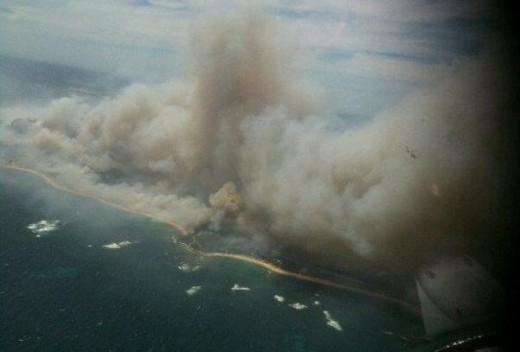
Related Events:
.
During September, DEC’s prescribed burning spring was in full swing across Western Australia. Opposition Leader Eric Ripper questioned whether DEC had been under political pressure to complete an extraordinary number of prescribed burns before the official start of the bushfire season on December 1. [Source: ‘WA Premier admits failures on Margaret River fire’, by Nicolas Perpitch and Paige Taylor, The Australian, 20111125, ^http://www.theaustralian.com.au/national-affairs/politics-news/wa-premier-admits-failures-on-margaret-river-fire/story-fn59nqld-1226205457331].
DEC Principal Fire Operations Manager, Terry Maher, has more or less confessed that DEC fast-tracked this planned prescribed burn. Maher has said that wet weather in October prevented the Department from concluding the prescribed burn sooner.
.
“It would have been absolute negligence if we hadn’t had a crack at trying to complete it because the result would have been the same,” he said.
“It was running around. We had to complete that burn.”
[Source: ‘ Cool change hoses down Margaret River fire‘, 20111125, ABC, ^ http://www.abc.net.au/news/2011-11-25/cool-change-hoses-down-fires/3695026?section=wa]
.
On 15th September, the biggest controlled burn in WA’s history was reported underway on the Nullarbor plain, with DEC setting fire to 660,000 hectares (80km x 80km) of native grasslands. [Source: ‘Nullarbor goes up in smoke‘, ABC Rural, by Tara De Landgrafft, 20110915, ^http://www.abc.net.au/rural/wa/content/2011/09/s3318617.htm?site=perth]. The bushphobic logic was that recent rains had generated natural regrowth, which is demonised as bushfire ‘fuel’, so best burn it in case it burns. No thought was given to the consequential killing of vulnerable fauna native to the Nullabor grasslands such as the Yitjarritjarri (Notoryctes typhlops), Sandhill Dunnart (Sminthopsis psammophila), Bush Stone-curlew (Burhinus grallarius) and Malleefowl (Leipoa ocellata). Interesting how the same logic applied to flammable native vegetation is not applied to flammable pine plantations. Why? The latter is valued, the former is not.
‘It’s only spinifex, she’ll be right’
.
The same day, the WA State Government’s Emergency Services Minister Rob Johnson announced that 80% of Western Australia was at heightened risk of bushfire due to regrowth of native vegetation and so urged home owners ‘to be prepared‘. In the preceding February around the Perth Hills towns of Kelmscott and Roleystone, 72 homes had been destroyed by bushfire. Johnson went on to reassure the public stating that ‘authorities are adequately prepared for the season ahead after considering recommendations from recent bushfire reviews and implementing changes’. [Source: ‘Warning to be prepared for increased bushfire risk’, ABC Rural, 20111015, ^http://www.abc.net.au/news/2011-10-15/bushfire-preparation-wa/3573018/?site=perth]. In October, Johnson had further publicly declared “I don’t think we’ve ever been so well prepared as we are at this moment in time.” [Source: ‘A dire bushfire season ahead: how will it be tackled?‘, by Natasha Harradine, ABC Rural, 20111109, ^http://www.abc.net.au/news/2011-11-09/bushfire-preparedness-feature/3655174]
.
Throughout September, October and right up until 23rd November 2011, no mention can be found online of any news about the supposed continuing prescribed burn in the Margaret River Area. So up until this time one may presume that the prescribed burn in question was either under control, or otherwise out of control in remote bushland and not reported to the media.

On Wednesday 9th November, the local newspaper, the Augusta-Margaret River Mail, had reported a landowner in the Prevelly area burning off a pile of branches, which had escaped due to a sudden wind gust and then burning about 400 square metres of surrounding grass and scrub. The fire was supposedly extinguished. Brigade captain and fire control officer for Prevelly, Brett Trunfull, was quited at the time as saying: “Obviously we are happy to see people burning off their piles, but they must do it within regulation“. The article stated that permits for burning piles were permitted in the area up until midnight on 21st November. [Source: ‘No permit, no burn‘, by Tom Nelson, Augusta-Margaret River Mail, 20111116, ^http://www.margaretrivermail.com.au/news/local/news/general/no-permit-no-burn/2360451.aspx] Editor: Is this a wise practice?
.
The Keelty Report into the Perth Hills Bushfire of February 2011 (released 17th August 2011) highlighted damning inadequacies in the State’s ability to respond to major bushfires – including a lack of appropriate equipment, poor and mismatched radio communication systems, and difficulties in the interaction between the agencies responsible for responding to fires. The Report made 55 recommendations, of which thus far, the Barnett Government has implemented just nine.
Since then the West Australian Government response has been to increase funding into bushfire fighting by about $6 million, including leasing a waterbomber and importing five new appliances (fire tanker trucks), except the trucks aren’t due to arrive until summer 2012. The United Firefighters Union had called for 13 medium tankers. The United Firefighters Union secretary Graeme Geer’s comment was pertinent:
“The next thing is to make sure that the career fire and rescue services have got enough resources on the days when they need them. There are a lot of resources out in the state but they belong to a range of different agencies. On those days when it’s extreme and catastrophic they should be ready to respond at short notice.”
[Source: ‘ A dire bushfire season ahead: how will it be tackled?‘, by Natasha Harradine, ABC Rural, 20111109, ^ http://www.abc.net.au/news/2011-11-09/bushfire-preparedness-feature/3655174]
.
In the weeks leading up to the Margaret River Bushfire, strict new firebreak and fuel hazard reduction notices had been issued in October to property owners in towns and subdivisions throughout the Augusta-Margaret River Shire, including those in Augusta, Margaret River, Witchcliffe, Rosabrook, Cowaramup, Gnarabup, Prevelly, Gracetown and Molloy Island. Property owners who failed to comply with the notice requirements risked a $5000 fine plus the additional cost of paying for a contractor called in by the council to clear their land. Co-ordinator of council rangers Gavin Jennion said that from 6th December 2011: “We will begin inspecting the high risk areas first – places like Prevelly, Gnarabup, Gracetown and Molloy Island where there is only one road in and out.” [Source: ‘Fire hazards may cost land owners’, by Mal Gil, Augusta-Margaret River Mail, 20111102, ^http://www.margaretrivermail.com.au/news/local/news/general/fire-hazards-may-cost-land-owners/2344773.aspx?storypage=1]. Clearly, many of these property owners have now incurred an immensely far greater personal cost.
In early November, near the township of Nannup, about 60km west of Margaret River, a suspicious bushfire was reported which was quickly suppressed by DEC. It burnt out an estimated 67 hectare of bushland. Also around the time of the Margaret River bushfire flare up, nother prescribed burn at Mount Lindesay National Park, north of south coast WA township of Denmark went out of control.
.
.
Wed. 23rd Nov 2011: Suddenly properties already destroyed
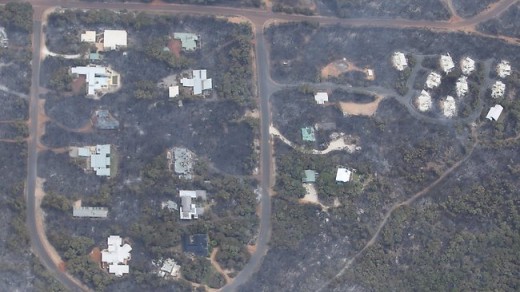
Apparently, the fire started after embers from the still smouldering burn-offs became airborne and ignited in surrounding scrub and began threaten properties along the north-south running Caves Road, west of the township of Margaret River.
7.28pm: Police Commissioner Karl O’Callaghan has told ABC Southwest Radio the current plan was to make sure there were enough resources on the ground for tomorrow.
.
7.40pm: There have been conflicting reports just how many properties have been damaged or destroyed in the fire but according to FESA chief executive Wayne Gregson 21 houses, nine chalets, five sheds and two other buildings had been damaged.
.
7.46pm: The latest alert from FESA advises the potential for severe bushfire behaviour still exists. “The fire has crossed the Margaret River mouth and is currently impacting Prevelly and the south-eastern edge of Gnarabup townsite. “Spot fires have developed in the vicinity of Terry Drive and are burning aggressively in a south easterly direction and have crossed Redgate Road in the vicinity of Redgate Beach. “Winds are moving westerly during the evening, with conditions easing. Homes are still at risk of being damaged by the fire and you need to keep up to date. According to FESA the blaze is likely to have burnt through about 2400 hectares. Firefighters are actively engaged in firefighting at Prevelly, Cherry Road and Burnside Road. Western Power crews are working to re-establish power.
.
8.05pm: While cooler conditions tomorrow are predicted to make it easier for firefighters to control the fire FESA has just issued a severe fire danger advice for parts of the South West land division. A full list of towns and shire in the region can be found at www.fesa.wa.gov.au Residents are urged to stay alert and watch for signs of fire, especially smoke and flames. Have your bushfire survival plan and kit ready.
8.56pm: We are going to wrap up tonight’s coverage now but will be back nice and early in the morning. Visit www.fesa.wa.gov.au for further updates. A Total Fire Ban has been declared tormorrow, Friday, for the shires of Augusta-Margaret River, Busselton, Boyup Brook, Bridgetown-Greenbushes, Donnybrook-Balingup, Manjimup and Nannup.
.
[Source: ‘Parts of Margaret River evacuated as fire approaches‘, by staff reporters, 20111123, ^http://www.margaretrivermail.com.au/news/local/news/general/parts-of-margaret-river-evacuated-as-fire-approaches/2368478.aspx]
.
.
Thu 24th Nov 2011: Flare Up
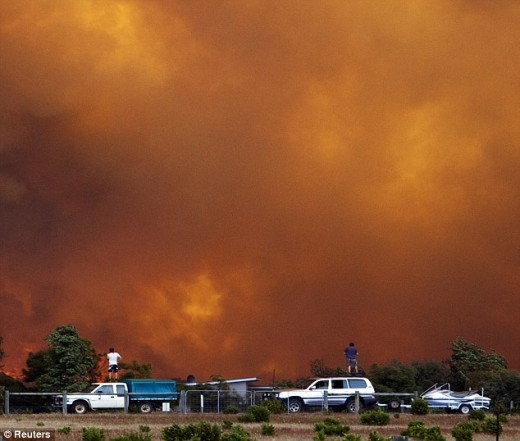
7.05am: Evacuation centre that ”it’s still pretty sleepy”, with dozens of people resting, many of them still uncertain whether they have lost their homes in the fires.
.
7.33am: The Insurance Council of Australia has declared an insurance catastrophe for the bushfires currently burning around Margaret River.
Chief executive Rob Whelan said it was too early to quantify the damage caused by the fires, but expected it to be in the tens of millions of dollars.
.
8.48am: A Bureau of Meteorology spokesman said the temperature at Margaret River was currently 28 degrees, with humidity at 25 per cent.
The spokesman said the winds were currently north north-easterly up to 30km/h with gusts up to 35km/h.
He said that during the day the winds would be about 40km/h with gusts up to 60km/h, changing to north north-westerly through the afternoon.
The Bureau has forecast a maximum temperature of 30 degrees for Margaret River today.
.
9.35am: Wayne Gregson, chief executive at FESA confirms on ABC Radio that so far 10 homes, nine cottages and five sheds have been completely destroyed, and two more homes have been badly damaged.
He said the fire was between 85 and 90 per cent under control, but that this meant that overall it was still out of control.
“Prevelly is under threat. Our focus is on Prevelly in terms of homes and people,” he told ABC Radio.
“At this stage, we think that we have no loss of live or injury.”
He said he had “significant resources” at the scene ahead of blustery winds expected to hit the South-West this afternoon.
.
10.18am: A community meeting is currently underway at the Margaret River Cultural Centre. The crowd is spilling out of the centre as hundreds of people attempt to get the latest information.
DEC incident controller Roger Armstrong is currently addressing the crowd, who are voicing their frustrations at the lack of information. Residents are shouting out for information on road closures and how many homes have been lost.
Mr Armstrong has told the crowd that “we’re not out of the woods here today” and that Prevelly Park was still the main concern for firefighters.
.
10.45am: Prevelly Park remains the area about which authorities are most concerned. DEC incident controller Roger Amstrong said the fire was 80 per cent contained but if winds changed, there was a significant risk for communities west of Margaret River.
.
11.27am: Roger Armstrong, DEC’s incident controller told ABC Radio that an evacuation has been ordered for people in a rural subdivision north of the Margaret River as the bushfire front continues to move.
He said FESA and DEC would be evacuating residents about four to five kilometres ahead of the frontline as the blaze continues to move with the north north-easterly winds.
He said the subdivision, north of Harrington Road, south of Burnside Road, west of Sandpit Road and Boodjidup Roads was the next to be evacuated as a precaution, and said they were in no immediate danger.
Winds in the area are currently about 40km/h, with gusts up to 60km/h.
.
12.38pm: Two more fires have been declared out of control around the state, with six homes in Martin, in the City of Gosnells currently under threat.
The fire is burning between Versteeg Grove and Feldts Road, and residents are being urged to evacuate in the immediate vicinity.
FESA have also warned of a fire that broke containment lines near Denmark.
.
1pm: 140 people find safety in emergency welfare centre ‘Margaret River Cultural Centre on Wallcliffe Road’, intended for Margaret River people who have had to relocate from their homes because of the bushfire, and were being provided with food, care and a place to sleep.
.
1.18pm: The latest update from FESA: A bushfire emergency warning remains in place for people in the Kilcarnup subdivision, Prevelly and Wallcliffe subdivisions and the area north of Wallcliffe Road and east of Caves Road.
An evacuation has occurred in the following areas: south of Burnside Road, north of Harrington Road (also called Exmoor Road), west of Umberto, Kevill, Sandpit and Boodjidup Road.
FESA are advising people in this area that it is too late to leave, and they need to take shelter in their homes and actively defend their properties.
A bushfire watch and act has been issued for people in the greater fire area, including the localities of Ellensbrook, north-east of Kilcarnup, south of Prevelly and east of Caves Road.
.
1.26pm: Mirambeena Aged Care Facility in Margaret River has been evacuated this afternoon.
.
1.32pm: Several reports via Twitter that the fire has now crossed the mouth of the Margaret River. Still awaiting official confirmation but doesn’t sound good. If it’s true, many more homes are likely to be under threat.
.
1.59pm: The fire seems to ramp up as a 100 square-kilometre area south-west of Margaret River is being evacuated, and the blaze is now burning in Prevelly, the DEC told the media scrum.
.
3.00pm: About 30 people stranded on the beach near Prevelly and Gnarabup are being evacuated by jet ski as the fire pushes towards the coast, a resident whose son has been called to help. He said all jet skis in the area had been called to assist.
Only an hour earlier the department had said the beach was the safest place for them to be and that evacuating them would draw resources away from battling the fire. The blaze crossed the Margaret River at Surfers Point Road earlier this afternoon.
.
3.19pm: FESA have advised the Augusta Margaret River Vet Hospital, less than 2 kilometres from the town centre, to now prepare for evacuation. In the last two days they have taken in 31 family pets of people who have been evacuated from the area
.
4pm: WIN news reported flames up to 10-metres high have been spotted as more than 100 firefighters work into the evening to extinguish the blaze.
Ryan Jose told reporters all residents could do was “hope it [the fire] doesn’t burn your house to the ground” while Sam Kinney said residents would be pointing their finger at DEC. “DEC has a lot to answer for” said Mr Kinney.
Residents have told ABC SouthWest radio there is a lot of smoke in the area with one listener saying “it’s very scary”. Another listener has vented her frustration at DEC for burning off on “a day like today” so close to homes.
Olivia who owns some horses has had to take the animals to the local showgrounds and said there is lots of smoke but has yet to see any flames. She was concerned about the change in the wind which may push the fire toward her property.
According to Olivia the townsite was very full with people congregating in the park and in cars as they waited for more information.
More than 100 fire personnel and 30 fire units from the Department of Environment and Conservation, Fire and Rescue Service and local volunteer bushfire brigades are on the scene. Two helicopters and two fixed-wing water bombers are assisting ground crews.
He said almost 100 volunteers were on the scene.
According to DEC the fire is moving in a south-westerly direction towards Ellen Brook homestead at around 200 metres an hour. It is out of control and unpredictable. There have been unconfirmed reports the homestead has been damaged. Firefighters are expecting the wind to change from north-east to north-west about 5pm. This means properties to the east of Caves Road and south of Ellen Brook Road may be impacted by the fire and residents need to keep up to date. So far more than 1000 hectares have been burnt.
 House engulfed near Prevelly 24th November 2011
(likely an ember attack)
House engulfed near Prevelly 24th November 2011
(likely an ember attack)
(Photo by Andre Vanderheyden)
.
[Sources: ‘ Flames up to 10-metres high as residents terrified‘, 20111124, Augusta-Margaret River Mail, ^ http://www.margaretrivermail.com.au/news/local/news/general/flames-up-to-10metres-high-as-residents-terrified/2369987.aspx?storypage=1, ‘WA’s bushfire emergency’, by staff reporters, WA Today, 20111124, 7:59PM, ^http://www.watoday.com.au/wa-news/live-coverage-was-bushfire-emergency-20111124-1nvog.html]
.
.
Fri 25th Nov 2011: Bushfires still uncontained
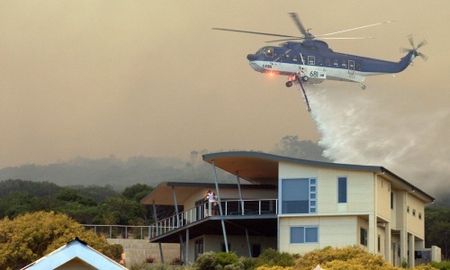
[Source: ‘Fire threatens Hills home’, by staff reporters, Perth Now, 20111125, ^http://www.perthnow.com.au/news/western-australia/wa-fires-fire-threatens-hills-homes-s-w-resort-at-risk/story-e6frg13u-1226205630864]
.
Key Items:
- A bushfire emergency warning remains in place in WA’s Margaret River region, where 34 homes and holiday cottages have been destroyed by a prescribed burn that got out of control.
- The fires, which have been burning out of control for two days, has claimed 25 homes nine holiday chalets, including historic Wallcliffe House, built in 1865.
- However cooler weather today — and the possibility of some rain — either today or tomorrow is expected to help firefighters.
- Some residents are advised to leave their homes immediately if the way is clear but not to relocate at the last minute.
- The warning is directed at people in the area south of Carters Road, north of Forest Grove Road and Conto Road on the west side of the Bussell Highway, south of the industrial area. If they cannot leave, residents are advised to get ready to take shelter in their home and actively defend it. If they have prepared their property to the highest level and plan to use their home as shelter they are being advised to start patrolling it to put out spot fires.
- Twenty-five houses and nine chalets were lost to the fire on Wednesday and Thursday, and properties have been burnt or damaged at Prevelly, Gnarabup and Redgate, the Department of Environment and Conservation said in a statement early today.
- The Department of Environment and Conservation (DEC) said homes were still at risk and it was important for residents to remain up to date.
- Yesterday the fire crossed the Margaret River mouth and burnt through parts of Prevelly and the southeastern edge of Gnarabup.
- Spot fires in the around Terry Drive resulted in aggressive fire behaviour south of Redgate Road.
- The fire is estimated to have burnt around 2800 hectares.
- According to FESA 27,000 hectares has been burnt since the fire was reported in the area at 10pm on Thursday.
- Thirty Fire and Rescue Service, Bush Fire Service and DEC firefighters from six stations are managing the fire.
- Western power said power had been cut along the Vasse Hwy between Stewart Rd and Seven Day Rd.
- Vasse Hwy has been close between Nannup and Pemberton.
- Late yesterday State Emergency Coordinator Karl O’Callaghan said fires were burning out of control in the several areas including Prevelly, where at least 30 properties have been destroyed and 2000 hectares razed after prescribed burning in the Leeuwin-Naturaliste National Park over the past 10 weeks sparked the widespread blaze on Wednesday.
- He said the State Emergency Management Committee had met on Thursday evening and determined no extra resources would be needed to fight the fires in Margaret River, Nannup and Denmark today. “We spoke about whether there would be more resources required, but we’re not expecting them to need more resources tomorrow,” he said.
- FESA spokesman Allen Gale told 6PR about 30 homes and about 10 sheds were severely damaged. He said the area of concern was Gnarabup and further south towards Redgate, where the fire was headed.
- Fifty-five people stranded on a Prevelly beach overnight had to be rescued by jet ski after the high bushfire swept through their coastal town.
- Reports firefighters were “holding back” a blaze which threatening Margaret’s Beach Resort in Gnarabup.
- Cooler temperatures and low winds are making the bushfire ravaging Margaret River easier to fight, although authorities say the fire is still not contained.
- More than 150 firefighters continue to battle the fire wall, which is 34 kilometres in perimeter.
- About 700 residents have gathered in Margaret River for the latest community briefing from emergency services about the fire.
- Despite confirmation another 15 properties were destroyed overnight, taking the total to 34
- As more than 400 firefighters last night battled an out-of-control blaze in and around Margaret River, 233km south of Perth, Emergency Services Minister Rob Johnson conceded the State Alert fire system failed to send phone warnings to some residents until “after the fire had gone through their particular area”.
- Emergency services across the southern part of the state were stretched to capacity as the south coastal town of Denmark last night braced itself for a similar fire threat. Harvester bans were put in place across the state’s entire wheatbelt region while Perth sweltered in 37C heat, and spot fires across the city’s hills kept locals nervous and firefighters busy.
- The Margaret River fire has so far burnt 2400ha and destroyed or damaged at least 30 homes, including the historic Wallcliffe House, a 1865 riverbank manor restored by Woodside chairman Michael Chaney.
- WA Premier Colin Barnett has acknowledged the burn had “gone wrong”
- A report by the community development and justice standing committee tabled in parliament yesterday found there had not been enough action taken on a recommendation for DEC, the Fire and Emergency Services Authority and local government to develop a single, integrated fuel-load management system.
- A DEC spokesman said the fire was “85 per cent” contained after engulfing1800ha, but if winds pushed the fire south-west this morning, houses in Prevellywere in danger. Extra firefighters would be deployed to secure that front of the fire, he said. “If we can get through the next couple of hours here, things are looking good”, the spokesman said.
- An estimated tens of millions of dollars worth of damage by Margaret River bush fires has been declared an ‘insurance catastrophe’. The Insurance Council of Australia chief executive officer Rob Whelan though it was too early to quantify the damage amount, they predicted it would be tens of millions of dollars.
.
[Sources: ‘ WA Premier admits failures on Margaret River fire‘, by Nicolas Perpitch and Paige Taylor, The Australian, 20111125, ^ http://www.theaustralian.com.au/national-affairs/politics-news/wa-premier-admits-failures-on-margaret-river-fire/story-fn59nqld-1226205457331, ‘ DEC denies Margaret River fire negligence‘, by Courtney Trenwith and Aja Styles, WA Today, 20111124, 12:02 PM, ^ http://fw.farmonline.com.au/news/state/agribusiness-and-general/general/dec-denies-margaret-river-fire-negligence/2369712.aspx], ‘Bush fire is an insurance catastrophe’, Augusta-Margaret River Mail, 20111124, ^ http://www.margaretrivermail.com.au/news/local/news/general/bush-fire-is-an-insurance-catastrophe/2369749.aspx]
.
.
Initial Assessment:
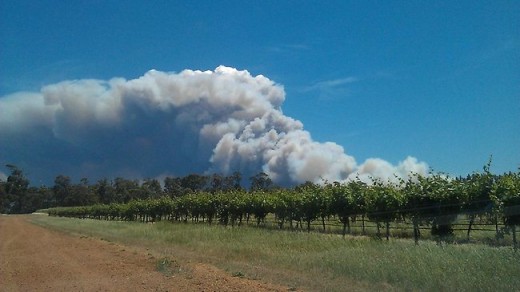
- Sue the arsonist bastards, DEC and the WA Government, jointly in a community-wide class action.
- The ‘blame game‘ phrase is standard defence language of the culpable to try to divert accountability. When someone’s negligence causes your house to burn down, legal justice allows for fair compensation to the victims of negligence. If culpability is proven, compensatory damages are payable by the culpable to restore a victim to the position before the negligence. The fact is not one of discretionary moral blame. It is a fact of culpability. Most criminals will argue black and blue that they are never to blame. They will point to the system, to critics, to the messengers, even to the victims, to anyone but themselves.
- The Premier Colin Barnett has promised a full inquiry into the Department of Environment and Conservation’s handling of the Margaret River fire an hour after the department denied culpability. Barnett’s offer of $3000, to declare Margaret River a disaster area, to spend money on a full enquiry are standard means of government to capture and dissipate community anger so over time all will be forgotten and DEC and FESA business as usual may resume.
- DEC set fire to the environmentally protected Leeuwin-Naturaliste National Park.
- DEC allowed a prescribed burn to get out of control
- Hundreds of people were affected and many have lost everything and will never fully recover – financially, physically, emotionally, as a community
- The full direct and indirect cost of bushfire suppression including the 100 odd firefighters, aircraft and support organisations – must be worn by DEC
- An untold because unknown number of wildlife have suffered and been killed, and perhaps causing or contributing to local extinctions – an independent (DEC-funded) zoological and ecological assessment is called for, with results to be made public.
.
.
Selected Comments from the Community:
‘Well done DEC (Destroy Everything Completely). You have screwed up royally by destroying people’s homes and destroying the environment and the wildlife there. I hope you are proud of what you have done you morons. You knew about the weather conditions and still went ahead. My thoughts go to the people who have lost everything thanks to DEC. My thanks go to the fire fighters who always put in no matter what. They, along with the cops and ambos and the volunteers who will no doubt be there to help everyone, are champs. Stay safe people.’
~ It is I of Perth, posted 20111124
.
‘The time has come to finally get rid of the most incompetent organisation in W.A., the criminal damage they cause to property, humans, wildlife and habitat is beyond comprehension. They create problems where ever they are based to justify their own exsistance.they are also destroying local tourism with their ‘jack boot’ mentality.’
~ the girrawheen oracle, , posted 20111124
.
‘Just having been to Marg River for holidays (the third in 3 yrs to this area) I cannot believe they did a prescribed burn at this time of year in that area I live in Port Lincoln and my house was very close to being burnt down two years ago in our fires .My heart goes out to those people who have lost everything as many of my friends did in our fire .I love the sou west area and stayed at the Margarets beach resort last year hopefully it can be saved as it’s a fantastic resort.Stay safe and stenghth to those who have to pick up the pieces to those who made the decision to burnmshame on you and goodluck sleeping at night as the lives you have shattered are on your consciences. To all those fighting the blaze goodluck and stay safe our prayers are with you……’
~ Mark Wright of Port Lincoln South Australia,, posted 20111124
.
‘My sympathies to the people who have lost homes, need to be relocated and to the animals that were caught in the blaze! Thankyou to the firefighters, ambos and police who will tirelessly work through the days and nights! My fiancé is a police officer. We live in ravensthorpe (2 hrs from esperance) and he has been called to Denmark to help. I hope he stays safe and I am crossing my fingers that nobody will be injured or killed while this fire rages on.’
~ Shouldhavebetterthingstodo of Ravensthorpe,, posted 20111124
‘Firefighters are our heroes but their bosses are twerps.Maybe they will implement the Keelty report recommendations now but then maybe not!’
~ boocuddles, , posted 20111124
.
‘I’m on the surf coast in Victoria and our controlled burns always get out of control! I have family in margs (Margaret River) and friends in prev (Prevelly) so be safe love to everyone helping out. Let’s see the end of these “prescribed burns”‘
~ jodie of victoria, , posted 20111124
.
‘When a cop accidently starts a bushfire with an angle grinder he is charged and prosecuted by police. I wonder if the person/department responsible for this bushfire will also be charged and prosecuted?’
~ Wots good for the Goose, , posted 20111124
.
‘Just the inept DEC (Department of Everything) causing sorrow and mayhem again. There needs to be a full enquiry into all of the DEC doings. They are corrupt, vindictive, horribly inept and almost above the law. Disband the DEC and let’s start again with a fresh honest department.’
~ Dave, posted 20111124
.
‘Let’s see the end of these “Prescribed Burns”. Living in the foothills of Perth, every fine day during the winter months, you see that plume of smoke as CALM lights yet another fire, and in the morning the smoke haze can be seen in the distance, the excuse is to stop wild fires, therefore reduce loss of life and property. People choose to live in wooded areas and know the risks, I was one of them and loved the way of life until I had to come back to live in the burbs, with every hectare CALM burn. How many animals are killed or loose their homes, how many birds nests are burned down during their breeding season in Spring, and how many people with respiratory problems like myself end up sick because of the continuous smoke haze from “prescribed Burning”? Let’s start to do something to stop this legal arson. For goodness sake, doing a so called “prescribed Burn” on a 36 degree day with high winds is stupidity. The person who allowed it should be sacked and sued by the people who lost their homes. Couldn’t agree more!
~ b of a, , posted 20111124
.
‘My family have just lost there house in Prevelly…..’
~ Liz of Jandakot, posted 20111124
.
.
Further Reading:
.
[1] ‘ A Shared Responsibility: The Report of the Perth Hills Bushfire February 2011 Review‘, by Mr Mick Keelty APM AO, ^http://sharedservices.servicenet.wa.gov.au/bushfire/Perth_Hills_Bushfire_Report_Feb_2011.pdf, [ Read Full Report – 8MB]
.
Tags: Caves Road, DEC, Department of Environment and Conservation, escaped burn, Gnarabup, hazard reduction, Keelty Report, Margaret River Bushfire, Margaret River Fire, Master Burn Planning, prescribed burning, Prevelly, State Arson, State-sanctioned Arson, strategic bushfire protection, United Firefighters Union, Western Australian Government
Posted in Threats from Bushfire | 3 Comments »
Add this post to Del.icio.us - Digg
|
|
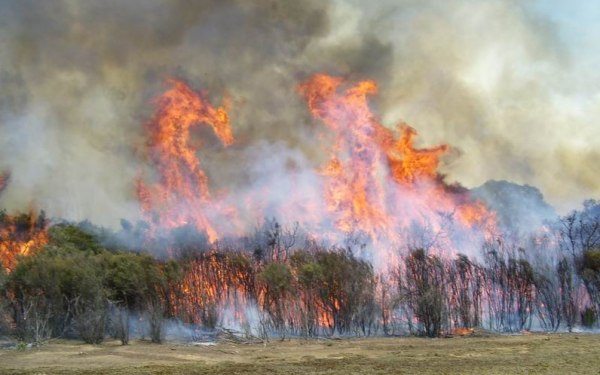 .
.