Archive for the ‘Habitat Threats’ Category
Saturday, February 11th, 2012
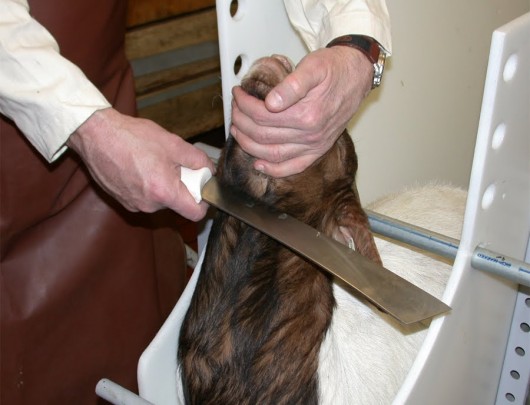 Halal Religious Slaughter
..requires throat slitting with a steel knife
. Halal Religious Slaughter
..requires throat slitting with a steel knife
.
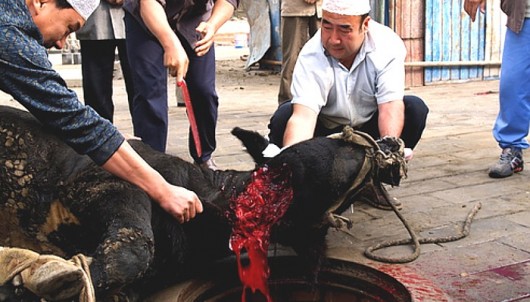
The conditions required for ‘halal slaughter‘ require no stunning, instead death is executed manually using a steel knife, irrespective of the consciousness of the victim.
[Source: Halal Meat International Pty Ltd, ^http://ausmeat.net/halal.html]
.
A sentient animal (like this healthy goat above) is initially trusting of human caretakers, but upon the knife stroke and pain is conscious of being killed, and is so stressed (as any human would be).
The animal dies from bleeding to death while conscious. It suffers pain from the knife cutting into its flesh, its arteries, its oesophagus. To eat meat killed without instant death by stunning/shot, any alternate practice is unnecessary, by choice, barbaric and immoral. All animal cruelty must be outlawed, and prescribed into every country’s Crimes Act. The United Nations else needs to universally deem recalcitrant nations, barbaric. Thus Australia is barbaric, along with Indonesia, Israel and the United States!
This article expresses horror and disgust at the immoral treatment of animals by any human. While this article criticises religious and cultural practices, it is only in respect of how these may cause cruelty to animals. This article and this website respects the freedom of all human religions and cultures. But the moment anyone for whatever reason, belief or justification inflicts cruelty upon any animal, we utterly condemn it as wrong, barbaric and prescribe such action as a crime equal and deserving of the same crime inflicted on a human.
Animals are not anyone’s property, just as women are not the property of men, just like children are not slaves.
.
The Golden Rule of Human Morality

Morality condemns the inflicting of pain and suffering on any sentient being. The hahal practice is immoral. It is only performed for religious ritual reasons by barbaric patriarchal extremists. Halal needs to be banned globally.
In Australia, predominant modern Christian values prescribe moral human conduct based upon the fundamental universal premise:
.
“Do to others as you would have them do to you.”
~ Luke 6:31
.
Sensibly, no halal executioner or eater of halal meat would want to be killed by having their throat slit. Indeed, no rational person would want to be killed at all. Animal liberationists would argue that no animals should be killed and that to eat meat is murder.
While the ethics of killing animals for meat is a debated issue, inflicting cruelty on sentient beings is one of clear immorality. Inflicting cruelty is a discretionary choice and is avoidable.
The moral maxim that one should treat others as one would like others to treat oneself, indeed extends beyond modern Christian values. It is more broadly referred to as the ethic of reciprocity or ‘Golden Rule’ prescribing human moral conduct. Conversely, the Silver Rule is the negative interpretation: ‘One should not treat others in ways that one would not like to be treated.’ The Golden Rule dates back to Ancient Egypt and has prescribed standards of human morality across almost every ethical tradition of civilised human history including Christianity, Confucianism, Hinduism, Buddhism, Taoism, Baha’i, Brahmanism, Brahma Kumaris, Indigenous, Interfaith, Islam, Jainism, Judaism, Native American, Neo-Pagan, Sikhism, Taoism, Theosophist, Unitarian Universalist and Zoroastrian.
The Golden Rule has universally become the common principled base for the “Declaration Toward a Global Ethic” from the Parliament of the World’s Religions. The Initial Declaration was signed by 143 respected leaders from all of the world’s religions in 1993. Outside that global ethic there of course are those who justify killing anthing for their own ends. There will always be extremists.
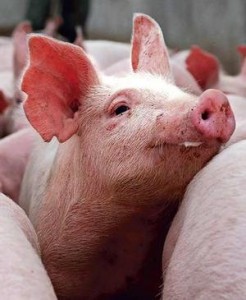 By instinct, an animal trusts us, but learns to fear us for its life By instinct, an animal trusts us, but learns to fear us for its life
.
Throat Slitting Slaughter is Immoral
The cruel practice of ‘halal slaughter‘ is one of the Islamic faith that has become a deviant abberation of that faith by men, just as the practice of patriarchal honour killings breach the ethical tenets of Islam.
 Label used for Halal Meat Label used for Halal Meat
.
A fundamental Quranic concept and a Pillar of Islam is ‘forbidding what is evil‘ and ‘opposing injustice‘. Those who choose to selectively exclude sentient beings are applying an extreme and narrow interpretation on their faith. Killing is wrong. Cruelty is wrong, evil and unjust.
Similarly, Jewish orthodox ‘kosher slaughter‘ practices prescribes ritual killing of an animal by slitting its throat with a knife. Kosher slaughter is simply a extreme and narrow interpretation of the Bible and the Torah, the Judaic scriptures. Somehow that interpretation claims that stunning before throadt slitting means the animal is unfit for Jews to eat, but nowhere in the Judaic scriptures is this explicitly prescribed.
 Label used for Kosher Meat Label used for Kosher Meat
.
Mutual respect applies not just between human beings but between humans (who have the intelligence to recognise) and all sentient beings – those living creatures that can feel, perceive or be conscious, including being able to feel pain and suffering.
Whereas morality is essential for civilised humanity, religion is a choice of faith. One’s choice of religion is a subset of human morality. Without a sound moral code, humanity descends into an uncivilised state – one that is barbaric, vicious, primitive and wicked. Those who inflict cruelty on any sentient being, either other humans or animals, act immorally. It is not as if they are ammoral (unaware of what morality is); they are decidedly immoral – they knowingly do what is wrong. Those who support the eating of animals cruelly killed are similarly immoral.
Ancient Greek society primitively and self-righteously viewed animals existing only for human benefit. The ancient Greek philosopher Aristotle viewed animals as ‘natural slaves‘ made for humans to be used as a means to an end. Aristotle assigned animals toward the bottom of a hierarchical pecking order, where somehow things lower on the chain were made for those higher on the chain. So plants were made for animals, animals were made for people, slaves were made for masters, women were made for men, and men were at the top of the earthly chain, made only for God. Aristotle was a man so may be that had somethig to to with his patriarchal world view. Civilised society rightly rejects such male hegemony and any form of enslavement.
Ancient Christianity similarly viewed animals existing only human use. In the Bible’s old testament book of Genesis, God gave man dominion over every living thing that crept on the earth. Every moving thing that lived was meant for man. Some people argue that this is the reason why animals can be treated as property, or in some cases, as machines. It is easy to justify the use of animals for food, research or pleasure when it is believed that they exist for humans.
Such narrow simplistic and self-serving world views reinforce the scope of religion being a subset of the universal holistic concept of human morality.

.
Animal Welfare Law in Australia
.
In modern best practice civilised societies, cruelty against animals is enshrined in law. In the United States, animals are viewed as property, but then that same society’s legislators reinstigated human torture and built Guantanamo Bay prison. Animals in the United States are segregated into being viewed as companion animals for humans, or lesser farm animals, or research animals or wildlife. It is practically an animal apartheid. In respect to the slaughter of farm animals, under the the Humane Slaughter Act in the United States ritual throat slitting is legalised.
In Germany, legislation has expressed the responsibility of human beings to protect animals. This idea steps away from the belief that animals are here for us to use as a means to an end.
In Australia, there is still no national law applying to animal welfare. Instead there is a hotch potch state and territory based regulations.
- New South Wales has its Prevention of Cruelty to Animals Act 1979
- Vic has its Prevention of Cruelty to Animals Act 1986
- Queensland has its Animal Care and Protection Act 2001
- South Australia has its Animal Welfare Act 1985
- West Australia has its Animal Welfare Act 2002
- Tasmania has its Animal Welfare Act 1993
- Northern Territory has its Animal Welfare Act
- Australian Capital Territory has its Animal Welfare Act1992
.
Even though the designated government departments charged with the administration and enforcement of the respective Acts are the primary industry departments, it is a government cop out that standard practice is to delegate enforcement to the RSPCA, a community charity.
.

The RSPCA in Australia
.
The Royal Society for the Protection of Animals is a community based charity that works to prevent cruelty to animals by actively promoting their care and protection. RSPCA Australia is a Federation of eight independent State and Territory RSPCA bodies called member Societies. RSPCA member Societies do much of the hands on work traditionally associated with the RSPCA such as the operation of shelters and the Inspectorate plus community education and fundraising.
The RSPCA’s Inspectorate’s primary role is:
- To investigate complaints of cruelty and neglect
- To provide guidance and education to animal owners where necessary
- To initiate prosecutions for offences
- To attend to sick and injured stray animals or those that have been abandoned
- To carry out regular inspections of saleyards, pet shops, abattoirs, livestock export operations, animal boarding and breeding establishments, intensive and non-traditional farms, and all places where animals are kept and used for public entertainment.
.
Editor: What a government cop out! – getting charities to do its dirty work. And how effective can a charity be to monitor, police and prosecute such industries and cultures?
.
Australian Standards for Farm Animal Slaughter
[Source: RSPCA, ^http://kb.rspca.org.au/What-is-kosher-slaughter-in-Australia_117.html]
Meat Standards Australia – whose cultural definition?
.
The standard for ‘meat production‘ (aka farm animal slaughter) in Australia is that all animals must be effectively stunned (unconscious) prior to slaughter. Kosher slaughter does not comply with this standard (Ed: nor does Halal slaughter).
Despite the Australian standard requiring stunning, there are instances where the relevant Australian state or territory meat-inspection authority can provide an exemption and approve an abattoir for ritual slaughter without prior stunning – either halal or kosher – for the domestic market. For cattle and sheep, the requirements for this type of slaughter are set out in a nationally adopted guideline Ritual Slaughter for Ovine (Sheep) and Bovine (Cattle):
For cattle, this means the animal must remain in an upright position with the head and body restrained. The animal must be stunned with a captive-bolt pistol immediately after the throat is cut (known as ‘sticking’). Two separate people must perform the sticking and stunning. If there are any problems restraining the animal while attempting to stick it, then it must be stunned immediately.
For religious slaughter of sheep, the guideline requires cutting both the carotid arteries and the jugular veins. This must be confirmed — if they are not completely severed, then the animal must be immediately stunned.
Cattle and sheep requirements are different because cattle have an extra blood supply to the brain through the back of the neck. Therefore, cutting cattle’s throats results in less rapid loss of consciousness.
Kosher beef, sheepmeat and chicken are produced from animals that have not been stunned prior to having their throat cut.
‘The RSPCA is strongly opposed to all forms of slaughter that do not involve prior stunning of the animal.‘
.
The RSPCA is concerned there are greater risks of animal suffering during religious slaughter without stunning than for conventional slaughter. The number of animals involved is a tiny percentage of all animals killed but, regardless, the method is distressing to the animal due to:
- Increased restraint
- Injury caused by the slaughter methods
- Subsequent bleeding out
The use of stunning during the slaughter process can remove some, but not all, of these concerns.
The RSPCA definition of humane killing is: ‘an animal must be either killed instantly or rendered insensible to pain until death supervenes’. When killing animals for food, this means they must be stunned before slaughter so they immediately become unconscious. The RSPCA policy on ritual slaughter is clear: slaughter without prior stunning is inhumane and completely unnecessary.
The RSPCA is opposed to inhumane methods of killing and continues to promote this view to governments and the public. This view of animal welfare and animal slaughter of the RSPCA is supported by The Habitat Advocate, although we consider that concerted effort needs to be made to reduce human reliance upon animals for food.
.
End ‘cruel’ religious slaughter, say (British) scientists
[Source: ‘End ‘cruel’ religious slaughter, say scientists’, by Martin Hickman, Consumer Affairs Correspondent, The Independent (UK), 20090622, ^http://www.independent.co.uk/news/uk/home-news/end-cruel-religious-slaughter-say-scientists-1712241.html]
.
Religious slaughter techniques practised by Jews and Muslims are cruel and should be ended, says a scientific assessment from the (UK) Government’s animal welfare advisers.
The Farm Animal Welfare Council (UK) says that slitting the throats of the animals most commonly used for meat, chickens, without stunning, results in “significant pain and distress”. The committee, which includes scientific, agricultural and veterinary experts, is calling for the Government to launch a debate with Muslim and Jewish communities to end the practice.
One Muslim organisation, the Halal Food Authority, already insists on the slaughterhouses it regulates stunning animals first on welfare grounds, as long as they are still alive when their throats are slit. But in other halal and almost all kosher slaughterhouses, animals have their throats slit without prior stunning which would render them insensible to the pain. Religious groups say that doing so would be against their interpretation of religious texts.
They are granted an exemption to the Welfare of Animals (Slaughter or Killing) Regulations 1995, which stipulates that creatures such as cows, goats and chickens be stunned first.
In a report into the slaughter of white meat, the Farm Animal Welfare Council (FAWC) said evidence suggested that chicken and turkeys were likely to be conscious for up to 20 seconds as blood seeped out of them. The animals are killed by a transverse incision across their neck, cutting skin, muscle, trachea, oesophagus, carotid arteries, jugular veins and major nerves.

“Such a large cut will inevitably trigger sensory input to pain centres in the brain,” the council said. “Our conclusions … are that such an injury would result in significant pain and distress … before insensibility supervenes. Fawc is in agreement with the prevailing scientific consensus that slaughter without pre-stunning causes pain and distress. On the basis that this is avoidable and in the interests of welfare, FAWC concludes that all birds should be pre-stunned before slaughter.”
While recognising the difficulties of reconciling scientific findings with matters of faith, it urged the Government to “continue to engage with religious communities” to make progress. In a 2003 report on red meat, FAWC called for ministers to repeal the religious groups’ legal opt-out.
The Shechita Council, which oversees kosher meat, was contacted but did not supply a comment. Massood Khawaja, president of the Halal Food Authority, insisted that its animals were stunned, unlike those regulated by another group, the Halal Monitoring Committee. “The Koran says use your brain, ponder about things and that’s what we are doing,” he said. “It’s a question of animal welfare.”
The Government no longer keeps statistics on religious slaughter, but five years ago, the Meat Hygiene Service suggested 114 million animals were killed under halal and 2.1 million under kosher methods each year in Britain.
The Department for Environment, Food and Rural Affairs said it would not change its “long-standing policy of religious tolerance” by ending the opt-out. “And while the Government would prefer to see all animals stunned before slaughter, we will continue to ensure that required standards of animal welfare are effectively monitored and enforced in all slaughterhouses,” it said in a statement.
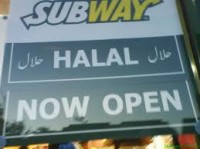
Last year, Lord Rooker , a minister in the department, called for meat slaughtered without stunning to be labelled for the public’s benefit, since some cuts were considered unacceptable to eat, and sold back into the food chain. The Government no longer keeps statistics on religious slaughter, but five years ago the Meat Hygiene Service suggested 114 million were killed under halal and 2.1 million under kosher methods each year.
Last night, the vegetarian organisation Viva!, Tom Lane, said: “How many times does the Government’s own advisory committe on animal welfare have to ask for a ban on slaughter without pre-stunning before action is taken? Viva! embraces multiculturalism and all religious faiths, but the suffering of these animals is so extreme that a line has to be drawn somewhere.”
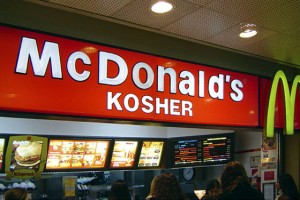 . .
What is Kosher Slaughter?
.
‘At every kosher slaughterhouse, animals are killed by a ritual cut to the neck called ‘shechita‘ that severs the esophagus and trachea (or at least one of these in the case of chickens and turkeys). Ideally, the cut also severs blood flow to the brain and, after a variable period of time, leads to unconsciousness. Jewish law specifies that a razor sharp blade must be used and that the slaughter must be performed by a properly trained individual called a shochet.
‘These rules are particularly important for animal welfare because the sharpness of the blade and its proper use seems to reduce the pain caused by the cut and speed unconsciousness. Most, though not all, authorities in halakha (Jewish law) have further argued that the animal must be conscious while shechita is performed. In non-kosher slaughterhouses, U.S. law requires that animals be stunned before being slaughtered on humane grounds.’
[Source: Jewish Vegetarians of North America, Read More: ^http://jewishveg.com/media11.html]
.
[Editor: Illegality and immorality receive a blind eye when Religion overrules State. Communities have a right to expect their political representatives to appropriately represent community values and for their government to set and maintain high standards, else community faith and trust in political process and in government are undermined].
.
The Cruelty Behind Muslim Ritual Slaughter
[Source: ‘The Cruelty Behind Muslim Ritual Slaughter‘ by Logan Scherer, PETA, 20090812, ^http://www.peta.org/b/thepetafiles/archive/2009/12/08/the-cruelty-behind-muslim-ritual-slaughter.aspx]
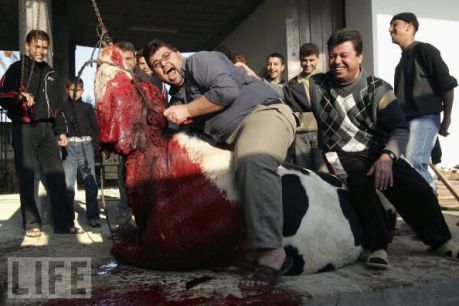
‘I’m going to be frank—after a minute and a half of Global Action in the Interest of Animals (GAIA)’s latest undercover video footage from a halal slaughterhouse in Belgium, I had to stop watching. But while I was able to hit a pause button, the more than 250,000 cows, sheep, and goats who are slaughtered while they are still conscious must endure prolonged torment. Animals killed halal (according to Islamic law) cannot be stunned before their throats are cut, which means that many animals—including the cow shown in this video—fight and gasp for their last breath, struggling to stand while the blood drains from their necks.
Belgium forbids slaughter without prior stunning, but the law does not apply to ritual slaughter practices, even though much of the halal meat produced in the country is distributed both to religious and nonreligious markets. Islamic teachings encourage kindness and compassion toward all creatures, which is why many Muslims make the humane decision to go vegan.
Visit IslamicConcern.com to learn more about cruelty-free alternatives to halal meat.
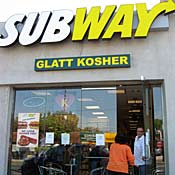
Editor: What has become regarded as politically correct has been allowed to descend into morally incorrect. Ritual slaughter is religious tolerance at any cost. If halal and kosher is permitted what is stopping tolerance of voodoo, pagan animal sacrifice, Indian Khond human sacrifice, Sumatran Batak canabalism? Humans can justify any practice on the basis of cultural tradition.
>
What has Australia’s Meat and Livestock Association have to say?
[Source: ^ http://www.mla.com.au/Livestock-production/Animal-health-welfare-and-biosecurity]

.
MLA: ‘Animal health, welfare and biosecurity are important at all stages of the livestock production chain. Each can have potentially adverse impacts on productivity if managed poorly and because producers have a duty of care to their livestock. If not upheld, these issues have the potential to reflect badly on the whole industry.’
Producers must consider the five freedoms for animals and the need to incorporate these into property management plans and procedures:
- Freedom from hunger and thirst
- Freedom from discomfort
- Freedom from pain, injury and disease
- Freedom to express normal behaviour
- Freedom from fear and distress
‘Attention to health, welfare and biosecurity is easier during good seasons, but is equally important during poor seasons or during foreseen circumstances likes floods, drought, fires and other adverse events. Special attention needs to be paid when these circumstances necessitate the humane destruction of large numbers of animals.’
.
Animal welfare
.
‘The welfare of sheep, cattle and goats affects the productivity, profitability and sustainability of the Australian livestock industries. The welfare of livestock is important during all stages of production, from birth to slaughter. Good animal welfare practices are an integral part of a property management plan.
MLA is committed to investing in animal welfare research that provides tools and knowledge to producers to help them improve the wellbeing of their livestock and address issues of community concern.’
.
Editor: Well, that is Meat Industry spin. The following articles reveal Australia’s meat industry reality.
.
Rogue abattoir not representative: government
[Source: ‘Rogue abattoir not representative: government’, 10 February 2012, AAP, ^http://www.sbs.com.au/news/article/1625242/Sydney-abattoir-shut-down-over-cruelty-concerns]
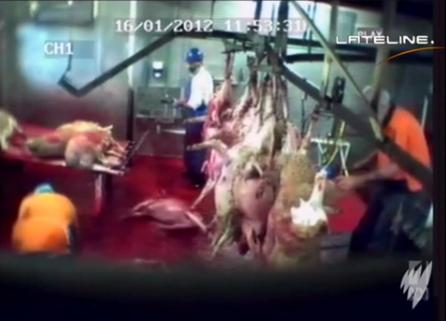 Half dead lamb writhes on the abattoir floor at the Hawkesbury Valley Abattoir
Abattoir workers (in orange) continue slaughtering other animals business-as-usual. Half dead lamb writhes on the abattoir floor at the Hawkesbury Valley Abattoir
Abattoir workers (in orange) continue slaughtering other animals business-as-usual.
.
A Sydney abattoir that has been shut down because of gross animal mistreatment is a rogue operator and not representative of the industry, the NSW Food Authority says.
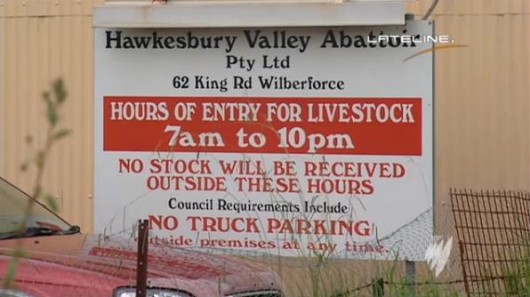
The Authority suspended operations at Hawkesbury Valley Meat Processors at Wilberforce on Thursday after it received video footage depicting “acts of gross animal mistreatment”.
The footage, shown on ABC’s Lateline program on Thursday night, showed a worker bashing a pig several times over the head with a metal bar. [See Video – WARNING contains disturbing footage].
Another pig was hit 13 times because it had not been stunned properly.
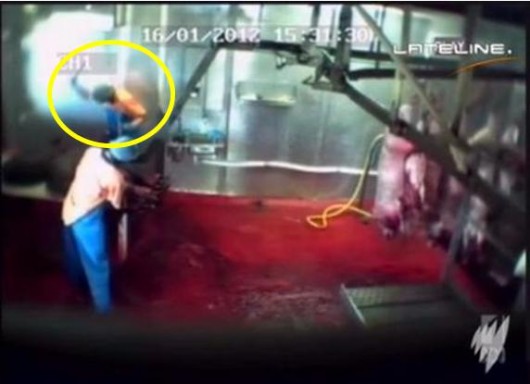 Abattoir worker bashed pigs over the head with a metal pole to kill them Abattoir worker bashed pigs over the head with a metal pole to kill them
.
Investigation Launched
.
The Authority, the RSPCA and NSW Department of Primary Industries have launched an investigation into the abattoir, while the operation has been ordered to make a submission as to why it shouldn’t lose its licence.
Peter Day, executive director of compliance at the authority, said it was the worst animal welfare breach at an abattoir that he has ever seen, but defended the industry as a whole.
“Obviously the footage we have seen, we would be of the view that it is not representative of the industry as a whole, and that this is a rogue operation, that is in no way compliant with what is expected of abattoirs,” he told reporters in Sydney.
“We will work with the relevant other agencies… to ensure that we fully uncover why this has occurred and how we can ensure operations like this don’t occur into the future.
“There is no denying that the footage is disturbing. I’m shocked. I think it is the worst case I’ve seen in an abattoir in terms of animal welfare breaches.”
.
Workers Sacked
.
Workers involved in the mistreatment of animals at a Sydney slaughterhouse have been sacked or moved to other duties, the abattoir says.
Hawkesbury Valley Meat Processors said it was extremely concerned about video footage aired on television on Thursday night showing animals being bashed to death while conscious.
“Casual staff involved in the incident have been stood down and permanent staff have been moved to other duties until the investigation has been finalised,” the abattoir said in a statement on Friday.
Hawkesbury Valley said it reported the incident to authorities as soon as it became aware of the video and was cooperating with the current investigation.
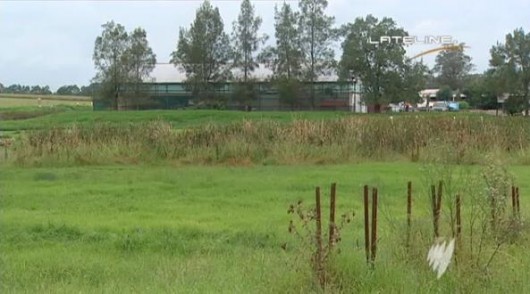 Wilberforce’s Halal House of Horror Wilberforce’s Halal House of Horror
.
Wake-Up Call
.
NSW Primary Industries Minister Katrina Hodgkinson on Friday said the footage should act as a “wake-up call” for all abattoir operators, and flagged a review of the state’s abattoirs.
“I’ve seen this footage, and it may well be a one-off, but we’re certainly going to review the operations in all abattoirs as a result of this,” she told ABC Radio.
“I want to make sure that all operations right across NSW are being conducted in a manner which follows those animal welfare guidelines.”
The body representing NSW farmers said it was appalled by the cruelty depicted in the video and welcomed the investigation into the abattoir.
NSW Farmers president Fiona Simson said animal welfare had to be a priority for everyone in the meat production chain.
“After the live export issue in 2011, our membership reaffirmed that the highest level of animal welfare should always be carried out, whether at home or abroad,” she said in a statement.
.
Call for CCTV Cameras
.
Animals Australia called for closed circuit television cameras to be installed in all Australian abattoirs.
“One of the problems is that unlike export abattoirs, domestic abattoirs don’t have an inspector or government officer on site most of the time,” campaign director Lyn White said in a statement. She said Animals Australia was calling on authorities to follow the lead of the UK where one in five abattoirs was fitted with CCTV cameras.
“Only the presence of cameras will actively discourage workers from engaging in such wanton acts of gross cruelty,” she said.
The food authority’s Mr Day said there were a number of risks with CCTV.
“It is something that we will look at in terms of whether that could have worked in this regard,” he said. “But I think that raises a lot of other questions around who watches the video, who owns the video footage, compliance and so on. I think we are really focussing on the fact that this a one off, in terms of a rogue operator. “We’ve taken the necessary action, they’re not operating now, and we’re doing our full investigation.”
.
Inspected 4 Times
.
Mr Day said the Sydney abattoir had been audited or inspected four times in 2011. “(But) there was nothing to indicate the levels of the problems that were revealed in the footage were
occurring there”.
Asked if the authority’s compliance procedures had failed, Mr Day said it carried out unannounced inspections and audits.
“I don’t know what more we can do there in that regard,” he said. “I think that our compliance program is as good as it can be at the present time.” Mr Day said part of the investigation would also look at ongoing investigation and compliance activities. “I think we need to be clear that ultimately the responsibility to comply with the legislation lies with the abattoir owner operators,” he added.
“As the regulator our action is to respond and react and take action appropriately, where we do uncover breaches, and I think we’ve done that in this regard.”
NSW Chief Veterinary Officer Ian Roth agreed that the Hawkesbury operation was a rogue operator. “We were horrified – we were shocked,” Dr Roth said.
“We think it’s very appropriate … to immediately suspend the operation at the abattoir and also to refer it to the RSPCA for a full investigation.”
Dr Roth said he had never seen cruelty like that filmed at the Sydney abattoir. “I was shocked, and we were horrified, and I obviously didn’t like it at all,” he said.
.
 Real halal…real horror Real halal…real horror
.
Editor: How do we know this practice is not representative? From the footage it is a clear workplace culture!
.
Not a One-Off – ‘Vic abattoir probed over cruelty claims’
[Source: ‘Vic abattoir probed over cruelty claims’, by AAP, 20111125, ^http://news.smh.com.au/breaking-news-national/vic-abattoir-probed-over-cruelty-claims-20111125-1nz6r.html]
.
A Victorian pig abattoir (LE Giles Abattoir, in Trafalgar, west of Melbourne) has been ordered to stop operations while it is investigated over animal cruelty claims.
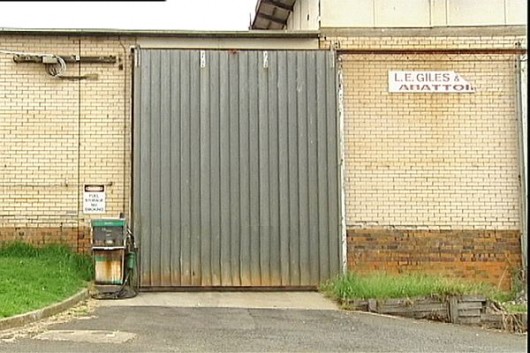 Cruel animal treatment – out of sight, out of mind Cruel animal treatment – out of sight, out of mind
.
Victoria’s department of primary industries announced on Friday it has launched a full investigation into slaughter practices at the Gippsland abattoir following serious animal welfare complaints.
Video footage allegedly taken inside the L.E. Giles and Sons Abattoir will be analysed as part of the probe, which will determine whether animal cruelty prevention laws have been broken.
PrimeSafe Victoria, which licenses the state’s domestic abattoirs, has ordered the abattoir owners to stop operations by suspending its licence.
PrimeSafe chief executive Brian Casey said he ordered the immediate cease after viewing the video footage. Mr Casey said it will vigorously pursue the complaints to ensure any inhumane treatment of animals is stamped out.
“I am appalled by the treatment of animals shown in the video footage,” he said in a statement.
As the abattoir is now prevented from slaughtering livestock, there is no ongoing risk to the welfare of livestock at the facility or to public health.
Mr Casey said he was prepared to cancel the abattoir’s licence once the probe is complete. “I have advised the abattoir owners that it is my intention, immediately the investigation is concluded, to take action with a view to cancelling their PrimeSafe licence,” he said.
PrimeSafe is empowered to cancel the operating licence of any abattoir which does not meet animal welfare standards. The investigation will also uncover any potential breaches of the Meat Industry Act.
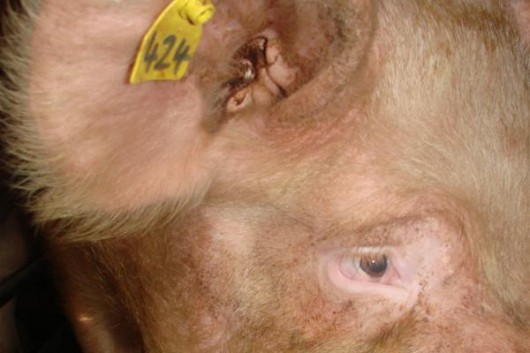 One of the abused pigs
. One of the abused pigs
.
Further Reading:
.
[1] ‘Rogue abattoir not representative: government’, 20120210, AAP, ^ http://www.sbs.com.au/news/article/1625242/Sydney-abattoir-shut-down-over-cruelty-concerns
.
[2] Royal Society for the Prevention of Cruelty to Animals (Australia), RSPCA, ^ http://www.rspca.org.au/
.
[3] http://kb.rspca.org.au/What-is-kosher-slaughter-in-Australia_117.html
.
[4] Halal Meat International Pty Ltd (Australia), ^ http://ausmeat.net/halal.html
.
[5] Animal Legal and Historical Center, USA, ^ http://www.animallaw.info/articles/ddusicacl.htm
.
[6] Luke Muehlhauser, Singularity Institute Executive Director,^ http://lukeprog.com/
.
[7] ‘ Vic abattoir probed over cruelty claims‘, by AAP, 20111125, ^ http://news.smh.com.au/breaking-news-national/vic-abattoir-probed-over-cruelty-claims-20111125-1nz6r.html
.
[8] Meat and Livestock Association ( Australia’s peak industry body joke), ^ http://www.mla.com.au/Livestock-production/Animal-health-welfare-and-biosecurity
.
[9] Islamic Concern.com, ^ http://www.islamicconcern.com/
.
[10] Jewish Vegetarians of North America, ^ http://jewishveg.com/media11.html
.
[11] ‘Activists question Australian Standards’ by Steve Cannane , ABC TV Lateline programme, 20120211, ^ http://www.abc.net.au/news/2012-02-11/activists-not-convinced-abattoir-abuse-is-isolated/3824486
.
[12] Melbourne: ‘Animal activist rescues dog from illegal abattoir’ by Maris Beck and Nino Bucci, 20120203, Hawkesbury Gazette, ^ http://www.hawkesburygazette.com.au/news/national/national/general/animal-activist-rescues-dog-from-illegal-abattoir/2442639.aspx
.
[13] Melbourne’s illegal dog meat abattoir: ‘ Peter Avraam, illegal dog meat abattoir… RSPCA did nothing!‘, by Chris Roubis, 20120206, ^ http://www.chrisroubis.com/2012/02/peter-avraam-illegal-dog-meat-abattoir-rspca-did-nothing/
.
[14] RSPCA Watchdog – a community voluntary watchdog on what the RSPCA is doing and not doing, ^ http://www.rspcawatchdog.org/articles/whatswrong.htm
.
Footnote
.
‘Trade put first when RSPCA raised issue’
[Source: ‘Trade put first when RSPCA raised issue’, by Kelly Burke, Sydney Morning Herald, 20110602, ^http://theland.farmonline.com.au/news/nationalrural/livestock/cattle/trade-put-first-when-rspca-raised-issue/2182830.aspx?storypage=0]
.
The RSPCA took its concerns over the welfare of cattle exported to Indonesia to the federal government in writing two years ago. But the animal welfare organisation was denied permission by the government to investigate, for fear of offending its closest trade partner.
The government also ignored alarm bells that rang 18 months ago, when a departmentally endorsed report designed to document the improvements Australia had achieved in Indonesian abattoirs instead identified serious animal welfare issues at the point of slaughter.
As another ship, the Hereford Express, prepared to leave for Indonesia from Darwin yesterday with about 2000 head of cattle aboard, the Australian Veterinary Association joined the growing call for an immediate ban on all live exports to Indonesia.
So far, the Agriculture Minister, Joe Ludwig, has only declared a moratorium on the supply of cattle to 11 targeted abattoirs, but has declined to specify exactly how the government might enforce such a limited ban while continuing the live export to Indonesia of some 500,000 cattle every year.
”The live export of all cattle to Indonesia should be suspended until the same animal welfare standards as Australia’s can be assured,” said the president of the Australian Veterinary Association, Barry Smyth.
“This means that pre-slaughter stunning must be mandatory and the appropriate use of restraining boxes is enforced.”
The RSPCA has told the Herald it sought to travel to Indonesia to inspect conditions in the abattoirs in 2009, but the then agriculture minister, Tony Burke, brushed off the concerns and referred the matter to the Meat & Livestock Association.
The RSPCA was subsequently refused permission to conduct its own investigation.
”There were suggestions that the minister felt it could upset the Indonesian government,” said the RSPCA’s chief scientist, Bidda Jones. ‘‘But no reason was ever given in writing.’‘
Then last November, the RSPCA received a request by the Department of Agriculture to attend a briefing in Canberra, where Dr Jones was told an independent report had found that slaughter conditions in Indonesia had been ”generally good”.
Dr Jones received a copy of the report, which had been completed six months earlier. The Herald has also since obtained a copy of the report, which documents a variety of substandard practices that would be illegal under Australian laws and in violation of international guidelines.
Examples included head slapping, where the panicked prostrate animal constantly bangs its head on the steel draining trough as a result of the design of the Australian Mark 1 boxes, and the finding that the average number of cuts to an animal’s throat prior to loss of conscience was four, with up to 18 cuts recorded.
”From the information available in the report it is clear that the majority of the animals observed were subjected to significant levels of pain, fear and distress during handling and an inhumane slaughter,” Dr Jones’s analysis concluded. ”It is therefore both perplexing and extremely disappointing that the report takes the range of conditions observed and summarises them into one sentence: ‘Animal welfare was generally good’.”
.
What’s wrong with the RSPCA?
Despite the hard work of volunteers, RSPCA management consistently fails animals.
by Patty Mark and Erik Gorton
.
Q. Why is the RSPCA in business with the largest battery egg producer in Australia?
The RSPCA says it’s against the cruel battery cage yet maintains a business arrangement and accepts sponsorship from Pace Farms, Australia’s largest battery egg producer. The RSPCA say their Liberty Barnlaid Egg Endorsement Scheme with Pace will ensure some hens get out of their cages, yet the number of battery hens in cages has not decreased while the RSPCA gets paid (to date) over $182,560 in royalty payments. Meanwhile, Pace Farms has just built the largest battery hen factory in the southern hemisphere (West Wyalong).
.
Q. Why does the RSPCA justify overcrowding, beak mutilations, lack of perches, prevention of roosting, chronic stress and electric shock training to the hens they abuse for their barnlaid approved eggs?
The Animal Liberation Victoria undercover rescue team repeatedly videotape and photograph all of the above cruelties inside RSPCA approved barnlaid sheds.
.
Q. True or False: The RSPCA is the only animal organisation legally able to prosecute for cruelty in Victoria?
True. (Section 24 of the Prevention of Cruelty to Animals Act – POCTA). Other Victorian animal organisations depend on the RSPCA to investigate their cruelty complaints. For twenty years Animal Liberation Victoria has presented clear violations and gross suffering in egg-laying factories, broiler chicken sheds and intensive piggeries, yet the RSPCA ignores this evidence and fails to prosecute.
.
Q. How often do the RSPCA routinely inspect those businesses and industries that use the majority of animals in Victoria?
Chickens are the most numerous animals used in Victoria requiring the protection of the RSPCA.
Millions of birds in hundreds of breeding farms, battery/barnlaid and free-range egg farms, and broiler (chicken meat) farms rated only three routine inspections in 2002. The inspections are cursory. What hope do the animals have, especially if inspections are at Pace Farms?
.
Q. Killing them softly? Is the RSPCA involved in sending animals to the slaughterhouse?
The RSPCA is also in business with pig producers. Otway Pork was a sponsor of 2006’s Million Paws Walk and the RSPCA makes $$$ from pigmeat sold by Otway Pork. Pigs are as intelligent as dogs. Would the RSPCA send all the unclaimed lost dogs who they euthanise to a slaughterhouse to be electrically prodded, terrorised, have their throats slit, then hung up by one leg to bleed out, with some possibly entering a scalding tank alive? Ask them why they treat pigs this way.
.
Q. What creatures (great and small) does the RSPCA serve or cook at it’s fund-raisers and family days?
The RSPCA consistently serves animal flesh at their public functions knowing the enormous pain and terror these animals suffered during their rearing, transport and finally their slaughter at the abattoir. There are numerous meat-free alternatives they could use to spare these creatures this torment while also leading the community forward with a truly humane and healthy food choice.
.
Q. What did the RSPCA do to help 378 dogs at a cruel Ballarat Puppy Farm?
Eurovision’s Puppy factory which was situated near Ballarat had been farming thousands of puppies in extremely cruel conditions for over twenty years. Repeated evidence of abuse presented to the RSPCA was dismissed, who claimed that the farm’s operations were legal. After video evidence of an undercover rescue was presented, the RSPCA still maintained “No animal welfare issues observed”. Finally, sustained protests and lobbying of Ballarat’s local council by campaigner Debra Tranter and Animal Liberation Victoria resulted in the farm’s closure due to appalling conditions.
The RSPCA then delivered it’s greatest slap in the face when it mislead the public in it’s newsletter, implying that the closure of the factory was due to their efforts! A very cleverly worded article proclaimed the closure of the Puppy factory, and while it never actually claimed victory, the clear impression given to the reader was that the RSPCA had ordered the closure.
.
Q. How is the RSPCA currently handling the case of starving horses in Tolmie?
For seven months now the RSPCA have issued four compliance notices to an animal hoarder who has red-worm infested horses in her care. To date, nine horses have died as a result of insufficient nutrition and lack of adherence to a proper rehabilitation regime. Many more horses are still in danger and yet the RSPCA refuses to seize the horses, claiming that they cannot do so while the owner complies with veterinary advice. The RSPCA appointed vet, however, has since discontinued involvement due to frustration that the owner is not following the procedures he has set out. (Read: ‘RSPCA fails horses in need‘ for the full story).
.
Editor:
Australian Governments (national and state) are turning a blind eye to animal cruelty in farming and this is unacceptable. Agriculture Minister, Joe Ludwig, needs to be sacked for gross neglect and immoral complicity. The MLA’s previous bossDon Heatley and the Cattle Council’s past boss Greg Brown need to be investigated and both organisations wound up over complicity in the known cruelty of the Indonesian livestock trade.
.
Reform Initiative:
The current inspectorate functions of the RSPCA charity is a government cop out of responsibility for law and order. That animal welfare is regulated undre multiple state-based systems is a legacy of colonialism. The entire inspectorate role needs to be wholly transferred to a new dedicated national agency, fully national government-funded and transparently independent from industry and government departments. Essentially this is a veterinary standard that applies to all animals in Australia – farmed, companion animals, and wildlife. So perhaps a suitable title for the new agency should have a veterinarian board of management and be called the Australian Animals Police to operate under a strict new national Animal Crimes Act.
Refer to previous The Habitat Advocate articles on this issue:
.
.
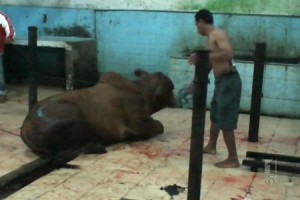 Photo extract of infamous secret video of Indonesian abattoir barbarism
…don’t travel to Indonesia. Boycott this backward country! Photo extract of infamous secret video of Indonesian abattoir barbarism
…don’t travel to Indonesia. Boycott this backward country!
.
Tags: Animal Crimes Act, animal cruelty, Animal Welfare Law, Australian abattoirs, Australian Animals Police, Farm Animal Welfare Council, Halal KFC, Halal McDonalds, halal slaughter, Halal Subway, Hawkesbury Valley Abattoir, Kosher McDonalds, kosher slaughter, Kosher Subway, L.E. Giles and Sons Abattoir, Meat and Livestock Association, Meat Standards Australia, religious slaughter, RSPCA, The Golden Rule, Throat Slitting Slaughter, throats slit
Posted in Threats from Farming | 4 Comments »
Add this post to Del.icio.us - Digg
Tuesday, February 7th, 2012
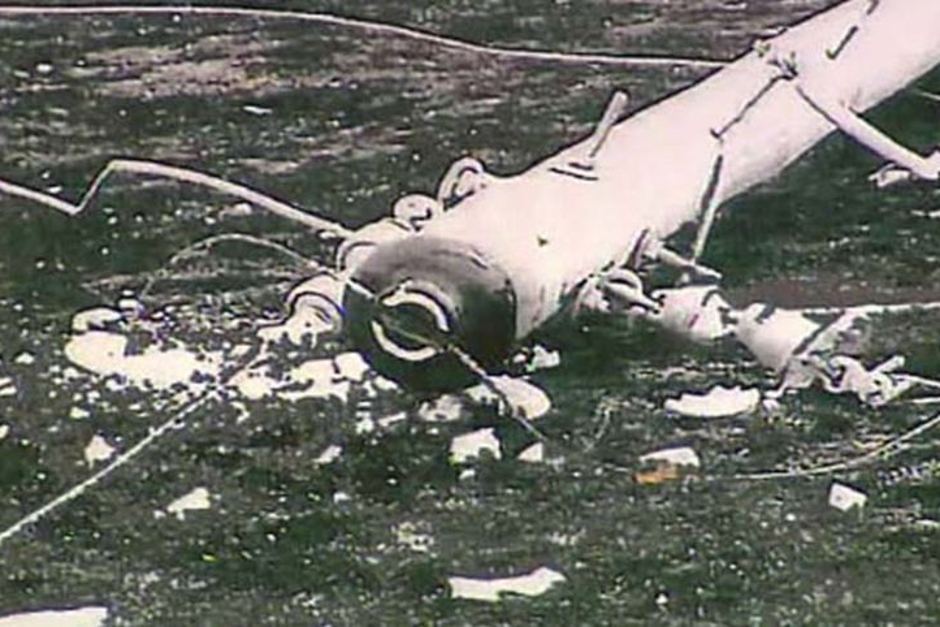
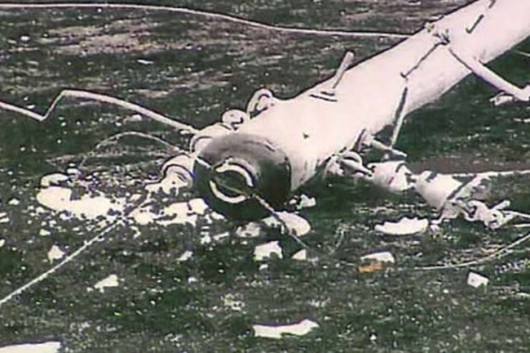 SP AusNet’s power pole near the one believed to have ignited the East Kilmore Bushfire of 2009
(Source: ABC, ^http://www.abc.net.au/news/2009-11-18/this-power-pole-is-near-where-the-kilmore-bushfire/1159986) SP AusNet’s power pole near the one believed to have ignited the East Kilmore Bushfire of 2009
(Source: ABC, ^http://www.abc.net.au/news/2009-11-18/this-power-pole-is-near-where-the-kilmore-bushfire/1159986)
.
Today marks the third anniversary of the 2009 Victorian Bushfires. People reading this do so because they are interested in understanding and seeking answers, and so do I. This is one reason why I write. (Editor)
After a Royal Commission and much government promising, the test of faith is do people in regional Victoria feel safer from the risk of bushfire and confident that the subsequent actions by government at all levels are better prepared to mitigate a repeat of 2009?
The first two terms of reference of the Royal Commission into the 2009 Victorian Bushfires were to investigate:
1. ‘The causes and circumstances of the bushfires which burned in various parts of Victoria in late January and in February 2009 (“2009 Bushfires”).’
2. ‘The preparation and planning by governments, emergency services, other entities, the community and households for bushfires in Victoria, including current laws, policies, practices, resources and strategies for the prevention, identification, evaluation, management and communication of bushfire threats and risks.’
.
The underlying premise of the entire investigation was not about attributing individual blame per se, although some of that has been attributed two a few individuals, but to understand why the devastation was of such a scale and impact, with a view to learn from the tragedy and to better prepare for the future. Loved ones cannot be returned, but from their loss our society needs to learn and protect itself from a repeat. It has happened before. This editor was in Melbourne during the 1983 Ash Wednesday bushfires. It must not happen again.
.
Causes of the 2009 Victorian Bushfires
.
People rightly wanted to know the direct causes and circumstances of the fires, about emergency management of the fires, bushfire detection, the warnings given or not given, about bushfire preparedness.
Well the final report of the Royal Commission grouped the causes of the bushfires according to their separate geography as follows:
1. Delburn Fires cause: “suspicious“
2. Bunyip Fire cause: “suspected lightning“
3. Kilmore East Fire cause: “electrical failure“
4. Horsham Fire cause: “electrical failure“
5. Coleraine Fire cause: “electrical failure“
6. Pomborneit–Weerite: “electrical failure“
7. Churchill Fire cause: “suspicious“
8. Murrindindi Fire cause: “suspicious“
9. Redesdale Fire cause: “undetermined“
10. Narre Warren at Harkaway cause: “accidental“; at Lynbrook: “not determined“
11. Upper Ferntree Gully Fires cause: “unknown“
12. Bendigo Fire cause: “suspicious“
13. Beechworth–Mudgegonga Fire: “electrical failure“
.
“Most of the major fires that burned in late January and in February 2009 started as a direct or indirect result of human activity.”
.
Main Cause: Overhead Electricity Arcing of a neglected SP AusNet Asset
.
Failure of electricity assets owned and neglected by SP AusNet was responsible for five fires—Kilmore East, Beechworth–Mudgegonga, Horsham, Coleraine and Pomborneit–Weerite.
The causes of four fires—Murrindindi, Churchill, Delburn and Bendigo—are thought to be suspicious (i.e. arson). One fire—Harkaway—was started accidentally. Only the Bunyip fire is thought to have been the result of natural causes (lightning), although fire investigators have been unable to definitively reach this conclusion. The causes of both Lynbrook fires and the Upper Ferntree Gully and Redesdale fires are not known.”
[Source: 2009 Victorian Bushfires Royal Commission, Final Report, July 2010, Volume 1, Chapter 15.1 Conclusions – Fire causes, p.226]
.
These conclusions are far from satisfactory, given the considerable resources and expertise made available to the Royal Commission, and that its number one task from to identify the exact causes of the fires. Why are the conclusions so vague? Is it symptomatic of the inadequacies of CFA bushfire monitoring and investigation skills? What were the delays between the estimate ignitions and the respective onground investigations?
It is easy to become bamboozled by the complexity of the many separate bushfires and their respective causes, the contributing factors and varying responses, and particularly since the Royal Commission final report is so long and unwieldy. I don’t think anyone questions that the bushfire conditions were characterised by many years of drought producing tinder dry bushland and extreme heat and low humidity on the day, which all produced an ‘unprecedented‘ extreme bushfire risk.
But of all the bushfires that occurred in the lead up to and on the day of 7th Februray 2009, the single bushfire that caused the most destruction and tragic loss of life was the Kilmore East Fire. The Kilmore East Fire started about 85 kilometres north of Melbourne and ended up burning easterly across the Hume Highway through the shires of Whittlesea, Nillumbik, Mitchell and Yarra Ranges extending south east 70km.
It burnt through the towns of Wallaby Creek, Humevale, Strathewen, Kinglake, Kinglake West, Clonbinane, Steels Creek, Chum Creek, St Andrews, Dixons Creek, Yarra Glen, and Strathewen. Then the wind changed southerly and raged the fire on to Pheasant Creek, Yabamac, Flowerdale, Hazeldene, Castella, Break O’Day, Glenburn and Toolangi.
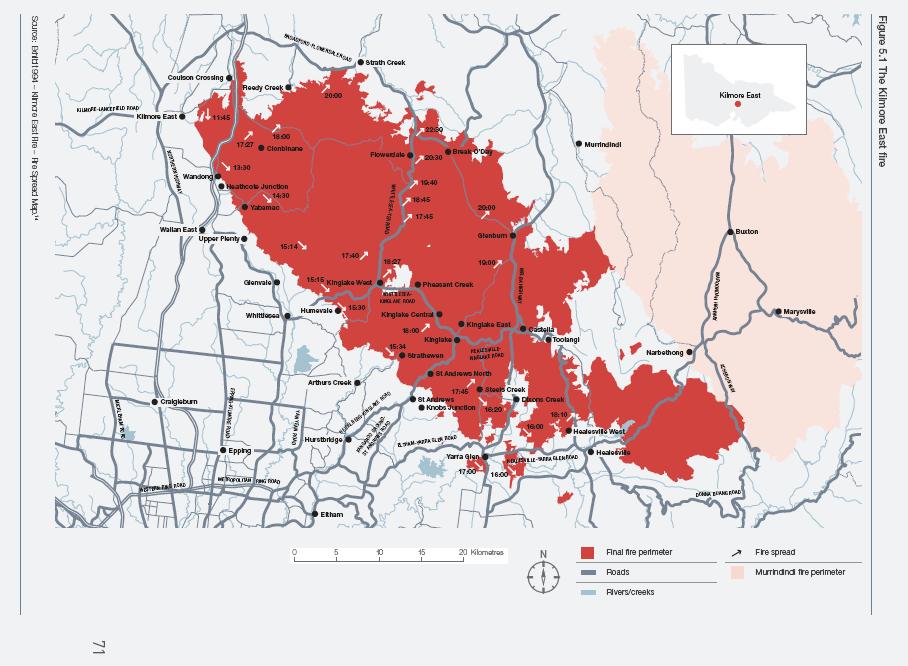
The fire burnt an overall area of 125,383 hectares, roughly 70 km long and 20 wide, as shown on the following fire map.
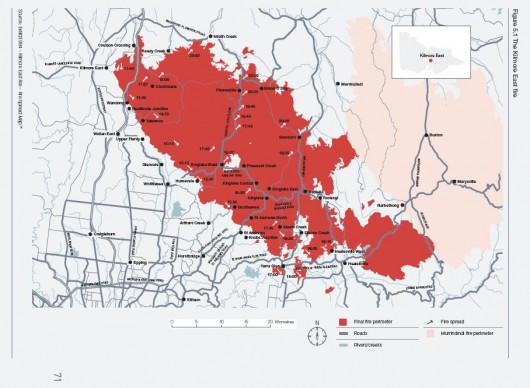 Kilmore East Fire (dark red area)
Click to see enlarged map (320kb) – arrows show when and where the fire wind changed Kilmore East Fire (dark red area)
Click to see enlarged map (320kb) – arrows show when and where the fire wind changed
The adjacent fire (pink area) was the Murrindindi Fire which was started by arson (deemed “suspicious” by the Royal Commission)
(Source: VBRC Final Report Vol. 1, Chapter 5, p.71)
.
Of the 173 reported human deaths of the 2009 Victorian Bushfires, 119 (most) were as a consequence of the Kilmore East Fire, which had initially been ignited by a powerpole electrical failure. Another 232 casualties were reported and some 1,242 houses were destroyed by the Kilmore East Fire.
Ultimately, the Victorian Government here is accountable for its delegated arrangements to provide essential services such as electricity supply to the people of Victoria. That Victorian Government under Premier John Brumby and its various prior policies under different political persuasions, chose to outsource electricity provision to a private operator, no less diminishes the Victorian Government’s fuduciary duty for that supply and all its component standards including reliability and least of all, safety. Morally and legally in Australia, no government can outsource its fiduciary duty and then wipe its hands of that fiduciary duty. Both then Victorian Premier Brumby and then Prime Minister Rudd must fall on their swords.
The Kilmore East Fire ignited at midday on 7th February 2009 from electrical arcing at the top of a rocky hill between two gullies near Saunders Road in Kilmore East. A Single Wire Earth Return (SWER) electricity line (the conductor) ran across the gullies. The area where the fire started was undulating pasture interspersed with native vegetation alongside cleared and standing forestry plantations. The conductor formed part of the Pentadeen Spur power line.
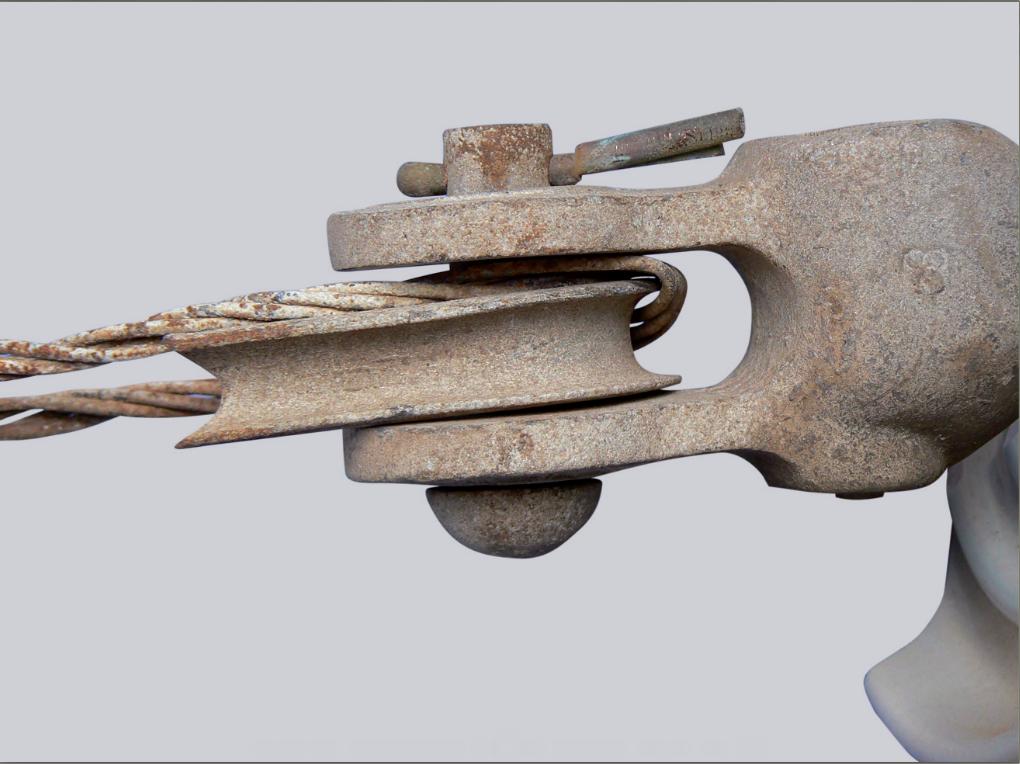
The fire started after the conductor between two power poles failed and the live conductor came into contact with a cable stay. This contact caused arcing that ignited vegetation near the base of one of the poles. An electrical fault was recorded at 11:45am. The conductor failed as a result of fatigue on the conductor strands very close to where a helical termination was fitted to the conductor at the pole. The conductor was about 43 years old. A line inspection carried out in February 2008 had failed to identify the incorrectly seated helical fitting.
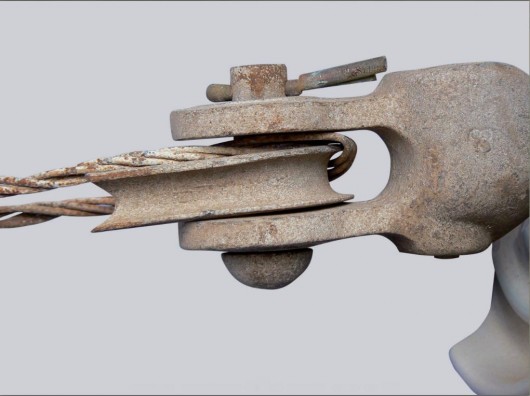 An ill-designed and jammed helical termination
(Click to enlarge and bloody frame if you want!) An ill-designed and jammed helical termination
(Click to enlarge and bloody frame if you want!)
(Source: VBRC, Exhibit 525 – HRL Technology Report – Kilmore East Fire)
.
Within two minutes, a fire tower observer at Pretty Sally tower, Peter Coleman, spotted a column of white smoke at 11:47am about 30 to 40 metres high coming from behind a hill in the direction of Saunders Road, Kilmore East. The fire was reported to the CFA two minutes later at 11:49am.
The volunteer Victorian Country Fire Authority (CFA) Clonbinane Brigade fire truck initially responded, but requested additional resources as it was of an uncontrollable size and was spotting ahead of the fire front into bushland. A decision to escalate the bushfire emergency to an Incident Management Team (IMT) was put in place at 4:30pm, some four and a half hours later in unprecedented extreme bushfire risk conditions and just as the now firestorm was impinging upon the communities of Humevale and Kinglake West – over 20km from the ignition.
[Source: 2009 Victorian Bushfires Royal Commission, Final Report, July 2010, Volume 1, Chapter 5.6 The Kilmore East Fire – Conclusions, pp.75-84]
.
In relation to those bushfires collectively attributed by the Royal Commission as being caused by ‘electrical failures‘, the Commission’s recommendations were:
- Replace ageing powerlines with safer bundled or underground cables
- High-risk areas should have all lines replaced within 10 years and inspected within 3 years
.
Specifically the Royal Commission’s recommendations were:
.
Recommendation # 27:
Progressive replacement of all single-wire earth return power lines in Victoria with aerial bundled cable, underground cabling or other technology that delivers greatly reduced bushfire risk. The replacement program should be completed in the areas of highest bushfire risk within 10 years and should continue in areas of lower bushfire risk as the lines reach the end of their engineering lives the progressive replacement of all 22-kilovolt distribution feeders with aerial bundled cable, underground cabling or other technology that delivers greatly reduced bushfire risk as the feeders reach the end of their engineering lives. Priority should be given to distribution feeders in the areas of highest bushfire risk.
.
Recommendation #28:
Electricity distribution businesses to inspect all SWER lines and all 22-kilovolt feeders in areas of high bushfire risk at least every three years.
.
Recommendation #29:
Electricity distribution businesses to review and modify their current practices, standards and procedures for the training and auditing of asset inspectors to ensure that registered training organisations provide adequate theoretical and practical training for asset inspectors.
.
Recommendation #30:
Electricity distribution businesses adopt measures to reduce the risks posed by ‘hazard trees’
.
Recommendation #31:
Municipal councils include in their municipal fire prevention plans for areas of high bushfire risk provision for the identification of hazard trees and for notifying the responsible entities with a view to having the situation redressed.
.
Recommendation #32:
Electricity distribution businesses to disable the reclose function on the automatic circuit reclosers on all SWER lines for the six weeks of greatest risk in every fire season, adjust the reclose function on the automatic circuit reclosers on all 22-kilovolt feeders on all total fire ban days to permit only one reclose attempt before lockout.
.
Recommendation #33:
Electricity distribution businesses to fit spreaders to any lines with a history of clashing or the potential to do so fit or retrofit all spans that are more than 300 metres long with vibration dampers as soon as is reasonably practicable.
.
Recommendation #34:
The State amend the regulatory framework for electricity safety to strengthen Energy Safe Victoria’s mandate in relation to the prevention and mitigation of electricity-caused bushfires and to require it to fulfill that mandate.
[Source: 2009 Victorian Bushfires Royal Commission, Final Report, July 2010, Volume 1, Summary & Recommendations, pp.29-30]
.
The test of faith is do people in regional Victoria feel safer from the risk of bushfire and confident that the subsequent actions by government at all levels are better prepared to mitigate a repeat of 2009?
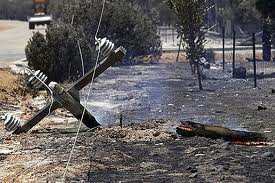 . .
Tags: 2009 Victorian Bushfires, Break O'Day, bushfire arson, Castella, causes, Chum Creek, Clonbinane, Dixons Creek, Failure of electricity assets, Flowerdale, Glenburn, Hazeldene, Humevale, jammed helical termination, Kilmore East, Kilmore East Fire, Kinglake, Kinglake West, Murrindindi Fire, Pheasant Creek, Power pole, recommendation, Regional Victoria, Singapore Power, SP AusNet, St Andrews, Steels Creek, Strathewen, Toolangi, Victorian Bushfires Royal Commission, Wallaby Creek, Wong Kim Yin, Yabamac, Yarra Glen
Posted in Threats from Bushfire | No Comments »
Add this post to Del.icio.us - Digg
Thursday, February 2nd, 2012
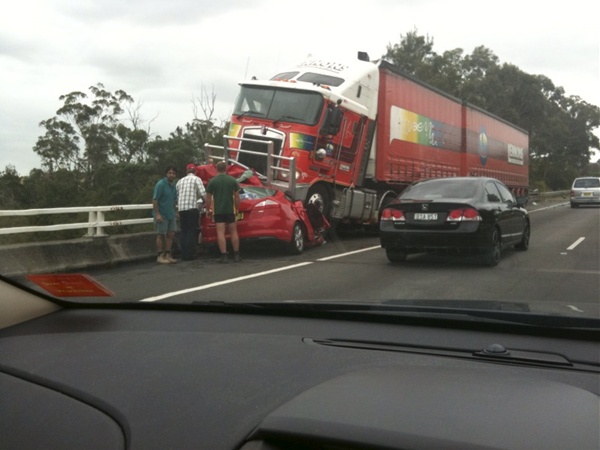
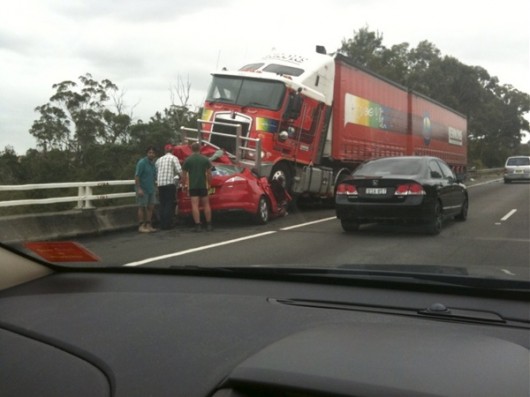 No chance!
A B-Double crosses the wrong side of the Hume Highway
and slams head-on into a car killing all three occupants No chance!
A B-Double crosses the wrong side of the Hume Highway
and slams head-on into a car killing all three occupants
.
Last Friday, a brick-laden truck crossed a grass embankment, crashed through a guard rail and ended up on the opposite side of the Menangle Bridge on the Hume Highway south of Sydney. It slammed head-on into a car killing the three people inside.
[Source: ‘From joy to instant death‘, by Nick Ralston, 20120125, Illawarra Mercury, ^http://www.illawarramercury.com.au/news/local/news/general/from-joy-to-instant-death/2432730.aspx]
.
It is only a matter of time before such a tragedy befalls the Great Western Highway in the Blue Mountains as more and more B-Doubles ply this regional route.
Driving along many highways throughout Australia has become deadly as more and bigger trucks travel faster just a metre away on the other side of a white line or two. Not only are there more semi-trailers, but trucking companies are increasingly putting larger capacity B-double trucks on the road, which can weigh over 70 tonnes.
When 70 tonnes hits you it is an instant wall of death.
 A speeding semi ploughs into the front yard of a home in Rosanna,
in eastern Melbourne on 21st September 2010 A speeding semi ploughs into the front yard of a home in Rosanna,
in eastern Melbourne on 21st September 2010
.
Yet both Liberal and Labor governments at both national and state level are pouring billions of taxpayer dollars to facilitate more road freight on Australian highways, while ignoring the comparative line haul efficiencies and inherent safety of rail freight.
In 1998, the New South Wales Labor Government announced a 12-year $360 million ‘upgrade’ of the Great Western and Mitchell Highways between Penrith (outer Sydney) and Orange in the central west of NSW. In addition, the Federal Liberal-National Coalition Government committed an extra $100 million as part of its Auslink National Network.
The ‘upgrade’ meant transforming the two lane regional highway over the Blue Mountains into a four lane 80kph expressway to facilitate greater and faster trucking – a ‘trucking expressway‘. The then promoted features of this new trucking expressway were to be:
- Widening of the highway to a four lane, divided road between Penrith and Katoomba
- Widening the highway to mostly three lanes between Katoomba and Mount Victoria (including Blackheath)
- Providing additional overtaking lanes along stretches of the highway
- Improving pedestrian and traffic facilities at intersections crossing the highway in townships
- providing bicycle facilities along the highway
- Extensive landscaping and urban design initiatives within Blue Mountains towns and villages.’
.
[Source: NSW Roads and Traffic Authority Great Western Highway Upgrade’ brochure, January 2002]
.
Well, the widening is certainly carving through Blue Mountains communities and bushland. Pedestrian walkways and crossings are few and far between and the few cycle lanes are within a metre of B-doubles hurtling along at 80kph – those that stick to the speed limit. Who’d be a cyclist on the Great Western Highway now unless one had a death wish?
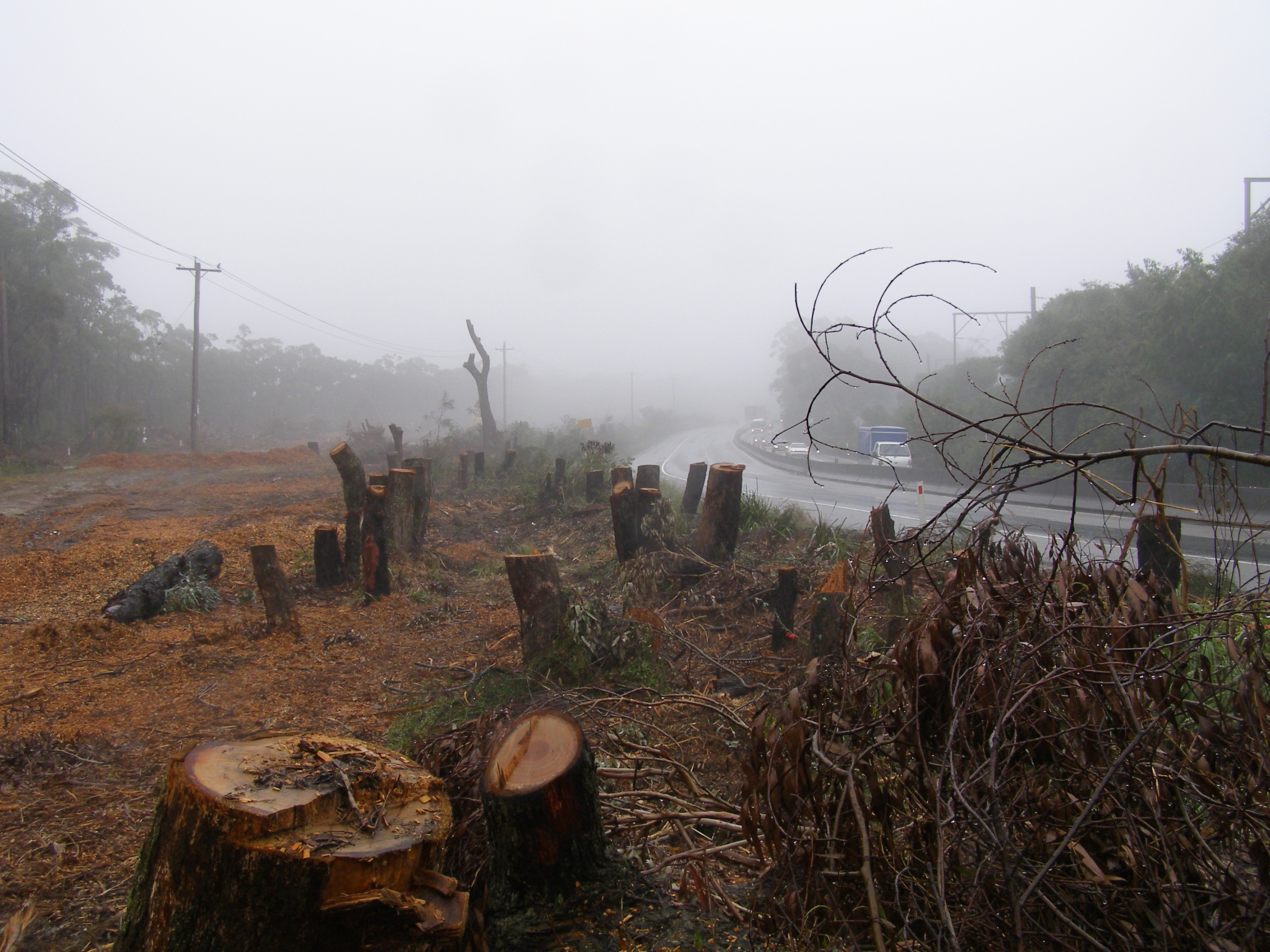
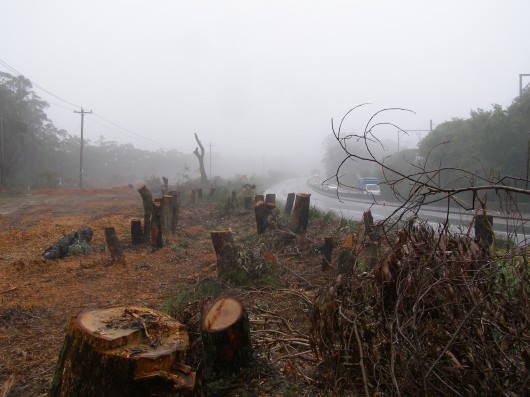 Destruction in progress yesterday at Boddington Hill, east of Wentworth Falls
Great Western Highway Blue Mountains
(Photo by Editor 20120201, free in public domain, click photo to enlarge) Destruction in progress yesterday at Boddington Hill, east of Wentworth Falls
Great Western Highway Blue Mountains
(Photo by Editor 20120201, free in public domain, click photo to enlarge)
.
In September 2008, the then Federal Labor MP Bob Debus for the Macquarie electorate (covering the Blue Mountains region) committed another $450 million on the Great Western Highway to bypass the village of Mount Victoria and River Lett Hill near Lithgow.
Debus revealed the purpose of the widening on his website:
.
“The bypass will halve times between Mt Victoria and Lithgow, reduce accidents by two-thirds, and improve freight transport from the Central West .
The bypass will provide a route on the western escarpment more suited to the operation of heavy vehicles than the current Victoria Pass…”
.
[Source: ‘Bob Debus for Macquarie E-news #2‘, Bob Debus MP website, ^http://www.bobdebus.com/newsletter2.html (page since defunct since Debus has resigned from Federal Parliament]
.
The joint Labor-Liberal policy focus on developing road freight and ignoring rail freight is short-sighted 20th Century truck thinking. But it is also meaning our regional highways are morphing into bigger and faster freight routes – trucking expressways. Local communities are having to share regional roads with huge trucks.
The trucking industry has allowed itself to become largely contract based where drivers instead of being paid for their time driving are paid on a trip rate. This means that the more trips a driver makes and the faster the delivery times, the more money the drivers earn. This work arrangement only encourages truck drivers to drive faster, often too fast, with disastrous consequences.
.
‘It is a statistic that will alarm police and governments dealing with a string of fatal road accidents: almost two thirds of long haul truck drivers interviewed for a national study say their employers pressure them into using unsafe work practices.’
[Source: ‘Truckies pushed into danger zone’, by Andrew West, Sydney Morning Herald, 20100109, p.2]
.
Recent fatalities on NSW roads , including the death of an 11-year-old boy, have sparked a renewed call for action on trucks in the Mountains.
Deputy Mayor Mark Greenhill moved a matter of urgency at Blue Mountains City Council (BMCC) meeting 31st January 2012, calling on state and federal government representatives to meet with BMCC to discuss “means and methods by which large trucks can be limited or controlled in terms of behaviour on the Great Western Highway over the Blue Mountains” following several shocking incidents in other areas of the state.
Clr Greenhill: “While the courts have not yet had a chance to determine guilt or otherwise, and I don’t seek to either, recent accidents on NSW roads stand testimony to the awesome power of these trucks,” he said. “In the Campbelltown area a large truck went over the top of a car and killed three people. They had no chance. In coastal NSW a boy was killed while sleeping in his house when a large truck ploughed through it.”
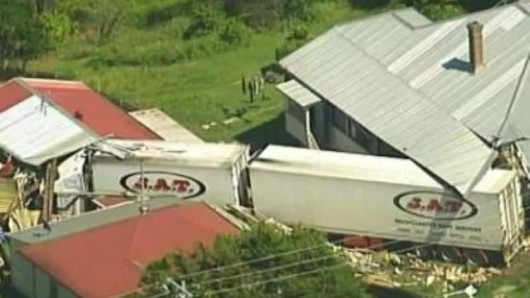 Eleven-year-old boy killed when a B-double crashes through his bedroom
Anyone living within 100 metres of a highway has got cause for concern Eleven-year-old boy killed when a B-double crashes through his bedroom
Anyone living within 100 metres of a highway has got cause for concern
.
Penrith residents are mourning the death of Max MacGregor, the 11-year-old killed when a truck loaded with bananas crashed through his bedroom on the state’s mid-north coast. Max was asleep in the holiday home his family were renting in Urunga when, at 5am on Sunday, a B-double semi collided head-on with a ute before swerving into the holiday home (100 metres from the highway).
[Source: ‘B-double fatality on mid-north coast brings Penrith family’s holiday to tragic end’, by Emma Schiller, 20120110, Penrith Press, ^http://penrith-press.whereilive.com.au/news/story/penrith-familys-holiday-tragedy/]
.
Clr Greenhill: “When things go wrong and [trucks] are out of control, they are an uncompromising and deadly weapon. “In that context, people have been killed in significant numbers in the Blue Mountains. It is a scandal to me that governments are not doing more to control tucks on the highway across the Mountains. “This should especially be the case while the highway works are under way.”
Clr Greenhill released BMCC figures in September last year that showed trucks were over-represented in local crash statistics and motorists were three times more likely to die in a collision with one. The statistics showed that from 2005 to 2009, trucks represented nearly a third of all vehicles involving deaths despite being less than a third of vehicles on local roads. Three per cent of all truck crashes were fatal, compared to one per cent of crashes by all other vehicles, the figures showed.
Clr Greenhill said he had reports from local residents about large trucks “even braving the Old Bathurst Road bends”, and said he would like to see vehicles such as B-doubles off local roads for the time being.’
[Source: ‘Tragedies spark call for action on trucks’, by Krystyna Pollard, 20120201, Blue Mountains Gazette, ^http://www.bluemountainsgazette.com.au/news/local/news/general/tragedies-spark-call-for-action-on-trucks/2440033.aspx]
.
‘Give Rail a Go’
[Source: Letter to the Editor, Blue Mountains Gazette, 20120201, p4]
.
The tragic accident involving a 25/26m B-double truck at Menangle last week reaffirms the fact that the Great Western Highway, even after the upgrade to Katoomba is completed, will never be suitable for these massive trucks.
Yet the federal government is funding stage one of a multi-billion dollar highway bypass between Mt Victoria and Lithgow, the main purpose being to allow 25/26/30m B-double trucks carrying up to 77 tonnes to use the highway through the Blue Mountains. Despite overwhelming community disapproval the federal government is pushing ahead with stage one, a purpose built 25/26/30m B-double bypass at River Lett Hill.
The Blackheath Highway Action Group along with many other Blue Mountains Groups successfully lobbied for an independent review to be conducted on the proposed Mount Victoria to Lithgow highway bypass and the future of the highway west of Katoomba. In July 2011 the NSW government appointed Evans and Peck, a firm with local knowledge to conduct this review. the review was completed in November so why is the federal government stalling on its public release?
The federal government refuses to fund a $5 million rail study, a key recommendation of the Central West Transport Needs Study. Rail deserves the same funding, tax incentives and regulatory framework as is currently given to support long haul trucking.
For the sake of safety, local amenity and the long term sustainability it’s time to give rail a fair go and permanently abandon plans to spend billions to turn our highway inot a 25/26/30m B-double freight corridor.’
~ Michael Paag, Chairman, Blackheath Highway Action Group, Blue Mountains
.
‘Head-on crash: driver dies as truck explodes’
[Source: ‘Head-on crash: driver dies as truck explodes’, by Glenda Kwek, 20120124, Sydney Morning Herald, ^http://www.smh.com.au/nsw/headon-crash-driver-dies-as-truck-explodes-20120124-1qehm.html]
‘A driver has died after a truck caught fire and exploded following a head-on collision between the tabletop truck and B-double took place about 24 kilometres south of Dubbo at Mountain Creek Road about 4am, emergency services said. The Newell Highway in Dubbo is closed in both directions between Mitchell Highway and Tomingley Road. The tabletop truck was carrying food and plastic food containers, and the B-double was carrying fertiliser, Ms O’Connor said.’
.
‘Orange truck rollover’
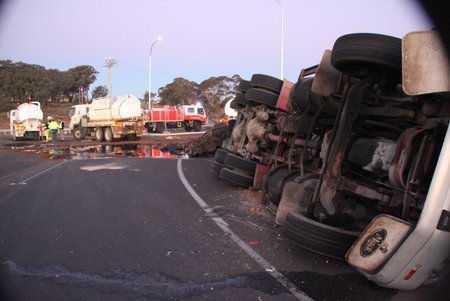 Truck Roll Over at the intersection of Burrendong Way & The Northern Distributor
Orange, Central NSW, 20100629
[Source: ‘Orange truck rollover’ by Steve Smith, Rural Fire Service, Canobolas, ^http://www.canobolas.rfs.nsw.gov.au/dsp_content.cfm?cat_id=131107] Truck Roll Over at the intersection of Burrendong Way & The Northern Distributor
Orange, Central NSW, 20100629
[Source: ‘Orange truck rollover’ by Steve Smith, Rural Fire Service, Canobolas, ^http://www.canobolas.rfs.nsw.gov.au/dsp_content.cfm?cat_id=131107]
.
‘Teenage driver killed in truck collision’
[Source: ‘Teenage driver killed in truck collision’ by Ellen Lutton, 20111218, Brisbane Times with AAP, ^ http://www.brisbanetimes.com.au/queensland/teenage-driver-killed-in-truck-collision-20111217-1p0ax.html]
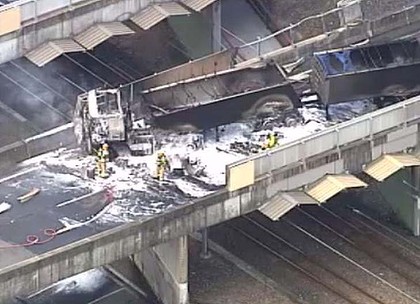
‘One woman was killed and five people were injured in two accidents involving B-double trucks. Engineers were called to the scene of a dramatic accident on the Gateway Motorway at Boondall in Brisbane about midday yesterday, when a B-double truck exploded after it and a car collided. The intensity of the explosion and subsequent fire was so severe that parts of the truck fused together, raising concerns about damage to the road and overpass bridge underneath, a police spokeswoman said.
(Meanwhile) on the Bruce Highway near Rockhampton, a 19-year-old woman died and four people were injured when a car and a B-double truck collided. Police said the station wagon tried to turn into the southbound lanes of the Bruce Highway at Marmor just before 8pm on Friday when the car and truck, which was travelling in the northbound lane, collided.
The 19-year-old driver was killed, while her three female passengers, two aged 19 and one aged 18, were taken to Rockhampton hospital. The three are in a stable condition.The 65-year-old driver of the B-double was taken to hospital for precautionary treatment and has been released.
.
‘Three trucks involved in two separate highway collisions’
[Source: ‘Three trucks involved in two separate highway collisions’, by Wendy Marshall and Kate Moody, 20100408, Daily Liberal, ^http://www.dailyliberal.com.au/news/local/news/general/three-trucks-involved-in-two-separate-highway-collisions/1797078.aspx]
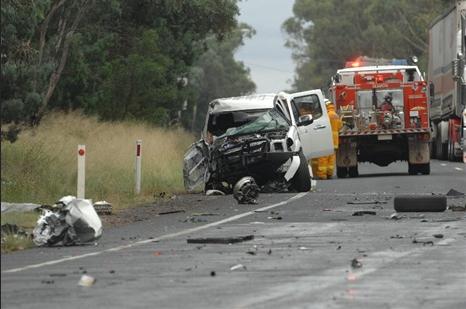
A 50-year old man was taken to Dubbo Base Hospital with serious injuries after a collision between a B-double truck and a utility vehicle, occurred about 1.15pm on the Newell Highway just south of Gilgandra.
Earlier in the day, in a separate accident, two trucks collided 25 km outside of Dubbo on the Golden Highway. A UD truck crashed into the back of a Mitsubishi Canter turning right at the Barbigal Road turn off to Wongarbon about 11.40am yesterday.
At the scene, Ballimore RFS deputy captain Col Buckler said the Golden Highway was not currently built for trucks and “most definitively” needed upgrading.
“This is the official B-double road to Newcastle (and) the roads need to be built to carry trucks,” Mr Buckler said. “It’s time they spent money to make it safer because of the amount of trucks that use it.”
.
‘Fatal crash between car and truck causes explosion, closes Pacific Highway’
[Source: ‘Fatal crash between car and truck causes explosion, closes Pacific Highway’, by Nathan Klein, The Daily Telegraph, 20110405, ^http://www.news.com.au/fatal-crash-between-car-and-truck-closes-pacific-highway/story-e6freuy9-1226033739809?from=public_rss]
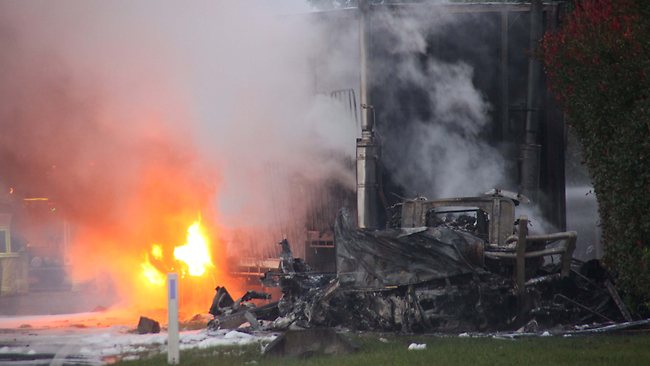
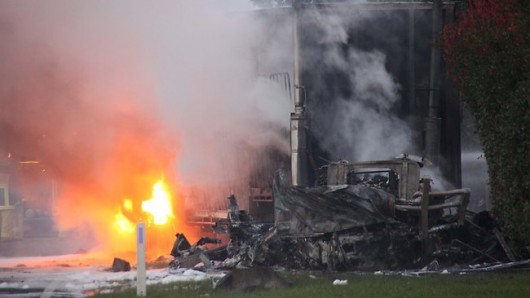 Flames … scenes from a fatal crash between a B double truck and a car on the Pacific Highway south of Macksville.
(Photo by Frank Redward) Flames … scenes from a fatal crash between a B double truck and a car on the Pacific Highway south of Macksville.
(Photo by Frank Redward)
.
AT least one person has been killed in the fiery collision between a car and a B-double truck at Warrell Creek, about 10km south of Macksville, just before 4am today.
“The B-doubles can’t pass using the diversion as the rail overpass is not suitable for their weight,” a spokesman for the Roads and Traffic Authority told AAP.
The truck involved in the crash was carrying chemicals and exploded in flames on impact, but Fire and Rescue NSW extinguished the blaze. One person from the car has been confirmed dead, but police say it’s not clear how many people were in the car when it crashed.
.
‘Driver’s lucky escape’
[Source: ‘Driver’s lucky escape’, 20100730, Cowra Guardian, ^http://www.canobolas.rfs.nsw.gov.au/dsp_content.cfm?cat_id=131113]
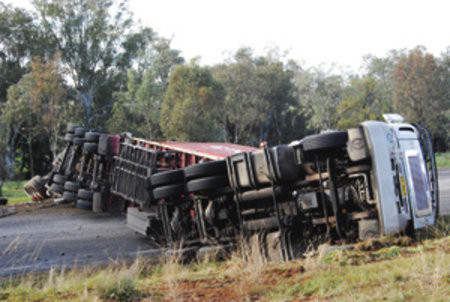 The overturned B-Double truck 2km south on the Boorowa Road The overturned B-Double truck 2km south on the Boorowa Road
.
‘A Canberra man was lucky to escape without serious injury after the B-Double truck he was driving along the Boorowa Rd overturned at 6.15am on Wednesday morning. The 42 year old man lost control of the vehicle 2km south out of town and ran off the road, before the entire truck overturned and spilled out over both lanes of the road.
The overturned truck was carrying furniture and concrete slabs and left more than a dozen slabs scattered over the road. Local resident Russell Denning said he heard a ‘monstrous bang’ when the truck crashed on the road near his home.
Senior Constable John Newton said a lack of attention from the driver appears to be the cause of the accident but police are still investigating.
“At this stage it appears the driver was distracted but there are still final enquiries to be completed,” he said. “My understanding is the driver will receive an infringement for negligent driving.”
.
Tags: B-double crashes, b-doubles, Blackheath Highway Action Group, Blue Mountains, Great Western Highway, head-on, Menangle Bridge, Mt Victoria bypass, RTA, truck collision, trucking expressway, Urunga, walls of death
Posted in Blue Mountains (AU), Threats from Road Making | 5 Comments »
Add this post to Del.icio.us - Digg
Wednesday, February 1st, 2012
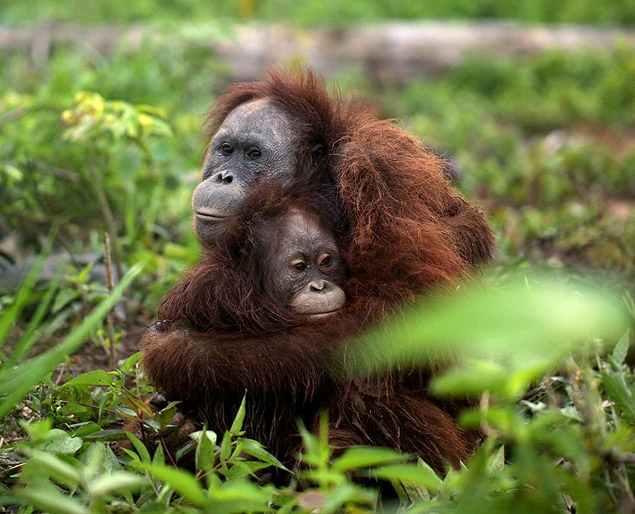
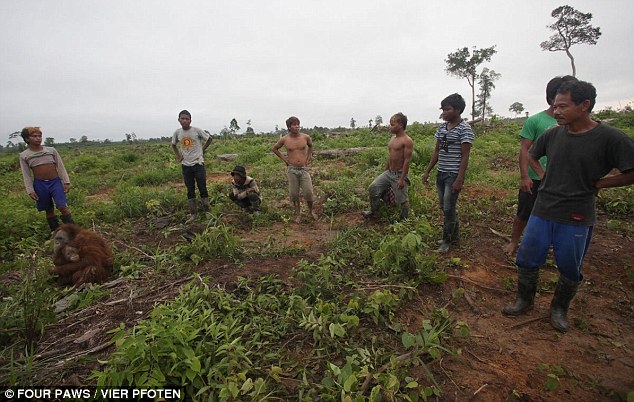
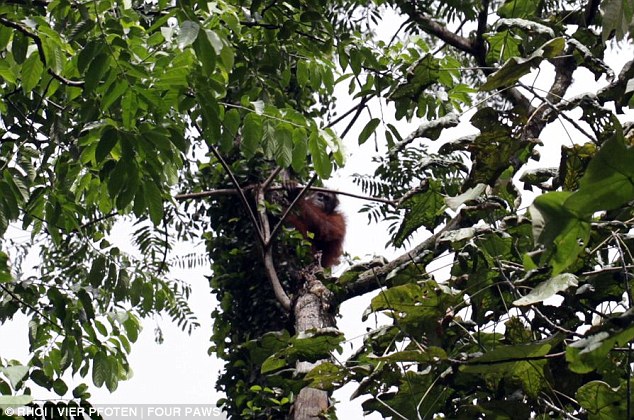
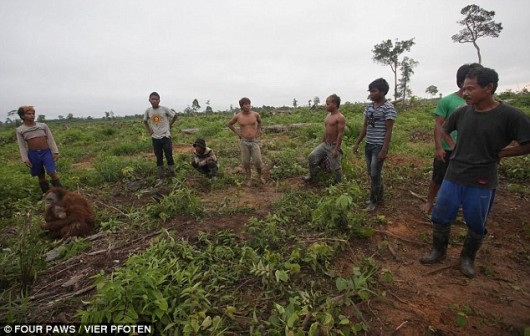
It’s a remarkable photograph: A pregnant Orang-utan protectively clutching her five-year-old child as death seems imminent at the hands of bounty hunters armed with knives.
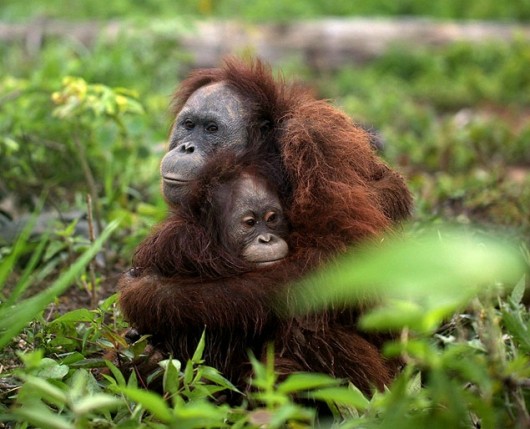 Ordeal…the mother and baby Orang-utan, above, were lucky to have escaped
a group of juvenile Indonesian poachers (below) in Kalimantan (Borneo)
(© Photo by Vier Pfoten of Four Paws International, ^http://www.four-paws.org.uk/ and Ordeal…the mother and baby Orang-utan, above, were lucky to have escaped
a group of juvenile Indonesian poachers (below) in Kalimantan (Borneo)
(© Photo by Vier Pfoten of Four Paws International, ^http://www.four-paws.org.uk/ and
PT Restorasi Habitat Orangutan Indonesia (RHOI)
^http://forest-carbon.org/project-list/first-project)
.
At The Habitat Advocate we wish to emphasise and thank the vital role of wildlife photographers around the world whose photos continue to help convey the plight of wildlife at the hands of humans. Without such photos, the truth would be less disseminated.
The following article was reproduced in The Sun-Herald newspaper (Sydney) on 20120129 on page 30. The article was borrowed from the New York Daily News newspaper (New York) which published the article on 20120127. The original source was the Daily MAIL (UK), written by Richard Shears, 20120127, under the long heading: ‘Don’t hurt my baby! Pregnant Orang-utan protectively hugs her daughter as ruthless Borneo bounty hunters move in for the kill‘.
The ultimate source is from the website of Four Paws UK.
Four Paws International is an international animal charity, campaigning to end animal suffering and cruelty. Four Paws International was founded in 1988 in Austria to campaign against fur farms and against battery farmed eggs.
Visit their website (English office) : ^http://www.four-paws.org.uk/
The partner organisation based in Indonesia is PT Restorasi Habitat Orang-utan Indonesia (RHOI), which translates into English as the Borneo Orang-utan Survival (BOS). Its name could not be more literal! Humans are systematically exterminating a species – the Orang-utan.
BOS has developed an Ecosystem Restoration Concession with the intention of using the forest area as a release site for rehabilitated Orang-utans. The proposed concession is in East Kalimantan is comprised of the ex-PT Mugitriman International (MGI) timber concession. BOS would like to obtain sustainable funding for managing and safeguarding this forest and is currently exploring the option of an avoided deforestation/REDD project where the sale of carbon.
Visit their website: ^http://forest-carbon.org/project-list/first-project
.
.
‘Pregnant Orang-utan mother and child rescued at last minute from knife-bearing bounty hunters in Borneo’,
by Rolando Pujol in the New York Daily News, Friday, 20120127, ^http://www.nydailynews.com/news/pregnant-orangutan-mother-child-rescued-minute-knife-bearing-bounty-hunters-borneo-article-1.1013270?]
.
It’s a remarkable photograph: A pregnant Orang-utan protectively clutching her five-year-old child as death seems imminent at the hands of bounty hunters armed with knives.
At the last minute, however, members of Four Paws International, an international animal-rescue group, swooped in last week and prevented their killings in Borneo, the Daily Mail reported.
“A few minutes later and the Orang-utans could have been dead,” said Dr. Signe Preuschoft, a primate expert with the British-based organization, according to the Daily Mail. “We discovered a gang of young men surrounding them and both victims were clearly petrified.”
The incident showcases the threat Orang-utans are facing as they are targeted for slaughter with a price on their heads.
“The gang meanwhile were jubilant in anticipation of their rewards for catching and killing the animals.”
The incident, compellingly captured in a dramatic photo of the mother cradling her child for dear life, casts a fresh light on the disturbing plight of Orang-utans, who were once common throughout Southeast Asia but now mostly live in Borneo and other areas in Indonesia.
The mother, estimated to be between 25 and 30, and the child were the only Orang-utans the team found alive in the area surrounding a palm-oil plantation. The group said it was scouting the area after reports of mass Orang-utan slaughter.
The spread of palm oil plantations, the group said, is accelerating the demise of the already endangered animals, which are losing native habitat because of widespread deforestation. The very name Orang-utan means “person of the forest,” as they spend most of their time in trees.
.
The palm-oil companies, the group said, are allegedly making matters worse by offering rewards of about $100 per dead Orang-utan, because they see the animals as nuisances.
.
“These massacres must not be allowed to continue,” Preuschoft said to the Daily Mail.
The rescued animals have since been released back in the wild in an area far from where they almost met death. The mother was fitted with a radio transmitter to help ensure the apes stay safe, the group said.
“Tens of thousands of adult Orang-utans have been slaughtered, while their orphaned offspring is frequently being sold off as pets or left behind to die, if they aren’t killed on the spot as well“, Four Paws International posted on its website.
The slaughter of Orang-utans is illegal in Indonesia, but enforcement has stepped up only recently, the group said.
“Mass graves that were discovered last September triggered the first few serious arrests, including a senior plantation manager“, the group wrote.
.
A similar article (in more detail) by the Daily Mail (UK):
.
‘Don’t hurt my baby! Pregnant Orang-utan protectively hugs her daughter as ruthless Borneo bounty hunters move in for the kill’
[Source: ”Don’t hurt my baby! Pregnant Orang-utan protectively hugs her daughter as ruthless Borneo bounty hunters move in for the kill’, by Richard Shears, 20120127, Daily Mail (UK), ^http://www.dailymail.co.uk/news/article-2092722/Pregnant-orang-utan-hugs-daughter-bounty-hunters-Borneo-in.html]
.
- Pair saved at last minute by UK-based animal rescue group
- Palm oil firms trying to clear plantations said to be offering £70 for each Orang-utan killed on the Borneo palm oil plantations
.
As bounty hunters with bush knives entrapped them in a circle and moved in for the kill, the only thing this mother Orang-utan could think to do was to wrap a giant protective arm around her daughter. The pair seemed to be facing a certain death as a gang of hunters surrounded them in Borneo, keen to cash in on the palm oil plantations’ bid to be rid of the animals.
But, happily, a team from the British-based international animal rescue group Four Paws International arrived in time to stop the slaughter and saved their lives.
The pregnant mother and daughter were captured and moved to a remote and safe area of the rainforest and released back into the wild – but not before the mother was equipped with a radio device so she and her young can be tracked to ensure they remain safe.
‘Our arrival could not have been more timely,’ said Dr Signe Preuschoft, a Four Paws primate expert. ‘A few minutes later and the Orang-utans could have been dead.’
‘We discovered a gang of young men surrounding them and both victims were clearly petrified.
‘The gang meanwhile were jubilant in anticipation of their rewards for catching and killing the animals. These massacres must not be allowed to continue.’
Saved: ‘Our arrival could not have been more timely. A few minutes later and the Orang-utans could have been dead’ said Dr Signe Preuschoft, a Four Paws primate expert
‘A few minutes later and the Orang-utans could have been dead.’ said Dr Signe Preuschoft, a Four Paws International primate expert
Mother and daughter were captured and moved to a remote and safe area of the rainforest and released back into the wild – but not before the mother was equipped with a radio device so she and her young can be tracked to ensure they remain safe.
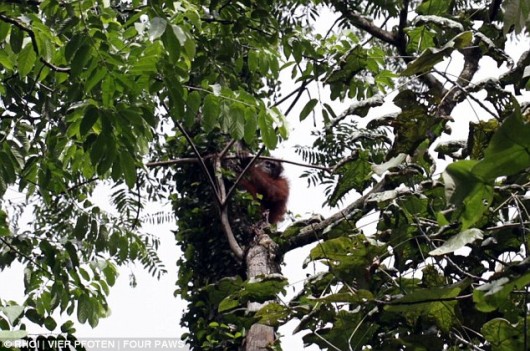 Mother and baby rescued and placed into the wild.
But with their rainforest wilderness rapidly being destroyed how long have these Orang-utans got? What happened to the father? Mother and baby rescued and placed into the wild.
But with their rainforest wilderness rapidly being destroyed how long have these Orang-utans got? What happened to the father?
.
Before the rescue, a Four Paws International team had scoured the area on the Indonesian side of Borneo, which is shared with Malaysia, but found no other Orangutans which had survived an earlier slaughter.
.
Deforestation has dramatically reduced their habitat and their numbers have dropped from 250,000 a few decades ago to only 50,000 in the wild. And while the loss of their habitat by logging companies has created a major threat to their existence, a more brutal form of reducing their numbers has emerged in recent years – direct slaughter.
.
Palm oil is used in hundreds of products from chocolate to oven chips, but the demand for buying it at a low price has resulted in significant deforestation as habitats are being destroyed to make way for plantations. Some palm oil companies see Orang-utans as pests, a threat to their lucrative business, and have placed a bounty on their heads.
Company executives are reported to be offering up to £70 to employees for each Orang-utan killed on the palm oil plantations. While such stories were at first denied, proof of the slaughter emerged last September when graves and bones were found by investigators.
‘Killing of Orang-utans is illegal in Indonesia but the law is lacking enforcement,’ said a Four Paws UK spokesman.
‘Before November last year only two low-level arrests had ever been made. But in the last two months 10 more arrests have taken place including the arrest of the senior manager of the plantation where the worst graves have been found.’
In an equally tragic scenario, babies left alive after adult Orang-utans have been slaughtered have been put up for sale in the Pet Trade by hunters.
When traumatised babies are found by Four Paws International and other animal rescue teams they are taken to a sanctuary and taught skills they will need in order to return to the wild.
.
.
Selected comments from readers:
.
‘Boycott any product with palm oil!!!’
~ maninthemiddle, 20120128.
.
“Let’s find the corporate entities who are paying for the palm oil,then boycott,very sad story,very touching”
~ olefan_is_a_moron, 20120128.
olefan_is_a_moron (20120128):.
“The real problem in the world is overpopulation. Natural resources replace themselves unless they are overburdened by excessive demand due to a big population. Cutting down 1% of a forest will not harm it since trees will just grow back but when you’re destroying too much at once you’re just striping the land bare.”
~ DocPaul (20120128)
.
“Soon man shall be the only “animal” left for hunting.”
~ 3 VULTURES (20120128).
.
“Orang-utans are critically endangered in the wild because of rapid deforestation and the expansion of palm oil plantations into their rainforest home. The situation described in this article is all too common unfortunately. If nothing is done to protect these amazing creatures, they will be extinct in just a few years. Visit the Orangutan Outreach website to learn more and make a difference! http://redapes.org Reach out and save the orangutans! Adopt an orangutan today! {:(|}”
~ OrangutanOutreach (20120128).
.
“How about a bounty of $150 per dead bounty hunter?”
~ Meowmeister, 20120128.
.
“This is what happens when you have: 1. People believing that the so-called phrase “and man shall have dominion over the beasts” means they can be killed at will and 2. When human beings believe nothing absolutely nothing is more important than profit.”
~ itsallinperception, 20120128.
.
“Farmers are being killed in south America for the same reason, land. Plantation owners want the land to get money for carbon credits…”
~ nlohu, 20120128.
.
“So sad. Palm oil is not just used in food. It is also used in cosmetics. I think it is called retinyl palmitate, something like that. Any ingredient that has “palmitate (ie: palm) is from palm oil. It is a form of vitamin A, used in skin creams alot.”
~ ana63, 20120128.
.
“These companies should not be allowed to trade in the UK. We shouldn’t be trading with any company that doesn’t respect life and the environment.”
~ Lo, cheshire, UK, 20120128.
.
“Everything that is wrong with the world is due to humans. We will continue to destroy our world unless something radical happens to reduce the human population and to change the greedy mindset of the human population. This makes me so incredibly sad!”
~ GB, UK, 20120128.
.
“…I think what would be more helpful is to have the names of the food manufacturers who are purchasing the palm oil from those companies. I suspect we would see major names such as Nabisco, Kraft, etc.”
~ InfoOverload, 20120128.
.
.
ANSWER: The largest palm oil company worldwide is ‘Wilmar International’
.
One of the most powerful opponents of our ‘Save our Borneo’ activists is Wilmar International, the largest palm oil company worldwide, based in Singapore.

“Wilmar International Limited, founded in 1991, is Asia’s leading agribusiness group.
“We are amongst the largest listed companies by market capitalisation on the Singapore Exchange. Our business activities include oil palm cultivation, oilseeds crushing, edible oils refining, sugar, specialty fats, oleochemicals and biodiesel manufacturing and grains processing. Headquartered in Singapore, Wilmar has over 300 manufacturing plants and an extensive distribution network covering China, India, Indonesia and some 50 other countries to support a well established processing and merchandising business. Wilmar also manufactures and distributes fertilisers and owns a fleet of vessels. The Group is backed by a multi-national workforce of approximately 90,000 people.”
“We are today:
- The largest global processor and merchandiser of palm and lauric oils
- One of the largest plantation companies in Indonesia/Malaysia
- The largest palm biodiesel manufacturer in the world
- A leading consumer pack edible oils producer, oilseeds crusher, edible oils refiner, specialty fats and oleochemicals manufacturer in China
- One of the largest edible oils refiners and a leading producer of consumer pack edible oils in India
- The largest edible oils refiner in Ukraine
- The leading importer of edible oils into East Africa and one of the largest importers of edible oils into South-east Africa.
‘We will continue to leverage on the scale and strengths of our business model to benefit from the long term growth potential of the agricultural commodity business, especially in Asia.”
Visit website: ^http://www.wilmar-international.com/
.
.
Cyclone Yasi 2011 destruction sees Wilmar take over Australia’s CSR’s Sucrogen
.

[Source: ‘ Proserpine creditors approve sale of mill to Sucrogen‘, 20111209, ^ http://www.sucrogen.com/media/news]
.
‘Sucrogen, the Australian-based sugar subsidiary of Singapore-listed Wilmar International Limited, looks forward to an exciting future as the new owner of Proserpine Sugar Mill after a majority of Proserpine creditors, by number and value, voted today to approve Sucrogen’s purchase of the mill.
Sucrogen CEO Ian Glasson said the creditors’ vote was a great outcome and paved the way for the sale transaction to be completed immediately.
“The positive result means creditors will be paid, in full, before Christmas,” Mr Glasson said. “We are grateful to have received such strong support from creditors, who have clearly shown faith in us and our plans for the Proserpine region.”
Sucrogen’s offer comprised a headline price of A$120 million, plus a working capital adjustment, normal settlement adjustments, as well as absorption of the mill’s normal operating costs and certain critical capital expenditure incurred from 31 October 2011.
Mr Glasson said while Sucrogen was pleased to finally purchase the mill, it was disappointing the sale was not possible before the Co-operative was placed into voluntary administration.
“The negative campaign Tully ran to derail the first two member votes has, ultimately, cost members a substantial amount of money in administration and legal fees,” he said. Critically, it has also delayed capital and maintenance at the mill.”
However, the transition to Sucrogen management and leadership will begin immediately and we will hit the ground running next week and do our best to ensure the mill is ready for the start of 2012 season, despite the lengthy delays.”
Mr Glasson said Wilmar had expressed a strong interest in working with growers to help expand Proserpine’s sugar industry.
“We look forward to a long and productive relationship with local growers, Proserpine Sugar Mill employees and the whole Proserpine community.”
.
So the company that is behind the palm plantation clearing destroying Orang-utan habitat and encouraging Oran-gutans to be slaughtered, is the parent company that sells CSR Sugar across Australia and Chelsea Sugar across New Zealand and the artificial sweetener ‘Equal‘.

.
.
The palm oil industry says: ‘Orang-utans are pests!’
[Source: ^http://www.rainforest-rescue.org/newsletter/1267/282c3e5ec03e375e7afa82c63564ae41]
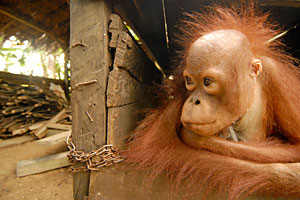 This juvenile Orang-utang’s mother was killed on one of the palm oil plantations This juvenile Orang-utang’s mother was killed on one of the palm oil plantations
.
“Dear friends of the rainforest, the BBC reports that Orang-utans are treated as “pest” and exterminated on Indonesian and Malaysian palm oil plantations. In the last year alone, up to 1,800 Orang-utans were killed in Kalimantan (Indonesian Borneo). They wander hungry through the plantations as though in a daze, looking for food and thus eat the palm seedlings. Palm oil plantation workers are paid to kill Orang-utans either before a forest is cleared or, if they see any in a plantation. Either way, it is totally illegal to harass, harm or kill any Orang-utans.”
[Source: ”Borneo: Environmentalists need help for preserving the rainforest’, ^https://www.rainforest-rescue.org/donate/90/borneo-environmentalists-need-help-for-preserving-the-rainforest]
.
“The current trend of converting rainforest into palm oil plantations is devastating our country. Our people cannot provide for themselves any longer; and endangered species such as the Orang-utans are doomed to die. It is high time for us to join forces and jointly put a stop to the palm oil industry’s illegal activities on all levels.“
Nordin, head and founder of our partner organisation ‘Save our Borneo’ (SOB) has lately experienced a great deal of suffering caused by the destruction of tropical rainforest in his home province Central Kalimantan in Borneo – including his own family. His little son Mirza was born when wildfires were raging for several months, obscuring the sky over Central Kalimantan and making breathing truly agonizing. Due to his chronic breathing difficulties, Mirza had to be hospitalised often. Even though slash and burn clearing methods are prohibited in Indonesia, fires are started again and again in order to gain more space for palm oil plantations.
One of the most powerful opponents of our ‘Save our Borneo’ activists is Wilmar International, the largest palm oil company worldwide.
.
(Wilmar International) act as if no rules apply to them. This company has the rainforest illegally logged and new plantations set up; they drive peasants off their land and arrest them if they defend themselves. Wilmar keeps founding new subsidiaries, and bribes officials to side-step the law.
.
Therefore, Save Our Borneo’s boss Nordin sent ‘Rainforest Rescue’ a strategic plan in order to unite our efforts and take action against Wilmar: We are also supported by regional environmentalists of ‘Walhi’, the Indonesian branch of ‘Friends of the Earth’.
.
“We want to sue the Wilmar Group at their headquarters in Singapore for their crimes committed against humans and nature,“ says Nordin. “However, first we will have to gather enough detailed facts and evidence for an absolutely watertight lawsuit.”
.
Their strategic plan is set to run for 18 months and works on all levels, including:
- Workshops with affected peasant families to discuss land rights and, possibly, draw up maps. Another goal is to inform the population about Wilmar’s modus operandi and how to defend themselves.
- Training in Forest Management and Land Rights
- Research and data gathering regarding activities of Wilmar subsidiaries.
- Workshops on corruption
- Public relations activities disclosing Wilmar’s law violations as well as any political involvement (multimedia campaign on TV, radio or the internet such as facebook, brochures etc.)
- Public dialogues between all the parties involved, having politicians, scientists, journalists, environmentalists and victims of the palm oil industry all sit together at one table.
.
Nordin calls his major offensive against Wilmar International an “Action Plan for a Better Life“.
Visit Rainforest Rescue website: ^http://www.rainforest-rescue.org/
.
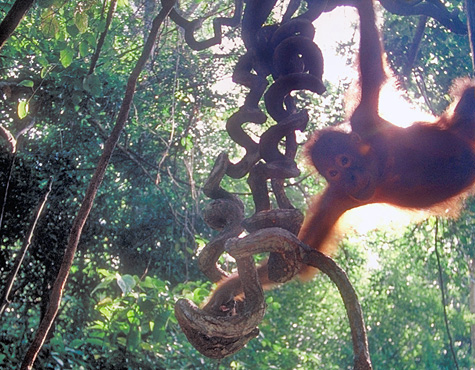
.
Tags: Borneo, Borneo Orang-utan Survival, Chelsea sugar, CSR sugar, Four Paws International, Indonesian farmers, Indonesian palm oil plantations, Kalimantan, Malaysian palm oil plantations, orang-utan, orang-utan bounty hunters, palm oil plantations, PT Restorasi Habitat Orangutan Indonesia, Sucrogen, wildlife photographers, Wilmer International
Posted in Kalimantan (ID), Orang-utans, Threats from Farming, Threats from Poaching and Poisoning | No Comments »
Add this post to Del.icio.us - Digg
Saturday, January 28th, 2012
Since 12thMay 2005, Blue Mountains Swamps have been listed as an endangered ecological community under the Environmental Protection Biodiversity Conservation Act 1999, (EPBC Act), as amended in 2005. Blue Mountains Swamps are listed under the scientific category of Temperate Highland Peat Swamps on Sandstone.
The objectives of the EPBC Act include providing for the protection of the environment, especially matters of national environmental significance and to conserve Australian biodiversity. In the case of Blue Mountains Swamps, the EPBC Act serves to prevent the actions of land use developers and others posing a significant impact upon the integrity of these vital swamp ecosystems.
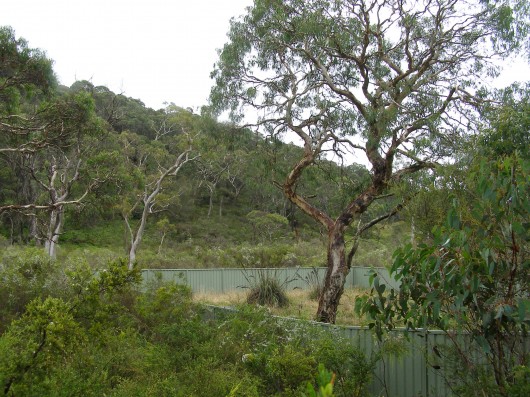 A Blue Mountains Swamp
…blatantly slashed, reclaimed and exotic grass introduced by this property development
on the wild edge of Katoomba, adjacent to the Greater Blue Mountains World Heritage Area. A Blue Mountains Swamp
…blatantly slashed, reclaimed and exotic grass introduced by this property development
on the wild edge of Katoomba, adjacent to the Greater Blue Mountains World Heritage Area.
.
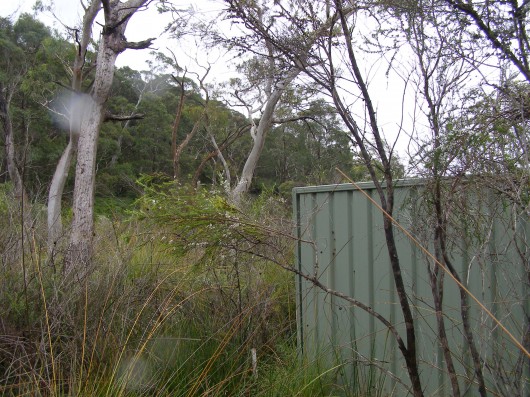 The steel fence of the development is built right into the Blue Mountains Swamp
(Photo by Editor 20120118, free in public domain, click to enlarge) The steel fence of the development is built right into the Blue Mountains Swamp
(Photo by Editor 20120118, free in public domain, click to enlarge)
.
This housing development was approved by Blue Mountains Council.
At the same time, Blue Mountains Council’s Upland Swamp Rehabilitation Programme was commenced in 2006 after Blue Mountains Swamps were listed as part of the Temperate Highland Peat Swamps on Sandstone endangered ecological community, with the aim of protecting and restoring Blue Mountains Swamp across the Local Government Area (LGA).
“In August 2008 Blue Mountains Council and Lithgow Council formed a partnership to deliver the ‘Saving our Swamps’ (S.O.S) project to restore Temperate Highland Peat Swamps on Sandstone across both LGAs. With grant funding of $250,000 over 3 years from the Urban Sustainability program of the NSW Environmental Trust, the SOS project will both strengthen Blue Mountains Council’s long term Upland Swamp Rehabilitation Programme and transfer skills to build the capacity of Lithgow Council to protect the Newnes Plateau Shrub Swamp endangered ecological community of the Newnes Plateau.”
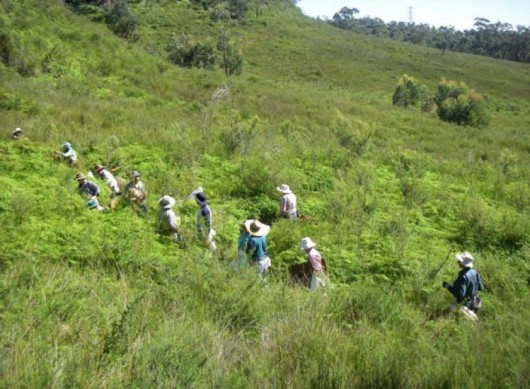 Local community volunteers helping Blue Mountains Council
to rehabilitate Kitty Hawk Swamp at Wentworth Falls in the Blue Mountains
[Source: Blue Mountains Council’s ‘Swampwatch’ Factsheet 7) Local community volunteers helping Blue Mountains Council
to rehabilitate Kitty Hawk Swamp at Wentworth Falls in the Blue Mountains
[Source: Blue Mountains Council’s ‘Swampwatch’ Factsheet 7)
.
“The SOS initiative will build on the Blue Mountains Council’s Upland Swamp Rehabilitation Programme, by providing funds for bush regeneration, soft engineering swamp re-hydration and creek bank stabilization in degraded Blue Mountains Swamps on both public and private land. The project will also deliver a community and school education program to raise awareness of the significance of Blue Mountains Swamps and their associated threatened species and to explain how the community can assist in their protection.
The successful partnership between BMCC and LCC was expanded in 2009 to incorporate Wingecarribee Shire Council and Gosford Council. The resultant SOS stage 2 project received a $400,000 federal Caring for Country grant over 12 months to expand the model across all four LGAS under the leadership of Blue Mountains Council.”
[Source: ^ http://saveourswamps.com.au/Blue-Mountains-City-Council.php]
.
Am I missing something here?
Blue Mountains Council receiving $250,000 plus $400,000
to save Blue Mountains Swamps,
while approving development into them?
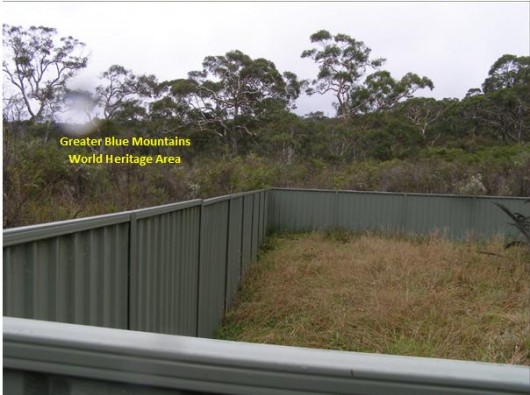 Saving Our Swamps by Council-approved slashing, bulldozing and reclamation
This is immediately adjacent to the Greater Blue Mountains World Heritage Area.
. Saving Our Swamps by Council-approved slashing, bulldozing and reclamation
This is immediately adjacent to the Greater Blue Mountains World Heritage Area.
.
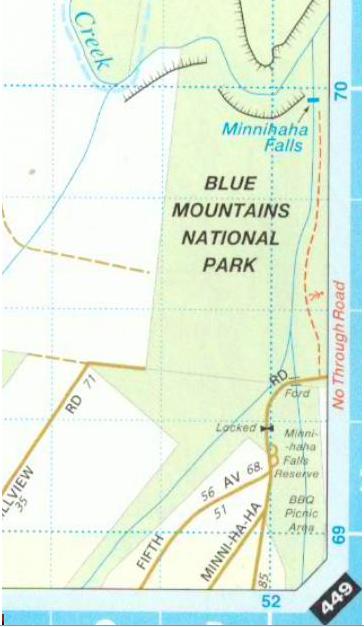 Location of Fifth Avenue adjacent to Blue Mountain National Park (BMNP)
BMNP forms part of the Greater Blue Mountains World Heritage Area. Location of Fifth Avenue adjacent to Blue Mountain National Park (BMNP)
BMNP forms part of the Greater Blue Mountains World Heritage Area.
.
“This park, which is part of the Greater Blue Mountains World Heritage Area, protects an unusually diverse range of vegetation communities. There are rare and ancient plants and isolated animal populations tucked away in its deep gorges.”
[Source: NSW Office of Environment and Heritage, NSW National Parks and Wildlife Service, ^http://www.environment.nsw.gov.au/nationalparks/parkHome.aspx?id=N0004]
.
Saturday, January 28th, 2012
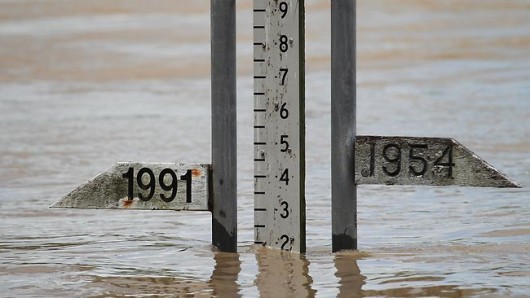 Queensland Flood Gauge – where have all the gauges gone?
Removing them is as bad as burning books – history becomes dangerously forgotten.
Put ’em back! Queensland Flood Gauge – where have all the gauges gone?
Removing them is as bad as burning books – history becomes dangerously forgotten.
Put ’em back!
.
Cyclone Yasi
.
Far North Queensland experiences a recurring pattern of tropical cyclones during the Wet Season (Cyclone Winifred in 1986, Cyclone Rona in 1999, Cyclone Larry in 2006) – some being more damaging than others. It is the luck of the draw, but should never be underestimated.
Cyclone Yasi in 2011, became severe category 5 cyclone by 1st February crossing the coast at Mission Beach bringing damaging winds of up to 290kph, torrential rain, flash flooding and 7 metre high sea storm surge.
I would not have wanted to have been there, recalling that twenty years ago in 1990 while working as a casual hotel porter, I happened to have been bunkered down in Cairns’ Four Seasons Hotel on the Esplanade, when Cyclone Joy loomed of the coast. I recall the imminent sense of the cyclone’s force warned being beyond what authorities could cope with and so everyone was genuinely frightened. The hotel’s lobby glass doors bowed inwards from the storm and I dont’ know why they didn’t break.
People that have not bunkered down in the path of an imminent cyclone cannot realise the fear of not knowing and what could happen – the prospect of death is real, people hug each other as a final gesture of humanity. As it luckily turned out, Cyclone Joy fizzled into a widespread depression causing floods across Queensland. To those at the time on the Cairns’ coast preapred to cop death, a torrential depression was nothing compared to what had been threatened. We were alive!
Luck is spiritual, and convinced of having a guardian angel, I respect Nature and so have become very conservatively minded. I once was in the Army, but I am a woos now.
Yasi delivered flooding rains inland as far as Mount Isa, Alice Springs and south into the Marray Darling basin.
The impact was mainly property and crop destruction (particularly sugar and banana), forests flattened, widespread power outage and water system failure centred around the coastal communities of Mission Beach, Tully, Silkwood, Innisfail and Cardwell. Severe flooding cut the Bruce Highway between Townsville and Ingham and many inland communities (Oodnadatta, Glendambo and Anna Creek) became isolated. One man died near Ingham.
The economic loss estimates from the storm were estimated to reach A$3.5 billion, including A$2 billion in agriculture, mining and local government, and A$1 billion in tourism.
The government response came from all three levels of government. The State’s combined emergency services were overwhelmed, so the Australian Government deployed the combined services of the Australian Defence Force under Operation Yasi Assist to aid civilian emergency response efforts with mainly transport logistics. As a precaution, the RAAF provided aeromedical evacuations for 255 patients in Cairns Base Hospital and Cairns Private Hospital ahead of the cyclone. Later emergency supplies had to be flown in to inland communities isolated by extensive flooding and many military personnel were engaged in debris removal.
The Queensland Premier, Anna Bligh, initiated the Premier’s Disaster Relief Appeal which ended up raising $281 million from inside the Australian community and from overseas donors. St. Vincent de Paul received $23 million which providing funds to over 2,464 affected households.
The Queensland Reconstruction Authority was established to develop, implement and manage a state wide plan for rebuilding and reconnecting communities affected by the floods and cyclones. The restoration and recovery cost were estimated at $800 million, mainly to rebuild road and transport infrastructure. This cost was borne 25% by the Queensland Givernment,and 75% by Australian Government.
Under the Australian Government’s dedicated Disaster Assist programme outlays for some 273,942 claims amounted to $310 million.
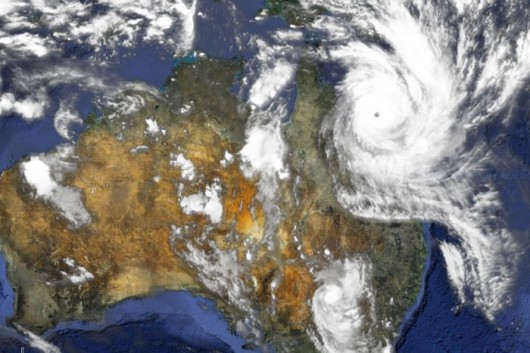 Northern Australia’s annual cyclone season – seen this before; nothing new Northern Australia’s annual cyclone season – seen this before; nothing new
.
Queensland Floods
.
Over the summer of 2010-11, a series of torrential rain storms likely associated with the La Niña climate pattern over the Pacific as well as record-high ocean temperatures in the north-eastern Indian Ocean.
This climate pattern, alternating between the high risk flooding of La Niña and the prolonged droughts of El Niño is a well established weather pattern affecting particularly northern Australia.
The Queensland Floods of 2011 affected the Fitzroy, Burnett, Condamine, Ballone, Mary, Brisbane and Bremer Rivers as well as Lockyer Creek and Oakey Creek (Toowoomba). An unexpected flash flood raced through Toowoomba’s central business district. Water from the same storm devastated communities in the Lockyer Valley. A few days later thousands of houses in Ipswich and Brisbane were inundated as the Brisbane River rose and Wivenhoe Dam used a considerable proportion of its flood mitigation capacity.
More than 70 towns were flooded, forcing evacuation of over 200,000 people. Much of central and southern Queensland including Brisbane, Rockhampton, Emerald, Bundaberg, Dalby, Toowoomba, and Ipswich were inundated. More than 5900 insured homes were inundated in Brisbane and Ipswich when rivers erupted on 12th and 13th January 2011. Three-quarters of the state of Queensland was declared a disaster zone. There were 35 people confirmed dead and 9 missing. The damages bill was A$30 billion.
A large mobilisation of the Australian Defence Force was activated and a relief fund created. The head of the recovery taskforce was Major General Michael Slater, DSC, AM, CSC. The Queensland Reconstruction Authority was formed to co-ordinate the rebuilding program beyond the initial taskforce and a Commission of Inquiry established to investigate all matters related to the floods.
In figures released at the end of January 2011, the Insurance Council of Australia calculated that 38,460 individual claims were lodged with insurers which were worth A$1.51 billion. Nearly half of those claims were for damage to homes and more than half were made by those living in Brisbane.
With much of Queensland’s agriculture destroyed, the price of food across Australia rose, particularly fruits and vegetables and coal production slowed due to coal railway lines were closed and numerous mine sites being flooded. The Australian Government is estimating an ultimate bill of $5.6 billion.
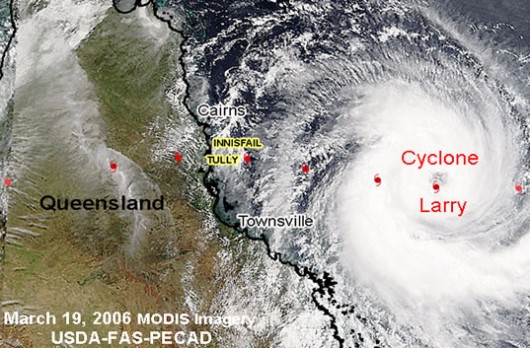 Australia’s recurring history of cyclones Australia’s recurring history of cyclones
.
- 1899 – CYCLONE MAHINA (Category 5)
- 1918 – CYCLONE MACKAY (Category 4)
- 1918 – CYCLONE INNISFAIL (Category 5)
- 1970 – CYCLONE ADA (Category 4)
- 1971 – CYCLONE ALTHEA (Category 4)
- 1972 – CYCLONE EMILY (Category 2)
- 1974 – CYCLONE TRACY (Category 4)
- 1975 – CYCLONE JOAN (Category 5)
- 1978 – CYCLONE ALBY (Category 4)
- 1986 – CYCLONE WINIFRED (Category 3)
- 1989 – CYCLONE ORSON (Category 4)
- 1995 – CYCLONE BOBBY (Category 4)
- 1997 – CYCLONE JUSTIN (Category 3)
- 2005 – CYCLONE INGRID (Category 4/5)
- 2006 – CYCLONE LARRY (Category 4)
- 2006 – Cyclone Larry (Category 4)
- 2007 – CYCLONE GEORGE (Category 5)
- 2011 – CYCLONE YASI (Category 5)
.
Notice any trend? They tend to come in La Niña waves.
.
Indirect Causes of the 2010-11 Queensland Floods
.
1. Category 5 Cyclone Yasi – cyclones are a frequent occurrence in Far North Queensland during the Wet (November to March)
2. The known prevailing La Niña climate pattern affecting Australia generally, worsening with known trends in climate change
3. Widespread torrential rain storms causing localised flooding
4. The creating and design of artificial storage dams on major rivers altering the natural river flows – Wivenhoe Dam on the Brisbane River
5. Deforestation denying tree transpiration to take up much of the surface water, exacerbating surface runoff causing flooding of rivers and creeks regionally
6. Human population settlements situated in known flood-prone land, encouraged by urban planning, land use development and housing approvals, thus with heightened exposure to periodic storm flood. Why were areas developed when people knew it was flood-prone? What planning laws were ignored by Local and State governments to allow housing approvals in low-lying areas prone to flood and storm surge, indeed withaq recurring history of flooding? The CSIRO has found that 32,500 homes in Queensland’s thickly settled southeast are exposed to a 2.5m storm tide, risking damage of $1.1 billion – by the time today’s babies leave school, in 2030, the number of homes at risk will be 61,500, at a potential cost of of $2bn in today’s dollars. Local and State governments have forgotten about flooding and permitted too much development in danger zones on the sea front and in flood plains.
7. Human population settlements situated in known sea surge -prone land, encouraged by urban planning, land use development and housing approvals, , thus with heightened exposure to periodic storm flood. It is not as if Brisbane has no precedent for flood – look at 1893 and 1974!
8. Local government land use development legislation allowing and facilitating building on flood-prone land
9. Greedy developers profiting from property sales and development on land having a known recurring record of storm flood and surge risk
10. Local, State and National governments turning a blind eye to mitigate the impacts of recurring storms in known areas that have and continue to cause flooding, damaging winds and coastal inundation.
 Widespread deforestation of riverine valleys including their steep upper reaches
removes vital native forest cover denying natural transpiration
and so exacerbates local surface runoff and consequential regional flash flooding Widespread deforestation of riverine valleys including their steep upper reaches
removes vital native forest cover denying natural transpiration
and so exacerbates local surface runoff and consequential regional flash flooding
.
Direct and Culpable Causes of the Queensland Floods Impact
.
1. The delayed timing of the water overflow release from Wivenhoe Dam that directly caused the Brisbane River flooding
2. State government failure to assess the effectiveness of home and contents insurance coverage of property owners located in known flood prone and storm surge areas and failure to proactively address the shortcomings of this risk ahead of such disasters. The Insurance Council has estimated the damage from flooding and cyclones in Queensland amounts to $2 billion — modelling emerged to show how vulnerable the country is to extreme weather.
3. Local, State and National governments failure to undertake adequate risk assessment for disaster management, especially in areas having a recurring history of cyclones, torrential rains, riverine flooding, flash floods, storm surges and coastal inundation. Where is Queensland’s, indeed Northern Australia’s disaster preparedness and resilience plan? It needs to factor in all the Dorothea MacKeller terror scenarios.
4. Failure by the Queensland Government to utilise the Brisbane River’s Wivenhoe Dam for its intended purpose – flood mitigation, not water storage
5. Operational failure by the Queensland Government to release water ahead of know heavy rain period during the known high risk La Niña climate pattern in the height of summer at a time of ongoing torrential rains
6. Failure to listen to prior warning from the Australian Bureau of Meteorology about the heightened risk from La Niña and for State, Local and National Governements to prepare and respond accordingly
7. Failure by State and National governments to provide appropriate infrastructure situated and designed to withstand flash flooding events, storm surges and damaging winds. Power lines are still placed above ground making critical power supply susceptible to damaging winds causing widespread power outages. Why are critical facilities such as public hospitals and evacuation/emergency relief centres not located safely beyond the effects of flood, and storm surges and coastal inundation?
8. Failure by State and National governments to provide for emergency contingency and a sufficiently resources response. Natural disasters such as torrential flooding rain and cyclones are not preventable but in Queensland are a know recurrence. Their impact and cost is compounded by poor planning decisions and unheeded warnings. Queensland’s disaster contingency preparation is woeful.Emergency services were stretched to the limit nationally, hence the Australian Defence Force was called in – a desperate last resort. The Australian Defence Force is primarily trained, equipped and prepared for military emergencies, not civil emergencies such as natural disasters, so the response was suboptimal. What is the capacity, training and state of readiness of Defence Forces to cope with civil disasters at home, let alone in our region?
9. Recurring failure by local, State and national governments to collectively learn from past natural disasters, to adopt and implement the recommendations from previous reports and enquiries into natural disasters across Queensland, and to consider and implement world’s best practice solutions.
10. Recurring failure by local, State and national governments to accordingly budget for and to allocate sufficient capital and recurrent funding to ensure timely outcomes
11. Greedy insurance companies denying claims payments because of discretionary interpretation of home and contents insurance clauses.
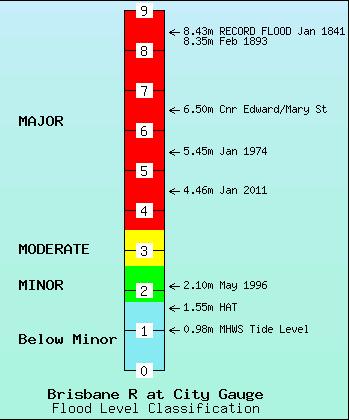 Brisbane River Flood History Brisbane River Flood History
.
Government Responsibility
.
What do we vote in and pay our politicians for? Is it to represent our collective interests, deliver on election promises and to get done the job of government or is it speech writing and popularism?
The incumbent US President Barack Obama rode to power in 2008 on the basis of good speech writing and delivery and on the back of an incompetent, dysfunction Bush Government embroiled in warmongering on false pretences and corrupt involvement by Halliburton, $300 billion in Defence excesses, a failed health care system, a $455 billion deficit, a widened wealth gap and condoning torture at Guantanimo. Arguably at the time, Obama piggybacked on the popular mandate for change when almost anyone was going to better than the Republicans arrogant clown from Texas, George W.
Obama in his speeches to win office inspired and promised. On the night before the 2008 presidential election on 3rd November 2008, Obama declared:
“I come away with an unyielding belief that if we only had a government as responsible as all of you, as compassionate as the American people, that there is no obstacle that we can’t overcome. There is no destiny that we cannot fulfill.” “Tomorrow you can choose policies that invest in our middle class, create new jobs and grow this economy so that everybody has a chance to succeed.”
.
Then he went full-blown American, ranting on about “this defining moment in history“, “this is where change begins“, “the men and women who serve on our battlefields..(who) fought together and they bled together…some die together under the same proud flag, “yes we can“, blah, blah, blah.
Four years later in 2012, Obamba’s policies have added $1.4 trillion to US national debt, the U.S. credit rating has been downgraded to AA+, unemployment is still over 8%, the US strategic war in Afghanistan is still going, healthcare is still unaffordable to most Americans, and Gitmo is still open for business. Obama has spent a record $12.8 trillion bailing out failed banks, mortgage lenders and car manufacturers. To a degree, the Republican Party’s ‘no we won’t‘ party political recalcitrance, stymieing US Congress decision making, has stiffled Obama’s ‘yes we can‘ delivery. The politics is stifling the country.
.
Back in Australia, at the height of the combined calamities afflicting Queensland by Cyclone Yasi, regional flooding and the Brisbane River flood; on 13th January 2011 Labor Premier Anna Bligh gave a short media conference, now famously referred to as her ‘We are Queenslanders‘ speech.
“As we weep for what we have lost, and as we grieve for family and friends and we confront the challenge that is before us, I want us to remember who we are,” she said. “We are Queenslanders. We are the people they breed tough north of the border. We’re the ones that they knock down, and we get up again.
“I said earlier this week that this weather may break our hearts, and it is doing that. But it will not break our will. And in the coming weeks and the coming months we are going prove that beyond any doubt. Together we can pull through this, and with your help, we can achieve it.”
[Source: ‘Blighs tearfilled cry we are queenslanders’, by Megan Levy, 20110113, ^http://www.brisbanetimes.com.au/environment/weather/blighs-tearfilled-cry-we-are-queenslanders-20110113-19oxt.html]
.
Spare us!
In such crises, people look to their government for leadership, security and resources. At other times, people have a right to expect that their government will responsibly assess risks and prepare for contingencies in the event of crises. This necessarily involves appropriate contingency planning, infrastructure provision and resourcing of emergency management. It also involves appropriate and timely emergency response followed by recovery and rebuilding. It also requires learning lessons and implementing appropriate measures to mitigate the impact of future crises. In Queensland’s case three are three levels of government and in 2011 both State and Federal Government were Labor.
Beyond stirring speeches how has the Bligh Government performed its duty as government?
[Source: ‘Summer of fury exposes planning failures‘ by Jamie Walker, Natasha Bita, Jared Owens, The Australian, 20110212, ^http://www.theaustralian.com.au/news/nation/summer-of-fury-exposes-planning-failures/story-e6frg6nf-1226004691620]
.
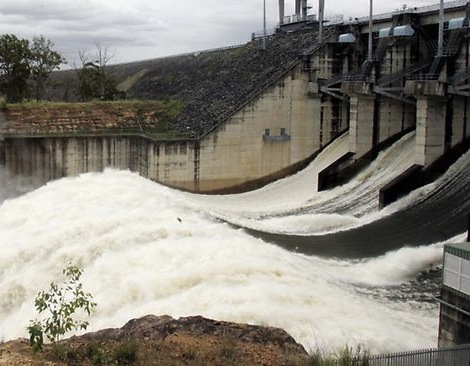 We are Queenslanders – we opened the flood gates at the wrong time – sorry. We are Queenslanders – we opened the flood gates at the wrong time – sorry.
.
Tags: Brisbane River flooding, Causes of the Queensland Floods, Cyclone Yasi, Government Responsibility for flooding, La Niña, Queensland Floods, We are Queenslanders Speech, Wet Season, Widespread deforestation, Wivenhoe Dam flood gates
Posted in Threats from Development, Threats from Government Funding Neglect, Threats from Government Mismanagement, Threats from Stormwater Runoff | No Comments »
Add this post to Del.icio.us - Digg
Tuesday, January 24th, 2012
 The Tasman Highway, Tasmania – now just like everywhere else
It could be New South Wales, western Victoria, West Australia’s wheatbelt,
or New Zealand’s Canterbury Plains (in drought), or even North America’s mid-west
(Photo by Editor 20110928, free in public domain, click photo to enlarge) The Tasman Highway, Tasmania – now just like everywhere else
It could be New South Wales, western Victoria, West Australia’s wheatbelt,
or New Zealand’s Canterbury Plains (in drought), or even North America’s mid-west
(Photo by Editor 20110928, free in public domain, click photo to enlarge)
.
Do a Google Earth search on Tasmania and observe that half the entire island has been cleared of its native vegetation.
Drive around the cleared areas – up the Midland, Tasman, West Tamar and Bass highways and observe the abundance of cleared land. Note how much of it is unproductive.
 A tree! How did that get there?
(Freycinet National Park in the background)
(Photo by Editor 20110928, free in public domain, click photo to enlarge) A tree! How did that get there?
(Freycinet National Park in the background)
(Photo by Editor 20110928, free in public domain, click photo to enlarge)
Forestry argues the concept of ‘locking up’ native forests. Forestry argues that by governments locking up native forests, Forestry is denied the opportunity to log them.
Well the above photos show part of the ‘unlocked’ half of Tasmania – long logged, used, abused and now mostly abandoned. Why destroy Tasmania’s desperate remaining virgin forest habitat?
Observe that the current legal hope rests with the IGA – Tasmanian Forests Intergovernmental Agreement of 7th August 2011). Our leaders ‘The IGA Parties’ (Australia’s Prime Minister Julia Gillard and Tasmania’s Premier Lara Giddings) to that agreement have breached its clauses and if it were illegal, thus acted illegally.
What is to be the genuine way of protecting Tasmania’s heritage from governments that do not respect Old Tasmania’s values, enough to respect and protect that heritage for perpetuity?
 A dead tree and many yellow Gorse weeds (Ulex europaeus) A dead tree and many yellow Gorse weeds (Ulex europaeus)
In springtime as one flies into Hobart, the countryside is blanketed with the bastard yellow plague
It conveys a message of neglected and abandoned country
~ a message which Tasmanian Aborigines would likely be saddened by, knowing what quality country thrived before.
(Photo by Editor 20110928, free in public domain, click photo to enlarge)
. .
What has become Forestry’s truthful “sustainably managed” concept? Sustainable for whom? Where can Forestry point to exemplify ancestral respect in a forest of Tasmanian forest ancestors?.
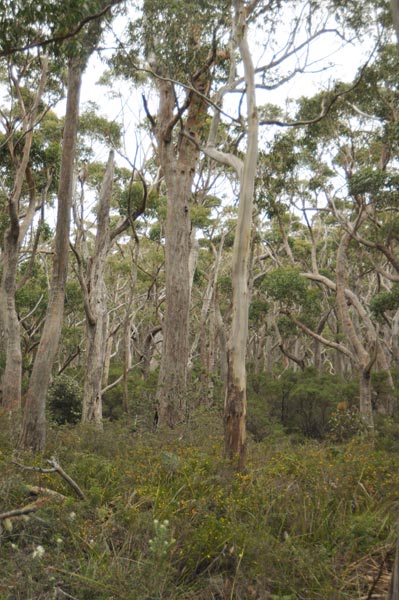 This is the native forest that once blanketed the region above
Wild, rough, untamed and rich in wildlife and biodiversity This is the native forest that once blanketed the region above
Wild, rough, untamed and rich in wildlife and biodiversity
.
 Tasmania Map of Cleared Land in 2006
The white areas are private land and almost all cleared of native vegetation
The light green areas are State Forest and subject to logging, burning, poaching, mining, etc.
Try to find the area designated ‘Aboriginal land’.
(Source: The Tasmanian Wilderness World Heritage Area, © Commonwealth of Australia,
^http://www.environment.gov.au/heritage/publications/protecting/pubs/tas-wilderness.pdf)
. Tasmania Map of Cleared Land in 2006
The white areas are private land and almost all cleared of native vegetation
The light green areas are State Forest and subject to logging, burning, poaching, mining, etc.
Try to find the area designated ‘Aboriginal land’.
(Source: The Tasmanian Wilderness World Heritage Area, © Commonwealth of Australia,
^http://www.environment.gov.au/heritage/publications/protecting/pubs/tas-wilderness.pdf)
.
.
But then there remain a few wild virgin forests of Tasmania that as yet have not been logged, burned, mined, abused and livestock-defecated upon by colonial exploitation. But you have to know where to look…and you’d better be quick, if you what to remember what was once majestic …
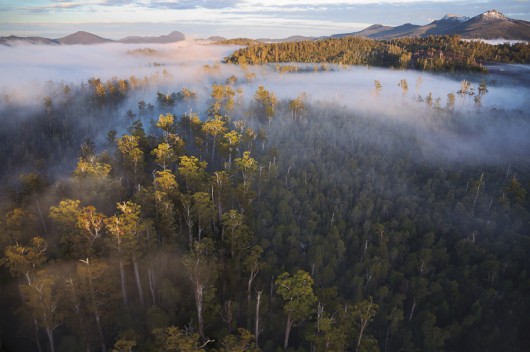 Tasmania’s Styx Valley Forests – not like anywhere else
(© Photo by Rob Blakers with permission) Tasmania’s Styx Valley Forests – not like anywhere else
(© Photo by Rob Blakers with permission)
.
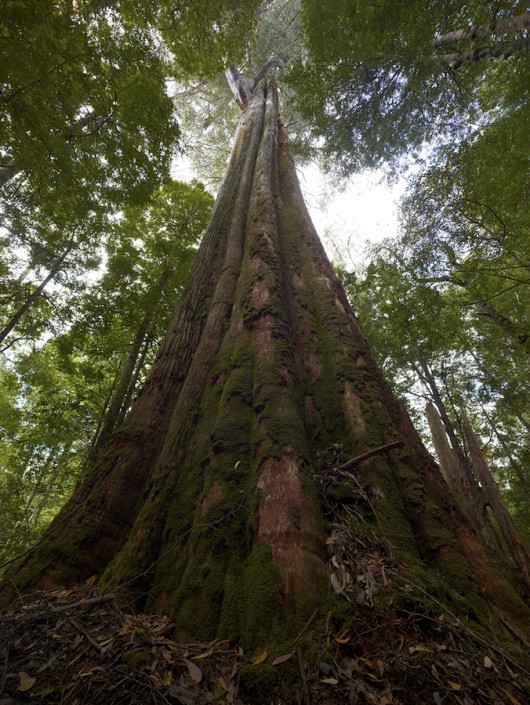 Tasmanian Giant Eucalypt
In Mount Mueller Forest – currently at risk of logging
For more information visit www.observertree.org
(© Photo by Rob Blakers with permission) Tasmanian Giant Eucalypt
In Mount Mueller Forest – currently at risk of logging
For more information visit www.observertree.org
(© Photo by Rob Blakers with permission)
.
Tags: forestry, locking up native forests, Mount Mueller, Myrtle Beech, Nothofagus cunninghamii, old growth, Styx Forest, Styx Valley Forests, Tasmania, Tasmania Map of Cleared Land, The Observer Tree, unlocked, unlocked Tasmania
Posted in + Wild Tasmania, Tasmania (AU), Threats to Wild Tasmania | 1 Comment »
Add this post to Del.icio.us - Digg
Monday, January 23rd, 2012

“It will get worse before it gets better...Saturday, Sunday are going to be pretty extreme days once again. Temperatures will be at least in the low 40s.”
.
~ sound byte by Fairfax Media, Journalist Tim Young using a provocative sound byte from Dr Chris Ryan, Australian Bureau of Metereology at a media conference on Friday 6th February 2009.
.
Amongst the tragedies of the 2009 Victorian Bushfires – the catastrophic loss of 173 lives, many more people injured and traumatised, the massive loss of livestock and property, unmeasured fauna killed, and bushfire history repeating itself – was the excited media (and Victorian Premier John Brumby personally) dramatising on State television, newspapers and radio about an impending extreme bushfire risk.
Gippsland was already two weeks into a series of bushfires that were known to have been lit by arsonists – the Bunyip Bushfire and the Delburn Bushfire and these dominated the headlines. The media focus on the bushfires were about ‘scoops’ and sensational journalism. It had grown into a media infatuation. Every new bushfire story attracted headline news. To a dormant arsonist, such messages would have been a red rag to a bull.
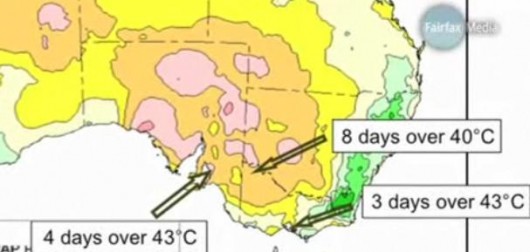 Record temperatures publicised with emphasis like never before
…on Friday 6th February 2009 Record temperatures publicised with emphasis like never before
…on Friday 6th February 2009
.
Victoria was in a severe long drought (like the 1983 Ash Wednesday Bushfires) with tinder dry bushland and extreme hot windy and dry weather conditions that the Victorian Country Fire Authority (CFA) had acknowledged as causing the forecast bushfire risk index for the coming weekend to fly off the scale.
Yet while the media and the Premier were effectively scaremongering, the CFA publicly stated that it was prepared for the weekend of 7th and 8th February 2009. This public confidence misleadingly lulled Victorians into a false sense of security and confidence in bushfire management business as usual, and contributed to the tragedy of long horrific day’s journey into night that unfolds.
The following media articles dated the morning of Saturday 7th February 2009 are reproduced here, the first a full double page spread in Fairfax’s ‘The Age’ newspaper on pages 4 and 5:
.
‘The sun rises on our ‘worst day in history’
[Source: ‘ The sun rises on our ‘worst day in history‘, by Ben Doherty and Erdem Koch, The Age (morning newspaper), 20090207, ^ http://www.theage.com.au/national/the-sun-rises-on-our-worst-day-in-history-20090206-7zzf.html]
 Grape grower Lou Bennett with some of his crop scorched in the recent hot weather.
He estimates about 30% of his crop has failed, burnt dry by the sun.
(Photo: Glenn Milne) Grape grower Lou Bennett with some of his crop scorched in the recent hot weather.
He estimates about 30% of his crop has failed, burnt dry by the sun.
(Photo: Glenn Milne)
.
Today is likely to be among the hottest on record in Victoria, and the effects of the heatwave are adding up across the state.
The weather bureau tells Lou Bennett it’s 44 degrees (Celsius). But he trusts better his own thermometer, rigged up on the back verandah. It says 52.
It doesn’t really matter anyway, whatever the number, the sun feels oppressively, infernally hot, and he’ll be out in it.
Warnings from the Premier about today’s heatwave being “the worst day in the state’s history” don’t carry much weight with growers around Red Cliffs, near Mildura in Victoria’s north-west corner. There’s been plenty of tough ones already.
“Out on the farm it’s pretty hot, but whatever it is we’re out there in it,” Mr Bennett said. “Sometimes you’re lucky and you’re in the air-conditioned tractor, but most of the time you’re on the shovel or the motorbike.”
Straitened times have forced Mr Bennett to let his farmhands go. “Now I’ve got my kids coming out in 40-degree heat after school to help.”
By Mr Bennett’s count, today will be the 12th straight over 40 degrees at his place. It has sapped the life from his plants. He lost two complete hectares in one scorching morning, as well as about 30 per cent of his crop overall.
“It’s not just me, it’s everybody. It’s my neighbours, my friends. Your family suffers.”
Farmers across Victoria are suffering similarly. Growers in the Goulburn Valley are writing off crops of pears, apricots and apples ruined by sunburn.
In shearing sheds across the state, sheep have been passing out, overcome by the heat and the heavy fleece they’re carrying (a good rouseabout carries a bottle of water in hot weather to revive them).
Today is set to be the worst of the lot. Across the state, blistering temperatures are predicted, up to 46 degrees in the Mallee, while Melbourne will reach 44.
Northerly winds, gusting up to gale force at 100 km/h, will run across the state, with the potential to fan bushfires across tracts of tinder-dry land.
All sorts of records are being broken. Twelve straight days over 40 in the Mallee smashes the previous state record of nine days. By tonight, Melbourne will have gone 34 days without rain, the third worst dry spell on record.
The heat has also pushed the state’s morgue to its capacity. The Victorian coroner took in 50 bodies a day during last week’s heatwave — more than three times the average rate.
State coroner Jennifer Coate said yesterday that her office had to arrange for hospitals and funeral directors to store the bodies of people whose deaths required further investigation.
Imposing a statewide total fire ban for today, the CFA said the whole state was at extreme risk.
.
Premier John Brumby (on the Friday prior) warned that conditions were comparable to 1983’s deadly Ash Wednesday.
.
“It’s just as bad a day as you can imagine and on top of that the state is just tinder-dry,” he said. “People need to exercise real common sense … If you don’t need to go out, don’t go out, it’s a seriously bad day. If you don’t need to travel, don’t travel. Don’t go on the roads. If you don’t need to use the public transport system, don’t use it. If you can stay at home, stay at home.”
.
V/Line has told people not to travel to Gippsland unless they have to, warning that the Bunyip bushfire would likely disturb coach and train travel.
The Premier urged people to look after the elderly, infirm and vulnerable.
“Ring them … it’s going to be a terrible day for anyone who is ill or who is old,” he said.
Yesterday, the Federal Government issued a directive to nursing homes, requiring them to monitor 170,000 residents across the country. Nursing homes in Victoria and South Australia face spot checks and audits of their air-conditioning systems, following complaints.
Water Minister Tim Holding excused Victorians from their water saving for a day, saying people needed, above all else, to keep cool.
Water consumption peaked at 283 litres per person in Melbourne last Friday, when the temperature hit 45. The average for this summer has been 172 litres per person per day.
Power outages, which wreaked havoc across the state last week, are again a real possibility, with power companies urging people to prepare to do without electricity.
The peak of the extreme heat is likely to push the state’s power capabilities to their limit, while the afternoon change could bring winds that will bring down trees across power lines.
Victoria is preparing for the worst. Sport is being cancelled.
Two and four-legged competitors are heading for the shade. Cricket matches are being moved or called off, while the Classic Dog Show, which was to feature 1200 of Victoria’s most pampered and prize-adorned pups, has been cancelled.
Racing at Caulfield, including the Group 1 Orr Stakes, has been put back to Sunday. The only horses racing today will be at the non-TAB picnic meeting at Buchan in East Gippsland.
But punters with an itch to unload can still have a wager.
Online bookmakers are laying bets on just how hot it will be in Melbourne today.
However, no one’s betting against Lou Bennett summoning the courage to brave the heat, regardless of what the mercury tells him.
“You can’t stay inside, mate, you’ve got to get outside and get it done, because no one else is going to do it for you,” he says.
.
‘Town in fury over bush arsonist’
[Source: ‘Town in fury over bush arsonist’, by Chris Johnston, The Age, p.5, 20090207, ^ http://www.theage.com.au/national/town-in-fury-over-bush-arsonist-20090206-7zzj.html]
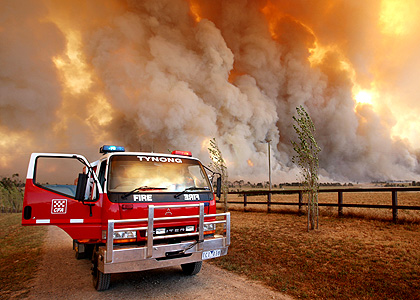
Most unnerving of all for Boolarra residents, is that whoever lit the fires may well be one of their own.
At the peak of the devastating Boolarra bushfires eight days ago it was, according to a local, like “a war zone without bullets”. Helicopters in the sky, panic in the streets. Sirens and explosions. The burnt-out shells where houses once stood.
The fires are now contained, but today’s extreme hot and windy conditions — tipped to be the worst in the state’s history — will be terrifying in this pretty village in Gippsland’s foothills.
It could all go up again. But they know that. They are ready. The firefighters have been working towards this day all week.
The deeper problem is something that no one really knows how to handle. The fires were deliberately lit and the close-knit community of 600 is seething. There are whispers of revenge and vigilantes, of bush justice. No one can believe anyone would do such a thing.
The talk is about how whoever did this must be a “sick bastard” and how they should be strapped to a tree in the next firefront and left to burn to “see how they like it”. Someone said that if caught, they would need police protection because the town wants blood.
“People and families here are scared and angry,” said Rob Herni, who grows tree ferns and chairs the local community development group. “And I don’t think there’s any reason for them not to be. Lives have been put at risk, homes destroyed, livelihoods gone. Plenty of people would want an hour or two with the culprits, I can tell you. Normally sane people threatening all kinds of things.”
The fires reached a peak last Friday. That was when they were coming on three fronts, the power was out and the drinking water was contaminated.
Thirty houses, 82 sheds, nine cars and a pig farm were destroyed in 6500 hectares around Boolarra, Mirboo North, Darlimurla and Yinnar, all in the Strzelecki Ranges south of Morwell. That no one died either fighting it or caught in it is seen by the community as a miracle.
Police yesterday announced a new taskforce to investigate the fires and said the driver of a dark silver or grey Toyota Hilux single-cab utility could be the firebug after such a vehicle was seen at the ignition points. Two men were questioned last week but released. The Age believes they were apprehended at the Boolarra CFA staging ground last Thursday, but were not CFA members. A $100,000 reward has been posted.
Boolarra CFA captain Todd Birkbeck believes he knows how it played out. His pager went off at 7.30am last Wednesday; a fire had been lit in the forested hills behind the Boolarra goldfish farm. It was put out but lit again later that day. The next day, he said, another was lit near a track off Creamery Road, near Yinnar, and another at Lyrebird Walk, near Mirboo North.
“By last Thursday night the three had joined up,” he said. “That was the problem. There was no lightning. Fires don’t light up on their own.”
His wife, Michelle, said she and most others were anxious, paranoid and on edge. She heard a motorcycle out in the trees one night, when the fires were out, and feared the worst. It was someone checking fences.
“It’s surreal,” she said. “Nervy. Everyone’s jumping at shadows. You could be talking to them, you don’t know. You see a stranger and you wonder. It’s horrible.”
Mr Herni said he was paranoid about having to drive some mower fuel home to Boolarra from Yinnar today. “Does that make me an arsonist?” he asked. “In the eyes of others?”
The most difficult thing for people to understand is that the arsonist may well be one of their own. Forensic psychologist Rebekah Doley, Australia’s only criminal profiler of bushfire arsonists, said most lived within 10 kilometres of the scene.
“They have knowledge of the landscape and they know where to set the fire best to achieve what they want,” she said.
The culprit was likely to be a male loner with a dysfunctional background who lit the fires to exert power over a community in which he felt powerless.
“They need to assert themselves in some way and fire is a very universally powerful tool to do that so it’s about the experience of the fire rather than setting the fire itself,” she said.
She said serial arsonists were common and the Boolarra firebug could strike again.
“They have to demonstrate they still have the power even if they know police are on their tail.”
She said a serial arsonist was someone with a “deep-seated, long-term interest in fire” who used it as coping tool to relieve emotional tension.
A recent Australian Institute of Criminology report into bushfires said they cost the country $1.6 billion a year and half — about “20,000 to 30,0000” — were deliberately lit.
All this is unthinkable to the people of Boolarra. It has happened to them before — and in the towns nearby like Churchill — but it never makes sense. They live in the trees here, in a village, a hidden valley. Why would someone destroy that, why tear the community apart? With fire, of all things.
“I don’t have any of the answers,” said Rob Herni. “All I know is that people are scared. There’s a lot of fear, real fear. Where are they going to light a fire next? And when?”
.
Read Reports by the Australian Institute of Criminology
(Each 150kb)
[1] >The Cost of Bushfires (AIC, 20041123).pdf
[2] >Firefighter Arson Pt1 (AIC 20050607).pdf
[3] >Firefighter Arson Pt 2 (AIC 20050621).pdf
.
.
Editor: Early Afternoon of Saturday 7th February 2009 – the reports start coming in…
.
‘Fire crews retreat as strong winds fuel flames’
[Source: ‘Fire crews retreat as strong winds fuel flames’, by Robyn Grace, AAP, 20090207, ^http://www.theage.com.au/national/fire-crews-retreat-as-strong-winds-fuel-flames-20090207-806a.html]
.
The Country Fire Authority has issued a number of urgent threat messages as fire activity increases throughout the state.
Ground attack firefighters were earlier forced to retreat from a bushfire burning through the Bunyip State Forest east of Melbourne after the blaze broke containment lines.
Emergency authorities were forced to pull their ground crews out of the fire ground in the Bunyip State Forest, near Pakenham, this morning because of the escalating risk as forecast strong winds began blowing through the area.
Authorities have warned power supplies may be at risk as bushfires near power lines.
Officials also warned people to stay away from the forest area after recreational four-wheel drivers and trail bikers were spotted heading into the state parkland.
“We put road closures in place because unfortunately we’ve had people who’ve tried to go out into the bush early this morning,” incident controller David Nugent said.
“We have got some closures in place in areas like Bunyip State Park. We had people go out there this morning, which is really disappointing to us. It’s not a very good idea to be out in the bush today, particularly around the fire area where we are trying to do our work on the fire.”
More than 100 firefighters are desperately working to contain the fire in Bunyip State Park as it nears a number of small townships.
The fire broke through containment lines about 3am today and crews now fear the worst as the humidity drops and winds reach predicted levels.
Victorians were yesterday told to brace for its worst day in history with 44-degree heat, gale-force winds and tinder-dry conditions fuelling the fire threat.
“Everything is going according to predictions unfortunately,” Department of Sustainability and Environment state duty officer Stuart Ord told Sky News about 8am.
Firefighters worked in shifts overnight to try to contain the fire near Pakenham in Melbourne’s east.
After the blaze broke control lines overnight, DSE crews were forced to retreat because of the escalating risk and difficult terrain.
Mr Nugent said the change in tactics meant only aircraft crews were deployed to waterbomb the 165-hectare blaze in an effort to limit its potential, before weather conditions took a forecast turn for the worse.
The communities of Labertouche, Jindivick West and Tonimbuk are now on high alert as winds push the blaze in a south-easterly direction.
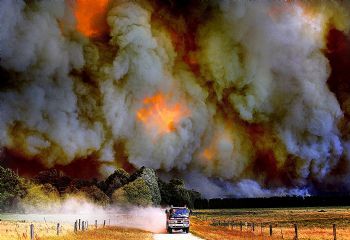
The fire is spotting in multiple areas. The Country Fire Authority said the fire was not currently posing a threat but activity had increased and it had the potential to impact on towns directly.
Residents have been warned to expect increased smoke and embers within the next two hours. They have also been told to be prepared to activate their bushfire survival plans if necessary.
Mr Ord said flames were 10 metres tall in some parts of the fire. Dry lightning in other parts of the state were also a concern, he said.
DSE incident controller David Nugent said fire crews had worked tirelessly in an effort to minimise the anticipated spread of the fire.
“Our bulldozer operators have worked non-stop to build control lines around the fire edge and this effort has been greatly enhanced by the work of firefighting aircraft,” Mr Nugent said.
Firefighting aircraft included the Elvis Erikson aircrane, fixed-wing aircraft dropping retardant on the perimeter of the fire and two medium water-bombing helicopters.
Mr Nugent said the power easements supplying Melbourne and other parts of Victoria remained a key issue.
Melbourne Water has released extra water into the Taraoo aqueduct to fight the expected fires.
CFA spokesman Paul Little said a forecast change in wind direction later today could mean the fire front grows from one or two kilometres to several kilometres in width, creating more challenges for fire crews trying to contain the blaze and protect assets.
“Right now, we’ve got crews strategically placed around Labertouche and other areas ready to respond,” Mr Little said. “But what happens later … we’ll have to wait and see. If the wind changes direction, we’ll have a small firefront grow into a massive firefront and that won’t be good.’‘
The rest of south-east Australia is also gearing up for a horror weekend of extreme heat and bushfires.
In Adelaide, the temperature is expected to peak at 41 on Saturday with the mercury in some South Australian country areas tipped to go even higher.
Tomorrow, temperatures are likely to top 47 degrees in parts of NSW.
The CFA advises:
- Tourists are advised to avoid the following areas: Bunyip State Park, Kurth Kiln Regional Park, Tarago Forest and surrounding areas.
- Road closures currently in place: Intersection of Beenak Road and Launching Place Road, intersection of Princes Freeway and Tynong North Road, intersection of Princes Freeway and Bunyip Road, and intersection of Forest Road and Labertouche North Road.
- Emergency relief centres are located at: Warragul Leisure Centre.
For information on fires in Victoria and general fire safety advice, contact the Victorian Bushfire Information Line on 1800 240 667. Callers who are deaf, hard of hearing, or have a speech/communication impairment may call textphone/ telewriter on 1800 122 969. Information is also available at www.dse.vic.gov.au/fires.’.
.
‘Death toll may reach more than 40: police’
[Source: ‘Death toll may reach more than 40: police’, 20090207, AAP, ^http://www.theage.com.au/national/death-toll-may-reach-more-than-40-police-20090207-80ao.html]
“Email your photos to scoop@theage.com.au”
.
Fourteen people have been killed in the savage bushfires which set Victoria ablaze today. Victoria police confirmed the deaths tonight and said they fear the figure may be more than 40.
At least 100 homes have been destroyed as nine major blazes burnt out of control across Victoria in the worst fire conditions in the state’s history.
Deputy police commissioner Kieran Walshe said all the deaths were in a massive blaze northwest of Melbourne – six at Kinglake, four at nearby Wandong, three at Strathewen and one in Clonbinane.
Mr Walshe said he believed the Kinglake victims were all in the same car. He believed arsonists were responsible for some of the nine major fires ripping across the state.
“We suspect a number of the fires have been deliberately lit,” Mr Walshe told reporters. “This is an absolute tragedy for the state and we believe the figure may even get worse,” Mr Walshe said. “We base that on the fact we’re only just getting into these areas now … to search buildings and properties these have been very very significant fires … the figure could get into the 40s.’‘
The fire started in East Kilmore, 80km north of Melbourne, and covered a huge area as it pushed 30km east to Kinglake, through the small townships of Wandong, Strathewen and Clonbinane.
Mr Walshe said he could not determine whether the victims were civilians or firefighters. He said identifications could not be carried out until at least Sunday. One man, aged in his 40s, is in critical condition after suffering burns to 50 per cent of his body when he tried to move stock in the Coleraine area in the state’s west.
More than 3,000 firefighters and many more residents battled major fronts at Horsham, Coleraine, Weerite, Kilmore East, Bunyip, Churchill, Dargo, Murrindindi and Redesdale in all corners of the scorched state as the searing heat in the mid 40s and high winds exceeded authorities’ predictions of the worst fire conditions in the state’s history.
The Kilmore region in the north and several areas of Gippsland in the east were on high alert as an uneasy dusk fell on Saturday night, while the Horsham fire was downgraded early in the evening.
Fifty houses were reportedly lost in the Bendigo area in the Redesdale blaze and up to 30 houses went up in the Kilmore fire which pushed across Whittlesea and into the town of Kinglake, northwest of Melbourne, which one resident said had gone up in flames.
“The whole township is pretty much on fire,” Peter Mitchell told ABC Radio.
“There was was no time to do anything … it came through in minutes. There’ll be a massive loss of houses … There’ll be a lot of us homeless. All those who have made it into town will be fine. The others will be sheltering and working on their fire plans, God help them.”
Mr Mitchell said he was with around 200 residents holed up in the local pub and that no fire trucks could get into the town.
Thousands more residents in the region were sheltering wherever they could find cover as they were warned the worst was to come overnight.
A cool change early this evening did not bring any respite but, in fact, was expected to create more volatile conditions.
“It hasn’t helped the firefighters, only presented them with new fronts,” the Country Fire Authority (CFA) spokeswoman said.
The CFA and DSE (Department of Sustainability and Environment) warned Victorians to prepare to be hit by fire late tonight and to be especially prepared for ember attack.
“You should assume that as the wind change comes through, that your property could be impacted,” CFA State Coordinator Geoff Conway said.
La Trobe Valley power stations were under threat as a fire on the eastern fringes of the Strzelecki Ranges spread toward the Gippsland coast, threatening towns such as Yarram, Langsbrough and Manns Beach.
“It is pretty well every part of the state except the far northwest,” CFA Deputy Chief Fire Officer John Haynes said.
The Horsham fire burnt 5700 hectares and claimed at least three homes, the town’s golf club and several sheds.
The Bunyip State Park reached 2400 hectares, and one at Kilmore burned 2000 hectares.
CFA deputy chief fire officer John Haynes said it would be about midnight, after the cool change had swept across the state, before fire fighters knew whether they had got on top of the blazes.
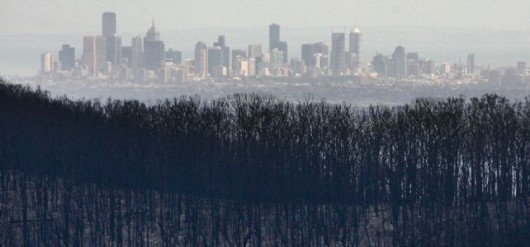 Melbourne: a wealthy growing city, neglecting Regional Victoria Melbourne: a wealthy growing city, neglecting Regional Victoria
.
“Our guys have been flat out trying to fight the fires and trying to pin them down a bit,” Mr Haynes said.
.
“The fire weather … was extreme and off the scale.”
.
By 6pm, at least one house was destroyed at Coleraine in Victoria’s west, in Melbourne’s southeast three homes were destroyed at Lyndbrook; and north of Melbourne six houses were destroyed at Wandong and one at Whittlesea. Homes were also lost in Labertouche, near the Bunyip State Park east of Melbourne.
“There will be more to come,” Mr Haynes said. Julie Venrooy said from Shady Creek, east of Melbourne, said she had been forced to stay on the Princes Highway south of Tonimbuk by police, unable to return to her home. “I’ve been able to contact my husband once. He’s had ember attack, that was about an hour ago but I don’t know what’s happened since,” Ms Venrooy said.
Victoria Premier John Brumby said one fire threatening his parents’ home in Coleraine was stopped literally on their doorstep.
“I would like to thank DSE, CFA and SES (State Emergency Services) fire fighters and volunteers who have fought tirelessly throughout the day to protect Victorian people and property,” Mr Brumby said.
The fires came as Melbourne reached its hottest ever temperature of 46.4 degrees (Celsius), while nearby Avalon recorded the state’s high of 47.9 (Celsius).
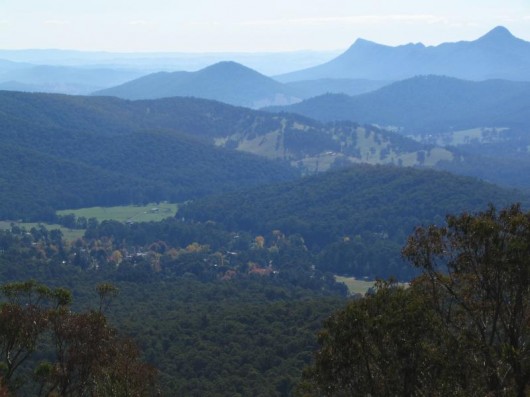 Remembering Marysville and indeed, Regional Victoria Remembering Marysville and indeed, Regional Victoria
.
|
|
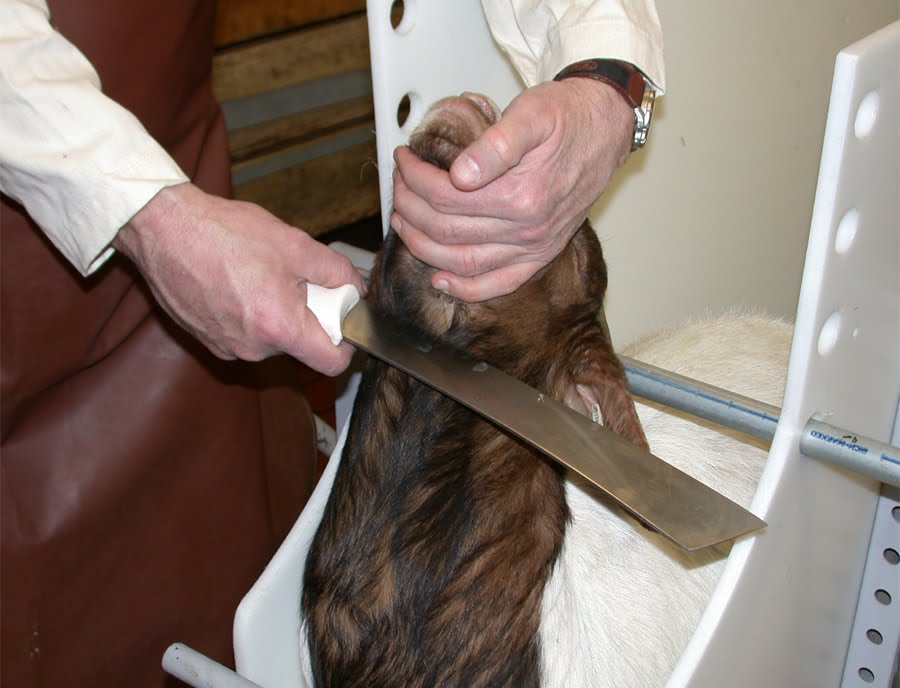 Halal Religious Slaughter
..requires throat slitting with a steel knife
.
Halal Religious Slaughter
..requires throat slitting with a steel knife
.
 By instinct, an animal trusts us, but learns to fear us for its life
 Label used for Halal Meat

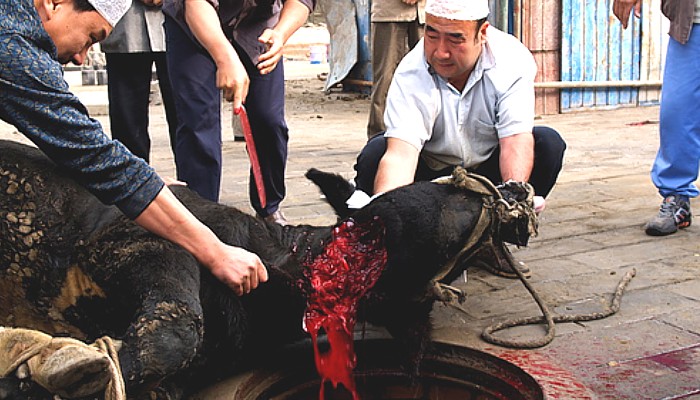

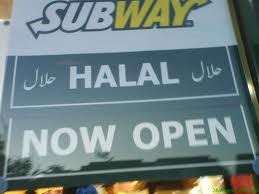
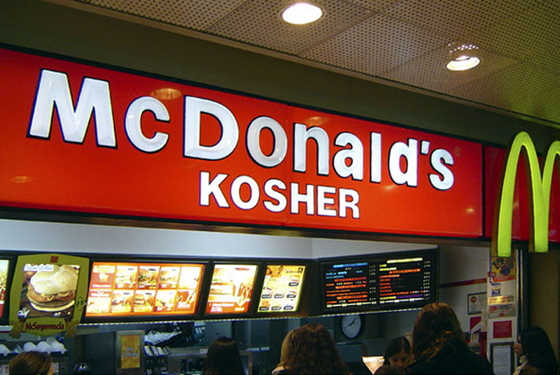 .
.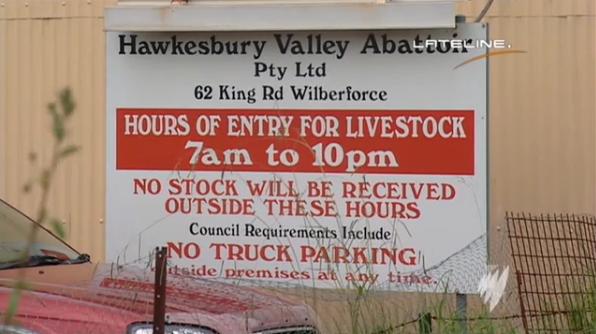
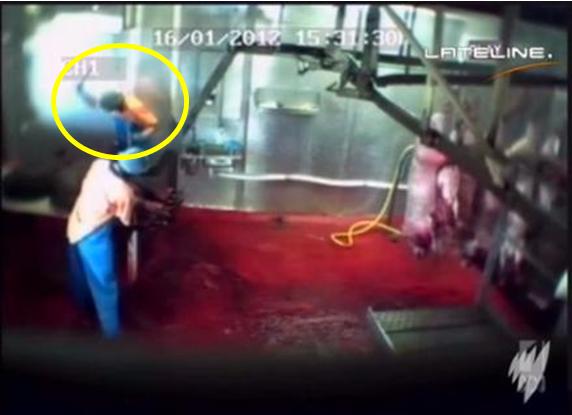 Abattoir worker bashed pigs over the head with a metal pole to kill them
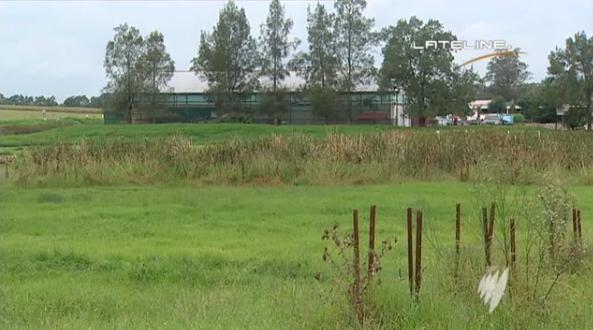 Wilberforce’s Halal House of Horror
 Real halal…real horror
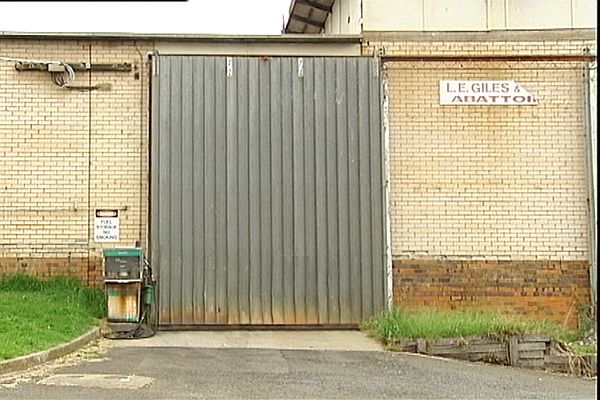 Cruel animal treatment – out of sight, out of mind
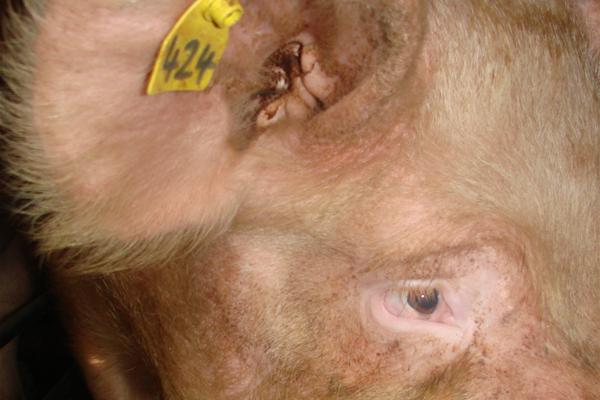 One of the abused pigs
.
One of the abused pigs
.
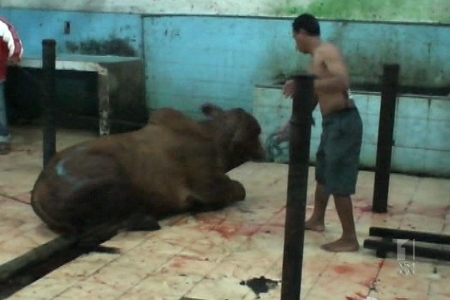 Photo extract of infamous secret video of Indonesian abattoir barbarism
…don’t travel to Indonesia. Boycott this backward country!
Photo extract of infamous secret video of Indonesian abattoir barbarism
…don’t travel to Indonesia. Boycott this backward country!