Archive for the ‘Habitat Threats’ Category
Sunday, January 22nd, 2012
Tags: Bill Kelty, Blueprint for Tasmania's Forest, Conservation Agreement, Contractors Voluntary Exit Grants, ENGO, ENGO Report of Logging breaching IGA, Environmental NonGovernment Organisation, FIAT Submission to Legislative Council, Forest Reserve Map, Forestry Tasmania, Giddings Labor Government, Gillard Labor Government, Heads of Agreement, Independent Verification Group Terms of Reference, interim reserves, National Partnership Agreement, Protecting Private Forests, Tasmanian Forest Contractors Exit Assistance Program, Tasmanian Forests Agreement, Tasmanian Forests Agreement Independent Verification Group, Tasmanian Forests IGA, Tasmanian Forests Intergovernmental Agreement (IGA), Tasmanian Forests Interim Report, Tasmanian Forests Statement of Principles, Tasmanian Regional Forest Agreement, Timber Workers for Forests
Posted in Tasmania (AU), Threats from Deforestation, Threats to Wild Tasmania | No Comments »
Add this post to Del.icio.us - Digg
Wednesday, January 18th, 2012
On Sunday 13th November 2006 two separate bushfire ignitions were believed to have been started by lightning just west of the Grose Valley of the Greater Blue Mountains World Heritage Area, according to the Rural Fire Service (RFS). One ignition was located outside the small rural village of Hartley Vale in a valley referred to as Lawsons Long Alley, while the other was in rugged bushland at Burra Korain Head about 4 km east of the village of Mount Victoria. Ten days later catastrophe…
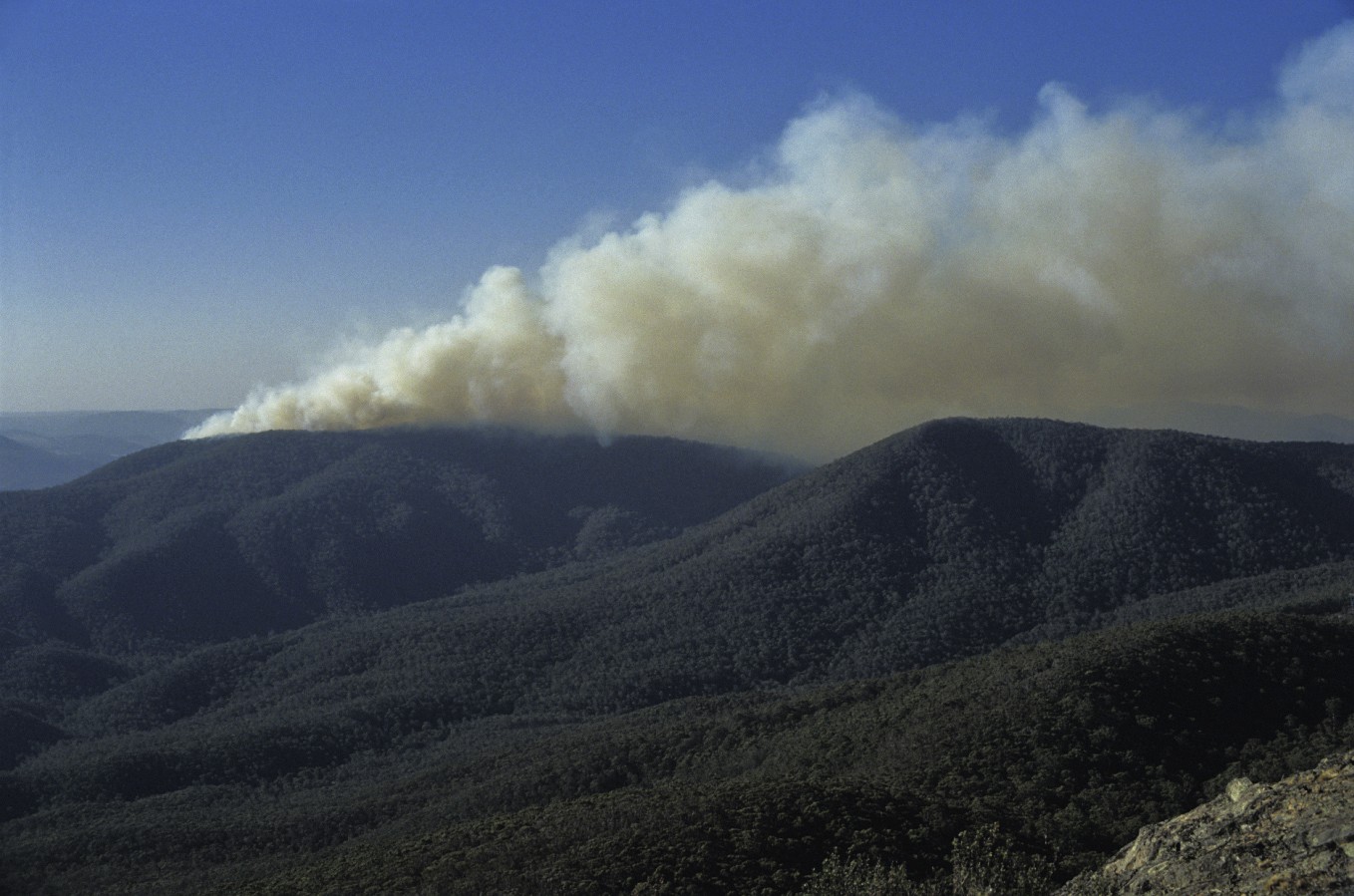
 Pyrocumulus cloud as the Grose Valley goes up in smoke on 23rd November 2006 Pyrocumulus cloud as the Grose Valley goes up in smoke on 23rd November 2006
.
‘Two bushfires that were believed to have been started by lightning strikes on Monday are burning in the Blue Mountains National Park. A fire burning 2 km north of Mount Victoria has burnt out about 1100 hectares of private property and parkland and is burning on both sides of the Darling Causeway. The Darling Causeway remains closed to traffic and motorists are advised to use the Great Western Highway and Bells Line of Road as alternate routes.
A second fire burning about 5 km north of Blackheath in the Grose Valley has burnt out about 500 hectares of parkland. Waterbombing aircraft are slowing the progress of the fire as it is burning in difficult and inaccessible terrain.’
[Source: New South Wales Rural Fire Service Blue Mountains website, Fire Name: Lawsons Long Alley, Time Message Issued: 1700, Date Message Issued: 16/11/06, ^http://lists.rfs.org.au/mailman/listinfo/bluemountains-info]
.
At the time the RFS reported that the ‘fire is not threatening any properties or homes at this stage‘, but it was this reassurance that lulled the fire fighting effort into a false sense of security. Over the coming days the fires were not earnestly suppressed but instead allowed to burn out of control as neither were ‘threatening any properties or homes at this stage‘. Famous last words. Worse was that a series of broadscale backburns were started by the RFS at Hartley Vale, Blackheath and along Bells Line of Road – each of which at times got out of control.
.
Comparison with 2003 Canberra Firestorm
.
Three years prior, four ignitions that had been purportedly been sparked by lighting on 8th January 2003 were allowed to burn out of control in remote bushland outside Canberra, Australian Capital Territory (ACT), and starting outside the ACT in NSW. At the time, those fires were deemed not to be threatening any properties or homes at that stage too. Ten days later, the four fires – McIntyre’s Hut Fire, the Bendora Fire, the Stockyard Spur Fire and the Mount Gingera Fire all coalesced into what became known as the 2003 Canberra Firestorm in which four people perished.
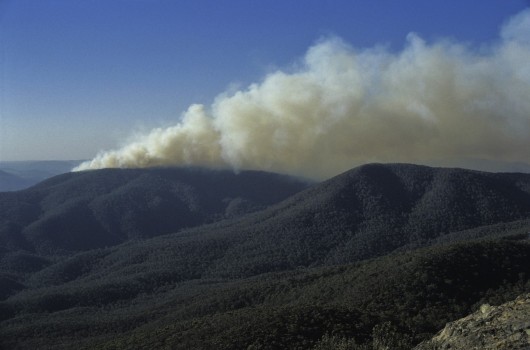 McIntyre’s Hut Fire 20030108 – distant, isolated and remote at this stage.
Ten days later it became the 2003 Canberra Firestorm McIntyre’s Hut Fire 20030108 – distant, isolated and remote at this stage.
Ten days later it became the 2003 Canberra Firestorm
.
Three years hence, the two bushfires west of the Grose Valley after seven days had coalesced into what has become known as the 2006 Grose Valley Fires that ended up incinerating 14,070 hectares of wild bush habitat, including the iconic Blue Gum Forest down in the Grose Valley inside the Greater Blue Mountains World heritage Area .
Both catastrophic bushfires were ultimately the responsibility of the RFS in New South Wales to suppress in order to prevent them becoming uncontrollable firestorms. The RFS failed catastrophically on both occasions with RFS Commissioner Phil Koperberg at the helm. The lessons from the 2003 Canberra Firestorm had not been heeded.
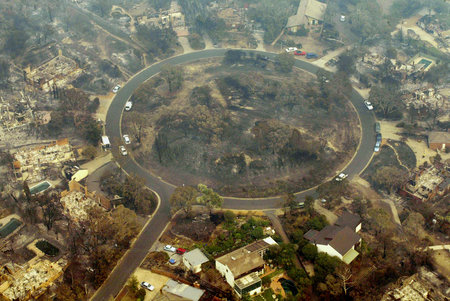 An aerial view of a fire-devastated Chauvel Circle in the suburb of Chapman on 21st January, 2003 in Canberra,
where 15 of 20 homes in the street were destroyed by fire.
Four people were killed and 419 homes destroyed when the fires being fought on five fronts swept through the nation’s capital.
(Photo by Daniel Berehulak, Getty Images) An aerial view of a fire-devastated Chauvel Circle in the suburb of Chapman on 21st January, 2003 in Canberra,
where 15 of 20 homes in the street were destroyed by fire.
Four people were killed and 419 homes destroyed when the fires being fought on five fronts swept through the nation’s capital.
(Photo by Daniel Berehulak, Getty Images)
.
According to the report of the official enquiry into the 2003 Canberra Firestorm by ACT Coroner Maria Doogan, she states:
‘During the inquiry it was submitted that the severity of the firestorm could not have been foreseen. I do not accept this. Australia has a recorded history of extreme fire events dating back to at least 1851. As discussed in Chapter 7 (of the Coroner’s Report), CSIRO fire expert Phil Cheney predicted several years ago a conflagration of the type experienced in January 2003. He made his prediction on the basis of information in the report of one of the seven inquiries that have been held since 1986 to examine various aspects of the ACT’s emergency services.
‘The point to make here is that experiences in life, be they good or bad, serve no useful purpose if we fail to learn from them. It is hoped, therefore, that the many lessons that can be learnt from this catastrophe in the ACT are in fact learnt and result in positive action, not just supportive words and shallow promises.’
[Source: ‘The Canberra Firestorm: Inquest and Inquiry into Four Deaths and Four Fires between 8 and 18 January 2003’, Vol 1, Ch1, pp.2-3., by ACT Coroner]
.
Blue Mountains Council’s response to the 2006 Grose Valley Fires
.
The 2006 Grose Valley Fires coalesced into a conflagration on Thursday 23rd November 2006 down in the World Heritage Grose Valley. Many in the local Blue Mountains community were outraged that this could have been allowed to have occurred. Public demands for answers finally led Blue Mountains Council two months later on Tuesday 30th January 2007 to agree to support the call of ‘concerned residents’ for the New South Wales Government to undertake a thorough, independent review of the Grose Valley Fires.
It is important to note that at the time there was a Labor Government in New South Wales, which was ultimately held responsible for both the 2003 and 2006 bushfire emergency responses.
The following is a copy of the official meeting minutes of Blue Mountains Council’s Ordinary Meeting of 20070130, two months after the 2003 Grose Valley Fires:
.
‘A Motion was moved by Councillors (Terri) Hamilton (Independent) and (Daniel) Myles (Liberal):
.
1. That the Council gratefully acknowledges the efforts of all the volunteers, professionals and agencies that worked together to control the recent Grose Valley Fire.
.
2. That the Council, in order that improvements in fire management can continue for the Blue Mountains and other parts of NSW, as a matter of urgency, writes to the Premier of New South Wales, the Hon Morris Iemma, stating it supports the call of concerned residents on the New South Wales Government, which appeared on page 13 of the Blue Mountains Gazette of 6 December, 2006, as follows:
“1. Undertake a thorough, independent review of the Grose Valley Fire, involving all stakeholders with particular attention to the following questions:
- Were fire detection and initial suppression timely and adequate?
- Were resources adequate, appropriate and supported?
- Were the adopted strategies the best available under the circumstances?
- Could other strategies of closer containment have offered lower risk to the community, better firefighter safety, higher probabilities of success, lower costs and less impact on the environment?
- Was existing knowledge and planning adequately utilised?
- Is fire management funded to the most effective way?
2. Ensure adequate funding is available for post-fire restoration, including the rehabilitation of environmental damage.
3. Fund more research to improve understanding of fire in the Blue Mountains landscape and methods for fire mitigation and suppression.
4. Improve research and training in strategies for controlling fires in large bushland areas.
5. Improve pre-fire planning to support decision-making during incidents.
6. Improve systems to ensure that local fire planning and expertise is fully utilised during incidents, and that the protection of the natural and cultural values of World Heritage areas and other bushland are fully considered.”
.
3. That the independent review includes addressing the questions raised by Blue Mountains Conservation Society:
a. The Blue Mountains City Council therefore supports the following adopted position of the Blue Mountains Conservation Society and would like the review to address the following questions:
i. In what circumstances are back burning from the “Northern Strategic Line” and the Bells Line of Road appropriate?
ii. What can be improved to ensure that lightning strikes or arson fires are contained as quickly as possible?
iii. What can be done to better manage fire risk in the Grose Valley in terms of preparation and suppression to minimise damage to people, property and biodiversity?
iv. What is needed to allow remote area fire teams to be able to work at night when conditions are more benign?
v. How can funding of bushfire management and suppression be changed to reduce overall costs to the community. (Federal funding of suppression under section 44 means funding for trail maintenance and planning is limited.)
.
b. If practicable, would the review also address the following?
i. The World Heritage Area contains a number of threatened species and ecological communities that, in addition to the direct threats associated with climate change, are particularly vulnerable to increased fire frequency and intensity.
ii. The effects on biodiversity of the fire regimes in the Grose Valley over the last 40 years, where there has been a succession of large intense wild fires without sufficient interval between them.
iii. Climate change predictions suggest a probability of more frequent and more intensive fire events, with significant implications for fire management and integrity of ecosystems.
iv. The Blue Mountains City Council also supports and requests involvement in the forum being organised by the Director of the Central Branch of the National Parks and Wildlife Service, Bob Conroy, on the 17 February 2007.
.
4. That the Council emphasises that the requested review should be of a scientific and technical nature.
.
5. That a copy of this letter be forwarded to the Minister for Emergency Services, the Hon Tony Kelly, the Member for the Blue Mountains, the Hon. Bob Debus, and the New South Wales Opposition Leader, Peter Debnam.
.
Upon being PUT to the Meeting, the MOTION was CARRIED, the voting being:
FOR:
- Fiona Creed (Liberal)
- Terri Hamilton (Independent)
- Pippa McInnes (Greens)
- Daniel Myles (Liberal)
- Kerrin O’Grady (Greens)
- Lyn Trindall (Blue Mountains First
.
AGAINST:
- Mayor Jim Angel (Labor)
- Kevin Frappell (Labor)
- Alison McLaren (Labor)
- Adam Searle (Labor)
- Chris Van der Kley (Liberal) and Chair of Blue Mountains Bush Fire Management Committee
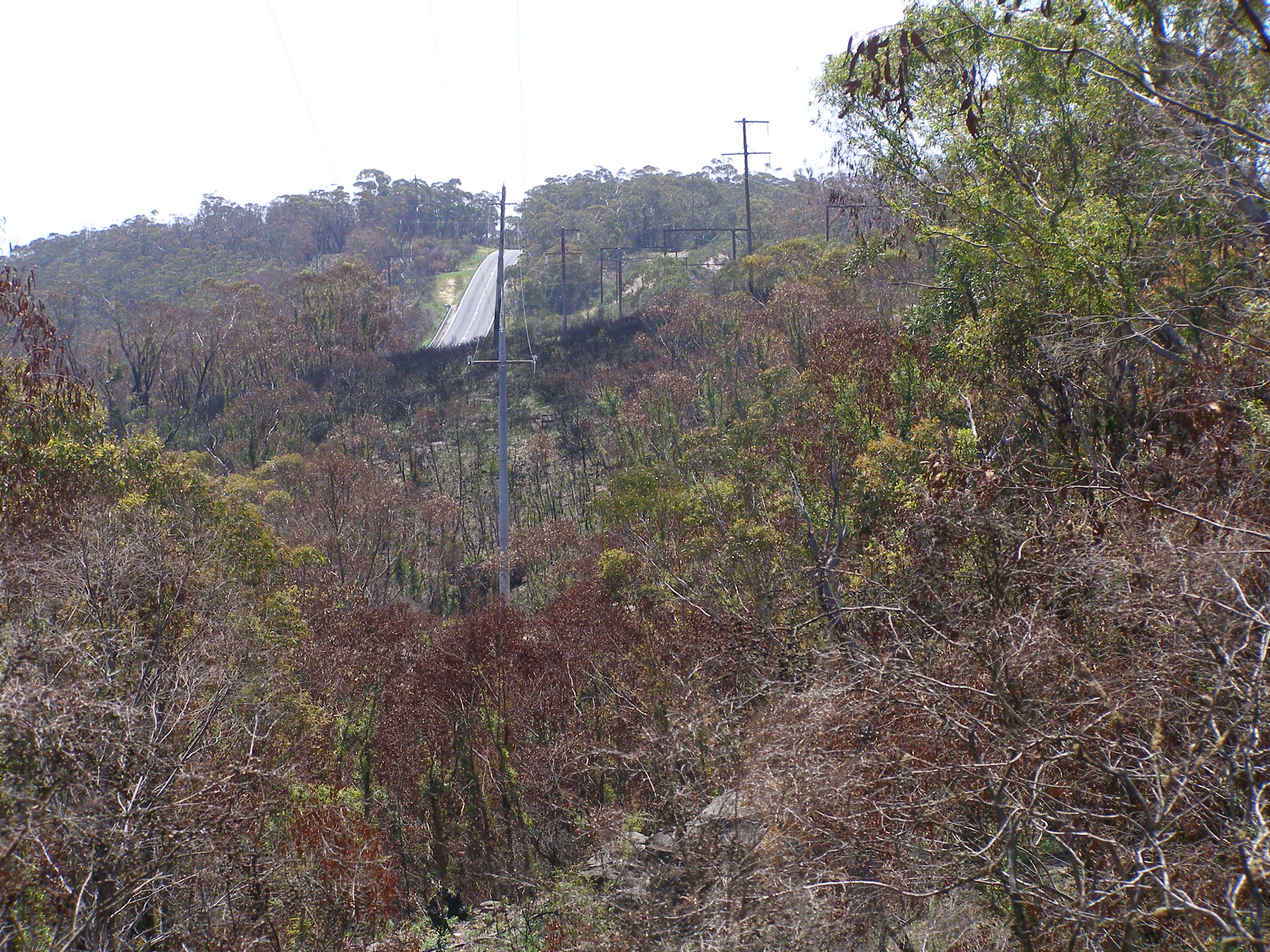
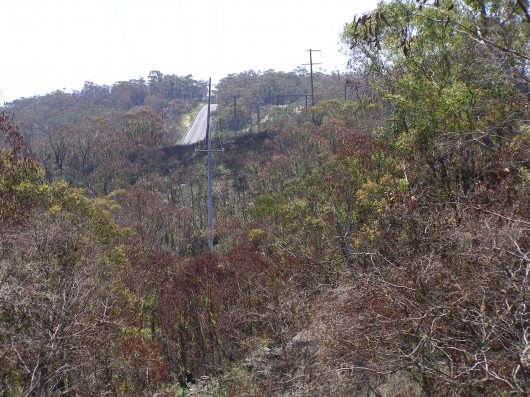 The Hartley Vale backburn 20061115 escaped up Hartley Vale Road and over the Darling Causeway (above) toward the Grose Valley to the right
(Photo by Editor 20070204, free in pubic domain, click to enlarge) The Hartley Vale backburn 20061115 escaped up Hartley Vale Road and over the Darling Causeway (above) toward the Grose Valley to the right
(Photo by Editor 20070204, free in pubic domain, click to enlarge)
..
Editor’s Note:
Ahead of the Blue Mountains Council voting for the above motion, two Labor Councillors, Clr Chris Van der Kley (also Chair of the Blue Mountains Bush Fire Management Committee) and Clr Kevin Frappell (Labor) moved an alternative motion, however it was lost upon voting. This proposed alternative motion was labelled an ‘amendment’ but it was significantly different in detail. The proposed amendment excluded calls for an independent review (per the first item in the original motion).
This proposed amendment also excluded asking the six key questions put by the concerned residents such as ‘Were fire detection and initial suppression timely and adequate?‘, ‘Is fire management funded to the most effective way?‘, etc.
This proposed amendment also excluded that part of Item 1 which recommended strategic improvements to bushfire management such as ‘Ensure adequate funding is available for post-fire restoration, including the rehabilitation of environmental damage‘ and ‘Fund more research to improve understanding of fire in the Blue Mountains landscape and methods for fire mitigation and suppression‘, etc.
This proposed amendment instead drew upon the view of the leadership of the Blue Mountains Conservation Society at the time that considered an independent enquiry would equate to criticism and assigning blame and so be politicised. This did however include advocating “an interagency and technical review process, to tease out the lessons learned.”
.
The Amendment (although lost in the Council voting) is important for the record and read as follows:
1. That the Blue Mountains City Council gratefully acknowledges the efforts of all the volunteers, professionals and agencies that worked together to control the recent Grose
Valley fire.
.
2. That the Blue Mountains City Council supports the recent position adopted by the Blue Mountains Conservation Society in relation to the Grose Valley fire in November
2006. We note and support the position of the Society when it says,
“The circumstances of the bushfire are complex and it is not in anyone’s interest for criticism or blame to be apportioned. However, there is much to be gained by looking at what was done and how it can be improved. The Society does not therefore support a large public inquiry and its attendant politicisation. Instead, the Society advocates an interagency and technical review process, to tease out the lessons learned.”
.
3. That the Blue Mountains City Council therefore supports the following adopted position of the Blue Mountains Conservation Society and would like the review to
address the following questions:
- In what circumstances are back burning from the “Northern Strategic Line” and the Bells Line of Road appropriate?
- What can be improved to ensure that lightning strikes or arson fires are contained as quickly as possible?
- What can be done to better manage fire risk in the Grose Valley in terms of preparation and suppression to minimise damage to people, property and biodiversity?
- What is needed to allow remote area fire teams to be able to work at night when conditions are more benign?
- How can funding of bushfire management and suppression be changed to reduce overall costs to the community. (Federal funding of suppression under Section 44 means funding for trail maintenance and planning is limited.)
.
If practicable, would the review also address the following?
- The World Heritage Area contains a number of threatened species and ecological communities that, in addition to the direct threats associated with climate change, are particularly vulnerable to increased fire frequency and intensity.
- The effects on biodiversity of the fire regimes in the Grose Valley over the last 40 years, where there has been a succession of large intense wild fires without
sufficient interval between them.
- Climate change predictions suggest a probability of more frequent and more intensive fire events, with significant implications for fire management and
integrity of ecosystems.
- That the Blue Mountains City Council also supports and requests involvement in the forum being organised by the Director of the Central Branch of the National Parks and Wildlife Service, Bob Conroy, on the 17 February 2007.
.
Upon being PUT to the Meeting, the AMENDMENT was LOST, the voting being:
FOR:
- Mayor Jim Angel (Labor)
- Kevin Frappell (Labor)
- Alison McLaren (Labor)
- Adam Searle (Labor)
- Chris Van der Kley (Liberal, and Chair of Blue Mountains Bush Fire Management Committee)
.
AGAINST:
- Creed (Liberal)
- Hamilton (Independent)
- McInnes (Greens)
- Myles (Liberal)
- O’Grady (Greens)
- Trindall (Blue Mountains First)
.
[Source: Blue Mountains Council’s Ordinary Meeting, 20070130, Minute No. 7, File Ref. C01095. Subject: ‘Grose Valley Fire’, pp.15-16]
.
Editor’s Analysis:
.
- Similar failure by the RFS and the National Parks and Wildlife Service (NPWS) to muster all available necessary resources to suppress and extinguished both the Lawson’s Long Alley and Burra Korain Head fires, demonstrated that lessons from the 2003 Canberra Firestorm had not been learnt. Critical time was lost in the initial days of the ignitions at both to effectively suppress the fires while they were of a small size and weather conditions relatively favourable to enable suppression.
- The RFS strategy to apply excessive broadscale backburning on multiple fronts at at Hartley Vale, Blackheath and Bells Line of Road exacerbated the complexity and scale of both fires and in the most part contributed to the conflagration of all the fires down in the Grose Valley on 23rd November 2006
- The shortcoming of not mustering all necessary resources to suppress and extinguish bushfires, irrespective of whether a fire is immediately affecting property and homes or not, is flawed, negligent and only heightens the inherent risk of a bushfire escalating out of control. The risk of a bushfire escalation into uncontrollable firestorm is heightened as time allows for the prospect of worsening bushfire weather conditions – increased wind, wind gusts, wind direction, temperatures, and lowering humidity – contributory factors in both the respective Canberra and Grose Valley Fires. There is no indication that this operational culture has changed.
- That a bushfire is situated in inaccessible terrain is not an excuse for bushfire management not to muster all airborne and RAFT resources to suppress and extinguish it as soon as feasibly possible
- After local community realisation that the bushfire had overrun the Grose Valley including burning through the iconic Blue Gum Forest on 23rd November, an informal collection of local ‘concerned residents‘ formed numbering 143 and co-ordinated by Blue Mountains resident Ian Brown. By Wednesday 6th December, within days of the fire finally being suppressed (3rd Dec), this informal group had collectively paid for a full page letter in the Blue Mountains Gazette newspaper costing $2,131.40(page 13). The letter was entitled ‘Burning Issues – fire in the Grose Valley – A statement funded and supported by concerned residents‘. The context was that detailed in Council’s carried motion above.
- Blue Mountains Council’s response was simply a manifestation of the “supportive words and shallow promises” whom ACT Coroner Maria Doogan had cautioned in the Coroner’s Report into the 2003 Canberra Firestorm. No effective Council follow up to its supportive words was undertaken. Sure per Council’s carried motion, Council’s then acting General Manager, Dave Allen, sent off the letter with supportive words to the NSW Premier Morris Iemma, on 20th February 2007, but Council took no other review or enquiry action.
- In the Central Blue Mountains, there are three government agencies responsible for bushfire management – the New South Wales Rural Fires Service, the National Parks and Wildlife Service as part of the NSW Department of Environment (what ever its frequently changing title) and Blue Mountains Council. Collectively these three bodies have co-operated under the Blue Mountains Bush Fire Management Committee, which was/is chaired by Blue Mountains Councillor Chris van der Kley.) and is responsible for planning in relating to bush fire prevention and coordinated bush fire fighting, as well as responsible for advising the Commissioner on bush fire prevention; mitigation and coordinated bush fire suppression. Included on the Committee is also the Commissioner of the RFS, and a nominated representative respectively from the NSW Fire Brigades, Forests NSW, NPWS, the Local Government Association of NSW, the Shires Association of NSW, the NSW Rural Fire Service Association, NSW Police, a nominee of the Minister for the Environment (then Bob Debus), a representative of the Nature Conservation Council of NSW, a person appointed by the Minister on the recommendation of the NSW Farmers Association, a representative of the Department of Community Services and a representative of the Department of Lands. In March 2008, the Blue Mountains Bush Fire Management Committee (BMBFMC) staged a series of community workshops on the Plan’s review process. The Plan was approved on 14th December 2000 with a required review every five years. So by the Grose Valley Fire, the Plan was a year out of date and by March 2008 the Plan was three years out of date.
- It is not surprisingly that the above proposed amendment to the Council letter to the NSW Premier excluded calls for an independent review. Those who proposed the motion and who voted for it were either all Labor Party members or in the case of Liberal Councillor Chris Van Der Kley, Chair of the Blue Mountains Bush Fire Management Committee who was operationally involved. An independent enquiry and the proposed strategic improvements to the bushfire management establishment would have likely revealed operational and government failings and recommended changes to the RFS structure, strategies, and management and importantly to its culture. The amendment was rejected anyway due to Labor having insufficient votes on Council.
- On Sunday 13th November 2006 two separate bushfire ignitions were believed to have been lit by lightning just west of the Grose Valley of the Greater Blue Mountains World Heritage Area by the RFS. Following a back burn/hazard reduction burn that had got out of control up Hartley Vale Road and crossed the Darling Causeway, on Wednesday 15th November the RFS declared a formal escalation to a Section 44 bushfire emergency. This four day delay in detection and suppression is unexplained by the RFS.
- Despite the calls by the concerned residents (with Blue Mountains Council’s supportive words) for the ‘NSW Government to undertake a thorough, independent review of the Grose Valley Fire, involving all stakeholders, so such independent review was done.
- The local Labor member for the NSW Seat of Blue Mountains at the time and NSW Minister for the Environment was Bob Debus MP, who categorically refused requests for either an independent review or a public review into the management of the Grose Valley Fires.
- The Blue Mountains Conservation Society (BMCS) similarly rejected calls for a public enquiry, stating “the circumstances of the bushfire are complex and it is not in anyone’s interest for criticism or blame to be apportioned. However, there is much to be gained by looking at what was done and how it can be improved. The Society does not therefore support a large public inquiry and its attendant politicisation. Instead, the Society advocates an inter-agency and technical review process, to tease out the lessons learned.” It needs to be pointed out that key committee members of the BMCS were/are also active members of the RFS, which raises the issue of and actual or perceived conflict of interest.
- There were two reviews of sorts, none independent and none public.
- On Tuesday 19th December 2006 there was apparently an ‘Inter-Agency Review‘ which took place at Katoomba behind closed doors by members of bushfire management and operating personnel involved in the fire fighting. Despite requests by this Editor, no minutes or reports of that meeting were ever forthcoming. The meeting was internal and secret.
- On Saturday 17th February 2007, there was a ‘Grose Valley Fire Forum‘ held at Mount Tomah organised by Director of the Central Branch of the National Parks and Wildlife Service, Bob Conroy, and the Blue Mountains World Heritage Institute. Only selected participants were permitted to attend – mainly from the bushfire management, fire experts and selected members of the Blue Mountains Conservation Society. A copy of the report of that forum will be publicised on this website shortly.
- Following ongoing community concerns about the lack of transparency, no evidence of any lessons being learned from the Grose Valley Fires and even of a cover up into some of the operational decisions, in January 2007 Bob Debus MP announced a suggestion of there being an Environmental Summit to be staged in the Blue Mountains to provide the first public forum into important environmental issues affecting the Blue Mountains region, notably to discuss the Grose Valley Fire. Well, by the time the summit eventuated it was over a year later and held on the weekend of 23rd and 24th February 2008. By then Bob Debus had moved to federal politics (though still representing the Blue Mountains via the Seat of Macquarie. The summit was chaired by the RFS Commissioner responsible for the 2006 Grose Valley Fires, Philk Koperberg (now local Labor MP) and even the bushfire Incident Controller of the 2006 Grose Valley Fires, RFS Superintendent Mal Cronstedt, was in attendance. However, the summit was now called a conference and the agenda had expanded to many issues including Energy, Social Systems, Natural Systems and Water. Discussion about bushfire was restricted to a two hour workshop and so available time to the Grose Fire to one or two questions which copped only official spiel. It was a classic Labor tactic or stalling on accountability until the community gives up or forgets.
- Since 2006, the Blue Mountains community still doesn’t know whether in the 2006 Grose Valley Fire or currently:
- Fire detection and initial suppression was/is timely and adequate?
- Whether bushfire management resources were/are adequate, appropriate and supported?
- Whether in the Grose Valley Fire the adopted strategies were the best available under the circumstances?
- Whether other strategies of closer containment could have offered lower risk to the community
- Whether currently it has better firefighter safety, higher probabilities of success, lower costs and will cause less impact on the environment?
- Whether existing knowledge and planning is adequately utilised?
- Whether bushfire management is funded to the most effective way?
- Is adequate funding available for post-fire restoration, including the rehabilitation of environmental damage?
.
Another three years hence, in the Blue Mountains we have witnessed from afar the catastrophic Victorian ‘Black Saturday’ Bushfires of 7th February 2009.
.
Another three years hence in 2012, have we learnt anything?
.
Tags: 2003 Canberra Firestorm, Bliue Mountains Conservation Society, Blue Gum Forest, Blue Mountains Bush Fire Management Committee, Blue Mountains City Council, Blue Mountains National Park, broadscale backburning, Burra Korain Fire, Burra Korain Head, funding of bushfire management, Grose Valley Fire Forum, Grose Valley Fires 2006, Labor Government, Lawsons Long Alley Fire, McIntyre's Hut Fire, Northern Strategic Line, NSW Rural Fire Service, RFS, RFS Commissioner Phil Koperberg, RFS Superintendent Mal Cronstedt
Posted in Blue Mountains (AU), Threats from Bushfire | No Comments »
Add this post to Del.icio.us - Digg
Tuesday, January 17th, 2012
Tarkine National Coalition (TNC) has questioned the motives behind the watering down of the EPBC assessment approach to the Tarkine Road proposal in Tasmania.
The Federal Environment Minister Tony Burke has opted for the less stringent Public Environment Report approach despite the original Tarkine Road proposal being subject to an Environmental Impact Statement approach prior to it’s withdrawal. This comes on top of the Minister’s refusal to National Heritage List the area despite the former proposal triggering a Emergency National Heritage Listing in 2009 by former minister Peter Garrett (lapsed by Minister Burke in 2010).
“There are some questions here that the Minister must answer. Clearly the revise Tarkine Road proposal is not being subjected to the same scrutiny as the original proposal, at a time when the risks to the area are even better understood than in 2009,” said Tarkine National Coalition spokesperson Scott Jordan.
The resubmitting of the Tarkine Road proposal by the Tasmanian Government called into play a promise made by Minister Burke in December 2010 that if the Tarkine Road was resubmitted, that he would immediately re-list the Tarkine. The Minister failed to deliver on that promise.
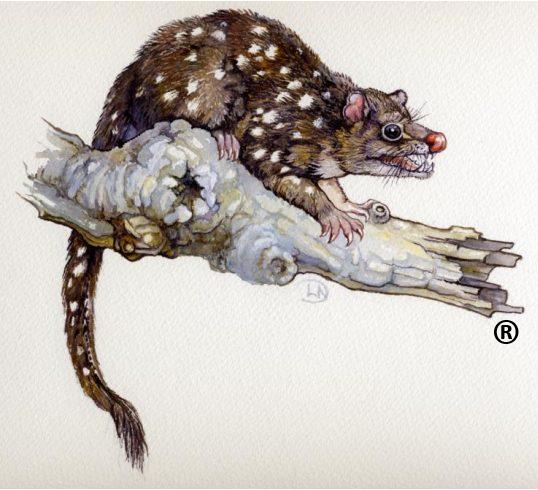
TNC has maintained conditional support for the revised project, subject to the altered route, staging of the project sections and there being demonstrable evidence that proposed mitigation measures address the expected increase in roadkill of Tasmanian devil and Spotted tailed quoll normally seen with road sealing. So far no mitigation trials have been conducted and that evidence does not exist.
“The lowering of the bar doesn’t make sense given that the state government is increasing it’s efforts to reduce the impact of the road. I suspect pressure is coming from other sources”.
“In my estimation, the lowering of the assessment approach has less to do with the alterations to the route, but the fact that a mining company now needs this route for transporting product to ports”.
 . .
‘Few understand how much transport influences land use patterns. Transport leads land use. Once an expressway or railway is built, it is easy to change the zoning and development laws to increase the population along the corridor.’
[Source: Then New South Wales Minister for Planning, Frank Sartor, Sydney Morning Herald, 20080929, p11]
.
‘A road desecrates wilderness
and enslaves wildness’
~ Editor
.
.
Monday, January 16th, 2012
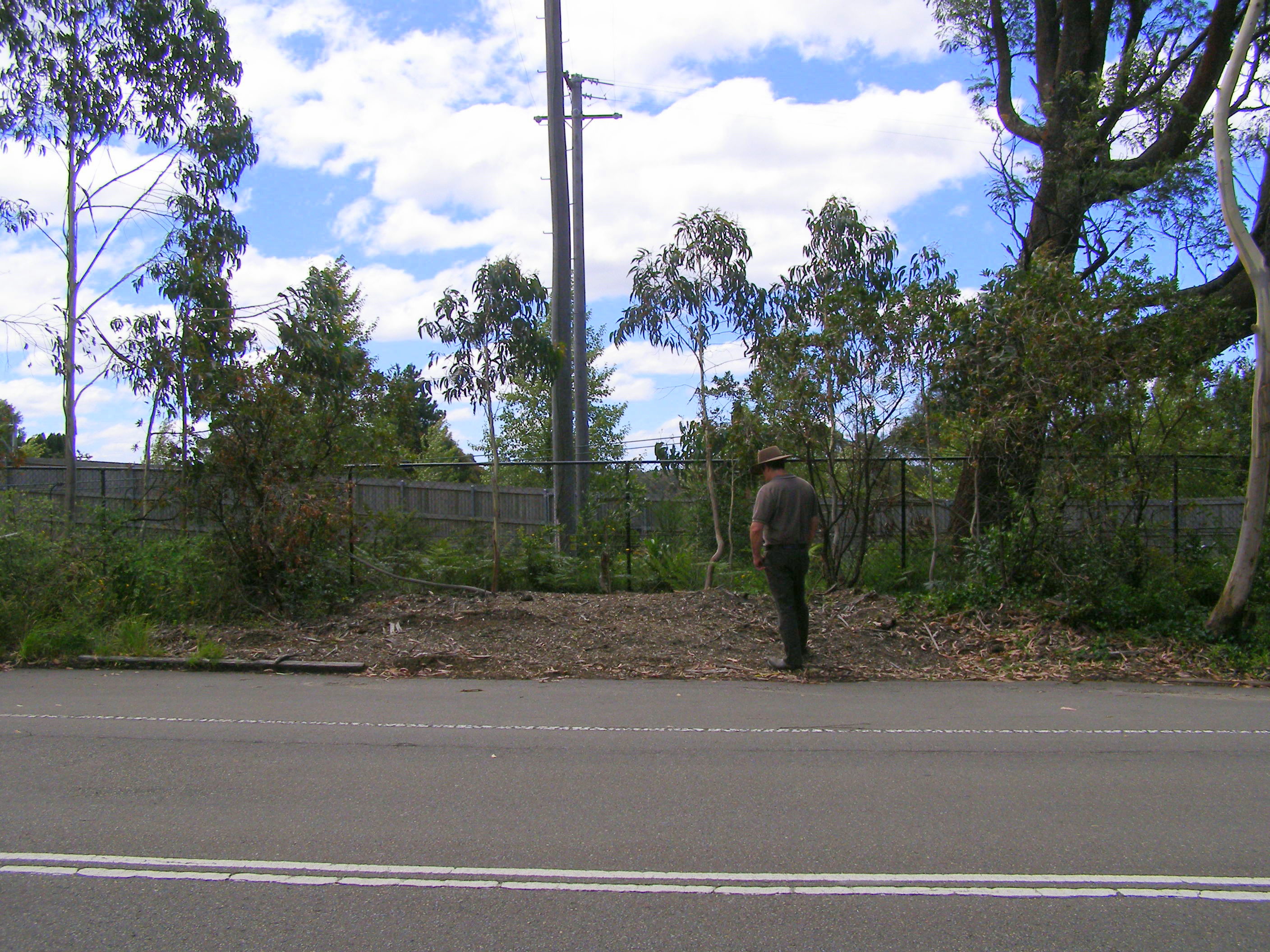
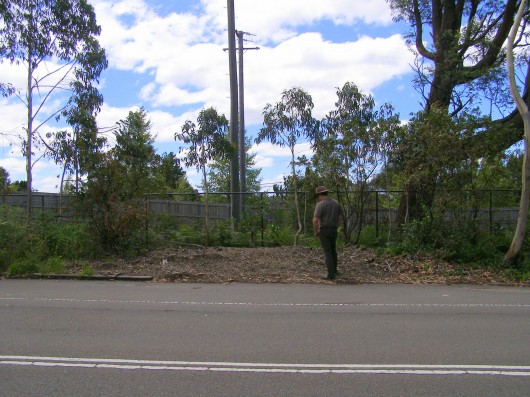 The site of Blue Mountains Significant Tree #5 – it was a massive Eucalyptus oreades
~ Our endemic heritage woodchipped into oblivion
Lest we forget!
(Photo of Editor 20120111, free in public domain, click photo to enlarge) The site of Blue Mountains Significant Tree #5 – it was a massive Eucalyptus oreades
~ Our endemic heritage woodchipped into oblivion
Lest we forget!
(Photo of Editor 20120111, free in public domain, click photo to enlarge)
.
This mature native tree was respected enough to have been listed on Blue Mountain Council’s Significant Tree Register. Indeed it was the 5th such listed tree on Blue Mountains Council’s Register of Significant Trees back in 1988.
So what is the meaning of a ‘Significant Tree‘ on Blue Mountains Council’s register?
Well back on 21st June 1988 the Register of Significant Trees was adopted by Blue Mountains Council as an integral part of its Development Control Plan, which proclaimed significant trees be protected under Clause 6 ‘Protection of Items Listed in the Register of Significant Trees‘ so that:
.
‘No person shall ringbark, cut down, top, lop, injure, wilfully destroy or cause damage to the root system off any tree listed on the Register of Significant trees without consent of Council.’
.
Perhaps the current Blue Mountains Council mayor may care to publicly explain why its Significant Tree Number 5, a locally endemic Eucalyptus oreades (Blue Mountains Ash) of some stature located opposite 252 Old Bathurst Road Katoomba (Lot 2 DP707) has been woodchipped into oblivion?
- Was formal Blue Mountains Council consent given to kill it?
- If so, when was this Blue Mountains Council consent given to kill it?
- What Blue Mountains Council documentation is publicly available to validate such consent?
- What public notice was provided by Blue Mountains Council for community consultation about its killing?
- Does Blue Mountains Council give a bleeding toss?
.
The objectives of Blue Mountains Council’s Significant Tree Register include:
.
(a) identify and protect those trees listed on the Register
(b) promote greater public awareness of the existence of the Register, and the individual items listed
(c) ensure existing and, importantly, prospective land owners, are made aware of the Significant Trees which may be located on their property
(d) ensure correct on-going care and maintenance of those trees listed, through the recommendations included with the significant tree register
.
The following tree is not even on the Blue Mountains Council Significant Tree Register, so has even less chance of protection.
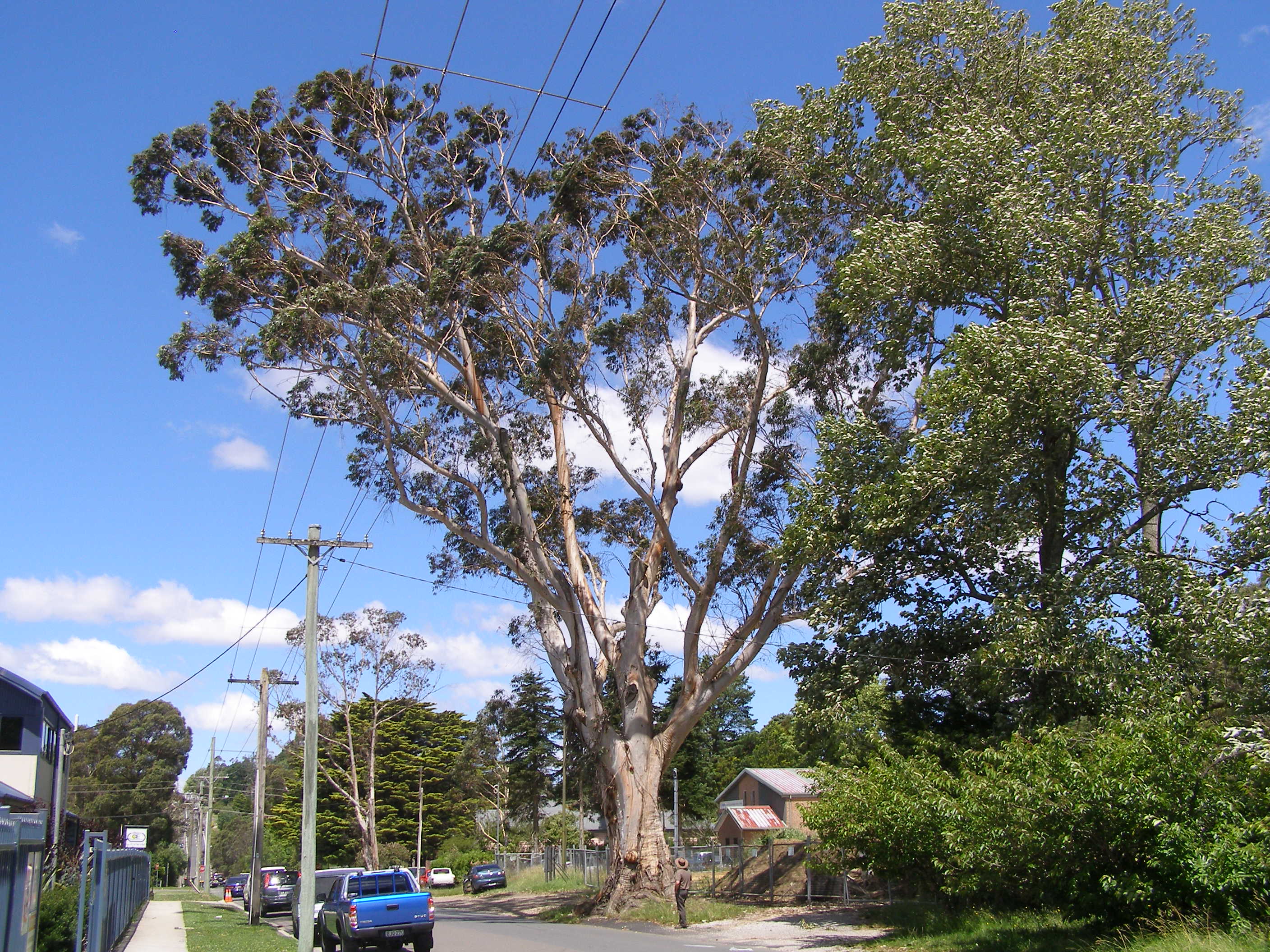
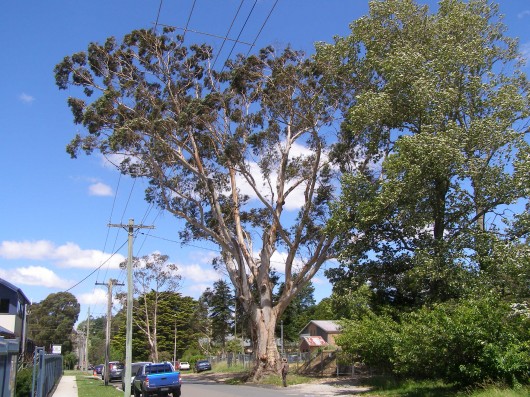 Katoomba’s most significant (grandfather) Eucalyptus oreades, beside Megalong Street
Pitifully it manages to survive as an extremely rare relic of the once magnificent Oreades Forest
This tree is ‘endemic’ to the Central Upper Blue Mountains at Katoomba
(That is, it grows naturally nowhere else on the friggin Planet!)
(Photo of Editor 20120111, free in public domain, click photo to enlarge) Katoomba’s most significant (grandfather) Eucalyptus oreades, beside Megalong Street
Pitifully it manages to survive as an extremely rare relic of the once magnificent Oreades Forest
This tree is ‘endemic’ to the Central Upper Blue Mountains at Katoomba
(That is, it grows naturally nowhere else on the friggin Planet!)
(Photo of Editor 20120111, free in public domain, click photo to enlarge)
.
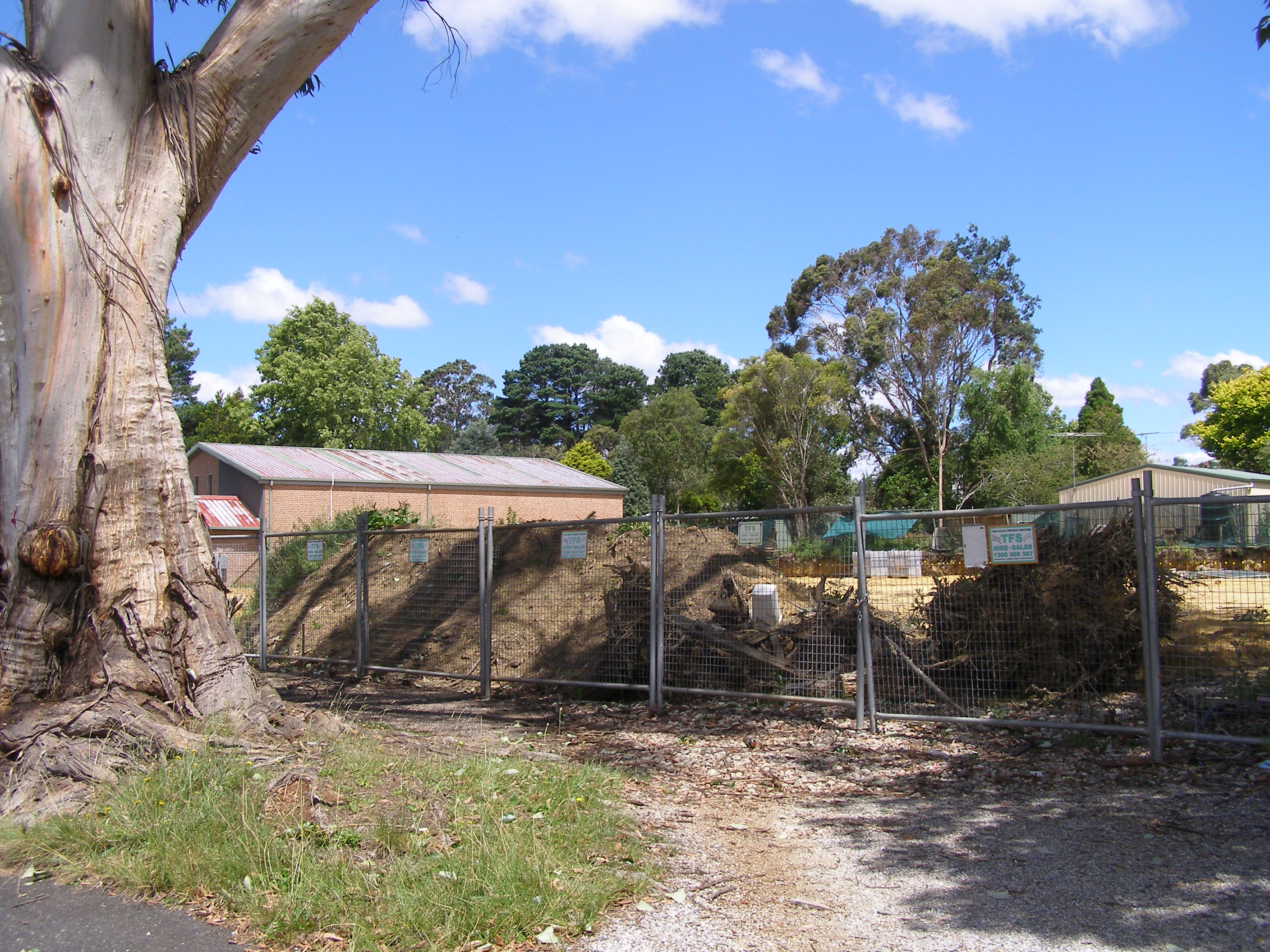
But this tree is perpetually being subjected by Blue Mountains Council approved industrial development after industrial development – the road widening, the recent expansion of the bus depot across the road and now some ‘mega industrial’ estate behind it. Blue Mountains Council pro-development forces are mounting against it.
.
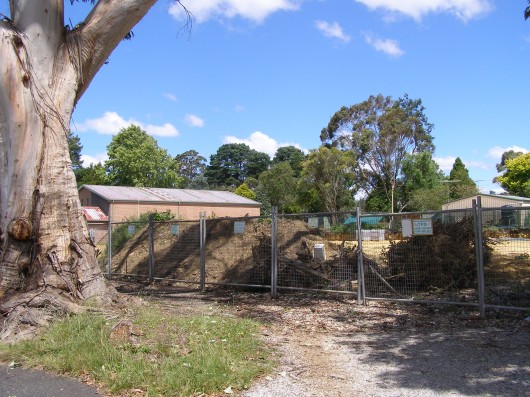 The Mega industrial development immediately behind this magnificent native tree
~ but what would BMCC care?
(Photo by Habitat Investigator 20120111, free in public domain, click photo to enlarge) The Mega industrial development immediately behind this magnificent native tree
~ but what would BMCC care?
(Photo by Habitat Investigator 20120111, free in public domain, click photo to enlarge)
.
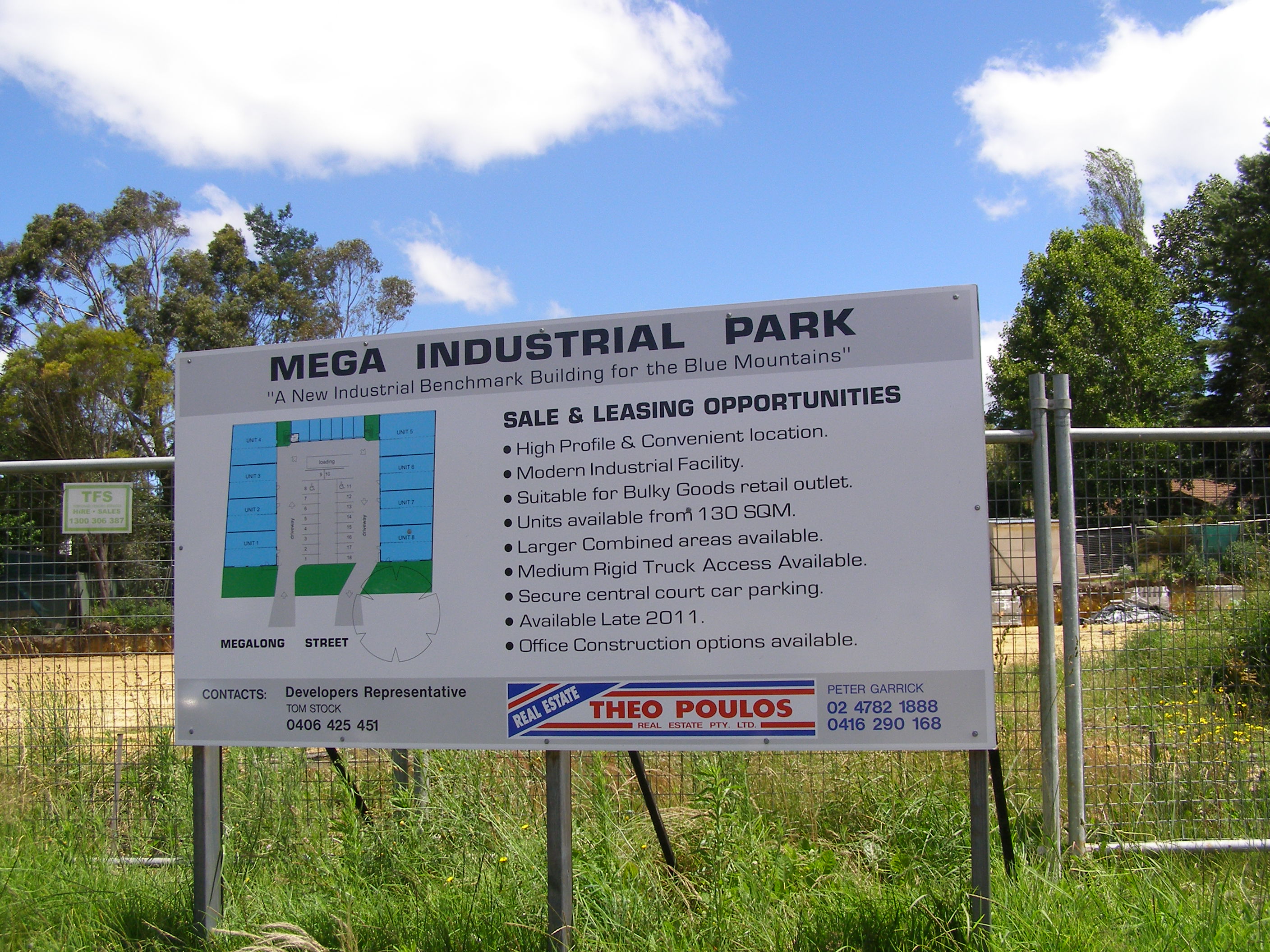
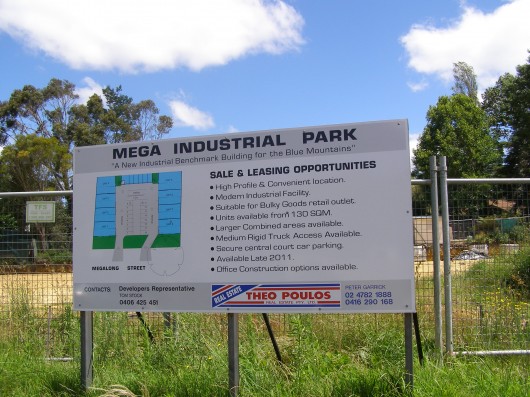 The Theo Poulos promoted ‘Mega Industrial Park’
excavated right behind this rare, significant Eucalyptus oreades,
~ as if the developer or Theo Poulos gives a crap!
(Photo by Habitat Investigator 20120111, free in public domain, click photo to enlarge) The Theo Poulos promoted ‘Mega Industrial Park’
excavated right behind this rare, significant Eucalyptus oreades,
~ as if the developer or Theo Poulos gives a crap!
(Photo by Habitat Investigator 20120111, free in public domain, click photo to enlarge)
.
But then Blue Mountains Council’s so-called Significant Tree Register has always been a crock of deceptive community greenwashing!
As soon as any tree on its register becomes slightly inconvenient, our pro-development Blue Mountains Council, strangled by Liberal-Labor Party vested interests, easily turns a blind eye to significant Blue Mountain heritage and no more significant tree.
Is it any wonder that as the Blue Mountains is allowed to be developed and its natural amenity destroyed that outsiders no longer see the Blue Mountains as a significant attraction, but more as an extension of Sydney sprawl? They just speed past on that forever faster, noisier and more dangerous Trucking Expressway!
.
Tags: Blue Mountains, Blue Mountains City Council, Blue Mountains Council, Blue Mountains Significant Tree Register, Blue Mountains World Heritage Area, endemic, Eucalyptus oreades, industrial development, Lest we forget, Megalong Street, Oreades Forest, significant trees
Posted in Blue Mountains (AU), Threats from Development, Threats from Greenwashing | 1 Comment »
Add this post to Del.icio.us - Digg
Sunday, January 15th, 2012
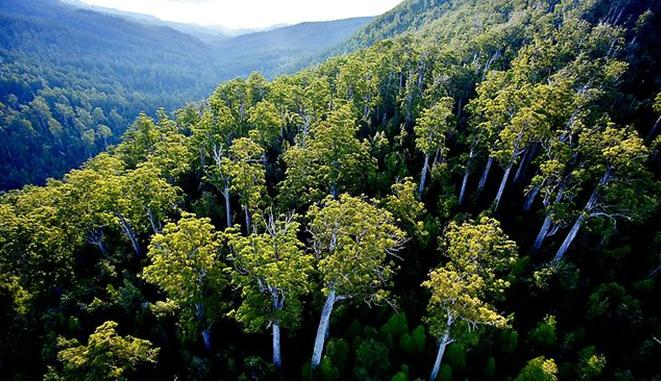
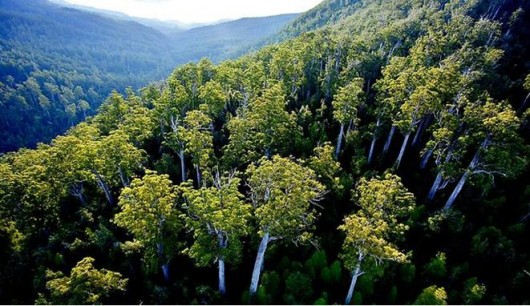 Tasmania’s magnificent ‘Weld Forest’
~ one of Tasmania’s rare ancient forests constantly threatened
by Tasmanian Government recidivist logger ‘Forestry Tasmania’ Tasmania’s magnificent ‘Weld Forest’
~ one of Tasmania’s rare ancient forests constantly threatened
by Tasmanian Government recidivist logger ‘Forestry Tasmania’
.
Australia’s Gillard Labor Government yesterday (20120114) announced an ‘interim legal protection for 428,000 ha’ ahead of tomorrow’s scheduled return of recidivist logging.
This appears good news which obviously the Gillard media release intends. But the process is duplicitous and sly.
Tasmania’s 2011 Forests Agreement is a community agreement about public forest protection involving taxpayer funded Forestry Tasmania so what moral right does the Labor Party have to deny the process being public – i.e. transparent and open? Why is the forest map not publicly online showing the updates of the discussions? Which 1950ha get the chainsaw and why?
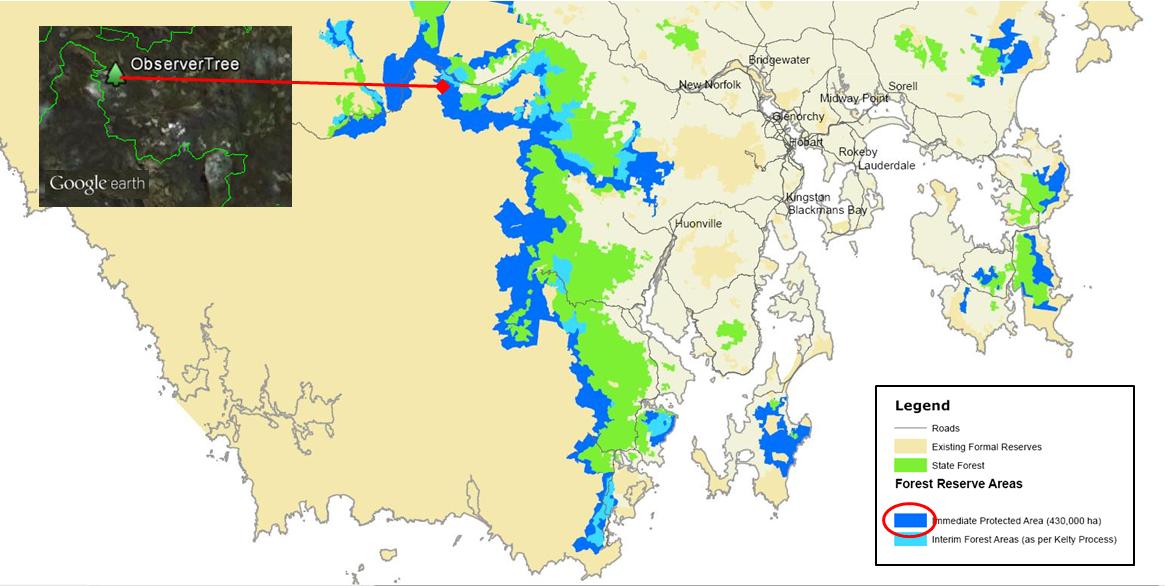
This is the only available map. [Read Tasmanian Forest Protection Map 2011]
Professor Jonathan West, Chair of the Independent Verification Group has a lot to answer for. Why has he not voiced outrage publicly of Forestry Tasmania’s illegal logging of the 430.000 hectares of native forests protected in Interim Reserves under the Agreement?
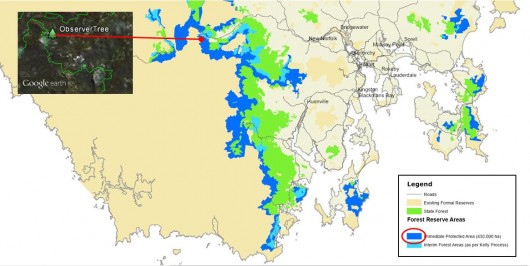
Relative position of the local Tasmanian community protest tree sit The Observer Tree
For ongoing updates visit The ObserverTree.org
.
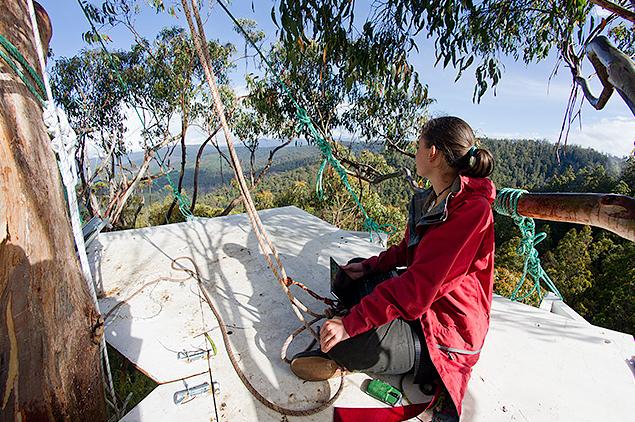
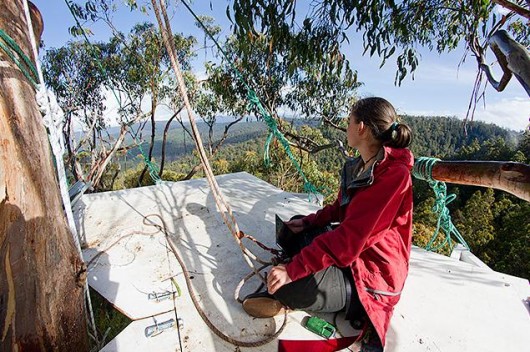 Tasmania’s Forest Defender – Miranda Gibson
stationed in a eco-Tree Sit 60 metres above the Styx Valley Forest floor
Visit: The ObserverTree.org
…waiting for Australia’s Prime Minister Julia Gillard to honour her personal promise to Tasmanians to protect Tasmanian old growth forests for perpetuity.
. Tasmania’s Forest Defender – Miranda Gibson
stationed in a eco-Tree Sit 60 metres above the Styx Valley Forest floor
Visit: The ObserverTree.org
…waiting for Australia’s Prime Minister Julia Gillard to honour her personal promise to Tasmanians to protect Tasmanian old growth forests for perpetuity.
.
572,000 hectares of Tasmania’s remaining old growth
…’as agreed‘ Julia!
.
‘Tassie forests deal like a Gunn to the head’
[Source: ‘Tassie forests deal like a Gunn to the head’, by political journalist Bruce Montgomery in Hobart, ^http://www.crikey.com.au/2011/09/06/tasmanian-forrests-deal-gillard-and-giddings/]above the Styx
.
‘The $276 million agreement that Prime Minister Julia Gillard and Tasmanian Premier Lara Giddings flaunted only a month ago as the ultimate peace deal to end the 40-year war in Tasmania’s forests is dead in the water. It comes as no surprise to those who have sought to interpret the poorly drafted provisions of the intergovernmental agreement (IGA) signed by Gillard and Giddings and those of the agreement that preceded it, the so-called Statement of Principles.
The Statement of Principles was the product of those purporting to represent the Tasmanian forest industry and the conservation movement to achieve a peace, most recently under the guidance of former ACTU secretary Bill Kelty.
Both documents appear to have been the work of plant operators rather than draftspeople. Grammar and proofing blunders aside, the giant flaw in both agreements has been the right of conservation groups to identify and nominate another half a million hectares of Crown land in Tasmania to be annexed into reserves, perhaps to the status of national parks or World Heritage, in order to neuter, by law, the timber industry in Tasmania and to pay alms to its victims.
Private foresters, who manage 26% of the total forest cover, were excluded from the negotiations on the pretext that the talks did not involve forests on private land, yet clause 31 of the IGA specifically drags 885,000 hectares of private forests into the equation.
Such a deal, whether concluded at NGO or government level, was never going to pass Tasmania’s Upper House, the Legislative Council. If it did come to pass, it would seal the fate of the Labor-Green governments in Canberra and Hobart as far as Tasmanian voters were concerned.
The premise for the Statement of Principles and the IGA was that the major industrial player, Gunns, was getting out of native forest logging in favour of plantations in order to swing public and banker support behind its $2.5 billion pulp mill proposal at Long Reach on the Tamar River.
In effect, Gunns was about to place all its eggs in one basket, a world-scale pulp mill using only plantation timber. Both agreements hinged on Gunns getting government compensation for its departure from public native forests, yet the mood in Tasmania has clearly been that Gunns should get nothing; its exit from native forests was being made on purely commercial grounds; it was immaterial that it had residual rights to use the public native forests.
If the Giddings government had been responsible for giving Gunns one red cent from the overall $276 million compensation package for the IGA, it would have faced political and electoral oblivion.
We don’t know what Gunns was offered in the end. It is thought to have been $23 million, but on the proviso that it pay its debts to Forestry Tasmania, a disputed $25 million.
Yesterday the Tasmanian government confirmed Gunns had rejected the offer, though Gunns, which has been in a trading halt on the stock exchange since August 8, said nothing.
Assuming that is right, it has the option to place those forest rights on the market. Since the IGA depends on those forests being protected, the keystone to the agreement is gone.’
.
‘Tasmanian forest deal riles green groups‘
[Source: ‘Tasmanian forest deal riles green groups’, by Lanai Vasek and Matthew Denholm, ‘The Australian’, 20120113, The Australian: ^http://www.theaustralian.com.au/national-affairs/tasmanian-forest-deal-riles-green-groups/story-fn59niix-1226243780040]
.
The Gillard Labor Government has announced interim legal protection for 428,000 ha of Tasmania’s forests, but has been accused of reneging on a deal to deliver a larger logging ban.
 Australia’s 27th Prime Minister, The Hon. Julia Gillard (June 2010 – ?)
In her vital and privileged position, she has the power, influence, connections and taxpayer resources
to protect Tasmania’s 572,000 hectares of old growth native forests consistent with the IGA.
As usual, it comes down to political will, courage and innovative thinking – which is what we expect of our leaders. Australia’s 27th Prime Minister, The Hon. Julia Gillard (June 2010 – ?)
In her vital and privileged position, she has the power, influence, connections and taxpayer resources
to protect Tasmania’s 572,000 hectares of old growth native forests consistent with the IGA.
As usual, it comes down to political will, courage and innovative thinking – which is what we expect of our leaders.
.
Environment Minister Tony Burke announced the move today after the Greens suspended normal relations with the government in protest at continues logging of areas deemed sensitive.
The new Conservation Agreement with the Tasmanian Government falls 1950ha short of the forest protection promised under last year’s intergovernmental agreement (IGA) between the Gillard and Giddings governments.
This provoked an angry reaction from environment groups, who said it had “shaken” their confidence in the two governments’ ability to deliver a broader agreement to protect up to 572,000ha.
And Greens leader Bob Brown said it was “a blueprint for the destruction of more than 20 square kilometres of high-conservation value forests”.
…The agreement provides legal protection to the area until an independent process decides how much of the larger area of 572,000ha deserves protection and can be locked up without harming existing timber contracts.
Mr Burke said the new interim deal was good for both forest conservation and jobs and would allow all parties to focus on supporting the longer-term independent verification process, expected to complete by June.
“With this agreement in place, all parties can now concentrate their efforts on assisting the important work of the Independent Verification Group, which is assessing the conservation values of the entire 572,000ha nominated by environmental non-governmental organisations, in addition to verifying long-term timber supply requirements,” Mr Burke said.
“This is a good result for Tasmania’s forestry industry, for local jobs and communities while protecting Tasmania’s iconic forests.”
However, the Wilderness Society, the Australian Conservation Foundation and Environment Tasmania all condemned the two governments for allowing logging in the 1950 ha, saying this included iconic, ancient forests in the Styx Valley, Weld Valley and The Tarkine, including endangered species habitat.
Earlier this week Greens leader Bob Brown said he would not resume his regular meetings with Julia Gillard once parliament returns next month unless she committed to ending logging. This afternoon, Senator Brown said he remained open to ad-hoc talks with Ms Gillard, who will visit Tasmania on the weekend, but accused her of reneging on the promise to protect the full 430,000ha in the IGA announced in August last year.
.
How is Tasmania’s Premier Lara Giddings dealing with the colonial cultural right to log Tasmania’s remaining ancient forests?
Only when Tasmania’s condemned old growth forest is ultimately logged, will neanderthal loggers ugg…
.
‘Where’s me big trees gone’ ?
 . .
Bill Kelty’s drafting of the IGA was a contradictory hoodwink
.
While the public message is $276 million (no less) to exit native forests and a logging moratorium, what is Lara Giddings saying privately to Forestry that we see its business as usual pursuing old growth logging self-righteously on its perceived right to log?
Under the conservation agreement, the Tasmanian government agency Forestry Tasmania is restrained from logging swathes of disputed public forest while the deal is settled. However, evidence has been found of Forestry Tasmania continuing to penetrate its logging deep into these wilderness forests. Meanwhile the contradictory message by the Giddings Labor Government to the Tasmanian forest industry is that it has a ‘guaranteed wood supply‘.
Perhaps having the $276 million cake she says its ok to log the forest too!
In 2004 the Timber Workers for Forests (TWFF) defended their “statutory requirement that a minimum of 300,000 m3 of high quality Eucalypt veneer and sawlog be made available annually.” It’s ‘Logging Statutory Requirement‘ versus ‘Native Logging Moratorium‘ allowing a duplicitous and sly parallel government message process.
Bill Kelty’s drafting of the IGA was worse that a compromise. Its complex and contradictory legalese was a hookwink. Kelty’s wording allowed Forestry to have its cake and eat it. On the one hand it promises Conservation (lumped as “ENGO’s”) under Clauses 25, 26 and 27 …”The State will immediately place the 430,000 ha of native forest…into Informal Reserves.”
While at the same time it also guarantees Forestry wood supply for the remaining industry under Clause 17…”At least 155 000 thousand cubic metres per year of high quality sawlog, by regulation, 265 000 metres per year of peeler billets, a speciality timber supply, noting that the industry claim is 12,500 cubic metres per year, subject to verification.”
So Forestry has has a window of logging opportunity to go for it while Professor Jonathan West’s Independent Verification Group decides the exact boundaries of the 430,000 and 572,000 for either protection or the chainsaw (Clause 20). That decision was due 31st Dec 2011, two weeks ago.
.
“It is little wonder that many Tasmanians now worry that the woodchippers’ greed destroys not only their natural heritage, but distorts their parliament, deforms their polity and poisons their society. And perhaps it is for that reason that the battle for forests in Tasmania is as much about free speech and democracy – about a people’s right to exercise some control over their destiny, about their desire to have a better, freer society – as it is about wild lands.”
[Source: ‘Out of Control: The tragedy of Tasmania’s forests’, by Richard Flanagan, in The Monthly, May 2007, ^http://www.themonthly.com.au/monthly-essays-richard-flanagan-out-control-tragedy-tasmania-s-forests-512]
.
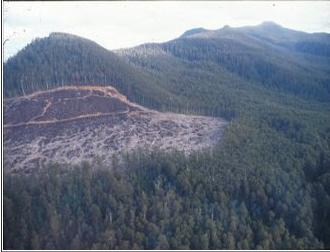 Logging invades Tasmania’s South-West wilderness in the Huon valley,
not far downstream of the above photo.
This logging is ruining the integrity of the adjacent Tasmanian Wilderness World Heritage Area
whose boundaries have been drawn to protect the treeless mountaintops
and leave the forested valleys to the loggers. Logging invades Tasmania’s South-West wilderness in the Huon valley,
not far downstream of the above photo.
This logging is ruining the integrity of the adjacent Tasmanian Wilderness World Heritage Area
whose boundaries have been drawn to protect the treeless mountaintops
and leave the forested valleys to the loggers.
.
Tags: Bill Kelty, Forestry Tasmania, Gillard Labor Government, Independent Verification Group, Julia Gillard, Labor Party, Lara Giggings, old growth forest, recidivist logging, Tasmania, Tasmanian Forests Intergovernmental Agreement, Weld Forest
Posted in + Wild Tasmania, Tasmania (AU), Threats from Deforestation | No Comments »
Add this post to Del.icio.us - Digg
Saturday, January 14th, 2012
 A ‘paddock tree’ in Australia – valued by farmers for their livestock shade
Also a desperate refuge for remnant wildlife, long denied their entire friggin forest!
.
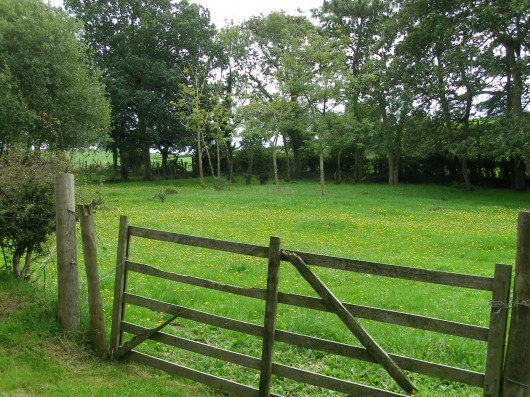 A 19th Century farm meadow in Northern Ireland
Ulster American Folk Park, Castletown, Northern Ireland
(Photo by Editor 20060904, free in public domain, click photo to enlarge) A 19th Century farm meadow in Northern Ireland
Ulster American Folk Park, Castletown, Northern Ireland
(Photo by Editor 20060904, free in public domain, click photo to enlarge)
.
In a native forest, old trees naturally die and saplings germinate from the seed of their parent trees. Native forests are living regenerating ecosystems.
But when humans destroy and disturb forest ecology, the forests change. When humans destroy complete forests and leave a few token shade-providing ‘paddock trees‘ in deforested paddocks, and livestock fertilize the thin fragile soils, humans completely deny forest ecological succession. Isolated trees are isolated trees, so they die. Dieback is one such outcome – suitably named; that is ‘Deforestation Dieback‘ as distinct from the disease ‘Phytophthora dieback‘.
And now some are crying foul out over losing these token ‘paddock trees‘, despite the loss of the entire original forest not getting a mention. This is such anthropocentric bias. The 19th Century William Wordsworth/John Constable pastoral romanticism of what the English countryside ought to look like became the colonial vision for Australia from 1788. It is this inherited notion of a ‘Colonial Bucolic Vista‘ and disturbingly it’s legacy still pervades Australian agricultural culture.
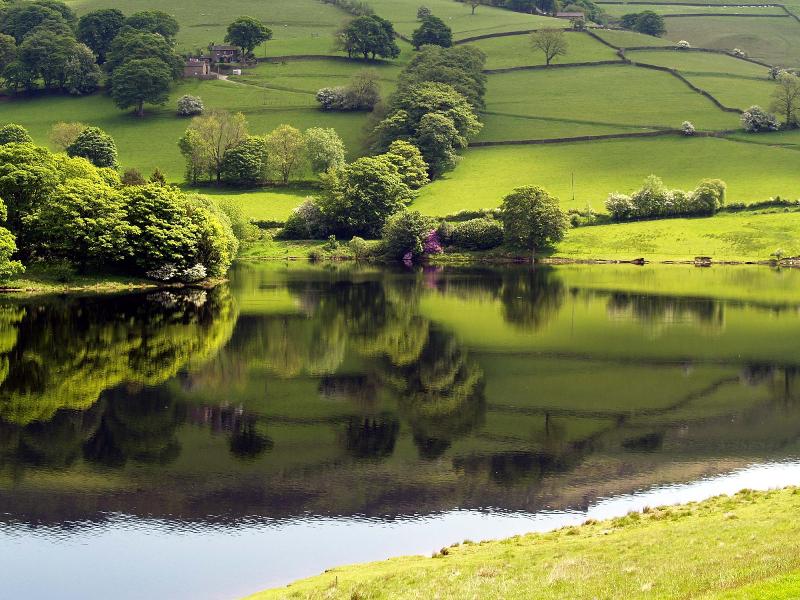
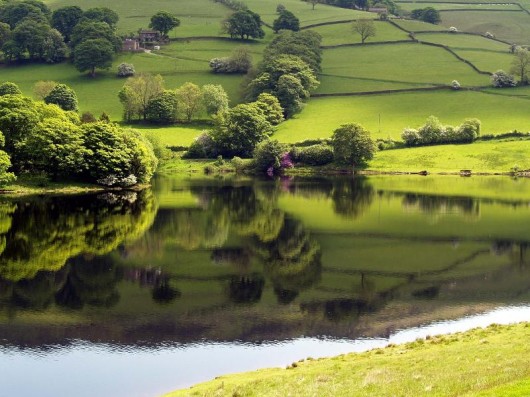 A classic vision of the bucolic English countryside
– where centuries of native heritage, agrarian culture and constant rainfall…permit. A classic vision of the bucolic English countryside
– where centuries of native heritage, agrarian culture and constant rainfall…permit.
.
‘Reversing a tree regeneration crisis’ (Dr Joern Fischer)
.
[Source: ‘Reversing a tree regeneration crisis’, by Dr Joern Fischer, Fenner School of the Environment and Society, ANU College of Medicine Biology and Environment, Summer 2009, Australian National University, ^http://news.anu.edu.au/?p=1725]
.
According to Australian National University (ANU) research published in the US-based ‘Proceedings of the National Academy of Sciences (2009):
.
‘Australia’s south-east temperate grazing region could be virtually treeless within decades.‘
.
‘The research team concluded that most of the trees scattered across millions of hectares of temperate grazing land in New South Wales and Victoria re old and close to death. Existing land management practices (Ed: aka broadscale deforestation) have prevented regeneration of young trees to replace them. The study pointed out that disappearance of ‘paddock trees’ would lead to loss of shelter for livestock, loss of habitat for birds and other wildlife, decreasing water infiltration and other detrimental flow-on effects over the entire ecosystem.
.
(Ed: Is there any trace of a native forest ecosystem on rural farm holdings? These shade tree deprived farmers didn’t complain when they were massacring Australian native forests. A treeless wasteland is the consequence of deforestation, you fools!)
.
Dr Joern Fischer from the Fenner School of the Environment and Society says:
“Under existing management practices, millions of hectares of grazing country, currently supporting tens of millions of trees, will be treeless within decades from now,” “And the loss of this tree cover is predicted to lead to massive declines in biodiversity and grazing productivity.” Dr Fischer’s Sustainable Farms research group has spent the last couple of years documenting the extent of the tree regeneration failure and has been investigating if the situation can be reversed by changing land management.
“Although clearing has largely stopped, tree cover continues to decline because many existing trees are dying of old age, and few young trees are regenerating,” says Fischer. “We studied a 1,000,000 hectare area in the Upper Lachlan catchment of New South Wales. Typical paddock trees are often over 140 years old, and in many locations, no young trees have regenerated for decades.”
ANU’s Dr Joern Fischer’s research found that ‘(native) trees are more likely to regenerate in unfertilised pastures under high -intensity rotational grazing than under conventional, continuous grazing. Fischer states that the study found that maintaining tree cover over vast areas cannot be done without Nature’s help – that is to say via natural regeneration. Therefore, farm ecosystems must become self-sustaining, allowing for natural tree regeneration while also providing an income to farmers.
.
(Editor: What brilliant insight! I hope the taxpayer didn’t fund such lay findings).
.
According to Tim Wetherill, ‘paddock trees‘ provide shelter for livestock, homes for native animals, barriers against soil erosion and a host of other benefits. They’re an icon of the Australian countryside’.
[Source: ‘Reversing a tree regeneration crisis’, by Tim Wetherill, ANU News, Summer 2009, ^http://news.anu.edu.au/?p=1725]
.
(Editor: “An icon of the Australian countryside” What colonial Pastoral Romanticism! What about the more important values of intact native forests before the farmers clearfelled them, burnt the remains and dragged the topsoil under plough?
.
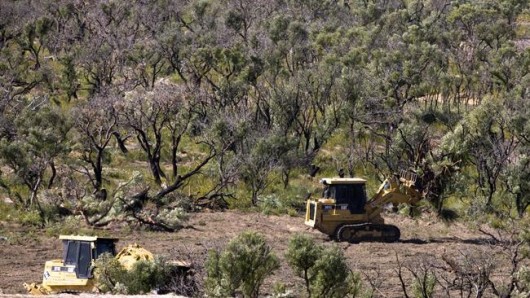 The decidedly browner, drier reality of Australia’s fragile disappearing native vegetation
Nature on the run: Hundreds of hectares of native animal habitat is bulldozed for a new housing development in Perth’s outer suburbs this year.
(Source: Perth Now, Photo by World Wildlife Fund, Australia 2009) The decidedly browner, drier reality of Australia’s fragile disappearing native vegetation
Nature on the run: Hundreds of hectares of native animal habitat is bulldozed for a new housing development in Perth’s outer suburbs this year.
(Source: Perth Now, Photo by World Wildlife Fund, Australia 2009)
.
Fischer’s report continues…
.
‘It’s long been known that paddock trees in much of Australia’s temperate grazing region are not regenerating. With every year we lose a few more as the old trees die but nothing is coming through to replace them. In recent years there’s been a growing realisation that the situation is rapidly evolving into a crisis.
“Our study identified a short list of management options for maintaining paddock trees,” says Fischer. “In some areas, natural regeneration is unlikely in the short term, for example because there are few parent trees, or because soil nutrient levels are high. In such areas, scattered trees can be planted with re-usable tree guards that protect individual trees from livestock – some pioneering farmers are doing this already. Another option is to temporarily exclude livestock from a paddock prior to re-seeding it and resting it for several years – an approach successfully used by Greening Australia in the Canberra region.”
“Our findings suggest that self-perpetuating farm ecosystems with farms trees can be created by applying high intensity rotational grazing with long rest periods, and by phasing out fertiliser use,” explains Fischer. “Even where these practices are adopted, changes in tree regeneration will not occur overnight. But unless significant changes in management are introduced now, old trees will continue to disappear, and opportunities for natural regeneration will continue to be lost.
“The future of Australia’s paddock trees depends on urgent and widespread management action. While mature trees still exist, they provide regeneration nuclei throughout the landscape, thereby offering a window of opportunity to reverse the tree regeneration crisis.”
.
Editor: Fischer’s quest to save ‘paddock trees’ is ecologically ‘penny wise, pound foolish’.
If Fischer’s aim is to have paddock trees regenerate so that farmers’ livestock may continue to have shade from the sun, then farmers can jolly well plant out their own shade trees – simple problem solved cheaply. Farmers could even propagate their own.
If Fischer’s aim is to maintain the 19th Century notion of the colonial bucolic vista, then he is disingenuous about forest ecosystem regeneration and ought to transfer from Science to Arts and study English Romanticism .
If Fischer’s aim is science-based forest ecosystem regeneration, then he should revisit the ANU Library and grab some appropriate books on forest ecosystem regeneration and realise that it is a tad more than about saving ‘paddock trees’).
.
Behold the Colonial Bucolic Vista! …derived from 18th and 19th Century Pastoral Romanticism…achieved by clearfelling, ploughing, fertilising, grazing and leaving a few token ‘paddock trees’.
.
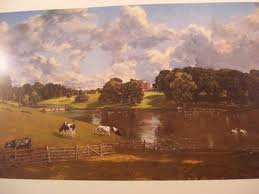 ‘Wivenhoe Park, Essex’
by 19th Century English Romantic painter John Constable ‘Wivenhoe Park, Essex’
by 19th Century English Romantic painter John Constable
.
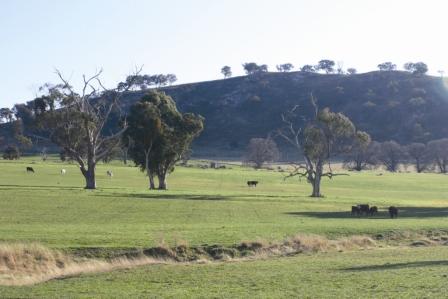 The colonial conversion of Australia The colonial conversion of Australia
.
‘Older paddock trees are dying at a rapid rate’ (M. Sheahan)
.
[Source: ‘Isolated Trees’, by M. Sheahan, Murray Catchment Management Committee/Department of Land & Water Conservation, Border Rivers-Gwydir – Catchment Management Authority, ^http://brg.cma.nsw.gov.au/index.php?page=isolated-trees]
.
‘When the land was cleared for grazing and agriculture, isolated ‘shade’ trees were left across the landscape. These isolated trees are, in many areas, all that remain of the native vegetation which once covered the land. As time passes, these trees are aging and dying, sometimes prematurely. If no action is taken to prevent their decline or replace them, we will be left with a treeless land – exacerbating land degradation and changing the face of a familiar landscape.
.
What are isolated trees?
.
Isolated trees can be defined as ‘trees around which the other components of a native vegetation community have been removed’. In some vegetation communities, like Open Woodland, the trees are naturally well-spaced. Trees in these communities are not considered to be ‘isolated’, if the vegetation community they are a part of generally remains intact.
.
The values of isolated trees
.
Isolated trees have a range of important values, including:
- Scenic and aesthetic value – isolated trees are, in many instances, what gives the Australian landscape its unique character. What would your area look like if all the isolated trees had gone?
- Shade – isolated trees provide shade for stock, enhancing livestock performance by preventing heat stress.
- Nesting sites for wildlife – many isolated trees are old, and commonly they have hollows. These hollows are used by many species of native animals, including birds, insect-eating bats and mammals. A third of all woodland birds require hollows for nesting, so these old trees may be the only place in the landscape where these species can breed. Hollows only begin to form in Eucalypts after about 100 years – the trees you plant today will take at least this long to replace the old isolated trees.
- Feeding sites for wildlife
.
A 300 year old Grey Box (Eucalyptus microcarpa) with a height of 20 metres and a diameter of 1.5 metres has a bark area of about 94 sq. metres. In comparison, a 20 year old tree which is 15 metres high with a diameter of 20cm has a bark surface area of just 9 metres. This extra bark (10 times more on the old tree) supports a diversity of insect life which can provide 10 times more food for insect eating birds. Healthy mature trees also produce more nectar, foliage and fruits than young trees, as the younger trees put more energy into growth in height.
.
Connective value
.
- Isolated trees can act like ‘stepping stones’, enabling birds and other species to move across the landscape.
- Fallen limbs – fallen limbs provide habitat for a range of ground-dwelling species.
- Nutrient cycling – the deep roots of isolated trees bring nutrients deep from the soil profile. These are then released at the surface in leaves, twigs, and branches that fall from the trees.
- Seed source – isolated trees can shower the site with seed, helping natural regeneration.
.
Why are they dying?
.
Isolated trees are, commonly, in decline and dying in some regions. This may be because they are old and reaching the end of their natural life, and they are not being replaced.
However, they may be dying prematurely, as a result of the change in land use around them. The changes which are affecting them can include:
- Soil compaction from stock
- Increased nutrient levels from stock and fertilisers
- Insect attack (the understorey, which provides the habitat of the insects natural predators, has been removed)
- Changes in the watertable
- Use of herbicides
.
.
Saving the ones that are left
.
Large trees were naturally once part of a functioning ecosystem that contained a range of other plant species and wildlife. Now they are sitting out on their own, surrounded by grazed pasture or crop-land. Their support mechanisms – the understorey which contained habitat for the predators of insects, neighbouring trees for protection and pollination – have been removed.
Ideally, to ensure their survival, we need to try and recreate the conditions that existed before. This means re-instating a ‘web of life’ that brings back the tree’s support system.
There are three actions that can help this – fence, revegetate and connect.
- Fence the trees, or clumps of trees, so that an area twice the size of their canopies is protected. If the ground cover is weedy, or is dominated by introduced pasture grasses, these will need to be controlled.
- Revegetate this area with locally native shrubs and groundcover. Allow the trees to regenerate from seed-fall.
- Connect these fenced clumps together and link them to larger areas of native vegetation, such as roadsides, stock routes and reserves.
.
In some situations, this may not be practical. It might cost too much, might take too long or may take too much land out of production. If so, consider the following:
- Avoid the use of fertilisers under the canopy and around the trees;
- Avoid cultivating under the canopy of the trees;
- Ensure herbicide doesn’t drift onto the trees;
- Don’t scorch the trees if burning off; and
- Leave fallen branches and sticks where they fall under the trees.
- Fencing is still important. Fence out the larger clumps where possible. If planning new fencelines, position them to provide protection for clumps of older trees.
.
Temporary fencing is one of the best solutions for managing isolated trees, to ‘give them a break’ and to encourage growth and regeneration. This should be twice the size of the canopy of the tree/s. After 2 or 3 years, young seedlings may have grown above browse height, so the fence can be moved to another tree or clump of trees.
.
The importance of groundcover
.
It might not seem important, but in all cases, the quality of the ground layer is a critical factor in:
- determining the health of isolated trees
- their ability to regenerate.
.
If the groundcover is dominated by native species, then older trees will more easily recover and regenerate. If the groundcover is weedy, or dominated by introduced grasses, recovery and regeneration will be difficult to promote. This is because weeds and vigorous introduced grasses like Phalaris intercept a lot of soil moisture before it can be taken up by the trees. The introduced grasses develop a dense sward, which suppresses tree regeneration. If the groundcover is weedy or dominated by introduced species, these species need to be controlled.
.
‘Intensifying agriculture – removal of isolated trees’
.
Advances in agriculture have seen the introduction of wider machinery and new agricultural systems. To adopt these new and more efficient systems it is sometimes felt necessary to remove some or all of the isolated trees in a paddock. The condition of isolated trees can decline, as branch tips die and, as condition declines, defoliation becomes intensive.
The process can be reversed if sound management is applied. However, if removal of trees is proposed to intensify agricultural enterprises, favour the retention of trees in better condition. Indeed, the advent of new systems and machinery, and the associated conversion of grazing land to crop land, and crop land to irrigation, has the potential to dramatically reduce the number of trees in the landscape. This would lead to undesirable consequences – land and water degradation, loss of wildlife, and the loss of a familiar and pleasing landscape.
However, with sound planning, it may be possible to maintain the values of isolated trees and encourage more efficient agricultural systems. Isolated trees fall within the definition of ‘native vegetation’ under the Native Vegetation Conservation Act 1997. Clearing of native vegetation (unless exempt) requires an application to be made to the Department of Land and Water Conservation.
The chance of any application being successful will be much greater where the landholder is willing to `trade off’ the removal of some isolated trees, in return for better protection and management of other isolated trees and native vegetation. In doing so, a ‘win-win’ outcome may be able to be achieved. Given that the condition of many isolated trees is rapidly declining, such an outcome can ensure that there is no ‘net loss’ of vegetation over the long term, and that the landholder can make his or her enterprise more efficient.
.
‘Developing a proposal for intensifying agriculture’
.
First, you will need to map your proposal on a property plan or aerial photograph. In doing so, identify where the development can take place with the least impact on native vegetation.
- Site the proposed development on the land with least number of trees, and on areas with trees of poorer condition;
- Site the proposed development on land where the ground cover is dominated by weeds or introduced grasses, rather than on land with native ground cover;
- Avoid areas of remnant native vegetation and habitat features such as watercourses and wetlands;
- Identify areas where clumps of trees, including old or large trees, can be retained;
- Maintain corridors of trees and native vegetation that connect to other patches of native vegetation both inside and outside the property. These corridors could connect clumps of isolated trees, follow natural features such as watercourses or ridges, or be retained along fencelines; and
- Propose better protection (i.e. fencing) and management of retained vegetation.
.
Second, arrange for a Catchment Manager or Vegetation Management Officer to discuss your proposal on site before you complete a clearing application. Ring you nearest Department of Land and Water Conservation office to arrange this.
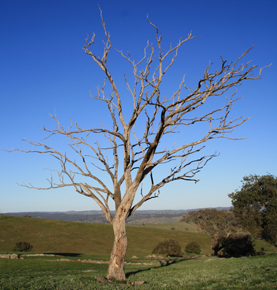 Once was a Shade Tree, once was a Forest
Now a dead reminder of self-righteous colonial exploitation
(Photo: Kate Sherren) Once was a Shade Tree, once was a Forest
Now a dead reminder of self-righteous colonial exploitation
(Photo: Kate Sherren)
.
References:.
.
- Cremer, K.W (1990) Trees for rural Australia. Inkata Press, Melbourne.
- DNRE (1990) Wildlife needs natural tree hollows. Land For Wildlife Note No. 6 Department of Natural Resources and Environment, Victoria.
- DNRE (1992) Old Trees for Wildlife. Land for Wildlife Note No. 18. Department of Natural Resources and Environment, Victoria.
- Nadolny, C. et al. (1997) A farmers guide to trees and bushland. North West Catchment Management Committee, Tamworth.
- Reid, N. (1996) Managing mistletoe. North West Catchment Management Committee, Tamworth.
- Wakefield, S. & Goldney, D. (1996) Assessing scattered farm trees, in Save The Bush Toolkit Charles Sturt University, Bathurst.
- Wakefield, S. & Goldney, D. (1996) Managing scattered farm trees, in Save the bush toolkit. Charles Sturt University, Bathurst.
.
Friday, January 13th, 2012
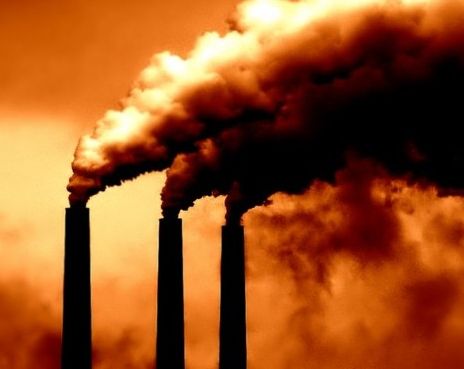
Unless there’s economic growth, we’re not making progress
Unless the trucks rumble along the roads, we’re not making progress
Unless the engines of industry are turning, we’re not making progress
Unless the factories and mills belch out smoke, we’re not making progress
Unless our armies are on the move, we’re not making progress
.
In truth, until we respect the planet, we won’t progress.
.
Thursday, January 12th, 2012
[This article was initially published by Tigerquoll on CanDoBetter.net on 20090703 under the title ‘Victorian Bushfires: CFA ill-prepared and reliant on obsolete firefighting technologies‘].
 The charred shell of a $350,000 CFA fire-tanker near Belgrave Heights, Dandenongs
Victoria in the aftermath of the 2009 Victorian Bushfires
(Photo: Craig Abraham, The Age, 20090225) The charred shell of a $350,000 CFA fire-tanker near Belgrave Heights, Dandenongs
Victoria in the aftermath of the 2009 Victorian Bushfires
(Photo: Craig Abraham, The Age, 20090225)
.
The above fire tanker was fortunately able to protect three firefighters from an out-of-control bushfire as it burnt over them.
But in 1998, a burn-over incident during a bushfire at Linton, near Ballaarat, tragically killing five CFA volunteers.

A report by ABC journalist, Jane Cowan, 20090701, ‘Bushfire lawyers blast CFA’s Rees‘ states that lawyers assisting Victorian State Premier John Brumby’s Royal Commission into the 2009 Victorian Bushfires have in an interim report concluded that the Victorian Country Fire Authority (CFA) was ill-prepared for what has been labelled by the media as ‘Black Saturday‘ (7th February 2009).
The lawyers have criticised CFA chief fire officer, Russell Rees, as having been “divorced from fundamental aspects of the responsibilities” as chief officer, including the provision of public warnings and the protection of life and assert that Mr Rees “should have made himself aware of predictions forecasting the path of the fires.”
Criticism has also been made about the reliance by the CFA on obsolete fire fighting technologies. Bushfire consultant assisting the Commission, Tony Cutcliffe, has stated “We still have people running these organisations who are predominantly devoted to a firefighting technology that is no longer in vogue let alone being attuned to the needs of behavioural management and leadership.”
What is most disturbing of all is that hereon the CFA looks to continue business as usual.
The CFA says it has full confidence in Mr Rees and expects him to be at the helm again this summer. Mr Cutcliffe has expressed his concerns that:
.
‘Whatever changes are made, as it stands now the same management team that presided over the system which failed to cope on Black Saturday will be required to implement the new regime. If the calamity of what happened to Victoria last summer won’t force an overhaul of firefighting in Australia, what will?
.
The CFA’s old-school firefighting culture dies hard:
- The CFA remains an emergency response organisation almost totally dependent on a disparate weekend volunteer base (not the fault of the volunteers who are effectively unpaid public servants);
- The CFA’s bushfire notification system is wholly reliant on public calls to 000;
- The CFA’s fire fighting response system is centred around urban fire trucks that cannot access remote ignitions and so must wait until accessible from a roadside, when the fire is by then often out of control.
.
Taking fire trucks into the bush to fight fires is deadly as the above photo shows;
- The CFA remains a public authority with carte blanche to allow and deliberately cause immense irreversible damage to Victoria’s remaining ecolgical habitat, yet with no ecological expertise in its management or ranks;
- The CFA is grossly underfunded by state and federal governments.
Some questions:
- Given that unprecedented extreme weather was forecast and known to the CFA, what commensurate planning, preparation and response did the CFA deploy and when?
- What improvements in fire fighting practices have been implemented by the CFA since the 1983 Ash Wednesday fires to avoid a repeat?
- Where are the statistics showing the fire fighting performance in respect to each reported ignition, namely:
- Elapsed time from estimated ignition time to detection time (CFA becoming aware of ignition)?
- Elapsed time from detection time and on site response time (CFA arriving at the fire site/front with fire fighting equipment)?
- Elapsed time from response time to suppression time (fire extinguished by CFA)?
These are the three core fire fighting performance metrics.
The 2009 Victorian Bushfire Royal Commission is following its terms of reference in assessing the specific facts and specific causes of the fires and logically as expected is starting to lay blame.
What’s the bet many findings are similar to those of previous bushfire investigations?
If the Royal Commission finds that the current system and structure of Victoria’s (read ‘Australia’s’) volunteer firefighting organisation was at fault, then this is a constructive outcome.
Only at such a legal level will change be forced on the system and culture. Previous internal debrief meetings and investigations (e.g. the 2003 Esplin Enquiry) have managed to have lessons from bushfire disasters ignored and fire fighting practices remain relatively unchanged.
If fire fighting is becoming more effective then how can such tragedies be continuing and growing in scale? How much more 20-20 hindsight is needed by the so-called ‘experienced’ fire fighting leadership before we can observe tangible improvements in fire fighting performance?
It’s all same old same old.
Given the dire inadequacies of this organisation, the culture has forced to become one of absolute defeatism – the only way it believes it can deal with bushfires is to slash and burn as much of the natural burnable landscape as possible, so that there is nothing left to burn. It’s as crackbrained as backburning through Belgrave Heights in order to save Belgrave.
Change cannot be brought to the CFA within the CFA. Change must come from Brumby and Rudd.
 . .
(Ed: While Victorian Premier John Brumby has since been dismissed by election, PM Kevin Rudd currently remains as Australia’s Labor Foreign Minister. But Rudd has been discredited by this tragedy due to the grossly substandard emergency response, recovery, rebuilding and lack of proper emergency investment. His tangible disregard for victims deserves him to be sacked. Rudd has set the foundation for bushfire emergency history to repeat itself, all the while those who suffered still suffer; all the while Australia’s native wildlife are pushed by human ecological abuse and negligence closer to extinction, yet in absence of government care and funding. Australia’s Liberal-Labor governments remain immoral ecological extinctionists, comparable in ecological terms to the Cambodian Khmer Rouge).
.
|
|
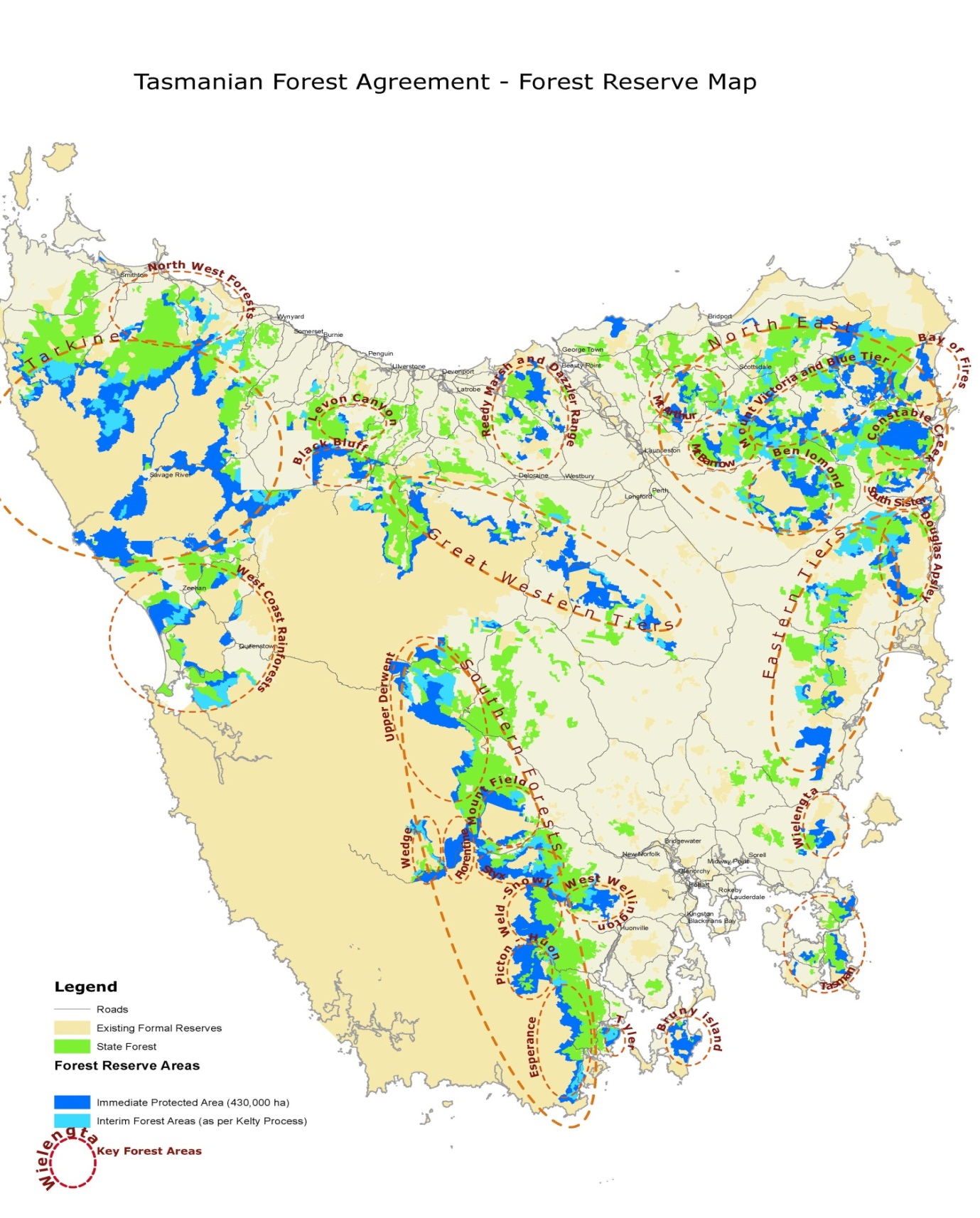 Forest Reserve Map – ‘Interim Reserve Boundaries’ (IGA)