[The following article was initially published as a letter in the local Blue Mountains Gazette (BMG) newspaper on page 4 by this Editor 20081008 under the title ‘RTA Juggernaut‘. It was sparked by reading two separate letters in the paper from Bullaburra residents angry with the RTA and the highway widening process. Copies of those letters are at the end of this article – one by long time Bullaburra resident Viki Wright Rivett; the other by lifetime Bullaburra resident and local historian Una King.]
.
Note: RTA = New South Wales Roads and Traffic Authority; GWH = Great Western Highway
Bullaburra’s rural amenity
Looking east along Great Western Highway towards Railway Station (left)
(Photo by Editor 20110115, free in public domain, click photo to enlarge)
.
Decades of complacency and naivety, or do residents of bucolic Bullaburra simply deserve rights to quiet enjoyment and their buena vista? The RTA highway juggernaut is at the door. It won’t just ‘bisect’ the community [‘Anger at RTA‘ BMG 1-10-08]; it will permanently segregate it, raze its rural amenity and degrade it into a noisy truck side stop. Bullaburra is set to receive the same utility vision imposed on Blaxland and so many other Mountains communities.
Bullaburra looking east along Great Western Highway towards Noble Street (far centre)
(Photo by Editor 20110115, free in public domain, click photo to enlarge)
.
I too attended the August township meeting at Bullaburra’s Progress Association hall, not as a Bullaburra resident, nonetheless as a Mountains resident. At the packed meeting, Bullaburrans unanimously endorsed an alternative plan asking the RTA to accommodate local linkages across what will become another four-lane barrier dividing a local community. Personal experience in dealing with the RTA at Leura, Medlow Bath and Katoomba affirms it doesn’t listen or care. It has just plundered the rare 1820s convict road at Leura, hardly pausing its schedule.
Bullaburra: “Blue Skies” Village – reads the sign (Aboriginal translation)
Western approach to Bullaburra along the Great Western Highway
(Photo by Editor 20110115, free in public domain, click photo to enlarge)
.
The RTA’s massive budget is only limited by political will. It stands to be key recipient of the new Building Australia Fund of $22,000,000,000 then claims it can’t afford community bridges. Be clear, the RTA’s mandate for ‘progress’ is to build more expressways. Driven by road lobbyists, the RTA is extending greater Sydney’s swelling suburbia like Roman legions extended empire.
‘Few understand how much transport influences land use patterns. Transport leads land use. Once an expressway or railway is built, it is easy to change the zoning and development laws to increase the population along the corridor.’ [Then NSW Minister for Planning, Frank Sartor, SMH 29-9-08, p11].
RTA performance is measured by it maximising road ‘ride quality’ and minimising ‘travel times.’ The RTA juggernaut will remain unstoppable so long as local townships rely upon single-handed last ditch battles. Our freshly elected Mountains councillors should stand up for the people of Bullaburra.
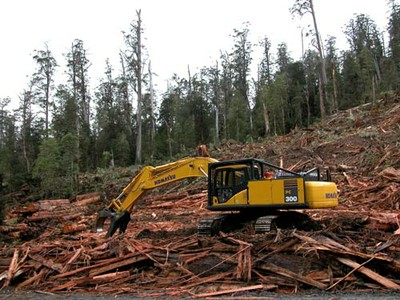
This is what awaits Bullaburra – destruction of rural amenity
Clearfelled mature native trees at Katoomba to make way for a wider faster trucking expressway
Same project, different section.
(Photo by Editor 20090501, free in public domain)
.
More of what awaits Bullaburra – a trucking expressway amenity!
Eastern approach to Wentworth Falls near Rest Easy Motel (off photo to right).
(Photo by Editor 20110115, free in public domain, click photo to enlarge).
.
.
Following this letter in the weekly local paper, the next week (20081015) the Chairman of the Bullaburra Township Committee, Mr Will Silk, responded as follows:
.
‘Missed Target’
letter by Will Silk in BMG 20081015
.
‘I really don’t know where the author (BMG 08.Oct.2008) is coming from, but he seems to have parachuted into a campaign in the dark and has missed the landing zone.
Steven, a word, to you and other latecomers who are just now arriving from above to hitch themselves to the Bullaburra bandwagon – take the time to find out more about us partisans and the grounds on which we have to work.
At the recent Bullaburra Town Meeting, if you weren’t so blinkered by your condescending stereotyping of a “bucolic Bullaburra”, with its residents slumbering in selfish “complacency and naivety”, you might have seen, heard and, possibly, learned some things of interest to residents’ right activists, environmentalists and radical democrats.
You correctly observed a packed meeting of Bullaburra residents as they unanimously (re-)endorsed the Bullaburra Township Committee’s (BTC) plan to manage the way in which the GWH goes through Bullaburra, and condemned the RTA’s plan.
But, hey, Steven! Where did the BTC Plan come from? It came from 18 years’ proactive work by Bullaburra residents and their organisations. We saw the RTA “juggernaut” coming a long time ago, and instead of just whingeing, we developed our own plan before the RTA did, and we united behind it!
You failed to see that at the meeting, the BTC Plan (with its three integral foundations of pedestrian trian bridge), service road and North-South Bullaburra road-rail bridge) has the unanimous support of all the community organisations in Bullaburra. You also failed to hear all of the now elected ward councillors give our plan their support. And moreover, you didn’t see the now mayor, Adam Searle, and from the Liberal side, Chris van der Kley both, literally “stand up”, together and not for the first time, to show their support.
Far from being naive and complacent, Bullaburra, and the BTC have already put in the hard yards of “politically correct” struggle; delegations, submissions, lobbying. What you failed to see at the meeting was a community gearing up, giving its representatives a very clear mandate, for the next stage in its struggle for a renewed, people and environmentally-friendly village.
We are not “at a last ditch”. But we are about to go to the barricades. We encourage you and all Blue Mountaineers who care about creating such townships to join us if you wish. But leave the mocking paternalism behind. Seeing the RTA as an “instoppable Juggernaut” is defeatist. It is a sort of jaded fatalism that is itself an impotent form of complacency.’
~ Will Silk, President of the Bullaburra Township Committee.
.
.
Harsh defensive words from Mr Silk.
I chose not to reply to Will Silk’s above letter in the local paper, because to have done so would have only detracted Bullaburra residents from their united focus behind Will Silk to deal with the RTA. The aim of my letter had merely been to awaken fence sitting residents to the realisation of the force and power they were dealing with at the RTA. I had witnessed similar David v Goliath community campaigns along the highway, most notably at adjacent Lawson, each village/town community singularly convinced that their case was special and naively campaigning in isolation against the legal might and finances of the RTA.
So I was happy to withdraw my involvement at the time to avoid potential conflict, yet my protest campaign in the local paper broadly against the Trucking Expressway continued through into 2010.
What Mr Silk didn’t realise was that I had been actively involved in previous community campaigns concerning the RTA highway widening stretching back to 2001 when I first arrived in the Blue Mountains. Previous highway campaigns have included Shell Corner (2001-02), Soldiers Pinch (2001-02), Lawson (2003-09), Leura section 1 (2004-05), Medlow Bath (2005 ), Leura section 2 (2006-08), Katoomba (2006-09), Mount Victoria bypass (2006-08) and Bells Line of Road (2005-07).
What Mr Silk also didn’t realise was that at the time I was contracting as a management accountant with the RTA, with some insight into the mechanisations, agendas and management culture of this very much political organisation. What Mr Silk also didn’t realise was that I had researched the history of Bullburra and learnt about the RTA plans for the highway widening through the town.
The RTA plans are set to divide Bullaburra by a faster four-laned expressway, greatly restricting local access and offering very few design concessions to local residents.
.
.
I didn’t have to wait long for the optimistic Bullaburra community sentiments to sour about the likely success of the BTC’s alternative highway design.
The above letter in the local paper by Mr Silk a Chairman of the Bullaburra Township Committee, saw the following week a media release by the Bullaburra Township Committee, headed up with a photo including Will Silk.
.
‘Bullaburra joins highway battle‘
by Michael Cleggett (journalist), BMG 20081022, p3.
.
‘The RTA’s highway-widening roadshow continues to attract jeers wherever it arrives, and this time it’s Bullaburra residents voicing anger at plans for their stretch of tarmac.
Members of the Bullaburra Township Committee (BTC) are furious their own designs for the upgrade have seemingly been ignored.
BTC president Will Silk is concerned the RTA has not fully accounted for the effect of any works on the village and its people.
After years of campaigning to different levels of government and departments, residents were dismayed by the RTA proposal when it was made public earlier this year.
“We went in to see them in the first week of June this year and not to our surprise, but to our disgust, we found that they didn’t even know about our plan, they hadn’t taken it into consideration,” Mr Silk said.
In anticipation of the highway upgrade the community has been looking into the issue for more than 20 years. The three pillars of the BTC designs are a road bridge connecting north and south Bullaburra, a comprehensive service road on the southern side running parallel to the highway and a pedestrian bridge. None of these form part of the RTA’s proposal.
Mr Silk said the BTC’s vision presents a much better opportunity to create “a modern 21st century village with the unavoidable highway through the middle of it”.
The service road is intended to allow residents to traverse the town without having to make a difficult turn onto the highway while the bridges would avoid permanently dividing the town as well as providing easier emergency vehicle access. This stage of work will expand the highway to two lanes in each direction from Noble Street to 600 metres west of Genevieve Road.
Outside of the widening, the main features of the RTA plans involve relocating the commuter car park to the southern side of the highway, moving the pedestrian crossing lights, an access road for some properties between Genevieve Road and Noble Street and a number of other changes to street access and bus stops.
Member for Blue Mountains Phil Koperberg has expressed a willingness to further examine the issue.
“(The BTC) proposal for a link bridge between north and south of the Great Western Highway obviously has merit,” he said. “However, whether or not it is practical, feasible or constructable I’ll take advice from the RTA.”
An RTA pamphlet delivered to residents suggests that advice will be bad news. It describes a comprehensive access road and a pedestrian overbridge as unfeasible.
A spokesperson for the RTA said an information session earlier this month was well attended with “some worthwhile suggestions . . . put forward, which will be investigated”.
A second information session will be held by the RTA from 10am-1pm at Lawson Bowling Club this Saturday, October 25.’
.
.
This article by the Bullaburra Township Committee was then followed up by Bullaburra resident Patrick Tatam, who clearly had a stronger interpretation of how discussions between locals and the Roads and Traffic Association were proceeding.
.
‘RTA Bullaburra fiasco’
by Patrick Tatam, Bullaburra (letter in BMG 20081029, p4)
.
‘Regarding the obstructionist, bullying attitude of the RTA towards the Bullaburra Township Committee (BTC), attacking the BTC’s proposed alternativeplan for the GWH rod widening through Bullaburra, here’s my take on what locals are saying:
The major political parties are basically inept, unable to listen to constituents and consumed with retaining/grasping power
Phil Koperberg (then local Labor MP) has no effectively influential power, says anything to avoid an issue, is “a bit of a show pony”, and has furthered his career utilising the ‘who you know, not what you know’ approach
The RTA is seen as a mob of bureaucratic bullies, are even more incompetent than their political masters (the Hazelbrook railway bridge fiasco is common knowledge), and are responsible/answerable solely to the faceless bosses located deeply within the termite mound of RTA headquarters.
RTA representatives at community meetings are aggressive, non-consultative, driven only by their own preferred agendas, ill-prepared, and are the antithesis of ‘public servants’
Exiting either Boronia or Genevieve Road is currently dangerous, and will become definitely more so with the planned RTA ‘seagull’ intersection, increased speed restrictions (from 70kph to 80kph) and higher traffic volumes (particularly those larger faster trucks).
The BTC’s plan is a far better solution for the Bullaburra area than the ‘crash through or crash anyway’ RTA proposal; it’s a plan that addresses the needs of the people who live here, not the needs of a termite from a city office, and incorporates beneficial infrastructurec, not just ‘bloody minded’ bitumen.
.
Elected government members, and RTA personnel, should realise that they are our representatives, and that locals are becoming more politically astute, voting more for independents, if only to make our representatives more representative. Those bullies that remain, hiding behind the skirts of party machinery, should recall the destiny of the dinosaur. Or just move to the last bastions of ‘Bullyville’: Zimbabwe, Myanmar, etc.
~Patrick Tatam, Bullaburra.
.
.
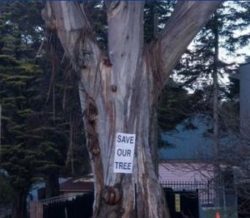
Editor’s Campaign to Save Bullaburra’s 300+ year old Angophora tree from the RTA
.
Bullaburra’s Angophora – on RTA’s death row .
Listed on Blue Mountains Council’s Significant Tree Register
Registered Significant Tree #: 29
Botanical Name: Angophora costata
Common Name: Smooth Barked Apple, Red Gum
Date Registered: 17th July 1985, adopted 21st June 1988
Location: Great Western Highway, Bullaburra, Opp. Lot 173, DP13407.
Campaign article in Blue Mountains Gazette 20081203, p19..
This followed a quarter page campaign article published in this newpaper on 20081105 costing this Editor $460.
(Click image to enlarge)
A palatable, viable and ethical solution to the worsening pathogenic human overpopulation infecting this finite planet
.
Humans now at 7 billion and exponentially breeding, have become Earth’s Pathogen.
It is our sheer numbers that are the root cause driving ecological harm across the planet – deforestation, salination, pollution, climate change, wildlife extinctions, sprawl – all compounded by decadent consumerism since the Industrial Revolution. We have become a rat race, spreading across the globe, converting ecosystems to usable resources so we may grow.
What is the definition of a pathogen? An agent of disease. Humans at 7 billion and exponentially breeding, have become for all other species and Earth’s aggregated ecosystems, a pathogenic disease that is killing them and this blue planet. It is not ‘our’ blue planet; we are the top order predator.
To curb human overpopulation we need human-sterilsation in global drinking water. Add it to the fluoridation globally. It’s a simple cost effective solution to curb humanity’s pathogenic impost on the planet. Wait three generations and until there’s about half a million of us humans left. Then adjust the sterilisation treatment to maintain the half million threshold with each nation a quota. That was our global number pre-‘Industrial Civilisation’ circa 1700, before our exponential ecological carnage. Half a million humans globally may be thought of as Earth’s ‘healthy equilibrium capacity‘ for our species.
The planet and its inhabitants will breathe anew! Melbourne would be like leafy quiet Suggan Buggan – paradise!
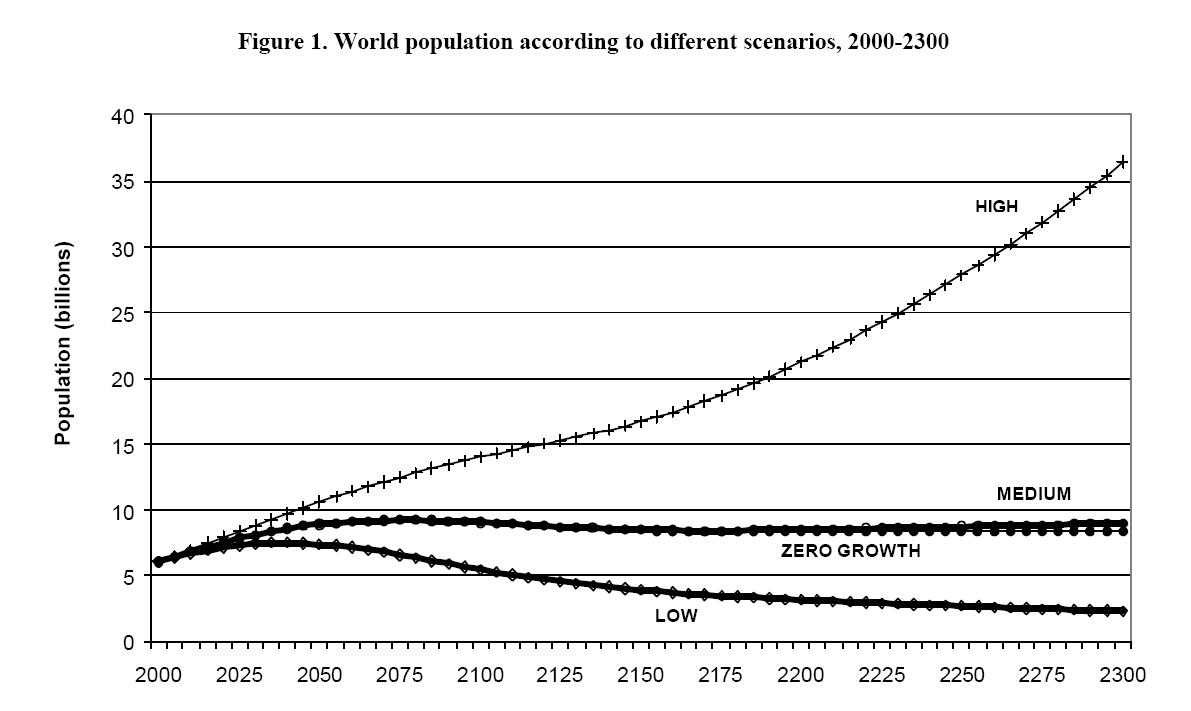
While it’s not politically correct, it sure beats China’s cruel one child policy. What are the alternatives to Earth’s Pathogen? 17,000,000,000 by 2050 and 35,000,000,000 by 2300 as predicted by the United Nations?
Human Population Growth scenarios (2003) [Read More]
.
How else can current exponential human population growth be reversed and reduced substantially and quickly? Global human sterilisation (indisciminate) sure beats famine, plagues, pestilence, genocides, wars, nuclear holocaust, etc. – and no-one gets hurt, just ‘clucky-frustrated‘. I’d award the developers of such a human-specific sterilisation method the Nobel Peace Prize and the planet will thank them.
About the right human density for ‘Healthy Equilibrium Capacity’ ?
.
Tigerquoll
Suggan Buggan
Snowy River Region
Victoria 3885
Australia
~Tom Milliken, Elephant and Rhinoceros expert for the wildlife trade monitoring network ‘TRAFFIC’
.
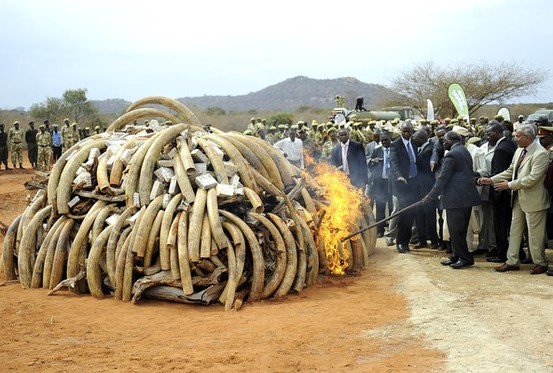
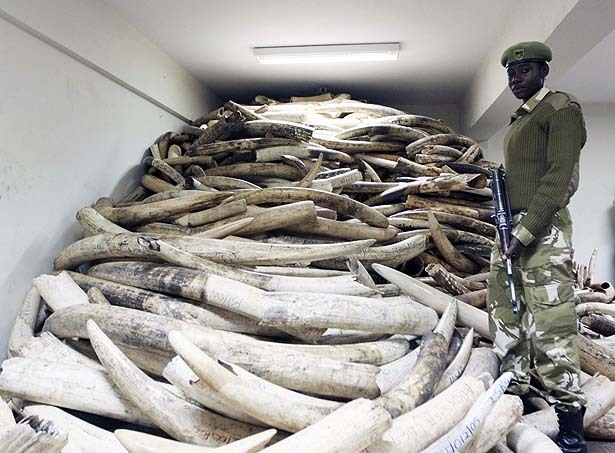
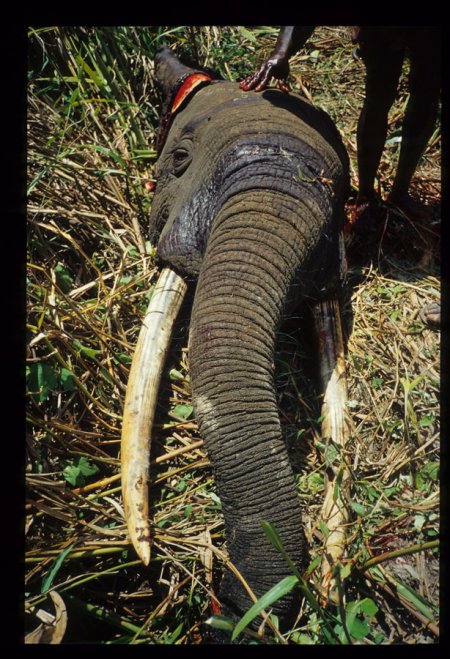
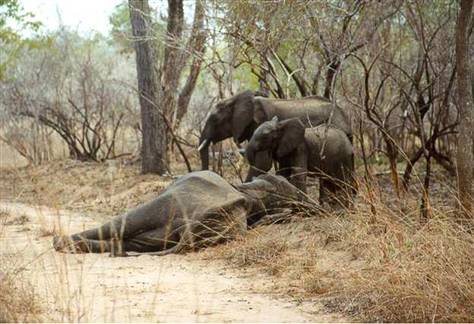
Large seizures of elephant tusks make this year the worst on record since ivory sales were banned in 1989, with estimates suggesting as many as 3000 elephants were killed by poachers as Asian syndicates move into the continent.
Tom Milliken, elephant and rhino expert for the wildlife trade monitoring network Traffic, said: “2011 has truly been a horrible year for elephants.”
In one case earlier this month, Malaysian authorities seized hundreds of African elephant tusks worth $1.3 million that were being shipped to Cambodia. The ivory was concealed in containers of Kenyan handicrafts.
‘Around 23,000 elephants live in Kenya but populations can be devastated by poaching within a couple of years.
A recent survey in Chad showed its elephant population had declined from 3,800 to just over 600 in the past three years.’
^http://www.thestar.com/article/692972
.
“In 23 years of compiling ivory seizure data . . . this is the worst year ever for large ivory seizures,” said Milliken.
Most cases involve ivory being smuggled from Africa into Asia, where growing wealth has fed the desire for ivory ornaments and for rhino horn that is used in traditional medicine, though scientists have proved it has no medicinal value. Traffic said Asian crime syndicates were increasingly involved in poaching and the illegal ivory trade across Africa, a trend that coincides with growing Asian investment on the continent.
“The escalation in ivory trade and elephant and rhino killing is being driven by the Asian syndicates that are now firmly enmeshed within African societies,” Milliken said. “There are more Asians than ever in the history of the continent, and this is one of the repercussions.”
Reports from Central Africa were particularly alarming and if current levels of poaching were sustained, some countries, such as Chad, could potentially lose their elephant populations in the very near future, said Jason Bell, director of the International Fund for Elephant Welfare.
In Tanzania’s Selous Game Reserve alone, some 50 elephants a month are being killed, according to the Washington-based Environmental Investigation Agency. It has been a disastrous year for elephants, perhaps the worst since ivory sales were banned in 1989 to save the world’s largest land animals from extinction.
According to the wildlife trade monitoring network TRAFFIC, a record number of seizures of elephant tusks from at least 2,500 dead animals shows that organised crime networks, in particular Asian syndicates, are increasingly involved in the illegal ivory trade and the poaching that feeds it.
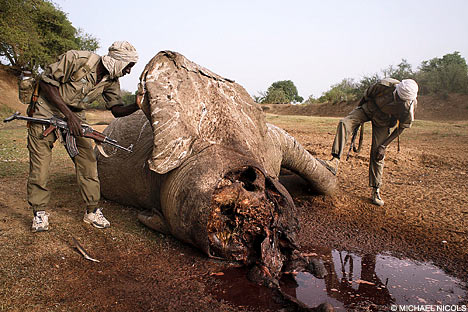
Endangered elephant butchered for TCM
(Photo by Michael Nichols)
.
Some of the seized tusks came from old stockpiles, the elephants having been killed years ago. It is not clear how many elephants were recently killed in Africa for their tusks, but experts are alarmed.
TRAFFIC’s elephant and rhino expert Tom Milliken thinks criminals may have the upper hand in the war to save rare and endangered animals: “The escalation in ivory trade and elephant and rhino killing is being driven by the Asian syndicates that are now firmly enmeshed within African societies.”
Miliken said: “There are more Asians than ever before in the history of the continent, and this is one of the repercussions.”
Most cases involve ivory being smuggled from Africa into Asia, where growing wealth has fed the desire for ivory ornaments and for rhino horn that is used in traditional medicine, though scientists have proved it has no medicinal value.
All statistics are not yet in, and no one can say how much ivory is getting through undetected, but “what is clear is the dramatic increase in the number of large-scale seizures, over 800kg in weight, that have taken place in 2011,” TRAFFIC said in a statement.
.
Asian Elephant Parts Trade:
.
In the most recent case, Malaysian authorities seized hundreds of African elephant tusks on December 21 worth $1.3m that were being shipped to Cambodia, hidden in containers of handicrafts from Kenya. Most large seizures have originated from Kenyan or Tanzanian ports, TRAFFIC said.
Fifty elephants a month are being killed, their tusks hacked off, in Tanzania’s Selous Game Reserve, according to the Washington-based Environmental Investigation Agency.
With shipments so large, criminals have taken to shipping them by sea instead of by air, and falsifying documents with the help of corrupt officials, monitors said.
Milliken said some of the seized ivory has been identified as coming from government-owned stockpiles, made up of confiscated tusks and those of dead elephants, in another sign of corruption.
“In 23 years of compiling ivory seizure data … this is the worst year ever for large ivory seizures,” said Milliken.
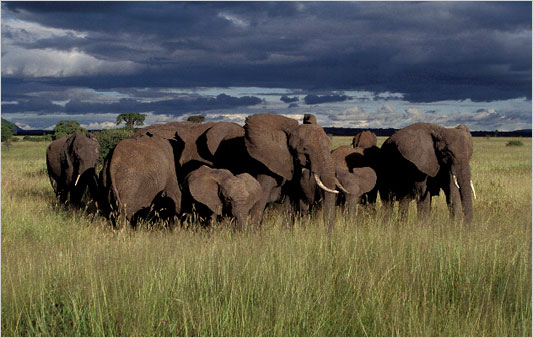
Africa’s elephant population was estimated at between 5 million and 10 million before the European colonisation era. Massive poaching for the ivory trade in the 1980s halved the remaining number of African elephants to about 600,000.
.
Tusk seizures double in last year as syndicates continue to undermine 1989 ban on sale of ivory.
.
It’s a big business year for illegal African ivory. A record number of ivory seizures were made globally this year, produced by an enormous surge in elephant poaching.
Central Africa is most brutally affected, with most of the illegal African ivory collected for China or Thailand where most of the tusks are made into jewelry and art carvings. Tom Milliken in Zimbabwe manages Traffic, which operates an Elephant Trade Information System. He says
“A conservative estimate of the weight of ivory seized in the 13 largest seizures in 2011 puts the figure at more than 23 tonnes, a figure that probably represents some 2,500 elephants, possibly more.”
The Guardian reports that Millliken also says that the 13 large-scale seizures of over 800kg of ivory recorded in 2011, compares with just six seized in 2010. He notes that’s the largest amount of seizures in the more than two decades since he’s been operating his database.
The increased poaching and illegal trade are the result of China’s decision to make an investment drive into Africa to obtain the mineral and energy resources it needs to fuel its economic growth.
Milliken comments:
“We’ve reached a point in Africa’s history where there are more Asian nationals on the continent than ever before. They have contacts with the end-use market and now they are at the source in Africa. This is all adding up to an unprecedented assault on elephants and other wildlife”
Such a heinous crime invokes capital punishment – eye for and eye beheading
.
He concedes it is possible that some of the ivory getting into illegal markets could be coming from African government stockpiles from old seizures. But Milliken points out that trade figures and wildlife monitors show a rise in elephant killings. Most of the kilings he notes are occurring in the Congo, but poaching is also going on in Zimbabwe, Zambia, northern Mozambique, Tanzania and Kenya.
In 1989, a global ban placed on the ivory trade was credited with stemming the unstoppable slaughter of African elephants in Africa’s central region. Since then, African governments have sanctioned occasional auctions from its stockpiles.
It’s believed Africa’s elephant population varies widely from 400,000 to 700,000. Some southern African states like Botswana have large and growing populations and in South Africa burgeoning elephant populations are raising concerns that they are damaging the environment.
‘There is a war taking place on our planet for which there are no headlines, no demonstrations, and no voice. It is a war against some of the most endangered species on our planet and it takes place in some of the most majestic and unexplored biospheres of the world. Unseen and untouched by the Western world, these places are well-suited to commit atrocious acts in hiding.’
Traditional Chinese Medicine – a backward asian cult that must be eradicated!
.
TCM is 5000 years old. Its quacks profit from promising cures for headaches, skin disorders, irritable bowel syndrome, constipation and diarrhoea, stress, allergies, and impotence. Of Traditional Chinese Medicine (TCM) that relies on slaughtering endangered wildlife for their body parts for potions, it promotes a sick barbaric trade. It is a witchdoctor cult.
In the West, when something happens we ask what we can do about it. In the East when something happens they ask what has caused it. Traditional Chinese Medicine looks for the underlying causes of imbalances and patterns of disharmony within the body, blabs on about Yin and Yang, then goes out and slaughters endangered wildlife for their body parts to make a dodgy quack potion.
Boycott Traditional Chinese Medicine. It is illegal by driving the illegal trade in endangered species. It is more barbaric than the child sex trade.
Australian model Elle Macpherson does. Since 2010 she says she regrets any distress she may caused by jokingly advocating the use of powdered rhino horn, a traditional Chinese medicine that is banned worldwide, during an interview with The Sunday Times Magazine, the Australian model said that she had tasted rhino horn and that it had “done the job“. The model told news.com.au today that she had “never knowingly consumed or encouraged the use or consumption of any products which contain material derived from endangered species”.
Spate of wildlife diseases across human-contaminated Tasmania
.
Dr David Obendorf, Wildlife Veterinary Pathologist in Tasmania, says that the recent outbreak of disease killing off Tasmanian Devils is symptomatic of similar recent diseases affecting other wildlife the same areas of Tasmania, which is impacting on their survival.
Coming out of nowhere for Tasmania is ‘Mucor amphibiorum‘, a fungal disease in platypus and frogs which doesn’t occur on the mainland and yet we know that, that organism occurs on the mainland. Tasmania now has a cat borne infection ‘Toxoplasmosis‘ which is spread by feral cats which kills wallabies, wombats, bandicoots. Tasmania has a new staphylococcal infection that infests the pads of echidnas so they get this sort of raw pustular wound that impregnates their pads they, they just can’t dig. Tasmanian wombats have developed Sarcoptic mange, you know, a little mite that burrows into skin causing intensely painful skin lesion where they develop all this weeping skin and they become like armour plated animals just losing their skin. They walk around like sort of robots because they just can’t stretch out, there’s no flexibility left in their skin. These animals die an incredibly painful death as a result of having this disease.
The Tasmanian Government after great reluctance, says Dr David Obendorf, has published a report listing about twenty two significant wildlife diseases (just in the past 30 years) that are impacting Tasmanian wildlife. In frogs, in wombats, in bandicoots, in wallabies, in devils, in seals, in birds. We’re trying to maintain threatened species in the face of viral infections, parasitic infections, fungal infections. You’ve got to ask yourself the question, why, why all of a sudden do we have all this pathogen stress on wildlife?
Dr David Obendorf contributes the spate of Tasmania’s wildlife diseases to human abuse of the environment – pesticide and herbicide spraying, biocide contamination of streams, the continuation of habitat fragmentation and habitat destruction, allowing these diseases to be transmitted more easily and compounding pathogen stresses on wildlife.
You’d be a fool not to try and see if there’s one health underpinning for a scenario such as what appeared to have been occurring in the north east region of Tasmania. That region had undergone massive land transformation and the introduction of silvi-cultural plantations over vast catchments and the beginnings of usages of chemicals that were being aerial sprayed over large acreages.
The north east corner of Tasmania has undergone massive transformation since the Regional Forest Agreement was signed in 1996. You have a mosaic of landscapes now created with silvi cultural plantations, hardwood plantations of nitens, (Ed: genetically manipulated) Eucalyptus nitens trees. You have some fragmented pockets of natural environment. You have dairy farms. You have small villages and you have the large settlement of St Helen’s which is at the end of the catchment of the George River. So in that sort of context chemical usage has really come into being a dominant player in the sort of risk management of that whole environment. Because you’re dealing with herbicides and pesticides, insecticides, the use of 1080 for a long time as well. So all these things are playing into that landscape and affecting how the water may pick up those residues and the impact it might have on oysters. But also on the bio-accumulation risk that it would represent to the species, the native species that are living in natural ecosystems.
The big issue is when are these sorts of relationships between ecology, wildlife, humans…is there a relationship here between an event, a sudden event, mass mortality, and something that may well have affected that ecology or that environment to contaminate it?’
.
The demise of the Tasmanian Devil is symptomatic of the harm 21st Century human activities are causing to Australia’s wildlife habitat and wildlife in general.
‘Australia has one of the worst mammal extinction rates in the world, with 22 mammals becoming extinct over the past 200 years, including the Bridled Nailtail Wallaby (Onychogalea fraenata), now listed as endangered. Broadscale bushfire (wildfire or hazard reduction), altered fire regimes including frequent fire, compounded with feral cat predation and introduced herbivores have caused major population decline in many small native mammals such as the Greater Bilby (Macrotis lagotis), the Brush-tailed Tree Rat (Conilurus penicillatus) native to northern Australia.
‘While rigorous efforts have been made to save endangered groups, scientists now fear Australia is on the cusp of another wave of extinctions with a reduction in abundance of some species and alarmingly their range. Some mammal species have already disappeared from more than 90% of their past range in Northern Australia. Such is the seriousness of the situation, that Professor Iain Gordon from CSIRO Sustainable Ecosystems is chairing a meeting at the International Ecology Symposium in Brisbane on Australia’s mammal extinction crisis.’
‘Some species have already disappeared from more than 90% of their past range across the North. Many formerly abundant animals such as the Northern Quoll (Dasyurus hallucatus), Golden Bandicoot (Isoodon auratus) , and Greater Bilby(Macrotis lagotis) are declining, and doing so very rapidly. The declines are being reported from pastoral lands, indigenous lands, and national parks alike.’
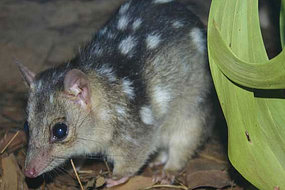
Baby Northern Quoll
.
‘Northern Australia is the largest remaining tropical savanna on Earth. However, changes in land management have meant that many mammals in these savannas are now struggling to find enough food and shelter to survive. A range of factors, such as feral cats, unmanaged (Ed: read ‘neglected’) fire and over‐grazing are implicated in causing these declines.’
‘The meeting unanimously agreed that decisive and immediate action across all land tenures is needed if we are to save species. This includes developing and implementing land management work plans as well as research plans to fill in priority knowledge gaps.’
‘In part we need to better understand the detail of what each native mammal needs to survive. However, we do know enough now to immediately assist and support landholders across Northern Australia to do the on‐ground management work needed ‐ work such as feral animal control and managing fire ‐ which we know will immediately assist these threatened species.’
‘This is undoubtedly one of the major biodiversity conservation issues affecting Australia, which already has the worst rate of mammal extinctions in the world.
‘It would be heartbreaking and internationally embarrassing if we were to stand aside and witness another wave of extinctions without making any effort to intervene. The only way to reduce the chance of extinctions in our iconic northern Australian mammals over the next decade is to take urgent action now’.
~ Dr. Sarah Legge of Australian Wildlife Conservancy (Ed: that was in May 2010. It is now January 2012, 18 months later!)
‘Of the 85 species of native mammals (excluding bats) known to have once occupied Australia’s northern arid zone (including the Pilbara region of Western Australia), 11 are now extinct, six are extinct on the mainland and are found only on off-shore islands and 16 are now severely restricted in their range.’
[Source: ‘Extinction crisis for North Australia’s mammals’ , Wildlife Preservation Society of Australia – Bilby Projects, 20100514, ^http://wpsa.org.au/pro_bilby.html]
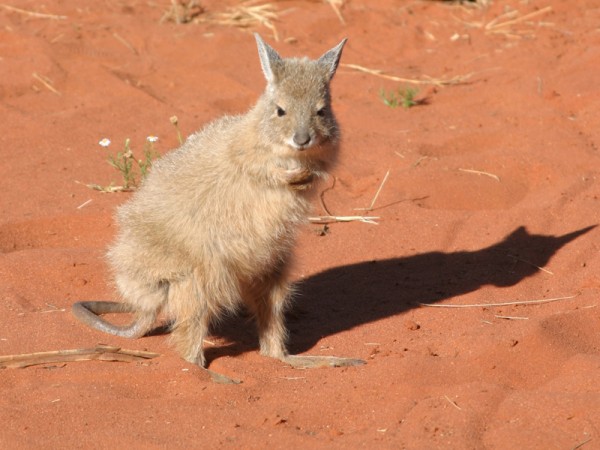
Mala
Only 200 in the world, centred around Uluru-Kata Tjuta National Park (September 2011)
.
‘Critically Endangered’ (only a handful left)
.
Northern Quoll (Dasyurus hallucatus)
Golden-backed Tree-rat (Mesembriomys macrurus)
Carpentarian Rockrat (Zyzomys palatalis)
.
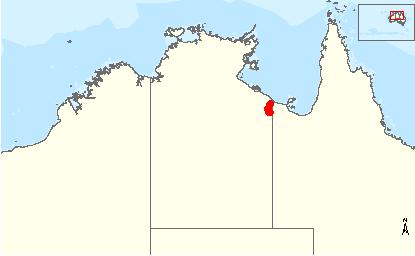
Severely restricted distribution of the Carpentarian Rock-rat
.
‘Endangered’
.
Golden Bandicoot (Isoodon auratus)
Fawn Hopping-mouse (Notomys cervinus)
Dusky Hopping-mouse (Notomys fuscus)
Carpentarian Antechinus (Pseudantechinus mimulus)
Plains Rat (Pseudomys australis)
Common Brushtail Possum (Central Australian subspecies) (Trichosurus vulpecula vulpecula)
Central Rock-rat (Zyzomys pedunculatus)
.
Plus other mammal species classified as ‘Vulnerable‘, as well as many native birds, reptiles, amphibians, fish, invertebrates, and plants that are also extinct or approaching extinction.
“It’s really this sense of apathy and the belief that somehow wildlife is a nuisance and if they die, well, you know, well, what do you expect us to do about it?…wildlife (is) really just a small hobby sideline area of investigation.”
~ Dr David Obendorf
.
Governments have an entrusted responsibility, delegated to them and financed by the communities they represent, to be competent and active custodial managers of a State’s natural values. Government agencies charged with custodial responsibility for natural ecosystems and native flora and fauna have a moral obligation to be honest and conscientious in properly maintain the integrity (the wholeness and intactness) of a State’s natural heritage.
International Environmental Law has adopted a number of important guiding principles which need to form the policy bases and plans of management for managing our natural heritage – including the polluter pays principle, the precautionary principle, the principle of sustainable development, and intra-generational and inter-generational equity.
‘Any judgment made today that has an adverse impact on natural populations, particularly if it involves the extinction of a species or communities, is likely to be irrevocable (Beattie and Ehrlich, 2001).
Custodial responsibility, sometimes called the principle of inter-generational equity, underpins both the intrinsic value and the utilitarian cases for conservation. The Intergovernmental Agreement on the Environment (Australian Government Publishing Service, 1992, para 3.5.1) defined the precautionary principal as:
‘Where there are threats of serious or irreversible environmental damage, lack of full scientific certainty should not be used as a reason for postponing measures to prevent environmental degradation.’
Back in 1863, the great biogeographer and evolutionary biologist, Alfred Wallace, made a clear statement about custodial responsibility:
“…future ages will certainly look back on us as people so immersed in the pursuit of wealth as to be blind to higher considerations. They will charge us with having culpability allowed the destruction of some…[species]…which we had it in our power to preserve; and while professing to regard every living thing,…with a strange inconsistency, seeing many of them perish irrecoverably from the face of the Earth, uncared for and unknown (p.234).”
.
[Source: ‘Practical conservation biology‘, text by David Lindenmayer, Mark A. Burgman, 2005, CSIRO Publishing, Australia, ISBN 0 643 09089 4]
.
‘Human beings are part of the natural world, and all forms of life on Earth deserve our respect.’ (Australian Greens Principle #1).
May we learn from our forefathers’ wanton and misguided persecution of the now ‘fabled’ Tasmanian Tiger. May we learn from our current fathers’ misguided exploitation of wildlife habitat as a ‘natural resource‘. May we in 2012 take all efforts and funding to prevent the Tasmanian Devil becoming another fabled tragedy of our making. May 2012 be a break-though year for those, especially young people, trying to convince governments the virtue of mature respect for our fragile natural world.
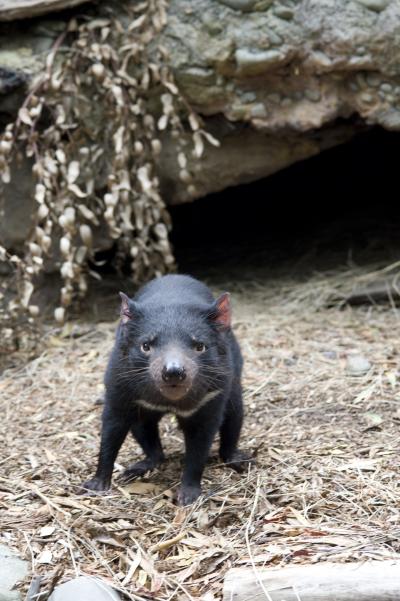
Tasmanian Devil (Sarcophilus harrisii) – a species now dying out
What area of old growth native forest has been saved from business-as-usual deforestation as a result of the United Nation’s declaration of 2011 as the International Year of Forests?
Well, at the time of writing, the public relations material on the official UN website conveys a general message that the ‘Forests 2011‘ programme is intended “to strengthen global efforts to improve the state of forests” and draws upon its dedicated subsidiary United Nations Forum on Forests (UNFF), adopting four Global Objectives:
Reverse Forest Loss – reverse the loss of forest cover worldwide through sustainable forest management, including protection,restoration, afforestation and reforestation, and increase efforts to prevent forest degradation.
Enhance Forest-based Benefits – economic, social and environmental benefits, including by improving the livelihoods of forest-dependent people.
Increase Sustainably Managed Forests – including protected forests, and increase the proportion of forest products derived from sustainably managed forests.
Mobilize Financial Resources – reverse the decline in official development assistance for sustainable forest management and mobilise significantly-increased new and additional financial resources from all sources for the implementation of sustainable forest management.
Sounds encouraging, but where are the stated deliverables?, key result areas?, key performance indicators?, programme targets?, UN budget to achieve these global objectives? Where is the implementation plan and the delegated implementation task force?
The website is thick on its public relations message, but thin on substance. In the absence of any mention of the means to achieve these four objectives, my initial reaction is that it is more motherhood and perhaps just about ‘raising awareness‘. But don’t we already know that deforestation is a critical global problem?
.
The aim of the UN International Year of Forests 2011 seems to have merely been “to raise awareness and strengthen the sustainable management, conservation and sustainable development of all types of forests for the benefit of current and future generations“.
.
It just sounds like more Forestry spin!
.
And ‘sustainable forest management‘ is a familiar phrase and one bandied about not by environmentalists, but by forestry industry – i.e. industrial loggers. Type ‘sustainable forest management’ in Google at look at the websites results:
Australian Government Department of Agriculture, Fisheries and Forestry (i.e. derives revenue from logging)
Australian Forest Education Alliance (AFEA) – includes members from Australian Forest Products Association, Forests NSW, Forest Education Foundation Tasmania, Forest and Wood Products Australia, Primary Industries and Resources South Australia, Forestry Sustainable Forestry Program (Southern Cross University), NSW Forest Products Commission WA, VicForests (i.e. all derive revenue directly from logging, or subsidised by industrial loggers)
Forestry Tasmania (i.e. derives revenue from logging)
Forests NSW (i.e. derives revenue from logging)
Food and Agriculture Organisation of the United Nations (encouraged forest be used for wood production)
The Institute of Foresters of Australia
Department of Sustainability and Environment (Victoria) (encouraged logging and burning of native forests)
etc.
.
UN International Year of Forests 2011 – ‘Global Achievements‘?
.
The only other information that may be gleaned from the official UN site covers topics such as promotional events, films, photos, collaborative global partner organisations plus some forest statistics, a few online publications but that’s about it. So today on 30th December 2011 as the International Year for Forests draws to a close, what has the UN programme actually achieved?
What area of the world’s native forests has been protected from otherwise business-as-usual deforestation? What has stopped Forestry Tasmania and its band of loggers from their business-as-usual holocaust treatment of Tasmania’s endangered ancient native forest ecosystems?
Answer: More PR funding for the UN’s next programme?
.
Australian Government’s endorsement of International Year of Forests 2011
.
Rather than convey an assessment here, I shall just quote from the Australian Government’s website dedicated to supporting this programme (before it vanishes):
‘Australia has some of the most beautiful and productive forest areas in the whole world. These fantastic and magical places mean a lot of different things to different people. Some of us work with the wood from the forests. Some work with the creatures that live in the forests. Some of us live in the forests and some of us play in the forest (camping, hiking, exploring) and some of us just love looking and being in a forest!
‘Without a doubt what ever your use, be it a little or a lot, Australian’s should be proud of Australia’s forests!
‘The United Nations announced 2011 as the International Year of Forests. Australians can unite and celebrate our sustainably managed forests and the diversity that our forests bring to our lives. Our forests give us wood that we use every single day and these very same forests give us the best playground that our kids could ever hope for. Australia’s forests are used by everyone and are the best in the world!
.
Ministers Address
.
‘Australia has about 4 per cent of the world’s forests on 5 per cent of the world’s land area, and has one of the best managed forestry sectors in the world.
‘The nation’s forests, and the products they produce, provide significant employment, environmental and recreational benefits to communities across Australia. Australia’s forestry and wood manufacturing sector employs nearly 76,000 people, many in regional areas, and generates around $7 billion worth of wood and paper products annually.
‘Across the nation the forests in conservation reserves cover over 23 million hectares. These reserves provide recreational benefits for communities and contribute to the 12 billion tonnes of carbon stored by Australian forests. Industry and government have been working hard to make sure our forests remain sustainable and viable for the long-term.
‘The Australian Government recognise the importance of World Forestry Day and the International Year of Forests and has actively supported both initiatives. This year the Gillard Government intends to release legislation to ban the importation of timber products that have not been legally harvested. This law will contribute to global efforts to stop illegal logging, provide for sustainable forest products made in Australia and reduce unfair competition. The Gillard Government remains committed to promoting sustainable forestry initiatives and encourages people to celebrate the International Year of the Forest.’
Senator Joe Ludwig,
Minister for Agriculture, Fisheries and Forestry
.
And guess who’s embraced the 2011 International Year of Forests with public relations relish?
.
Forestry Tasmania
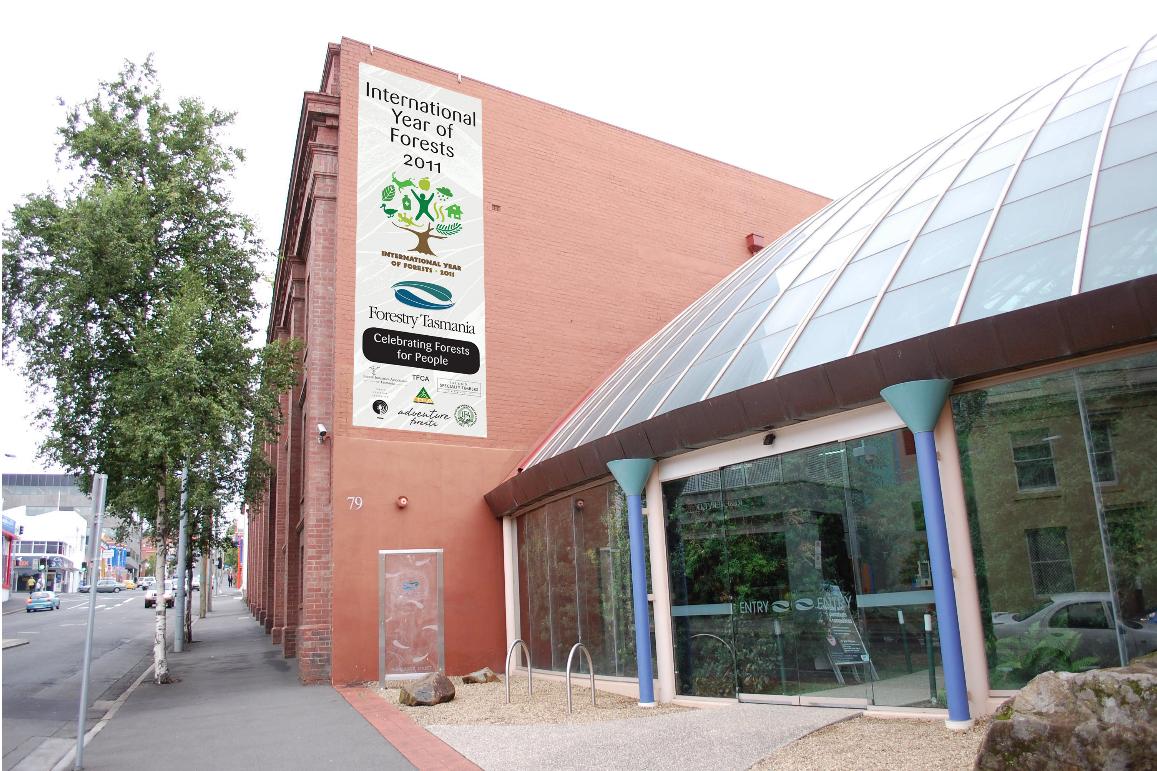
“Congratulations to Forestry Tasmania (FT) who held a successful Tasmanian launch of International Year of Forests. Held in Hobart on 25 January the ‘forest in the city’ event proved to be a popular summer holiday diversion with a steady stream of families, shoppers and naturalist flowing in to the Melville Street Dome throughout the afternoon.” .
‘Forestry Tasmania (FT) kicked off its celebrations for the United Nations International Year of Forests 2011 with an open day at the ‘forest in the city’ in its Hobart headquarters on 25 January. The event proved to be a popular summer holiday diversion, with a steady stream of families, shoppers and naturalists flowing into the Melville Street Dome throughout the afternoon. Their curiosity was rewarded by science and fire fighting displays, indoor abseiling, and even the opportunity for the young (and young at heart) to have their photo taken with ‘Krusty’, FT’s very own giant freshwater crayfish.
Forestry Tasmania’s promotional campaign for the International Year of Forests 2011
…to educate children early on that Forestry is good for native forests.
Tasmania’s endangered Giant Freshwater Crayfish just loves loggers destroying its habitat.
Get ’em while they’re young Bob!
.
Forestry Tasmania’s General Manager Corporate Relations and Tourism, Ken Jeffreys, said the open day was just a taste of things to come, with a 12-month calendar of events planned to celebrate the International Year of Forests.
“We have a number of exciting projects scheduled over the next year, such as the opening of new accommodation at Tahune, to be called the AirWalk Lodge.
“This development will, for the first time, see family accommodation available at one of Tasmania’s most highly visited tourism attractions. It will allow our guests to spend a full day experiencing all of the activities on offer at the AirWalk, as well as the many other attractions on offer in the Huon Valley.
“The year will also see a number of high-profile sporting events on state forest, including mountain biking and the multi-sport Ben Lomond Descent.
“And one of our bursary recipients, Shannon Banks, is going to attempt to visit all 52 of our recreation and tourism attractions around the State over the year. She’ll be writing a blog about her adventures, which we hope will inspire Tasmanians to experience the wonders of the forests in their own backyard.”
.
Mr Jeffreys said FT’s staff were excited by the opportunities presented by the International Year of Forests 2011.
“This year, we want to show the community that we are proud of the work we do to ensure the full range of forest values are maintained in perpetuity. Our staff worked hard to create displays for the launch that were fun and informative. The public’s reception showed us that there is a great deal of interest, and open-mindedness, about the way our forests are managed.”
.
Speech notes Simon Grove (Conservation Biologist with Forestry Tasmania – Division of Forest Research & Development):
.
‘Before I hand over to Rebecca White MHA to officially launch the International Year of Forests, I’ve been asked to say a few words about what our forests mean to the people that work here in Forestry Tasmania. Since our values come from our personal life-experiences, all I can do is tell you my own story, while recognising that every one of us here has their own story too.
I work as a researcher, a conservation biologist, with Forestry Tasmania. In some ways I deal with the meat in the sandwich that is forestry today – what does nature have to say about how we manage – or should manage – the forests in our care? But I want to start at the beginning. Life is all about discovery, learning and figuring things out, and I was lucky to discover early in life that nature, and forests, can be an excellent source of inspiration and experimentation. So here are a few of my naturalists’ memories, going back to toddlerdom.
I remember:
Figuring out that earthworms have bristles that work like legs – if you fill an empty milk-bottle with worms and then leave the milk-bottle in the kitchen, the worms climb out and slither all over the kitchen floor.
Learning that if I sat very still in the woods, I could watch the native mice going about their lives – and I could even catch them in my hands – but that they would bite my little sister’s hands if she tried the same thing.
Learning that bumblebees loved the nectar of honeysuckle flowers as much as I did – and that they wouldn’t sting if I picked them up to enjoy the sensation of having them buzzing around in my cupped hands – but that they would sting my little sister’s hands if she tried the same thing.
Discovering that it wasn’t only nasty wasps that filled the summer air with their droning, but beautiful flower-loving hoverflies – but little sisters aren’t always good at telling them apart.
Realising that hungry ground-beetles eat lizards if you keep them in the same cage and don’t feed them.
Learning that baby starlings abandoned by their parents get too hot if you try and incubate them on the boiler.
Discovering that tadpoles kept in a glass jar don’t turn into frogs unless you give them some land to climb out onto.
Realising that flower-presses were designed for delicate plants such as dandelions, and not for cacti.
Learning that seashells brought back from the beach get very smelly if they still have their animals in them.
Discovering that puffball fungi give off clouds of spores if you wee on them.
Discovering that blackbirds’ eggs taste as good as chooks’ eggs if you fry them up on a camping stove in the garden.
Figuring out that foxes eat cherries – you can find the stones in their poos.
Figuring out that I could make wonderfully whiffy stink-bomb mixture by adding all sorts of sordid ingredients – dog-poo, apple-cores, ink – to the liquid accumulating in the bottom of a tree-hollow; but that if I then added real chemical stink-bomb ingredients to this then I ended up with dead-maggot stew instead.
.
We all have stories like this. (Ed: perhaps only at FT) In retrospect, we can see that they make us who we are today. Our challenge is to ensure that the next generation is encouraged to explore and experiment too.
I didn’t grow up in Tasmania, but the other side of the world in England. But I don’t think it would have made much difference to my outlook as a child. Nature’s all around us, and children the world over are tuned into it. If it’s nurtured, as it was in me, the empathy for nature can grow. Otherwise it may die away. The presence here today of so many families and children is testament to the amount of nurturing going on around us – which is wonderful to see. And what better place to do so than in our forests.
Some of us are lucky in that as adults we still get to liberate our inner child from time to time – every day if we’re very lucky. That’s how I’ve managed to live my life since leaving school – right through the years of university study; of working with nature conservation organisations in the UK; of working in Uganda as a conservation trainer in the forest department and in Indonesia as a training adviser on an international sustainable forest management project. It’s how I lived my life when I was researching rainforest insects in North Queensland for my PhD. And it’s how I have done so for the past decade as a conservation biologist here at Forestry Tasmania.
And despite what you might expect from media coverage of forestry issues, I don’t feel alone. Many people working in forestry here in Tasmania are naturalists at heart, and many more who wouldn’t call themselves naturalists nevertheless have a deep appreciation for the bush and an understanding of what makes it tick. Not so much sawdust in our veins, as bushdust – an empathy with the forests, and a recognition that we humans are not so much their lords and masters as their stewards.
My brother and I used to call chainsaws ‘long bottoms’, because to my ear they sounded like someone doing a very long fart. Later in my youth I came to see them as the conservationist’s friend, as we went about clearing wildling pines invading the heathland where rare birds nested. Today I know that chainsaws also have more prosaic functions – people use them to harvest trees so that they can be turned into products that we all use, such as timber and paper. This would be a tragic end for the forest if harvest were indeed the end-point. But it’s not, because experience shows that the elements of nature displaced by the harvest begin to move straight back in almost as soon as the chainsaws fall silent, and the forest begins to regrow and to fill with life again.
A background in natural history is good for making connections – among species and among natural processes. We learn that eagles feed on pademelons that graze on grasses and browse on young saplings; eagles nest in the old trees that grew up after the last wildfire and that escaped the browsing of pademelons; fungi and beetles recycle the trees – and even the eagles and pademelons – once they die. Eagles, trees, fungi, pademelons and beetles are all connected. Those of us steeped in natural history and ecology also make connections between humans and the rest of nature. We’re the original environmentalists. We recognise that the world faces not only a GFC but also a GEC – a global environmental crisis. I should emphasise that this crisis is not the outcome of sustainable forestry. But it is the cumulative outcome of all of our growing material demands outstripping the planet’s ability to supply. We all – especially our children – have to deal with the consequences.
In this context, we still expect the world’s remaining forests to be reservoirs of nature and yet to continue to supply our material and spiritual needs. It’s a big ask, but it can be done – certainly so in a place like Tasmania, with all the expertise in forestry and conservation at our disposal.
If I’ve discovered one big theme about the natural world during my life, it is that nature, for all its fragility, is remarkably resilient – think how forests recover after a bushfire. And the main take-home message from the forestry Masters course that I took at Oxford all those years ago, reinforced by daily experience since then, is that forestry is as much about people as it is about trees. Connecting the two concepts I come to a heartening conclusion. Through the increasing value that all of us place on our forests, they look set to become landscapes not of conflict but of reconciliation. Let’s see if we can use this International Year of Forests to further that end.
I’d now like to formally hand over to Rebecca White MHA, so that she can officially launch this International Year of Forests as Forestry Tasmania’s Ambassador.’
.
(Tasmanian) State Labor Member for Lyons and International Year of Forests Ambassador, Rebecca White MP, was on hand to officially launch Forestry Tasmania’s celebrations for 2011. She said the UN’s theme for the year, ‘celebrating forests for people’, had struck a deep chord with her.
“This theme resonated deeply with me, as it conveys the need to manage forests for many values, including conservation and sustainable development. It means that these values, which are often portrayed as being in conflict, are in fact intertwined. It also recognises that people are central to the effective management of forests.
“With careful, scientifically driven management, such as we have in Tasmania, there need not be a contradiction between conserving biodiversity and providing wood products and other non-commercial values from forests.Forestry Holocaust of the Tarkine, October 2009
.
“While not all values may be delivered in any one area of forest, they are delivered across the entire landscape. While there are of course a number of challenges confronting the forest industry at present, it’s nonetheless important to remember that our state forests provide skilled employment for thousands of Tasmanians, and indirect employment for many more in our rural and regional communities.
“And of course, our state forests also provide clean drinking water to our towns and cities, they store the equivalent of 24% of Tasmania’s carbon emissions each year, and they provide a host of recreation activities and tourism attractions that appeal to locals and visitors alike.”
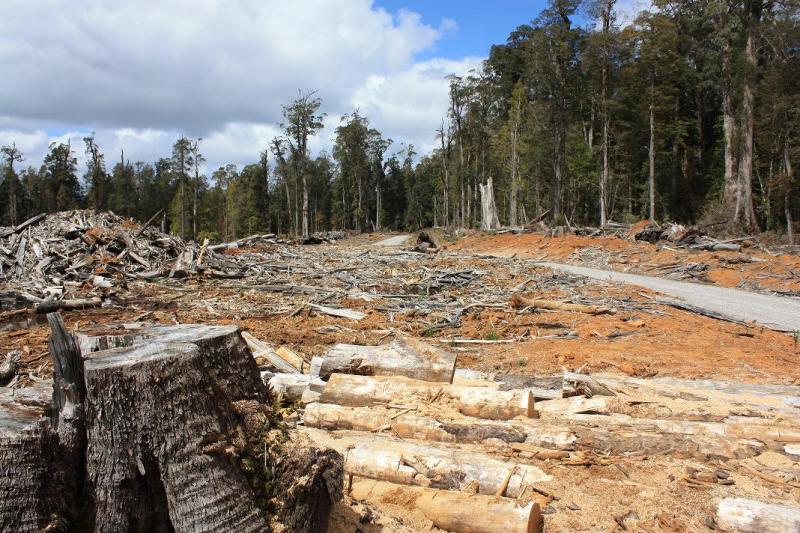
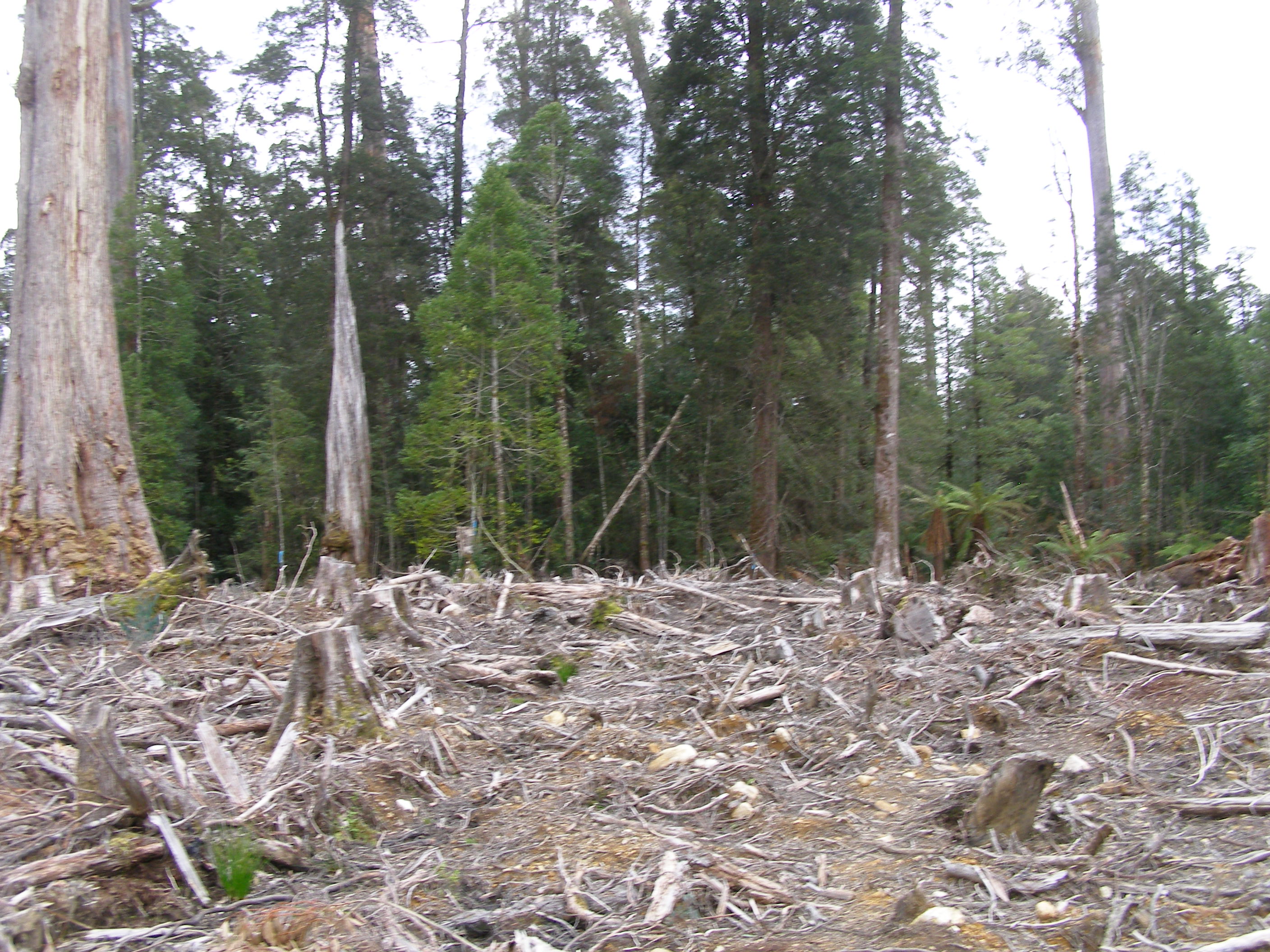
Upper Florentine old growth forest clearfelled by Forestry Tasmania in 2009, situated behind Forest Defenders’ Camp Flozza
(Photo by Editor 20110928, free in public domain, click to enlarge)
.
World Deforestation Clock
.
Each year about 13 million hectares of the world’s forests are lost due to deforestation, but the rate of net forest loss is slowing down, thanks to new planting and natural expansion of existing forests.
From 1990 to 2000, the net forest loss was 8.9 million hectares per year.
From 2000 to 2005, the net forest loss was 7.3 million hectares per year – an area the size of Sierra Leone or Panama and equivalent to 200 km2 per day.
Primary forests are lost or modified at a rate of 6 million hectares per year through deforestation or selective logging.
Plantation forests are established at a rate of 2.8 million hectares per year.
These are Forestry Scabs:
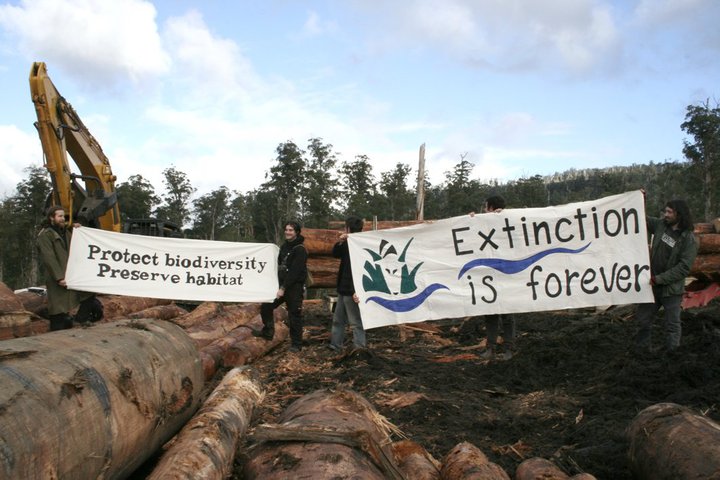
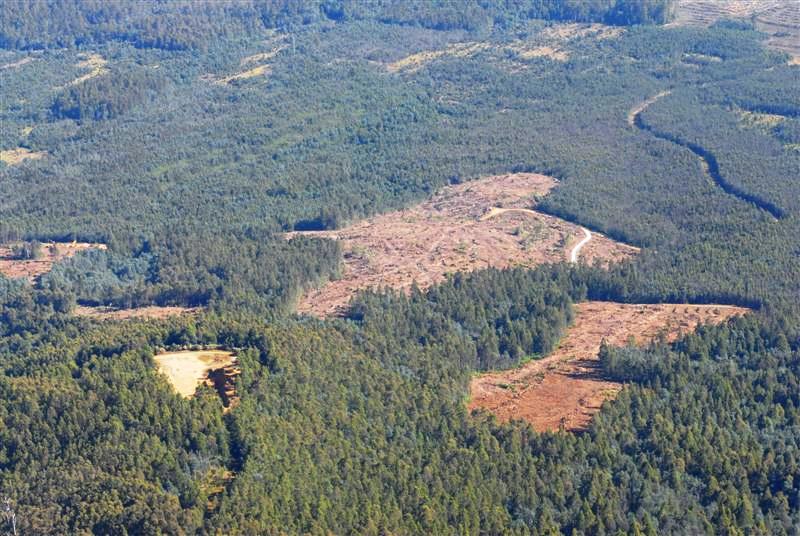
Forestry Scabs of clearfelled Tasmanian endangered old-growth forests
Google Earth reveals the clearfell truth behind the Forestry propaganda
(Click satellite image to enlarge – note environmental protestors’ ObserverTree)
To download Google Earth software (93MB), go to: ^http://www.google.com/earth/index.html
.
This is an aerial close up of Forestry Scabs:
Forestry Scabs pocking the endangered Upper Florentine Forest, 2011
.
This is the ‘Forestry Plunder’
Old Growth which in the case of the Styx Valley, Forestry Tasmania labelled ‘Coupe SX015‘
.
Recall 2006: ‘Forests protected: another tall story‘
Two days after the election the police moved into the Styx Valley to apprehend a small band of protesters. An arrest was made and a 70-metre-tall tree holding a protest platform was blown up! Cable logging was set to resume in the Styx Valley of the Giants.
Yet last year both the state and federal Governments claimed that they had saved the giant trees of the Styx. Indeed, they claimed to have resolved the entire forests debate.
This week’s developments have given the lie to those claims. Not only is logging making a comeback in the Styx; it is also about to start in parts of the Weld and Upper Florentine that have never before seen a chainsaw. Other key areas are likely to follow, from the Tarkine in the far north-west, where there are still 400 square kilometres of threatened oldgrowth forest, to South Sister on the East Coast, Bruny Island in the south and the beleagured north-east highlands.
The Styx case is a classic example of how the governments deal with forest issues. One of the new reserves they have promised to create is the 336-hectare Styx Tall Trees Forest Reserve. This reserve occurs on either side of Skeleton Road, the road up which 4000 people marched on a cold, drizzly day in July 2003 to protest at logging.
The Reserve’s southern boundary occurs very close to the huge stump on which speakers at the rally delivered their speeches. The reserve contains several well-known giants, including the Chapel Tree — an 85-metre-tall giant which is the second most massive known living thing in Tasmania. It also contains the Mount Tree and Icarus Dream, which, at 96 and 97 metres respectively, are the tallest known trees in the Southern Hemisphere. The Two Towers, Gothmog, the Perfect Tree and the Andromeda Twins are other registered giants within the reserve.
Declaration of this reserve will be very welcome. However, cold hard scrutiny reveals that very little loggable forest has been conceded by the industry here. About 20 hectares were already in the informal Andromeda Reserve, which contains some of the tall trees mentioned above. In addition, Forestry Tasmania’s Giant Trees policy and protocols, adopted in the wake of the El Grande debacle, require the establishment of buffers of at least 100 metres radius around each registered giant. The abundance of giant trees in this patch of forest means that logging had already been severely curtailed.
In essence, the creation of the Styx Tall Trees Reserve is a minimalist recognition that little logging could have proceeded amongst these statuesque giants anyway.
.
Protected the bare minimum area
.
A look at the mapped boundaries of the reserve shows them to be very convoluted. That’s because the reserve has been designed to accommodate areas planned for logging.
Last year, Forestry Tasmania scheduled 26-hectare coupe SX18F. This created a cable-logged cut on the steep slopes immediately south-east of the Reserve. The imminent destruction of the tall oldgrowth forests in coupe SX15A will mark the southern edge of the reserve. Immediately west of the reserve is the already-logged SX13D and the scheduled SX13K. Later in the logging schedule come SX18E and SX13J.
Forestry Tasmania logging the Styx Valley of its ancient old growth
.
The conclusions to be drawn from this are simple.
Forestry Tasmania protected the absolute bare minimum area of tall-eucalypt forest in the Styx Tall Trees Forest Reserve.
.
“Forestry Tasmana is now embarking on a program of ringing the reserve with new coupes. This appears to be an obvious bid to pre-empt any future expansion of the reserve. This strategy will have the effect of isolating the giants from adjacent protective forest. The reserve will become increasingly prone to the ‘edge effects’ of fire, wind and disease. This situation is not assisted by the messy design of the reserve.”
.
Forestry Tasmania will claim that it has protected these giants and met all of its legislated obligations. In fact, Forestry Tasmania has still failed to meet the targets set in the RFA for the protection of oldgrowth Eucalyptus regnans — the tallest flowering plant on Earth.
The Howard Government has been a party to this sham, providing millions of dollars of taxpayers’ funds to the logging industry and state government as ‘compensation’.
.
‘Forests Onslaught to Follow Election’
.
by Geoff Law, Tasmanian Campaign Coordinator, The Wilderness Society, 20060318, comment to an article in the Tasmanian Times of a speech made by Richard Flanagan, Parliament House Rally, Hobart, 16 March 2006, ^http://tasmaniantimes.com/index.php?/article/we-will-not-give-up/]
.
‘An onslaught of burning, logging and clearing in Tasmania’s forests will follow Saturday’s election, according to the Wilderness Society.
“New logging operations in the Styx, South Sister, Weld and Jackeys Marsh, huge new areas of tree-clearing, and another 30,000 hectares of burning are set to follow the election,” said the Society’s Tasmanian Campaign Coordinator, Geoff Law.
The burning program is set out in a brochure about forestry burn-offs distributed by Forestry Tasmania and FIAT in the Derwent Valley Gazette on Wednesday. It says: This autumn, the forest industry plans to prepare about 30,000 hectares of land for planting or sowing in patches scattered across Tasmania.
Logging is also poised to move into contentious forests in the Upper Florentine, at South Sister and unprotected parts of the Tarkine.
Mr Law said that his warning was based on:
Forestry Tasmania’s attempt to log coupe SX15A in the Styx Valley, which was put on hold two weeks ago after the efforts of a handful of protesters. The logging machinery is poised and ready to go as soon as the election is out of the way.
Forestry Tasmania’s interim draft Three Year Plan which has scheduled almost 16,000 hectares of tree-clearing for this calendar year as well as logging at South Sister, Jackeys Marsh, in the Weld and Upper Florentine Valleys and unprotected parts of the Tarkine
The brochure on burning, which presents ‘Facts about the forest industry’s planned burning program during Autumn’ and which foreshadows 30,000 hectares of burning this autumn.’
A Styx Legacy
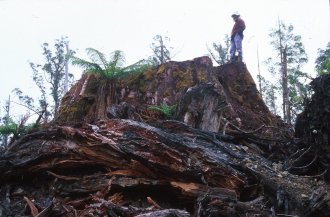
A Eucalyptus regnans giant stump is all that remains of one of the huge trees
felled to make way for the logging road in coupe SX 15A in the Styx Valley.
^http://www.lexicon.net/peterc/Tasmania/Tas01.htm
.
‘Forestry Tasmania’s Sustainability Charter for Threatened species, communities and habitats‘
.
“Aim: Maintain viable populations of all existing animal and plant species and communities found in State forests. This will involve:
Increasing understanding of ecology and habitats of threatened species and communities and implementing appropriate management
Active participation in the management of threatened species, communities and habitats
Implementing specific strategies to protect threatened species and their habitats.”
.
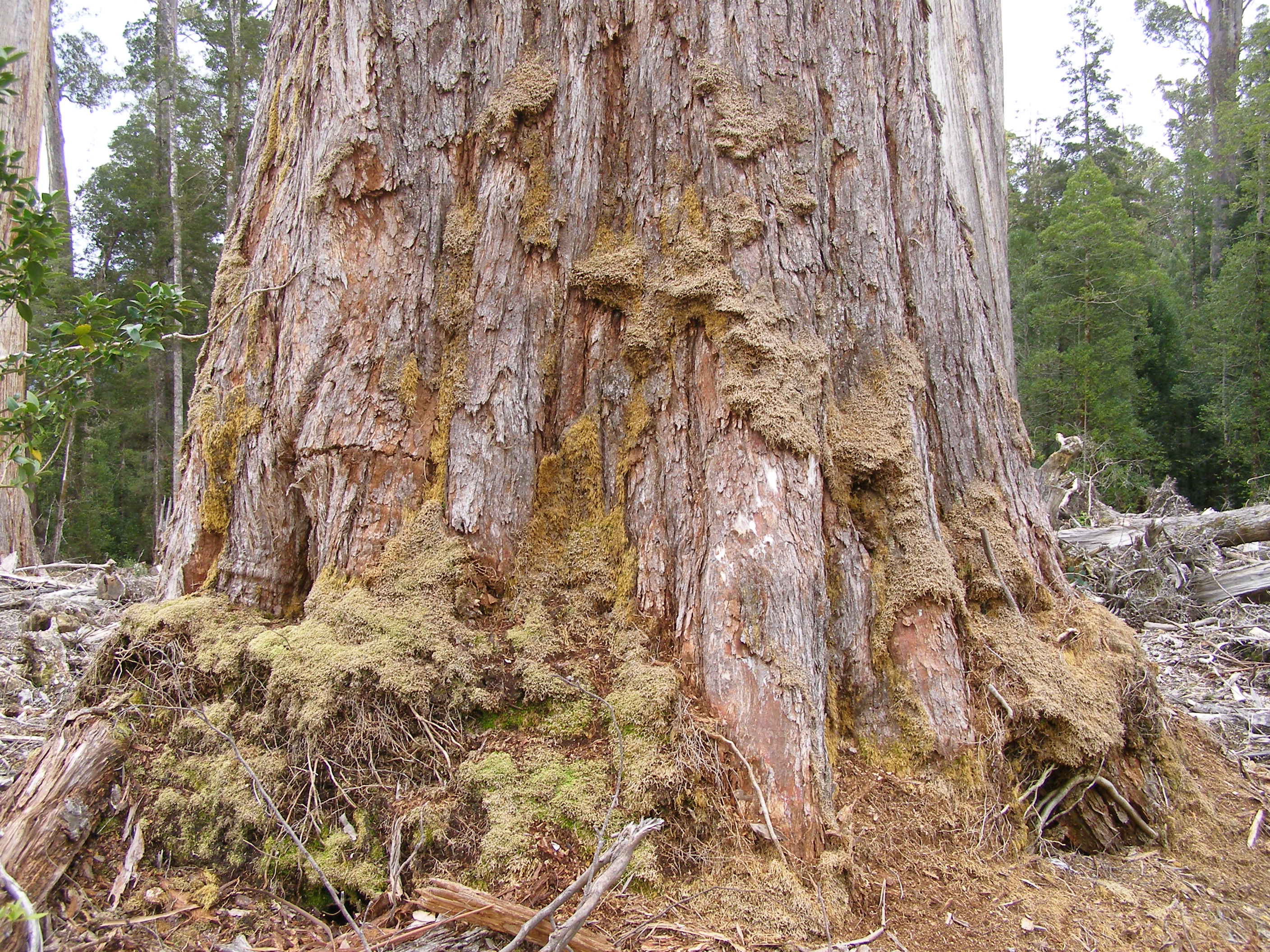
A rare giant Eucalyptus regnans of the nearby Upper Florentine
(Photo by Editor 20110928, free in public domain, click photo to enlarge)
.
2012 Year of the Forestry Scab?
.
In late 2011 and now going into 2012, Forestry Tasmania are at it again, trying to clearfell the Styx Valley of its old growth.
Get the lastest from the forest protest at The ObserverTree below Mount Mueller in the Styx Valley.
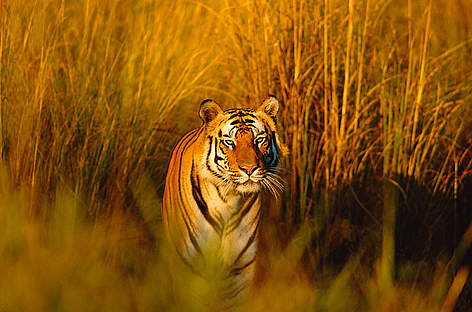
In February 2010, at the advent of the Chinese Year of the Tiger, the World Wildlife Fund (WWF) reported that tigers were in crisis around the world. With as few as 3,200 left of this endangered species compared to 100,000 a century ago, it was clear that this would be the vital tipping point for tigers.
Two key causes of the tiger’s plight are (1) poaching to feed consumer demand for tiger body parts, mostly for use in traditional Asian medicines (TCM) and folk remedies, and (2) deforestation as more and more forests are cleared for paper and palm oil, tiger habitat disappears daily.
.
‘New Study shows Bengal Tiger’s Habitat in Danger’ .
..
A new study by WWF scientists and partner organizations has found global climate change could shrink Bangladesh’s Sundarbans tiger habitat by 96 %, potentially reducing the tiger population to fewer than 20 breeding individuals!
An estimated sea level rise of 11.2 inches above 2000 levels by 2070 means this unique mangrove ecosystem could disappear within half a century.
The Sundarbans delta is the largest mangrove forest in the world.
This UNESCO World Heritage Site is shared by India and Bangladesh and sits at the mouth of the Ganges River. It is home to an estimated 254-432 Bengal tigers, the only tiger population adapted to live in mangroves. The tigers here regularly swim between islands and are the only tigers to have crabs and other seafood as an important part of their diet.
The area is an amazing ecosystem that houses a plethora of species including the spotted deer (the tiger’s prey), water birds, many kinds of fish, marine mammals, crocodiles, and snakes. The landscape naturally protects the area from natural disasters such as cyclones, storm surges, and wind damage. The mangroves are home not only to endangered fauna like tigers, but also to several million people who depend on the Sundarbans for their livelihoods.
The Bengal tiger population has already been under threat from poaching and habitat destruction and loss, and research suggests that the seas may be rising faster than originally thought.
Worldwide, tigers occupy only 7 percent of their historic range with as few as 3,200 left in the wild. The study encourages local governments to take immediate action to conserve and expand mangroves while cracking down on poaching. It suggests that globally, countries should work strongly on reducing greenhouse gas emissions in order to save the Sundarbans.
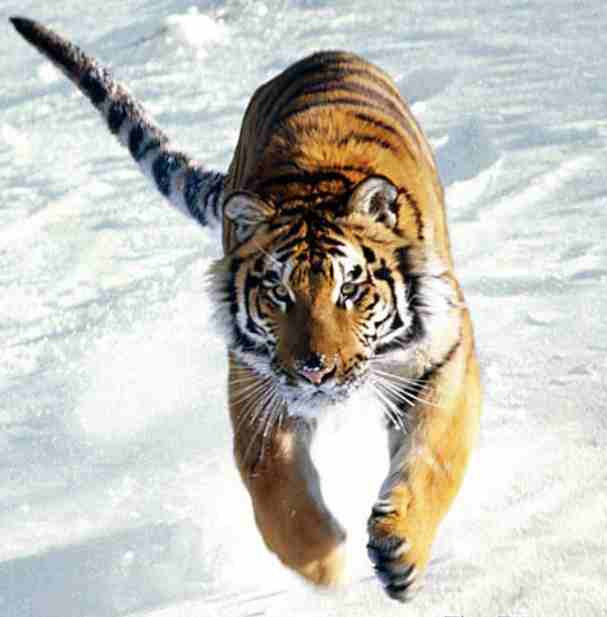
The Siberian tiger is a tiger subspecies inhabiting mainly the Sikhote Alin mountain region with a small subpopulation in southwest Primorye province in the Russian Far East. In 2005, there were 331–393 adult-subadult Amur tigers in this region, with a breeding adult population of about 250 individuals.
The main threats to the survival of the Siberian Tiger are (1) poaching, (2) habitat loss, and (3) illegal hunting of ungulates, which are tigers’ main prey (Ed: looks similar to a lama). Because they increase access for poachers, roads are another important threat to the Siberian tiger. Intrinsic factors such as inbreeding depression and disease are also potential threats to this big cat, but are less understood.
The Siberian tiger (Panthera tigris altaica), also known as the Amur tiger
.
Poaching
.
Roads in Amur tiger habitat, Russian Far East Wildlife Conservation Society (WCS) research has demonstrated that human-caused mortality accounts for 75-85% of all Amur tiger deaths. Current estimates indicate that 20-30 tigers are poached in the Russian Far East each year, although actual numbers may be higher.
Population modeling based on Siberian Tiger Project field data suggests that poaching rates exceeding 15% of the adult female population could have dangerous repercussions, especially as tigers have fairly low population growth rates compared to other big cats. Analysis of mortality data in Sikhote-Alin Biosphere Reserve indicates that poaching rates may be at least this high in a significant area of Russian tiger range.
Tigers are most commonly poached for their fur and for their body parts, such as bones, that are used in Traditional Chinese Medicine. The opening of the border between China and Russia after the fall of the Soviet Union has now made it possible to easily transport goods to Chinese markets and beyond. Although tigers are a protected species in Russia, enforcement agencies have very limited ability to catch convict poachers, and, even when this happens, fines are relatively small and disincentives insufficient. Poaching problems are further exacerbated by low incomes in many rural areas of the Russian Far East – sale of a tiger skin and bones represents a substantial source of income for poor people in remote villages.
It is also common for hunters to poach tigers to eliminate competition for ungulates and for locals to kill tigers in retaliation for depredations on domestic animals such as dogs and cows.
.
Habitat Loss
.
In Russia, human population growth does not threaten habitat as it does in many other tiger-range countries. However, activities such as logging, grazing, various development projects and uncontrolled fires are all resulting in direct habitat loss in the Russian Far East. Habitat is increasingly being divided into isolated patches, particularly at the southern edge of Amur tiger range.
Logging takes place in most of Amur tiger habitat. Although existing guidelines for timber harvest are actually quite sufficient, significant illegal logging and overharvest still occur. Selective logging, rather than clear cutting, is most common in tiger habitat, and does not seriously impact the quality of the habitat, if access to the extensive road system is controlled (thereby limiting poaching).
Fires are another important form of habitat loss. Many local residents consider fires to be the main cause of loss of forest habitat in parts of Primorsky Krai, and Amur tigers avoid areas that have burned, as they provide neither adequate cover for hunting, nor the habitat needed for prey.
.
Illegal Hunting of Ungulates
.
Illegal hunting of ungulates such as deer and wild boar significantly reduce prey availability for tigers. While official estimates continue to report stable numbers of ungulates, many hunters and wildlife biologists believe that abundance of ungulates in the Russian Far East has decreased considerably over past 15 years. Analyses from WCS’s Amur Tiger Monitoring Program clearly demonstrate that ungulate numbers are often 2-3 times higher inside protected areas, which are nonetheless impacted by poaching, though to a lesser extent.
Low ungulate numbers also foster a sense of competition between hunters and tigers. When ungulates numbers are low, it is easy to blame tigers, even when the root cause of population declines is over-harvest by humans. When there is little prey available in the forest, tigers sometimes enter villages and prey on domestic animals, including dogs and livestock, which creates tiger-human conflict situations.
.
Roads
.
The number of roads in Amur tiger habitat is increasing steadily as logging activities and development push into even the most remote regions. Besides allowing greater access for poachers, roads increase tiger mortality from vehicle collision, and increase the probability of accidental encounters between tigers and people, leading to tigers being shot out of fear or opportunity.
Roads also provide poachers greater access to ungulate habitat, which reduces tiger prey abundance. Roads can be divided into two categories: primary roads, which are maintained year-round and provide access between villages and towns; and secondary roads, which are not regularly maintained but nonetheless allow access.
From 1992 to 2000 the Wildlife Conservation Society studied the fates of radio-collared Siberian tigers living in areas with no roads, secondary roads and primary roads. Our findings:
100% survival rate for adult tigers living in areas with no roads
89% survival rate for adult tigers living in areas with secondary roads
55% survival rate for adult tigers living in areas with primary roads
.
These results clearly demonstrate that the presence of both secondary and primary roads both greatly increase the odds of tigers being poached, and indicate the need for road closures and access control. (Ed. Main roads contribute to tiger road kill reducing tiger populations by about a half).
The number of tigers in the world has diminished at an alarming speed in recent years, global conservation group WWF cautioned on Wednesday, blaming poaching for much of the decline. “We are left with roughly 3,500 tigers (2008) all around the world now,” Bivash Pandav, a tiger specialist at the World Wildlife Fund, said, pointing out that “five years back, the estimate was around 5,500 to 6,000.” [Ed: In 2010 total world population was 3,200, and in 2011?, 2012?]
.
In India, which is home to nearly half of the world’s tigers, or 1,400 animals,
the number of the big cats has shrunk by 60% over the past three to four years!
…Pandav said during a visit to Sweden.
A century ago, some 40,000 tigers roamed the Indian subcontinent, according to the WWF, which singles out poaching, widespread destruction of the tigers’ natural habitat and human hunting of their prey as the main causes of today’s dire situation.
“Poaching is primarily to meet the demand for tiger bones in Traditional Chinese Medicine (TCM)… That’s the immediate reason behind the decline of tigers,” Pandav explained.
“The situation is pretty bad in the sense that they (the tigers) are rapidly being wiped out from many parts of their range,” he added.
.
According to the WWF:
On the Chinese market, a dead tiger can be worth “tens of thousands of dollars”
The United States is the world’s second largest market for tiger products.
.
Despite the daunting challenge of preserving tiger populations, Pandav insisted that “there is definitely hope,” pointing out that big cats “are prolific breeders (and) produce large numbers of offspring.”
“Despite all the problems, there are a couple of places in India (where tigers) are doing pretty well,” he said.
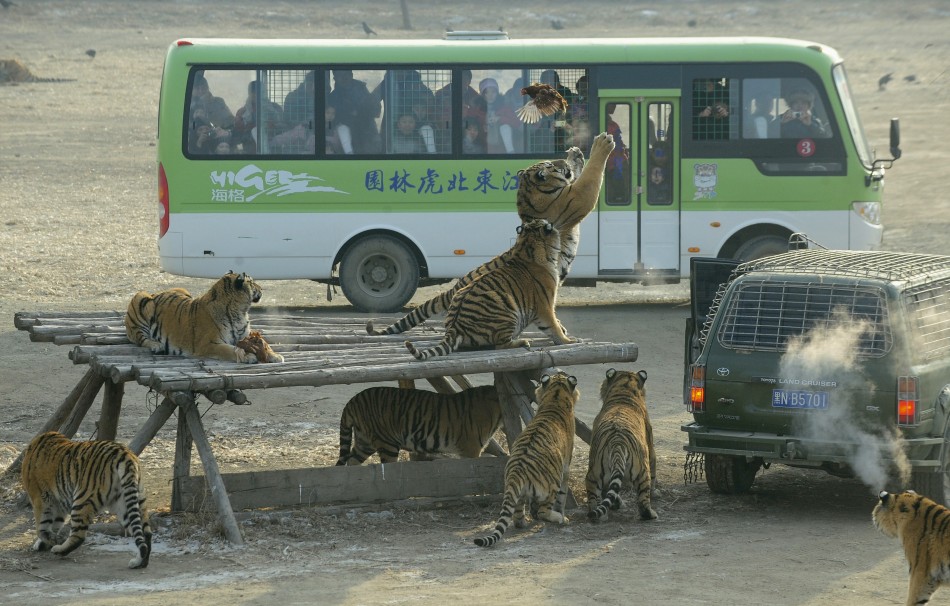
To rectify the overall situation however, the animals need access to forests, food and undisturbed habitats, Pandav said, insisting that the main priority was to protect the tigers from poachers and put “pressure on China to stop the farming of tigers.”
“The Chinese government is actively planning to legalise the trade (of tiger products) and if they legalise this trade then the demand for wild tigers is going to increase many fold,” he said, pointing out that people preferred products from wild tigers over farmed animals. That is going to be the death blow for the tigers in the wild,” he said.
..
‘At the beginning of this year, a ground-breaking, new, and scientific tiger census, which took two years to complete, announced that there were 1,411 wild tigers left in India. By November, the Government had admitted that of that number, 14 tigers had been poached this year. The figure actually may be nearly double.
The poaching cases registered and seizures of body parts of tigers this year show that around 27 of the big cats have been killed in 2008, making the number of wild tigers in India less than even 1,400, and showing that government efforts have failed so far to deter poachers.
“On an average, 25 tigers are poached every year”
.
…says an official from the NTCA. Data compiled by the WPSI shows an equal number, 27 tigers, were killed in 2007.
In January, a tiger survey commissioned by the Government indicated that there were only five-seven tigers left in Panna. Now, tiger experts fear the number may actually be just two. Kanha, also in Madhya Pradesh, lost a tiger to poaching by electrocution, using an 11,000-volt current, this November.
According to data compiled by the Wildlife Protection Society of India (WPSI), there have been 27 instances of tiger skins and parts being found in different parts of the country in 2008. The Wildlife Crime Control Bureau (WCCB), which came into existence this year, recovered a tiger skeleton from Gurgaon and two tiger skins from Himachal Pradesh, a case that involved a Tibetan national.
“Tiger killing may be higher than what recorded numbers tell us,” admits National Tiger Conservation Authority Member Secretary Rajesh Gopal. “Poachers are very clandestine and at times even a tiger carcass may not be found.”
A WCCB official said their main problem was that the trade in tiger parts was trans-country and inter-state, necessitating strong intervention from the Centre.
“Day before, we managed to get a case registered in Bihar for Dariya, a tiger poacher, who was arrested in December in Katni, Madhya Pradesh. A case had to be registered in Bihar where he is suspected to have poached tigers from the Valmiki tiger reserve. We have to expedite history-sheeting quickly to facilitate arrest of poachers who travel and escape extensively,” he added.
“The fact that tiger numbers are going down but poaching remains constant is a huge cause for concern. The number of tigers as per the Census is very low. If we don’t improve protection, India may well lose its tigers,” says Belinda Wright, Executive Director, WPSI.
The tiger census also shows another trend: that India’s tigers are now found only in areas with a high degree of protection, which is sanctuaries or existing tiger reserves. Recognising this, the NTCA has given approval to as many as 12 new tiger reserves this year, of which four — Pilibhit (Uttar Pradesh), Sunabeda (Orissa), Rapa Pani (MP) and Sahyadri (Madhya Pradesh) — have got in-principle approval.’
.
Videos on the plight of the Bengal Tiger
.
Videos in 2010 on the Bengal Tiger by big cat expert Dr. Alan Rabinowitz i, hosted by the BBC on its Lost Land of the Tiger series.
Click the following link then scroll down to watch the four episode extracts:
The tiger is at the top of the food chain in all the ecosystems it lives in. If one species in a food chain becomes extinct there is a knock-on effect on other species. The loss of a main predator can actually cause the extinction of a prey species as greater competition presents a threat to a species.
When the Bali and Javan tigers became extinct in the 20th century, poachers turned their attention to the Sumatran tiger. Which animal will be exploited into extinction once all the tigers are gone?
If tigers were to go, the forests which are currently protected as key habitat would be more likely to fall victim to illegal logging, conversion to agriculture and development. This leads to greater CO2 emissions and climate change. Deforestation currently accounts for 15% of global greenhouse gas emissions. Which species live alongside the tiger? Many of the species which could be affected by the disappearance of tigers are also endangered and already fighting for their own survival. The 5 sub-species of tigers live in some of the most spectacular parts of the world which provide a home for some other amazing species, including:
.
A herd of Siberian tigers chased and devoured live chicken flung at them from a tourist safari bus at the Siberian Tiger Forest Park in Harbin, north-west China, on Tuesday.
Siberian Tigers Grab at Live Chickens Tossed at Them to Tourists’ Delight in China
20111227 (two days ago)
Photo by Sheng Li
The white form of the Grey Goshawk is the only pure white raptor in the world. In Tasmania, Grey Goshawks, are listed as endangered species, with their nesting habitat affected by logging. It favours tall closed forests including rainforests and particularly those of the large wild tracts of tall forest across the Tarkine.
Grey Goshawks form permanent pairs that defend a home territory year round. Both sexes construct a stick nest lined with leaves high in a tree fork, and often re-use the same nest. While the female does most of the incubation, the male relieves her when she needs to feed, and catches most of the food for the young, which the female tears up for them to eat.
Bordered by the Arthur River in the north, the Pieman River in the south, the Murchison Highway in the east, and the ocean to the west, Tasmania’s wild Tarkine is a magnificent wilderness sanctuary but threatened by ongoing industrial interests from mining and logging, as well as from road making, off-road vehicles, poaching, cattle and exploitative tourism.
Scott Jordan from the Tarkine National Coalition says:
“We see it as an area containing great wilderness values, a lot of natural – as well as cultural – values. We see it as an area that really needs to be protected and enjoyed.”
Volunteer Tasmanian Environmentalist, Scott Jordan
The Tarkine National Coalition wants to see it made a national park, and protected under a World Heritage listing, before it is ruined and goes the same way as Mount Lyell.
With Tasmania’s alternating Labor and Liberal governments still hell bent on carving up Tasmania’s remaining wilderness, they have divvied up more than 50 mining exploration licences in the Tarkine.
There are some ten proposed mines set to dig up the Tarkine!
.
Whereas Alan Daley from industrial miner Tasmania Magnesite has plans to develop an open cut mine. He is reticent about identifying the Tarkine…“I’m not sure what the Tarkine is. To my knowledge there isn’t a boundary yet defined as the Tarkine.” I understand the marketing value.”
Tasmania Magnesite (Beacon Hill Resources) wants to establish an open cut magnesite mine within the Keith River area, Shree Minerals wants an open cut iron ore mine at Nelson Bay River, and Venture Minerals are planning open cut mining for tin and tungsten in the rainforest at Mount Lindsay.
Savage River MineThis is on the northern boundary of the Tarkine
.
Editor:
It has become apparent to this observer, that many of those with a broad commitment to protecting Nature are comparatively young. Whereas those ‘baby-boomer‘ industrial executives and old school Labor/Liberal politicians seem narrower in outlook, committed to pursuing 20th Century exploitation as if such business-as-usual plundering of Nature is limitless. May be I’m generalising.
. Tim Flannery:
“One of the greatest tragedies of Tasmania is that its European inhabitants have always wanted their island home to be something it is not – a little England perhaps, or the world’s largest sheep paddock or even, in later years, the Ruhr of the South (which was to be powered by Tasmania’s out-of-control hydro schemes). All such dreams have failed, but nevertheless their pursuit has cost the present generation dearly.” (Tarkine, 2010, p.4-5).
.
Tasmania’s Queenstown Left behind by 19th and 20th Century industrial minersThis is south of the Tarkine
"We're coming to you from the custodial lands of the Hairygowogulator, Tarantulawollygong, and Longdrop country, within the Australia nation since 1901. From our home in Inner West Katoomba we pay respects to uncles and grandaddy elders past, present and emerging from their burrows. So wise to keep a distance out bush."
Recent
Supporting Us
A VOICE FOR NATIVE HABITAT
One’s solo mindful walk…
The Friends of Katoomba Falls Creek Valley Inc. in The Gully
The Gully Collection
Save Atlas Campaign
The Friends Archive: War and Peace with the Blue Mountains ‘hysterical’ Society
 Bullaburra’s rural amenity
Looking east along Great Western Highway towards Railway Station (left)
(Photo by Editor 20110115, free in public domain, click photo to enlarge)
Bullaburra’s rural amenity
Looking east along Great Western Highway towards Railway Station (left)
(Photo by Editor 20110115, free in public domain, click photo to enlarge)
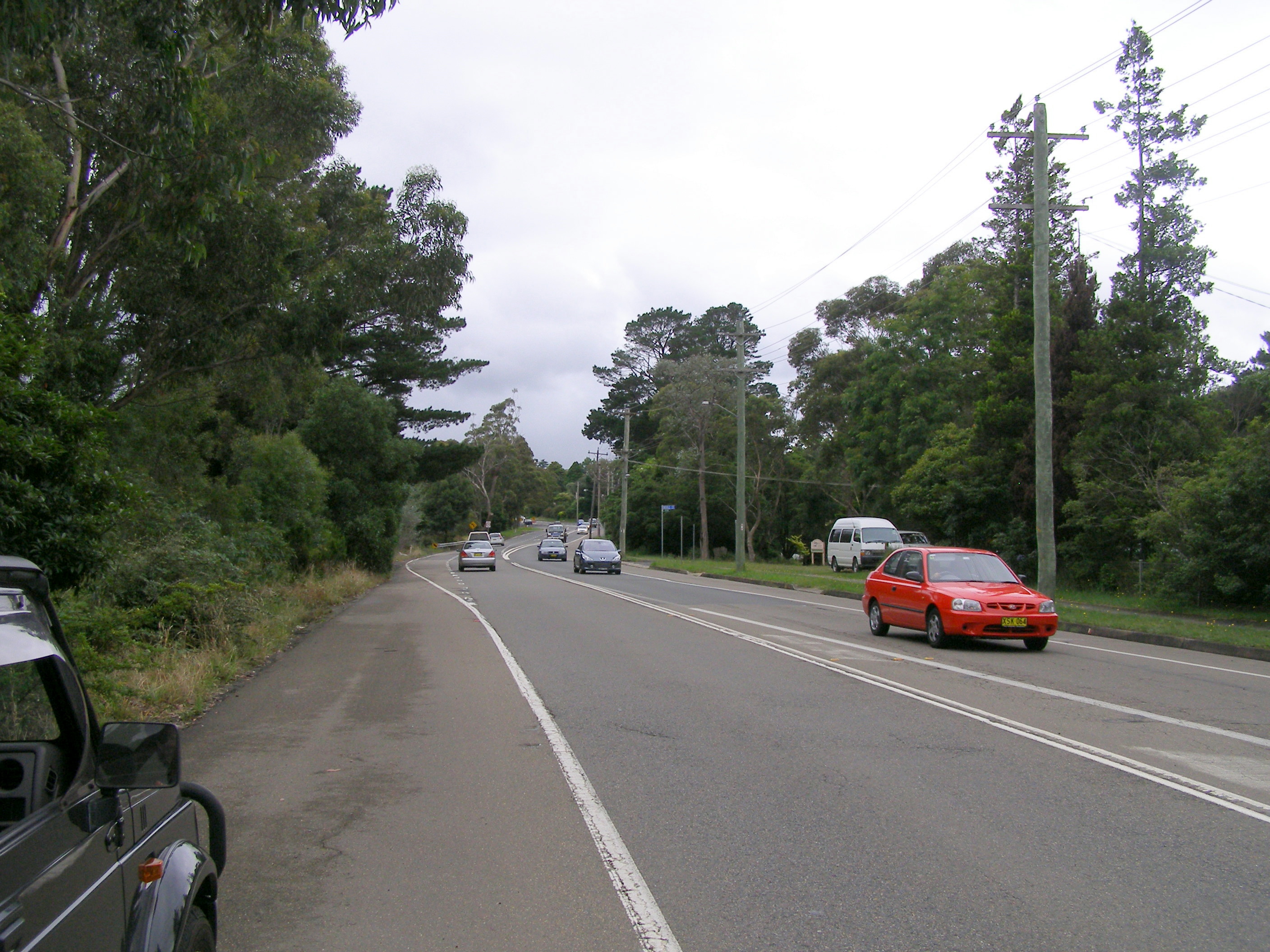 Bullaburra looking east along Great Western Highway towards Noble Street (far centre)
(Photo by Editor 20110115, free in public domain, click photo to enlarge)
Bullaburra looking east along Great Western Highway towards Noble Street (far centre)
(Photo by Editor 20110115, free in public domain, click photo to enlarge)
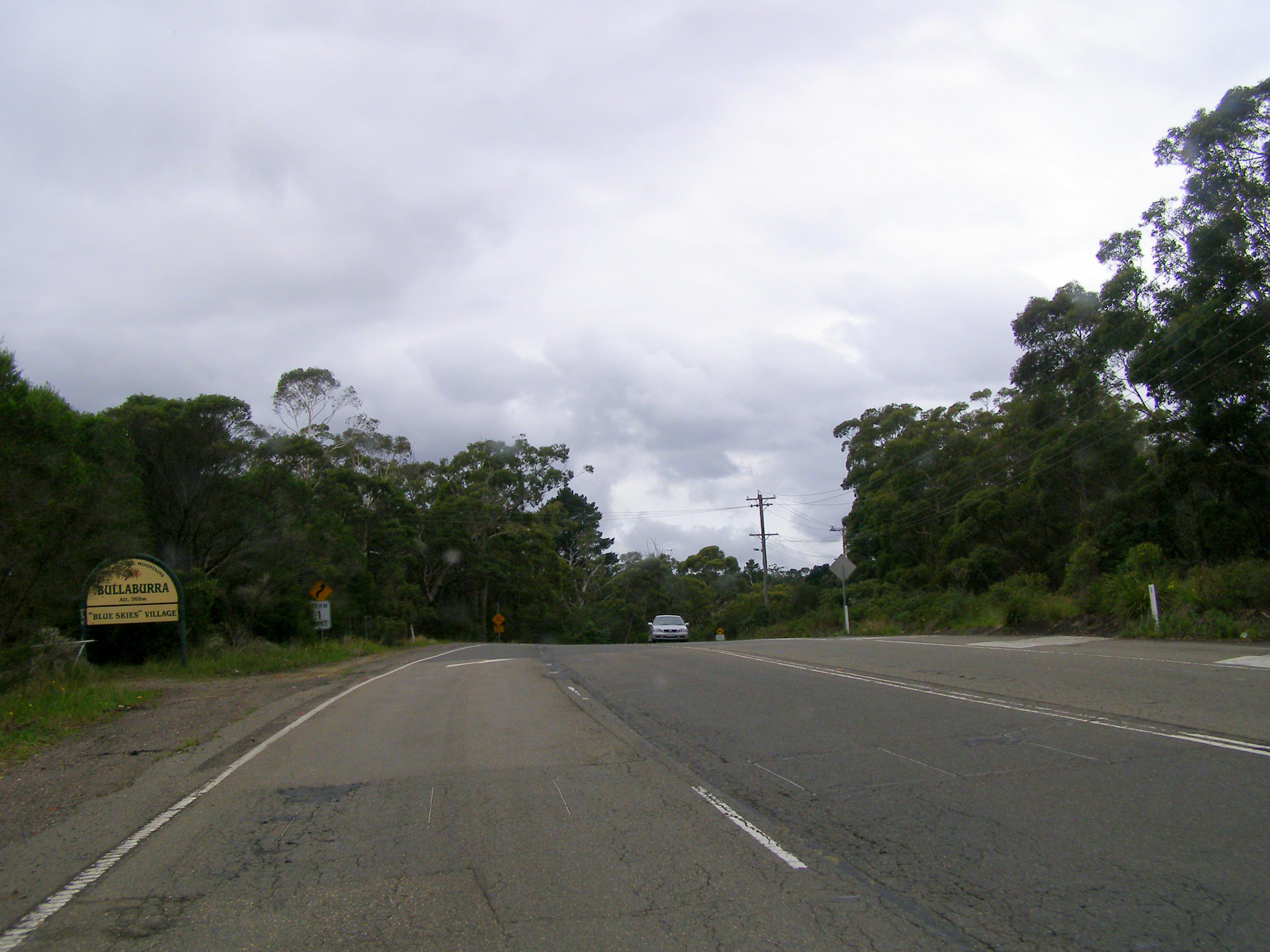 Bullaburra: “Blue Skies” Village – reads the sign (Aboriginal translation)
Western approach to Bullaburra along the Great Western Highway
(Photo by Editor 20110115, free in public domain, click photo to enlarge)
Bullaburra: “Blue Skies” Village – reads the sign (Aboriginal translation)
Western approach to Bullaburra along the Great Western Highway
(Photo by Editor 20110115, free in public domain, click photo to enlarge)
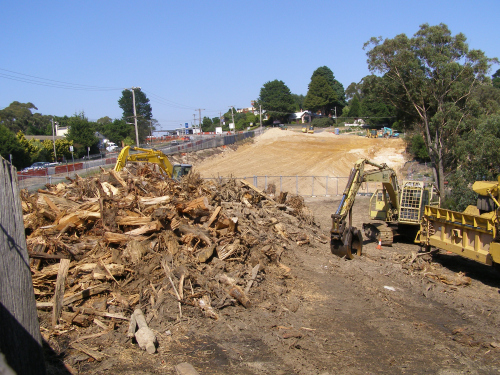 This is what awaits Bullaburra – destruction of rural amenity
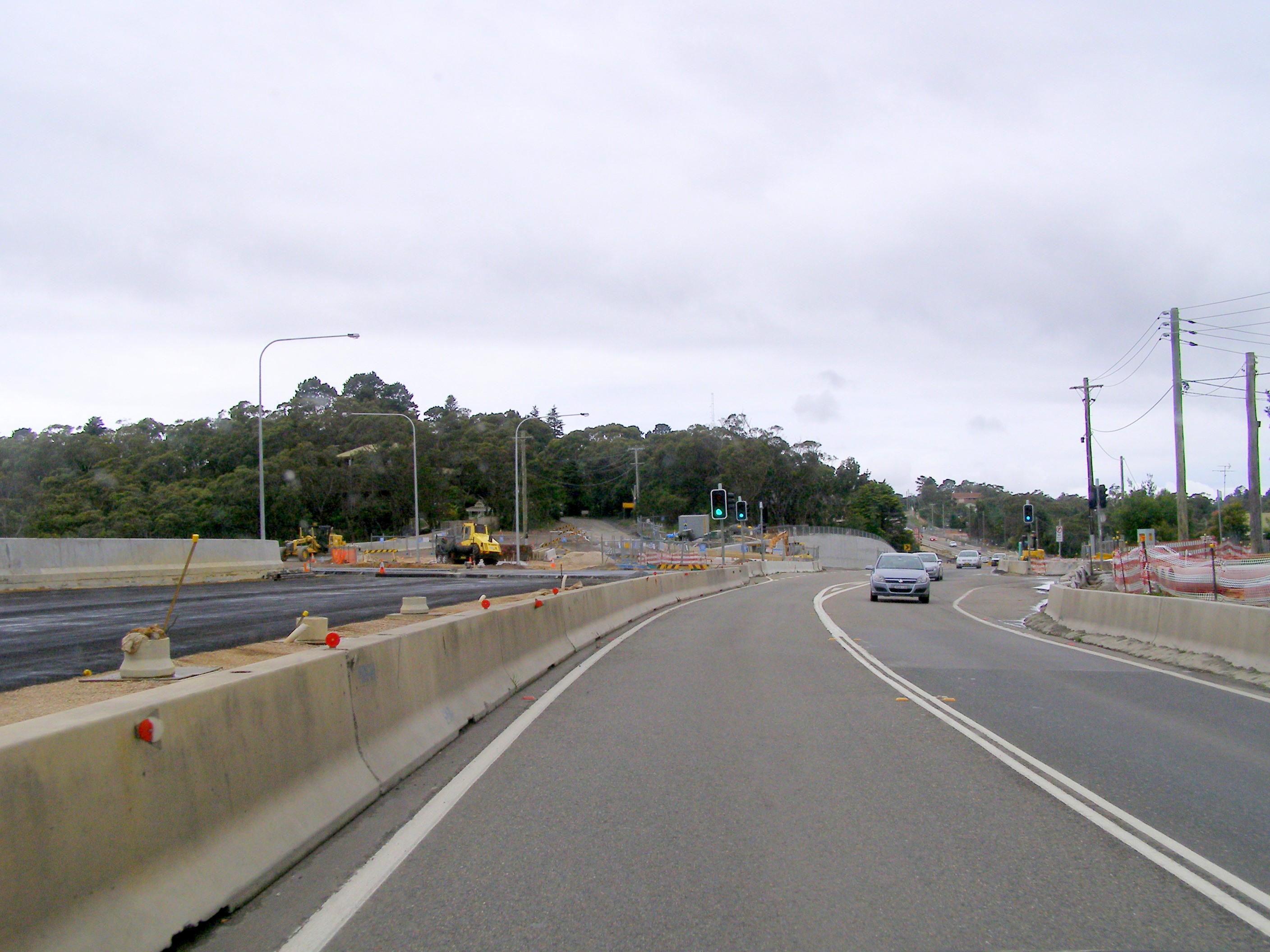 More of what awaits Bullaburra – a trucking expressway amenity!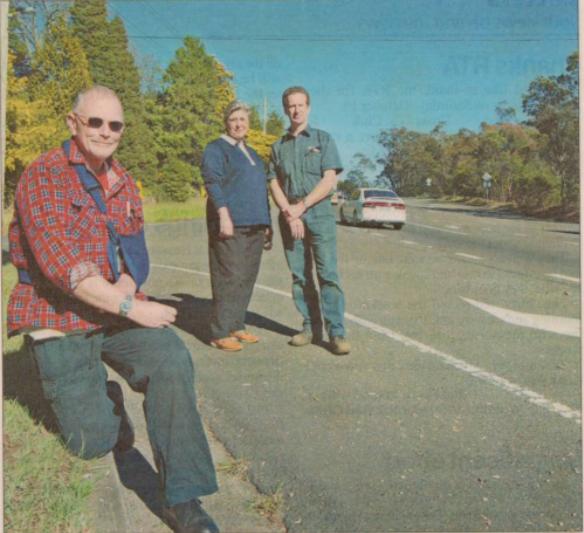
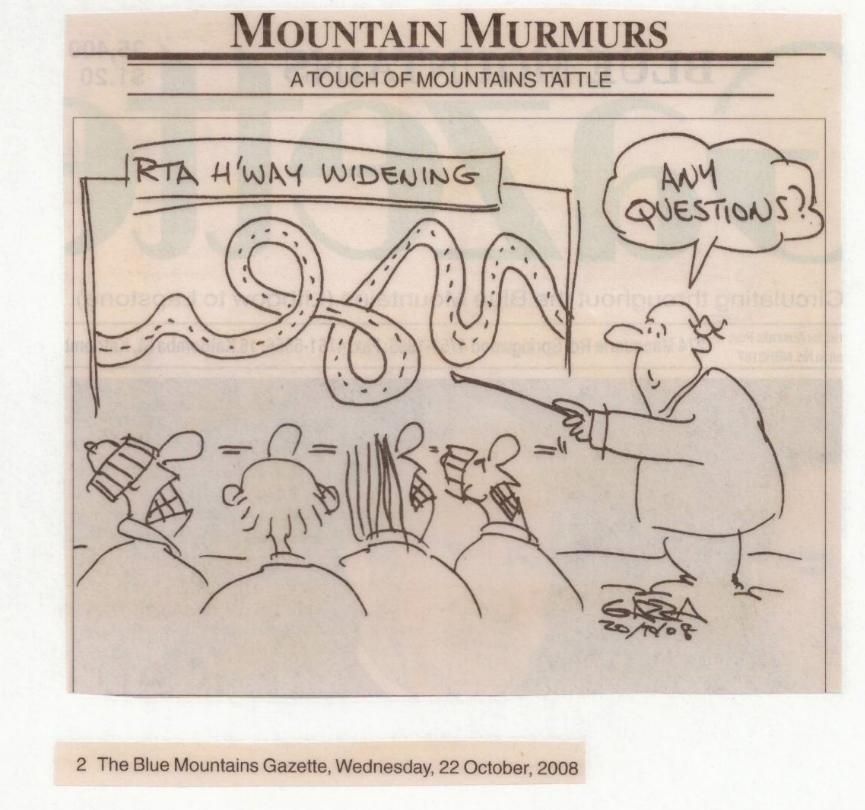
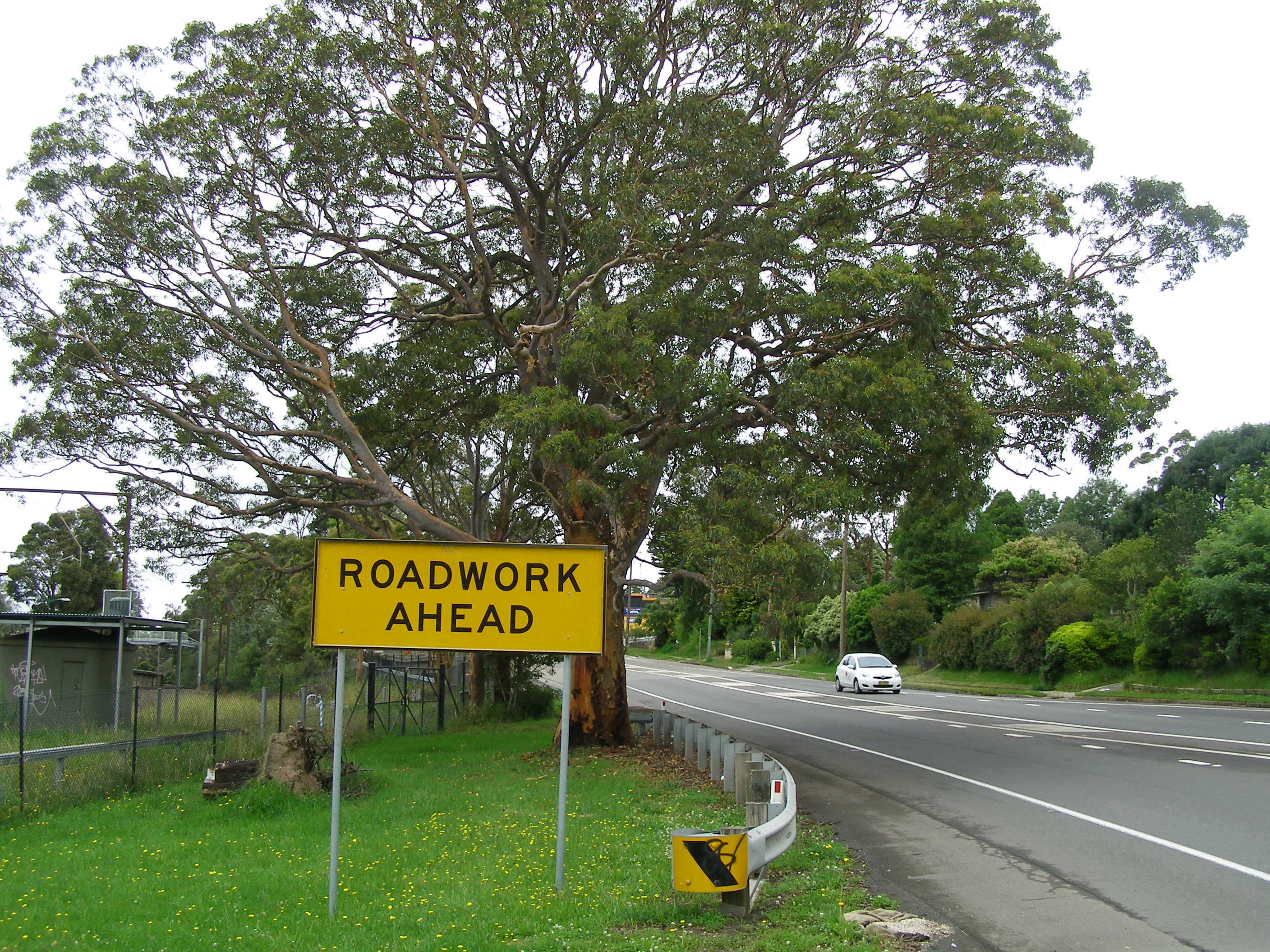 Bullaburra’s Angophora – on RTA’s death row
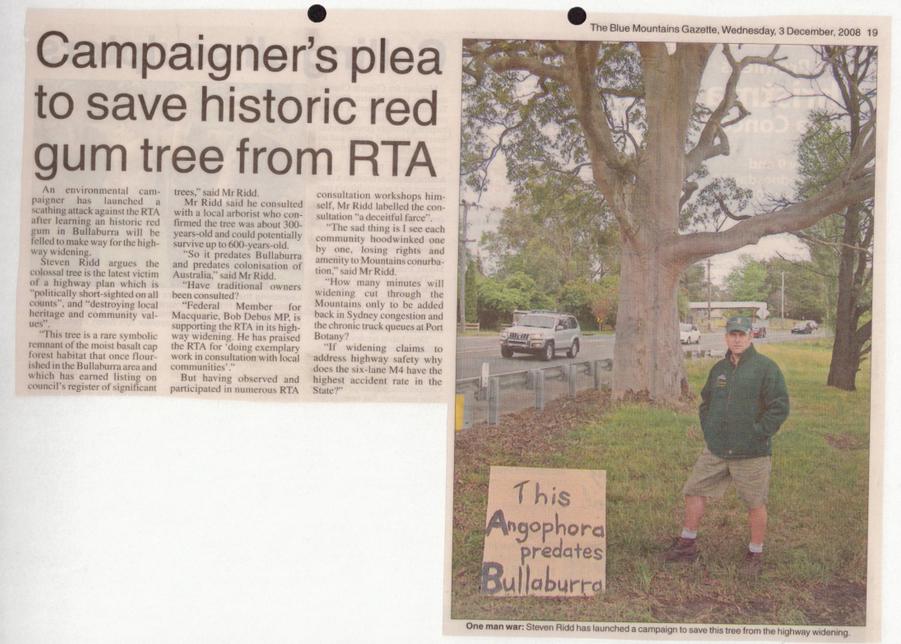 Campaign article in Blue Mountains Gazette 20081203, p19.
.
This followed a quarter page campaign article published in this newpaper on 20081105 costing this Editor $460.
(Click image to enlarge)
Campaign article in Blue Mountains Gazette 20081203, p19.
.
This followed a quarter page campaign article published in this newpaper on 20081105 costing this Editor $460.
(Click image to enlarge)
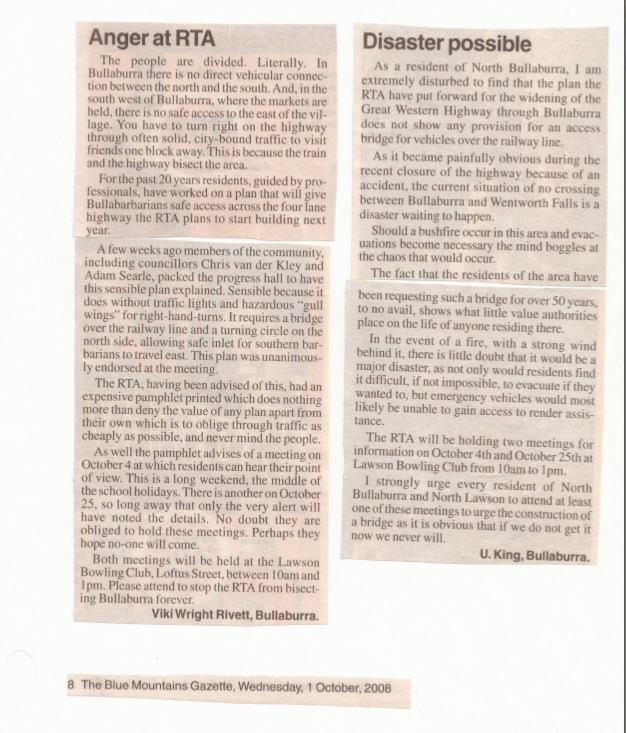 (Click image to enlarge)