Archive for the ‘Threats from Pollution’ Category

Blue Mountains ‘City’ Council’s heritage hypocrisy persists

Tuesday, December 23rd, 2025

Blue Mountains ‘City’ Council’s development approval process is organisation-wide, culturally mealy-mouthed and corrupted from one’s learned personal experience since 2001 and of records well prior, indeed since 1957 from damning local accounts.
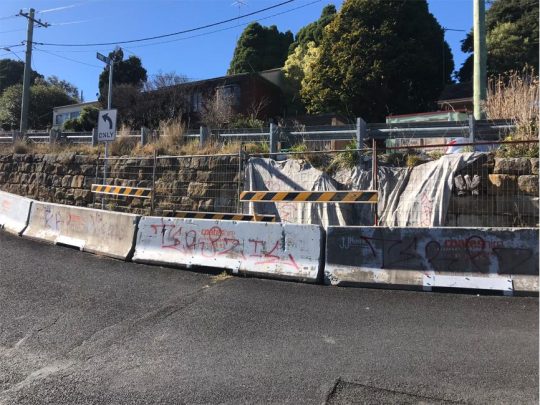
 

Heritage Katoomba – intersection of Cascade and Pine Streets.  Council neglect of The Gully Catchment is systemic.  This 19th Century heritage streetscape has been ignored for decades by Blue Mountains (City) Council with its city-centric mindset, hateful of our colonial heritage.  [Photo: By author June 2024].


PART  I.    A Land-Use Development issue at hand


We highlight a non-complying third outbuilding development by an immediate neighbour (being a current work in progress in December 2025) located in a low density residential zoned and heritage listed area of Katoomba in the Blue Mountains.   Verbal feedback is that it is set to become a new ‘backyard sauna‘ situated just 30cm from this author’s back fence boundary, yet our research shows that the build is prohibited under various local Council and Sydney Water planning rules. 

Post build, the currently owner-occupied residential property (with renovated dwelling) is, news to hand, now intended to be let out to online Airbnb-type tourists for likely tourist group parties.  Include also the likes of online holiday let ‘Stayz’, ‘Bookings.com’, etc.    It will thus far become number 13 holiday let of a owner occupied residential house and land property within a recent trend of invading gourmet Airbnb-profiting investment owners in this heritage residential only conservation area.’ 

An intro heads up:  Check out this and the pricing:  ^https://holidaybluemountains.com/properties/


This regrettably sanctioned ‘blind-eyed’ allowance by local Council continues to undermine and engulf our quiet heritage listed residential cul-de-sac (where we’ve owned and lived as a small family since 2001).  Our century-old home, which we are ongoing restoring in heritage sympathy with colonial cottages around us is listed as 1883 ‘North’s Estate’

One serious concern is that local tenants, once prominent in this precinct have simply been priced out of available rental accommodation by greedy distant investors of residential properties around us on the band wagon of holiday letting their residential properties for many times the rental market average.  Local tenants have nowhere to go but to relocate far flung from family way afar.  Indeed, its sad and bad times, all encouraged by government failure and lack of interest in their constituents and all three levels of Australian government – federal, state and local!
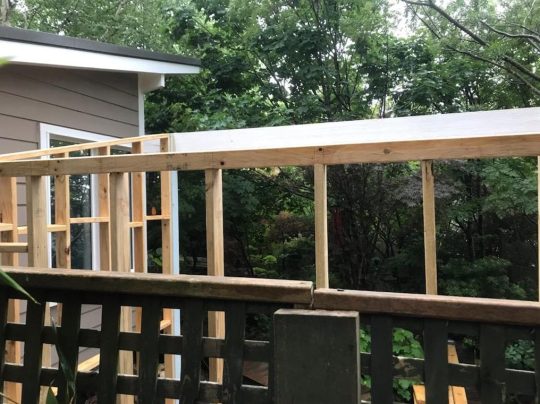
 

An unnotified, unapproved new backyard sauna right on our back fence to be part of a new Airbnb for guests to party.  WTF!


A case in point is an ongoing current over-development/overcrowding of a residential property In Katoomba situated close by us, situated within a designated heritage (historical) conservation area.  It is in breach of many Council development rules.  Yet, despite our expressed concerns, citing of legislative breaches (ignored), then our submitted complaint, Council has just turned a blind eye and wipes its hands, citing NSW state legislation supposed exempting legislation.   Council’s attitude, by some blow-in inspector from Sydney, is that property owners may do what they bloody well want, heritage be damned, neighbours be damned!

As a Conservation Consultant, this little black duck didn’t come down in the last shower!  

This is a non-public photo of the subject property, only to demonstrate the reality anonymously.  It is situated somewhere within a listed heritage conservation area and there exist multiple ‘rules’ regarding development for this area and this address. 

Firstly we know, because firstly we have ourselves gone through the property development rules, guidelines, red tape restrictions, respecting where we are, sensitive to the heritage amenity and to our neighbours.  We eventually succeeded in having our plans approved by Council way back in 2005 after much effort, research and personal cost.  Our renovation project is both a sympathetic restoration and quality classic home improvement to the long neglected cottage we purchased back in 2000. 

Secondly, Steven Ridd, this joint owner has spent many years since 2001 as a environmental/conservation activist  initially with The Friends of Katoomba Falls Creek Valley Inc.,  The Blue Mountains Conservation Society, The Colong Foundation for Wilderness Inc., and The Habitat Advocate – ongoing here since 2001.


PART  II.   Disclaimer


(1)   This article herein expresses the concerns of this author. 


(2)   This article is yes, political. 


(3)   The views, assumptions and opinions expressed in this article are the author(s) own. They do not purport to reflect the official policy of The Habitat Advocate or associates. Data references (images, documents, links, copyright, sources, etc.) appearing in this article are not necessarily controlled or monitored by The Habitat Advocate.


(4)   The information provided on this [Website/in this Article/Document] is for general informational purposes only. 


(5)   This article and its author hold absolutely no malice towards the example property developer which is anonymously used in this article simply to highlight the ongoing systemic failures of the Blue Mountains local government to respect local heritage conservation. 


(6)   This article is purely intended as a critical commentary on the injustice of due process, using this property development example as a sample case study only.  The property owner is irrelevant, rather it is about the failure of due process.


(7)   All information is provided in good faith for informational purposes only.  This article is not a guide or advice.  It is citizen journalism.  We make no representation or warranty of any kind, express or implied, regarding the accuracy, adequacy, validity, reliability, availability, or completeness of any information provided.


(8)   Under no circumstance shall we have accept any liability to any reader for any loss or damage of any kind incurred as a result of the use of the [site/article/document] or reliance on any information provided therein.  A reader’s use of the [site/article/document] and/or reliance on any information is solely at the reader’s own risk.  This article  is citizen journalism.


(9)  The [site/article/document] cannot and does not contain [medical/legal/financial/etc.] advice.  The information is provided for general informational and educational purposes only and is not a substitute for professional advice.  Accordingly, before taking any actions based on such information, we encourage any reader to consult with the appropriate professionals. The use or reliance of any information contained in this [site/article/document] is solely at a reader’s own risk.


(10)  Due privacy is respected in this article.  No identifying information is provided in this article about the property or the owner which a member of the general public could recognise in any text or images included in this article.  However, we do photograph the builder – Wayne, and identify the Council inspector, both of whom have ignored all the development rules and need to be held accountable.


(11)  The purpose of this article is not about any individual property owner, but to critique and challenged an example the systemic wrong/illegal land use development approval process by Blue Mountains (City) Council over many years, and is clearly ongoing.
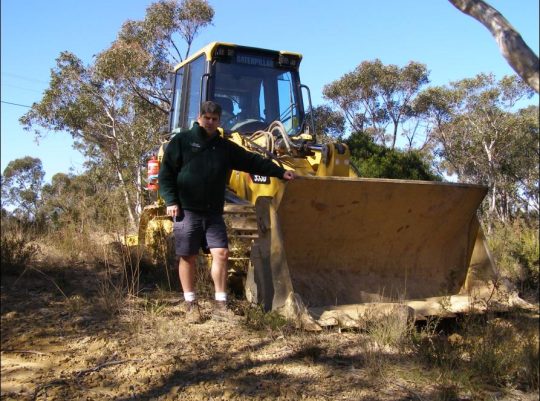


This author, The Habitat Advocate’s founder, Conservation Consultant, Steven Ridd.


PART  III.   Issue Background


So, how does Blue Mountains ‘City’ Council’s heritage hypocrisy persist?   

Well, here’s an extract map of part of  North’s Estate Conservation Area in Katoomba dating back to 1883, as registered by Council, yet only on paper for starters since Council’s filed it for a decade:
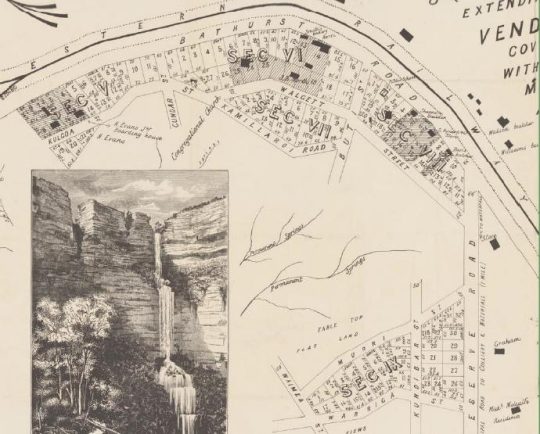
 

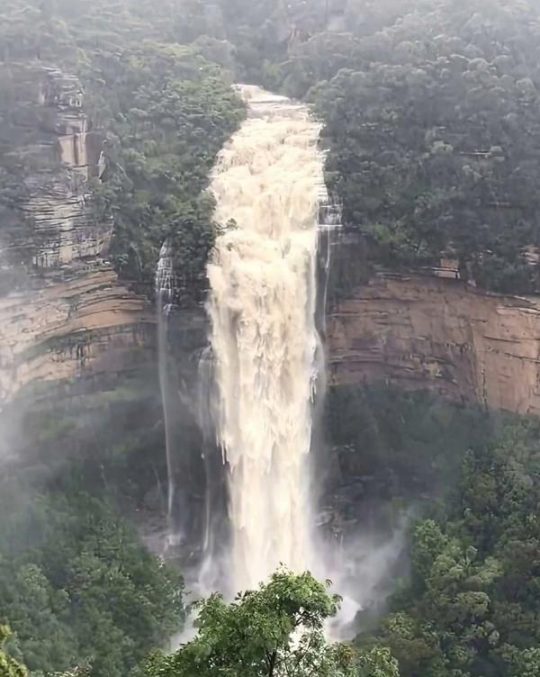
‘North’s Estate’ – quote: just two? housing subdivision precincts (north and south) skirting the valley in between back in 1883.  No!  Try nine sections. This is a portion of the fully image/reality. It was no less used by Blue Mountains Council’s ignorant ring-in ‘heritage’ consultants from distant Sydney. [AUTHOR’S NOTE:  An ‘artist’s impression of Katoomba Falls (in full flood) insert. The above Airbnb dwelling is within SEC IX.]


Council’s repeated actions fail to comply with its very own policies, planning documents, bi-laws, and PR gestures.   

That this local government Council (‘BMCC’ acronym) patting itself on the back about in its quarterly community newsletter is blatant propaganda about all the so-called good it is doing for the Blue Mountains – its oxymoronic slogan “A City within a World Heritage Area” boasted claim.   

Yeah?   Like how all its stormwater and unbunded rubbish waste tips (Blackheath | Katoomba | Blaxland) up on the plateau tops seep their toxic effluent into the surrounding groundwater to watercourses and water catchments through World Heritage?   

Check the mapping.  Council’s Katoomba Tip (with a fancy name), situated on a ridgetop off Woodlands Road, has for decades received household garbage and an array of toxic contaminants that have been allowed to seep into the ground water and down into nearby Yosemite Creek, over Minnehaha Falls (and swimming hole) thence downstream into Katoomba Creek, Govetts Creek and into the Grose River through World Heritage.   It is therefore not a wise move to swim in that swimming hole. 

The same has been allowed at Council’s Blaxland Tip to contaminate adjacent Cripple Creek (appropriately named in hindsight), thence into Fitzgeralds Creek and into the Nepean River.  Similarly, it is therefore also not a wise move to swim at Penrith Beach adjacent. 
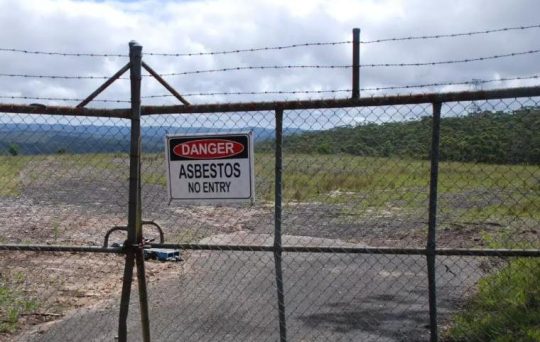
  

Council’s old Blackheath Tip on Ridgewell Road closed and fenced off since November 2017 due to illegal asbestos dumping.  The garbage and contaminants dumped there over decades have been allows to seep toxic waste into Victoria Creek below which flows into the Grose River within the Blue Mountains World heritage Area.  To date the site remains unremediated by Council.


And yeah?  Like how its five public swimming pools (all chlorine saturated) respectively at Blackheath, Katoomba, Lawson, Springwood and Glenbrook each drain their entire contents each winter into the surrounding watercourses.   So is that why all the native aquatic wildlife (fish, eels, freshwater crayfish and macro-invertebrates) – no longer subsist in the Blue Mountains World Heritage creeks and rivers downstream? 
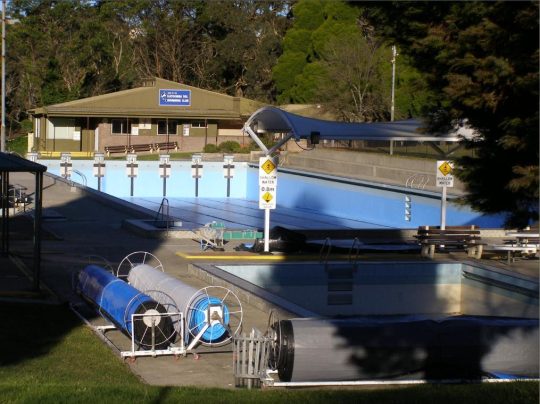
 

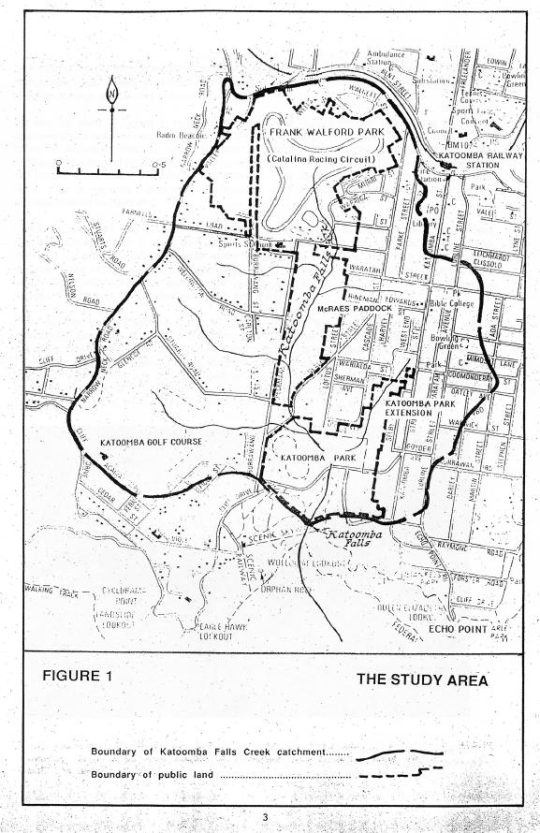
Council’s Katoomba Aquatic Centre 50 metre Olympic pool. Since first opening in 1972, it’s 2.5 million litres get drained not into the sewer system, but into the adjoining Catalina dam every winter which then drains into the adjoining creek.  That creek Katoomba Falls Creek flows over Katoomba Falls (1km south) which feeds Kedumba River through the Blue Mountains World Heritage Area and supplies Sydney’s drinking water in the dammed Lake Burragorang.   No wonder many Sydneysiders choose bottled water.  This is just one of five Council swimming pools which all do this.


Long dead are all downstream creeks and the Kedumba and Grose Rivers of our World Heritage Blue Mountains.  Why are we still “World Heritage” listed with UNESCO if it’s just a political ruse to fuel a megalopolis snowballing Sydney’s drinking water supply?   Labor’s former Member for Blue Mountains Bob Debus never answered that question.  I wouldn’t drink the stuff, well knowing what goes downstream into Lake Burragorang above Sydney’s survival Warragamba Dam.

Council in its aloof chambers perched in a high rise away from the Katoomba community has thought of itself as running a “city” moreso than a regional municipality well beyond the big city high-rise and sprawl that is the metropolitan city of Sydney.   Most councillors, management, staff (the ‘Council mob’) and of course the plethora of senior management’s ring-in consultants have emanated from Sydney, muchly with an urban big city mindset.  

Quote: “Suburbs“?   So is NSW Tibooburra a quote “suburb” as well?   Wikipedia:  “Tibooburra is a town in the far northwest of New South Wales, Australia, located 1,187 kilometres (738 mi) from the state capital, Sydney.”  [read more]
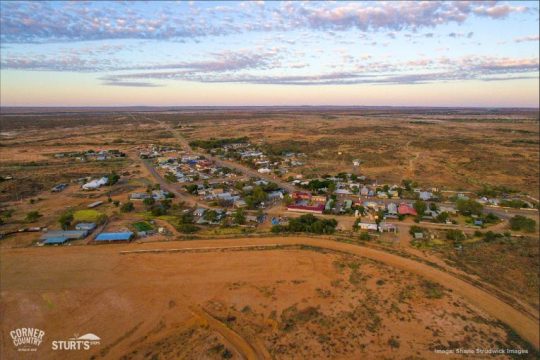
 

We suggest Australia’s own remote village of Tibooburra (shown here) replaces the otherwise politically-correct “sister cities” of the Blue Mountains Council – currently being exotic Sanda City (Japan) and Flagstaff (Arizona, USA).  Outback Tibooburra would well save local Blue Mountains ratepayer funded councillors rorting the ‘sister city’ con on business class flights to both.   We can’t image the elite councillors swapping business class exotic perks for Aussie outback reality!   Hey they could claim Tibooburra as a Climate Change inspection trip!


Katoomba, for those not familiar, is not yet a suburb of megalopolis Sydney.  It’s just an equivalent well distant remote village like that of Shelby in Montana, USA ain’t yet a suburb of New York City!  [read more about Shelby]

Meanwhile, property investors across Australia are cashing in with Airbnb outsourcing and the NSW Government lets ’em… Check this in this subject area of North’s Estate Conservation Area in regional Katoomba, which confirms no tourist accommodation exists.  Crap! … Try more that 500 Airbnbs taking over the regional Blue Mountains !!!  Here’s an example…
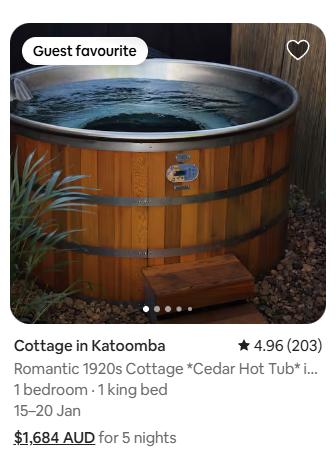
 

This nearby sample local two-bedroom cottage investment has two income options: (A) Market median rental at $650/week, else (B) Airbnb at $2400/week (calc: being $1722 x 7/5) – so approaching 4 times the rental income!  So instead of charging about $100 per day, try close to $350 per day!  Plus ulility expenses of course – electricity, gas, water.  Such has been allowed to become a housing unaffordable pandemic – wealthy baby boomers denying local young renters in favour of more lucrative wealthy fly-by tourists, mostly from overseas. Dare we term it ‘Wham, bam, thank you, ma’am‘ housing.  Government politicians do similar – like own multiple properties on the investment bandwagon.  [Source:  Airbnb] 


The average rent for a house in the Blue Mountains is around $600 – $650+ per week, with specific suburbs varying, but showing strong demand and low vacancy rates, meaning it’s a tight rental market with prices generally trending up, especially for larger homes“. 

[Source:  Google AI (2025) – so anonymous, so frankly who knows the truth online these days.]


Sydney is far from being an ideal city, so not an appropriate role model for any regional community.   The Blue Mountains village of Leura would be a far better role model, but visitors note, the streetscape and garden plantings down Leura Mall are not the work of Council, but rather by volunteer efforts and funding by local Leura residents and Leura small retailers.   

Whereas, Council loathes knowledgeable long-time locals because ex-Sydney council staff are blow-ins reaping self-interest paychecks.  Council prevails in its bubble mindset in ‘north Katoomba’ conjured up tarting up the footpath in nearby Katoomba and Bathurst Streets (‘south’ Katoomba).  That brain snap cost $3 million and did squat.  Of course Council outsourced it to some Sydney contractor again.  But it directly shut down many retailers retail for nearly a year causing many to go broke.  Nice one, lower Mountains Mayor Mark Greenhill!

More recently, self-anointed Blue Mountains councillors (100% Labor Party obedient disciples) have ramped up the ‘ECO’ zealotry thus…
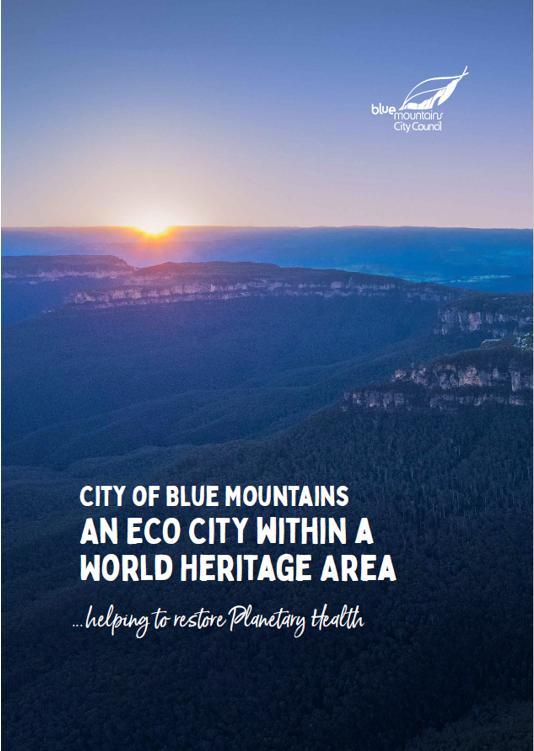
 

“Eco City”? “Planetary Health”?


Pull the other one, Council!  

This Council mob continues to remain aloof to the interests of locals and chronically blasé in attitude to respecting local Mountains heritage in all its genres.  The bureaucrats are so overpaid (out of local ratepayer rates and their NSW Labor mates’ NSW government grants) and so happily unaccountable, especially the higher echelons to a salary of $300,000+ per year.  Where’s the helicopter and helipad to fly in Council’s GM’s ring-in commute from Sydney to Katoomba chambers to show up for the odd (“yeah, we need you”) meeting?

As a long-time resident of the Blue Mountains region west of Sydney, The Habitat Advocate (read about us) has become accustomed with this local council’s ongoing contempt for heritage.  Heritage conservation in all its genres – natural/environmental, historical, built/architectural, village streetscape, Aboriginal, you name it.   

A case in point is comparing the ground-truthing reality with Council’s webpage entitled ‘Heritage Conservation Areas’ (Go to this link and read: ^https://www.bmcc.nsw.gov.au/heritage/heritage-conservation-areas).


The spiel starts off as follows: 

“The Blue Mountains is well-known for the historic character of many of its towns and villages.  In some towns and neighbourhoods buildings from the Victorian, Federation, Edwardian, Inter-War and Post-War eras create visually interesting and layered streetscapes.  Many streetscapes are enhanced by mature street tree plantings and established exotic gardens. 

Council has established ongoing recognition and protection for the many early houses and the generally traditional streetscapes found in most towns and villages of the Blue Mountains. These important historic areas are protected as heritage conservation areas. The full list of heritage conservation areas is listed in Schedule 5 of the Blue Mountains Local Environmental Plan 2015 (LEP).

The boundary and inclusions for each heritage conservation area are defined by an accompanying map, and the reasons for listing explained in the heritage inventory sheet for each area. 

On 19 July 2019, areas of older housing, formerly protected as Period Housing Areas, were converted to new heritage conservation areas as part of Amendment 6 to LEP 2015. Subsequently, the Period Housing provisions of the LEP were superseded by Clause 5.10 of LEP 2015.  Full details and timelines from start to finish on this planning proposal are under ‘related sites’.”


Propaganda‘ is generally defined as “information, especially of a biased or misleading nature, used to promote a particular cause, doctrine, or point of view.”   That is what the above  extract is – Council propaganda.  Council says one thing yet does another.  Council is hypocritical.


Blue Mountains Heritage ‘knowledge’ does NOT reside with Council management and staff


So, why do Blue Mountains councillors seek out Sydneysiders as consultants so repeatedly?  Political links? Favours?  Bias?  Corrupt conduct?  All the above?   It is because the management are culturally fearful that by Council staff learning such skills, that the Council staff will gain more knowledge that the management.  So by Council management engaging distant contractors for one off research tasks, at ratepayers expense of course (else funded out of NSW Government grants) the management incumbent management cannot be replaced by more knowledgeable and competent staff.  Jobs for life.  Like, Council’s General Manager Dr Rosemary Dillon (not a medical doctor, and elevated in government to corporatised ‘Chief Executive Officer’) has been on management for 30 years, and now gets paid $421,535 per year.  Australia’s prime Minister gets $622,000 per year.

We note the tabulated list of these branded ‘Heritage Conservation Areas‘ and surprised to note that these are grouped under the tabulated heading of “Villages”.  Good!  This is correct!  It is in contrast to many amongst the Council mob (ex-Sydney) terming the villages as “suburbs” as if the Blue Mountains is a city.  It is that city-centric mindset being propagated to the Mountains locals.   

We focus specifically herein on Katoomba’s ‘North’s Estate‘ listing midway down the table.  By then clicking on that table’s Map and Inventory Sheet hyperlink  ‘K171‘ for North’s Estate, one is directed to another Council webpage to enable one to download a PDF document.   The full name of the North’s Estate “item” is ‘North’s Estate Heritage Conservation Area‘ (Local ID: K171).  That document is eleven pages long in PDF and we supply a copy link, since it is in the public domain.

 

Loader Loading...
EAD Logo Taking too long?

Reload Reload document
| Open Open in new tab


[SOURCES:  Not Blue Mountains own, but yet again more of Council’s outsourced ring-in consultants from Sydney – the likes of: 

    1. Paul Davies Heritage Architects Pty Ltd (of Drummoyne, Sydney)
    2. (Robyn) Conroy Heritage Planning (of Surry Hills, Sydney)
    3. Croft & Associates Pty Ltd (of Baulkham Hills, Sydney)
    4. Meredith Walker (of Rockdale?, Sydney),
    5. Tropman &Tropman Architects, of 55 Lower Fort St, The Rocks, Sydney.


Blue Mountains Council’s heritage knowledge resides not within its management nor staff.  Over the years as long-time employees leave or are asked to leave, no-idea ring-ins typically escaping Sydney take on responsible roles such as in heritage yet with no local knowledge and no handover nor training.  It’s like Council’s new recruit orientation going like this:  “Welcome aboard, there’s your seat and your shared desk, any questions?”  Indeed, we know of one of its legendary former employees Local Studies Librarian and Blue Mountains local historian, Mr John Low OAM who got ‘retired’ way too early by Council management in 2007.  

“John Low was Local Studies Librarian at the Blue Mountains City Library 1982-2007.  [Note: some 25 years]  An active member of the Blue Mountains Historical Society, he received an Order of Australia Medal (OAM) in 2012.”

John had more local knowledge about Blue Mountains history than anyone else at Council.  John has over the years written history books on the Blue Mountains and has delivered public presentations on various topics of Blue Mountains history.  He researched and prepared a history of this author’s house and street back in 2001.  Along with John Low, John Merriman has served as senior staff (but not management) on the Council payroll for almost as long, acquiring  details and extensive knowledge and insights into Blue Mountains heritage, particularly its history back to the first colonial crossing of 1813 and prior.  Like John Low, John Merriman is also an established author of Blue Mountains history, having written many books and academic papers and published online.   

However, Mr Merriman has, instead of being duly promoted for his ability, dedication and long service to say Heritage Manager, he has been relegated from his history office in heritage-listed Braemar House (c.1890 guesthouse) to a basement desk in a corridor below the new Springwood Library, more inaccessible to the public for research, as he was previously.   In 2024 the interior of the house was re-purposed as an art gallery featuring local visual art throughout the rooms.

Previously, during the 1980s – 2000s period, both John’s (whom this author knows well) worked under the guidance of Council’s qualified heritage architect Christo Aitken.   Mr Aitken probably has more details heritage architecture experience on Council (management and staff).  Alas, he was made part-time back in the early 2000s (Council senior management politics again?).  So he has since set up his own heritage advisory firm consulting back to Council.   

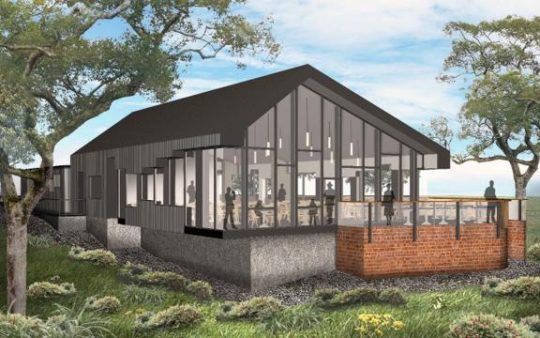
The only ones on Blue Mountains Council these days with heritage knowledge are young ring-ins from Sydney, with no local knowledge or experience – (not their fault per se) but its just as senior management wish to ensure.  It’s of course so senior management can maintain a disproportionate power and influence on Council to safeguard their self-interests.   Crikies, cynically Council’s heritage strategy and heritage constraints if duly respected and followed could stymie Council’s city-centric development projects, like Council’s Katoomba Falls Kiosk  “revitalisation project” of 2019.   Check these photos:

An original photo during construction back in 1921:
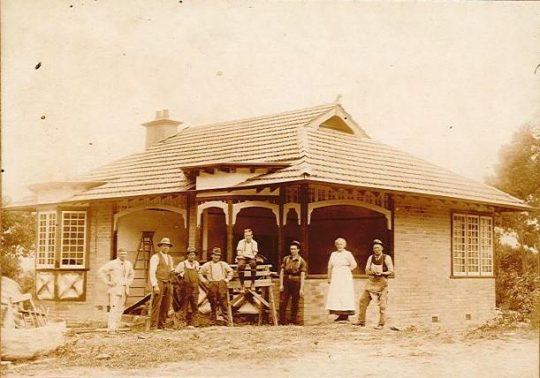
 

Katoomba Falls Kiosk (owned wholly by Council and heritage listed, Ref. K059)


Yet, Blue Mountains CITY Council’s anti-heritage replacement plan of 2019:
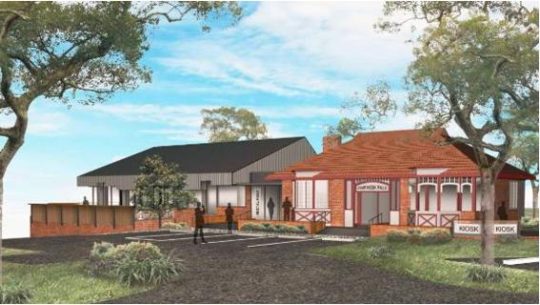


Council’s destructive design for Katoomba Falls Kiosk was rejected by the local Blue Mountains community heritage panel.   

[AUTHOR’S NOTE:  We recommend that Council assess the bushland site and remove the long closed and dilapidated toilet block near the escarpment edge below the kiosk;  it’s overgrown by noxious covered in weeds.  Then to and undertake weed removal and bushcare to restore the native vegetation (with an aesthetic fire barrier – use Conservation Hut as a model amenity outcome].

This author went for a job on Council once, being a naïve new Blue Mountains resident (from Melbourne) in 2001.  In the author’s view the interview process was corrupt and underhand. 

The reason why we are writing this article is to cite yet again another example of Blue Mountains Council’s city-centric organisational culture of ignoring and acting contrary to its own policies, planning, rules particularly as they related to Blue Mountains heritage respect, conservation and sympathetic restoration.   This deals with a land use development within North’s Estate Heritage Conservation Area  (Local ID: K171).   
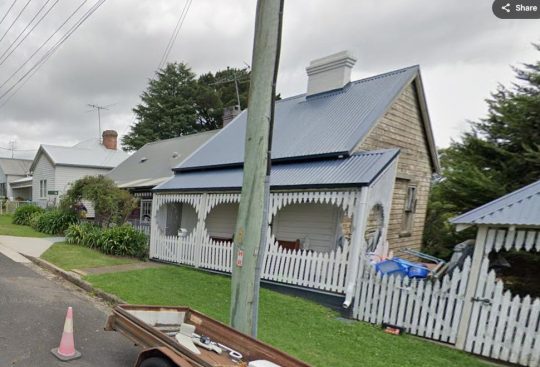
 

A sample of the heritage housing of North’s Estate.


This article’s writer, and The Habitat Advocate’s founder and Conservation Consultant, Steven Ridd, continues to be based in residence within the North’s Estate Heritage Conservation Area since 2001. 

This area is also within what we refer to as ‘The Gully Water Catchment‘, otherwise more broadly known as Katoomba Falls Creek Valley for many decades.   Within this catchment is the small natural bushland valley, termed ‘The Gully Aboriginal Place‘.   In recognition that many locals (immediate locals) will not know or even be aware the specific location we are to focus upon, for introductory reference, given that we reach a wide audience, for clarity we supply the following maps zoom-in sequence to identify where we are: 


PART   IV.   Topic Location


[AUTHOR’S NOTE:   The ‘Issue‘ in this article is about Blue Mountains Council hypocritical treatment of heritage value of the Blue Mountains, in this case historical built heritage and colonial streetscape.   The specific ‘Topic‘ within this issue in this article  is ‘North’s Estate Heritage Conservation Area’.  And then a specific ‘Case in Point‘ is the example of a current ongoing illegal and unapproved ‘backyard sauna‘ development that breaches many rules – heritage, zoning, Council approval process, etc. which adversely impacts this author.


[A]   A Global Location Map:


[B]   Katoomba- Sydney Location Map: 
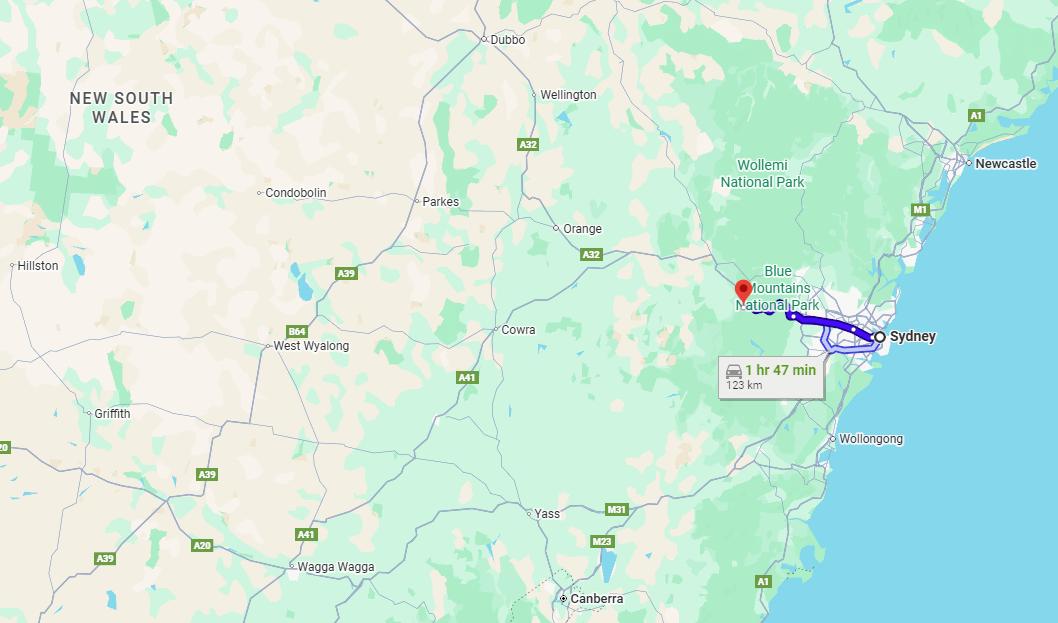
The town of Katoomba is about 100km west of Sydney by train or driving via the M4 Motorway.


[C]    Katoomba Falls Creek Valley Map: 

This map section shows part of the township of Katoomba in the Blue Mountains and within that section the red circle indicates the general location of North’s Estate Conservation Area juxtaposed west of Katoomba town centre and south of the Great Western Highway/Railway.  Note: ‘Wells Street‘ labelled which lies within that Estate.   [Source: Google Maps]


[D]   ‘North’s Estate Heritage Conservation Area’ extract historic cartilage map (within):


This historical complete map is sourced from the real estate advertising flyer for the original housing subdivision of North’s Estate dating back to 1883. Why?  Hey the railway arrived in Katoomba (then the (sandstone rock ‘The Crushers’ in 1874).  An entrepreneurial gold mine!   Note that Wells Street is not shown as per the current map above, but instead labelled as Kamillaroi Road, but it is one in the same.  Note also: ‘Kamillaroi’ is Aboriginal; ‘Wells’ is not Aboriginal.  It is probable that Council renamed it.  Many of the other street names have Aboriginal. origin. [Source: ‘Draft Heritage Data Form, Blue Mountains Heritage 2016’, Blue Mountains City Council]


So hopefully now as a reader to this article, you can find the location of where we are talking about.  

Prices per night under San Francisco based Airbnb…
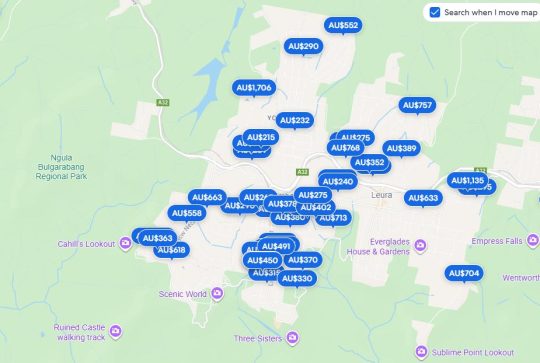
 

Katoomba invaded by Airbnb-style short stay holiday lets. Not all are shown on this map.  [Source: Google Maps 2025]


PART   V.    Critique of Blue Mountains Council’s mistreatment of ‘North’s Estate Heritage Conservation Area’


[AUTHOR’S NOTE:  A ‘critique’ is not just criticism, but also evaluation and judgment, with some constructive recognition of content of merit.  Whilst we do criticise certain aspects of this Council documented report, we also constructive when we consider content to be apt, based upon our own insight and research.   Such critique comes from this author’s personal background (academically, professionally, research, local knowledge and reasonable longevity from living in the subject area.   The author of this article is an Analyst by qualification and experience.  This article aims to provide thoughtful insight and feedback of the report (the oddly entitled ‘Draft Heritage Data Form‘).  We encourage a deeper understanding of the concept and details of what comprises a ‘Heritage Conservation Area’, that it be formally completed, enhanced to best practice standards, then displayed as a comprehensive draft #2 publicly freely, consulted publicly, before being legally gazetted and thereafter legally enforced.]


Here we focus on ‘North’s Estate Heritage Conservation Area‘, being where we are based and reside.  Again, this is Council’s ‘Draft Heritage Data Form‘ pertaining to this heritage ‘item’:

Loader Loading...
EAD Logo Taking too long?

Reload Reload document
| Open Open in new tab


This enclosed document, Council’s ‘Draft Heritage Data Form‘ pertaining to this heritage ‘item’ (or really ‘area’) warrants a few critiques, as follows:


[Our Critique #1]   The form is in 2025 dated 2016, making it in December 2025 being a decade old, so sending a message that it has been since ignored by Council.


[Our Critique #2]   The form is in 2025, remains a “Draft” a decade later.   Why?   Council does not care.  Council only prepared this document (or rather was legally required to do so because of NSW Government legislation in 2015 re-branding what was zoned ‘Period Housing’ to be ‘Heritage Conservation’.  Cynically, this effectively was just a tokenistic name change. 


[Our Critique #3]    Council has overlooked its own website concerning heritage conservation across the Blue Mountains local government area.  How so?  Well, its Development Control Plan of 2015 still continues to use the long obsolete term ‘Period Housing‘ (circled below).   This reflects Council’s disregard towards updating its heritage management records and rules.
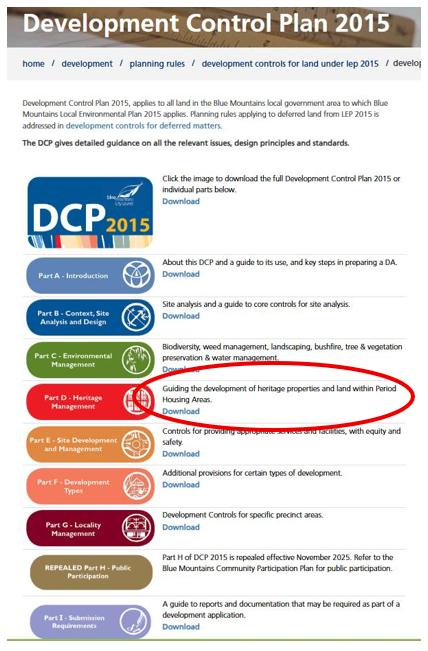
 

Source: ^https://www.bmcc.nsw.gov.au/development/planning-rules/development-controls-for-land-zoned-under-LEP-2015/DCP-2015


[Our Critique #4]    The form was not written by Council.  As highlighted above, it was researched and compiled by outsourced ring-in consultants from Sydney – the likes of  Paul Davies Heritage Architects Pty Ltd (of Drummoyne, Sydney), (Robyn) Conroy Heritage Planning (of Surry Hills, Sydney), Croft & Associates Pty Ltd (of Baulkham Hills, Sydney), Meredith Walker (of Rockdale?, Sydney), Tropman &Tropman Architects, of 55 Lower Fort St, The Rocks, Sydney.


[Our Critique #5]    The Statement of Significance at pages 1 and 2 requires factual historical correcting.   

Yes, we note that the ‘Level of Significance’ for North’s Estate is at both ‘Local’ Level (Blue Mountain Local Government Area and at ‘State’ Level (New South Wales).  So this is not insignificant.

The North’s Estate Heritage Conservation Area (HCA) in fact dates to 1876 when the then Government of the colony of New South Wales sold a large bushland parcel of the Blue Mountains plateau (western part of today’s Katoomba around the Katoomba Falls environs) to English immigrant, stockbroker, miner then property developer John Britty North (1831-1917).  North subdivided the northernmost part of his property for residential development in 1883 and it became known as North’s Estate, the very first (and so oldest) housing subdivision in the Blue Mountains region.
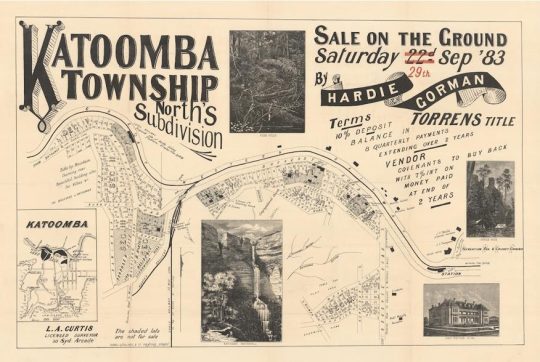
 

This was the original real estate advertisement for new land releases as part of then ‘North’s Subdivision’ Estate circa mid-1883 and likely in one of Sydney’s newspapers – either The Sydney Morning Herald (from 1842 – current), the Illustrated Sydney News (1853-1894), the Sydney Mail (1860-1938).
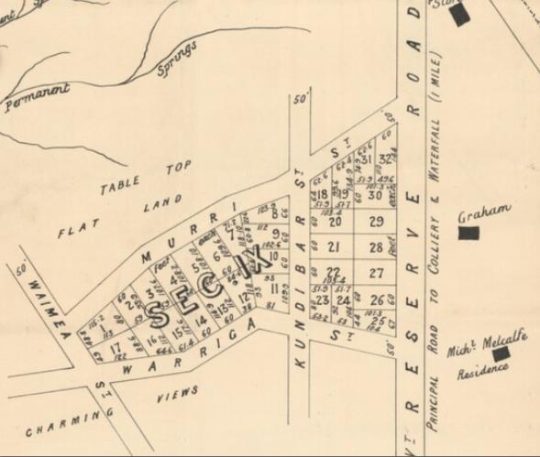


[Our Critique #6]   Yes, ‘North’s Estate’ survives in two separate precincts (subdivision sections) on either side of the steep gully (The Gully) at the head of North’s property where it met the highway (Bathurst Road). The larger area surrounds his family home near Bathurst Street, and the smaller is sited on the small ridge extending west from Cascade Street near the Carrington Hotel.” 
 
However, a closer research examination of the above original reveals the extent of North’s landholding ownership and of his proposed subdivision.  There were in fact a total of nine Sections (numbered from west to east labelled with Roman numerals ‘SEC I’ to  ‘SEC IX’).   The HCA chooses to only include the surviving abutting ‘SEC V‘, ‘SEC VI‘, ‘SEC VII‘ and ‘SEC VIII‘ (comprising the northern precinct south of Bathurst Road between then North’s Colliery Siding (coal shale railway west) (now Valley Road), and Reserve Road (now Cascade Street).   The southern precinct ‘SEC IX‘ is the smaller cul-de-sac located toward the south, juxtaposed to the west of Reserve Road (now Cascade Street).   SEC 1, SEC II, SEC III, SEC IV allotments were not sold in this process, possibly due to lack of sufficient demand and the walking distance from the then new village of Katoomba to the east around the railway station (shown).  
 
Note, more southern isolated smaller ‘SEC IX‘ is bounded by just five streets, being Cascade, Murri, Kundibar, Waimea and Warriga Streets.  And this SEC IX (Section Nine) features a vacant 32 housing allotments in total.  (Image curtilage extract below).  


Close up extract map of North’s Estate from the original 1883 real estate advertisement above.  The area size is about 200m (E-W) x 100m (N-S)


This is where The Habitat Advocate base resides.   It is also especially why, one takes a special interest in this matter.  We are here, home long located in North’s Estate of 1883 ‘SEC IX‘. 

Yes, we after 25 hard-working and costly investment renovation years, take a focused interest in what happens in our neighbourhood that could try to ever undermine it.
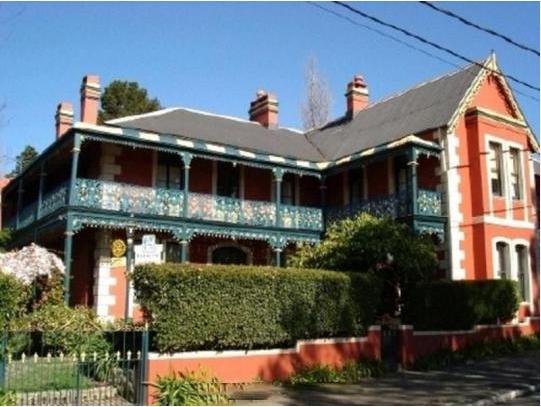
 

[Critique #7]   Yes, the two residential precincts of North’s Estate dating from the late 1900’s to 1940’s feature and retain “the aesthetic or historic qualities of the original streetscape.”  Yes, “many (of the houses) make a significant contribution to the HCA through their fabric and aesthetic heritage values.”  Yes, both precincts are “distinguished by notable examples of substantial homes interspersed with Victorian and early 20th century cottages.”  Yes, “the physical link between North’s house and his mine remains interpretable through the open space along the gully leading to Katoomba Falls (not within the HCA).”
 
However, the observation that there were “no formal guesthouses or residential hotels of the type of scale that are found throughout the main spine of the town” is incorrect.   Historical records account that in fact, there were back in 1883, the Balmoral House (guesthouse), the ‘Montrose’ guesthouse (where Dan Murphys current is today), Glenample guesthouse and The Katoomba Hotel.  They were all situated along Bathurst Road (which was then the main highway between Sydney and the town of Bathurst) and positioned walking-distance to the then newly built Katoomba Railway station (opened on 2nd February 1874 as ‘Crushers’).  There were of course no motor cars back then.   The last three mentioned guesthouses no longer exist.   
 
The advertising flyer includes ‘SEC VIII‘ with earlier buildings along the Bathurst Road including an inn, school, stores and two butcher shops.  It was because the original village of Katoomba from 1883 was centred along Bathurst Road (the road to Bathurst) with the railway station from 1874 running parallel according to gradient.   These buildings were present before North’s Subdivision adjoining to the west and south.


Balmoral Guesthouse as it is today (built in 1880) at 196 Bathurst Road Katoomba.  Built as a guesthouse this two-storey (13 room) Victorian Italianate villa was situated cleverly convenient level street walking distance (200m) from new Katoomba railway station then, recalling well before the advent of motor cars!


At this juncture, we point out to readers that prior to 1813, the Blue Mountains was a wild bushland plateau inaccessible by New South Wales colonists.  It had been indigenous Aboriginal land for perhaps 60,000 years prior, traversed and used by various regional tribes during warmer seasons.   Following colonial exploration, and once the first rough road (Cox’s Road) was constructed in 1815, from the 1820s, settlement, land clearing for pasture (grazing) and a few timber inns were built for travelling settlers over the Blue Mountains.  However, besides a few small hamlets that evolved from squatting and the odd small plot grant by the colonial government; no formal housing subdivision existed anywhere across the Blue Mountains until 1883 with the advent of North’s Subdivision (later referred to as ‘North’s ‘Estate’ once housing construction commence).  This was the year that informal ‘Crushers’ was formerly re-named as Katoomba by the colonial government in Sydney.


[Critique #8]    Yes, the character of the residential development of North’s Estate (HCA) is low-scale and most buildings are modest..cottages and houses that are representative of their era (1880 to Federation and up to 1940).   The area is solely classic residential – detached dwellings of 2 plus bedrooms, pitched rooves, front yard and backyard even if small.  [AUTHOR’S NOTE: that is a key factor of why we selectively chose to buy in this area when we did back in 2000.  Property owners deserve an ownership right to expect that a low-density residential area in which they buy will never be downgraded.  This particular area was deemed ‘Period Housing’ when we purchased our house back in 2000.  That gave us reassurance.]


[Critique #9]    Holiday accommodation banned. 
 
Further research would be required to determine if any of the properties were used as holiday rental properties or guesthouses.   The eastern end of the Bathurst Road streetscape includes commercial land uses, most of which are located in new buildings, either infill or built following the demolition of earlier buildings.”
 
“This small precinct is physically remote from the centre of Katoomba today and is unusual in the way that it includes relatively few properties that service the tourist industry, demonstrating instead the characteristics of a small residential area. The subdivision includes the Bathurst Road, Walgett, Kamillaroi and Murri Street precincts.”   
 
[AUTHOR’S NOTE:   We criticise why in the report did the consultants introduce these precinct terms for North’s Subdivision?  The SEC I through to SEC IX are the original identifiers.  The so-called heritage consultants ought to have professionally respected that original heritage labelling rather than try to ‘reinvent the wheel’ and impose their own labelling.  Some heritage consultants!]
 
The following statements describe the mostly pre-Federation character and fabric of the purely low-density detached residential cottage housing of North’s Estate Heritage Conservation Area, to which we concur.
 
 
(9A)  “This small precinct is physically remote from the centre of Katoomba today and is unusual in the way that it includes relatively few properties that service the tourist industry, demonstrating instead the characteristics of a small residential area.”  [AUTHOR’S NOTE:  This is a false statement and increasingly so over recent years to 2025 at the time of writing.  This North’s Estate Heritage Conservation Area (HCA) has been ongoingly swamped by Airbnb short-stay holiday lets by the dozens.  Such tourist accommodation is in breach of the HCA. ]
 
(9B)  The typologies most commonly found in the area include the simple symmetrical Victorian cottage (hipped or gabled), simple L-plan Edwardian cottage, Federation house with return verandahs and Inter-War bungalow in both the Sydney-style and designed variations. Later infill is mainly 1970s style project homes with a recent large infill at the south-eastern end of Buti Street. Almost all structures are a single storey in height.”
 
(9C)   “Murri, Warriga and Kundibar Streets have a similar character to Walgett and Wells Streets, with a range of more modest built forms, mainly late Victorian/early 20th century cottages and small houses, plus examples of later styles and periods.”
 
(9D)   “Physical condition and Archaeological potential Not investigated, but the location of at least some of the pre-1883 structures along Bathurst Road are shown on the subdivision plan and have significant archaeological potential. The area in the vicinity of the settlement has the potential for archaeological deposits related to the use of this area.”
 
(9E)   “The streetscapes within the North’s Estate HCA are clearly differentiated from each other and from the surrounding area. Their common underlying configuration of an outer loop road attached to the main road with internal connecting streets has facilitated the cohesive aesthetic character within the area with a clearly expressed overall consistency in the scale, form and siting of individual buildings.”
 
(9F)   “The streetscape of Murri Street also contributes to the aesthetic heritage values of the HCA, with sandstone-faced split-level roadways separated by traditional timber arras fencing in places. It features quality houses that are good and representative examples of their architectural style. Many of the houses in this part of the HCA have undergone extensive alterations and additions to facilitate the capture of the views from the properties, but the overall character remains one of a simple, traditional streetscape on the edge of the bushland.  As a group they create a strong sense of place that helps to define the aesthetic character of their streetscape.”
 
(9G)   “Fences are low, visually transparent and are generally appropriate for the period of development. There is relatively little evidence of gentrification or reworking of historic fabric.”
 
(9H)   “The buildings in the area include a good range of typologies from the main period of development (1880s to 1940s). Although many houses have had minor alterations and additions, most have retained the integrity of their original form and continue to contribute positively to the quality of the streetscape.”
 
 
(9I)   What is omitted are street by street photos by the researchers rather than just descriptive text and few old maps.


[Our Critique #10]   


The consultant’s report is vague toward the ending pages, mentioning but not discussing matters of significance such as ‘social significance’, ‘technical/research  significance’, ‘SHR” (we presume this means ‘State Heritage Register’, yet it is not so defined on the report), ‘rarity’, ‘representativeness’, and ‘integrity’.   Perhaps the unfinished repoirt was due to consultants running out of time or funding or just moved on to other work.


[Our Critique #11]   


Much streetscape and housing architecture information is omitted from the draft HCA.


[Our Critique #12]   


The report’s recommendations are similarly very brief, however the statement “retain low density residential zones” is a clear message.  The emphasis is on the public domain (streetscape) within the HCA, moreso that the architectural character,  integrity in preserving the colonial cottage style of the Victorian era.   Else it concludes with rather generic waffle at the end, possible sourced form a previous report.


[Our Critique #13]   


In any case, Council has since done nothing about implementing the recommendations, or any further research, but as usual just filed it.  the HCA exercise was merely to comply with the NSW Government’s change in terminology from ‘Period Housing’ to ‘Heritage Area’ in its DCP2015 from Blue Mountains LEP 2005.   It seems that is all that Council has done, which from one’s experience with Council’s many Plans of Management, is typical of Council management (mismanagement). 


PART  VI.   A Case in Point


In 2006, an immediate neighbour of ours within North’s Estate Heritage Conservation Area (HCA) ‘SEC IX’ (per the mapping above) had purchased a residential property having a pre-existing heritage detached residential dwelling, so at the time of writing, close to 20 years ago.   Extensive renovations over the years in sympathy with the colonial cottage style character of the property and the HCA were undertaken, likely at substantial cost.  For ethical privacy reason, we choose not to identify the property herein, since the issue we raise is of a failed process by Council.

We became aware of a new third outbuilding being constructed in the backyard in November 2025 – an outdoor backyard sauna.  But by Sunday 6th December 2025, the scale of that build and its 350mm close proximity to our fence seemed to be an over-development of the site.  We’re talking about an under a 700m2 block in a low density residential zone in a designated heritage area. 

We’ve also learned subsequently that the property is to be yet another Airbnb-style holiday let investment, so no longer to be owner-occupied.  It will add to the more than an dozen holiday lets within the tiny (HCA) ‘SEC IX‘.   None of this this was previously communicated to us as an immediate neighbour.  We phoned and left a non-contextual voice message just for the owner to call one back.  Ignored.

Frustrated, here are the subsequent photos from our side of the fence of this new build in progress at the time of writing:
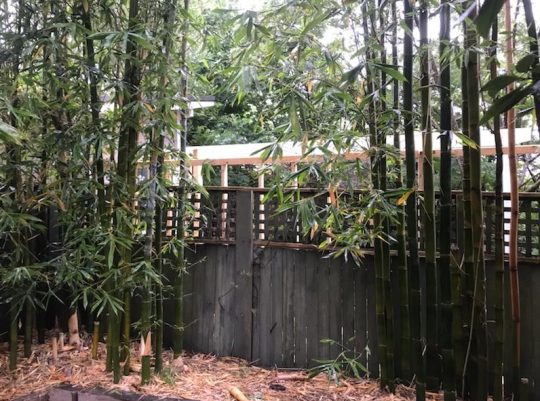
 

Note that due to the small size of our own residential block, some time ago we planted clumping (non-running) low maintenance bamboo hedging to create mutual privacy between our neighbours backyards, instead of say high maintenance dark conifers.  Following our prior consultation with adjoining neighbours, our choice with the clumping bamboo to establish mutual privacy was welcomed by all our adjoining neighbours.
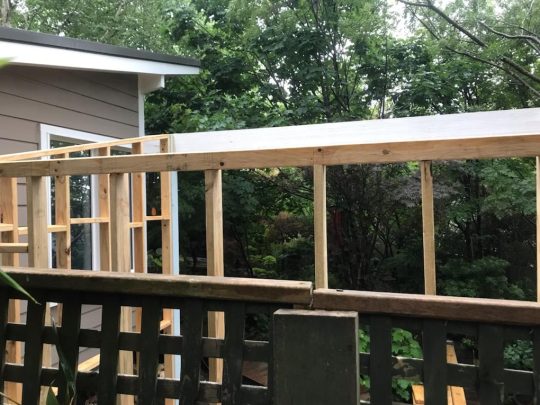
 

Note to the left of the photo the previous entertainment pavilion build (new outbuilding #2) i addition to a carport (outbuilding #1) on site.  Yet legally, only two outbuildings (not three) are permitted in this low density residential area.  After  which 3+ outbuildings downgrades this low density heritage residential area to medium density and ultimately to high density.  


Another proximity photo shows the roof rafter of this new backyard sauna to be just a 350mm (1 foot) setback from our boundary.  Unbelievable!   The new sauna wall is to be just 500mm setback from our fence.  This setback is illegal. It has to be a minimum setback to any boundary of 1400mm.  It is a very arrogant intrusion by an adjoining neighbour.
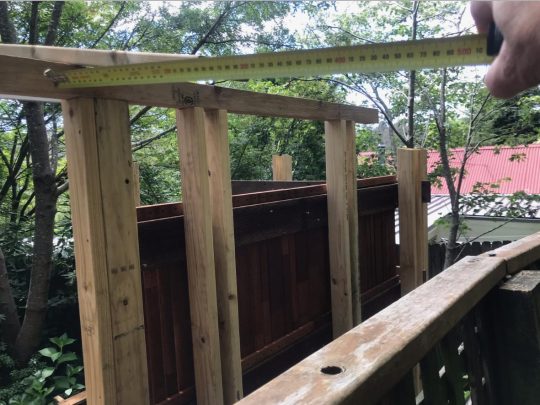
 

And we’re not exaggerating our measurements. Evidence by us from our side of the fence always!  
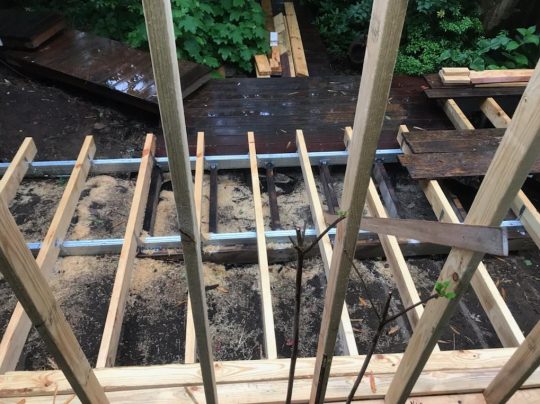
 

This backyard sauna fabrication is using cheap and combustible pinewood which is illegal in our bushfire prone fire zone.   This is a cheap cowboy backyard build.  We soon learn it’s been going ahead without Council knowledge let alone approval.   Our home is dangerously exposed potentially to this a large bushfire torch on our boundary – and it’s all being setup for Airbnb holiday let parties using the pavilion and now this sauna as sales features on our residential boundary for Christ sake!


So,  inquisitive, one wrote to Blue Mountains Council (BMCC) by email on the Monday morning thus:


Correspondence #1:

Monday 8th December 2025, one phones Council and reports the matter to the Council’s Customer Service Department.

A CSR (Customer Service Request) is requested by self from Council for the record: #634961.


Correspondence #2:

Same day, one sends a followup email to Council with the details and including four relevant photos as evidence of work in progress, thus:


Attention: [Council’s Health & Building Surveyor]
Blue Mountains City Council
Locked Bag 5
KATOOMBA NSW 2780

8th December 2015


Dear Mr XXXXXXXX,

I wish to enquire with you at Blue Mountains City Council whether a current backyard construction adjoining my residential property has BMCC approval and is appropriate.

Currently, there is a building construction underway at (SUBJECT DEVELOPMENT SITE)  Katoomba over my back fence adjoining our property that has just become obvious to me, yet it would appear to be perhaps excessive?  I attach a few current photos of the work in progress from our property for your information for clarity.  This is a heritage residential precinct.

My property is located at (SUBJECT DEVELOPMENT SITE) Katoomba and in recent weeks I have noted that a sizeable building development is underway that is very noticeable and comes to being measured just 350mm from our back fence and looks to become well above our fence line once completed.  Our neighbour, whom we are otherwise amicable with, is currently in the process of having this construction become a new backyard sauna.  Of late we have noted that it is very dominant and close to and rises above our rear fence line.  It is unclear whether this will entail an associated noise impost once operational.

Is Council aware of this new construction development and does this have Council permission and approval?  Since I have received no such written notice of this development.

Kind regards,
Steven Ridd


Correspondence #3:

Two days later, on Wednesday 10th December 2025, one phones Council to followup the Monday request.

Council advises that as yet no ranger or investigator has been assigned to this matter.  One requests a documented ‘Customer Service Request reference number (CSR) and is advised of CSR #634109 about of this raised neighbourhood concern.

Council advises that the Health & Building Surveyor addressed in one’s email is not with Council (presumable he must have resigned and Council has deleted all records of his senior staff role existence).  One had dealt with him co-operatively for over a decade regarding one’s own legitimate and approved development application.


Correspondence #4:

On Friday 12th December 2025 four days later, one received its first reply from Council on this reported matter, thus:


“Dear Mr Ridd,

Council do not hold records of the development you have described at (SUBJECT DEVELOPMENT SITE) Katoomba.

The State Environmental Planning Policy (Exempt and Complying Development Codes) 2008 (‘Exempt Code’) outlines development that can be undertaken without requiring development consent.

The photographs you have provided show the structure will likely largely meets subdivision 9 of Part 2 of the Exempt Code when built, except perhaps the distance to the boundary.

Would you like this structure investigated for distance to the boundary? If so, please let me know.
Please be aware that Council does not disclose to a person who complained about them, but it may be very obvious to you neighbour that it was you.

Regards,

Judy Le Breton | Senior Investigations Officer | t:  02 4780 5000 |  e:  council@bmcc.nsw.gov.au
Blue Mountains City Council  |  council@bmcc.nsw.gov.au   |  www.bmcc.nsw.gov.au  |  Locked Bag 1005 Katoomba NSW 2780 ”


Some relevant observations at this juncture:

(i)  One’s presumption had been correct, that the owner had not sought nor obtained Council approval for the third outbuilding – the sauna;

(ii)  There are no plans or design drawings for the sauna.  As an immediately adjoining neighbour to this construction development, one is entitled to be notified in advance of such a development;

(iii)  How can this development (over-development) be exempt from planning controls such as the HCA  and Council’s rules – its Development Control Plan 2015, DCP 2015 Amendment 8 Part D – Heritage Management, and that this residential area is zoned ‘R2: Low-Density Residential’?;

(iv)  Why should one as a resident be required to research and interpret State Environment Planning Policy?  This is the task of Council;

(v)  Is this person Judy Le Breton, a supposed Senior Investigations Officer in any way qualified to assess this development for its compliance with Council’s planning rules? 


Correspondence #5:

Same day, on Friday 12th December 2025, one phone’s Council requesting to speak with Ms Le Breton, but she is not there and so leaves a message.

Another Customer Service Request number is issued to Mr Ridd: ‘CSR 634961‘.


Correspondence #6:

Same day, on Friday 12th December 2025, one emails Council referencing CSR 634961 and attaches a copy of the North’s Estate Heritage Conservation Area document, obtained from Council’s very own website.  This is because Ms Le Breton in her email reply did not mention this very relevant document, nor mention Council’s relevant zoning requirements, nor Council’s the DCP 15 Heritage Management, but only state policy.


Correspondence #7:


Then on Friday 12th December 2025,  Mr Ridd emails Ms Le Breton as follows:


RE: (Subject address) Katoomba – new development adjoining (CSR 634961)

Hello Ms Le Breton,

Thank you for your email reply.

However, I reported this to Council by phone last Monday 8th December 2025, so some four days prior. It is disappointing that this is the first that I have had Council contact me about this. Had the weather not been rainy this past week, the neighbour ‘Wayne’ may well have finish the build by now.

I follow with Council by phone on Wednesday 10th December and was told that a ranger had not yet been assigned to the matter.

Yes. I wish to check due process and the legalities concerning this new development. I don’t mind in the slightest about the owner knowing it is me (over the corner side fence) raining my concerns.

I have known the previous owner (SUBJECT DEVELOPMENT SITE) for over the past 15 years on a very amicable basis, not just as adjoining neighbours but as good friends.
I have today followed up again by phoning Council after receiving your email reply below.


My Concern that should be addressed by Council in this matter:

(1)  I am concerned that you seem to be fobbing me off to research some state legislation online. Is that not your task or that of Council’s Development Monitor Team to check? This would seem lazy?

(2)   My wife and I had our own land use application submitted and approved by Council submitted back in 2005 (Reference X/XXX/2005). It subsequently gained substantial commencement status. We had to comply with the many rules for the renovations and extensions and the conditions of consent. So we are aware of the rules and restrictions for our own development which after many years remains ongoing.

(3)  One of the rules is that our building may not extend to within 1400mm from any boundary on the property land site. However, this new outdoor building measures just 350mm from our boundary.

(4)  I note that you say Council is not aware of this development at (SUBJECT DEVELOPMENT SITE) Katoomba (literally adjoining part of our back fence).

(5)   I point out that the fabrication is being made using pine timber, however this is in breach of the bushfire regulations since both properties are situated within a bushfire high risk zone (<50 metres) , so demanding non-combustive construction material (not pine) for all exterior cladding.

(6)   This build is a second one that adjoin this, (The “pavilion”) probably also in fabricated in pine.

(7)   In contrast, all our exterior materials are in approved Merbau hardwood or concrete sheeting (on a temporary basis). It has thus far cost us a considerable outlay over the years
trying to do the right thing by Councils rules and the legislation.

(8)  This residential area is a designated heritage conservation area known as North’s Estate heritage Conservation Area (Reference K171) (see attached copy and link to Council’s website ^https://www.bmcc.nsw.gov.au/documents/map-and-heritage-inventory-sheet-k171 ) The heritage conservation assigns a high value to the amenity and streetscape to this rare purely residential area. It seems you are not aware of this special heritage conservation classification that include both xxxxxxxxxxx and xxxxxxxxxxxx Streets.

(9)  It is not supposed to have any tourism development, yet over recent years numerous homes have been converted to permanent Airbnb’s. It is my understanding that this is planned with (SUBJECT DEVELOPMENT SITE), with this new build become a outdoor sauna and shower in the garden.  Others include 4, 7 (x2), 10, and 8 Kundibar Street – none with local resident notification and probably nor Council notification, awareness, nor approval.  So they would thus be each in breach of the classification.  Quote at page 7: “it does not provide tourist accommodation or facilities.

(10)  We have received no plans or written information from the owner about what is proposed in this “sauna” – such as a potential fireplace, noise, perhaps amplified music, hours of use. As such this would seem to be an illegal development.

(11)  I wrote to (Council’s Health & Building Surveyor) on this , however he seems to have retired or moved on from Council. We’ve dealt with him for many years he was very knowledgeable about development matters and quite helpful and responsive.

Please investigate this onsite ASAP and not after Christmas and New Year break, since the thing will likely be operational by then. Feel free to contact me to arrange access to our property for inspection from our side of the fence.

Yours faithfully,

Steven Ridd


Correspondence #8:


[On Friday 19th December 2025, Mr Ridd from his backyard happened to observe the subject owner talking with an unrecognisable man close to the back fence – presumably an inspector from Council.   Then on Monday 22nd December 2025,  Mr Ridd received to following email from Council]


(Subject Address) Katoomba (CSR 634961)

Dear Mr Ridd,

I have inspected the structure being built at the rear of (SUBJECT DEVELOPMENT SITE) Katoomba. I am satisfied it meets the provision of the State Environmental Planning Policy (Exempt and Complying Development Codes) 2008 (‘Exempt SEPP’), and no action is to be taken by Council.

These codes relate to development that can be undertaken without requiring the consent of Council. I have addressed your noise concerns with the owner of 5 Warriga Street. I am satisfied with the noise mitigation measures that will be employed, however should noise become an issue, you are able to seek a Noise Abatement Order via the Local Court.

The structure being built, whilst within a Heritage Conservation Area, is not a Heritage Item. This means that many of the Exempt SEPP development provisions (including those that apply to the structure being built at (SUBJECT DEVELOPMENT SITE) can be applied without seeking the approval of Council.

Assessing compliance with state legislation is a major part of my job. The legislation largely determines what is allowed and what is not.

In relation to your Airbnb concerns, the Department of Fair Trading changed the rules around short term rental accommodation and it is no longer regulated by Council.

Regards,

Judy Le Breton | Senior Investigations Officer | t 02 4780 5000 | e council@bmcc.nsw.gov.au
Blue Mountains City Council | council@bmcc.nsw.gov.au | www.bmcc.nsw.gov.au | Locked Bag 1005 Katoomba NSW 2780


Correspondence #9:


22nd December 2025

Hello Ms Le Breton,

I total reject your rejection of the rules.

You are acting in breach of Council’s own regulations.

You have offered me no justification for doing so.


So, I am going public on this issue, having first tried my best through normal channels unsuccessfully.

Yours faithfully,

Steven Ridd


Our Critique:


(1)   The sole person observed by Mr  Ridd who inspected onsite the Friday prior to Ms Le Breton’s email decision of the following Monday, was not female.

(2)   For a Council development compliance inspector to firstly admit that Council had not been notified of the development and then to approve it anyway is tantamount to incompetent conduct, if not corrupt conduct, in our view.

(3)   We deal with Ms Le Breton’s obfuscating reliance upon State Environmental Planning Policy (Exempt and Complying Development Codes) 2008 (‘Exempt SEPP’) further on, but frankly what is her job and is she doing it?  So Mountains backyarders don’t require the consent of Mountains Council these days?   Hey, well that sends a message!   May be I should build meself a backyard moonshine still – surely give Mountains Culture Brewing a run for its money, I reckon.   Got the room and all.
 

So, what a slack job Council Senior Investigator Le Breton as a compliance inspector quoting exempt State legislation by default.  Having the shallow interest of a politician and the skills of a Grade 3 school student in …our view.


(4)   Noise?  Council Senior Investigator Le Breton dismisses noise issues. Back on me:  She again cops out and quotes: “however should noise become an issue, you are able to seek a Noise Abatement Order via the Local Court.”  Her cost? Her involvement?  Nuh!  


(5)  Senior Investigator Le Bereton quoted response:  “The structure being built, whilst within a Heritage Conservation Area, is not a Heritage Item.”  Yes, so is that not a breach of the HCA?   What if this property owner constructs another six outhouses and houses a dozen holiday makers on his residential site.  Council to reckon: nothing to see here?  All EXEMPT?


(6)  Quote:   “In relation to your Airbnb concerns, the Department of Fair Trading changed the rules around short term rental accommodation and it is no longer regulated by Council.”

So no limit?  What does heritage management mean Senior Investigator Le Breton?  Nothing, a free for all?  Le Breton has the slackest job on Council – do nothing, roneo copy and email state legislation.  A eight year old could do that.     Go back to megalopolis Sydney!


PART  VII:   Blue Mountains Planning – Shed Development Rules 


[AUTHOR’S NOTE:  Council is treating this sauna (to be) as no more than ‘a shed’.]

“In the Blue Mountains, a shed may be considered “exempt development” and not require council approval if it meets specific size, height, and setback criteria under the NSW planning rules.  

The key setback requirement for an exempt shed is generally a minimum of 900mm from each boundary.”  [AUTHOR’S NOTE:  The owner’s setback of the sauna wall framing from Mr Ridd’s back fence is just 500 mm.  It will be less than that once the wall cladding is added.  The lean-to roof currently has one rafter 350 mm from the fence.]


Shed Requirements for Exempt Development in NSW


“If your shed meets all the following criteria (from the State Environmental Planning Policy (Exempt and Complying Development Codes) 2008), it is exempt and does not need a  Development Application (DA):


Size:   No larger than 20 square metres in floor area in residential zones (50 sqm in rural zones).” 

[Our Comment:  The owner has not disclosed the eternal dimensions of the build to anyone, including Mr Ridd or to Council.  It appears to be approximately 4m long (along tne fence), 2.5m deep and 2.5m high with a lean-to roof, so this make the overall floor area 10m2, not allowing for the addition of the proposed outdoor shower.  But it seems to be being designed as it is constructed.  There are no known design plans.  Observations are that the owner and builder seem to be in regular onsite discussions as to what to do – making it up as they go along.]


Height:   No higher than 3 metres above ground level, or 2.4 metres if built within 1 metre of a boundary.” 

[Our Comment:  The subject build is within 500mm of our boundary, perhaps the lean-to being 2m at the fence line, rising to 2.5m on the other garden side.]


Setback:   A minimum setback of 900mm (0.9 metres) from each property boundary.” 

[Our Comment:  As mentioned above in this part, the owner’s setback of the sauna wall framing from Mr Ridd’s back fence is just 500 mm.  It will be less than that once the wall cladding is added.  The lean-to roof currently has one rafter just 350 mm from the fence.]


Location:   Must be located behind the building line of the main house.” 

[Our Comment:   Yes, from a public ‘streetscape’ narrow perspective, it is.  Yet, it encroaches on the amenity of an adjoining neighbour, Mr Ridd.  Neither the owner nor Council has not engaged in any resident consultation process in relation to (A) the North’s Estate Heritage Conservation Area, nor (B) Zoning of this R2 Low-Density Residential Zone, nor  (C) This particular Backyard Sauna development].   Council frankly couldn’t give a shit.


Number of structures:   There are generally no more than two exempt development structures (e.g., sheds, carports) per property.” 

[Our Comment:  The subject owner has (1) a renovated carport, (2) a newly constructed (<4 years) pavilion (large entertainment shed – dimensions 5m (L) x 3m(D) x 3m (H) without any Council approval]


Materials:   If the property is on bushfire-prone land, the shed must be constructed of non-combustible materials. (Much of the Blue Mountains is bushfire-prone).” 

[Comment:  The subject property’s backyard sauna is zoned within ‘Bushfire Prone Land – Vegetation Buffer’ under Council’s emapping software, yet the pinewood fabrication is highly combustible and so a prohibited material.]
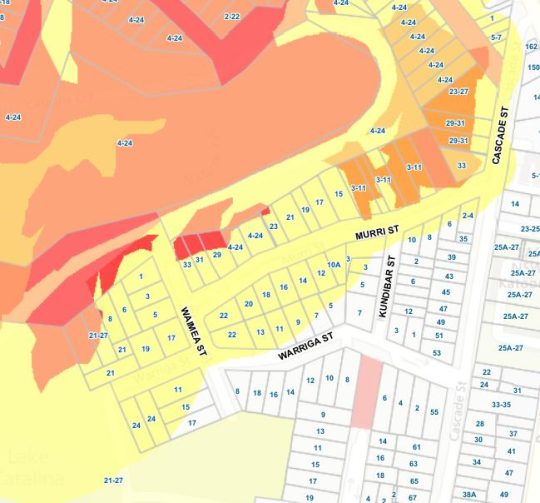
Bushfire Prone cadastral mapping of the subject section of North’s Estate ‘SEC IX’, without specifically identifying the subject property.  [Source:  Spectrum Spatial’s e-mapping on Blue Mountains Council’s website’s Interactive maps] 
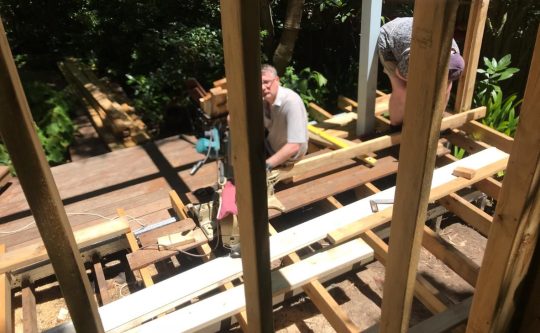
 

The subject backyard sauna under construction.  [Photo by author from fence line].


Other conditions:   It cannot be a shipping container and must not interfere with access or fire safety measures of another building.” 

[Comment:  The backyard sauna poses a fire risk due to the combustible construction materials used, the need for a heating device to make the sauna functional, and likely no planned allowance form first retardant measures such as a fire blanket and fire extinguishers.  In addition, the owner’s intention to soon dedicate the entire property to being an Airbnb holiday let would mean that such guests would likely not be trained in fire safety or fire supression in the event of a fire in the sauna.   The close proximity of the backyard sauna to Mr Ridd’s rear fence would severely restrict fire fighting access Mr Ridd’s property from the rear.]


Neighbour Notification and Disputes


Exempt Development:   While there is no formal requirement to notify neighbours for exempt development, it is always recommended as a common courtesy to maintain good relations and prevent future disputes.” 

[Our Comment:  Council’s has advised that the property owner has not notified Council.  The property owner has not notified adjoining neighbour (property owner) Mr Ridd.  Mr Ridd has disputed Council’s lax interpretation that this backyard sauna is deemed ‘exempt developmentunder the the NSW SEPP (Exempt and Complying Development Code) 2008.  Whilst physically minor in scale, compared with say a dwelling, the build fails to meet any definition of being a shed and breaches multiple rules as this article herein highlights and explains. is not a shed per se.   It does indeed require formal council planning or construction approval, as well as notification to adjoining neighbours likely to be adversely impacted, and there be an opportunity for such neighbours to raise concerns and possible objections about such likely impacts. ]


Development Application (DA):     If your shed does not meet all the exempt development criteria (e.g., you want to build closer than 900mm to the boundary), you will need to submit a DA to the Blue Mountains City Council. In this case, neighbours will be formally notified during the exhibition period and have an opportunity to make submissions or raise concerns.”

[Our Comment:  Hello!  It ain’t just a shed.  Construction needs to be halted immediately. It does not meet all the exempt development criteria (e.g., it  is under 500mm setback from the side boundary).  A DA needs to be submitted to the Blue Mountains (City) Council.   Neighbours need to be formally notified during the exhibition period and have an opportunity to make submissions or raise concerns.]


Actionable Steps

Verify your property’s zoning and constraints:   Use the NSW Planning Portal Spatial Viewer to check your specific property’s zoning, bushfire rating, and other potential constraints.”   

[Our Comment: Been there with the bushfire rating, but more assessment is to be made about other zoning constraints herein in this article below in ‘PART IX.   Scrutiny of LEP 2015/ DCP 2015  Zoning Compliance’]


Confirm the rules:   Review the full list of conditions in the State Environmental Planning Policy (Exempt and Complying Development Codes) 2008 and the Blue Mountains Development Control Plan (DCP) 2015 on the Council’s website.” 

[Our Comment:   It would have been wise for the property owner to have done so in advance, or sought professional advice.  He would have saved time and money and effort and  dispute with Mr Ridd, who would have preferred to utilise his Christmas break doing better things than dealing with a unnecessary dispute.]


Contact the Council:  If you are unsure whether your project is exempt, contact the Blue Mountains City Council’s planning department for advice.”  [Our Comment:   It would have been wise too.]


[AUTHOR’S NOTE:  Council is treating this sauna (to be) as no more than ‘a shed’.  However, this is incorrect.   Unlike a shed, a sauna is not for storage (such as for garden tools) but instead intentionally intended for people to sit in.  It requires a heat source (usually electricity).  That presents a fire risk if not correctly installed by a qualified electrician with experience with sauna installations who knows the risks and follows the rules and uses the factory approved heating device(s).  A sauna necessitates steam , so it requires a water source and water heater which creates noise.  This particular sauna of the owners is to also have an adjoining cold shower attached.  It will be part of a new Airbnb offering, one that has become popular overseas such as in Finland for decades.  This then will attract multiple guests to party right by one’s back fence, so replacing what has for decades been a quite back corner of that owner’s backyard.  It will risk posing a new annoying noise problem.  With the electricity supply, this will facilitate guests to play music – how late and how loud?   Council has abrogated it responsibility in controlling this unauthorised unplanned, unknown development in many ways.]


PART  VIII:   State Environmental Planning Policy (Exempt and Complying Development Codes) 2008


2.17 Specified development


The construction or installation of a cabana, cubby house, fernery, garden shed, gazebo or greenhouse is development specified for this code if it is not constructed or installed on or in a heritage item or a draft heritage item, on land in a foreshore area or in an environmentally sensitive area.

[AUTHOR’S NOTE:   “In English, “cabana” refers to a small, often freestanding shelter typically found near pools or beaches. The term originates from the Spanish word “cabaña,” meaning hut or cabin, and has evolved to describe structures that offer a combination of shade, privacy, and leisure amenities in outdoor settings.”.  Such a structure  was recently built by the subject owner in his backyard, which he dubs ‘The Pavilion”.  The backyard sauna is to be a similar example of the build.]  
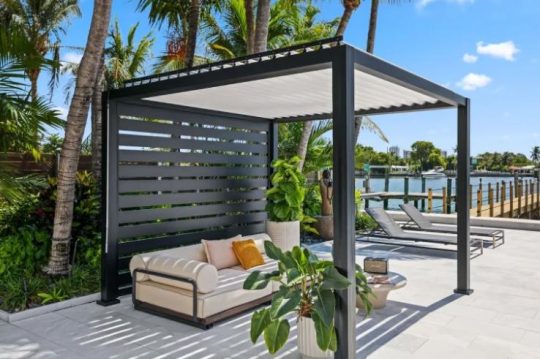
 

A sample cabana


2.18 Development standards


(1) The standards specified for that development are that the development must—

(a) (Repealed)
(b) not have a floor area of more than—

(i) on land in Zone RU1, RU2, RU3, RU4, RU6 or R5—50m2, or   [OUR COMMENT:  these are rural zonings] (ii) on land in any other zone—20m2, and


(c) be not higher than 3m above ground level (existing), and

(d) be located at a distance from each lot boundary of at least—

(i) for development carried out in Zone RU1, RU2, RU3, RU4, RU6 or R5—5m, or
(ii) for development carried out in any other zone—900mm, and


(e) if it is not on land in Zone RU1, RU2, RU3, RU4 or RU6—be located behind the building line of any road frontage, and

(f) not be a shipping container, and

(g) be constructed or installed so that roofwater is disposed of without causing a nuisance to adjoining owners, and 

[OUR COMMENT:  There is as yet no indication that any guttering to the backyard sauna (to be) is to be constructed/installed.  As mentioned, no known design plans for this backyard sauna exist.   The lean-to roof area slopes back towards and very close to Mr Ridd’s fence.  The roof area is estimated to be 4m x 2.5 so an area of about 10m2 . In the frequent event of heavy rainfall that roofwater would be sheeted on to Mr  Ridd’s back fence causing a nuisance and likely damage, including timber rot.  There is no know stormwater management known].

(h) to the extent it is comprised of metal components—be constructed of low reflective, factory pre-coloured materials if it is located on land in a residential zone, and

[OUR COMMENT:  The materials are unknown, since no known design plans for this backyard sauna exist.   However, what has been observed is the use of pinewood for the wall and floor framing].

(i) if it is located on bush fire prone land and is less than 5m from a dwelling—be constructed of non-combustible material, and

[OUR COMMENT:  What has been observed is the use of pinewood for the wall and floor framing, which is highly combustible and so prohibited in this bushfire prone zone].

(j) if it is constructed or installed in a heritage conservation area or a draft heritage conservation area—be located in the rear yard, and

(k) if it is located adjacent to another building—be located so that it does not interfere with the entry to, or exit from, or the fire safety measures contained within, that building, and

(l) be a Class 10 building and not be habitable, and

(m) be located at least 1m from any registered easement   

[Our Comment:  The subject backyard sauna is being constructed directly vertically above a Sydney Water Sewer main, which runs from the top via a manhole access on Mr Ridd’s side of the fence under the back fence and directly below the new backyard sauna construction.  This is illegal.  Mr Ridd became familiar with such a law during the process of his own renovation approved by Council back in 2005 involving stormwater management planning.]
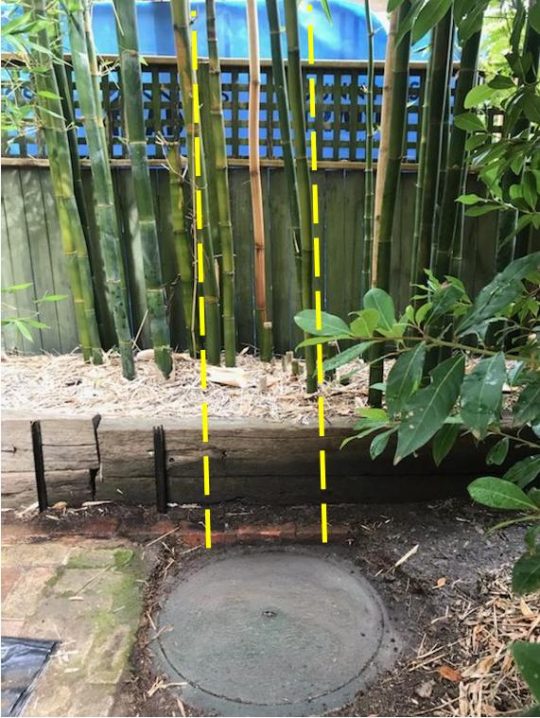
 

Mr Ridd’s backyard adjoining the subject property has a pre-existing trespassing sewer main from decades prior with a manhole access  (shown above) near the back boundary.  This sewer main runs from this access manhole directly behind under the rear fence (10 feet deep) downstream. So the new backyard sauna is being constructed by the subject property owner directly above the Sydney Water sewer registered easement.  So this new backyard sauna build in situ is illegal.


(n) in relation to a cabana—not be connected to water supply or sewerage services.

[Our Comment:  The subject backyard sauna is to be connected to water supply for both the sauna heater and the shower.]


(2) There must not be more than 2 developments per lot.

[Our Comment:  The subject backyard sauna is to be the third outbuilding, following the new cabana adjacent (dubbed ‘the pavilion’) in addition to the carport] 


SOURCE:  ^https://legislation.nsw.gov.au/view/html/inforce/current/epi-2008-0572#sec.2.18


PART IX.    Scrutiny of LEP 2015/ DCP 2015  Zoning Compliance


We note the following zoning restrictions to this subject property and to ours, likewise.

This information is publicly available on Blue Mountains Council’s website’s Interactive Maps subdomain:  ^https://www.bmcc.nsw.gov.au/property-search  (Click view our interactive maps link).


AUTHORS NOTES:

Of relevance: 

(1)   LEP 2015 Zone ‘R2 – Low Density Residential

(2)   LEP 2015 Heritage – K171 North’s Estate Conservation Area (General)

(3)   Bushfire Prone Land – Vegetation Buffer


References and Further Reading:


[AUTHOR’S NOTE:   Most references are publicly available at the time of publishing this article.  Each reference below was accessed by this article’s author at the time of publishing so the date of the reference is accurate of as that date.  Given that governments habitually change their websites, the included online links may die over time; in which case, where possible, we have also included a copy of the relevant document as an imbedded PDF document that is downloadable by readers of this article. ]

An example:  
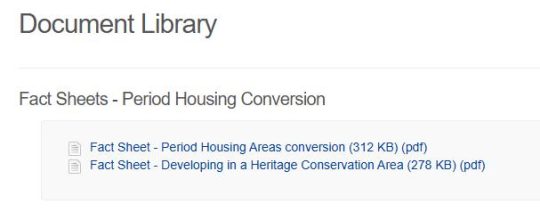
SOURCE:  ^https://yoursay.bmcc.nsw.gov.au/periodhousing/widgets/190457/documents


[1]   ‘Draft Heritage Data Form – Blue Mountains Heritage 2016‘, 2014, external consultant report on North’s Estate Heritage Conservation Area, Local ID K171, by Paul Davies Heritage Architects Pty Ltd (Sydney), and by Conroy Heritage Planning (Sydney), 11 pages (file size 476KB), ^https://www.bmcc.nsw.gov.au/documents/map-and-heritage-inventory-sheet-k171, a PDF copy embedded and downloadable below. 

Loader Loading...
EAD Logo Taking too long?

Reload Reload document
| Open Open in new tab

Download


[2]   ‘Heritage Conservation Areas‘, Blue Mountains Council website, 2015, ^https://www.bmcc.nsw.gov.au/heritage/heritage-conservation-areas), 5 pages


[3]   ‘DCP 2015 Part D Heritage Management – Guiding the development of heritage properties‘, Revision: Amendment 8, November 2015, Blue Mountains Council, ^https://www.bmcc.nsw.gov.au/documents/dcp-2015-part-d-heritage-management, copy in PDF embedded below for download and printing,  88 pages

Loader Loading...
EAD Logo Taking too long?

Reload Reload document
| Open Open in new tab

Download


[4]   ‘Development Control Plan 2015‘, 2015, Blue Mountains Council website, ^https://www.bmcc.nsw.gov.au/development/planning-rules/development-controls-for-land-zoned-under-LEP-2015/DCP-2015, Full Version (916 pages) ^https://www.bmcc.nsw.gov.au/documents/dcp-2015-full-version


[5]   ‘Fact Sheet – Period Housing Areas conversion to Heritage Conservation Areas‘, 2018-06-29, Blue Mountains Council website, ^https://yoursay.bmcc.nsw.gov.au/periodhousing/widgets/190457/documents, 2 pages

Loader Loading...
EAD Logo Taking too long?

Reload Reload document
| Open Open in new tab

Download


[6] Fact Sheet – Developing in a Heritage Conservation Area‘, 2018-06-29, Blue Mountains Council website, ^https://yoursay.bmcc.nsw.gov.au/periodhousing/widgets/190457/documents, 2 pages

Loader Loading...
EAD Logo Taking too long?

Reload Reload document
| Open Open in new tab

Download


[7]   ‘Blue Mountains Heritage Strategy 2021-2025‘, (undated), by Blue Mountains Council and probably mostly scribed by its external consultant from Sydney, 60 pages, ^https://www.bmcc.nsw.gov.au/advanced-search?keys=The+Blue+Mountains+Heritage+Strategy+2021-2025

Part 1:  Strategy Background:

Loader Loading...
EAD Logo Taking too long?

Reload Reload document
| Open Open in new tab

Download


Part 2:  Strategy:

Loader Loading...
EAD Logo Taking too long?

Reload Reload document
| Open Open in new tab

Download


Part 3:  Implementation Plan:

Loader Loading...
EAD Logo Taking too long?

Reload Reload document
| Open Open in new tab

Download

[AUTHOR’S NOTE:  Hypocrisy in an aloof bubble on steroids – Blue Mountains would do better run from New Zealand.]   


[8]   ‘blue mountains shed development setback rules neighbours‘,  (an Internet web browser search phrase typed by yours truly in ‘Google Chrome’ software), Result per Google AI Overview):   See above Part VII above.


[9]   ‘Property Map Search‘, Blue Mountains Council’s website, ^https://www.bmcc.nsw.gov.au/property-search

Search for information about a property:

Use our interactive maps to identify the zoning and site characteristics of land. This property search tool is useful in establishing site constraints and development opportunities.

      • Click on the link below and add the property address.
      • Click the ‘layers icon’ in the top right of the webpage, and then tick the maps to view.
      • More information is also available by clicking on the three dots to the right of the Lot and Plan number, on the left side of the webpage.
      • For the best user experience, please use Google Chrome to browse this website.”

View Our Interactive Maps:  ^https://emapping.bmcc.nsw.gov.au/connect/analyst/mobile/#/main?mapcfg=Locality&lang=en-au


[10] State Environmental Planning Policy (Exempt and Complying Development Codes) 2008‘, 2008, NSW Government,  ^https://legislation.nsw.gov.au/view/html/inforce/current/epi-2008-0572#sec.2.18


[11]   ‘Pictorial Memories – Blue Mountains‘, (book) by John Low OAM, 2ED, 1994, published by Kinsclear Books, 135 pages.


[12]   ‘Blue Mountains Council’s ‘love local’ hypocrisy towards small business‘, 2021-05-21, Nature Trail website (click link below)


Blue Mountains Council’s ‘love local’ hypocrisy towards local businesses


[13]   ‘Century-old Blue Mountains kiosk to get new lease of life‘,  2019-04-17, by Alison Cheung,  ^https://www.commercialrealestate.com.au/news/century-old-blue-mountains-kiosk-to-get-new-lease-of-life-45705/     [AUTHOR’S NOTE:   the terms ‘revitalisation’ and ‘new lease of life’ are anti-heritage architectural values – think Hong Kong high-rise Alison Cheung].
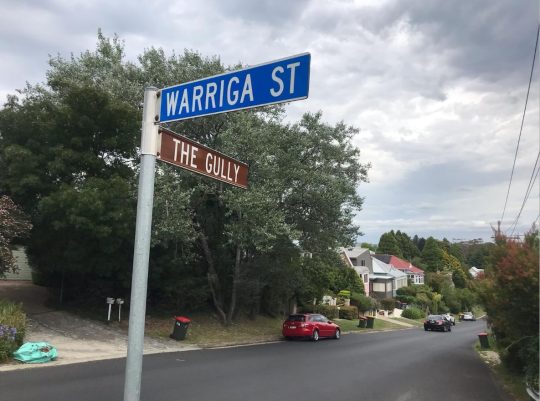


The Gully (Katoomba) holds meaningless heritage value to Blue Mountains Council, except exploitative propaganda and enterprise value to it.  No trust.


[This article’s publishing last updated:  1st January 2026.]

 

The curse of vegetation machinery and uncivil meatheads

Tuesday, April 22nd, 2025

Regan McNeil


We live and work from home in a quiet leafy area on the edge of The Gully on the edge of Katoomba. 

Yet on a semi-regular basis different neighbours, unannounced, choose at times to suddenly start up loud machinery to break that peace and quiet.

Due common courtesy would be for a neighbour to inform nearby neighbours of pending machinery racket, but instead they couldn’t give a rats about imposing their noise pollution on neighbours.

Here are a few example snippets:

Monday · 24 Feb 2025 · 08:20…


Thursday · 20 Mar 2025 · 13:22…


Tuesday · 22 Apr 2025 · 08:36…


And, all this unwelcome noise culture is not just from selfish discourteous neighbours and their contractors.

Also, we cop similar machinery noise outside our window from:

  • Blue Mountains Council – roadworks, footpath works
  • NBN Internet concrete sawing for trenching optical fibre
  • Sydney Water
  • Electricians and other trades
  • Endeavour Energy’s – vegetation contractor Asplundh or Active Tree Services
  • Even RAAF low-flying its Hercules and Globemaster transport aircraft from Richmond Airbase at a close 500 feet directly over our home  
  • And other private aircraft thinking they can flout the 1000 foot minimum altitude over built-up areas like ours  (we know the low altitudes since we hold a commercial helicopter license)


All unannounced.

Perhaps Richmond Air Traffic Control Tower wouldn’t mind if one was to buzz the tower unannounced?


Postscript:

‘Iceman’ recognition:


Blue Mountains City Council’s neglect of Katoomba Falls and Kedumba River

Tuesday, June 4th, 2024

This is yet another example of neglected stormwater runoff maintenance by Blue Mountains {city} Council.     Its in-creek water pollution trap (vane style) device is situated just above Katoomba Falls (left of photo). 


Our editor standing in front of large piles of sand pollution re-directed out of Katoomba Falls Creek by an in-creek pollution control device (left). [Photo by The Habitat Advocate, taken Thursday 30th May-2024.]

 

This pollution detritus trap has, from our very local experience over two decades, been typically full of destroyed native vegetation debris caused by (a) torrential rain events, and (b) bushland clearing (deforestation).  It has also been observed typically full of siltation from (a) upstream creek bank erosion through Maple Grove, (b) from housing construction sand and graded topsoil, and (c) from unfiltered urban stormwater waste ignored by Council since it was established first as the Municipality of Katoomba in 1889. 

We have lived in The Gully Water Catchment since 2001.  The Gully Water Catchment includes all land with watercourses and natural drainage flowing to Katoomba Falls, and we have taken a keen interest in this natural place.  

Katoomba Falls Creek Catchment as it was then called in 1993.   [SOURCE: The Bell Report]
 

From our observed experience as local environmental activists, Council’s ongoing management culture is such that it focuses on the capital works projects, obtains external grant funding (usually from the NSW Government) but then fails to budget and resource the ongoing maintenance of such capital works projects.  This Baramy Trap is another case in point.

We repeatedly observe this pollution trap full and overflowing for months at a time, so the trap overflows and the continuing detritus flows downstream into the downstream Kedumba River to supply Greater Sydney’s drinking water to Sydney’s artificial Lake Burragorang for Sydney and a Greater Sydney so scarily morphing beyond.  Currently this pollution trap has been full of sand sediment for many months.   

The above photo shows the concrete ramp down to the pollution trap for access by a small front-end mechanical loader designed to remove the sand and debris pollution into a waiting tip-truck.  

A Bobcat more suited to a construction site or at a beach as in this example photo.  But at Blue Mountains {city} Council it’s Missing-In-Action.


Council is supposed to maintain it and clean it out on an ‘as-needed‘ basis periodically, but it doesn’t.  The following is an extract of Baramy’s terms and conditions for this pollution device once installed.  

We obtained a copy of these terms and conditions back in 2004 when The Friends of Katoomba Falls Creek Valley Inc. (the Friends) sought a quote for a similar but smaller pollution device (4 m long x 2.1 m wide) previously to be constructed in the same creek further upstream.   Baramy’s quote came in at $26,000 and we referred this initiative for action/grant funding to Council – it being the custodian of this community land and the creek water catchment.  But Council ignored it.  

In this case Council is the “customer” having paid to have this much larger device constructed by Baramy Engineering in this different location much further downstream.  It would have cost Council double, constructed probably around 2005 from one’s memory.  

Council’s culture 

Council has form of having its other non-environmental priorities, such as its latest newfangled ‘Planetary Health Initiative’ to showcase its environmental stewardship, when it is just more greenwashing.

Previously, all such debris, sediment and stormwater pollution into the creek used to just flow over Katoomba Cascades and further downstream over Katoomba Falls into the Kedumba River below and southward through the Jamison Valley.   


Katoomba Cascades during full flood, situated about 100 metres downstream of the pollution trap.  [SOURCE: Photo by Brigitte Grant, in article ‘Flood photos: Three-day drenching’ 22nd March 2021, Blue Mountains Gazette newspaper]


Katoomba Falls in full flood after days of heavy rain.  The falls are situated about 300 metres downstream of the pollution trap.  [SOURCE: Photographer unknown, in article ‘Police to co-ordinate evacuation of visitors trapped in Megalong Valley following landslip’ 4th April 2024, by Damien Madigan in  Blue Mountains Gazette newspaper] 


By the way, Upper Mountains sewage design (Katoomba, Leura, Wentworth Falls) back between 1907 and the 1990’s also flowed by iron piping down into the Jamison Valley to the former Leura Sewage Treatment Plant (historic image below) situated just by Leura Falls Creek between Echo Point and Sublime Point.   The iron piping still can be seen along hiking tracks down the escarpment – the reason for the hiking tracks actually being first constructed. 

We estimate that the current sand quantity filling this particular Creek Pollution Trap would be twenty cubic metres at least.  We reported the problem to Council the day we took the first photo above – receiving Council’s Customer Service Request reference #533082.

We’re not the only locals having noticed this particular in-creek pollution trap full.  Here’s another documented event of the very same pollution trap in February 2020.  It was during the start of Australia’s East Coast Low events associated with the La Niña oscillating weather pattern:

Local Blue Mountains Aboriginal Gundungurra Elder, Mr David King, posting his video on Google YouTube protesting this exact same problem back in 2020. He even likened it Bondi Beach!    [SOURCE]

This pollution trap’s exact location is situated beside Cliff Drive in Katoomba on the southern (downstream) side of the road at the road culvert over Katoomba Falls Creek.  See the aerial photographic map below showing the yellow star.  

An aerial photo of the 100 ha extent of The Gully Water Catchment juxtaposed upstream of this pollution trap.  (NB. The “Katoomba Falls” photo label is incorrectly shown on this image, being rather just a Google nominal reference on the roadside.  [SOURCE: Google Maps aerial photo, 2024]


This in-creek pollution trap was constructed by Baramy Engineering Pty Ltd of Katoomba for Council.   

The Baramy Vane Trap showing the two rows of vertical galvanised steel vanes in the creek line that divert debris to the concrete trap device on the right.


The construction timing was a few years or so following The Greater Blue Mountains Area (1 million km2) being inscribed on the UNESCO World Heritage list on 29th November 2000.   Katoomba Falls flows into the Jamison Valley within this World Heritage area.  The Jamison Valley, below these falls (and others) is also part of the drinking water catchment leading to Warragamba Dam supplying an ever-expanding Greater Sydney (current population approaching 5.5 million) adjoining the Blue Mountains region.   

It is the researched opinion of The Habitat Advocate that this World Heritage listing was more about the human utility of protecting the value of Sydney’s drinking water in perpetuity, than it was about protecting the Eucalyptus forests of the Blue Mountains. 

Katoomba Falls in the centre of this photo.  The Gully Water Catchment  upstream feeds natural and stormwater to these falls.  The area covers an estimated 100 hectares a passes through a small valley up on the Blue Mountains plateau. This valley includes bushland and increasingly more and more housing development.


Notably, the sand type in this pollution trap appears to be not the naturally river sand, but consistently all the same light colour of Concrete Sand type used commercially in construction.


Concrete Sand


Concrete Sand is a coarser sand variety, pivotal in construction use to create strong and durable concrete structures.  It’s typically made from crushed quartz, which gives it a rougher texture, enhancing the binding properties in concrete mixtures. This sand type is indispensable for laying robust foundations, constructing driveways, and forming sidewalks.  This is exactly what is going on in The Gully Catchment upstream of this creek pollution trap.

Whereas the natural creek-bed of Katoomba Falls Creek is comprised of small pebbles.  This editor knows this from being local to Katoomba Falls Creek Valley and having voluntarily performed Streamwatch quality monitoring of Katoomba Falls Creek for five years (2004-2008) on behalf of the Friends of Katoomba Falls Creek Valley, Inc. reporting to the Sydney Catchment Authority (SCA) within the New South Wales Governments Sydney Water department. 

An example of the characteristics of creek-bed pebbles typically found naturally on the creek bed of Katoomba Falls Creek and other nearby watercourses – yet sadly beneath the years of construction sand sedimentation pollution from various identified housing construction sites throughout this plateaued catchment.


Council doesn’t analyse the sand to determine its source.  Council doesn’t fine the polluters and issue a stop work court order.  Council doesn’t employ a hydrologist or geotechnical engineer on its books.     Yet where is all the housing constrution taking place in the Blue Mountains?   Upstream of the World Heritage area.

In our view, Council is unfit in delegated stewardship as custodian of the geographic plateau of the Blue Mountains Local Government Area (LGA) atop the Blue Mountains World Heritage Area from its atrocious record of failings.   So long as this pollution control device is full and overflowing, sand and debris is flowing downstream over Katoomba Cascades and Katoomba Falls into the Kedumba River.   Parks Service (‘NPWS’) doesn’t monitor pollution levels or water quality in Kedumba River down in the Jamison Valley.

Council doesn’t enforce sediment controls are housing development sites upstream in The Gully Water Catchment (Katoomba Falls Creek Valley).

There are current two large housing subdivision sites contribution to sedimentation of the creek.


1.  Katoomba Golf Course – ‘Yarrabee Katoomba’ – a 24 townhouse subdivision

Totally inadequate sediment controls.   These townhouses are constructed of concrete using concrete sand.   [Photo by Editor, Sunday 26th May 2024]


What sediment controls for this massive pile we’ve dubbed ‘The Sphynx’?  [Photo by Editor, Sunday 26th May 2024]


2.    21 Stuarts Road, Katoomba – massive housing subdivision

Some 13 odd hectares of fragile native bush surrounding an upland brook between Stuarts & Wellington Roads is to be bulldozed into a 53 cluster housing subdivision.


Bulldozing all the top soil throughout this side creek valley to Katoomba Falls Creek (Kedumba River).   [Photo by Editor, Sunday 26th May 2024]


Council care factor?   Zilch.


References:


[1]   ‘Concrete Sand: Essential for Structural Integrity’, ^https://www.constructor.net.au/breaking-down-the-different-types-of-sand-used-in-construction/


[2]   ‘Flood photos: Three-day drenching‘,  2021-03-24, Blue Mountains Gazette, ^https://www.bluemountainsgazette.com.au/story/7178181/flood-photos-three-day-drenching/


[3]   ‘Police to co-ordinate evacuation of visitors trapped in Megalong Valley following landslip‘, 2024-04-04, by Damien Madigan, Blue Mountains Gazette, ^https://www.bluemountainsgazette.com.au/story/8580550/blue-mountains-flash-flooding-warning-ses/


[4] Katoomba Baramy Trap‘, Maple Grove Reserve, February 2020, video by David King, ^https://www.facebook.com/dingodarbo/videos/maple-grove-reserve-katoomba-baramy-trap-february-2020/783187302176658/?_rdr


[5]   ‘Pollution Control Device‘ quote prepared for ‘Frank Walford Park Bushcare’ (Friends of Katoomba Falls Creek Valley Inc), 2004-09-27, by Baramy Engineering Pty Ltd, 7 pages.


[6]    ‘Leura Sewage Treatment Works‘, by Ask Roz Blue Mountains, Tourist information centre, ^https://www.facebook.com/AskRozBlueMountains/posts/historic-snapshot-leura-sewage-treatment-works-what-were-they-thinking-if-you-ha/3724364867606906/


World Parks Congress Sydney opportunity cost

Saturday, November 15th, 2014
World Parks Congress SydneySmoking Ceremony or Smoke and Mirrors?
Staged for the delegates by National Parks and Wildlife Service of New South Wales (NPWS), somewhere outside Sydney, Australia
[Source:  ‘Global First Nations environmentalists share stories at the World Parks Congress in Sydney.5:30’, ^https://twitter.com/nitvnews, 20141113]

.

Every ten years a World Parks Congress is a forum staged by the International Union for Conservation of Nature to discuss the effectiveness of World Heritage Listed Protected Areas.   For 2014, Parks Australia put up Sydney’s hand to host and fund it.

<<“We (Parks Australia) are delighted to be co-hosting the IUCN World Parks Congress with our colleagues in the New South Wales National Parks and Wildlife Service – and look forward to welcoming inspiring leaders from around the world.”>>

IUCN’s vision is a “just world that values and conserves nature.”  The theme for the 2014 conference is “Parks, people, planet: inspiring solutions”.

The last congress was in Durban, South Africa eleven years ago in 2003 and significant messages from that congress were that:

  1. Considerable progress has been made in the establishment of protected areas although significant gaps remain
  2. Protected areas face many challenges, and management effectiveness must be strengthened
  3. Protected areas play a vital role in biodiversity conservation and sustainable development
  4. A new deal is needed for protected areas, local communities and indigenous peoples
  5. There is a need to apply new and innovative approaches for protected areas, linked to broader agendas
  6. Protected areas require a significant boost in financial investment
  7. Protected areas management must involve young people

.

Congress Cost Benefits ?

.

The obvious first question for the 2014 Sydney Congress is what are the outcomes from these seven messages of 2003?

The second question is what is to be the conservation return on investment of staging the 2014 congress in Sydney?   That starts with Parks Australia and NPWS disclosing the full costs of the congress.  How much will it have cost by the time this week is over?   Five million? Ten million? Twenty million? More?  That also involves disclosure of the onground conservation outcomes, if any.   The congress hosts more than 5000 delegates for a week-long event in Sydney.

If the answers are not forthcoming and/or the performances less than satisfactory, then perhaps the money could have been better spent (invested) by Parks Australia and NPWS on specific onground conservation of current and worthy Protected Areas in Australia.  So the third question is what is the opportunity cost of the 2014 IUCN World Parks Congress which could have delivered the IUCN vision of a “just world that values and conserves nature”?

.

Congress Opportunity Costs

.

According to IUCN director general, Julia Marton-Lefevre, assessments during the past decade have found that half of the world’s protected areas at best — and possibly as few as 20 per cent — are managed effectively. “Some are what we refer to as ‘paper parks’ ” – parks just on paper.

The Australian Government’s $180 million allocation to expand the park reserve system expired last year.

The Great Barrier Reef Marine Park is a case in point.  It is the iconic Protected Area in Australia.  Its World Heritage listing along with various national zoning, management plans, permits, education and incentives are supposed to protect and conserve the marine ecosystems and migratory species from human threats. But farm and urban runoff continues to contaminate the rivers that flow into the Reef.

In 2009 and 2011, mining company Queensland Nickel discharged nitrogen-laden water and 516 tonnes of toxic waste water into the Great Barrier Reef.

On 21 July 2013, on the second day of the biennial joint training exercise Talisman Saber, two American AV-8B Harrier fighter jets launched from aircraft carrier USS Bonhomme Richard (LHD-6) dropped four bombs, weighing a total 1.8 metric tons (4,000 pounds), into more than 50 metres (164 ft) of water. On 3rd April 2010, The Shen Neng 1, a Chinese ship carrying 950 tonnes of oil, ran aground, causing the 2010 Great Barrier Reef oil spill.

In December 2013, Greg Hunt, the Australian environment minister, approved a plan for dredging to create three shipping terminals as part of the expansion of an existing coal port. According to corresponding approval documents, the process will create around 3 million cubic metres of dredged seabed that will be dumped within the Great Barrier Reef Marine Park.

On 31 January 2014, a permit was issued to allow three million cubic metres of sea bed from Abbot Point, north of Bowen, to be transported and unloaded in the waters of the Great Barrier Reef Marine Park, just outside of Abbot Bay.  The dredge spoil will cloud the water and block sunlight, thereby starving sea grass and coral up to distances of 80 km away from the point of origin due to the actions of wind and currents.  The dredge spoil will smother reef or sea grass to death, while storms can repeatedly resuspend these particles so that the harm caused is ongoing; secondly, disturbed sea floor can release toxic substances into the Great Barrier Reef Marine Park.

Dredging the Great Barrier ReefDredging the Great Barrier Reef for bulk export shipping

.

The Great Barrier Reef Marine Park has become just a blue line on a map.  The trickle of funds for Australia’s national parks betrays a lack of appreciation of their economic contribution. Annual funding for the authority that runs Australia’s most famous reserve, the Great Barrier Reef Marine Park, is about 1 per cent of the $5.2bn it earns the country in tourism revenue.

Yet if the IUCN World Parks Congress cost a conservative $20 million to stage then a key opportunity cost would be the June 2014 Federal budget cuts to the Great Barrier Reef Marine Park Authority.

The budget axed 17 staff including five of its’ directors positions.   These positions included the director of heritage conservation, the director of policy and governance and the director of coastal ecosystems and water quality as part of an internal restructure.  It’s being described as the greatest loss of expertise from Australia’s most important natural wonder and it comes at the very time the Great Barrier Reef is facing the greatest threat to its survival.

The Greater Barrier Reef Marine Park Authority has been reduced by the Australian Government to being in name only and ineffective at protecting the reef.

Until recently, one of those five directors, Adam Smith, was charged with dealing with the contentious Abbot Point coal terminal development and the proposal to dump three million cubic metres of dredge spoil into the marine park.   Despite Dr Smith’s concerns, the sea dumping was approved by the Marine Park Authority.

Dr Smith has since accepted voluntary redundancy and moved on after disagreeing with the Authority’s new economic leadership and values.  Heritage conservation director Jon Day has left after 21 years, disillusioned too with the direction the Authority has taken to compromise the reef.

Next year UNESCO will decide whether to put the reef on its world heritage in danger list.  Native Dugongs are already endangered.  The deliberate extermination of the dugong and turtles which habituated the Gladstone area is a national tragedy. Dugongs are species listed under the Federal Environment Protection Biodiversity & Conservation Act, which requires the Federal government to legally protect these animals.

Gladstone Dugong Dead

Prior to the massive dredging operation of 52 million cubic metres of seabed for the development of the world’s largest LNG Terminal, ( which is 62% completed) a study commissioned by the Gladstone Ports Corporation found that a take, or a quota, of more than zero dugongs would be unsustainable.

In the face of massive mortality of dugongs, turtles and inshore dolphins during the ongoing massive dredging, both the Federal and Queensland governments ignored the slaughter.

Look at the stranding data from the Queensland Department of Environment and Resource Management. Monthly cumulative Dugong strandings by year for Queensland, up to 31 January 2012.

Queensland Dugong Strandings to 2012

There are 22,000 vessel movements a month in Gladstone Harbour. No ship strikes of Dugongs or of Green Turtles need to be reported.  No audit of environmental conditions has been undertaken by the Queensland or Federal Governments.   The wholesale slaughter of our marine wildlife is the price Australians are paying for the transformation of the Great Barrier Reef World Heritage Area into the world’s largest unregulated quarry.

Queensland Tourism getting up close and personal with Humpback WhalesMass tourism operators good for the economy
Getting up close to protected Humpback Whales within their 100 metre Protected Area

.

Australian protected areas have seen rule changes in the eastern states have allowed cattle to graze, recreational shooters to hunt and hotel developers to build in national parks. Shore-based recreational fishing has been allowed in areas of NSW marine parks previously zoned as no-take sanctuaries.  National parks on land and in the ocean are dying a death of a thousand cuts, in the form of bullets, hooks, hotels, logging concessions and grazing licences.

Yet as host of the 2014 World Parks Congress, Australia is showcasing “our own inspiring places, inspiring people and inspiring solutions.”     The Global Eco Forum within the Congress programme focuses on tourism exploitation of Protected Areas because like the new Greater Barrier Reef Marine Park Authority, the new values are not about conservation by the billions in revenue opportunity to Australia’s economy.

The October 2006 issue of National Geographic published an article “The Future of Parks: Hallowed Ground – Nothing is Ever Safe”.

It stated:

“Landscape and memory combine to tell us certain places are special, sanctified by their extraordinary natural merits and by social consensus. 

We call those places parks, and we take them for granted.”

.

Sydney’s 2014 World Parks Congress appears to be expensive window dressing, showcasing fraudulent conservation of Protected Areas in Australia.

It’s termed Greenwashing.  The opportunity cost of the 2014 Congress could have instead funded the retention of the previously effective Great Barrier Reef Marine Park Authority and so done more for Protected Areas than all the pomp, promising, luncheons, showcasing, and talk-festing of the congress combined.

.

Great Barrier Reef World Heritage in DangerProtest to stop Queensland Resources Council dumping dredge spoil inside the Reef
Protest by Cairns and Far North Environment Centre (CAFNEC), June 2014
^http://cafnec.org.au/wp-content/uploads/2014/03/rally-promo-photo.jpg

.

Further Reading:

.

[1]    IUCN World Parks Congress (Sydney 2014), International Union for Conservation of Nature, ^http://worldparkscongress.org/

.

[2]   ‘Global Eco-Tourism in Protected Areas‘, by EcoTourism Australia,  >2014 Global Eco Tourism in Protected Areas.pdf   (1.1MB, 2 pages)

.

[3]   Great Barrier Reef Marine Park Authority (website), Australian Government,  ^http://www.gbrmpa.gov.au/

.

[4]   Fight for The Reef (website), Australian Marine Conservation Society, ^https://fightforthereef.org.au/risks/dredging/

.

[5]   No Hunting in National Parks (website),  The National Parks Association of NSW,  ^http://nohunting.wildwalks.com/

.

[6]   ‘An international perspective on tourism in national parks and protected areas‘, by J.G. Castley (2014), >An international perspective on tourism in national parks and protected areas.pdf  (100kb, 10 pages)

.

[7]   ‘EXTRA: ‘Nasho’, Royal National Park, Sydney’s neglected southern jewel‘, by Nick Galvin, Journalist, Sydney Morning Herald, 20140613, ^http://www.smh.com.au/nsw/extra-nasho-royal-national-park-sydneys-neglected-southern-jewel-20140613-zs6d8.html

.

[8]   ‘Paradise lost: Australia’s heritage jewels under threat‘, (audio), ABC ‘Background Briefing’ radio programme, by Sarah Dingle, 20131208, ^http://www.abc.net.au/radionational/programs/backgroundbriefing/2013-12-08/5132224

.

White Lemuroid PossumWhite Lemuroid Possum
(Wet Tropics of Queensland World Heritage Area in Danger)
Has the white lemuroid possum become the first mammal to go extinct due to global warming?
The species, normally found above 1000m, has not been sighted during any nighttime spotlighting expedition since 2005. Experts fear a temperature rise of 0.8 degrees Celsius may be to blame for the animal’s disappearance. 
[Source:  ^http://www.wherelightmeetsdark.com/index.php?module=newswatch&NW_user_op=view&NW_id=453]

.

Copenhagen was a deadline without a plan

Sunday, June 30th, 2013
The following article was initially published on ^CanDoBetter.net 20091218 by Tigerquoll.

.

Copenhagen Summit 2009

.

Copenhagen was a deadline without a plan.

Like Vikings, they rushed in. Too many issues, too many causes, too many delegates, too much reading, too many options and yet forced to deliver a global consensus solution in just 2 weeks!

Copenhagen’s approach ought to have been pragmatic. It needed to come down from the stratosphere in idealistic thinking to have focused on what could be the fastest means to offer the greatest reduction in greenhouse gases commencing in 2010.

Money is the obvious facilitator. The G11 response to the Global Financial Crisis ‘Mark I’ demonstrated the sheer scale of quick cash available from developed nations. Since developing nations need the cash, therein lies an obvious negotiating connector.

Try this scenario… rank countries on the basis of their aggregate carbon emissions and also carbon emissions per capita.  The size of reduction responses and the amount of funding for carbon reduction programmes should be proportional on both bases.  That is, the worst emitting developed nations pay more, and the worst emitting/deforesting developing nations get compensated more not to log.

Pay compensation to countries to stop deforestation is simply a matter of money and there is certainly enough of that around it seems. This should start by Christmas – calculate the forest area, calculate the compensation value, sign the agreement, developing countries contribute to a trust account, transfer the funds electronically to the host country of the forests, send in UN monitors to enforce the agreement to make sure no trees fall.  If Copenhagen just did that, it would have achieve a significant inroad – 20% reduction in one year or something in that order.

News of the pledge by US based Climate Progress of US$1 billion over three years towards decreasing deforestation is an excellent outcome. The funding will go to developing countries that develop REDD (Reducing Emissions from Deforestation and Degradation) programs.

REDD
But horse trading in emissions is pure problem avoidance.  Perhaps a less patriarchal culture may have helped too. Perhaps less Viking patriarchal culture and perhaps a more matriarchal approach to negotiation would have achieved better. The alpha male approach has clearly failed.

‘COP15’ was also a silly name. It just meant the 15th United Nations Climate Change Conference. Rather than the meaningless ‘COP15’ (‘Conference of Parties’ #15) , such a vital global forum series deserves a more accessible and meaningful name in order to better engage with ordinary folk.

Perhaps instead a better name should be ‘Greenhouse 2009’, then work towards ‘Greenhouse 2010’, ‘Greenhouse 2011’ – for each year, setting and achieving a distinct global reduction outcome by legal treaty. Such numbering and annual frequency would better convey the sense of urgency.

.
Malaysian Logging
This is Malaysia
Don’t holiday in Malaysia. Don’t fly Malaysian Airlines.

.

Toxic chemicals trucked through World Heritage

Saturday, June 29th, 2013
Chemtrans Tank Container
Toxic liquid chemicals being trucked through the Blue Mountains World Heritage Area

.

The New South Wales Government decision in the late 1990s to permit 19-metre B-doubles to operate along the Great Western Highway was recognised by many informed Blue Mountains residents as the thin end of the wedge to encourage bigger and faster trucks and to extend Sydney sprawl.

Its planning minister in 2008, Frank Sartor, famously heralded:

.

“Few understand how much transport influences land use patterns.  Transport leads land use.  Once an expressway or railway is built, it is easy to change the zoning and development laws to increase the population along the corridor.” 

.

~ Frank Sartor,  NSW Planning Minister, Sydney Morning Herald, 20080929, p11.

.


The Greater Blue Mountains is a vast forested wilderness covering over one million hectares, characterised by ancient sandstone tablelands and escarpments, ancient temperate eucalypt forest types,  rainforests, heathlands and swamps containing rare and endemic flora and ecological communities.   It was formally inscribed on the World Heritage List on 29 November 2000 and constitutes one of the largest and most intact tracts of protected bushland in Australia.

.

Jamison Valley , Blue MountainsJamison Valley wilderness and beyond
Blue Mountains World Heritage Area
[Photo by Editor, 20130307, Photo © under  ^Creative Commons,
click image to enlarge]

.

Along the headwaters of the Jamison Valley above Wentworth Falls, the Jamison Creek flows as a stormwater drain underneath the Great Western Highway.

On or about 7th July 2012, a large quantity of toxic pyrethrin, used as a fumigation pesticide, was dumped into the creek resulting in extermination of all aquatic wildlife downstream and into the World Heritage below.   [Source:  ‘Health risk posed by Wentworth Falls creek, 20120711, Blue Mountains Gazette newspaper, ^http://www.bluemountainsgazette.com.au/story/273589/health-risk-posed-by-wentworth-falls-creek/]

A year on and still no prosecution has been made against the culprit known by both the local council and the EPA.  The contamination could easily have come from the overturning of one of the many trucks that ply the highway now carting toxic chemicals, nudging 90kph.

The Great Western Highway winds its way over the central plateau ridgeline of the Blue Mountains east to west from Sydney.  In every respect, the Greater Blue Mountains World Heritage Area is juxtaposed downstream of this highway.

.
Great Western Highway
Great Western Highway at Boddington Hill before the Trucking Expressway conversion
The notorious greenwashing sign
[Photo by Editor, 20100327, Photo © under  ^Creative Commons]

.

Increasingly, the Great Western Highway is becoming dominated by larger trucks and an increasing frequency of B-Double Trucks carting sand and soil, containers, palletised freight, heavy machinery and bulk liquids.  Transport companies are not delivering to the Blue Mountains; they are transiting through the Blue Mountains for destinations far beyond including Perth and Darwin.

Large Trucks along Great Western HighwayOne of the many thousands of larger trucks that now dominate the Great Western Highway
Political lobbying by trucking companies continues to be the prime driver for the multi-billion conversion of this regional highway into a 4-laned interstate Trucking Expressway nudging 90kph.
[Photo by Editor at Bullaburra looking west, 20130406, Photo © under  ^Creative Commons]

.

However, local Blue Mountains supporters of this website have informed us that recently the trend is worse, with chemical tank containers now being sighted.    The company transporting these bulk chemicals is Chemtrans, a subsidiary of corporate trucker, Scott Corporation, based in Sydney’s west industrial suburb of Padstow.

Scott Corporation

The tanks display hazardous warnings on the sides.

Corrosive Hazard

What chemicals are being trucked over the Blue Mountains anyway?

.

  • Sulphuric Acid?

  • Phosphoric Acid?

  • Anhydrous Ammonia?

  • Vinyl Chloride Monimor?

.

Kills Nature

Hazardous to Ecology

How can this be?  What if there is a crash and a spill?

.

With substandard toxic containment infrastructure, World Heritage dies.

.

The Great Western Highway is not designed to contain large flash runoff from storms, let alone contain chemical spills toxic to ecology from entering the downstream headwaters and water courses that flow from the ridgeline down into the surrounding Greater Blue Mountains World Heritage Area.

.

Leura Retention Basin Overflow 16-Jan-06
The notorious Leura Retention Basin overflowing during the construction of the Trucking Expressway in 2006
The NSW Government allowed hundreds of tonnes of piled construction sand to wash into and fill the surrounding watercourses and into the World Heritage Area
The then RTA Project Manager, Iain MacLeod, tried excuse the seasonal frequent and heavy rainfall as ‘One in a Hundred Year Events’
[Photo by Editor at Leura north side of highway, 20060116, Photo © under  ^Creative Commons]

.

So when did the NSW Government give permission for bulk toxic chemicals to be transported through the Blue Mountains?  What community consultation did the government not engage in?  What legislative safety and governance restrictions were not enacted?

.

Chemtrans TruckChemtrans.

She’ll Be Right, eh Barry O’Farrell?

.

..Just like when in May this year, a FULLY-LADEN DOUBLE FUEL TANKER overturned in a short, straight, three-laned section of the highway between Katoomba and Medlow Bath in the early hours of Sunday, May 12.   The giant rig owned by Orange-based Ron Finemores Transport was being driven west when it veered onto the road shoulder and overturned down an embankment, coming to rest with the twin tankers upside down.

She’ll Be Right, eh Barry O’Farrell?

.

Flammable Liquids

 
B-double overturn at Medlow Bath in May 2013
The scene at Sunday morning’s truck crash near Medlow Bath.
Driver fatigue is suspected as a possible cause of the smash.
[Source:  Photo: Len Ashworth, Lithgow Mercury, in article ‘Lucky escape for truck driver, 20130515, by Len Ashworth, Blue Mountains Gazette newspaper, ^http://www.bluemountainsgazette.com.au/story/1500162/lucky-escape-for-truck-driver/]

.

The tanker overturned in bushland just upstream from the Cascade Water Catchment that stores drinking water for the region and in which fines for tresspass are $44,000.

But Ron Finemores Transport was not fined the $44,000.    Why not?

.

Lake Medlow Dam

Sydney Catchment Authority sign

.

Sydney Water ‘Special Areas’ prohibit public entry in order to protect water quality.

This benefits the community by:

  • Protecting water quality
  • Protecting large areas of bushland and plant and animal habitats
  • Protecting threatened plants and animal species
  • Preserving evidence of Aboriginal occupation dating back many thousands of years, and
  • Preserving evidence of non-Aboriginal exploration, early settlement and phases of development such as forestry, mining and dam building.

.

[Source:  Sydney Catchment Authority, NSW Government, ^http://www.sca.nsw.gov.au/the-catchments/special-areas]

.

What Next?  Trucking nuclear waste through the Blue Mountains?

.

Nuclear Waste

Don’t put it past them.  There are plans afoot to truck radioactive waste and parts of Australia’s old 1960s nuclear reactor out of Sydney under plans to clean up the Lucas Heights nuclear facility and develop a national hazardous-waste dump in the outback.

The trucks will necessarily pass by residential homes carrying a radioactive high-flux reactor’ and spent fuel rods.

Transportation of Radioactive Waste

The Sources of Radioactive Waste

.

  1. The Australian Nuclear Science and Technology Organisation, which manages the Lucas Heights Nuclear Reactor, has been given $28.7 million to prepare for the move. The four-year funding package will pay for ‘pre-disposal conditioning of existing radioactive waste in preparation for long-term underground storage, including radioactive contaminated buildings and infrastructure at Lucas Heights.
  2. Also planned to be trucked is nuclear contaminated soil waste from the former uranium smelter site at Hunters Hill.
  3. Also planned to be trucked is spent fuel rods after they were reprocessed at a nuclear facility in France.

.

The target waste disposal site is on remote Aboriginal land near Muckaty, 800 km south of Darwin (specifically 100 km north of Tennant Creek) in the Northern Territory.   The most direct trucking route, some 2,387 km from Lucas Heights, is via the Great Western Highway through the Blue Mountains World Heritage Area.

The only other feasible trucking route is via the Pacific Highway to Newcastle and then north-west along the Golden Highway, which is unlikely because it would pass through more densely populated communities.

The Australian Government approved its Radioactive Waste Dump at Muckaty in the Northern Territory under the National Radioactive Waste Management Bill 2010, passed through the Senate on 13 March, 2012.

This was in blatant contradiction to years of resistance and opposition from from the remote and marginalised Muckaty indigenous community and supportive environmental groups.  Traditonal Owners maintain that both the Northern Land Council and the Commonwealth failed to accurately identify, consult with and receive their consent and are seeking to reverse the decision.

What’s new?

Responsible radioactive waste management needs an approach based on:

  • Non-imposition
  • Community consent
  • Scientific and procedural rigour.

.

None of the approaches was observed during the opaque transition of this proposal into law.

.

[Source:  ‘Nuclear waste on the move in clean-up’, 20130516, by Heath Aston, Political reporter, Sydney Morning Herald, ^http://www.smh.com.au/nsw/nuclear-waste-on-the-move-in-cleanup-20130515-2jmu5.html; and ‘Muckaty radioactive dump’, not dated (2013?), by Manuwangku, Australian Conservation Foudnation, ^http://www.acfonline.org.au/be-informed/northern-australia-nuclear/muckaty-radioactive-dump]

.

Nuclear Waste Dump
The Australian Government’s preferred site for Nuclear Waste
is Muckaty Station, near Tennant Creek,
trucked from Lucas Heights, Botany and Hunters Hill through the Blue Mountains.
 

.

In 1997, a train carrying 180 tonnes of high-level nuclear waste derailed in France.  In 2004, a truck spilled strontium-90 onto Highway 95 in Roane County, Tennessee.

.

Radioactive Waste Transportat Spill

She’ll be Right!

.

America 2011:

.

<<  With the passage of Senate Bill 1504 in the Texas Senate (Texas Low-Level Radioactive Waste Disposal Compact) , radioactive waste could soon be barreling down Texas highways and through our neighborhoods by way of Interstate 10 through Houston, San Antonio and El Paso; Interstate-20 and Interstate-30 though Dallas and Forth Worth, Midland and Odessa ; and Interstate-27 though Lubbock and Amarillo.

The greatest risk we face is having an accident with vehicles containing waste.  Cleanup estimates range from $100 to a billion dollars or more according to the U.S. Department of Energy, but the state of Texas has set aside only $500,000.  Taxpayers would pay the rest.

And what if an accident happens next to a school, playground or hospital?  Don’t we want to make sure that our local emergency responders have the training and equipment needed to handle an accident where a truck is leaking radioactive waste?

Thanks to Senator Seliger’s leadership, there have been some important protections added in, but a number of loopholes remain that dramatically increases the risk and liability assumed by Texas taxpayers.  There is still a chance to close these loopholes.  This bill goes to the Texas House floor next week and Texans should ask their legislators to make sure that there is an immediate thorough analysis of transportation risks, costs of cleaning up contamination from accidents or leaks, and waste capacity at the site.

As the Japanese nuclear disaster has taught us, cleaning up after radioactive waste can be a costly and dangerous process.  We urge the house to make sure we have protective measures in place before an accident.  >>

.

[Ed:  The Texas Senate Bill 1504 was made effective 9th January 2011]

.

[Source:  Radioactive Waste Could Be Rumbling Through Your Town Unless State Legislators Close Loopholes in SB 1504, 20110414, by Citizen Carol,
^http://texasvox.org/2011/04/14/radioactive-waste-could-be-rumbling-through-your-town-unless-state-legislators-close-loopholes-in-sb-1504/]

.

Taxing Air – daring to question ‘Climate Change’

Thursday, June 27th, 2013
Taxing Air by Bob Carter and John Spooner 2103
‘Taxing Air : Facts & Fallacies about Climate Change’
A new book by leading environmental scientist Professor Bob Carter
and political cartoonist John Spooner, with Bill Kininmonth, Martin Feil, Stewart Franks, Bryan Leyland.

.

Book released in June 2013:

<< In this accessible and beautifully produced full colour book, The Age (newspaper’s) brilliant political cartoonist John Spooner and leading environmental scientist Professor Bob Carter combine with colleagues to answer a series of critical and highly controversial questions about the politics and science of climate change.

Are human industrial carbon dioxide emissions causing dangerous global warming?

If it is so then climate change surely is one of the great moral challenges of our time.

But is it possible that the so-called consensus science around global warming produced by lavishly funded research institutes and with its own international political lobby organization – the United Nations Intergovernmental Panel on Climate Change (IPCC) – is wrong?

Could it be that the emperor has no clothes?

Climate Change Armageddon
Climate Change Alarmism
Continues to invoke taxpayer billions to be wasted
without stopping the culprit, Pollution – notably worst from coal power, road traffic, petro/chemical industry, landfill into oceans…

.

<< Accessible, clearly written and illustrated with simple scientific illustrations, and accompanied by Spooner’s brilliantly wry and telling cartoons, Taxing Air answers – without the spin, evasions or propaganda that pollutes most official writing on climate change – every question you have about global warming but have been too intimidated by the oppressive ‘consensus’ to ask. >>

.

..Did You Know?

.

• Just 8,000 years ago, there was virtually no summer sea-ice in the Arctic Ocean.

• Sea-level rise is natural, and declining in rate.

• Australian rainfall has not decreased over the last 100 years.

• A previous Australian drought lasted 69 years.

• By catchment management, the Murray-Darling Basin now contains almost 3 times as much water as it held naturally.

• Global air temperature has not increased for the last 16 years, despite an 8% increase in CO2.

• Global ocean temperature is also steady or cooling slightly.

• Australian territory absorbs up to 20 times the amount of CO2 that we emit.

• The CO2 tax will cost about $1,000/person/year; and rising.

• The result of reducing Australian CO2 emissions by 5% by 2020 will be a theoretical (and unmeasurable) cooling of between 0.0007 O and 0.00007 O C by 2100.

• No scientist can tell you whether the world will be warmer or cooler than today in 2020.

.

Just a selection of the fascinating facts provided in answer to more than 100 basic questions about global warming and climate change that are covered in the book. >>

.

[Source:   ‘Bob Carter’s new book: “Taxing Air” – climate change facts and fallacies‘, 201306, Australian Conservative, ^http://australianconservative.com/2013/06/bob-carters-new-book-taxing-air-%E2%80%93-climate-change-facts-and-fallacies/]

.


[Ed:  Yet while they tax air in the name of Climate Change,

Weak Environmental Laws exacerbate pollution]

.

Manmade Pollution
Simple old fashioned Pollution is ignored in favour of Climate Change Evangelism
Where is the Pollution Alarmism? It is real.  You can touch and taste it!
[Source:  ‘Beijing China motorway smog pollution January 2013, by Getty’s Images,
^http://www.newstalkzb.co.nz/auckland/news/nbint/1347280267-smog-envelops-huge-swathes-of-china]

.

James Cook University caves in to Climate Change Evangelism and Bullying

.

James Cook University

So much for “higher” education.

James Cook University (in Townsville, Far North Queensland, Australia) has blackballed Professor Bob Carter, not because of any flaw in his scientific reasoning, but because he speaks outside the permitted doctrine. His views on climate science do not fit with the dominant meme (or the grant applications). And then there were pesky complaints and emails from disgruntled fans of the prophets-of-doom. (Quite a drain on the office.)

They took his office a while back, then they took the title. Carter was still supervising a student, and another professor hired him for an hour a week with his own budget. It meant Carter could continue supervising and keep his library access. But that wouldn’t do. Professor Jeffrey Loughran blocked that as well. The library pass and the email was shut off on June 21. It takes an active kind of malice to be this petty.

.

Professor Bob CarterProfessor Bob Carter

.

In years to come when everyone admits that the Great Global Warming Scare was hyped, James Cook University (JCU) could have been seen as one of the rare beacons of academic honour and principle. Instead, apparently, it’s as spineless as any other bureucratic collective. The irony for James Cook University, is that Bob Carter has been working there for 31 years, and they only had to put up with him for a little bit longer in order to claim their glory (albeit post hoc) and then pretend that really they had supported him all along.

The dominant meme is collapsing, thousands of respected scientists are speaking out and skeptic blogs are storming the awards. The evidence has turned, the carbon market has sunk to junk status, and assertive daring articles are appearing in mainstream media in places they would never have been seen a few years ago, like the New York Times, and the Economist. The climate scientists themselves are admitting they don’t know why the world isn’t warming. But the man who was right about that all along is persona non-gratis.

Professor Bob Carter has been a key figure in the Global Warming debate, doing exactly what good professors ought to do, challenging paradigms, speaking internationally, writing books, newspaper articles, and being invited to give special briefings with Ministers in Parliament.

He’d started work at James Cook University in 1981 and served as Head of the Geology Department until 1998. [UPDATE: to clarify, sometime after that he retired]. Since then he’s been an honorary Adjunct Professor.

All James Cook University had to do was to approve an extension of this arrangement, giving him library and email access, at little cost to them, and he could have continued to help students and staff, provide a foil, a counterpoint, and keep alive the spirit of true scientific enquiry. (Not to mention his continued speaking, books, and influence on the National debate).

Instead every person in the chain of command tacitly, or in at least one case, actively endorsed the blackballing. Each one failed to stand for free speech and rigorous debate. In the end, James Cook University didn’t even make any effort to disguise the motive. The only reasons given were that the staff of the School of Earth and Environmental Studies had discussed the issue (without any consultation with Carter) and decided that his views on climate change did not fit well within the School’s own teaching and research activities.

Apparently it took up too much time to defend Carter against outside complaints about his public writings and lectures on climate change. (Busy executives don’t have time to say “Why don’t you ask Carter yourself?” or “We value vigorous debate here.” Presumably they are too busy practising their lines and learning the litany? )

Each of these eminent professors, no doubt, is certain that they are independent minded, tolerant of other views, and have exacting ethical standards. I gather any one of them could have risen above the lap-dog obedience to the dogma of the day.

None did. >>

.

[Source:  ‘JCU caves in to badgering and groupthink — blackballs “politically incorrect” Bob Carter‘, 201306, by Joanne Nova, ^http://joannenova.com.au/2013/06/jcu-caves-in-to-badgering-and-groupthink-blackballs-politically-incorrect-bob-carter/]

.

Climate Change HypocriteJet A1 gusling hypocrites fly globally
to attend Climate Change talkfests like the failed Copenhagen Summit in 2009
[Source:  ‘Hypocrite Prince Charles slammed for flying to Copenhagen in jet with large carbon footprint’, 20091217,
^http://www.smh.com.au/environment/climate-change/hypocrite-prince-charles-slammed-for-flying-to-copenhagen-in-jet-with-large-carbon-footprint-20091217-kxzl.html]


.

And while Australia scaremongers Climate Change, Coal remains King

.

Coal Pollution
Coal Fired Power Pollutes worse than Climate Change
[Photo:  http://www.cleveland.com/business/index.ssf/2012/03/epa_to_reduce_new_power_plants.html]
 

Australia’s Pollution Fact Sheet

.

1. Australia is the world’s #1 Developed Nation polluter

Consulting the US Energy Information Administration database (see: http://www.eia.doe.gov/ ) we obtain the following information on “annual per capita fossil fuel-derived carbon dioxide (CO2) pollution” in “tonnes (t) per person per year” for Australia and other major polluters (2004 data): 19.2 (for Australia; 40 if you include Australia’s coal exports), 19.7 (the US), 18.4 (Canada), 9.9 (Japan), 4.2 (the World), 3.6 (China), 1.0 ( India) and 0.25 (for Bangladesh).

.

2. Germanwatch index places Australia #54 in the list of the worst polluters (#56 being worst)

Of course “annual per capita fossil fuel-derived CO2 pollution” is but one – albeit a very important – indicator of climate impact. The Germanwatch Climate Change Index 2008, a comparison of the 56 top CO2 emitting nations (see: http://www.germanwatch.org/ccpi.htm ), takes other parameters into account in ranking. In this ranking of 56 top CO2 emitting nations, Sweden and Germany are #1 and #2 for greenhouse responsibility, while shale-oil-rich Canada (a US ally), coal-rich Australia (a US ally), the USA and oil-rich Saudi Arabia (US-linked) rank #53, #54, #55 and #56, respectively (see: http://www.germanwatch.org/ccpi.htm ).

.

3. In 2004 Australia (0.3% world population) gave 3% total fossil fuel

Consulting the US Energy Information Administration database (see: http://www.eia.doe.gov/ ), in 2004 Australia (0.3% world’s population) yielded 1.4% of world’s fossil fuel-derived CO2 (3% including coal exports). The World’s 27,043 Mt fossil fuel-derived CO2 (2004) comprised 10,850 Mt (petroleum), 5602 Mt (gas), and 10,592 Mt (coal) with the Australia breakdown being 810 Mt (total), 117 Mt (petroleum), 52 Mt (gas), 217 Mt (coal, domestic), 424 Mt (coal exports).

.

4. Australia world’s largest coal exporter (30% total world coal exports)

From Australian Coal Association (see: http://www.australiancoal.com.au/exports.htm ) Australia maintained its position as the world’s largest coal exporter with exports of 233 Mt in 2005-06 ($A24.5 billion) or 30% of the world total (777 Mt) (M, G, T = million, billion, trillion).

.

5. Australia produces about 6% of world hard coal (black coal)

From World Coal Institute (see:

http://www.worldcoal.org/pages/content/index.asp?PageID=188 ) total World: hard coal consumption 5339 Mt (2006); coal production 5370 Mt (2006); World brown coal 914 Mt ; Australia 309 Mt hard coal (5.8% of World production; used for thermal electricity and as coking coal for steel production).

From Australian Minerals Index (see:

http://www.australianminesatlas.gov.au/build/common/siteindex.jsp ) Australia produces about 6% of the world’s saleable black coal and is ranked fourth after China (45%), US (19%) and India (8%).

.

6. Australia has 24% of World’s brown coal and produces 8% of World’s Total

From Australian Minerals Index (see: http://www.australianminesatlas.gov.au/aimr/commodity/brown_coal.jsp )

Australian brown coal production for 2005/06 was 67.7 Mt (valued at $849 million) – all was from Victoria and used to generate electricity. Australia has about 24% of World recoverable brown coal and is ranked first. However, Australia produces about 8% of the World’s brown coal and is ranked fifth largest producer after Germany (22%), Russia (10%), USA (9%) and Greece (8%).

.

7. Australian coal reserves

Australia has about 77 billion tonnes of coal resources

http://gc3.cqu.edu.au/modern-world/index.php . There are 909 billion tonnes of proven coal reserves worldwide (see: http://www.worldcoal.org/pages/content/index.asp?PageID=100 ). The price in 2006 was about US$100/t but is expected to reach US$300/t in 2008.

.

8. Coal to CO2 and coal to kWh conversions

Carbon (C, atomic weight 12) to carbon dioxide (CO2, molecular weight 44 ) conversion involves a stoichiometry of 12 g C -> 44 g CO2 i.e. 1 g C to 3.7 g CO2. 1 g coal yields about 1.9 g CO2 (depends on coal type). Thus the US Energy Information Agency estimates World total CO2 from energy-related coal burning at 12,898 Mt in 2008 (see: http://tonto.eia.doe.gov/ask/environment_faqs.asp#source_by_fuel )  and the World Coal Institute estimates 2008 coal production at 5,845 Mt  hard coal and 951 Mt brown coal/lignite (see: http://www.worldcoal.org/resources/coal-statistics/ ), this yielding 12,898 Mt CO2/6,796 Mt coal = 1.9 Mt CO2/Mt coal, the specific values for different kinds of coal being  2.85 Mt CO2/Mt coal (anthracite), 2.47 Mt CO2/Mt coal (bituminous), 1.86 Mt CO2/Mt coal (sub-bituminous) and 1.40 Mt CO2/Mt coal (lignite, brown coal) (see: http://www.eia.doe.gov/oiaf/1605/coefficients.html ).  In a coal-fired power station 0.327 kg coal yields 1 kWh (kilowatt hour) of energy.

Greenlivingpedia (see: http://www.greenlivingpedia.org/Australian_coal_exports ) estimates that in 2008 Australia exported 288 Mt CO2/120 Mt thermal coal (2.4 Mt/Mt thermal coal) and 238 Mt CO2/140 Mt coking coal ( 1.7 Mt CO2/Mt coking coal) for an average value of 526 Mt CO2/260 Mt coal (and an average value of 2.0 Mt CO2/Mt coal exported from Australia).

.

A further estimate comes from 12,064 Mr CO2 from coal in 2006 (see US EIA: http://www.eia.doe.gov/iea/carbon.html )  and World production of 6779 million short tons of coal (6779 x 0.9072 = 6,150 Mt of coal) in 2006 (see US EIA: http://www.eia.doe.gov/emeu/aer/txt/ptb1114.html ) – 12,064 Mt CO2 /6,150 Mt coal = 1.96 or about 2.0 Mt CO2 per Mt coal (this includes brown coal and low quality sub-bituminous coal in the denominator and would thus  would underestimate the CO2 from the burning of exported Australian coal).

.

9. Australia gets 77% of its electricity from coal, 92% from fossil fuels

According ot the Australian Uranium Association (see: http://www.uic.com.au/nip37.htm ) electricity generation in Australia involves about 51 billion W (51 GW) capacity; the price varies during the day etc at about 4 c /kWh; in 2006 Australia’s power stations produced 255 billion kilowatt hours (trillion Wh = TWh) of electricity; the energy source breakdown was 92.2% Carbon-based (black coal 54.8% , brown coal 21.9%, oil 1.3%, gas 14.2%, hydro 6.8%. and renewables 1%; 77% is coal-based electricity.

.

10. The true cost of coal energy is 4 times the market cost (Ontario Government study) – 4,860 Australians killed by coal annually @ $1.6 million each?

In Ontario (see: http://www.evworld.com/news.cfm?newsid=8836) the cost/kWh jumped from $0.04 to $0.164 with environmental and human impacts added; pollution from coal plants producing 27 TWh/year (20% of supply) kill 668 people per year in Ontario (population 12.2 million) suggesting coal plants producing 77% of Australia’s annual 255 TWh of electricity (see: http://www.uic.com.au/nip37.htm ) i.e. 0.77 x 255 = 196.4 TWh/year might kill about 196.4 TWh x 668/27 TWh = 4,859 people annually in Australia (population 21 million); in Australia 255 bn kWh x $0.04/kWh = $10.2 bn; 0.77 (coal-based) x $10.2 bn = $7.85 billion; $7.85 bn /4,859 deaths i.e. Australian electricity consumers pay for electricity @ $1.6 million per fellow Australian killed by coal.  >>

.

[Source:  ‘Yarra Valley Climate Action Group (YVCAG)’, 200806, ^https://sites.google.com/site/yarravalleyclimateactiongroup/%E2%80%9Ccoal-is-king%E2%80%9D-australia-co2-pollution-fact-sheet]


Australian Coal Train

Australia is the world’s leading coal exporter !


.

<< Over the past 10 years black coal exports have increased by more than 50%.

Japan takes 39.3% of Australia’s black coal exports – the largest share, with a total of 115.3 million tonnes exported last financial year.

China is our second largest market with 42.4 million tonnes in 2009-2010, almost double the previous year.

The Republic of Korea accounts for 40.7 million tonnes, India for 31.92 million tonnes and Taiwan for 26.53 million tonnes, rounding out the top five destinations for coal from Australia.

Together these five countries accounted for 88% of all black coal exports with a further 28 countries taking the remaining 12%.

Demand for coal in China and India is expected to increase dramatically over the next decade in line with these countries’ projected need for coal for energy and manufacturing.

Australia was the only one of the world’s 33 advanced economies to grow in 2009 during the worst global recession since the Great Depression.

The principal reason for this was our continued coal exports. The importance of coal in the economy is also evident in its growing share of Gross Domestic Product.

This share has more than doubled, from 1.7 % in 2006-07 to 3.5 % in 2008-09, making it the largest contributor to the mining sector.

In 2011, Australia’s thermal coal exports grew by four %, relative to 2010, to total 148 million tonnes. Projections for 2012 see an increase of 10% in 2012 to 162 million tonnes, then growing at an average annual rate of 11 % between 2013 and 2017, to total 271 million tonnes by the end of the period.

Australia’s exports of metallurgical coal are forecast to increase at an average annual rate of eight %, reaching 218 million tonnes in 2017, with total earnings forecast at $40 billion in current Australian dollars..

Looking to purchase coal?

Please contact our members for further information. >>

Australian Coal Association

.

[Source:  The Australian Coal Association, ^http://www.australiancoal.com.au/exports.html]

.

Pollution Tax not Carbon Tax
If pollution causes climate change and coal is the worst polluter, why is Australian Coal not pollution taxed?
[Source: Greenpeace, ^http://www.greenpeace.org/australia/en/news/climate/Coal-train-stopped-in-tracks1/]

.

Chinese Coal
Chinese Coal
[Source:  Econews, ^http://econews.com.au/news-to-sustain-our-world/greenpeace-china-coal-plan-may-spark-water-crisis/]

.

China's Coal PollutionHaze and sulfur aerosol pollution produced by China unnaturally.
[Source: NASA]

.

Pollution of ChinaPollution impacts on China
[Source:  ^http://splashman.phoenix.wikispaces.net/East+Asia+Environmental+Issues,+RS]

.

.


.

Further Reading

.

[1]   “Taxing Air” – climate change facts and fallacies’

For more information about this book, including how to order go to: ^www.taxingair.com.

.

[2]  “Axe the tax”and “adapt to the fact” of climate change, Professor Bob Carter says’

^http://australianconservative.com/2011/08/%E2%80%9Caxe-the-tax%E2%80%9Dand-%E2%80%9Cadapt-to-the-fact%E2%80%9D-of-climate-change-prof-bob-carter-says/

.

[3]   ‘Gillard’s climate committee is a farce, Bob Carter says’

^http://australianconservative.com/2010/11/gillards-climate-committee-is-a-farce-bob-carter-says/

.

[4]    ‘Prof Bob Carter reviews the climate debate and Gillard Govt’s irrational response’

^http://australianconservative.com/2012/02/prof-bob-carter-reviews-the-climate-debate-and-gillard-govts-irrational-response/

.

[5]    ‘Bob Carter on the climate counter-consensus’

^http://australianconservative.com/2010/05/prof-bob-carter-on-the-climate-change-counter-consensus/

.

[6]  ‘ “Their” ABC gags climate realist Bob Carter’

^http://australianconservative.com/2010/03/their-abc-gags-bob-carter/

.

[7]     ‘Politicians miss the point on climate change’

^http://australianconservative.com/2010/08/politicians-miss-the-point-on-climate-change/

.

[8]    ‘100 reasons why climate change is natural’

^http://australianconservative.com/2009/12/100-reasons-why-climate-change-is-natural/

.

[9]     ‘The World’s Worst Pollution Problems:  Assessing Health Risks at Hazardous Waste Sites’

2012, by Blacksmith Institute and Greencross Switzerland

>World’s Worst Polluted 2012  (4MB, PDF)

^http://www.worstpolluted.org/files/FileUpload/files/2012%20WorstPolluted.pdf


[10]   Who are the world’s biggest polluters?

^http://www.reuters.com/news/pictures/slideshow?articleId=USRTXRKSI#a=1

.

[11]    Eleven Most Polluted Rivers in the World  (by Humans)

^http://www.takepart.com/photos/10-most-polluted-rivers-world/lake-karachay–russia

.

Dee River pollution from Mount Morgan Mine

Thursday, April 18th, 2013
The Dee River at Dululu, 55km downstream from the Mount Morgan mine, North Queensland.
The aqua colour is due to heavy metal compounds polluting the river.
[Source: (Photo by Ian Townsend), ‘Toxic mine water’, ABC Radio National programme, 20130217,
^http://www.abc.net.au/radionational/programs/backgroundbriefing/2013-02-17/4513916]

.

Mining companies are perhaps the worst form of entity that perpetuates in modern industrial society to inflict ongoing narcisistic destruction upon the Natural landscape.

Mining companies employ consultants to window dress their activities with the effect of putting lipstick on a pig.    They rape pillage and plunder the landscape with impunity because of corrupt governments sharing financial vested interests in the booty.   Mining companies before, during and after their nefarious operations have no concern for the irreversible damage to ecology and landscape, but only for the profit promise.  They are a relic of the 19th Century with the same immorality as the corporate slave traders.

As Mount Lyell in Tasmania remains the moonscape legacy of 19th Century mining, then in Mount Morgan is its sister mining moonscape.

‘Iron Blow Mine’
Mount Lyell’s copper mining legacy of West Coast Tasmania
(Photo by Gary Sauer-Thompson)

.

Both have irrevocably destroyed all ecology for miles and contaminated river systems with heavy metals and lethal toxins.  Both made their mining companies, mining magnates and complicit investors millions.  Both were abandonned when the ore ran out and the taxpayer has been left to pay for the clean up if ever that could be possible.

And mining companies complain when there is suggestion of a mining tax.  Beyond a mining tax, mining companies in the 21st Century need to be held accountable for their impacts before they dig the first sod.   There needs to be a compulsory bond required from mining companies up front to sufficiently cover the complete remediation of the site according to scale and risk.   Instead of the artificial obscene profit skimming by management and investors that currently ignores the real cost of mining on the landscape, it would bring the profits from mining more in line with corporate social responsibility.

The Dee River is a river in Central Queensland, Australia. The Dee is a tributary of the Dawson River, itself a tributary of the Fitzroy River.  The mining town of Mount Morgan is located on the river. It is crossed by the Burnett Highway a number of times.  The Dee River rises in the Razorback Range south of Bouldercombe Gorge Resources Reserve near Bouldercombe. Tributaries include Limestone Creek, Horse Creek, Hamilton Creek and Nine Mile Creek on the left while Boulder Creek, Oaky Creek and Pruce Creek enter from the right. The Dee River joins the Don River near Rannes.

But Queensland’s Dee River is being killed by toxic water from the old gold mine of Mount Morgan – and is one of thousands of abandoned and unregulated mine sites, many of which are leaking contaminated ‘legacy water’ into river catchments.

In this picture you can see the acid mine water gushing out the side of the mine pit.
(Photo by Ian Townsend,  February 2013)

.

The largest dam on the Dee River is in mining accounting lingo, ‘Number 7 Dam‘, built for the Mount Morgan Mine.

Number 7 Dam
Mount Morgan Mine in 2011
Lies right next to the Mount Morgan township

.

Mount Morgan Mine has been a copper, gold and silver mine in northern Queensland, Australia since 1882 up until 1981. Over its lifespan, the mine yielded approximately 262 tonnes of gold, 37 tonnes of silver and 387,000 tonnes of copper and was once the largest gold mine in the world.

Mount Morgan Limited progressively scaled back its workforce and operations until it reached the end of its ore body in 1981.  Since 2007, the mine and mining leases have been owned by Norton Gold Fields and an estimated 327,000 ounces of gold still apparently exists at the site.

Concerns regarding the discolouration of the river’s water and fears of contamination causing irreversible damage to the river were raised back in mid 2011.

In January 2013, the mine pit overflowed… and 700 mm of rain fell after ex-tropical Cyclone Oswald resulted in the 2013 Eastern Australia floods.

Towards the end of February the dam was still spilling acid and heavy metals into the river, and probably continues at the time of writing.

.

The Dee River at Mount Morgan is highly acidic.
Here the river is badly contaminated with heavy metals, staining the rocks and producing a sludge in the river.
(Photo by Ian Townsend, February 2013)

.

Contamination fears for Dee River

.

<<Calls have been made for a full investigation into pollution in the Dee River, with fears of contamination from nearby closed mines.

The Queensland member for Mirani, Ted Malone, said he is worried that the Dee River’s very blue-green colour is unnatural and that something is very wrong with the waterway, according to The Morning Bulletin.

Malone called for a comprehensive inquiry into contaminated water leaking into the river from the Mount Morgan mine, and to identify it as an environmental hazard.

“With controlled releases of highly contaminated mine water this year, as well as seepage offsite, the Dee is in a contemptible state. It is void of life and lined with a precipitate containing heavy metals and it will soon be past the rehabilitation stage if the government does not step in and fully rehabilitate the mine site,” chairman of the Wowan/Dululu Landcare Group, Neal Johnson, said.

These calls come after the QLD Government announced a boost in funding for the rehabilitation of the Mount Morgan and Mount Oxide mines.  It announced $24.2 million in funding to ensure the safe management and rehabilitation of historic mine sites.

Mining minister Stirling Hinchliffe stated that historic mines such as Mt Morgan and Mt Oxide are a legacy of old mining practices and need safe management.

“This is Government is committed to managing problems caused by past mining practices,” Hinchliffe said.  “Problems with old and outdated mining practices were created over many years and will take many years to address but we won’t shy away from that.  That’s why we’re investing a further $24.2 million over four years for mine management and rehabilitation, $6 million of this operational and capital funding will be invested during 2011-12.”

However, Queensland senator Barnaby Joyce stated that the government has failed to address the issue of contaminated water in Mt Morgan’s pit lake.  He said the pit lake is almost full and could leak into the Dee River, exacerbating residents concerns of contamination.

Joyce did state, following the funding, “thankfully now they are doing something”.

QLD mines minister Stirling Hichliffe stated that the government had also just completed a $1.8 million upgrade of the Mt Morgan mine water treatment plant to increase capacity to one billion litres each year, to allay fears of uncontrolled releases.>>

.

[Source:  ‘Contamination fears for Dee River’, 20110725, by Cole Latimer, ^http://www.miningaustralia.com.au/news/contamination-fears-for-dee-river]

.

“I never wonder to see men wicked, but I often wonder to see them not ashamed.”

~ Jonathan Swift (1667-1745)

.

error: Content is copyright protected !!