Once again in the lead up to Christmas in Australia, State governments and their media PR cohorts remind us of “extreme temperatures”, “low humidity”, “forecast high winds”, “declared total fire bans” and even “catastrophic bushfire conditions”.
.
So what’s new? – hot Australian Summers are not really newsworthy.
Perhaps to create news, readers were again stirred with the fear and dread of bushfire risk and reminded of previous Summer bushfire catastrophes – “State Warned of heatwave and black Christmas” (Sydney’s Daily Telegraph page 1 headline, 23-12-05].
But media talking up bushfire risk must surely stir dormant bush arsonists, as if overtly tempting drugs to addicts?
.
Take the following newspaper quotes of recent days (SMH, AAP, Telegraph):
“It will be a bad fire day with the wind hitting late afternoon in Sydney and moving up to Port Macquarie with a bang on Saturday night.”
“The worst is yet to come”
“Essentially, now any fires that might start would be very very hard to bring under control.”
“Authorities fear scorching temperatures.. will fuel further fires.”
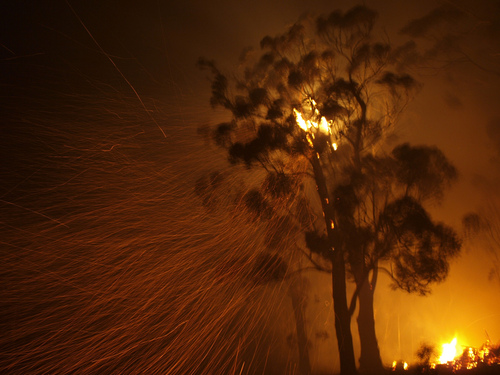
“The weather is providing perfect firestorm conditions.”
.
…like a red rag to a bull.
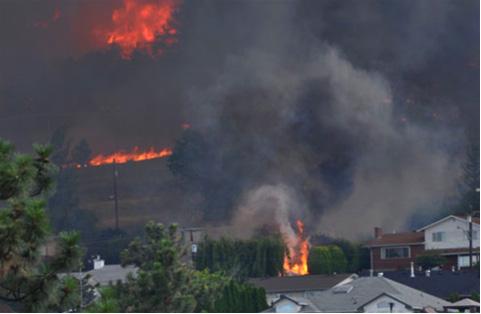
Then sure enough, starting from Christmas Eve (with no reported lightning) we hear of the spate of bush fires started across NSW, of multiple ignitions forming into a fire front near Woy Woy, a suspicious grass fire next to the old Canberra brickworks, and of many other bushfires across NSW and interstate.
Long respected is the media code of ethics not to report suicide deaths because experience has sadly shown that such publicity encourages copy-cats.
Yet invariably each year preceding Christmas, some media stir up this supposedly ‘inevitable’ bushfire threat. Such emotive language risks fuelling serial arsonists, drawing recidivists out of hibernation to prove media forecasts correct.
Arsonists read newspapers. The media are part of the solution – headline the convictions not their crimes.
.
[This letter by the editor was first published in the Blue Mountains Gazette 20060118.]
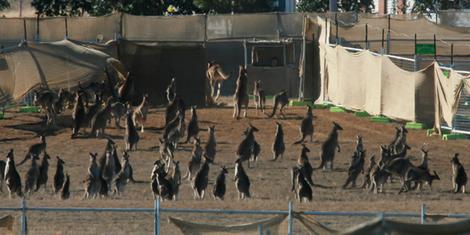
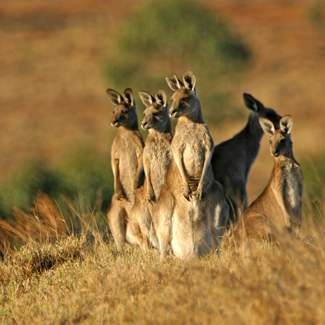
A new rural organisation in Australia, driving innovative agribusiness ideas, the New Rural Industries Association (NRIA) truly has some good ideas for those on the land. But one of them is certainly not such a good idea – supporting more kangaroo slaughter.
The NRIA on its new website states that its mission is:
“through cooperation, coordination and education, to create an environment for the development and capacity-building of new, innovative, Australian rural industries and to maximise the economic benefits our nation gains from such industries.”
.
At what ecological cost? At what untold wildlife trauma?
.
It is all very well encouraging those on the land to make a quid and prosper from new emerging agricultural markets, but poaching wildlife is immoral in the mix of available options.
To push for more wildlife trade in Australia, is akin to the logging industry pushing for a new exploitative use of our native forests for ‘biomass’ – burning trees for power! It is no different to the ‘bushmeat’ wildlife trade currently being prosecuted from Africa to Europe.
Reading the NRIA website section under New Animal Industries – ‘Kangaroos and Wallabies‘- the script seems taken drirectly out of a promotion by the Kangaroo Industry Association (KIA). It is peppered with exploitative euphemistic terms like ‘kangaroo industry‘, ‘kangaroo harvesting‘ and ‘pest control‘. All terms deliberately chosen to try to legitimise what is blatantly wildlife poaching.
Then it suggests that the poaching is legitimate by claiming there is “a quota system” and that the poaching is “administered by the state and federal governments”.
It then argues that this wildlife trade is highly lucrative, quoting the “kangaroo industry was an estimated $43.9 million in 2007”, with major export markets being Indonesia, New Zealand and Russia. It is trying to sell kangaroo meat overseas beyond what has long been regarded as pet food. It is trying to rebrand the pet food as ‘game meat’ and is having success in Europe, notably recently in France, South Africa and Germany, and in Russia as sausage meat..
.
‘Bushmeat’?
.
Wildlife is wildlife and with so little remaining on so few token reserves, all wildlife deserve humanity’s utmost respect and protection.
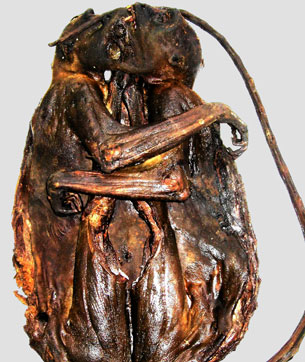
Australian wildlife is no less deserving than African wildlife. In Africa, ‘illegal bushmeat is being sold on Paris streets‘ ranging from monkey carcasses, smoked anteater, even preserved porcupine. In Australian, bushmeat is our wildlife – our native kangaroo, wallaby, koalas, platypus, echidna, Tasy devil, wombat, potoroo and many other unique and vulnerable fauna.
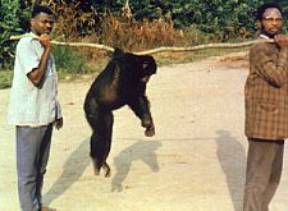
‘A bonobo, most human-like of the great apes, killed for meat’.
‘In Paris, a recent study has found more than five tonnes of bushmeat slips through the city’s main airport each week to serve its underground bushmeat market. Experts suspect similar amounts are arriving in other European hubs as well – an illegal trade that is raising concerns about diseases ranging from monkeypox to Ebola, and is another twist in the continent’s struggle to integrate a growing African immigrant population. According to research published in the journal ‘Conservation Letters’,
“Anecdotally we know it does happen … But it is quite surprising the volumes that are coming through,” said Marcus Rowcliffe, a research fellow of the Zoological Society of London and one of the study’s authors.
“Everyone knows bushmeat is sold in the area and they even know where to buy it,” said Hassan Kaouti, a local butcher. “But they won’t say it’s illegal.”
For the study, European experts checked 29 Air France flights from Central and West Africa that landed at Paris’ Roissy-Charles de Gaulle airport over a 17-day stretch in June 2008. Of 134 people searched, nine had bushmeat and 83 had livestock or fish.
The people with bushmeat had the largest amounts: one passenger had 51kg of bushmeat – and no other luggage. Most of the bushmeat was smoked and arrived as dried carcasses. Some animals were identifiable, though scientists boiled the remains of others and reassembled the skeletons to determine the species.
Experts found 11 types of bushmeat including monkeys, large rats, crocodiles, small antelopes and pangolins, or anteaters. Almost 40 per cent were listed on the Convention on International Trade in Endangered Species.
Based on what officials seized – 188kg of bushmeat – the researchers estimated that about five tonnes of bushmeat get into Paris each week.
Bushmeat is widely eaten and sold in Central and West Africa, with Central African Republic, Cameroon and Republic of Congo being the main sources. It varies whether it is legal. It is typically allowed where people are permitted to hunt, as long as their prey aren’t endangered and they can prove the animals were killed in the wild. And just as scientists have warned that eating African bushmeat is a potential health hazard, eating roadkill and wildlife is just at risk of bacterial infections like salmonella and ecoli.
Nina Marano, chief of the quarantine unit at the US Centres for Disease Control and Prevention, said similar underground markets for bushmeat exist across the US. “We have to be culturally sensitive and recognise this is important for some African communities,” she said. “But there are no regulations for the preparation of meat from wildlife to render it safe.”
The scale of Europe’s illicit bushmeat trade suggests the emergence of a luxury market. Prices can be as high as 30 euros ($A43) per kilogram, double what more mundane supermarket meats cost. “It’s like buying the best cut of organically grown beef,” Rowcliffe said, adding that bushmeat like giant rats and porcupine, which he has tasted, has a strong, gamey flavour.’
Meanwhile back in Australia, the NRIA claims “commercial harvesting” of wallabies is happening across Tasmania and on Flinders Island and King Island in Bass Strait…”ensuring the sustainability of the harvest“. Shooters are now targeting Tasmania’s beautiful Bennett’s Wallaby (Macropus r. rufogriseus) and the Tasmanian Pademelon (Thylogale billardierii).
.
“More than 9000 wallabies were harvested in 2005-06 but this was much less than the combined quota of 34,750.”
It is pleasing to learn that the City of Sydney council is funding $100,000 into its first serious biodiversity survey of inner Sydney, which is expected to take three months.
The aim is to support biodiversity information for an “urban ecology strategic action plan to conserve indigenous plant and animal species and identify ways to improve their habitats.”
The council has engaged the Australian Museum (located in the Sydney CDB) and specifically ecologists Henry Cook and Glenn Muir to identify all the native animals and plants living in inner Sydney. According to an article in the Sydney Morning Herald today, Sydney has long lost most of its native fauna to 220 years of urban development and habitat destruction.
Amazingly, Native Green and Golden Bell Frogs and Grey-Headed flying foxes still exist in one or two isolated locations but are endangered. Brush-tailed possums, Ring-tailed possums and native water rats are amongst the more adaptable to human incursion, albeit often persecuted.
The ecologists expect to find about 60 indigenous bird species and several reptile and frog species and the survey results are due in mid-2011.
A proven effective strategy against bushfires is early detection and response to ignitions.
Suppressing and ignition before it spreads seems logical enough, although perhaps with existing Rural Fire Service (RFS) is easier said than done. But is funding, and are RFS ‘fuel management’ strategies focusing on this albeit logical fire-fighting solution?
The Blackheath Glen wildfire (reportedly lit by bush arsonists, unconvicted) that started on 13th December 2002 was confirmed as having spread over 13 kilometres in less than six hours. By simple calculation the fire was travelling at less than 3kph. Why was it not detected early and suppressed?
Bushfire ignitions should be responded to before growing into uncontrollable wildlife fronts. Relying upon phone calls from the public to ‘000’ shouldn’t be a main detection mechanism, especially during times of known extreme bushfire (arson) risk.
Constant monitoring of bushfire prone bushland during the high risk season is crucial if we are serious about early detection. These days we have sophisticated long-range digital video cameras, radar and real-time satellite infrared cameras that can pick up individual trees! Perhaps the RFS should also have dedicated airborne fire surveillance crews. As for operational response, are fire crews sited in the most strategic response locations 24/7 on standby?
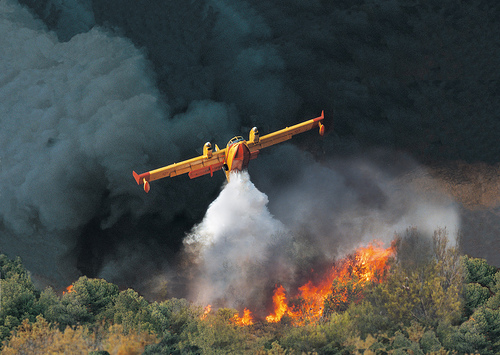
Is bushfire modelling and are the fire history databases utilised to allocate crews strategically to vulnerable and probable ignition locations? Stand-by helicopter air cranes equipped with water bombing capability provide faster response and superior access than truck-based crews.
Such solutions exist, yet require sophisticated resources, management and cost millions.
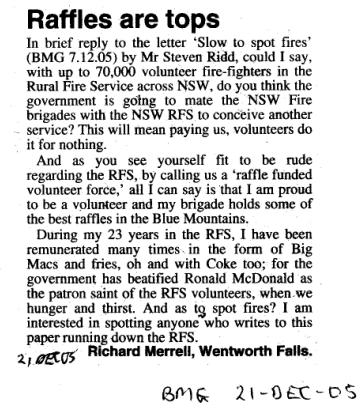
We choose to build closer to the bush, but are we serious about protecting lives and million of dollars worth of property from bushfire? Can we afford to rely on a grant and raffle-funded volunteer force or is it time to evolve the RFS into a specialist division of the NSW Fire Brigade and seriously resource it?
[This letter by this editor was first published in the Blue Mountains Gazette, 7th December 2005 on page 10]
[The following letter was first published in the Blue Mountains Gazette, 16-Nov-2005, contributed by the editor as Director, Colong Foundation for Wilderness. It sparked a debate in this local paper over successive months and preceded the 2006 Grose Fire in the Blue Mountains, possibly the worst fire storm in the history of the Blue Mountains.]
.
‘Premises at Risk’
Part and parcel of choosing to live in the Blue Mountains is that, by being on ridge lines surrounded by Eucalypt forests, many properties are inherently exposed to bushfire threat. Whether bushfires be caused by lightning (rarely), accidentally by people, RFS-prescribed, or by arson (usually); bushfire risk management is a community responsibility – not just the lot of RFS volunteers. The arson threat aside, “residents, landowners and land managers of the Blue Mountains need to accept that they are in a bushfire prone area and their properties may be subject to ember attack when threatened by bushfire.” (Blue Mountains Conservation Society Bushfire Policy).
To dispel a rural myth, not all native habitats recover from bushfire. Certain species and old growth flourish only in ecosystems that are never burnt. Post-bushfire regrowth often spawns dominant species like Eucalypt and Acacia, whereas original biodiversity may take centuries to recover. Bushfire is often a precursor to infestations of grass and weeds, and if followed by intense rain, also a catalyst for eroding irreplaceable native soils.
The antique premise ‘hazard reduction’ has become spin for pre-emptive burning that is prone to escaping out of control and so itself a hazard. Slashing and bulldozing under the premise of ‘Asset Protection Zone’ is also proving to be ineffective against ember attack and wildfire. But like arson, the hazard reduction and APZ theories contribute to the net loss of important habitat.
Proven effective and sustainable is early detection and response to ignitions. Most artificial fires start on developed land, so this in where the control measures should be focused – maintenance of gardens and guttering, retrofitting houses with materials and defences to resist fire, planting fire-retardant hedging around houses and implementing counter-measures recommended by Australian Standard AS3959.
The future of sustainable bushfire risk management starts by preventing houses being built where they cannot be safely protected from bushfires. Effective ‘hazard reduction’ is investigating and catching the arsonists.
.
.
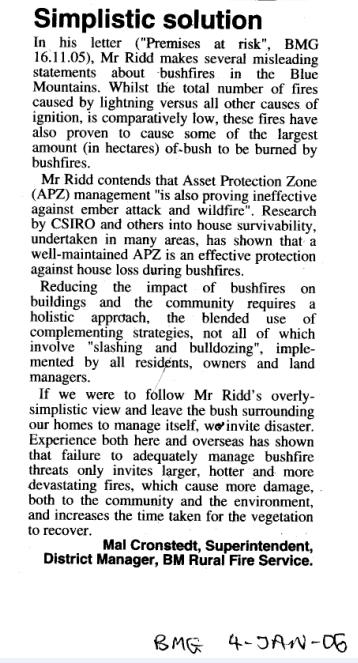
Reply by District Manager, Rural Fire Service (RFS) Blue Mountains, Mal Cronstedt, 20060104 [Cronstedt ten month later was in charge of the response to the Grose Fire]:
.
.
.
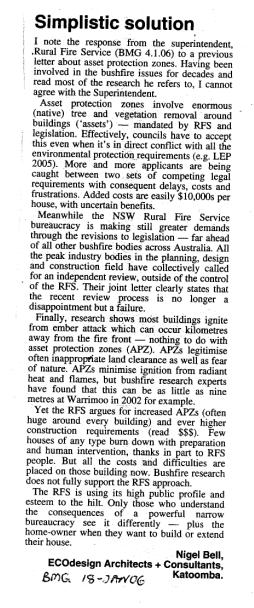
Reply by local Architect, Nigel Bell, 20060118:
.
.
.
Counter reply by editor 20060222, page 10:
.
World Hazard Area?
I welcome RFS BM Superintendent’s response (BMG 4-1-06) to my letter (‘Premises at Risk’ BMG 16-11-05) and him challenging two of many researched points I raised.
In reply, my statements were not “misleading”. RFS’s own research confirms that most bushfires are caused by arson. Of 466 investigated fires in NSW (2001-2004), 296 (64%) were determined to be the result of deliberate ignition and the most prominent cause of significant bushfires. (Australian Institute of Criminology, Bushfire Arson Bulletin, 16-8-05).
In reply, an RFS ‘Asset Protection Zone’ will not stop a raging wildfire “with flames of up to 30m” nor stop embers carried by hot “60kph” winds well ahead of a wildfire front (Woy Woy). Burning/bulldozing bush, before arsonists get to it, is flawed logic. How many hectares of habitat would need to be destroyed to insulate bushfire-prone property from wildfire? Wildfires need not be inevitable. Wildfire fronts are often caused by an excitement-motivated arsonist’s multiple ignitions linking up.
I unreservedly commend the dedication of RFS volunteers each Summer. But habitat-destroying strategies applied by RFS bushfire committees each Autumn-Spring hark to 1940s solutions and are as ineffective as they are environmentally destructive. ‘Hazard’ reduction assumes a direct relationship between wildfire risk and the total area burned. But ‘hazard’ reduction does not significantly reduce wildfire risk. In 2003, the Auditor General of Victoria identified in his audit on fire prevention and preparedness, that “the relationship between hazard reduction burning and the overall wildfire risk is currently limited”.
Mal, no-one said solutions were simple. But to be effective, bushfire risk management must focus on the root causes – by (1) seriously resourcing investigation into bush arson, and (2) ambulance-speed detection and suppression of spot fires – else we do “invite disaster”! Our World Heritage need not be a wedge victim between ‘hazard’ reduction and serial arsonists.
.
.
.
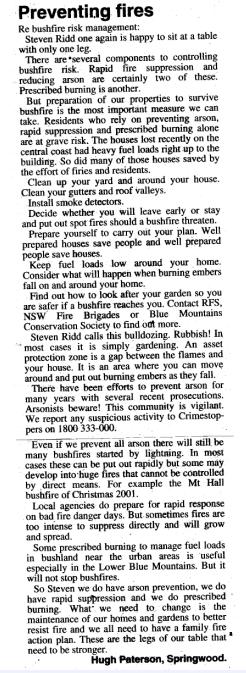
Reply by RFS Blue Mountains Bushfire Management Committee member, Hugh Paterson, 20060405, page 10:
.
.
.
Counter reply by editor 20060426:
.
‘Land Clearing Immunity’
.
I welcome Hugh Patterson’s public input into the environmentally destructive practice of ‘hazard’ reduction (BMG 5-4-06). Conspicuously, none of the repeated research refuting the fallacy that ‘prescribed’ burning and bulldozing native habitat prevents wildfires, is disputed.
Hugh claims the Mt Hall bushfire in 2001 could not be controlled. But the coronial enquiry noted: “prescribed burns had been done… only two years and four months earlier” and “the ability of the fire to leap or bound many hundreds of metres at a time.” Reconfirmation that ‘hazard’ reduction does not prevent wildfires.
Why was the initial spot fire at Mt Hall not detected sooner and standby airborne water-bombing deployed?
Resourcing is clearly available when bushfire co-ordination committees can command millions in federal funding each year to perpetuate ‘hazard’ reduction – an unquestioned tradition dating back over 50 years. Last year these committees squandered $1.3 million ‘hazard’ reducing 3785 km2 of National Parks habitat, 565 km2 of Crown Land, and a further 391 km2 of local council-owned lands across NSW.
‘Hazard’ reduction is blatant land clearing. Worse, ‘mechanical’ hazard reduction (ie: bulldozing) permanently destroys habitat. Anyone else – farmers, developers, would attract severe penalties as environmental vandals. But these bushfire committees operate immune from EPA prosecution, write their own rules and code with eco-friendly jargon then call in the bulldozer anyway.
The discretionary millions deserve to be invested in effective detection and airborne suppression of spot fires, not squandered on finding something for volunteers to do over winter, which wildfires leap over anyway. According to the mayor of Junee last summer, “if it hadn’t been for the water-bombing aircraft half of Junee would have gone”.
Anyone arguing to divert scarce grant funding away from effective airborne fire-fighting and to justify futile habitat destruction doesn’t have a moral leg to stand on.
.
.
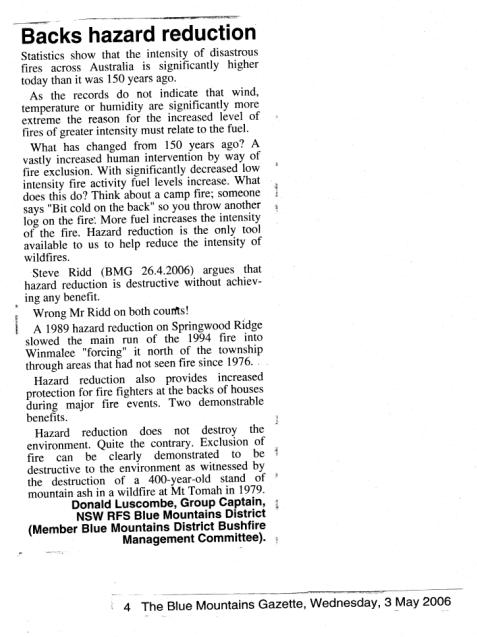
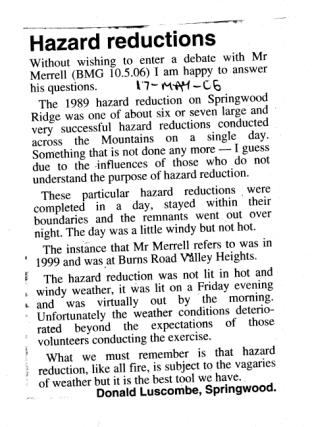
Reply by RFS Group Captain, Donald Luscombe 20060503:
.
.
.
Reply by local resident, Elizabeth Saxton, 20060517:
In the 1940s, ‘hazard’ reduction was a knee-jerk response in the wake of the Black Friday firestorms. The bushfire-prone nature of our community should compel us all to frequently look towards better solutions for bushfire prevention and suppression. We need to heed the latest investigative bushfire research telling us what’s effective and what’s not effective, then exercise best practice.
The research keeps reconfirming that hazard reduction is not effective. At the Adelaide Bushfire Conference 2004, research concluded that 90% of houses ignited in Australian bushfires are due to ember attack. ‘Hazard’ reduction does not prevent ember attack, so how does its stop the remaining 10%?
By walking around with petrol torches ‘hazard` reducing, volunteers are reducing habitat and reducing themselves to arson. Our actions need to respect both our built and natural assets. Most of us value our special Blue Mountains natural environment, otherwise why choose to live here and not in Portland or Pyrmont, where trees are scarce and concrete has eliminated bushfire risk?
Research into the Warrimoo, Valley Heights and Yellow Rock bushfires of 2001-2 concluded that the main cause of houses destroyed by bushfire was from burning debris (ember attack) allowed to gain entry into houses through inadvertent openings. Houses-by-house, those that survived were due to vigilant intervention by those present putting out small fires after the fire front had actually passed. CSIRO Research (1999) into causes of building loss from bushfires in Hobart (1967), Blue Mountains (1968), Otway and Macedon Ranges (1983), and Sydney 1994) confirmed the same and advocated focus on landscaping and building design strategies. Out of the 2001/2002 NSW bushfires, Sydney Councils recommended Sydney Water increase mains water capacity during bushfire crises.
Research literature is not widely promulgated, which means that the wider community must re-learn lessons in the wake of subsequent bushfires.
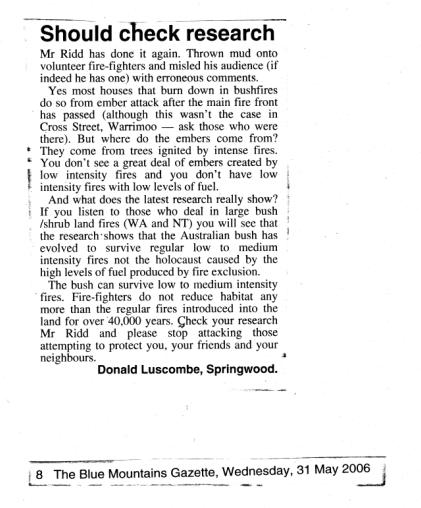
Perhaps like all residents, I wholeheartedly commend the dedication of RFS fire fighters fighting bushfires. I reaffirm this in rebuff to the misrepresenting tirade from Blue Mountains Bushfire Committee boss, Mr Luscombe (BMG 31-5-06).
The big local environmental issue continues to be the hundreds of Blue Mountains hectares cleared every autumn under the pretext of defending houses.
Mr Luscombe agrees the main cause of bushfire damage to houses is ember attack AFTER a fire front has passed. But he contradicts himself by justifying the need for hazard reduction in autumn BEFORE the risk season even starts. Clearly, hazard reduction is about thinning bush to minimise the intensity of a possible fire front, yet we agree the fire front itself isn’t the cause of house damage. Mr Luscombe is putting out the wrong fires. A sledgehammer approach to bushfire risk management won’t prevent wildfires or embers, but it will stuff forest ecology. I say it again – ‘hazard’ reduction is land clearing – an environmentally unsustainable practice all participants should critically question.
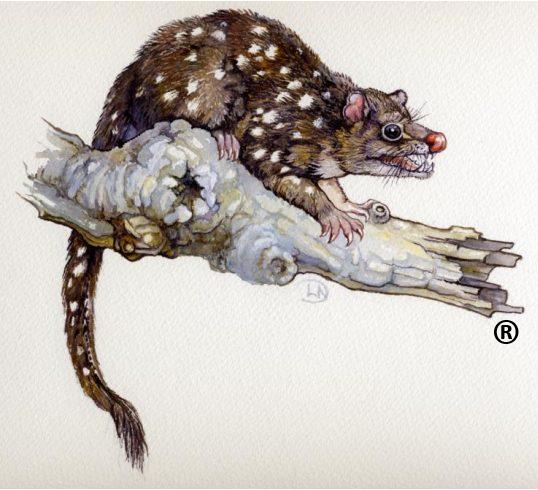
Extensive field research by Catling (1991) of the CSIRO Division of Wildlife Ecology has shown that “vertebrate fauna of south-eastern Australia is most abundant in forests with a dense understorey.” “If shrubs, litter and ground cover are removed, reduction in complexity of forest structure leads to a reduction in abundance and species diversity of small mammals” (Lunney 1987, Royal Zoological Society of NSW). Frequent, low-intensity burns in autumn reduce and eventually eliminate dense understorey – because rain and warm weather needed for regrowth are denied. As understorey is lost, threatened ground-dwelling native mammals (Tiger Quolls, Eastern Pygmy Possums, Rufous Bettongs) lose habitat protection, while many exotic species (foxes, feral cats, black rats) are advantaged.
On 28th April, ‘hazard’ reduction burning was prescribed for 347ha of the World Heritage Jamison Valley.
.
.
Counter reply by editor 20060719:
.
‘Slowly Cooking Habitat’
In the landmark book advocating the now famous Bradley method of bush regeneration by the Bradley sisters, ‘Bringing Back the Bush’ (1988), Joan Bradley challenged the 1940’s hazard reduction practices which still perpetuate unchecked today:
“One of the many myths about Australian vegetation is that occasional fire is essential for its renewal and that only natives are affected in this way by fire. But natives are not the only plants to flourish on an ashbed. I do not know of a single bush invading weed which does not respond in exactly the same way. Seeds germinate in abundance, and (weeds), like dahlias, lasiandra, cotoneaster, lantana and privet shoot from their base like gum trees.”
“Hazard-reduction fire is completely different from a real bushfire. Burning is done at the time of the year when the bush is dormant, and on the ground the leaf mulch is heavy and moist. For this reason it must be deliberately lit, frequently many times, whereupon it smokes, smoulders and steams. This type of burn consumes only the understorey. The ground smells like a garden rubbish heap, not a bit like bush after a bushfire, because the mulch is left to steam at high temperatures, and then putrefy.”
“It should be remembered that in the cooler seasons, plants and trees are storing food in their roots, ready for the surge of growth in spring, so this is not just an unnatural and unwelcome interruption to the vital feeding process. It is a major setback, as it was intended.”
“A prescribed burn has a disastrous effect on native plants and an absolutely explosive effect on weeds. With the understorey gone, the soil…is exposed to light which weeds thoroughly enjoy. The slow and uneven growth of the native plants (during the cooler seasons) does little to keep (weeds) in check.”
.
Result of defacto hazard reduction below Govetts Leap, Grose Valley, Blue Mountains
Photo by editor 20061209 free in public domain.
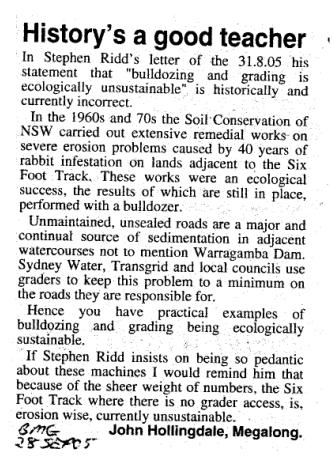
On Thursday 7th July 2005, while volunteering as Honorary Director of the Colong Foundation for Wilderness, the editor took a phone call at the Colong office from a Medlow Bath resident, who reported in that the Rural Fire Service had extensively graded the Six Foot Track in late June 2005. In the resident’s opinion the grading had occurred to such an extent that substantial damage had been caused to native flora, riparian zones and so warranted community reaction.
That same day I contacted the legal manager of the Six Foot Track, Jon Guyver of the Lands Department, based at Orange and heard his view, learning that the grading was requested by the Rural Fire Service and authorised by the Trustee using grant funding from the Federal Department of Transport and Regional Services (DOTARS). I then phoned Greg Wardell, acting BM head of the Rural Fire Service to hear his view. In each case there is a strong sense of righteousness in the grading. The justification for the grading was to create a Primary Fire Trail, but this RFS action breached many of the conservation provisions of Six Foot Track Conservation and Management Plan 1997, including the Policy 7.2 (d). [Refer References below].
On Sunday 10th July at the resident’s request I undertook a first hand inspection of the track, using topographical map ‘Katoomba 8930-1S’ and proceeded to Grid square 66 South, 48 East, which shows the Six Foot Track following the winding Megalong Creek south-westerly. On return that evening, I emailed the following report to the Blue Mountains Conservation Society’s Land User Officer:
“Noticeable evidence of grading activity starts at a bend in the track NE of the words ‘SIX FOOT TRACK’ . There is the remains of a stone fireplace here, as well as bush and topsoil graded into the bush toward the creek. Between this site and the concrete bridge at Devils Hole Creek I counted 6 fresh mitre drains. Between Devils Hole Creek and the locked gate [Grid Ref 642458] passed the horse paddocks, I counted another 15 fresh mitre drains, before reaching Corral Creek. I didn’t continue west beyond Corral Creek.
There are three obvious environmental impacts from this bulldozing activity:
Over-clearing of bushland
Leaving topsoil exposed to rain and erosion
Grading bush and topsoil into the Corral Creek
The disregard and disrespect for Aboriginal culture in the area appears to have been totally ignored/discounted. You are very right in bringing this issue to the attention of the public, stakeholders and authorities. Your efforts deserve recognition by the Blue Mountains conservation community.
Having this primary data, I agree that this environmental destruction deserves to be made very public and the process abuse exposed. The voluntary RFS are not a law unto themselves. RFS culture needs a wake up call to its unchecked environmental accountability.”
.
On Sunday 17th July, the Land Use Officer of the local Blue Mountains Conservation Society drafted a letter to the General Manager of the Blue Mountains Council which read as follows:
RE: Nellies Glen Rd – Six Foot Track – Breach of development consent conditions
“The Society wishes to raise two questions about the recent work undertaken on a section of Nellies Glen Road, which forms part of the Six Foot Track. The section in question is:
Legality of Re-location of a section of Road
A section of the road was rerouted. Extensive clearing has been undertaken.
It does not appear that the Dept Lands is exempt from the provisions of the LEP when widening or re-locating a road.
LEP 91 clause 17.7 exempts the Crown from “carrying out of any development required in connection with the construction, reconstruction, improvement, maintenance or repair of any Classified Road, except the widening, realignment, or relocation of such road”
Furthermore as the Six Foot Track is listed in Schedule 2 of LEP 91 as Heritage item MG6, Clause 25 applies.Clause 25.1 statesA person shall not, without the consent of the Council, in respect of a building work, relic, place or tree that is a heritage item –
(a) demolish or alter the building or work; or …..
(c) damage or despoil the place or tree; or
(d) damage or remove any tree or horticultural features on the land on which the building, work, or relic is situated or on the land which comprises the place.”
Did council give consent to the widening and re-location of the section of the Six Foot Track? If consent was given, was a heritage assessment undertaken? If no consent was given, what steps does council intend to take to penalise the land manager and/or to require restoration?
Pollution of Watercourses
The Society understands that Council has regulatory powers to enforce the NSW Protection of the Environment Operations Act.
We request that Council investigates the
Excavation of mitre drains within 10m of creeklines
Extensive clearing of vegetation around the constructed within 20m of watercourses, causing sediment to flow into the creek.”
.
.
‘RFS Bulldozes Six Foot Track’
[written by editor and published in the Blue Mountains Gazette, 27th July 2005].
This is what a bulldozer can do midweek when nobody’s watching.
The Six Foot (Bridle) Track is a State icon, first negotiated on horseback in 1887 as a shortcut from Katoomba to Jenolan Caves. The track is ‘protected’ under the Central Tablelands Heritage Trust by the Department of Land and Water Conservation. The area holds important Aboriginal cultural value. The Track passes through a significant River Oak Forest vegetation community and the topsoils along this river valley are particularly sandy, and once exposed are highly susceptible to erosion and weed infestation.
RFS choice of contractor has bulldozed the heritage Six Foot Track out to a 66 foot speedway and fresh mitre drains to channel the new runoff problem into Megalong Creek. Once the rains come and the exposed topsoil’s washed into the creek, flat chance the bush’ll come back.
This is not fire trail ‘maintenance’. This is road making. How ‘strategic’ anyway is a track deep in a bush valley over two kilometres from Katoomba? Strategic for arsonists perhaps. Anyone else would need development consent to bulldoze bush – and probably would be rightly rejected. The privileged exemption status granted to the RFS is for times of emergency. It is not a carte blanche for cowboy contractors.
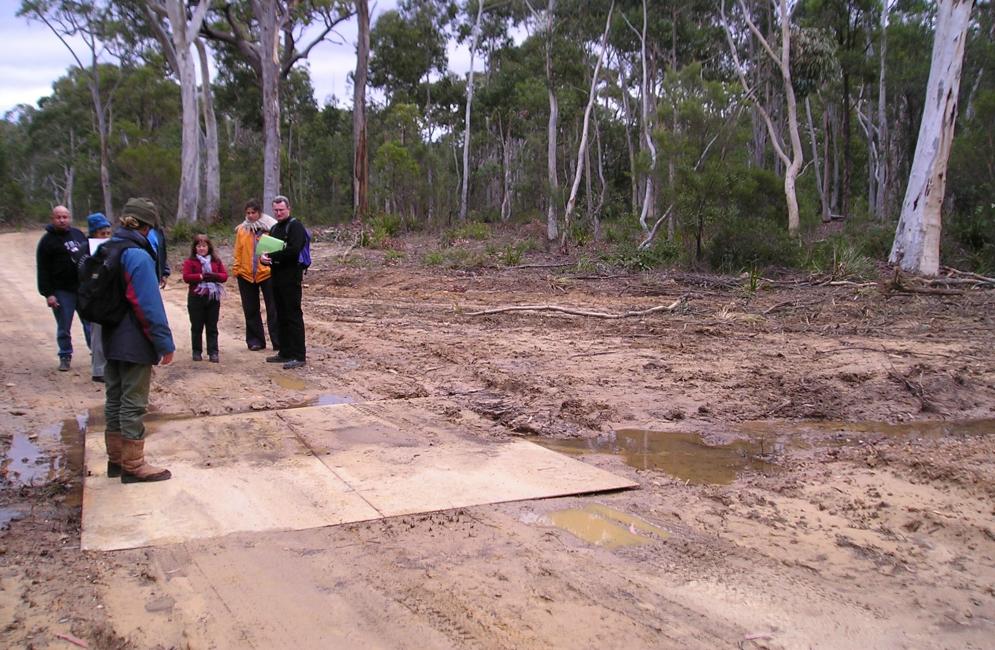
This sad muddy bog left at the Corral Creek crossing is testament to the loose procedural controls of the bushfire committee. Such actions cannot help the RFS’ otherwise high community standing.
Following the publishing of my letter, correspondence from the Blue Mountains Conservation Society’s (ConSoc) Land Use Subcommittee, of which I was an active member, when silent.
My email to the Subcommittee on 14th August read as follows:
Re: LUC Meeting Item 2 ‘Firetrails
“Can someone please advise what actions may have been taken since the RFS bulldozing events in late June on the Six Foot Track (SFT) and on the track
on Fairy Bower Reserve at Mount Piddington (and possibly other bush tracks we are yet to find out about).
The minutes of the LUC August meeting indicated that ConSoc is to write to RFS “again”, so this suggest correspondence has already been made. I would appreciate any copies of correspondence please. What was the outcome (agreed actions) of the midweek meeting between ConSoc, >the RFS and trustee Jon Guyver back on or around 14 Jul 05?
Has the RFS agreed to remediate the bulldozing of the SFT site with endemic plantings, sediment controls?
Has the RFS or Jon Guyver been able to provide any minutes or correspondence regarding the decision making of the bushfire committee to authorise the bulldozing in June?
The silence on this has been ‘Council-esk’ and no public comment appears forthcoming from the RFS.”
.
Regulation of the Six Foot Track
“As per the previous LUC meeting on 13 Jul 05, I have enquired into the possible existence of a trust deed governing management and legal conditions concerning the control of the Six Foot Track.
The Land Department Office in Orange confirms no trust deed as such exists, but rather the SFT is governed by a Reserve Trust under the provisions of
the NSW ‘Crown Lands Act 1989’ and ‘Crown Lands (General Reserves) By Law 2001’ as Reserve No. 1001056.
Jon Guyver is the official administrator of the Six Foot Track Heritage Trust and he has provided me with a copy of the relevant sections of the Act, a complete set of the By laws applicable to the SFT and the Six Foot Track Conservation Management Plan Volumes I and II. The latter cost me $22. Lyn has indicated that she already has a copy of the Plan of Management – I assume this is the same. Volume I is 137 pages and Volume II is 142 pages. I am presently reading through Volume I.
From my reading so far, the bulldozing breaches the Management Plan’s ecologically sustainable development principles, although “the plan is
intended to serve as a guide to conservation and management of the entire Track, but is not a statutory plan which is binding” (Vol. I, p 8).
Jon says he is commissioning an updated version, so I suggest it would be useful for ConSoc to participate in the drafting of this updated version.”
.
[No answer was received from ConSoc, yet on 16th August the editor received a warning from a leading figure within the ‘conservation movement’: “Please do not cast aspersions against RFS people in Con Soc.”]
.
Then on Tuesday 23rd August, the editor emailed the following researched feedback to the Blue Mountains Conservation Society:
“All, Way back on 7-Jul-05, a call was made to the Colong Foundation advising that the Six Foot Track had been severely bulldozed near Megalong Creek. As a member based in Katoomba, I have followed this up, along with enquiries by other ConSoc LUC members.
I proceeded to acquire first hand information, walked to the site and have obtained extensive documentation from the trustee on the Plan of Management
and legislation governing the Track. I am still yet to find out what actions others have taken. I am still yet to receive a response to my email below.
Avid Gazette readers may have come across a small press release from someone in the Gazette’s Mountain Murmurs on 13-Jul-05. After no news, I submitted
my letter of 27-Jul-05 alerting the Mountains community to inappropriate destruction of native habitat and important heritage values of the Six Foot Track [the editor changed my heading]. The thrust of my message was to try to highlight the cause of the problem in an effort to prevent it re-occurring. I referred to the “loose procedural controls of the bushfire committee.” Last week, three mixed response letters arrived, one targeting the contractor, but all ignoring the problem source – the actions of the bushfire committee. Still no public statement has come from the RFS, despite this public call for accountability. I note that ConSoc’s latest Hut News (Aug-05, p3) contains a useful account of the “informative gathering” on 21-Jul-05 by representatives of various stakeholder organisations agreeing on the need for rehabilitation work. But what is still unaccounted for are the actions of the bushfire committee.
Is this bushfire committee made up of these same representatives?
Well, in the absence of feedback, I have continued my investigations and discovered that the underlying cause is the Bushfire Mitigation Programme
of the federal government Department of Transport and Regional Services. I direct you to the following website, the introductory extract and the
attached spreadsheet that lists the following ‘Fire Trails’ in the Blue Mountains for targeting as well as another undisclosed areas of the Blue Mountains National Park.
Question is, have all these locations been subjected to similar bulldozing that we don’t know about yet?
The Six Foot Track bulldozing is a drop in the ocean. The RFS Bushfire Assessment Code refers to complying with the >principles of Ecologically Sustainable Development, which seems nothing more than greenwashing.
Reserve / Activity Name Treatment Area (km) NSW Allocation
Cripple Creek Fire Trail Stage 2 5kma $15,000.00
Cripple Creek Fire Trail Complex 5 km $10,909.09
Caves Creek Trail 0.4 km $5,000.00
Edith Falls Trail 2 km $2,040.00
Boronia Rd – Albert Rd Trails 1km $1,360.00
Perimeter Trail – North Hazelbrook 1.5km $1,360.00
McMahons Point Trail – Kings Tableland 7km $1,000.00
Back Creek Fire Trail 3.2 km $816.00
Mitchell’s Creek Fire Trail 3.5km $204.00
Northern Strategic Line -Primary 8km $11,000.00
De Faurs Trail – Mt Wilson -Primary 2.8km $7,540.00
Mitchell’s Creek Fire Trail – Primary 3.5km $1,836.00
“Fire trails are important resources in the facilitation of prevention and mitigation works. An effective fire trail network increases options available in implementing hazard reduction to protect communities and their social, cultural, environmental and economic assets.
In September 2004 the Prime Minister announced the allocation of $15 million for a Bushfire Mitigation Programme, over three years, for the construction, maintenance and signage of fire trail networks to assist local communities to better prepare for bushfires.
About the Programme
The Bushfire Mitigation Programme is a national programme aimed at identifying and addressing bushfire mitigation risk priorities across the nation. It funds construction and maintenance of fire trails and associated accessibility measures that contribute to safer, sustainable communities better able to prepare, respond to and withstand the effects of bushfires. The specific objective of the programme is to enhance the effectiveness of fire trail networks and as a result increase the:
Safety of fire fighting personnel involved in a fire suppression effort;
Rapidity with which fire suppression agencies are able to access a fire; and
Type of resources that can safely be made available to a fire suppression effort.
The programme is administered by the Australian Government Department of Transport and Regional Services. “
.
[Again, no answer was received from ConSoc.]
.
‘Six Foot Track Abused’
[Published by the editor in the Blue Mountains Gazette, 31st August 2005, page 12].
.
The June bulldozing or grading of the Six Foot Track near Megalong Creek was not only wrong, unnecessary and excessive; it breached the statutory provisions of the Crown Lands Act 1989 under Crown Lands (General Reserves) Bylaw 2001, which prescribes rules for the Track’s environmental protection, heritage and public recreation.
For instance, By-law 23 (2) (n) prohibits conduct in the reserve involving defacing or removing or disturbing any rock, sand, soil, stone or similar substance. It appears no written consent was provided by the Trustee of the Six Foot Track Heritage Trust to the RFS.
The bulldozing also breached the Six Foot Track Conservation and Management Plan of 1997 (two volumes totalling 279 pages). Section 2.1.1 prescribes the need for ecologically sustainable development principles to be followed for all management and planning associated with the Track. Bulldozing or grading is not ecologically sustainable. Policy Statement (7.2) (d) states that the physical elements of the Track including examples of the original alignment, works and sites of Aboriginal and European significance and remnant stands of vegetation should be retained and conserved wherever possible. Numerous threatened species of flora and fauna are recorded as likely present in the Six Foot Tack environs and are listed in Volume I of the Plan. The Plan also states at Section 8.2.5 that “Where development consent is not required an environmental impact statement should be undertaken where there is likely to be an adverse impact on the environment.”
The Plan proposes the following general management objectives for the Six Foot Track:
(1) To ensure that all management decisions fully recognise the considerable cultural and heritage significance of the Six Foot Track
(2) To seek to recover and retain the Track’s original character by the preservation and restoration of identified sites and Track features.
.
.
Reader feedback at the time:
.
.
.
RFS Strategy Misguided
[Published by the editor in the Blue Mountains Gazette, 5th October 2005]
It has been revealed that the June bulldozing or grading of the Six Foot Track near Megalong Creek was a mere drop in the RFS Bushfire Mitigation Programme. Across the Blue Mountains, some twenty natural reserves including the Six Foot Track were targeted under the RFS 2004-05 fire trail strategy – Edith Falls, McMahons Point, Back Creek Cripple Creek plus some 95 hectares inside our National Park. According to the federal Department of Transport and Regional Services (DOTARS) website, $151,195 was granted to the RFS in the Blue Mountains alone, bulldozing 144 hectares of bush in the name of “addressing bushfire mitigation risk priorities.”
The Six Foot Track Conservation and Management Plan 1997, Vol II lists numerous vulnerable species of fauna recorded near Megalong Creek – the Glossy Black-Cockatoo (Clyptorhynchus lathami), Giant Burrowing Frog (Heleioporus australiacus), Spotted-tailed Quoll (Dasyurus maculatus). The RFS contractors wouldn’t have had a clue if they were within 100 metres or 1 metre of rare, vulnerable or threatened species.
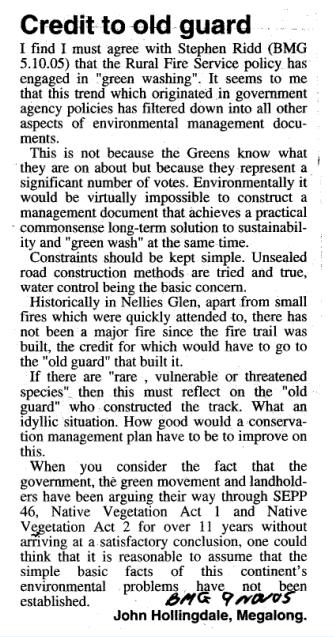
The RFS is not exempt from destroying important ecological habitat; rather it is required to have regard to the principles of Ecologically Sustainable Development (ESD). Yet the RFS policy on hazard reduction is woefully loose on the ‘Bushfire Co-ordinating Committee Policy 2/03’ on ESD – advocating protection of environmental values and ensuring that ESD commitments are adopted and adhered to by contractors. Experience now confirms this policy is nothing more than ‘green-washing’.
The critical value of dedicated RFS volunteer fire-fighters fighting fires is without question. What deserves questioning is the unsustainable response of the RFS ‘old guard’ to fire trails and hazard reduction with token regard for sensitive habitat. Repeated bushfire research confirms that bushfires are mostly now caused by arson and that the prevalence of property damage is a result of more residential communities encroaching upon bushland.
.
.
Reader feedback at the time:
.
.
Aftermath
.
Following the above publicity and the on site survey of the grading damage by Andrew Scott on behalf of the trustee (Department of Lands -Soil Conservation Service), soil remediation of the Six Foot Track was carried out later in 2005 at a taxpayer cost estimated at $27,000. The RFS has continued to contract out its grading of thousands of kilometres of fire trails across New South Wales, federally funded by the Department of Transport and Regional Services (DOTARS). In 2008, DOTARS ceased online publishing the details of its funded fire trails activities.
The Blue Mountains Conservation Society Land Use Subcommittee (LUC) effectively ostracised the editor from all LUC meeting notifications, minutes and communications despite the editor emailing repeated requests for inclusion (all records remain on file). The logical conclusion drawn from this action is that due to the involvement by key influential members of ConSoc with the local Rural Fire Service and Blue Mountains Council’s Blue Mountains Bushfire Management Committee a conflict of interest existed in which the vested interest of the latter held sway. The Land Use Officer subsequently joined Blue Mountains Council. The editor (as Honorary Director) was also reprimanded by the Director of the Colong Foundation for Wilderness for taking a principled stand against ConSoc’s condoning of damaging bushfire management practices.
This issue has become a regrettable chapter in one’s exposure to questionable principles of the NSW conservation movement. On 19th January 2009, on principle the editor resigned from both ConSoc and the Colong Foundation for Wilderness to embark on designing an independent voice in The Habitat Advocate website. In November 2010, the editor renewed his membership with the Colong Foundation for Wilderness.
For United Nations credibility, Cancun had to be better than the Copenhagen shemozzle. Remember when US President Obama’s last minute token promise failed because he hadn’t secured a US Congress mandate.
A memorandum of understanding between the ‘have’ nations and the ‘have not’ nations seems to be a follow-the leader approach to dealing with human-caused climate change – aka ‘pollution’ rebranded. Problem is the responsible leader, the United States is AWOL, delusional that its 20th Century economics can restore its capital prowess in our 21st Century society.
Assuming global warming is real and being caused by human carbon emissions, the overarching aim of the United Nations is to reduce carbon emissions and so minimise global warming and its consequential problems of sea-level rise, mass extinctions and associated climate catastrophes – droughts, floods, heatwaves, massive storms and exponential human misery.
Toward this ideal, COP16 has been the 16th annual Conference of the Parties of the United Nations Framework Convention on Climate Change (COP) and the 6th Conference of the Parties serving as the meeting of the Parties to the Kyoto Protocol (CMP). This year COP16 was hosted in Cancun, Mexico.
So what was the outcome of the conference this time around?
Well, according a summary by The Climate Institute the delegate at COP16 broadly accepted the ‘Cancun Agreement‘ on 14th December 2010. Three important areas of achievement should be noted:
Anchoring of national mitigation commitments: formal recognition and ‘anchoring’ of existing pollution targets and commitments from all major polluting countries, covering around 80 per cent of global emissions. This is the first time pollution commitments from US, China and all other major economies (both developed and developing) have been captured in a formal UN agreement.
New ‘Green Climate Fund’: agreement to establish a new fund to help mobilise US$100 billion a year by 2020 to support low pollution economic development; protecting tropical forests and helping the world’s most vulnerable people build resilience to change impacts. However, there was no decision on how to raise the public and private money for this fund.
Improved transparency: measures to improve transparency and verification of domestic efforts to reduce pollution, including a process for international review of countries’ actions by technical experts.
.
According to Greenpeace, “the talks did not deliver a global climate deal but have placed the building blocks for that strong deal to be created.” There are acknowledgements of the gap between commitments on emissions cuts and scientific evidence, the establishment of a climate fund and an agreement on REDD [United Nations Collaborative Programme on Reducing Emissions from Deforestation and Forest Degradation in Developing Countries].
However, we are still missing the actual commitments on lower emissions, a way to deliver that climate fund and some critical parts of the REDD agreement to make it a strong one. Now we must continue to demand our leaders redouble their efforts to drive change at home.
So in other words, nations are gradually coming around to the climate change problem, but still a bit slow working out what to do. They’re getting there.
There are positive signs of progress, and moreso than the token promises by the United States like at Copenhagen. For instance, there is at least now general agreement that greater pollution reduction effort is required. There are sources of financing by the World Bank to make this happen. There are now common accounting rules, and a legal framework.
Tangible promises have also been committed by Mexico, the host nation of this year’s conference, including a promise to reduce 51 million tons of CO₂ in 2012, securing a US$500 million loan with the World Bank to finance technological assistance and increase scientific knowledge in relation with current sources of emissions and carbon sinks. Mexico has also promised to ensure that in 2012, 26% of the electricity produced will come from renewable sources. Mexico will also receive US$15 million from the Norwegian government to reduce emissions through soil conservation and reforestation.
While the worst polluter and most conspicuous carbon consumer, the United States, has been AWOL and navel-gazing; this time China has promised to cut 45% of its greenhouse gases by 2020.
However, the conference has not been without its criticism. The editor of the Sydney Morning Herald makes the following observations:
“There are no binding targets for reducing greenhouse gas emissions, and the world is not on course yet to avoid the worst climate change scenarios. Developed and developing countries still cannot agree to concerted action, developing countries arguing they should not have to bear an equal burden, because they have not had polluting industries as long, or on the same scale, as the developed world.
The US and China are still circling each other warily, and (President) Obama is now forced to negotiate any agreement through a Congress that, following the midterm elections, will contain significantly increased numbers of climate-change sceptics and Sinophobes.”
It’s all happening one year at a time. Next year’s conference will be in Durban, South Africa.
In between, some individual countries are already moving unilaterally. May be the United States could show some leadership next round; dare this mean Republican warmongers pulling back from high carbon- intensive imperial war games in Afghanistan and Korea!
The U.S.S. George Washington has left its home port and is sailing to the Korean Peninsula. (Please not again)
The Aircraft Carrier, with 75 fighter aircraft and 6000 Sailors and Marines will be participating in exercises in the region. What will be the carbon footprint of this ego? Meanwhile, North Korea said on Friday it would strike again at the South if a live-fire drill by Seoul on a disputed island went ahead, with an even stronger response than last month’s shelling that killed four people. The North had said its November shelling was a response to South Korean “provocations” after an artillery battery on the island fired in what Seoul said was a routine drill.
<<The Murray-Darling Basin draft plan is riddled with holes and should not be used as a guide to save the ailing river system, the nation’s peak farming lobby says.
The National Farmers Federation released its submission to the Murray-Darling Basin Authority‘s draft proposals today.
The submission coincides with a meeting of the Murray-Darling Basin Ministerial Council in Albury.
The NFF argues that the draft plan is “fundamentally flawed” and needs to be dumped in place of more detailed research and infrastructure spending.
It wants a more collaborative approach between environmentalists, communities, and the agriculture industry to develop better environmental targets.
“We want to get the balance with the environment right, it is critically important to the communities that that happens,” NFF president Jock Laurie told ABC Radio today.
“I don’t believe you can deliver … without the communities working as part of the process [alongside] agriculture and environmentalists.
“They all need to work together to deliver .. and get that balance right.”>>
<<The federal and state governments must stand firm on developing a robust Murray-Darling Basin plan to fix over-allocation and salinity, and ensure water security, South Australia’s River Murray Minister Paul Caica says.
The minister is attending a Murray-Darling Basin Ministerial Council meeting in Albury today, where he will seek to ensure the basin plan remains on track to deliver a functioning healthy river system.
Mr Caica said in a statement the plan must restore environmental values and provide for viable and productive industries and communities into the future.
“The development of a robust basin plan provides a once in a lifetime opportunity to address over-allocation, manage salinity issues and achieve improved environmental and water security across the basin and we cannot let this opportunity go,” he said.
“There is no doubt the launch of the guide could have been handled better, but equally, some of the reactions to the guide have also been overblown and we must be careful not to let this distract us, or weaken our resolve to deliver this important reform.”
Mr Caica said the the Murray-Darling Basin was a complex system undergoing a challenging reform that had not been done anywhere in the world at this scale.
“We can only succeed in this very challenging task by working together,” he said.>>
<<AN EXTRA $5 billion could be needed to achieve the controversial reforms to the Murray-Darling River system, according to one of the nation’s top water market firms.
Broking firm Waterfind has also warned that a conflict of interest exists so long as the federal government is the biggest buyer in a water market which it ultimately controls.
Waterfind analysed progress on the Murray-Darling reforms in its annual report and found the government’s existing $8.9 billion spend would not secure enough water to reach the minimums sought in October’s Guide to the Murray-Darling Basin Plan.
The guide said that a minimum of 3000 billion litres needed to be returned to the river, but Waterfind estimated the government’s $8.9 billion would only yield about 2500 billion litres.
If government buybacks of farmers’ water continued at the prices paid to date, Waterfind estimated an extra $1.6 billion would be needed to reach the 3000 billion litres minimum.
Returning 4000 billion litres to the river, as many environmental groups have requested, would cost an extra $5 billion according to Waterfind’s estimates, which the report said were ”conservative in the extreme”.
The Gillard government has previously acknowledged their spending may not be enough to satisfy the basin plan, and the government has promised to spend whatever is necessary to meet the requirements of the plan.
Waterfind also reported that government buybacks had so far deflated the price of water in the Murray-Darling.
The report said Australia boasted the world’s most advanced water market, yet it was still undermined by arrangements which made the federal Water Minister both a buyer and regulator of market.>>
"We're coming to you from the custodial lands of the Hairygowogulator, Tarantulawollygong, and Longdrop country, within the Australia nation since 1901. From our home in Inner West Katoomba we pay respects to uncles and grandaddy elders past, present and emerging from their burrows. So wise to keep a distance out bush."
Recent
Supporting Us
A VOICE FOR NATIVE HABITAT
One’s solo mindful walk…
The Friends of Katoomba Falls Creek Valley Inc. in The Gully
The Gully Collection
Save Atlas Campaign
The Friends Archive: War and Peace with the Blue Mountains ‘hysterical’ Society
 The Bush Arsonist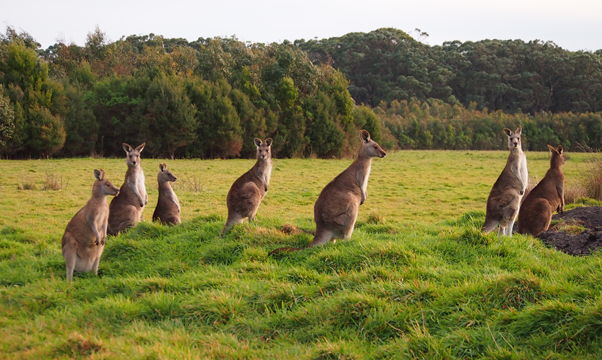















” Why is Australia’s Gillard Government condoning a trade in Australian wildlife? ” i would love to hear the answer to that!