2006 Grose Fire – Log of Media Releases

September 8th, 2010

by Editor 20100907.
The 2006 Grose Fire that devastated the protected Grose Valley and iconic Blue Gum Forest in November of that year was initially referred to as the ‘Burra Korain Fire‘ by the fire authorities because that was the initial localised bushfire at the time. The first ignition purportedly started by a lightning strike near Burra Korain Head, which is a bluff situated about 4km east of the village of Mount Victoria inside the Blue Mountains National Park, west of Sydney. The head is situated at the northern end of the prominent Burra Korain Ridge above the western side of the Grose Valley. [Ref: Topographic Map ‘Mt Wilson 8930-1N’ grid reference GR 498815 – per RFS official Section 44 Report].
A second ignition purportedly took place north west of Mount Victoria, south of the village of Hartley Vale was referred to as the ‘Lawson’s Long Alley Fire‘. Defensive backburning operatings in Hartley Vale, along the Bells Line of Road and along the Blackheath escarpment then got out of control, winds picked up and the multiple fires conflagrated into a massive fire storm on Wednesday 22nd November 2006.

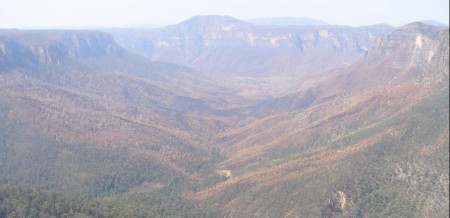
Burnt Grose Valley 9-Dec-06.
[©Photo by Editor, free on Public Domain – click to enlarge].


The following are extracts of successive media releases by the Blue Mountains Fire Control RFS NSW R ural Fire Service, Emergency Services Centre, Cnr Bathurst Rd & Valley Rd, KATOOMBA. RFS advice about health and instructions to residents have not been included, since these sections are generic and repeated in each media release. [Source: http://lists.rfs.org.au/mailman/listinfo/bluemountains-info]. It is instructive to compare and contrast the media releases of each day with the Day by Day Synopsis (pages 6 – 11) in the official Report on Lawson’s Long Alley Section 44. Read Report: Lawsons Long Alley Section 44 Report 20070208.pdf.


Thursday 16-Nov-06:

Fire Name: Lawsons Long Alley

Time Message Issued: 1700

Date Message Issued: 16/11/06

Two bushfires that were believed to have been started by lightning strikes on Monday are burning in the Blue Mountains National Park. A fire burning 2 km north of Mount Victoria has burnt out about 1100 hectares of private property and parkland and is burning on both sides of the Darling Causeway. The Darling Causeway remains closed to traffic and motorists are advised to use the Great Western Highway and Bells Line of Road as alternate routes.

A second fire burning about 5 km north of Blackheath in the Grose Valley has burnt out about 500 hectares of parkland. Waterbombing aircraft are slowing the progress of the fire as it is burning in difficult and inaccessible terrain.

The fire is not threatening any properties or homes at this stage.

All walking tracks into the Grose Valley are closed but cliff top tracks remain open. Hat Hill Road, Victoria Falls Road and Pierces Pass are currently closed within the Grose Valley.

Strategy

About 160 firefighters and ten waterbombing aircraft are working to contain the fires. Backburning operations have taken place north of Mt Victoria around St Georges Parade and the Darling Causeway.

.


Friday 17-Nov-06:

“Around 70 NSW Rural Fire Service (RFS), NSW Fire Brigades (NSWFB) and National Parks and Wildlife Service (NPWS) personnel will today join the dedicated volunteer firefighters of the Blue Mountains as they continue to work on two fires burning in the Grose Valley in the upper Mountains.

Dubbed the “Lawsons Long Alley Fire”, the main fire started on Tuesday afternoon near Hartley Vale, in the Lithgow District, and quickly spread up to the Darling Causeway – blown by strong westerly winds – and has now burned out around 1,370 hectares. A second fire, known as “Burra Korain Fire” is burning to the north of Blackheath and covering an area of approximately 100 hectares.

Fire conditions today are expected to remain in the firefighters’ favour, with continued low temperatures and light, variable winds. No properties or homes are currently under threat by the fire, however large volumes of smoke are visible throughout the Mountains and some parts of the Sydney basin and there has been some impact on local roads.

Assisting the local firefighters are other committed volunteers from Lithgow and Hornsby, with NPWS supplying specialist Remote Area Firefighting Teams (RAFT) to effect containment strategies. Eleven aircraft, including two large Skycranes, will again work vigorously to hinder the fire’s progression to allow the preparation and implementation of control lines.

Whilst today’s weather conditions remain relatively benign, information from the Weather Bureau indicates warmer temperatures ahead, under a north-westerly influence. Firefighting strategies have been developed in anticipation of these conditions and increased preparation is being undertaken. The Darling Causeway remains closed to all traffic between Mt Victoria and Bell. Motorists are advised to use the Great Western Highway or Bells Line of Road as alternate routes. Mt York Road also remains closed west of the Lockyers Road Track.

From today, the NSW Rural Fire Service will be undertaking public information sessions with communities in the communities surrounding the areas affected by the fire in an effort to ensure a well-informed and well-prepared community.

The Blue Mountains is a major tourist attraction and members of the public are advised that although a fire is currently burning in the upper Grose Valley, all walks, attractions and tourist facilities remain open and operating as normal east of Blackheath.”
.


Saturday 18-Nov-06:


RFS media release:

“Two bushfires that were believed to have been started by lightning strikes on Monday are burning in the Blue Mountains National Park. A fire burning 2 km north of Mount Victoria is largely contained and has burnt out about 1100 hectares of private property and parkland and is burning on both sides of the Darling Causeway. The Darling Causeway remains closed to traffic and motorists are advised to use the Great Western Highway and Bells Line of Road as alternate routes.

A second fire burning about 5 km north of Blackheath in the Grose Valley has burnt out about 600 hectares of parkland. Waterbombing aircraft are slowing the progress of the fire as it is burning in difficult and inaccessible terrain.”

So Saturday morning the main bushfire threat was from the Burra Korain Fire’. The fire management strategy at this time according to the RFS community newsletter issued by the Incident Management Team on behalf of the Commissioner of the NSW Rural Fire Service was as follows:

“A review of containment strategies has been undertaken overnight with forecasts provided from the Bureau of

Meteorology. Today fire crews will recommence direct attack of the fire where accessible, supported by

extensive water bombing. At the same time preparation of control lines will commence on the northern boundary

of Blackheath. After further information from the Bureau of Meteorology, and assessment of the fire progression,

and containment achieved as a result of the direct attack, backburning may commence along the Blackheath

control lines in the evening and through to Sunday. Residents are advised to ensure that all windows and doors

are closed and rear of the properties clear should this option be undertaken.”

At 1300hrs the RFS ’Bushfire Update read:

“A review of containment strategies has been undertaken and this afternoon extra resources the greater Sydney area will be brought in to undertake extensive backburning operations. Crews from the RFS and NSWFB will be burning behind properties between MT Victoria and Blackheath. This operation will continue through the night and into Sunday.”


Monday 20-Nov-06:

At 1100hrs the RFS ’Community Newsletter’ read:

About 250 firefighters have progressed well with the second stage of backburning operations along The Bells

Line of Road between the Darling Causeway at Bell to Mount Tomah. Crews have completed backburning from

the Bells Line of Road during the evening and will continue working on backburning towards Pierces Pass

Picnic Area. The fire is not contained at this stage.

Crews from the RFS NSW Fire Brigades and National Parks and Wildlife Service will be mopping up and will

continue to work on containment lines throughout the day and overnight. Due to the increased amount of fire in

the valley between The Bells Line of Road, Blackheath and Mt Victoria residents are advised to take appropriate

precautions if smoke or ash affect their properties._

Around 50 RFS and National Parks and Wildlife Service remote area firefighters and 16 aircraft will continue to

work on inaccessible parts of the fire in the Grose Valley today. The Bells Line of Road remains closed due to fire operations and falling trees.

Strategy

Crews will continue to work on the northern, western and southern boundaries of the fire today. The eastern

edge of the fire is burning in inaccessible terrain and remote area firefighters will be winched in to work on fire

breaks. Aircraft will continue to water bomb the eastern edge in anticipation of worsening weather conditions on

Tuesday and Wednesday. Firefighting operations will focus on the eastern edge today and overnight.”

Ed: So now the fire is in the Grose Valley…


Tuesday 21-Nov-06:

Blue Mountains Fire Update – 11.00am

“The fire in the Blue Mountains breached containment lines overnight on the northern end of Hat Hill Road at Anvil Rock. Firefighters worked hard overnight to hold the eastern containment line but strong westerly winds and dry conditions hindered operations and the fire was unable to be held on that edge. Containment lines in the north, west and south continue to hold and these are not expected to be tested today.

About 400 firefighters from the RFS, National Parks and Wildlife Service and NSW Fire Brigades and 18 aircraft will work to slow the spread of the fire in preparation for worsening weather conditions today and tomorrow.

Blue Mountains residents to the north-east, east and south-east of the fire should prepare their properties for fire and ensure they have a plan to stay or relocate early if the fire reaches their area.

The Bells Line of Road remains closed due to fire operations and falling trees. The Blue Mountains National Park will remain closed until further notice.

Crews will continue to work on containment strategies in preparation worsening weather conditions today and tomorrow. Aircraft will work to slow the progress of the eastern edge of the fire and will work on any new fire outbreaks ahead of the fire. The eastern edge of the fire is burning in inaccessible terrain but will continue to burn in difficult country until weather conditions improve. “

Weather Forecast

Tuesday: 32 degrees with strong hot winds from the W/NW gusting up to 50 km/h and humidity at a low of 10%. Wind changing to WNW overnight up to 80 km/h A Total Fire Ban is in place until midnight Tuesday night.

Wednesday: Fine, hot north westerly winds gusting up to 50 km/h in the day. Very high to extreme fire danger expected.

Many tourist attractions in the Blue Mountains and Lithgow remain open but the Blue Mountains National Park is closed. Hat Hill Road, Ridgewell Road, Victoria Falls Road, Pierces Pass and Mt Banks Road remain closed.

Blue Mountains Fire Update 5am:

“The 6800ha fire in the Blue Mountains National Park escaped in the eastern section earlier this evening, confirming concerns the fire will be difficult to control in extreme fire conditions over coming days. The fire is not directly threatening property at this time but there are concerns that strong westerly winds could cause property issues over the next 72 hours.

The fire escaped near Anvil Rock. Crews were already concentrated in this area to work on containment lines and nine more fire tankers were responded when the escape occurred at about 11pm. Firefighters tried to hold the fire at Perrys Track but difficult terrain and fire behaviour meant this was not possible.

Aerial reconnaissance will be undertaken at first light to identify the spread of the fire and direct waterbombing aircraft to help limit the spread of the escape. While there is a chance firefighters can steady spread through waterbombing, strong westerly winds are forecast for today and continuing difficult weather conditions are predicted for the rest of the week. This could cause the fire to run. About 400 firefighters will continue to work on the fire today.

The two bushfires which have been burning in the Blue Mountains National Park for the past nine days have joined and are being treated as one fireground. The fire is in an area surrounded by the Great Western Hwy, Darling Causeway, Bells Line of Road. The Bells Line of Road will be closed between the Darling Causeway and Mount Tomah until further notice.”


Wednesday 22-Nov-06:

“Crews from the Rural Fire Service were unable to complete back burning operations to consolidate containment along the Mount Banks Fire trail, east of the fire, due to erratic fire behaviour and some spot-overs from the fire have moved into the Banks Ridge area, running predominately in an easterly direction. As a precautionary measure, a strike team comprising of NSWFB and RFS crews has been deployed to the south west of Mount Tomah to provide patrolling and observation of the fire and possible asset protection if required. All Blue Mountains residents to the north-east, east and south-east of the fire should prepare their properties for fire and ensure they have a plan to stay and defend their property, or relocate early if the fire reaches their area.

The Bells Line of Road between the Darling Causeway and Mount Tomah remains closed due to fire operations and falling trees. All areas of Blue Mountains National Park will remain closed until further notice and the Mount Tomah Botanical Gardens will also be closed today. The Great Western Highway and the Darling Causeway are open, however smoke may reduce visibility in some areas and drivers are asked to proceed with caution.”

Strategy

“Crews will continue to work on containment strategies in preparation for worsening weather conditions and aircraft will continue to slow the progress of the eastern edge of the fire and work on any new fire outbreaks ahead of the fire front. The eastern edge of the fire is still burning in inaccessible terrain towards King Georges Brook and is expected to continue to burn in difficult country until weather conditions improve. ”

Weather Forecast

Today: Fine, hot north westerly winds gusting up to 70 km/h in the day. Very high to extreme fire danger expected.

Thursday: Warm fine weather, winds easing.

Authorized By: Mal Cronstedt – Incident Controller

Communiqué at 1100 hrs:

“The fire in the Blue Mountains National Park continues to burn in an easterly direction and has been active in the Anvil Rock area where helicopters are waterbombing and is not affecting properties at this time. There are 400 firefighters and 15 aircraft working on the fire which is not contained and conditions are expected to be difficult today.

RFS crews attempted to consolidate containment to the east overnight by conducting a back burn along the Mount Banks Fire Trail. The crews experienced some erratic fire behaviour and the fire has spotted over to the east overnight and is progressing in the Explorers Ranges and Banks Ridge areas.

A NSWFB strike team has been deployed to Mount Tomah to the north east of the fire, as a precautionary measure, to patrol fire progress and provide possible asset protection, if required.

The fire is about 5km southwest of Mt Tomah and 5km from Blackheath and is about 14500ha. Containment lines in the north, west and south continue to hold and are being patrolled.

The fire is not directly threatening properties at this time but difficult winds and hot weather are expected to challenge firefighters today.”

Weather Forecast

Today: Fine, hot north westerly winds gusting up to 70 km/h in the day. Very high to extreme fire danger expected.

Thursday: Warm fine weather, winds easing.”

Blue Mountains Fire Update 2pm:

“The fire in the Blue Mountains National Park is experiencing very strong winds causing two spot fires due to increased fire activity in the Banks Mountain area. Helicopters are waterbombing the spotfires. While it is not affecting properties at this time there are concerns as fire activity increases.

The two spotfires are north of the Woodford Dam, one is 5km north of Linden and the other 5km north of Hazelbrook. A NSWFB strike team has been deployed to Mount Tomah to the north east of the fire, as a precautionary measure, to patrol fire progress and provide possible asset protection, if required. Firefighters are also deployed to Blackheath in Hat Hill Rd.

There are 400 firefighters and 15 aircraft working on the fire which is not contained with strong winds of 50kph gusting at times to 90kph from variable directions but generally northwest. This has caused the fire to spot ahead of itself to the southeast. The spot fires are …

The fire is about 5km southwest of Mt Tomah and 5km from Blackheath and is about 14500ha. Containment lines in the north, west and south continue to hold and are being patrolled.”

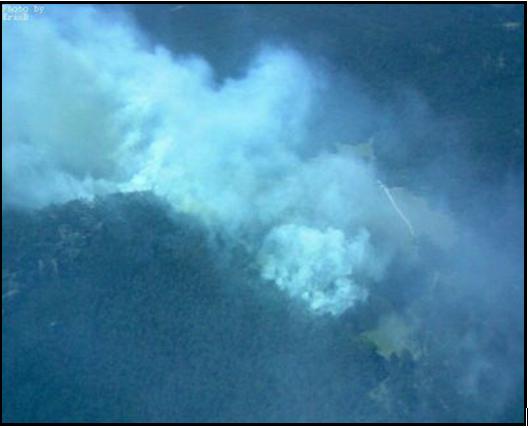
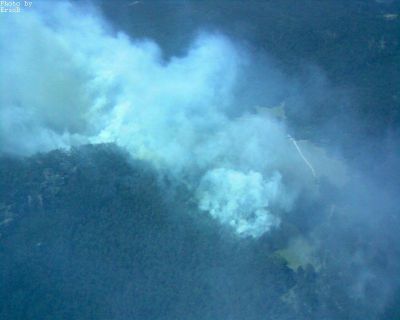
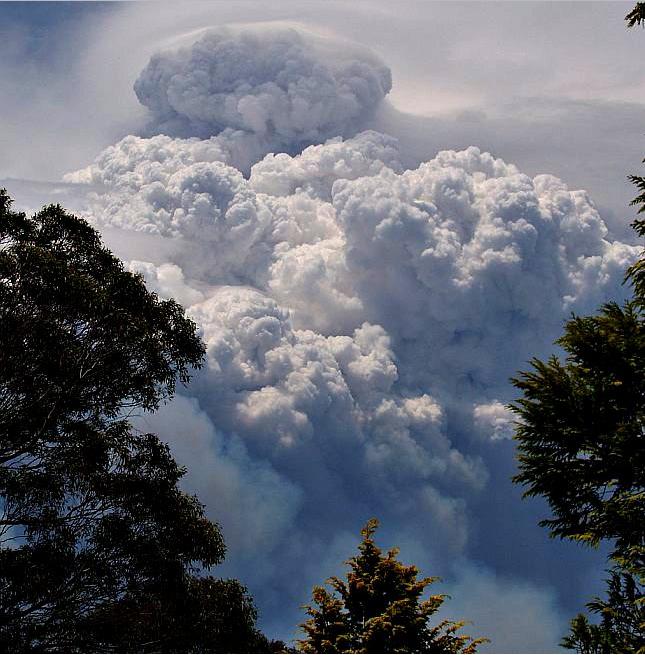
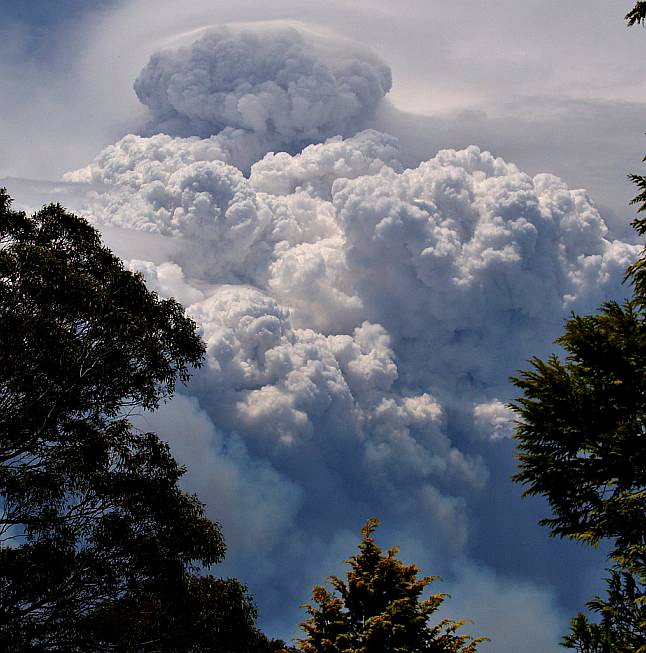
Pyrocumulus cloud over the Grose Valley Wednesday afternoon 22-Nov-06. [©Photo blackheath weather.com http://www.blackheathweather.com/summer2006/fire22-11-06-003a.jpg – click to enlarge].

Spotfire update 2.24pm – Blue Mountains Fire:

“Aerial Observation units had reported two spotfires to the north of Hazelbrook and the Woodford Dam.

NSW Rural Fire Service and NSW Fire Brigades crews were immediately responded to the area along with waterbombing aircraft.

One of the spotfires has now been brought under control and the second spotfire is currently being held by waterbombing operations.”

Blue Mountains Fire – 4.30pm Update Wednesday:

“The fire in the Blue Mountains National Park is experiencing very strong winds which had caused two spot fires due to increased fire activity in the Banks Mountain area. Helicopters were used to waterbomb the spotfires. They are believed to have contained one spotfire and are bringing the other under control.

The spotfire believed to be contained is about 4km north of Lake Woodford, the other is 5km north of Hazelbrook and helicopters are currently waterbombing to slow its progression. A number of NSW Rural Fire Service (RFS) and NSW Fire Brigades (NSWFB) units were responded to the surrounding areas to ascertain the location and spread of the spotfires.

All aircraft assigned to this fire are currently in use waterbombing the fire which has been moving steadily east.

A NSWFB strike team has been deployed to Mount Tomah to the north east of the fire, as a precautionary measure, to patrol fire progress and provide possible asset protection, if required. Firefighters are also deployed to Blackheath in Hat Hill Rd.

Throughout the day 400 firefighters and 15 aircraft have been working on the fire which is not contained with strong winds of 50kph gusting at times to 90kph from variable directions but generally northwest. This has caused the fire to spot ahead of itself to the southeast.

The fire is about 5km southwest of Mt Tomah and 5km from Blackheath and is about 14500ha. Containment lines in the north, west and south continue to hold and are being patrolled.

Residents of the Blue Mountains who reside to the north, northeast and southeast of the fire are advised to prepare their properties for fire and ensure they have a plan to either stay and defend or relocate early if fire reaches their area.

The Bells Line of Road is closed between the Darling Causeway and Mount Tomah, due to fire operations and falling trees. All areas of Blue Mountains National Park will remain closed until further notice. Park closure enquiries can be made to Blackheath Heritage Centre on (02) 4787 8877.

Predicted weather: Temp: 30 degrees Winds: Primarily northwest 45kph gusting higher Humidity: 13%.”

Blue Mountains Fire 7.15pm update:

“Strong winds and high temperatures that drove the Blue Mountains fire have eased this evening allowing for about 500 NSW Rural Fire Service (RFS), NSW Fire Brigades (NSWFB) and National Parks and Wildlife Service (NPWS) firefighters to prepare for backburning operations this evening.

Crews will commence backburning east along the Bells Line of Road all the way to Mount Tomah then progress from Mount Tomah to Mount Banks. Backburning operations are also planned along fire trails between Hat Hill Road and Mount Hay Road behind Leura. This operation will continue along Mount Hay Road to Mount Hay.

A west-south-west influence is expected in the evening but may not reach the northern edges of the fire through the Grose Valley. Weather over the coming days is predicted to be cooler and should see winds easing, allowing for calmer conditions for firefighters. Unpredictable fire behaviour, driven by strong erratic winds has so far made it very difficult for firefighters to contain.

Two spotfires occurred during the day about 6.5km North West of Faulconbridge. Aircraft were able to successfully extinguish one spot fire to the north of Lake Woodford. Aircraft have slowed the progress of the second spotfire and will continue to work on slowing its progress.

Residents of the Blue Mountains who reside to the north, northeast and southeast of the fire are advised to prepare their properties for fire and ensure they have a plan to either stay and defend or relocate early if fire reaches their area.

The Bells Line of Road is closed between the Darling Causeway and Mount Tomah, due to continuing fire operations and falling trees. All areas of Blue Mountains National Park will remain closed until further notice.”


Thursday 23-Nov-06:

Bushfire Update:

“High winds and temperatures provided momentum for the fire to take runs to the east and significant spotting occurred several kilometres from the main fire front yesterday afternoon. As a result, five strike teams were deployed to the townships of Linden and Falconbridge as a precautionary measure for any significant wind changes. By mid afternoon, over 500 crews comprising of RFS, NPWS and NSWFB were deployed for possible property protection and patrolling and 15 aircraft were successful in extinguishing one spot fire and significantly hindering the progress of the other spot fire. These two fire sites continue to be monitored today by water-bombing aircraft and Remote Area Fire Team (RAFT) crews.

During the night as winds eased and temperatures dropped, crews were successful in consolidating containment through back burning along the southern side of Bells Line of Road towards Mount Tomah and also east of Blackheath, along Hat Hill Road and these works will continue through today and tonight. Reports of another small unrelated fire to the north of the main fire along Queen Victoria Pass, at Mount Victoria was received around midnight. Crews were responded to this and were able to contain this fire that had dropped over the edge from Queen Victoria Pass.

The Bells Line of Road between the Darling Causeway and Mount Tomah remains closed, due to fire operations and falling trees. All areas of Blue Mountains National Park will remain closed until further notice.

Strategy

Crews will continue to monitor the fire’s progress through Mt Banks Ridgeline and work towards full containment. It is anticipated that the fire will continue to burn in inaccessible terrain, until significant weather or rain influence its direction and intensity.

Weather Forecast

Today: Fine, warm with winds tending south, south-west, gusting up to 40 km/h in the day. High to Very high fire danger expected.

Friday: Warm fine weather, winds still easing.”

Bushfire Update 1330hrs 23-Nov-06:

“Firefighters are continuing to conduct backburning work around Mt Tomah and along fire trails from Blackheath towards Evans Lookout, as they try to contain the fire in the Blue Mountains. Backburning is progressing well with weather conditions assisting firefighters at this stage.”

Mount Tomah/Blackheath

“Crews are backburning along the Bells Line of Road all the way to Mount Tomah. They will then progress from Mount Tomah to Mount Banks. Crews are also backburning from Pulpit Rock Rd to Evans Lookout Rd Blackheath. Backburning operations are along fire trails between Hat Hill Road and Mount Hay Road behind Leura. This operation will continue along Mount Hay Road to Mount Hay.

Two spotfires occurred during yesterday afternoon 6.5km northwest of Faulconbridge. Aircraft were able to successfully extinguish one spot fire to the north of Lake Woodford. Aircraft have slowed the progress of the second spotfire which is 60ha and will continue operations today.

The fire is not contained and active fire is burning 2.5km south of Mt Tomah and 7km north of Wentworth Falls and has burnt 12500ha.”

Mitchell’s Lookout ( Queen Victoria Pass)

“Another unrelated fire was reported at midnight along Queen Victoria Pass in the vicinity of Mitchells Lookout, north of Mt Victoria. Crews were responded and have contained the fire on top of the cliff and over the cliff edge. Over 300 personnel will work on the fire today with further crews available for response. Crews are from NSW Rural Fire Service (RFS), NSW Fire Brigades (NSWFB) and National Parks and Wildlife Service (NPWS).”

Weather Conditions

Weather conditions today are predicted to include temperatures of 27 degrees, winds from the west southwest of 25kph gusting to 45kph and relative humidity of 17 percent. Current weather at Mt Boyce is around 25 degrees, with westerly winds 19kph to 28kph and humidity of 18 percent. Winds over the coming 12 hours indicates a wind shift to a south westerly influence with a decline in wind speed. This predict Blue Mountains who reside to the north, northeast and southeast of the fire are advised to prepare their properties for fire and ensure they have a plan to either stay and defend or relocate early if fire reaches their area.”


Friday 24-Nov-06:

[Bluemountains-info] Blue Mountains Fire Update- 5 am Friday

Mount Tomah/Blackheath

“Late last night both temperature and winds dropped and light misty rain fell over the area of operations, hindering progress on backburning and forcing crews to black-out any active back-burn edges. Partial burns were achieved to the north of Falconbridge and along Hat Hill road. Some backburning continued at Mount Tomah and along the southern edge of Bells Line of Road, to contain the fire south of Bells Line of road with the assistance of crews from Hawkesbury Fire District. Strike teams from NSWFB and RFS were all assisting with the back burning operation last night and this morning, until weather conditions no longer made this feasible.

The main fire still remains active, with a line scan planned this morning, subject to visibility and from this, planned containment consolidation options will be re-assessed today.

Mt Victoria

The Mitchells Lookout Fire is blacked out and will be periodically checked for possible re-ignition, should weather conditions change significantly. Residents are reminded to call Crime-Stoppers if they see any suspicious activity by calling 1800 333 000.

Weather

Weather predictions indicate winds continuing with an easterly influence tending north and easing. The easterly influence will also bring in an increase relative humidity, which will allow for the back burning to continue safely, provided no further light rain falls. Saturday is predicted to have increased temperatures and winds tending north, northwest with Sunday expecting 30 degree temperatures and easterly winds.” – Inspector Eric J Berry JP (RFS, Katoomba)

Bushfire Update Friday 24 November 2006

“Last night and early this morning, crews from NSW RFS, NSWFB and NPWS continued back-burning operations overnight, north of Falconbridge, along hat Hill road and south of Bells Line of road towards Mt Tomah, until light rains hampered progress. Some burning was achieved, but with the weather conditions generally success was limited .The fire continues to remain along the Dawes Ridge, Lawson Ridge and Carmarthen Ridge, under the influence of light north easterly wind.

A small fire reported late yesterday evening at Mitchells Lookout, Mount Victoria was extinguished yesterday and is being monitored for possible re-ignitions. The cause of this fire is under investigation and residents are reminded that a Crime Stoppers hotline is available for reports of all suspicious activity by calling 1800 333 000.

Strategy

Crews will continue to work on containment strategies along existing containment lines with back burning being considered, should weather conditions allow, in preparation worsening weather conditions which are expected on Sunday and Monday and aircraft will continue to slow the progress of the eastern edge of the fire and continue work on any new fire outbreaks ahead of the fire front.

Weather Forecast

Today: Fine, warm with easterly winds tending north-easterly in the afternoon gusting up to 22 km/h. High fire danger expected.

Saturday: Warm weather with temperatures expected to reach 30 degrees with winds tending north westerly.


Saturday 25-Nov-06:

[Bluemountains-info] Blue Mountains Fire Update Saturday 8pm

“Back burning has recommenced from Medlow Bath to Point Pilcher this afternoon, and will continue as long as is viable into the night. The Bells Line of Road has also now been re-opened in all directions.

Ground and remote area fire crews were today deployed to Hurley Heights and Lawson Ridge for a direct attack. Dozer lines have also been established in order to provide tanker access and support for the Remote Area Fire crews. Crews have completed mopping up along Bells Line of Road and the western side of Mt Tomah.

Current Strategy

“Work is continuing on improving the existing fire trails adjacent to properties in the Berambing/Bilpin area in preparation for back burning operations if fire crosses Tomah Creek or the Grose River.

A back burn in the base of the Grose Valley may be visible to residents of Yarramundi, Grose Vale, Bowen Mountain and Grose Wold. Residents are advised not to be alarmed as this consolidation work is being carried out.

Road Closures

The Bells Line of Road is now open.

All areas of Blue Mountains National Park will remain closed until further notice.

Weather Forecast

Sunday : Fine. Warm. Light winds.


Monday 27-Nov-06:

COMMUNITY NEWSLETTER

Bushfire Situation 0600 hrs

[Issued by the Incident Management Team on behalf of the Commissioner of the NSW Rural Fire Service]

“Mild conditions continued overnight, with minimal fire activity current across the fireground. Mild easterly weather conditions predicted today are likely to minimise the threat of fires affecting property. However if conditions tend to westerly winds with lower humidity, re-ignitions could threaten contained edges.

Backburning up to 100m deep around the western side of Mt Tomah is complete with all edges inactive. The main front is generally inactive but is within 2 to 3km SW of Mount Tomah/Berambing. The Dawes Ridge spotfire has been effectively suppressed by heli-bucketting. Backburning reached Grand Canyon Road with minimal depth due to very low fuels. Mt Hay edges are inactive in very low fuels.

The Bells Line of Road between the Darling Causeway and Mount Tomah has been re-opened, however, residents and visitors are advised that Mount Banks and Pierces Pass trails / tracks are closed to the public. Visitors and residents travelling along Bells Line of Road are advised that whilst the road has been re-opened, it may be closed intermittently due to fire operations. The Great Western Highway and the Darling Causeway remain open, however, as previously advised, smoke may reduce visibility in some areas and drivers are asked

to proceed with caution.

The Blue Mountains National Park south of the Great Western Highway is open for park visitors, however with ongoing fire operations the Blue Mountains National Park north of the Great Western Highway will remain closed until further notice. This park closure affects visitation to Govetts Leap, Evans Lookout, Victoria Falls, Point Pilcher, Pulpit Rock, Perry’s Lookdown and Mount Hay. Visitors and residents should refrain from wandering around burnt areas of the park due to the potential for dangerous trees to drop limbs or fall.”

Strategy

“High overnight humidity has prevented recommencement of backburning operations. Crews will be patrolling and observing fire on all fronts until the recommencement of back burning activities later today (weatherpermitting). Crews will be working along containment lines mopping-up and blacking out around Thunder Gorge, Lawson Ridge & Hurley Heights. Backburning activities from Evans to Point Pilcher will be reviewed later today.

Weather Forecast

Today: Fine, with easterly winds tending east-north-easterly with gusts up to 25 km/hr. Maximum temperatures mid 20’s. Moderate fire danger expected.

Tuesday: Fine, westerly winds peaking around 25-30km/hr. Maximum temperatures around 30 degrees.

Authorised By: Tom Shirt – Incident Controller”


Tuesday 28-Nov-06:

Bushfire Incident Update – 5:30am:

General Informational Update

“National Parks and Wildlife Service (NPWS) personnel continued to actively patrol the fireground overnight which, coupled with the milder conditions, allowed several more areas of concern to be addressed in preparation for the less favourable fire weather predicted for later today.

Currently the major fire fronts of last week have self extinguished in lower levels of fuel along the Mt Hay Range which has also had the benefit of mild easterly weather conditions over the last few days. These lower levels of fuel are the result of the Mt Hay fires of 2002/2003.

Both air and ground crews will continue to patrol and mop up these edges from first light this morning to minimise the risk of re-ignitions.

Residents in the Blue Mountains should continue to prepare their properties and are advised to ensure that all windows and doors remain closed and that their properties are clear of combustible materials. Residents are also advised to patrol their property regularly for hot embers and potential spot fires. Those residents with health issues affected by smoke are advised to take appropriate precautions and remain indoors where possible.”

Weather Forecast

“Today: Isolated afternoon and evening showers and thunderstorms, tending scattered in the north. Local early morning fog or mist patches in the east. Moderate to occasionally fresh west to northwest winds.

Max Temps: Katoomba 31c. Springwood 36c.

Fire danger: Very High to Extreme – A TOTAL FIRE BAN is in force until Midnight tonight.

Wednesday: Cloudy periods in east with the chance of isolated showers or drizzle. Fine and mostly sunny in the west. Warm West to southwest winds, turning easterly in the east.

Authorised By: Jack Tolhurst – Deputy Incident Controller”

Update as at 0800:

“Fire behaviour throughout yesterday was again subdued due to continuing mild conditions and the main front extinguishing in very low fuel levels. Advantage was taken of these conditions to consolidate containment lines and extend the depth of blackout across all areas of the fire.

Ground and specialised Remote Area Fire crews continued to be deployed to burnt ground in an effort to mop up and patrol the fire ground for potential hot spots. Ground crews were involved in blacking out some fourteen identified hot spots to help minimise the chance of the fire front re-igniting.

Conditions today are expected to increase the amount of smoke and will see crews actively patrolling throughout the fire area as, given the weather conditions, there could be some reactivation of recent fire edges.

The Bells Line of Road between the Darling Causeway and Mount Tomah remains open; however, residents and visitors are advised that Mount Banks and Pierces Pass trails / tracks are still closed to the public.

Strategy

With winds predominately from the North/West and reaching speeds of up to 45km/h and humidity expected to drop into the low teens by this afternoon, today will see continued aerial observation of the fire with Remote Area Fire crews patrolling the ground to knock-down any re-ignitions. All crews will take

Weather Forecast

Today: Fine, with north westerly winds gusting up to 45 km/h. Maximum temperatures low 30’s with reducing humidity. There is the possibility of a shower or thunderstorm, most likely in the afternoon. Please note strong, gusty and erratic winds may occur with and near any thunderstorm.

Very high to extreme fire danger expected

A TOTAL FIRE BAN is in force until Midnight tonight

Wednesday: Fine, winds turning south easterly, becoming cloudy with humidity increasing.

Authorised By: Mal Cronstedt – Incident Controller


Tuesday 28-Nov-06:

General Informational Update, current as at 1200:

“Rural Fire Service crews and National Parks and Wildlife Service personnel continue to actively patrol the fireground today moping up hot spots in preparation for the less favourable weather predicted for this afternoon. Very high to extreme fire danger is expected for this afternoon and as a result.

A TOTAL FIRE BAN is in force until Midnight tonight

Both air and ground crews are continuing to patrol and mop up edges to minimise the risk of re-ignitions whilst continuing to consolidate the progress made to date.

“While increasing temperatures and dryer nor-westerly winds may increase the amount of smoke being produced and could result in some increase in fire activity we are quietly confident that the control lines, and consolidation of those lines, that has taken place over the past days will hold.” said Incident Controller Superintendent Mal Cronstedt.

“We are satisfied that we have sufficient resources for the current conditions, however we have reserve capacity available for deployment should conditions change.” continued Superintendent Cronstedt.

Aerial observation of the fire will continue throughout the day to identify any hotspots and re-ignitions. Remote Area Firefighting Teams (RAFT) will be deployed to mop up areas of the fire and to extinguish any re-ignitions.”

Weather Forecast

Today: Fine, with north westerly winds gusting up to 45 km/h. Maximum temperatures low 30’s with reducing humidity. There is the possibility of a shower or thunderstorm, most likely in the afternoon. Please note strong, gusty and erratic winds may occur with and near any thunderstorm

Wednesday: Fine, winds turning south easterly, becoming cloudy with humidity increasing.

Authorised By: Mal Cronstedt – Incident Controller

Current as at 1800:

“Weather conditions throughout the day proved to be as testing as predicted with wind speeds reaching as high as 70km/h in some areas. Despite the high temperatures and low humidity, but for a few minor exceptions all lines have held today.

“Today proved a real test of the planning and hard work undertaken over the past few days, a test that has been successfully passed'” commented Incident Controller Superintendent Mal Cronstedt.

Ground patrols who have been attending Lawson Ridge, Evans Head and the Swamp have reported no renewed fire activity. There has been fire activity in some areas, but no new spot fires just flare ups on existing edges. A combination of aerial suppression and Remote Area Firefighting Teams (RAFT) have been able to re-establish control lines in these few instances. There are still hot spots occurring, but they are being subjected to ongoing aerial bombing, including the use of the Skycrane, and mopping up by ground crews.

The current status of the fire has been downgraded from “Going” to “Being Controlled”.

Currently the RTA is not listing any road closures in the area as a result of the fire activity. NPWS advises that north of the Great Western Highway – All roads, tracks, canyons and lookouts in the National Park are closed.

Strategy

For the rest of today and overnight a continuation of aerial observation and RAFT crews, patrolling the ground to knock-down any re-ignitions, will be utilised. Crews will take full advantage of the humid and cooler conditions overnight to consolidate containment lines within existing edges. It is planned Grose River. (to contain the fire at the Grose River?)

Weather Forecast

Today: Showers and thunderstorms this evening. Becoming fine overnight. NOTE: Strong, gusty and erratic winds may occur with and near thunderstorms. Very high to extreme fire danger expected.

A TOTAL FIRE BAN is in force until Midnight tonight.

Wednesday: Wednesday: W/SW winds ahead of a SE change 30/45 km/h late morning / early afternoon. Fine day ahead of the change. Some light rain or drizzle developing later in the afternoon/evening.


Wednesday 29-Nov-06:

Current as at 0700:

“Weather conditions overnight did not ease as significantly as indicated with temperatures general higher than predicted and, conversely, humidity was lower than expected. Two areas of active flame have been monitored throughout the night with aerial bombing and grounds crews tasked to work on these this morning. The first is in the Govetts Creek region while the other is south west of Mount Bell, both of which are located within areas of low fuel loads and within containment lines. Neither is currently causing major concerns at this point, however firefighters are keen to deal with these spots before the day is out.

The spot fires from last week to the north west of Linden and Falconbridge were again patrolled throughout the night with no reports of any fire activity or hot spots. The Incident Controller is confident that these areas are now well contained.

With the decrease in fire activity further updates will be issued once a day, at 4.00pm and posted directly on the Blue Mountains Website (www.bluemountains.rfs.nsw.gov.au) Currently the RTA is not listing any road closures in the area as a result of the fire activity.

Strategy

The rest of today will bring a continuation of aerial observation work, in tandem with Remote Area Firefighting Teams patrolling the ground to knock-down any re-ignitions. Ground crews will work on consolidation of containment lines and extending the depth of blackout across all parts of the fire ground.

Weather Forecast

Today: Fine. Westerly winds expected to get a little gusty about higher areas this morning. A SE change will reach eastern parts of the fire ground around midday, gradually extending to western and higher parts by about 3pm.


Saturday 2-Dec-06:

“Following the recent bushfire activity in the Blue Mountains and Lithgow Districts, a series of Community Meetings will be held several locations throughout the Mountains.

The purpose of these meetings is to:
Operations:

  • Provide an overview of what happened and didn’t happen
  • Detail what was done and what wasn’t done, and why.

Community Liaison and Public Information:

  • Provide information on the Community Liaison process,
  • Obtain feedback from you, our community, on how well we did it this time and how we might be able to do it better in the future,

Recovery

  • Explain what is going to happen in the coming days and weeks,
  • Provide details of who to contact if you need assistance,
  • Provide information on what we can do, as a community, in the future

Our overall Aim is:

Better integration between emergency services and the community.

Who will be attending:

  • Your local fire brigade members, officers and Group Officers
  • Members of the Community Liaison Team
  • Members of the Incident Management Team
  • Representatives from the Rural Fire Service
  • NSW Fire Brigades
  • National Parks and Wildlife Service
  • Blue Mountains City Council.

Who should attend:

  • Community members directly or indirectly affected by the recent bushfire
    activity,
  • Community members who want to know what happened and why,
  • Community members who would like to obtain information about how to
    prepare for bushfires.

Remember — This is only the start of the bushfire season, not the end of it. Now is not the time to become complacent or to think that it won’t happen again this summer.

For information about preparing your home, or to make a written bushfire action plan, visit our website: www.bluemountains.rfs.nsw.gov.au or call 02 4782 2159 during business hours.

Date and Time Location

======================================================================

Thursday, 7 Dec @ 7:30pm Winmalee Rural Fire Station, Cnr Coramandel Ave & Hawkesbury Rd

Friday, 8 Dec @ 7:30pm Leura Golf Club, Sublime Point Rd Leura (Opp. Fairmont Resort)

Saturday, 9 Dec @ 10:30am Mt Tomah Rural Fire Station, Charleys Rd, Mt Tomah

Saturday, 9 Dec @ 3:00pm Clarence Rural Fire Station, Chifley Rd

Saturday, 9 Dec @ 7:30pm Blackheath Golf Club, Brightlands Ave

Sunday, 10 Dec @ 10:00am Faulconbridge Rural Fire Station, Railway Pde

These meetings are being facilitated by the Community Safety Group of the Blue Mountains Bush Fire Management Committee. For further enquiries, please call 02 4782 2159 during business hours, Mon-Fri.”

Inspector Eric J Berry JP
Community Safety Officer
Blue Mountains District
NSW Rural Fire Service
Emergency Services Centre
Cnr Bathurst Rd & Valley Rd
KATOOMBA NSW 2780


Reported in the Sydney Moring Herald at the time:

“MORE than 70 years ago this forest inspired the birth of the modern Australian conservation movement. Today Blue Gum Forest stands forlorn in a bed of ash. But was it unnecessarily sacrificed because of aggressive control burning by firefighters focused on protecting people and property? That is the tough question being asked by scientists, fire experts and heritage managers as a result of the blaze in the Grose Valley of the upper Blue Mountains last month.

As the fate of the forest hangs in the balance, the State Government is facing demands for an independent review of the blaze amid claims it was made worse by control burning and inappropriate resources.

This comes against a backdrop of renewed warnings that Australia may be on the brink of a wave of species loss caused by climate change and more frequent and hotter fires. There are also claims that alternative “ecological” approaches to remote-area firefighting are underfunded and not taken seriously.

In an investigation of the Blue Mountains fires the Herald has spoken to experienced fire managers, fire experts and six senior sources in four agencies and uncovered numerous concerns and complaints.

      • It was claimed that critical opportunities were lost in the first days to contain or extinguish the two original, separate fires.
      • Evidence emerged that escaped backburns and spot fires meant the fires linked up and were made more dangerous to property and heritage assets – including the Blue Gum Forest. One manager said the townships of Hazelbrook, Woodford and Linden were a “bee’s dick” away from being burnt. Another described it as “our scariest moment”. Recognising the risk of the backburn strategy, one fire officer – before the lighting of a large backburn along the Bells Line of Road – publicly described that operation as “a big call”. It later escaped twice, advancing the fire down the Grose Valley.
      • Concerns were voiced about the role of the NSW Rural Fire Service Commissioner, Phil Koperberg.
      • Members of the upper Blue Mountains Rural Fire Service brigades were unhappy about the backburning strategy.
      • There were doubts about the mix and sustainability of resources – several senior managers felt there were “too many trucks” and not enough skilled remote-area firefighters.
      • Scientists, heritage managers and the public were angry that the region’s national and international heritage values were being compromised or ignored.”

[Source: Sydney Morning Herald, Gregg Borschmann, 11-Dec-06, ‘The ghosts of an enchanted forest demand answers’, http://www.smh.com.au/news/national/the-ghosts-of-an-enchanted-forest-demand-answers/2006/12/10/1165685553891.html ]


Burnt Blackheath Plateau above Grose Valley 9-Dec-06.
[©Photo by Editor, free on Public Domain – click to enlarge].

 
Ed: Much attention was paid by the fire authorities on protecting human life and property. The core problem with this narrow focus, not only ignoring high value conservation ecology, was that by placing low priority on remote ignitions in the National Park, the firefighting strategy was neglectfully allowed to degrade from a controllable offensive position into a defensive uncontrollable position over days in which the weather and wind changed.
 
Fire waits for no man! Man waiting for fire is fatalistic.


The culture that bushland is expendable and not an asset is the real problem. Remote fire subdues the fire fighting sense into a dangerous sense of apathy.

Grose Lesson: Best to respect fire no matter where it starts and to quell it promptly, else risk the consequences. All fire has inherent risk and risk is unpredictable.


Leave a Reply

You must be logged in to post a comment.

2006 Grose Valley Fires…dodgy report

September 6th, 2010

.

The official RFS Section 44 Report into the 2006 Grose Valley Fires found that “there (were) not sufficient RAFT crews” despite multiple spot fires in difficult terrain and “the likelihood of fire escape during severe fire weather (being) certain.”

Suspected” dry lightning sparked two ignitions last November on Monday 13, one oddly mapped to a grass paddock within easy fire truck access off Walton’s Road, Hartley Vale.  But these fires were “not detected until the following day.”  On Tuesday 14, with a gusting westerly and a fire index of 25, numerous spot fires had progressed into steep bushland inaccessible to fire truck crews.  Despite it becoming apparent to fire authorities that these fires “would present problems beyond the resources available locally”, the decision to declare a Section 44 escalated response wasn’t taken until Wednesday 15.

Multiple broad-acre backburning became the “fall-back strategies” despite “spot-over” fires occurring “some 12 kilometres distant from the main fire” north of Linden, showing up backburning as ineffectual.  A new burn was lit along Hungerford Track inside the Grose and “aerial incendiary” was dropped “north of Blackheath on Sunday 19.  An RFS burn south of Bells Line of Road became “a concern” on Wednesday 22 (“blow-up day”) before it coalesced with the wildfires into “a major run” through the Grose Valley.  A massive 6km pyro-cumulous cloud developed “visible from much of the Sydney basin”.  Some 14,070 hectares of bush habitat had been burnt.

The report documents insufficient aerial support, “deployment was less than satisfactory”, “radio communications (were) poor”, bulldozer contractors were unsupervised and RFS RAFT crew standards “were questioned”.

Lack of early detection resources, of rapid initial suppression and ineffective resource management were inferred as key operational concerns behind the Grose Fire.  Surely, fire fighters protecting both community and public assets deserve first class management, resources and funding.

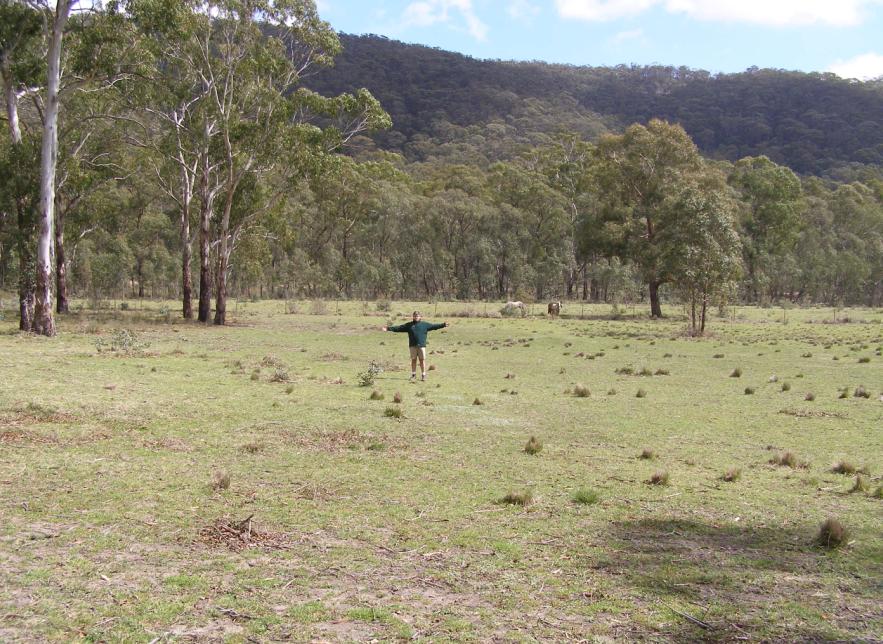
Silverdale‘ property south of  Hartley Vale.  Editor standing at the exact Grid Reference GR 442842 documented by the New South Wales Rural Fire Service Section 44 Report’s ‘official’ location of the ignition of the Lawsons Long Alley bushfire which ‘officially’ was struck by lightning and caused the devastating 14,070 hectare Grose Valley Fires in the Greater Blue Mountains World Heritage Area of November 2006.    (Bollocks!)

[Photo taken 22 Sep 2007, just ten months after the firestorm].


Doubtful?   Check the Lawsons Long Alley Section 44 Report 20070208.pdf

Leave a Reply

You must be logged in to post a comment.

Where have all the native animals gone?

September 2nd, 2010

by Editor 20100902.

Detail from ‘The Blue Mountains Pioneers‘, Sydney Mail, Christmas Supplement, 1880,

Engraving in printed periodical  BN336  [State Library of New South Wales, http://www.sl.nsw.gov.au/discover_collections/history_nation/exploration/blue_mountains/index.html]


Shot one pheasant [Superb Lyrebird], with tail complete; shot two others without tail.  It appears too early in the season for them.” (William Cox crossing the Mountains in 1814).  In 1824, Rene Lesson observed lyrebirds had become less common around Springwood Military Depot “since there had been persistent hunting.”  In 1836, Charles Darwin at Hassan’s Walls commented “a few years since, the country abounded with wild animals; but now the emu is banished a long distance; and the kangaroo is becoming scarce; to both the English Greyhound is utterly destructive.”  [J. & P. Smith 1990, ‘Fauna of the Blue Mountains]

Upon first setting foot in Australia’s undisturbed ecosystems, early colonial explorers diarised observations of native animals in abundant numbers.  Then the colonialists set about their survival-fired mission to exploit and convert the unfamiliar Australian bush into a familiar replica of the pastoral landscape they had migrated from. It was a different time and culture.

As was inflicted upon so much of colonial Australia, timber getting, ring barking and land clearing cumulatively displaced many native animal populations across the settled central Blue Mountains plateau following Cox’s transit route.  “Tiger Quolls, Eastern Quolls and Dingos were all apparently common in the Blue Mountains in the 1880s and were renowned for their raids on [farmers’] poultry.”  In those early pioneering days, survival in the inhospitable bush became a fundamental preoccupation; so justifying any means to achieve it, a self-proclaimed right.  Any concept of ‘native habitat’ would have been deemed, understandably, though not excusably, a fanciful hindrance.

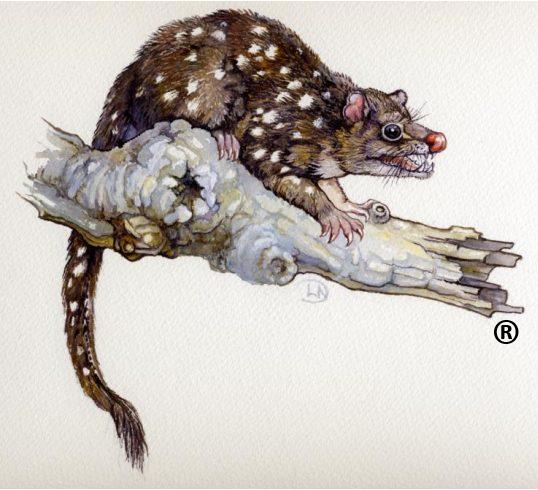
Tiger Quoll (Dasyurus maculatus)

Trapped on Pulpit Hill, Blue Mountains in 1995,
subsequently handed over to National Parks and Wildlife Service.

.


Following the rail reaching Mount Vic in 1868, hunting was touted as a main tourist attraction.  “In 1888, the advertised local game was Scrub [Swamp] Wallabies, Rock Wallabies, Wombats, Tiger Cats [Quolls], Native Cats [Eastern Quolls], Wallaroos, Platypuses, Hares, Opossums, Lyrebirds, Satin birds [Satin Bowerbirds], Cockatoos, Parrots and others.”  The popular fur trade in the 1890s saw marsupials hunted for their skins.  Hundreds of thousands of Brush tailed Rock-wallabies were slaughtered for their skins. Pelts of platypus, sugar gliders and opossums were also prized. [Smith 1990]

The early 1900s became the ultimate watershed for Blue Mountains fauna.  Most hotels in the area maintained hunting lodges for the entertainment of their guests. In January 1902, the visiting English cricket team was treated to a shoot in Kanimbla Valley, which turned out to be the ‘last great wallaby drive.’  Shooting parties from Richmond and Windsor shot at anything and everything. [Smith 1990 citing Kinghorn 1924]

That upon the arrival of the colonists, native fauna across the Blue Mountains was observed to be in such prolific numbers; provides testament to the harmonious relationship Australian indigenous people had maintained with nature over tens over tens of thousands of years.  In hindsight, we can now see how colonist land management practices over just a hundred years, directly or indirectly had decimated native fauna populations and diversity.

A further hundred years, today Australia’s ‘lucky’ first world society has advanced well beyond its initial survival needs.  Yet inherited colonial practices die hard.  Our habitual exploitative land practices perpetuate many of the same serious threats to native fauna survival. Land clearing, in all its guises, continues to destroy habitat. Foxes and feral cats have long supplanted the quolls and wild dingos of the Blue Mountains region at the top of the food chain.  Road making across the Mountains either prevents wildlife roaming or otherwise contributes to the ‘road kill’ of many native mammals and marsupials each year.  The only ‘Wildlife Crossing’ dedicated by the RTA on the Great Western Highway is on the Boddington Hill climb where a solid concrete barrier greets wildlife crossing.

If we value the return of Blue Mountains fauna, we must get serious about preserving the integrity of its habitat, exterminating feral predators and facilitating effective wildlife corridors.  Without rich dense habitat and fauna diversity, our Blue Mountains swamps, forests and heath lands, while appearing healthy and natural from vantage points like Echo Point, will incrementally become sterile ornamental gardens.

As to the feral predators, what happened to the promises in 2004 of a strategy after the Blue Mountains Urban Fox Control Programme’s public survey?  Of the survey respondents 64% confirmed foxes as an environmental problem in the Blue Mountains mainly because of their negative impact on wildlife,  53% felt that not enough is being done or more work is needed to manage foxes in the Blue Mountains, and 82% said they would support one or more ways to control foxes.    The follow up implementation (“Active Control”) component of the strategy in May 2004 at page 4 recommended to:

  • “Protect communities of threatened species in the Management Area likely to be impacted upon by foxes.  If research indicates that populations of such species are present in the Management Area a fox control programme is to be implemented.   Actions include liaising with the Blue Mountains Threatened Species Team and using best practice procedures.
  • Supplying a list of fox control contractors to residents who want to actively control foxes on their properties and investigate the servicing of community requests for assistance through an active fox control project supported by Blue Mountains City Council.
  • Respond to community calls for fox control at high-density fox sites (eg. Blaxland tip site) with the trial of a fox control project.”

With the survey done, the fox problem confirmed and the implementation actions agreed in May 2004, the programme was then stymied. Political will faltered and local council, as the land manager responsible to effect and fund the above actions, found other priorities, downplayed the problem and rustled up a defeatist line: “the damage has been done and due to the pervasive extent of fox distribution it cannot be rectified… there is no way to prevent foxes from entering the area.”   So thus, far this costly survey and committee has achieved a zero return on investment.

So where have all the native animals gone?

Toward extinction.

– – –

by Editor, 14-Jul-06.

[This article as first published in The Colong Bulletin Issue 221, May 2007, p.7,  of The Colong Foundation for Wilderness Ltd, of which the Editor was an honorary director for two years from July 2005.


This article was previously submitted for publishing in the ‘Hut News’ of the Blue Mountains Conservation Society [BMCS].  However, it was rejected so as not to upset the ‘relevant authorities’.  Feedback from the BMCS Management Committee was:

We have to choose our battles carefully and be realistic about what we can achieve with our limited resources. Wherever possible, we prefer to approach the relevant authorities first to see if we can work with them, before going public with our concerns. Whilst we share your concern about threats to our native wildlife, we also appreciate that the control of feral animals is a complex issue. For this reason I have decided not to publish your article in Hut News. I have no objection to re-visiting the debate over fox control in the Hut News but any articles need to be factually correct and, if they are expressing an opinion as that of the BMCS, they will need to be approved by the Management Committee.”  [ ‘Hut News’ Editor, Blue Mountains Conservation Society, email 24-Jul-06.]


©The Habitat Advocate    Public Domain


Leave a Reply

You must be logged in to post a comment.

Australian National Wattle Day: 1st Sept.

August 31st, 2010

by Editor 20100831.

Australia’s Wattle Day Centenary (1910-2010)
is being celebrated on Wednesday 1 September 2010.

The Wattle flower is uniquely Australian.  It is a plant genus ‘Acacia‘ native to Australia.  That it is natural to Australia has made it ideal as a recognised and universally accepted Australian symbol.  The ‘Golden Wattle‘ (Acacia pycnantha) in particular is Australia’s Floral Emblem and is an integral part of the Australian Coat of Arms.

‘The first known use of wattle as a meaningful emblem in the Australian colonies dates back to the early days of Tasmania (1838), when the wearing of silver wattle sprigs was encouraged on the occasion of an anniversary celebration of the seventeenth century European discovery of the island.’      [Wattle Day Association]


Australian Coat of Arms

‘The first granting of armorial bearings to the Commonwealth of Australia was made in 1908. A new design was granted by Royal Warrant on 19 September 1912. The branches of wattle used as an ornamental accessory to the shield, representing the badges of the six States as they were in 1912, were not mentioned in the blazon, but were depicted in the coloured illustration included in the gazettal of the Australian armorial bearings. The wattle depicted has clusters of spherical flowerheads coloured yellow and blue-grey, and green phyllodes characteristic of many species of Acacia. It is not a botanically accurate representation of Acacia pycnantha ( ‘Golden Wattle’).


Order of Australia

The Order of Australia is part of the Australian system of honours and awards formally recognising achievement or meritorious service to the Australian nation.  The designs of the insignia of the Order are based on an individual ball of wattle flowers. The insignia are convex golden discs adorned with beads and radiating lines, and surmounted by an enamelled crown, signifying the traditional role of the Queen as Sovereign Head of the Order.  Blue ribbons decorated with golden wattle motifs complete the insignia in which the colours that predominate, blue and gold, represent the sea which surrounds Australia and the colour of the popularly accepted national flower. The blue and gold wreath surmounting the shield in the armorial bearings of Australia is described in the blazon, ‘for the Crest On a Wreath Or and Azure. . .’

Australians representing their country in international sporting events usually wear the national colours, green and gold, said to be based on wattle foliage and flowers.


Australian Patriotism

‘In the spirit of national and patriotic fervour generated by the approach of Federation, achieved in 1901, public interest in the Australian environment was awakened and the search for a national identity brought the desire for national symbols.

‘Archibald Campbell founded a Wattle Club in Victoria in 1899 to promote a Wattle Day demonstration every September to encourage recognition of the flower as a symbol of patriotism. In 1908 he delivered a lecture entitled ‘Wattle Time; or Yellow-haired September’ in which he stated that ‘by numbers, the Wattle is almost exclusively Australian, and should undoubtedly be our National Flower’. Interest in a national Wattle Day was revived in Sydney in 1909. Victoria and South Australia participated in 1910, and Queensland in 1912.

‘At the same time R. T. Baker, botanist and museum curator, advocated the choice of the Waratah, Telopea speciosissima as the Australian national flower. He wrote:

    “The expression ‘the land of the Waratah’, applies to Australia and no other; it is Australia’s very own. In the Wattle, Australia has not a monopoly like the Waratah, for Africa has over one hundred native wattles, and it also occurs in America, East and West Indies and the Islands. Then again it is not too much to say that throughout the whole botanical world the Waratah is probably unsurpassed as a flower for decorative purposes, and it is impossible to so conventionalise it out of recognition a great feature in a national flower.”

‘In 1911 the Evening News in South Australia reported indignant local reaction to a report ‘that South Africa has commandeered the yellow flower (wattle), and proposes to use it for patriotic purposes’ and supported the choice of the Waratah as the Australian national flower, noting its tangible features of strength, beauty and colour and its symbolic qualities of health, firmness, endurance and independence.

‘The adoption of wattle as the national flower tends to be confirmed by its introduction into the design of the Australian armorial bearings on the recommendation of the Rt Hon. Andrew Fisher, Prime Minister of Australia, when the Commonwealth Armorial Ensigns and Supporters were granted by Royal Warrant on 19 September 1912.’

The conflict which existed about the choice of the Australian national flower is seen in the inclusion of both waratah and wattle flowers as decoration on the three golden trowels used by the Governor General, Lord Denman, the Prime Minister, the Rt Hon. Andrew Fisher and the Minister for Home Affairs, the Hon. King O’Malley, for the laying of foundation stones of the commencement column in Canberra, the national capital, on 12 March 1913.
 
[Source:  Australian National Botanic Gardens, ^http://www.anbg.gov.au/emblems/aust.emblem.html ]


Australians in the Great War  [1914-1918]


“During World War I, various gum leaves and golden wattle were often enclosed with letters to me on service, as reminders of things they loved at home. There comes to mind the story that the arrival of one such mail caused an offensive to occur in France, with the same dried gum leaves stirring some men from the bush to burn some, to enjoy the smell of burning gum trees. One became so excited with memories, that he discharged his rifle in glee, unfortunately Fritz was not to know that and some replied with rifle fire which induced machine guns to join in and so it spread until artillery of both sides were engaged.”

Alban Pierce – Extract from a personal letter

‘Wattle Day and wattle blossom took on a new emphasis during World War I. Light-hearted celebrations and carefree gatherings were replaced by serious fundraising and a depth of patriotism never before experienced among Australians.

The New South Wales Wattle League put all its energies into helping the war effort. Together with the Red Cross and Patriotic Fund, they combined forces to raise as much money as possible by selling sprigs of wattle on the streets of Sydney. Depots were established in various parts of the city to receive wattle sent by country supporters.’

[Source:  http://wattleday.com/greatwar.php ]


National Wattle Day – why do we celebrate?

  • ‘Wattle is our national floral emblem. It is a symbol that comes directly from our land;
  • ‘Wattle is Australian and rerpesents us all. Unlike other national days, National Wattle Day excludes no one;
  • ‘Like our people, wattle has great diversity (with nearly 1.000 species) and resilience;
  • ‘Wattle welcomes in the spring and is among the first plants to regenarate after fire, reminding us of the importance of renewal as it paints our national colours across our land; and
  • ‘Wattle is a unifying symbol for all Australians. There is no other symbol that says so much about us and our land, Australia.
  • ‘Wattle is a symbol of Australia and Australians.

So join the celebration of National Wattle Day – 1 September 2010 in this, the centennial year.

Terry Fewtrell
President
Wattle Day Association

2010

[Source:  ^http://www.wattleday.asn.au/]


Victorian Bushfires 2009

‘This is the message of National Wattle Day. Wattles are usually the first pioneer plants to rise from the ashes of bushfires, using the extra nutrients to support their growth. They then provide protection for other seedlings growing underneath in a natural succession of the bush.’

‘This year we suffered the tragedy of the worst bushfires experienced in our land. Many Victorians lost their lives, their property, everything they owned. Australians all over the continent rallied to their aid, donating money and goods in an unprecedented appeal. The victims are now putting their lives back on track and planning their recovery. This resilience is a characteristic of the Australian way of life. Australians have always shown a determination to succeed and rise above any disasters, showing the spirit that has made us a great nation.’

[Source: http://wattleday.com/ ]
Golden Wattle (Acacia pycnantha Benth.)
©Mornington Peninsula Youth Enterprises
http://www.mpye.org.au/plants.htm

National Wattle Day – ‘It’s an honour’


Further Information:

Australian Government http://www.itsanhonour.gov.au/symbols/flora.cfm
 
Australians in The Great War 1914-1918 http://wattleday.com/greatwar.php
Wattle Day http://www.worldwidewattle.com/infogallery/symbolic/wattleday.php
Proclamation http://www.anbg.gov.au/emblems/wattle.day.gaz.html
Wattle Day Association http://www.wattleday.asn.au/about-wattle-day-1
Australian National Botanic Gardens http://www.anbg.gov.au/emblems/aust.emblem.html
Australia’s Wattle Day http://www.aph.gov.au/library/pubs/cib/1995-96/96cib1.htm
Nationalising Nature: Wattle Days in Australia http://www.api-network.com/jas/pdf/libby_robin.pdf
Wattle Day Research http://wattleday.com/research.php
Wattle Days from Adam Lindsay Gordon to Ginger Mick http://www.nla.gov.au/pub/nlanews/2007/aug07/story-1.pdf
Wattle Nationalism http://www.nla.gov.au/pub/nlanews/2008/jan08/story-1.pdf
National Symbols – Australia’s national floral emblem and national colours www.australiaday.org.au/toolkit/page173.asp
The Genus Acacia http://www.anbg.gov.au/acacia/index.html
Article: Introduction to Acacia http://plantnet.rbgsyd.nsw.gov.au/WattleWeb/intro.php
Article: The name Acacia retained for Australian species http://www.anbg.gov.au/cpbr/taxonomy/acacia-conserved-2004.html
The Acacia Page Association of Societies for Growing Australian Plants (ASGAP) http://asgap.org.au/acacia.html
World Wide Wattle – conservation, utilization and enjoyment of Australian Acacia species (Wattles) http://www.worldwidewattle.com/
Traditional uses of Australian acacias http://www.worldwidewattle.com/infogallery/utilisation/aboriginal.php
Article: If You Start Sneezing don’t Blame the Acacias http://asgap.org.au/APOL2007/jan07-s3.html
Aussie-Info http://www.aussie-info.com/identity/flora/wattle.php

© The Habitat Advocate    Public Domain


Leave a Reply

You must be logged in to post a comment.

World’s Most Endangered Trees

August 28th, 2010

by Editor 20100828.

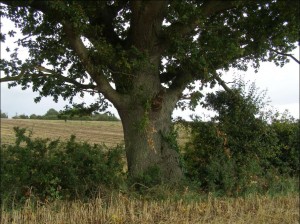
Sherwood Forest

‘Major Oak’


‘Yes, that Sherwood Forest. What was once a thick and dark mass of trees covering 100,000 acres (~20km x 20km) is now a spartan450 acres. Intense harvesting of the forest’s massive, ancient oaks for several centuries is the cause of the deforestation of this legendary woodland. Outcrops of Sherwood’s trees exist beyond the 450 acres but are not dense enough to be considered intact forest.’

[Source:  WebEcoist.com   ^http://webecoist.com/2008/09/13/20-unusual-threatened-forests-around-the-world/]

Canada’s Red Mulberry – at risk of extinction

The Red mulberry (Morus rubra) is one of Canada’s most endangered tree species and is only found in the Carolinian forest zone of southern Ontario. Red mulberry is typically an understorey species found in moist, forested habitats, including floodplains, bottomlands, sand pits and slopes. Because of its declining numbers (there are less than 200 red mulberry trees remaining in Canada) and because of the presence of several threats to its existence, the Committee on the Status of Endangered Wildlife in Canada (COSEWIC) has designated the red mulberry as “endangered” in Canada.’


[Source: Natural Resources Canada,  ^http://cfs.nrcan.gc.ca/factsheets/mulberry ]

Florida’s  Torreya Tree – most at risk on the planet!

Florida torreya (Torreya taxifolia)
©Calvin & Judy Seaman
^http://www.dfr.state.nc.us/urban/tree_detail.asp?Tree_ID=210


According to the website Hubpages.com‘ the tree the Florida Torreya (Torreya taxifolia) is the most endangered tree species in the wild in the world, and the other most at risk endangered trees around the world are:

  • African Ash
  • African cherry
  • African mahogany
  • African Teak
  • Afzella
  • Aja
  • Ajo
  • Alcerce
  • Almaciga
  • Argarwood
  • Bintangor
  • Brazilian cherry
  • Brazilian rosewood a.k.a.Dalbergia Nigra, Jacaranda da Bahia
  • Bleedwood tree
  • Ceylon satinwood
  • Egba
  • Guatemalan fir
  • Honduras mahogany
  • Ipe
  • Kauri
  • King William Pine
  • Lauan
  • Meranti
  • Molave
  • New Guinea walnut
  • Nayotah
  • Parana pine
  • Parlatorei
  • Pau rosa a.ka. Pau Brasil
  • Pencil cedar
  • Ramin
  • Red sandalwood
  • Rosewood
  • Sajo
  • Spanish cedar
  • Teak
  • Utile
  • Walnut
  • West Indian Satinwood
  • [Source:  ^http://hubpages.com/hub/Endangered-Trees ]

    UNEP Official List of Endangered Tree Species:

    According to the United Nations Environment Programme [UNEP], the world’s officially top twelve species of endangered trees are:

    African Blackwood, which is also known as Mpingo in Swahili is considered to be the national tree of Tanzania, despite the fact that it is native to 26 African countries, ranging from northern Ethiopia, to the south in Angola, also spreading from Senegal across to Tanzania.

    Mpingo not only improves soil fertility, but is also good at maintaining soil stability. Its leaves offer feed for migrating herbivores and for domestic livestock. The mature African Blackwood trees are capable of surviving fires that destroy other vegetation in grasslands. The dark heartwood of Mpingo, is one of the most economically valuable timbers in the world.

    Bois dentelle is a beautiful tree, endemic to the high cloud forest of Mauritius. Despite the fact that it has no commercial value, only two individuals are left. The most remarkable thing about the species are the flowers – sprays of white bell flowers with fine lacy petals that cover the tree in summer (January -March).

    The Clanwilliam cedar is a species endemic to the Cederberg Mountains in the Western Cape Province of South Africa. A majestic tree of 6-18 meters in height, the Clanwilliam cedar is a rot-resistant, fragrant and visually beautiful timber that was extensively exploited for building, furniture and later on telegraph poles by European settlers in the eighteenth century.

    The Dragon Tree is found on the Canary Islands, Cape Verde Islands, Madeira and Morocco. The Guanche people of the Canary Islands used the sap for mummification purposes. In Ancient Rome, Sangre de Drago (Dragon Tree) was used as a colorant and across Europe it has been used as a varnish for iron tools.

    According to the Greek myth, “The Eleventh Labor of Hercules: The Apples of the Hespérides”, the hundred-headed dragon, Landon, who was said to have been the guardian of the Garden of the Hespérides, was killed by either Hercules or Atlas in order to fulfill Hercules’ task to bring back three golden apples from the garden. As told in the myth, the trees known as ‘Dragon Trees’ sprung from Landon’s red blood, which flowed out upon the land.

    The species is classified as being “Endangered” by Cape Verde, while it is identified as being extinct in the wild on Brava and Santiago where only planted specimens exist today.


    The Honduras rosewood is found in Belize in Central America and produces timber, which is extremely valued on the world market because of its use in musical instrument production.

    Since the Honduras Rosewood supplies hard, heavy, durable and very resonant timber, when struck, it gives off a clear, loud note and making it itself most highly valued in the production of orchestral xylophones and claves. It is also used to make thin covering for fine furniture and cabinets, , knife handles etc.


    The Loulu is a palm endemic to the northernmost of the Hawaiian Islands chain with the most variety of plant species of any island in Hawaii. There are fewer than 300 individuals of the Loulu left, because of limited regeneration caused by seed predation by rats and pigs as well as competing plants.


    The Monkey Puzzle is the National Tree of Chile. Nevertheless, there is at least of these trees in every botanical garden in Europe. Its local name is Pehuén and its existence has great historical and social importance to the people living in that area known as the Pehuenche, which means “people of Pehuén”. The seeds of the tree shape an important part of their diet.

    The Monkey puzzle is also valued for its unique and natural beauty, which makes it an emblem of a national parks and provinces in both Chile and Argentina. The timber found from the Pehuén has a high mechanical resistance and moderate resistance to fungal decay, hence for its being used for beams in buildings, bridges, roofs, furniture, boat structures, thin covering etc. Monkey puzzle forests have been fast destroyed and degraded due to logging, fire and grazing.


    Nubian Dragon Tree is found in Djibouti, Saudi Arabia, Somalia, Sudan, and Uganda and was once a widespread and abundant species.

    It is one of the few species that can survive wide periods of drought in all parts of its scope, hence making it an important part of the desert ecosystem. The mature fruits of the Nubian Dragon tree are eaten and its sap and fruit may also have medicinal properties.


    Pau brasil is the national tree of Brazil, making it have strong cultural links to Brazil’s social and economic history. The species is known for the dye extract taken from the heartwood, for which it has been exploited since 1501. Presently, the dye extract and its bark are used locally for medicinal purposes. Research is being carried out to find out whether the bark of this tree can be used as a cure for cancer.

    Pau brasil wood is hard and compact, which is almost indestructible and was traditionally used to make hunting tools; commercially, it was harvested for use as a construction timber and in craftwork. It is also highly valued by musical instrument makers and still being exported for the production of bows for stringed instruments.

    The various uses acquired from the Pau Brasil have made it target to extensive collection and export of the dyewood, resulting in the loss of large areas of forest and the enslavement of local people and later on the demand for its timber by bow manufacturers has contributed to a great loss.


    Quercus hintonii, also known as Encino of Hinton (Hinton’s Oak), is endemic to Mexico. Some of the wood’s uses range from locally made tool handles, to beams and fencing poles, and primarily for firewood. Traditionally the wood is used to bake bread known as “las finas”, which the distinctive taste is brought on by the smoke.

    The species has also been highly affected by grazing, which prevents regeneration as well as the coming up of agriculture, coffee plantation and road construction have all contributed to the decline in the Quercus hintonii populations.

    “Hinton’s Oak, Quercus hintonii, is listed as Critically Endangered on the IUCN’s Red List of Threatened Species™. It is found in sub-montane to montane dry forest in Mexico. Hinton’s Oak has a restricted habitat and is thought to have strict altitudinal requirements. It has become threatened in recent years due to the serious destruction and reduction in size of its habitat.”

    [Source:  IUCN, ^http://www.iucnredlist.org/sotdfiles/quercus-hintonii.pdf


    St Helena gumwood was selected as St. Helena’s national tree in 1977. The endemic floras of St Helena are not only of great biogeographical significance, but they are also home for equally rare and unusual animal species. The St. Helena gumwood is one of the fourteen most globally endangered and endemic tree species in St Helena. It is threatened by human presence and their use of the timber for firewood and building.


    The Wollemi pine belongs to the ancient Araucariaceae species, thought to be over 200 million years old. Until 1994, the Wollemi pine was believed to have become extinct about 2 million years ago, but it was rediscovered in a gorge 150 km north-west of Sydney, Australia. There are less than 100 mature trees in the wild, making it one of the rarest species in the world. Because of this rarity, the Wollemi attracts a lot of tourism, which threatens its existence because of the therefore threatened by tourism, for it may be disturbed by human activities, also exposing it to seeds being trampled, compaction of the soil, the introduction of weeds and an increase in the possibility of fires.

    Wollemi Pine (Wollemia nobilis),
    © J.Plaza RBG Sydney

    [Source:  UNEP, ^http://www.unep.org/documents.multilingual/default.asp?documentid=445&articleid=4845&l=en, accessed 28-Aug-10.]


    IUCN categorisation of tree species at risk of extinction:

    The International  Union for Conservation of Nature [^IUCN] ‘criterion A’ requires that a subject tree species has a small wild population – less than 5000 individual specimens exist in the wild on Earth.

    • A tree species will be determined to be Critically Endangered (of extinction) if there is expected to be at least 80 %  decline in 10 years or 3 generations
    • A tree species will be determined to be Endangered (of extinction) if there is expected to beat least 50 % decline in 10 years or 3 generations (Endangered)
    • A tree species will be determined to be Vulnerable (of extinction) if there is expected to beat least 20 % decline in 10 years or 3 generations.

    [Source:  ^http://www.cites.org/eng/prog/criteria/1st_meeting/trees.shtml]


    Further Information:

    [1]  Global Trees Campaign  ^ http://www.globaltrees.org/

    [2]  Fauna & Flora International ^http://www.fauna-flora.org/

    [3]  Botanical Gardens Conservation International ^http://www.bgci.org/

    [4]  Guide to Endangered Trees ^http://ran.org/content/guide-endangered-trees-0

    [5]  Trees for Life  ^http://www.treesforlife.org.uk/index.html

    [6]  Tree species evaluation using the new CITES* listing criteria ^http://www.cites.org/eng/prog/criteria/1st_meeting/trees.shtml

    [7] WebEcoist ^http://webecoist.com/2008/09/13/20-unusual-threatened-forests-around-the-world/

    [8]  BBC article ‘Sherwood Forest ‘is under threat‘,5-Oct-07, ^http://news.bbc.co.uk/2/hi/uk_news/england/nottinghamshire/7029493.stm

    [9]  1000 year old Major Oak, Sherwood Forest, Nottinghamshire, England  ^http://www.eyemead.com/majoroak.htm

    [10]  The Tree Council (UK),  ^http://www.treecouncil.org.uk/

    [11] The Tree Council (Ireland), ^http://www.treecouncil.ie/

    [12]  Treasures of the Plant Kingdom, ^http://gardenwebs.net/plant.jewels.htm

    [13] WollemiPine.com  ^http://www.wollemipine.com/index.php

    [14] Kew Gardens – Science & Conservation (England),  ^http://www.kew.org/science-conservation/index.htm

    *CITES stands for the ‘Convention on International Trade and Endangered Species of Wild Fauna and Flora


    Did You Know that?

    • ‘An area of a rainforest the size of a football field is being destroyed each second.’

    • ‘The forests of Central Africa are home to more than 8,000 different species of plants.’

    • ‘More than 5,000 things are made from trees such as houses, furniture, pencils, utensils, fences, books, newspaper, movie tickets even clothing and toothpaste.’

    • ‘Three-quarters of the world’s people rely on wood as their main source of energy.’

    • ‘In Ethiopia, between 100,000 and 200,000 hectares of forest are cut down every year. Still, at least 200 million people lack enough wood to cook their food properly.’

    • ‘Destruction of forests creates numerous environmental catastrophes, including altering local rainfall patterns, accelerating soil erosion, causing the flooding of rivers, and threatening millions of species of plants, animals and insects with extinction.’

    • ‘Tropical forests cover 23 per cent of the Earth’s land surface, but they are disappearing at a rate of 4.6 million hectares a year. Asia leads losses with 2.2 million hectares a year, Latin America and the Caribbean together lose 1.9 million and Africa loses 470,000 hectares of rain forest every year.’

    • ‘About 6.1 million hectares of moist deciduous forest disappear every year, of which the largest regional share is in Latin America and the Caribbean, with 3.2 million hectares lost.’

    • ‘More than 1.8 million hectares of dry deciduous forest disappear every year, 40 per cent of which is lost in the Sudan, Paraguay, Brazil and India.’

    • ‘Annual losses of very dry forest total some 341,000 hectares. The Sudan loses 81,000 hectares of this type of forest every year, followed closely by Botswana, with 58,000 hectares.’

    • ‘Global annual deforestation for desert forest stands at an estimated 82,000 hectares, 60 per cent of which is lost in Mexico and Pakistan.’

    • ‘Hills and mountains lose about 2.5 million hectares of forest annually, 640,000 of which are lost in Brazil, 370,000 in Mexico, and 150,000 hectares in Indonesia.’

    [Source: ^UNEP website ]


    El Árbol del Tule

    (Spanish for “the Tule Tree”) is a tree located in the church grounds in the town center of Santa María del Tule in the Mexican state of Oaxaca.  It has the stoutest trunk of any tree in the world. In 2001 it was placed on a UNESCO tentative list of World Heritage Sites.  In 2005, its trunk had a circumference of 36.2 m (119 ft), equating to a diameter of 11.62 m (38.1 ft).      [Source: http://en.wikipedia.org/wiki/Árbol_del_Tule ]

    © The Habitat Advocate    Public Domain

    Leave a Reply

    You must be logged in to post a comment.

    VicForests’ policy of extinction

    August 26th, 2010

    by Editor 20100826.

    East Gippsland, Victoria April 2009:

    The senseless killing of a 500+ year old rare surviving Eucalyptus regnans
    by VicForest contractors in April 2009.
    ( Photo courtesy of Environment East Gippsland)
     

    Logging halted at iconic Bungywarr Creek (East Gippsland, Victoria, Australia)

    29 April, 2009

    ‘Today independent forests conservationists are protecting ancient forests from logging in far East Gippsland.

    “Two protestors are ‘flying’ a platform located thirty metres up in the tree canopy”, says spokesperson for the group, Ms Lauren Caulfield. “This platform is cabled off to four logging machines, immobilizing them.”

    The tree-top protestors are supported by twenty-five forests conservationists on the site.

    Bungywarr Creek was first blockaded in 1994, and has remained a contentious logging site ever since.

    “Bungywarr Creek forest was identified as iconic almost two decades ago. The old-growth that remains at Bungywarr should be included in the Brumby government’s next round of forest protection”, said Ms Caulfield.

    Earlier this month it was revealed that forests like the magnificent stands along Bungywarr Creek are sold to export woodchipping companies for less than the price of a Mars bar – a mere $2.50 per tonne.

    “Selling our valuable and carbon-rich native forests for the price of a fast food snack is not making the best financial returns to Victorians”, said Ms Caulfield.

    “For VicForests to continue to woodchip the remaining 8% of Victoria’s old-growth forests under Mr Brumby’s watch is a disgrace. Victorians expect and deserve management of our forests for a truly sustainable future.”

    “Protecting nature is one of the most important ways to fight climate change”, continued Ms Caulfield. “The forest at Bungywarr Creek will do a better job fighting climate change if it is left intact and able to suck carbon dioxide out of the atmosphere.”

    “While the Brumby government dithers on delivering the ageing 2006 old-growth forest promise, logging at Bungywarr Creek is making climate change worse”, concluded Ms Caulfield.”

    [Media Release courtesy of Environment East Gippsland]
     

    © The Habitat Advocate    Public Domain

    Leave a Reply

    You must be logged in to post a comment.

    The Planet’s Critically Endangered Birds

    August 26th, 2010

    by Editor 20100826.

    Critically Endangered Birds: A Global Audit’ is a summary review by ^Birdlife International as a product of its BirdLife Preventing Extinctions Programme.  It presents the science underpinning the programme and the actions needed by other organisations, agencies and governments to complement it.

    It reports the state of the world’s Critically Endangered birds as they were in 2008, highlighting the pressures they face, and the actions needed to prevent their extinction.  The report is drawn from material developed for State of the World’s Birds, a broader report which is available for download and as an extensive searchable database at ^www.birdlife.org/sowb

    The ‘Critically Endangered Birds: A Global Audit’ report (PDF, 3.36 MB) is available by clicking the following link :

    ^Critically_Endangered_Birds_global_audit_(Birdlife_Intl_2008)


    © The Habitat Advocate    Public Domain

    Leave a Reply

    You must be logged in to post a comment.

    Bushfire Reform 01: Total Fire Cost

    August 20th, 2010

    by Editor 20100820.

    Following the devastating Grose Valley bushfires of November 2006 in New South Wales (Australia), which burnt out 14,070 hectares of high conservation bushland in and around the Greater Blue Mountains World Heritage Area, the editor (a nearby resident and witness) wrote to the head of the NSW Rural Fire Service.

    The letter raised serious concerns about bushfire management and offerred constructive recommendations and a detailed operational reform initiative.  The letter was not responded to by the Rural Fire Service.

    [Read below]

    Aftermath of the Grose Valley Bushfires, Blue Mountains, NSW (Australia)
    looking from Govett’s Leap, Blackheath.
    [Photo taken 9-Dec-2006]


    The Habitat Advocate

    PO Box 21

    KATOOMBA NSW 2780

    Wednesday, 9th January 2007

    Mr Keith Harrap

    Assistant Commissioner

    NSW Rural Fire Service

    15 Carter Street

    HOMEBUSH NSW 2127

    Dear Mr Harrap,

    Your Ref:   M07/0515

    RE: FOI Request for Operational Reports & Costs of the Grose Fire

    Thank you for your reply letter of 24-Dec-07.  I appreciate the efforts of your staff to search and to try to provide this information that I have requested about the operational reports and costs directly associated with the Grose Fire of November 2006.  I am particularly grateful for the co-operative communication provided by Justin Walsh at NSW Rural Fire Service (RFS) headquarters.

    I have some questions about the information provided in respect to the RFS recording of events and costs associated with this major fire.  I wish to also offer some observations and make recommendations that I will appreciate you taking on board by way of ongoing quality improvements to fire management policy and practices.  In this regard, I have had some brief communication with the local Superintendent District Manager of the RFS in the district where I live (the Blue Mountains), Mal Cronstedt.

    Mal Cronstedt as you will be aware, was the Incident Controller of the Grose Fire.  As courtesy I shall send him a copy of this letter as well as the information you have provided me.  I will also appreciate you passing on a copy of this letter to the NSW RFS Commissioner, Mr Shane Fitzsimmons and advise that I will also welcome his feedback.

    Fire Incident Recording

    I am surprised by your reply that the RFS does not have any record or minutes of the operational meeting immediately following the Grose Fire.  The reported inter-agency review that took place at Katoomba on 19th December 2006 some three weeks after the fire would have included critical operational information about the Grose Fire. The accurate hands-on operational feedback from fire fighters would have proved invaluable in preparing the formal Section 44 Incident Controller’s Report into this fire.  Such operational information, feedback and assessment would be invaluable in providing increased understanding of the fire incident and fire behaviour, of resource utilisation and of management handling and decision making during the fire.

    This would support fire investigation efforts and facilitate analysis of the fire and of fire fighting performance and effectiveness.  It would be a valuable addition to the wealth of strategic and operational fire knowledge to the local fire command to help them take remedial actions to improve fire management standards and resourcing.

    However, without any operation records of this major fire incident such benefits have been lost.

    I have asked Justin Walsh at RFS headquarters to also find out if any reports or meeting minutes exist by either Fire Captains at Katoomba or Lithgow from where the fire fighting of the Grose Fire was jointly controlled.  If such information exists then I shall be applying for an additional Freedom of Information request for this.

    Given the considerable monetary cost of this fire, the extensive resources required to combat it and bring it under control, the wide media attention it attracted and the public outcry as a result of the damage to the Blue Gum Forest, it would seem inconceivable that no records, field notes or daily records exist about the fire’s progress and of decisions and actions taken by fire management.

    If so, this suggests a serious disconnect between executing fire suppression operations and monitoring those operations.  This surely would undermine performance management planning and review systems within the RFS.  It sends a message to the community that the RFS is not accountable.

    As you will be aware, under the RFS Corporate Plan 2007-2009, a key value includes ‘continuous improvement’ which it applies on page 14 to being “we pro-actively seek, develop and implement benchmarks, to measure, monitor and improve our performance.”

    RFS Key Strategy Programme 1.1.5 under this plan reads:

    “Maintain an accurate system for the recording of all fire and emergency incidents using the Fire Incident Reporting System (FIRS) by reporting all incidents to the Operations Customer Support Centre.”

    RFS Key Strategy Programme 1.1.33 under this plan reads:

    “Continuously improve the effectiveness and efficiency of the Service’s business and tactical planning by reviewing, maintaining and improving the Service Delivery Model (SDM).”


    I have concerns that this plan is not transferring into practice.

    Recommendation:


    Last month I outlined to Mal Cronstedt a recommended reform initiative ‘Compulsory Fire Event Logging’.  This reform initiative proposes to standardise and make compulsory a Bushfire Event Log for every registered fire in New South Wales.  This would seek to capture all quantitative and qualitative information about a fire. The purpose of a Fire Event Log would be to capture and consolidate all information associated with combating a fire into one document for operational analysis and future reference use.

    I look forward to Mal’s feedback on this recommended reform.

    Total Fire Cost

    The expenditure summary that you have provided seems to be an internal RFS accounting report limited to the direct recorded outlays of the RFS associated with the Grose Fire.

    However, my Freedom of Information request is for the total cost of the Grose Fire – the ‘Total Fire Cost’. By this I am referring to all expenditures and costs incurred by the RFS and all associated organisations involved directly and indirectly in fighting this fire, including asset loss valuations.  The direct and indirect costs that I expect can be attributed to the fire, would include:

    • Direct and indirect operating costs incurred by the RFS from the time of first responding to the fire through to completing mopping up operations after the fire was extinguished
    • Direct and indirect operating costs incurred by all fire fighting authorities fighting the fire including NSW Rural Fire Service (RFS) – both local and Inter-District, NSW Fire Brigades (NSWFB), Department of Environment & Conservation (NSW) – (NSW National Parks and Wildlife Service (NPWS)).
    • Direct costs incurred by organisations associated with fighting the fire such as the many interstate support agencies seconded to fight the fire, including their associated transport and accommodation costs, plus the costs of other support organisations which can directly attribute costs specifically to this fire.   Support Agencies listed in the Section 44 Report section 4.2 include the following:
    • Any direct operating costs of the fire not paid for by the RFS due to funding, subsidies or rebates provided by government agencies outside the RFS.
    • Direct expenses of related injury and accident claims of personnel directly involved in fighting the fire, including the cost of WorkCover claims, related payouts and lost time at work.
    • Economic loss valuations of property, plant and equipment damaged as a direct result of the fire.  This includes those of owners of land and infrastructure such as DECC, Blue Mountains City Council, RailCorp, Sydney Catchment Authority, Integral Energy, Telstra, the NSW Roads and Traffic Authority and private land owners, including insurance claims.
      • Ambulance Service of New South Wales
      • Blue Mountains City Council (BMCC)
      • Department of Defence, Royal Australian Air Force (RAAF)
      • Integral Energy
      • NSW Department of Community Services
      • NSW Department of Land and Water Conservation
      • NSW Department of Primary Industries
      • NSW Health
      • NSW Police Force
      • NSW State Emergency Service (SES)
      • Roads and Traffic Authority, NSW (RTA)
      • Rail Corporation New South Wales (RaiICorp)
      • Salvation Army
      • St Johns Ambulance of Australia
      • Sydney Catchment Authority (SCA)
      • Sydney Water
      • Telstra Corporation Limited

    This list is not exhaustive.

    Importantly, here I am not seeking to obtain the broader social and environmental costs, which though relevant, would understandably be more difficult to estimate and obtain.  Instead, I am merely seeking those accounting costs that can be reasonably and justifiably attributed to this fire.  Such costs must be recorded respectively by each organisation as part of Australian financial accounting practices.

    Does the RFS have access to these costs?  Does the RFS maintain a database that captures all direct and indirect costs of each major bushfire in NSW?  If not, does the RFS have any plans to start capturing Total Fire Costs of major fire or indeed to capture the Total Fire Costs of each registered fire incident during each financial year?

    Recommendation:

    I propose that the RFS should capture the Total Fire Costs for each major fire and, to be comprehensive, for all registered fire incidents to which the RFS responds.  The expertise for this task may well require the assistance of an outside audit firm.

    However, the benefit of this to the RFS and to the community will be considerable in highlighting the Total Fire Costs of fighting fires in New South Wales, which I argue we still don’t know with any reliably accuracy.  I expect that for the Grose Fire for instance, the Total Fire Cost will be a considerably larger figure than the internally recorded accounting records of the RFS of $6.1 million.

    Such record keeping will serve to greatly assist the effort of the RFS to attract increased funding to enable it to better:

    1. mitigate the risk of bushfires
    2. resource itself to better detect ignitions
    3. resource itself to better suppress bushfires.

    I understand that between 2003 and 2007 the Bushfire Co-operative Research Centre (Bushfire- CRC) with RMIT University completed a research project, which involved researching the ‘true costs of bushfires’.  It would be useful to seek the reports from this project.

    RFS Reporting of Fire Incidents

    Please advise RFS policy and practice guidelines for recording major fire incidents?  [Read recommended policy initiative below]

    Recommendation:

    As an RFS policy, that for each major fire incident declared under Section 44 of the Rural Fire Act 1997, I recommend that both an Incident Controllers Report together with the Total Fire Costs of Fire be provided by the RFS to the Minister for Emergency Services.

    I will welcome your feedback and the opportunity to participate in reforms to fire management across NSW.

    Yours sincerely,

    [the Editor]

    CC:                   Mal Cronstedt, Superintendent, District Manager, Blue Mountains


    Rural Fire Management Reform

    Recommended Reform Initiative #01

    Compulsory Fire Event Logging

    Table of Contents


    1.    Purpose of Reform Initiative

    2.    Recommended Policy

    3.    Recommended Procedures

    4.    Justifications for Reform Initiative

    5.    Benefits of Reform Initiative


    1.     Purpose of Reform Initiative

    This reform initiative proposes to standardise and make compulsory a Bushfire Event Log for every registered fire in New South Wales.

    The purpose of a Fire Event Log is to capture and consolidate all information associated with combating a fire into one document for operational and reference use.

    Typical information about a fire is to be sourced from fire management decision-making, deployment instructions, radio communications from fire-fighting crews, observations by airborne crews, current weather statistics from the Bureau of Meteorology and relevant information received from other emergency services (NSWFB, Police, Ambulance, SES, etc) associated with a subject fire.


    2.     Recommended Policy

    The Fire Control Centre of each Rural Fire District in New South Wales must establish and maintain a separate Fire Event Log of each registered fire occurring, either wholly or partially, within its Rural Fire District.

    A minimum Australian standard of vital fire information necessary for a Fire Event Log must be established and approved by the NSW Rural Fire Service Commissioner.  This standard must be reviewed annually ahead of each peak fire risk season.

    A suitable training programme in Fire Event Log Procedures must be established to enable suitable fire personnel to be trained in order to competently maintain a Fire Event Log to the minimum Australian standard.

    This policy should be integrated into the RURAL FIRE SERVICE Standard Operating Procedures once a process of consultation with all relevant personnel has been extensively undertaken across the entire breadth of the organisation.

    Once approved, a Fire Event Log Policy and Procedures should be gazetted into the Rural Fires Act (NSW), 1997 and considered similarly for each fire authority in each Australian State.


    3.     Recommended Procedures

    • The Fire Control Centre of each Rural Fire District across New South Wales must establish a new and separate Fire Event Log upon becoming first aware of any fire within its fire district.
    • A Fire Event Log must be maintained continuously throughout the duration of a fire within a Fire District until such time as the responsible Fire Control Officer (or higher RURAL FIRE SERVICE command) declares the fire extinguished within that district.
    • A Fire Event Log must be recorded using the RURAL FIRE SERVICE central computer system, with appropriate daily data back ups generated at the end of each day.
    • The Fire Control Officer for a given Rural Fire District is ultimate responsibile and accountabile for establishing and maintaining an accurate and thorough Fire Event Log for each fire in its district.  A Fire Control Officer may only delegate the task of maintaining a Fire Event Log to a qualified fire fighter holding a current endorsement in Fire Event Log Procedures.
    • The Fire Control Officer of each Rural Fire District must endeavour to capture all information about a fire in a separate Bushfire Event Log for each fire (where possible) including, but not limited to
    1. The designated name of the subject fire
    2. Date & time of the ignition
    3. Location of the ignition
    4. Cause of the ignition
    5. GIS digital map updating of the fire spread, likely path and key data
    6. Details of the initial reporting of the fire outbreak/detection details
    7. Lapse time to initial response & details of initial response action
    8. Location of fire(s) & fire behaviour updates at 15 minute intervals
    9. Local and forecast weather statistics relevant to the fire
    10. Interstate agencies seconded
    11. Daily updates on Total Area Burnt
    12. Daily updates on any lives Lost
    13. Daily updates on property lost, including number of dwellings
    14. Daily updates on area of private property & farmland burnt
    15. Daily updates on areas of mapped high conservation areas burnt
    16. Daily updates on the number of fire-fighters involved
    17. Daily updates on the number of aircraft involved
    18. Daily synopsis on the fire(s) status
    19. Executive decisions and actions taken, including incident declaration
    20. Critical issues
    21. Key operational threats & risks
    22. Fire resource needs and shortfalls
    23. Contact details and correspondence with assigned fire investigation
    24. Total duration of fire activity once extinguished
    25. Injury Summary Report
    26. Resource Usage Summary Report by contribution agency
    27. Register of Support Agency Involvement
    • When a fire takes the form of combined fires or multiple fire fronts within reasonable proximity in a geographic area, the responsible Fire Control Officer may order that a single Fire Event Log be maintained for the combined fires/multiple fire front.
    • Regular communication must be maintained between the Fire Control Centre and field brigades fighting a fire to facilitate logging fire activity to a minimum standard that allows communications at a minimum interval of 15 minutes.
    • Any communications failures or difficulties between firefighting crews (ground and airborne) and Fire Control, or any problems experienced  in maintaining a minimum 15 minute communications frequency, must be immediately reported by the Fire Control Officer, or in the case of a major fire incident, to the Incident Controller.
    • A Fire Event Log is to be deemed the official single register of a fire event, a core operational document and a legal document admissible in a court of law.
    • As an internal document, a Fire Event Log is not automatically available for public access.  The RURAL FIRE SERVICE Commissioner may at his/her discretion allow public access to such a document via a Freedom of Information Request from a member of the public.
    • The integrity and security of a Fire Event Log is paramount and is the ultimate responsibility of the Fire Control Officer assigned to a given fire.  A digital copy of Fire Event Log must be provided by a Rural Fire District branch to RURAL FIRE SERVICE Headquarters within 7 days of the fire being declared extinguished.  A secure and accessible database of Fire Event Logs is to be maintained by both the respective  Rural Fire District branch and for all fires across NSW by RURAL FIRE SERVICE Headquarters.

    4.     Justifications for Reform Initiative

    • While it is acknowledged that the author is not a member of the Rural Fire Service and so not privy to Rural Fire Service policy and procedures for recording bushfire operations, the lack of operational detail provided the Section 44 Incident Controllers Report for the Nov-06 Grose bushfire and the absence of minutes from the subsequent Inter-Agency review on 19-Dec-06, highlight shortcomings in record keeping of fire operations.
    • Perhaps much of the information reported of bushfire events is obtained from personal recollection of events from individual line personnel a considerable time after the event.   For instance, the Section 44 Report into the Grose bushfire (14-Nov-06 to 3-Dec-06) is dated 8-Feb-07, two months later.  There are obvious problems relying upon recollecting detailed events, the precise time and order of those events, the changing fire behaviour, the decisions made and actions taken and the changing conditions at the time.  The absence of a factual minute by minute event log makes it difficult to be accurate and comprehensive in reporting major bushfire incidents. In the event of a major fire, maintaining a Fire Event Log will provide a record the performance of the four ICS functions – control, operations, planning and logistics.
    • It may well be that bushfire agencies in each Australian state have their own methods and protocols for recording fire events.  It may also be that different agencies and indeed different regional branches have their own different ways of recording bushfire event data. There is likely no universal consistent standard across Australia of recording bushfire events as they occur.  Some records may be better than others.  There is a need to have a consistently high standard of record keeping for bushfire events across Australia.
    • Recent coronial inquests in Australia into bushfire deaths (Canberra Bushfire Jan 2003, Eyre Peninsula Fire Jan 2005), highlight the need for fire authorities need to have accurate records of bushfire events so that they are better able to defend their actions in court.

    5.     Benefits of Reform Initiative

    • The benefits of establishing and maintaining a Bushfire Event Log is to better enable bushfire management to achieve an accurate and comprehensive record of a fire – the events, decisions and actions and outcomes associated with each fire event.   All relevant operational data associated with a fire will be recorded in one convenient document.
    • A Bushfire Event Log will provide a reliable source document for preparing a fire incident report.  This will avoid the often difficult task of having to recall events, the order of those events, decisions made along with the fire behaviour at the time, long after a fire sometimes days or weeks later when memories have faded.
    • Recent reports and inquests have highlighted failures in fire-fighting communications, which arguably had a role in contributing to operational problems in controlling the spread, severity and impacts of fires.  Compulsorily requiring a Bushfire Event Log will require regular communication between fire-fighters and Fire Control.  This requirement will help drive the need to improve the reliability of operational communications during a bushfire event.
    • A Bushfire Event Log will provide a actual live record of the performance of the co-ordination, command and control functions of the ICS, including the operational sequence: Reaction, Reconnaissance, Appreciation, Plan, Issue of Orders and Deployment.   This log will be highly useful at a debriefing session following a fire, allowing operational problems to be better identified.  This will aid the RURAL FIRE SERVICE to increases its knowledge and understanding of rural fire fighting.
    • A Bushfire Event Log will enable bushfire management to be more transparent in reporting its operations, assisting any possible coronial investigations, for operational evaluation and improvement, analysis and to contribute firefighting practice into bushfire research.  By making fire event logging compulsory, regular information must be fed back to central command in order to achieve the minimum reporting standard.  This will drive a higher standard in strategic communications.


    © The Habitat Advocate    Public Domain

    Leave a Reply

    You must be logged in to post a comment.

    error: Content is copyright protected !!
    The Habitat Advocate