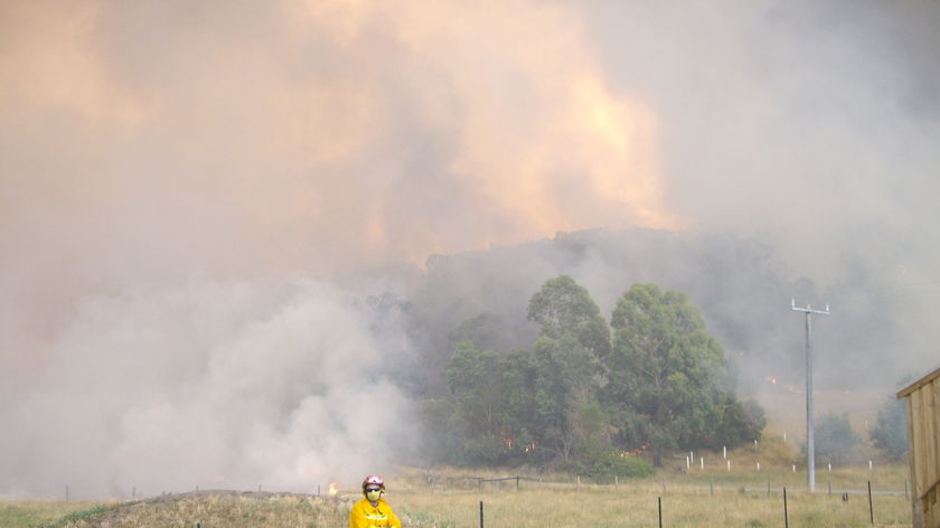
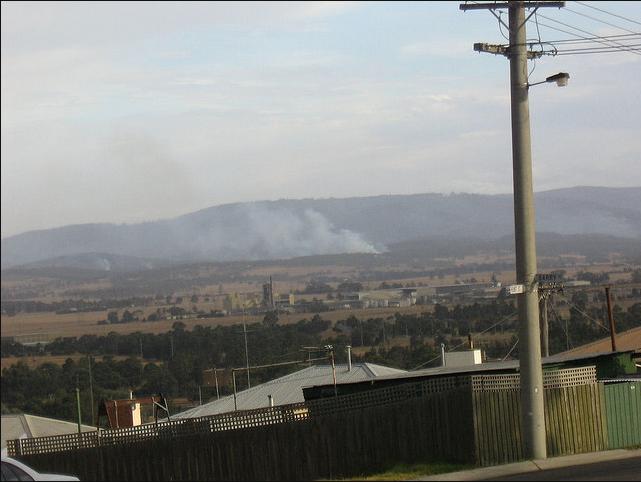
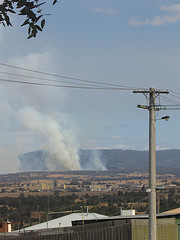
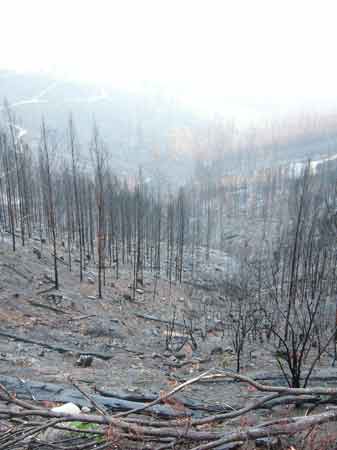
NSW National Parks and Wildlife Service setting fire to native habitat while the weather is calm. What fauna, it’s an ‘Ecological Burn’?
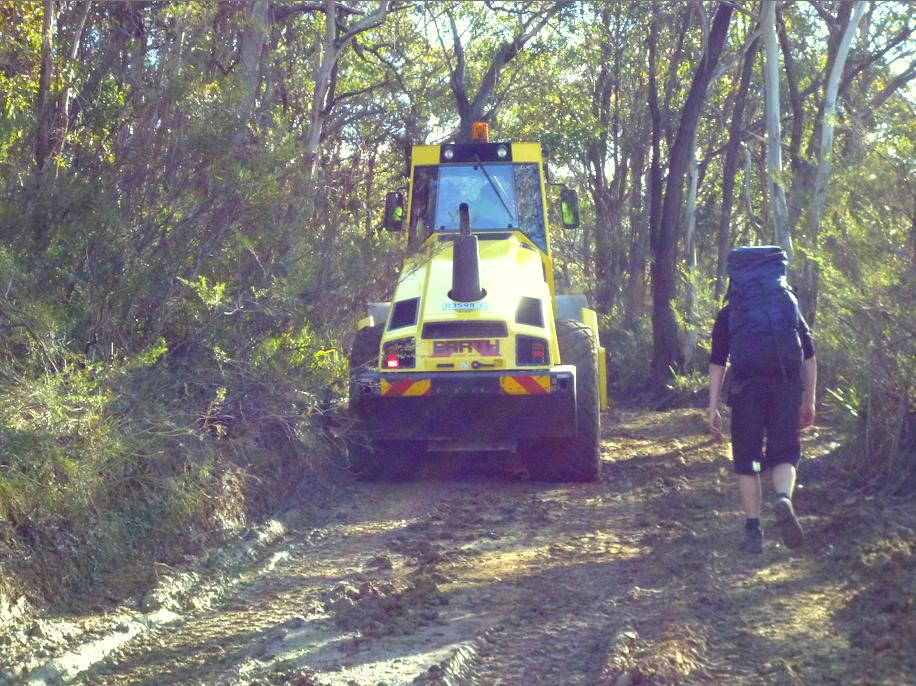
This week’s hazard reduction burn in Barrington Tops NP, north of Dungog
[Source: Photo by Andy Boleyn, ^http://newcastleonhunter.com/2012/08/npws-burning-down-the-tops/]
.
It’s that time of year across Australia, when bush arson is deemed acceptable (even noble) , so long as it is ‘prescribed‘ by government, even when it often gets out of control.
Australia’s native habitat is deliberately set fire to by Australian Government agencies every year, just in case it burns, which means that frequently they can’t put it out.
Dropping petrol bombs by immoral helicopter pilots ..”hey man, this is like Nam all over again!”
.
None of the arson rationale respects native wildlife, as with illegal bush arsonists. There is little difference on wildlife impact as to who sets fire to their habitat – illegal or government sanctioned. In the above burn, Acting NPWS Barrington Tops Area Manager Peter Beard, justifies setting fire to wildlife habitat thus:
.
“Hazard reduction burn aims to protect lives and property, whilst maintaining the biodiversity of the World Heritage-listed park.”
.
Yet it is carried out without any thought or knowledge about the ecological impacts upon ground dwelling fauna populations or upon flora species that are fire sensitive nor the complex and fragile co-existences. Where are the independent scientific wildlife counts before and after each prescribed arson sortie? Where is the qualified wildlife ecologist’s report that made public that says burning this forest is not harmful?
The fire lighting is not even mosaic. It is blanket, broadscale and indiscriminate. Aerial incendiaries are dropped along the ridge top by helicopter casuing multiple ignition points so that the fire takes hold.
Aerial ‘habitat reduction’ occurs across National Parks and World Heritage Areas – no habitat is sacrosanct. It is euphemistically branded ‘Biodiversity Burning’ – fire is good for wildlife – watch them run, watch the Echinas and Wombats burn!
.
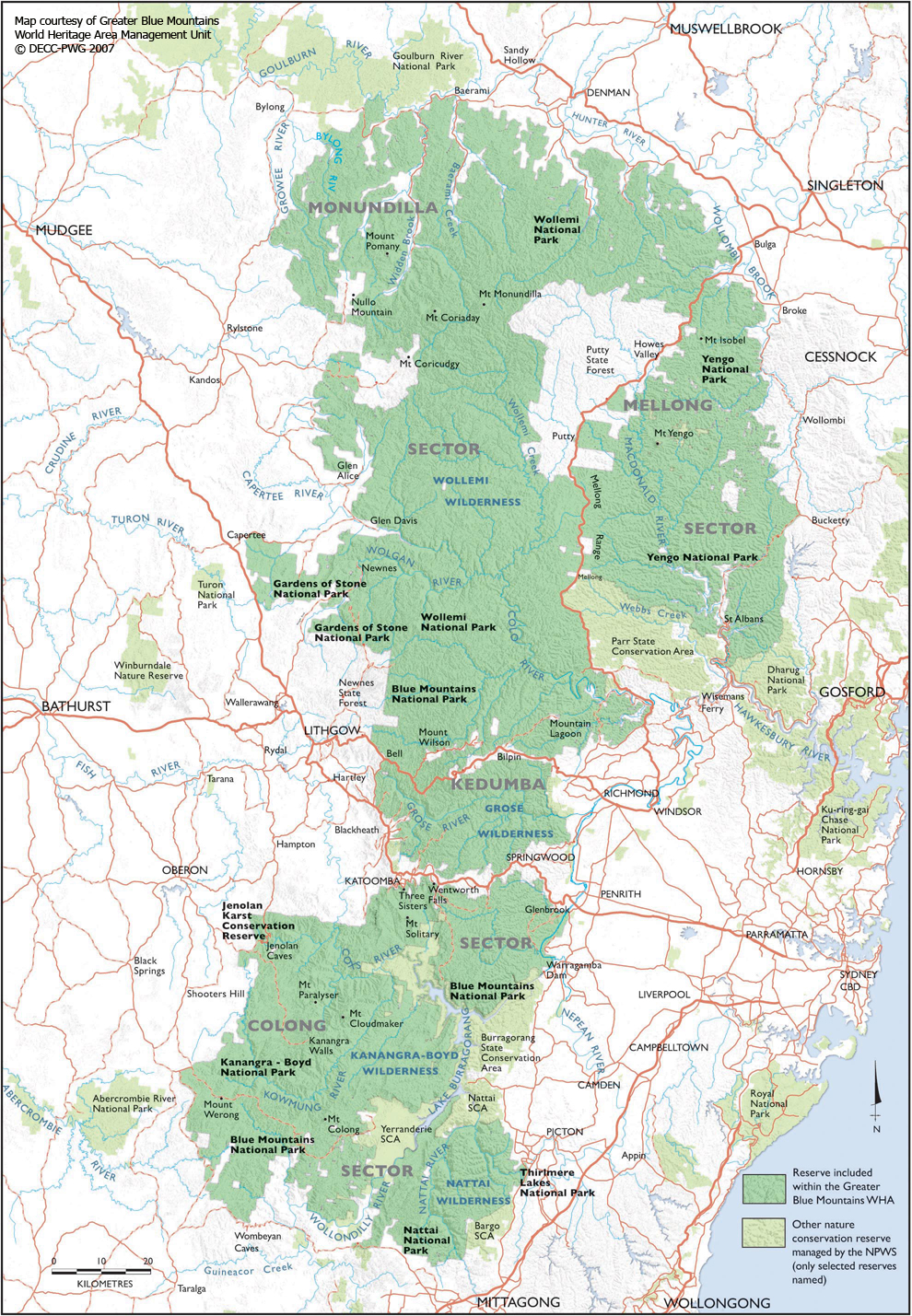
It is one of many hundred being conducted across New South Wales native landscapes by the National Parks and Wildlife Services as well as by the Rural Fires Service and with assistance from regional fire brigades. Another 25 burns covering 6000ha are planned in the next week, including burns in In Ku-ring-gai Chase National Park and the Blue Mountains World Heritage Area.
Rather through unrelenting government propaganda, all Australian native vegetation is demonised as a ‘threat‘, a ‘hazard‘ and as ‘fuel‘ – just like the Christian church has for centuries demonised non-believers as heathens.
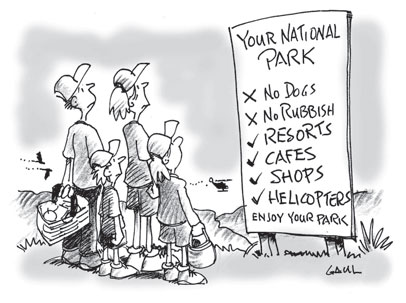
National Parks are deemed by Australian governments as a ‘hazards’!
It is a town park mentality – a bit of greenery for people to enjoy at weekends.
.
It doesn’t take much effort by a layperson to access a computer, download Google Earth and zoom into New South Wales, then to realise that the native vegetation that remains is dotted in islands within vast landscapes of denuded cleared farmland, and then to respect that if the native wildlife exist anywhere, they are in these vegetation islands.
This is Destination New South Wales..about 90% deforested, or burned, or farmed, or mined, or housed or else deserted
“There are some amazing natural attractions in New South Wales. From the coast to the country you’re spoilt for choice. All over this state you can meander at your own pace and discover a whole world of extraordinary natural wonders. With close to 900 ^NSW national parks, forests and reserves, the State features the most diverse nature experiences in Australia ranging from rainforests, marine parks, a city within a national park, outback landscapes, mountains, islands and World-heritage listed areas.”
Then for these islands of native vegetation to be deliberately set fire to can only contribue to native wildlife extinctions. It doesn’t take more than a lay person to realise this by deduction. Yet wildlife extinction is exactly what these senseless fatalistic government bush arson culls are doing every year. Setting fire to wildlife habitat is wildlife desecration, just like an invading army razing a village.
Rural fire agencies throughout Australia are no different in mindset to paid professional urban fire brigades – their mandate is to serve only to protect human life and property – but all native vegetation and wildlife is demonised as a liability and dismissed as only a risk to human life and property. The key distinction between rural fire fighters and their urban counterparts is that the urban fire fighters are paid professionals. Governments save billions by not paying rural firefighters and by not training them to the skill level of urban firefighters – yet operationally their job is exactly the same. Volunteers have been conned by governments to being cheap fingers in the dyke, so that taxes can be channelled elsewhere instead of properly into emergency management.
When there is a wildfire under extreme bushfire weather conditions, the ill-equipped, under=prepared and under-resourced bushfire agenecies know full well, that they cannot reliably detect, reach or suppress ignitions most of the time. They are depressing forced to rely upon the vagrancies of wind changes to dictate the impact of wildfires and the fate to lives and property.
So that is why government is so keen to prescribe preventative fighting fire with fire. If the bush is burned so that there is litte to burn then when a wildfire erupts in hot, dry and windy conditions the risk is less.
.
.. one has to destroy the village to save it!
.
Oddly this mindset is not allowed to apply to plantation forests – because they are deemed ‘economic assets’ and so therefor evaluable and therefore worth protecting from fire.
Of course, after every major fire involving loss of human life, such as in Victoria in 2009, all the politicians come out crying “shocking, shocking, shocking”, promising expensive enquiries, promising more resourcing, and that it will never happen again. All the while, politicians full well know that when the media cameras lose interest, it is cheap volunteer business as usual, because by the time the next wildfire, they will be happily lifestyle pensioned out – polly gold card privileges and all.
The Victorian Bushfires of 2009 that caused the deaths of 173 people were in the main caused initially by either powerline neglect and arson. The fire brigade was not prepared for a catastrophe despite the bushfire danger index forecast days before to be well off the scale. The underprepared, under-resourced Dad’s Army preparedness contributed to the 173 deaths.
Instead, all Australian and State governments have blamed the Australian wildlife habitat for being the fuel like and ‘accessory before the fact’. It was the victim.
So hazard reduction is now ramped up Australia wide. In New South Wales hazard reduction this year is the NSW Government’s response strategy, costing $62 million “to boost wildfire preparedness“. Under the NSW NPWS ‘Enhanced Bushfire Management Programme’, NPWS aims to double the number of hazard reduction hectares each year, for the next five years. NSW Environment Minister Robyn Parker said hazard reduction work is part of an ongoing State-wide operation.
If there is unburnt bush, it will be targeted for burning! Burn it before it burns, god damn! If the Rural Fire Starters had access to B52s and Agent Orange, they sure the would deploy both, such is the inculcated bushphobic mindset.
“NPWS crews are already taking advantage of favourable spring weather to carry out 12 burns covering more than 2,500 hectares of national park in the past fortnight.”
The NSW Government is doing everything it can to reduce the risk of fire, including in our national parks – particularly with a drier, hotter summer than we’ve recently experience predicted.”
Broadscale Hazard Reduction ‘So when summer comes we should be right – there’ll be nothing left to burn!’‘Job Done!‘
.
It is a wicked species-anhilating strategy that most in the broader community ignorantly accept as justified, because government propaganda threats say so and because few folk have the wisdom or courage to dare question the propaganda.
Woops, the prescribed burn got out of controlThat’s ok its only Fraser Island World Heritage – it’ll grow back!
.
Last weekend, a 12-year-old boy was charged with lighting a bushfire at Watannobi on the Central Coast around lunch time. Just like the fire fighters he must be watching and learning from, the bushfire was lit using multiple ignition points so that it took hold. Sure enough, the blaze quickly escalated. In the end some eighty hectares of native vegetation and grassland were burnt before the fire was contained in the mid afternoon.
He may be charged now, but no doubt he is recruitment material for the local Rural Fire Starters when he gets older.
But unlike the State-sanctioned arsonists, the boy was publicly apologetic for what he had done, realising that it was wrong. To his credit he said:
.
“I’m sorry for what I have done .. and I won’t do it again.”
Government-sanctioned arsonists know what they are doing is wrong – but the Firie peer pressure is too great
.
Why don’t gardeners of Australian native gardens follow the National Parks biodiversity burning mantra and set fire to their gardens? Because they respect the unburnt value of Australia’s flora.
.
Why do we not see much wildlife anymore in National Parks?
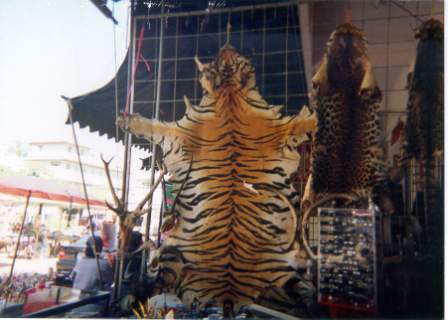
DELHI, INDIA: Tiger Range Countries meet in Delhi, India next week (May 2012) to evaluate progress of the Global Tiger Recovery Programme (GTRP) in what will be a true test of their national commitment to end the tiger trade.
The GTRP was signed into existence in November 2010 in St Petersburg, Russia, with the common objective of doubling the world’s wild tiger population by 2022.
The agenda for the Delhi meeting, from May 15-17, includes issues which to date have received too little attention in this forum – demand reduction and effective enforcement.
With final preparations for the meeting underway, the Environmental Investigation Agency (EIA) today warned that concrete action is needed to shut down tiger breeding operations and destroy their stockpiles of tiger skins and bones if the GTRP is to retain serious credibility.
EIA lead campaigner Debbie Banks said: “Successful demand reduction will be dependent on the closure of operations that breed tigers for trade in their parts and derivatives, and those that provide the living specimens to stock such operations.”
Operations in Thailand, Laos and Vietnam have been implicated in the illegal international trade; in China, breeders are allowed to sell farmed tiger skins on the domestic market.
“This trade simply serves to perpetuate demand, undermining enforcement efforts and sending mixed messages to consumers,” added Banks.
Tiger Farming was hotly debated in 2007 at the 14th Meeting of the Conference of Parties to the UN Convention on International Trade in Endangered Species (CITES), where the majority of Parties voted against domestic and international trade in parts of farmed tigers and called for a phasing out of such operations.
No country has yet reported on what action is being taken to fulfil the CITES decision.
While there have been recent high profile seizures and arrests in Thailand, and Vietnam has prosecuted at least one tiger farm owner, there is no report of action against tiger farmers in Laos; China stated in March 2011 that it had inspected tiger breeding operations, but it has not shared information on any convictions of those found selling tiger bone and products.
China also allows tiger breeding operations to maintain freezers full of tiger carcasses, instead of destroying them as urged by CITES. While tiger bone trade is currently prohibited, China has a scheme for registering, labelling and selling the skins but refuses to disclose how many skins have entered the scheme.
“How can these stockpiles possibly be justified?” asked Banks. “Maintaining stockpiles serves no conservation purpose; it only creates confusion and speculates that one day these parts may be traded for profit. That runs completely counter to a commitment to end tiger trade and totally undermines efforts at demand reduction.
“For the credibility of the GTRP, we need to see unequivocal and emphatic action to shut down all commercial tiger breeding operations and to transparently destroy the stockpiles.”
.
The Environmental Investigation Agency (EIA) is a UK-based Non Governmental Organisation and charitable trust (registered charity number 1040615) that investigates and campaigns against a wide range of environmental crimes, including illegal wildlife trade, illegal logging, hazardous waste, and trade in climate and ozone-altering chemicals.
Skin trade registration scheme. In 2007, China introduced a mechanism for registering and selling skins from ‘legal’ sources, including captive tigers. EIA has been trying to find out how many skins have been registered, sold, etc, and how legality is determined – read more at http://www.eia-international.org/enforcement-and-asian-big-cats
Auctions of tiger bone wine. In 2011, NGOs reported there was to be a sale of Tiger Bone Wine in Beijing. This was stopped by the SFA after an outcry, but EIA research shows many more sales were advertised and may have gone ahead. We urgently need clarification on these – read more at http://www.eia-international.org/tiger-bone-wine-auctions-in-china
Enforcement action. China has recently reported a number of enforcement actions on wildlife crime in general, but from the reports available it seems it has not focused efforts in the provinces EIA has highlighted as key to the tiger and Asian big cat trade. Criminals we have identified trading in Asian big cat parts between 2005-09 were still operating in July 2011. China has not provided any evidence of targeted enforcement action against known criminals and trade hotspots.
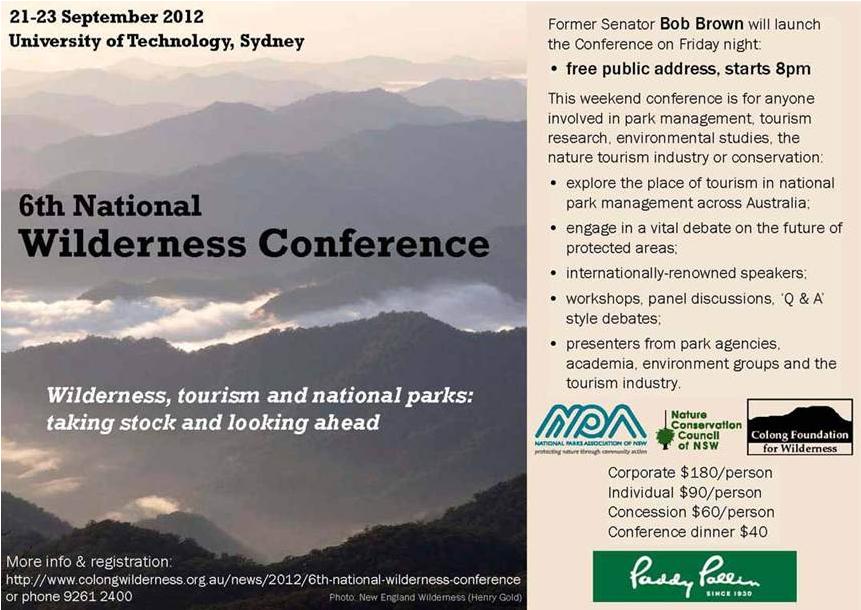
Does wilderness still matter? Or is it just a nostalgic and overblown idea from the 1960s that has worn out its usefulness?
Unsurprisingly, the Colong Foundation for Wilderness vigorously asserts that wilderness is more important than ever. As the global environment plummets into crisis, ‘business as usual’ is rushing ever more recklessly in the opposite direction, chasing the almighty dollar. Our parks, reserves and natural areas are everywhere imperilled, by climate change, mining, tourism and many other threats. Wilderness remains a sanctuary and an insurance against the complete exploitation of nature.
Which is why the Colong Foundation has taken up the baton again for the Sixth National Wilderness Conference, established by Geoff Mosley and the Australian Conservation Foundation in 1977. The 5th and most recent conference, Celebrating Wilderness, was hosted by the Colong Foundation in 2006.
.
6th National Wilderness Conference
.
The 6th National Wilderness Conference will be held in Sydney on 21-23 September 2012 and co-presented by the NSW National Parks Association and the Nature Conservation Council of NSW.
With environmental protection laws under attack in all states and nationally, this conference comes at a critical time. So if you haven’t signed up for this conference yet, now’s the time. And don’t forget the Conference dinner, $40 for three beautiful courses at Maynard’s Café, Newtown.
‘National Parks’ in Australia are merely State Parks They exist at the whim of State politicians
.
In Australia, ‘National Parks‘ are a misnomer.
National Parks across Australia are not protected, conserved and managed by the Australian Government at national level, as the name would suggest. Instead, the custodial responsibility is delegated to the respective States.
National parks in each Australian State, such as in New South Wales, or Queensland or Tasmania, are protected, conserved and managed under that State’s national parks legislation, not under national legislation. So in Australia, the term ‘National Park‘ is quite misleading. Australians presume that our national parks are nationally protected, but they are not.
The respective ‘National Parks and Wildlife Services‘ are similarly also a misnomer. Each State and Territory has its own separate National Parks and Wildlife Service. In New South Wales (NSW), ‘national parks’ are managed by the NSW National Parks and Wildlife Service. In Tasmania, the State-controlled Parks and Wildlife Service manages national parks only in Tasmania.
In Victoria, the State-based agency is called Parks Victoria, which manages national parks in Victoria under Victorian legislation – the Parks Victoria Act 1998 and reports to the Victorian Minister for Environment and Climate Change. While in Queensland, the Queensland Parks and Wildlife Service comes under the Department of National Parks, Recreation, Sport and Racing.
When a government lumps national parks with racing, it regards the values of natural heritage in anthropocentric exploitative terms.
.
Neglectful Underfunding
.
Worse is that the delegated State Government custodians are invariably so short of funding, that critical funding to properly protect, control and manage national parks is not provided. The Australian Government knows this, yet withholds vital funding so that the primary duties of protecting and conserving national parks can be fundamentally fulfilled.
State Governments select other funding priorities according to election cycles. In the 2012-13 budget year, the NSW Government has cut $55 million in recurrent funding and $22 million in capital expenditure budget in its management of national parks and to help protect native fauna. [Source: ‘NSW environment suffers $77m budget cut’, Jun 12 2012, ^http://news.ninemsn.com.au/national/8482272/nsw-environment-suffers-77m-budget-cut]
In Queensland, the State Government in 2012 has not only removed one hundred jobs from the Queensland Parks and Wildlife Service, closed regional offices, and reduced the number of QPWS regions from nine to six, but plans to revoke 875,000 hectares of national parks land across the State. [Source: ‘LNP Government: Mean To Students, Tricky On National Parks’, by Annastacia Palaszczuk, 20120719, ^http://www.queenslandlabor.org/2012/07/19/lnp-government-mean-to-students-tricky-on-national-parks/]
In Victoria in 2012, more than 130 jobs have been cut from Parks Victoria and several hundred from the Department of Sustainability and Environment (DSE). [Source: ‘Jobs and courses feel Budget strain’, by Kate Dowler, Weekly Times Now, 20120509, ^http://www.weeklytimesnow.com.au/article/2012/05/09/479741_national-news.html]
Last Easter in April 2012, some state and national parks are facing industrial action by Parks Victoria rangers belonging to the Community and Public Sector Union.
‘On the surface this may appear to be a simple wage dispute, but in fact it’s just a symptom of a larger and much more serious disease. It’s no secret that Parks Victoria is suffering from chronic underfunding. Parks and reserves across Victoria are seeing the results of decades of government cut-backs. These funding cuts affect our parks and reserves in many ways. From the supply of basic amenities (such as toilet rolls), all the way to establishing and maintaining user facilities such as walking and mountain bike trails as well as creating new management and environmental plans for the future. Looking after our public spaces is, quite simply, a massive job and if it is to be done correctly it will require substantial government funding.
Many Parks Victoria rangers do an amazing job in increasingly difficult circumstances. One of my ranger friends commented that ‘productivity improvements’ was in fact government speak for ‘saving money’. [Source: ‘Parks Victoria: Death By a Thousand Cuts’, by lenn Tempest, April 6, 2012, ^http://osp.com.au/?p=3253]
.
Belittling the National Parks Status
.
Just as bad is that the role of National Parks and Wildlife Service at each State jurisdiction has become swallowed up within mega-departmental portfolios. Australia used to have dedicated ministers for environment. Environment was their sole responsibility and national parks featured as a key part of that responsibility. But over recent decades, all the state governments have seen fit to bundle the responsibility for national parks within a large range of disparate portfolio responsibilities to one government minister.
In Tasmania, national parks responsibility falls under the responsibility of the Department of Primary Industries, Parks, Water and Environment – tagged on at the end. The current minister responsible is Brian Wightman MP, who is also Minister for Environment, Parks and Heritage (a different department name) and simultaneously Minister for Justice. How much time and energy can Wightman dedicate to national parks in his working week?
In New South Wales, the NSW National Parks and Wildlife Service (NPWS) is part of the Office of Environment and Heritage (OEH), within the NSW Department of Premier and Cabinet. The delegated minister is Robyn Parker MP who is the Minister for the Environment and the Minister for Heritage. These functions are relatively compatible, yet only a few years prior under the previous government, NPWS came under the Department of Environment, Climate Change and Water, and the various ministers responsible for varying short stints, also had other unrelated yet demanding portfolios such Commerce and Health.
In Queensland, Steven Dickson MP is responsible for National Parks, Recreation, Sport and Racing. In Victoria, Parks Victoria is lumped in with the Department of Sustainability and Environment, Catchment Management Authorities, Commissioner for Environmental Sustainability, Environment Protection Authority Victoria, Landcare Victoria, Sustainability Victoria and Zoos Victoria, which all report to Ryan Smith MP is Minister for Environment and Climate Change as well as being Minister for Youth Affairs. How many minutes does Smith give Parks Victoria in a given week?
The extreme bundling of so many responsibilities with the national parks function, effectively belittles its role.
The dilution of the national parks role is compounded by the trend of the short term assignment of a given minister to the portfolio, even within the one term of government, let alone when governments change hands. And where is the ultimate guardian for Australia’s national parks in all this – wiping its hands of responsibility and accountability for Australia’s most precious ecological assets.
Further, one can think of no minister for the environment who has ever had formal training or qualifications in environmental scence, or having been a National Parks ranger. The ultimate responsibilities for environment are delegated to politicians with little or no understanding of managing the natural environment, with all its complexities. In New South Wales the current Minister for Environment and Heritage is qualified in child day care.
.
.
World Heritage managed at State Level
.
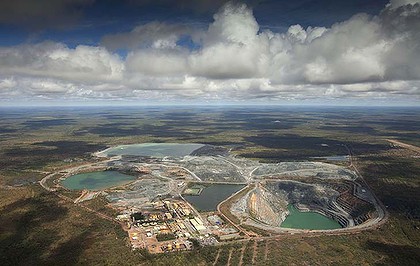
State delegation of national parks even applies to national parks in Australia that have been listed as World Heritage Areas, like the Blue Mountains National Park, Fraser Island National Park, Great Barrier Reef National Park, Kakadu National Park, and Tasmanian Wilderness. While the Australian Government has an international obligation to protect and conserve World Heritage properties, those World Heritage properties do not become Australian Commonwealth property. State and local laws still apply. The only protection afforded to World Heritage properties is that land uses must not threaten any of the outstanding universal values of the property.
World Heritage listed properties in Australia are supposed to be managed by the Australian Government under obligations that the Australian Government signs up to under the World Heritage Convention for each listed property.
The management objectives for World Heritage properties are part of Australia’s general obligations under the World Heritage Convention, which primarily includes protecting and conserving the World Heritage values of the given World Heritage property. However, the Australian Government chooses to achieve this objective by what it describes as “recognising the role of current management agencies in the protection of a property’s values” (that is by government agencies in their respective States), but also delegating custodial responsibility to the local community “in the planning and management of a World Heritage property.
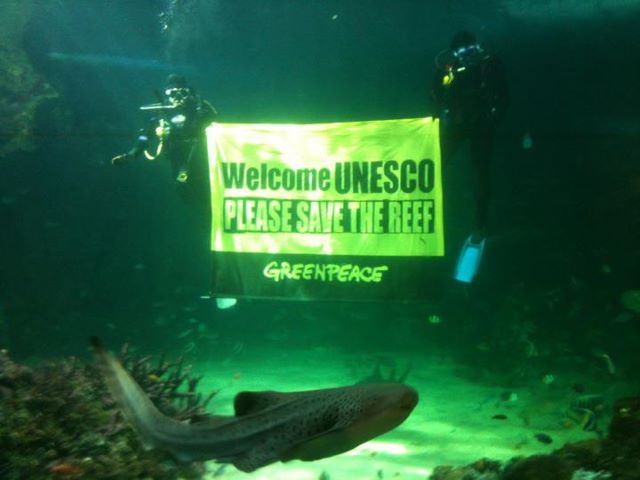
In doing so, the Australian Government wipes its hands of its signed up custodial responsibility to protect and conserve Australia’s World Heritage listed properties. This is most evident with the Queensland Government currently allowing dredging in Gladstone Harbour within the Great Barrier Reef World Heritage. It is also most evident with the Tasmanian Government allowing clearfell logging adjacent to the Tasmanian Wilderness World Heritage.
The Australian Government is also liberal with its interpretation of protecting and conserving World Heritage values by what it describes as “allowing provision for use of the property which does not have a significant impact on the World Heritage values and their integrity.”
[Source: ‘Management of Australia’s world heritage listed places’, Australian Government, Department of Environment etc (currently called the Department of Sustainability, Environment, Water, Population and Community, ^http://www.environment.gov.au/heritage/about/world/managing.html]
.
‘We have become, by the power of a glorious evolutionary accident called intelligence, the stewards of life’s continuity on earth. We did not ask for this role, but we cannot abjure it. We may not be suited to it, but here we are.’
~ Steven Jay Gould, paleontologist .
Industrialisation of the Great Barrier Reef
The dredging in Gladstone Harbour for the seam gas has been blamed by local environmentalists for the area’s poor water quality
and a skin disease affecting marine life. Green activists say dredging has adversely affected whales and dugongs in the area.
[Source: Queensland slams UNESCO, defends gas on the barrier reef
Posted on June 5, 2012, ^http://rowenadelarosayoon.wordpress.com/2012/06/]
[The following article was written by Tigerquoll and initially published under the title ‘Anthology of State Serial Rape of Bermagui’s Spotted Gum Forest Habitat‘, on ^CanDoBetter.net 20100216]
Click this image to play music then click back to this article as it plays
.
Nothing less than the Australian Government can be trusted to protect vital Koala Habitat.Lesser smaller-minded state governments only see Koala Habitat as a logging and tourism resource.Small minded politicians like Kristina Keneally can never be trusted with national treasures
.
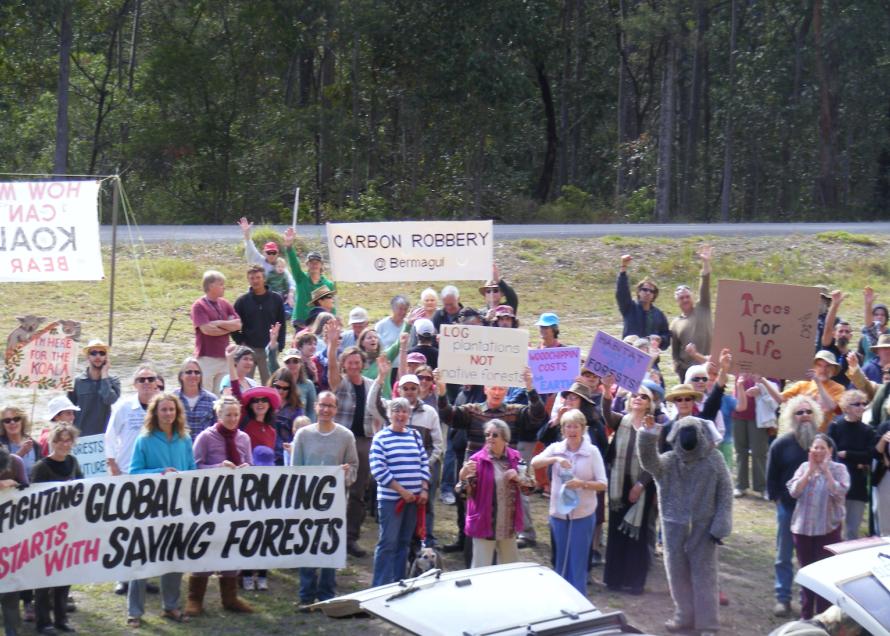
Bermagui’s Spotted Gums..the local Narooma Community in their defence against ‘Forest NSW’ (the Forest-Fiddling loggers)
.
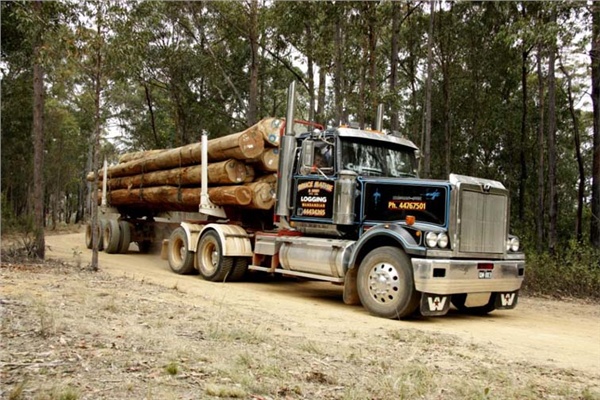
Forest-Fiddling Logger driving his Spotted Gum spoils truck
.
But Eucalyptus maculata is a tree, not a floor
.
In terms of Australia’s iconic ‘Spotted Gum’, the word “spotted” refers to the soft mottled colour caused by weathering of the outer tree as it sheds elliptical strips of bark.
Spotted Gum bark
.
This colour varies from pale greybrowns and soft creams to a rich chocolate brown. A very tough timber, its frequent wavy grain can produce an attractive and highly valued fiddleback effect. [Source: Boral website, ^http://www.boral.com.au/timberflooring/timber_species_-_spotted_gum.asp]
.
Build something great, but don’t destroy something great in the process – like Koala Spotted Gum Forests!
Invest in Boral and you invest in Koala extinction
.
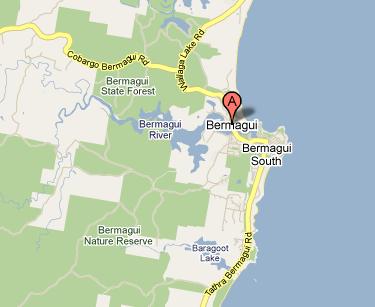
About 380km south of Sydney lies what NSW Tourism labels the beautiful ‘Sapphire Coast’ with the popular seaside town of Bermagui.
Less than 3km north of Bermagui heading north along Bermagui-Cobargo Road and up the Bermagui River estuary is the Bermagui State Forest – a label by the NSW Department of Primary Industry (DPI) given to magnificent Spotted Gum forest.
.
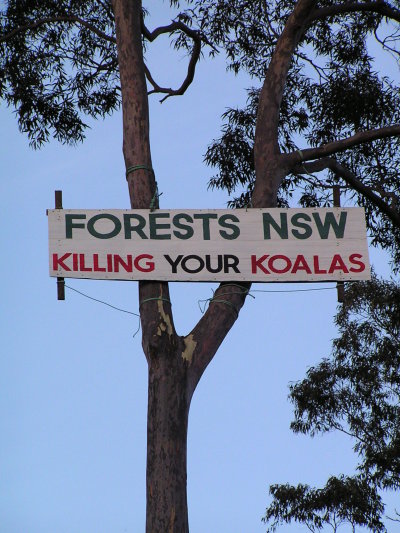
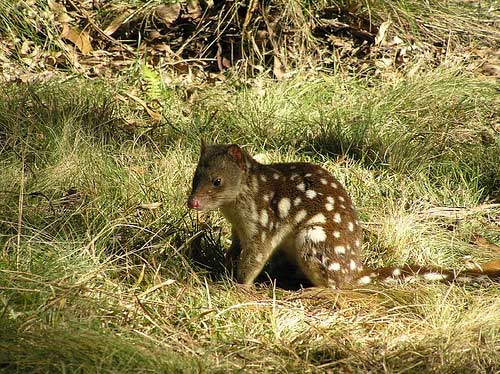
This forest is vital habitat for threatened native fauna – the Yellow Bellied Gliders, Grey-Headed Flying Foxes, Tiger Quolls, Sooty Owls, Sea Eagles, Possums and Australia’s iconic Koala.
.
Koala in Bermagui’s Spotted Gum forest – a displaced landlord
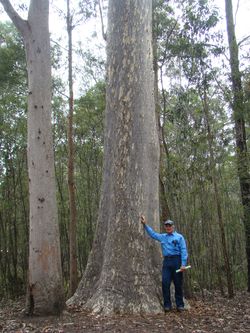
Australia’s magnificent and unique Spotted Gums are naturally distributed in open forests along the hilly coastal corridor from south-east Queensland down through New South Wales and with a few isolated pockets in East Gippsland, Victoria. They belong to the botanical family ‘Myrtaceae’ and grow straight and tall up to 40 metres. Their height attracts roosting by Sea Eagles.
Note the planet’s sole natural distribution of Spotted Gum ForestsThey have become the target of corporate development simply because Spotted Gums prefer a mild temperate climate near the coast..like Australia’s millions of breeding humans, and profiteering corporate developers
.
Spotted gums flower once every two years and produce a rich pollen that attracts native birds such as Lorikeets and Yellow Tailed Cockatoos as wells as possums and flying foxes including the IUCN vulnerable listed Grey-Headed Flying Fox. [Source: Australian Native Plants Society, Corymbia maculata, ^http://asgap.org.au/c-mac.html]
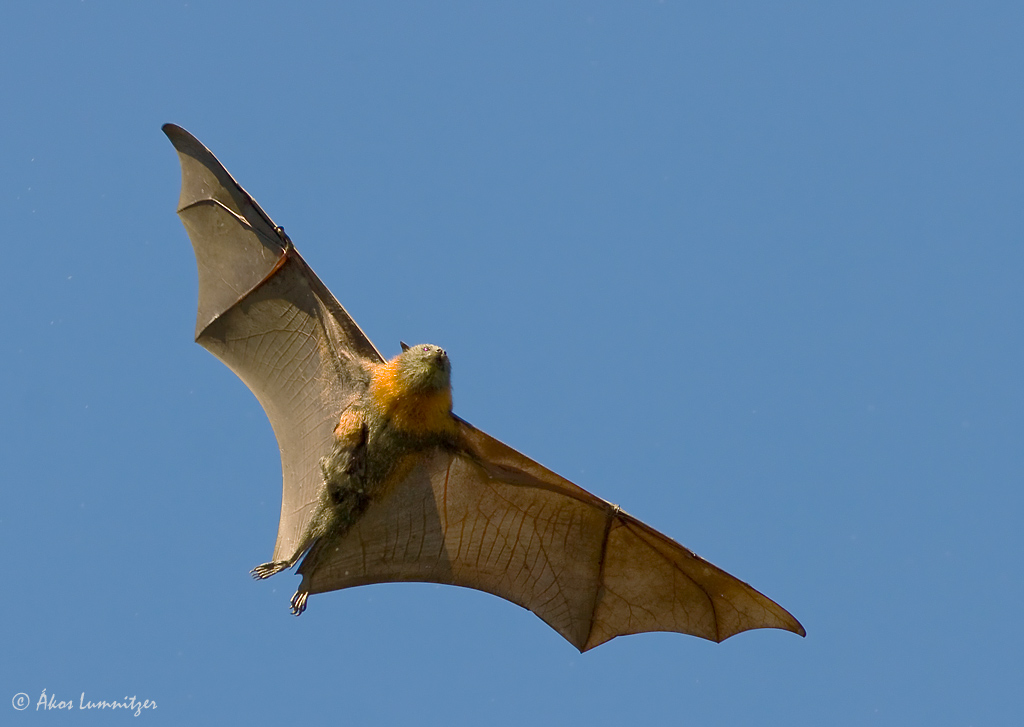
Grey-Headed Flying Fox (Pteropus poliocephalus)
The grey-headed flying-fox is listed as vulnerable to extinction under NSW and Australian legislation because of declining numbers and key threats such as habitat loss and urban conflict. Records indicate that grey-headed flying-foxes may once have numbered in the millions, but are now reduced to as few as 400,000. In the decade before listing, their population was estimated to have declined by 30%.
(Photo by Ákos Lumnitzer, ^http://amatteroflight.com/)
.
Unlike the declaration of a ‘National Park’ which affords federal environmental protection to forest habitat, the State label of a ‘State Forest’ is a misnomer. A ‘State Forest’ is deemed a timber and woodchip resource for logging. The same public relations label is used across New South Wales, ACT, Victoria, Western Australia, Tasmania and Queensland. A State Forest is not treated as a forest for its natural habitat values, but rather as a logging coup on death row, that can be chainsawed at will anytime. Perhaps ‘Death Row Forest’ is a more apt label than speaking the State euphemism of ‘State Forests’.
And its public relations label logging as ‘harvesting’, a euphemism to belie the destructive reality.
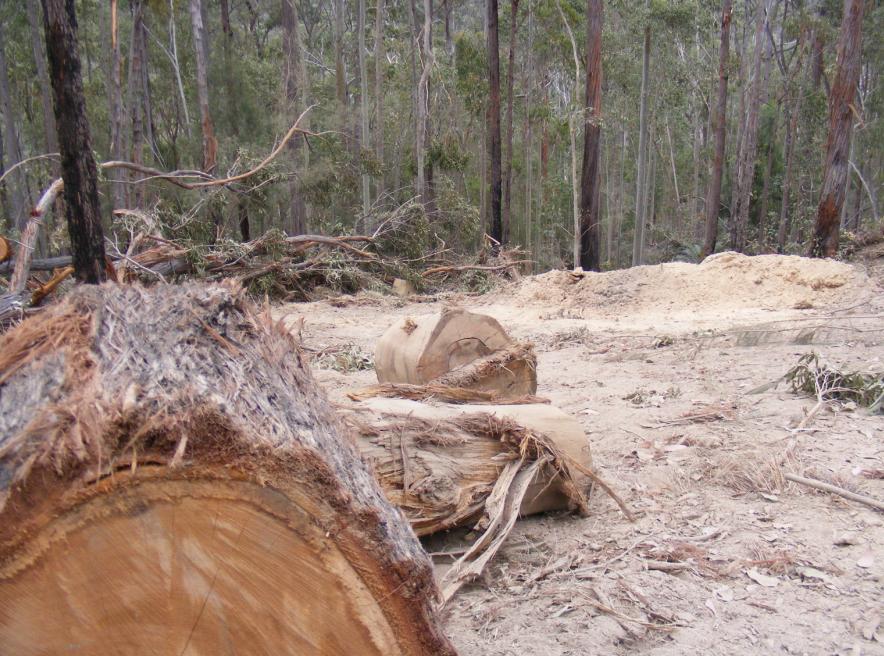
Bermagui State Forest after the loggers
.
The NSW Logging Offensive of 1988
.
On the back of a century of clear felling Bermagui State Forest was logged in the late 1980s. Then according to data from the ‘Bureau of Resource Science‘ (aka science graduates on the payroll of loggers), 148ha were “thinned” in 1996, and another 133ha that same year, then 94ha in 1999.
Typically 70% of the spotted gums goes to Boral’s mills in Narooma, Nowra and Batemans Bay as sawlogs to be processed into mainly flooring. The remainder end up as woodchips at Nippon Paper’s woodchip mill at Twofold Bay for export to Japan.
So Australia’s precious endangered habitat is being destroyed for house flooring and office paper. .
This RFA is one of three established in 1999, in which the NSW Government relegated 15.1 million hectares of native forests across New South Wales for logging anytime. The usual public relations spin preceded the logging. Southern Region manager of Forests NSW, Ian Barnes.
It was at this time that Labor’s Minister for Primary Industries (Forests NSW) Ian MacDonald and Labor’s Minister for Police Tony Kelly started to use Dick Cheney tactics to push their weight around with protesters. The following questions to the NSW Legislative Council by NSW Greens Senator Lee Rhiannon on 28th October 2008, highlight the escalated use of law enforcement into a heavy handed riot squad:
.
Lee Rhiannon MLC:
“I direct my question to the Minister for Police. Did officers stationed at Batemans Bay police station in collaboration with Forests New South Wales hold a meeting at the Bermagui Country Club in September to warn locals associated with calling for forest protection not to protest when logging commenced in the Bermagui State Forest? Does the holding of this meeting reflect that Batemans Bay police officers have adopted a zero tolerance policing approach to forest protesters? Considering that since logging started in Bermagui State Forest on 27 October with a group of about 40 protesters gathered in the vicinity, about 15 police cars, more than 20 police, including members of the Public Order and Riot Squad, a mobile police command bus and two police rescue vans have been in attendance, will this level of policing continue for the coming six weeks of logging in this area? What is the anticipated cost of this operation?
.
Tony Kelly MLC (response):
“The Far South Coast Local Area Command of the New South Wales Police Force has been advised that New South Wales Forests is to commence logging compartments of Bermagui State Forest later this month. As in the past, protests are expected. As always, the New South Wales Police Force is committed to maintaining public order. For this reason, local police and various commands, including the Public Order and Riot Squad, Highway Patrol and Rescue Squad will join together to conduct an operation.
This operation will focus on ensuring the protection of persons engaged in lawful activities. Local police have made it clear that anyone engaging in unlawful or dangerous activity in or near the logging operation will have action taken against them. When offences continue and are considered dangerous, police will arrest and charge people as necessary. Police respect people’s rights to protest during these times; in no way are they looking to prevent lawful and peaceful protests. Police have asked anyone who intends to protest to contact them so that they can attempt to facilitate lawful activity, minimise disruption and focus on protecting the safety of everyone involved.”
On Monday 2nd February 2009, logging operations resumed in the Bermagui State Forest after the summer holiday break period and continued for about two months.
Bruce Mathie and Sons is one of the prominent loggers in the area, but most timber finds its way either as saw logs to Boral for Spotted Gum flooring or else to Nippon Papers woodchip mill at Twofold Bay, Eden for export to Japan.
The forest eco-rapers ‘Forests NSW’ – bulldozed, chainsawed, logged, then left with their booty.
.
Kevin Mathie – 4th generation logger
.
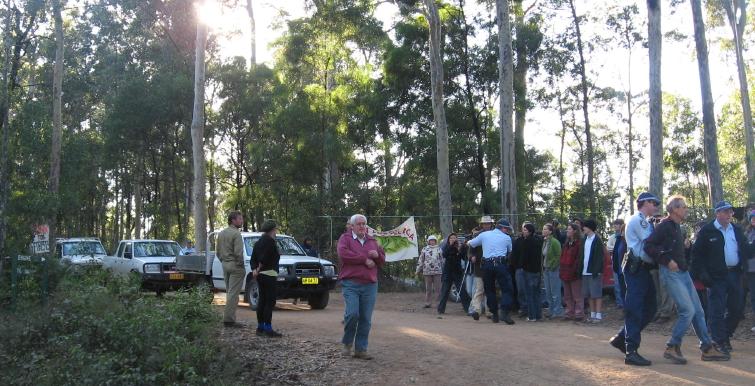
Logging contractor, Gil Mathie, in the middle of the picture at front (pink jumper)More notably, this editor is saddened by bearing witness to a senior member of the Bermagui community being arrested for conserving Spotted Gums and Koalas.We love, we defend, we act for love. Salute the man being arrested.
[Source: Local environmentalist, John Perkins, Gulaga Protest near Tilba on the NSW South Coast, 20070514]
.
Labor’s Ian MacDonald’s Forestry Regulation of 2009
.
But rather that do the right thing by the Environment and by the Community and obey the law of the land, those in power The Labor Government’s (Forests NSW) forced changes to the law of the land to bloody well suit themselves. Arguably reminiscent of England’s King Henry VIII changing laws to accommodate his adultery, or Joh Bjelke-Petersen’s gerrymandering that secured his electoral hold on power.
In order to keep the cameras and local conservationist away from the loggers destructive practices, Forests NSW got the Minister to legislate an exclusion area around its logging with the public relations labeling of “mainly for safety reasons”.
On 1 September 2009, the NSW Forestry Regulation 2009 came into force making it illegal for anyone to trespass into areas marked by NSW Forests for logging. This has given Forests NSW absolute logging power with the police as its enforcement lackies.
Forests NSW Minister for Primary Industries, Ian MacDonald, tabled the Bill and it became law preventing democratic protests by people trying to save important habitat from destruction. It has given loggers free reign to log State Forests with impunity.
Under Part 3, Division 1, Clause 11 of this Regulation, a logger has legal authority to request anyone to leave a forestry area and this includes if that person “causes inconvenience.”
Under Clause 12, a logger can forcible remove anyone from a forestry area “who is causing annoyance or inconvenience.”
Surely such removal by a logger can be construed an assault under the Crimes Act? It is draconian. It is certainly an assault on Australians’ democratic right to protest. What was Ian MacDonald thinking?
.
Labor’s Ministers in charge three years hence…
.
Labor’s Police Minister Tony Kelly MLC
NSW Minister for Emergency Services, Lands, Police and Primary Industries.
.
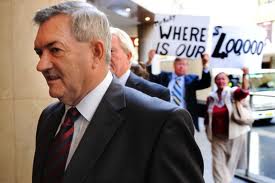
‘Tony Kelly was targeted by protesters as he arrived to give evidence at the ICAC in June. Today the commission has found the former minister engaged in corrupt conduct.’
‘DISGRACED former state Labor ministers Tony Kelly and Ian Macdonald are demanding taxpayers foot their legal bills and the state government could be forced to hand over up to $250,000. Despite being found by corruption watchdog ICAC to have forged official documents while a minister, Mr Kelly has formally asked the O’Farrell government to cover the cost of his elite legal team.’
Labor’s Logging Minister Ian MacDonald MLC
Forests NSW/ Minister for Primary Industries in 2009
.
‘The disgraced former NSW resources minister Ian Macdonald is to face a new corruption inquiry into the granting of coal exploration licences. The Independent Commission Against Corruption said in a statement yesterday that Mr Macdonald is being investigated for allegedly using his ministerial position ”to advantage the private interests of others”.
‘The senior state minister Ian Macdonald signed taxpayers up to the V8 Supercars race without a system to manage potential conflicts of interest, without advice from the government’s major events body and without a proper business case, the NSW Auditor-General finds.’
In September 2009, Forests NSW commenced logging again in Bermagui State Forest, like pack rapists marauding through a maternity ward.
Sure enough, on Monday, 14th September 2009, Police arrested two of four forest campaigners who had allegedly entered Bermagui State Forest in what Forests NSW had labeled logging compartments 2001 and 2002. Apparenpe known to support koalas is unacceptable, particularly when the NSW government cannot prove their claims that koalas can be found anywhere in the south east,” said Robert Bertram, local Friends of Five Forests member.
“This is yet another example of Forests NSW lack of care for community and the environment,” said Lisa Stone, spokesperson for South East Forest Rescue.
“They are logging old-growth in Dampier, threatened species habitat in South Brooman, endangered species habitat in Nadgee and now this.”
“The loss of biodiversity coupled with logging and burning means the condition of many forests is as bad as the endangered ecological communities on private land, unable to support most threatened and endangered species and unable to recover.”
“We urge the newly appointed Minister for the Environment, Mr John Robertson, to step in on behalf of the native forests and their dependents and stop these archaic practices.”
“The current government policy of destroying habitat to satisfy ‘wood supply agreements’ is robbing from the future generations their chance of survival. The amount of breaches was astounding and shows that Forests NSW cannot be trusted to log these important areas of Koala habitat.”
“We have inspected many other logging operations in the past year and have found the same breaches everywhere we have looked. This is pe known to support koalas is unacceptable, particularly when the NSW government cannot prove their claims that koalas can be found anywhere in the south east,” said Robert Bertram, local Friends of Five Forests member.
“This is yet another example of Forests NSW lack of care for community and the environment,” said Lisa Stone, spokesperson for South East Forest Rescue.
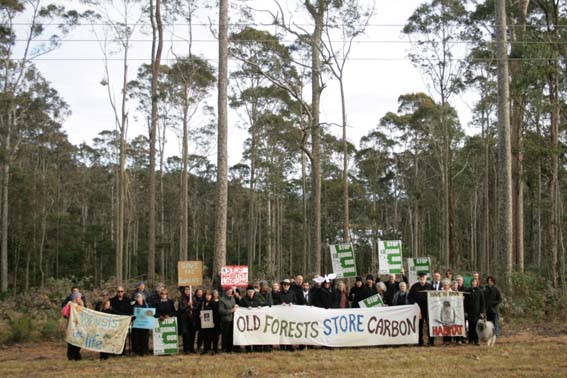
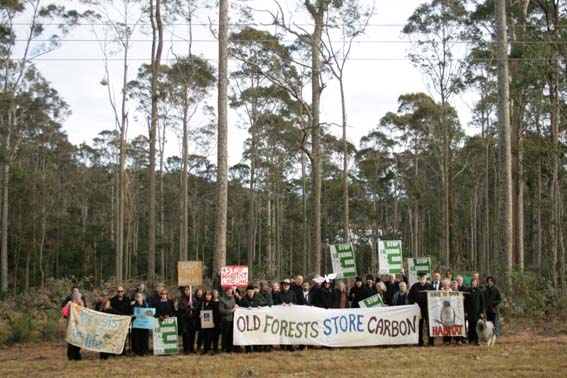
A community morally right to defend habitat and prepared to defend that right
.
“They are logging old-growth in Dampier, threatened species habitat in South Brooman, endangered species habitat in Nadgee and now this.”
“The loss of biodiversity coupled with logging and burning means the condition of many forests is as bad as the endangered ecological communities on private land, unable to support most threatened and endangered species and unable to recover.”
“We urge the newly appointed Minister for the Environment, Mr John Robertson, to step in on behalf of the native forests and their dependents and stop these archaic practices.”
“The current government policy of destroying habitat to satisfy ‘wood supply agreements’ is robbing from the future generations their chance of survival. The amount of breaches was astounding and shows that Forests NSW cannot be trusted to log these important areas of Koala habitat.”
“We have inspected many other logging operations in the past year and have found the same breaches everywhere we have looked. This is not a once off mistake but a systemic disgust for any environmental protection measures.”
Conservationists state the native forest logging industry is unsustainable and only propped up by political will, public subsidies and union backing.
Spokesperson for the South East Region Conservation Alliance, Pru Acton, says:
“The significant social and economic costs of reduced biodiversity can only increase while our natural systems are poorly managed.”
“Credible experts agree that the cost of logging this habitat is not only the last few koalas, but also potable water supplies, oysters, the inspiration for the local artists community, and another chunk of the Wilderness Coast’s tourism potential.”
“It seems the NSW Government has now decided its contractual obligations to supply sawlogs locally and woodchips to Asia is more important then protecting this much loved native animal.”
.
South East Region Conservation Alliance
.
Conservationists state the native forest logging industry is unsustainable and only propped up by political will, public subsidies and union backing.
Spokesperson for the South East Region Conservation Alliance, Pru Acton, says: “The significant social and economic costs of reduced biodiversity can only increase while our natural systems are poorly managed.”
“Credible experts agree that the cost of logging this habitat is not only the last few koalas, but also potable water supplies, oysters, the inspiration for the local artists community, and another chunk of the Wilderness Coast’s tourism potential.”
“It seems the NSW Government has now decided its contractual obligations to supply sawlogs locally and woodchips to Asia is more important then protecting this much loved native animal.”
.
[Source: ‘Logging resumes at Bermagui’, by Stan Gorton Narooma News, 20090204 – note the Narooma News has removed this news item online. However, the Narooma News has chosen not to remove its following story (Source: ^http://www.naroomanewsonline.com.au/story/191381/albino-possum-causes-log-truck-roll-over-at-narooma/ if it be not similarly removed].
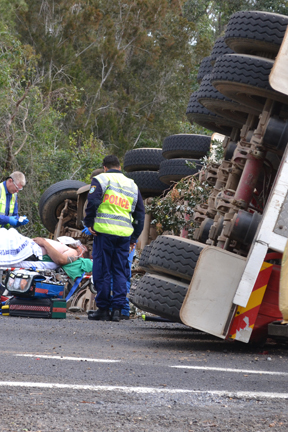
Speeding logging trucker blames possum..Narooma News editor’s reputation shot
.
Narooma News spins the following story to appease local logger readership:
.
“In a bizarre set of circumstances, a rare but dead albino possum is believed to have caused a log truck roll-over on the Princes Highway just south of Narooma.
The accident occurred just after 1pm when witnesses said a local from Wallaga Lake stopped to look at the road-kill possum that had been lying on the roadside at the entrance to the Island View Beach Resort.
A series of cars backed up behind the stopped vehicle in the southbound lane. Another Narooma local who was last in the line of stopped cars looked in his rear-vision mirror only to see the huge red-coloured truck coming up fast from behind.
“I think I am going to buy a lottery ticket,” said the local, who at one point thought the truck was going to smash into him and end his life.
The truck driver then allegedly swerved onto the wrong side of the road, narrowly missing the line of cars and while he was fortunate not to face any oncoming northbound traffic, he did lose control on the straight stretch of highway.
The truck reportedly clipped a boat trailer, flipped onto its side, sliding down the highway with the prime mover coming to rest in bushland just off the verge north of the Nangudga Bridge.
An ACT couple who among those first on the scene were able to help the truck driver out of the cab but they said he was badly shaken up and was not aware of where he was.
The Pambula man was the only person injured in the accident and was taken to Moruya Hospital for treatment.
The highway was closed down to one lane with firefighters, police and RMS personnel cleaned up and investigated the scene.
Residents from the nearby Island View caravan park were alerted to the accident by a loud bang and they lined the highway watching the accident.
The accident occurred at the start of the June long weekend where NSW police were out in force urging drivers to be careful on the busy roads.
Albino or golden brush-tailed possums are very rare but there is a known population living in the Narooma area.’
.
~ by the Narooma News editor…and watch out for drop bears too!
.
Meanwhile NSW Forests remains culturally contemptuous to NSW forests
.
Forests NSW recruit their students with Communications degrees to lie for it on its website:
“State forests in NSW are managed sustainably to provide a supply of timber today and into the future, to protect the environmental values of the forest and provide community amenities.”
Forests NSW website claims that “Ecologically sustainable forest management (ESFM) is our guiding philosophy. ESFM is about managing forests to maintain ecological principles and biodiversity while optimising the benefits to the community from all uses of the forest…”
Narooma Community in defence of Koala Habitat
– clearly not convinced about Forests NSW spiel about “optimising the benefits to the community”
.
Revolving Door politics of NSW Labor
.
In the revolving door politics of NSW Labor, Premier #3 Nathan Rees on 16th November 2009 sacked Ian MacDonald from his DPI Ministry.
Rees was himself sacked as premier on 3 December, then a week later, Labor Premier #4 Kristina Keneally (Labor show pony) reappointed Ian MacDonald ‘Minister for State & Regional Development and Minister for Mineral & Forest Resources‘ in December 2009.
The labelling of Minister for ‘Forest Resources’ left NSW State Forests in no doubt about the death row status. Throughout NSW Labor’s factional power shuffle Macca’s chair never got cold.
The then Minister for Primary Industries , Tony Kelly, overseeing Forests NSW, claimed on 18 November 2009: “The NSW Government has a solid track-record for maintaining prosperous and sustainable primary industries, I will be working hard with industry to ensure this tradition continues.”
All State Forests should be added to Australia’a National Park Estate. State Governments and their narrow mindset culture cannot be trusted with ecology. Boral and Nippon Paper can transition their logging operations into plantation-only FSC resources.
The Twofold Bay Woodchip Mill was set up near Eden in 1969 by Daishowa Paper Manufacturing Company has exported and profitted from over 35 million tonnes of Australian native forest woodchips, mostly to Japan, where its parent company is based.
In contributing to the annihilation of thousands of hectares of Australia’s native forest habitat the Daishowa Twofold Bay Woodchip Mill is Australia’s Habitat Auschwitz. It must be unceremoniously closed down immediately.
Daishowa – Japan’s BIG Corporate Eco-Rapist and BIG Koala Exterminator
‘Greens MP David Shoebridge today met with local campaigners and timber workers in the Bermagui State Forest to get a first-hand view of the impact of continued logging in the South East Forests.
“There is a real concern that this logging is further fracturing the remaining stands of koala habitat in the South East,” Mr Shoebridge said.
“The logging is being undertaken in a nature corridor that links Wallaga Lake National Park and Bermagui Nature reserve. This corridor should be protected.
“With the logging at Bermagui coming within a few hundred meters of town the prospects of more intensive and drier regrowth producing higher levels of fire hazard are real.
“Forests NSW has said that the beautiful “cathedral” entrance to Bermagui will be protected. However on closer inquiry only a small part of the western side and a 50m ‘visual protection zone’ to the east is currently protected.
“In discussions with Forests NSW today they have committed to reviewing the decision on the cathedral to consider protecting all of it from logging. This would be a welcome, if modest, concession.
“The South East Forests are a priceless natural asset and this new State government has a real chance to break with the past and save them from continued logging for wood chips.
“Local campaigners are committed to saving these beautiful forests and this will remain a key focus in the coming years,” Mr Shoebridge said.
.
[Ed: That was over a year ago – our love and commitment for the old forest – we remember ]
..the evening news media dramatises a forthcoming government declaration of a‘Total Fire Ban’. Next day yep, dry and hot, then early afternoon wind picks up. Yep, having mapped target, and with no-one around, opportunity to be ‘Bushfire Hero’…
.
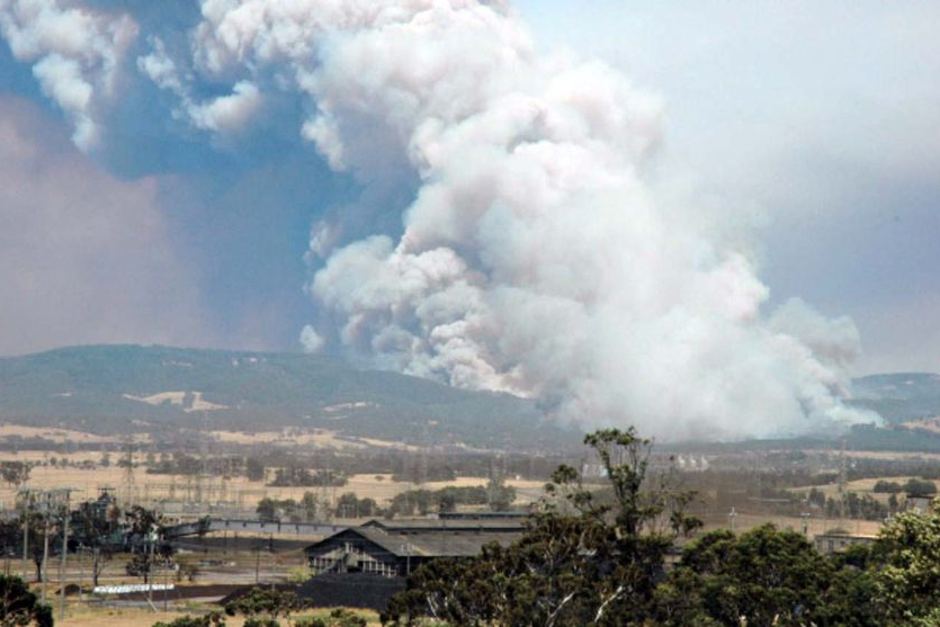
7th Feb 2009, 1:30pm – a pine plantation near Churchill, West Gippsland:
Of the thousands of bushfires that burn Australia’s natural landscape each year, humans cause the vast majority, with somewhere around half of these being deliberately lit, that is, not by accident.
Bush Arson is a serious and heinous crime now systemic in bushfire-prone Australia, California and southern forested regions of Europe. It is committed usually by misfit serial offenders, yet despite the statistics, across all states in Australia from Tasmania to the Top End, the crime remains largely given lip service by governments.
Researchers at the Australian Institute of Criminology have assessed that there are many reasons why people light fires. While some want to relieve boredom by creating havoc and excitement, other arsonists crave recognition or attention. Some light fires out of anger or protest while others believe they are being altruistic by clearing what they see as dangerous fuel-loads. Sometimes there are multiple motives.
People who light fires for excitement will often stay around after the fire to view their handiwork, which suggests that fire crews should look around and talk to the people who are there watching. Knowing that some people light fires just so they can treated as a hero if they report the fire or put it out is also useful, especially for fire services screening new members.
Some of those people who light those fires do become members of fire services, and this needs to be a consideration in the firefighting recruitment process.
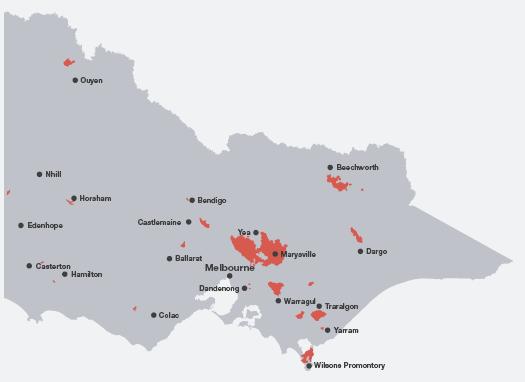
The 2009 Victorian Bushfires, collectively branded by the media as ‘Black Saturday’, involved far many more bushfires that the ones that ignited and reported by the media on Saturday 7th February 2009.
‘The number of fires that had not been extinguished rose from seven on New Year’s Day to 29 on 14 January. Then it doubled to 58 by 25 January and continued to steadily increase to 125 in the week before 7 February. By this time firefighting resources had been committed for a fortnight responding to new fires and attending to fires already contained or controlled.’
[Source: ‘The Number of Fires’ in Overview, Part One: ‘The January-February 2009 Fires’, Vol I: ‘The Fires and the Fire-Related Deaths’ p.4 citing the Department of Sustainability and Environment – Annual Report 2009 (TEN.201.001.0001) at 0047, in Final Report, July 2010, Vol. 1, p.20, by 2009 Victorian Bushfires Royal Commission, State Government of Victoria ]
.
According to the Victoria Country Fire Authority, of the fires that were not readily contained on or before 7 February, 14 of those 47 became ‘major fires’. On 7th February alone however, the CFA indicated there were a total of 1386 incidents reported on 7 February — 592 grass and bushfires, 263 structure fires and 156 reported incidents that were false alarms.
.
[Ed: Clearly the bushfire conditions were extreme (beyond the usual ‘Total Fire Ban’ severity), the number and distribution of bushfires were considerable and emergency resources were overwhelmed. So for bush arson to be committed on such a declared day was beyond arson; it was ‘pyroterrorism’. But the crime does not yet feature in the Crimes Act. It needs to be. The penalty needs to be equated to that which would be imposed upon a terrorist attempting or actually causing mass murder. It is past time that Australia’s lackadaisical and euphemistic term ‘fire bug‘ is cast to history. We owe this to the memory and respect of 173 people lost. What is significant is that of the 173 who died, most were due to either arson or powerline spark – both human caused].
.
The bushfires associated with Black Saturday that were selected to be investigated by the Victorian Royal Commission were on the basis of fires having caused the death of the 173 people and/or where significant damage had occurred.
.
2009 Bushfires investigated by the Royal Commission
The investigated bushfires numbered twelve and they were:
Kilmore East Bushfire
Murrindindi Bushfire
Churchill Bushfire
Delburn Bushfire
Bunyip Bushfire
Narre Warren Bushfire
Beechworth-Mudgegonga Bushfire
Bendigo Bushfire
Redesdale Bushfire
Coleraine Bushfire
Horsham Bushfire
Pomborneit–Weerite Bushfire
.
[Ed: NOTE: We include the suffix ‘bushfire’ above, unlike the Royal Commission in its literature which abbreviates ‘bushfire’ just to ‘fire’, or even drops the reference to fire completely, bless their imported cotton socks].
2009 Victorian Bushfires – Overview Map
.
It is instructive to emphasise that the eventual naming of these fires was based on the point of origin, however on the day it had proven problematic during the overwhelming speed and complexity of the multiple simultaneous bushfire emergencies.
The lead item in the Terms of Reference for the Victorian Royal Commission was sensibly to inquire into ‘the causes and circumstances of these bushfires‘.
.
The Bushfires Deliberately Lit *
.
Of the above 12 bushfires investigated, those known or suspected to have been caused by arson or otherwise in obscure firefighting-speak ‘undetermined‘ or ‘unknown‘ were:
Murrundindi Bushfire
Delburn Bushfire
Redesdale Bushfire
Upper Ferntree Gully Bushfire
Bendigo Bushfire
Churchill Bushfire
.
*Various vague assessments as to cause included ‘suspicious’, ‘unknown’, ‘undetermined’, which in 2012 is unacceptable. Compare the term ‘undetermined‘ to any police investigation into an urban fire causing significant damage; such a vague dismissal would be publicly unacceptable. So in the absence of competent investigation, we shall presume bush arson. So half were caused by arson, which is in line with the Australian Institute of Criminology’s conclusions, above.
.
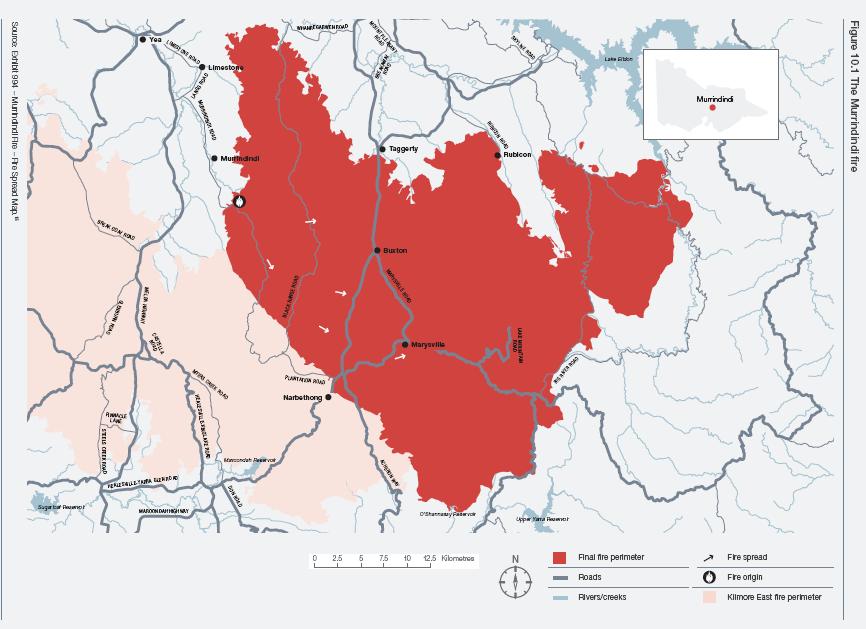
The Murrindindi Bushfire
With bushfire conditions extreme (temperature 44.6°C, humidity 8%, wind 46kph, Bushfire Index 110 – off the scale), the bushfire started about 14:55 on 7 February 2009, to the north of a sawmill in Wilhelmina Falls Road, Murrindindi. The cause was assessed as ‘suspicious’.
After the bushfire had merged with the Kilmore East Bushfire some 168,542 hectares had been burnt. Forty people were killed, another 73 people were injured, 538 houses were destroyed or damaged, mainly in and around Marysville, Narbethong and Buxton. The commercial centre of Marysville was razed to the ground. Firefighting resources involved 195 CFA and 311 NEO personnel, supported by 45 CFA appliances, 22 Networked Emergency Organisation (NEO)* appliances and 3 aircraft.
* [Ed: Networked Emergency Organisation? – a rather new convoluted bureaucratic term given to the Royal Commission to collectively represent a mix of disparate government agencies quickly cobbled together to deal with an emergency outside the control of the Country Fire Authority volunteer base].
.
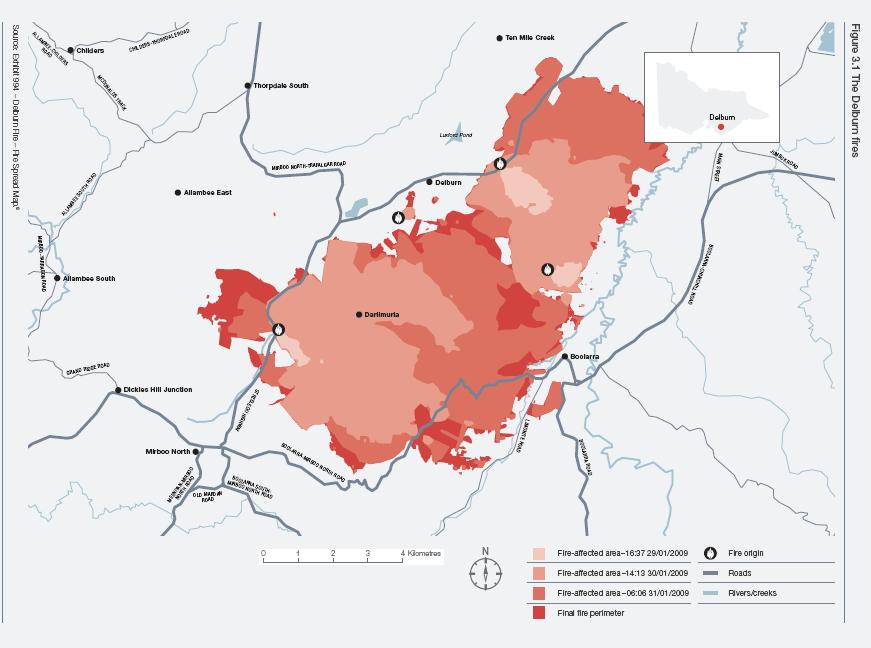
The Delburn Bushfire
With bushfire conditions similarly extreme, albeit with a lower Fire Index of 52, this bushfire started as three separate ignitions in the Strzelecki Ranges on 28 and 29 January 2009:
The Ashfords Road Bushfire – discovered on 28 January at about 4.00 pm, 2.5 kilometres north-north-west of Boolarra.
The Creamery Road Bushfire – discovered at about 1.00 pm on 29 January, 2.5 kilometres east of Delburn.
The Lyrebird Walk–Darlimurla Bushfire – discovered at about 3.30 pm on 29 January, 4 kilometres north of Mirboo North near Darlimurla.
.
[Ed: So each started under extreme bushfire conditions in the early afternoon]
.
The causes of both the above Creamery Road Bushfire and the Lyrebird Walk–Darlimurla Bushfire were assessed as ‘suspicious’ and the Victorian Police have since laid criminal charges against the suspected arsonist.
The three separate bushfires were not contained and ultimately merged. Increasing wind and changes in wind direction caused spotting and resulted in the bushfire spreading quickly east towards the outskirts of the townships of Boolarra and Yinnar. The surrounding townships included Mirboo North (population 1,300), Boolarra (pop. 600), Yinnar (pop. 600) and Churchill (pop. 5,000). Fortunately there were no fatalities or casualties, but 44 houses were destroyed maily on the outskirts of Boolarra, and some 6,534 hectares burnt out. Firefighting resources involved 597 CFA and 699 NEO personnel, supported by 112 CFA appliances, 103 NEO appliances and 14 aircraft.
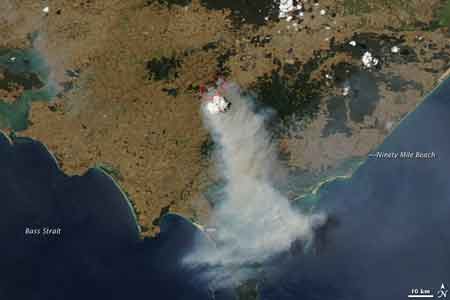
Delburn Bushfire 30th January 2009 from NASA satellite
.
There had been a further three ignitions around the time (1) at the Delburn–Yinnar refuse transfer station, (2) at Ten Mile Creek Rd in a Hancock Victoria Plantation and (3) at Brewsters Rd, Yinnar. Each was either contained or burnt out without fire-fighting intervention.
.The 2009 Delburn Bushfire
A CFA firefighter runs out hose on Piggery Road at Boolarra 2nd February 2009.
(Photo by Greg Cahir)
.
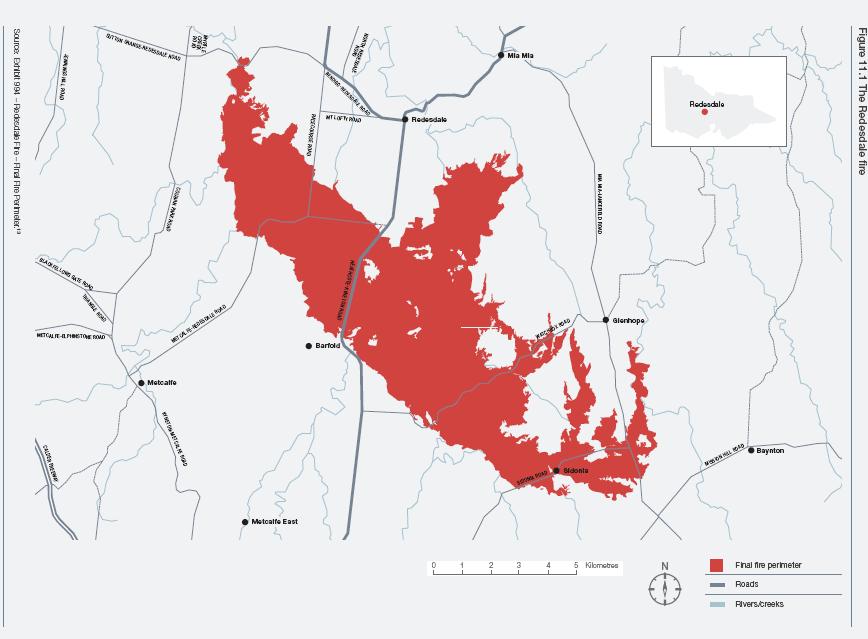
The Redesdale Bushfire
The Redesdale Bushfire started with similar bushfire conditions (temperatures reaching 44.7°C, humidity 7%, winds up to 50kph, Bushfire Index 87.2). The bushfire was reported at 3:11 pm on 7 February 2009.
According to the CFA, the ignition started in a creek bed on open farmland between the eastern bank of the Coliban River and the northern end of Summerhill Road, about two kilometres to the west of the township of Redesdale, about 95 kilometres north-west of Melbourne and 35 kilometres south-east of Bendigo. There were more than 100 houses in the bushfire area.
The cause of ignition of the Redesdale fire has been investigated but ‘not determined‘. Possible sources of ignition that have not been excluded are:
(a) ignition by a spark or hot exhaust system
(b) deliberate ignition
(c) ignition by farm operations
(d) ignition by a carelessly discarded cigarette butt
There was no evidence that any of these sources ignited the fire.
The bushfire burned towards the south-east for about 19 kilometres. It was the first of two bushfires in the region on that day, the second originating
in Maiden Gully, 8 kilometres north-west of Bendigo, around 4:20pm. Fortunately again there were no fatalities, but one reported casualty, 14 houses destroyed as well as more than 50 farm sheds and outbuildings, the Baynton church and a bridge, two olive oil plantations, a vineyard and two blue gum plantations, and 7,086 hectares were burned.
Firefighting resources required were 536 CFA and 127 NEO personnel, supported by 103 CFA appliances, 21 NEO dozers and 1 aircraft. Two CFA forward control vehicles were damaged in the course of the fire fight.
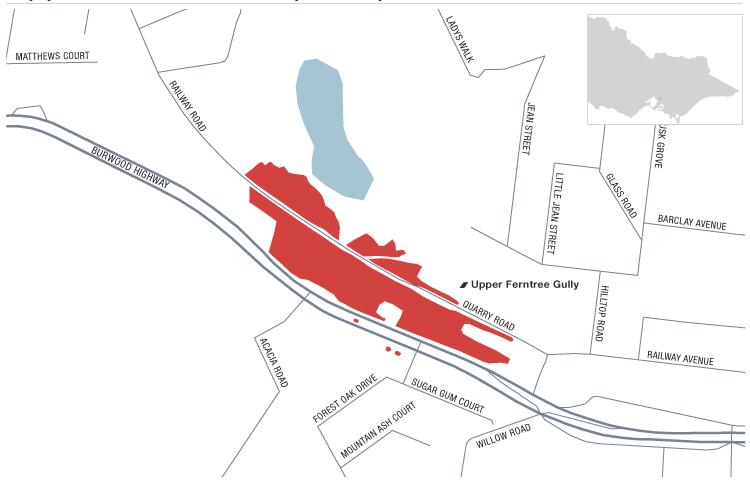
The Upper Ferntree Gully fire started on Saturday 7th February 2009 at about 3:40 pm in a suburban railway corridor through bushland between the Burwood Highway and Quarry Road. The bushfire conditions were extreme as with the entire State. By mid afternoon the wind had picked up and was gusting to 90kph, exacerbating the conditions.
The cause of the fire was not known. The fire initially spread by spotting south-east through scrubland between the Burwood Highway and Quarry Road near houses. By 4:30pm an air crane was requested and just after 5pm the Erikson Aircrane nicknamed ‘Elvis’ had made a number of rapid water drops on the fire, obtaining water from a nearby disused quarry, critically preventing the loss of houses and finally contained by 6pm. There were no fatalities or casualties and no houses were lost, but 4 hectares of regenerated scrubland was burnt.
Erickson S-64 Air-Crane Helitanker (N179AC)
.
[To stop video and continue, click the pause button bottom left]
Repeat Offenders? – same place lit again in January 2012: a hot, dry, windy afternoon, familiar turf
.
‘Members of the Upper Ferntree Gully cricket team were quick to report a grass fire that started near Quarry Rd. Firefighters from Ferntree Gully and Upper Ferntree Gully attended the blaze, which was reported about 7.15pm on Friday. Upper Ferntree Gully CFA captain Peter Smith said the fire started in vegetation-regeneration area near Quarry Rd.
“It was a grass and scrub fire at the old quarry of probably about a third of a hectare,” Mr Smith said. “Conditions were on our side but we wouldn’t have wanted it any hotter or windier.”
About five trucks responded to the blaze and Mr Smith praised the efforts of those who called 000.
“The people that spotted it were fantastic,” Mr Smith said. “They were local guys from the Upper Ferntree Gully Cricket Club I think, that helped us get in and assisted police.”
The cause of the fire is unknown and being investigated.‘
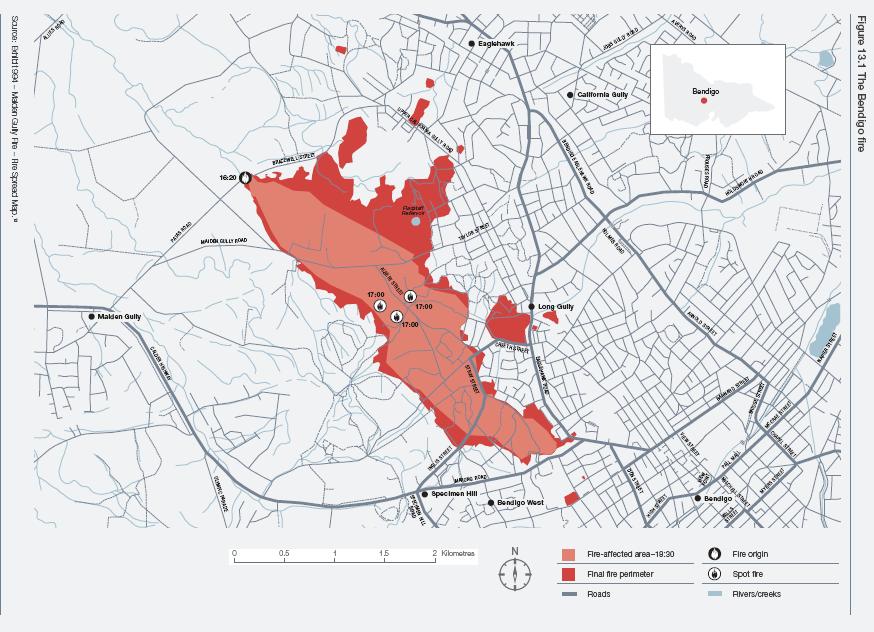
The Bendigo Bushfire started shortly after 4pm on Saturday 7th February 2009 in the tinder dry hilly bushland of Maiden Gully, 8 km north-west of central Bendigo. Bushfire conditions were extreme (temperatures up to 45.4°C, humidity 6%, winds up to 41kph and the Bushfire Index off the scale at 129). The ignition cause was assessed as ‘suspicious’ – the arsonist was classically upwind of the outskirts of targeted western Bendigo.
The bushfire burned through gently rolling country bordering the city’s western suburbs, where there are numerous former gold diggings that are now public open space interspersed between suburban blocks. One person died as a result, plus there were 41 reported casualties. Some 58 homes were destroyed and 341 hectares burned out.
Firefighting resources required were 152 CFA and 111 NEO personnel, which were supported by 30 CFA appliances, 31 NEO appliances and 3 aircraft.
.
The Churchill Bushfire
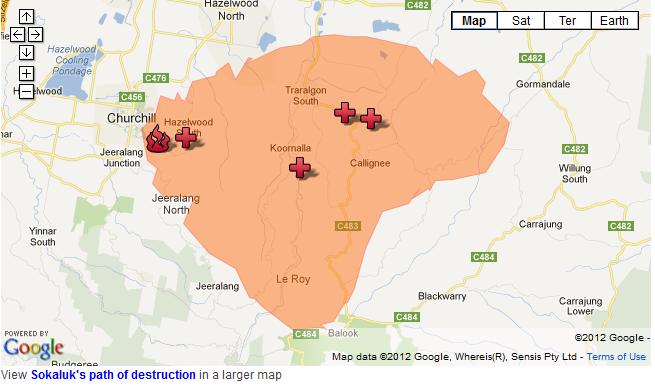
2009 Churchill Fire Map Overview
.
The Churchill Bushfire started at 1:30pm on Saturday 7th February 2009, 3km south-east of the Churchill fire station, from two separate ignitions respectively one at the intersection of Glendonald Road and the other at Jelleffs Outlet. The recorded ‘000’ call received from the public, not coincidently, at 13:32, two minutes later.
Like the other bushfires on that day, the climate background was characterised by a decade long El Niño drought, making the native vegetation tinder dry and so extremely flammable. It was a declared Total Fire Ban across Victoria. The Forest Fire Danger index was off the scale recorded at 103 at Latrobe Valley AWS at 4pm, the temperature reached 46.1°C an humidity at just 8% at the Latrobe Valley automatic weather station around 4pm, the humidity just 8%. The maximum winds recorded before the wind change were north-north-westerly
at 44 kilometres an hour at Latrobe Valley Automatic Weather Station at 15:43, before a south-westerly wind change came through.
Before 7th February, the Country Fire Authority and the Department of Sustainability and Environment had already been providing support in response to three separate bushfires which had started on 28th and 29th January and which had coalesced into one and became the Delburn Bushfire. It had been contained by 3rd February. Like the Delburn Bushfire, thge Churchill Bushfire was started on the one day by two separate ignitions by an arsonist. So then was the Churchill Bushfire a copy cat arson episode? Were the two somehow connected? Did both arsonists know each other?
At the time, the cause of the Churchill Bushfire was recorded as ‘suspicious’. It was in fact deliberately lit in two locations, outside the township of Churchill along a roadside next to and upwind of a pine plantation owned by Hancock Plantations Victoria at the foot of Walkers Hill. The tinder dry conditions fanned by a steady breeze meant the ignitions took hold quickly.
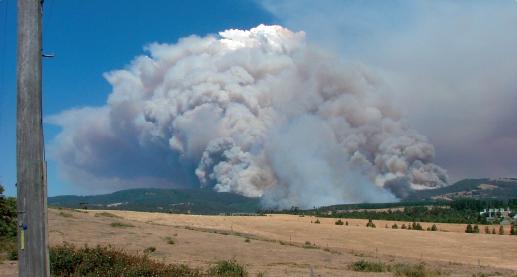
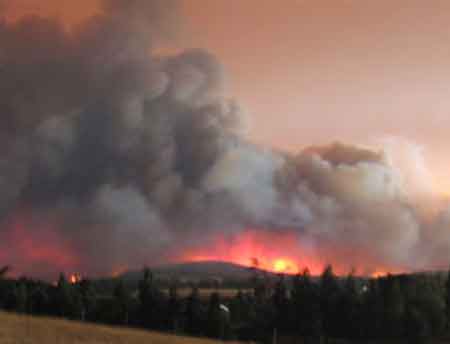
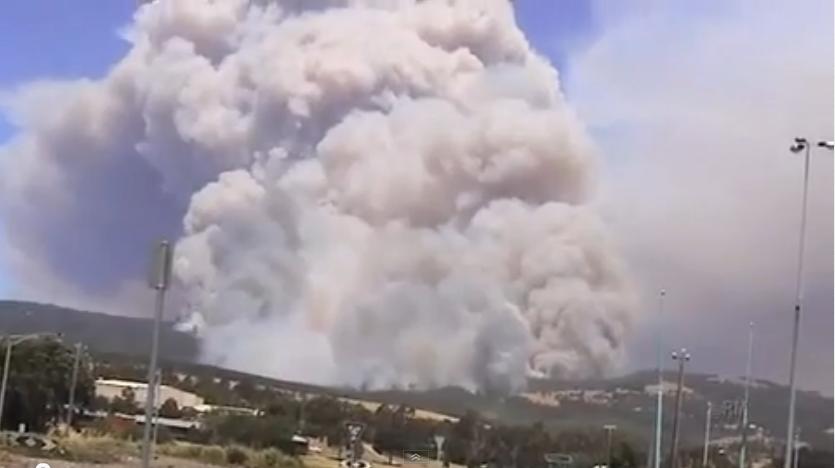
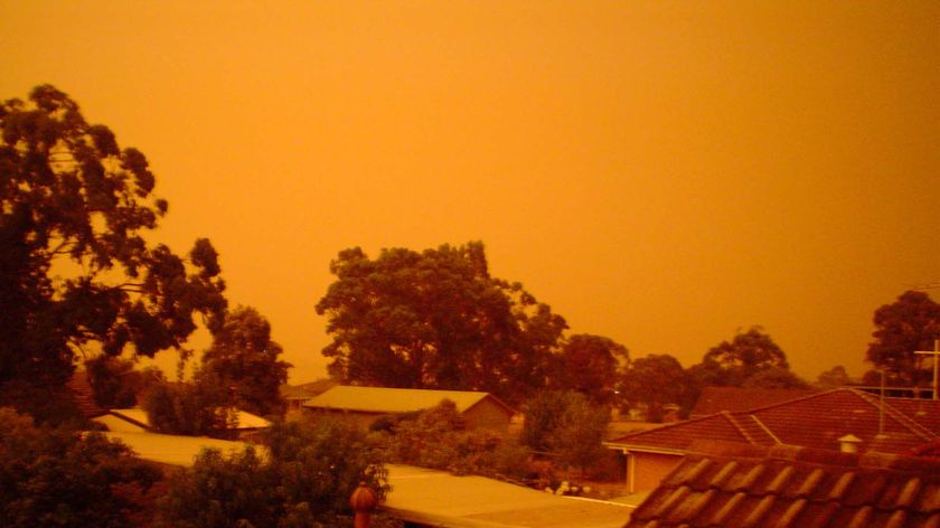
The recorded 000 call received from the arsonist himself at 13:32, two minutes later. Actual fire-fighting response was not documented in the Royal Commission report. It could well have been some hours before the blaze was fought. The following photos of the Churchill Fire are purportedly from the nearby township of Morwell looking south. They show the early minutes after the ignitions.
.
The very start of Churchill Bushfire
Photo taken looking south from Hunt Street, Morwell
.
‘Composition: vertical-panorama of the smoke from the Churchill Fires that have jumped containment lines near me’
.
[Source of photos: ‘Nchalada’s Photostream’, Flickr, ^http://www.flickr.com/photos/nchalada/page2/, accessed 20120827, Ed: Due to their controversial nature, the many photos on this Flickr website may not be accessible for long.]
.
.
During the afternoon and early evening the fire travelled rapidly, affecting Jeeralang North, Balook, Le Roy, Koornalla, Callignee, Callignee North, Callignee South, Hazelwood South, Hazelwood North, Traralgon South, Devon, Yarram and Carrajung South. The final statistics confirm that firefighting resources deployed involved 409 CFA, 167 NEO personnel and 33 Hancock Victorian Plantations firefighters, supported by 76 CFA appliances, 29 NEO appliances and 4 waterbombing aircraft.
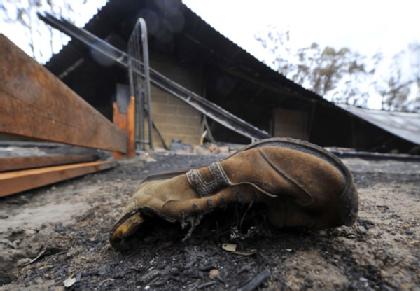
Although the fire was at its most destructive on 7th February, it was not reported as controlled until 19th February. Eleven people died as a result of the fire, plus an additional 35 casualties, 156 houses were destroyed, and more than 36,000 hectares were burnt.
About 1000 hectares of Bluegum plantations and 1700 hectares of Radiata Pine plantations owned Hancock Victorian Plantations by were burnt in the fires. An untold number of livestock and wildlife were also burned to death. In the nearby Delburn Fire, an arrest has been made but the outcome of that trial is not yet known at the time of publishing this article.
‘Residents of fire ravaged Gippsland towns have been warned to remain alert despite cooler temperatures today. So far 27 homes around Boolarra and Mirboo North have been lost in the fires. (Ed: The Delburn Bushfire)
More than 400 firefighters from as far as Mildura are currently battling the 6300 hectare blaze with 113 fire trucks, 14 helicopters and 12 bulldozers. About 40 Boolarra and Mirboo North residents have spent the past two nights in emergency accommodation at Monash University in Churchill, after fire swept through their town on Friday.
More than 100 residents attended a community meeting in Churchill this morning to discover whether their properties had survived the weekend.
CFA spokeswoman Rachel Allen warned locals the blaze was far from being classified as safe, despite drizzle predicted and a top temperature of only 29 degrees. “Obviously the threat has diminished somewhat because of the cooler temperatures, but it as important now as it was a few days ago to keep yourselves aware,” Ms Allen said.
Peter McHugh from the Department of Sustainability and Environment agreed, saying the fire threat “was far from over,” and that residents need to remain vigilant for flying embers.
Mr McHugh said possible electrical storms predicted to hit the area later today are a cause of concern for emergency services.
The Delburn fires have claimed 27 homes, 59 sheds, 5 cars and a piggery since they began on Wednesday. Another home is also believed to have been lost yesterday, but fire crews have so far been unable to access the property, just outside Mirboo North. Almost 40 homes are still left without power, while water supply has been restored to Boolarra.
Department of Primary Industries staff are now counting livestock losses around the Boolarra area, and the number is believed to be substantial.
Latrobe City CEO Paul Buckley said it would take at least a year to rebuild Mirboo North and Boolarra.
“When the fires hit Toongabbie about three years ago that took six months to rebuild, and this one is much, much worse,” Mr Buckley said.
Boolarra evacuees housed in Monash University student accommodation units have shared their horror stories of the blaze that engulfed their town.
Tania Martin, 35, praised the efforts of her partner Dave Caldwell, 40, for saving both theirs and their neighbours’ house.
Ms Martin and her son Storm, 10, left their Boolarra home late Friday while Mr Caldwell stayed behind to defend the properties.
“I think he is an absolute hero,” Ms Martin said. Mr Caldwell worked for hours pumping water on both houses as flying embers showered all around him from the fire less than 100 metres away. But Mr Caldwell said the real heroes are the firefighters who have been working around the clock.
“Those guys and girls, you should watch them heading over the hill straight for the fire. It’s unbelievable,” Mr Caldwell said. “They are made of the right stuff, they are.”
Val Kingston, 68, and her husband recently moved to Boolarra from Melbourne for a “tree change.” “And now all the trees are gone,” Ms Kingston said.
Ms Kingston said leaving Boolarra lat Friday had been difficult. “It was the saddest sight I have ever seen looking over my shoulder as I drove away. I just thought “there goes my town.”
Ms Kingston praised the efforts of Monash University residential staff. The University purchased fans for the units where evacuees have set up makeshift homes. They have also provided tea and coffee and icy poles for the kids. “We can’t thank them enough,” Ms Kingston said.
A further 20 firefighters from Mildura and 18 firefighters from Ballarat arrived in Churchill this morning to relieve exhausted colleagues who have been stationed on the fire front for the past two days.
The Churchill fire was threatening communities in south Gippsland late on Monday, fire authorities said. The 33,000 hectare blaze was threatening the community of Won Wron just north of Yarram, in south Gippsland at 5.30pm (AEDT) on Monday.
Residents of nearby Carrajung on the east side of Carrajung-Woodside Road were also expected to be impacted directly.
The Country Fire Authority also issued an urgent threat message at 4.15pm (AEDT) to residents near the Thomson Road area, Churchill, who were being directly hit by the fire. A CFA spokesman said the fire threat had increased as freshening winds picked up.
The death toll from the fires, which police believe were deliberately lit, in the area continued to rise. Nineteen people have now been confirmed dead in the region after the Churchill fires devastated the towns of Callignee, Hazelwood, Jeeralang and Koornalla in southwest Gippsland.
Nine people died in Callignee, one person was killed in Upper Callignee, four people died at Hazelwood, one at Jeeralang and four at Koornalla.
The Churchill fires south of the Princes Highway have so far burnt about 33,000 hectares, while the Bunyip Ridge fire, north of the highway, has razed 25,000 hectares.
Containment lines are also being established on the western and eastern flanks of the Bunyip blaze. Residents of Gembrook have also been warned to be vigilant, although the town is not currently under threat.
In the north of the state, fire around Dederang escalated significantly late on Monday afternoon, also threatening the towns of Beechworth and Yackandandah. The fire was spotting ahead of the main fire and ash and embers were threatening communities in Gundowring, Gundowring Upper, Glen Creek, Kergunyah South, Mudgeegonga and Running Creek. Authorities said some fires could take weeks to contain.
At least 750 homes have been destroyed and more than 330,000 hectares burnt out. The latest death toll is 131, which surpasses the toll from the 1983 Ash Wednesday bushfires, in which 75 people died in Victoria and South Australia, and the Black Friday bushfires of 1939, which killed 71.’
.
Misfit Profile of a Bush Arsonist
.
Brendan James Sokaluk, was in April 2012 found guilty of all 10 counts of arson causing death by the Victorian Supreme Court in Melbourne for deliberately lighting the Churchill Bushfire on 7th February, 2009. Sokaluk was an ex-volunteer firefighter with a local brigade of the Victorian Country Fire Authority (CFA) from 1987 to 1988, some twenty years prior.
Brendan SokalukNot the smartest bush arsonist, but then could he be?
.
Sokaluk, then aged 39, claimed that his old sky blue Holden HJ sedan had apparently broken down on the road near where the fire started, next to a pine plantation where the Churchill Black Saturday fire had begun just minutes earlier.
He was the only outsider on the road. To the residents of Glendonald Road busily packing up their possessions and preparing to flee the raging fire, Brendan Sokaluk stood out. Dressed in shorts and sandals, he was frantically trying to restart his broken-down Holden, which was partially blocking the gravel road.
Once home, Sokaluk climbed on to the roof of his house so he could look back towards Glendonald Road and watch the fire burn.
Sokaluk told several lies to cover his tracks. He told one person he was on his way to a wedding, while to others he said he was visiting a friend in the area. As he was driven back to Churchill by a resident, Sokaluk was overheard telling his father on the phone that he had been in the area to visit a friend to get his chisel set back.
Days later Sokaluk was arrested on the following Friday 12th February on a local street while working delivering the local Latrobe Valley Express newspaper. Sokaluk was interviewed by police for about three hours both at the scene of the fire and in an interview room at a local police station. Police interviewed him and on the following day, Saturday 13th February, they returned him to Glendonald Road and to nearby Jelleff’s Outlet, where the fire had started and where the landscape was now blackened and burnt out.
What emerged was that on the morning of 7th February, Sokaluk had picked up his father Kazimir in his distinctive sky blue Holden HJ and the pair drove to Morwell and Traralgon, visited auto and hardware stores, had lunch at KFC and bought lottery tickets. Kazimir Sokaluk said Brendan’s car was playing up and “running rough” but against his advice his son said he was “going up into the trees” because it was cooler there. Sokaluk also said he wanted to get a chisel set back from a friend named Dave who lived in that area. Another excuse was to access his apparent junk metal collection along Glendonald Road.
The police attempted a re-enactment and the field interview was recorded by video. Sokaluk admitted to police that he had started the blaze, but declared it had been an accident after he dropped cigarette ash out of his car window. He explained that the previous Saturday he had been driving slow, dawdling along in his car. “Looking for animals and stuff,” he said. Asked if he is familiar with the area, he replies: “It’s different `cause it’s not green no more. It’s all burnt out.” The detective asks “How do you know this area?” Sokaluk replied it was where he threw his piece of paper out the window.
“Part of my cigarette thing fell on the floor, so I got a bit of paper out to grab it and stuff… I thought it was dead and I’ve chucked it out the window, but I didn’t know it had lit up. I thought it was out when I threw the paper out the window.” Sokaluk told them. “I had no intention of this all to happen. Now I have to put up [with it] for the rest of my life and it makes me sad.”
The cigarette ash explanation was pivotal in what was a largely circumstantial case. But Sokaluk strenuously denied deliberately starting the fire. But then Sokaluk had told several lies to cover his tracks. He was a serial liar. Yet, without witnesses, evidence, a confession, proving bush arson is inherently difficult.
Prosecutor Ray Elston Senior Counsel argued that Sokaluk deliberately drove to bushland and started a fire on a day that had temperatures that reached nearly 45C. He was calculating enough to lie about his reasons for being in the area, to try to cover his tracks and to point the finger at others. Sokaluk tried to disguise his crime by claiming to police that it was an accident, lying about his reasons for being in the area and trying to point the finger at others, including making a false anonymous report to Crime Stoppers from his home computer blaming a Department of Sustainability and Environment worker for the fire.
Police managed to piece together Sokaluk’s movements on Black Saturday almost to the minute from phone records, witness accounts, shop receipts and CCTV footage. At 1.16 pm Sokaluk was in the IGA store in Churchill where he bought cigarettes before heading off into the Jeeralang Hills. Within 15 minutes a fire erupted in the hills and witnesses said that in tinder dry conditions the inferno tore through the bush seawards towards Yarram.
The Crown called 80 witnesses and its case was a mosaic of evidence that pointed to the guilt of Sokaluk. Mr Elston told the jury the accused had no reason to be in the area that day and if he was going to see Dave, who was home, he never got there.
“Why did he travel on a dirt road to get out there?” Mr Elston said to the jury in his summing up. “Why did he drive off that dirt road on to a graded track on the south side of Glendonald Road? A short distance from where the fire started Sokaluk’s car broke down and he was spotted at the side of the road by a Churchill CFA truck and then later picked up by a couple who drove him back to town.
Mr Elston told the jury:
”When the accused man arrives at that intersection there is no fire. ‘No one else is suggested to be present. When he leaves it’s ablaze. All causes save for deliberate ignition of this fire have been eliminated. ‘There is only therefore one irresistible conclusion to draw from the totality of the material, with respect, we suggest, and that is the accused man set those fires at two points.”
.
Neighbours saw Sokaluk on his roof watching the progress of the fire and for some never explained reason he later walked back into the fire area. A resident found him in his back yard and told him to shelter in his house a few minutes before the returning fire storm passed. The jury saw a pathetic picture of Sokaluk with a garden hose in his hand taken by the resident.
It was not until after he was charged with 10 counts of arson causing death that experts diagnosed him with autism spectrum disorder. Until then his family had believed his disability was result of a difficult birth. People in the Churchill area thought Sokaluk was a weirdo and called him” beanie boy” and other names and as soon as locals learned he was in the area where the bushfire erupted he became the prime suspect.
Sokaluk’s barrister Jane Dixon SC during the trial painted a picture of a harmless individual, a “simpleton” whose autism set him apart from others in the community – a “lights out and no-one home” type of personality. “He’s a bit of a misfit really, but nevertheless he muddled along in his own way, muddled along OK with a bit of help from his mum and dad, comfortable enough with his own company, his dog, his hobbies, his obsessions.”
After leaving school, where he had been bullied, Sokaluk worked in a series of jobs before becoming a gardener at Monash University. He did that job for nearly 18 years. Sokaluk spent his days watching kids TV and collecting scrap metal with his dog. Neighbours would hear Sokaluk playing Bob the Builder and Thomas the Tank Engine tapes as he worked in his shed, where he liked to tinker with scrap metal and other junk he had found dumped in the area. Sokaluk’s neighbour Patricia Hammond would sometimes talk to him over the back fence. He would talk to his dog as if he was talking to a child, she said during the trial.
Justice Paul Coghlan of the Victorian Supreme Court sentenced Sokaluk stated in his summing up: “The event was terrifying for all involved in the fires, whether directly or otherwise,” he said. “For the victims, these were and are life-changing events and no sentence that I impose can compensate for their loss.”
Yet Justice Paul Coghlan of the Victorian Supreme Court sentenced Sokaluk to a non-parole custodial sentence of just 14 years. That is one and half years for each human death, excluding the millions of dollars in property damage and the horrific cruel burning to death of all people and animals, the other irreversible damage and tragedy – 156 homes with their personal possessions and memories, the livestock, 36,000 hectares of land, all the agricultural equipment and infrastructure, the forgotten wildlife.
Sokaluk is one of Australia’s worst mass killers as Justice Coghlan concluded. Sokaluk should never be released. Yet his lawyers have already said they are likely to appeal. So who are the real villians? Sokaluk’s barrister Jane Dixon, SC, argued her client had autism and was a simple man and a misfit who was incapable of concocting a web of lies or deceit. Cold comfort to the victims. It was early afternoon on an extreme bushfire day. Sokaluk was upwind of and next to a pine plantation. Sokaluk knew what he was doing.
Had he done it before but not been caught?
Why did he leave the CFA?
Had he been dismissed?
In the CFA one is taught how to light fires for prescribed burning. What triggered his arson?
Was it the devastation and attention that the Delburn Bushfire had created? It too was the cause of local arson.
What was the news reporting like at the time?
Did the media sensationalising serve to encourage Sokaluk as a dormant arsonist to copycat?
.
As aptly described by the Herald Sun’ Norrie Ross:
“He was a killer who brought death and devastation to his own community and left a vile legacy for LaTrobe Valley that will never be forgotten or erased.”
.
Royal Commission’s Findings into Bush Arson
.
One of the Royal Commission’s identified research gaps and priorities emanating out of its analysis was the extent of ‘Deliberately Lit Bushfires‘ and the ‘Causes of Fire-setting Behaviour‘. [Source: ‘Final Report – Summary’, July 2010, Vol. 1, p.20, by 2009 Victorian Bushfires Royal Commission, State Government of Victoria ]
Following from this, the Royal Commission made two specific recommendations to address what it terms ‘Deliberately lit Fires’. Those two recommendations read as follows:
.
ROYAL COMMISSION RECOMMENDATION 35
.
Victoria Police continue to pursue a coordinated statewide approach to arson prevention and regularly review its approach to ensure that it contains the following elements:
High-level commitment from senior police
A research program aimed at refining arson prevention and detection strategies
Centralised coordination that includes comprehensive training, periodic evaluation of arson prevention strategies and programs, and promotion of best-practice prevention approaches
A requirement that all fire-prone police service areas have arson prevention plans and programs, according to their level of risk.
.
ROYAL COMMISSION RECOMMENDATION 36
.
The Commonwealth, states and territories continue to pursue the National Action Plan to Reduce Bushfire Arson in Australia, giving priority to producing a nationally consistent framework for data collection and evaluating current and proposed programs in order to identify and share best-practice approaches.
.
[Source: ‘Final Report – Summary’, July 2010, Vol. 1, pp.30-31, by 2009 Victorian Bushfires Royal Commission, State Government of Victoria ]
.
.
Misfits in Fire Fighting
.
It is disturbing that Sokaluk’s lawyer went to considerable effort and persuasion to try to have Sokaluk acquitted on mental illness grounds. Despite the adversarial nature of our legal system, the ego and public profile of lawyers should not be encouraged in spite of justice. Why was Sokaluk entitled to be represented by expensive and exclusive Senior Counsel? The bastard was at best entitled to Legal Aid. What was the total cost to Victorian taxpayers for his legal defence case? Why was the cost not made public?
Sokaluk was not just an arsonist. The scale and impact of his crime escalates him to being a pyroterrorist. But in Australia, the law lags reality. The maximum penalty for arson is 25 years custodial sentence, yet bushfire arson carries a maximum penalty of just 14 or 15 years. Sokaluk received just 14 years – the maximum penalty for arsonists are charged with criminal damage by fire or similar offences under the Bushfire Act or a manslaughter charge if someone dies as a result of the fire.
What is the rationale behind that discrepancy? It is archaic colonial legislation that sends a message that the value of Australia’s natural environment matters not. But when the bush burns, sometimes it lead to 173 human lives destroyed, as well as widespread calamity and wildlife extinctions.
Sokaluk’s 14 years custodial sentence translates to just 15 months in prison for each human he killed by fire. His sentence ignores his inflicting 35 human casualties, 156 houses destroyed, and more than 36,000 hectares of native forest and plantation forest burnt. Solaluk’s penalty is a judicial disgrace. The slap on the wrist penalty sends an sick and enticing message to dormant serial arsonists, that no matter how bad the fire you may light, at worst you get just 14 years. Solaluk should rot in prison. Yet legally technically, Sokaluk could have received the maximum penalty under the Victorian Forests Act of 1958 for ‘Lighting – intentionally or negligently and where authority should have been obtained – or maintaining a fire in the open air in a state forest or national park; failing to prevent the spread of a fire; leaving a fire without taking reasonable precautions to prevent it spreading or causing injury’.
The maximum penalty? 2 years
Australia’s arson laws and penalties are obscenely excusing of mass murder by being burned alive, horrific burn injuries, considerable and absolute property loss, large scale livestock loss by being burned alive, widespread wildlife habitat killing by being burned alive, livelong trauma, ruination of families and communities, immense suffering, widespread habitat destruction, and the irreversible destruction of a region in every sence of the meaning.
Yet Australian backward politicians dismissively treat bush arson akin to the playing with matches of a fire bug.
In the United States, ‘pyroterrorism’ is becoming seriously recognised. It is deemed to be the willful destruction of a Nation’s forests, farms and cities, through the use of fire. On 28th March 2005 the US Homeland Security held a press conference and revealed that they now had an anti-pyroterrorist taskforce. On April 1st, George W. Bush announced that “Anyone caught deliberately setting forest fires as an act of pyroterrorism will be dealt with the same way we treat other terrorists. Pyroterrorists are getting smarter and learning how to create bigger, more unstoppable forest fires… or there are copycats who want to do the same thing.
The Australian Institute of Criminology has concluded that half of Australia’s 20,000 to 30,000 vegetation fires each year are deliberately lit, costing the community $1.6 billion per year. So what is the Australian Government doing about this home grown terrorism? Nothing!
Many bushfire arsonist are disturbingly drawn from the very agencies entrusted to fight fires. But where are the statistics and what is being done about it?
How many misfits serve in volunteer fire fighting across Australia? How many have been psychologically tested as suitable? How many are subject to IQ tests before joining? None? How many dormant Sokaluks does Australian rural fire-fighting have in its ranks?
The Australian Government at federal and delegated state level neglectfully relies upon a low-cost volunteer base that is drawn from a goodwilling Australian culture, but which is dangerously under-resourced, underfunded and recipient of propaganda that perpetuates this.
Consequently, Australia’s non urban fire-fighting is so desperate for volunteers that dormant Sokaluks are unscrutinised, undetected and yet with their bushfire fighting training are trained to become the most deadly bush arsonists of all.
.
Armageddon aftermath of Sokaluk’s 2009 Churchill Bushfire Arson– he’ll be out in just 14 years
.
‘Police in Victoria are refusing to confirm reports that the major suspect in their investigation into the marysville bushfire is a member of the Country Fire Authority. Earlier this month detectives said they were closing in on the arsonist responsible. The Marysville fire claimed more than 30 lives. Fairfax Media has reported that the CFA fire-fighter is now considered the major suspect and has been questioned and released with investigations continuing. The CFA won’t comment except to say it’s working closely with the Phoenix Taskforce investigating the fires.’
‘A CFA volunteer was jailed for 22 months today for starting a series of bushfires that had to be fought by his comrades in the local brigade. Justice Michael Tinney told Damian Lisle, 36, that any of the fires had the potential to cause catastrophic loss of life and property in one of Victoria’s highest bushfire danger areas, the Herald Sun reports.
Lisle drove around Mt Evelyn throwing lit pieces of paper from his car just days after the first anniversary of Black Saturday in which 173 Victorians lost their lives. Judge Tinney said Lisle started fires in dead-end streets near houses and in bushland and he did not hang around to see what happened. “You lit these fires and you left. Thereafter it was in the lap of the gods,” Judge Tinney said in his County Court sentence.
Lisle pleaded guilty to nine charges that on February 17, 2010, he intentionally caused a bushfire, and to counts of attempting to escape from custody and drink driving. Judge Tinney said Lisle had a history of mental and alcohol problems and at the time of his offending he was suspended from the Mt Evelyn CFA and facing the sack from his job as an assistant supermarket manager. After he was caught, Lisle told police he had drunk eight stubbies and added: “I remember being angry. I don’t know what about.”
Each of the arson counts faced by Lisle carries a maximum of 15 years jail. Judge Tinney said members of the Mt Evelyn brigade told the court that his crimes had a significant impact on CFA morale. The judge said the fact that Lisle was a CFA volunteer and had fought bushfires made him more aware of the danger to life and limb and both general and specific deterrence were important factors in sentencing.
During a court appearance at Melbourne Magistrates’ Court Lisle jumped the dock and tried to escape and the judge said two people were injured trying to restrain him. He set a maximum term of three years and 10 months.’
‘A CFA volunteer has been charged over a series of fires north of Melbourne, including one on Christmas Day. A man will appear in court today charged with lighting a series of bushfires north of Melbourne.
Jarred Brewer, 19, of Darraweit Guim, near Wallan, has been charged with five counts of intentionally starting a bushfire and 16 counts of improper use of emergency services.Brewer was arrested yesterday following a joint operation between Seymour detectives and the arson squad that began in May last year. The charges relate to fires in bush at Wallan and at nearby Mount Disappointment.
Mr Brewer faced Broadmeadows Magistrates’ Court briefly yesterday afternoon before he was remanded until today. Police prosecutor Sen-Constable Renee Azzopardi told the court Mr Brewer had been charged over fires at Mt Disappointment on November 12 and Christmas Day and two fires at Wallan on January 15.
Sen-Constable Azzopardi said he is also alleged to have made 16 calls to 000 reporting fires. At the Christmas Day fire a 20L fuel container and matches were allegedly found.At one of the fires at Wallan investigators believe the fire was started using fire starters. Mr Brewer was allegedly captured on CCTV footage at Safeway in Wallan shortly before the fire with a shopping bag. The court was told that store records showed a BBQ gas lighter and a bag of fire starters were purchased at that time.
Sen-Constable Azzopardi said local emergency services believed their resources were deliberately stretched so that Darraweit Guim fire brigade could be turned out to fires. The court heard that Mr Brewer attended a fire station at one point and became abusive to fire fighters when they wouldn’t allow him on a truck. Court documents reveal that Mr Brewer has also been charged with lighting fires at Wallan on October 10 and November 16.’
Six Foot Track being bulldozed into a two-laned RFS Fire Trail
(Photo by Daniel Kelton, 20120802)
.
News is filtering out that a large section of the iconic Six Foot Track has been bulldozed and vast swathes of forest destroyed.
The Six Foot Track starts from the Blue Mountains west of Sydney near the famous Explorers’ Marked Tree on the Great Western Highway near Katoomba and traces through wild gorges, forests and over ridges to the famous Jenolan Caves, some 42km to the south-west.
‘The Track descends via Nellies Glen to the Coxs River and then climbs Blacks Range before descending again to the Jenolan River by way of Binomea Ridge. In traversing The Track walkers cross a number of distinct cultural and physical landscapes.
William Cooper was instructed in 1884 to undertake a survey of a bridle track between Katoomba and Jenolan Caves. Cooper also supervised the construction of a track which had a width of six feet following approval by the New South Wales Parliament.’[Source: ‘Six Foot Track Conservation and Management Plan’, 1997, Foreword, prepared by Integrated Site Design Pty Ltd in association with Jim Smith for the Six Foot Track Heritage Trust].
The 19th Century Heritage of the Six Foot Track
(An old photo at the information shelter at the start of The Track)
.
Aug 2012: Track Bulldozed
.
Two weeks ago, on Thursday 2nd August 2012, an Outdoor Recreation Lecturer leading a group of students along the Six Foot Track happened across a crew of construction workers driving bulldozers and in the process of destroying the Six Foot Track. The section of the track affected is situated between Allum Creek and the Black Range Campsite.
When challenged, the construction workers said that the work had been approved by Oberon Council and Kanangra Boyd National Parks Office. They were calling it “road maintenance“.
So much for the Six Foot Track and its 19th Century heritage. It is now a six metre wide road so that fire trucks can hoon along ringing their fire bells in the middle of the forest. In some places the Track has been bulldozed it to 30 metres wide!
Six Foot Track bulldozed beyond recognition
(Photo by Daniel Kelton, 20120802)
.
Daniel Kelton, an Outdoor Recreation Lecturer at TAFE and a Bush Walking Guide for a regional commercial company leads regular walks along the Six Foot Track more than twenty times a year.
“I saw numerous earth moving machines blocking the iconic track, doubling the width of the original fire trail in places, I saw many old growth trees bulldozed and pushed into the bush in piles, I saw water drains driven excessively into the vegetation on each side of the track. I witnessed stunned native birds walking amongst the newly felled trees. The impact is over a 15km section of the 6ft Track and has impacted up to 30 metres each side of the original fire trail”, Mr Kelton said.
.
Initial investigation has revealed that the earth works were given the go ahead by Oberon Council Engineering Service’s works manager, Ian Tucker, and the Oberon Area Manager with the New South Wales National Parks and Wildlife Service (NPWS), Kim De Govrik, apparently without any environmental, hydrological, or cultural heritage assessments or supervision.
After initial complaints being made to National Parks and Wildlife Service office and Oberon Shire Council from Friday 27th July, road works where substantially decreased, yet Aboriginal sites were damaged after these concerns where raised.
Initial onsite investigation has confirmed the following damage caused along the Six Foot Track:
.
Aboriginal Sites have been destroyed at Mini Mini Saddle, Kyangatha Station and Alum Creek along the Track
Road works have been bulldozed to within less than a metre of watercourses along Little River (large piles of dirt waiting to be washed into the river in the next rain)
Counted 213 mature native trees pushed over with a 300 mm or more Diameter at Breast Height (DBH)
At least 23 hollow forming (habitat) trees pushed over
Heritage listed fence post and gate from the old Kyangatha Station knocked down and has disappeared.
The Six Foot Track has been widened, up to double its original width, “For fire trucks to pass” as explained by NPWS Oberon Office
Water mitre drains have been pushed into the bush up to 50 metres in length
Considerable destruction of native vegetation and top soil removal through wetland areas, which may fall under the ecosystem classification of a Montane Peatlands (Temperate Highland Swamps on Sandstone?)
Water drains have been created in inappropriate or unnecessary locations
Piles of soil have been graded into Spring Gully at Grid Reference 2234450E 62603500N, with no silt trap to prevent siltation of the watercourse
Vast areas of exposed soil left will inevitably attract weeds
Large amounts of non-road or safety related impact on vegetation stretching up 50 square in some areas.
There appears to have been no consultation with land owners, or the Aboriginal Land Council, or Gundungurra people of the region
The damage will cause serious adverse impact on tourism appeal of The Six Foot Track
Since the Six Foot Track is now no longer a walking track, vehicles will use it and present a hazard to bush walkers walking along the new road.
.
The Aboriginal site destruction and massive Native Flora impact was which committed by a contract road works gang, who where engaged to undertake the works without any impact statements, by Ian Tucker of Oberon Shire Council. The destruction has occurred between Grid Reference 2236590E 6262500N at old Kayangatha Station Ruins and Grid Reference 2269000E 6260600N at the edge of the Pine Forest.
Aboriginal Sites that have been destroyed by machinery are at the following grid references:
.
Kyangatha Station: 2236590E 6262500N on the right edge of the road 50m North of the cattle grid. Two chert flakes, and one quartz flake
Mini Mini Saddle: 2235850E 6261700N on the flat cleared ground opposite the un-used cattle grid. Six chert flakes, a direct impact break in one of the flakes from a heavy machine rolling over it
Alum Creek: 2234900E 6260500N on the Little River side of the road opposite Tree of Heaven cluster. One white chert flake.
.
All sites are comprised of small chert and quartz flake material of varying colours and sizes. The size of the materials vary from 10mm to 50mm. I was led to believe that the site in which heavy rolling machines have rolled over, and broken some of the chert flake pieces, at Mini Mini Saddle was a pre-recorded camp site. This directly breaches Section 90 of the National Parks and Wildlife Act 1974, whether the sites where identified prior to the works or not.
In an undated Archaeological assessment of the Six Foot Track by Hooper and Marloo, which ran numerous predicted modelling of Archaeological significant areas it was interesting to note that the Black Range was mentioned as a possible route to the West from the Megalong and Kanimbla Valleys. The significance of the ridge as a travel path remained un-assessed, although it was noted as a highly likely area for Aboriginal sites. It is also interesting to note that the only two site areas in the West of the Six foot track that where impacted by the recent works, were listed in the article.
.
Why?
.
The unsupervised construction workers called it “routine maintenance”. Crap! Clearly, this is illegal land use development. It is wanton irreverible vandalism of important New South Wales natural and cultural heritage.
Oberon Man?
.
It appears the Oberon Council was in a hurry to spend “a big payout from flood relief money” according to one of the construction workers, and that they fast tracked the earth works. They told National Parks and the Six Foot Track Heritage Trust that the works where only minor and would fall under the banner of “routine maintenance“.
But how can flood relief money be connected to converting The Six Foot Track into a two-laned fire trail? Has the funding been misappropriated by Oberon Council?
In the past two weeks, many of the so called ‘improvement areas’ have subsequently returned to their original boggy state even after little to no rain.This begs the question: Why the works where carried out in the first place?
.
National Parks seem to have agreed with the works, so that they can now drive two fire trucks along it – hooning along a nice wide speedway two abreast.
You reckon?
.
“I feel very hurt, and disheartened by the damage to the Track, and I have many unanswered questions”, says Mr Kelton:
‘How can Oberon Council claim that the large amount of impact was only routine maintenance?’
‘Why where local Aboriginal Land Council Members not consulted about the impact on potential sites?’
‘Why was there no member from National Parks or Aboriginal Lands Council on the ground during the works to assess (supervise) damage?’
‘Why where local businesses and tour operators not consulted or informed?’
‘Why does National Parks need to drive two fire trucks along the track, as there are no residential properties along the Black Range Road, and fire trucks could not pass each other on any of the long hill sections anyway?’
‘Would a more thoughtful, ongoing fire control regimes negate the necessity for emergency fire truck access?’
‘Was the impact to local tourism even considered?’
‘What will be the safety and aesthetic impact of the widened road for bushwalkers, who share the track?’
.
Aboriginal rock implements found along the bulldozed section of the Six Foot Track Aboriginal cultural sites have been reportedly destroyed at Mini Mini Saddle, Kyangatha Station and Alum Creek.
.
Oberon Man’s Day Off?
.
History of Government Vandalism to Six Foot Track
.
Destruction to The Six Foot Track is not new. Back in June 2005, the Blue Mountains Bushfire Co-ordination Committee, under the chairmanship of Blue Mountains Councillor Chris Van Der Kley, subcontracted a similar bulldozing of the Nellies Glen section of the Six Foot Track. Again the earth works were unsupervised. Again the earth works caused considerable ecological and riparian damage and again they involved reckless bulldozing through documented Aboriginal sites and cultural heritage – as in the case now, numerous ancient stone implements were discovered disturbed by the trail making works.
In August 2005, recent bulldozing of the Six Foot Track was inspected by local Indigenous people and members of the Blue Mountains Conservation Society
(Photo by Liz Mitchell, 20050814)
.
Subsequent remediation of the works involved a number of stakeholder meetings and the responsibility for environmental remediation was passed from the BM Bushfire Co-ordination Committee to the Blue Mountains Council to fix. The earth works had resulted in significant disturbance of the road verge in several sections along the road. Ultimately the remediation was carried out by a soil remediation consultant through the New South Wales Department of Lands Soil Conservation Service costing $27,000.
The Soil Conservation Service inspected the damage and created a rehabilitation plan and specification for a section of Crown Road and Crown Reserve (Nellies Glen Road and along the Six Foot Track) where fire trail maintenance works were implemented by the Blue Mountains Rural Fire Service.
The majority of the mitre drains installed typically exceeded the recommended amount of fall. Many of the mitre drains have been extended into drainage lines and were already actively eroding. There were several sections of track where mitre drains had been installed and there was insufficient drainage / fall causing water to build up and likely to erode the table drains and / or mitre drains down slope. Several small culverts had been graded over limiting their capacity. There were several sections of track where water flow would likely increase due to the slope and lack of drainage measures. Several creek crossings had been graded over, potentially exposing the creek bed to scour. There was also noted significant clearing and disturbance along the length of the roadside/track.
The Department of Lands Soil Conservation Service is the New South Wales Government agency to which the custodial Six Foot Track Heritage Trust reports.
Back in 2005, a local Blue Mountains resident, Liz Mitchell, reported her similar shock discovery of recent bulldozing along the Nellies Glen section of The Six Foot Track to this Editor. At the time, this Editor was acting in the capacity as Honorary Director of Colong Foundation for Wilderness. Subsequent investigations were initiated including a walk down The Track to inspect the damage first hand. This Editor wrote the following two articles in the Local Blue Mountains Gazette in the weeks following:
.
Letter #1: ‘RFS Bulldozes Six Foot Track’
.
This is what a bulldozer can do midweek when nobody’s watching. (Ed: See photo above)
The Six Foot (Bridle) Track is a State icon, first negotiated on horseback in 1887 as a shortcut from Katoomba to Jenolan Caves. The track is ‘protected’ under the Central Tablelands Heritage Trust by the Department of Land and Water Conservation. The area holds important Aboriginal cultural value. The Track passes through a significant River Oak Forest vegetation community and the topsoils along this river valley are particularly sandy, and once exposed are highly susceptible to erosion and weed infestation.
RFS choice of contractor has bulldozed the heritage Six Foot Track out to a 66 foot speedway and fresh mitre drains to channel the new runoff problem into Megalong Creek. Once the rains come and the exposed topsoil’s washed into the creek, flat chance the bush’ll come back.
This is not fire trail ‘maintenance’. This is road making. How ‘strategic’ anyway is a track deep in a bush valley over two kilometres from Katoomba? Strategic for arsonists perhaps. Anyone else would need development consent to bulldoze bush – and probably would be rightly rejected. The privileged exemption status granted to the RFS is for times of emergency. It is not a carte blanche for cowboy contractors.
This sad muddy bog left at the Corral Creek crossing is testament to the loose procedural controls of the bushfire committee. Such actions cannot help the RFS’ otherwise high community standing.’
[Source: ‘RFS Under Fire’ (title changed by newspaper), Blue Mountains Gazette, 20050727, Read previous article on The Habitat Advocate: >’RFS Bulldozes Six Foot Track‘]
.
Letter #2: ‘Six Foot Track Abused’
.
‘The June bulldozing or grading of the Six Foot Track near Megalong Creek was not only wrong, unnecessary and excessive; it breached the statutory provisions of the Crown Lands Act 1989 under Crown Lands (General Reserves) Bylaw 2001, which prescribes rules for the Track’s environmental protection, heritage and public recreation.
For instance, By-law 23 (2) (n) prohibits conduct in the reserve involving defacing or removing or disturbing any rock, sand, soil, stone or similar substance. It appears no written consent was provided by the Trustee of the Six Foot Track Heritage Trust to the RFS.
The bulldozing also breached the Six Foot Track Conservation and Management Plan of 1997 (two volumes totalling 279 pages). Section 2.1.1 prescribes the need for ecologically sustainable development principles to be followed for all management and planning associated with the Track. Bulldozing or grading is not ecologically sustainable. Policy Statement (7.2) (d) states that the physical elements of the Track including examples of the original alignment, works and sites of Aboriginal and European significance and remnant stands of vegetation should be retained and conserved wherever possible. Numerous threatened species of flora and fauna are recorded as likely present in the Six Foot Tack environs and are listed in Volume I of the Plan. The Plan also states at Section 8.2.5 that “Where development consent is not required an environmental impact statement should be undertaken where there is likely to be an adverse impact on the environment.”
The Plan proposes the following general management objectives for the Six Foot Track:
To ensure that all management decisions fully recognise the considerable cultural and heritage significance of the Six Foot Track
To seek to recover and retain the Track’s original character by the preservation and restoration of identified sites and Track features.’
[Source: ‘Six Foot Track abused’, by Editor, (letter to the editor), Blue Mountains Gazette, 20050831, p.12]
.
Oberon Man after a big night out?
.
Letter #3: ‘RFS Strategy Misguided’
.
It has been revealed that the June bulldozing or grading of the Six Foot Track near Megalong Creek was a mere drop in the RFS Bushfire Mitigation Programme. Across the Blue Mountains, some twenty natural reserves including the Six Foot Track were targeted under the RFS 2004-05 fire trail strategy – Edith Falls, McMahons Point, Back Creek, Cripple Creek, plus some 95 hectares inside our National Park. According to the federal Department of Transport and Regional Services (DOTARS) website, $151,195 was granted to the RFS in the Blue Mountains alone, bulldozing 144 hectares of bush in the name of “addressing bushfire mitigation risk priorities.”
The Six Foot Track Conservation and Management Plan 1997, Vol II lists numerous vulnerable species of fauna recorded near Megalong Creek – the Glossy Black-Cockatoo (Clyptorhynchus lathami), Giant Burrowing Frog (Heleioporus australiacus) and the Tiger Quoll (Dasyurus maculatus). The RFS contractors wouldn’t have had a clue if they were within 100 metres or 1 metre of rare, vulnerable or threatened species.
The RFS is not exempt from destroying important ecological habitat; rather it is required to have regard to the principles of Ecologically Sustainable Development (ESD). Yet the RFS policy on hazard reduction is woefully loose on the ‘Bushfire Co-ordinating Committee Policy 2/03’ on ESD – advocating protection of environmental values and ensuring that ESD commitments are adopted and adhered to by contractors. Experience now confirms this policy is nothing more than ‘green-washing’.
The critical value of dedicated RFS volunteer fire-fighters fighting fires is without question. What deserves questioning is the unsustainable response of the RFS ‘old guard’ to fire trails and hazard reduction with token regard for sensitive habitat. Repeated bushfire research confirms that bushfires are mostly now caused by arson and that the prevalence of property damage is a result of more residential communities encroaching upon bushland.’
[Source: ‘RFS Strategy Misguided’ by Editor, (letter to the editor), Blue Mountains Gazette, 20051005]
.
Recommendations:
.
The management and conservation of The Six Foot Track is guided by the aptly named ‘Six Foot Track Conservation and Management Plan‘ 1997, which comprises two volumes of a total of 279 pages.
However, on at least two occasions now this plan has been ignored and The Six Foot Track and its surrounding natural habitat and cultural heritage fabric have been extensively vandalised by government contractors. This is unacceptable. Enough is enough. Some organisations are just either slow at learning, or more likely think they are above the law and somehow beyond community accountability.
We make the following recommendations:
All earth works to be immediately halted along The Six Foot Track
An immediate inspection of the damage to be made by Department of Lands and stakeholders including local indigenous peoples to be invited to inspect and comment
Since the NPWS, the Oberon Council or the Trustee of The Six Foot Track can’t be trusted with environmental heritage, the Premier of New South Wales, Mr Barry O’Farrell, should order the Legislative Assembly Committee on Environment and Regulation to conduct a Parliamentary Enquiry with terms of reference to investigate: (1) The extent of the damage to environmental and cultural values caused by the earth works, (2) The extent to which the damage has breached The Six Foot Track Conservation and Management Plan, (3) The custodial failings by the trustee, (4) Whether government flood relief funds have been misused by the Oberon Council, and (5) Make findings and recommendations as to appropriate actions including environmental remediation and appropriate future governance of The Six Foot Track conservation, management and reporting framework and the delegation of its execution.
Disciplinary action should be taken against NPWS Oberon Area Manager, Kim De Govrik; Oberon Council Engineering Service’s works manager, Ian Tucker; and against the Trustee of the Six Foot Track Heritage Trust, Jon Guyver, or whoever is currently in the role. If they are found responsible for the damage, then they should each be immediately dismissed from their positions and from their respective government employers.
Dead fox found near Braeside Track, Blackheath, Blue Mountains in 2006
There was no sign of it being shot. Was it baited?
(Photo by Editor, 20060722, free in public domain, click image to enlarge)
.
In June 2012, Gerry from Hazelbrook in the Blue Mountains west of Sydney wrote in the local Blue Mountains Gazette newspaper:
“Our place backs on to bushland. The other morning I was looking out the kitchen window and I saw two foxes just beyond our back fence, ambling along, very relaxed, looking like they owned the place. They were large, and looking extremely well fed.
A few days earlier I had seen a very large feral cat stalking prey in the same area.
Question: whose brief is feral animal control in the Blue Mountains, and what to they actually do about the problem?”
[Source: ‘Who is responsible?’, (letter to the editor), by Gerry Binder, Hazelbrook, Blue Mountains Gazette, 20120627, p.4]
.
Well, no one from the authorities responded to Gerry in the newspaper.
So who is responsible for fox control across the Blue Mountains? One would be inclined to consider the local Blue Mountains Council, or the regional National Parks and Wildlife Service (NPWS) if the fox is in the National Park.
A phone call to Blue Mountains Council today revealed that the Council does not get involved in feral animal control. It has no policy or strategy to deal with the fox problem, or indeed with feral predation in the Blue Mountains local government area (LGA).
This area comprises two east-west human-settled corridors through the central region of the Blue Mountains: (1) along the Great Western Highway (including Hazelbrook) and (2) along the Bells Line of Road. Both corridors are surrounded and upstream of the UNESCO-listed Greater Blue Mountains World Heritage Area.
According to the Blue Mountains Council, feral animal control across the Blue Mountains, outside the World Heritage Area, is handled by the New South Wales Government Department, the Livestock Health and Pest Authority. So to answer Gerry’s question above, if anyone has an issue with foxes outside the World Heritage Area, don’t contact Blue Mountains Council, but instead contact the the Livestock Health and Pest Authority (LHPA).
The LHPA has geographically divided the Blue Mountains region into two serviced districts. From Bullaburra east back toward Sydney, the Cumberland Livestock Health and Pest Authority based at Camden takes an interest (Tel: 02-6331 1377). From Wentworth Falls west to Bathurst, the Bathurst Livestock Health and Pest Authority based at Bathurst takes an interest (Tel: 02-4655 9165).
The Livestock Health and Pest Authority (LHPA) is primarily tasked with safeguarding agriculture from threats – such as feral predation, insect control, livestock disease prevention and health. It has sixty offices across NSW and works with rural producers, government and industry to safeguard agriculture in NSW. The LHPA operates under the Rural Lands Protection Act 1998 (NSW) and is ultimately accountable to the NSW Minister for Primary Industries.
Strangely enough, the LHPA has NOT listed foxes as ‘declared pests’ in NSW. It does list wild rabbits, wild dogs, feral pigs and locusts as declared pests. The reason is one of jurisdiction and legal delegation. The LHPA is primarily charged with safeguarding agriculture, not safeguarding native habitat and fauna. It classes foxes and mice merely as ‘nuisance animals’ throughout New South Wales and states that there is no legal obligation for a landholder in NSW to control foxes or mice. LHPA only provides control advice and assistance to rural property owners. So in relation to fox control, the LHPA is more token and lip service. Blue Mountains Council adopts a complete cop out approach to the fox problem across the Blue Mountains.
From its brochure on foxes, the control methods LHPA adopts for fox control are:
1080 poison (sodium monofluoroacetate) – a cruel and indiscriminate poison, that kills slowly (carnivores up to 21 hours) causes pain, suffering, trembling, convulsion and vomiting. It is banned in most countries because it is considered inhumane, but still used across Australia. [Read More: ^http://www.wlpa.org/1080_poison.htm]
Rubber jawed leg hold traps
Mesh cage traps, which seem the most humane option.
A week after Gerry’s letter, on the front page of the Blue Mountains Gazette ran the story of a Burns Road resident in nearby Springwood discovering that his cat Sam had been caught in a wild dog trap. Sam’s legs had been broken by the trap and he was euthanised as a result. The article in the paper stated that the Blue Mountains Council and National Parks and Wildlife Service were jointly undertaking a trapping programme in the Blaxland to Springwood area after receiving complaints about wild dogs. Traps has been set along a fire trail to catch the wild dogs. [Source: ‘Sad end for Sam’, by Damien Madigan, Blue Mountains Gazette, 20120704, p.1]
Rubber Jaw Leg-Hold Trap
.
That the cat was roaming in the bushland down a fire trail, suggests that it may well have been preying on wildlife as well. What is the difference in wildlife impact between that of a targeted wild dog, and a companion cat that is roaming wild in bushland? That the trap broke the cat’s legs meant that the control method was not humane. It also means that trapping, like poisoning is an indiscriminate form of feral animal control. So herein lies a challenge of feral predator control.
Native Dingo caught in a rubber jaw leg-hold trapIt confirms that trapping is indiscriminate
.
In May 2011, Paul from Winmalee in the Blue Mountains, with his stated background in wildlife conservation, wrote in his letter in the Blue Mountains Gazette that shooting feral animals as a conservation measure is a largely inefficient way to control foxes. “The National Parks and Wildlife Service has done studies showing that shooting/hunting feral animals has minimal affect (sic) on their numbers”, he said. [Source: ‘Not conservation’ (letter to the editor), by Paul Bailey, Winmalee, Blue Mountains Gazette, 20110511, p.8]
.
Recreational shooting of feral animals can attract the wrong mentality
.
Back in July 2011, a local Blue Mountains resident, ‘Don’, asked in his email to The Habitat Advocate “would you like to give some coverage to the lack of ongoing fox control around Katoomba?” Don clarified in his email:
“Quite a good effort was made about 3-4 years ago (2007-08) and for about 18 months afterwards there was no sign of foxes but, as happens all too often with the bureaucratic model of pest animal control, there was no ongoing effort and foxes are now back in serious numbers, as can be detected by direct sightings, tracks and scats.
We have noticed huge losses amongst wood duck especially (the ducklings are very vulnerable to fox predation) and the swamp wallaby population is no-where near what it should be. In fact, observable wallaby numbers are down on what they were ten or fifteen years ago.
The cost of control programmes is obviously an issue. Unfortunately, due to the parasitisation of the environmental movement by animal rights folk, self-sustaining control measures such as the commercial exploitation of foxes for their skins is no longer pursued. If that remains the case, can we realistically expect the politicians ever to find the money for ongoing effective fox control, given the competing environmental considerations, not to mention budgetary issues such as mental health, which is sorely languishing?”
Feral Foxes are healthy across the Blue Mountains
.
Don’s request happened to be our very first request for onground action and so we shall stay by Don and see that his very legitimate request is pursued.
Our understanding is that across the Blue Mountains region, there are three categories of land ownership/control which would be impacted by fox predation:
The Greater Blue Mountains World Heritage Area
Council lands spread across 8 multiple Local Government Areas (LGAs) of:
Blue Mountains
Lithgow
Oberon
Wollondilly
Hawkesbury
Muswellbrook
Singleton
Mid-Western Regional (Mudgee)
Private land including urban, rural, farms and to a small extent, mining leasehold land
Greater Blue Mountains World Heritage Area
(Source: New South Wales then Department of Environment and Climate Change, 2007)
(Click image to enlarge)
.
The custodial responsibility for managing the natural values of the Blue Mountains World Heritage Area is the Australian Government. The area totals roughly 10,000 square kilometres (1.03 million hectares) of sandstone plateaux, escarpments and gorges dominated by temperate eucalypt forest. It comprises eight protected areas:
Blue Mountains National Park
Kanangra-Boyd National Park
Wollemi National Park
Gardens of Stone National Park
Yengo National Park
Nattai National Park
Thirlmere Lakes National Park
Jenolan Caves Karst Conservation Reserve
‘Blue Mountains World Heritage Area’
Listed by UNESCO in 2000 for its unique and significant natural values
(Photo by the Rural Fire Service)
.
Fauna of the Blue Mountains region classified as ‘threatened with extinction’ or ‘rare’ include the Tiger Quoll, the Koala, the Yellow-bellied Glider, the Brush-tailed Rock Wallaby and the Long-nosed Potoroo as well as rare reptiles and endangered amphibians such as the Green and Golden Bell Frog, the Blue Mountain Water Skink and the Broad-headed Snake and endangered birds like the Regent Honeyeater. The largest predator of the region is the Australian Dingo to which its natural prey in the region is the Grey Kangaroo and various subspecies of Wallaby, other macropods, small marsupials and reptiles.
Tiger Quoll (Dasyurus maculatus)
Also known as the spotted-tail quoll (which we consider a rather naff politically correct name)
An endangered carnivore, native to the Blue Mountains and competing with the Dingo and feral fox as the top order predator of the region
(Photo by OzTrek)
.
The feral fox, being carnivorous, poses two types of threats to wildlife across the Blue Mountains region. It preys on small ground dwelling animals and reptiles. It also competes for prey with the Tiger Quoll and Dingo.
.
Greater Blue Mountains World Heritage Area – significant natural values
.
The Australian Government has outsourced and delegated its custodial responsibility for managing the natural values of the Blue Mountains World Heritage Area to the New South Wales State Government, which has in turn delegated the responsibility to one of its departments, the New South Wales National Parks and Wildlife Service (NSW NPWS).
At the time of writing, the NSW NPWS, is part of the Office of Environment and Heritage (OEH), within the NSW Department of Premier and Cabinet. One has to check every four years or so, because the department changes its name that frequently. This is the current website, but that could change too: ^http://www.nationalparks.nsw.gov.au/about
The regional office of the NSW NPWS is located in Katoomba in the Blue Mountains.
Conservation management of the Blue Mountains World Heritage Area, including feral animal control, is guided by a number of documents. Pertinent to the fox predation threat, the Blue Mountains World Heritage Area listing includes World Heritage natural values worth conserving and protecting under World Heritage Natural Criterion 44 (a)(iv):
“…contains the most important and significant natural habitats for in-situ conservation of biological diversity, including those containing threatened species of outstanding universal value from the point of view of science or conservation…”
Pertinent to fox predation threat, The Blue Mountains World Heritage Area meets World Heritage Natural Criterion 44 (a)(iv) by it including significant habitats for in situ conservation of biological diversity, taxa of conservation significance, exceptional diversity of habitats providing outstanding representation of the Australian fauna within a single place. These include endemic species, relict species, species with a restricted range, and rare or threatened species (40 vertebrate taxa – including 12 mammal species) and examples of species of global significance such as the Platypus (Ornithorhynchus anatinus) and the Echidna (Tachyglossus aculeatus aculeatus).
In 1999, the Australian Government’s Department of Environment et al. published a threat abatement plan (TAP) which established a national framework to guide and coordinate Australia’s response to the impacts of European red foxes on biodiversity. It sought to comply with Australia’s Endangered Species Protection Act 1992 to promote the recovery of species and ecological communities that are endangered or vulnerable, and to prevent other species and ecological communities from becoming endangered.
In Schedule 3 of the Act, Predation by the European Red Fox (Vulpes vulpes) is listed as a key threatening process. The focus of this plan is on the actions required to reduce the threat posed by foxes to endangered or vulnerable species or ecological communities.
It concluded that ‘eradication of foxes on the mainland is not possible‘ and so settled for methods to reduce fox numbers and predation on wildlife in significant areas. The fox abatement plan aimed to reduce the impact of fox predation on native wildlife over a 5-year period by:
implementing fox control programs in specific areas of high conservation priority;
encouraging the development and use of innovative and humane control methods for fox management;
educating land managers and relevant organisations to improve their knowledge of fox impacts and ensure skilled and effective participation in control activities; and
collecting and disseminating information to improve our understanding of the ecology of foxes in Australia, their impacts and methods to control them.
The Australian Government’s funding to implement the plan was to be primarily through funding programmes of the Natural Heritage Trust.
The ideal of the Fox Threat Abatement Plan was to eradicate foxes, which seems fair enough. To achieve fox eradication it proposed:
The mortality rate for foxes must be greater than the replacement rate at all population densities
There must be no immigration
Sufficient foxes must be at risk from the control technique so that mortality from all causes results in a negative rate of population increase
All foxes must be detectable even at low densities
A discounted benefit-cost analysis must favour eradication over control
There must be a suitable socio-political environment (Ed: ‘political will’)
[Source: Bomford and O’Brien, 1995]
.
However, because foxes had become so well established across a vast area, the plan pre-concluded that complete removal of foxes from Australia was well beyond the capacity of available techniques and resources. Saunders et al. (1995) reviewed current knowledge on techniques for suppressing fox populations including poison baiting, shooting, trapping, hunting with dogs and fumigating dens. The review concluded that, with the exception of broad-scale baiting, the existing control methods are expensive, labour intensive, require continuing management effort and can be effective in only limited areas.
[Ed: This reads as a self-fulfilling ‘too-hard basket’ prophecy by bureaucrats. Do nothing, and for sure, nothing will happen]
.
Baiting
The fox abatement plan considered that in most situations, poison baiting (using 1080 poison) was the most effective method of reducing fox numbers and impact. However, it acknowledged the negative impact on non-target species. “A major drawback is that it may affect native carnivores and scavengers such as dingoes, quolls, goannas and some scavenging birds, and also domestic dogs.” Whoops.
“Aerial baiting of foxes has been demonstrated to be an effective method of control for covering large areas provided the risk of non-target bait uptake is minimal.”
Sounds the kind of spiel akin to the CIA about its collateral damage in Vietnam with its Agent Orange sorties. Well Western Australia is happy to use aerial baiting of 1080 over large areas (up to three million hectares) and has been shown to dramatically reduce fox numbers. Apparently, it has had minimal impact on populations of rare species because the native fauna somehow have a higher resistance to the naturally occurring 1080 poison found in native plants. Mmm, where is the proof?
..
Biological Control
This was more conceptual a strategy, since no current pathogen yet exists that is virulent, humane and specific to foxes and not transferable to other species. The idea is that by targeting fox fertility, an effective long-term approach to reducing their numbers can be achieved. Fertility control is still at an experimental stage of development. It has not been successfully applied to a free-ranging population of wild vertebrates over a large area nor has it been attempted as a method of reducing the impacts of predation on an endangered or vulnerable species. Methods of fertility control include hormone treatment and sterility (immunocontraceptive technology). However, some scientists and wildlife managers remain sceptical about the likely success and effectiveness of this approach (Carter, 1995). The obstacles to achieving a workable method are formidable and include:
difficulty of isolating an infectious virus specific to foxes;
difficulty of developing a contraceptive vaccine;
difficulty of combining the two into a treatment that causes permanent sterility and no other significant disorders in an infected fox;
the possibility that in the field, natural selection and elements of fox ecology may overcome or compensate for any attack on the species’ reproductive capacity;
social concerns that the methods may not be controllable once released; and
the need to be cost-effective relative to other methods.
.
Barriers to Fox Invasion
Fences have been proposed as a component in conservation management programs to protect endangered species from predators such as foxes and cats. A large range of fence designs has been used to exclude foxes from particular areas but there is little information on the effectiveness of particular designs.
A recent review of predator-proof fencing in Australia (Coman and McCutchan, 1994) found that although fences can be a significant barrier to foxes, even the most elaborate can be breached. Frequent monitoring for the presence of foxes inside the fence is an essential precaution as considerable damage can be caused by a single fox breaching the fence.
Shortcomings of fences include posing a hazard to non-target wildlife, restricting the natural ability of native animals to disperse, the high cost of predator-proof fencing and the necessary maintenance costs for it to be effective. However, recent studies at Shark Bay, Western Australia have found that a combination strategy of fencing, baiting, trapping along with a combination of natural water barriers, can be effective fencing on peninsulas (Department of Conservation and Land Management, 1994).
[Ed: Question is did it adversely affect non-target native species? One could incinerate the entire landscape, defoliate it, concrete it so there may be not foxes left, but then no wildlife as well. This seems consistent with West Australia’s simplistic blanket one-size-fits-all approach to environmental control].
.
Habitat Management
In environments with dense vegetation, steep topography, rocky crevices or extensive wetlands, prey are less likely to be caught by foxes (Saunders et al.et. al. 1995). [Ed: This would seem to describe the Blue Mountains landscape with its many impassable escarpments]
The foraging efficiency of foxes seems to be maximal in open habitats where they are able to range widely and freely. They readily use roads, tracks and other cleared access ways through denser vegetation or complex topography. [Ed: This has been encouraged by the frequent fire regime of the Rural Fires Service and NPWS to remove thick vegetation labelled as ‘fuel’].
Arboreal marsupials become vulnerable when they descend to the ground to move between trees. A continuous canopy and a thick understorey of shrubs enable them to move about in the trees where they are not at risk from fox predation. An important conservation strategy for some situations will be to minimise habitat fragmentation and to investigate options for fire, grazing or other management practices which do not destroy ground habitat.
.
Fox Bounties
Reviews of the history of fox management in particular (Braysher, 1993; Saunders et al.et. al. 1995), concluded that fox bounties have rarely been effective. There is little evidence, except occasionally and in small areas, that hunting of foxes has a significant or lasting impact on fox numbers or the damage they cause. Where private land adjoins or contains important wildlife habitat, assistance or encouragement to landholders and the development of incentives to promote fox control on private land may be appropriate, especially if the property forms part of a buffer zone to protect threatened species populations.
[Ed: This is a scientific lesson for the current NSW OFarrell Government in light of its recent decision to counter legislate for hunting in 79 National Parks across the State for supposed feral animals like foxes]
Then in 2003, the NPWS along with the Blue Mountains Council and other government agencies commissioned a public survey using a questionnaire method to gauge public perception about the impact of foxes across the Blue Mountains. An external consultant as engaged and a committee formed, the Blue Mountains Urban Fox Steering Committee‘.
The survey found that foxes were indeed considered a problem in the Blue Mountains. In January 2004, published in the survey results included was that 64% of those surveyed considered foxes to be a major problem. The impact of foxes was 30% domestic animal impacts, 12% wildlife impacts, and 6% property damage impacts. 53% of respondents felt that not enough was being done to manage foxes in the Blue Mountains townships and surrounding natural areas.
And so the assembled committee prepared a strategy document on the management of ‘urban foxes’ and some education material. But it wasn’t to control foxes…
“The top two priorities of this strategy are for:
community education
local research on foxes and their impacts.
.
It was a bureaucratic waste of time so that Blue Mountains NPWS could be politically seen to be thinking about doing something about foxes. The gain was corp0rate-political for NPWS Blue Mountains Senior Ranger, Chris Banffy, to be seen to be doing something on paper, but nothing on the ground, financial gain for the engaged Pest Management Consultant, Nicola Mason.
True to consultant form there was the big survey, survey advertising, data collation, published results in January 2004 and a follow up community workshop on 26th March 2004.
Yes, there was community education published in May 2004. It took the form of another two page A4 brochure. Here it is, as two scanned pages.
.
Community Education Page 1:
Click image to enlarge and read
.
Community Education Page 2:
Click image to enlarge and read
.
And of course, NPWS did nothing about the Blue Mountains confirmed fox problem. It just built a bigger library of reports.
Was it due to lack of funding or lack of direction from Environment ministers. Or perhaps it always just a token public servant ‘look busy’ project to be seen to be thinking about doing something to justify one’s cosy job perpetuation? Certainly to the foxes of the Blue Mountains, it was business-as-usual and they saw nothing from the entire exercise.
And still the fox threat continues unabated
.
The whole project was a steaming scat, perhaps one of the better construed abuses of taxpayer and ratepayer funds of the Blue Mountains in living memory.
In 2006, the NPWS then umbrella department called the ‘Department of Environment and Climate Change (DECC) in its ‘State of the Environment Report 2006′, Chapter 6 on Biodiversity, reported on ‘ Terrestrial Invasive Species (Section 6.4). It acknowledged the feral predation problem, combining it with the weed problem:
“Invasive species remain one of the greatest threats to biodiversity in New South Wales. Over half of all the key threatening processes listed relate to invasive species. Once invasive species become widely established, few can ever be eradicated, and controlling them must focus on strategically limiting their impacts on biodiversity. The main vertebrate pests in NSW have been present for the last century, with many widespread across the State.
Predation by foxes and cats is implicated in the decline or extinction of numerous small- to medium-sized animals. Herbivores, particularly rabbits and feral goats, are responsible for overgrazing of native vegetation and land degradation. Some 1350 exotic plant species have become established in NSW, more than 300 of which are significant environmental weeds. New pest species continue to become established in the environment. Combining prevention, early detection and eradication is the most cost-effective way to minimise the impacts of new pests.”
.
DECC listed ‘Introduced Terrestrial Species’ (Ed: a fancy name for feral foxes and cats, etc) as a key bio-indicator of National Park health, with pest animals having a devastating impact on biodiversity. Predation by feral cats and red foxes had contributed to regional declines and the extinction of a range of native species, particularly among small-to medium-sized ground-dwelling and semi-arboreal mammals, ground-nesting birds, and freshwater turtles (Dickman 1996).
DECC recommended better coordination efforts across jurisdictions to target control efforts for species listed as key threatening processes, and research into more effective and target-specific control methods, such as biological control. It prepared a NSW Threat Abatement Plan (TAP). It prioritised feral cat control based on a review of the evidence of cat impacts, and little mention of foxes. The threat abatement strategy was “Research…Develop and trial a cat-specific bait that will ensure non-target species are not impacted.”
Then three years hence in 2007, the NPWS fox survey report was getting a tad stale, so NPWS did another survey and another report. The Katoomba NPWS regional office this time was aggregation feral animals with weeds, and calling the lot ‘pests’. It was drafting its ‘regional pest strategy’ and foxes were now grouped with weeds. It asked for community input, but like most government strategies, they stopped short of funded action to do anything except generate another report confirming a problem that needed to be addressed. This is the report:
Ed: Another year another plan, nothing done, ongoing fox predation, less wildlife.
.
We end here as we began, with a last word from a concerned reader, which succinctly tells it as it is:
.
‘Act now to save native wildlife or it’ll be too late‘
.
“This letter is an appeal on behalf of all our endangered native creatures being destroyed by the ever-increasing numbers of feral animals.
The Federal Government estimates there are 18 million feral cats roaming our countryside killing our unique marsupials and birds in numbers that equate to a massacre. There are also countless numbers of foxes doing their best to wipe out our wildlife. And those are only two of the dreadful “invasive” animals, as the Government calls them. There are also cane toads, carp, pigs and goats.
Unfortunately for our native creatures there is not a politician in Australia who seems to be interested in this matter. They will jump up and down about whales, but ask them to show some interest in our native wildlife and they are struck dumb. If you ask the political parties they will say they have policies to solve these problems but that is empty rhetoric. No one is doing anything constructive to address this problem.
In the case of feral cats, I am advised that governments have access to a number of viruses that could be used with some success but I can only surmise these brave politicians are afraid of a backlash from the “domestic cat lobby”, even though there are vaccines available to protect pet cats.
The only party that I thought might show an interest in this problem, the Greens, hides behinds a screen of policy statements that means absolutely nothing unless implemented with some positive action.
Perhaps someone with some interest in this terrible problem and who has the clout to do something about it might start the ball rolling to protect our native wildlife. Otherwise future generations of Australians may see our brilliant birds and fascinating marsupials only in zoos.
[Source: ‘Act now to save native wildlife or it’ll be too late‘, (letter to the editor) by Neville Ridge, Bowral, Sydney Morning Herald, 20090110, p.24]
.
…well perhaps not the last word…
Fox Predation – unequivocal results
Roland Van Zelst, left, Rene Mooejkind and Darren Bain with their night’s haul.
(Photo by Lee Griffith)
.
Hundreds of foxes and other feral animals have been culled in agricultural regions across WA to protect livestock and native animals from the destructive pests.
At the weekend, hundreds of farmers and scores of volunteers took part in the annual Red Card for Red Fox drive which encourages rural communities to bait and shoot foxes.
The cull will resume on the March 20-21 weekend.
Now in its eighth year, the Red Fox Drive aims to reduce Australia’s seven million-strong fox population. During the cull weekends, agricultural communities also target feral pigs, cats and rabbits. In the community of Wandering, 120km south-east of Perth, locals culled 140 foxes, nine feral pigs, 12 feral cats and 43 rabbits.
Co-ordinator Lisa Turton said the aim was to keep the fox population at a manageable level.
“We will never be able to eradicate the foxes,” Ms Turton said. “But we need to ensure that their populations are low because they do get to the young lambs and they target the native birds and marsupials.” Foxes eat an average of 136kg of food a year, including lambs, mice, rabbits and many species of native animals.
Ms Turton said those participating in the drive were not “cowboys” with guns but instead followed strict guidelines. “Everybody who takes part must do so on their own land,” she said. “We don’t just go out on the road and start shooting. We do this to protect the native species.”
Last year, 5000 foxes, 230 feral cats and 2500 rabbits were shot over the four weekends throughout WA.
Response from the Livestock Health and Pest Authority 20120914:
Livestock Health and Pest Authorities (LHPAs) are responsible for administering and enforcing the Rural Lands Protection Act 1998 (RLP Act), which governs the control of declared pest animals in New South Wales (NSW). Animals declared as pests include; feral pigs, wild dogs and European wild rabbits. The declaration of the species as pests requires landholders to control them. Other animals such as foxes, goats and deer are feral and considered pests by many people but the legislation doesn’t require landholders to continually control them.
There are many reasons why these other species of feral animals are not declared pests such as, restricted control options (in the case of fox control), public perception, potential financial value and even recreational value. Therefore the control of these species essentially lies with the landholder to determine whether they need to control them based on impacts caused by the species not because the landholder is legally required to. For example, foxes preying on lambs on an agricultural property, or foxes preying on an endangered species in a National Park.
LHPAs are a statutory authority funded via a rating system whereby landholders with 10 hectares or more pay compulsory rates to the LHPA. LHPAs provide assistance to these landholders in relation to livestock health and pest animal control. LHPAs also provide much greater benefit to the general community through livestock disease surveillance and disease control, and the coordination of pest and feral animal control programs on LHPA rateable and non rateable land.
LHPAs cannot simply declare animal species as pests under the RLP Act. This decision is made by government and LHPAs enforce the legislation set by government. Despite this, LHPAs are involved in coordinating numerous fox control programs around NSW for both agricultural and environmental benefits.
Legal restrictions on pesticide use and restrictions on other control techniques present challenges for landholders in implementing effective fox control. There are restrictions on the distance baits must be laid from houses, a requirement to notify all people who are within 1km of bait sites, and those laying the bait require a training qualification to use and store the pesticide known as 1080. This presents a problem with implementing fox control along the urban and peri-urban corridor along the Great Western Highway in the Blue Mountains.
LHPAs do not set these restrictions. These are set in Pesticide legislation and regulated by the Environment Protection Authority (EPA), and are in place for valid reasons such as reducing the likely impact to animals like domestic dogs which are very susceptible to 1080. LHPAs must however ensure that the restrictions can be observed and applied by the person laying baits to ensure that it is used safely and effectively whilst minimising risks.
1080 is a very effective poison to control carnivores and is very target specific contrary to what many people are led to believe. It is a naturally occurring chemical in Australia and as a result of this many of our native species, particularly birds and reptiles have high natural tolerances to 1080.
Rubber jaw leg hold traps for foxes and wild dogs is effective but generally very labour intensive and require specialised skills. Cage trapping is considered ineffective and only occasionally results in success. Baiting is generally used to reduce populations significantly and trapping is utilised as a secondary technique which aims at maintaining populations at a low level.
The Blue Mountains World Heritage Area (BMWHA) is an enormous area much of which is completely inaccessible. Despite a history of control programs, pest and feral animals are still present, even if in low densities due to the success of control programs. On mainland Australia, despite developments in control techniques, research and understanding of feral and pest animal biology, we are yet to eradicate an introduced vertebrate pest species.
Due to budgetary constraints pest and feral animal control has become much more strategic over the last decade. Pest control is being prioritised based on impacts caused by a particular species whether it is a feral or a declared pest and programs have become highly coordinated to get the most effective results with the available resources. Coordination has involved the establishment of working groups, one such example is the Oberon feral pig and wild dog working group which largely covers most of the BMWHA and includes representatives from various government departments and private landholders who work together to coordinate and implement programs which provide joint benefit to agriculture and the environment.
Pest control can be a sensitive issue and although it may seem little is being achieved, there are a number of programs being implemented particularly in the BMWHA which is a significant conservation area with unique values. The urban corridor through the middle of it adds to its uniqueness but also presents many challenges one of which is pest management. Urban fringe areas generally support higher densities of some pest animals, namely foxes, as we provide them with ideal opportunities to prosper such as food and harbour which are the fundamentals for their survival. We do this without even realising for example, leaving food out for dogs or keeping poultry in our backyards. These are simple examples that are highly attractive to foxes and they can’t resist and won’t refuse them.
Community education and responsible domestic animal keeping is the key to eliminating most of the problem. Pest and feral animal control is a landscape issue and therefore everyone’s problem, not just government. LHPAs will continue to assist landholders and coordinate control programs working within the legislation to ensure that pest control is target specific and effective in providing benefits to agriculture and the environment.’
Steve ParkerRangerCumberland Livestock Health and Pest Authority
"We're coming to you from the custodial lands of the Hairygowogulator and Tarantulawollygong, and pay respects to uncle and grandaddy elders past, present and emerging from their burrows. So wise to keep a distance out bush."
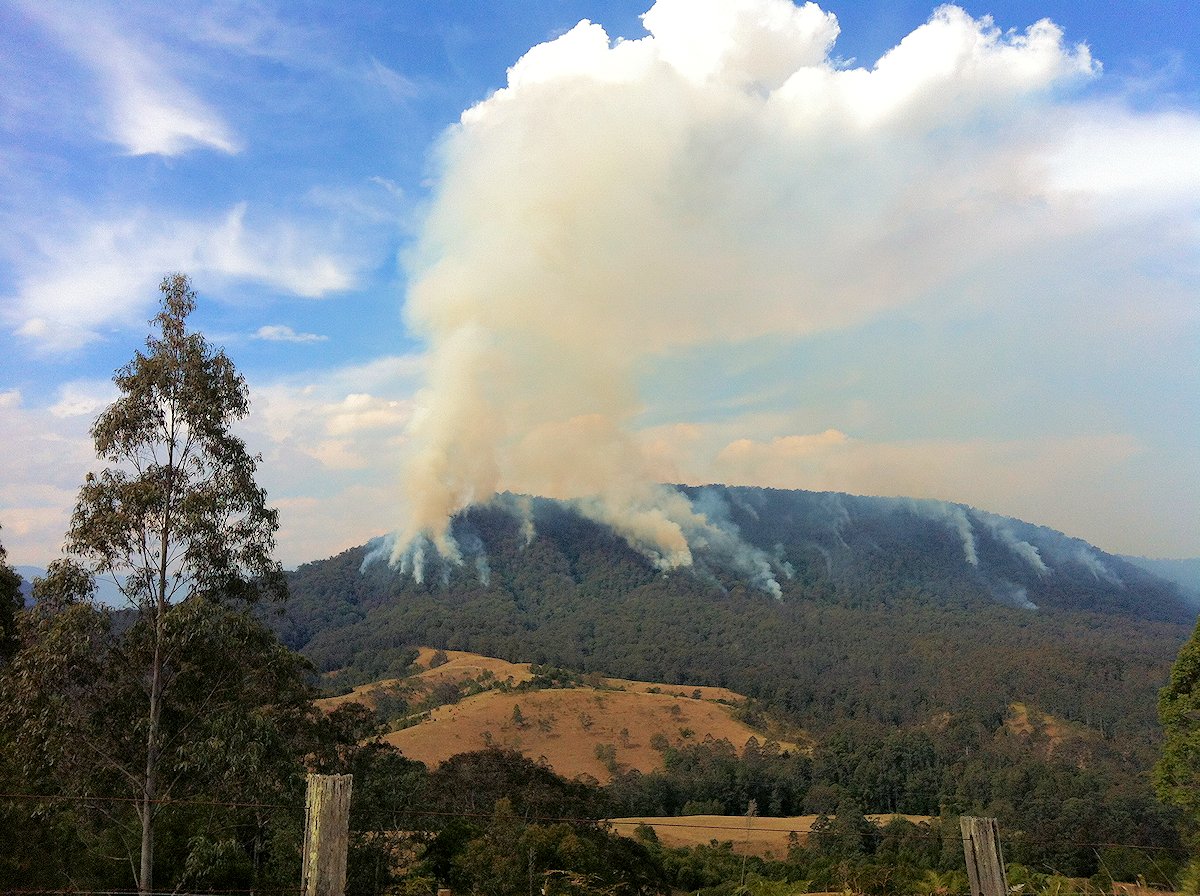 NSW National Parks and Wildlife Service setting fire to native habitat while the weather is calm.
What fauna, it’s an ‘Ecological Burn’?
This week’s hazard reduction burn in Barrington Tops NP, north of Dungog
[Source: Photo by Andy Boleyn, ^http://newcastleonhunter.com/2012/08/npws-burning-down-the-tops/]
NSW National Parks and Wildlife Service setting fire to native habitat while the weather is calm.
What fauna, it’s an ‘Ecological Burn’?
This week’s hazard reduction burn in Barrington Tops NP, north of Dungog
[Source: Photo by Andy Boleyn, ^http://newcastleonhunter.com/2012/08/npws-burning-down-the-tops/]
 Dropping petrol bombs by immoral helicopter pilots
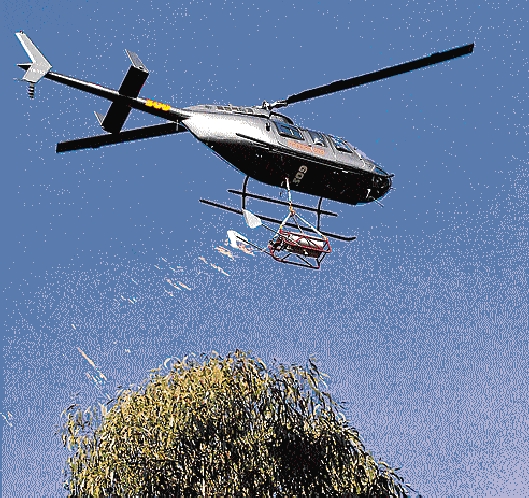 Aerial ‘habitat reduction’ occurs across National Parks and World Heritage Areas
– no habitat is sacrosanct.
It is euphemistically branded ‘Biodiversity Burning’ – fire is good for wildlife – watch them run, watch the Echinas and Wombats burn!
Aerial ‘habitat reduction’ occurs across National Parks and World Heritage Areas
– no habitat is sacrosanct.
It is euphemistically branded ‘Biodiversity Burning’ – fire is good for wildlife – watch them run, watch the Echinas and Wombats burn!
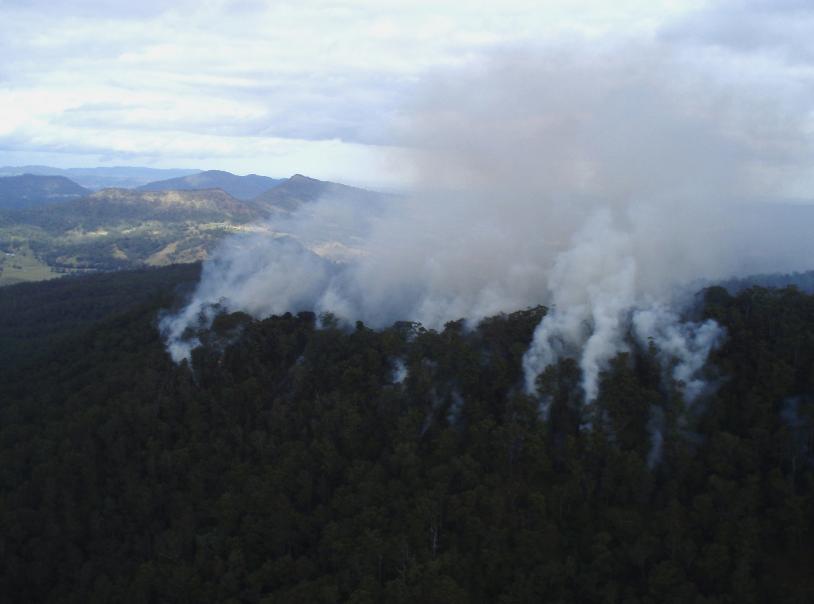 National Parks are deemed by Australian governments as a ‘hazards’!
It is a town park mentality – a bit of greenery for people to enjoy at weekends.
National Parks are deemed by Australian governments as a ‘hazards’!
It is a town park mentality – a bit of greenery for people to enjoy at weekends.
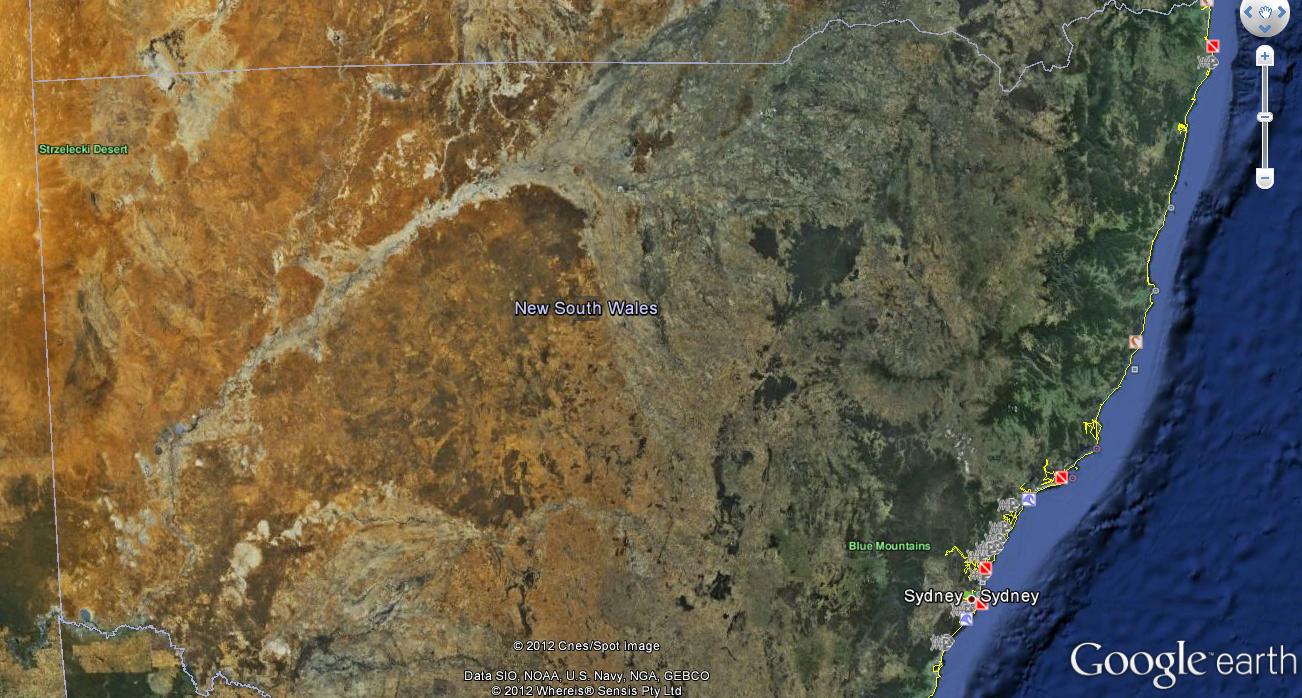 This is Destination New South Wales..
about 90% deforested, or burned, or farmed, or mined, or housed or else deserted
This is Destination New South Wales..
about 90% deforested, or burned, or farmed, or mined, or housed or else deserted
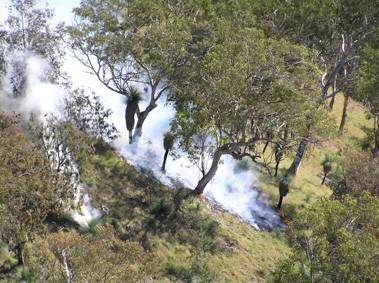
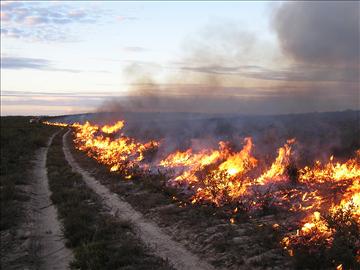 Broadscale Hazard Reduction
‘So when summer comes we should be right – there’ll be nothing left to burn!’
‘Job Done!‘
Broadscale Hazard Reduction
‘So when summer comes we should be right – there’ll be nothing left to burn!’
‘Job Done!‘
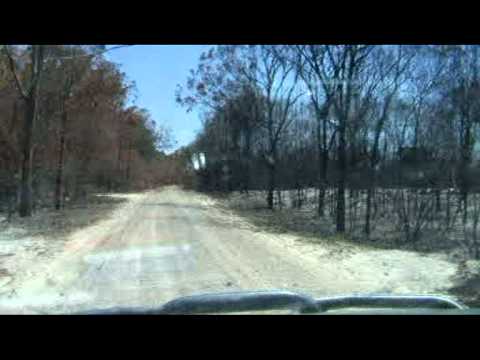 Woops, the prescribed burn got out of control
That’s ok its only Fraser Island World Heritage – it’ll grow back!
Woops, the prescribed burn got out of control
That’s ok its only Fraser Island World Heritage – it’ll grow back!
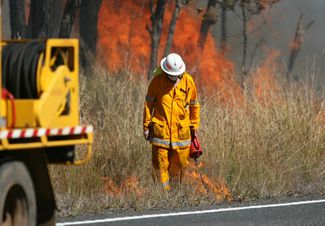 Government-sanctioned arsonists know what they are doing is wrong
– but the Firie peer pressure is too great
Government-sanctioned arsonists know what they are doing is wrong
– but the Firie peer pressure is too great